

ISO/IEC 14496-26:2010/Amd 2:2010
(Amendment)Information technology — Coding of audio-visual objects — Part 26: Audio conformance — Amendment 2: BSAC conformance for broadcasting
General Information
- Abstract
- Status
- Withdrawn
- Publication Date
- 28-Sep-2010
- Current Stage
- 9599 - Withdrawal of International Standard
- Start Date
- 08-Nov-2024
- Completion Date
- 29-Aug-2026

Overview
ISO/IEC 14496-26:2010/Amd 2:2010 is an important amendment to the international standard for information technology related to the coding of audio-visual objects. Specifically, it targets Part 26: Audio conformance with an emphasis on BSAC (Bit-Sliced Arithmetic Coding) conformance for broadcasting. This amendment enhances the existing ISO/IEC 14496-26:2010 standard by adding support for BSAC audio coding profiles to better facilitate terrestrial digital multimedia broadcasting (T-DMB) implementations.
Developed under the joint technical committee ISO/IEC JTC 1, Subcommittee SC 29, this amendment provides crucial extensions in conformance testing for broadcasters and technology implementers working with audio streams in digital broadcast environments. It ensures compatibility and streamlines audio quality verification for terrestrial DVB products using BSAC coding formats.
Key Topics
Audio Conformance for Broadcasting: This amendment focuses on defining BSAC audio bitstreams and conformance criteria specific to broadcasting, which is vital for high-quality digital radio and multimedia services.
BSAC Profiles for Terrestrial-DMB: Adds detailed Bit-Rate, sampling rates (24, 44.1, and 48 kHz), and layer configurations for various BSAC object types tailored to the T-DMB broadcasting environment.
Extension of ER BSAC Object Types: Provides a comprehensive table (Table 26.A) listing extended BSAC audio configurations including parameters such as:
- Base and top bitrates in kbit/s
- Number of elementary streams (ES)
- Number of audio channels
- Tool usage flags (Intensity, Mid/Side stereo (MS), Temporal Noise Shaping (TNS), Perceptual Noise Substitution (PNS))
- EpConfig and Scalefactor Band Adjustment (SBA) specifics
Conformance Bitstreams for Implementation: Having these defined bitstreams supports the validation and development of audio decoders for broadcast devices and software.
Applications
Terrestrial Digital Multimedia Broadcasting (T-DMB): The amendment supports broadcasters and manufacturers in deploying reliable audio streams compliant with ISO/IEC standards for digital radio and multimedia services over terrestrial networks.
Broadcast Equipment Manufacturing: Enables manufacturers to design and test audio coding solutions that comply with BSAC profiles and ensures interoperability across devices and networks.
Audio Decoder Development: Software and hardware developers utilize this standard for validating audio decoders against defined BSAC conformance bitstreams, ensuring robust performance in real-world broadcasting scenarios.
Quality Assurance and Standard Compliance: Testing laboratories and certification bodies rely on these conformance specifications to quantify and verify the compliance of BSAC audio streams within broadcast systems.
Related Standards
ISO/IEC 14496 Series: Broadly covers the coding of audio-visual objects, including video and audio coding standards and MPEG-related technologies.
ISO/IEC 14496-3: Audio coding as part of MPEG-4, providing the foundation for MPEG audio profiles including AAC and BSAC.
ISO/IEC JTC 1 SC 29: The subcommittee responsible for multimedia coding standards encompassing audio, video, and image technologies.
Digital Radio and Multimedia Broadcasting Standards: T-DMB and other digital broadcast standards often reference ISO/IEC 14496 parts for audio coding conformance.
Keywords: ISO/IEC 14496-26 amendment 2, BSAC conformance, audio coding standard, terrestrial digital multimedia broadcasting, T-DMB audio conformance, audio coding for broadcasting, audio-visual objects coding, digital broadcast audio standard, MPEG audio conformance, BSAC profiles, digital radio broadcasting standard.
Relations
- Effective Date
- 01-Jan-2022
- Effective Date
- 28-Jan-2023
Get Certified
Connect with accredited certification bodies for this standard

BSI Group
BSI (British Standards Institution) is the business standards company that helps organizations make excellence a habit.

NYCE
Mexican standards and certification body.
Sponsored listings
Frequently Asked Questions
ISO/IEC 14496-26:2010/Amd 2:2010 is a standard published by the International Organization for Standardization (ISO). Its full title is "Information technology — Coding of audio-visual objects — Part 26: Audio conformance — Amendment 2: BSAC conformance for broadcasting". This standard covers: Information technology — Coding of audio-visual objects — Part 26: Audio conformance — Amendment 2: BSAC conformance for broadcasting
Information technology — Coding of audio-visual objects — Part 26: Audio conformance — Amendment 2: BSAC conformance for broadcasting
ISO/IEC 14496-26:2010/Amd 2:2010 is classified under the following ICS (International Classification for Standards) categories: 35.040 - Information coding; 35.040.40 - Coding of audio, video, multimedia and hypermedia information. The ICS classification helps identify the subject area and facilitates finding related standards.
ISO/IEC 14496-26:2010/Amd 2:2010 has the following relationships with other standards: It is inter standard links to ISO/IEC 14496-26:2010, ISO/IEC 14496-26:2024. Understanding these relationships helps ensure you are using the most current and applicable version of the standard.
ISO/IEC 14496-26:2010/Amd 2:2010 is available in PDF format for immediate download after purchase. The document can be added to your cart and obtained through the secure checkout process. Digital delivery ensures instant access to the complete standard document.
Standards Content (Sample)
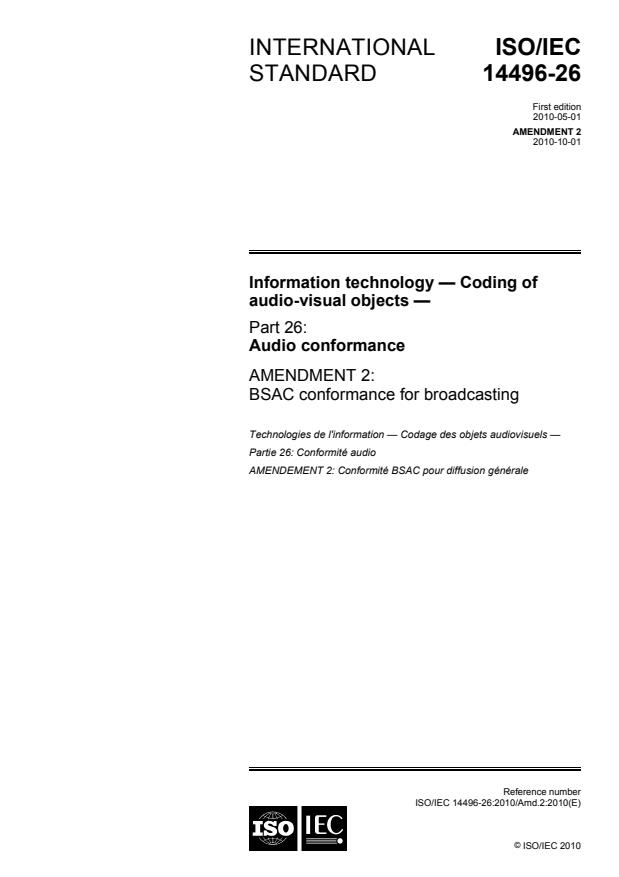
INTERNATIONAL ISO/IEC
STANDARD 14496-26
First edition
2010-05-01
AMENDMENT 2
2010-10-01
Information technology — Coding of
audio-visual objects —
Part 26:
Audio conformance
AMENDMENT 2:
BSAC conformance for broadcasting
Technologies de l'information — Codage des objets audiovisuels —
Partie 26: Conformité audio
AMENDEMENT 2: Conformité BSAC pour diffusion générale
Reference number
ISO/IEC 14496-26:2010/Amd.2:2010(E)
©
ISO/IEC 2010
ISO/IEC 14496-26:2010/Amd.2:2010(E)
PDF disclaimer
This PDF file may contain embedded typefaces. In accordance with Adobe's licensing policy, this file may be printed or viewed but
shall not be edited unless the typefaces which are embedded are licensed to and installed on the computer performing the editing. In
downloading this file, parties accept therein the responsibility of not infringing Adobe's licensing policy. The ISO Central Secretariat
accepts no liability in this area.
Adobe is a trademark of Adobe Systems Incorporated.
Details of the software products used to create this PDF file can be found in the General Info relative to the file; the PDF-creation
parameters were optimized for printing. Every care has been taken to ensure that the file is suitable for use by ISO member bodies. In
the unlikely event that a problem relating to it is found, please inform the Central Secretariat at the address given below.
© ISO/IEC 2010
All rights reserved. Unless otherwise specified, no part of this publication may be reproduced or utilized in any form or by any means,
electronic or mechanical, including photocopying and microfilm, without permission in writing from either ISO at the address below or
ISO's member body in the country of the requester.
ISO copyright office
Case postale 56 • CH-1211 Geneva 20
Tel. + 41 22 749 01 11
Fax + 41 22 749 09 47
E-mail copyright@iso.org
Web www.iso.org
Published in Switzerland
ii © ISO/IEC 2010 – All rights reserved
ISO/IEC 14496-26:2010/Amd.2:2010(E)
Foreword
ISO (the International Organization for Standardization) and IEC (the International Electrotechnical
Commission) form the specialized system for worldwide standardization. National bodies that are members of
ISO or IEC participate in the development of International Standards through technical committees
established by the respective organization to deal with particular fields of technical activity. ISO and IEC
technical committees collaborate in fields of mutual interest. Other international organizations, governmental
and non-governmental, in liaison with ISO and IEC, also take part in the work. In the field of information
technology, ISO and IEC have established a joint technical committee, ISO/IEC JTC 1.
International Standards are drafted in accordance with the rules given in the ISO/IEC Directives, Part 2.
The main task of the joint technical committee is to prepare International Standards. Draft International
Standards adopted by the joint technical committee are circulated to national bodies for voting. Publication as
an International Standard requires approval by at least 75 % of the nationa
...