

ISO/IEC 23008-9:2022
(Main)Information technology — High efficiency coding and media delivery in heterogeneous environments — Part 9: 3D Audio conformance testing
General Information
- Abstract
This document specifies conformance criteria for both bitstreams and decoders compliant with the MPEG-H 3D audio standard as defined in ISO/IEC 23008-3. This is done to assist implementers and to ensure interoperability.
- Status
- Withdrawn
- Publication Date
- 23-Mar-2022
- Technical Committee
- ISO/IEC JTC 1/SC 29 - Coding of audio, picture, multimedia and hypermedia information
- Drafting Committee
- ISO/IEC JTC 1/SC 29/WG 6 - MPEG Audio coding
- Current Stage
- 9599 - Withdrawal of International Standard
- Start Date
- 15-May-2023
- Completion Date
- 29-Aug-2026



Overview
ISO/IEC 23008-9:2022 specifies conformance testing rules for the MPEG‑H 3D Audio ecosystem. The standard defines conformance criteria for both bitstreams and decoders that claim compliance with the MPEG‑H 3D audio specification (ISO/IEC 23008‑3). Its primary goal is to help implementers validate compatibility and ensure interoperability across encoders, decoders, authoring tools and delivery chains for 3D/spatial audio.
Key topics and technical requirements
This part of the ISO/IEC 23008 series addresses practical conformance checks and includes:
- Conformance scope and profiles - definitions of test profiles and the scope of conformance testing for MPEG‑H 3D Audio.
- Test procedures and naming conventions - standardized test workflows, naming of test assets and reporting conventions to enable repeatable testing.
- Conformance test tools - references to the types of tools and methodologies used to execute bitstream and decoder tests.
- Bitstream characteristics and configuration elements - detailed elements and syntax that test suites validate, including:
- mpegh3daConfig(), FrameworkConfig3d(), Signals3d()
- SpeakerConfig3d(), mpegh3daFlexibleSpeakerConfig(), mpegh3daSpeakerDescription()
- mpegh3daDecoderConfig(), mpegh3daCoreConfig(), element configs (single channel, channel pair, LFE, extension)
- Frame structures and payload elements (mpegh3daFrame(), core coder data, fd_channel_stream(), etc.)
- Audio features and extensions covered by conformance tests:
- MPEG Surround (SpatialSpecificConfig, SpatialFrame)
- SAOC and SAOC 3D configuration and frames
- Dynamic range control (uniDrc configuration and gain frames)
- Object metadata and EnhancedObjectMetadata (object metadata frames, low‑delay modes)
- AudioPreRoll and recursive extension payload handling
- Higher Order Ambisonics (HOA) and SAOC3D specifics
- Validation areas - syntax conformance, parameter ranges, frame-level behavior and extension handling.
Practical applications and who uses it
ISO/IEC 23008‑9 is intended for:
- Codec developers implementing MPEG‑H 3D Audio encoders/decoders who need to verify correct bitstream generation and decoder behavior.
- Device manufacturers (set‑top boxes, smart TVs, gaming consoles, mobile devices) validating playback interoperability.
- Streaming platforms and broadcasters ensuring delivered assets and receiver implementations interoperate in heterogeneous environments.
- Test labs and conformity assessment bodies creating test vectors, automated test suites and certification programs.
- Content and tools vendors (authoring tools, object‑based audio production suites) to validate metadata and spatial rendering conformance.
Using this standard helps reduce integration costs, improve cross‑vendor compatibility and accelerate deployment of immersive audio services.
Related standards
- ISO/IEC 23008‑3 - MPEG‑H 3D Audio (normative reference for bitstream and decoder behavior).
- Other parts of the ISO/IEC 23008 series that address high‑efficiency coding and media delivery in heterogeneous environments.
Relations
- Consolidated By
ISO/IEEE 11073-10103:2025 - Health informatics — Device interoperability — Part 10103: Nomenclature, implantable device, cardiac - Effective Date
- 22-Mar-2025
- Effective Date
- 24-Dec-2022
- Effective Date
- 10-Jul-2021
Get Certified
Connect with accredited certification bodies for this standard

BSI Group
BSI (British Standards Institution) is the business standards company that helps organizations make excellence a habit.

NYCE
Mexican standards and certification body.
Sponsored listings
Frequently Asked Questions
ISO/IEC 23008-9:2022 is a standard published by the International Organization for Standardization (ISO). Its full title is "Information technology — High efficiency coding and media delivery in heterogeneous environments — Part 9: 3D Audio conformance testing". This standard covers: This document specifies conformance criteria for both bitstreams and decoders compliant with the MPEG-H 3D audio standard as defined in ISO/IEC 23008-3. This is done to assist implementers and to ensure interoperability.
This document specifies conformance criteria for both bitstreams and decoders compliant with the MPEG-H 3D audio standard as defined in ISO/IEC 23008-3. This is done to assist implementers and to ensure interoperability.
ISO/IEC 23008-9:2022 is classified under the following ICS (International Classification for Standards) categories: 35.040.40 - Coding of audio, video, multimedia and hypermedia information. The ICS classification helps identify the subject area and facilitates finding related standards.
ISO/IEC 23008-9:2022 has the following relationships with other standards: It is inter standard links to ISO/IEEE 11073-10103:2025, ISO/IEC 23008-9:2023, ISO/IEC 23008-9:2019. Understanding these relationships helps ensure you are using the most current and applicable version of the standard.
ISO/IEC 23008-9:2022 is available in PDF format for immediate download after purchase. The document can be added to your cart and obtained through the secure checkout process. Digital delivery ensures instant access to the complete standard document.
Standards Content (Sample)
INTERNATIONAL ISO/IEC
STANDARD 23008-9
Second edition
2022-03
Information technology — High
efficiency coding and media delivery
in heterogeneous environments —
Part 9:
3D Audio conformance testing
Technologies de l'information — Codage à haut rendement et
fourniture de supports dans les environnements hétérogènes —
Partie 9: Essais de conformité 3D Audio
Reference number
© ISO/IEC 2022
© ISO/IEC 2022
All rights reserved. Unless otherwise specified, or required in the context of its implementation, no part of this publication may
be reproduced or utilized otherwise in any form or by any means, electronic or mechanical, including photocopying, or posting on
the internet or an intranet, without prior written permission. Permission can be requested from either ISO at the address below
or ISO’s member body in the country of the requester.
ISO copyright office
CP 401 • Ch. de Blandonnet 8
CH-1214 Vernier, Geneva
Phone: +41 22 749 01 11
Email: copyright@iso.org
Website: www.iso.org
Published in Switzerland
ii
© ISO/IEC 2022 – All rights reserved
Contents Page
Foreword .vii
Introduction .viii
1 Scope . 1
2 Normative references . 1
3 Terms, definitions and abbreviated terms . 1
3.1 Terms and definitions . 1
3.2 Abbreviated terms . 2
4 MPEG-H 3D audio conformance testing . 3
4.1 General . 3
4.2 Profiles . 3
4.3 Test procedure . 3
4.3.1 General . 3
4.3.2 Naming convention . 4
4.3.3 Conformance test tools . 6
5 MPEG-H 3D audio bitstreams . 6
5.1 Characteristics, test procedure . 6
5.2 MPEG-H 3D audio general configuration . 7
5.2.1 mpegh3daConfig() . 7
5.2.2 FrameworkConfig3d() . 7
5.2.3 Signals3d() . . 7
5.2.4 SpeakerConfig3d() . 7
5.2.5 mpegh3daFlexibleSpeakerConfig(). 7
5.2.6 mpegh3daSpeakerDescription() . . 8
5.3 MPEG-H 3D core audio configuration . 8
5.3.1 mpegh3daDecoderConfig() . 8
5.3.2 mpegh3daSingleChannelElementConfig() . 8
5.3.3 mpegh3daChannelPairElementConfig() . 8
5.3.4 mpegh3daCoreConfig() . 9
5.3.5 mpegh3daLfeElementConfig() . 9
5.3.6 mpegh3daExtElementConfig() . 9
5.3.7 mpegh3daConfigExtension() . 10
5.3.8 SbrConfig() . 10
5.3.9 Mps212Config() . . 10
5.4 MPEG-H 3D core audio frame . 10
5.4.1 mpegh3daFrame() . 10
5.4.2 mpegh3daSingleChannelElement() . 10
5.4.3 mpegh3daChannelPairElement() . 11
5.4.4 mpegh3daLfeElement() . 11
5.4.5 mpegh3daExtElement() . 11
5.4.6 ics_info() . 11
5.4.7 mpegh3daCoreCoderData() .12
5.4.8 StereoCoreToolInfo() .12
5.4.9 fd_channel_stream() .12
5.4.10 lpd_channel_stream(). 13
5.4.11 acelp_coding() . 14
5.4.12 tcx_coding () . 14
5.4.13 lpd_stereo_stream() . 14
5.4.14 igf_stereo_pred_data(). 15
5.4.15 igf_data() . 15
5.4.16 tbe_data() . 15
5.4.17 tw_data() . 16
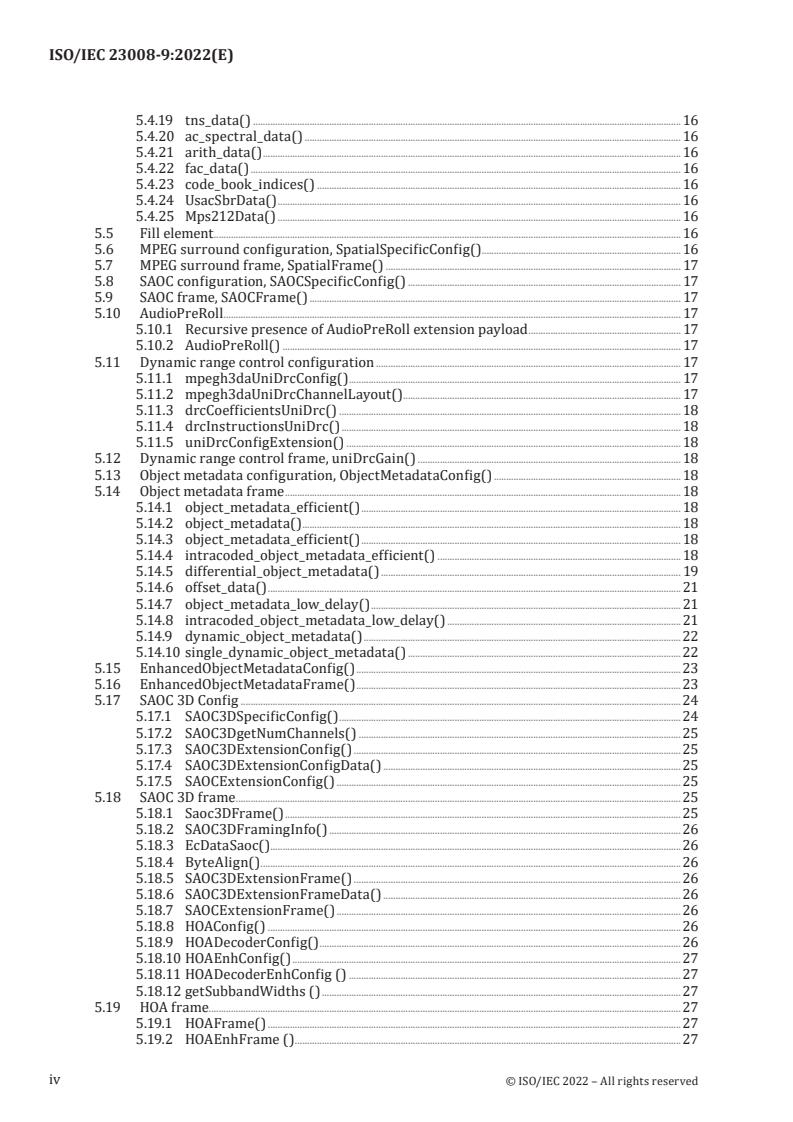
5.4.18 scale_factor_data() . 16
iii
© ISO/IEC 2022 – All rights reserved
5.4.19 tns_data() . 16
5.4.20 ac_spectral_data() . 16
5.4.21 arith_data() . 16
5.4.22 fac_data() . 16
5.4.23 code_book_indices() . 16
5.4.24 UsacSbrData() . 16
5.4.25 Mps212Data() . 16
5.5 Fill element . . 16
5.6 MPEG surround configuration, SpatialSpecificConfig(). 16
5.7 MPEG surround frame, SpatialFrame() . 17
5.8 SAOC configuration, SAOCSpecificConfig() . 17
5.9 SAOC frame, SAOCFrame() . 17
5.10 AudioPreRoll . 17
5.10.1 Recursive presence of AudioPreRoll extension payload . 17
5.10.2 AudioPreRoll() . 17
5.11 Dynamic range control configuration . 17
5.11.1 mpegh3daUniDrcConfig() . 17
5.11.2 mpegh3daUniDrcChannelLayout(). 17
5.11.3 drcCoefficientsUniDrc() . 18
5.11.4 drcInstructionsUniDrc() . 18
5.11.5 uniDrcConfigExtension() . 18
5.12 Dynamic range control frame, uniDrcGain() . 18
5.13 Object metadata configuration, ObjectMetadataConfig() . 18
5.14 Object metadata frame . 18
5.14.1 object_metadata_efficient() . 18
5.14.2 object_metadata() . 18
5.14.3 object_metadata_efficient() . 18
5.14.4 intracoded_object_metadata_efficient() . 18
5.14.5 differential_object_metadata() . 19
5.14.6 offset_data() . 21
5.14.7 object_metadata_low_delay() . 21
5.14.8 intracoded_object_metadata_low_delay() . 21
5.14.9 dynamic_object_metadata() . 22
5.14.10 single_dynamic_object_metadata() . 22
5.15 EnhancedObjectMetadataConfig() . 23
5.16 EnhancedObjectMetadataFrame() . 23
5.17 SAOC 3D Config . 24
5.17.1 SAOC3DSpecificConfig() . 24
5.17.2 SAOC3DgetNumChannels() . 25
5.17.3 SAOC3DExtensionConfig() . 25
5.17.4 SAOC3DExtensionConfigData() . 25
5.17.5 SAOCExtensionConfig() .25
5.18 SAOC 3D frame . 25
5.18.1 Saoc3DFrame() . 25
5.18.2 SAOC3DFramingInfo() . 26
5.18.3 EcDataSaoc() . . .26
5.18.4 ByteAlign() .26
5.18.5 SAOC3DExtensionFrame() . 26
5.18.6 SAOC3DExtensionFrameData() . 26
5.18.7 SAOCExtensionFrame() . 26
5.18.8 HOAConfig() .26
5.18.9 HOADecoderConfig() . 26
5.18.10 HOAEnhConfig() . 27
5.18.11 HOADecoderEnhConfig () . 27
5.18.12 getSubbandWidths () . 27
5.19 HOA frame. 27
5.19.1 HOAFrame() . 27
5.19.2 HOAEnhFrame () . 27
iv
© ISO/IEC 2022 – All rights reserved
5.19.3 ChannelSideInfoData() .28
5.19.4 AddAmbHoaInfoChannel() .28
5.19.5 HOAGainCorrectionData() .28
5.19.6 VVectorData() .28
5.19.7 HOAPredictionInfo() .29
5.19.8 HOADirectionalPredictionInfo() .29
5.19.9 readDirPredDiffValues() .29
5.19.10 HOAParInfo () .29
5.19.11 readParDiffValues () .30
5.20 FMT converter frame, FormatConverterFrame() .30
5.21 Multi-channel coding tool config, MCTConfig () .30
5.22 Multi-channel coding tool frame . 30
5.22.1 MultichannelCodingBoxRotation () .30
5.22.2 MultichannelCodingBoxPrediction () . 31
5.22.3 MultichannelCodingFrame() . 31
5.23 Tonal component coding configuration, TccConfig () . 31
5.24 Tonal component coding frame . 31
5.24.1 General . 31
5.24.2 TccGroupOfSegments() . 31
5.25 HREP config, HREPConfig() . 32
5.26 HREP frame, HREPFrame() . 32
5.27 ICG config, ICGConfig () .33
5.28 SignalGroupInformation Config, SignalGroupInformation () . 33
5.29 DownmixMatrix . 33
5.29.1 downmixConfig() . 33
5.29.2 DownmixMatrixSet() . 33
5.29.3 DownmixMatrix() . 33
5.29.4 DecoderGainValue() .34
5.29.5 ReadRange() .34
5.29.6 EqualizerConfig() .34
5.30 Loudness info . 35
5.30.1 mpegh3daLoudnessInfoSet() . 35
5.30.2 loudnessInfo() . 35
5.30.3 loudnessInfoSetExtension() . 35
5.31 Audioscene info . 35
5.31.1 mae_AudioSceneInfo . .35
5.31.2 mae_Data() . 35
5.31.3 mae_GroupDefinition() . . 36
5.31.4 mae_SwitchGroupDefinition() .36
5.31.5 mae_Description() . 37
5.31.6 mae_ContentData() . 37
5.31.7 mae_CompositePair() . 37
5.31.8 mae_GroupPresetDefinition() . 37
5.31.9 mae_ProductionScreenSizeData() .38
5.31.10 mae_LoudnessCompensationData () .38
5.31.11 mae_ProductionScreenSizeDataExtension() .39
5.31.12 mae_GroupPresetDefinitionExtension() .39
5.31.13 mae_DrcUserInterfaceInfo() .40
5.32 HOA matrix .40
5.32.1 HoaRenderingMatrixSet() .40
5.32.2 HoaRenderingMatrix() . 41
5.32.3 DecoderHoaMatrixData() . 41
5.32.4 DecoderHoaGainValue() . 41
5.33 CompatibleProfileLevelSet(). 41
5.34 Restrictions depending on profiles and levels . 42
5.34.1 General . 42
5.34.2 Low complexity profile . 42
6 MPEG-H 3D audio interfaces to the MPEG-H 3D audio decoder .46
v
© ISO/IEC 2022 – All rights reserved
6.1 Characteristics and test procedure .46
6.2 Interface for local setup information .46
6.2.1 mpegh3daLocalSetupInformation().46
6.2.2 LoudspeakerRendering() .46
6.2.3 BinauralRendering() . 47
6.2.4 LocalScreenSizeInformation() . . 47
6.3 Interface for user interaction . 47
6.3.1 mpegh3daElementInteraction() . 47
6.3.2 ElementInteractionData () . 47
6.3.3 ei_GroupInteractivityStatus () . 47
6.3.4 LocalZoomAreaSize() .48
6.4 Interface for loudness normalization and dynamic range control .48
6.5 Interface for scene displacement data, mpegh3daSceneDisplacementData() .48
6.6 Interface for positional scene displacement data,
mpegh3daPositionalSceneDisplacementData() .48
7 MPEG-H 3D audio decoders .48
7.1 General .48
7.2 Basic conformance test conditions .49
7.2.1 Element configuration test condition .49
7.2.2 Sampling rate. 51
7.2.3 Core mode tests [Fd|Lpd|Cct] . 52
7.3 Additional test conditions . 52
7.3.1 3D audio core (FD) . 52
7.3.2 3D audio core (LPD) .60
7.3.3 3D audio core (FD and LPD) .64
7.3.4 Object rendering . 71
7.3.5 Higher order ambisonics (HOA) .74
7.3.6 Signalling of HOA rendering matrix [Hmx] . 78
7.3.7 Downmix matrix test condition (dwx) . 78
7.3.8 Dynamic range and loudness control .80
7.3.9 AudioPreRoll() condition, immediate playout frame (IPF) .84
7.4 Decoder settings .85
7.4.1 Target layout (Lay-) .85
7.4.2 Target loudness (Lou-) .86
7.4.3 DRC effect type request (Eff-) .87
7.4.4 Group preset request (Pr-) .87
7.4.5 Conformance point (Cpo-) .88
Bibliography .89
vi
© ISO/IEC 2022 – All rights reserved
Foreword
ISO (the International Organization for Standardization) and IEC (the International Electrotechnical
Commission) form the specialized system for worldwide standardization. National bodies that are
members of ISO or IEC participate in the development of International Standards through technical
committees established by the respective organization to deal with particular fields of technical
activity. ISO and IEC technical committees collaborate in fields of mutual interest. Other international
organizations, governmental and non-governmental, in liaison with ISO and IEC, also take part in the
work.
The procedures used to develop this document and those intended for its further maintenance
are described in the ISO/IEC Directives, Part 1. In particular, the different approval criteria
needed for the different types of document should be noted. This document was drafted in
accordance with the editorial rules of the ISO/IEC Directives, Part 2 (see www.iso.org/directives or
www.iec.ch/members_experts/refdocs).
Attention is drawn to the possibility that some of the elements of this document may be the subject
of patent rights. ISO and IEC shall not be held responsible for identifying any or all such patent
rights. Details of any patent rights identified during the development of the document will be in the
Introduction and/or on the ISO list of patent declarations received (see www.iso.org/patents) or the IEC
list of patent declarations received (see patents.iec.ch).
Any trade name used in this document is information given for the convenience of users and does not
constitute an endorsement.
For an explanation of the voluntary nature of standards, the meaning of ISO specific terms and
expressions related to conformity assessment, as well as information about ISO's adherence to
the World Trade Organization (WTO) principles in the Technical Barriers to Trade (TBT) see
www.iso.org/iso/foreword.html. In the IEC, see www.iec.ch/understanding-standards.
This document was prepared by Technical Committee ISO/IEC JTC 1, Information technology,
Subcommittee SC 29, Coding of audio, picture, multimedia and hypermedia information.
This second edition cancels and replaces the first edition (ISO/IEC 23008-9:2019), which has been
technically revised.
The main changes are as follows:
— conformance testing of Baseline Profile support.
A list of all parts in the ISO 23008 series can be found on the ISO and IEC websites.
Any feedback or questions on this document should be directed to the user’s national standards
body. A complete listing of these bodies can be found at www.iso.org/members.html and
www.iec.ch/national-committees.
vii
© ISO/IEC 2022 – All rights reserved
Introduction
This document specifies how tests can be designed to verify whether bitstreams and decoders meet
the requirements as specified in ISO/IEC 23008-3 and allow interoperability with remote terminals in
interactive, broadcast, streaming and local (with stored contents) sessions. These tests can be used for
various purposes, such as:
— manufacturers of encoders, and their customers, can use the tests to verify whether the encoder
produces bitstreams compliant with ISO/IEC 23008-3,
— manufacturers of decoders and their customers can use the tests to verify whether the decoder
meets the requirements specified in ISO/IEC 23008-3 for the claimed decoder capabilities,
— manufacturers and customers of terminals supporting interactive, broadcast, streaming, and local
sessions over a multitude of transport protocols and networks, can use the tests to verify whether
the claimed functionalities are compliant with ISO/IEC 23008-3,
— manufacturers of test equipment, and their customers can use the tests to verify compliance with
ISO/IEC 23008-3.
viii
© ISO/IEC 2022 – All rights reserved
INTERNATIONAL STANDARD ISO/IEC 23008-9:2022(E)
Information technology — High efficiency coding and
media delivery in heterogeneous environments —
Part 9:
3D Audio conformance testing
1 Scope
This document specifies conformance criteria for both bitstreams and decoders compliant with the
MPEG-H 3D audio standard as defined in ISO/IEC 23008-3. This is done to assist implementers and to
ensure interoperability.
2 Normative references
The following documents are referred to in the text in such a way that some or all of their content
constitutes requirements of this document. For dated references, only the edition cited applies. For
undated references, the latest edition of the referenced document (including any amendments) applies.
ISO/IEC 23003-1, Information technology — MPEG audio technologies — Part 1: MPEG Surround/ —
Amendment 1: Conformance testing
ISO/IEC 23003-2, Information technology — MPEG audio technologies — Part 2: Spatial Audio Object
Coding (SAOC) — Amendment 4: SAOC Conformance
ISO/IEC 23003-3:2020, Information technology — MPEG audio technologies — Part 3: Unified speech and
audio coding
ISO/IEC 23003-4:2020, Information technology — MPEG audio technologies — Part 4: Dynamic range
control
ISO/IEC 23008-3:2019/Amd 2:2020, Information technology — High efficiency coding and media delivery
in heterogeneous environments — Part 3: 3D audio/ — Amendment 2: 3D Audio baseline profile, corrections
and improvements
ISO/IEC 23091-3, Information technology — Coding-independent code points — Part 3: Audio
3 Terms, definitions and abbreviated terms
3.1 Terms and definitions
For the purposes of this document, the following terms and definitions apply.
ISO and IEC maintain terminology databases for use in standardization at the following addresses:
— ISO Online browsing platform: available at https:// www .iso .org/ obp
— IEC Electropedia: available at https:// www .electropedia .org/
3.1.1
bitstream
encoded audio data
© ISO/IEC 2022 – All rights reserved
3.1.2
conformance test bitstream
MPEG-H 3DA encoded bitstream used for testing the conformance of a MPEG-H 3DA decoder
3.1.3
conformance test case
combination of one or more conformance test conditions for which one conformance test bitstream is
provided
3.1.4
conformance test condition
condition which applies to properties of a conformance test bitstream in order to test a certain
functionality of the MPEG-H 3DA decoder
3.1.5
conformance test criteria
one or more conformance test tools with requirements that define whether a given output from a
decoder under test fulfils the conformance
3.1.6
conformance test data
conformance test sequences and conformance criteria
3.1.7
conformance test sequences
generic term for conformance test bitstream and decoder settings with a corresponding reference
3.1.8
conformance test tool
tool to compare the reference waveform with the output from a decoder under test
3.1.9
decoder setting case
combination of one or more decoder setting conditions to trigger specific settings of the decoder
3.1.10
decoder setting condition
condition applied to the decoder behaviour in ord
...