


ISO 19810:2023
(Main)Fine ceramics (advanced ceramics, advanced technical ceramics) - Test method for self-cleaning performance of semiconducting photocatalytic materials under indoor lighting environment - Measurement of water contact angle
Fine ceramics (advanced ceramics, advanced technical ceramics) - Test method for self-cleaning performance of semiconducting photocatalytic materials under indoor lighting environment - Measurement of water contact angle
This document specifies a test method for the determination of the self-cleaning performance of sheet-form materials that contain an indoor-light-active photocatalyst or have indoor-light-active photocatalytic films on the surface, under indoor lighting environment. This method is used to measure the change of water contact angle under indoor lighting environment, which is one of the indices reflecting the self-cleaning performance of semiconducting photocatalytic materials. This document is not applicable to permeable materials on which water droplets cannot hold and rough materials which obscure water droplets. This document is not applicable to materials of which the changes in the water contact angle due to decomposition of adhered organic matter cannot be evaluated because even if the surface is clean, the water contact angle is remarkably large or the water contact angle cannot be sufficiently increased by attaching organic matter to the surface.
Céramiques techniques — Méthode d'essai relative aux propriétés autonettoyantes des matériaux photocatalytiques semiconducteurs dans un environnement d'éclairage intérieur — Mesurage de l'angle de contact de l'eau
General Information
- Status
- Published
- Publication Date
- 23-Jul-2023
- Technical Committee
- ISO/TC 206 - Fine ceramics
- Drafting Committee
- ISO/TC 206 - Fine ceramics
- Current Stage
- 6060 - International Standard published
- Start Date
- 24-Jul-2023
- Due Date
- 14-Sep-2024
- Completion Date
- 24-Jul-2023
Relations
- Effective Date
- 18-Mar-2023
Overview
ISO 19810:2023 specifies a standardized test method to evaluate the self‑cleaning performance of sheet‑form materials that contain an indoor‑light‑active semiconducting photocatalyst or have photocatalytic films on the surface. The method quantifies changes in water contact angle under an indoor lighting environment (visible light), providing an index of photocatalytic self‑cleaning activity for advanced ceramics and related materials. This second edition (2023) is a minor revision of ISO 19810:2017.
Key topics and technical requirements
- Scope & applicability: Applies to sheet‑form semiconducting photocatalytic materials and surface films; excludes permeable or very rough materials where water droplets cannot be formed or evaluated.
- Principle: Remove surface organics by UV pretreatment, coat with a model organic (stearic acid), measure the initial water contact angle, then expose to controlled visible light and monitor the reduction in contact angle as organics decompose.
- Measured indices:
- Initial contact angles (before/after pretreatment and after organic coating)
- Time‑series contact angle θ(n) under visible light
- Initial contact angle halving time (n1/2) and contact angle reduction time to 10° (n10°) as performance metrics
- Apparatus & reagents:
- UV source (per ISO 10677), UV irradiation apparatus, UV radiometer
- Visible light source with UV‑cut filter (ISO 14605 Type A), visible light irradiating apparatus, illuminometer
- Contact angle measurement instrument (per ISO 27448)
- Reagents: stearic acid, n‑heptane, distilled water
- Test conditions: Controlled laboratory temperature and humidity (document specifies preferred ranges) and precise illuminance settings; specimen size and preparation rules to avoid contamination.
- Validity & reporting: Procedures for calculation, rounding, conditions for valid tests, and required reporting details are specified.
Applications and who uses ISO 19810:2023
- Quality control and product certification for fine ceramics, façade tiles, glass, coatings and advanced technical ceramics with indoor photocatalytic functions.
- R&D and comparative performance testing for manufacturers developing indoor‑light‑active photocatalytic materials (e.g., TiO2‑based coatings).
- Architects, specifiers, testing laboratories and regulatory bodies assessing self‑cleaning, antibacterial or deodorizing claims under indoor lighting.
- Useful for product marketing claims backed by standardized metrics (n1/2, n10°).
Related standards
- ISO 27448 - Measurement of water contact angle for photocatalytic self‑cleaning tests
- ISO 14605 - Light source for indoor photocatalytic testing
- ISO 10677 - UV light source specifications for photocatalytic testing
Keywords: ISO 19810:2023, fine ceramics, semiconducting photocatalytic materials, self‑cleaning performance, water contact angle, indoor lighting, contact angle halving time, visible light irradiation.
ISO 19810:2023 - Fine ceramics (advanced ceramics, advanced technical ceramics) — Test method for self-cleaning performance of semiconducting photocatalytic materials under indoor lighting environment — Measurement of water contact angle Released:24. 07. 2023
Frequently Asked Questions
ISO 19810:2023 is a standard published by the International Organization for Standardization (ISO). Its full title is "Fine ceramics (advanced ceramics, advanced technical ceramics) - Test method for self-cleaning performance of semiconducting photocatalytic materials under indoor lighting environment - Measurement of water contact angle". This standard covers: This document specifies a test method for the determination of the self-cleaning performance of sheet-form materials that contain an indoor-light-active photocatalyst or have indoor-light-active photocatalytic films on the surface, under indoor lighting environment. This method is used to measure the change of water contact angle under indoor lighting environment, which is one of the indices reflecting the self-cleaning performance of semiconducting photocatalytic materials. This document is not applicable to permeable materials on which water droplets cannot hold and rough materials which obscure water droplets. This document is not applicable to materials of which the changes in the water contact angle due to decomposition of adhered organic matter cannot be evaluated because even if the surface is clean, the water contact angle is remarkably large or the water contact angle cannot be sufficiently increased by attaching organic matter to the surface.
This document specifies a test method for the determination of the self-cleaning performance of sheet-form materials that contain an indoor-light-active photocatalyst or have indoor-light-active photocatalytic films on the surface, under indoor lighting environment. This method is used to measure the change of water contact angle under indoor lighting environment, which is one of the indices reflecting the self-cleaning performance of semiconducting photocatalytic materials. This document is not applicable to permeable materials on which water droplets cannot hold and rough materials which obscure water droplets. This document is not applicable to materials of which the changes in the water contact angle due to decomposition of adhered organic matter cannot be evaluated because even if the surface is clean, the water contact angle is remarkably large or the water contact angle cannot be sufficiently increased by attaching organic matter to the surface.
ISO 19810:2023 is classified under the following ICS (International Classification for Standards) categories: 81.060.30 - Advanced ceramics. The ICS classification helps identify the subject area and facilitates finding related standards.
ISO 19810:2023 has the following relationships with other standards: It is inter standard links to ISO 19810:2017. Understanding these relationships helps ensure you are using the most current and applicable version of the standard.
You can purchase ISO 19810:2023 directly from iTeh Standards. The document is available in PDF format and is delivered instantly after payment. Add the standard to your cart and complete the secure checkout process. iTeh Standards is an authorized distributor of ISO standards.
Standards Content (Sample)
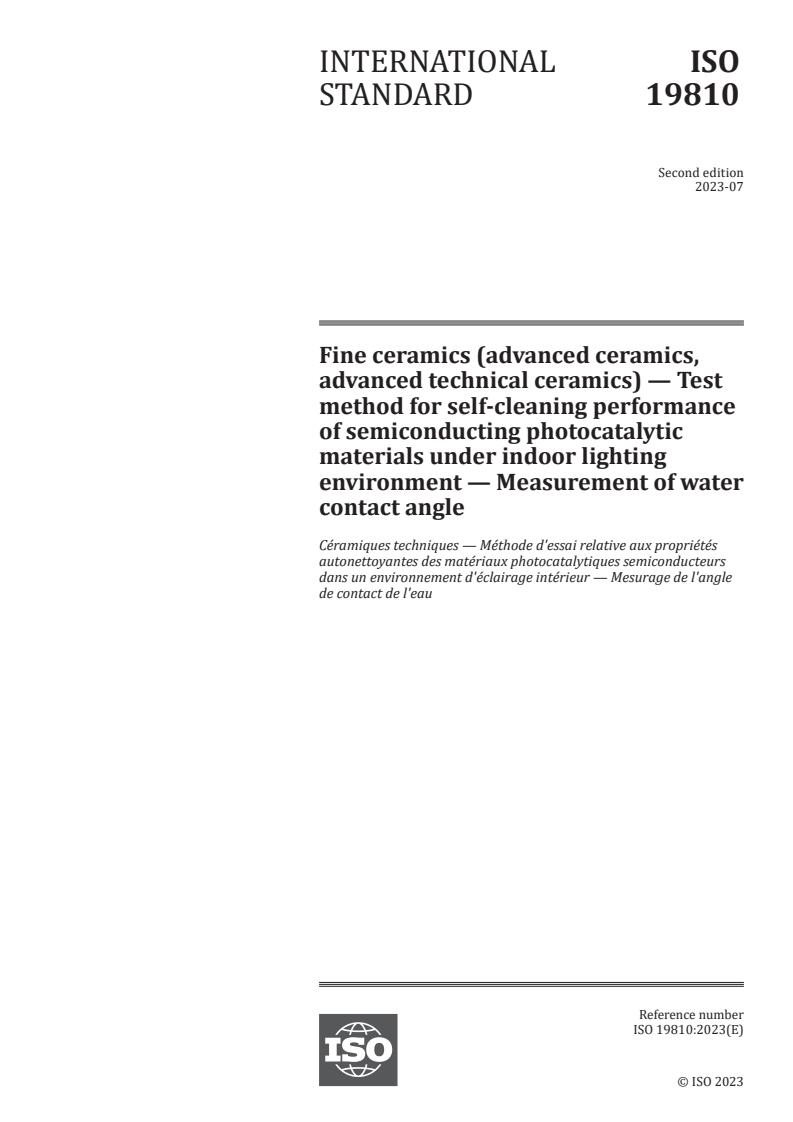
INTERNATIONAL ISO
STANDARD 19810
Second edition
2023-07
Fine ceramics (advanced ceramics,
advanced technical ceramics) — Test
method for self-cleaning performance
of semiconducting photocatalytic
materials under indoor lighting
environment — Measurement of water
contact angle
Céramiques techniques — Méthode d'essai relative aux propriétés
autonettoyantes des matériaux photocatalytiques semiconducteurs
dans un environnement d'éclairage intérieur — Mesurage de l'angle
de contact de l'eau
Reference number
© ISO 2023
All rights reserved. Unless otherwise specified, or required in the context of its implementation, no part of this publication may
be reproduced or utilized otherwise in any form or by any means, electronic or mechanical, including photocopying, or posting on
the internet or an intranet, without prior written permission. Permission can be requested from either ISO at the address below
or ISO’s member body in the country of the requester.
ISO copyright office
CP 401 • Ch. de Blandonnet 8
CH-1214 Vernier, Geneva
Phone: +41 22 749 01 11
Email: copyright@iso.org
Website: www.iso.org
Published in Switzerland
ii
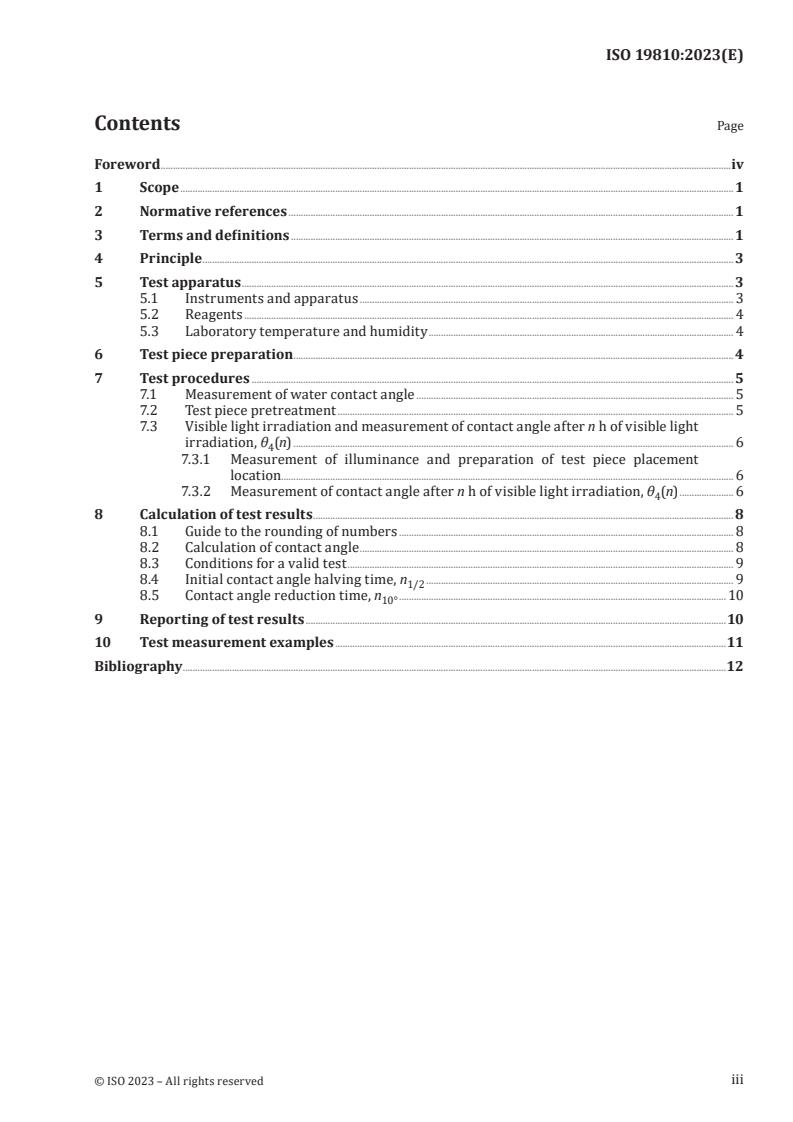
Contents Page
Foreword .iv
1 Scope . 1
2 Normative references . 1
3 Terms and definitions . 1
4 Principle . 3
5 Test apparatus .3
5.1 Instruments and apparatus . 3
5.2 Reagents . 4
5.3 Laboratory temperature and humidity . 4
6 Test piece preparation .4
7 Test procedures . 5
7.1 Measurement of water contact angle . 5
7.2 Test piece pretreatment . 5
7.3 Visible light irradiation and measurement of contact angle after n h of visible light
irradiation, θ (n) . 6
7.3.1 Measurement of illuminance and preparation of test piece placement
location . . 6
7.3.2 Measurement of contact angle after n h of visible light irradiation, θ (n) . 6
8 Calculation of test results . 8
8.1 Guide to the rounding of numbers . 8
8.2 Calculation of contact angle . 8
8.3 Conditions for a valid test . 9
8.4 Initial contact angle halving time, n . 9
1/2
8.5 Contact angle reduction time, n . 10
10°
9 Reporting of test results .10
10 Test measurement examples .11
Bibliography .12
iii
Foreword
ISO (the International Organization for Standardization) is a worldwide federation of national standards
bodies (ISO member bodies). The work of preparing International Standards is normally carried out
through ISO technical committees. Each member body interested in a subject for which a technical
committee has been established has the right to be represented on that committee. International
organizations, governmental and non-governmental, in liaison with ISO, also take part in the work.
ISO collaborates closely with the International Electrotechnical Commission (IEC) on all matters of
electrotechnical standardization.
The procedures used to develop this document and those intended for its further maintenance are
described in the ISO/IEC Directives, Part 1. In particular, the different approval criteria needed for the
different types of ISO document should be noted. This document was drafted in accordance with the
editorial rules of the ISO/IEC Directives, Part 2 (see www.iso.org/directives).
ISO draws attention to the possibility that the implementation of this document may involve the use
of (a) patent(s). ISO takes no position concerning the evidence, validity or applicability of any claimed
patent rights in respect thereof. As of the date of publication of this document, ISO had not received
notice of (a) patent(s) which may be required to implement this document. However, implementers are
cautioned that this may not represent the latest information, which may be obtained from the patent
database available at www.iso.org/patents. ISO shall not be held responsible for identifying any or all
such patent rights.
Any trade name used in this document is information given for the convenience of users and does not
constitute an endorsement.
For an explanation of the voluntary nature of standards, the meaning of ISO specific terms and
expressions related to conformity assessment, as well as information about ISO's adherence to
the World Trade Organization (WTO) principles in the Technical Barriers to Trade (TBT), see
www.iso.org/iso/foreword.html.
This document was prepared by Technical Committee ISO/TC 206, Fine ceramics.
This second edition cancels and replaces the first edition (ISO 19810:2017), of which it constitutes a
minor revision. The changes are as follows:
— definitions of 3.1, 3.2 and 3.4 corrected;
— minor editorial changes.
Any feedback or questions on this document should be directed to the user’s national standards body. A
complete listing of these bodies can be found at www.iso.org/members.html.
iv
INTERNATIONAL STANDARD ISO 19810:2023(E)
Fine ceramics (advanced ceramics, advanced technical
ceramics) — Test method for self-cleaning performance
of semiconducting photocatalytic materials under indoor
lighting environment — Measurement of water contact
angle
1 Scope
This document specifies a test method for the determination of the self-cleaning performance of
sheet-form materials that contain an indoor-light-active photocatalyst or have indoor-light-active
photocatalytic films on the surface, under indoor lighting environment.
This method is used to measure the change of water contact angle under indoor lighting environment,
which is one of the indices reflecting the self-cleaning performance of semiconducting photocatalytic
materials.
This document is not applicable to permeable materials on which water droplets cannot hold and rough
materials which obscure water droplets. This document is not applicable to materials of which the
changes in the water contact angle due to decomposition of adhered organic matter cannot be evaluated
because even if the surface is clean, the water contact angle is remarkably large or the water contact
angle cannot be sufficiently increased by attaching organic matter to the surface.
2 Normative references
The following documents are referred to in the text in such a way that some or all of their content
constitutes requirements of this document. For dated references, only the edition cited applies. For
undated references, the latest edition of the referenced document (including any amendments) applies.
ISO 10677, Fine ceramics (advanced ceramics, advanced technical ceramics) — Ultraviolet light source for
testing semiconducting photocatalytic materials
ISO 14605, Fine ceramics (advanced ceramics, advanced technical ceramics) — Light source for testing
semiconducting photocatalytic materials used under indoor lighting environment
ISO 27448, Fine ceramics (advanced ceramics, advanced technical ceramics) — Test method for self-
cleaning performance of semiconducting photocatalytic materials — Measurement of water contact angle
3 Terms and definitions
For the purposes of this document, the terms and definitions given in ISO 27448 and the following apply.
ISO and IEC maintain terminology databases for use in standardization at the following addresses:
— ISO Online browsing platform: available at https:// www .iso .org/ obp
— IEC Electropedia: available at https:// www .electropedia .org/
3.1
photocatalyst
substance that performs one or more catalytic functions based on oxidation or reduction reactions
under photoirradiation
Note 1 to entry: The functions include decomposition and removal of air and water contaminants, deodorization,
antibacterial, self-cleaning and antifogging actions. A photocatalyst can also be used for light energy conversion.
[SOURCE: ISO 20507:2022, 3.1.62]
3.2
photocatalytic materials
material in which or on which the photocatalyst is added by coating, impregnation or mixing
Note 1 to entry: Materials include ceramic, metal, plastic, paper and cloth for general purposes.
3.3
semiconducting photocatalyst
substance that displays photocatalytic action based on its electronic band structure
Note 1 to entry: This applies to metal oxides like titanium dioxide, and sulphides. Photocatalysts which are not
semiconducting includes metal complexes.
3.4
self-cleaning effect
maintenance of surface cleanliness of a material by employing a photocatalyst loaded onto the surface
Note 1 to entry: Self-cleaning using photocatalysis is achieved through decomposition of surface contaminants
by oxidation and reduction reactions, and/or hydrophilicity that allows stains or dirt to be easily removed by the
flow of (rain)water over the surface.
Note 2 to entry: Examples include glass, tiling and other facings for buildings, and plastics and coatings for
general purposes.
3.5
indoor lighting environment
indoor lighting environment with an artificial light source for general lighting service that does not
include sunlight
Note 1 to entry: For the purposes of photocatalytic activity characterization, a clear definition of spectral range
and intensity is normally required.
3.6
indoor-light-active photocatalyst
substance that carries out many functions based on oxidization and reduction reactions produced by
an artificial light source for general lighting service, including decomposition and removal of air and
water contaminants, deodorization, and antibacterial, antifungal, self-cleaning and antifogging actions
3.7
contact angle before pretreatment
θ
water contact angle before pretreatment by UV irradiation and coating with organic matter
3.8
contact angle after UV irradiation and before coating
θ
water contact angle after pretreatment by UV irradiation and before coating with organic matter
3.9
initial contact angle
θ
water contact angle after pretreatment by UV irradiation and coating with organic matter and
immediately before starting visible light irradiation (water contact angle after 0 h of visible light
irradiation)
3.10
contact angle after n h of visible light irradiation
θ (n)
water contact angle after applying visible light irradiation for n h
Note 1 to entry: The unit of time may also be in days, minutes, and seconds in addition to hours.
3.11
initial contact angle halving time
n
1/2
time required for water contact angle to reach half the value of the initial contact angle θ due to visible
light irradiation
3.12
contact angle reduction time (10°)
n
10°
time required for water contact angle to reach 10° due to visible light irradiation
3.13
test piece set
multiple test pieces of the same material, treated under the same conditions, to investigate time-series
changes in a water contact angle by sequential measurement under identical visible light irradiation
conditions
4 Principle
This test method measures the time until a water contact angle increased by attaching organic matter to
a test piece is reduced due to decomposition of the organic matter by the photocatalytic effect of visible
light irradiation, thus provides an index of the self-cleaning effect performance of an indoor-light-active
photocatalytic material. First, the test piece is irradiated with UV light to remove any organic matter
adsorbed to its surface, and organic matter for test purposes (stearic acid) is then applied to the test
piece by a previously established method. Next, the initial contact angle is measured, and the test piece
is then irradiated with a given amount of visible light. The time-series changes in the contact angle due
to visible light irradiation are measured, and the elapsed time from the start of visible light irradiation
until the contact angle reaches half of the initial value and until the contact angle reaches 10° or lower
are determined.
5 Test apparatus
5.1 Instruments and apparatus
5.1.1 Black light blue fluorescent lamp, in accordance with ISO 10677.
In general, the lamp recommended for use is an ultraviolet fluorescent lamp which produces ultraviolet
rays termed UVA and has a peak emission at 351 nm, employing blue glass which absorbs visible light.
5.1.2 Ultraviolet light irradiation apparatus, in accordance with ISO 27448.
5.1.3 Ultraviolet light radiometer, in accordance with ISO 10677.
5.1.4 Visible light source (fluorescent lamp and UV cut filter).
Indoor illumination environment condition (Condition A) shall be used with a cool white halophosphate
fluorescent lamp and a UV sharp cut filter designated as Type A from among those specified by
ISO 14605, with an attached cover which transmits light longer than wavelengths of 400 nm. Fluorescent
lamps shall be warmed up for 15 min before use to stabilize output.
5.1.5 Visible light irradiating apparatus.
To ensure uniform irradiation of test piece sets by light produced by the lamp, allow for blocking of light
from surroundings, and allow for adjustment of illuminance, the test piece or the position of the lamp
shall be movable. If a lamp reflector is attached, it shall employ a material with little absorption of visible
light and degradation under visible light conditions and the structure shall allow for measurement of
illuminance where the test piece is located. Illuminance at the test piece surface shall be adjustable over
a threefold or greater range.
5.1.6 Illuminometer, in ac
...
ISO 19810:2023 is a standard that defines a test method for measuring the self-cleaning performance of semiconducting photocatalytic materials under indoor lighting conditions. The method involves measuring the change in water contact angle, which is an indicator of self-cleaning ability. The test is suitable for sheet-form materials with photocatalysts or films on the surface, but not for permeable or rough materials. Additionally, it may not be applicable to materials where changes in water contact angle due to the decomposition of organic matter cannot be evaluated.
記事タイトル:ISO 19810:2023 - 細密セラミックス(高度セラミックス、高度技術セラミックス)- 室内照明環境下での半導体光触媒材料の自己洗浄性能試験方法 - 水接触角の測定 記事内容:この文書は、室内照明環境下で、室内光活性光触媒を含むシート状材料や表面に室内光活性光触媒膜を有する材料の自己洗浄性能を測定するための試験方法を規定しています。この方法は、半導体光触媒材料の自己洗浄能力を反映する指標の1つである水接触角の変化を測定します。この文書は、水滴を保持することができない透過性のある材料や水滴を遮る粗い材料には適用できません。また、表面がきれいでも水接触角が非常に大きい場合や有機物が表面に付着しても十分に増加しない場合など、付着した有機物の分解による水接触角の変化が適切に評価できない材料にも適用できません。
ISO 19810:2023 is a document that specifies a test method for assessing the self-cleaning performance of sheet-form materials with indoor-light-active photocatalysts or films. The method measures the change in water contact angle, which indicates the self-cleaning ability of semiconducting photocatalytic materials. The document does not apply to permeable or rough materials that prevent water droplets from adhering. It also does not apply to materials where changes in water contact angle due to decomposition of organic matter cannot be evaluated.
기사 제목: ISO 19810:2023 - 세라믹스 (고급 세라믹스, 고급 기술 세라믹스) - 실내 조명 환경에서 반도체 광촉매 물질의 자정 성능을 측정하기 위한 시험 방법 - 수분 접촉 각도 측정 기사 내용: 이 문서는 실내 조명 환경에서 실내 조명 활성 광촉매를 포함하거나 표면에 실내 조명 활성 광촉매 필름을 가지고 있는 시트형 재료의 자정 성능을 결정하기 위한 시험 방법을 명시한다. 이 방법은 세미컨덕팅 광촉매 물질의 자정 성능을 반영하는 지표 중 하나인 수분 접촉 각도의 변화를 측정한다. 이 문서는 수분 방울을 보유할 수 없는 투과성 재료나 물방울을 가리는 거친 재료에는 적용할 수 없다. 또한, 표면이 깨끗해도 수분 접촉 각도가 매우 크거나 표면에 유기물이 부착되면 충분히 증가하지 않는 경우도 평가할 수 없는 유기물의 분해로 인한 수분 접촉 각도의 변화가 불충분한 재료에는 적용할 수 없다.
記事のタイトル: ISO 19810:2023 - 精密セラミックス(高度セラミックス、高度技術セラミックス)- 屋内照明環境下での半導体光触媒材料の自己清浄性能試験方法 - 水接触角の測定 記事内容: 本文書は、屋内照明環境下で屋内光活性光触媒を含むシート形状材料または表面に屋内光活性光触媒フィルムを有する材料の自己清浄性能を測定するための試験方法を規定しています。この方法は、半導体光触媒材料の自己清浄性能を反映する指標の1つである水接触角の変化を測定するために使用されます。本文書は、水滴が付着しない透過性材料や水滴が覆われている粗い材料には適用されません。また、表面が清潔でも付着した有機物の分解による水接触角の変化を評価できない材料にも適用されません。
제목: ISO 19810:2023 - 세라믹(고급 세라믹, 고급 기술 세라믹) - 실내 조명 환경에서 반도체 광촉매 소재의 자가 청소 성능에 대한 시험 방법 - 물 접촉각 측정 내용: 이 문서는 실내 환경에서 실내 조명에 반응하는 광촉매를 함유하거나 표면에 실내 조명에 반응하는 광촉매 필름이 있는 시트 형태 재료의 자가 청소 성능을 결정하기 위한 시험 방법을 명시한다. 이 방법은 반도체 광촉매 소재의 자가 청소 성능을 반영하는 지표 중 하나인 물 접촉각의 변화를 측정하는 데 사용된다. 이 문서는 물방울이 묻을 수 없는 투과성 재료나 물방울이 가려지는 거친 재료에는 적용되지 않는다. 또한 표면이 깨끗하더라도 묻은 유기물의 분해로 인한 물 접촉각의 변화를 평가할 수 없는 재료에는 적용되지 않는다.
Questions, Comments and Discussion
Ask us and Technical Secretary will try to provide an answer. You can facilitate discussion about the standard in here.
Loading comments...