


ISO 22475-1:2006
(Main)Geotechnical investigation and testing — Sampling methods and groundwater measurements — Part 1: Technical principles for execution
Geotechnical investigation and testing — Sampling methods and groundwater measurements — Part 1: Technical principles for execution
ISO 22475-1:2006 deals with the technical principles of sampling soil, rock and groundwater, and with groundwater measurements, in the context of geotechnical investigation and testing, as described in EN 1997-1 and EN 1997-2.
Reconnaissance et essais géotechniques — Méthodes de prélèvement et mesurages piézométriques — Partie 1: Principes techniques des travaux
L'ISO 22475-1:2006 traite des principes techniques relatifs aux méthodes de prélèvement du sol, de la roche et de l'eau du terrain et aux techniques de mesurages piézométriques, dans le cadre des reconnaissances et essais géotechniques tels que décrits dans l'EN 1997-1 et l'EN 1997-2.
General Information
- Status
- Withdrawn
- Publication Date
- 13-Sep-2006
- Withdrawal Date
- 13-Sep-2006
- Technical Committee
- ISO/TC 182 - Geotechnics
- Drafting Committee
- ISO/TC 182 - Geotechnics
- Current Stage
- 9599 - Withdrawal of International Standard
- Start Date
- 05-Oct-2021
- Completion Date
- 12-Feb-2026
Relations
- Effective Date
- 12-Feb-2026
- Consolidates
ISO 14015:2001 - Environmental management — Environmental assessment of sites and organizations (EASO) - Effective Date
- 06-Jun-2022
- Effective Date
- 19-Mar-2016

ISO 22475-1:2006 - Geotechnical investigation and testing -- Sampling methods and groundwater measurements

ISO 22475-1:2006 - Reconnaissance et essais géotechniques -- Méthodes de prélevement et mesurages piézométriques
Get Certified
Connect with accredited certification bodies for this standard

Zavod za gradbeništvo Slovenije (ZAG) - Inšpekcija
ZAG inspection body for construction products, structures, and materials.
Sponsored listings
Frequently Asked Questions
ISO 22475-1:2006 is a standard published by the International Organization for Standardization (ISO). Its full title is "Geotechnical investigation and testing — Sampling methods and groundwater measurements — Part 1: Technical principles for execution". This standard covers: ISO 22475-1:2006 deals with the technical principles of sampling soil, rock and groundwater, and with groundwater measurements, in the context of geotechnical investigation and testing, as described in EN 1997-1 and EN 1997-2.
ISO 22475-1:2006 deals with the technical principles of sampling soil, rock and groundwater, and with groundwater measurements, in the context of geotechnical investigation and testing, as described in EN 1997-1 and EN 1997-2.
ISO 22475-1:2006 is classified under the following ICS (International Classification for Standards) categories: 93.020 - Earthworks. Excavations. Foundation construction. Underground works. The ICS classification helps identify the subject area and facilitates finding related standards.
ISO 22475-1:2006 has the following relationships with other standards: It is inter standard links to EN ISO 22475-1:2006, ISO 14015:2001, ISO 22475-1:2021. Understanding these relationships helps ensure you are using the most current and applicable version of the standard.
ISO 22475-1:2006 is available in PDF format for immediate download after purchase. The document can be added to your cart and obtained through the secure checkout process. Digital delivery ensures instant access to the complete standard document.
Standards Content (Sample)
INTERNATIONAL ISO
STANDARD 22475-1
First edition
2006-09-15
Geotechnical investigation and testing —
Sampling methods and groundwater
measurements —
Part 1:
Technical principles for execution
Reconnaissance et essais géotechniques — Méthodes de prélèvement
et mesurages piézométriques —
Partie 1: Principes techniques des travaux
Reference number
©
ISO 2006
PDF disclaimer
This PDF file may contain embedded typefaces. In accordance with Adobe's licensing policy, this file may be printed or viewed but
shall not be edited unless the typefaces which are embedded are licensed to and installed on the computer performing the editing. In
downloading this file, parties accept therein the responsibility of not infringing Adobe's licensing policy. The ISO Central Secretariat
accepts no liability in this area.
Adobe is a trademark of Adobe Systems Incorporated.
Details of the software products used to create this PDF file can be found in the General Info relative to the file; the PDF-creation
parameters were optimized for printing. Every care has been taken to ensure that the file is suitable for use by ISO member bodies. In
the unlikely event that a problem relating to it is found, please inform the Central Secretariat at the address given below.
© ISO 2006
All rights reserved. Unless otherwise specified, no part of this publication may be reproduced or utilized in any form or by any means,
electronic or mechanical, including photocopying and microfilm, without permission in writing from either ISO at the address below or
ISO's member body in the country of the requester.
ISO copyright office
Case postale 56 • CH-1211 Geneva 20
Tel. + 41 22 749 01 11
Fax + 41 22 749 09 47
E-mail copyright@iso.org
Web www.iso.org
Published in Switzerland
ii © ISO 2006 – All rights reserved
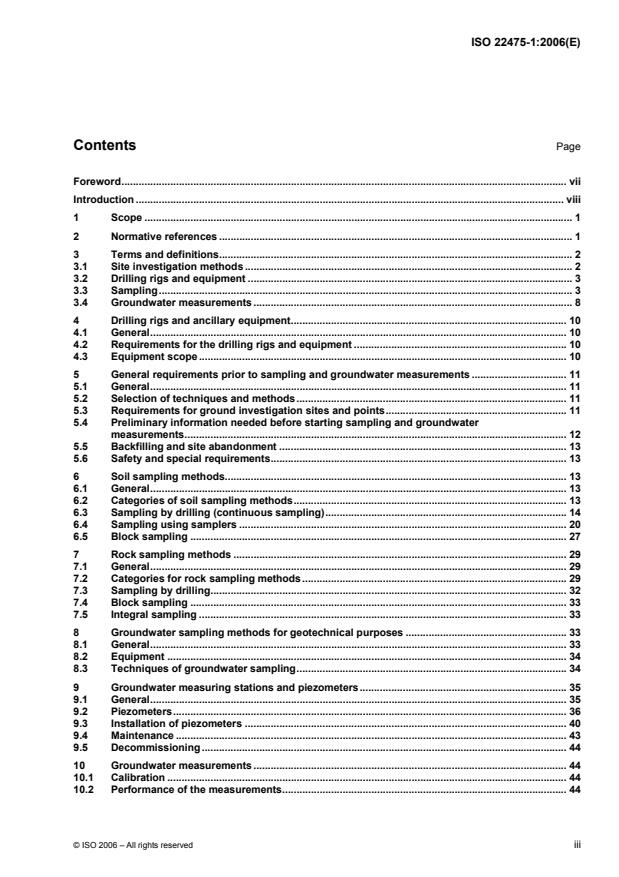
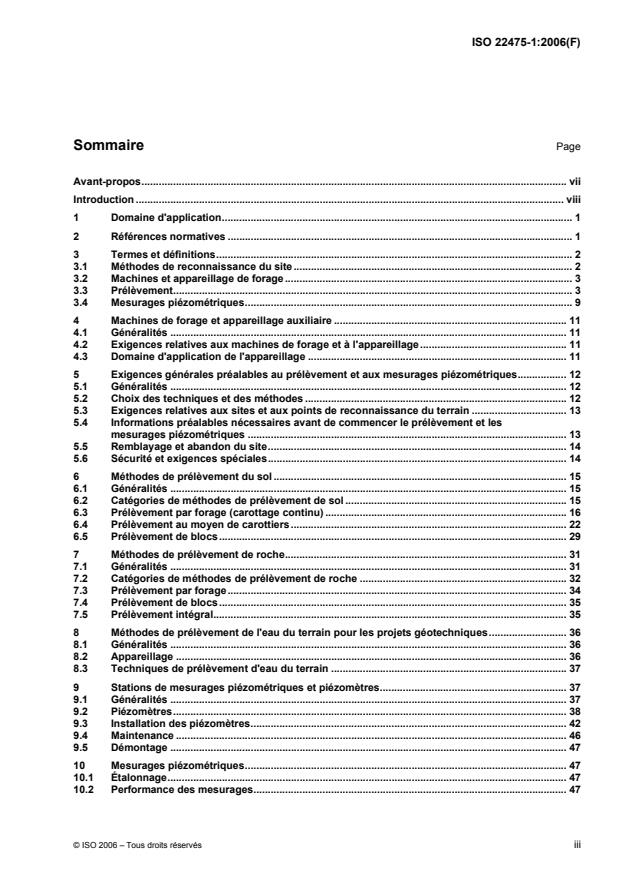
Contents Page
Foreword. vii
Introduction . viii
1 Scope . 1
2 Normative references . 1
3 Terms and definitions. 2
3.1 Site investigation methods . 2
3.2 Drilling rigs and equipment . 3
3.3 Sampling. 3
3.4 Groundwater measurements . 8
4 Drilling rigs and ancillary equipment. 10
4.1 General. 10
4.2 Requirements for the drilling rigs and equipment . 10
4.3 Equipment scope. 10
5 General requirements prior to sampling and groundwater measurements . 11
5.1 General. 11
5.2 Selection of techniques and methods. 11
5.3 Requirements for ground investigation sites and points. 11
5.4 Preliminary information needed before starting sampling and groundwater
measurements. 12
5.5 Backfilling and site abandonment . 13
5.6 Safety and special requirements. 13
6 Soil sampling methods. 13
6.1 General. 13
6.2 Categories of soil sampling methods. 13
6.3 Sampling by drilling (continuous sampling). 14
6.4 Sampling using samplers . 20
6.5 Block sampling . 27
7 Rock sampling methods . 29
7.1 General. 29
7.2 Categories for rock sampling methods.29
7.3 Sampling by drilling. 32
7.4 Block sampling . 33
7.5 Integral sampling . 33
8 Groundwater sampling methods for geotechnical purposes . 33
8.1 General. 33
8.2 Equipment . 34
8.3 Techniques of groundwater sampling.34
9 Groundwater measuring stations and piezometers. 35
9.1 General. 35
9.2 Piezometers. 36
9.3 Installation of piezometers . 40
9.4 Maintenance . 43
9.5 Decommissioning. 44
10 Groundwater measurements . 44
10.1 Calibration . 44
10.2 Performance of the measurements. 44
11 Handling, transport and storage of samples. 45
11.1 General . 45
11.2 Preservation materials and sample containers . 46
11.3 Handling of samples . 46
11.4 Labelling of samples. 47
11.5 Transport of samples. 47
11.6 Preparation of storage and shipping containers. 49
11.7 Storage of samples . 50
12 Report. 50
12.1 Field report. 50
12.2 Report of the results . 56
Annex A (informative) Example of a form for the preliminary information on the intended
sampling and groundwater measurements. 58
Annex B (informative) Field reports. 60
Annex C (informative) Drilling and sampling equipment for soil and rock . 69
Annex D (informative) Vacuum bottles for groundwater sampling. 115
Annex E (informative) Protective measures of piezometers. 117
Bibliography . 119
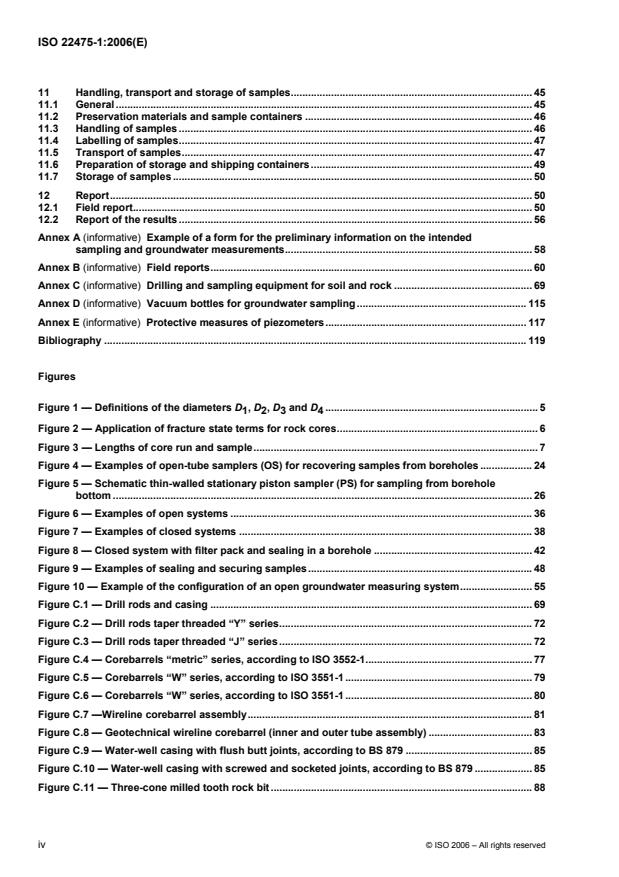
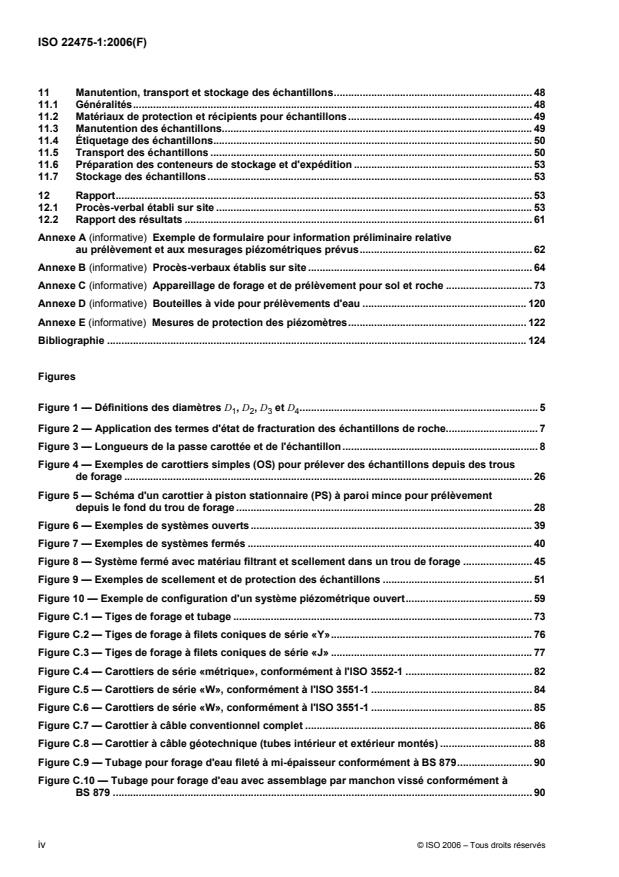
Figures
Figure 1 — Definitions of the diameters D , D , D and D . 5
1 2 3 4
Figure 2 — Application of fracture state terms for rock cores. 6
Figure 3 — Lengths of core run and sample. 7
Figure 4 — Examples of open-tube samplers (OS) for recovering samples from boreholes . 24
Figure 5 — Schematic thin-walled stationary piston sampler (PS) for sampling from borehole
bottom . 26
Figure 6 — Examples of open systems . 36
Figure 7 — Examples of closed systems . 38
Figure 8 — Closed system with filter pack and sealing in a borehole . 42
Figure 9 — Examples of sealing and securing samples. 48
Figure 10 — Example of the configuration of an open groundwater measuring system. 55
Figure C.1 — Drill rods and casing . 69
Figure C.2 — Drill rods taper threaded “Y” series. 72
Figure C.3 — Drill rods taper threaded “J” series. 72
Figure C.4 — Corebarrels “metric” series, according to ISO 3552-1. 77
Figure C.5 — Corebarrels “W” series, according to ISO 3551-1 . 79
Figure C.6 — Corebarrels “W” series, according to ISO 3551-1 . 80
Figure C.7 —Wireline corebarrel assembly. 81
Figure C.8 — Geotechnical wireline corebarrel (inner and outer tube assembly) . 83
Figure C.9 — Water-well casing with flush butt joints, according to BS 879 . 85
Figure C.10 — Water-well casing with screwed and socketed joints, according to BS 879 . 85
Figure C.11 — Three-cone milled tooth rock bit . 88
iv © ISO 2006 – All rights reserved
Figure C.12 — Tungsten carbide button bit. 88
Figure C.13 — Typical corebarrel lifters. 90
Figure C.14 — Typical sampler retainers . 91
Figure C.15 — Thin wall sampler (Shelby tube) . 92
Figure C.16 — Hydraulic piston sampler. 93
Figure C.17 — Stationary piston sampler with a 50-mm diameter liner — Sampling category A. 94
Figure C.18 — Stationary piston sampler with a 50-mm liner — Parts . 96
Figure C.19 — Stationary piston sampler with a 50-mm diameter liner — Sampling categories A
and B . 97
Figure C.20 — U100 Sampler. 98
Figure C.21 — Standard penetration test (SPT) samplers. 99
Figure C.22 — Typical automatic trip hammer . 100
Figure C.23 — Window and windowless samplers . 101
Figure C.24 — Clay cutter and shell (bailer) . 102
Figure C.25 — Sectional shell . 103
Figure C.26 — Chisels and stubber . 104
Figure C.27 — Continuous flight auger . 105
Figure C.28 — Augers with diameters between 36 mm and 100 mm — Sampling category C . 106
Figure C.29 — Hollow stem auger. 107
Figure C.30 — Examples of sampling from trial pits . 108
Figure C.31 — Recovering samples from trial pits — Example. 109
Figure C.32 — Example for a thin-walled open-tube sampler. 110
Figure C.33 — Example for a thick-walled open-tube sampler. 111
Figure C.34 — Example of sampling from borehole bottom using a large sampler (Sherbrooke
block sampler). 112
Figure C.35 — Method of sampling using a Laval sampler. 114
Figure D.1 — Equipment for vacuum bottle sampling. 116
Figure E.1 — Example of termination of an open piezometer above ground level. 117
Figure E.2 — Example of termination of an open piezometer below ground level. 118
Tables
Table 1 — Quality classes of soil samples for laboratory testing and sampling categories to be
used. 14
Table 2 — Sampling by drilling in soils. 16
Table 3 — Soil sampling using samplers. 21
Table 4 — Examples on sampling methods with respect to the sampling category in different
soils. 28
Table 5 — Soil sampling using samplers. 31
Table C.1 — Drill rods and casing “W”-series according to ISO 3551-1. 70
Table C.2 — Drill rods and casing “metric” series according to ISO 3552-1 . 71
Table C.3 — Drill rods taper threaded “Y” series . 72
Table C.4 — Drill rods taper threaded “J” series. 72
Table C.5 — Corebarrels “W” series, according to ISO 3551-1. 73
Table C.6 — Corebarrels “metric” series, according to ISO 3552-1 . 74
Table C.7 — Air flush corebarrels . 75
Table C.8 — Drill rods and casing. 76
Table C.9 — Corebarrels “metric” series, according to ISO 3552-1 . 78
Table C.10 —Wireline drill rod dimensions . 82
Table C.11 — Wireline corebarrel dimensions. 82
Table C.12 — Geotechnical wireline corebarrel drill pipe dimensions. 84
Table C.13 — Geotechnical wireline corebarrel dimensions. 84
Table C.14 — Dimensions of water-well casings with flush butt joints . 85
Table C.15 — Dimensions of water-well casings with screwed and socketed joints . 85
Table C.16 — Bit selection chart . 86
Table C.17 — Core bit profiles — Diamond set, impregnated, TC and PCD. 87
Table C.18 — Three-cone milled tooth rock bit. 88
Table C.19 — Tungsten carbide button bit. 89
vi © ISO 2006 – All rights reserved
Foreword
ISO (the International Organization for Standardization) is a worldwide federation of national standards bodies
(ISO member bodies). The work of preparing International Standards is normally carried out through ISO
technical committees. Each member body interested in a subject for which a technical committee has been
established has the right to be represented on that committee. International organizations, governmental and
non-governmental, in liaison with ISO, also take part in the work. ISO collaborates closely with the
International Electrotechnical Commission (IEC) on all matters of electrotechnical standardization.
International Standards are drafted in accordance with the rules given in the ISO/IEC Directives, Part 2.
The main task of technical committees is to prepare International Standards. Draft International Standards
adopted by the technical committees are circulated to the member bodies for voting. Publication as an
International Standard requires approval by at least 75 % of the member bodies casting a vote.
Attention is drawn to the possibility that some of the elements of this document may be the subject of patent
rights. ISO shall not be held responsible for identifying any or all such patent rights.
ISO 22475-1 was prepared by the European Committee for Standardization (CEN) Technical Committee
CEN/TC 341, Geotechnical investigation and testing, in collaboration with Technical Committee ISO/TC 182,
Geotechnics, Subcommittee SC 1, Geotechnical investigation and testing, in accordance with the Agreement
on technical cooperation between ISO and CEN (Vienna Agreement).
ISO 22475-1 consists of the following parts, under the general title Geotechnical investigation and testing —
Sampling methods and groundwater measurements:
⎯ Part 1: Technical principles for execution
⎯ Part 2: Qualification criteria for enterprises and personnel
⎯ Part 3: Conformity assessment of enterprises and personnel by third party
Introduction
ISO 22475-1 specifies the technical principles for the execution of sampling and groundwater measurements
for geotechnical purposes.
The quality of these services can be proven by:
a) a declaration of conformity by a contractor (first party control);
b) a declaration of conformity by a client (second party control);
c) a declaration of conformity by a conformity assessment body (third party control).
Every enterprise or individual may decide, if and how they will prove the fulfilment of the technically related
criteria: by first, second or third party control because no part of ISO 22475 requires such a declaration.
ISO/TS 22475-2 specifies the qualification criteria for enterprises and personnel that perform sampling and
groundwater measurements according to ISO 22475-1.
The conformity assessment by third party control can be made according to the technical principles for
execution of sampling and groundwater measurements specified in ISO 22475-1, as indicated in
ISO/TS 22475-2, and in the conformity assessment procedure given in ISO/TS 22475-3.
viii © ISO 2006 – All rights reserved
INTERNATIONAL STANDARD ISO 22475-1:2006(E)
Geotechnical investigation and testing — Sampling methods
and groundwater measurements —
Part 1:
Technical principles for execution
1 Scope
This part of ISO 22475 deals with the technical principles of sampling of soil, rock and groundwater, and with
groundwater measurements, in the context of geotechnical investigation and testing, as described in
EN 1997-1 and EN 1997-2.
The aims of such ground investigations are:
a) to recover soil and rock samples of a quality sufficient to assess the general suitability of a site for
geotechnical engineering purposes and to determine the required soil and rock characteristics in the
laboratory;
b) to obtain information on the sequence, thickness and orientation of strata and joint system and faults;
c) to establish the type, composition and condition of strata;
d) to obtain information on groundwater conditions and recover water samples for assessment of the
interaction of groundwater, soil, rock and construction material.
The quality of a sample is influenced by the geological and hydrogeological conditions, the choice and
execution of the drilling and/or the sampling method, handling, transport and storage of the samples.
This part of ISO 22475 does not cover soil sampling for the purposes of agricultural and environmental soil
investigation.
NOTE 1 Soil sampling for these purposes is to be found in ISO 10381.
Water sampling for the purposes of quality control, quality characterisation, and identification of sources of
pollution of water, including bottom deposits and sludges is not covered.
NOTE 2 Water sampling for these purposes is to be found in ISO 5667.
2 Normative references
The following referenced documents are indispensable for the application of this document. For dated
references, only the edition cited applies. For undated references, the latest edition of the referenced
document (including any amendments) applies.
EN 791, Drill rigs — Safety
EN 996, Piling equipment — Safety requirement
EN 1997-1, Eurocode 7: Geotechnical design — Part 1: General rules
EN 1997-2, Eurocode 7: Geotechnical design — Part 2: Design assisted by laboratory testing
ISO 22476-3, Geotechnical investigation and testing — Field testing — Part 3: Standard penetration test
ISO 14688-1, Geotechnical investigation and testing — Identification and classification of soil — Part 1:
Identification and description
ISO 14689-1, Geotechnical investigation and testing — Identification and classification of rock — Part 1:
Identification and description
ISO 3551-1, Rotary core diamond drilling equipment — System A — Part 1: Metric units
ISO 3552-1, Rotary core diamond drilling equipment — System B — Part 1: Metric units
GUM: Guide to the expression of uncertainty in measurement, BIPM/IEC/IFCC/ISO/OIML/IUPAC/IUPAP
ISO 10097-1, Wireline diamond core drilling equipment — System A — Part 1: Metric units
3 Terms and definitions
For the purposes of this document, the terms and definitions given in EN 1997-1, EN 1997-2, ISO 14688-1
and ISO 14689-1 and the following apply.
NOTE Additional terms and definitions can be found in the books and literature listed in the Bibliography.
3.1 Site investigation methods
3.1.1
trial pit
open excavation constructed to examine the ground conditions in situ, recover samples or carry out field
testing
3.1.2
shaft
open vertical or steeply inclined excavation, typically more than 5 m deep, constructed to examine the ground
conditions in situ, recover samples or carry out field testing
3.1.3
heading
adit
small tunnel driven horizontally or with a slight inclination from a shaft or into sloping ground to examine the
ground conditions in situ, recover samples and carry out field testing
3.1.4
borehole
hole of any predetermined diameter and length formed in any geological formation or man-made material by
drilling
NOTE Investigations carried out in such a hole can be to recover rock, soil or water samples from a specified depth
or to carry out in situ tests and measurements.
3.1.5
drilling
process by which a borehole is produced in any geological formation by rotary, rotary percussive, percussive
or thrust methods and in any predetermined direction in relation to the drill rig
3.1.6
small diameter drilling
drilling in the soil with a diameter greater than 30 mm but less than 80 mm
2 © ISO 2006 – All rights reserved
3.1.7
drilling method
technique employed to create and stabilise the borehole
3.2 Drilling rigs and equipment
3.2.1
drilling tool
device attached to, or forming an integral part of, the drill string, used as a cutting tool for penetrating the
geological formation
3.2.2
drill bit
device attached to, or forming an integral part of, the drill string, used as a cutting tool to penetrate the
formation being drilled by the drilling method employed
3.2.3
drill rig
device which carries out the drilling function
3.2.4
casing
tubing temporarily or permanently inserted into a borehole
NOTE Casing is used, e.g. to stabilise the borehole, to prevent the loss of flushing medium to the surrounding
formation, or to prevent cross flow between different groundwater horizons
3.2.5
flushing medium
liquid or gaseous medium used to move cuttings and/or samples and to lubricate and cool the drilling tool from
the borehole
3.2.6
flushing additive
substance added to the flushing medium in order to affect or change its properties to improve its functioning
3.2.7
core lifter
split, internally slotted or serrated conical spring steel ring, grooves, flexible spring fingers, hinged wedge-
shaped fingers or hinged flaps mounted in a carrier ring, to retain the core sample whilst the corebarrel is
being hoisted from the borehole
3.2.8
sample retainer
cylindrical retainer fitted with a split-ring core lifter; it is mounted at the lower end of the sampler tube and used
to retain the sample in the tube as the sampler is being lifted from the ground
3.3 Sampling
3.3.1
sampling by drilling
continuous sampling
process by which samples are obtained by the drilling tools as the borehole proceeds
NOTE The drilling process is designed to obtain complete samples of the length of the borehole. The drilling tools are
used as sampling tools.
3.3.2
sampling by using sampler
process by which samples are obtained by samplers from trial pits, headings, shafts or borehole bottom at
selected positions
3.3.3
soil sampling by small diameter drilling
sampling by drilling in soils, using drilling tools with a diameter greater than 30 mm but less than 80 mm
3.3.4
sample
defined amount of rock, soil or groundwater recovered from recorded depth
3.3.5
core, core sample
cylindrical sample of soil or rock obtained from a borehole from recorded depth
3.3.6
block sample
sample of soil or rock cut out by special techniques
3.3.7
cuttings
particles of geological formations formed in the borehole by the cutting action of the drilling tool
3.3.8
suspended matter
abraded ground material in the flushing medium generated by drilling, in which the individual particle size
cannot be recognised with the naked eye
3.3.9
core run
length of the core drilling between the start and the finish for the removal of the sample
3.3.10
core loss
difference between a core run and the length of the core recovered
3.3.11
area ratio
C
a
ratio of the area of soil displaced by the sampler tube in proportion to the area of the sample
DD−
C=⋅ 100
a
D
See Figure 1.
NOTE 1 The area ratio is expressed in per cent.
NOTE 2 One of the factors that determines the mechanical disturbance of the soil.
3.3.12
inside clearance ratio
C
i
DD−
C=⋅ 100
i
D
4 © ISO 2006 – All rights reserved
See Figure 1.
NOTE 1 The inside clearance ratio is expressed in percent.
NOTE 2 One of the factors that determines the mechanical disturbance of the sample caused by the friction on the
inside wall of sample tube or of the liner.
Key
D inside diameter of the cutting shoe α taper angle
D greatest outside diameter of the cutting shoe 1 sample tube
D inside diameter of the sample tube or liner 2 cutting shoe
D outside diameter of the sample tube 3 liner (optional)
Figure 1 — Definitions of the diameters D , D , D and D
1 2 3 4
3.3.13
outside clearance ratio
C
o
DD−
C=⋅ 100
o
D
See Figure 1.
NOTE The outside clearance ratio is expressed in percent.
3.3.14 Fracture state terms
3.3.14.1
total core recovery in rock
TCR
total length of core sample recovered (solid and non-intact), expressed as a percentage of the length of the
core run
See Figure 2.
3.3.14.2
rock quality designation
RQD
sum length of all core pieces with at least one full diameter that are 100 mm or longer between natural
fractures, measured along the centre line of the core, expressed as a percentage of the length of the core run
See Figure 2.
3.3.14.3
solid core recovery
SCR
length of core recovered as solid cylinders, expressed as a percentage of the length of the core run
See Figure 2.
NOTE A solid core has a full diameter, uninterrupted by natural discontinuities, but not necessarily a full
circumference, and is commonly measured along the core axis or other scan line.
NOTE All features shown are natural discontinuities unless stated otherwise.
Key
1 drilling-induced fractures Description of fracture state of rock cores:
2 at least one full diameter RQD rock quality designation
3 no single full diameter SCR solid core recovery
4 non-intact TCR total core recovery
5 no recovery
6 core run
Figure 2 — Application of fracture state terms for rock cores
6 © ISO 2006 – All rights reserved
3.3.15
sample recovery ratio in soil
TC
ratio of the length of the sample, l , to the length of the sample run, H
g
See Figure 3.
3.3.16
net sample recovery ratio
IC
ratio of the net length of the sample, l , to the length of the sample run, H
n
See Figure 3
a) Before withdrawal of sampler b) After withdrawal of sampler
Key
1 casing l length of the lower part of the sample, which was
b
remoulded or lost
2 beginning of coring
l difference between the sample run and the actual length
3 end of coring e
of the sample
4 bottom of predrilled borehole
l total length of the sample after withdrawal of the
g
5 vent-hole
sampler, measured from the top of the sample to the
6 sample
cutter edge, including the remoulded or lost parts at both
ends of the sample
D inside diameter of the sample tube or liner
l length of the remoulded or polluted upper part of the
H length of the sample run
h
sample
Z depth, under the natural ground level, of the lower
f
l net length of the sample, before its conditioning
end of the sampler after sampling and before
n
withdrawing the sampler
l effective (useful) length of the sampling tube
t
Z depth, under the natural ground level, of the borehole
i
bottom before sampling, and before the beginning of
the following core run
Figure 3 — Lengths of core run and sample
3.3.17
thin-walled sampler
soil sampler with a low area ratio and a low taper angle and thin edge
3.3.18
thick-walled sampler
soil sampler that has an area ratio, taper angle and/or edge larger than that of thin-walled sampler
3.4 Groundwater measurements
3.4.1
piezometric head
sum of pressure head and elevation
3.4.2
groundwater surface
upper boundary surface of the groundwater
3.4.3
aquifer
body of permeable rock or soil mass suitable for containing and transmitting groundwater
3.4.4
aquitard
confining layer that retards, but does not prevent, the flow of water to or from an adjacent aquifer
3.4.5
aquiclude
body of soil or rock with extremely low transmissivity, which effectively prevents the flow of water through the
ground
3.4.6
confined aquifer
aquifer which is bounded above and below by aquicludes
3.4.7
unconfined aquifer
aquifer in which the groundwater surface forms the upper boundary
3.4.8
pore pressure
pressure of the fluid that fills the voids of a soil or rock mass
3.4.9
permeability
capacity of soil or rock for transmitting water
3.4.10
filter
water permeable section of a piezometer retaining the soil
3.4.11
filter pack
water permeable backfilling around the filter and retaining the soil
3.4.12
open filter area
opening percentage of the filter surface
8 © ISO 2006 – All rights reserved
3.4.13
groundwater measurement
measurement of the groundwater surface or pore pressure
3.4.14
groundwater measuring station
place where groundwater measuring equipment is installed or groundwater measurement is carried out
3.4.15
groundwater fluctuations
variations of groundwater surface and/or pore pressure
3.4.16
groundwater pressure
the pressure in pores, voids and fissures in the ground at a certain point and time
3.4.17
piezometer
equipment for the determination of the groundwater or the piezometric head, including both open and closed
systems
3.4.18
open system
measuring system in which the groundwater is in direct contact with the atmosphere and in which the
groundwater surface at the filter level is measured
3.4.19
closed system
measuring system in which the groundwater is not in direct contact with the atmosphere and in which the pore
pressure at the filter level is measured hydraulically, pneumatically or electrically
3.4.20
hydraulic system
closed system in which the water pressure in the filter tip is transmitted to a measuring unit on or close to the
ground surface through a liquid-filled pressure tube
3.4.21
pneumatic system
closed system in which the water pressure acts on a membrane located behind the filter of the filter tip and
which is balanced by gas pressure on the membrane's reverse side by a pressure tube from the ground
surface
3.4.22
electrical system
closed system in which the water pressure effects the membrane located behind the filter of the filter tip and
where the water pressure is converted into an electrical signal
3.4.23
pick-up system
electrical transducer system, in which the transducer can be added to and removed from the filter tip installed
in the ground
3.4.24
filter tip
tip for piezometers provided with a filter to prevent soil particles from entering the equipment
3.4.25
high air entry filter
filter with small pores giving a high resistance to air entry when water saturated
3.4.26
time lag
time lapse between a change in pore pressure in the ground and its total recording by the measuring system
4 Drilling rigs and ancillary equipment
4.1 General
The drilling and sampling equipment selected shall be of the appropriate size and type in order to produce the
required quality.
If applicable, the drilling and sampling equipment shall be in accordance with ISO 3351-1, ISO 3352-1 and
ISO 10097-1.
4.2 Requirements for the drilling rigs and equipment
Drilling rigs with appropriate stability, power and equipment such as drill rods, casing, corebarrels and bits
shall be selected in order that the required sampling and borehole tests can be carried out to the required
depth of the borehole and sampling categories.
NOTE Annex C gives a selection of equipment which is currently used.
4.3 Equipment scope
The drilling rig and equipment shall allow all drilling functions to be adjusted accurately. When specified, the
following drilling parameters should be measured and recorded against depth:
⎯ drill head rotational torque (Nm)
−1
⎯ drill head rotational speed (min );
⎯ feed thrust and pulling force (kN);
⎯ penetration rate (m/min);
⎯ depth of hammering intervals (on/off);
⎯ topographical depth (m);
⎯ azimuth and inclination when inclined drilling (degree);
⎯ drilled length when inclined drilling (m);
⎯ flushing medium pressure at the output of the pump (kPa);
⎯ flushing medium circulation rate (input) (l/min);
⎯ flushing medium recovery rate (l/min).
10 © ISO 2006 – All rights reserved
5 General requirements prior to sampling and groundwater measurements
5.1 General
The type and extent of sample recovery and groundwater measurements shall be specified in advance
according to the purpose of the project, the geological and hydrogeological conditions and the anticipated field
and laboratory testing (see EN 1997-2).
5.2 Selection of techniques and methods
5.2.1 The techniques and methods for sampling and groundwater measurements shall be selected
according to the purpose of the investigations in relation to the expected geological and hydrogeological
conditions.
5.2.2 Sampling techniques, sample transportation and storage procedures shall be selected on the basis of
the required
⎯ sample quality class according to EN 1997-2,
⎯ sample mass, and
⎯ sample diameter,
depending on the type of laboratory tests to be carried out.
5.2.3 A specific sampling category shall be selected in order to achieve a required sample quality class
according to EN 1997-2 (see 6.2).
5.2.4 Different disturbance of sample can be expected when using different sampling methods. The quality
class of a sample taken with the same sampler can vary depending on, e.g. the soil type to be sampled, the
presence of groundwater and the sampling operation. The following sample disturbance can be generated by
the drilling and sampling methods:
⎯ mechanical sample disturbance due to compression, shearing, flushing or vibration during drilling or
excavation;
⎯ sample disturbance due to release of in situ stresses and related rebound;
⎯ changes in material and chemical constituents such as water content and gases.
5.2.5 The sample diameter for soils containing large particles should be chosen with respect to the size of
the largest particles of the sampled material.
5.2.6 If investigation below the groundwater surface or to greater depths is necessary, stable or stabilized
boreholes are required.
5.2.7 Trial pits, headings and shafts give the possibility to investigate the ground in a larger scale e.g. to
get information on the composition, sequence, structure and orientation of strata and possible rock surface.
Without groundwater lowering, the depth is often limited to shallow depth above the groundwater surface.
Large samples can be taken in order to analyse boulder content, bearing capacity, compactibility and
permeability. At the same time, the excavability could be assessed and photographic documentation made.
5.3 Requirements for ground investigation sites and points
5.3.1 Site investigation points on land shall be marked on the site befor
...
NORME ISO
INTERNATIONALE 22475-1
Première édition
2006-09-15
Reconnaissance et essais
géotechniques — Méthodes de
prélèvement et mesurages
piézométriques —
Partie 1:
Principes techniques des travaux
Geotechnical investigation and testing — Sampling methods and
groundwater measurements —
Part 1: Technical principles for execution
Numéro de référence
©
ISO 2006
PDF – Exonération de responsabilité
Le présent fichier PDF peut contenir des polices de caractères intégrées. Conformément aux conditions de licence d'Adobe, ce fichier
peut être imprimé ou visualisé, mais ne doit pas être modifié à moins que l'ordinateur employé à cet effet ne bénéficie d'une licence
autorisant l'utilisation de ces polices et que celles-ci y soient installées. Lors du téléchargement de ce fichier, les parties concernées
acceptent de fait la responsabilité de ne pas enfreindre les conditions de licence d'Adobe. Le Secrétariat central de l'ISO décline toute
responsabilité en la matière.
Adobe est une marque déposée d'Adobe Systems Incorporated.
Les détails relatifs aux produits logiciels utilisés pour la création du présent fichier PDF sont disponibles dans la rubrique General Info
du fichier; les paramètres de création PDF ont été optimisés pour l'impression. Toutes les mesures ont été prises pour garantir
l'exploitation de ce fichier par les comités membres de l'ISO. Dans le cas peu probable où surviendrait un problème d'utilisation,
veuillez en informer le Secrétariat central à l'adresse donnée ci-dessous.
© ISO 2006
Droits de reproduction réservés. Sauf prescription différente, aucune partie de cette publication ne peut être reproduite ni utilisée sous
quelque forme que ce soit et par aucun procédé, électronique ou mécanique, y compris la photocopie et les microfilms, sans l'accord écrit
de l'ISO à l'adresse ci-après ou du comité membre de l'ISO dans le pays du demandeur.
ISO copyright office
Case postale 56 • CH-1211 Geneva 20
Tel. + 41 22 749 01 11
Fax. + 41 22 749 09 47
E-mail copyright@iso.org
Web www.iso.org
Publié en Suisse
ii © ISO 2006 – Tous droits réservés
Sommaire Page
Avant-propos. vii
Introduction . viii
1 Domaine d'application. 1
2 Références normatives . 1
3 Termes et définitions. 2
3.1 Méthodes de reconnaissance du site. 2
3.2 Machines et appareillage de forage. 3
3.3 Prélèvement. 3
3.4 Mesurages piézométriques. 9
4 Machines de forage et appareillage auxiliaire . 11
4.1 Généralités . 11
4.2 Exigences relatives aux machines de forage et à l'appareillage. 11
4.3 Domaine d'application de l'appareillage . 11
5 Exigences générales préalables au prélèvement et aux mesurages piézométriques. 12
5.1 Généralités . 12
5.2 Choix des techniques et des méthodes . 12
5.3 Exigences relatives aux sites et aux points de reconnaissance du terrain . 13
5.4 Informations préalables nécessaires avant de commencer le prélèvement et les
mesurages piézométriques . 13
5.5 Remblayage et abandon du site. 14
5.6 Sécurité et exigences spéciales. 14
6 Méthodes de prélèvement du sol . 15
6.1 Généralités . 15
6.2 Catégories de méthodes de prélèvement de sol . 15
6.3 Prélèvement par forage (carottage continu) . 16
6.4 Prélèvement au moyen de carottiers. 22
6.5 Prélèvement de blocs. 29
7 Méthodes de prélèvement de roche. 31
7.1 Généralités . 31
7.2 Catégories de méthodes de prélèvement de roche . 32
7.3 Prélèvement par forage. 34
7.4 Prélèvement de blocs. 35
7.5 Prélèvement intégral. 35
8 Méthodes de prélèvement de l'eau du terrain pour les projets géotechniques. 36
8.1 Généralités . 36
8.2 Appareillage . 36
8.3 Techniques de prélèvement d'eau du terrain . 37
9 Stations de mesurages piézométriques et piézomètres. 37
9.1 Généralités . 37
9.2 Piézomètres. 38
9.3 Installation des piézomètres. 42
9.4 Maintenance . 46
9.5 Démontage . 47
10 Mesurages piézométriques. 47
10.1 Étalonnage. 47
10.2 Performance des mesurages. 47
11 Manutention, transport et stockage des échantillons. 48
11.1 Généralités. 48
11.2 Matériaux de protection et récipients pour échantillons . 49
11.3 Manutention des échantillons. 49
11.4 Étiquetage des échantillons. 50
11.5 Transport des échantillons . 50
11.6 Préparation des conteneurs de stockage et d'expédition . 53
11.7 Stockage des échantillons. 53
12 Rapport. 53
12.1 Procès-verbal établi sur site . 53
12.2 Rapport des résultats . 61
Annexe A (informative) Exemple de formulaire pour information préliminaire relative
au prélèvement et aux mesurages piézométriques prévus. 62
Annexe B (informative) Procès-verbaux établis sur site . 64
Annexe C (informative) Appareillage de forage et de prélèvement pour sol et roche . 73
Annexe D (informative) Bouteilles à vide pour prélèvements d'eau . 120
Annexe E (informative) Mesures de protection des piézomètres. 122
Bibliographie . 124
Figures
Figure 1 — Définitions des diamètres D , D , D et D . 5
1 2 3 4
Figure 2 — Application des termes d'état de fracturation des échantillons de roche. 7
Figure 3 — Longueurs de la passe carottée et de l'échantillon. 8
Figure 4 — Exemples de carottiers simples (OS) pour prélever des échantillons depuis des trous
de forage . 26
Figure 5 — Schéma d'un carottier à piston stationnaire (PS) à paroi mince pour prélèvement
depuis le fond du trou de forage . 28
Figure 6 — Exemples de systèmes ouverts. 39
Figure 7 — Exemples de systèmes fermés . 40
Figure 8 — Système fermé avec matériau filtrant et scellement dans un trou de forage . 45
Figure 9 — Exemples de scellement et de protection des échantillons . 51
Figure 10 — Exemple de configuration d'un système piézométrique ouvert. 59
Figure C.1 — Tiges de forage et tubage . 73
Figure C.2 — Tiges de forage à filets coniques de série «Y». 76
Figure C.3 — Tiges de forage à filets coniques de série «J» . 77
Figure C.4 — Carottiers de série «métrique», conformément à l'ISO 3552-1 . 82
Figure C.5 — Carottiers de série «W», conformément à l'ISO 3551-1 . 84
Figure C.6 — Carottiers de série «W», conformément à l'ISO 3551-1 . 85
Figure C.7 — Carottier à câble conventionnel complet . 86
Figure C.8 — Carottier à câble géotechnique (tubes intérieur et extérieur montés) . 88
Figure C.9 — Tubage pour forage d'eau fileté à mi-épaisseur conformément à BS 879. 90
Figure C.10 — Tubage pour forage d'eau avec assemblage par manchon vissé conformément à
BS 879 . 90
iv © ISO 2006 – Tous droits réservés
Figure C.11 — Outil tricône à dents pour roche. 93
Figure C.12 — Outil à pastilles de carbure de tungstène. 93
Figure C.13 — Extracteurs à ressort courants pour carottier.95
Figure C.14 — Extracteurs à lamelles courants . 96
Figure C.15 — Carottier à paroi mince (carottier Shelby). 97
Figure C.16 — Carottier à piston hydraulique . 98
Figure C.17 — Carottier à piston stationnaire avec étui de 50 mm de diamètre — Prélèvement de
catégorie A . 99
Figure C.18 — Carottier à piston stationnaire avec étui de 50 mm de diamètre — Parties . 101
Figure C.19 — Carottier à piston stationnaire St II avec étui de 50 mm de diamètre — Prélèvement
de catégories A et B . 102
Figure C.20 — Carottier U100 . 103
Figure C.21 — Carottiers pour l'essai de pénétration au carottier (SPT). 104
Figure C.22 — Marteau coulissant automatique type . 105
Figure C.23 — Carottiers à fenêtre et sans fenêtre . 106
Figure C.24 — Carottier pour découpage de l'argile et carottier à soupape . 107
Figure C.25 — Carottier modulaire . 108
Figure C.26 — Trépans. 109
Figure C.27 — Tarière hélicoïdale continue. 110
Figure C.28 — Tarières de diamètre compris entre 36 mm et 100 mm — Prélèvements de
catégorie C . 111
Figure C.29 — Tarière creuse . 112
Figure C.30 — Méthode de prélèvement depuis des tranchées de reconnaissance. 113
Figure C.31 — Prélèvement d'échantillons depuis des tranchées de reconnaissance — Exemple. 114
Figure C.32 — Exemple de carottier poinçonneur à paroi mince. 115
Figure C.33 — Exemple de carottier poinçonneur à paroi épaisse . 116
Figure C.34 — Exemple de prélèvement depuis le fond du trou de forage au moyen d'un carottier
de grande dimension (carottier de type Sherbrooke). 117
Figure C.35 — Méthode de prélèvement au moyen du carottier LAVAL . 119
Figure D.1 — Appareillage pour prélèvement par bouteille à vide. 121
Figure E.1 — Exemple de terminaison d'un tube piézométrique au-dessus du sol . 122
Figure E.2 — Exemple de terminaison d'un tube piézométrique sous la surface du sol. 123
Tableaux
Tableau 1 — Classes de qualité d'échantillons de sol destinés à des essais de laboratoire et
catégories de prélèvement à utiliser. 16
Tableau 2 — Prélèvement par forage dans les sols. 18
Tableau 3 — Prélèvement de sol au moyen de carottiers .23
Tableau 4 — Exemples de méthodes de prélèvement en fonction de la catégorie de prélèvement
dans différents sols. 31
Tableau 5 — Prélèvement par forage rotatif dans la roche. 33
Tableau C.1 — Tiges de forage et tubage de série «W», conformément à l'ISO 3551-1. 74
Tableau C.2 — Tiges de forage et tubage de série «métrique», conformément à l'ISO 3552-1 . 75
Tableau C.3 — Tiges de forage à filets coniques de série «Y» . 76
Tableau C.4 — Tiges de forage à filets coniques de série «J».77
Tableau C.5 — Carottiers de série «W», conformément à l'ISO 3551-1. 78
Tableau C.6 — Carottiers de série «métrique», conformément à l'ISO 3552-1. 79
Tableau C.7 — Carottiers «à injection d'air». 80
Tableau C.8 — Tiges de forage et tubage. 81
Tableau C.9 — Carottiers de série «métrique», conformément à l'ISO 3552-1. 83
Tableau C.10 — Dimensions des tiges de forage pour carottier à câble . 87
Tableau C.11 — Dimensions des carottiers à câble. 87
Tableau C.12 — Dimensions des tiges de forage pour carottier à câble géotechnique. 89
Tableau C.13 — Dimensions des carottiers à câble géotechniques . 89
Tableau C.14 — Dimensions des tubages pour forage d'eau filetés à mi-épaisseur. 90
Tableau C.15 — Dimensions des tubages pour forage d'eau avec assemblage par manchon vissé. 90
Tableau C.16 — Guide pour le choix de la couronne. 91
Tableau C.17 — Profils de couronne — Diamant, imprégné, TC et PCD. 92
Tableau C.18 — Outil tricône à dents pour roche. 93
Tableau C.19 — Outil à pastilles de carbure de tungstène. 94
vi © ISO 2006 – Tous droits réservés
Avant-propos
L'ISO (Organisation internationale de normalisation) est une fédération mondiale d'organismes nationaux de
normalisation (comités membres de l'ISO). L'élaboration des Normes internationales est en général confiée
aux comités techniques de l'ISO. Chaque comité membre intéressé par une étude a le droit de faire partie du
comité technique créé à cet effet. Les organisations internationales, gouvernementales et non
gouvernementales, en liaison avec l'ISO participent également aux travaux. L'ISO collabore étroitement avec
la Commission électrotechnique internationale (CEI) en ce qui concerne la normalisation électrotechnique.
Les Normes internationales sont rédigées conformément aux règles données dans les Directives ISO/CEI,
Partie 2.
La tâche principale des comités techniques est d'élaborer les Normes internationales. Les projets de Normes
internationales adoptés par les comités techniques sont soumis aux comités membres pour vote. Leur
publication comme Normes internationales requiert l'approbation de 75 % au moins des comités membres
votants.
L'attention est appelée sur le fait que certains des éléments du présent document peuvent faire l'objet de
droits de propriété intellectuelle ou de droits analogues. L'ISO ne saurait être tenue pour responsable de ne
pas avoir identifié de tels droits de propriété et averti de leur existence.
L'ISO 22475-1 a été élaborée par le comité technique CEN/TC 341, Recherches et essais géotechniques, du
Comité européen de normalisation (CEN) en collaboration avec le comité technique ISO/TC 182,
Géotechnique, sous-comité SC 1, Recherches et essais géotechniques, conformément à l'Accord de
coopération technique entre l'ISO et le CEN (Accord de Vienne).
L'ISO 22475 comprend les parties suivantes, présentées sous le titre général Reconnaissance et essais
géotechniques — Méthodes de prélèvement et mesurages piézométriques:
⎯ Partie 1: Principes techniques des travaux
⎯ Partie 2: Critères de qualification des entreprises et du personnel
⎯ Partie 3: Évaluation de la conformité des entreprises et du personnel par un organisme tiers
Introduction
L'ISO 22475-1 spécifie les principes techniques des travaux de prélèvement et des mesurages
piézométriques pour les projets géotechniques.
La qualité de ces services peut être démontrée par:
a) une déclaration de conformité établie par le contractant (contrôle interne);
b) une déclaration de conformité établie par le client (contrôle externe);
c) une déclaration de conformité établie par un organisme d'évaluation de la conformité (contrôle par tierce
partie).
Chaque entreprise ou individu peut décider de démontrer ou non qu'il respecte les critères techniques et
choisir la méthode qui lui convient (contrôle interne, contrôle externe ou contrôle par tierce partie) car aucune
partie de l'ISO 22475 n'exige une telle déclaration.
L'ISO/TS 22475-2 spécifie les critères de qualification pour les entreprises et le personnel qui exécute les
prélèvements et les mesurages piézométriques conformément à l'ISO 22475-1.
L'évaluation de la conformité aux principes techniques des travaux de prélèvement et des mesurages
piézométriques spécifiés dans l'ISO 22475-1, par contrôle par tierce partie, peut être effectuée comme
indiqué dans l'ISO/TS 22475-2 et selon la procédure d'évaluation de la conformité définie dans
l'ISO/TS 22475-3.
viii © ISO 2006 – Tous droits réservés
NORME INTERNATIONALE ISO 22475-1:2006(F)
Reconnaissance et essais géotechniques — Méthodes
de prélèvement et mesurages piézométriques —
Partie 1:
Principes techniques des travaux
1 Domaine d'application
La présente partie de l'ISO 22475 traite des principes techniques relatifs aux méthodes de prélèvement du sol,
de la roche et de l'eau du terrain et aux mesurages piézométriques, dans le cadre des reconnaissances et
essais géotechniques tels que décrits dans l'EN 1997-1 et l'EN 1997-2.
Ces reconnaissances ont pour objectifs:
a) de prélever des échantillons de sol et de roche d'une qualité suffisante pour évaluer l'aptitude générale
d'un site à des fins d'ingénierie géotechnique et pour déterminer les caractéristiques requises du sol et de
la roche en laboratoire;
b) d'obtenir des informations relatives à la succession, à l'épaisseur et à l'orientation du système de couches,
de diaclases et de failles;
c) d'établir le type, la composition et la nature des couches;
d) d'obtenir des informations sur l'état de l'eau interstitielle et de prélever des échantillons d'eau en vue
d'évaluer l'interaction entre l'eau interstitielle, le sol, la roche et le matériau de construction.
La qualité d'un échantillon est influencée par les conditions géologiques et hydrogéologiques, le choix et
l'exécution des méthodes de forage et/ou de prélèvement, la manutention, le transport et le stockage des
échantillons.
La présente partie de l'ISO 22475 ne s'applique pas au prélèvement de sol en vue d'une reconnaissance
agricole et environnementale.
NOTE 1 Le prélèvement du sol à ces fins est donné dans l'ISO 10381.
Le prélèvement de l'eau à des fins de contrôle de la qualité, de caractérisation de la qualité et d'identification
des sources de pollution de l'eau, y compris les sédiments et les boues, n'est pas couvert par la présente
partie de l'ISO 22475.
NOTE 2 Le prélèvement de l'eau à ces fins est donné dans l'ISO 5667.
2 Références normatives
Les documents de référence suivants sont indispensables pour l'application du présent document. Pour les
références datées, seule l'édition citée s'applique. Pour les références non datées, la dernière édition du
document de référence s'applique (y compris les éventuels amendements).
EN 791, Appareils de forage — Sécurité
EN 996, Matériel de battage — Prescriptions de sécurité
EN 1997-1, Eurocode 7: Calcul géotechnique — Partie 1: Règles générales
EN 1997-2, Eurocode 7: Calcul géotechnique — Partie 2: Calcul sur la base d'essais de laboratoire
ISO 22476-3, Reconnaissance et essais géotechniques — Essais en place — Partie 3: Essai de pénétration
au carottier
ISO 14688-1, Reconnaissance et essais géotechniques — Dénomination, description et classification des
sols — Partie 1: Dénomination et description
ISO 14689-1, Reconnaissance et essais géotechniques — Dénomination, description et classification des
roches — Partie 1: Dénomination et description
ISO 3551-1, Matériel de forage rotatif au diamant avec carottage — Système A — Partie 1: Unités métriques
ISO 3552-1, Matériel de forage rotatif au diamant avec carottage — Système B — Partie 1: Unités métriques
Guide pour l'expression de l'incertitude de mesure, BIPM/CEI/FICC/ISO/OIML/UICPA/UIPPA
ISO 10097-1, Équipement de forage au diamant à ligne à câble avec carottage — Système A —
Partie 1: Unités métriques
3 Termes et définitions
Pour les besoins du présent document, les termes et définitions donnés dans l'EN 1997-1, l'EN 1997-2,
l'ISO 14688-1 et l'ISO 14689-1 ainsi que les suivants s'appliquent.
NOTE Des termes et définitions supplémentaires peuvent être trouvés dans les ouvrages et les publications
répertoriés dans la Bibliographie.
3.1 Méthodes de reconnaissance du site
3.1.1
tranchée de reconnaissance
excavation à ciel ouvert aménagée pour examiner les conditions du terrain in situ, récupérer des échantillons
ou réaliser des essais sur le terrain
3.1.2
puits de reconnaissance
excavation à ciel ouvert, verticale ou très inclinée et généralement de plus de 5 m de profondeur, creusée
dans le terrain pour examiner les conditions du terrain in situ, prélever des échantillons ou réaliser des essais
sur le terrain
3.1.3
galerie
tunnel étroit percé horizontalement ou avec une faible pente à partir d'un puits de reconnaissance ou dans un
terrain en pente pour examiner les conditions du terrain in situ, prélever des échantillons ou réaliser des
essais sur le terrain
3.1.4
trou de forage
trou d'un diamètre et d'une longueur prédéterminés, creusé par forage dans une formation géologique ou un
matériau d'origine anthropique
NOTE Les reconnaissances effectuées dans un tel forage peuvent comprendre le prélèvement d'échantillons de
roche, de sol ou d'eau à une profondeur spécifiée ou la réalisation d'essais et de mesurages in situ.
3.1.5
forage
procédé par lequel un trou de forage est réalisé dans une formation géologique selon des méthodes par
rotation, par rotopercussion, par percussion ou par fonçage et dans une direction prédéterminée selon la
machine de forage
2 © ISO 2006 – Tous droits réservés
3.1.6
forage de petit diamètre
forage dans le sol d'un diamètre compris entre 30 mm et 80 mm
3.1.7
méthode de forage
technique utilisée pour réaliser et stabiliser le trou de forage
3.2 Machines et appareillage de forage
3.2.1
outil de forage
dispositif fixé sur le train de tiges de forage ou faisant partie intégrante de celui-ci, utilisé comme outil de
découpage pour pénétrer dans la formation géologique
3.2.2
couronne
trépan
dispositif fixé sur le train de tiges de forage ou faisant partie intégrante de celui-ci, utilisé lors du forage
comme outil de découpage pour pénétrer dans la formation selon la méthode de forage employée
3.2.3
machine de forage
machine qui réalise la fonction de forage
3.2.4
tubage
tubes introduits temporairement ou en permanence dans un trou de forage
NOTE Un tubage est utilisé pour stabiliser le trou de forage, pour éviter la perte de fluide de forage dans la formation
environnante ou pour empêcher la mise en communication de différentes nappes.
3.2.5
fluide de forage
fluide liquide ou gazeux destiné à remonter les débris de forage et/ou les échantillons et à lubrifier et refroidir
l'outil de forage dans le trou de forage
3.2.6
additif pour fluide de forage
substance ajoutée au fluide de forage afin d'en influer ou d'en modifier les propriétés en vue d'améliorer son
efficacité
3.2.7
extracteur à ressort
anneau en acier à ressort conique, fendu, cannelé ou strié intérieurement, doigts à ressort flexibles, doigts
articulés en forme de coin ou clapets articulés montés dans un anneau support, monté sur le carottier afin de
maintenir et de retenir la carotte pendant que le carottier est remonté hors du trou de forage
3.2.8
extracteur à lamelles
dispositif d'arrêt cylindrique équipé d'un anneau à ressort fendu fixé à l'extrémité inférieure du carottier et
servant à retenir l'échantillon dans le tube pendant que le carottier est remonté hors du terrain
3.3 Prélèvement
3.3.1
prélèvement par forage continu
procédé par lequel des échantillons sont obtenus au moyen d'outils de forage au fur et à mesure de
l'avancement du trou de forage
NOTE Le procédé de forage est conçu de manière à obtenir des échantillons de la longueur totale du trou de forage.
Les outils de forage sont utilisés comme outils de prélèvement.
3.3.2
prélèvement par carottier
procédé par lequel des échantillons sont obtenus au moyen de carottiers dans des tranchées de
reconnaissance, des galeries, des puits de reconnaissance ou au fond du trou de forage à des positions
choisies
3.3.3
prélèvement de sol par forage de petit diamètre
prélèvement par forage dans des sols, au moyen d'outils de forage d'un diamètre compris entre 30 mm
et 80 mm
3.3.4
échantillon
quantité définie de roche, de sol ou d'eau interstitielle récupérés à une profondeur notée
3.3.5
carotte
échantillon carotté
échantillon cylindrique de sol ou de roche provenant d'un trou de forage à une profondeur notée
3.3.6
bloc d'échantillon
échantillon de sol ou de roche découpé par des techniques spéciales
3.3.7
débris de forage
particules de formations géologiques qui se produisent dans le trou de forage sous l'action de coupage de
l'outil de forage
3.3.8
particules en suspension
terrain broyé et produit par le forage, en suspension dans le fluide de forage, dont la taille des particules
individuelles ne peut être discernée à l'œil nu
3.3.9
passe carottée
longueur de forage entre le début et la fin du carottage de l'échantillon
3.3.10
perte de carottage
perte de matériau de la carotte sur une longueur définie comme étant la différence entre la passe carottée et
la longueur de la carotte récupérée
3.3.11
indice de surface
C
a
rapport entre l'aire de la section transversale du tube carottier et celle de l'échantillon de sol
DD −
C =⋅ 100
a
D
Voir Figure 1.
NOTE 1 L'indice de surface est exprimé en pourcentage.
NOTE 2 Un des facteurs qui caractérisent le remaniement d'origine mécanique du sol.
4 © ISO 2006 – Tous droits réservés
3.3.12
indice de jeu intérieur
C
i
DD −
C =⋅ 100
i
D
Voir Figure 1.
NOTE 1 L'indice de jeu intérieur est exprimé en pourcentage.
NOTE 2 Un des facteurs qui caractérisent le remaniement d'origine mécanique de l'échantillon, provoqué par son
frottement sur la paroi intérieure du carottier ou de l'étui.
Légende
D diamètre intérieur de la trousse coupante
D plus grand diamètre extérieur de la trousse coupante
D diamètre intérieur du carottier ou de l'étui
D diamètre extérieur du carottier
α angle d'attaque du biseau de la trousse coupante
1 carottier
2 trousse coupante
3 étui (éventuel)
Figure 1 — Définitions des diamètres D , D , D et D
1 2 3 4
3.3.13
indice de jeu extérieur
C
o
DD −
C =⋅ 100
o
D
Voir Figure 1.
NOTE L'indice de jeu extérieur est exprimé en pourcentage.
3.3.14 État de fracturation
3.3.14.1
pourcentage de récupération de roche
TCR
rapport entre la longueur totale de la carotte récupérée (solide et non intacte) et la longueur de la passe
carottée, exprimé en pourcentage
Voir Figure 2.
3.3.14.2
indice de carottage
RQD
rapport entre la somme des longueurs de tous les morceaux de carotte ayant au moins un diamètre entier et
dont la longueur est de 100 mm ou plus entre des fractures naturelles, mesurées le long de l'axe de la carotte,
et la longueur de la passe carottée, exprimé en pourcentage
Voir Figure 2.
3.3.14.3
taux de carottage solide
SCR
rapport entre la longueur de la carotte récupérée sous forme de cylindres solides et la longueur de la passe
carottée, exprimé en pourcentage
Voir Figure 2.
NOTE Une carotte solide possède un diamètre entier, non interrompu par des discontinuités naturelles, mais pas
forcément une circonférence complète et est habituellement mesurée le long de l'axe de la carotte ou d'une autre ligne
d'analyse.
6 © ISO 2006 – Tous droits réservés
NOTE Toutes les caractéristiques représentées correspondent à des discontinuités naturelles, sauf indication
contraire.
Légende
1 fractures induites par le forage Description de l'état de fracturation des carottes de roche:
2 au moins un diamètre entier RQD indice de carottage
3 aucun diamètre entier SCR taux de carottage solide
4 non intacte TCR pourcentage de récupération de roche
5 pas de récupération
6 passe carottée
Figure 2 — Application des termes d'état de fracturation des échantillons de roche
3.3.15
pourcentage de carottage
taux de carottage
TC
rapport entre la longueur de l'échantillon, l , et la longueur de pénétration du carottier, H
g
Voir Figure 3.
3.3.16
indice net de carottage
IC
rapport entre la longueur nette de l'échantillon, l , et la longueur de pénétration du carottier, H
n
Voir Figure 3.
a) Avant remontée du carottier b) Après remontée du carottier
Légende
1 tubage l longueur de la partie inférieure de l'échantillon, qui a
b
été remaniée ou perdue
2 début du carottage
l différence entre la longueur de pénétration du carottier
3 fin du carottage e
et la longueur réelle de l'échantillon
4 fond du trou de forage avant carottage
l longueur totale de l'échantillon après remontée du
g
5 évent
carottier, mesurée à partir du sommet de l'échantillon
6 échantillon
jusqu'à la base de la trousse coupante, y compris les
parties remaniées ou perdues aux deux extrémités de
D diamètre intérieur du carottier ou de l'étui
l'échantillon
H longueur de pénétration du carottier
l longueur de la partie supérieure remaniée ou polluée
h
Z profondeur, par rapport au niveau du terrain naturel, de
f
de l'échantillon
l'extrémité inférieure du carottier après carottage et
l longueur nette de l'échantillon, avant son
avant la remontée du carottier
n
conditionnement
Z profondeur du fond du trou de forage par rapport au
i
l longueur utile du carottier
niveau du terrain naturel avant prélèvement et avant le
t
début de la passe carottée suivante
Figure 3 — Longueurs de la passe carottée et de l'échantillon
3.3.17
carottier à paroi mince
carottier de sol ayant un faible indice de surface, un faible angle d'attaque du biseau de la trousse coupante et
une extrémité mince
3.3.18
carottier à paroi épaisse
carottier de sol ayant un indice de surface, un angle d'attaque et/ou une extrémité plus grands qu'un carottier
à paroi mince
8 © ISO 2006 – Tous droits réservés
3.4 Mesurages piézométriques
3.4.1
niveau piézométrique
somme de la charge hydraulique et de la cote
3.4.2
surface de la nappe
surface limite supérieure de l'eau dans le terrain
3.4.3
formation aquifère
massif rocheux perméable ou masse de sol apte à contenir et à permettre la circulation de l'eau du terrain
3.4.4
formation peu perméable
couche confinée qui retarde, mais qui ne peut pas empêcher, l'écoulement de l'eau vers ou en provenance
d'une formation aquifère adjacente
3.4.5
formation microporeuse très peu perméable
massif rocheux ou sol avec une très faible transmitivité, qui empêche l'écoulement de l'eau à travers le terrain
3.4.6
formation aquifère confinée
nappe captive
formation aquifère qui est limitée à sa partie supérieure et à sa partie inférieure par des formations micro-
poreuses très peu perméables
3.4.7
formation aquifère non confinée
nappe libre
formation aquifère dans laquelle la surface de la nappe est sa limite supérieure
3.4.8
pression interstitielle
pression du fluide qui remplit les pores du massif rocheux ou du sol
3.4.9
perméabilité
aptitude du sol ou de la roche à laisser circuler l'eau
3.4.10
filtre
partie d'un piézomètre perméable à l'eau et retenant le sol
3.4.11
matériau filtrant
remblai perméable à l'eau, entourant le filtre et retenant le sol
3.4.12
surface filtrante
pourcentage de vide à la surface du filtre
3.4.13
mesurage piézométrique
mesurage du niveau de la surface de la nappe ou de la pression interstitielle
3.4.14
station piézométrique
lieu où est installé un appareillage de mesurage piézométrique ou lieu où est réalisé le mesurage
piézométrique
3.4.15
fluctuations piézométriques
variations du niveau piézométrique ou de la pression interstitielle
3.4.16
pression d'eau dans le terrain
pression dans les pores, les vides et les fissures du terrain à un endroit et à un instant donnés
3.4.17
piézomètre
appareillage utilisé pour déterminer le niveau piézométrique ou la charge hydraulique, englobant les systèmes
ouverts et fermés
3.4.18
système ouvert
dispositif de mesure où l'eau de la nappe est en contact direct avec l'atmosphère et où le niveau de la nappe
est mesuré au niveau du filtre
3.4.19
système fermé
dispositif de mesure où l'eau de la nappe n'est pas en contact direct avec l'atmosphère et où la pression
interstitielle est mesurée hydrauliquement, pneumatiquement ou électriquement au niveau du filtre
3.4.20
système hydraulique
système fermé dans lequel la pression de l'eau dans la pointe filtrante est transmise à un organe de mesure
placé en surface ou proche de la surface du terrain au moyen d'un tube de pression rempli d'un liquide
3.4.21
système pneumatique
système fermé dans lequel la pression de l'eau agit sur une membrane placée derrière le filtre de la pointe
filtrante, une contre-pression étant appliquée au revers de la membrane au moyen d'un gaz circulant dans
une tubulure reliée à la surface du terrain
3.4.22
système électrique
système fermé dans lequel la pression de l'eau agit sur une membrane placée derrière le filtre de la pointe
filtrante et est convertie en signal électrique
3.4.23
système amovible
dispositif à transducteur électrique dans lequel le transducteur peut être introduit ou retiré de la pointe filtrante
mise en place dans le terrain
3.4.24
pointe filtrante
pointe pour piézomètres pourvue d'un filtre destiné à empêcher les particules de sol de pénétrer dans
l'appareillage
3.4.25
filtre à haut point d'entrée d'air
filtre avec des pores de petite taille présentant une résistance élevée à l'entrée d'air lorsqu'il est saturé
10 © ISO 2006 – Tous droits réservés
3.4.26
temps de réponse
temps écoulé entre une variation de la pression interstitielle dans le terrain et son enregistrement complet par
le système de mesurage
4 Machines de forage et appareillage auxiliaire
4.1 Généralités
Les matériels de forage et de prélèvement choisis doivent être de la dimension et du type appropriés afin
d'obtenir la qualité requise.
Le cas échéant, les matériels de forage et de prélèvement doivent être conformes à l'ISO 3351-1, à
l'ISO 3352-1 et à l'ISO 10097-1.
4.2 Exigences relatives aux machines de forage et à l'appareillage
Des machines de forage d'une stabilité et d'une puissance appropriées et pourvues d'équipements adéquats,
tels que tiges de forage, tubage, tubes carottiers et couronnes, doivent être choisies pour pouvoir réaliser les
prélèvements et les essais en forage à la profondeur fixée et selon les catégories de prélèvement requises.
NOTE L'Annexe C donne un choix d'appareils utilisés couramment.
4.3 Domaine d'application de l'appareilla
...
Questions, Comments and Discussion
Ask us and Technical Secretary will try to provide an answer. You can facilitate discussion about the standard in here.
Loading comments...