


ISO/IEC 14496-10:2003
(Main)Information technology — Coding of audio-visual objects — Part 10: Advanced Video Coding
Information technology — Coding of audio-visual objects — Part 10: Advanced Video Coding
ISO/IEC 14496-10:2003 was developed jointly with the ITU-T in response to the growing need for higher compression of moving pictures for various applications such as digital storage media, television broadcasting, Internet streaming and real-time audiovisual communication. It is also designed to enable the use of the coded video representation in a flexible manner for a wide variety of network environments. It is designed to be generic in the sense that it serves a wide range of applications, bit rates, resolutions, qualities and services. The use of ISO/IEC 14496-10:2003 allows motion video to be manipulated as a form of computer data and to be stored on various storage media, transmitted and received over existing and future networks and distributed on existing and future broadcasting channels. In the course of creating ISO/IEC 14496-10:2003, various requirements from typical applications have been considered, necessary algorithmic elements have been developed, and these have been integrated into a single syntax. Hence, ISO/IEC 14496-10:2003 will facilitate video data interchange among different applications. The coded representation specified in the syntax is designed to enable a high compression capability for a desired image quality. The algorithm is not lossless, as the exact source sample values are typically not preserved through the encoding and decoding processes. A number of techniques are defined that may be used to achieve highly efficient compression. The expected encoding algorithm (not specified in ISO/IEC 14496-10:2003) selects between inter and intra coding for block-shaped regions of each picture. Inter coding uses motion vectors for block-based inter prediction to exploit temporal statistical dependencies between different pictures. Intra coding uses various spatial prediction modes to exploit spatial statistical dependencies in the source signal for a single picture. Motion vectors and intra prediction modes may be specified for a variety of block sizes in the picture. The prediction residual is then further compressed using a transform to remove spatial correlation inside the transform block before it is quantised, producing an irreversible process that typically discards less important visual information while forming a close approximation to the source samples. Finally, the motion vectors or intra prediction modes are combined with the quantised transform coefficient information and encoded using either variable length codes or arithmetic coding. Annexes A through E contain normative requirements and are an integral part of ISO/IEC 14496-10:2003. Annex A defines three profiles (Baseline, Main and Extended), each being tailored to certain application domains, and defines the levels of capability within each profile. Annex B specifies syntax and semantics of a byte stream format for delivery of coded video as an ordered stream of bytes or bits. Annex C specifies the Hypothetical Reference Decoder and its use to check bitstream and decoder conformance. Annex D specifies syntax and semantics for Supplemental Enhancement Information message payloads. Annex E specifies syntax and semantics of the Video Usability Information parameters of the sequence parameter sets of coded video sequences.
Technologies de l'information — Codage des objets audiovisuels — Partie 10: Codage visuel avancé
General Information
- Status
- Withdrawn
- Publication Date
- 26-Nov-2003
- Withdrawal Date
- 26-Nov-2003
- Current Stage
- 9599 - Withdrawal of International Standard
- Start Date
- 28-Sep-2004
- Completion Date
- 12-Feb-2026
Relations
- Effective Date
- 15-Apr-2008

Get Certified
Connect with accredited certification bodies for this standard

BSI Group
BSI (British Standards Institution) is the business standards company that helps organizations make excellence a habit.

NYCE
Mexican standards and certification body.
Sponsored listings
Frequently Asked Questions
ISO/IEC 14496-10:2003 is a standard published by the International Organization for Standardization (ISO). Its full title is "Information technology — Coding of audio-visual objects — Part 10: Advanced Video Coding". This standard covers: ISO/IEC 14496-10:2003 was developed jointly with the ITU-T in response to the growing need for higher compression of moving pictures for various applications such as digital storage media, television broadcasting, Internet streaming and real-time audiovisual communication. It is also designed to enable the use of the coded video representation in a flexible manner for a wide variety of network environments. It is designed to be generic in the sense that it serves a wide range of applications, bit rates, resolutions, qualities and services. The use of ISO/IEC 14496-10:2003 allows motion video to be manipulated as a form of computer data and to be stored on various storage media, transmitted and received over existing and future networks and distributed on existing and future broadcasting channels. In the course of creating ISO/IEC 14496-10:2003, various requirements from typical applications have been considered, necessary algorithmic elements have been developed, and these have been integrated into a single syntax. Hence, ISO/IEC 14496-10:2003 will facilitate video data interchange among different applications. The coded representation specified in the syntax is designed to enable a high compression capability for a desired image quality. The algorithm is not lossless, as the exact source sample values are typically not preserved through the encoding and decoding processes. A number of techniques are defined that may be used to achieve highly efficient compression. The expected encoding algorithm (not specified in ISO/IEC 14496-10:2003) selects between inter and intra coding for block-shaped regions of each picture. Inter coding uses motion vectors for block-based inter prediction to exploit temporal statistical dependencies between different pictures. Intra coding uses various spatial prediction modes to exploit spatial statistical dependencies in the source signal for a single picture. Motion vectors and intra prediction modes may be specified for a variety of block sizes in the picture. The prediction residual is then further compressed using a transform to remove spatial correlation inside the transform block before it is quantised, producing an irreversible process that typically discards less important visual information while forming a close approximation to the source samples. Finally, the motion vectors or intra prediction modes are combined with the quantised transform coefficient information and encoded using either variable length codes or arithmetic coding. Annexes A through E contain normative requirements and are an integral part of ISO/IEC 14496-10:2003. Annex A defines three profiles (Baseline, Main and Extended), each being tailored to certain application domains, and defines the levels of capability within each profile. Annex B specifies syntax and semantics of a byte stream format for delivery of coded video as an ordered stream of bytes or bits. Annex C specifies the Hypothetical Reference Decoder and its use to check bitstream and decoder conformance. Annex D specifies syntax and semantics for Supplemental Enhancement Information message payloads. Annex E specifies syntax and semantics of the Video Usability Information parameters of the sequence parameter sets of coded video sequences.
ISO/IEC 14496-10:2003 was developed jointly with the ITU-T in response to the growing need for higher compression of moving pictures for various applications such as digital storage media, television broadcasting, Internet streaming and real-time audiovisual communication. It is also designed to enable the use of the coded video representation in a flexible manner for a wide variety of network environments. It is designed to be generic in the sense that it serves a wide range of applications, bit rates, resolutions, qualities and services. The use of ISO/IEC 14496-10:2003 allows motion video to be manipulated as a form of computer data and to be stored on various storage media, transmitted and received over existing and future networks and distributed on existing and future broadcasting channels. In the course of creating ISO/IEC 14496-10:2003, various requirements from typical applications have been considered, necessary algorithmic elements have been developed, and these have been integrated into a single syntax. Hence, ISO/IEC 14496-10:2003 will facilitate video data interchange among different applications. The coded representation specified in the syntax is designed to enable a high compression capability for a desired image quality. The algorithm is not lossless, as the exact source sample values are typically not preserved through the encoding and decoding processes. A number of techniques are defined that may be used to achieve highly efficient compression. The expected encoding algorithm (not specified in ISO/IEC 14496-10:2003) selects between inter and intra coding for block-shaped regions of each picture. Inter coding uses motion vectors for block-based inter prediction to exploit temporal statistical dependencies between different pictures. Intra coding uses various spatial prediction modes to exploit spatial statistical dependencies in the source signal for a single picture. Motion vectors and intra prediction modes may be specified for a variety of block sizes in the picture. The prediction residual is then further compressed using a transform to remove spatial correlation inside the transform block before it is quantised, producing an irreversible process that typically discards less important visual information while forming a close approximation to the source samples. Finally, the motion vectors or intra prediction modes are combined with the quantised transform coefficient information and encoded using either variable length codes or arithmetic coding. Annexes A through E contain normative requirements and are an integral part of ISO/IEC 14496-10:2003. Annex A defines three profiles (Baseline, Main and Extended), each being tailored to certain application domains, and defines the levels of capability within each profile. Annex B specifies syntax and semantics of a byte stream format for delivery of coded video as an ordered stream of bytes or bits. Annex C specifies the Hypothetical Reference Decoder and its use to check bitstream and decoder conformance. Annex D specifies syntax and semantics for Supplemental Enhancement Information message payloads. Annex E specifies syntax and semantics of the Video Usability Information parameters of the sequence parameter sets of coded video sequences.
ISO/IEC 14496-10:2003 is classified under the following ICS (International Classification for Standards) categories: 35.040 - Information coding; 35.040.40 - Coding of audio, video, multimedia and hypermedia information. The ICS classification helps identify the subject area and facilitates finding related standards.
ISO/IEC 14496-10:2003 has the following relationships with other standards: It is inter standard links to ISO/IEC 14496-10:2004. Understanding these relationships helps ensure you are using the most current and applicable version of the standard.
ISO/IEC 14496-10:2003 is available in PDF format for immediate download after purchase. The document can be added to your cart and obtained through the secure checkout process. Digital delivery ensures instant access to the complete standard document.
Standards Content (Sample)
INTERNATIONAL ISO/IEC
STANDARD 14496-10
First edition
2003-12-01
Information technology — Coding of
audio-visual objects —
Part 10:
Advanced video coding
Technologies de l'information — Codage des objets audiovisuels —
Partie 10: Codage visuel avancé
Reference number
©
ISO/IEC 2003
PDF disclaimer
This PDF file may contain embedded typefaces. In accordance with Adobe's licensing policy, this file may be printed or viewed but
shall not be edited unless the typefaces which are embedded are licensed to and installed on the computer performing the editing. In
downloading this file, parties accept therein the responsibility of not infringing Adobe's licensing policy. The ISO Central Secretariat
accepts no liability in this area.
Adobe is a trademark of Adobe Systems Incorporated.
Details of the software products used to create this PDF file can be found in the General Info relative to the file; the PDF-creation
parameters were optimized for printing. Every care has been taken to ensure that the file is suitable for use by ISO member bodies. In
the unlikely event that a problem relating to it is found, please inform the Central Secretariat at the address given below.
© ISO/IEC 2003
All rights reserved. Unless otherwise specified, no part of this publication may be reproduced or utilized in any form or by any means,
electronic or mechanical, including photocopying and microfilm, without permission in writing from either ISO at the address below or
ISO's member body in the country of the requester.
ISO copyright office
Case postale 56 • CH-1211 Geneva 20
Tel. + 41 22 749 01 11
Fax + 41 22 749 09 47
E-mail copyright@iso.org
Web www.iso.org
Published in Switzerland
ii © ISO/IEC 2003 – All rights reserved
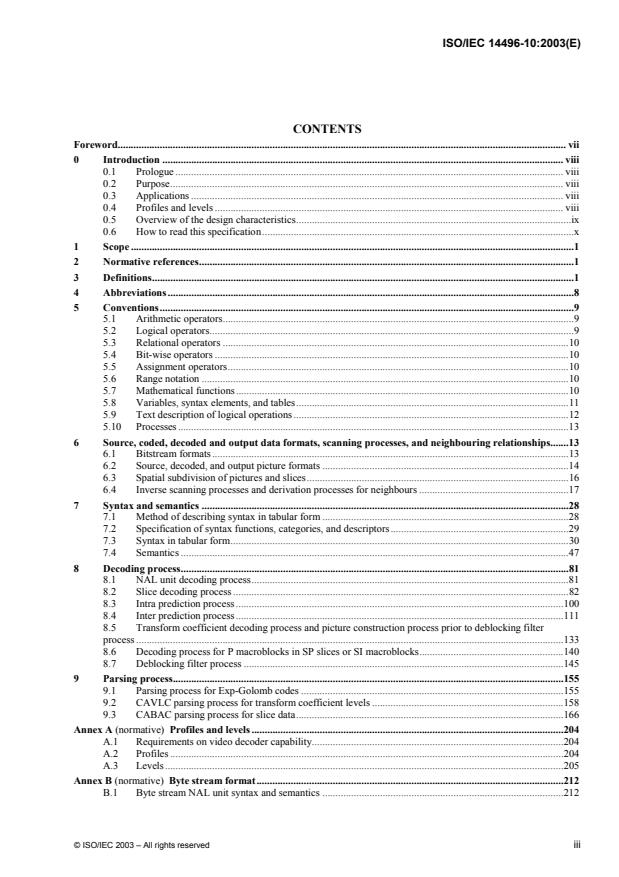
CONTENTS
Foreword. vii
0 Introduction . viii
0.1 Prologue. viii
0.2 Purpose. viii
0.3 Applications. viii
0.4 Profiles and levels . viii
0.5 Overview of the design characteristics.ix
0.6 How to read this specification.x
1 Scope .1
2 Normative references.1
3 Definitions.1
4 Abbreviations .8
5 Conventions.9
5.1 Arithmetic operators.9
5.2 Logical operators.9
5.3 Relational operators.10
5.4 Bit-wise operators.10
5.5 Assignment operators.10
5.6 Range notation.10
5.7 Mathematical functions.10
5.8 Variables, syntax elements, and tables.11
5.9 Text description of logical operations .12
5.10 Processes.13
6 Source, coded, decoded and output data formats, scanning processes, and neighbouring relationships.13
6.1 Bitstream formats.13
6.2 Source, decoded, and output picture formats .14
6.3 Spatial subdivision of pictures and slices.16
6.4 Inverse scanning processes and derivation processes for neighbours .17
7 Syntax and semantics .28
7.1 Method of describing syntax in tabular form .28
7.2 Specification of syntax functions, categories, and descriptors.29
7.3 Syntax in tabular form.30
7.4 Semantics.47
8 Decoding process.81
8.1 NAL unit decoding process.81
8.2 Slice decoding process .82
8.3 Intra prediction process .100
8.4 Inter prediction process .111
8.5 Transform coefficient decoding process and picture construction process prior to deblocking filter
process .133
8.6 Decoding process for P macroblocks in SP slices or SI macroblocks.140
8.7 Deblocking filter process .145
9 Parsing process.155
9.1 Parsing process for Exp-Golomb codes .155
9.2 CAVLC parsing process for transform coefficient levels .158
9.3 CABAC parsing process for slice data.166
Annex A (normative) Profiles and levels .204
A.1 Requirements on video decoder capability.204
A.2 Profiles.204
A.3 Levels.205
Annex B (normative) Byte stream format.212
B.1 Byte stream NAL unit syntax and semantics .212
© ISO/IEC 2003 – All rights reserved iii
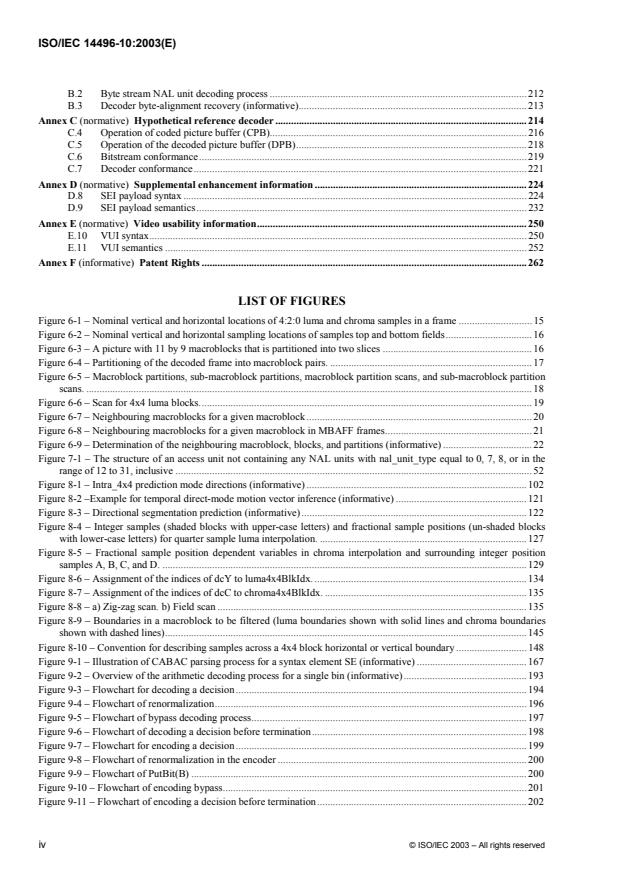
B.2 Byte stream NAL unit decoding process . 212
B.3 Decoder byte-alignment recovery (informative). 213
Annex C (normative) Hypothetical reference decoder . 214
C.4 Operation of coded picture buffer (CPB). 216
C.5 Operation of the decoded picture buffer (DPB). 218
C.6 Bitstream conformance. 219
C.7 Decoder conformance. 221
Annex D (normative) Supplemental enhancement information . 224
D.8 SEI payload syntax . 224
D.9 SEI payload semantics. 232
Annex E (normative) Video usability information. 250
E.10 VUI syntax. 250
E.11 VUI semantics. 252
Annex F (informative) Patent Rights . 262
LIST OF FIGURES
Figure 6-1 – Nominal vertical and horizontal locations of 4:2:0 luma and chroma samples in a frame . 15
Figure 6-2 – Nominal vertical and horizontal sampling locations of samples top and bottom fields. 16
Figure 6-3 – A picture with 11 by 9 macroblocks that is partitioned into two slices . 16
Figure 6-4 – Partitioning of the decoded frame into macroblock pairs. . 17
Figure 6-5 – Macroblock partitions, sub-macroblock partitions, macroblock partition scans, and sub-macroblock partition
scans. . 18
Figure 6-6 – Scan for 4x4 luma blocks. 19
Figure 6-7 – Neighbouring macroblocks for a given macroblock. 20
Figure 6-8 – Neighbouring macroblocks for a given macroblock in MBAFF frames. 21
Figure 6-9 – Determination of the neighbouring macroblock, blocks, and partitions (informative) . 22
Figure 7-1 – The structure of an access unit not containing any NAL units with nal_unit_type equal to 0, 7, 8, or in the
range of 12 to 31, inclusive . 52
Figure 8-1 – Intra_4x4 prediction mode directions (informative) . 102
Figure 8-2 –Example for temporal direct-mode motion vector inference (informative) . 121
Figure 8-3 – Directional segmentation prediction (informative) . 122
Figure 8-4 – Integer samples (shaded blocks with upper-case letters) and fractional sample positions (un-shaded blocks
with lower-case letters) for quarter sample luma interpolation. . 127
Figure 8-5 – Fractional sample position dependent variables in chroma interpolation and surrounding integer position
samples A, B, C, and D. . 129
Figure 8-6 – Assignment of the indices of dcY to luma4x4BlkIdx. . 134
Figure 8-7 – Assignment of the indices of dcC to chroma4x4BlkIdx. . 135
Figure 8-8 – a) Zig-zag scan. b) Field scan . 135
Figure 8-9 – Boundaries in a macroblock to be filtered (luma boundaries shown with solid lines and chroma boundaries
shown with dashed lines). 145
Figure 8-10 – Convention for describing samples across a 4x4 block horizontal or vertical boundary . 148
Figure 9-1 – Illustration of CABAC parsing process for a syntax element SE (informative) . 167
Figure 9-2 – Overview of the arithmetic decoding process for a single bin (informative). 193
Figure 9-3 – Flowchart for decoding a decision . 194
Figure 9-4 – Flowchart of renormalization. 196
Figure 9-5 – Flowchart of bypass decoding process. 197
Figure 9-6 – Flowchart of decoding a decision before termination. 198
Figure 9-7 – Flowchart for encoding a decision . 199
Figure 9-8 – Flowchart of renormalization in the encoder . 200
Figure 9-9 – Flowchart of PutBit(B) . 200
Figure 9-10 – Flowchart of encoding bypass. 201
Figure 9-11 – Flowchart of encoding a decision before termination. 202
iv © ISO/IEC 2003 – All rights reserved
Figure 9-12 – Flowchart of flushing at termination .202
Figure C-1 – Structure of byte streams and NAL unit streams for HRD conformance checks.214
Figure C-2 – HRD buffer model .215
Figure E-1 – Location of chroma samples for top and bottom fields as a function of chroma_sample_loc_type_top_field
and chroma_sample_loc_type_bottom_field .257
LIST OF TABLES
Table 6-1 – ChromaFormatFactor values.14
Table 6-2 – Specification of input and output assignments for subclauses 6.4.7.1 to 6.4.7.5.21
Table 6-3 – Specification of mbAddrN.25
Table 6-4 - Specification of mbAddrN and yM .27
Table 7-1 – NAL unit type codes.48
Table 7-2 – Meaning of primary_pic_type .58
Table 7-3 – Name association to slice_type.61
Table 7-4 – reordering_of_pic_nums_idc operations for reordering of reference picture lists.66
Table 7-5 – Interpretation of adaptive_ref_pic_marking_mode_flag .68
Table 7-6 – Memory management control operation (memory_management_control_operation) values .68
Table 7-7 – Allowed collective macroblock types for slice_type .70
Table 7-8 – Macroblock types for I slices.71
Table 7-9 – Macroblock type with value 0 for SI slices .72
Table 7-10 – Macroblock type values 0 to 4 for P and SP slices .73
Table 7-11 – Macroblock type values 0 to 22 for B slices.74
Table 7-12 – Specification of CodedBlockPatternChroma values.75
Table 7-13 – Relationship between intra_chroma_pred_mode and spatial prediction modes .76
Table 7-14 – Sub-macroblock types in P macroblocks.77
Table 7-15 – Sub-macroblock types in B macroblocks .78
Table 8-1 – Refined slice group map type .86
Table 8-2 – Specification of Intra4x4PredMode[ luma4x4BlkIdx ] and associated names .101
Table 8-3 – Specification of Intra16x16PredMode and associated names.107
Table 8-4 – Specification of Intra chroma prediction modes and associated names.109
Table 8-5 – Specification of the variable colPic .115
Table 8-6 – Specification of PicCodingStruct( X ) .116
Table 8-7 – Specification of mbAddrCol, yM, and vertMvScale .117
Table 8-8 – Assignment of prediction utilization flags.119
Table 8-9 – Derivation of the vertical component of the chroma vector in field coding mode.124
Table 8-10 – Differential full-sample luma locations .127
Table 8-11 – Assignment of the luma prediction sample predPartLX [ x , y ].129
L L L
Table 8-12 – Specification of mapping of idx to c for zig-zag and field scan .136
ij
Table 8-13 – Specification of QP as a function of qP .136
C I
Table 8-14 – Derivation of indexA and indexB from offset dependent threshold variables α and β .152
Table 8-15 – Value of filter clipping variable t as a function of indexA and bS.153
C0
Table 9-1 – Bit strings with “prefix” and “suffix” bits and assignment to codeNum ranges (informative).155
Table 9-2 – Exp-Golomb bit strings and codeNum in explicit form and used as ue(v) (informative).156
Table 9-3 – Assignment of syntax element to codeNum for signed Exp-Golomb coded syntax elements se(v).156
Table 9-4 – Assignment of codeNum to values of coded_block_pattern for macroblock prediction modes.157
Table 9-5 – coeff_token mapping to TotalCoeff( coeff_token ) and TrailingOnes( coeff_token ).160
Table 9-6 – Codeword table for level_prefix .163
Table 9-7 – total_zeros tables for 4x4 blocks with TotalCoeff( coeff_token ) 1 to 7 .164
Table 9-8 – total_zeros tables for 4x4 blocks with TotalCoeff( coeff_token ) 8 to 15 .164
Table 9-9 – total_zeros tables for chroma DC 2x2 blocks .165
© ISO/IEC 2003 – All rights reserved v
Table 9-10 – Tables for run_before. 165
Table 9-11 – Association of ctxIdx and syntax elements for each slice type in the initialisation process. 168
Table 9-12 – Values of variables m and n for ctxIdx from 0 to 10. 169
Table 9-13 – Values of variables m and n for ctxIdx from 11 to 23. 169
Table 9-14 – Values of variables m and n for ctxIdx from 24 to 39. 169
Table 9-15 – Values of variables m and n for ctxIdx from 40 to 53. 169
Table 9-16 – Values of variables m and n for ctxIdx from 54 to 59. 170
Table 9-17 – Values of variables m and n for ctxIdx from 60 to 69. 170
Table 9-18 – Values of variables m and n for ctxIdx from 70 to 104. 170
Table 9-19 – Values of variables m and n for ctxIdx from 105 to 165. 171
Table 9-20 – Values of variables m and n for ctxIdx from 166 to 226. 172
Table 9-21 – Values of variables m and n for ctxIdx from 227 to 275. 173
Table 9-22 – Values of variables m and n for ctxIdx from 277 to 337. 174
Table 9-23 – Values of variables m and n for ctxIdx from 338 to 398. 175
Table 9-24 – Syntax elements and associated types of binarization, maxBinIdxCtx, and ctxIdxOffset . 177
Table 9-25 – Bin string of the unary binarization (informative). 178
Table 9-26 – Binarization for macroblock types in I slices . 180
Table 9-27 – Binarization for macroblock types in P, SP, and B slices . 181
Table 9-28 – Binarization for sub-macroblock types in P, SP, and B slices. 182
Table 9-29 – Assignment of ctxIdxInc to binIdx for all ctxIdxOffset values except those related to the syntax elements
coded_block_flag, significant_coeff_flag, last_significant_coeff_flag, and coeff_abs_level_minus1 . 184
Table 9-30 – Assignment of ctxIdxBlockCatOffset to ctxBlockCat for syntax elements coded_block_flag,
significant_coeff_flag, last_significant_coeff_flag, and coeff_abs_level_minus1. 185
Table 9-31 – Specification of ctxIdxInc for specific values of ctxIdxOffset and binIdx. 191
Table 9-32 – Specification of ctxBlockCat for the different blocks . 192
Table 9-33 – Specification of rangeTabLPS depending on pStateIdx and qCodIRangeIdx.195
Table 9-34 – State transition table. 196
Table A-1 – Level limits. 207
Table A-2 – Baseline profile level limits. 208
Table A-3 – Main profile level limits . 209
Table A-4 – Extended profile level limits . 209
Table A-5 – Maximum frame rates (frames per second) for some example frame sizes. 210
Table D-1 – Interpretation of pic_struct . 233
Table D-2 – Mapping of ct_type to source picture scan. 234
Table D-3 – Definition of counting_type values . 234
Table D-4 – scene_transition_type values. 242
Table E-1 – Meaning of sample aspect ratio indicator . 252
Table E-2 – Meaning of video_format . 253
Table E-3 – Colour primaries . 254
Table E-4 – Transfer characteristics . 255
Table E-5 – Matrix coefficients. 256
Table E-6 – Divisor for computation of ∆t ( n ) . 258
fi,dpb
Table F-1 – Organisations providing patent rights licensing notices. 262
vi © ISO/IEC 2003 – All rights reserved
Foreword
ISO (the International Organization for Standardization) and IEC (the International Electrotechnical Commission) form
the specialized system for worldwide standardization. National bodies that are members of ISO or IEC participate in the
development of International Standards through technical committees established by the respective organization to deal
with particular fields of technical activity. ISO and IEC technical committees collaborate in fields of mutual interest.
Other international organizations, governmental and non-governmental, in liaison with ISO and IEC, also take part in the
work. In the field of information technology, ISO and IEC have established a joint technical committee, ISO/IEC JTC 1.
International Standards are drafted in accordance with the rules given in the ISO/IEC Directives, Part 2.
The main task of the joint technical committee is to prepare International Standards. Draft International Standards
adopted by the joint technical committee are circulated to national bodies for voting. Publication as an International
Standard requires approval by at least 75 % of the national bodies casting a vote.
ISO/IEC 14496-10 was prepared by Joint Technical Committee ISO/IEC JTC 1, Information technology, Subcommittee
SC 29, Coding of audio, picture, multimedia and hypermedia information.
This part of ISO/IEC 14496 is technically aligned with ITU-T Rec. H.264 but is not published as identical text.
ISO/IEC 14496 consists of the following parts, under the general title Information technology — Coding of audio-visual
objects:
Part 1: Systems
Part 2: Visual
Part 3: Audio
Part 4: Conformance testing
Part 5: Reference software
Part 6: Delivery Multimedia Integration Framework (DMIF)
Part 7: Optimized reference software for coding of audio-visual objects
Part 8: Carriage of ISO/IEC 14496 contents over IP networks
Part 9: Reference hardware description
Part 10: Advanced video coding
Part 11: Scene description and application engine
Part 12: ISO base media file format
Part 13: Intellectual Property Management and Protection (IPMP) extensions
Part 14: MP4 file format
Part 15: Advanced Video Coding (AVC) file format
Part 16: Animation Framework eXtension (AFX)
© ISO/IEC 2003 – All rights reserved vii
0 Introduction
This clause does not form an integral part of this Recommendation | International Standard.
0.1 Prologue
This subclause does not form an integral part of this Recommendation | International Standard.
As the costs for both processing power and memory have reduced, network support for coded video data has diversified,
and advances in video coding technology have progressed, the need has arisen for an industry standard for compressed
video representation with substantially increased coding efficiency and enhanced robustness to network environments.
Toward these ends the ITU-T Video Coding Experts Group (VCEG) and the ISO/IEC Moving Picture Experts Group
(MPEG) formed a Joint Video Team (JVT) in 2001 for development of a new Recommendation | International Standard.
0.2 Purpose
This subclause does not form an integral part of this Recommendation | International Standard.
This Recommendation | International Standard was developed in response to the growing need for higher compression of
moving pictures for various applications such as videoconferencing, digital storage media, television broadcasting,
internet streaming, and communication. It is also designed to enable the use of the coded video representation in a
flexible manner for a wide variety of network environments. The use of this Recommendation | International Standard
allows motion video to be manipulated as a form of computer data and to be stored on various storage media, transmitted
and received over existing and future networks and distributed on existing and future broadcasting channels.
0.3 Applications
This subclause does not form an integral part of this Recommendation | International Standard.
This Recommendation | International Standard is designed to cover a broad range of applications for video content
including but not limited to the following:
CATV Cable TV on optical networks, copper, etc.
DBS Direct broadcast satellite video services
DSL Digital subscriber line video services
DTTB Digital terrestrial television broadcasting
ISM Interactive storage media (optical disks, etc.)
MMM Multimedia mailing
MSPN Multimedia services over packet networks
RTC Real-time conversational services (videoconferencing, videophone, etc.)
RVS Remote video surveillance
SSM Serial storage media (digital VTR, etc.)
0.4 Profiles and levels
This subclause does not form an integral part of this Recommendation | International Standard.
This Recommendation | International Standard is designed to be generic in the sense that it serves a wide range of
applications, bit rates, resolutions, qualities, and services. Applications should cover, among other things, digital storage
media, television broadcasting and real-time communications. In the course of creating this Specification, various
requirements from typical applications have been considered, necessary algorithmic elements have been developed, and
these have been integrated into a single syntax. Hence, this Specification will facilitate video data interchange among
different applications.
Considering the practicality of implementing the full syntax of this Specification, however, a limited number of subsets
of the syntax are also stipulated by means of "profiles" and "levels". These and other related terms are formally defined in
clause 3.
A "profile" is a subset of the entire bitstream syntax that is specified by this Recommendation | International Standard.
Within the bounds imposed by the syntax of a given profile it is still possible to require a very large variation in the
viii © ISO/IEC 2003 – All rights reserved
performance of encoders and decoders depending upon the values taken by syntax elements in the bitstream such as the
specified size of the decoded pictures. In many applications, it is currently neither practical nor economic to implement a
decoder capable of dealing with all hypothetical uses of the syntax within a particular profile.
In order to deal with this problem, "levels" are specified within each profile. A level is a specified set of constraints
imposed on values of the syntax elements in the bitstream. These constraints may be simple limits on values.
Alternatively they may take the form of constraints on arithmetic combinations of values (e.g. picture width multiplied by
picture height multiplied by number of pictures decoded per second).
Coded video content conforming to this Recommendation | International Standard uses a common syntax. In order to
achieve a subset of the complete syntax, flags, parameters, and other syntax elements are included in the bitstream that
signal the presence or absence of syntactic elements that occur later in the bitstream.
0.5 Overview of the design characteristics
This subclause does not form an integral part of this Recommendation | International Standard.
The coded representation specified in the syntax is designed to enable a high compression capability for a desired image
quality. The algorithm is not lossless, as the exact source sample values are typically not preserved through the encoding
and decoding processes. A number of techniques may be used to achieve highly efficient compression. Encoding
algorithms (not specified in this Recommendation | International Standard) may select between inter and intra coding for
block-shaped regions of each picture. Inter coding uses motion vectors for block-based inter prediction to exploit
temporal statistical dependencies between different pictures. Intra coding uses various spatial prediction modes to exploit
spatial statistical dependencies in the source signal for a single picture. Motion vectors and intra prediction modes may be
specified for a variety of block sizes in the picture. The prediction residual is then further compressed using a transform
to remove spatial correlation inside the transform block before it is quantised, producing an irreversible process that
typically discards less important visual information while forming a close approximation to the source samples. Finally,
the motion vectors or intra prediction modes are combined with the quantised transform coefficient information and
encoded using either variable length codes or arithmetic coding.
0.5.1 Predictive coding
This subclause does not form an integral part of this Recommendation | International Standard.
Because of the conflicting requirements of random access and highly efficient compression, two main coding types are
specified. Intra coding is done without reference to other pictures. Intra coding may provide access points to the coded
sequence where decoding can begin and continue correctly, but typically also shows only moderate compression
efficiency. Inter coding (predictive or bi-predictive) is more efficient using inter prediction of each block of sample
values from some previously decoded picture selected by the encoder. In contrast to some other video coding standards,
pictures coded using bi-predictive inter prediction may also be used as references for inter coding of other pictures.
The application of the three coding types to pictures in a sequence is flexible, and the order of the decoding process is
generally not the same as the order of the source picture capture process in the encoder or the output order from the
decoder for display. The choice is left to the encoder and will depend on the requirements of the application. The
decoding order is specified such that the decoding of pictures that use inter-picture prediction follows later in decoding
order than other pictures that are referenced in the decoding process.
0.5.2 Coding of progressive and interlaced video
This subclause does not form an integral part of this Recommendation | International Standard.
This Recommendation | International Standard specifies a syntax and decoding process for video that originated in either
progressive-scan or interlaced-scan form, which may be mixed together in the same sequence. The two fields of an
interlaced frame are separated in capture time while the two fields of a progressive frame share the same capture time.
Each field may be coded separately or the two fields may be coded together as a frame. Progressive frames are typically
coded as a frame. For interlaced video, the encoder can choose between frame coding and field coding. Frame coding or
field coding can be adaptively selected on a picture-by-picture basis and also on a more localized basis within a coded
frame. Frame coding is typically preferred when the video scene contains significant detail with limited motion. Field
coding typically works better when there is fast picture-to-picture motion.
0.5.3 Picture partitioning into macroblocks and smaller partitions
This subclause does not form an integral part of this Recommendation | International Standard.
© ISO/IEC 2003 – All rights reserved ix
As in previous video coding Recommendations and International Standards, a macroblock, consisting of a 16x16 block
of luma samples and two corresponding blocks of chroma samples, is used as the basic processing unit of the video
decoding process.
A macroblock can be further partitioned for inter prediction. The selection of the size of inter prediction partitions is a
result of a trade-off between the coding gain provided by using motion compensation with smaller blocks and the
quantity of data needed to represent the data for motion compensation. In this Recommendation | International Standard
the inter prediction process can form segmentations for motion representation as small as 4x4 luma samples in size, using
motion vector accuracy of one-quarter of the luma sample grid spacing displacement. The process for inter prediction of
a sample block can also involve the selection of the picture to be used as the reference picture from a number of stored
previously-decoded pictures. Motion vectors are encoded differentially with respect to predicted values formed from
nearby encoded motion vectors.
Typically, the encoder calculates appropriate motion vectors and other data elements represented in the video data
stream. This motion estimation process in the encoder and the selection of whether to use inter prediction for the
representation of each region of the video content is not specified in this Recommendation | International Standard.
0.5.4 Spatial redundancy reduction
Th
...
Questions, Comments and Discussion
Ask us and Technical Secretary will try to provide an answer. You can facilitate discussion about the standard in here.
Loading comments...