

ISO 1552:1976
(Main)Liquid chlorine for industrial use — Method of sampling (for determining only the volumetric chlorine content)
General Information
- Abstract
The method is applicable when an agreement has previously been reached between the interested parties for the removal of two representative samples during filling of the tank-wagon at the manufacturer's premises. It cannot be applied when it is intended to determine the water content. The principle consists in checking that the equipment used is gas-tight; collection of the samples in steel bottles. One bottle is intended for the customer and the other is retained by the manufacturer in case an analysis is required for checking purposes. - Replaces ISO Recommendation R 1552-1970.
- Status
- Published
- Publication Date
- 31-Mar-1976
- Technical Committee
- ISO/TC 47 - Chemistry
- Drafting Committee
- ISO/TC 47 - Chemistry
- Current Stage
- 9093 - International Standard confirmed
- Start Date
- 20-Oct-2023
- Completion Date
- 29-Aug-2026
Buy Documents


ISO 1552:1976 - Liquid chlorine for industrial use -- Method of sampling (for determining only the volumetric chlorine content)
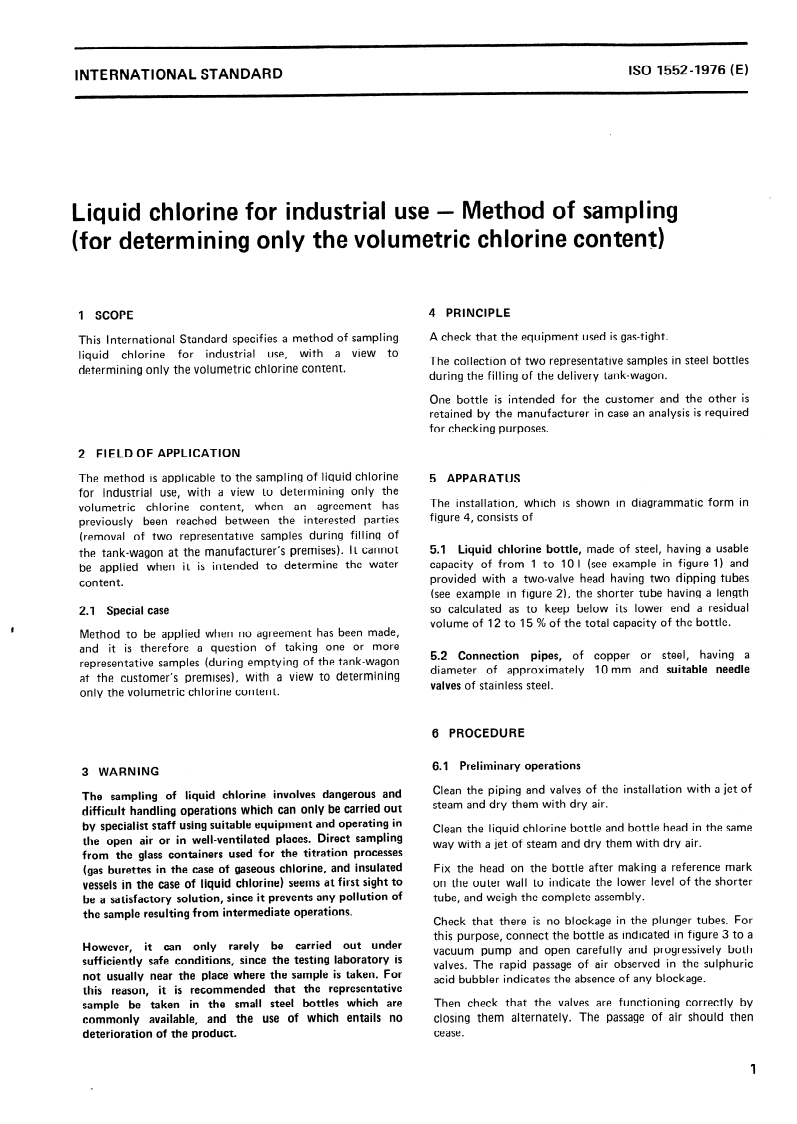
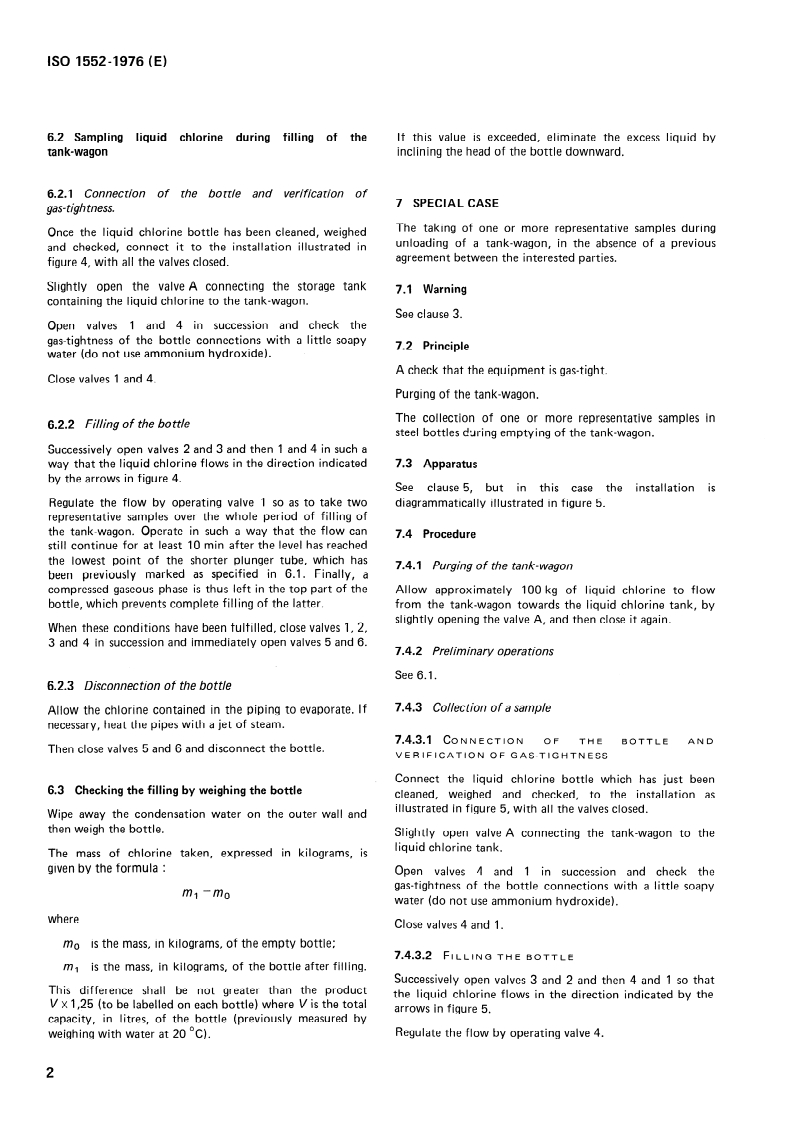
ISO 1552:1976 - Liquid chlorine for industrial use — Method of sampling (for determining only the volumetric chlorine content)/1/1976

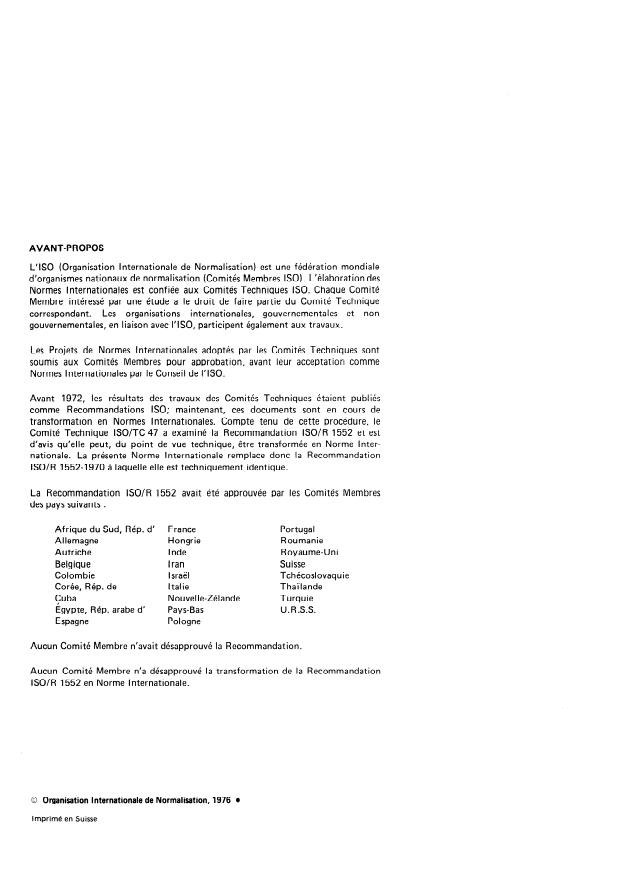

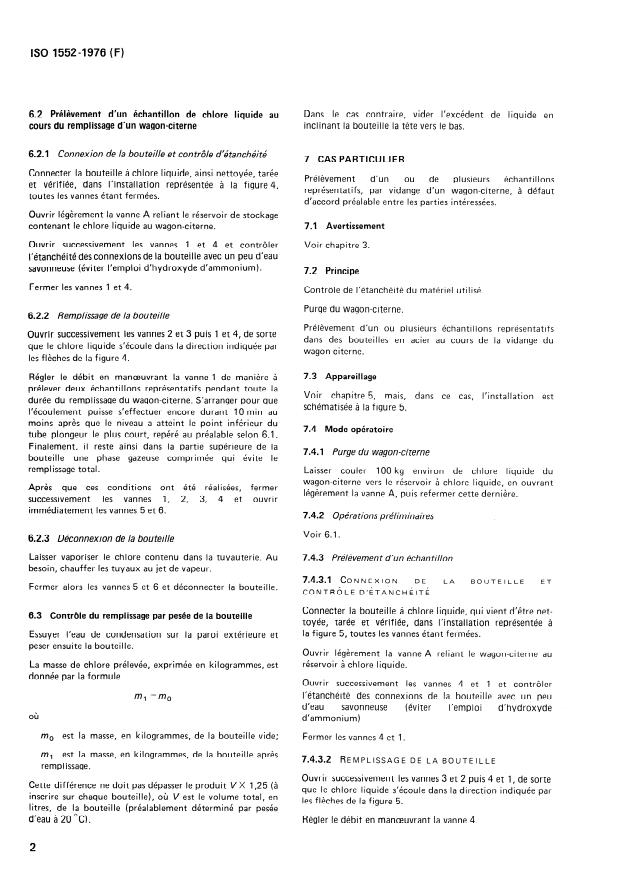
ISO 1552:1976 - Chlore liquide a usage industriel -- Méthode d'échantillonnage (en vue uniquement de la détermination du titre volumétrique en chlore)


ISO 1552:1976 - Chlore liquide a usage industriel -- Méthode d'échantillonnage (en vue uniquement de la détermination du titre volumétrique en chlore)
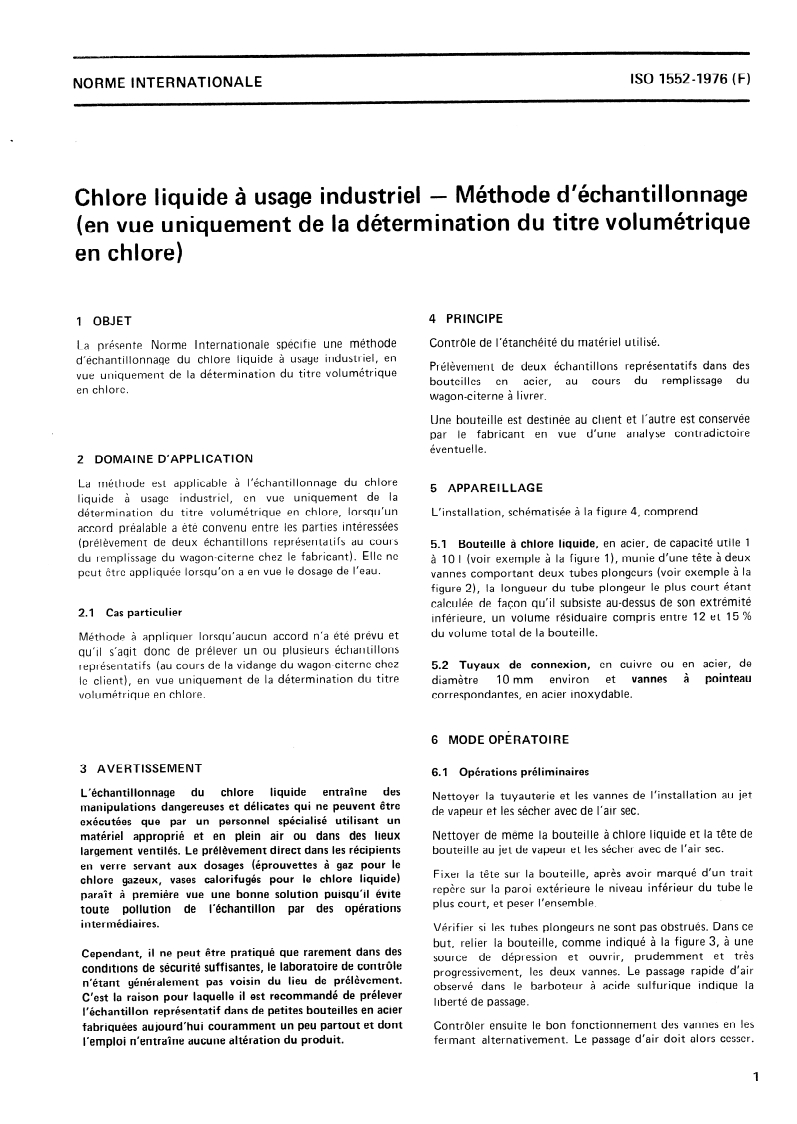
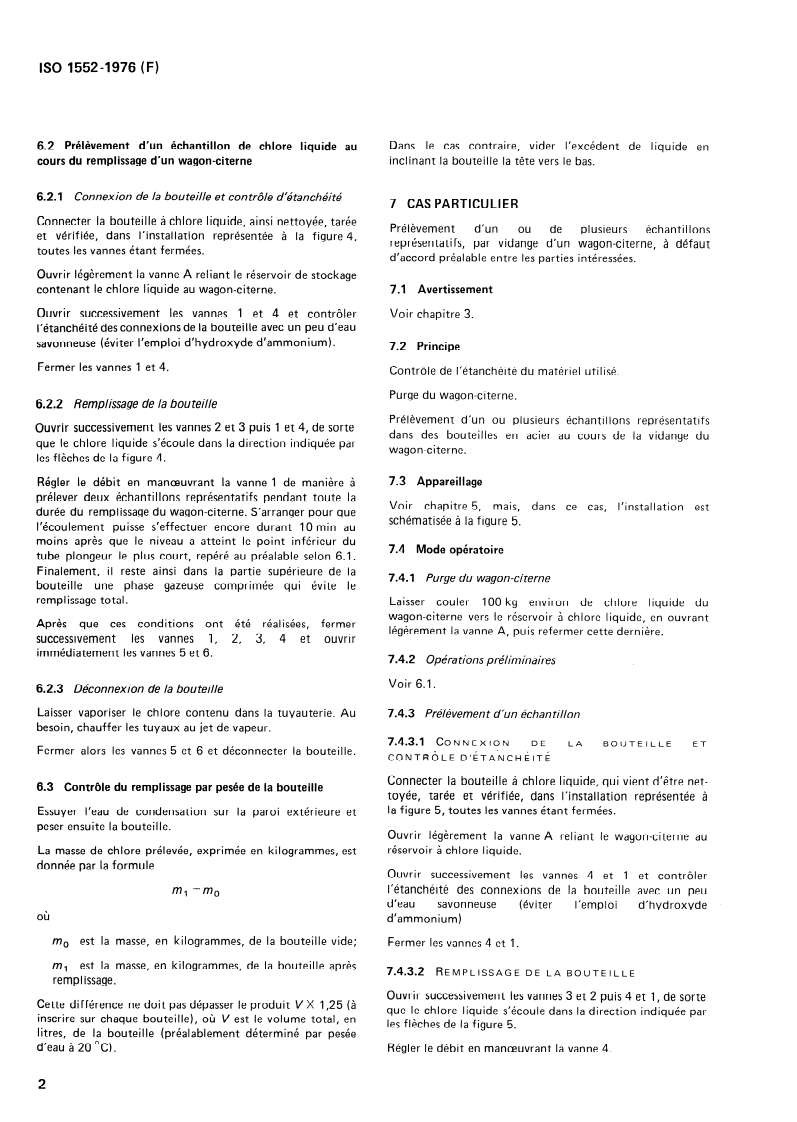
ISO 1552:1976 - Chlore liquide à usage industriel — Méthode d'échantillonnage (en vue uniquement de la détermination du titre volumétrique en chlore)/1/1976
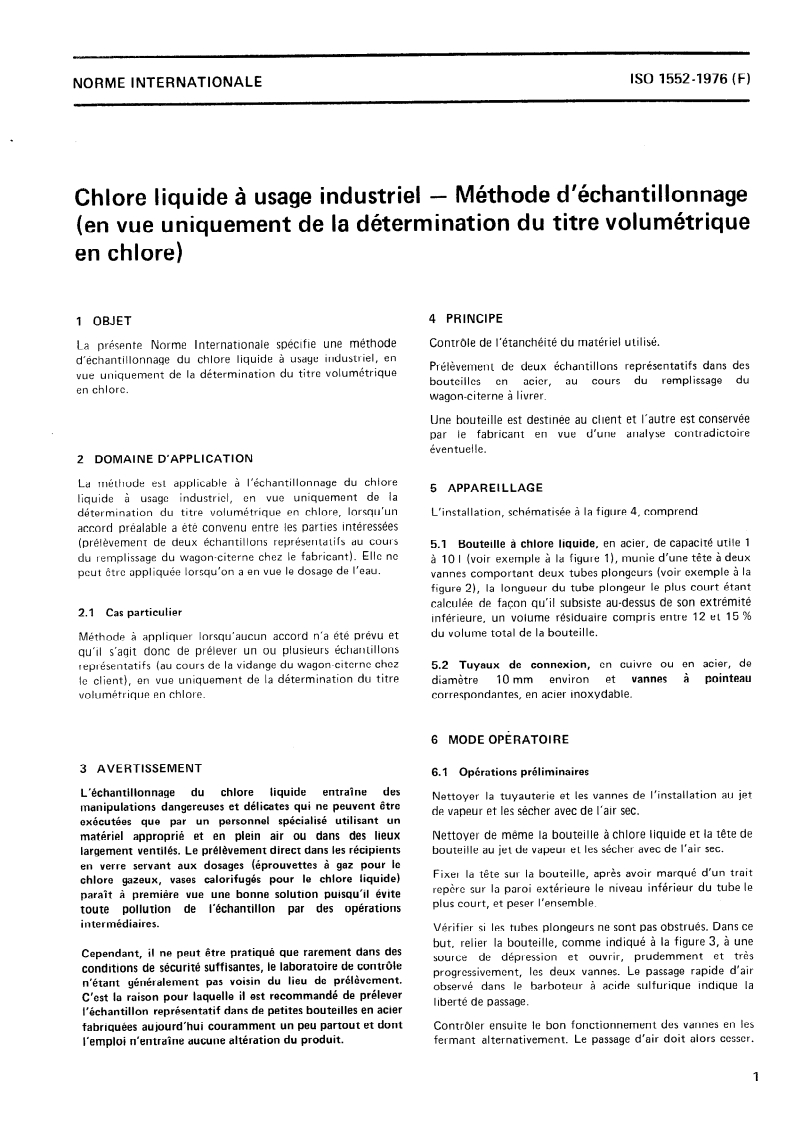
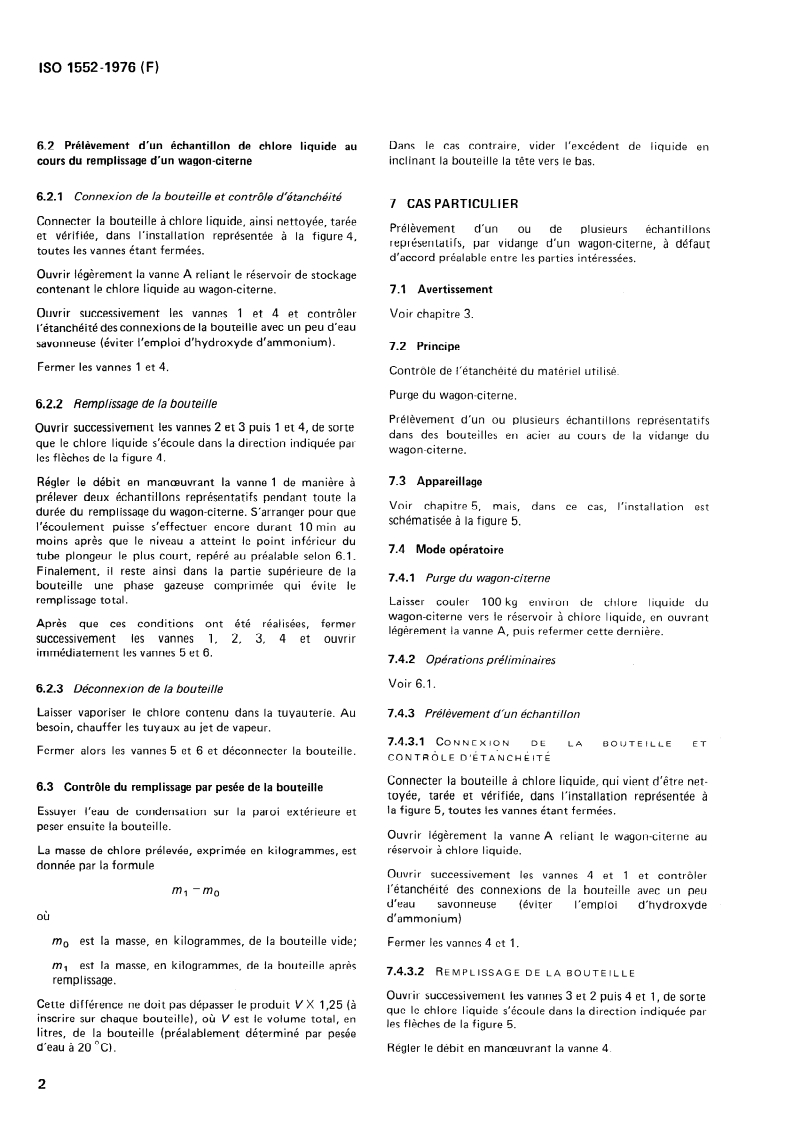
ISO 1552:1976 - Chlore liquide à usage industriel — Méthode d'échantillonnage (en vue uniquement de la détermination du titre volumétrique en chlore)/1/1976
Overview
ISO 1552:1976 - "Liquid chlorine for industrial use - Method of sampling (for determining only the volumetric chlorine content)" specifies a controlled procedure for taking representative liquid-chlorine samples during transfer to or from tank-wagons. The standard applies only when the sampling is intended to determine volumetric chlorine content (not water content) and assumes prior agreement between parties to take two representative samples during filling at the manufacturer's premises.
Key topics and technical requirements
- Purpose: Sampling method to obtain representative samples for volumetric chlorine analysis; one sample for the customer and one retained by the manufacturer for dispute checks.
- Applicability: Only for volumetric chlorine determination; a special-case procedure exists for sampling during wagon emptying if no prior agreement was made.
- Sample containers: Steel sample bottles with a useful capacity of 1 to 10 L, fitted with a two-valve head and two dip tubes. The shorter dip tube is dimensioned so a residual gas phase of about 12–15% of bottle volume remains (prevents complete liquid fill).
- Equipment & connections: Copper or steel connecting hoses (~10 mm), needle valves and associated stainless-steel fittings; provision for safe venting to a scrubber or degassing hood.
- Leak and integrity checks: Verify gas-tightness of the sampling system and bottle heads (soap solution checks, acid-sulphuric bubbler evidence) before sampling.
- Cleaning & preparation: Clean piping and bottles with steam and dry with dry air prior to sampling.
- Filling control: Samples are normally taken during wagon filling; bottle filling is controlled and checked by weighing (to determine mass of chlorine sampled). Flow should continue for at least 10 minutes after the liquid level reaches the lower end of the short dip tube to ensure representative sampling.
- Record keeping: A sampling protocol (procès-verbal) must document method reference, any special circumstances, and any deviations or optional operations performed.
Applications and users
ISO 1552:1976 is used by:
- Chlorine manufacturers and plant quality departments for standardized sampling during loading of tank-wagons.
- Transport operators and logistics teams handling industrial liquid chlorine.
- Industrial users and procurement/quality teams receiving chlorine deliveries who require an independent sample.
- Analytical and quality-control laboratories performing volumetric chlorine determinations.
- Safety and compliance officers managing safe sampling procedures and record-keeping.
This standard supports reliable, reproducible sampling practices that reduce disputes over delivered chlorine concentration while emphasizing safety and leak-tight handling.
Related standards
- ISO 2120 - Determination of volumetric chlorine content (gravimetric method for gasified product)
- ISO 2121 - Water determination (related dosing methods)
- ISO 2202 - Water determination using an electrolytic titrator
Keywords: ISO 1552:1976, liquid chlorine sampling, volumetric chlorine content, tank-wagon sampling, steel sample bottles, gas-tight sampling, industrial chlorine.
Relations
- Referred By
EN 937:2009 - Chemicals used for treatment of water intended for human consumption - Chlorine - Effective Date
- 25-Aug-2026
- Referred By
EN 937:2016 - Chemicals used for treatment of water intended for human consumption - Chlorine - Effective Date
- 25-Aug-2026
Buy Documents
ISO 1552:1976 - Liquid chlorine for industrial use -- Method of sampling (for determining only the volumetric chlorine content)
ISO 1552:1976 - Liquid chlorine for industrial use — Method of sampling (for determining only the volumetric chlorine content)/1/1976
ISO 1552:1976 - Chlore liquide a usage industriel -- Méthode d'échantillonnage (en vue uniquement de la détermination du titre volumétrique en chlore)
ISO 1552:1976 - Chlore liquide a usage industriel -- Méthode d'échantillonnage (en vue uniquement de la détermination du titre volumétrique en chlore)
ISO 1552:1976 - Chlore liquide à usage industriel — Méthode d'échantillonnage (en vue uniquement de la détermination du titre volumétrique en chlore)/1/1976
ISO 1552:1976 - Chlore liquide à usage industriel — Méthode d'échantillonnage (en vue uniquement de la détermination du titre volumétrique en chlore)/1/1976
Get Certified
Connect with accredited certification bodies for this standard

ECOCERT
Organic and sustainability certification.

Eurofins Food Testing Global
Global leader in food, environment, and pharmaceutical product testing.

Intertek Bangladesh
Intertek certification and testing services in Bangladesh.
Sponsored listings
Frequently Asked Questions
ISO 1552:1976 is a standard published by the International Organization for Standardization (ISO). Its full title is "Liquid chlorine for industrial use — Method of sampling (for determining only the volumetric chlorine content)". This standard covers: The method is applicable when an agreement has previously been reached between the interested parties for the removal of two representative samples during filling of the tank-wagon at the manufacturer's premises. It cannot be applied when it is intended to determine the water content. The principle consists in checking that the equipment used is gas-tight; collection of the samples in steel bottles. One bottle is intended for the customer and the other is retained by the manufacturer in case an analysis is required for checking purposes. - Replaces ISO Recommendation R 1552-1970.
The method is applicable when an agreement has previously been reached between the interested parties for the removal of two representative samples during filling of the tank-wagon at the manufacturer's premises. It cannot be applied when it is intended to determine the water content. The principle consists in checking that the equipment used is gas-tight; collection of the samples in steel bottles. One bottle is intended for the customer and the other is retained by the manufacturer in case an analysis is required for checking purposes. - Replaces ISO Recommendation R 1552-1970.
ISO 1552:1976 is classified under the following ICS (International Classification for Standards) categories: 71.060.10 - Chemical elements. The ICS classification helps identify the subject area and facilitates finding related standards.
ISO 1552:1976 has the following relationships with other standards: It is inter standard links to EN 937:2009, EN 937:2016. Understanding these relationships helps ensure you are using the most current and applicable version of the standard.
ISO 1552:1976 is available in PDF format for immediate download after purchase. The document can be added to your cart and obtained through the secure checkout process. Digital delivery ensures instant access to the complete standard document.
Standards Content (Sample)
INTERNATIONAL STANDARD
INTERNATIONAL ORGANIZATION FOR STANDARDIZATION .MEXflYHAPOflHAfl OPI-AHM3AUMR l-IO CTAH~APTM3ALWl -ORGANISATION INTERNATIONALE DE NORMALISATION
Liquid chlorine for industrial use - Method of sampling
(for determining only the volumetric chlorine content)
.
Chlore liquide a usage industriel - M6 th ode d%chan tillonnage (en vue uniquemen t de Ia db termina tion
du titre volumbtrique en chlore)
First edition - 1976-04-15
~~
Ref. No. ISO 1552-1976 (E)
UDC 661.41 : 543.05
Descriptors : liquefied gases, chlorine, sampling, determination of content, voiumetric analysis.
Price based on 6 pages
FOREWORD
ISO (the International Organization for Standardization) is a worldwide federation
of national Standards institutes (ISO Member Bodies). The work of developing
International Standards is carried out through ISO Technical Committees. Every
Member Body interested in a subject for which a Technical Committee has been set
up has the right to be represented on that Committee. International organizations,
governmental and non-governmental, in liaison with ISO, also take part in the work.
Draft International Standards adopted by the Technical Committees are circulated
to the Member Bodies for approval before their acceptance as International
Standards by the ISO Council.
Prior to 1972, the results of the work of the Technical Committees were published
as ISO Recommendations; these documents are now in the process of being trans-
formed into International Standards. As part of this process, Technical Committee
ISO/TC 47 has reviewed ISO Recommendation R 1552 and found it technically
suitable for transformation. International Standard ISO 1552 therefore replaces
ISO Recommendation R 1552-1970 to which it is technically identical.
ISO Recommendation R 1552 was approved by the Member Bodies of the
following countries :
Austria India Romania
Belgium Iran South Africa, Rep. of
Colombia Israel Spain
Cuba I taly Switzerland
Czechoslovakia Korea, Rep. of Thailand
Egypt, Arab Rep. of Netherlands Turkey
France New Zealand United Kingdom
Germany Poland U.S.S.R.
Hungary Portugal
No Member Body expressed disapproval of the Recommendation.
No Member Body disapproved the transformation of lSO/R 1552 into an Inter-
national Standard.
0 International Organkation for Standardkation, 1976 l
Printed in Switzerland
ISO 15524976 (E)
INTERNATIONAL STANDARD
Liquid chlorine for industrial use - Method of sampling
(for determining only the volumetric chlorine content)
.
4 PRINCIPLE
1 SCOPE
A check that the equipment used is gas-tight.
This International Standard specifies a method of sampling
liquid chlorine for industrial use, with a view to
The collection of two representative samples in steel bottles
determining only the volumetric chlorine content.
during the filling of the delivery tank-wagon.
One bottle is intended for the customer and the other is
retained by the manufacturer in case an analysis is required
for checking purposes.
2 FIELD OF APPLICATION
The method is applicable to the sampling of liquid chlorine
5 APPARATUS
for industrial use, with a view to determining only the
The installation, which is shown in diagrammatic form in
volumetric chlorine content, when an agreement has
figure 4, consists of
previously been reached between the interested Parties
(removal of two representative samples during filling of
5.1 Liquid chlorine bottle, made of steel, having a usable
the tank-wagen at the manufacturer’s premises). lt cannot
capacity of from 1 to 10 I (see example in figure 1) and
be applied when it is intended to determine the water
provided with a two-valve head having two dipping tubes
content.
(see example in figure 2), the shorter tube having a length
2.1 Special case so calculated as to keep below its lower end a residual
volume of 12 to 15 % of the total capacity of the bottle.
Method to be applied when no agreement has been made,
and it is therefore a question of taking one or more
5.2 Connection pipes, of topper or steel, having a
representative samples (during emptying of the tank-wagon
diameter of approximately 10 mm and suitable needle
at the customer’s premises), with a view to determining
valves of stainless steel.
only the volumetric chlorine content.
6 PROCEDURE
6.1 Preliminary operations
3 WARNING
Clean the piping and valves of the installation with a jet of
The sampling of liquid chlorine involves dangerous and
steam and dry them with dry air.
difficult handling operations which tan only be carried out
by specialist staff using suitable equipment and operating in
Clean the liquid chlorine bottle and bottle head in the same
the open air or in weil-ventilated places. Direct sampling
way with a jet of steam and dry them with dry air.
from the glass Containers used for the titration processes
Fix the head on the bottle after making a reference mark
(gas burettes in the case of gaseous chlorine, and insulated
on the outer wall to indicate the lower level of the shorter
vessels in the case of liquid chlorine) seems at first sight to
tube, and weigh the complete assembly.
be a satisfactory Solution, since it prevents any pollution of
the Sample resulting from intermediate operations.
Check that there is no blockage in the plunger tubes. For
this purpose, connect the bottle as indicated in figure 3 to a
However, it tan only rarely be carried out under
vacuum pump and open carefully and progressively both
sufficiently safe conditions, since the testing laboratory is
valves. The rapid passage of air observed in the sulphuric
not usually near the place where the Sample is taken. For
acid bubbler indicates the absence of any blockage.
this reason, it is recommended that the representative
Then check that the valves are functioning correctly by
Sample be taken in the small steel bottles which are
closing them alternately. The passage of air should then
commonly available, and the use of which entails no
deterioration of the product. cease.
ISO 1552-1976(E)
6.2 Sampling liquid chlorine during filling If this value is exceeded, eliminate the excess liquid by
inclining the head of the bottle downw
...
INTERNATIONAL STANDARD
INTERNATIONAL ORGANIZATION FOR STANDARDIZATION .MEXflYHAPOflHAfl OPI-AHM3AUMR l-IO CTAH~APTM3ALWl -ORGANISATION INTERNATIONALE DE NORMALISATION
Liquid chlorine for industrial use - Method of sampling
(for determining only the volumetric chlorine content)
.
Chlore liquide a usage industriel - M6 th ode d%chan tillonnage (en vue uniquemen t de Ia db termina tion
du titre volumbtrique en chlore)
First edition - 1976-04-15
~~
Ref. No. ISO 1552-1976 (E)
UDC 661.41 : 543.05
Descriptors : liquefied gases, chlorine, sampling, determination of content, voiumetric analysis.
Price based on 6 pages
FOREWORD
ISO (the International Organization for Standardization) is a worldwide federation
of national Standards institutes (ISO Member Bodies). The work of developing
International Standards is carried out through ISO Technical Committees. Every
Member Body interested in a subject for which a Technical Committee has been set
up has the right to be represented on that Committee. International organizations,
governmental and non-governmental, in liaison with ISO, also take part in the work.
Draft International Standards adopted by the Technical Committees are circulated
to the Member Bodies for approval before their acceptance as International
Standards by the ISO Council.
Prior to 1972, the results of the work of the Technical Committees were published
as ISO Recommendations; these documents are now in the process of being trans-
formed into International Standards. As part of this process, Technical Committee
ISO/TC 47 has reviewed ISO Recommendation R 1552 and found it technically
suitable for transformation. International Standard ISO 1552 therefore replaces
ISO Recommendation R 1552-1970 to which it is technically identical.
ISO Recommendation R 1552 was approved by the Member Bodies of the
following countries :
Austria India Romania
Belgium Iran South Africa, Rep. of
Colombia Israel Spain
Cuba I taly Switzerland
Czechoslovakia Korea, Rep. of Thailand
Egypt, Arab Rep. of Netherlands Turkey
France New Zealand United Kingdom
Germany Poland U.S.S.R.
Hungary Portugal
No Member Body expressed disapproval of the Recommendation.
No Member Body disapproved the transformation of lSO/R 1552 into an Inter-
national Standard.
0 International Organkation for Standardkation, 1976 l
Printed in Switzerland
ISO 15524976 (E)
INTERNATIONAL STANDARD
Liquid chlorine for industrial use - Method of sampling
(for determining only the volumetric chlorine content)
.
4 PRINCIPLE
1 SCOPE
A check that the equipment used is gas-tight.
This International Standard specifies a method of sampling
liquid chlorine for industrial use, with a view to
The collection of two representative samples in steel bottles
determining only the volumetric chlorine content.
during the filling of the delivery tank-wagon.
One bottle is intended for the customer and the other is
retained by the manufacturer in case an analysis is required
for checking purposes.
2 FIELD OF APPLICATION
The method is applicable to the sampling of liquid chlorine
5 APPARATUS
for industrial use, with a view to determining only the
The installation, which is shown in diagrammatic form in
volumetric chlorine content, when an agreement has
figure 4, consists of
previously been reached between the interested Parties
(removal of two representative samples during filling of
5.1 Liquid chlorine bottle, made of steel, having a usable
the tank-wagen at the manufacturer’s premises). lt cannot
capacity of from 1 to 10 I (see example in figure 1) and
be applied when it is intended to determine the water
provided with a two-valve head having two dipping tubes
content.
(see example in figure 2), the shorter tube having a length
2.1 Special case so calculated as to keep below its lower end a residual
volume of 12 to 15 % of the total capacity of the bottle.
Method to be applied when no agreement has been made,
and it is therefore a question of taking one or more
5.2 Connection pipes, of topper or steel, having a
representative samples (during emptying of the tank-wagon
diameter of approximately 10 mm and suitable needle
at the customer’s premises), with a view to determining
valves of stainless steel.
only the volumetric chlorine content.
6 PROCEDURE
6.1 Preliminary operations
3 WARNING
Clean the piping and valves of the installation with a jet of
The sampling of liquid chlorine involves dangerous and
steam and dry them with dry air.
difficult handling operations which tan only be carried out
by specialist staff using suitable equipment and operating in
Clean the liquid chlorine bottle and bottle head in the same
the open air or in weil-ventilated places. Direct sampling
way with a jet of steam and dry them with dry air.
from the glass Containers used for the titration processes
Fix the head on the bottle after making a reference mark
(gas burettes in the case of gaseous chlorine, and insulated
on the outer wall to indicate the lower level of the shorter
vessels in the case of liquid chlorine) seems at first sight to
tube, and weigh the complete assembly.
be a satisfactory Solution, since it prevents any pollution of
the Sample resulting from intermediate operations.
Check that there is no blockage in the plunger tubes. For
this purpose, connect the bottle as indicated in figure 3 to a
However, it tan only rarely be carried out under
vacuum pump and open carefully and progressively both
sufficiently safe conditions, since the testing laboratory is
valves. The rapid passage of air observed in the sulphuric
not usually near the place where the Sample is taken. For
acid bubbler indicates the absence of any blockage.
this reason, it is recommended that the representative
Then check that the valves are functioning correctly by
Sample be taken in the small steel bottles which are
closing them alternately. The passage of air should then
commonly available, and the use of which entails no
deterioration of the product. cease.
ISO 1552-1976(E)
6.2 Sampling liquid chlorine during filling If this value is exceeded, eliminate the excess liquid by
inclining the head of the bottle downw
...
~~~~~
ME INTERNATIONALE
INTERNATIONAL ORGANIZATION FOR STANDARDIZATION .~lFdi)i,~YHAPOdLlHA51 OPTAHM3ALlM5i r10 CTAHAAPT~i3ALWM~ORGANISATION INTERNATIONALE DE NORMALISATION
Chlore liquide à usage industriel - IVléthode d’échantillonnage
(en vue uniquement de la détermination du titre volumétrique
en chlore)
Liquid chlorine for industria/ use - Method of sampling (for determining only the volumetric
chlorine content)
Première édition -- 1976-04-15
G-
Y
Réf. no : ISO 1552-1976 (F)
CDU 661.41 : 543.05
CD
z
v
f
chlore, échantillonnage, dosage, méthode volumétrique.
Descripteurs : gaz liquéfié,
s:
Ln
i
-
Prix basé sur 6 pages
AVANT-PROPOS
L’ISO (Organisation Internationale de Normalisation) est une fédération mondiale
d’organismes nationaux de normalisation (Comités Membres ISO). L’élaboration des
Normes Internationales est confiée aux Comités Techniques ISO. Chaque Comité
Membre intéressé par une étude a le droit de faire partie du Comité Technique
correspondant. Les organisations internationales, gouvernementales et non
gouvernementales, en liaison avec I’ISO, participent également aux travaux.
Les Projets de Normes Internationales adoptés par les Comités Techniques sont
soumis aux Comités Membres pour approbation, avant leur acceptation comme
Normes Internationales par le Conseil de I’ISO.
Avant 1972, les résultats des travaux des Comités Techniques étaient publiés
comme Recommandations ISO; maintenant, ces documents sont en cours de
transformation en Normes Internationales. Compte tenu de cette procédure, le
Comité Technique lSO/TC 47 a examiné la Recommandation lSO/R 1552 et est
d’avis qu’elle peut, du point de vue technique, être transformée en Norme Inter-
nationale. La présente Norme Internationale remplace donc la Recommandation
ISO/R 1552-1970 à laquelle elle est techniquement identique.
La Recommandation lSO/R 1552 avait été approuvée par les Comités Membres
des pays suivants :
Afrique du Sud, Rép. d’ France Portugal
Allemagne Hongrie Roumanie
Autriche Inde Royaume-Uni
Belgique Iran Suisse
Colombie I sraëi Tchécoslovaquie
Corée, Rép. de Italie Tha’s’iande
Nouvelle-Zélande Turquie
Cuba
Égypte, Rép. arabe d’ U.R.S.S.
Pays-Bas
Espagne Pologne
Aucun Comité Membre n’avait désapprouvé la Recommandation.
Aucun Comité Membre n’a désapprouvé la transformation de la Recommandation
ISO/R 1552 en Norme Internationale.
0 Organisation Internationale de Normalisation, 1976 l
Imprimé en Suisse
ISO 1552-1976 (F)
NORME INTERNATIONALE
Chlore liquide à usage industriel - Méthode d’échantillonnage
(en vue uniquement de la détermination du titre volumétrique
en chlore)
4 PRINCIPE
1 OBJET
Contrôle de l’étanchéité du matériel utilisé.
La présente Norme internationale spécifie une méthode
d’échantillonnage du chlore liquide à usage industriel, en
Prélèvement de deux échantillons représentatifs dans des
vue uniquement de la détermination du titre volumétrique
bouteilles en acier, au cours du remplissage du
en chlore.
wagon-citerne à livrer.
Une bouteille est destinée au client et l’autre est conservée
vue d’une analyse contradictoire
par le fabricant en
éventuel le.
2 DOMAINE D’APPLICATION
La méthode est applicable à l’échantillonnage du chlore
5 APPAREILLAGE
liquide à usage industriel, en vue uniquement de la
détermination du titre volumétrique en chlore, lorsqu’un L’installation, schématisée à la figure 4, comprend
accord préalable a été convenu entre les parties intéressées
(prélèvement de deux échantillons représentatifs au cours
5.1 Bouteille à chlore liquide, en acier, de capacité utile 1
du remplissage du wagon-citerne chez le fabricant). Elle ne
à 10 I (voir exemple à la figure l), munie d’une tête à deux
peut être appliquée lorsqu’on a en vue le dosage de l’eau.
vannes comportant deux tubes plongeurs (voir exemple à la
figure 2), la longueur du tube plongeur le plus court étant
calculée de facon qu’il subsiste au-dessus de son extrémité
2.1 Cas particulier
inférieure, un volume résiduaire compris entre 12 et 15 %
du volume total de la bouteille.
Méthode à appliquer lorsqu’aucun accord n’a été prévu et
qu’il s’agit donc de prélever un ou plusieurs échantillons
représentatifs (au cours de la vidange du wagon-citerne chez
5.2 Tuyaux de connexion, en cuivre ou en acier, de
le client), en vue uniquement de la détermination du titre vannes à pointeau
diamètre IOmm environ et
volumétrique en chlore.
correspondantes, en acier inoxydable.
6 MODE OPÉRATOIRE
3 AVERTISSEMENT
6.1 Opérations préliminaires
L’échantillonnage du chlore liquide entraîne des
Nettoyer la tuyauterie et les vannes de l’installation au jet
manipulations dangereuses et délicates qui ne peuvent être
de vapeur et les sécher avec de l’air sec.
exécutées que par un personnel spécialisé utilisant un
matériel approprié et en plein air ou dans des lieux Nettoyer de même la bouteille à chlore liquide et la tête de
largement ventilés. Le prélèvement direct dans les récipients bouteille au jet de vapeur et les sécher avec de l’air sec.
en verre servant aux dosages (éprouvettes à gaz pour le
Fixer la tête sur la bouteille, après avoir marqué d’un trait
chlore gazeux, vases calorifugés pour le chlore liquide)
repère sur la paroi extérieure le niveau inférieur du tube le
paraît à première vue une bonne solution puisqu’il évite
plus court, et peser l’ensemble.
toute pollution de l’échantillon par des opérations
intermédiaires.
Vérifier si les tubes plongeurs ne sont pas obstrués. Dans ce
but, relier la bouteille, comme indiqué à la figure 3, à une
Cependant, il ne peut être pratiqué que rarement dans des
source de dépression et ouvrir, prudemment et très
conditions de sécurité suffisantes, le laboratoire de contrôle
progressivement, les deux vannes. Le passage rapide d’air
n’étant généralement pas voisin du lieu de prélèvement.
observé dans le barboteur à acide sulfurique indique la
C’est la raison pour laquelle il est recommandé de prélever
liberté de passage.
l’échantillon représentatif dans de petites bouteilles en acier
fabriquées aujourd’hui couramment un peu partout et dont Contrôler ensuite le bon fonctionnement des vannes en les
l’emploi n’entraîne aucune altération du produit. fermant alternativement. Le passage d’air doit alors cesser.
ISO 1552-1976 (F)
Dans le cas contraire, vider l’excédent de liquide en
6.2 Prélèvement d’un échantillon de chlore liquide au
inclinant la bouteille la tête vers le bas.
cours
...
~~~~~
ME INTERNATIONALE
INTERNATIONAL ORGANIZATION FOR STANDARDIZATION .~lFdi)i,~YHAPOdLlHA51 OPTAHM3ALlM5i r10 CTAHAAPT~i3ALWM~ORGANISATION INTERNATIONALE DE NORMALISATION
Chlore liquide à usage industriel - IVléthode d’échantillonnage
(en vue uniquement de la détermination du titre volumétrique
en chlore)
Liquid chlorine for industria/ use - Method of sampling (for determining only the volumetric
chlorine content)
Première édition -- 1976-04-15
G-
Y
Réf. no : ISO 1552-1976 (F)
CDU 661.41 : 543.05
CD
z
v
f
chlore, échantillonnage, dosage, méthode volumétrique.
Descripteurs : gaz liquéfié,
s:
Ln
i
-
Prix basé sur 6 pages
AVANT-PROPOS
L’ISO (Organisation Internationale de Normalisation) est une fédération mondiale
d’organismes nationaux de normalisation (Comités Membres ISO). L’élaboration des
Normes Internationales est confiée aux Comités Techniques ISO. Chaque Comité
Membre intéressé par une étude a le droit de faire partie du Comité Technique
correspondant. Les organisations internationales, gouvernementales et non
gouvernementales, en liaison avec I’ISO, participent également aux travaux.
Les Projets de Normes Internationales adoptés par les Comités Techniques sont
soumis aux Comités Membres pour approbation, avant leur acceptation comme
Normes Internationales par le Conseil de I’ISO.
Avant 1972, les résultats des travaux des Comités Techniques étaient publiés
comme Recommandations ISO; maintenant, ces documents sont en cours de
transformation en Normes Internationales. Compte tenu de cette procédure, le
Comité Technique lSO/TC 47 a examiné la Recommandation lSO/R 1552 et est
d’avis qu’elle peut, du point de vue technique, être transformée en Norme Inter-
nationale. La présente Norme Internationale remplace donc la Recommandation
ISO/R 1552-1970 à laquelle elle est techniquement identique.
La Recommandation lSO/R 1552 avait été approuvée par les Comités Membres
des pays suivants :
Afrique du Sud, Rép. d’ France Portugal
Allemagne Hongrie Roumanie
Autriche Inde Royaume-Uni
Belgique Iran Suisse
Colombie I sraëi Tchécoslovaquie
Corée, Rép. de Italie Tha’s’iande
Nouvelle-Zélande Turquie
Cuba
Égypte, Rép. arabe d’ U.R.S.S.
Pays-Bas
Espagne Pologne
Aucun Comité Membre n’avait désapprouvé la Recommandation.
Aucun Comité Membre n’a désapprouvé la transformation de la Recommandation
ISO/R 1552 en Norme Internationale.
0 Organisation Internationale de Normalisation, 1976 l
Imprimé en Suisse
ISO 1552-1976 (F)
NORME INTERNATIONALE
Chlore liquide à usage industriel - Méthode d’échantillonnage
(en vue uniquement de la détermination du titre volumétrique
en chlore)
4 PRINCIPE
1 OBJET
Contrôle de l’étanchéité du matériel utilisé.
La présente Norme internationale spécifie une méthode
d’échantillonnage du chlore liquide à usage industriel, en
Prélèvement de deux échantillons représentatifs dans des
vue uniquement de la détermination du titre volumétrique
bouteilles en acier, au cours du remplissage du
en chlore.
wagon-citerne à livrer.
Une bouteille est destinée au client et l’autre est conservée
vue d’une analyse contradictoire
par le fabricant en
éventuel le.
2 DOMAINE D’APPLICATION
La méthode est applicable à l’échantillonnage du chlore
5 APPAREILLAGE
liquide à usage industriel, en vue uniquement de la
détermination du titre volumétrique en chlore, lorsqu’un L’installation, schématisée à la figure 4, comprend
accord préalable a été convenu entre les parties intéressées
(prélèvement de deux échantillons représentatifs au cours
5.1 Bouteille à chlore liquide, en acier, de capacité utile 1
du remplissage du wagon-citerne chez le fabricant). Elle ne
à 10 I (voir exemple à la figure l), munie d’une tête à deux
peut être appliquée lorsqu’on a en vue le dosage de l’eau.
vannes comportant deux tubes plongeurs (voir exemple à la
figure 2), la longueur du tube plongeur le plus court étant
calculée de facon qu’il subsiste au-dessus de son extrémité
2.1 Cas particulier
inférieure, un volume résiduaire compris entre 12 et 15 %
du volume total de la bouteille.
Méthode à appliquer lorsqu’aucun accord n’a été prévu et
qu’il s’agit donc de prélever un ou plusieurs échantillons
représentatifs (au cours de la vidange du wagon-citerne chez
5.2 Tuyaux de connexion, en cuivre ou en acier, de
le client), en vue uniquement de la détermination du titre vannes à pointeau
diamètre IOmm environ et
volumétrique en chlore.
correspondantes, en acier inoxydable.
6 MODE OPÉRATOIRE
3 AVERTISSEMENT
6.1 Opérations préliminaires
L’échantillonnage du chlore liquide entraîne des
Nettoyer la tuyauterie et les vannes de l’installation au jet
manipulations dangereuses et délicates qui ne peuvent être
de vapeur et les sécher avec de l’air sec.
exécutées que par un personnel spécialisé utilisant un
matériel approprié et en plein air ou dans des lieux Nettoyer de même la bouteille à chlore liquide et la tête de
largement ventilés. Le prélèvement direct dans les récipients bouteille au jet de vapeur et les sécher avec de l’air sec.
en verre servant aux dosages (éprouvettes à gaz pour le
Fixer la tête sur la bouteille, après avoir marqué d’un trait
chlore gazeux, vases calorifugés pour le chlore liquide)
repère sur la paroi extérieure le niveau inférieur du tube le
paraît à première vue une bonne solution puisqu’il évite
plus court, et peser l’ensemble.
toute pollution de l’échantillon par des opérations
intermédiaires.
Vérifier si les tubes plongeurs ne sont pas obstrués. Dans ce
but, relier la bouteille, comme indiqué à la figure 3, à une
Cependant, il ne peut être pratiqué que rarement dans des
source de dépression et ouvrir, prudemment et très
conditions de sécurité suffisantes, le laboratoire de contrôle
progressivement, les deux vannes. Le passage rapide d’air
n’étant généralement pas voisin du lieu de prélèvement.
observé dans le barboteur à acide sulfurique indique la
C’est la raison pour laquelle il est recommandé de prélever
liberté de passage.
l’échantillon représentatif dans de petites bouteilles en acier
fabriquées aujourd’hui couramment un peu partout et dont Contrôler ensuite le bon fonctionnement des vannes en les
l’emploi n’entraîne aucune altération du produit. fermant alternativement. Le passage d’air doit alors cesser.
ISO 1552-1976 (F)
Dans le cas contraire, vider l’excédent de liquide en
6.2 Prélèvement d’un échantillon de chlore liquide au
inclinant la bouteille la tête vers le bas.
cours
...
~~~~~
ME INTERNATIONALE
INTERNATIONAL ORGANIZATION FOR STANDARDIZATION .~lFdi)i,~YHAPOdLlHA51 OPTAHM3ALlM5i r10 CTAHAAPT~i3ALWM~ORGANISATION INTERNATIONALE DE NORMALISATION
Chlore liquide à usage industriel - IVléthode d’échantillonnage
(en vue uniquement de la détermination du titre volumétrique
en chlore)
Liquid chlorine for industria/ use - Method of sampling (for determining only the volumetric
chlorine content)
Première édition -- 1976-04-15
G-
Y
Réf. no : ISO 1552-1976 (F)
CDU 661.41 : 543.05
CD
z
v
f
chlore, échantillonnage, dosage, méthode volumétrique.
Descripteurs : gaz liquéfié,
s:
Ln
i
-
Prix basé sur 6 pages
AVANT-PROPOS
L’ISO (Organisation Internationale de Normalisation) est une fédération mondiale
d’organismes nationaux de normalisation (Comités Membres ISO). L’élaboration des
Normes Internationales est confiée aux Comités Techniques ISO. Chaque Comité
Membre intéressé par une étude a le droit de faire partie du Comité Technique
correspondant. Les organisations internationales, gouvernementales et non
gouvernementales, en liaison avec I’ISO, participent également aux travaux.
Les Projets de Normes Internationales adoptés par les Comités Techniques sont
soumis aux Comités Membres pour approbation, avant leur acceptation comme
Normes Internationales par le Conseil de I’ISO.
Avant 1972, les résultats des travaux des Comités Techniques étaient publiés
comme Recommandations ISO; maintenant, ces documents sont en cours de
transformation en Normes Internationales. Compte tenu de cette procédure, le
Comité Technique lSO/TC 47 a examiné la Recommandation lSO/R 1552 et est
d’avis qu’elle peut, du point de vue technique, être transformée en Norme Inter-
nationale. La présente Norme Internationale remplace donc la Recommandation
ISO/R 1552-1970 à laquelle elle est techniquement identique.
La Recommandation lSO/R 1552 avait été approuvée par les Comités Membres
des pays suivants :
Afrique du Sud, Rép. d’ France Portugal
Allemagne Hongrie Roumanie
Autriche Inde Royaume-Uni
Belgique Iran Suisse
Colombie I sraëi Tchécoslovaquie
Corée, Rép. de Italie Tha’s’iande
Nouvelle-Zélande Turquie
Cuba
Égypte, Rép. arabe d’ U.R.S.S.
Pays-Bas
Espagne Pologne
Aucun Comité Membre n’avait désapprouvé la Recommandation.
Aucun Comité Membre n’a désapprouvé la transformation de la Recommandation
ISO/R 1552 en Norme Internationale.
0 Organisation Internationale de Normalisation, 1976 l
Imprimé en Suisse
ISO 1552-1976 (F)
NORME INTERNATIONALE
Chlore liquide à usage industriel - Méthode d’échantillonnage
(en vue uniquement de la détermination du titre volumétrique
en chlore)
4 PRINCIPE
1 OBJET
Contrôle de l’étanchéité du matériel utilisé.
La présente Norme internationale spécifie une méthode
d’échantillonnage du chlore liquide à usage industriel, en
Prélèvement de deux échantillons représentatifs dans des
vue uniquement de la détermination du titre volumétrique
bouteilles en acier, au cours du remplissage du
en chlore.
wagon-citerne à livrer.
Une bouteille est destinée au client et l’autre est conservée
vue d’une analyse contradictoire
par le fabricant en
éventuel le.
2 DOMAINE D’APPLICATION
La méthode est applicable à l’échantillonnage du chlore
5 APPAREILLAGE
liquide à usage industriel, en vue uniquement de la
détermination du titre volumétrique en chlore, lorsqu’un L’installation, schématisée à la figure 4, comprend
accord préalable a été convenu entre les parties intéressées
(prélèvement de deux échantillons représentatifs au cours
5.1 Bouteille à chlore liquide, en acier, de capacité utile 1
du remplissage du wagon-citerne chez le fabricant). Elle ne
à 10 I (voir exemple à la figure l), munie d’une tête à deux
peut être appliquée lorsqu’on a en vue le dosage de l’eau.
vannes comportant deux tubes plongeurs (voir exemple à la
figure 2), la longueur du tube plongeur le plus court étant
calculée de facon qu’il subsiste au-dessus de son extrémité
2.1 Cas particulier
inférieure, un volume résiduaire compris entre 12 et 15 %
du volume total de la bouteille.
Méthode à appliquer lorsqu’aucun accord n’a été prévu et
qu’il s’agit donc de prélever un ou plusieurs échantillons
représentatifs (au cours de la vidange du wagon-citerne chez
5.2 Tuyaux de connexion, en cuivre ou en acier, de
le client), en vue uniquement de la détermination du titre vannes à pointeau
diamètre IOmm environ et
volumétrique en chlore.
correspondantes, en acier inoxydable.
6 MODE OPÉRATOIRE
3 AVERTISSEMENT
6.1 Opérations préliminaires
L’échantillonnage du chlore liquide entraîne des
Nettoyer la tuyauterie et les vannes de l’installation au jet
manipulations dangereuses et délicates qui ne peuvent être
de vapeur et les sécher avec de l’air sec.
exécutées que par un personnel spécialisé utilisant un
matériel approprié et en plein air ou dans des lieux Nettoyer de même la bouteille à chlore liquide et la tête de
largement ventilés. Le prélèvement direct dans les récipients bouteille au jet de vapeur et les sécher avec de l’air sec.
en verre servant aux dosages (éprouvettes à gaz pour le
Fixer la tête sur la bouteille, après avoir marqué d’un trait
chlore gazeux, vases calorifugés pour le chlore liquide)
repère sur la paroi extérieure le niveau inférieur du tube le
paraît à première vue une bonne solution puisqu’il évite
plus court, et peser l’ensemble.
toute pollution de l’échantillon par des opérations
intermédiaires.
Vérifier si les tubes plongeurs ne sont pas obstrués. Dans ce
but, relier la bouteille, comme indiqué à la figure 3, à une
Cependant, il ne peut être pratiqué que rarement dans des
source de dépression et ouvrir, prudemment et très
conditions de sécurité suffisantes, le laboratoire de contrôle
progressivement, les deux vannes. Le passage rapide d’air
n’étant généralement pas voisin du lieu de prélèvement.
observé dans le barboteur à acide sulfurique indique la
C’est la raison pour laquelle il est recommandé de prélever
liberté de passage.
l’échantillon représentatif dans de petites bouteilles en acier
fabriquées aujourd’hui couramment un peu partout et dont Contrôler ensuite le bon fonctionnement des vannes en les
l’emploi n’entraîne aucune altération du produit. fermant alternativement. Le passage d’air doit alors cesser.
ISO 1552-1976 (F)
Dans le cas contraire, vider l’excédent de liquide en
6.2 Prélèvement d’un échantillon de chlore liquide au
inclinant la bouteille la tête vers le bas.
cours
...
~~~~~
ME INTERNATIONALE
INTERNATIONAL ORGANIZATION FOR STANDARDIZATION .~lFdi)i,~YHAPOdLlHA51 OPTAHM3ALlM5i r10 CTAHAAPT~i3ALWM~ORGANISATION INTERNATIONALE DE NORMALISATION
Chlore liquide à usage industriel - IVléthode d’échantillonnage
(en vue uniquement de la détermination du titre volumétrique
en chlore)
Liquid chlorine for industria/ use - Method of sampling (for determining only the volumetric
chlorine content)
Première édition -- 1976-04-15
G-
Y
Réf. no : ISO 1552-1976 (F)
CDU 661.41 : 543.05
CD
z
v
f
chlore, échantillonnage, dosage, méthode volumétrique.
Descripteurs : gaz liquéfié,
s:
Ln
i
-
Prix basé sur 6 pages
AVANT-PROPOS
L’ISO (Organisation Internationale de Normalisation) est une fédération mondiale
d’organismes nationaux de normalisation (Comités Membres ISO). L’élaboration des
Normes Internationales est confiée aux Comités Techniques ISO. Chaque Comité
Membre intéressé par une étude a le droit de faire partie du Comité Technique
correspondant. Les organisations internationales, gouvernementales et non
gouvernementales, en liaison avec I’ISO, participent également aux travaux.
Les Projets de Normes Internationales adoptés par les Comités Techniques sont
soumis aux Comités Membres pour approbation, avant leur acceptation comme
Normes Internationales par le Conseil de I’ISO.
Avant 1972, les résultats des travaux des Comités Techniques étaient publiés
comme Recommandations ISO; maintenant, ces documents sont en cours de
transformation en Normes Internationales. Compte tenu de cette procédure, le
Comité Technique lSO/TC 47 a examiné la Recommandation lSO/R 1552 et est
d’avis qu’elle peut, du point de vue technique, être transformée en Norme Inter-
nationale. La présente Norme Internationale remplace donc la Recommandation
ISO/R 1552-1970 à laquelle elle est techniquement identique.
La Recommandation lSO/R 1552 avait été approuvée par les Comités Membres
des pays suivants :
Afrique du Sud, Rép. d’ France Portugal
Allemagne Hongrie Roumanie
Autriche Inde Royaume-Uni
Belgique Iran Suisse
Colombie I sraëi Tchécoslovaquie
Corée, Rép. de Italie Tha’s’iande
Nouvelle-Zélande Turquie
Cuba
Égypte, Rép. arabe d’ U.R.S.S.
Pays-Bas
Espagne Pologne
Aucun Comité Membre n’avait désapprouvé la Recommandation.
Aucun Comité Membre n’a désapprouvé la transformation de la Recommandation
ISO/R 1552 en Norme Internationale.
0 Organisation Internationale de Normalisation, 1976 l
Imprimé en Suisse
ISO 1552-1976 (F)
NORME INTERNATIONALE
Chlore liquide à usage industriel - Méthode d’échantillonnage
(en vue uniquement de la détermination du titre volumétrique
en chlore)
4 PRINCIPE
1 OBJET
Contrôle de l’étanchéité du matériel utilisé.
La présente Norme internationale spécifie une méthode
d’échantillonnage du chlore liquide à usage industriel, en
Prélèvement de deux échantillons représentatifs dans des
vue uniquement de la détermination du titre volumétrique
bouteilles en acier, au cours du remplissage du
en chlore.
wagon-citerne à livrer.
Une bouteille est destinée au client et l’autre est conservée
vue d’une analyse contradictoire
par le fabricant en
éventuel le.
2 DOMAINE D’APPLICATION
La méthode est applicable à l’échantillonnage du chlore
5 APPAREILLAGE
liquide à usage industriel, en vue uniquement de la
détermination du titre volumétrique en chlore, lorsqu’un L’installation, schématisée à la figure 4, comprend
accord préalable a été convenu entre les parties intéressées
(prélèvement de deux échantillons représentatifs au cours
5.1 Bouteille à chlore liquide, en acier, de capacité utile 1
du remplissage du wagon-citerne chez le fabricant). Elle ne
à 10 I (voir exemple à la figure l), munie d’une tête à deux
peut être appliquée lorsqu’on a en vue le dosage de l’eau.
vannes comportant deux tubes plongeurs (voir exemple à la
figure 2), la longueur du tube plongeur le plus court étant
calculée de facon qu’il subsiste au-dessus de son extrémité
2.1 Cas particulier
inférieure, un volume résiduaire compris entre 12 et 15 %
du volume total de la bouteille.
Méthode à appliquer lorsqu’aucun accord n’a été prévu et
qu’il s’agit donc de prélever un ou plusieurs échantillons
représentatifs (au cours de la vidange du wagon-citerne chez
5.2 Tuyaux de connexion, en cuivre ou en acier, de
le client), en vue uniquement de la détermination du titre vannes à pointeau
diamètre IOmm environ et
volumétrique en chlore.
correspondantes, en acier inoxydable.
6 MODE OPÉRATOIRE
3 AVERTISSEMENT
6.1 Opérations préliminaires
L’échantillonnage du chlore liquide entraîne des
Nettoyer la tuyauterie et les vannes de l’installation au jet
manipulations dangereuses et délicates qui ne peuvent être
de vapeur et les sécher avec de l’air sec.
exécutées que par un personnel spécialisé utilisant un
matériel approprié et en plein air ou dans des lieux Nettoyer de même la bouteille à chlore liquide et la tête de
largement ventilés. Le prélèvement direct dans les récipients bouteille au jet de vapeur et les sécher avec de l’air sec.
en verre servant aux dosages (éprouvettes à gaz pour le
Fixer la tête sur la bouteille, après avoir marqué d’un trait
chlore gazeux, vases calorifugés pour le chlore liquide)
repère sur la paroi extérieure le niveau inférieur du tube le
paraît à première vue une bonne solution puisqu’il évite
plus court, et peser l’ensemble.
toute pollution de l’échantillon par des opérations
intermédiaires.
Vérifier si les tubes plongeurs ne sont pas obstrués. Dans ce
but, relier la bouteille, comme indiqué à la figure 3, à une
Cependant, il ne peut être pratiqué que rarement dans des
source de dépression et ouvrir, prudemment et très
conditions de sécurité suffisantes, le laboratoire de contrôle
progressivement, les deux vannes. Le passage rapide d’air
n’étant généralement pas voisin du lieu de prélèvement.
observé dans le barboteur à acide sulfurique indique la
C’est la raison pour laquelle il est recommandé de prélever
liberté de passage.
l’échantillon représentatif dans de petites bouteilles en acier
fabriquées aujourd’hui couramment un peu partout et dont Contrôler ensuite le bon fonctionnement des vannes en les
l’emploi n’entraîne aucune altération du produit. fermant alternativement. Le passage d’air doit alors cesser.
ISO 1552-1976 (F)
Dans le cas contraire, vider l’excédent de liquide en
6.2 Prélèvement d’un échantillon de chlore liquide au
inclinant la bouteille la tête vers le bas.
cours
...