


ISO/IEC 23092-2:2019
(Main)Information technology — Genomic information representation — Part 2: Coding of genomic information
Information technology — Genomic information representation — Part 2: Coding of genomic information
This document provides specifications for the normative representation of the following types of genomic information: — unaligned sequencing reads including read identifiers and quality values; — aligned sequencing reads including read identifiers and quality values; — reference sequences.
Technologies de l'information — Représentation des informations génomiques — Partie 2: Codage des informations génomiques
General Information
- Status
- Withdrawn
- Publication Date
- 17-Oct-2019
- Withdrawal Date
- 17-Oct-2019
- Current Stage
- 9599 - Withdrawal of International Standard
- Start Date
- 20-Oct-2020
- Completion Date
- 12-Feb-2026
Relations
- Effective Date
- 23-Apr-2020

Get Certified
Connect with accredited certification bodies for this standard

BSI Group
BSI (British Standards Institution) is the business standards company that helps organizations make excellence a habit.

NYCE
Mexican standards and certification body.
Sponsored listings
Frequently Asked Questions
ISO/IEC 23092-2:2019 is a standard published by the International Organization for Standardization (ISO). Its full title is "Information technology — Genomic information representation — Part 2: Coding of genomic information". This standard covers: This document provides specifications for the normative representation of the following types of genomic information: — unaligned sequencing reads including read identifiers and quality values; — aligned sequencing reads including read identifiers and quality values; — reference sequences.
This document provides specifications for the normative representation of the following types of genomic information: — unaligned sequencing reads including read identifiers and quality values; — aligned sequencing reads including read identifiers and quality values; — reference sequences.
ISO/IEC 23092-2:2019 is classified under the following ICS (International Classification for Standards) categories: 35.040.99 - Other standards related to information coding. The ICS classification helps identify the subject area and facilitates finding related standards.
ISO/IEC 23092-2:2019 has the following relationships with other standards: It is inter standard links to ISO/IEC 23092-2:2020. Understanding these relationships helps ensure you are using the most current and applicable version of the standard.
ISO/IEC 23092-2:2019 is available in PDF format for immediate download after purchase. The document can be added to your cart and obtained through the secure checkout process. Digital delivery ensures instant access to the complete standard document.
Standards Content (Sample)
INTERNATIONAL ISO/IEC
STANDARD 23092-2
First edition
2019-10
Information technology — Genomic
information representation —
Part 2:
Coding of genomic information
Technologies de l'information — Représentation des informations
génomiques —
Partie 2: Codage des informations génomiques
Reference number
©
ISO/IEC 2019
© ISO/IEC 2019
All rights reserved. Unless otherwise specified, or required in the context of its implementation, no part of this publication may
be reproduced or utilized otherwise in any form or by any means, electronic or mechanical, including photocopying, or posting
on the internet or an intranet, without prior written permission. Permission can be requested from either ISO at the address
below or ISO’s member body in the country of the requester.
ISO copyright office
CP 401 • Ch. de Blandonnet 8
CH-1214 Vernier, Geneva
Phone: +41 22 749 01 11
Fax: +41 22 749 09 47
Email: copyright@iso.org
Website: www.iso.org
Published in Switzerland
ii © ISO/IEC 2019 – All rights reserved
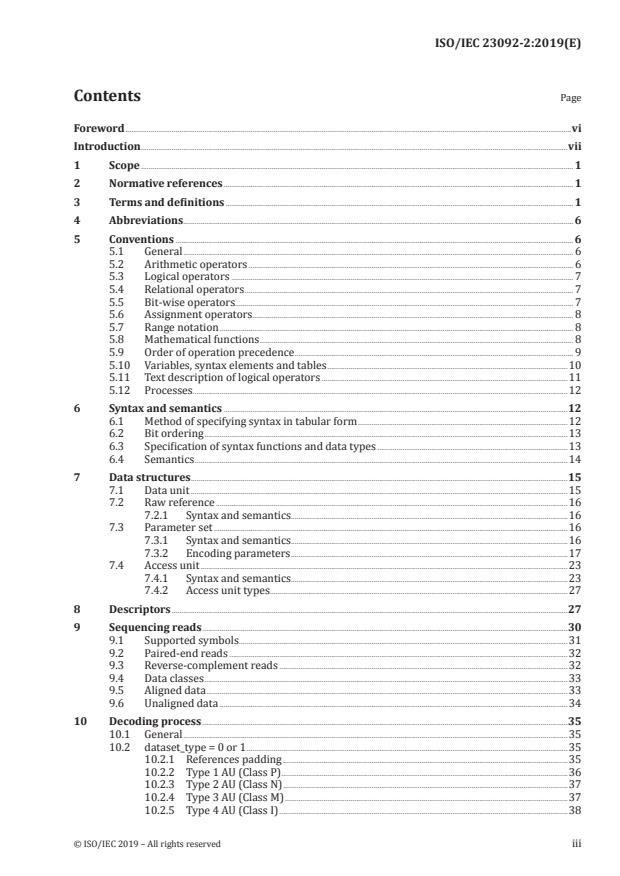
Contents Page
Foreword .vi
Introduction .vii
1 Scope . 1
2 Normative references . 1
3 Terms and definitions . 1
4 Abbreviations. 6
5 Conventions . 6
5.1 General . 6
5.2 Arithmetic operators . 6
5.3 Logical operators . 7
5.4 Relational operators . 7
5.5 Bit-wise operators. 7
5.6 Assignment operators . 8
5.7 Range notation . 8
5.8 Mathematical functions . 8
5.9 Order of operation precedence . 9
5.10 Variables, syntax elements and tables .10
5.11 Text description of logical operators .11
5.12 Processes .12
6 Syntax and semantics .12
6.1 Method of specifying syntax in tabular form .12
6.2 Bit ordering .13
6.3 Specification of syntax functions and data types .13
6.4 Semantics .14
7 Data structures .15
7.1 Data unit .15
7.2 Raw reference .16
7.2.1 Syntax and semantics.16
7.3 Parameter set .16
7.3.1 Syntax and semantics.16
7.3.2 Encoding parameters .17
7.4 Access unit .23
7.4.1 Syntax and semantics.23
7.4.2 Access unit types.27
8 Descriptors .27
9 Sequencing reads .30
9.1 Supported symbols .31
9.2 Paired-end reads .32
9.3 Reverse-complement reads .32
9.4 Data classes .33
9.5 Aligned data .33
9.6 Unaligned data .34
10 Decoding process .35
10.1 General .35
10.2 dataset_type = 0 or 1 .35
10.2.1 References padding .35
10.2.2 Type 1 AU (Class P) .36
10.2.3 Type 2 AU (Class N) .37
10.2.4 Type 3 AU (Class M) .37
10.2.5 Type 4 AU (Class I) .38
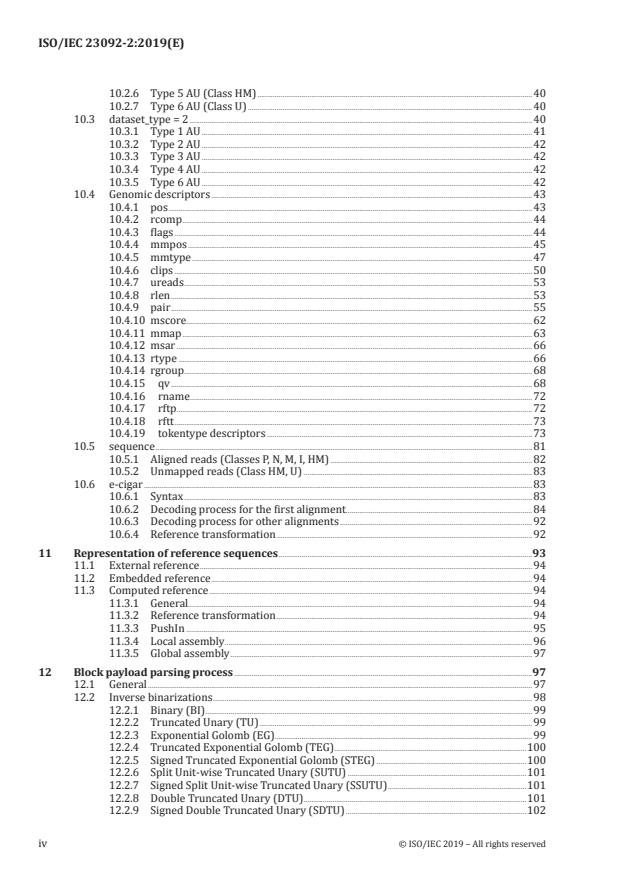
© ISO/IEC 2019 – All rights reserved iii
10.2.6 Type 5 AU (Class HM) .40
10.2.7 Type 6 AU (Class U) .40
10.3 dataset_type = 2 .40
10.3.1 Type 1 AU .41
10.3.2 Type 2 AU .42
10.3.3 Type 3 AU .42
10.3.4 Type 4 AU .42
10.3.5 Type 6 AU .42
10.4 Genomic descriptors .43
10.4.1 pos .43
10.4.2 rcomp .44
10.4.3 flags .44
10.4.4 mmpos .45
10.4.5 mmtype .47
10.4.6 clips .50
10.4.7 ureads .53
10.4.8 rlen .53
10.4.9 pair .55
10.4.10 mscore .62
10.4.11 mmap .63
10.4.12 msar .66
10.4.13 rtype .66
10.4.14 rgroup .68
10.4.15 qv .68
10.4.16 rname .72
10.4.17 rftp .72
10.4.18 rftt .73
10.4.19 tokentype descriptors .73
10.5 sequence .81
10.5.1 Aligned reads (Classes P, N, M, I, HM) .82
10.5.2 Unmapped reads (Class HM, U) .83
10.6 e-cigar .83
10.6.1 Syntax .83
10.6.2 Decoding process for the first alignment.84
10.6.3 Decoding process for other alignments .92
10.6.4 Reference transformation .92
11 Representation of reference sequences .93
11.1 External reference .94
11.2 Embedded reference .94
11.3 Computed reference .94
11.3.1 General.94
11.3.2 Reference transformation .94
11.3.3 PushIn .95
11.3.4 Local assembly .96
11.3.5 Global assembly .97
12 Block payload parsing process .97
12.1 General .97
12.2 Inverse binarizations .98
12.2.1 Binary (BI) .99
12.2.2 Truncated Unary (TU) .99
12.2.3 Exponential Golomb (EG) .99
12.2.4 Truncated Exponential Golomb (TEG) .100
12.2.5 Signed Truncated Exponential Golomb (STEG) .100
12.2.6 Split Unit-wise Truncated Unary (SUTU) .101
12.2.7 Signed Split Unit-wise Truncated Unary (SSUTU) .101
12.2.8 Double Truncated Unary (DTU) .101
12.2.9 Signed Double Truncated Unary (SDTU) .102
iv © ISO/IEC 2019 – All rights reserved
12.3 Decoder configuration .102
12.3.1 Sequences and quality values .102
12.3.2 Support values .103
12.3.3 CABAC binarizations .104
12.3.4 Transformation parameters .107
12.3.5 Msar descriptor and read identifiers .108
12.3.6 State variables .109
12.4 Initialization process for context variables .112
12.5 Arithmetic decoding engine .112
12.5.1 Initialization .112
12.5.2 Arithmetic decoding process.113
12.6 Decoding process for sequence descriptors .120
12.6.1 General.120
12.6.2 Block payload decoding process .121
13 Output format .135
13.1 General .135
13.2 MPEG-G record .135
13.2.1 number_of_template_segments .137
13.2.2 number_of_record_segments .137
13.2.3 number_of_alignments .137
13.2.4 class_ID .137
13.2.5 read_group_len .138
13.2.6 read_1_first .138
13.2.7 seq_ID .138
13.2.8 as_depth .138
13.2.9 read_len .138
13.2.10 qv_depth .138
13.2.11 read_name_len .138
13.2.12 read_name .138
13.2.13 read_group .138
13.2.14 sequence .139
13.2.15 quality_values .139
13.2.16 mapping_pos . .139
13.2.17 ecigar_len .139
13.2.18 ecigar_string .139
13.2.19 reverse_comp .139
13.2.20 mapping_score .139
13.2.21 split_alignment .139
13.2.22 delta .140
13.2.23 split_pos .140
13.2.24 split_seq_ID .140
13.2.25 flags .140
13.2.26 more_alignments .140
13.2.27 next_pos .140
13.2.28 next_seq_ID .140
13.3 Initialization process .140
Annex A (informative) Tokenization of reads identifiers .143
Annex B (informative) Mapping quality .145
Annex C (informative) Inverse binarization examples .146
© ISO/IEC 2019 – All rights reserved v
Foreword
ISO (the International Organization for Standardization) and IEC (the International Electrotechnical
Commission) form the specialized system for worldwide standardization. National bodies that
are members of ISO or IEC participate in the development of International Standards through
technical committees established by the respective organization to deal with particular fields of
technical activity. ISO and IEC technical committees collaborate in fields of mutual interest. Other
international organizations, governmental and non-governmental, in liaison with ISO and IEC, also
take part in the work.
The procedures used to develop this document and those intended for its further maintenance are
described in the ISO/IEC Directives, Part 1. In particular, the different approval criteria needed for
the different types of document should be noted. This document was drafted in accordance with the
editorial rules of the ISO/IEC Directives, Part 2 (see www .iso .org/directives).
Attention is drawn to the possibility that some of the elements of this document may be the subject
of patent rights. ISO and IEC shall not be held responsible for identifying any or all such patent
rights. Details of any patent rights identified during the development of the document will be in the
Introduction and/or on the ISO list of patent declarations received (see www .iso .org/patents) or the IEC
list of patent declarations received (see http: //patents .iec .ch).
Any trade name used in this document is information given for the convenience of users and does not
constitute an endorsement.
For an explanation of the voluntary nature of standards, the meaning of ISO specific terms and
expressions related to conformity assessment, as well as information about ISO's adherence to the
World Trade Organization (WTO) principles in the Technical Barriers to Trade (TBT) see www .iso
.org/iso/foreword .html.
This document was prepared by Joint Technical Committee ISO/IEC JTC 1, Information technology,
Subcommittee SC 29, Coding of audio, picture, multimedia and hypermedia information.
A list of all parts in the ISO/IEC 23092 series can be found on the ISO website.
Any feedback or questions on this document should be directed to the user’s national standards body. A
complete listing of these bodies can be found at www .iso .org/members .html.
vi © ISO/IEC 2019 – All rights reserved
Introduction
The advent of high-throughput sequencing (HTS) technologies has the potential to boost the adoption
of genomic information in everyday practice, ranging from biological research to personalized genomic
medicine in clinics. As a consequence, the volume of generated data has increased dramatically during
the last few years, and an even more pronounced growth is expected in the near future.
At the moment genomic information is mostly exchanged through a variety of data formats, such as
FASTA/FASTQ for unaligned sequencing reads and SAM/BAM/CRAM for aligned reads. With respect to
such formats, the ISO/IEC 23092 series provides a new solution for the representation and compression
of genome sequencing information by:
— Specifying an abstract representation of the sequencing data rather than a specific format with its
direct implementation.
— Being designed at a time point when technologies and use cases are more mature. This permits the
addressing of one limitation of the textual SAM format, for which incremental ad-hoc addition of
features followed along the years, resulting in an overall redundant and suboptimal format which
at the same time results not general and unnecessarily complicated.
— Normatively separating free-field user-defined information with no clear semantics from the
normative genomic data representation. This allows a fully interoperable and automatic exchange
of information between different data producers.
— Allowing multiplexing of relevant metadata information with the data since data and metadata are
partitioned at different conceptual levels.
— Following a strict and supervised development process which has proven successful in the last
30 years in the domain of digital media for the transport format, the file format, the compressed
representation and the application program interfaces.
The ISO/IEC 23092 series provides the enabling technology that will allow the community to create an
ecosystem of novel, interoperable, solutions in the field of genomic information processing. In particular
it offers:
— Consistent, general and properly designed format definitions and data structures to store sequencing
and alignment information. A robust framework which can be used as a foundation to implement
different compression algorithms.
— Speed and flexibility in the selective access to coded data, by means of newly-designed data
clustering and optimized storage methodologies.
— Low latency in data transmission and consequent fast availability at remote locations, based on
transmission protocols inspired by real-time application domains.
— Built-in privacy and protection of sensitive information, thanks to a flexible framework which
allows customizable secured access at all layers of the data hierarchy.
— Reliability of the technology and interoperability among tools and systems, owing to the provision
of a normative procedure to assess conformance to the standard on an exhaustive dataset.
— Support to the implementation of a complete ecosystem of compliant devices and applications,
through the availability of a normative reference implementation covering the totality of the
specification.
The fundamental structure of the ISO/IEC 23092 series data representation is the genomic record. The
genomic record is a data structure consisting of either a single sequencing read, or a paired sequencing
read, and its associated sequencing and alignment information; it may contain detailed mapping and
alignment data, a single or paired read identifier (read name) and quality values.
© ISO/IEC 2019 – All rights reserved vii
Without breaking traditional approaches, the genomic record introduced in the ISO/IEC 23092 series
provides a more compact, simpler and manageable data structure grouping all the information related
to a single DNA template, from simple sequencing data to sophisticated alignment information.
The genomic record, although it is an appropriate logic data structure for interaction and manipulation of
coded information, is not a suitable atomic data structure for compression. To achieve high compression
ratios, it is necessary to group genomic records into clusters and to transform the information of the
same type into sets of descriptors structured into homogeneous blocks. Furthermore, when dealing
with selective data access, the genomic record is a too small unit to allow effective and fast information
retrieval.
For these reasons, this document introduces the concept of access unit, which is the fundamental
structure for coding and access to information in the compressed domain.
The access unit is the smallest data structure that can be decoded by a decoder compliant with this
document. An access unit is composed of one block for each descriptor used to represent the information
of its genomic records; therefore, a block payload is the coded representation of all the data of the same
type (i.e. a descriptor) in a cluster.
In addition to clusters of genomic records compressed into access units, reads are further classified in
six data classes: five classes are defined according to the result of their alignment against one or more
reference sequences; the sixth class contains either reads that could not be mapped or raw sequencing
data. The classification of sequencing reads into classes enables the development of powerful selective
data access. In fact access units inherit a specific data characterization (e.g. perfect matches in class
P, substitutions in class M, indels in class I, half-mapped reads in class HM) from the genomic records
composing them, and thus constitute a data structure capable of providing powerful filtering capability
for the efficient support of many different use cases.
Access units are the fundamental, finest grain data structure in terms of content protection and
in terms of metadata association. In other words each access unit can be protected individually and
independently. Figure 1 shows how access units, blocks and genomic records relate to each other in the
ISO/IEC 23092 series data structure.
Figure 1 — Access units, blocks and genomic records
viii © ISO/IEC 2019 – All rights reserved
Figure 2 — High-level data structure: datasets and dataset group
A dataset is a coded data structure containing headers and one or more access units. Typical datasets
could for example contain the complete sequencing of an individual, or a portion of it. Other datasets
could contain for example a reference genome or a subset of its chromosomes. Datasets are grouped in
dataset groups, as shown in Figure 2.
According to the ISO/IEC 23092 series, the compressed sequencing data can be multiplexed into a
normative bitstream suitable for packetization for real-time transport over typical network protocols.
In storage use cases coded data can be encapsulated into a file format with the possibility to organize
blocks per descriptor stream or per access unit, to further optimize the selective access performance
to the type of data access required by the different application scenarios. The ISO/IEC 23092 series
further provides a reference process to convert a normative transport stream into a normative file
format and vice versa.
This document defines the syntax and semantics of the compressed genome sequencing data
representation and the deterministic decoding process that reconstructs the contents of datasets. The
decoding process is fully specified such that all decoders that conform to this document will produce
identical decoded output. A simplified diagram of the decoding process is shown in Figure 3.
© ISO/IEC 2019 – All rights reserved ix
Figure 3 — The decoding process
The International Organization for Standardization (ISO) and International Electrotechnical
Commission (IEC) draw attention to the fact that it is claimed that compliance with this document may
involve the use of a patent.
ISO and IEC take no position concerning the evidence, validity and scope of this patent right. The
holder of this patent right has assured ISO and IEC that he/she is willing to negotiate licences under
reasonable and non-discriminatory terms and conditions with applicants throughout the world. In this
respect, the statement of the holder of this patent right is registered with ISO and IEC. Information may
be obtained from:
GenomSys SA
EPFL Innovation Park Building C
CH-1015 Lausanne
Switzerland
info@genomsys .com
Attention is drawn to the possibility that some of the elements of this document may be the subject of
patent rights other than those identified above. ISO and IEC shall not be held responsible for identifying
any or all such patent rights.
x © ISO/IEC 2019 – All rights reserved
INTERNATIONAL STANDARD ISO/IEC 23092-2:2019(E)
Information technology — Genomic information
representation —
Part 2:
Coding of genomic information
1 Scope
This document provides specifications for the normative representation of the following types of
genomic information:
— unaligned sequencing reads including read identifiers and quality values;
— aligned sequencing reads including read identifiers and quality values;
— reference sequences.
2 Normative references
The following documents are referred to in the text in such a way that some or all of their content
constitutes requirements of this document. For dated references, only the edition cited applies. For
undated references, the latest edition of the referenced document (including any amendments) applies.
ISO/IEC 10646, Information technology — Universal Coded Character Set (UCS)
ISO/IEC 23092-1, Information technology — Genomic information representation — Part 1: Transport and
storage of genomic information
3 Terms and definitions
For the purposes of this document, the terms and definitions given in ISO/IEC 23092-1 and the
following apply.
ISO and IEC maintain terminological databases for use in standardization at the following addresses:
— ISO Online browsing platform: available at https: //www .iso .org/obp
— IEC Electropedia: available at http: //www .electropedia .org/
3.1
alignment
information describing the similarity between a sequence [typically a sequencing read (3.28)] and a
reference sequence (for instance, a reference genome)
Note 1 to entry: An alignment is described in terms of a position within the reference, the strand of the reference,
and a set of edit operations (matches, mismatches, insertions and deletions, clipping of the sequence ends and
splicing information) needed to turn the first sequence into the second.
© ISO/IEC 2019 – All rights reserved 1
3.2
CIGAR string
CIGAR
textual way of representing an alignment (3.1)
Note 1 to entry: Several definitions have been used by different programs; the one referred to here is the one used
in the SAM format. It encodes a set of edit operations (matches, mismatches, insertions and deletions, clipping of
the sequence ends and splicing information) needed to turn
...
Questions, Comments and Discussion
Ask us and Technical Secretary will try to provide an answer. You can facilitate discussion about the standard in here.
Loading comments...