


ISO/IEC 14496-4:2004/Amd 5:2005
(Amendment)Information technology - Coding of audio-visual objects - Part 4: Conformance testing - Amendment 5: Conformance extensions for error-resilient simple scalable profile
Information technology - Coding of audio-visual objects - Part 4: Conformance testing - Amendment 5: Conformance extensions for error-resilient simple scalable profile
Technologies de l'information — Codage des objets audiovisuels — Partie 4: Essai de conformité — Amendement 5: Extensions de conformité pour profil <<error-resilient simple scalable>>
General Information
- Status
- Published
- Publication Date
- 21-Apr-2005
- Current Stage
- 6060 - International Standard published
- Start Date
- 22-Apr-2005
- Due Date
- 18-Sep-2004
- Completion Date
- 18-Sep-2004
Relations
- Effective Date
- 06-Jun-2022
- Effective Date
- 15-Apr-2008
Overview
ISO/IEC 14496-4:2004/Amd 5:2005 is an important amendment to the international standard concerning coding of audio-visual objects, specifically Part 4 which covers conformance testing. This amendment introduces conformance extensions for the Error-Resilient Simple Scalable Profile (ERSSP), addressing key issues related to error resilience in scalable video coding. The update enables reliable decoding of enhancement layers even in error-prone environments such as mobile communications, expanding the applicability of MPEG-4 Simple Scalable Profile (SSP) beyond error-free conditions.
The amendment was developed by the joint ISO/IEC technical committee (JTC 1, SC 29) responsible for multimedia coding. It provides a comprehensive set of bitstreams to be used for conformance testing of error-resilient scalable video decoders, ensuring compliance with updated scalability and error-resilience requirements.
Key Topics
Error-Resilient Simple Scalable Profile (ERSSP)
Extends the Simple Scalable Profile by incorporating advanced error resilience tools to ensure robust video decoding despite network errors, especially important for wireless and mobile use cases.Conformance Testing
Defines a detailed framework and normative test bitstreams that validate decoder performance and compliance with ERSSP specifications. This includes both functional and dynamic tests.Scalability and Error Resilience
Supports various scalability features such as temporal (P-VOP and B-VOP), spatial scalability, and data partitioning to optimize video performance across different network conditions and device capabilities.Test Bitstreams Specifications
Precise bitstream descriptions are provided for testing specific functionalities such as temporal scalability with P or B frames, spatial scalability, and use of resync markers to maintain synchronization during error recovery.VBV Buffer Management
Stress testing the Video Buffering Verifier (VBV) parameters, ensuring decoders handle bitrate peaks and buffering constraints effectively.
Applications
Mobile Communications
The amendment is highly relevant for mobile video streaming and broadcasting, where network conditions are prone to errors and packet loss. It enables scalable video delivery with error resilience, providing better user experience on cellular and wireless networks.Adaptive Streaming Services
Use of ERSSP conformance testing allows service providers to ensure video streams can adapt seamlessly to changing bandwidth and network reliability, delivering multiple layers of quality based on subscriber preferences or subscriptions.Video Multicast to Heterogeneous Devices
Supports delivering video content to diverse devices with varying display resolutions and processing capabilities by leveraging scalable coding techniques validated through these conformance tests.Decoder Development and Certification
Manufacturers and developers use the specified test bitstreams and conditions to certify their hardware or software decoders against international benchmarks, ensuring interoperability and quality compliance.
Related Standards
ISO/IEC 14496-2 (Part 2: Visual)
Defines the core video coding tools and profiles including the baseline for scalable video coding extended by this amendment.ISO/IEC JTC 1/SC 29
The subcommittee responsible for coding audio, picture, multimedia, and hypermedia information, coordinating development of MPEG and JPEG standards.Other MPEG-4 Parts
These include parts related to systems, elementary streams, and media formats which integrate with Part 4 to provide complete multimedia coding solutions.
Summary
ISO/IEC 14496-4:2004/Amd 5:2005 significantly enhances the MPEG-4 conformance testing framework by introducing error resilience extensions for the Simple Scalable Profile. This ensures that scalable video streams remain robust in error-prone environments, unlocking broader applications in mobile networks and adaptive streaming. The amendment includes detailed test bitstreams and conditions that validate decoder performance against international standards, supporting interoperability and quality assurance in video coding technologies.
By adopting this amendment, industries involved in video codec development, mobile communication, and multimedia services can deliver scalable, high-quality video experiences suited for modern, heterogeneous network environments.
Frequently Asked Questions
ISO/IEC 14496-4:2004/Amd 5:2005 is a standard published by the International Organization for Standardization (ISO). Its full title is "Information technology - Coding of audio-visual objects - Part 4: Conformance testing - Amendment 5: Conformance extensions for error-resilient simple scalable profile". This standard covers: Information technology - Coding of audio-visual objects - Part 4: Conformance testing - Amendment 5: Conformance extensions for error-resilient simple scalable profile
Information technology - Coding of audio-visual objects - Part 4: Conformance testing - Amendment 5: Conformance extensions for error-resilient simple scalable profile
ISO/IEC 14496-4:2004/Amd 5:2005 is classified under the following ICS (International Classification for Standards) categories: 35.040 - Information coding; 35.040.40 - Coding of audio, video, multimedia and hypermedia information. The ICS classification helps identify the subject area and facilitates finding related standards.
ISO/IEC 14496-4:2004/Amd 5:2005 has the following relationships with other standards: It is inter standard links to ISO/IEC 14496-4:2004; is excused to ISO/IEC 14496-4:2004. Understanding these relationships helps ensure you are using the most current and applicable version of the standard.
ISO/IEC 14496-4:2004/Amd 5:2005 is available in PDF format for immediate download after purchase. The document can be added to your cart and obtained through the secure checkout process. Digital delivery ensures instant access to the complete standard document.
Standards Content (Sample)
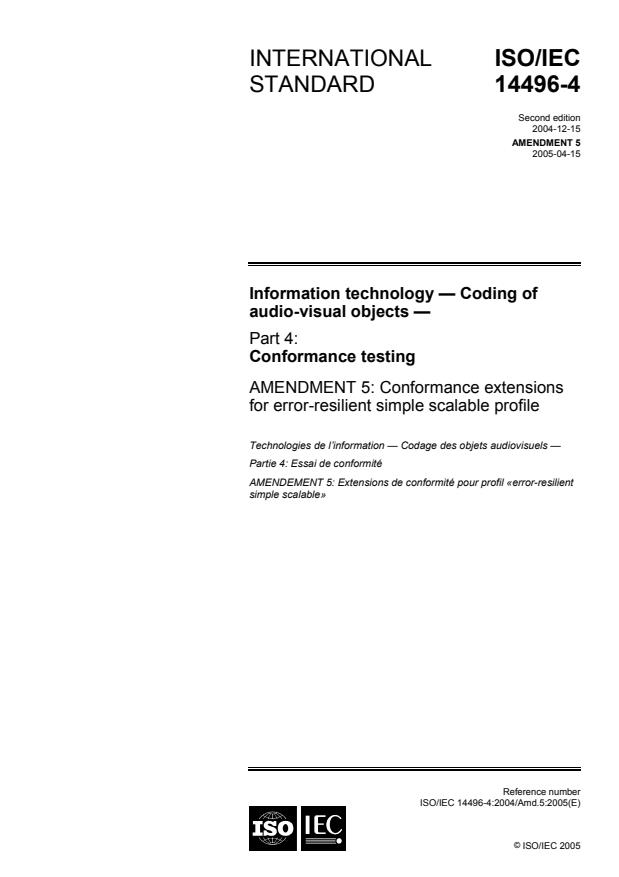
INTERNATIONAL ISO/IEC
STANDARD 14496-4
Second edition
2004-12-15
AMENDMENT 5
2005-04-15
Information technology — Coding of
audio-visual objects —
Part 4:
Conformance testing
AMENDMENT 5: Conformance extensions
for error-resilient simple scalable profile
Technologies de l’information — Codage des objets audiovisuels —
Partie 4: Essai de conformité
AMENDEMENT 5: Extensions de conformité pour profil «error-resilient
simple scalable»
Reference number
ISO/IEC 14496-4:2004/Amd.5:2005(E)
©
ISO/IEC 2005
ISO/IEC 14496-4:2004/Amd.5:2005(E)
PDF disclaimer
This PDF file may contain embedded typefaces. In accordance with Adobe's licensing policy, this file may be printed or viewed but
shall not be edited unless the typefaces which are embedded are licensed to and installed on the computer performing the editing. In
downloading this file, parties accept therein the responsibility of not infringing Adobe's licensing policy. The ISO Central Secretariat
accepts no liability in this area.
Adobe is a trademark of Adobe Systems Incorporated.
Details of the software products used to create this PDF file can be found in the General Info relative to the file; the PDF-creation
parameters were optimized for printing. Every care has been taken to ensure that the file is suitable for use by ISO member bodies. In
the unlikely event that a problem relating to it is found, please inform the Central Secretariat at the address given below.
© ISO/IEC 2005
All rights reserved. Unless otherwise specified, no part of this publication may be reproduced or utilized in any form or by any means,
electronic or mechanical, including photocopying and microfilm, without permission in writing from either ISO at the address below or
ISO's member body in the country of the requester.
ISO copyright office
Case postale 56 • CH-1211 Geneva 20
Tel. + 41 22 749 01 11
Fax + 41 22 749 09 47
E-mail copyright@iso.org
Web www.iso.org
Published in Switzerland
ii © ISO/IEC 2005 – All rights reserved
ISO/IEC 14496-4:2004/Amd.5:2005(E)
Foreword
ISO (the International Organization for Standardization) and IEC (the International Electrotechnical
Commission) form the specialized system for worldwide standardization. National bodies that are members of
ISO or IEC participate in the development of International Standards through technical committees
established by the respective organization to deal with particular fields of technical activity. ISO and IEC
technical committees collaborate in fields of mutual interest. Other international organizations, governmental
and non-governmental, in liaison with ISO and IEC, also take part in the work. In the field of information
technology, ISO and IEC have established a joint technical committee, ISO/IEC JTC 1.
International Standards are drafted in accordance with the rules given in the ISO/IEC Directives, Part 2.
The main task of the joint technical committee is to prepare International Standards. Draft International
Standards adopted by the joint technical committee are circulated to national bodies for voting. Publication as
an International Standard requires approval by at least 75 % of the national bodies casting a vote.
Attention is drawn to the possibility that some of the elements of this document may be the subject of patent
rights. ISO and IEC shall not be held responsible for identifying any or all such patent rights.
Amendment 5 to ISO/IEC 14496-4:2004 was prepared by Joint Technical Committee ISO/IEC JTC 1,
Information technology, Subcommittee SC 29, Coding of audio, picture, multimedia and hypermedia
information.
© ISO/IEC 2005 – All rights reserved iii
ISO/IEC 14496-4:2004/Amd.5:2005(E)
Introduction
In ISO/IEC 14496-2:2004, the bitstream syntax of the Simple Scalable Profile does not allow the use of the
error resilience tools. As the enhancement layer can only be decoded if it is received error-free this limits the
use of scalable video to error-free communication environments. This would exclude mobile communications,
a significant future market for MPEG-4 SSP.
Scalable video can be quite useful in many other applications. For instance, matching different or varying
network bandwidths, video multicast to heterogeneous end systems and more importantly, providing different
subjective quality of video content to subscribers of a given video service depending on their network tariffs
and viewing preferences.
As such a set of bitstreams which should be used for conformance testing of MPEG-4 Error Resilient Simple
Scalable Profile is proposed.
iv © ISO/IEC 2005 – All rights reserved
ISO/IEC 14496-4:2004/Amd.5:2005(E)
Information technology — Coding of audio-visual objects —
Part 4:
Conformance testing
AMENDMENT 5: Conformance extensions for error-resilient simple
scalable profile
Add the following to 5.5.3.1:
5.5.3.1.36 Test bitstream #L0bGE-1
Specification: This bitstream tests dynamic performance of the decoder. It puts stress on a decoder at Level
L0b of the Simple Profile. It has a bitrate close to the maximum allowed at Level L0b. It utilizes extensively the
maximum allowed VBV buffer size. The default values are used for the VBV parameters vbv_buffer_size and
vbv_occupancy, as defined in Annex D of ISO/IEC 14496-2 “Video buffering verifier”.
Functional stage: Prediction bandwidth
Add the following subclauses after 5.5.3.3, and change the subclause numbers after those subclauses
...
Questions, Comments and Discussion
Ask us and Technical Secretary will try to provide an answer. You can facilitate discussion about the standard in here.
Loading comments...