


ISO/IEC 9595:1991
(Main)Information technology — Open systems Interconnection — Common management information service definition
Information technology — Open systems Interconnection — Common management information service definition
Technologies de l'information — Interconnexion de systèmes ouverts — Définition du service commun d'informations de gestion
General Information
- Status
- Withdrawn
- Publication Date
- 27-Mar-1991
- Withdrawal Date
- 27-Mar-1991
- Technical Committee
- ISO/IEC JTC 1 - Information technology
- Drafting Committee
- ISO/IEC JTC 1 - Information technology
- Current Stage
- 9599 - Withdrawal of International Standard
- Start Date
- 08-Oct-1998
- Completion Date
- 12-Feb-2026
Relations
- Effective Date
- 06-Jun-2022
- Effective Date
- 06-Jun-2022
- Effective Date
- 06-Jun-2022
- Effective Date
- 06-Jun-2022
- Effective Date
- 06-Jun-2022
- Effective Date
- 15-Apr-2008
- Effective Date
- 15-Apr-2008
- Effective Date
- 15-Apr-2008
- Effective Date
- 15-Apr-2008
- Effective Date
- 15-Apr-2008
- Effective Date
- 15-Apr-2008
- Effective Date
- 15-Apr-2008

ISO/IEC 9595:1991 - Information technology -- Open systems Interconnection -- Common management information service definition

ISO/IEC 9595:1991 - Technologies de l'information -- Interconnexion de systemes ouverts -- Définition du service commun d'informations de gestion
Get Certified
Connect with accredited certification bodies for this standard

BSI Group
BSI (British Standards Institution) is the business standards company that helps organizations make excellence a habit.

NYCE
Mexican standards and certification body.
Sponsored listings
Frequently Asked Questions
ISO/IEC 9595:1991 is a standard published by the International Organization for Standardization (ISO). Its full title is "Information technology — Open systems Interconnection — Common management information service definition". This standard covers: Information technology — Open systems Interconnection — Common management information service definition
Information technology — Open systems Interconnection — Common management information service definition
ISO/IEC 9595:1991 is classified under the following ICS (International Classification for Standards) categories: 35.100.70 - Application layer. The ICS classification helps identify the subject area and facilitates finding related standards.
ISO/IEC 9595:1991 has the following relationships with other standards: It is inter standard links to ISO/IEC 9595:1991/Amd 4:1992, ISO/IEC 9595:1991/Cor 2:1992, ISO/IEC 9595:1991/Cor 3:1994, ISO/IEC 9595:1991/Cor 1:1992, ISO/IEC 9595:1991/Cor 4:1995, ISO/IEC 9595:1998, ISO/IEC 9595:1990; is excused to ISO/IEC 9595:1991/Amd 4:1992, ISO/IEC 9595:1991/Cor 3:1994, ISO/IEC 9595:1991/Cor 2:1992, ISO/IEC 9595:1991/Cor 1:1992, ISO/IEC 9595:1991/Cor 4:1995. Understanding these relationships helps ensure you are using the most current and applicable version of the standard.
ISO/IEC 9595:1991 is available in PDF format for immediate download after purchase. The document can be added to your cart and obtained through the secure checkout process. Digital delivery ensures instant access to the complete standard document.
Standards Content (Sample)
I N TE R NAT I O NA L
ISO/IEC
STANDARD
Second edition
1991 -04-0 1
Information technology - Open Systems
Interconnection - Common management
information service definition
Technologies de l'information - Interconnexion de systèmes ouverts -
Définition du service commun d'information de gestion
b
, ~-_l_l_
I
I
Reference number
ISO/IEC 9595 : 1991 (E)
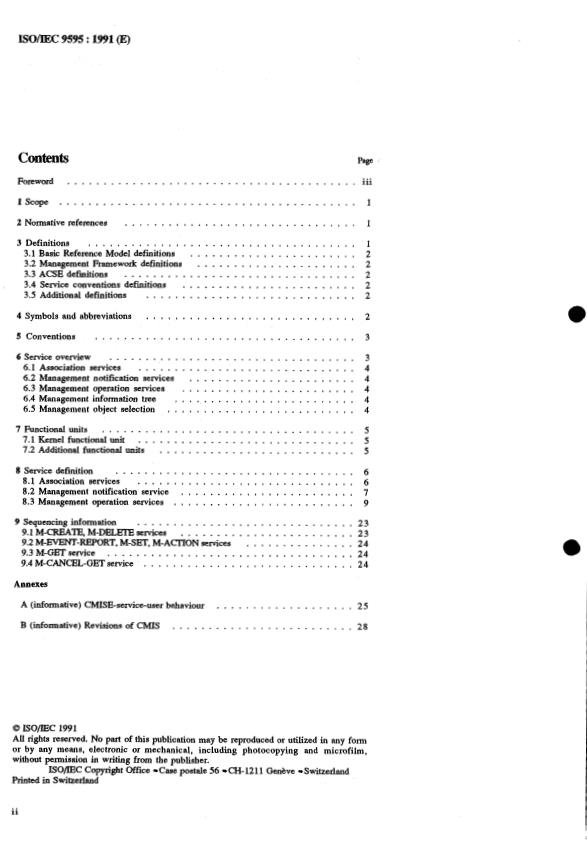
Contents Page
........................................
Foreword iii
1Scope . 1
2 Normative references . 1
.....................................
3 Definitions 1
3.1 Basic Reference Model definitions . 2
3.2 Management Framework definitions . 2
3.3 ACSE definitions .
3.4 Service conventions definitions . 2
3.5 Additional definitions . 2
4 Symbols and abbreviations . 2
5 Conventions . 3
6Serviceoverview . 3
6.1 Association services .
6.2 Management notification services . 4
6.3 Management operation services . 4
6.4 Management information tree . 4
6.5 Management object selection . 4
7 Functional units . 5
7.1 Kernel functional unit . 5
7.2 Additional functional units . 5
8 Service definition . 6
8.1 Association services . 6
8.2 Management notification service . 7
8.3 Management operation services . 9
9 Sequencing information . 23
9.1 M-WA M-DELETE services . 23
9.2 M-EVENT-REPORT. M-SET, M-ACIION services . 24
9.3 M-GET service . 24
9.4 M-CANCEL-GET service . 24
Annexes
A (informative) CMISEservice-user behaviour . 25
B (informative) Revisions of CMIS . 28
Q ISO/reC 1991
Aii rights reserved . No part of this publication may be reproduced or utilized in any form
or by any means. electronic or mechanical. including photocopying and microfilm.
without permission in writing from the publisher .
ISO/lEC Copyright Office Case postale 56 CH-1211 Genève Switzerland
Printed in Switzerland
ii
ISOhEC 9595 : 1991 @)
Foreword
IS0 (the International Organization for Standardization) and IEC (the International
Electrotechnical Commission) form the specialized system for worldwide standardization.
National bodies that are members of IS0 or IEC participate in the development of
International Standards through technical committees established by the respective
organization to deal with particular fields of technical activity. IS0 and IEC technical
committees collaborate in fields of mutual interest. Other international organizations,
governmental and non-governmental, in liaison with IS0 and IEC, also take paxt in the
work.
In the field of information technology, IS0 and IEC have established a joint technical
JTC 1. Draft Intemational Standards adopted by the joint technical
committee, ISO/iEC
committee are circulated to national bodies for voting. Publication as an International
Standard requires approval by at least 75% of the national bodies casting a vote.
hternational Standard ISO/EC 9595 was prepared by the Joint Technical Committee
ISO/iEC JTC 1, Information technology.
This second edition cancels and replaces the first edition (ISO/IEC 9595 : 1990), which
has been technically revised.
Annexes A and B are for information only.
I"ERNATT0NAL STANDARD ISOlIEC 9595 : 1991 (E)
Information technology - Open Systems Interconnection -
Common management information service definition
1 Scope
This International Standard defines an Application Service Elemeht (the Common Management Information Service Element), which
may be used by an application process in a centralized or decentralized management environment to exchange information and
commands for the purpose of systems management, as defined by the OS1 Management Framework in ISO/IEC 7498-4. This
International Standard-is positioned in the application layer of IS0 7498 and is defined according to the model provided by
SSO/IEC 9545.
This International Standard defines
- a set of sewice primitives that constitute the application service element;
- the parameters that are passed in each service primitive;
- any necessary information for the semantic description of each service primitive.
This International Standard does not define
- the nature of any implementation intended to provide the defined service;
- the semantics associated with the information or commands that are exchanged by means of the service;
- the manner in which management is accomplished by the user of the service;
- the nature of any interactions which result in the use of the service.
No requirement is made for conformance to this International Standard.
2 Normative rderences
Vie following standards contain provisions which, through reference in this text, constitute provisions of this International Standard.
At the time of publication, the editions indicated were valid. All standards are subject to revision, and parties to agreements based on
this International Standard are encouraged to investigate the possibility of applying the most recent editions of the standards listed
below. Members of JEC and IS0 maintain registers of currently valid International Standards.
SS0 7498 : 1984, Information processing systems - Open SYS~CII~S Interconnection - Basic Reference Model
ISOflEC 7498-4 : 1989. Information processing systenis - Open Systems Interconnection - Basic Reference Model - Purr 4.
Munugcvtient Fi uniework
iSO/TR 8509 : 1987, Inforrnation processing systenrs - Open Systems Interconnection - Service conventions
IS0 8649 : 1987, I?ZfOrIllUfiOn processing systenzs - open Systenis Interconnection - Service definition for the Association Control
Seriice Elcitient
lSO/iEC 9545 : 1Y89, Injorniation processing systeni5 - Open Systeiiis Interconnection - Application byer Structure (ALS).
3 Definitions
For the purposes of this International Standard, the following definitions apply.
-~ ~
xso/IEc 9595 : 1991 (E)
3.1 Basic Reference Model definitions
This International Standard makes use of the following terms defined in IS0 7498.
a) application-service-element;
b) open system;
c) systems-management.
3.2 Management Fkamework definitions
This International Standard makes use of the following terms defined in ISO/lEC 7498-4.
a) managed object;
b) management information;
c) systems management application-entity.
33 ACSE definitions
This International Standard makes use of the following terms defined in IS0 8649.
a) application-association;
b) application context;
c) association;
d) association-initiator.
3.4 Service conventions definitions
This International Standard makes use of the following terms defined in ISOm 8509.
a) confirm (primitive);
b) confirmed-service;
c) indication (primitive);
d) non-confirmed-service;
e) request (primitive);
f) response (primitive).
3.5 Additional denaitionS
3.5.1 Attribute: A property of a managed object. An attribute has a value.
3.5.2 Common Management Information Service Element: The particular application-service-element defined in this International
Standard.
3.5.3 Common Management Information Services: The set of services provided by the Common Management Information Service
Elemeii t .
3.5.4 CMISE-service-provider: An abstraction of the totality of those entities which provide CMSE services to peer CMISE-service-
users.
3.5.5 CMLSE-service-user: The part of an application process that makes use of the Common Management Information Service
Element.
3.5.6 Functional unit: The unit of service used for the negotiation of service options.
3.5.7 Invoking CMISE-service-user: The CMISE-sevice-user that invokes a management operation or notification.
3.5.8 Perfurming CMISEservice-user: The CMISE-sexvice-user that perfoms a managenient operation or notification invoked by a
peer CMISE-service-user.
3.5.9 Set-valued attribute: an attribute whose value is a mathematical set of values of the same type. Values in the set cannot be
repeated and no ordering is implied.
4 Symbois and abbreviations
ACSE Association Control Service Element
Tso.mc 9595 : 1991 (E)
ASE Application Service Element
CMIS Common Management Information Service
CMISE Common Management Information Service Element
Conf Confirm
Ind Indication
Req Request
Rsp Response
5 Conventions
This International Standard defines services for CMIS following the descriptive conventions defined in ISOm 8509. In clause 8, the
definition of each CMIS service includes a table that lists the parameters of its primitives. The definition of parameters in the
Rsp/Conf column of a table apply only to the confirmed service. For a given primitive, the presence of each parameter is described by
one of the following values
M the parameter is mandatory
the value of the parameter is equal to the value of the parameter in the column to the left
(=)
U
the use of the parameter is a service-user option
-
the parameter is not present in the interaction described by the primitive concerned
C
the parameter is conditional. The condition(s) are defined by the text which describes the parameter.
6 Service overview
Management information services are used by application processes in peer open systems, to exchange information and commands for
the purpose of systems management.
There are two types of information transfer service
- a management notification service;
- a management operation service.
The Common Management Information Service provides additional structuring facilities. These enable
- multiple responses to confirmed operations to be "linked" to the operation by the use of a linked identification parameter:
- Operations to be performed on multiple managed objects. selected to satisfy some criteria and be subject to a "synchronizing"
condition.
Tlie CMISE services are listed in table 1.
Table 1 - CMLSE services
Service
Type
M-CANCELGET confirmed
M-EVENT-REPORT confiimed/non-confimied
M-GET confimied
M-SET confirmed/non-confirmed
M-ACTION confimied/non-confirmed
M-CREATE confirmed
M-DJUXE confirmed
ISO/IEC 9595 : 1991 (E)
6.1 Association semces
This hiternational Standard does not provide separate services for the establishment and release of application associations. The
CMSE-service-user relies on the services of IS0 8649 for the control of application-associations.
During the association establishment phase, vanous ASEs may exchange initialisation information to establish an association using
ACSE. The application context specifies the rules required for coordinating the information belonging to different ASEs, embedded in
ACSE user information service parameters. The application context, presentation and session requirements are conveyed using
parameters of the A-ASSOCIATE service.
The A-RELEASE and A-ABORT services of IS0 8649 are used for the termination of an association. These may be invoked by either of
the CMISE-service-users.
6.2 Management notincation services
The definition of the notification and the consequent behaviour of the communicating entities is dependent upon the specification of
of the Common Management Information Service.
the managed object which generated the notification and is outside the scope
However, certain notifications are used frequently within the scope of systems management and CMIS provides the following
definition of the common service that may be used to convey management information applicable to the notification.
The M-EVENT-REPORT service is invoked by a CMISE-service-user to report an event about a managed object to a peer CMISE-
service-user. The service may be requested in a confirmed or a non-confirmed mode. In the confirmed mode, a reply is expected.
6.3 Management operation services
The definition of the operation and the consequent behaviour of the communicating entities is dependent upon the specification of the
managed object at which the operation is directed and is outside the scope of the Common Management Information Service. However,
certain operations are used frequently within the scope of systems management and CMIS provides the following definitions of the
common services that may be used to convey management information applicable to the operations.
6.3.1 The M-GET service is invoked by a CMISE-service-user to request the retrieval of management information from a peer CMISE-
service-user. The service may only be requested in a confirmed mode, and a reply is expected.
6.3.2 The M-SET service is invoked by a CMISE-service-user to request the modification of management infomation by a peer CMISE-
service-user. The service may be requested in a confirmed or a non-confirmed mode. In the confirmed mode, a reply is expected.
6.3.3 The M-ACTION service is invoked by a CMISE-service-user to request a peer CMISE-service-user to perform an action. The
service may be requested in a confirmed or a non-confirmed mode. In the confirmed mode, a reply is expected.
6.3.4 The M-CREATE3 service is invoked by a CMISE-service-user to request a peer CMISE-service-user to create an instance of a
managed object. The service may only be requested in the confirmed niode, and a reply is expected.
6.3.5 The M-DELETE service is invoked by a CMISE-service-user to request a peer CMISE-service-user to delete an instance of a
managed object. The service may only be requested in the confirmed mode, and a reply is expected.
6.3.6 The M-CANCEL-GET service is invoked by a CMISE-service-user to request a peer CMISE-service-user to cancel a previously
requested and currently outstanding invocation of the M-GET service. The service may only be requested in the confirmed mode and a
reply is expected.
6.4 Management information tree
Management information may be viewed as a collection of managed objects. each of which has attributes, and may have defined events
and actions. Names of instances of managed objects are arranged hierarchically in a management information tree.
II is conceivable that there may be dynamic changes to the management information tree and that this knowledge may not be
instantaneously available to other open systems.
6.5 Managed object selection
Managed object selection involves two phases: scoping and filtering.
Scoping entails the identification of the managed object(s) to which a filter is to be applied.
Filtering entails the application of a set of tests to each member of the set of previously scoped managed objects to extract a subset.
Tile subset of scoped managed objects that satisfy the filter is selected for the operation.
NOTE - If no filter is specified, then the set of scoped managed objects is selected for the operation.
1somc 9-595 : 1.991 (E)
6.5.1 Scoping
The base managed object is defined as the root of the subtree of the management information tree from which the search is to
commence. Four specifications of scoping level are defined
a) the base object alone;
the rith level subordinates of the base object;
b)
the base object and all of its subordinates down to and including the nth level;
c)
the base object and all of its subordinates (whole subtree).
d)
When the scope parameter is not specified, the scoped managed object is the object specified by the base object instance parameter.
NOTE -The base object is defined to be level zero.
6.5.2 Filtering
A filter is a set of one or more assertions about the presence or values of attributes in a scoped managed object. If the filter involves
more than one assertion, the assertions are grouped together using logical operators. If the filter test succeeds for a given managed
object, then that managed object is selected for performance of the operation.
6.5.3 Synchronization
A synchronization parameter is provided to allow the CMISE-service-user to indicate the manner in which operations are to be
synchronized across managed object instances when multiple managed objects have been selected by the scope and filter niechanism.
The CMISE-service-user may request one of two types of synchronization: atomic or best effort. Since the order in which object
instances are selected by the filter is a local matter, synchronization based on order is not meaningful.
NOTE - CMIS does not provide a parameter to indicate synclironization across attributes within a managed object. This will be specified as part of the
managed object behaviour and may vary for different attribute conibinations and operations.
7 Functional units
The general service capabilities are designated as functional units, where functional units correspond to the support of service
primitives or parameters.
7.1 Kernel functional unit
Ail of the CMISE services listed in table 1 except for the M-CANCEL-GET service are included in the kernel functional unit. For the
services in the kernel functional unit, the linked identification parameter shall not be used unless the multiple reply functional unit is
agreed for use on the association between the CMISE-service-users. The scope and synchronization parameters shall not be used unless
the multiple object selection functional unit has been agreed. The filter parameter shall not be used unless the filter functional unit has
been agreed.
7.2 Additional functional units
7.2.1 Multiple object selection functional unit
This functional unit makes available the use of the scope and synchronization parameters in the services in the kernel functional unit.
These parameters are not present in the M-EVENT-REPORT and M-CREATE services.
If the multiple object selection functional unit is proposed, then the multiple reply functional unit shall also be proposed.
7.2.2 Filter functional unit
This functional unit makes available the use of the filter parameter in the services in the kernel functional unit. The filter parameter is
not present in Uie M-EVENT-REPORT and M-CREATE services.
7.2.3 Multiple reply functional unit
This functional unit makes available the use of the linked identification parameter in the seilrices in the kernel functional unit. The
linked identification parameter is not preseiii in the M-EVENT-REPORT and M-CREATE services.
rsomc 9595 : 1991 (E)
Multiple replies to a single management operation may only occur if the invoking CMISE-service-user selects multiple managed
objects or requests an M-ACTION operation for a singIe managed object in which the action is defined to produce multiple responses,
NOTE - Thc use of the multiple reply functional unit may result in a large amount of data to be returned. Cumntly, CMIS provides only the M-CANCEL
GET service for controlling the flow of data. Additional mechanisms for controliing data flow or for controlling an operation arc for further study.
7.2.4 Extended service ninctionaI unît
This functional unit makes available presentation layer services in addition to the P-DATA service.
7.2.5 Cancel get ninctional unit
This functional unit makes available the use of the M-CANCEL-GET service.
8 Service defiiition
The CMSE services are listed in table 1.
Parameters returned as part of the confirm primitive may occur as the result of a successful operation (these are described as "included in
the success confirmation"), or as the result of an error condition (these are described as "included in the failure confirmation").
Some operations may report an error code. In the event of multiple errors with one of the errors being a security violation, the error
code "access denied" shall be returned.
8.1 Association services
8.1.1 Association establishment
TLie A-ASSOCIATEl service of IS0 8649 is invoked by a CMISE-service-user to establish an association with a peer CMISE-service-
user. Association establishment is the first phase of any instance of nianagement information service activity.
Table 2 lists the parameters that are defined by this International Standard to be the CMIS specific part of the user information
parameter of the A-ASSOCIATE service. Tliis information is specified by the association-initiator and exchanged when establishing an
association. Exchange of this initialisation information is required prior to using management operation and notification services.
Table 2 - A-ASSOCIATE user information
ParameterName I Reqhd I Rsp/Conf
Functional units I U I U
Access control I U I U
User information U U
8.1.1.1 Functional units
When supplied by the initiating CMISE-service-user, this parameter specifies the set of additional functional units that the initiating
CMISE-service-user is proposing for use on the association. When returned by the responding CMISE-service-user, this parameter
,specifies the set of additional functional units that the responding CMISE-service-user is proposing for use on the association.
When this parameter is not supplied, it is assumed that no additional functional unit is proposed.
Any additional functional unit that has been proposed by both CMISE-service users is agreed to be available for use on the association.
If the extended service functional unit is successfully negotiated, then presentation layer services other than the P-DATA service are
available for use. Details of those other presentation services and how they are used are desciïbed in the definitions of the application
context in use on the association.
8.1.1.2 Access control
This parameter is information of unspecified form to be used as input to access control functions in establishing default access
privileges for all exchanges on the association. If a subsequent service request specifies an access control parameter, then the access
privileges for that and only that invocation of the service are determined from that parameter.
8.1.1.3 User information
The initiating CMISE-service-user and/or the responding CMISE-service-user may optionally include user information on the request
and/or response primitive respectively. The meaning of this parameter is application context specific.
ISO.'JEC 9595 : 1991 (E)
8.1.2 Association release
The A-RELEASE service of IS0 8649 is invoked by a CMISE-service-user to request the orderly termination of an association between
peer application entities. This International Standard does not specify any use of the paranieters of the A-RELEASE service.
The A-ABORT service is invoked by a CMISE-service-user to request the abrupt termination of the association between peer
application entities.
Table 3 lists the parameters that are defined by this International Standard to be the CMIS specific part of the user information
parameter of the A-ABORT service.
Table 3 - A-ABORT user information
CMLS: parameter
A-ABORT R*d
Abort source
M
User information
U
8.1.2.1 Abort source
The abort source parameter indicates the initiating source of the abort. It takes one of the following symbolic values
- CMISE-service-provider;
- CMISE-service-user.
8.1.2.2 User information
The initiating source of the abort may include user information. The meaning of this parameter is application context specific.
8.2 Management notification service
The M-EVENT REPORT service is used by a CMISE-service-user to report an event to a peer CMISE-service-user. It is defined as a
confirmed and a non-confirmed service.
8.2.1 M-EVENT-REPORT parameters
Table 4 lists the parameters for this service.
Table 4- M-EVEN"-REPORT parameters
8.2.1.1 Invoke identifier
This parameter specifies the identifier assigned to the notification. It can be used to distinguish this notification from otiier
notifications or operations that the CMISE-service-provider may have in progress.
8.2.1.2 Mode
This parameter specifies the mode requested for the operation. The possible values are
- confirmed;
- non-confirmed.
ISO/LEC 9595 : 1991 @)
8.2.1.3 Managed object class
This parameter specifies the class of the managed object in which the event occurred. It may be included in any confinnation.
8.2.1.4 Managed object instance
This parameter specifies the instance of the managed object in which the event occurred. It may be included in any confirmation.
8.2.1.5 Event type
This parameter specifies the type of event being reported. It may be included in the success confirmation and shall be included if the
event reply parameter is included.
8.2.1.6 Event time
This parameter contains the time of generation of the event.
8.2.1.7 Event information
This parameter contains information that the invoking CMISE-service-user is able to supply about the event.
8.2.1.8 Current time
This parameter contains the time at which the response was generated. It may be included in the success confirmation.
8.2.1.9 Event reply
This parameter contains the reply to the event report. It may be included in the success confirmation.
8.2.1.10 Errors
This parameter contains the error notification for the operation. It shall be included in the failure confirmation. The following errors
may occur
- duplicate invocation: the invoke identifier specified was aliocated to another notification or operation;
- invalid argument value: the event information value specified was out of range or otherwise inappropriate;
- mistyped argument: one of the parameters supplied has not been agreed for use on the association between the CMSE-service-
users;
- no such argument: the event information specified was not recognized;
- no such event type: the event type specified was not recognized;
- no such object class: the class of the specified managed object was not recognized;
- no such object instance: the instance of the specified managed object was not recognized
- processing failure: a general failure in processing the notification was encountered;
- resource limitation: the notification was not processed due to resource limitation:
- unrecognized operation: the operation is not one of those agreed between the CMISE-service-users.
8.22 M-EVENT-REPORT P~OC~~W~S
8.2.2.1 The invoking CMISE-service-user reports an event to a performing CMISE-service-user by issuing an M-EVENT-REPORT
request primitive to the CMSE-service-provider.
8.2.2.2 If the CMISE-service-provider accepts the request, then it issues an M-EVENT-REPORT indication primitive to the performing
CMISE-service-user. Otherwise, the CMISE-service-provider rejects the request and the following procedures do not apply.
8.2.2.3 In the confirmed mode, the performing CMSE-service-user reports acceptance or rejection of the M-EVENT-REPORT request
primitive by issuing an M-EVENT-REPORT response primitive to the CMISE-service-provider.
8.2.2.4 In the confirmed mode, the CMISE-service-provider issues an M-EVENT-REPORT confirm primitive to the invoking CMISE-
service-user.
rSO/iEC 9595 : 1991 (E)
8.3 Management operation services
8.3.1 M-GET service
The M-GET service is used by a CMISE-service-user to retrieve attribute values from a peer CMISE-service-user. It is defined as a
confirmed service. This service may be cancelled by an invocation of the M-CANCEL-GET service.
8.3.1.1 M-GET parameters
Table 5 lists the parameters for this service.
Table 5 - M-GET parameters
I
8.3.1.1.1 Invoke identiner
This parameter specifies the identifier assigned to the operation. It can be used to distinguish this operation from other notifications
or operations that the CMISE-service-provider may have in progress.
Each response shall have a unique invoke identifier; the final response shall have an invoke identifier equal to that of the invoke
in the indication primitive.
identifier provided
8.3.1.1.2 Linked identifier
If multiple replies are to be sent for this operation, then this parameter specifies the identification that is provided by the performing
are returned. The linked identifier shall have the same value as that of the invoke identifier
CMISE-service-user when those replies
provided in the indication primitive.
D
8.3.1.1.3 Base object class
Tliis parameter specifies the class of the managed object that is to be used as the starting point for the selection of managed objects to
is to be applied.
which the filter (when supplied)
8.3.1.1.4 Base object instance
This pzwameter specifies tlie instance of the managed object that is to be used as the starting point for tlie selection of managetl objects
to which the filter (when supplied) is to be applied.
8.3.1.1.5 Scope
Tliis parameter indicates the subtree. rooted at the base managed object. which is to be searched. The levels of search that niay be
pei-îoimed are
- the base object alone:
- the nth level subordinates of the base object;
- the base object and all of its subordinates down to and including the nth level;
- the base object and all of its subordinates.
ISO/IEC 9595 : 1991 (E)
The default scope is the base object alone.
8.3.1.1.6 Filter
This parameter specifies the set of assertions thr defines the filter test to be applied to the scoped managed object(s). Multiple
assertions may be grouped using the logical operators AND, OR and NOT. Each assertion may be a test for equaliîy, ordering, presence,
or set comparison. Assertions about the value of an attribute are evaluated according to the matching rules associated with the attribute
syntax. If an attribute value assertion is present in the filter and that attribute is not present in the scoped managed object, then the
result of the test for that attribute value assertion shall be evaluated as FALSE. The managed object@) for which the filter test evaluates
to TRUE is(are) selected for the application of the operation. If the filter is not specified, all of the managed objects included by the
scope are selected.
8.3.1.1.7 Access control
This parameter is information of unspecified form to be used as input to access control functions.
8.3.1.1.8 Synchronization
This parameter indicates how the invoking CMISE-service-user wants the M-GET operations synchronized across the selected object
instances. Two ways of synchronizing a series of operations are defined
- Atomic: All managed objects selected for the operation are checked to ascertain if they are able to successfully perform the
operation. if one or more is not able to successfully perform the operation, then none perform it, otherwise all perfonn it.
- Best effort: Ail managed objects selected for the operation are requested to perform it.
If this parameter is not supplied, best effort synchronization is performed. If the base managed object alone is selected for the
operation, this parameter (if present) is ignored.
8.3.1.1.9 Attribute identifier list
This parameter contains a set of attribute identifiers fur which the attribute values are to be returned by the performing CMISE-service-
user, If this parameter is omitted, ail attribute identifiers are assumed. The definitions of the attributes are found in the specification of
the managed object class.
8.3.1.1.10 Managed object class
If the base object alone is specified, then this parameter is optional; otherwise it shall specify the class of the managed object whose
attribute values are returned. It may be included in any confirmation.
8.3.1.1.11 Managed object instance
If the base object alone is specified, then this parameter is optional; otherwise it shall specify the instance of the managed object
whose attribute values are returned. It may be included in any confirmation.
8.3.1.1.12 Current time
This parameter contains the time at which the response was generated. It may be included in the success confimiation.
8.3.1.1.13 Attribute list
This parameter contains the set of attribute identifiers and values that are returned by the performing CM1SE-service-user. It shall be
included in the success confirmation.
8.3.1.1.14 Errors
This parameter contains the error notification for the operation. It shall be included in the failure confirniation. The following eriois
may occur
- access denied: the requested operation was not performed for reasons pertinent to the security of the open system;
- class instance conflict: the specified managed object instance is not a member of the specified class:
- complexity limitation: the requested operation was not performed because a parameter was too complex;
- duplicate invocation: the invoke identifier specified was allocated to another notification or operation;
Isomc 9595 : 1991 (J3)
- access denied: the requested operation was not performed for reasons pertinent to the security of the open system;
- no such attribute: the identifier for the specified attribute or attribute group was not recognized.
The attribute values that could be read are returned;
- invalid filter: the filter parameter contains an invalid assertion or an unrecognized logical operator;
- invalid scope: the value of the scope parameter is invalid;
- mistyped argument: one of the parameters supplied has not been agreed for use on the association between the CMISE-service-
users;
- no such object class: the class of the specified managed object was not recognized;
- no such object instance: the instance of the specified managed object was not recognized;
-operation cancelled the operation was cancelled by an M-CANCEL-GET operation, and no further attribute values will be returned
by this invocation of the M-GET service;
- processing failure: a general failure in processing the operation was encountered;
- resource limitation: the operation was not performed due to resource limitation;
- synchronization not supported: the type of synchronization specified is not supported;
- unrecognized operation: the operation is not one of those agreed between the CMISE-service-users.
8.3.1.2 M-GET procedures
8.3.1.2.1 The invoking CMISE-service-user requests a performing CMISE-service-user to retrieve attribute vaiue(s) by issuing an
M-GET request primitive to the CMISE-service-provider.
8.3.1.2.2 If the CMISE-service-provider accepts the request, then it issues an M-GET indication primitive to the performing CMISE-
service-user. Otherwise, the CMISE-service-provider rejects the request and the following procedures do not apply.
8.3.1.2.3 If the operation cannot be performed. then the performing CMISE-service-user rejects the M-GET request by issuing an
M-GET response primitive with the appropriate error code. In this case, the following procedum do not apply.
8.3.1.2.4 If only one response is to be generated, then procedures 8.3.1.2.5, 8.3.1.2.6 and 8.3.1.2.7 shall be ignored.
8.3.1.2.5 The perfoming CMISE-service-user retrieves the requested attribute value(s) and generates a response which includes results
and/or error notifications. The linked identifier shall be present in the service primitive, with its value to be set equal to the invoke
identifier of the indication primitive, and the managed object class and instance shall be present.
8.3.1.2.6 The CMISE-service-provider issues an M-GET confirm primitive to the invoking CMISE-service-user which shall include the
linked identifier and managed object class and instance.
8.3.1.2.7 Procedures 8.3.1.2.5 and 8.3.1.2.6 shall be repeated until all replies have been completed.
8.3.1.2.8 The completion of the response is indicated by the performing CMISE-service-user issuing an M-GET response primitive
wlijcli shall not contain the linked identifier, and, if there were linked responses generated by procedures 8.3.1.2.5 and 8.3.1.2.6,
wliich shall not contain the attribute list.
8.3.1.2.9 The CMISE-service-provider issues an M-GET confirm primitive to the invoking CMISE-service-user, completing the
M-GET operation.
8.3.1.3 M-CANCEL-GET service
The M-CANCEL-GET service is used by an invoking CMISE-service-user to request the cancellation of a previously requested and
currently outstanding invocation of the M-GET service by a peer CMISE-service-user. It is defhed as a confirmed service.
8.3.1.3.1 M-CANCELGET parameters
Table 6 liste the parameters for this service.
ISO/IEC 9595 : 1991 (E)
Parameter Name Rea/Ina Rsp/Conf
Invoke identifier
M w-1
-
Get invoke identifier M
I Errors -
I I C
I
8.3.1.3.1.1 Invoke identifier
This parameter specifies the identifier assigned to the operation. It can be used to distinguish this operation from other notifications
or operations that the CMISE-service-provider may have in progress.
8.3.1.3.1.2 Get invoke identifier
This parameter specifies the identifier assigned to the previously requested and currently outstanding M-GET operation.
8.3.1.3.1.3 Errors
This parameter contains the error notification for the operation. It shall be included in the failure confirmation. The following errors
may occur
- duplicate invocation: the invoke identifier specified was already allocated to another notification or operation;
- mistyped operation: the get invoke identifier parameter did not refer to an M-GET operation;
- no such invoke identifier: the get invoke identifier parameter was not recognized;
- processing failure: a general failure in processing the operation was encountered;
- resource limitation: the operation was not performed due to resource limitation;
- unrecognized operation: the operation is not one of those agreed between the CMISE-service-users.
8.3.1.3.2 M-CANCEL-GET procedures
8.3.1.3.2.1 The invoking CMISE-service-user requests a performing CMISE-service-user to cancel a previously requested and
currently outstanding M-GET operation by issuing an M-CANCELGET request primitive to the CMISE-service-provider.
8.3.1.3.2.2 If the CMISE-service-provider accepts the request, then it issues an M-CANCEL-GET indication primitive to the
performing CMISEservice-user. OtheMise, the CMISE-service-provider rejects the request and the following procedures do not apply.
8.3.1.3.2.3 If the operation cannot be performed, then the performing CMISE-service-user rejects the M-CANCEL-GET request by
issuing an M-CANCEL-GET response primitive with the appropriate error code. In this case, the following procedures do not apply.
8.3.1.3.2.4 The performing CMISE-service-user cancels the outstanding M-GET operation and issues an M-GET response primitive
which shall contain the operation cancelled error and which shall not contain the managed object class and managed object instance
parameters, and an M-CANCEL-GET response primitive to the CMISE-service-provider.
8.3.1.3.2.5 If there are any M-GET response primitives issued by the performing CMISE-service-user after the invoking CMISE-
service-user issues the M-CANCEL-GET request primitive. but before the performing CMISE-service-user receives the M-CANCEL-GET
indication primitive, then the invoking CMISE-service-user shall receive M-GET confirm primitives for those M-GET response
primitives.
8.3.1.3.2.6 '"he CMISE-service-provider issues an M-GET confirm primitive to the invoking CMISE-service-user which shall include
the operation cancelled error indication, completing the M-GET operation, and an M-CANCEL-GET confirm primitive to the invoking
CMISE-service-user, completing the M-CANCEL-GET operation.
8.3.2 M-SET service
The M-SET service is used by an invoking CMISE-service-user to request the modification of attribute values by a peer CMISE-service-
user. It is defined as a confirmed and a non-confinned service.
8.3.2.1 M-SET parameters
Table 7 lists the parameters for this service.
Iso.mc 9595 : 1991 (E)
Parameter Name
Reqhd RspiConf
Invoke identifier M
M
Linked identifier - C
Mode M -
Base object class M -
I I
Base obiect instance M - I
-
1 Scope U
-
1 Filter U
U -
l Access control
Svnc hronization IJ
Modification list
Current time U
Errors C
8.3.2.1.1 Invoke fdentifïer
This parameter specifies the identifier assigned to the operation. It can be used to distinguish this operation from other notifications
or operations that the CMISE-service-provider may have in progress.
Each response shall have a unique invoke identifier; the find response shall have an invoke identifier equal to that of the invoke
identifier provided in the indication primitive.
8.3.2.1.2 Linked identifier
If multiple replies are to be sent for this operation, then this parameter specifies the identification that is provided by the performing
CMISE-service-user when those replies are returned. The linked identifier shall have the same value as that of the invoke identifier
provided in the indication primitive.
8.3.2.1.3 Mode
This parameter specifies the mode requested for the operation. The possible values am
- confhed;
- non-confirmed.
8.3.2.1.4 Base object class
This parameter specifies the class of the managed object that is to be used as the starting point for the selection of managed objects to
which the filter (when supplied) is to be applied.
8.3.2.1.5 Base object instance
This parameter specifies the instance of the managed object that is to be used as the starting point for the selection of managed objects
to which the filter (when supplied) is to be applied.
8.3.2.1.6 Scope
This parameter indicates the subtree, rooted at the base managed object, which is to be searched. The levels of search that may be
peifoinied are
- the base object alone;
- the nth level subordinates of the base object;
- the base object and all of its subordinates down to and including the nth level;
- the base object and ail of its subordinates.
The default scope is the base object done.
ISO/IJX 9595 : 1991 (E)
8.3.2.1.7 Filter
This parameter specifies the set of assertions that defines the filter test to be applied to the scoped managed object(s). Multiple
assertions may be grouped using the logical operators AND, OR and NOT. Each assertion may be a test for equality, ordering, presence,
or set conipdaon. Assertions about the value of an attribute are evaluated according to the matching rules associated with the attribute
syntax. If an attribute value assertion is present in the filter and that attribute is not present in the scoped managed object, then the
result of the test for that attribute value assertion shall be evaluated as FALSE. The managed object@) for which the filter test evaluates
to TRUE are selected for the application of the operation. If the filter is not specified, all of the managed objects included by the scope
are selected.
8.3.2.1.8 Access control
This parameter is information of unspecified form to be used as input to access control functions.
8.3.2.1.9 Synchronization
This parameter indicates how the invoicing CMISE-service-user wants the M-SET operations synchronized across the selected object
instances. Two ways of synchronizing a series of operations are defined
- Atomic: All managed objects selected for the operation are checked to ascertain if they are able to successfully perform the
operation. if one or niore is not able to successfully perform the operation, then none perform it, otherwise all perform it.
- Best effort: Ail managed objects selected for the operation are requested to perform it.
If this parameter is not supplied, best effort synchronization is performed. If the base managed object alone is selected for the
operation, this parameter (if present) is ignored.
8.3.2.1.10 Managed object class
If the base object alone is specified, then this parameter is optional; otherwise it shall specify the class of the managed object whose
attribute values were modified. It may be included in any confirmation.
8.3.2.1.11 Managed object instance
If the base object alone is sp
...
NORME ISOKEI
I N TE R N AT I O NA L E
Première édition
199 1-04-0 1
Technologies de l’information - Interconnexion
de systèmes ouverts - Définition du service
commun d’informations de gestion
Information technology - Open Systems Interconnection - Common
management information service definition
Numéro de référence
ISO/CEI 9595:1991 (F)
iSO/CEi 9595 : 1991 (F)
8 ISOlCEl 1991
Droits de reproduction réserves. Aucune partie de cette publication ne peul être repro-
duite ni utilisée sous quelque forme que ce soit et par aucun procéd6, électronique Ou
mécanique, y compris la photocopie et les microfilms, sans l'accord &rit de 1 6ditetir.
ISO/CEI Copyright Office * Case Postale 56 CH-I211 Genève 20 * Suisse
imprimé en Suisse
ii
ISO/CEI 9595 : 1991 (F)
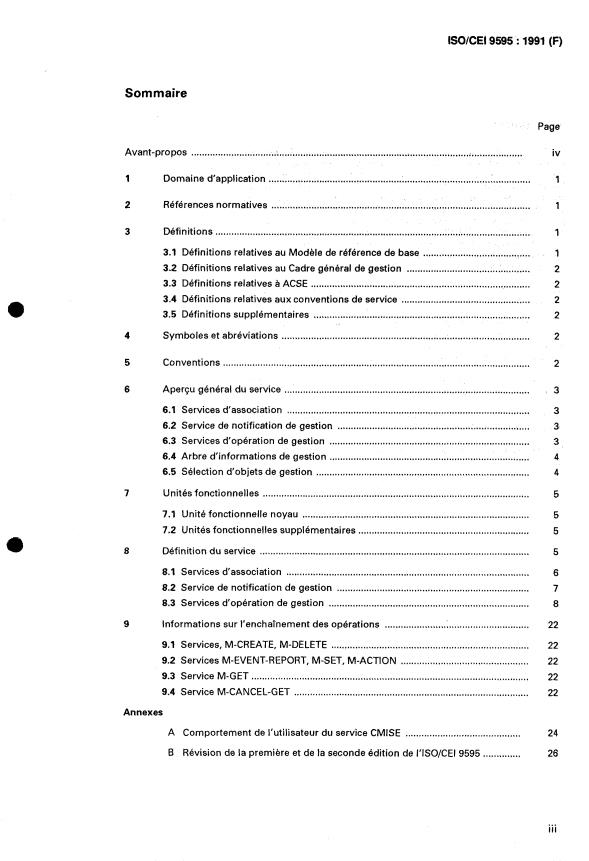
Sommaire
Page
iv
Avant-propos .
1 Domaine d'application . 1
2 Références normatives . 1
3 Défi nit i on s . 1
3.1 Définitions relatives au Modèle de référence de base .
3.2 Définitions relatives au Cadre général de gestion . 2
3.3 Définitions relatives à ACSE .
3.4 Définitions relatives aux conventions de service .
3.5 Définitions supplémentaires . 2
4 Symboles et abréviations .
5 Conventions .
6 Aperçu général du service . 3
6.1 Services d'association . 3
6.2 Service de notification de gestion . 3
6.3 Services d'opération de gestion .
6.4 Arbre d'informations de gestion .
6.5 Sélection d'objets de gestion . 4
7 Unités fonctionnelles . 5
7.1 Unité fonctionnelle noyau . 5
7.2 Unités fonctionnelles Supplémentaires . 5
8 Définition du service . 5
8.1 Services d'association . 6
8.2 Service de notification de gestion .
8.3 Services d'opération de gestion . 8
9 22
Informations sur l'enchaînement des opérations . .
9.1 Services. M.CREATE. M-DELETE . 22
9.2 Services M-EVENT-REPORT. M-SET. M-ACTION .
9.3 Service M-GET . 22
9.4 Service M-CANCEL-GET .
Annexes
A Comportement de l'utilisateur du service CMISE . 24
B Révision de la premiere et de la seconde édition de I'ISO/CEI 9595 .
...
III
ISO/CEI 9595 : 1991 (F)
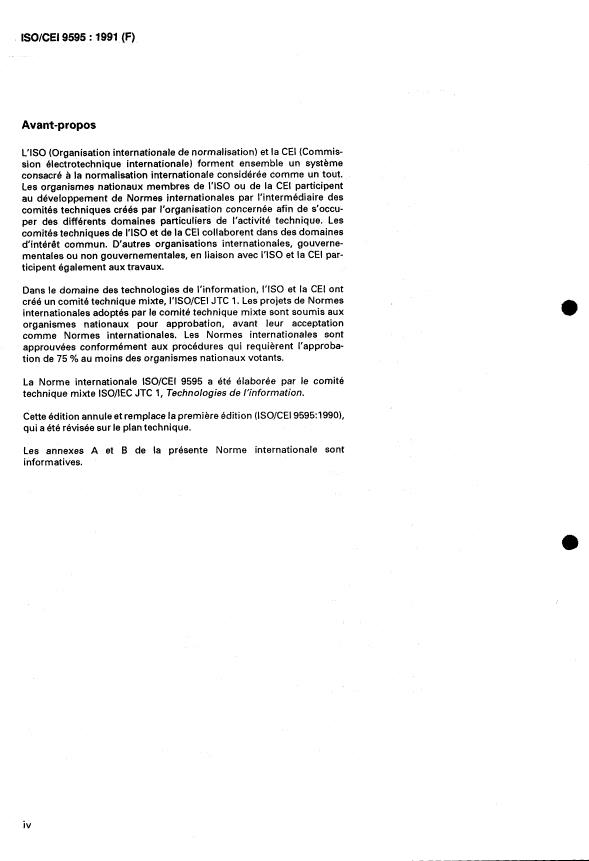
Avant-propos
L'ISO (Organisation internationale de normalisation) et la CE1 (Commis-
sion électrotechnique internationale) forment ensemble un système
consacré à la normalisation internationale considérée comme un tout.
Les organismes nationaux membres de 1'1S0 ou de la CE1 participent
au développement de Normes internationales par l'intermédiaire des
comités techniques créés par l'organisation concernée afin de s'occu-
per des différents domaines particuliers de l'activité technique. Les
comités techniques de I'ISO et de la CE1 collaborent dans des domaines
d'intérêt commun, D'autres organisations internationales, gouverne-
mentales ou non gouvernementales, en liaison avec I'ISO et la CE1 par-
ticipent également aux travaux.
Dans le domaine des technologies de l'information, 1'1S0 et la CE1 ont
créé un comité technique mixte, I'ISO/CEI JTC 1. Les projets de Normes
internationales adoptés par le comité technique mixte sont soumis aux
organismes nationaux pour approbation, avant leur acceptation
comme Normes internationales. Les Normes internationales sont
approuvées conformément aux procédures qui requièrent l'approba-
tion de 75 %au moins des organismes nationaux votants.
La Norme internationale ISO/CEI 9595 a été élaborée par le comité
technique mixte ISO/IEC JTC 1, Technologies de \'information.
Cette édition annule et remplace la premiere édition (ISOKEI 9595:1990),
qui a été révisée sur le plan technique.
Les annexes A et B de la présente Norme internationale sont
informatives.
IV
NORME INTERNATIONALE
ISO/CEI 9595 : 1991 (F)
Technologies de l'information - Interconnexion de
systèmes ouverts - Définition du service commun
d'informations de gestion
1 Domaine d'application la présente Norme internationale. Au moment de
la publication, les éditions indiquées étaient en
vigueur. Toute norme est sujette à révision et les
La présente Norme internationale définit un élé-
parties prenantes des accords fondés sur la pré-
ment de service d'application (élément de ser-
sente Norme internationale sont invitées à
vice commun d'informations de gestion) qui
a
rechercher la possibilité d'appliquer les éditions
peut être utilisé par un processus d'application
les plus récentes des normes indiquées ci-après.
dans un environnement de gestion centralisé ou
Les membres de la CE1 et de I'ISO possèdent le
décentralisé pour échanger des informations ou
registre des Normes internationales en vigueur à
des commandes en vue de réaliser la ges-
un moment donné.
tion-système, telle que définie par le cadre géné-
ral de gestion OS1 dans I'ISO/CEI 7498-4. La
IS0 7498 : 1984, Systèmes de traitement de /'in-
présente Norme internationale se situe dans la
formation - Interconnexion de systèmes
Couche Application de I'ISO 7498 ; elle est défi-
ouverts -Modèle de Référence de base.
nie suivant le modèle fourni par I'ISO/CEI 9545.
ISO/CEI 7498-4 : 1989, Systèmes de traitement de
La présente Norme internationale définit : l'information - Interconnexion de Systèmes
Ouverts - Modèle de Référence de base -
- un ensemble de primitives de service consti-
Partie 4 : Cadre général de gestion.
tuant l'élément de service d'application ;
ISO/TR 8509 : 1987, Systèmes de traitement de
- les paramètres transmis dans chaque primi-
l'information - Interconnexion de systèmes
tive de service ;
ouverts - Conventions de service.
-toute information nécessaire à la description
IS0 8649 : 1987, Systèmes de traitement de l'in-
sémantique de chaque primitive de service.
formation - Interconnexion de Systèmes
- Spécification du service pour I'élé-
Ouverts
La présente Norme internationale ne définit pas :
ment de service de contrôle d'association.
- la nature des réalisations fournissant le ser-
ISO/CEI 9545 : 1989, Systèmes de traitement de
vice décrit ;
l'information - Interconnexion de systèmes
ouverts - Structure de la Couche Application.
- la sémantique associée aux informations ou
aux commandes échangées au moyen de ce
service ;
3 Définitions
- comment l'utilisateur du service réalise la
gestion ;
Pour les besoins de la présente Norme interna-
- la nature des interactions résultant de l'utili-
tionale, les définitions suivantes s'appliquent.
sation du service,
3.1 Définitions relatives au Modèle de réfhrence
II n'y a pas de condition de conformité à la pré-
de base
sente Norme internationale.
La présente Norme internationale utilise les
termes suivants, définis dans I'ISO 7498 :
2 Références normatives
a) élément de service d'application ;
Les normes suivantes contiennent des disposi-
b) système ouvert ;
tions qui, par suite de la référence qui est en
faite, constituent des dispositions valables pour c) gestion-système,
ISOEEI 9595 : 1991 (F)
3.5.7 utilisateur de services CMISE appelant :
3.2 Définitions relatives au Cadre général de
Utilisateur de services CMISE qui demande une
gestion
opération de gestion ou qui émet une
La présente Norme internationale utilise les
notification de gestion.
termes suivants, définis dans I'ISO/CEI 7498-4 :
3.5.8 utilisateur de services CMISE exécutant :
a) objet de gestion ;
Utilisateur de services CMISE qui exécute une
opération de gestion ou qui reçoit une
b) information de gestion ;
notification de gestion.
c) entité d'application de gestion-système,
3.5.9 attribut de valeur d'ensemble : Attribut
3.3 Définitions relatives à ACSE
dont la valeur est un ensemble mathématique de
valeurs du même type. Les valeurs de
La présente Norme internationale utilise les
l'ensemble sont uniques et non ordonnées.
termes suivants, définis dans I'ISO 8649 :
a) association d'application ;
4 Symboles et abréviations
b) contexte d'application ;
NOTE - Les abréviations utilisées sont celles de la
c) association ;
version anglaise. Dans le présent article, on donne la
d) demandeur de l'association.
forme de ces abréviations développée en français. La
forme anglaise est indiquée entre parenthèses pour
aider à la compréhension.
3.4 Définitions relatives aux conventions de
service
Les symboles Conf, Ind, Req et Rsp ne sont pas
La présente Norme internationale utilise les utilisés dans la version française.
termes suivants, définis dans I'ISOflR 8509 :
ACSE Élément de service de contrôle d'asso-
ciation (Association Control Service
a) confirmation (primitive) ;
Element)
b) service de type confirmé ;
ASE clément de service d'application
c) indication (primitive) ;
(Application Service Element)
d) service de type non confirmé ;
CMlS Service commun d'informations de ges-
e) demande (primitive) ;
tion (Common Management Information
f) réponse à une demande (primitive).
Service)
CMISE Élément de service commun d'informa-
3.5 Définitions supplémentaires
tions de gestion (Common Management
Information Service Element).
3.5.1 attribut : Propriété que possède un objet
de gestion ; un attribut a une valeur.
Conf Confirmation (Confirm)
Ind Indication (Indication)
3.5.2 élément de service commun d'informa-
tions de gestion : Élément de service d'applica-
Req Demande (Request)
tion particulier défini dans la présente Norme
internationale.
Réponse à une demande (Response)
Rsp
3.5.3 services communs d'informations de
5 Conventions
gestion : Ensemble des services fournis par
l'élément de service commun d'informations de
gestion .
La présente Norme internationale définit les ser-
vices CMlS en suivant les conventions de descrip-
3.5.4 fournisseur de services CMISE : tion définies dans I'ISO/TR 8509. Dans l'article 8,
Représentation abstraite de toutes les entités
la description de chaque service CMlS comprend
fournissant des services CMISE aux utilisateurs un tableau avec une liste des paramètres des pri-
de services CMISE homologues. mitives du service. Les paramètres figurant dans
la colonne Réponse à une demandeKonfirmation
3.5.5 utilisateur de services CMISE : Partie d'un d'un tableau ne s'appliquent qu'à un service de
processus d'application utilisant l'élément de type confirmé. Pour une primitive donnée, la pré-
service commun d'informations de gestion. sence de chaque paramètre est indiquée en utili-
sant lessymboles suivants :
3.5.6 unité fonctionnelle : Unité de service
utilisée pour négocier des options de service.
ISO/CEt 9595 : 1991 (F)
M le paramètre est obligatoire terminaison d'associations d'application.
L'utilisateur de services CMISE s'appuie sur les
(4 la valeur du paramètre est égale à celle du
services définis dans I'ISO 8649 pour le contrôle
paramètre figurant dans la colonne située
d'associations d'application.
immédiatement à sa gauche.
Au cours de la phase d'établissement de
(U) l'utilisation du paramètre est optionnelle
l'association, plusieurs ASE peuvent échanger
(au choix de l'utilisateur)
des informations d'initialisation pour établir une
- le paramètre n'est pas présent dans I'inté-
association en utilisant ACSE. Le contexte
raction décrite par la primitive en question.
d'application spécifie les règles de coordination
des informations ; ces règles, concernaht
C le paramètre est conditionnel. La ou les
différents ASE, sont incorporées dans le
condition(s) sont définie(s) par la description
paramètre ((informations de l'utilisateur)) de
du paramètre.
ACSE. Le contexte d'application et les exigences
de la présentation et de la session sont véhiculés
en utilisant les paramètres du service
6 Aperçu général du service
d'établissement d'association (A-ASSOCIATE).
Les services d'informations de gestion sont utili-
Les services de terminaison d'association
sés par des processus d'application dans des
(A-RELEASE) et de coupure d'association
e
systèmes ouverts homologues, pour échanger
(A-ABORT), définis dans I'ISO 8649, sont utilisés
des informations et des commandes en vue de
pour terminer une association. Ils peuvent être
réaliser la gestion-système.
appelés par l'un ou l'autre des utilisateurs de
services CMISE.
II existe deux types de service de transfert des
informations :
6.2 Service de notification de gestion
a) un service de notification de gestion ;
La définition de la notification, et du
b) un service d'opération de gestion ; comportement des entités communicantes qui
en résulte, dépend de la spécification de l'objet
de gestion qui a généré la notification ; cette
CMIS fournit des facilités supplémentaires qui
définition est hors du domaine d'application de
permettent :
CMIS. Cependant, certaines notifications sont
fréquemment utilisées dans le cadre de la
a) de lier plusieurs réponses à des demandes
gestion-système et la présente norme définit le
d'opérations de type confirmé, en utilisant un
service commun qui peut être utilisé pour
paramètre ((identificateur lié» ;
véhiculer des informations de gestion
b) d'exécuter des opérations sur plusieurs
appropriées à la notification.
objets de gestion sélectionnés suivant cer-
tains critères et de soumettre ces opérations à
Le service M-EVENT-REPORT est appelé par un
e une condition de synchronisation.
utilisateur de services CMISE pour rendre
compte à un utilisateur de services CMISE
Le tableau I donne la liste des services CMISE.
homologue, d'un événement concernant un
objet de gestion. Le service peut être de type
Tableau 1 - Services CMISE
confirmé ou de type non confirmé, à la demande.
S'il est de type confirmé, une réponse est
Service
Type
attendue,
M-CANCEL-GET
Confirmé
M-EVENT-REPORT Confirméhon confirmé
6.3 Services d'opération de gestion
M-GET Confirmé
La définition de l'opération et le comportement
des entités communicantes qui en résulte,
M-SET Confirméhon confirmé
dépend de la spécification de l'objet de gestion
sur lequel s'applique t'opération ; cette définition
est hors du domaine d'application de CMIS.
M-CREATE Confirmé
Cependant, certaines opérations sont
M-DELETE Confirmé
fréquemment utilisées dans le cadre de la
gestion-système et la présente norme définit les
services communs suivants qui peuvent être
6.1 Services d'association
utilisés pour véhiculer les informations de
La présente Norme internationale ne définit pas
gestion appropriées aux opérations.
de service indépendant pour l'établissement et la
lSOlCEl9595 : 1991 (F)
6.5 Sélection d'objets de gestion
6.3.1 Le service M-GET est appelé par un
utilisateur de services CMISE pour demander à
La sélection d'objets de gestion comporte deux
un utilisateur de services CMISE homologue de
phases : définition du cadre de sélection et
fournir des informations de gestion. Le service
filtrage.
ne peut être que de type confirmé et une réponse
est attendue.
La définition du cadre de sélection consiste à
identifier un (des) objet(s) de gestion
6.3.2 Le service M-SET est appelé par un
au(x)quel(s) doit s'appliquer un filtre.
utilisateur de services CMISE pour demander la
modification d'informations de gestion par un
Les objets de gestion identifiés par le cadre de
utilisateur de services CMISE homologue. Le
sélection forment un ensemble ; le filtrage
service peut être de type confirmé ou de type
consiste à appliquer plusieurs tests à chaque
non confirmé, à la demande. S'il est de type
élément de cet ensemble pour en extraire un
confirmé, une réponse est attendue.
sous-ensemble.
6.3.3 Le service M-ACTION est appelé par un
L'opération s'applique au sous-ensemble
utilisateur de services CMISE pour demander à
d'objets de gestion identifiés et satisfaisant au
un utilisateur de service CMISE homologue
filtre.
d'exécuter une action. Le service peut être de
type confirmé ou de type non confirmé, à la
NOTE - Si aucun filtre n'est spécifié, l'opération
demande. S'il est de type confirmé, une réponse
s'applique à l'ensemble des objets de gestion
est attendue.
identifiés par le cadre de sélection.
6.3.4 Le service M-CREATE est appelé par un
6.5.1 Définition du cadre de sélection
utilisateur de services CMISE pour demander à
L'objet de gestion de base est défini comme la
un utilisateur de services CMISE homologue de
racine du sous-arbre d'informations de gestion à
créer une instance d'objet de gestion. Le service
ne peut être que de type confirmé et une réponse partir duquel la recherche doit commencer.
de cadre de sélection sont définis et
est attendue. Quatre types
:
indiquent si le filtre doit être appliqué
6.3.5 Le service M-DELETE est appelé par un
al à l'objet de base ;
utilisateur de services CMISE pour demander à
un utilisateur de services CMISE homologue de
b) aux objets subordonnés de niveau n ;
supprimer une instance d'objet de gestion. Le
service ne peut être que de type confirmé et une
c) a l'objet de base et tous ses subordonnés
réponse est attendue.
jusques et y compris ceux de niveau n ;
d) à l'objet de base et tous ses subordonnés
6.3.6 Le service M-CANCEL-GET est appelé par
(le sous-arbre entier).
un utilisateur de services CMISE homologue
pour annuler un service M-GET demandé
précédemment et en attente. Le service ne peut
Quand le paramètre «cadre de sélection)) n'est
être que de type confirmé et une réponse est
pas fourni, l'objet de gestion sélectionné est
attendue.
l'objet spécifié par le paramètre ((instance de
l'objet de base)).
6.4 Arbre d'informations de gestion
NOTE- Par définition, le niveau zéro est attribué a
l'objet de base.
Les informations de gestion peuvent être vues
comme une collection d'objets de gestion dont
6.5.2 Filtrage
chacun a des attributs ; des événements et des
actions peuvent être associés à ces objets de
Un filtre est un ensemble d'une ou plusieurs
gestion. Les noms des instances de ces objets de
assertions concernant la presence d'attributs ou
gestion sont organisés de façon hiérarchique
les valeurs d'attribut d'un objet de gestion
dans un arbre d'informations de gestion.
identifié par le cadre de sélection. Si le filtre
comporte plus d'une assertion, les assertions
L'arbre d'informations de gestion peut être
sont reliées par des opérateurs logiques. Si, pour
modifié de façon dynamique et ces changements
un objet de gestion donné, le test du filtre est
peuvent ne pas être instantanément disponibles
positif, cet objet de gestion est sélectionné pour
pour les autres systèmes ouverts.
exécuter l'opération.
ISO/CEI 9595 : 1991 (F)
6.5.3 Synchronisation 7.2.2 Unité fonctionnelle Filtre
Un paramètre ((synchronisation)) permet à Cette unité fonctionnelle permet d‘utiliser le
l’utilisateur de services CMISE d‘indiquer paramètre «filtre» dans les services de l’unité
fonctionnelle noyau. Le paramètre ((filtre)) ne
comment les opérations doivent être
synchronisées entre instances d‘objets de figure pas dans les services M-EVENT-REPORT et
gestion lorsque plusieurs objets de gestion ont M-CREATE.
été sélectionnés par les mécanismes de
définition du cadre de sélection et de filtrage.
7.2.3 Unité fonctionnelle Réponses multiples
L‘utilisateur de services CMISE peut demander
Cette unité fonctionnelle permet d’utiliser le
deux types de synchronisation : «atomique» ou
paramètre ((identificateur lié)) dans les services
((optimalen. L’ordre dans lequel les instances
de l‘unité fonctionnelle noyau. Le paramètre
d‘objet sont sélectionnées relève d’une initiative
((identificateur lie)) ne figure pas dans les
locale : la synchronisation fondée sur l‘ordre
services M-EVENT-REPORT et M-CREATE.
n‘est donc pas significative.
NOTE- CMlS ne fournit pas de paramètre pour
II ne peut y avoir de réponses multiples à une
indiquer la synchronisation entre attributs d‘un objet
seule opération de gestion que si l’utilisateur de
de gestion. Celle-ci fait partie du comportement de
services CMISE appelant sélectionne plusieurs
l‘objet de gestion et peut varier suivant les
objets ou demande une opération M-ACTION sur
combinaisons d’attributs et les opérations.
un seul objet de gestion et que l’action définie
doit fournir plusieurs réponses.
7 Unités fonctionnelles
NOTE - L’utilisation de l’unité fonctionnelle
Réponses multiples peut entraîner la récept%ion d‘une
quantité de données très importante. A l’heure
Les unités fonctionnelles désignent des capaci-
actuelle, CMlS fournit seulement le service
tés de service générales et correspondent à la
M-CANCEL-GET pour contrôler le flux des données ou
prise en charge de primitives de service ou de
pour contrôler une opération ; des mécanismes
paramètres.
suppplémentaires sont en cours d’étude.
7.1 Unité fonctionnelle noyau
7.2.4 Unité fonctionnelle Service étendu
L‘unité fonctionnelle noyau comprend tous les
Cette unité fonctionnelle permet d’utiliser
services cités au tableau 1, sauf le service
certains services de présentation, en plus du
M-CANCEL-GET. Le paramètre ((identificateur
service de transfert de données de présentation
lié)) ne doit pas être utilisé par les services de
(service P-DATA).
l’unité fonctionnelle noyau sauf si les utilisateurs
de services CMISE se sont mis d’accord pour
7.2.5 Unité fonctionnelle Annulation
uti I iser l‘unité fonction ne1 I e Réponses mu Iti pl es.
Cette unité fonctionnelle permet d’utiliser le
Les paramètres ((cadre de sélection)) et
service M-CANCEL-G ET.
((synchronisation)) ne doivent pas être utilisés
sauf si l’unité fonctionnelle Sélection de
plusieurs objets a été adoptée. Le paramètre
8 Définition du service
«filtre» ne doit pas être utilisé sauf si l’unité
fonctionnelle Filtre a été adoptée.
Le tableau 1 donne la liste des services CMISE.
7.2 Unités fonctionnelles supplémentaires
Les paramètres retournés dans une primitive de
7.2.1 Unité fonctionnelle Sélection de plusieurs
confirmation peuvent apparaître en tant que
objets résultat d‘une opération réussie (décrits par : «in-
clus dans la confirmation - acceptation))), ou en
Cette unité fonctionnelle permet d‘utiliser les
tant que notification d’une erreur (décrits par :
paramètres «cadre de sélection)) et
((inclus dans la confirmation - refus))).
((synchronisation)) dans les services de l‘unité
fonctionnelle noyau. Ces paramètres ne figurent
Certaines opérations peuvent signaler un code
pas dans les services M-EVENT-REPORT et
d‘erreur. Dans le cas où plusieurs erreurs ont été
M-CREATE.
signalées et si l‘une des erreurs résulte de la vio-
lation de règles de sécurité, le code erreur ccaccès
Si l’unité fonctionnelle Sélection de plusieurs
refusé)) doit être renvoyé.
objets est proposée, l‘unité fonctionnelle
Réponses multiples doit aussi être proposée.
ISO/CEI 9595 : 1991 (F)
d'application en vigueur au cours de
8.1 Services d'association
l'association donne la liste des services de
8.1.1 Etablissement d'association
présentation utilisés ainsi que les règles
d'utilisation.
Le service d'établissement d'association (A-AS-
SOCIATE), défini par I'ISO 8649, est appelé par un
8.1.1.2 Contrôle d'accès
utilisateur de services CMISE pour établir une
La forme des informations fournies par ce
association avec un utilisateur de service CMISE
paramètre n'est pas spécifiée. Ce paramètre est à
homologue. L'établissement d'association consti-
utiliser par les fonctions de contrôle d'accès pour
tue la première phase de toute activité de
établir des privilèges d'accès par défaut à utiliser
gestion.
pour tous les échanges au cours de l'association.
Si une demande de service ultérieure comporte
Le tableau 2 donne la liste des paramètres défi-
un paramètre ((contrôle d'accès)), ce paramètre
nis par la présente Norme internationale comme
détermine les privilèges d'accès pour cette
partie spécifique à CMIS du paramètre ((informa-
demande de service et seulement celle-ci.
tions de l'utilisateur)) du service d'établissement
d'association. Ces informations sont spécifiées
8.1.1.3 Informations de l'utilisateur
par l'initiateur de l'association et sont échangées
au cours de l'établissement d'une association.
L'utilisateur de services CMISE initiateur et/ou
L'échange de ces informations d'initialisation est
l'utilisateur de services CMISE en réponse peut
nécessaire avant d'utiliser les services d'opéra-
inclure, en option, le paramètre ((informations de
tion et de notification de gestion.
l'utilisateur)) dans une demande et/ou une
réponse à une demande. La signification de ce
Tableau 2 - Paramètre «informations
paramètre dépend du contexte d'application.
de l'utilisateur» du service
d'établissement d'association
8.1.2 Terminaison d'association
Le service de terminaison d'association
(A-RELEASE), défini dans I'ISO 8649, est
appelé par un utilisateur de services CMISE
pour demander une terminaison normale d'une
Unités
association entre entités d'application homologues.
fonctionnelles
La présente Norme internationale ne spécifie
Contrôle d'accès
pas comment sont utilisés les paramètres du
service de terminaison d'association.
Informations
U U
de l'utilisateur
Le service de coupure d'association (A-ABORT)
est appelé par un utilisateur de service CMISE
8.1.1.1 Unites fonctionnelles
pour demander une terminaison anormale
d'une association entre entités d'application
Quand il est fourni par l'utilisateur de services
homologues.
CMISE initiateur, ce paramètre spécifie I'ensem-
ble des unités fonctionnelles supplémentaires
Le tableau 3 indique les paramètres définis par la
que cet utilisateur propose d'utiliser au cours de
présente Norme internationale comme partie
l'association, Quand il est renvoyé par I'utilisa-
spécifique à CMIS du paramètre ((informations
teur de services CMISE en réponse, ce paramètre
de l'utilisateur)) du service de coupure d'associa-
spécifie l'ensemble des unités fonctionnelles
tion.
supplémentaires que cet utilisateur propose
d'utiliser au cours de l'association.
Tableau 3 - Paramètre «informations
de l'utilisateur» du service
Quand ce paramètre n'est pas fourni, il est admis
de coupure d'association
qu'aucune unité fonctionnelle supplémentaire
n'est proposée.
Paramètre CMlS de coupure
Tout e unité fonction n e I I e su pp I é m e nt a i r e
d'association
proposée par les deux utilisateurs de services
CMISE est adoptée et peut être utilisée au cours
Source de la coupure
de l'association.
informations
U
Si l'unité fonctionnelle Service étendu est
de l'utilisateur
adoptée, des services de presentation autre que
le service de transfert de données de
présentation peuvent être utilisés. Le contexte
ISO/CEI 9595 : 1991 (F)
8.1.2.1 Source de la coupure
cette notification d'autres notifications ou
opérations en cours chez le fournisseur de
Le paramètre «source de la coupure)) indique
services CMISE.
l'initiateur de la coupure. II prend une des
valeurs suivantes :
8.2.1.2 Mode
-fournisseur de services CMISE ;
Ce paramètre spécifie le type de service demandé
pour l'opération. Les valeurs possibles sont :
- utilisateur de services CMISE.
-confirmé ;
8.1.2.2 Informations de l'utilisateur
-non confirmé.
L'initiateur de la coupure peut être indiqué dans
le paramètre ((informations de l'utilisateur)). La
8.2.1.3 Classe d'objet de gestion
signification de ce paramètre dépend du
Ce paramètre spécifie la classe de l'objet de
contexte d'application.
gestion où s'est produit l'événement. II peut être
inclus dans une confirmation.
8.2 Service de notification de gestion
8.2.1.4 Instance d'objet de gestion
Le service M-EVENT-REPORT est utilisé par un
utilisateur de services CMISE pour rendre
Ce paramètre spécifie l'instance de l'objet de
compte d'un événement à un utilisateur de
gestion où s'est produit l'événement. II peut être
a
services CMISE homologue. C'est un service de
inclus dans une confirmation.
type confirmé ou de type non confirmé.
8.2.1.5 Type d'événement
8.2.1 Paramètres du service M-EVENT-REPORT
Ce paramètre spécifie le type d'événement dont il
est rendu compte. H peut être inclus dans une
Le tableau 4 donne la liste des paramètres du
confirmation indiquant le succès et doit figurer si
service M-EVENT-REPORT.
le paramètre ((réponse à un événement)) est
Tableau 4 - Paramètres du service
fourni.
M-EVENT-REPORT
8.2.1.6 Date et heure de l'événement
Réponse
Ce paramètre indique la date et l'heure
Nom
à une demandel
auxquelles s'est produit l'événement,
du paramètre Indication
Confirmation
8.2.1.7 Informations sur l'événement
Identificateur
M M (=)
d'appel
Ce paramètre contient toute information que
l'utilisateur de services CMISE appelant peut
fournir sur l'événement.
Classe d'objet de
8.2.1.8 Date et heure de la réponse
Instance d'objet Ce paramètre indique la date et l'heure
M U
de gestion auxquelles la réponse est générée. II peut être
inclusdans une confirmation indiquant le succès.
8.2.1.9 Réponse à l'événement
Date et heure de
Ce paramètre contient la réponse au compte
U -
l'événement
rendu d'événement. II peut être inclus dans une
confirmation indiquant le succès.
Information sur
U -
l'événement
8.2.1.10 Erreurs
Date et heure de
-
U
Ce paramètre sert à signaler les erreurs résultant
la réponse
de l'opération. II doit être inclus par l'utilisateur
Réponse à
de services CMISE exécutant dans une
-
C
l'événement
confirmation indiquant l'échec. La liste des
erreurs possibles est la suivante :
-
Erreurs
C
- doublon : l'identificateur d'appel spécifié
était déjà attribué à une autre notification ou &
une autre opération ;
Ce paramètre spécifie l'identificateur attribué à la
notification. II peut être utilisé pour distinguer
ISO/CEI 9595 : 1991 (F)
8.3.1.1 Paramètres du service M-GET
-valeur d'argument invalide : la valeur du
paramètre ((informations sur l'événement)) est
Le tableau 5 donne la liste des paramètres du
;
en dehors des limites fixées ou inappropriée
service M-GET.
- argument de type erroné : l'utilisation d'un
Tableau 5 - Paramètres du service M-GET
des paramètres fournis n'a pas fait l'objet d'un
accord entre les utilisateurs de service CMISE ;
- argument inconnu : l'information sur Nom I Demande, 1
l'événement spécifiée n'est pas connue ;
du paramètre Indication Confirmation
-type d'événement inconnu : la valeur du
Identificateur
paramètre «type d'événement)) n'est pas M M
d'appel
connue ;
- C
Identificateur lié
- classe d'objet inconnue : la classe de l'objet
de gestion n'est pas connue ;
Classe de l'objet
-
de base
- instance d'objet inconnue : l'instance de
l'objet de gestion n'est pas connue ; Instance de l'objet
de base
1.1 - I
-erreur de traitement : une erreur est
-
Cadre de sélection I U
survenue au cours du traitement de la
I I
~ 1)
notification ;
-
Filtre U
-limitation de ressource : la notification n'a
-
Contrôle d'accès U
pas été traitée par manque de ressource ;
-
Synchronisation
U
-opération inconnue : l'opération n'a pas fait
l'objet d'un accord entre les utilisateurs de Liste d'identifi-
-
services CMISE. cateurs d'attributs
I
Classe d'objet de -
8.2.2 Procédures M-EVENT-REPORT
aestion I
8.2.2.1 L'utilisateur de services CMISE appelant
Instance d'objet
-
C
rend compte d'un événement à l'utilisateur de
de gestion
services CMISE exécutant en envoyant une
Date et heure de
primitive de demande M-EVENT-REPORT au
fournisseur de services CMISE.
Liste d'attributs
8.2.2.2 Si le fournisseur de services CMISE
accepte la demande, il envoie une primitive Erreurs
d'indication M-EVENT-REPORT à l'utilisateur de
services CMISE exécutant. Sinon, les procédures
8.3.1.1.1 Identificateur d'appel
suivantes ne s'appliquent pas.
e
Ce paramètre spécifie l'identificateur attribué à
8.2.2.3 Si le service est de type confirmé,
l'opération, II peut être utilisé pour distinguer
l'utilisateur de services CMISE exécutant signale
cette opération d'autres notifications ou
s'il accepte ou rejette la primitive de demande
opérations en cours chez le fournisseur de
M-EVENT-REPORT en envoyant une primitive de
services CMISE.
réponse à une demande M-EVENT-REPORT au
fournisseur de services CMISE.
Chaque réponse doit avoir un identificateur
8.2.2.4 Si le service est de type confirmé, le d'appel unique, la réponse finale doit avoir un
fournisseur de services CMISE envoie une primi- identificateur d'appel égal à celui fourni dans la
tive de confirmation M-EVENT-REPORT à l'utili- primitive d'indication.
sateur de services CMISE appelant.
8.3.1.1.2 Identificateur lié
8.3 Services d'opération de gestion
Si plusieurs réponses doivent être envoyées, ce
8.3.1 Service M-GET
paramètre spécifie l'identificateur fourni par
l'utilisateur de services CMISE exécutant quand
Le service M-GET est utilisé par un utilisateur de
ces réponses sont renvoyées. L'identificateur lié
services CMISE pour obtenir des valeurs
doit avoir la même valeur que l'identificateur
d'attribut d'un utilisateur de services CMISE
d'appel fourni dans la primitive d'indication.
homologue. C'est un service de type confirmé.
ISO/CEI 9595 : 1991 (F)
8.3.1 .I .8 Synchronisation
8.3.1.1.3 Classe de l'objet de base
la classe de l'objet de Grâce à ce paramètre, l'utilisateur de services
Ce paramètre spécifie
CMISE appelant indique comment doivent être
gestion qui doit être utilisée comme point de
départ pour la sélection des objets de gestion sur synchronisées les opérations M-GET entre les
lesquels doit s'appliquer le filtre (s'il est fourni). instances d'objets sélectionnés. II y a deux
manières de synchroniser les recherches :
-atomique : tous les objets de gestion
8.3.1.1.4 Instance de l'objet de base
sélectionnés pour l'opération sont vérifiés
Ce paramètre spécifie l'instance de l'objet de
pour garantir qu'ils peuvent exécuter
gestion qui doit être utilisée comme point de
l'opération avec succès. Si un ou plusieurs
départ de la sélection des objets de gestion sur
objets ne peuvent pas exécuter l'opération,
lesquels le filtre doit s'appliquer (si le filtre est
aucun ne l'exécute ; autrement, tous
fourni).
l'exécutent ;
-optimale : tous les objets de gestion
sélectionnés pour l'opération doivent exécuter
8.3.1.1.5 Cadre de sélection
l'opération.
Ce paramètre indique le sous-arbre dans lequel
Si ce paramètre n'est pas fourni, la
la recherche va être effectuée, la racine de ce
synchronisation optimale est effectuée. Si seul
sous-arbre étant l'objet de base. II peut y avoir
*
l'objet de base est sélectionné pour l'opération,
différents niveaux de recherche :
ce paramètre est ignoré (si il est fourni).
- objet de base seul ;
8.3.1 .I .9 Liste d'identificateurs d'attributs
-subordonnés de niveau n par rapport à
l'objet de base ;
Ce paramètre contient un ensemble d'identifica-
teurs d'attributs pour lesquels l'utilisateur de ser-
-objet de base et tous ses subordonnés
vices CMISE exécutant doit renvoyer les valeurs
jusques et y compris les subordonnés de
d'attributs. Si ce paramètre est omis, tous les
niveau n ;
attributs sont Sélectionnés. La spécification de la
-objet de base et tous ses subordonnés. classe de l'objet de base donne les définitions
des attributs.
Le cadre de sélection par défaut est l'objet de
base seul. 8.3.1.1.10 Classe d'objet de gestion
Si seul l'objet de base est sélectionné, ce
8.3.1.1.6 Filtre
paramètre est optionnel ; sinon, il doit spécifier
la classe de l'objet de gestion dont les valeurs
Ce paramètre spécifie l'ensemble d'assertions
d'attributs sont renvoyées. II peut être inclus
définissant le test de filtrage à appliquer à ou aux
dans une confirmation.
objets de gestion identifiés dans le cadre de
O
sélection. Plusieurs assertions peuvent être
8.3.1.1.11 Instance d'objet de gestion
regroupées par des opérateurs logique ET, OU,
un test d'égali-
SAUF. Chaque assertion peut être
Si seul l'objet de base est sélectionné, ce
té, d'ordre, de présence ou de comparaison d'en-
paramètre est optionnel ; sinon, il doit spécifier
sembles. Les assertions relatives à la valeur d'un
l'instance de l'objet de gestion dont les valeurs
attribut sont évaluées suivant les règles de mise
d'attributs sont renvoyées. II peut être inclus
en concordance définies dans la syntaxe d'attri-
dans une confirmation.
but. Si le filtre comprend une assertion relative à
une valeur d'attribut et que cet attribut n'existe
8.3.1.1.12 Date et heure de la réponse
pas dans l'objet de gestion identifié dans le cadre
de sélection, le résultat du test doit être FAUX.
Ce paramètre indique la date et l'heure auxquel-
L'objet ou les objets pour lesquels les tests sont
les la réponse est générée. II peut être inclus
VRAIS sont sélectionnés pour l'opération. Si le
dans une confirmation indiquant le succès.
filtre n'est pas spécifié, tous les objets identifiés
dans le cadre de sélection sont sélectionnés.
8.3.1.1.13 Liste d'attributs
8.3.1.1.7 Contrôle d'accès Ce paramètre contient l'ensemble des identifica-
teurs d'attributs et valeurs d'attributs renvoyés
La forme des informations données par ce
par l'utilisateur de services CMISE exécutant. II
paramètre n'est pas spécifiée ; ce paramètre est
doit être inclus dans une confirmation indiquant
à utiliser par les fonctions de contrôle d'accès.
le succès.
ISOCEI 9595 : 1991 (F)
- opération inconnue : l'opération n'a pas fait
8.3.1.1.14 Erreurs
l'objet d'un accord entre les utilisateurs de
Ce paramètre sert â signaler les erreurs résultant
services CMISE.
de l'opération. II doit être inclus par l'utilisateur
de services CMISE exécutant dans une
8.3.1.2 Procédures M-GET
confirmation indiquant l'échec. La liste des
erreurs possibles est la suivante :
8.3.1.2.1 L'utilisateur de services CMISE
appelant demande à un utilisateur de services
- accès refusé : l'opération demandée n'a pas
CMISE exécutant de rechercher une ou des
été exécutée pour des raisons de sécurité du
valeur(s) d'attributs en envoyant une primitive
système ouvert ;
de demande M-GET au fournisseur de services
-conflit entre l'instance et la classe :
CMISE.
l'instance d'objet de gestion spécifiée
n'appartient pas à la classe spécifiée ; 8.3.1.2.2 Si le fournisseur de services CMISE
accepte la primitive de demande, il envoie une
-complexité : l'opération demandée n'a pas
primitive d'indication M-GET à l'utilisateur de
été exécutée parce qu'un paramètre est trop
services CMlSE exécutant ; sinon, le fournisseur
complexe ;
de services CMISE rejette la primitive de
-doublon : l'identificateur d'appel a déjà été
demande et les procédures suivantes ne
attribué à une autre notification ou une autre
s'appliquent pas.
opération ;
e
-erreur de lecture de la liste : une ou
8.3.1.2.3 Si l'opération ne peut pas être
plusieurs valeurs d'attributs n'ont pas été lues
exécutée, l'utilisateur de services CMISE
pour une des raisons suivantes :
exécutant rejette la primitive de demande M-GET
en envoyant une primitive de réponse à une
-accès refusé : l'opération demandée n'a
demande de M-GET avec un code erreur
pas été exécutée pour des raisons de sécurité
approprié. Dans ce cas, les procédures suivantes
du système ouvert,
ne s'appliquent pas.
- attribut inconnu : l'identificateur de
l'attribut ou du groupe d'attribut spécifié
8.3.1.2.4 Si une seule réponse doit être fournie,
n'est pas connu.
les procédures décrites en 8.3.1.2.5, 8.3.1.2.6 et
8.3.1.2.7 ne s'appliquent pas.
Néanmoins, les valeurs d'attributs pouvant
être lues sont renvoyées ;
8.3.1.2.5 L'utilisateur de services CMISE
exécutant recherche la ou les valeur(s)
-filtre invalide : le paramètre «filtre» contient
d'attributs demandées et génère une primitive
une assertion invalide ou un opérateur logique
de réponse incluant des résultats et/ou des
non connu ;
notifications d'erreurs. L'identificateur lié doit
-cadre de sélection invalide : la valeur du
figurer dans la primitive de service ; sa valeur
paramètre ((cadre de sélection)) n'est pas vala-
doit être égale à celle de l'identificateur d'appel
ble ;
de la primitive d'indication dans laquelle la
I)
- argument de type erroné : l'utilisation d'un
classe et l'instance d'objet de gestion doivent
des paramètres fournis n'a pas fait l'objet d'ac-
figurer.
cord entre les utilisateurs de services CMISE ;
8.3.1.2.6 Le fournisseur de services CMISE
-classe d'objet inconnue : la classe de l'objet
envoie une primitive de confirmation M-GET à
de gestion n'est pas connue :
l'utilisateur de service CMISE appelant ;
- instance d'objet inconnue : l'instance de
l'identificateur lié, la classe d'objet de gestion et
l'objet de gestion n'est pas connue ;
l'instance d'objet de gestion doivent figurer dans
-opération annulée : l'opération a été
la primitive de confirmation.
annulée par une opération M-CANCEL-GET ;
aucune autre valeur d'attribut ne sera
8.3.1.2.7 Les procédures décrites en 8.3.1.2.5 et
renvoyée ;
8.3.1.2.6 doivent être répétées jusqu'à ce que
toutes les réponses aient été données.
- erreur de traitement : une erreur est surve-
nue au cours du traitement de l'opération ;
8.3.1.2.8 L'utilisateur de services CMISE
- limitation de ressource : l'opération n'a pas
fin de la réponse en
exécutant indique la
pu être exécutée par manque de ressource ;
une
envoyant une primitive de réponse à
-synchronisation non prise en charge : le
demande M-GET sans identificateur lié et sans
type de synchronisation spécifié n'est pas pris
liste d'attributs, dans le cas où des réponses
en charge ;
liées ont été générées selon les procédures
décritesen 8.3.1.2.5et 8.3.1.2.6.
lSOlCEl9595 : 1991 (F)
8.3.1.2.9 Le fournisseur de services CMISE
-opération de type erroné : le paramètre
envoie une primitive de confirmation M-GET ((identificateur d'appel de l'opération M-GET»
l'utilisateur
...
Questions, Comments and Discussion
Ask us and Technical Secretary will try to provide an answer. You can facilitate discussion about the standard in here.
Loading comments...