

ISO 12981-1:2000
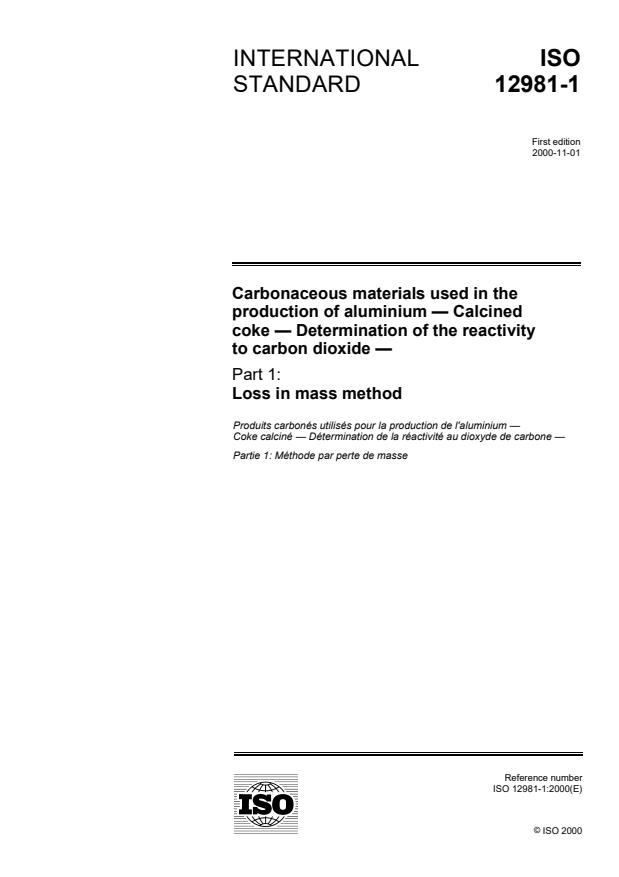
(Main)Carbonaceous materials used in the production of aluminium — Calcined coke — Determination of the reactivity to carbon dioxide — Part 1: Loss in mass method
General Information
- Abstract
- Status
- Published
- Publication Date
- 01-Nov-2000
- Technical Committee
- ISO/TC 226 - Materials for the production of primary aluminium
- Drafting Committee
- ISO/TC 226 - Materials for the production of primary aluminium
- Current Stage
- 9093 - International Standard confirmed
- Start Date
- 29-Oct-2023
- Completion Date
- 29-Aug-2026
Overview
ISO 12981-1:2000 sets out an internationally recognized method for determining the reactivity of calcined petroleum coke to carbon dioxide, using the loss in mass method. This standard is critical in the aluminium production sector, where calcined coke is a key raw material for manufacturing anodes. Understanding the coke's reactivity to carbon dioxide is essential for evaluating its performance and suitability in the electrolytic processes used in aluminium smelting.
Key Topics
Purpose of the Standard
- Specifies a procedure for assessing the reactivity of calcined petroleum coke by measuring the loss in mass after exposure to a CO₂ atmosphere at high temperatures.
- Focuses on the "loss in mass method," which provides a quantifiable index of coke reactivity important for anode manufacturing.
Sample Preparation and Testing
- Outlines sample collection and preparation requirements, including sieving, oil removal if necessary, and drying to constant mass.
- Describes the apparatus setup, including furnace and tube reactor specifications, and the required conditions for the test, notably a temperature of 1000°C and a controlled CO₂ flow.
Measurement and Reporting
- Details the procedure for measuring the initial and final mass of the coke sample to calculate reactivity as a percent loss in mass.
- Offers guidelines on calibration, precision, and repeatability, ensuring consistent results across different laboratories.
- Specifies content for test reporting, including sample identification, method reference, results, and any deviations from standard procedures.
Applications
Aluminium Smelting and Anode Production
- Used by aluminium producers and suppliers of calcined coke to ensure raw material meets industry requirements.
- Facilitates quality control and material selection, optimizing anode performance and enhancing the efficiency of the Hall-Héroult electrolytic process.
Research and Development
- Supports R&D activities in carbon material characterization, enabling improvements in coke preparation and refining.
Interlaboratory Consistency
- Promotes standardized testing methodologies, improving coherence and reliability in quality assessments across multiple production sites and laboratories worldwide.
Related Standards
ISO 12981-1:2000 is part of a family of standards supporting quality assurance for carbonaceous materials in aluminium production:
- ISO 12981-2: Specifies an alternative method (thermogravimetric) for determining coke reactivity to CO₂.
- ISO 6375: Describes techniques for sampling coke materials for aluminium electrodes.
- ISO 8723: Provides methods for determining oil content in calcined coke.
- ISO 12984: Outlines procedures for particle size distribution analysis of calcined coke.
- ISO 5725-2: Defines approaches to establishing repeatability and reproducibility in measurement methods.
Practical Value
Implementing ISO 12981-1:2000 helps organizations:
- Ensure High Anode Quality: Accurate determination of coke reactivity supports the selection of suitable materials that contribute to the longevity and efficiency of aluminium smelting operations.
- Reduce Process Variability: A standardized method minimizes discrepancies in test results between suppliers and consumers, facilitating better supplier relationships and reducing production issues.
- Comply with Industry Requirements: Using this international standard supports regulatory compliance and meets contractual obligations in the global aluminium industry.
Keywords: ISO 12981-1, calcined coke reactivity, aluminium production, loss in mass method, carbon dioxide reactivity, coke testing standard, carbonaceous materials, aluminium anode, quality control in smelting.
Get Certified
Connect with accredited certification bodies for this standard

ECOCERT
Organic and sustainability certification.

Eurofins Food Testing Global
Global leader in food, environment, and pharmaceutical product testing.

Intertek Bangladesh
Intertek certification and testing services in Bangladesh.
Sponsored listings
Frequently Asked Questions
ISO 12981-1:2000 is a standard published by the International Organization for Standardization (ISO). Its full title is "Carbonaceous materials used in the production of aluminium — Calcined coke — Determination of the reactivity to carbon dioxide — Part 1: Loss in mass method". This standard covers: Carbonaceous materials used in the production of aluminium — Calcined coke — Determination of the reactivity to carbon dioxide — Part 1: Loss in mass method
Carbonaceous materials used in the production of aluminium — Calcined coke — Determination of the reactivity to carbon dioxide — Part 1: Loss in mass method
ISO 12981-1:2000 is classified under the following ICS (International Classification for Standards) categories: 71.100.10 - Materials for aluminium production. The ICS classification helps identify the subject area and facilitates finding related standards.
ISO 12981-1:2000 is available in PDF format for immediate download after purchase. The document can be added to your cart and obtained through the secure checkout process. Digital delivery ensures instant access to the complete standard document.
Standards Content (Sample)
INTERNATIONAL ISO
STANDARD 12981-1
First edition
2000-11-01
Carbonaceous materials used in the
production of aluminium — Calcined
coke — Determination of the reactivity
to carbon dioxide —
Part 1:
Loss in mass method
Produits carbonés utilisés pour la production de l'aluminium —
Coke calciné — Détermination de la réactivité au dioxyde de carbone —
Partie 1: Méthode par perte de masse
Reference number
©
ISO 2000
PDF disclaimer
This PDF file may contain embedded typefaces. In accordance with Adobe's licensing policy, this file may be printed or viewed but shall not
be edited unless the typefaces which are embedded are licensed to and installed on the computer performing the editing. In downloading this
file, parties accept therein the responsibility of not infringing Adobe's licensing policy. The ISO Central Secretariat accepts no liability in this
area.
Adobe is a trademark of Adobe Systems Incorporated.
Details of the software products used to create this PDF file can be found in the General Info relative to the file; the PDF-creation parameters
were optimized for printing. Every care has been taken to ensure that the file is suitable for use by ISO member bodies. In the unlikely event
that a problem relating to it is found, please inform the Central Secretariat at the address given below.
All rights reserved. Unless otherwise specified, no part of this publication may be reproduced or utilized in any form or by any means, electronic
or mechanical, including photocopying and microfilm, without permission in writing from either ISO at the address below or ISO's member body
in the country of the requester.
ISO copyright office
Case postale 56 � CH-1211 Geneva 20
Tel. + 41 22 749 01 11
Fax + 41 22 749 09 47
E-mail copyright@iso.ch
Web www.iso.ch
Printed in Switzerland
ii © ISO 2000 – All rights reserved
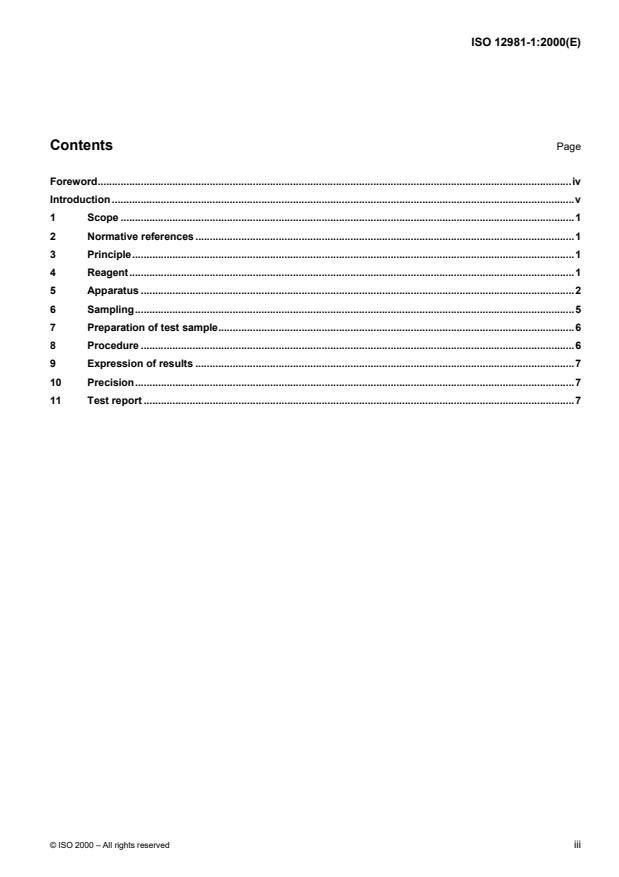
Contents Page
Foreword.iv
Introduction.v
1 Scope .1
2 Normative references .1
3 Principle.1
4 Reagent.1
5 Apparatus .2
6 Sampling.5
7 Preparation of test sample.6
8 Procedure .6
9 Expression of results .7
10 Precision.7
11 Test report .7
Foreword
ISO (the International Organization for Standardization) is a worldwide federation of national standards bodies (ISO
member bodies). The work of preparing International Standards is normally carried out through ISO technical
committees. Each member body interested in a subject for which a technical committee has been established has
the right to be represented on that committee. International organizations, governmental and non-governmental, in
liaison with ISO, also take part in the work. ISO collaborates closely with the International Electrotechnical
Commission (IEC) on all matters of electrotechnical standardization.
International Standards are drafted in accordance with the rules given in the ISO/IEC Directives, Part 3.
Draft International Standards adopted by the technical committees are circulated to the member bodies for voting.
Publication as an International Standard requires approval by at least 75 % of the member bodies casting a vote.
Attention is drawn to the possibility that some of the elements of this part of ISO 12981 may be the subject of
patent rights. ISO shall not be held responsible for identifying any or all such patent rights.
International Standard ISO 12981-1 was prepared by Technical Committee ISO/TC 47, Chemistry, Subcommittee
SC 7, Aluminium oxide, cryolite, aluminium fluoride, sodium fluoride, carbonaceous products for the aluminium
industry.
ISO 12981 consists of the following parts, under the general title Carbonaceous materials used in the production of
aluminium — Calcined coke — Determination of the reactivity to carbon dioxide:
� Part 1: Loss in mass method
� Part 2: Thermogravimetric method
iv © ISO 2000 – All rights reserved
Introduction
The reactivity of a calcined coke to carbon dioxide is assessed by determining the loss in mass of a sample
exposed in accordance with the following chemical reaction:
C� CO �2CO
This determination allows an assessment of the later anode reactivity to carbon dioxide in the electrolysis cell.
INTERNATIONAL STANDARD ISO 12981-1:2000(E)
Carbonaceous materials used in the production of aluminium —
Calcined coke — Determination of the reactivity to carbon
dioxide —
Part 1:
Loss in mass method
1 Scope
This part of ISO 12981 specifies a method for the determination, by a loss in mass method, of the reactivity of
calcined petroleum coke, used in the manufacture of anodes for the production of aluminium, to carbon dioxide.
2 Normative references
The following normative documents contain provisions which, through reference in this text, constitute provisions of
this part of ISO 12981. For dated references, subsequent amendments to, or revisions of, any of these publications
do not apply. However, parties to agreements based on this part of ISO 12981 are encouraged to investigate the
possibility of applying the most recent editions of the normative documents indicated below. For undated
references, the latest edition of the normative document referred to applies. Members of ISO and IEC maintain
registers of currently valid International Standards.
ISO 383, Laboratory glassware — Interchangeable conical ground joints.
ISO 5725-2, Accuracy (trueness and precision) of measurement methods and results — Part 2: Basic method for
the determination of repeatability and reproducibility of a standard measurement method.
ISO 6375, Carbonaceous materials for the production of aluminium — Coke for electrodes — Sampling.
ISO 8723, Carbonaceous materials for the production of a
...