


ISO 10303-209:2001
(Main)Industrial automation systems and integration — Product data representation and exchange — Part 209: Application protocol: Composite and metallic structural analysis and related design
Industrial automation systems and integration — Product data representation and exchange — Part 209: Application protocol: Composite and metallic structural analysis and related design
Systèmes d'automatisation industrielle et intégration — Représentation et échange de données de produits — Partie 209: Protocole d'application: Analyse structurelle composite et métallique et conception associée
General Information
- Status
- Withdrawn
- Publication Date
- 10-Oct-2001
- Withdrawal Date
- 10-Oct-2001
- Technical Committee
- ISO/TC 184/SC 4 - Industrial data
- Drafting Committee
- ISO/TC 184/SC 4/WG 3 - Oil, Gas, Process and Power
- Current Stage
- 9599 - Withdrawal of International Standard
- Start Date
- 01-Dec-2014
- Completion Date
- 12-Feb-2026
Relations
- Consolidated By
ISO 24333:2009 - Cereals and cereal products — Sampling - Effective Date
- 06-Jun-2022
- Effective Date
- 21-May-2011


ISO 10303-209:2001 - Industrial automation systems and integration -- Product data representation and exchange
ISO 10303-209:2001 - Industrial automation systems and integration -- Product data representation and exchange
Get Certified
Connect with accredited certification bodies for this standard

National Aerospace and Defense Contractors Accreditation Program (NADCAP)
Global cooperative program for special process quality in aerospace.
CARES (UK Certification Authority for Reinforcing Steels)
UK certification for reinforcing steels and construction.
DVS-ZERT GmbH
German welding certification society.
Sponsored listings
Frequently Asked Questions
ISO 10303-209:2001 is a standard published by the International Organization for Standardization (ISO). Its full title is "Industrial automation systems and integration — Product data representation and exchange — Part 209: Application protocol: Composite and metallic structural analysis and related design". This standard covers: Industrial automation systems and integration — Product data representation and exchange — Part 209: Application protocol: Composite and metallic structural analysis and related design
Industrial automation systems and integration — Product data representation and exchange — Part 209: Application protocol: Composite and metallic structural analysis and related design
ISO 10303-209:2001 is classified under the following ICS (International Classification for Standards) categories: 25.040.40 - Industrial process measurement and control. The ICS classification helps identify the subject area and facilitates finding related standards.
ISO 10303-209:2001 has the following relationships with other standards: It is inter standard links to ISO 24333:2009, ISO 10303-209:2014. Understanding these relationships helps ensure you are using the most current and applicable version of the standard.
ISO 10303-209:2001 is available in PDF format for immediate download after purchase. The document can be added to your cart and obtained through the secure checkout process. Digital delivery ensures instant access to the complete standard document.
Standards Content (Sample)
INTERNATIONAL ISO
STANDARD 10303-209
First edition
2001-10-01
Industrial automation systems and
integration — Product data representation
and exchange —
Part 209:
Application protocol: Composite and
metallic structural analysis and related
design
Systèmes d'automatisation industrielle et intégration — Représentation et
échange de données de produits —
Partie 209: Protocole d'application: Analyse structurelle composite et
métallique et conception associée
Reference number
©
ISO 2001
PDF disclaimer
This PDF file may contain embedded typefaces. In accordance with Adobe's licensing policy, this file may be printed or viewed but shall not
be edited unless the typefaces which are embedded are licensed to and installed on the computer performing the editing. In downloading this
file, parties accept therein the responsibility of not infringing Adobe's licensing policy. The ISO Central Secretariat accepts no liability in this
area.
Adobe is a trademark of Adobe Systems Incorporated.
Details of the software products used to create this PDF file can be found in the General Info relative to the file; the PDF-creation parameters
were optimized for printing. Every care has been taken to ensure that the file is suitable for use by ISO member bodies. In the unlikely event
that a problem relating to it is found, please inform the Central Secretariat at the address given below.
This CD-ROM contains the publication ISO 10303-209 in portable document format (PDF), which can be viewed
using Adobe® Acrobat® Reader.
Adobe and
...
INTERNATIONAL ISO
STANDARD 10303-209
First edition
2001-10-01
Industrial automation systems and
integration — Product data representation
and exchange —
Part 209:
Application protocol: Composite and
metallic structural analysis and related
design
Systèmes d'automatisation industrielle et intégration — Représentation et
échange de données de produits —
Partie 209: Protocole d'application: Analyse structurelle composite et
métallique et conception associée
Reference number
©
ISO 2001
PDF disclaimer
This PDF file may contain embedded typefaces. In accordance with Adobe's licensing policy, this file may be printed or viewed but shall not
be edited unless the typefaces which are embedded are licensed to and installed on the computer performing the editing. In downloading this
file, parties accept therein the responsibility of not infringing Adobe's licensing policy. The ISO Central Secretariat accepts no liability in this
area.
Adobe is a trademark of Adobe Systems Incorporated.
Details of the software products used to create this PDF file can be found in the General Info relative to the file; the PDF-creation parameters
were optimized for printing. Every care has been taken to ensure that the file is suitable for use by ISO member bodies. In the unlikely event
that a problem relating to it is found, please inform the Central Secretariat at the address given below.
© ISO 2001
All rights reserved. Unless otherwise specified, no part of this publication may be reproduced or utilized in any form or by any means, electronic
or mechanical, including photocopying and microfilm, without permission in writing from either ISO at the address below or ISO's member body
in the country of the requester.
ISO copyright office
Case postale 56 • CH-1211 Geneva 20
Tel. + 41 22 749 01 11
Fax + 41 22 749 09 47
E-mail copyright@iso.ch
Web www.iso.ch
Printed in Switzerland
ii © ISO 2001 – All rights reserved
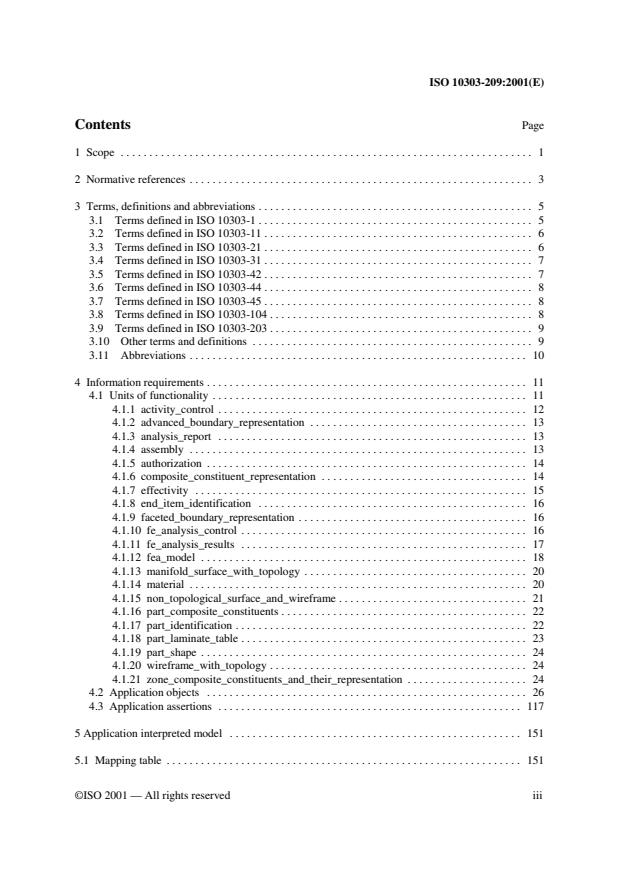
Contents Page
1 Scope . 1
2 Normative references . 3
3 Terms, definitions and abbreviations . 5
3.1 Terms defined in ISO 10303-1. 5
3.2 Terms defined in ISO 10303-11. 6
3.3 Terms defined in ISO 10303-21. 6
3.4 Terms defined in ISO 10303-31. 7
3.5 Terms defined in ISO 10303-42. 7
3.6 Terms defined in ISO 10303-44. 8
3.7 Terms defined in ISO 10303-45. 8
3.8 Terms defined in ISO 10303-104. 8
3.9 Terms defined in ISO 10303-203. 9
3.10 Other terms and definitions . 9
3.11 Abbreviations . 10
4 Information requirements . 11
4.1 Units of functionality . 11
4.1.1 activity_control . 12
4.1.2 advanced_boundary_representation . 13
4.1.3 analysis_report . 13
4.1.4 assembly . 13
4.1.5 authorization . 14
4.1.6 composite_constituent_representation . 14
4.1.7 effectivity . 15
4.1.8 end_item_identification . 16
4.1.9 faceted_boundary_representation . 16
4.1.10 fe_analysis_control . 16
4.1.11 fe_analysis_results . 17
4.1.12 fea_model . 18
4.1.13 manifold_surface_with_topology . 20
4.1.14 material . 20
4.1.15 non_topological_surface_and_wireframe . 21
4.1.16 part_composite_constituents . 22
4.1.17 part_identification . 22
4.1.18 part_laminate_table . 23
4.1.19 part_shape . 24
4.1.20 wireframe_with_topology . 24
4.1.21 zone_composite_constituents_and_their_representation . 24
4.2 Application objects . 26
4.3 Application assertions . 117
5 Application interpreted model . 151
5.1 Mapping table . 151
©ISO 2001 — All rights reserved iii
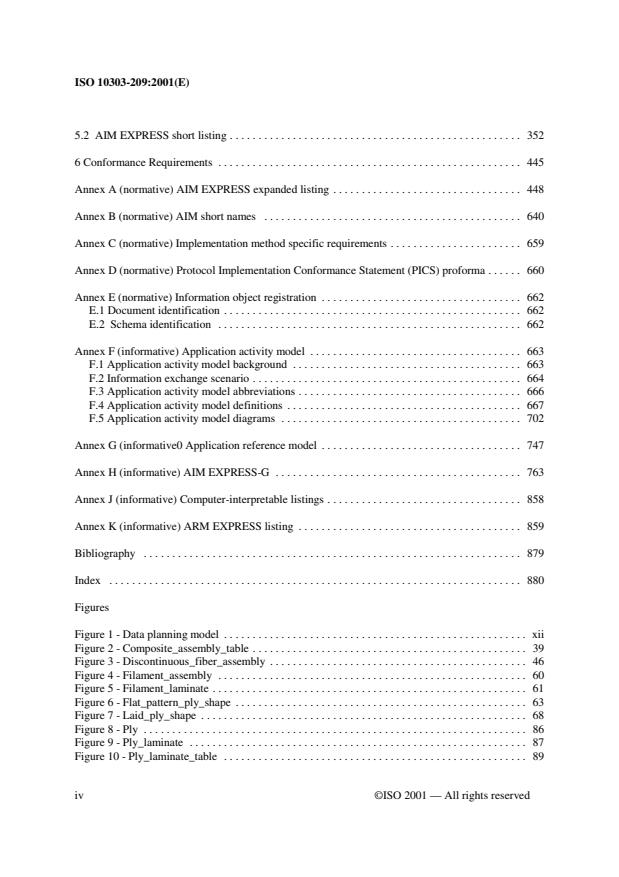
5.2 AIM EXPRESS short listing . 352
6 Conformance Requirements . 445
Annex A (normative) AIM EXPRESS expanded listing . 448
Annex B (normative) AIM short names . 640
Annex C (normative) Implementation method specific requirements . 659
Annex D (normative) Protocol Implementation Conformance Statement (PICS) proforma . 660
Annex E (normative) Information object registration . 662
E.1 Document identification . 662
E.2 Schema identification . 662
Annex F (informative) Application activity model . 663
F.1 Application activity model background . 663
F.2 Information exchange scenario . 664
F.3 Application activity model abbreviations . 666
F.4 Application activity model definitions . 667
F.5 Application activity model diagrams . 702
Annex G (informative0 Application reference model . 747
Annex H (informative) AIM EXPRESS-G . 763
Annex J (informative) Computer-interpretable listings . 858
Annex K (informative) ARM EXPRESS listing . 859
Bibliography . 879
Index . 880
Figures
Figure 1 - Data planning model . xii
Figure 2 - Composite_assembly_table . 39
Figure 3 - Discontinuous_fiber_assembly . 46
Figure 4 - Filament_assembly . 60
Figure 5 - Filament_laminate . 61
Figure 6 - Flat_pattern_ply_shape . 63
Figure 7 - Laid_ply_shape . 68
Figure 8 - Ply . 86
Figure 9 - Ply_laminate . 87
Figure 10 - Ply_laminate_table . 89
iv ©ISO 2001 — All rights reserved
Figure 11 - Processed_core . 94
Figure 12 - Projection_method . 98
Figure 13 - Surface_ply_shape . 109
Figure 14 - View_ply_shape . 113
Figure F.1 - PAS-C Suite Concept . 664
Figure F.2 - AP209 scenario from a structural designer’s viewpoint . 665
Figure F.3 - AP209 scenario from an analysis viewpoint . 667
Figure F.4 - A-0 Develop, procure, build, use and maintain an SP . 703
Figure F.5 - A0 Develop, procure, build, use and maintain an SP . 704
Figure F.6 - A2 manage, design, build, and support an SP . 705
Figure F.7 - A22 design and analyze an SP . 706
Figure F.8 - A223 perform structural part detail design and analysis . 707
Figure F.9 - A2232 create detail structural part design . 708
Figure F.10 - A22323 prepare SP models and drawing . 709
Figure F.11 - A223232 create SP geometry layouts and models . 710
Figure F.12 - A2232321 receive and review SP geometry data . 711
Figure F.13 - A2232322 build SP layouts and models . 712
Figure F.14 - A223233 create SP drawing data . 713
Figure F.15 - A2232332 prepare detail SP item drawings . 714
Figure F.16 - A22323322 prepare SP details . 715
Figure F.17 - A2232332233 create SP data . 716
Figure F.18 - A2232332231 prepare SP composite detail . 717
Figure F.19 - A22323322316 produce CSP ply stack-up . 718
Figure F.20 - A223233223162 create CSP ply tables . 719
Figure F.21 - A2232332232 prepare CSP core details . 720
Figure F.22 - A22323322322 develop CSP core periphery . 721
Figure F.23 - A22323322323 Design CPS core thickness, density, and material features . 722
Figure F.24 - A2233 conduct detail SP analysis . 723
Figure F.25 - A22335 conduct SP static stress analysis . 724
Figure F.26 - A223352 conduct SP finite element analysis . 725
Figure F.27 - A2233521 generate SP finite element models . 726
Figure F.28 - A22335211 generate SP node geometry . 727
Figure F.29 - A22335213 generate and assign SP element attributes . 728
Figure F.30 - A223352131 generate SP geometric attributes . 729
Figure F.31 - A2233521311 generate beam geometric attributes . 730
Figure F.32 - A2233521312 generate contoured panel geometric attributes . 731
Figure F.33 - A2233521313 generate core stiffened panel geometric attributes . 732
Figure F.34 - A223352133 generate/import SP material properties . 733
Figure F.35 - A2233521334 input SP anisotropic material property matrices . 734
Figure F.36 - A22335213341 input beam anisotropic material property . 735
Figure F.37 - A22335213342 input contoured panels anisotropic material property . 736
Figure F.38 - A22335123343 input core stiffened panel anisotropic material property . 737
Figure F.39 - A2233522 generate SP FE analysis environment and controls . 738
Figure F.40 - A2233523 perform SP mechanical and themo-mechanical analysis . 739
Figure F.41 - A2233524 create/document SP internal loads/stress data . 740
Figure F.42 - A223353 conduct SP detail stress analyses . 741
Figure F.43 - A223351 conduct SP static strength analyses . 742
Figure F.44 - A22335311 conduct beam static strength analysis . 743
©ISO 2001 — All rights reserved v
Figure F.45 - A22335312 conduct panel static strength analysis . 744
Figure F.46 - A2233532 conduct SP fine grid finite element analysis . 745
Figure F.47 - A4 develop and provide SP materials . 746
Figure G.1 - ARM EXPRESS-G diagram 1 of 15 . 748
Figure G.2 - ARM EXPRESS-G diagram 2 of 15 . 749
Figure G.3 - ARM EXPRESS-G diagram 3 of 15 . 750
Figure G.4 - ARM EXPRESS- G diagram 4 of 15 . 751
Figure G.5 - ARM EXPRESS-G diagram 5 of 15 . 752
Figure G.6 - ARM EXPRESS-G diagram 6 of 15 . 753
Figure G.7 - ARM EXPRESS-G diagram 7 of 15 . 754
Figure G.8 - ARM EXPRESS-G diagram 8 of 15 . 755
Figure G.9 - ARM EXPRESS-G diagram 9 of 15 . 756
Figure G.10 - ARM EXPRESS-G diagram 10 of 15 . 757
Figure G.11 - ARM EXPRESS-G diagram 11 of 15 . 758
Figure G.12 - ARM EXPRESS-G diagram 12 of 15 . 759
Figure G.13 - ARM EXPRESS-G diagram 13 of 15 . 760
Figure G.14 - ARM EXPRESS-G diagram 14 of 15 . 761
Figure G.15 - ARM EXPRESS-G diagram 15 of 15 . 762
Figure H.1 - AIM EXPRESS-G diagram 1 of 94 . 764
Figure H.2 - AIM EXPRESS-G diagram 2 of 94 . 765
Figure H.3 - AIM EXPRESS-G diagram 3 of 94 . 766
Figure H.4 - AIM EXPRESS-G diagram 4 of 94 . 767
Figure H.5 - AIM EXPRESS-G diagram 5 of 94 . 768
Figure H.6 - AIM EXPRESS-G diagram 6 of 94 . 769
Figure H.7 - AIM EXPRESS-G diagram 7 of 94 . 770
Figure H.8 - AIM EXPRESS-G diagram 8 of 94 . 771
Figure H.9 - AIM EXPRESS-G diagram 9 of 94 . 772
Figure H.10 - AIM EXPRESS-G diagram 10 of 94 . 773
Figure H.11 - AIM EXPRESS-G diagram 11 of 94 . 774
Figure H.12 - AIM EXPRESS-G diagram 12 of 94 . 775
Figure H.13 - AIM EXPRESS-G diagram 13 of 94 . 776
Figure H.14 - AIM EXPRESS-G diagram 14 of 94 . 777
Figure H.15 - AIM EXPRESS-G diagram 15 of 94 . 778
Figure H.16 - AIM EXPRESS-G diagram 16 of 94 . 779
Figure H.17 - AIM EXPRESS-G diagram 17 of 94 . 780
Figure H.18 - AIM EXPRESS-G diagram 18 of 94 . 781
Figure H.19 - AIM EXPRESS-G diagram 19 of 94 . 782
Figure H.20 - AIM EXPRESS-G diagram 20 of 94 . 783
Figure H.21 - AIM EXPRESS-G diagram 21 of 94 . 784
Figure H.22 - AIM EXPRESS-G diagram 22 of 94 . 785
Figure H.23 - AIM EXPRESS-G diagram 23 of 94 . 786
Figure H.24 - AIM EXPRESS-G diagram 24 of 94 . 787
Figure H.25 - AIM EXPRESS-G diagram 25 of 94 . 788
Figure H.26 - AIM EXPRESS-G diagram 26 of 94 . 789
Figure H.27 - AIM EXPRESS-G diagram 27 of 94 . 790
Figure H.28 - AIM EXPRESS-G diagram 28 of 94 . 791
Figure H.29 - AIM EXPRESS-G diagram 29 of 94 . 792
Figure H.30 - AIM EXPRESS-G diagram 30 of 94 . 793
vi ©ISO 2001 — All rights reserved
Figure H.31 - AIM EXPRESS-G diagram 31 of 94 . 794
Figure H.32 - AIM EXPRESS-G diagram 32 of 94 . 795
Figure H.33 - AIM EXPRESS-G diagram 33 of 94 . 796
Figure H.34 - AIM EXPRESS-G diagram 34 of 94 . 797
Figure H.35 - AIM EXPRESS-G diagram 35 of 94 . 798
Figure H.36 - AIM EXPRESS-G diagram 36 of 94 . 799
Figure H.37 - AIM EXPRESS-G diagram 37 of 94 . 800
Figure H.38 - AIM EXPRESS-G diagram 38 of 94 . 801
Figure H.39 - AIM EXPRESS-G diagram 39 of 94 . 802
Figure H.40 - AIM EXPRESS-G diagram 40 of 94 . 803
Figure H.41 - AIM EXPRESS-G diagram 41 of 94 . 804
Figure H.42 - AIM EXPRESS-G diagram 42 of 94 . 805
Figure H.43 - AIM EXPRESS-G diagram 43 of 94 . 806
Figure H.44 - AIM EXPRESS-G diagram 44 of 94 . 807
Figure H.45 - AIM EXPRESS-G diagram 45 of 94 . 808
Figure H.46 - AIM EXPRESS-G diagram 46 of 94 . 809
Figure H.47 - AIM EXPRESS-G diagram 47 of 94 . 810
Figure H.48 - AIM EXPRESS-G diagram 48 of 94 . 811
Figure H.49 - AIM EXPRESS-G diagram 49 of 94 . 812
Figure H.50 - AIM EXPRESS-G diagram 50 of 94 . 813
Figure H.51 - AIM EXPRESS-G diagram 51 of 94 . 814
Figure H.52 - AIM EXPRESS-G diagram 52 of 94 . 815
Figure H.53 - AIM EXPRESS-G diagram 53 of 94 . 816
Figure H.54 - AIM EXPRESS-G diagram 54 of 94 . 817
Figure H.55 - AIM EXPRESS-G diagram 55 of 94 . 818
Figure H.56 - AIM EXPRESS-G diagram 56 of 94 . 819
Figure H.57 - AIM EXPRESS-G diagram 57 of 94 . 820
Figure H.58 - AIM EXPRESS-G diagram 58 of 94 . 821
Figure H.59 - AIM EXPRESS-G diagram 59 of 94 . 822
Figure H.60 - AIM EXPRESS-G diagram 60 of 94 . 823
Figure H.61 - AIM EXPRESS-G diagram 61 of 94 . 824
Figure H.62 - AIM EXPRESS-G diagram 62 of 94 . 825
Figure H.63 - AIM EXPRESS-G diagram 63 of 94 . 826
Figure H.64 - AIM EXPRESS-G diagram 64 of 94 . 827
Figure H.65 - AIM EXPRESS-G diagram 65 of 94 . 828
Figure H.66 - AIM EXPRESS-G diagram 66 of 94 . 829
Figure H.67 - AIM EXPRESS-G diagram 67 of 94 . 830
Figure H.68 - AIM EXPRESS-G diagram 68 of 94 . 831
Figure H.69 - AIM EXPRESS-G diagram 69 of 94 . 832
Figure H.70 - AIM EXPRESS-G diagram 70 of 94 . 833
Figure H.71 - AIM EXPRESS-G diagram 71 of 94 . 834
Figure H.72 - AIM EXPRESS-G diagram 72 of 94 . 835
Figure H.73 - AIM EXPRESS-G diagram 73 of 94 . 836
Figure H.74 - AIM EXPRESS-G diagram 74 of 91 . 837
Figure H.75 - AIM EXPRESS-G diagram 75 of 94 . 838
Figure H.76 - AIM EXPRESS-G diagram 76 of 94 . 839
Figure H.77 - AIM EXPRESS-G diagram 77 of 94 . 840
Figure H.78 - AIM EXPRESS-G diagram 78 of 94 . 841
©ISO 2001 — All rights reserved vii
Figure H.79 - AIM EXPRESS-G diagram 79 or 94 . 842
Figure H.80 -AIM EXPRESS-G diagram 80 of 94 . 843
Figure H.81 - AIM EXPRESS-G diagram 81 of 94 . 844
Figure H.82 - AIM EXPRESS-G diagram 82 of 94 . 845
Figure H.83 - AIM EXPRESS-G diagram 83 of 94 . 846
Figure H.84 - AIM EXPRESS-G diagram 84 of 94 . 847
Figure H.85 - AIM EXPRESS-G diagram 85 of 94 . 848
Figure H.86 - AIM EXPRESS-G diagram 86 of 94 . 849
Figure H.87 - AIM EXPRESS-G diagram 87 of 94 . 850
Figure H.88 - AIM EXPRESS-G diagram 88 of 94 . 851
Figure H.89 - AIM EXPRESS-G diagram 89 of 94 . 852
Figure H.90 - AIM EXPRESS-G diagram 90 of 94 . 853
Figure H.91 - AIM EXPRESS-G diagram 91 of 94 . 854
Figure H.92 - AIM EXPRESS-G diagram 92 of 94 . 855
Figure H.93 - AIM EXPRESS-G diagram 93 of 94 . 856
Figure H.94 - AIM EXPRESS-G diagram 94 of 94 . 857
Tables
Table 1 - Mapping table for activity_control UoF . 153
Table 2 - Mapping table for advanced_boundary_representation UoF . 161
Table 3 - Mapping table for analysis_report UoF. 162
Table 4 - Mapping table for analysis_report UoF . 165
Table 5 - Mapping table for authorization UoF . 177
Table 6 - Mapping table for composite_constituent_representation UoF . 182
Table 7 - Mapping table for effectivity UoF . 201
Table 8 - Mapping table for end_item_identification UoF . 211
Table 9 - Mapping table for faceted_boundary_representation UoF . 212
Table 10 - Mapping table for fe_analysis_control UoF . 213
Table 11 - Mapping table for fe_analysis_results UoF . 232
Table 12 - Mapping table for fea_model UoF . 251
Table 13 - Mapping table for manifold_surface_with_topology UoF . 280
Table 14 - Mapping table for material UoF . 281
Table 15 - Mapping table for non_topological_surface_and_wireframe UoF . 288
Table 16 - Mapping table for part_composite_constituents UoF . 289
Table 17 - Mapping table for part_identification UoF . 316
Table 18 - Mapping table for part_laminate_table UoF . 327
Table 19 - Mapping table for part_shape UoF . 333
Table 20 - Mapping table for wireframe_with_topology UoF . 338
Table 21 - Mapping table for zone_composite_constituents_and_their_representation UoF . 339
Table 22 - Conformance Classes . 447
Table B.1 - AIM short names of entities . 640
viii ©ISO 2001 — All rights reserved
Foreword
ISO (the International Organization for Standardization) is a worldwide federation of national standards
bodies (ISO member bodies). The work of preparing International Standards is normally carried out
through ISO technical committees. Each member body interested in a subject for which a technical
committee has been established has the right to be represented on that committee. International
organizations, governmental and non-governmental, in liaison with ISO, also take part in the work. ISO
collaborates closely with the International Electrotechnical Commission (IEC) on all matters of
electrotechnical standardization.
International Standards are drafted in accordance with the rules given in the ISO/IEC Directives, Part 3.
Draft International Standards adopted by the technical committees are circulated to the member bodies
for voting. Publication as an International Standard requires approval by at least 75% of the member
bodies casting a vote.
Attention is drawn to the possibility that some of the elements of this part of ISO 10303 may be the
subject of patent rights. ISO shall not be held responsible for identifying any or all such patent rights.
International Standard ISO 10303-209 was prepared by Technical Committee ISO/TC 184,
Industrial automation systems and integration, Subcommittee SC 4, Industrial data.
This International Standard is organized as a series of parts, each published separately. The structure of
this International Standard is described in ISO 10303-1.
Each part of this International Standard is a member of one of the following series: description methods,
implementation methods, conformance testing methodology and framework, integrated generic resources,
integration application resources, application protocols, abstract tests suites, application interpreted
constructs, and application modules.
This part is a member of the application protocol series.
A complete list of parts of ISO 10303 is available from the Internet:
.
Annexes A, B, C, D, and E form a normative part of this part of ISO 10303. Annexes F, G, H, J, and K
are for information only.
©ISO 2001 — All rights reserved ix
Introduction
ISO 10303 is an International Standard for the computer-interpretable representation and exchange of
product data. The objective is to provide a neutral mechanism capable of describing products throughout
their life cycle. This mechanism makes it suitable not only for neutral file exchange, but also as a basis
for implementing and sharing product databases, and as a basis for archiving.
This part of ISO 10303 is a member of the application protocol series. This part of ISO 10303 specifies
an application protocol (AP) for the exchange of computer-interpretable composite and metallic
structural product definitions, including product shape, associated finite element analysis (FEA) models
and analysis results, and the material properties of these products.
The shape of a composite or metallic product definition includes the part and its constituents, including
any ply shapes necessary for FEA node and mesh generation of boundary definitions. This information
is suitable for the automated generation of composite material properties and geometric properties for
finite elements. The shape definitions for design and analysis are each independently configuration
controlled.
The finite element model idealizes a product or aspects of a product so that it may be analyzed to validate
the structural performance and structural integrity of a product.
Finite elements of homogenous (isotropic) metallic and adhesive material properties are treated in this
part of ISO 10303 as a subset of anisotropic composite material response. The differences between these
two material response idealizations are: 1) a simplified material response, and 2) having no associated
composite constituent information.
Assembly information provides the relationships necessary to identify analysis boundary conditions, and
when combined with part geometry, topology, and finite element analysis output, provides the input
necessary for detail analyses such as those for fastened structural joints.
This part of ISO 10303 satisfies the need for exchange of information between the iterative design and
analysis stages of the product life cycle. Product configuration information provides the audit trail
necessary to control the designed shape, its associated finite element model, and any related analysis
shape information during these iterative stages of the product life cycle.
This application protocol defines the context, scope, and information requirements for the exchange of
the information necessary to perform the design through analysis stages of the life cycle of composite
and metallic structural parts, and specifies the integrated resources necessary to satisfy these
requirements.
Application protocols provide the basis for developing implementations of ISO 10303 and abstract test
suites for the conformance testing of AP implementations.
Clause 1 defines the scope of the application protocol and summarizes the functionality and data covered
by the AP. Clause 3 lists the words defined in this part of ISO 10303 and gives pointers to words defined
elsewhere. An application activity model that is the basis for the definition of the scope is provided in
x ©ISO 2001 — All rights reserved
annex F. The information requirements of the application are specified in clause 4 using terminology
appropriate to the application. A graphical representation of the information requirements, referred to
as the application reference model, is given in annex G.
Resource constructs are interpreted to meet the information requirements. This interpretation produces
the application interpreted model (AIM). This interpretation, given in 5.1, shows the correspondence
between the information requirements and the AIM. The short listing of the AIM specifies the interface
to the integrated resources and is given in 5.2. Note that the definitions and EXPRESS provided in the
integrated resources for constructs used in the AIM may include select list items and subtypes which are
not imported into the AIM. The expanded listing given in annex A contains the complete EXPRESS for
the AIM without annotation. A graphical representation of the AIM is given in annex H. Additional
requirements for specific implementation methods are given in annex C.
Additionally, this application protocol enumerates the conformance requirements which identify the
implementation options for the abstract test suite. This application protocol may be implemented as a
whole, or as one of the allowed conformance classes. These conformance classes state the
implementation options for the representation of finite element analysis models, controls and results,
analysis reports, geometric models, composite material constituents and their representations, materials,
and configuration control.
A high level planning information model for this application protocol is shown in Figure 1. At this level,
the product can be conceptualized as a part that has both design and analysis product definitions. Each
definition has one or more shape representations. The analysis product definition has an associated finite
element model, analysis controls, and analysis results in addition to its shape representations.
The three possible product shape representations in this application protocol include the nominal design
shape, an idealized analysis shape, and a finite element model node shape. The nominal design shape
includes geometry and topology for the part and its constituents, such as ply boundaries. The idealized
analysis shape includes only the geometry and topology for mesh generation boundaries and associated
node geometry. The node shape includes only the node geometry, with no association to design shape
or to analysis idealized shape.
The five types of geometric and topological models that may be used to represent part shape in this
application protocol are: wireframe and surface without topology, wireframe geometry with topology,
manifold surfaces with topology, faceted boundary representation, and advanced boundary
representation.
The finite element analysis model consists of nodes, elements, and the associated element properties. The
finite element properties include shape aspects and material properties.
The finite element analysis material properties are specified with respect to an environment. The material
response matrices of the material properties may have an associated laminate table. The laminate table
specifies the constituents, such as plies in a laminate. Each constituent has a boundary, stock material,
and specifications. A separate geometric representation is used for composite material constituent
representations.
©ISO 2001 — All rights reserved xi
fe_analysis_
results
product_
part effectivity
configuration
fe_analysis_ fe_analysis_
results_step control_step
approval
stock_
material_
material
property
fe_analysis
environment constraint
percentage_
material_
ply
specification
analysis_report_
fea_model
representation
fea_material_
ply specification
zone_
element
structural_
makeup
fea_
material_
part_
definition
node
laminate_
table
element_
laminate_
shape_
analysis_
table
fea_ relationship
analysis_ discipline_
constituent_
material_
version product_
part
property
definition
node_shape_
analysis_
relationship
part_ design_
version version_
relationship
work_request
geometry_
analysis_
element
design_or_
shape
analysis
work_order
idealized_
assembly
analysis_
node_shape point_model
shape
design_
discipline_
product_
definition
shape_
shape
aspect geometric_
model_
nominal_
representation
design_shape
Figure 1 - Data planning model
xii ©ISO 2001 — All rights reserved
The finite element analysis controls and results are associated with a finite element model. The analysis
controls specify the operations to be carried out upon the model as a series of analysis steps. The analysis
results specify the state of the analysis variables at an instant in time. The state information includes
nodal solution variables such as deflections, the field variables within the elements, and the values of
constraints at a node. An analysis report of the finite analysis results may be presented in tabular and
graphical form. The analysis report also documents the detail analyses upon which the finite element
analysis results are based.
©ISO 2001 — All rights reserved xiii
INTERNATIONAL STANDARD ISO 10303-209:2001(E)
Industrial automation systems and integration —
Product data representation and exchange —
Part 209:
Application protocol: Composite and metallic structural
analysis and related design
1 Scope
This part of ISO 10303 specifies the use of integrated resources necessary for the scope and information
requirements for the analysis and related design of composite and metallic structural parts. This part of
ISO 10303 satisfies the need for the exchange of computer-interpretable composite and metallic
structural product definitions, including product shape, associated finite element analysis (FEA) models,
material properties, and analysis results.
NOTE The application activity model (AAM) in annex F provides a graphical representation of the processes and
information flows which are the basis for the definition of the scope of this part of ISO 10303.
The following are within the scope of this part of ISO 10303:
— the definition of composite structural parts;
— the definition of metallic structural parts;
— linear static finite element analysis;
— linear modes and frequencies finite element analysis;
— the product definition and configuration control information pertaining to the design through analysis
stages of a product's development;
— the information relating the part to the adjoining components in an assembly by either explicit or
external reference;
— the 2D and 3D models depicting the product shape;
— the five types of geometric and topologic model representations:
— wireframe and surface without topology;
— wireframe geometry with topology;
©ISO 2001 — All rights reserved 1
— manifold surfaces with topology;
— faceted boundary representation;
— advanced boundary representation.
— the representations for design and analysis disciplines and the association of nominal design shape,
idealized analysis shape, and finite element node shape representations;
— the association of the constituents of composite and metallic parts with the constituent shape model;
— the depiction of composite laminate tables describing the material, stacking sequence, ply orientation,
and constituents of the composite or a portion of the composite with a defined shape;
— the identification of material specifications from internal and external sources and their properties for
a specific operating environment;
— the finite element analysis model, analysis controls, and analysis results information;
— the plane stress and simple plane strain types of linear static and linear modes and frequencies finite
element structural analyses;
— the graphical presentation of:
— finite element model maps;
— analysis output information displays on top of the finite element model mesh;
— line drawings or images which document the part aspects subjected to detail analysis.
— the tabular presentation of the analysis assumptions, loadings, and critical locations in finite element
and detail analysis performed for the assessment of the margin of safety;
— the administrative information necessary to track the approval and configuration control of the design
and analysis of a product at a point in the life cycle when approval and configuration control are
necessary;
—- the identification of the supplier of a product, design, or analysis and, where required by an
organization, the qualification information for the supplier;
— a change to a design and an analysis, including information to identify the change, at a point in the
life cycle when tracking a change is necessary;
— the identification, when required, of the contract under which a design is developed and an analysis
is performed;
— the identification of the security classification of a part;
2 © ISO 2001 — All rights reserved
— the explicit representation of a bill-of-material.
The following are outside the scope of this part of ISO 10303:
— the business information for the management of a design and analysis project;
— the product definition and configuration control information pertaining to any information other than
that necessary for design and analysis;
— alternate representation of the information by disciplines outside of design and analysis such as
manufacturing;
— the use of constructive solid geometry for the representation of the shape of the product;
— the other types of finite element analysis beyond linear analysis, such as non-linear static analysis;
— the explicit graphical presentations derivable from design or analysis product representations;
— the composite fabrication process information;
— the product definition of initial or in-process part shapes.
2 Normative references
The following normative documents contain provisions which, through reference in this text, constitute
provisions of this part of ISO 10303. For dated references, subsequent amendments to, or revisions
of, any of these publications do not apply. However, parties to agreements based on this part of
ISO 10303 are encouraged to investigate the possibility of applying the most recent editions of the
normative documents indicated below. For undated references, the latest edition of the normative
document referred to applies. Members of ISO and IEC maintain registers of currently valid
International Standards.
ISO 31:1992, Quantities and units
ISO 1000:1992, SI units and recommendations for the use of their multiples and of certain other units
ISO/IEC 8824-1:1998, Information technology - Abstract Syntax Notation One (ASN.1): Specification
of basic notation
ISO 10303-1:1994, Industrial automation systems and integration - Product data representation and
exchange - Part 1: Overview and fundamental principles
ISO 10303-11:1994, Industrial automation systems and integration - Product data representation and
exchange - Part 11: Description methods: The EXPRESS language reference manual
ISO 10303-21:1994, Industrial automation systems and integration - Product data representation and
exchange - Part 21: Clear text encoding of the exchange structure
ISO 10303-31:1994, Industrial automation systems and integration - Product data representation and
exchange - Part 31: Conformance testing methodology and framework: General concepts
ISO 10303-41:1994, Industrial automation systems and integration - Product data representation and
exchange - Part 41: Integrated generic resources: Fundamentals of product description and support
ISO 10303-42:1994, Industrial automation systems and integration - Product data representation and
exchange - Part 42: Integrated generic resources: Geometric and topological representation
ISO 10303-43:1994, Industrial automation systems and integration - Product data representation and
exchange - Part 43: Integrated generic resources: Representation structures
ISO 10303-44:1994, Industrial automation systems and integration - Product data representation and
exchange - Part 44: Integrated generic resources: Product structure configuration
ISO 10303-45:1998, Industrial automation systems and integration - Product data representation and
exchange - Part 45: Integrated generic resource: Materials
ISO 10303-47:1997, Industrial automation systems and integration - Product data representation and
exchange - Part 47: Integrated generic resource: Shape variation tolerances
ISO 10303-104:2000 Industrial automation systems and integration - Product data representation and
exchange - Part 104: Integrated application resource: Finite element analysis
ISO 10303-501:2000 Industrial automation systems and integration - Product data representation and
exchange - Part 501: Application interpreted construct: Edge-based wireframe
ISO 10303-502:2000 Industrial automation systems and integration - Product data representation and
exchange - Part 502: Application interpreted construct: Shell-based wireframe
ISO 10303-507:2001 Industrial automation systems and integration - Product data representation and
exchange - Part 507: Application interpreted construct: Geometrically bounded surface
ISO 10303-509:2001 Industrial automation systems and integration - Product data representation and
exchange - Part 509: Application interpreted construct: Manifold surface
ISO 10303-510:2000 Industrial automation systems and integration - Product data representation and
exchange - Part 510: Application interpret
...
Questions, Comments and Discussion
Ask us and Technical Secretary will try to provide an answer. You can facilitate discussion about the standard in here.
Loading comments...