

ISO/TS 30432:2021
(Main)Human resource management — Workforce productivity metrics cluster
General Information
- Abstract
This document describes the elements of workforce productivity metrics cluster. This document provides the formula for comparable measures for internal and external reporting. This document also highlights issues to be considered when interpreting the productivity data, especially when deciding on the appropriate intervention internally and when reporting this to external stakeholders (e.g. regulators, investors).
- Status
- Published
- Publication Date
- 22-Mar-2021
- Technical Committee
- ISO/TC 260 - Human resource management
- Drafting Committee
- ISO/TC 260/WG 2 - Metrics
- Current Stage
- 9060 - Close of review
- Completion Date
- 02-Sep-2027
Buy Documents

ISO/TS 30432:2021 - Human resource management — Workforce productivity metrics cluster Released:3/23/2021

ISO/TS 30432:2021 - Human resource management — Workforce productivity metrics cluster/23/2021
Overview
ISO/TS 30432:2021 - “Human resource management - Workforce productivity metrics cluster” defines a standardized approach to measuring and reporting workforce productivity. The technical specification provides formulas and guidance for comparable internal and external reporting of productivity-related metrics, highlights interpretation issues, and identifies contextual and predictive factors to consider when deciding interventions or communicating results to stakeholders (e.g., regulators, investors).
Key topics
- Core metrics covered
- EBIT, revenue, turnover and profit per employee (for for‑profit organizations)
- Human capital Return on Investment (RoI)
- Alternative productivity measures tailored for NGOs and not‑for‑profit organizations (e.g., annual budget deployed, projects per employee, field-worker ratios)
- Metric components defined for each measure
- Description, purpose, formula, intended users, how to use, contextual factors, predictive factors
- Formulas and measurement principles
- Example: EBIT per employee = (revenues − expenses) / total number of employees (FTE may be used instead of headcount; contingent workforce inclusion is optional)
- Recommendation to use consistent measurement points and to compare over time (commonly 3–5 years)
- Contextual and predictive factors
- FTE/headcount changes, reorganizations, expansion, training, cultural shifts, economic cycles, acquisitions, legislative or sector impacts
- Special guidance for NGOs
- Use of program‑impact and budget‑deployment metrics where financial profit measures are inappropriate
Applications
ISO/TS 30432:2021 is practical for organizations that need robust workforce productivity measurement and comparable reporting:
- HR leaders and people analytics teams - set productivity KPIs, monitor trends, design workforce interventions
- CFOs and finance teams - align workforce metrics with financial performance (e.g., EBIT per employee, human capital RoI)
- Executive leadership and board members - benchmark organizational productivity and set strategic targets
- Investors and regulators - use standardized metrics for external reporting and comparison
- NGOs and not‑for‑profit managers - adopt alternative productivity indicators linked to service impact and budget utilization Practical uses include benchmarking, trend analysis, informing workforce planning, performance-based compensation design, and transparent external reporting.
Related standards
- ISO 30414:2018 - guidance on human capital reporting (ISO/TS 30432 complements ISO 30414 by focusing specifically on productivity metrics)
- Prepared by ISO/TC 260 - Human resource management
Keywords: ISO/TS 30432:2021, workforce productivity, productivity metrics, human capital RoI, EBIT per employee, revenue per employee, FTE, HR metrics, human resource management, ISO standard.
Relations
- Consolidated By
ISO 3382-3:2022 - Acoustics — Measurement of room acoustic parameters — Part 3: Open plan offices - Effective Date
- 06-Jun-2022
Buy Documents
ISO/TS 30432:2021 - Human resource management — Workforce productivity metrics cluster Released:3/23/2021
ISO/TS 30432:2021 - Human resource management — Workforce productivity metrics cluster/23/2021
Get Certified
Connect with accredited certification bodies for this standard

BSI Group
BSI (British Standards Institution) is the business standards company that helps organizations make excellence a habit.

Bureau Veritas
Bureau Veritas is a world leader in laboratory testing, inspection and certification services.

DNV
DNV is an independent assurance and risk management provider.
Sponsored listings
Frequently Asked Questions
ISO/TS 30432:2021 is a technical specification published by the International Organization for Standardization (ISO). Its full title is "Human resource management — Workforce productivity metrics cluster". This standard covers: This document describes the elements of workforce productivity metrics cluster. This document provides the formula for comparable measures for internal and external reporting. This document also highlights issues to be considered when interpreting the productivity data, especially when deciding on the appropriate intervention internally and when reporting this to external stakeholders (e.g. regulators, investors).
This document describes the elements of workforce productivity metrics cluster. This document provides the formula for comparable measures for internal and external reporting. This document also highlights issues to be considered when interpreting the productivity data, especially when deciding on the appropriate intervention internally and when reporting this to external stakeholders (e.g. regulators, investors).
ISO/TS 30432:2021 is classified under the following ICS (International Classification for Standards) categories: 03.100.30 - Management of human resources. The ICS classification helps identify the subject area and facilitates finding related standards.
ISO/TS 30432:2021 has the following relationships with other standards: It is inter standard links to ISO 3382-3:2022. Understanding these relationships helps ensure you are using the most current and applicable version of the standard.
ISO/TS 30432:2021 is available in PDF format for immediate download after purchase. The document can be added to your cart and obtained through the secure checkout process. Digital delivery ensures instant access to the complete standard document.
Standards Content (Sample)
TECHNICAL ISO/TS
SPECIFICATION 30432
First edition
2021-03
Human resource management —
Workforce productivity metrics cluster
Management des ressources humaines — Indicateurs de mesure de la
productivité de la main-d'œuvre
Reference number
©
ISO 2021
© ISO 2021
All rights reserved. Unless otherwise specified, or required in the context of its implementation, no part of this publication may
be reproduced or utilized otherwise in any form or by any means, electronic or mechanical, including photocopying, or posting
on the internet or an intranet, without prior written permission. Permission can be requested from either ISO at the address
below or ISO’s member body in the country of the requester.
ISO copyright office
CP 401 • Ch. de Blandonnet 8
CH-1214 Vernier, Geneva
Phone: +41 22 749 01 11
Email: copyright@iso.org
Website: www.iso.org
Published in Switzerland
ii © ISO 2021 – All rights reserved
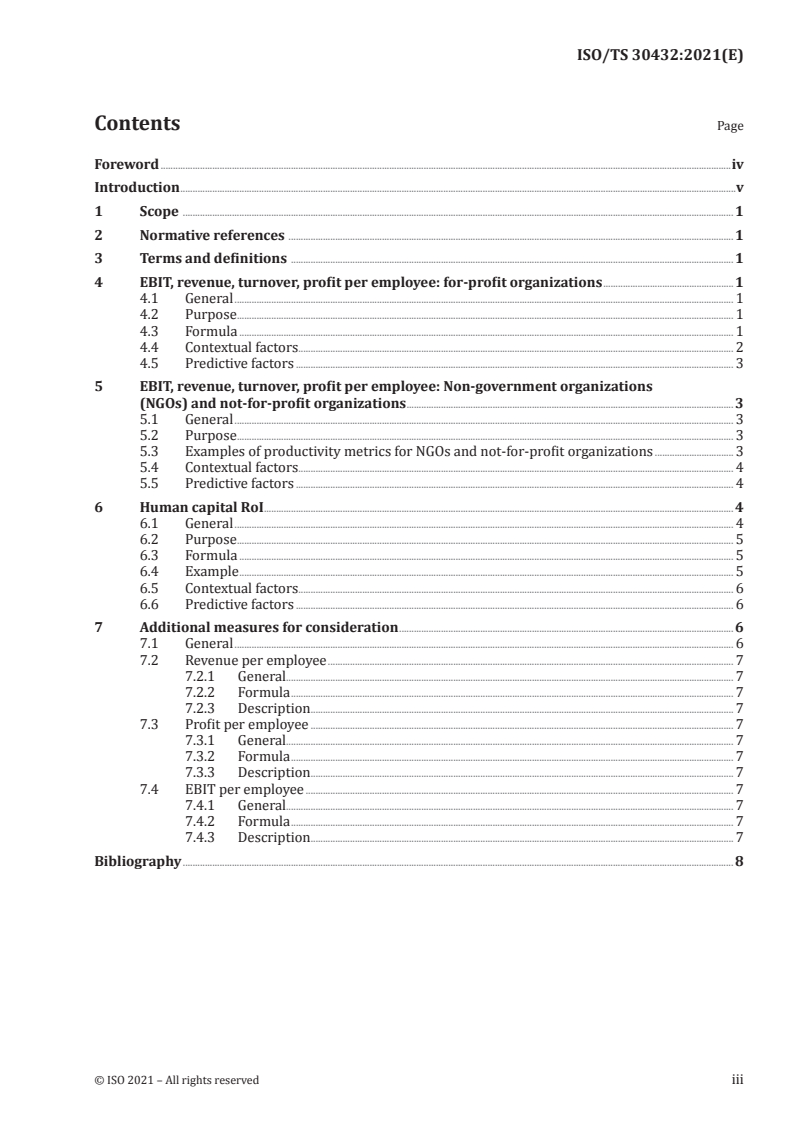
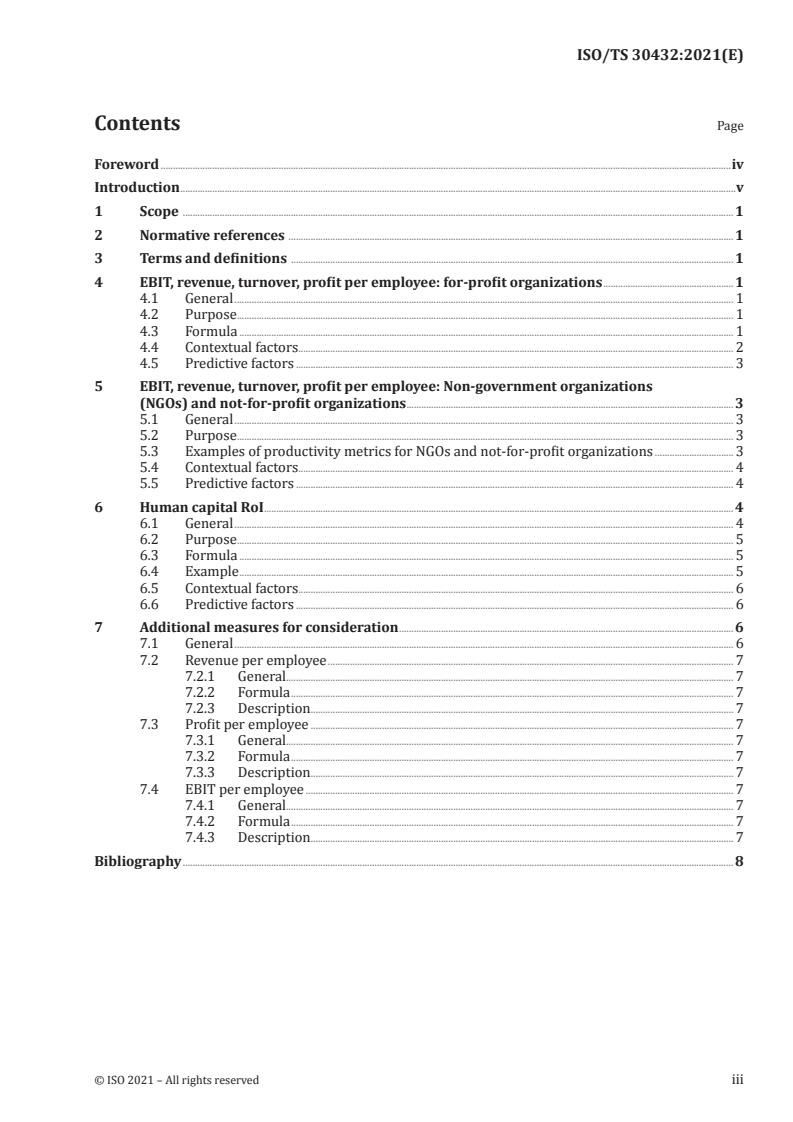
Contents Page
Foreword .iv
Introduction .v
1 Scope . 1
2 Normative references . 1
3 Terms and definitions . 1
4 EBIT, revenue, turnover, profit per employee: for-profit organizations .1
4.1 General . 1
4.2 Purpose . 1
4.3 Formula . 1
4.4 Contextual factors . 2
4.5 Predictive factors . 3
5 EBIT, revenue, turnover, profit per employee: Non-government organizations
(NGOs) and not-for-profit organizations . 3
5.1 General . 3
5.2 Purpose . 3
5.3 Examples of productivity metrics for NGOs and not-for-profit organizations . 3
5.4 Contextual factors . 4
5.5 Predictive factors . 4
6 Human capital RoI . 4
6.1 General . 4
6.2 Purpose . 5
6.3 Formula . 5
6.4 Example . 5
6.5 Contextual factors . 6
6.6 Predictive factors . 6
7 Additional measures for consideration . 6
7.1 General . 6
7.2 Revenue per employee . 7
7.2.1 General. 7
7.2.2 Formula . 7
7.2.3 Description . . . 7
7.3 Profit per employee . 7
7.3.1 General. 7
7.3.2 Formula . 7
7.3.3 Description . . . 7
7.4 EBIT per employee . 7
7.4.1 General. 7
7.4.2 Formula . 7
7.4.3 Description . . . 7
Bibliography . 8
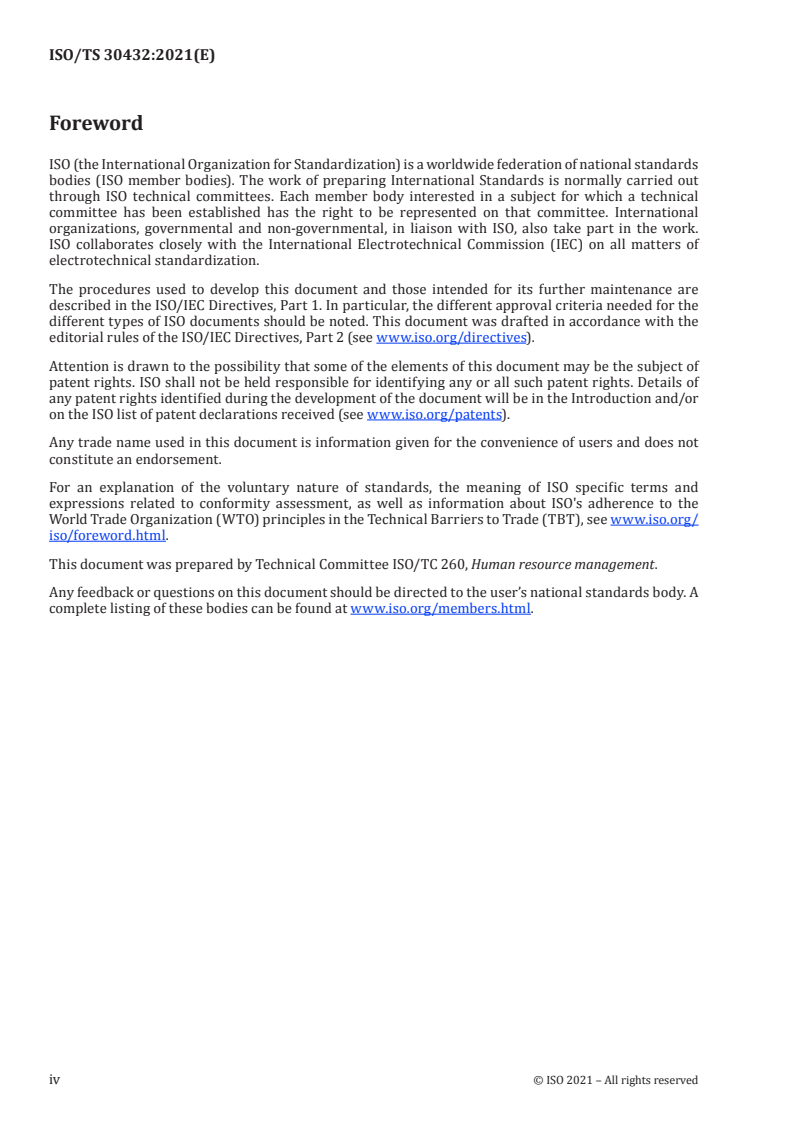
Foreword
ISO (the International Organization for Standardization) is a worldwide federation of national standards
bodies (ISO member bodies). The work of preparing International Standards is normally carried out
through ISO technical committees. Each member body interested in a subject for which a technical
committee has been established has the right to be represented on that committee. International
organizations, governmental and non-governmental, in liaison with ISO, also take part in the work.
ISO collaborates closely with the International Electrotechnical Commission (IEC) on all matters of
electrotechnical standardization.
The procedures used to develop this document and those intended for its further maintenance are
described in the ISO/IEC Directives, Part 1. In particular, the different approval criteria needed for the
different types of ISO documents should be noted. This document was drafted in accordance with the
editorial rules of the ISO/IEC Directives, Part 2 (see www .iso .org/ directives).
Attention is drawn to the possibility that some of the elements of this document may be the subject of
patent rights. ISO shall not be held responsible for identifying any or all such patent rights. Details of
any patent rights identified during the development of the document will be in the Introduction and/or
on the ISO list of patent declarations received (see www .iso .org/ patents).
Any trade name used in this document is information given for the convenience of users and does not
constitute an endorsement.
For an explanation of the voluntary nature of standards, the meaning of ISO specific terms and
expressions related to conformity assessment, as well as information about ISO's adherence to the
World Trade Organization (WTO) principles in the Technical Barriers to Trade (TBT), see www .iso .org/
iso/ foreword .html.
This document was prepared by Technical Committee ISO/TC 260, Human resource management.
Any feedback or questions on this document should be directed to the user’s national standards body. A
complete listing of these bodies can be found at www .iso .org/ members .html.
iv © ISO 2021 – All rights reserved
Introduction
ISO 30414 highlights guidelines on the following core human capital reporting areas or “clusters”:
— compliance and ethics;
— costs;
— diversity;
— leadership;
— organizational culture;
— organizational health, safety and well-being;
— productivity;
— recruitment, mobility and turnover;
— skills and capabilities;
— succession planning;
— workforce availability.
ISO 30414:2018, 4.7.8, describes productivity in organizations.
The following metrics are included in this document:
a) earnings before interest and taxes (EBIT), revenue, turnover, profit per employee
— for-profit organizations;
— non-government organizations (NGOs).
b) human capital return on investment (RoI).
This document describes the following components for each of the above metrics:
— description;
— purpose;
— formula;
— how to use;
— intended user(s);
— contextual factors;
— predictive factors.
It is recognized that employees, as well as workforce representatives, work councils and labour union
representatives, where they exist, can be consulted on issues of productivity and its measurement.
TECHNICAL SPECIFICATION ISO/TS 30432:2021(E)
Human resource management — Workforce productivity
metrics cluster
1 Scope
This document describes the elements of workforce productivity metrics cluster. This document
provides the formula for comparable measures for internal and external reporting.
This document also highlights issues to be considered when interpreting the productivity data,
especially when deciding on the appropriate intervention internally and when reporting this to external
stakeholders (e.g. regulators, investors).
2 Normative references
There are no normative references in this document.
3 Terms and definitions
No terms and definitions are listed in this document.
ISO and IEC maintain terminological databases for use in standardization at the following addresses:
— ISO Online browsing platform: available at https:// www .iso .org/ obp
— IEC Electropedia: available at http:// www .electropedia .org/
4 EBIT, revenue, turnover, profit per employee: for-profit organizations
4.1 General
Productivity ratios per employee, such as revenue or profit per employee, are commonly used to
compare the productivity of an organization in the market. These ratios can
...
TECHNICAL ISO/TS
SPECIFICATION 30432
First edition
2021-03
Human resource management —
Workforce productivity metrics cluster
Management des ressources humaines — Indicateurs de mesure de la
productivité de la main-d'œuvre
Reference number
©
ISO 2021
© ISO 2021
All rights reserved. Unless otherwise specified, or required in the context of its implementation, no part of this publication may
be reproduced or utilized otherwise in any form or by any means, electronic or mechanical, including photocopying, or posting
on the internet or an intranet, without prior written permission. Permission can be requested from either ISO at the address
below or ISO’s member body in the country of the requester.
ISO copyright office
CP 401 • Ch. de Blandonnet 8
CH-1214 Vernier, Geneva
Phone: +41 22 749 01 11
Email: copyright@iso.org
Website: www.iso.org
Published in Switzerland
ii © ISO 2021 – All rights reserved
Contents Page
Foreword .iv
Introduction .v
1 Scope . 1
2 Normative references . 1
3 Terms and definitions . 1
4 EBIT, revenue, turnover, profit per employee: for-profit organizations .1
4.1 General . 1
4.2 Purpose . 1
4.3 Formula . 1
4.4 Contextual factors . 2
4.5 Predictive factors . 3
5 EBIT, revenue, turnover, profit per employee: Non-government organizations
(NGOs) and not-for-profit organizations . 3
5.1 General . 3
5.2 Purpose . 3
5.3 Examples of productivity metrics for NGOs and not-for-profit organizations . 3
5.4 Contextual factors . 4
5.5 Predictive factors . 4
6 Human capital RoI . 4
6.1 General . 4
6.2 Purpose . 5
6.3 Formula . 5
6.4 Example . 5
6.5 Contextual factors . 6
6.6 Predictive factors . 6
7 Additional measures for consideration . 6
7.1 General . 6
7.2 Revenue per employee . 7
7.2.1 General. 7
7.2.2 Formula . 7
7.2.3 Description . . . 7
7.3 Profit per employee . 7
7.3.1 General. 7
7.3.2 Formula . 7
7.3.3 Description . . . 7
7.4 EBIT per employee . 7
7.4.1 General. 7
7.4.2 Formula . 7
7.4.3 Description . . . 7
Bibliography . 8
Foreword
ISO (the International Organization for Standardization) is a worldwide federation of national standards
bodies (ISO member bodies). The work of preparing International Standards is normally carried out
through ISO technical committees. Each member body interested in a subject for which a technical
committee has been established has the right to be represented on that committee. International
organizations, governmental and non-governmental, in liaison with ISO, also take part in the work.
ISO collaborates closely with the International Electrotechnical Commission (IEC) on all matters of
electrotechnical standardization.
The procedures used to develop this document and those intended for its further maintenance are
described in the ISO/IEC Directives, Part 1. In particular, the different approval criteria needed for the
different types of ISO documents should be noted. This document was drafted in accordance with the
editorial rules of the ISO/IEC Directives, Part 2 (see www .iso .org/ directives).
Attention is drawn to the possibility that some of the elements of this document may be the subject of
patent rights. ISO shall not be held responsible for identifying any or all such patent rights. Details of
any patent rights identified during the development of the document will be in the Introduction and/or
on the ISO list of patent declarations received (see www .iso .org/ patents).
Any trade name used in this document is information given for the convenience of users and does not
constitute an endorsement.
For an explanation of the voluntary nature of standards, the meaning of ISO specific terms and
expressions related to conformity assessment, as well as information about ISO's adherence to the
World Trade Organization (WTO) principles in the Technical Barriers to Trade (TBT), see www .iso .org/
iso/ foreword .html.
This document was prepared by Technical Committee ISO/TC 260, Human resource management.
Any feedback or questions on this document should be directed to the user’s national standards body. A
complete listing of these bodies can be found at www .iso .org/ members .html.
iv © ISO 2021 – All rights reserved
Introduction
ISO 30414 highlights guidelines on the following core human capital reporting areas or “clusters”:
— compliance and ethics;
— costs;
— diversity;
— leadership;
— organizational culture;
— organizational health, safety and well-being;
— productivity;
— recruitment, mobility and turnover;
— skills and capabilities;
— succession planning;
— workforce availability.
ISO 30414:2018, 4.7.8, describes productivity in organizations.
The following metrics are included in this document:
a) earnings before interest and taxes (EBIT), revenue, turnover, profit per employee
— for-profit organizations;
— non-government organizations (NGOs).
b) human capital return on investment (RoI).
This document describes the following components for each of the above metrics:
— description;
— purpose;
— formula;
— how to use;
— intended user(s);
— contextual factors;
— predictive factors.
It is recognized that employees, as well as workforce representatives, work councils and labour union
representatives, where they exist, can be consulted on issues of productivity and its measurement.
TECHNICAL SPECIFICATION ISO/TS 30432:2021(E)
Human resource management — Workforce productivity
metrics cluster
1 Scope
This document describes the elements of workforce productivity metrics cluster. This document
provides the formula for comparable measures for internal and external reporting.
This document also highlights issues to be considered when interpreting the productivity data,
especially when deciding on the appropriate intervention internally and when reporting this to external
stakeholders (e.g. regulators, investors).
2 Normative references
There are no normative references in this document.
3 Terms and definitions
No terms and definitions are listed in this document.
ISO and IEC maintain terminological databases for use in standardization at the following addresses:
— ISO Online browsing platform: available at https:// www .iso .org/ obp
— IEC Electropedia: available at http:// www .electropedia .org/
4 EBIT, revenue, turnover, profit per employee: for-profit organizations
4.1 General
Productivity ratios per employee, such as revenue or profit per employee, are commonly used to
compare the productivity of an organization in the market. These ratios can
...