


ISO 15189:2007
(Main)Medical laboratories — Particular requirements for quality and competence
Medical laboratories — Particular requirements for quality and competence
ISO 15189:2007 specifies requirements for quality and competence particular to medical laboratories. ISO 15189:2007 is for use by medical laboratories in developing their quality management systems and assessing their own competence, and for use by accreditation bodies in confirming or recognising the competence of medical laboratories.
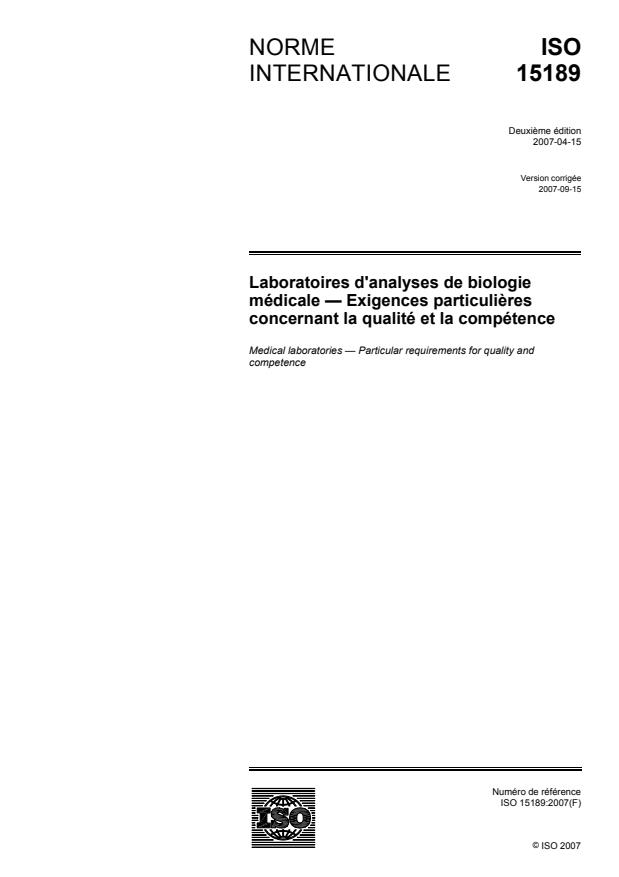
Laboratoires d'analyses de biologie médicale — Exigences particulières concernant la qualité et la compétence
L'ISO 15189:2007 spécifie les exigences de qualité et de compétence propres aux laboratoires d'analyses de biologie médicale. L'ISO 15189:2007 est destinée à être utilisée par les laboratoires d'analyses de biologie médicale qui élaborent leurs systèmes de management de la qualité et évaluent leur propre compétence ainsi que par les organismes d'accréditation engagés dans des activités de confirmation ou de reconnaissance de la compétence des laboratoires d'analyses de biologie médicale.
General Information
- Status
- Withdrawn
- Publication Date
- 18-Apr-2007
- Withdrawal Date
- 18-Apr-2007
- Drafting Committee
- ISO/TC 212/WG 1 - Quality and competence in the medical laboratory
- Current Stage
- 9599 - Withdrawal of International Standard
- Start Date
- 05-Nov-2012
- Completion Date
- 12-Feb-2026
Relations
- Effective Date
- 09-Feb-2026
- Effective Date
- 12-Feb-2026
- Effective Date
- 27-Feb-2010
- Effective Date
- 15-Apr-2008
ISO 15189:2007 - Medical laboratories -- Particular requirements for quality and competence
ISO 15189:2007 - Laboratoires d'analyses de biologie médicale -- Exigences particulieres concernant la qualité et la compétence

Get Certified
Connect with accredited certification bodies for this standard

BSI Group
BSI (British Standards Institution) is the business standards company that helps organizations make excellence a habit.

TÜV Rheinland
TÜV Rheinland is a leading international provider of technical services.

TÜV SÜD
TÜV SÜD is a trusted partner of choice for safety, security and sustainability solutions.
Sponsored listings
Frequently Asked Questions
ISO 15189:2007 is a standard published by the International Organization for Standardization (ISO). Its full title is "Medical laboratories — Particular requirements for quality and competence". This standard covers: ISO 15189:2007 specifies requirements for quality and competence particular to medical laboratories. ISO 15189:2007 is for use by medical laboratories in developing their quality management systems and assessing their own competence, and for use by accreditation bodies in confirming or recognising the competence of medical laboratories.
ISO 15189:2007 specifies requirements for quality and competence particular to medical laboratories. ISO 15189:2007 is for use by medical laboratories in developing their quality management systems and assessing their own competence, and for use by accreditation bodies in confirming or recognising the competence of medical laboratories.
ISO 15189:2007 is classified under the following ICS (International Classification for Standards) categories: 03.120.10 - Quality management and quality assurance; 11.100.01 - Laboratory medicine in general. The ICS classification helps identify the subject area and facilitates finding related standards.
ISO 15189:2007 has the following relationships with other standards: It is inter standard links to CEN ISO/TS 22367:2010, EN ISO 15189:2007, ISO 15189:2012, ISO 15189:2003. Understanding these relationships helps ensure you are using the most current and applicable version of the standard.
ISO 15189:2007 is available in PDF format for immediate download after purchase. The document can be added to your cart and obtained through the secure checkout process. Digital delivery ensures instant access to the complete standard document.
Standards Content (Sample)
INTERNATIONAL ISO
STANDARD 15189
Second edition
2007-04-15
Medical laboratories — Particular
requirements for quality and competence
Laboratoires d'analyses de biologie médicale — Exigences particulières
concernant la qualité et la compétence
Reference number
©
ISO 2007
PDF disclaimer
This PDF file may contain embedded typefaces. In accordance with Adobe's licensing policy, this file may be printed or viewed but
shall not be edited unless the typefaces which are embedded are licensed to and installed on the computer performing the editing. In
downloading this file, parties accept therein the responsibility of not infringing Adobe's licensing policy. The ISO Central Secretariat
accepts no liability in this area.
Adobe is a trademark of Adobe Systems Incorporated.
Details of the software products used to create this PDF file can be found in the General Info relative to the file; the PDF-creation
parameters were optimized for printing. Every care has been taken to ensure that the file is suitable for use by ISO member bodies. In
the unlikely event that a problem relating to it is found, please inform the Central Secretariat at the address given below.
© ISO 2007
All rights reserved. Unless otherwise specified, no part of this publication may be reproduced or utilized in any form or by any means,
electronic or mechanical, including photocopying and microfilm, without permission in writing from either ISO at the address below or
ISO's member body in the country of the requester.
ISO copyright office
Case postale 56 • CH-1211 Geneva 20
Tel. + 41 22 749 01 11
Fax + 41 22 749 09 47
E-mail copyright@iso.org
Web www.iso.org
Published in Switzerland
ii © ISO 2007 – All rights reserved
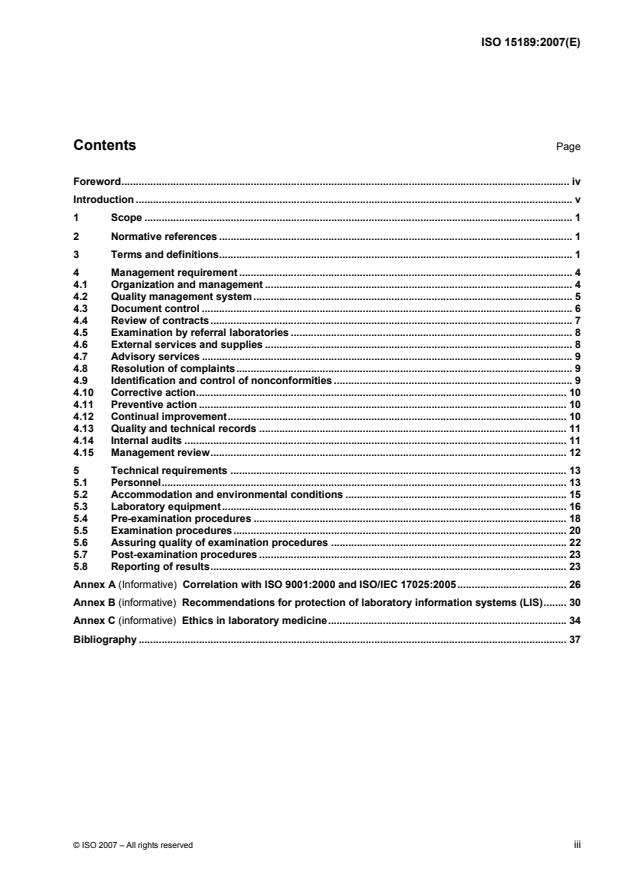
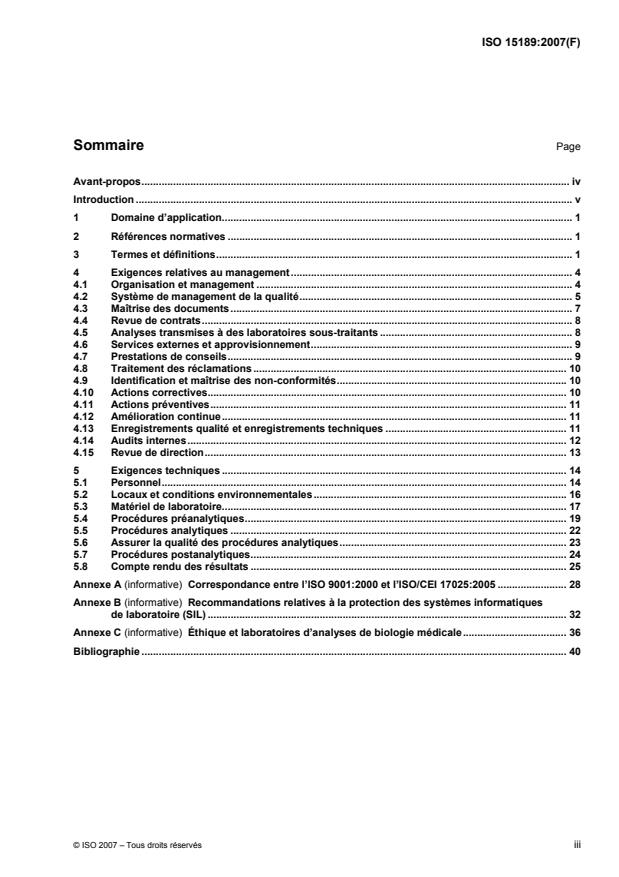
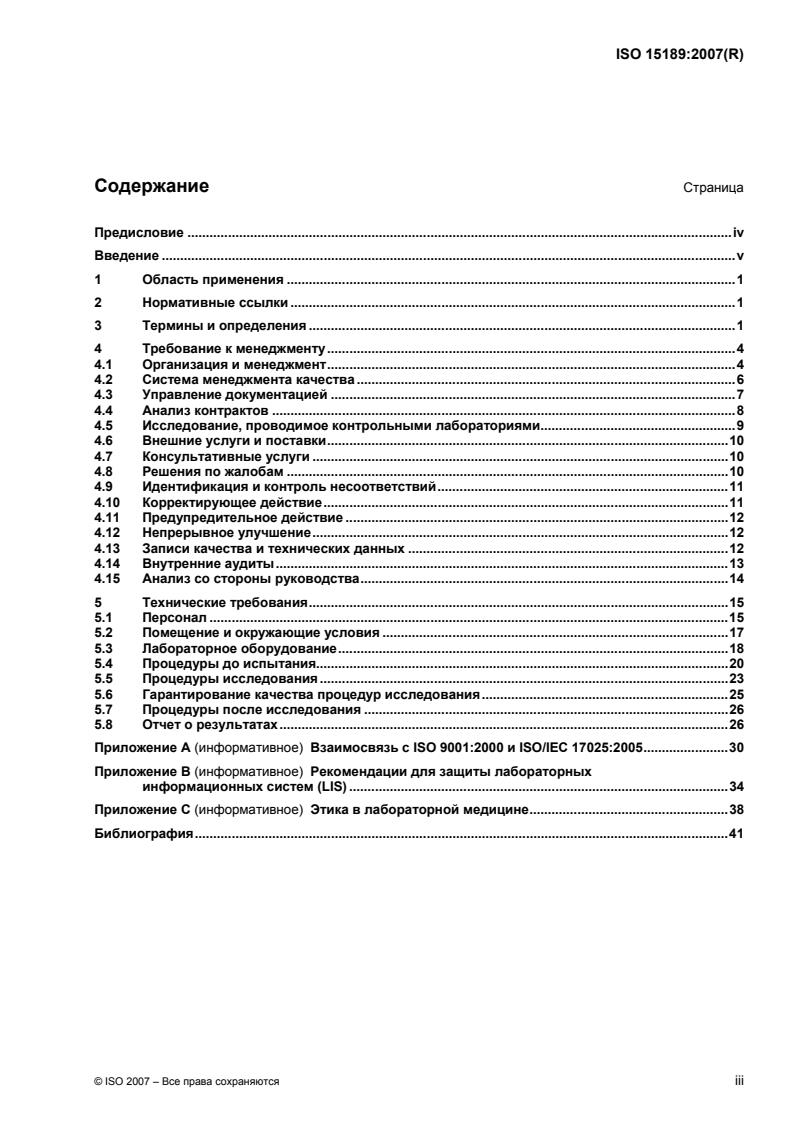
Contents Page
Foreword. iv
Introduction . v
1 Scope . 1
2 Normative references . 1
3 Terms and definitions. 1
4 Management requirement . 4
4.1 Organization and management . 4
4.2 Quality management system . 5
4.3 Document control . 6
4.4 Review of contracts. 7
4.5 Examination by referral laboratories . 8
4.6 External services and supplies . 8
4.7 Advisory services . 9
4.8 Resolution of complaints. 9
4.9 Identification and control of nonconformities .9
4.10 Corrective action. 10
4.11 Preventive action . 10
4.12 Continual improvement. 10
4.13 Quality and technical records . 11
4.14 Internal audits . 11
4.15 Management review. 12
5 Technical requirements . 13
5.1 Personnel. 13
5.2 Accommodation and environmental conditions . 15
5.3 Laboratory equipment. 16
5.4 Pre-examination procedures . 18
5.5 Examination procedures. 20
5.6 Assuring quality of examination procedures . 22
5.7 Post-examination procedures . 23
5.8 Reporting of results. 23
Annex A (Informative) Correlation with ISO 9001:2000 and ISO/IEC 17025:2005. 26
Annex B (informative) Recommendations for protection of laboratory information systems (LIS). 30
Annex C (informative) Ethics in laboratory medicine. 34
Bibliography . 37
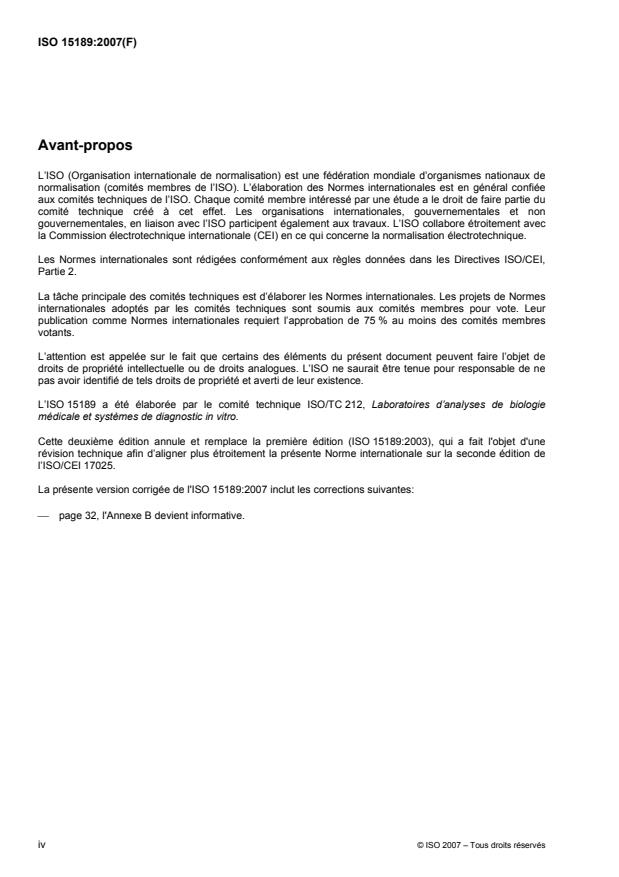
Foreword
ISO (the International Organization for Standardization) is a worldwide federation of national standards bodies
(ISO member bodies). The work of preparing International Standards is normally carried out through ISO
technical committees. Each member body interested in a subject for which a technical committee has been
established has the right to be represented on that committee. International organizations, governmental and
non-governmental, in liaison with ISO, also take part in the work. ISO collaborates closely with the
International Electrotechnical Commission (IEC) on all matters of electrotechnical standardization.
International Standards are drafted in accordance with the rules given in the ISO/IEC Directives, Part 2.
The main task of technical committees is to prepare International Standards. Draft International Standards
adopted by the technical committees are circulated to the member bodies for voting. Publication as an
International Standard requires approval by at least 75 % of the member bodies casting a vote.
Attention is drawn to the possibility that some of the elements of this document may be the subject of patent
rights. ISO shall not be held responsible for identifying any or all such patent rights.
ISO 15189 was prepared by Technical Committee ISO/TC 212, Clinical laboratory testing and in vitro
diagnostic test systems.
This second edition cancels and replaces the first edition (ISO 15189:2003) which has been technically
revised in order to align it more closely with the second edition of ISO/IEC 17025.
iv © ISO 2007 – All rights reserved
Introduction
This International Standard, based upon ISO/IEC 17025 and ISO 9001, provides requirements for
1)
competence and quality that are particular to medical laboratories . It is acknowledged that a country could
have its own specific regulations or requirements applicable to some or all its professional personnel and their
activities and responsibilities in this domain.
Medical laboratory services are essential to patient care and therefore have to be available to meet the needs
of all patients and the clinical personnel responsible for the care of those patients. Such services include
arrangements for requisition, patient preparation, patient identification, collection of samples, transportation,
storage, processing and examination of clinical samples, together with subsequent validation, interpretation,
reporting and advice, in addition to the considerations of safety and ethics in medical laboratory work.
Whenever allowed by national regulations, it is desirable that medical laboratory services include the
examination of patients in consultation cases, and that those services actively participate in the prevention of
disease in addition to diagnosis and patient management. Each laboratory ought also to provide suitable
educational and scientific opportunities for professional staff working with it.
While this International Standard is intended for use throughout the currently recognised disciplines of medical
laboratory services, those working in other services and disciplines could also find it useful and appropriate. In
addition, bodies engaged in the recognition of the competence of medical laboratories will be able to use this
International Standard as the basis for their activities. If a laboratory seeks accreditation, it should select an
accrediting body which operates to appropriate international standards and which takes into account the
particular requirements of medical laboratories.
Demonstrated conformity to this International Standard does not imply conformity of the quality management
system within which the laboratory operates to all the requirements of ISO 9001. This International Standard is
not intended to be used for the purposes of certification.
The correlation between the clauses and subclauses of this second edition of ISO 15189 and those of
ISO 9001:2000 and of ISO/IEC 17025:2005 is detailed in Annex A of this International Standard.
1) In other languages, these laboratories can be designated by the equivalent of the English term “clinical laboratories.”
INTERNATIONAL STANDARD ISO 15189:2007(E)
Medical laboratories — Particular requirements for quality and
competence
1 Scope
1.1 This International Standard specifies requirements for quality and competence particular to medical
laboratories.
1.2 This International Standard is for use by medical laboratories in developing their quality management
systems and assessing their own competence, and for use by accreditation bodies in confirming or
recognising the competence of medical laboratories.
2 Normative references
The following referenced documents are indispensable for the application of this document. For dated
references, only the edition cited applies. For undated references, the latest edition of the referenced
document (including any amendments) applies.
ISO 31 (all parts), Quantities and units
ISO 9000:2005, Quality management systems — Fundamentals and vocabulary
ISO 9001:2000, Quality management systems — Requirements
ISO/IEC Guide 43-1, Proficiency testing by interlaboratory comparisons — Part 1: Development and operation
of proficiency testing schemes
ISO/IEC 17025:2005, General requirements for the competence of testing and calibration laboratories
3 Terms and definitions
For the purposes of this document, the following terms and definitions apply.
3.1
accreditation
procedure by which an authoritative body gives formal recognition that a body or person is competent to carry
out specific tasks
3.2
accuracy of measurement
closeness of the agreement between the result of a measurement and a true value of the measurand
[VIM:1993, definition 3.5]
3.3
biological reference interval
reference interval
central 95 % interval of the distribution of reference values
NOTE 1 This supersedes such incorrectly used terms as “normal range”.
NOTE 2 It is an arbitrary but common convention to define the reference interval as the central 95 % interval. Another
size or an asymmetrical location of the reference interval could be more appropriate in particular cases. See [13] in the
Bibliography.
3.4
examination
set of operations having the object of determining the value or characteristics of a property
NOTE In some disciplines (e.g. microbiology) an examination is the total activity of a number of tests, observations or
measurements.
3.5
laboratory capability
physical, environmental and information resources, personnel, skills and expertise available for the
examinations in question
NOTE A review of laboratory capability could include results of earlier participation in interlaboratory comparisons or
external quality assessment schemes or the running of trial examination programmes, or all these, in order to demonstrate
uncertainties of measurement, limits of detection, etc.
3.6
laboratory director
competent person(s) with responsibility for, and authority over, a laboratory
NOTE 1 For the purposes of this International Standard, the person or persons referred to are designated collectively
as "laboratory director".
NOTE 2 National, regional and local regulations may apply with regard to qualifications and training.
3.7
laboratory management
person(s) who manage the activities of a laboratory headed by a laboratory director
3.8
measurement
set of operations having the object of determining a value of a quantity
[VIM:1993, definition 2.1]
3.9
medical laboratory
clinical laboratory
laboratory for the biological, microbiological, immunological, chemical, immunohaematological, haematological,
biophysical, cytological, pathological or other examination of materials derived from the human body for the
purpose of providing information for the diagnosis, prevention and treatment of disease in, or assessment of
the health of, human beings, and which may provide a consultant advisory service covering all aspects of
laboratory investigation including the interpretation of results and advice on further appropriate investigation
NOTE These examinations also include procedures for determining, measuring or otherwise describing the presence
or absence of various substances or micro-organisms. Facilities which only collect or prepare specimens, or act as a
mailing or distribution centre, are not considered to be medical or clinical laboratories, although they may be part of a
larger laboratory network or system.
2 © ISO 2007 – All rights reserved
3.10
post-examination procedures
postanalytical phase
processes following the examination including systematic review, formatting and interpretation, authorization
for release, reporting and transmission of the results, and storage of samples of the examinations
3.11
pre-examination procedures
preanalytical phase
steps starting, in chronological order, from the clinician’s request and including the examination requisition,
preparation of the patient, collection of the primary sample, and transportation to and within the laboratory,
and ending when the analytical examination procedure begins
3.12
primary sample
specimen
set of one or more parts initially taken from a system
NOTE In some countries, the term “specimen” is used instead of primary sample (or a subsample of it), which is the
sample prepared for sending to, or as received by, the laboratory and which is intended for examination.
3.13
quantity
attribute of a phenomenon, body or substance that may be distinguished qualitatively and determined
quantitatively
[VIM:1993, definition 1.1]
3.14
quality management system
management system to direct and control an organization with regard to quality
[ISO 9000:2005, definition 3.2.3]
NOTE For the purposes of this International standard, the "quality" referred to in this definition relates to matters of
both management and technical competence.
3.15
referral laboratory
external laboratory to which a sample is submitted for a supplementary or confirmatory examination procedure
and report
3.16
sample
one or more parts taken from a system and intended to provide information on the system, often to serve as a
basis for decision on the system or its production
EXAMPLE A volume of serum taken from a larger volume of serum.
3.17
traceability
property of the result of a measurement or the value of a standard whereby it can be related to stated
references, usually national or international standards, through an unbroken chain of comparisons all having
stated uncertainties
[VIM:1993, definition 6.10]
3.18
trueness of measurement
closeness of agreement between the average value obtained from a large series of results of measurements
and a true value
NOTE Adapted from ISO 3534-1:1993, definition 3.12
3.19
uncertainty of measurement
parameter, associated with the result of a measurement, that characterizes the dispersion of the values that
could reasonably be attributed to the measurand
[VIM:1993, definition 3.9]
4 Management requirement
4.1 Organization and management
4.1.1 The medical laboratory or the organization of which the laboratory is a part shall be legally identifiable.
4.1.2 Medical laboratory services, including appropriate interpretation and advisory services, shall be
designed to meet the needs of patients and all clinical personnel responsible for patient care.
4.1.3 The medical laboratory (hereafter referred to as “the laboratory”) shall meet the relevant requirements
of this International Standard when carrying out work in its permanent facilities, or at sites other than the
permanent facilities for which it is responsible.
4.1.4 The responsibilities of personnel in the laboratory with an involvement or influence on the examination
of primary samples shall be defined in order to identify conflicts of interest. Financial or political considerations
(e.g. inducements) should not influence testing.
4.1.5 Laboratory management shall have responsibility for the design, implementation, maintenance and
improvement of the quality management system. This shall include the following:
a) management support of all laboratory personnel by providing them with the appropriate authority and
resources to carry out their duties;
b) arrangements to ensure that management and personnel are free from any undue internal and external
commercial, financial or other pressures and influences that may adversely affect the quality of their work;
c) policies and procedures for ensuring the protection of confidential information (see Annex C);
d) policies and procedures for avoiding involvement in any activities that would diminish confidence in its
competence, impartiality, judgement or operational integrity;
e) the organizational and management structure of the laboratory and its relationship to any other
organization with which it may be associated;
f) specified responsibilities, authority and interrelationships of all personnel;
g) adequate training of all staff and supervision appropriate to their experience and level of responsibility by
competent persons conversant with the purpose, procedures and assessment of results of the relevant
examination procedures;
h) technical management which has overall responsibility for the technical operations and the provision of
resources needed to ensure the required quality of laboratory procedures;
4 © ISO 2007 – All rights reserved
i) appointment of a quality manager (however named) with delegated responsibility and authority to oversee
compliance with the requirements of the quality management system, who shall report directly to the level
of laboratory management at which decisions are made on laboratory policy and resources;
j) appointment of deputies for all key functions, while recognizing that in smaller laboratories individuals can
have more than one function and that it could be impractical to appoint deputies for every function.
4.1.6 Laboratory management shall ensure that appropriate communication processes are established
within the laboratory and that communication takes place regarding the effectiveness of the quality
management system.
4.2 Quality management system
4.2.1 Policies, processes, programmes, procedures and instructions shall be documented and
communicated to all relevant personnel. The management shall ensure that the documents are understood
and implemented.
4.2.2 The quality management system shall include, but not be limited to, internal quality control and
participation in organized interlaboratory comparisons such as external quality assessment schemes.
4.2.3 Policies and objectives of the quality management system shall be defined in a quality policy
statement under the authority of the laboratory director and documented in a quality manual. This policy shall
be readily available to appropriate personnel, shall be concise and shall include the following:
a) the scope of service the laboratory intends to provide;
b) the laboratory management’s statement of the laboratory’s standard of service;
c) the objectives of the quality management system;
d) a requirement that all personnel concerned with examination activities familiarize themselves with the
quality documentation and implement the policies and procedures at all times;
e) the laboratory’s commitment to good professional practice, the quality of its examinations, and
compliance with the quality management system;
f) the laboratory management’s commitment to compliance with this International Standard.
4.2.4 A quality manual shall describe the quality management system and the structure of the
documentation used in the quality management system. The quality manual shall include or make reference to
the supporting procedures including technical procedures. It shall outline the structure of the documentation in
the quality management system. The roles and responsibilities of technical management and the quality
manager, including their responsibility for ensuring compliance with this International Standard, shall be
defined in the quality manual.
All personnel shall be instructed on the use and application of the quality manual and all referenced
documents, and of the requirements for their implementation. The quality manual shall be kept up to date
under the authority and responsibility of an individual appointed to be responsible for quality by the laboratory
management [see 4.1.5 i)].
The table of contents of a quality manual for a medical laboratory might be as follows.
a) Introduction.
b) Description of the medical laboratory, its legal identity, resources and main duties.
c) Quality policy.
d) Staff education and training.
e) Quality assurance.
f) Document control.
g) Records, maintenance and archiving.
h) Accommodation and environment.
i) Instruments, reagents and/or relevant consumables management.
j) Validation of examination procedures.
k) Safety.
l) Environmental aspects [e.g., transportation, consumables and waste disposal, in addition to, and different
from, h) and i)].
m) Research and development (If appropriate).
n) List of examination procedures.
o) Request protocols, primary sample, collection and handling of laboratory samples.
p) Validation of results.
q) Quality control (including interlaboratory comparisons).
r) Laboratory information system (see Annex B).
s) Reporting of results.
t) Remedial actions and handling of complaints.
u) Communications and other interactions with patients, health professionals, referral laboratories and
suppliers.
v) Internal audits.
w) Ethics (see Annex C).
4.2.5 Laboratory management shall establish and implement a programme that regularly monitors and
demonstrates proper calibration and function of instruments, reagents and analytical systems. It shall also
have a documented and recorded programme of preventive maintenance and calibration (see 5.3.2), which, at
a minimum, follows manufacturer’s recommendations.
4.3 Document control
4.3.1 The laboratory shall define, document and maintain procedures to control all documents and
information (from internal and external sources) that form its quality documentation. A copy of each of these
controlled documents shall be archived for later reference and the laboratory director shall define the retention
period. These controlled documents may be maintained on any appropriate medium – including, or not, paper.
National, regional and local regulations concerning document retention could apply.
NOTE In this context, “document” is any information or instructions, including policy statements, text books,
procedures, specifications, calibration tables, biological reference intervals and their origins, charts, posters, notices,
memoranda, software, drawings, plans, and documents of external origin such as regulations, standards or examination
procedures.
6 © ISO 2007 – All rights reserved
4.3.2 Procedures shall be adopted to ensure that:
a) all documents issued to laboratory personnel as part of the quality management system are reviewed and
approved by authorized personnel prior to issue;
b) a list, also referred to as a document control log, identifying the current valid revisions and their
distribution is maintained;
c) only currently authorized versions of appropriate documents are available for active use at relevant
locations;
d) documents are periodically reviewed, revised when necessary, and approved by authorized personnel;
e) invalid or obsolete documents are promptly removed from all points of use, or otherwise assured against
inadvertent use;
f) retained or archived superseded documents are appropriately identified to prevent their inadvertent use;
g) if the laboratory’s documentation control system allows for the amendment of documents by hand
pending the re-issue of documents, the procedures and authorities for such amendments are defined,
while amendments are clearly marked, initialled and dated, and a revised document is formally re-issued
as soon as practicable;
h) procedures are established to describe how changes to documents maintained in computerized systems
are to be made and controlled.
4.3.3 All documents relevant to the quality management system shall be uniquely identified, to include:
a) title;
b) edition or current revision date, or revision number, or all these;
c) number of pages (where applicable);
d) authority for issue;
e) source identification.
4.4 Review of contracts
4.4.1 Where a laboratory enters into a contract to provide medical laboratory services, it shall establish and
maintain procedures for review of contracts. The policies and procedures for these reviews leading to a
change in the arrangements for examinations or contracts shall ensure that:
a) requirements, including the methods to be used, are adequately defined, documented and understood
(see 5.5);
b) the laboratory has the capability and resources to meet the requirements;
c) appropriate procedures selected are able to meet the contract requirements and clinical needs (see 5.5).
In reference to b), the review of capability should establish that the laboratory possesses the necessary
physical, personnel and information resources, and that the laboratory’s personnel have the skills and
expertise necessary, for the performance of the examinations in question. The review may also encompass
results of earlier participation in external quality assurance schemes using samples of known value in order to
determine uncertainties of measurement, limits of detection, confidence limits, etc.
4.4.2 Records of reviews, including any significant changes and pertinent discussions, shall be maintained
(see 4.13.3).
4.4.3 The review shall also cover any work referred by the laboratory (see 4.5).
4.4.4 Customers (e.g. clinicians, health care bodies, health insurance companies, pharmaceutical
companies) shall be informed of any deviation from the contract.
4.4.5 If a contract needs to be amended after work has commenced, the same contract review process
shall be repeated and any amendments shall be communicated to all affected parties.
4.5 Examination by referral laboratories
4.5.1 The laboratory shall have an effective documented procedure for evaluating and selecting referral
laboratories as well as consultants who are to provide second opinions for histopathology, cytology and
related disciplines. Laboratory management, with the advice of users of laboratory services where appropriate,
shall be responsible for selecting and monitoring the quality of referral laboratories and consultants and shall
ensure that the referral laboratory or referral consultant is competent to perform the requested examinations.
4.5.2 Arrangements with referral laboratories shall be reviewed periodically to ensure that:
a) requirements, including the pre-examination and post-examination procedures, are adequately defined,
documented, and understood;
b) the referral laboratory is able to meet the requirements and that there are no conflicts of interest;
c) selection of examination procedures is appropriate for the intended use;
d) respective responsibilities for the interpretation of examination results are clearly defined.
Records of such reviews shall be maintained in accordance with national, regional or local requirements.
4.5.3 The laboratory shall maintain a register of all referral laboratories that it uses. A register shall be kept
of all samples that have been referred to another laboratory. The name and address of the laboratory
responsible for the examination result shall be provided to the user of laboratory services. A duplicate of the
laboratory report shall be retained in both the patient record and in the permanent file of the laboratory.
4.5.4 The referring laboratory and not the referral laboratory shall be responsible for ensuring that referral
laboratory examination results and findings are provided to the person making the request. If the referring
laboratory prepares the report, it shall include all essential elements of the results reported by the referral
laboratory, without alterations that could affect clinical interpretation.
National, regional and local regulations may apply.
However, this does not require that the referring laboratory report include every word and have the exact
format of the referral laboratory report, unless national/local laws or regulations require it. The referring
laboratory director may elect to provide additional interpretative remarks to those, if any, of the referral
laboratory, in the context of the patient and the local medical environment. The author of such added remarks
should be clearly identified.
4.6 External services and supplies
4.6.1 Laboratory management shall define and document its policies and procedures for the selection and
use of purchased external services, equipment and consumable supplies that affect the quality of its service.
Purchased items shall consistently meet the laboratory’s quality requirements. National, regional or local
regulations may require records of purchased items. There shall be procedures and criteria for inspection,
acceptance/rejection and storage of consumable materials.
4.6.2 Purchased equipment and consumable supplies that affect the quality of the service shall not be used
until they have been verified as complying with standard specifications or requirements defined for the
procedures concerned. This may be accomplished by examining quality control samples and verifying that
8 © ISO 2007 – All rights reserved
results are acceptable. Documentation of the supplier’s conformity with its quality management system may
also be used for verification.
4.6.3 There shall be an inventory control system for supplies. Appropriate quality records of external
services, supplies and purchased products shall be established and maintained for a period of time, as
defined in the quality management system. This system shall include the recording of lot numbers of all
relevant reagents, control materials and calibrators, the date of receipt in the laboratory and the date the
material is placed in service. All of these quality records shall be available for laboratory management review.
4.6.4 The laboratory shall evaluate suppliers of critical reagents, supplies and services that affect the quality
of examinations and shall maintain records of these evaluations and list those approved.
4.7 Advisory services
Appropriate laboratory professional staff shall provide advice on choice of examinations and use of the
services, including repeat frequency and required type of sample. Where appropriate, interpretation of the
results of examinations shall be provided.
There should be regular documented meetings of professional staff with the clinical staff regarding the use of
the laboratory services and for the purpose of consultation on scientific matters. The professional staff should
participate in clinical rounds, enabling advice on effectiveness in general as well as in individual cases.
4.8 Resolution of complaints
The laboratory shall have a policy and procedures for the resolution of complaints or other feedback received
from clinicians, patients or other parties. Records of complaints and of investigations and corrective actions
taken by the laboratory shall be maintained, as required [see 4.13.3 i)].
NOTE Laboratories are encouraged to obtain both positive and negative feedback from the users of their services,
preferably in a systematic way (e.g. surveys).
4.9 Identification and control of nonconformities
4.9.1 Laboratory management shall have a policy and procedure to be implemented when it detects that
any aspect of its examinations does not conform with its own procedures or the agreed upon requirements of
its quality management system or the requesting clinician. These shall ensure that:
a) personnel responsible for problem resolution are designated;
b) the actions to be taken are defined;
c) the medical significance of the nonconforming examinations is considered and, where appropriate, the
requesting clinician informed;
d) examinations are halted and reports withheld as necessary;
e) corrective action is taken immediately;
f) the results of nonconforming examinations already released are recalled or appropriately identified, if
necessary;
g) the responsibility for authorization of the resumption of examinations is defined;
h) each episode of nonconformity is documented and recorded, with these records being reviewed at regular
specified intervals by laboratory management to detect trends and initiate preventive action.
NOTE Nonconforming examinations or activities occur in many different areas and can be identified in many different
ways, including clinician complaints, quality control indications, instrument calibrations, checking of consumable materials,
staff comments, reporting and certificate checking, laboratory management reviews, and internal and external audits.
4.9.2 If it is determined that nonconforming examinations could recur or that there is doubt about the
laboratory’s compliance with its own policies or procedures as given in the quality manual, procedures to
identify, document and eliminate the root cause(s) shall be promptly implemented (see 4.10).
4.9.3 The laboratory shall define and implement procedures for the release of results in the case of
nonconformities, including the review of such results. These events shall be recorded.
4.10 Corrective action
4.10.1 Procedures for corrective action shall include an investigative process to determine the underlying
cause or causes of the problem. These shall, where appropriate, lead to preventive actions. Corrective action
shall be appropriate to the magnitude of the problem and commensurate with possible risks.
4.10.2 Laboratory management shall document and implement any changes required to its operational
procedures resulting from corrective action investigations.
4.10.3 Laboratory management shall monitor the results of any corrective action taken, in order to ensure
that they have been effective in overcoming the identified problems.
4.10.4 When the identification of non-conformity or the corrective action investigation casts doubt on
compliance with policies and procedures or the quality management system, laboratory management shall
ensure that appropriate areas of activity are audited in accordance with 4.14. The results of corrective action
shall be submitted for laboratory management review.
4.11 Preventive action
4.11.1 Needed improvements and potential sources of nonconformities, either technical or concerning the
quality management system, shall be identified. If preventive action is required, action plans shall be
developed, implemented and monitored to reduce the likelihood of the occurrence of such nonconformities
and to take advantage of the opportunities for improvement.
4.11.2 Procedures for preventive action shall include the initiation of such actions and application of controls
to ensure that they are effective.
NOTE 1 Apart from the review of the operational procedures, preventive action might involve analysis of data, including
trend- and risk-analyses and external quality assurance.
NOTE 2 Preventive action is a pro-active process for identifying opportunities for improvement rather than a reaction to
the identification of problems or complaints.
4.12 Continual improvement
4.12.1 All operational procedures shall be systematically reviewed by laboratory management at regular
intervals, as defined in the quality management system, in order to identify any potential sources of
nonconformance or other opportunities for improvement in the quality management system or technical
practices. Action plans for improvement shall be developed, documented and implemented, as appropriate.
4.12.2 After action has been taken resulting from the review, laboratory management shall evaluate the
effectiveness of the action through a focused review or audit of the area concerned.
4.12.3 The results of action following the review shall be submitted to laboratory management for review and
implementation of any needed changes to the quality management system.
4.12.4 Laboratory management shall implement quality indicators for systematically monitoring and
evaluating the laboratory’s contribution to patient care. When this programme identifies opportunities for
improvement, laboratory management shall address them regardless of where they occur. Laboratory
management shall ensure that the medical laboratory participates in quality improvement activities that deal
with relevant areas and outcomes of patient care.
10 © ISO 2007 – All rights reserved
4.12.5 Laboratory management shall provide access to suitable educational and training opportunities for all
laboratory personnel and relevant users of laboratory services.
4.13 Quality and technical records
4.13.1 The laboratory shall establish and implement procedures for identification, collection, indexing, access,
storage, maintenance and safe disposal of quality and technical records.
4.13.2 All records shall be legible and stored such that they are readily retrievable. Records may be stored
on any appropriate medium subject to national, regional or local legal requirements (see Note, 4.3.1).
Facilities shall provide a suitable environment to prevent damage, deterioration, loss or unauthorized access.
4.13.3 The laboratory shall have a policy that defines the length of time various records pertaining to the
quality management system and examination results are to be retained. Retention time shall be defined by the
nature of the examination or specifically for each record.
National, regional and local regulations may apply.
These records may include but are not limited to the following:
a) request forms (including the patient chart or medical record only if used as the request form);
b) examination results and reports;
c) instrument printouts;
d) examination procedures;
e) laboratory work-books or sheets;
f) accession records;
g) calibration functions and conversion factors;
h) quality control records;
i) complaints and action taken;
j) records of internal and external audits;
k) external quality assessment records/interlaboratory comparisons;
l) quality improvement records;
m) instrument maintenance records, including internal and external calibration records;
n) lot documentation, certificates of supplies, package inserts;
o) incident/accident records and action taken;
p) staff training and competency records.
4.14 Internal audits
4.14.1 In order to verify that operations continue to comply with the requirements of the quality management
system, internal audits of all elements of the system, both managerial and technical, shall be conducted at
intervals defined by the system itself. The internal audit shall progressively address these elements and
emphasize areas critically important to patient care.
4.14.2 Audits shall be formally planned, organized and carried out by the quality manager or designated
qualified personnel. Personnel shall not audit their own activities. The procedures for internal audits shall be
defined and documented and include the types of audit, frequencies, methodologies and required
documentation. When deficiencies or opportunities for improvement are noted, the laboratory shall undertake
appropriate corrective or preventive actions, which shall be documented and carried out within an agreed
upon time.
The main elements of the quality management system should normally be subject to internal audit once every
twelve months.
4.14.3 The results of internal audits shall be submitted to laboratory management for review.
4.15 Management review
4.15.1 In order to ensure their continuing suitability and effectiveness in support of patient care and to
introduce any necessary changes or improvements, laboratory management shall review the laboratory’s
quality management system and all of its medical services, including examination and advisory activities. The
results of the review shall be incorporated into a plan that includes goals, objectives and action plans. A
typical period for conducting a management review is once every twelve months.
4.15.2 Management review shall take account of, but not be limited to:
a) follow-up of previous management reviews;
b) status of corrective actions
...
NORME ISO
INTERNATIONALE 15189
Deuxième édition
2007-04-15
Version corrigée
2007-09-15
Laboratoires d'analyses de biologie
médicale — Exigences particulières
concernant la qualité et la compétence
Medical laboratories — Particular requirements for quality and
competence
Numéro de référence
©
ISO 2007
PDF – Exonération de responsabilité
Le présent fichier PDF peut contenir des polices de caractères intégrées. Conformément aux conditions de licence d'Adobe, ce fichier
peut être imprimé ou visualisé, mais ne doit pas être modifié à moins que l'ordinateur employé à cet effet ne bénéficie d'une licence
autorisant l'utilisation de ces polices et que celles-ci y soient installées. Lors du téléchargement de ce fichier, les parties concernées
acceptent de fait la responsabilité de ne pas enfreindre les conditions de licence d'Adobe. Le Secrétariat central de l'ISO décline toute
responsabilité en la matière.
Adobe est une marque déposée d'Adobe Systems Incorporated.
Les détails relatifs aux produits logiciels utilisés pour la création du présent fichier PDF sont disponibles dans la rubrique General Info
du fichier; les paramètres de création PDF ont été optimisés pour l'impression. Toutes les mesures ont été prises pour garantir
l'exploitation de ce fichier par les comités membres de l'ISO. Dans le cas peu probable où surviendrait un problème d'utilisation,
veuillez en informer le Secrétariat central à l'adresse donnée ci-dessous.
DOCUMENT PROTÉGÉ PAR COPYRIGHT
© ISO 2007
Droits de reproduction réservés. Sauf prescription différente, aucune partie de cette publication ne peut être reproduite ni utilisée sous
quelque forme que ce soit et par aucun procédé, électronique ou mécanique, y compris la photocopie et les microfilms, sans l'accord écrit
de l'ISO à l'adresse ci-après ou du comité membre de l'ISO dans le pays du demandeur.
ISO copyright office
Case postale 56 • CH-1211 Geneva 20
Tel. + 41 22 749 01 11
Fax. + 41 22 749 09 47
E-mail copyright@iso.org
Web www.iso.org
Publié en Suisse
ii © ISO 2007 – Tous droits réservés
Sommaire Page
Avant-propos. iv
Introduction . v
1 Domaine d’application. 1
2 Références normatives . 1
3 Termes et définitions. 1
4 Exigences relatives au management. 4
4.1 Organisation et management . 4
4.2 Système de management de la qualité. 5
4.3 Maîtrise des documents. 7
4.4 Revue de contrats. 8
4.5 Analyses transmises à des laboratoires sous-traitants . 8
4.6 Services externes et approvisionnement. 9
4.7 Prestations de conseils. 9
4.8 Traitement des réclamations . 10
4.9 Identification et maîtrise des non-conformités. 10
4.10 Actions correctives. 10
4.11 Actions préventives. 11
4.12 Amélioration continue. 11
4.13 Enregistrements qualité et enregistrements techniques . 11
4.14 Audits internes. 12
4.15 Revue de direction. 13
5 Exigences techniques . 14
5.1 Personnel. 14
5.2 Locaux et conditions environnementales. 16
5.3 Matériel de laboratoire. 17
5.4 Procédures préanalytiques. 19
5.5 Procédures analytiques . 22
5.6 Assurer la qualité des procédures analytiques. 23
5.7 Procédures postanalytiques. 24
5.8 Compte rendu des résultats . 25
Annexe A (informative) Correspondance entre l’ISO 9001:2000 et l’ISO/CEI 17025:2005 . 28
Annexe B (informative) Recommandations relatives à la protection des systèmes informatiques
de laboratoire (SIL) . 32
Annexe C (informative) Éthique et laboratoires d’analyses de biologie médicale. 36
Bibliographie . 40
Avant-propos
L’ISO (Organisation internationale de normalisation) est une fédération mondiale d’organismes nationaux de
normalisation (comités membres de l’ISO). L’élaboration des Normes internationales est en général confiée
aux comités techniques de l’ISO. Chaque comité membre intéressé par une étude a le droit de faire partie du
comité technique créé à cet effet. Les organisations internationales, gouvernementales et non
gouvernementales, en liaison avec l’ISO participent également aux travaux. L’ISO collabore étroitement avec
la Commission électrotechnique internationale (CEI) en ce qui concerne la normalisation électrotechnique.
Les Normes internationales sont rédigées conformément aux règles données dans les Directives ISO/CEI,
Partie 2.
La tâche principale des comités techniques est d’élaborer les Normes internationales. Les projets de Normes
internationales adoptés par les comités techniques sont soumis aux comités membres pour vote. Leur
publication comme Normes internationales requiert l’approbation de 75 % au moins des comités membres
votants.
L’attention est appelée sur le fait que certains des éléments du présent document peuvent faire l’objet de
droits de propriété intellectuelle ou de droits analogues. L’ISO ne saurait être tenue pour responsable de ne
pas avoir identifié de tels droits de propriété et averti de leur existence.
L’ISO 15189 a été élaborée par le comité technique ISO/TC 212, Laboratoires d’analyses de biologie
médicale et systèmes de diagnostic in vitro.
Cette deuxième édition annule et remplace la première édition (ISO 15189:2003), qui a fait l'objet d'une
révision technique afin d’aligner plus étroitement la présente Norme internationale sur la seconde édition de
l’ISO/CEI 17025.
La présente version corrigée de l'ISO 15189:2007 inclut les corrections suivantes:
⎯ page 32, l'Annexe B devient informative.
iv © ISO 2007 – Tous droits réservés
Introduction
La présente Norme internationale, fondée sur l’ISO/CEI 17025 et sur l’ISO 9001, fournit les exigences de
1)
compétence et de qualité propres aux laboratoires d’analyses de biologie médicale . Il est admis qu’un pays
pourrait avoir ses propres réglementations ou exigences spécifiques applicables à une partie ou à l’ensemble
de la profession et à leurs activités et responsabilités dans ce domaine.
Les services fournis par les laboratoires d’analyses de biologie médicale sont essentiels pour les soins
prodigués aux patients; ils doivent donc satisfaire aux besoins à la fois des patients et des cliniciens
responsables des soins prodigués à ces patients. Les prestations des laboratoires incluent le traitement des
exigences, la préparation du patient et son identification, le prélèvement d’échantillons, le transport, le
stockage, le prétraitement et l’analyse d’échantillons biologiques, suivis de la validation des résultats, de leur
interprétation, du compte rendu et du conseil, tout en assurant la sécurité du personnel et le respect de
l’éthique.
Lorsque les réglementations nationales l’autorisent, il est souhaitable que les prestations fournies par le
laboratoire incluent aussi l’examen du patient dans le cadre de consultations et une participation active à la
prévention des maladies aussi bien qu’au diagnostic et à la surveillance des patients. Il est aussi recommandé
que chaque laboratoire assure l’éducation et la formation scientifique du personnel concerné.
Bien que la présente Norme internationale soit destinée à être utilisée dans toutes les disciplines
effectivement pratiquées par les laboratoires d’analyses de biologie médicale, d’autres secteurs et d’autres
disciplines peuvent également la juger utile et appropriée. De plus, les organismes intervenant dans la
reconnaissance de la compétence des laboratoires d’analyses de biologie médicale pourront utiliser la
présente Norme internationale comme base de leurs activités. Si un laboratoire recherche une accréditation, il
convient qu’il choisisse un organisme d’accréditation qui fonctionne conformément aux Normes
internationales appropriées et qui tienne compte des exigences particulières aux laboratoires d’analyses de
biologie médicale.
La conformité démontrée à la présente Norme internationale n’implique pas la conformité du système de
management de la qualité, que le laboratoire met en œuvre, à toutes les exigences de l’ISO 9001. La
présente Norme internationale n’est pas destinée à être utilisée pour les besoins de la certification.
L’Annexe A de la présente Norme internationale détaille la correspondance entre les articles et les
paragraphes de la présente deuxième édition de l’ISO 15189 et ceux de l’ISO 9001:2000 et de
l’ISO/CEI 17025:2005.
1) Dans d’autres langues, ces laboratoires peuvent être désignés en employant l’équivalent de l’anglais «clinical
laboratories».
NORME INTERNATIONALE ISO 15189:2007(F)
Laboratoires d'analyses de biologie médicale — Exigences
particulières concernant la qualité et la compétence
1 Domaine d’application
1.1 La présente Norme internationale spécifie les exigences de qualité et de compétence propres aux
laboratoires d’analyses de biologie médicale.
1.2 La présente Norme internationale est destinée à être utilisée par les laboratoires d’analyses de biologie
médicale qui élaborent leurs systèmes de management de la qualité et évaluent leur propre compétence ainsi
que par les organismes d’accréditation engagés dans des activités de confirmation ou de reconnaissance de
la compétence des laboratoires d’analyses de biologie médicale.
2 Références normatives
Les documents de référence suivants sont indispensables pour l’application du présent document. Pour les
références datées, seule l’édition citée s’applique. Pour les références non datées, la dernière édition du
document de référence s’applique (y compris les éventuels amendements).
ISO 31 (toutes les parties), Grandeurs et unités
ISO 9000:2005, Systèmes de management de la qualité — Principes essentiels et vocabulaire
ISO 9001:2000, Systèmes de management de la qualité — Exigences
ISO/CEI Guide 43-1, Essais d’aptitude des laboratoires par intercomparaison — Partie 1: Développement et
mise en œuvre de systèmes d’essais d’aptitude
ISO/CEI 17025:2005, Exigences générales concernant la compétence des laboratoires d'étalonnages et
d'essais
3 Termes et définitions
Pour les besoins du présent document, les termes et définitions suivants s’appliquent.
3.1
accréditation
procédure selon laquelle un organisme faisant autorité fournit une reconnaissance formelle qu’une personne
ou un organisme est compétent pour réaliser des tâches spécifiques
3.2
exactitude de mesure
étroitesse de l’accord entre le résultat d’un mesurage et une valeur vraie du mesurande
[VIM:1993, définition 3.5]
3.3
intervalle de référence biologique
intervalle de référence
intervalle correspondant au 95 % de la distribution des valeurs de référence
NOTE 1 Cette définition remplace les termes inappropriés tels que «valeurs normales».
NOTE 2 La définition de l’intervalle de référence comme étant la valeur au 95 % est une convention arbitraire, mais
couramment utilisée. Une autre dimension ou une autre position asymétrique de l’intervalle de référence peut être plus
appropriée dans certains cas. Voir la référence bibliographique [13].
3.4
analyse
ensemble d’opérations destinées à déterminer la valeur ou les caractéristiques d’une propriété
NOTE Dans certaines disciplines (par exemple la microbiologie), une analyse correspond à la totalité des essais, des
observations ou des mesurages effectués.
3.5
aptitude du laboratoire
ressources matérielles, environnementales et d’informations, ressources humaines, compétences et
expertises nécessaires à la réalisation des analyses
NOTE Une revue de l’aptitude du laboratoire peut inclure les résultats d’une participation antérieure à des
comparaisons interlaboratoires ou à des programmes externes d’évaluation de la qualité ou à la mise en œuvre de
programmes d’analyse afin de connaître les incertitudes de mesure, les limites de détection, etc.
3.6
directeur du laboratoire
la ou les personnes compétentes qui assument la responsabilité et l’autorité au sein du laboratoire
NOTE 1 Pour les besoins de la présente Norme internationale, la ou les personnes concernées sont désignées
collectivement sous le terme «directeur du laboratoire».
NOTE 2 Des réglementations nationales, régionales et locales sur les qualifications et la formation peuvent s’appliquer.
3.7
direction du laboratoire
la ou les personnes qui gèrent les activités d’un laboratoire sous l’autorité du directeur du laboratoire
3.8
mesurage
ensemble d’opérations ayant pour but de déterminer une valeur d’une grandeur
[VIM:1993, définition 2.1]
3.9
laboratoire d’analyses de biologie médicale
laboratoire d’analyses cliniques
laboratoire destiné à réaliser des analyses biologiques, microbiologiques, immunologiques, biochimiques,
immunohématologiques, hématologiques, biophysiques, cytologiques, anatomopathologiques ou d’autres
analyses de substances d’origine humaine pour apporter des informations utiles au diagnostic, à la prévention
ou au traitement des maladies ou à l’évaluation de l’état de santé d’êtres humains, et lequel peut proposer un
service de conseil couvrant tous les aspects des analyses de laboratoire, y compris l’interprétation des
résultats et des conseils sur d’autres analyses appropriées
NOTE Ces analyses sont pratiquées en utilisant des procédures destinées à déterminer, à mesurer ou à décrire la
présence ou l’absence de diverses substances ou microorganismes. Les laboratoires seulement destinés à prélever, à
préparer et à transmettre les échantillons primaires, sans effectuer les analyses, ne sont pas considérés comme des
laboratoires d’analyses de biologie médicale, bien qu’ils puissent faire partie d’un réseau ou d’une organisation de
laboratoires plus vaste.
2 © ISO 2007 – Tous droits réservés
3.10
procédures postanalytiques
phase postanalytique
toutes les étapes qui suivent l’analyse et comprennent la revue systématique, la mise en forme et
l’interprétation, la validation, le compte rendu et la transmission des résultats et le stockage des échantillons
biologiques examinés
3.11
procédures préanalytiques
phase préanalytique
série d’étapes commençant chronologiquement par la prescription des analyses par le clinicien, comprenant
la demande d’analyse, la préparation du patient, le prélèvement du spécimen, l’acheminement jusqu’au
laboratoire et au sein du laboratoire et finissant au début de la procédure analytique
3.12
échantillon primaire
spécimen
une ou plusieurs parties prélevées sur un système
NOTE Dans certains pays, le terme «spécimen» est utilisé au lieu du terme «échantillon primaire» (ou l’un de ses
sous-produits), lequel correspond à l’échantillon préparé pour envoi ou tel qu’il est reçu par le laboratoire et destiné à être
analysé.
3.13
grandeur
attribut d’un phénomène, d’un corps ou d’une substance qui est susceptible d’être distingué qualitativement et
déterminé quantitativement
[VIM:1993, définition 1.1]
3.14
système de management de la qualité
système de management permettant d’orienter et de contrôler un organisme en matière de qualité
[ISO 9000:2005, définition 3.2.3]
NOTE Pour les besoins de la présente Norme internationale, le terme «qualité» mentionné dans cette définition
concerne aussi bien le management que la compétence technique.
3.15
laboratoire sous-traitant
laboratoire externe auquel est soumis un échantillon biologique pour une analyse supplémentaire ou une
confirmation et un compte rendu
3.16
échantillon
une ou plusieurs parties prélevées sur un système en vue de fournir des informations sur ce système, souvent
pour servir de base à la décision concernant ce système ou sa production
EXEMPLE Un volume de sérum prélevé sur un volume de sérum plus important.
3.17
traçabilité
propriété du résultat d’un mesurage ou d’un étalon tel qu’il puisse être relié à des références déterminées,
généralement des étalons nationaux ou internationaux, par l’intermédiaire d’une chaîne ininterrompue de
comparaisons ayant toutes des incertitudes déterminées
[VIM:1993, définition 6.10]
3.18
justesse de mesure
étroitesse de l’accord entre la valeur moyenne obtenue à partir d’une large série de résultats de mesure et
une valeur vraie
NOTE Adapté de l’ISO 3534-1:1993, définition 3.12.
3.19
incertitude de mesure
paramètre, associé au résultat d’un mesurage, qui caractérise la dispersion des valeurs qui pourraient
raisonnablement être attribuées au mesurande
[VIM:1993, définition 3.9]
4 Exigences relatives au management
4.1 Organisation et management
4.1.1 Le laboratoire d’analyses de biologie médicale ou l’organisme dont il fait partie doit être identifiable
d’un point de vue légal.
4.1.2 Les prestations des laboratoires d’analyses de biologie médicale, incluant interprétation et conseil,
doivent être conçues pour répondre aux besoins des patients et de l’ensemble du personnel médical chargé
des soins prodigués aux patients.
4.1.3 Le laboratoire d’analyses de biologie médicale (désigné dans la suite du texte par le terme
«laboratoire») doit satisfaire aux exigences pertinentes de la présente Norme internationale dans la réalisation
de son travail dans ses propres locaux ou sur les autres sites dont il est responsable.
4.1.4 Les responsabilités du personnel de laboratoire qui participe aux analyses biologiques ou exerce une
influence sur ces analyses doivent être définies afin d’identifier d’éventuels conflits d’intérêt. Il convient
qu’aucune considération financière ou politique (par exemple des incitations) n’influe sur la réalisation des
analyses.
4.1.5 La direction du laboratoire doit avoir la responsabilité de la conception, de la mise en œuvre, de la
maintenance et de l’amélioration du système de management de la qualité. Cette responsabilité comprend les
éléments suivants:
a) le soutien de la direction à l’ensemble du personnel de laboratoire en mettant à sa disposition l’autorité et
les ressources nécessaires à la réalisation de ses tâches;
b) l’élaboration des dispositions permettant d’assurer que la direction et le personnel ne subissent aucune
pression ou influence commerciale indue, interne ou externe, financière ou autre, susceptible de mettre
en cause la qualité de leurs travaux;
c) la mise en place de politiques et de procédures permettant d’assurer la protection des informations
confidentielles (voir Annexe C);
d) la mise en place de politiques et de procédures permettant d’éviter l’engagement dans toute activité qui
réduirait la confiance en sa compétence, son impartialité, son jugement ou son intégrité opérationnelle;
e) l’établissement de la structure organisationnelle et directionnelle du laboratoire et de ses relations avec
tout autre organisme auquel il peut être associé;
f) la définition des responsabilités, de l’autorité et des interrelations pour l’ensemble du personnel;
4 © ISO 2007 – Tous droits réservés
g) la formation adéquate de tout le personnel et l’encadrement par des personnes compétentes, ayant
l’expérience et le niveau de responsabilité appropriés et connaissant les objectifs, les procédures et
l’évaluation de la pertinence des procédures analytiques;
h) la mise en place d’un encadrement technique ayant la responsabilité générale des opérations techniques
et de la fourniture des ressources nécessaires pour assurer la qualité requise des procédures du
laboratoire;
i) la nomination d’un responsable qualité (quel que soit son titre) bénéficiant d’une délégation de
responsabilité et d’une autorité lui permettant de s’assurer que les exigences du système de
management de la qualité sont satisfaites; ce responsable doit en référer directement à la direction du
laboratoire qui prend les décisions relatives à la politique et aux ressources du laboratoire;
j) la nomination de responsables adjoints pour toutes les fonctions clés, tout en reconnaissant que, dans
les laboratoires dont le personnel est limité, il se peut que certaines personnes cumulent plusieurs
fonctions et que la nomination d’adjoints pour chaque fonction ne soit pas possible.
4.1.6 La direction du laboratoire doit s’assurer que des processus de communication appropriés sont
établis au sein du laboratoire et que la communication relative à l’efficacité du système de management de la
qualité est mise en place.
4.2 Système de management de la qualité
4.2.1 Les politiques, les processus, les programmes, les procédures et les instructions doivent être
documentés et communiqués à tout le personnel concerné. La direction doit s’assurer que les documents sont
compris et mis en œuvre.
4.2.2 Le système de management de la qualité doit inclure, mais sans s’y limiter, la maîtrise interne de la
qualité et la participation aux comparaisons organisées entre laboratoires, telles que les programmes
externes d’évaluation de la qualité.
4.2.3 La politique et les objectifs du système de management de la qualité doivent être définis dans une
déclaration de politique de la qualité sous l’autorité du directeur du laboratoire et figurer dans le manuel
qualité. La politique qualité doit être facilement accessible au personnel concerné, exprimée avec concision et
doit inclure les éléments suivants:
a) le domaine des prestations que le laboratoire a l’intention d’offrir;
b) la déclaration de la direction du laboratoire sur le niveau de prestation du laboratoire;
c) les objectifs du système de management de la qualité;
d) l’exigence selon laquelle l’ensemble du personnel concerné par la réalisation des analyses doit se
familiariser avec la documentation concernant la qualité et appliquer la politique et les procédures à tout
moment;
e) l’engagement du laboratoire à se conformer aux bonnes pratiques professionnelles, à pratiquer des
analyses de qualité et à respecter le système de management de la qualité;
f) l’engagement de la direction du laboratoire de se conformer à la présente Norme internationale.
4.2.4 Un manuel qualité doit décrire le système de management de la qualité et la structure de la
documentation de celui-ci. Le manuel qualité doit inclure ou faire référence aux procédures de soutien,
incluant les procédures techniques. Il doit mettre en relief la structure de la documentation du système de
management de la qualité. Le rôle et les responsabilités de la direction technique et du responsable qualité, y
compris leur responsabilité concernant l’assurance de la conformité à la présente Norme internationale,
doivent être définis dans le manuel qualité.
L’ensemble du personnel doit être formé à l’utilisation et à l’application du manuel qualité, de tous les
documents référencés et des exigences relatives à leur mise en œuvre. Le manuel qualité doit être tenu à jour
sous l’autorité et la responsabilité d’un responsable qualité [voir 4.1.5 i)] désigné par la direction du laboratoire.
La table des matières du manuel qualité d’un laboratoire d’analyses de biologie médicale peut, par exemple,
se présenter comme suit.
a) Introduction.
b) Description du laboratoire, sa raison sociale, ses ressources et ses principales activités.
c) Politique qualité.
d) Qualification et formation du personnel;
e) Assurance qualité;
f) Maîtrise des documents.
g) Enregistrements, conservation et archivage.
h) Locaux et environnement.
i) Maîtrise des instruments, réactifs et/ou consommables appropriés.
j) Validation des procédures analytiques.
k) Sécurité.
l) Aspects environnementaux [par exemple acheminement, consommables, élimination des déchets, en
supplément et indépendamment des points h) et i)].
m) Recherche et développement (le cas échéant).
n) Liste des procédures et des méthodes analytiques.
o) Protocoles de prescription, prélèvement des échantillons primaires, recueil et traitement des échantillons
de laboratoire.
p) Validation des résultats.
q) Contrôle de qualité (y compris les comparaisons interlaboratoires).
r) Système informatique du laboratoire (voir Annexe B).
s) Compte rendu des résultats.
t) Actions correctives et traitement des réclamations.
u) Communications et autres relations avec les patients, les professionnels de la santé, les laboratoires
sous-traitants et les fournisseurs.
v) Audits internes.
w) Éthique (voir Annexe C).
4.2.5 La direction du laboratoire doit élaborer et mettre en œuvre un programme de surveillance régulière
permettant de démontrer l’adéquation de l’étalonnage et du fonctionnement des instruments, des réactifs et
des systèmes analytiques. Elle doit également mettre en place un programme documenté et enregistré de
6 © ISO 2007 – Tous droits réservés
maintenance préventive et d’étalonnage (voir 5.3.2) qui doit au minimum respecter les recommandations du
fabricant.
4.3 Maîtrise des documents
4.3.1 Le laboratoire doit définir, documenter et mettre à jour les procédures de maîtrise de tous les
documents et informations (de sources internes et externes) qui constituent sa documentation de la qualité.
Un exemplaire de chacun de ces documents doit être archivé pour toute consultation ultérieure et le directeur
du laboratoire doit définir la période de conservation. Ces documents maîtrisés peuvent se présenter sur tout
support approprié, y compris papier ou autre. Des réglementations locales, régionales ou nationales relatives
à la conservation des documents peuvent s’appliquer.
NOTE Dans le présent contexte, un «document» est un enregistrement de toute information ou instruction, y compris
les déclarations de politique, manuels, procédures, spécifications, tables d’étalonnage, intervalles de référence
biologiques et leur origine, diagrammes, affiches, notices, mémorandums, logiciels, croquis, plans et documents
provenant d’une source extérieure, tels que règlements, normes ou procédures analytiques.
4.3.2 Des procédures doivent être adoptées pour s’assurer que
a) tous les documents diffusés au personnel de laboratoire dans le cadre du système qualité sont, avant
diffusion, révisés et approuvés par le personnel habilité à le faire,
b) une liste ou un registre de contrôle des documents identifiant les versions valides en cours et l’état de
leur diffusion,
c) seules les versions actuellement autorisées des documents appropriés sont disponibles sur les lieux où
elles doivent être utilisées,
d) les documents font l’objet de revues périodiques, et qu’ils sont révisés si nécessaire et approuvés par le
personnel habilité à le faire,
e) les documents annulés ou obsolètes sont immédiatement retirés de tous les sites d’utilisation ou
préservés d’une utilisation involontaire,
f) les documents périmés conservés ou archivés sont identifiés de façon appropriée pour éviter qu’ils soient
utilisés par inadvertance,
g) si le système de maîtrise de la documentation du laboratoire permet des modifications manuscrites des
documents en attendant leur réédition, les procédures et les autorités concernant ces modifications sont
définies, les modifications étant clairement marquées, paraphées et datées, et qu’un document révisé fait
l’objet d’une réédition formelle dès que possible, et
h) des procédures sont établies pour décrire comment réaliser et contrôler les modifications effectuées sur
des documents conservés sur support informatique.
4.3.3 Tous les documents relatifs au système de management de la qualité doivent être identifiés de
manière univoque et doivent inclure
a) un titre,
b) la date d’édition ou de révision actuelle, ou encore le numéro des révisions ou l’ensemble de ces
données,
c) le nombre de pages (le cas échéant),
d) l’autorité responsable de l’édition, et
e) l’identification des sources.
4.4 Revue de contrats
4.4.1 Lorsque le laboratoire conclut un contrat de prestations de services en biologie médicale, il doit établir
et conserver des procédures pour la revue de contrats. Les politiques et les procédures pour ces revues
aboutissant à une modification des dispositions concernant les analyses ou les contrats doivent assurer que
a) les exigences, y compris les méthodes à utiliser, sont adéquatement définies, documentées et comprises
(voir 5.5),
b) le laboratoire a la capacité et les ressources nécessaires pour satisfaire aux exigences, et
c) des procédures appropriées choisies permettent de répondre aux exigences du contrat et aux besoins
cliniques (voir 5.5).
En ce qui concerne b), il convient que la revue de la capacité établisse que le laboratoire possède les
ressources matérielles, en personnel ou en informations nécessaires et que le personnel du laboratoire a les
compétences et l’expertise requises pour exécuter les analyses en question. La revue de la capacité peut
également faire appel aux résultats d’une participation antérieure à des programmes d’évaluation externe de
la qualité utilisant des échantillons de valeur connue afin de déterminer les incertitudes de mesure, les limites
de détection, les limites de confiance, etc.
4.4.2 Les enregistrements des revues, y compris toutes les modifications significatives et discussions
pertinentes, doivent être conservés (voir 4.13.3).
4.4.3 La revue doit également porter sur tout travail sous-traité par le laboratoire (voir 4.5).
4.4.4 Les clients (par exemple cliniciens, organismes de soins, caisses d’assurance maladie, laboratoires
pharmaceutiques) doivent être informés de tout écart par rapport au contrat.
4.4.5 S’il est nécessaire de modifier un contrat après le début des travaux, le même processus de revue de
contrat doit être répété et toute modification doit être communiquée à toutes les parties concernées.
4.5 Analyses transmises à des laboratoires sous-traitants
4.5.1 Le laboratoire doit disposer d’une procédure documentée efficace pour évaluer et sélectionner les
laboratoires sous-traitants ainsi que les laboratoires qu’il est appelé à consulter en seconde intention en
matière d’histopathologie, de cytologie et d’autres disciplines associées. La direction du laboratoire, en
partenariat avec, le cas échéant, les utilisateurs des prestations de laboratoire est responsable de la sélection
et de la surveillance des laboratoires auxquels elle confie des analyses et de ceux qu’elle consulte en
seconde intention, et elle doit s’assurer que le laboratoire sous-traitant ou le consultant référent est en mesure
de réaliser les analyses requises.
4.5.2 Les accords négociés avec les laboratoires sous-traitants doivent faire l’objet d’un examen périodique
afin de garantir que
a) les exigences, y compris les procédures préanalytiques et postanalytiques, sont correctement définies,
documentées et comprises,
b) le laboratoire sous-traitant est en mesure de respecter les exigences et qu’il n’y a pas de conflit d’intérêt,
c) la sélection des méthodes analytiques convient à l’utilisation prévue, et
d) les responsabilités respectives concernant l’interprétation des résultats des analyses sont clairement
définies.
Les enregistrements de ces revues doivent être conservés conformément aux exigences nationales,
régionales ou locales.
8 © ISO 2007 – Tous droits réservés
4.5.3 Le laboratoire doit conserver un registre de tous les laboratoires auxquels il fait appel. Un registre de
tous les échantillons envoyés à un autre laboratoire doit être conservé. Le nom et l’adresse du laboratoire
responsable du résultat de l’analyse doivent être fournis à l’utilisateur des prestations de laboratoire. Un
exemplaire du compte rendu du laboratoire doit être conservé dans le dossier du patient et dans le dossier
permanent du laboratoire.
4.5.4 C’est le laboratoire demandeur et non le laboratoire sous-traitant qui doit assumer la responsabilité de
s’assurer que les résultats et conclusions de l’analyse transmises par le laboratoire sous-traitant sont bien
communiqués au prescripteur. Si c’est le laboratoire demandeur qui prépare le compte rendu, celui-ci doit
comporter tous les éléments essentiels de ces résultats, sans modification susceptible d’affecter
l’interprétation clinique.
Des réglementations nationales, régionales et locales peuvent s’appliquer.
Toutefois, il n’est pas nécessaire que le compte rendu du laboratoire reprenne mot pour mot et sous sa forme
exacte le compte rendu du laboratoire sous-traitant, sauf exigence légale ou réglementaire nationale/locale
contraire. Le directeur du laboratoire demandeur peut décider, le cas échéant, d’indiquer des remarques
d’interprétation supplémentaires à celles du laboratoire sous-traitant dans le contexte clinique du patient et de
l’environnement médical local. Il convient que l’auteur de ces remarques supplémentaires soit clairement
identifié.
4.6 Services externes et approvisionnement
4.6.1 La direction du laboratoire doit définir et documenter ses politiques et ses procédures de sélection et
d’utilisation de services, d’équipements et de consommables achetés à l’extérieur susceptibles d’influer sur la
qualité de ses prestations. Les articles achetés doivent constamment être conformes aux exigences de qualité
du laboratoire. Des réglementations nationales, régionales et locales peuvent demander des enregistrements
des articles achetés. Il doit exister des procédures et des critères de contrôle, de réception ou de rejet et de
stockage des matériaux consommables.
4.6.2 L’équipement acheté et les consommables affectant la qualité du service ne doivent pas être utilisés
avant d’avoir fait l’objet d’une vérification conforme aux spécifications ou aux exigences normatives définies
pour les procédures concernées. Cela peut être effectué par l’examen des échantillons de contrôle de qualité
et la vérification de l’acceptabilité des résultats. Pour assurer cette vérification, il est également possible
d’utiliser la documentation établissant la conformité du fournisseur à son système de management de la
qualité.
4.6.3 Il doit exister un système de contrôle de l’inventaire des fournitures. Des enregistrements appropriés
relatifs à la qualité des services, des fournitures externes et des produits achetés doivent être établis et
conservés pendant une période définie dans le système de management de la qualité. Ce système doit
comprendre également l’enregistrement des numéros de lot de tous les réactifs, des matériaux de contrôle et
des calibrateurs, la date de réception au laboratoire et la date de mise en service du matériau. L’ensemble de
ces enregistrements doit être disponible pour la revue de direction du laboratoire.
4.6.4 Le laboratoire doit évaluer les fournisseurs de réactifs, de fournitures et de services critiques qui
influent sur la qualité des analyses. Il doit conserver les enregistrements de ces évaluations et rédiger la liste
des fournisseurs approuvés.
4.7 Prestations de conseils
Les professionnels qualifiés pour cette tâche doivent conseiller en matière de choix des analyses et
d’utilisation des prestations du laboratoire, y compris la fréquence de prescription et le type de d’échantillon
requis. Le cas échéant, l’interprétation des résultats des analyses doit être fournie.
Il convient que les biologistes rencontrent régulièrement le personnel médical à l’occasion de réunions ayant
pour objet le recours aux prestations du laboratoire et la délivrance de conseils sur des sujets scientifiques
particuliers. Il convient que les biologistes participent à des visites médicales, leur permettant ainsi de
proposer des conseils quant à la pertinence des analyses dans des cas particuliers ainsi que d’un point de
vue général.
4.8 Traitement des réclamations
Le laboratoire doit avoir une politique et des procédures pour le traitement des réclamations ou de tout autre
retour d’information de la part des cliniciens, des patients ou autres parties. Des enregistrements des
réclamations et des enquêtes ainsi que des actions correctives entreprises par le laboratoire doivent être
conservés, si nécessaire [voir 4.13.3 i)].
NOTE Les laboratoires sont encouragés à obtenir des retours d’information, tant positifs que négatifs, de la part des
utilisateurs de leurs services, de préférence d’une manière systématique (par exemple par l’intermédiaire d’enquêtes).
4.9 Identification et maîtrise des non-conformités
4.9.1 La direction du laboratoire doit mettre en place une politique et une procédure à mettre en œuvre en
cas de non-conformité quelconque de ses analyses par rapport à ses propres procédures ou aux exigences
convenues dans le cadre de son système de management de la qualité ou avec le clinicien prescripteur. Cette
politique et cette procédure doivent garantir que
a) le personnel chargé de résoudre le problème est désigné,
b) les mesures à prendre sont définies,
c) la signification médicale des analyses non conformes est prise en compte et, lorsque cela est nécessaire,
que le clinicien prescripteur est informé,
d) les analyses sont interrompues et les comptes rendus sont retenus autant que nécessaire,
e) les actions correctives sont immédiatement entreprises,
f) les résultats des analyses non conformes déjà communiqués sont rappelés ou correctement identifiés, si
nécessaire,
g) la responsabilité pour autoriser la reprise des analyses est définie, et
h) chaque non-conformité est documentée et enregistrée, ces enregistrements étant revus régulièrement
par la direction du laboratoire afin de déceler des tendances et mettre en place des actions préventives.
NOTE Les analyses ou les activités non conformes peuvent se produire dans différents domaines et être identifiées
de différentes façons, y compris les réclamations du clinicien, les indications du contrôle de qualité, l’étalonnage des
instruments, la vérification des matériaux consommables, les observations du personnel, les enregistrements et la
vérification des certificats, les revues de direction du laboratoire et les audits internes et externes.
4.9.2 S’il est établi que les analyses risquent d’être de nouveau non conformes ou qu’il y a un doute sur la
conformité du laboratoire avec sa propre politique ou les procédures telles qu’elles sont données dans le
manuel qualité, des procédures doivent être rapidement mises en œuvre pour permettre d’identifier, de
documenter et d’éliminer les causes à la source (voir 4.10).
4.9.3 Le laboratoire doit définir et mettre en œuvre des procédures relatives à la diffusion des résultats en
cas de non-conformité, y compris la revue de ces résultats. Cela doit être enregistré.
4.10 Actions correctives
4.10.1 Les procédures concernant les actions correctives doivent inclure un processus d’enquête afin de
déterminer la ou les causes cachées du problème. Ceci doit, s’il y a lieu, conduire à la mise en œuvre
d’actions préventives. Les actions correctives doivent être appropriées à l’importance du problème et en
rapport avec les risques possibles.
4.10.2 La direction du laboratoire doit documenter et mettre en œuvre toute modification nécessaire de ses
procédures opérationnelles résultant des enquêtes conduites lors des actions correctives.
10 © ISO 2007 – Tous droits réservés
4.10.3 La direction du laboratoire doit surveiller les résultats de toutes les actions correctives entreprises afin
de s’assurer de leur efficacité pour résoudre les problèmes identifiés.
4.10.4 Lorsque l’identification de la non-conformité ou de l’enquête dans le cadre de l’action corrective
suscite un doute sur la conformité avec les politiques et les procédures ou le système de management de la
qualité, la direction du laboratoire doit garantir que les domaines d’application appropriés sont audités
conformément à 4.14. Les résultats des actions correctives doivent faire l’objet d’une revue par la direction du
laboratoire.
4.11 Actions préventives
4.11.1 Les améliorations nécessaires et les sources potentielles de non-conformités, qu’elles soient
techniques ou qu’elles concernent le système de management de la qualité, doivent être identifiées. Si une
action préventive est nécessaire, des plans d’action doivent être élaborés, mis en œuvre et surveillés pour
réduire la probabilité d’occurrence de ces non-conformités et pour profiter des possibilités d’amélioration.
4.11.2 Les procédures relatives aux actions pré
...
МЕЖДУНАРОДНЫЙ ISO
СТАНДАРТ 15189
Второе издание
2007-04-15
Лаборатории медицинские. Частные
требования к качеству и компетенции
Medical laboratories – Particular requirements for quality and
competence
Ответственность за подготовку русской версии несёт GOST R
(Российская Федерация) в соответствии со статьёй 18.1 Устава ISO
Ссылочный номер
©
ISO 2007
Отказ от ответственности при работе в PDF
Настоящий файл PDF может содержать интегрированные шрифты. В соответствии с условиями лицензирования, принятыми
фирмой Adobe, этот файл можно распечатать или вывести на экран, но его нельзя изменить, пока не будет получена
лицензия на загрузку интегрированных шрифтов в компьютер, на котором ведется редактирование. В случае загрузки
настоящего файла заинтересованные стороны принимают на себя ответственность за соблюдение лицензионных условий
фирмы Adobe. Центральный секретариат ISO не несет никакой ответственности в этом отношении.
Adobe торговый знак фирмы Adobe Systems Incorporated.
Подробности, относящиеся к программным продуктам, использованным для создания настоящего файла PDF, можно найти в
рубрике General info файла; параметры создания PDF были оптимизированы для печати. Были приняты во внимание все
меры предосторожности с тем, чтобы обеспечить пригодность настоящего файла для использования комитетами-членами
ISO. В редких случаях возникновения проблемы, связанной со сказанным выше, просьба проинформировать Центральный
секретариат по адресу, приведенному ниже.
ДОКУМЕНТ ЗАЩИЩЕН АВТОРСКИМ ПРАВОМ
© ISO 2007
Все права сохраняются. Если не указано иное, никакую часть настоящей публикации нельзя копировать или использовать в
какой-либо форме или каким-либо электронным или механическим способом, включая фотокопии и микрофильмы, без
предварительного письменного согласия ISO по соответствующему адресу, указанному ниже, или комитета-члена ISO в стране
заявителя.
ISO copyright office
Case postale 56 • CH-1211 Geneva 20
Tel. + 41 22 749 01 11
Fax + 41 22 749 09 47
E-mail copyright@iso.org
Web www.iso.org
Опубликовано в Швейцарии
ii © ISO 2007 – Все права сохраняются
Содержание Страница
Предисловие .iv
Введение .v
1 Область применения .1
2 Нормативные ссылки .1
3 Термины и определения .1
4 Требование к менеджменту.4
4.1 Организация и менеджмент.4
4.2 Система менеджмента качества .6
4.3 Управление документацией .7
4.4 Анализ контрактов .8
4.5 Исследование, проводимое контрольными лабораториями.9
4.6 Внешние услуги и поставки.10
4.7 Консультативные услуги .10
4.8 Решения по жалобам .10
4.9 Идентификация и контроль несоответствий.11
4.10 Корректирующее действие.11
4.11 Предупредительное действие .12
4.12 Непрерывное улучшение.12
4.13 Записи качества и технических данных .12
4.14 Внутренние аудиты.13
4.15 Анализ со стороны руководства.14
5 Технические требования.15
5.1 Персонал .15
5.2 Помещение и окружающие условия .17
5.3 Лабораторное оборудование.18
5.4 Процедуры до испытания.20
5.5 Процедуры исследования .23
5.6 Гарантирование качества процедур исследования.25
5.7 Процедуры после исследования .26
5.8 Отчет о результатах.26
Приложение А (информативное) Взаимосвязь с ISO 9001:2000 и ISO/IEC 17025:2005.30
Приложение В (информативное) Рекомендации для защиты лабораторных
информационных систем (LIS) .34
Приложение С (информативное) Этика в лабораторной медицине.38
Библиография.41
Предисловие
Международная организация по стандартизации (ISO) является всемирной федерацией национальных
организаций по стандартизации (комитетов-членов ISO). Разработка международных стандартов
обычно осуществляется техническими комитетами ISO. Каждый комитет-член, заинтересованный в
деятельности, для которой был создан технический комитет, имеет право быть представленным в этом
комитете. Международные правительственные и неправительственные организации, имеющие связи с
ISO, также принимают участие в работах. ISO осуществляет тесное сотрудничество с международной
электротехнической комиссией (IEC) по всем вопросам стандартизации в области электротехники.
Проекты международных стандартов разрабатываются по правилам, указанным в Директивах ISO/IEC,
Часть 2.
Главная задача технических комитетов состоит в разработке международных стандартов. Проекты
международных стандартов, принятые техническими комитетами, рассылаются комитетам-членам на
голосование. Их опубликование в качестве международных стандартов требует одобрения, по
меньшей мере, 75 % комитетов-членов, принимающих участие в голосовании.
Обращается внимание на возможность патентования некоторых элементов данного международного
стандарта. ISO не несет ответственности за идентификацию какого-либо или всех таких патентных
прав.
ISO 15189 был подготовлен Техническим комитетом ISO/TC 212, Клиническое лабораторное
испытание и диагностические испытательные системы in vitro.
Настоящее второе издание отменяет и заменяет первое издание (ISO 15189:2003), которое было
технически пересмотрено, для того чтобы привести его в более близкое соответствие со вторым
изданием ISO/IEC 17025.
iv © ISO 2007 – Все права сохраняются
Введение
Настоящий международный стандарт, основанный на ISO/IEC 17025 и ISO 9001, устанавливает
1)
требования к компетенции и качеству, которые являются частными для медицинских лабораторий .
Допускается, что каждая страна может иметь свои собственные конкретные регламенты или
требования, относящиеся к части или всему профессиональному персоналу, его деятельности и
обязанностям в этой области.
Услуги медицинских лабораторий являются необходимыми для лечения пациентов, и поэтому они
должны быть доступны для удовлетворения потребностей всех пациентов и медицинского персонала,
ответственного за лечение своих больных. Такие услуги включают мероприятия по запросам,
подготовку и идентификацию пациентов, сбор проб, транспортировку, хранение, обработку и
исследование медицинских проб вместе с последующей валидацией, интерпретацией,
представлением отчета и рекомендациями, а также соблюдение безопасности и этических норм в
медицинской лабораторной работе.
Если национальный регламент допускает, то желательно, чтобы услуги медицинских лабораторий
включали обследование пациентов при необходимости консультаций и активно содействовали
предотвращению болезни помимо постановки диагноза и обслуживания пациентов. Каждая
лаборатория также должна обеспечивать соответствующие образовательные и научные возможности
для работающих в ней сотрудников.
Хотя данный международный стандарт предназначен для использования во всех признанных в
настоящее время дисциплинах в сфере услуг медицинских лабораторий, он также может оказаться
полезным и подходящим для работающих в других дисциплинах и службах. Кроме того, органы,
занимающиеся признанием компетенции медицинских лабораторий, смогут использовать этот
международный стандарт как основу для свой деятельности. Если лаборатория хочет получить
аккредитацию, она должна выбрать орган по аккредитации, который действует согласно
международным стандартам и учитывает частные требования медицинских лабораторий.
Демонстрируемое соответствие этому международному стандарту не подразумевает соответствия
системы менеджмента качества, в пределах которой работает данная лаборатория, всем требованиям
ISO 9001. Этот международный стандарт не предназначен для целей сертификации.
Связь между разделами и подразделами этого второго издания ISO 15189 и разделами и
подразделами ISO 9001:2000 и ISO/IEC 17025:2005 подробно представлена в Приложении А
настоящего международного стандарта.
1) В других языках для названия этих лабораторий можно использовать термин, эквивалентный английскому
термину "clinical laboratories" (клинические лаборатории).
МЕЖДУНАРОДНЫЙ СТАНДАРТ ISO 15189:2007(R)
Лаборатории медицинские. Частные требования к качеству
и компетенции
1 Область применения
1.1 Настоящий международный стандарт устанавливает требования к качеству и компетенции,
частные для медицинских лабораторий.
1.2 Настоящий международный стандарт предназначен для использования медицинскими
лабораториями при разработке систем менеджмента качества и при оценке своей собственной
компетенции, а также для использования органами аккредитации при утверждении или признании
компетенции медицинских лабораторий.
2 Нормативные ссылки
Следующие ссылочные нормативные документы являются обязательными при применении данного
документа. Для жестких ссылок применяется только цитированное издание документа. Для плавающих
ссылок необходимо использовать самое последнее издание нормативного ссылочного документа
(включая любые изменения).
ISO 31 (все части), Величины и единицы измерения
ISO 9000:2005, Системы менеджмента качества. Основные положения и словарь
ISO 9001:2000, Системы менеджмента качества. Требования
ISO/IEC Guide 43-1, Проверка компетентности путем межлабораторных сравнений. Часть 1.
Разработка и применение программ проверок компетентности лабораторий
ISO/IEC 17025:2005, Общие требования к компетенции испытательных и поверочных лабораторий
3 Термины и определения
Применительно к настоящему документу используются следующие термины и определения.
3.1
аккредитация
accreditation
процедура, посредством которой орган власти выдает официальное признание, что юридическое или
частное лицо компетентно для выполнения конкретных задач
3.2
точность измерения
accuracy of measurement
точность соответствия между результатом измерения и истинным значением измеряемой величины
[VIM:1993, определение 3.5]
3.3
биологический референтный интервал
референтный интервал
biological reference interval
reference interval
центральный 95 %-ный интервал распределения референтных значений
ПРИМЕЧАНИЕ 1 Этот термин заменяет такие неправильно используемые термины, как "нормальный интервал".
ПРИМЕЧАНИЕ 2 Это произвольное, но общепринятое соглашение для определения референтного интервала
как центрального 95 %-ного интервала. В частных случаях может использоваться другой размер или
асимметричное местоположение эталонного интервала. См. [13] в Библиографии.
3.4
исследование
examination
набор операций, цель которых состоит в определении значения или характеристик свойства
ПРИМЕЧАНИЕ В некоторых дисциплинах (например, в микробиологии) исследование является совокупностью
испытаний, наблюдений или измерений.
3.5
возможности лаборатории
laboratory capability
физические, внешние и информационные ресурсы, персонал, квалификация и компетентность,
имеющиеся для необходимых исследований
ПРИМЕЧАНИЕ Обзор возможностей лаборатории может включать результаты предыдущего участия в
межлабораторных сличениях или программы внешней оценки качества или ход выполнения программ опытных
исследований, либо все это вместе, для того чтобы продемонстрировать погрешности измерений, пределы
обнаружения и т.д.
3.6
директор лаборатории
laboratory director
компетентное лицо (компетентные лица), которое несет (которые несут) ответственность за
лабораторию и осуществляет (осуществляют) руководство ею
ПРИМЕЧАНИЕ 1 Применительно к настоящему международному стандарту упоминаемые лицо или лица
обозначаются в совокупности как “директор лаборатории”.
ПРИМЕЧАНИЕ 2 Национальные, региональные или местные регламенты могут применяться к квалификациям и
обучению.
3.7
руководство лаборатории
laboratory management
лицо(а), которое(ые) управляет(ют) деятельностью лаборатории, возглавляемой директором
лаборатории
3.8
измерение
measurement
набор операций, целью которых является определение значения величины
[VIM:1993, определение 2.1]
2 © ISO 2007 – Все права сохраняются
3.9
медицинская лаборатория
клиническая лаборатория
medical laboratory
clinical laboratory
лаборатория для биологического, микробиологического, химического, иммуногематологического,
гематологического, биофизического, цитологического, патологического или другого исследования
материалов, взятых из человеческого организма, в целях получения информации для постановки
диагноза, предотвращения или лечения болезни или определения состояния здоровья человека и для
обеспечения консультативного обслуживания по всем аспектам лабораторных исследований, включая
интерпретацию результатов и рекомендацию по дальнейшему соответствующему исследованию
ПРИМЕЧАНИЕ Эти исследования также включают процедуры для определения, измерения или другого
описания присутствия или отсутствия различных веществ либо микроорганизмов. Средства обслуживания,
которые занимаются только сбором проб или приготовлением образцов или действуют как рассылочные либо
распределительные центры, не считаются медицинскими или клиническими лабораториями, хотя они могут быть
частью большой лабораторной сети или системы.
3.10
процедуры после исследования
постаналитическая фаза
post-examination procedures
postanalytical phase
процессы после исследования, включающие систематический обзор, форматирование и
интерпретацию, санкционирование выпуска, публикации и передачи результатов, хранение образцов,
применяемых в исследовании
3.11
процедуры до исследования
преданалитическая фаза
pre-examination procedures
preanalytical phase
шаги в хронологическом порядке, начиная с медицинского запроса, включая заявку на исследование,
подготовку пациента, сбор первичных проб и их транспортировку в лабораторию и в ее пределах и
кончая моментом, когда начинается процедура аналитического исследования
3.12
первичная проба
образец
primary sample
specimen
набор одной или более частей, первоначально взятых из какой-либо системы
ПРИМЕЧАНИЕ В некоторых странах термин "specimen" (образец) используется вместо первичной пробы (или
части пробы), которая является пробой, приготовленной для отправки в лабораторию или полученной
лабораторией, и которая предназначена для исследования.
3.13
величина
quantity
свойство явления, организма или вещества, которое может отличаться качественно и определяться
количестве
[VIM:1993, определение 1.1]
3.14
система менеджмента качества
quality management system
система менеджмента, предназначенная для руководства и управления организацией относительно
качества
[ISO 9000:2005, определение 3.2.3]
ПРИМЕЧАНИЕ Применительно к настоящему международному стандарту "качество" в этом определении
относится к вопросам и управления и технической компетенции.
3.15
контрольная (субподрядная) лаборатория
referral laboratory
внешняя лаборатория, в которую отправляется проба для дополнительной или подтверждающей
процедуры исследования и отчета
3.16
проба
sample
одна или более частей, взятых из заданной системы и предназначенных для обеспечения информации
об этой системе, часто служит основанием для принятия решения по этой системе или ее
производству
ПРИМЕР Объем сыворотки, взятый из большего объема сыворотки.
3.17
прослеживаемость
traceability
свойство результата измерения или значение эталона, посредством которого его можно связать с
указанными образцами, обычно национальными или международными эталонами, через непрерывную
цепь сличений, которые все имеют заявленные погрешности
[VIM:1993, определение 6.10]
3.18
правильность измерения
trueness of measurement
точность соответствия между средним значением, полученным из большой серии результатов
измерений, и истинным значением
ПРИМЕЧАНИЕ Адаптировано из ISO 3534-1:1993, определение 3.12
3.19
погрешность измерения
uncertainty of measurement
параметр, связанный с результатом измерения, характеризующий дисперсию значений, который может
быть с достаточным основанием присвоен измеряемой величине
[VIM:1993, определение 3.9]
4 Требование к менеджменту
4.1 Организация и менеджмент
4.1.1 Медицинская лаборатория или организация, частью которой является лаборатория, должны
быть официально идентифицируемы.
4 © ISO 2007 – Все права сохраняются
4.1.2 Услуги медицинской лаборатории, включая соответствующие пояснения и консультации,
должны быть направлены на удовлетворение потребностей пациентов и всего медицинского
персонала, ответственного за обслуживание пациентов.
4.1.3 Медицинская лаборатория (далее "лаборатория") при осуществлении деятельности на своих
постоянных рабочих местах или в других принадлежащих ей пунктах должна удовлетворять
соответствующим требованиям настоящего международного стандарта.
4.1.4 Обязанности персонала лаборатории, относящиеся к исследованию первичных проб или
влияющие на него, должны быть определены для идентификации конфликтных вопросов. Финансовые
или политические соображения (например, стимулы) не должны влиять на испытание.
4.1.5 Руководство лаборатории несет ответственность за проектирование, реализацию, ведение и
улучшение системы менеджмента качества. Это включает следующее:
a) административную поддержку всего персонала лаборатории путем предоставления ему
соответствующих полномочий и ресурсов для выполнения своих обязанностей;
b) меры по освобождению руководства и персонала от неправомерных внутренних и внешних
коммерческих, финансовых или других давлений и влияний, которые могут негативно повлиять на
качество их работы;
c) политику и процедуры для обеспечения защиты конфиденциальной информации (см. Приложение C);
d) политику и процедуры для избежания вовлечения в любую деятельность, которая может снизить
уверенность в своей компетенции, беспристрастность, здравый смысл или профессиональную
добросовестность;
e) организационную и административную структуру лаборатории и ее связи с любой другой
соответствующей организацией
f) установленные обязанности, полномочия и взаимосвязи всего персонала;
g) соответствующее обучение всех сотрудников и проверку согласно их опыту и уровню
ответственности, проводимую компетентными лицами, хорошо знающими цель, процедуры и
оценку результатов выполняемых исследований;
h) технический менеджмент, который несет полную ответственность за технические операции и
предоставление ресурсов, необходимых для обеспечения требуемого качества лабораторных
процедур;
i) назначение менеджера по качеству (или называемого иначе) с делегированными обязанностями и
полномочиями для наблюдения за соответствием требованиям системы менеджмента качества,
который предоставляет информацию непосредственно на тот уровень руководства лаборатории,
на котором принимаются решения по лабораторной политике и ресурсам;
j) назначение заместителей на все ключевые функции, признавая, что в небольших лабораториях
работники могут выполнять более одной функции и может оказаться нецелесообразным назначать
заместителей для каждой функции.
4.1.6 Руководство лаборатории должно обеспечить, чтобы в пределах лаборатории были
установлены процессы обмена информацией и чтобы была передача информации относительно
эффективности системы менеджмента качества.
4.2 Система менеджмента качества
4.2.1 Решения, процессы, программы, процедуры и инструкции должны быть документированы и
доведены до сведения всего соответствующего персонала. Руководство должно обеспечить, чтобы
документы были понятны и выполнялись.
4.2.2 Система менеджмента качества должна включать, но не ограничиваться этим, внутренний
контроль качества и участие в организованных межлабораторных сличениях, таких как внешние
программы оценки качества.
4.2.3 Принципы и цели системы менеджмента качества должны быть определены в заявлении о
политике в области качества от имени директора лаборатории и документированы в руководстве по
качеству. Эта политика должна быть легко доступна для соответствующего персонала, быть краткой и
включать следующее:
a) сферу услуг, которые лаборатория намерена предоставлять;
b) заявление руководства лаборатории о лабораторном стандарте на услуги;
c) цели системы менеджмента качества;
d) требование, чтобы весь персонал, занятый исследованиями, был ознакомлен с документацией по
качеству и всегда выполнял установленную политику и процедуры;
e) обязательство лаборатории по добросовестной профессиональной практике, качеству
исследований и соответствию системе менеджмента качества;
f) обязательство руководства лаборатории по обеспечению соответствия данному международному
стандарту.
4.2.4 В руководстве по качеству описывается система менеджмента качества и структура
документации, используемая в этой системе. Руководство по качеству должно включать
вспомогательные процедуры или давать на них ссылки, включая технические процедуры. Руководство
по качеству должно описывать структуру документации в системе менеджмента качества. В
руководстве по качеству должны быть определены роли и обязанности технического менеджмента и
менеджера по качеству, включая их ответственность за обеспечение соответствия настоящему
международному стандарту.
Весь персонал должен быть проинструктирован по использованию и применению руководства по
качеству и всех ссылочных документов и по требованиям к их исполнению. Постоянная актуализация
руководства по качеству входит в обязанности [см. 4.1.5 i)] специального лица, назначаемого
руководством лаборатории ответственным за качество
Содержание руководства по качеству для медицинской лаборатории может включать следующие
разделы.
a) Введение.
b) Описание медицинской лаборатории, ее официальная идентификация и основные обязанности.
c) Политика в области качества.
d) Образование и обучение персонала.
e) Гарантия качества.
f) Управление документацией.
6 © ISO 2007 – Все права сохраняются
g) Записи, ведение и архивирование.
h) Помещение и окружающая среда.
i) Менеджмент приборов, реактивов и/или имеющихся предметов потребления.
j) Валидация процедур исследования.
k) Безопасность.
l) Аспекты окружающей среды [например, транспортировка, расходные материалы и удаление
отходов помимо и в отличие от h) и i)]
m) Научные исследования и проектные разработки (если имеются).
n) Перечень процедур исследования.
o) Протоколы запросов, первичная проба, сбор и транспортировка лабораторных образцов.
p) Валидация результатов.
q) Управление качеством (включая межлабораторные сличения).
r) Информационная система лаборатории (см. Приложение B).
s) Отчет о результатах.
t) Исправление ошибок и рассмотрение жалоб.
u) Обмен информацией и другие взаимодействия с пациентами, медицинскими работниками,
контрольными лабораториями и поставщиками.
v) Внутренние аудиты.
w) Этика (см. Приложение C).
4.2.5 Руководство лаборатории должно устанавливать и выполнять программу регулярного
мониторинга и демонстрации правильной калибровки и функционирования приборов, реактивов и
аналитических систем. Оно должно также иметь документированную и записанную программу
профилактического технического обслуживания и калибровки (см. 5.3.2), которая как минимум следует
рекомендациям изготовителя.
4.3 Управление документацией
4.3.1 Лаборатория должна определять, документировать и вести процедуры для управления всеми
документами и информацией (из внутренних и внешних источников), которые составляют ее
документацию по качеству. Копия каждого из этих контролируемых документов должна быть
архивирована для последующего обращения, и директор лаборатории должен устанавливать срок
хранения. Эти контролируемые документы могут храниться на любом подходящем носителе, включая,
или нет, бумагу. Могут применяться национальные, региональные и местные регламенты,
относящиеся к хранению документов.
ПРИМЕЧАНИЕ В этом контексте "документом" является любая информация или инструкция, включая
заявления о политике, пособия, процедуры, спецификации, калибровочные таблицы, биологические референтные
интервалы и их начало координат, карты, постеры, заметки, меморандумы, программные средства, чертежи,
планы и документы внешнего происхождения, такие как регламенты, стандарты или процедуры исследования.
4.3.2 Должны быть приняты процедуры для обеспечения того, чтобы:
a) все документы, выпускаемые для персонала лаборатории как часть системы менеджмента
качества, анализировались и утверждались уполномоченными лицами до их выпуска;
b) велся перечень, называемый также журналом для управления документооборотом,
идентифицирующий действительные в настоящее время пересмотры и их распределение;
c) только новые санкционированные версии соответствующих документов предоставлялись для
активного использования в соответствующих местах;
d) документы периодически пересматривались, при необходимости редактировались и утверждались
уполномоченным персоналом;
e) недействительные или устаревшие документы быстро удалялись из всех пунктов использования
или же принимались меры против их случайного использования;
f) хранящиеся или архивированные отмененные документы были правильно идентифицированы для
предотвращения их случайного использования;
g) если система управления лабораторной документацией допускает изменение документов от руки
до повторного выпуска документов, то процедуры и полномочия для таких изменений были
определены, изменения четко отмечены, подписаны и датированы, а официальный
пересмотренный документ выходил по возможности быстро;
h) были установлены процедуры, описывающие, как должны выполняться и контролироваться
изменения к документам, хранящимся в компьютерных системах.
4.3.3 Все документы, относящиеся к системе менеджмента качества, должны иметь однозначную
идентификацию, включающую:
a) заглавие;
b) дату редактирования или пересмотра либо номер пересмотра, или и то и другое;
c) количество страниц (где нужно);
d) разрешение на выпуск;
e) идентификацию источников.
4.4 Анализ контрактов
4.4.1 Когда лаборатория заключает контракт на выполнение медицинских лабораторных услуг, она
должна установить и соблюдать процедуры для пересмотра контрактов. Политика и процедуры для
этих пересмотров, ведущих к изменению договоренностей об исследованиях или к изменению
контрактов, должны обеспечивать, чтобы:
a) требования, включая методы, которые будут использоваться, были адекватно определены,
документированы и понятны (см. 5.5);
b) лаборатория имела возможности и ресурсы для удовлетворения этих требований;
c) подходящие выбранные процедуры могли удовлетворять требованиям контракта и медицинским
запросам (5.5).
8 © ISO 2007 – Все права сохраняются
Что касается b), то анализ возможностей должен установить, что лаборатория обладает
необходимыми физическими, кадровыми и информационными ресурсами и что персонал лаборатории
имеет необходимые квалификацию и опыт для выполнения требуемых исследований. Пересмотр
может также включать результаты предыдущего участия в программах внешней гарантии качества с
использованием проб известного значения для определения погрешностей измерения, пределов
обнаружения, доверительных пределов и т. д.
.4.4.2 Лаборатория должна вести записи пересмотров, включая любые значительные изменения и
соответствующие дискуссии (см. 4.13.3).
4.4.3 Пересмотр должен также включать любую работу, переданную лабораторией для контроля (см. 4.5).
4.4.4 Клиенты (например, врачи-клиницисты, органы здравоохранения, медицинские страховые
компании, фармацевтические компании) должны информироваться о любых отклонениях от контракта.
4.4.5 Если контракт приходится изменять, после того как работа уже начата, то повторяют тот же
самый процесс пересмотра контракта и о любых изменениях сообщают всем заинтересованным
сторонам.
4.5 Исследование, проводимое контрольными лабораториями
4.5.1 Лаборатория должна иметь эффективную документированную процедуру для оценки и выбора
контрольных лабораторий и консультантов, которые должны давать вторые мнения по гистопатологии,
цитологии и смежным дисциплинам. Руководство лаборатории, при консультации пользователей
лабораторными услугами, когда уместно, должно отвечать за выбор и мониторинг качества
контрольных лабораторий и консультантов и гарантировать, что контрольная лаборатория или
консультант обладают соответствующей компетенцией для выполнения требуемых исследований.
4.5.2 Соглашения с контрольными лабораториями должны периодически пересматриваться для
гарантии, что:
a) требования, включающие процедуры до и после исследования, адекватно определены,
документированы и понятны;
b) контрольная лаборатория может удовлетворять требованиям и нет никаких конфликтов интересов;
c) выбор процедур исследования соответствует предполагаемому использованию;
d) соответствующие обязанности для интерпретации результатов исследования четко определены.
Записи таких пересмотров должны вестись согласно национальным, региональным или местным
требованиям.
4.5.3 Лаборатория должна вести регистр всех контрольных лабораторий, которые она использует.
Регистр включает все пробы, которые направлялись в другую лабораторию. Пользователю
лабораторных услуг должны предоставляться название и адрес лаборатории, отвечающей за
результат исследования. Дубликат лабораторного отчета должен храниться как в карточке пациента,
так и в постоянном файле лаборатории.
4.5.4 Не контрольная, а запрашивающая лаборатория должна обеспечивать, чтобы результаты
исследования и данные, полученные контрольной лабораторией, были предоставлены лицу,
делающему запрос. Если запрашивающая лаборатория готовит отчет, то она должна включить все
существенные результаты, сообщенные контрольной лабораторией, без изменений, которые могли бы
повлиять на медицинскую интерпретацию.
Могут применяться национальные, региональные и местные регламенты.
Однако не требуется, чтобы отчет запрашивающей лаборатории включал каждое слово и имел точный
формат отчета контрольной лаборатории, если только это не предусмотрено в национальных/местных
законах или регламентах. Директор запрашивающей лаборатории может сделать дополнительные
пояснительные пометки к замечаниям контрольной лаборатории в отношении пациента и местного
медицинского окружения, если таковые имеются. Автор таких дополнительных пометок должен быть
четко идентифицирован.
4.6 Внешние услуги и поставки
4.6.1 Руководство лаборатории должно определять и документировать свою политику и процедуры
для выбора и использования закупаемых внешних услуг, оборудования и потребляемых материалов,
которые влияют на качество ее услуг. Закупаемые товары должны соответственно удовлетворять
требованиям лаборатории к качеству. Требованием национальных, региональных или местных
регламентов может быть наличие записей закупаемых товаров. Должны быть установлены процедуры
и критерии для контроля, приемки/отбраковки и хранения расходных материалов.
4.6.2 Закупаемые оборудование и расходные материалы, влияющие на качество услуг, не должны
использоваться до тех пор, пока они не будут верифицированы на соответствие техническим условиям
или требованиям, установленным для заданных процедур. Это может быть выполнено посредством
выборочного контроля качества и верификации приемлемости результатов. Для верификации можно
также использовать документацию поставщика о соответствии его системе менеджмента качества.
4.6.3 Для поставляемых товаров должна быть создана система инвентарного контроля.
Соответствующие записи по качеству внешних услуг, поставок и закупленной продукции ведутся в
течение установленного времени согласно системе менеджмента качества. Эта система должна
включать записи номеров партий всех имеющихся реактивов, контрольных материалов и средств
поверки, а также дату приемки материала в лаборатории и дату ввода материала в эксплуатацию. Все
эти записи качества должны предоставляться руководству лаборатории для пересмотров.
4.6.4 Лаборатория должна оценивать поставщиков критических реактивов, различных товаров и
услуг, которые влияют на качество исследований, и вести записи этих оценок и перечни одобренных
товаров.
4.7 Консультативные услуги
Соответствующие специалисты лаборатории должны давать советы по выбору исследований и
использованию услуг, включая частоту повторных исследований и требуемый тип пробы. В
соответствующих случаях должно даваться разъяснение результатов исследований.
Регулярно должны проводиться документированные совещания профессионального персонала
лаборатории с медицинским персоналом относительно использования лабораторных услуг и для
консультаций по научным вопросам. Персоналу лаборатории следует участвовать в медицинских
обходах, чтобы давать рекомендации по эффективности в общих и индивидуальных случаях.
4.8 Решения по жалобам
Лаборатория должна разрабатывать политику и процедуры для принятия решений по жалобам или
другим обратным связям, полученным от клиницистов, пациентов или других сторон. Записи жалоб,
исследований и корректирующих действий, принятых лабораторией, должны вестись в соответствии с
установленными требованиями [см. 4.13.3 i)].
ПРИМЕЧАНИЕ Рекомендуется, чтобы лаборатории получали положительные и отрицательные отзывы от
своих пользователей предпочтительно в систематической форме (например, в виде обзоров).
10 © ISO 2007 – Все права сохраняются
4.9 Идентификация и контроль несоответствий
4.9.1 Руководство лаборатории должно разработать политику и процедуры, которые необходимо
выполнять в случае обнаружения, что какой-либо аспект исследований не соответствует ее
собственным процедурам или установленным требованиям ее системы менеджмента качества либо
требованиям запрашивающего врача-клинициста. Эти принципы и процедуры должны обеспечивать,
чтобы:
a) был назначен персонал, ответственный за решение данных проблем;
b) были определены действия, которые необходимо предпринять;
c) медицинское значение исследований, не соответствующих требованиям, было рассмотрено и в
надлежащих случаях запрашивающий клиницист был информирован;
d) исследования были остановлены и отчеты задержаны, если это необходимо
e) немедленно было предпринято корректирующее действие;
f) уже выпущенные результаты несоответствующих исследований были отозваны или надлежащим
образом идентифицированы, если необходимо;
g) была определена ответственность за санкционирование на возобновление исследования;
h) каждый эпизод несоответствия был документирован и записан, причем эти записи должны
пересматриваться руководством лаборатории с установленными регулярными интервалами для
обнаружения разных тенденций и инициирования предупредительного действия.
ПРИМЕЧАНИЕ Исследования или мероприятия, не соответствующие требованиям, случаются во многих
различных областях, и их можно идентифицировать многими разными способами, включая медицинские жалобы,
показания контроля качества, калибровку приборов, проверку потребляемых материалов, замечания сотрудников,
отчеты и проверку сертификатов, критические обзоры со стороны руководства лаборатории, внутренние и
внешние аудиты.
4.9.2 Если установлено, что исследования, не соответствующие требованиям, могут повториться
или есть сомнение в соблюдении лабораторией своей собственной политики или процедур, указанных
в руководстве по качеству, то процедуры для идентификации, документирования и устранения
основных(ой) причин(ы) должны быть быстро выполнены (см. 4.10).
4.9.3 Лаборатория должна определить и выполнять процедуры для представления результатов в
случае несоответствий, включая анализ таких результатов. Эти случаи должны быть записаны.
4.10 Корректирующее действие
4.10.1 Процедуры для корректирующего действия должны включать исследовательский процесс,
чтобы определить основную причину или причины возникшей проблемы. В некоторых случаях они
приводят к предупредительным действиям. Корректирующее действие должно соответствовать
значимости проблемы и возможным рискам.
4.10.2 Руководство лаборатории должно документировать и вносить любые требуемые изменения в
рабочие процедуры, определенные в исследованиях корректирующего действия.
4.10.3 Руководство лаборатории должно отслеживать результаты каждого предпринятого
корректирующего действия, чтобы гарантировать их эффективность в решении идентифицированных
проблем.
4.10.4 Если идентификация несоответствия или исследование корректирующего действия вызывают
сомнение в согласованности с политикой и процедурами или с системой менеджмента качества,
руководство лаборатории должно обеспечить аудит соответствующих областей деятельности согласно
4.1.4. Результаты корректирующего действия должны быть представлены на рассмотрение
руководству лаборатории.
4.11 Предупредительное действие
4.11.1 Должны быть идентифицированы необходимые улучшения и потенциальные источники
несоответствий в технических аспектах или касающиеся системы менеджмента качества. Если
требуется предупредительное действие, то планы для такого действия должны быть разработаны,
реализованы и отслежены с тем, чтобы уменьшить вероятность возникновения таких несоответствий и
воспользоваться возможностью для улучшения.
4.11.2 Процедуры для предупредительного действия должны включать инициирование таких
действий и применение средств контроля для обеспечения их эффективности.
ПРИМЕЧАНИЕ 1 Помимо анализа рабочих процедур предупредительное действие может включать анализ
данных, в том числе анализ тенденций и рисков, а также внешнюю гарантию качества.
ПРИМЕЧАНИЕ 2 Предупредительное действие – это проактивный процесс для идентификации возможностей
улучшения, а не реакция на идентификацию проблем или жалоб.
4.12 Непрерывное улучшение
4.12.1 Все рабочие процедуры должны систематически пересматриваться руководством
лаборатории с регулярными интервалами согласно системе менеджмента качества, с тем чтобы
идентифицировать любые потенциальные источники несоответствия или другие возможности для
улучшения системы менеджмента качества или технологии. Планы мероприятий по улучшению
должны разрабатываться, документироваться и выполняться соответственно.
4.12.2 После того, как на основе пересмотра предпринято соответствующее действие, руководство
лаборатории должно оценить эффективность этого действия посредством специального анализа или
аудита в данной области.
4.12.3 Результаты анализа предпринятого действия должны быть представлены руководству
лаборатории для рассмотрения и реализации всех необходимых изменений в системе менеджмента
качества.
4.12.4 Руководство лаборатории должно обеспечивать показатели качества для систематического
мониторинга и оценки вклада лаборатории в обслуживание пациента. Если эта программа
идентифицирует возможности для улучшения, руководство лаборатории должно использовать их,
независимо от того, где они имеются. Руководство лаборатории должно обеспечивать участие
медицинской лаборатории в деятельности по улучшению качества в соответствующих областях и
результатов обслуживания пациентов.
4.12.5 Руководство лаборатории должно предоставить возможность соответствующего обучения и
подготовки для всех сотрудников лаборатории и пользователей лабораторных услуг.
4.13 Записи качества и технических данных
4.13.1 Лаборатория должна установить и выполнять процедуры для идентификации, сбора,
индексирования, доступа, хранения, ведения и безопасного удаления записей качества и технических
данных.
12 © ISO 2007 – Все права сохраняются
4.13.2 Все записи должны быть разборчивыми и храниться таким образом, чтобы был обеспечен их
быстрый поиск. Записи можно хранить на любом подходящем носителе, соответствующем
национальным, региональным и местным требованиям (см. Примечание, 4.3.1). Средства хранения
должны обеспечивать защиту от разрушения, повреждения, потери или несанкционированного доступа.
4.13.3 Политика лаборатории должна определять сроки хранения записей, касающихся системы
менеджмента качества и результатов исследований. Сроки хранения зависят от характера
исследования или являются конкретными для каждой записи.
Можно применять национальные, региональные и местные регламенты.
Эти записи могут включать, но не ограничиваться этим, следующее:
a) бланки запросов (включая карту пациента или только медицинскую запись, если она используется
как бланк запроса);
b) результаты исследования и отчеты;
c) распечатки регистрирующего прибора;
d) процедуры исследования;
e) лабораторные журн
...
Questions, Comments and Discussion
Ask us and Technical Secretary will try to provide an answer. You can facilitate discussion about the standard in here.
Loading comments...