

ISO 12977:1999
(Main)Carbonaceous materials for use in the production of aluminium — Pitch for electrodes — Determination of volatile matter content
General Information
- Abstract
- Status
- Published
- Publication Date
- 01-Dec-1999
- Technical Committee
- ISO/TC 226 - Materials for the production of primary aluminium
- Drafting Committee
- ISO/TC 226/WG 1 - Carbonaceous binders, including pitch
- Current Stage
- 9093 - International Standard confirmed
- Start Date
- 02-May-2024
- Completion Date
- 29-Aug-2026
Buy Documents
ISO 12977:1999 - Carbonaceous materials for use in the production of aluminium — Pitch for electrodes — Determination of volatile matter content Released:12/2/1999
ISO 12977:1999 - Produits carbonés utilisés pour la production d'aluminium — Brais pour électrodes — Détermination de la teneur en matiere volatile Released:11/16/2000
Overview
ISO 12977:1999 specifies an empirical gas chromatographic method to determine the volatile matter content of electrode pitch used in aluminium production. The standard defines volatile matter as the total percentage by mass of pitch components whose gas‑chromatographic retention times correspond to atmospheric‑pressure boiling points up to 360 °C under the prescribed conditions. Because the procedure is empirical, strict adherence to the method, reagents and chromatographic conditions is essential.
Key topics and technical requirements
- Analytical principle: Simulated distillation by GC - establish a linear relationship between chromatographic retention time and atmospheric boiling point for a set of calibrant compounds, then calculate the mass fraction boiling ≤ 360 °C.
- Reagents and calibrants:
- Internal standard: dibenzothiophene (≥98% purity). Analysis is performed with and without added dibenzothiophene because it may be present in the pitch.
- Calibrant mixture: naphthalene, 2‑methylnaphthalene, acenaphthene, dibenzofuran, fluorene, phenanthrene, fluoranthene and pyrene (all ≈ ≥98% purity).
- Solvent: toluene (analytical quality).
- Apparatus and chromatographic setup:
- Gas chromatograph with heated injector (capable of ~300 °C), flame‑ionization detector (FID) and programmed temperature control (≈50–300 °C).
- Non‑polar, low‑bleed capillary column (poly(dimethylsiloxane) type recommended).
- Electronic integrator to record retention times and peak areas.
- Sample preparation:
- Representative sampling per ISO 6257.
- Grind and sieve to pass a 212 µm test sieve.
- Prepare two test solutions (with and without internal standard) in toluene, using ultrasonic treatment and settling/filtration to minimise insolubles.
- Calibration & calculation: Determine response factors from the calibrant solution, construct the retention time vs boiling point relationship and compute the simulated distillation to obtain the volatile matter percentage.
- Quality aspects: The standard includes precision, calculation, reporting requirements and an informative annex with boiling points of calibrants.
Applications and users
- Who uses it:
- Analytical laboratories supporting the aluminium industry
- Quality control teams at electrode pitch and carbonaceous material manufacturers
- Process engineers monitoring feedstock properties in aluminium smelting
- Practical uses:
- Quality assessment of pitch for electrodes
- Process control and material specifications verification
- Raw material acceptance testing and supplier qualification
Related standards
- ISO 6257 - Sampling of pitch for electrodes (referenced)
- ISO 565 - Test sieves
- ISO 1042 - Volumetric flasks
Keywords: ISO 12977, volatile matter, pitch for electrodes, carbonaceous materials, gas chromatography, dibenzothiophene, aluminium production, simulated distillation.
Buy Documents
ISO 12977:1999 - Carbonaceous materials for use in the production of aluminium — Pitch for electrodes — Determination of volatile matter content Released:12/2/1999
ISO 12977:1999 - Produits carbonés utilisés pour la production d'aluminium — Brais pour électrodes — Détermination de la teneur en matiere volatile Released:11/16/2000
Get Certified
Connect with accredited certification bodies for this standard

ECOCERT
Organic and sustainability certification.

Eurofins Food Testing Global
Global leader in food, environment, and pharmaceutical product testing.

Intertek Bangladesh
Intertek certification and testing services in Bangladesh.
Sponsored listings
Frequently Asked Questions
ISO 12977:1999 is a standard published by the International Organization for Standardization (ISO). Its full title is "Carbonaceous materials for use in the production of aluminium — Pitch for electrodes — Determination of volatile matter content". This standard covers: La présente Norme internationale décrit une méthode empirique pour la détermination de la teneur en matière volatile des brais pour électrodes par analyse chromatographique en phase gazeuse de leur solution dans le toluène. Un respect rigoureux du mode opératoire est essentiel en raison de la nature empirique de la méthode.
La présente Norme internationale décrit une méthode empirique pour la détermination de la teneur en matière volatile des brais pour électrodes par analyse chromatographique en phase gazeuse de leur solution dans le toluène. Un respect rigoureux du mode opératoire est essentiel en raison de la nature empirique de la méthode.
ISO 12977:1999 is classified under the following ICS (International Classification for Standards) categories: 71.100.10 - Materials for aluminium production. The ICS classification helps identify the subject area and facilitates finding related standards.
ISO 12977:1999 is available in PDF format for immediate download after purchase. The document can be added to your cart and obtained through the secure checkout process. Digital delivery ensures instant access to the complete standard document.
Standards Content (Sample)
INTERNATIONAL ISO
STANDARD 12977
First edition
1999-12-01
Carbonaceous materials used in the
production of aluminium — Pitch for
electrodes — Determination of volatile
matter content
Produits carbonés utilisés pour la production de l'aluminium — Brais pour
électrodes — Détermination de la teneur en matière volatile
Reference number
©
ISO 1999
PDF disclaimer
This PDF file may contain embedded typefaces. In accordance with Adobe's licensing policy, this file may be printed or viewed but shall not
be edited unless the typefaces which are embedded are licensed to and installed on the computer performing the editing. In downloading this
file, parties accept therein the responsibility of not infringing Adobe's licensing policy. The ISO Central Secretariat accepts no liability in this
area.
Adobe is a trademark of Adobe Systems Incorporated.
Details of the software products used to create this PDF file can be found in the General Info relative to the file; the PDF-creation parameters
were optimized for printing. Every care has been taken to ensure that the file is suitable for use by ISO member bodies. In the unlikely event
that a problem relating to it is found, please inform the Central Secretariat at the address given below.
© ISO 1999
All rights reserved. Unless otherwise specified, no part of this publication may be reproduced or utilized in any form or by any means, electronic
or mechanical, including photocopying and microfilm, without permission in writing from either ISO at the address below or ISO's member body
in the country of the requester.
ISO copyright office
Case postale 56 � CH-1211 Geneva 20
Tel. + 41 22 749 01 11
Fax + 41 22 734 10 79
E-mail copyright@iso.ch
Web www.iso.ch
Printed in Switzerland
ii © ISO 1999 – All rights reserved
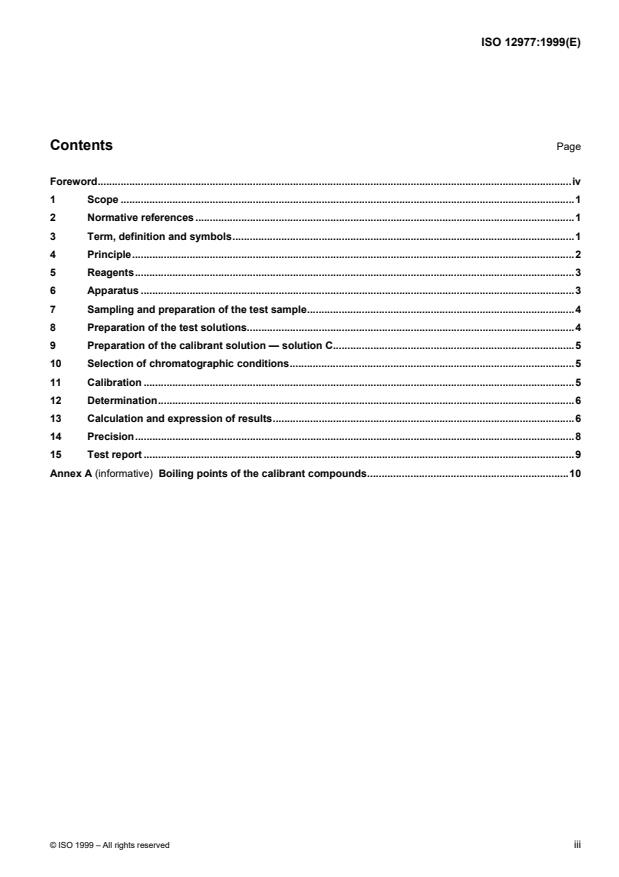
Contents Page
Foreword.iv
1 Scope .1
2 Normative references .1
3 Term, definition and symbols.1
4 Principle.2
5 Reagents.3
6 Apparatus .3
7 Sampling and preparation of the test sample.4
8 Preparation of the test solutions.4
9 Preparation of the calibrant solution — solution C.5
10 Selection of chromatographic conditions.5
11 Calibration .5
12 Determination.6
13 Calculation and expression of results.6
14 Precision.8
15 Test report .9
Annex A (informative) Boiling points of the calibrant compounds.10
© ISO 1999 – All rights reserved iii
Foreword
ISO (the International Organization for Standardization) is a worldwide federation of national standards bodies (ISO
member bodies). The work of preparing International Standards is normally carried out through ISO technical
committees. Each member body interested in a subject for which a technical committee has been established has
the right to be represented on that committee. International organizations, governmental and non-governmental, in
liaison with ISO, also take part in the work. ISO collaborates closely with the International Electrotechnical
Commission (IEC) on all matters of electrotechnical standardization.
International Standards are drafted in accordance with the rules given in the ISO/IEC Directives, Part 3.
Draft International Standards adopted by the technical committees are circulated to the member bodies for voting.
Publication as an International Standard requires approval by at least 75 % of the member bodies casting a vote.
Attention is drawn to the possibility that some of the elements of this International Standard may be the subject of
patent rights. ISO shall not be held responsible for identifying any or all such patent rights.
International Standard ISO 12977 was prepared by Technical Committee ISO/TC 47, Chemistry, Subcommittee
SC 7, Aluminium oxide, cryolite, aluminium fluoride, sodium fluoride, carbonaceous materials for the aluminium
industry.
Annex A of this International Standard is for information only.
iv © ISO 1999 – All rights reserved
INTERNATIONAL STANDARD ISO 12977:1999(E)
Carbonaceous materials used in the production of aluminium —
Pitch for electrodes — Determination of volatile matter content
1 Scope
This International Standard describes an empirical method for the determination of the volatile matter content of
pitch by gas chromatographic analysis of its solution in toluene. Strict adherence to the procedure is essential
because of the empirical nature of the method.
2 Normative references
The following normative documents contain provisions which, through reference in this text, constitute provisions of
this International Standard. For dated references, subsequent amendments to, or revisions of, any of these
publications do not apply. However, parties to agreements based on this International Standard are encouraged to
investigate the possibility of applying the most recent editions of the normative documents indicated below. For
undated references, the latest edition of the normative document referred to applies. Members of ISO and IEC
maintain registers of currently valid International Standards.
ISO 565, Test sieves — Metal wire cloth, perforated metal plate and electroformed sheet — Nominal sizes of
openings.
ISO 1042, Laboratory glassware — One-mark volumetric flasks.
ISO 6257, Carbonaceous materials used in the production of aluminium — Pitch for electrodes — Sampling.
3 Term, definition and symbols
3.1 Term and definition
For the purposes of this International Standard, the following term and definition applies.
3.1.1
volatile matter content
total percentage by mass of those components present in the pitch which have gas-chromatographic retention
times corresponding to atmospheric pressure boiling points up to 360 °C under the conditions used
3.2 Symbols, subscripts and superscripts
3.2.1 Symbols
A surface area of the chromatographic peak
a slope of the regression line
B equivalent boiling point at atmospheric pressure
b intercept of the regression line
© ISO 1999 – All rights reserved 1
F factor to convert tabulated peak areas to the corresponding percentages by mass in the original pitch
sample
K ratio of areas of dibenzothiophene to phenanthrene
A
K ratio of retention times
T
m mass of calibrant compound
R reproducibility
R response factor for calibrant compounds (5.2)
f
r repeatability
T retention time of the chromatographic peak
w percentage by mass of dibenzothiophene present in sample
d
3.2.2 Subscripts and superscripts
A, B, C solutions A, B, C corresponding respectively to chromatograms A, B, C
d dibenzothiophene
ii-th peak
p phenanthrene
pitch pitch
T retention time
tot total surface area of calibrant compounds in the chromatogram
0 presence in the original pitch sample
� contribution resulting from the addition of the dibenzothiophene internal standard
4Principle
A calibration analysis of a multicomponent test mixture of pure compounds comprising selected major components
of coal tar together with an internal standard component is performed by gas chromatography under defined
conditions on a chromatographic column having a non-polar stationary phase.
The results of this analysis establish a substantially rectilinear relationship between the chromatographic retention
times of the individual components of the mixture and their atmospheric pressure boiling points. In addition, the
analysis provides a mean relative response factor which relates the ratio of the total mass to total chromatographic
peak area for the selected calibrants to the equivalent ratio for the internal standard.
Because the selected internal standard compound, dibenzothiophene, is also a normal component of coal tar it is
necessary to perform the ensuing chromatographic analysis of the pitch on two solutions, one with and one without
addition of the internal standard, thus enabling the area to mass response of the chromatograph to the internal
standard to be calculated.
From the latter figure and from the mean relative response factor for the components in the calibration test mixture
the amounts of material represented by the peaks of the test sample analysis chromatogram are calculated. These
data, together with the previously established relationship between the chromatographic retention time and the
2 © ISO 1999 – All rights reserved
atmospheric pressure boiling points of the components, allow the construction of a simulated distillation curve or
table of values for the test sample.
From these values, the sum of the percentages of components with atmospheric pressure boiling points up to and
including 360 °C may be calculated by interpolation.
5 Reagents
WARNING — Refer to the reagent supplier's Health and Safety data sheets for the precautions which are to
be taken for the safe use of the reagents listed under 5.1, 5.2 and 5.3.
5.1 Dibenzothiophene,of atleast98% puritybymass.
1)
5.2 Calibrant compounds comprising naphthalene, 2-methylnaphthalene, acenaphthene, dibenzofuran,
fluorene, phenanthrene, fluoranthene and pyrene, all of which shall be of at least 98 % purity and none of which
shall contain a measurable amount of any impurity which co-elutes with the dibenzothiophene (5.1) under the
chromatographic conditions used.
NOTE Boiling points of the calibrant compounds are given in annex A.
5.3 Toluene, of analytical reagent quality.
6 Apparatus
Ordinary laboratory apparatus and the following.
6.1 Gas chromatograph, having a heated injector capable of operating at 300 °C, a flame-ionization detector
and its associated amplifier, and equipped for use with capillary columns under programmed-temperature
conditions from approximately 50 °C to 300 °C, with heating rates of 1 °C/min to 10 °C/min.
It is preferable that splitless injection is used. If any other arrangement is used, it shall be recorded in the test report
(see clause 15).
6.2 Electronic integrator, designed for processing the signal from the gas chromatograph (6.1) to give the
retention times and areas of the chromatographic peaks.
The integrator may be combined with the gas chromatograph (6.1) or may be a separate unit.
6.3 Capillary column, having a non-polar stationary phase with low-bleed characteristics under the
chromatographic conditions used in the test.
When the column is operated under the selected analysis conditions without injection of a sample, the baseline of
the chromatogram shall remain rectilinear without significant variation over the range of retention times which
includes the retention times of naphthalene and pyrene.
NOTE 1 Typically the column will be of 12 m to 25 m length, constructed of fused silica capillary tubing having an internal
diameter of 0,53 mm minimum, taking into account splitless injection and the injection volume selected (see clause 10).
The column shall have a chemically-bonded stationary phase of the poly(dimethylsiloxane) type.
NOTE 2 Other stationary phases which have the required low-bleed characteristics and give symmetrical peaks showing a
similarly rectilinear relationship between the retention times and the boiling points of the calibrants listed in 5.2 are acceptable.
1) "Calibrant" compounds are used as the reference materials for calibration.
© ISO 1999 – All rights reserved 3
6.4 Chromatographic syringes, of a type and capacity appropriate to the characteristics of the injection system
of the gas chromatograph (6.1).
NOTE Typically the required capacity will be in the range 1 �lto 25 �l.
6.5 Volumetric flasks, conforming to the requirements of ISO 1042, of capacity 10 ml and 100 ml.
6.6 Ultrasonic bath, of a type designed for general laboratory use.
NOTE Typically this will have a power rating of 100 W to 200 W and an operating frequency of 40 kHz.
6.7 Pestle and mortar, constructed of, or faced with, hard material which will not be abraded and thereby
contaminate the sample.
NOTE Typical suitable materials include agate, tungsten carbide and silicon carbide.
6.8 Tes
...
NORME ISO
INTERNATIONALE 12977
Première édition
1999-12-01
Produits carbonés utilisés pour la
production d'aluminium — Brais pour
électrodes — Détermination de la teneur en
matière volatile
Carbonaceous materials for use in the production of aluminium — Pitch for
electrodes — Determination of volatile matter content
Numéro de référence
©
ISO 1999
PDF – Exonération de responsabilité
Le présent fichier PDF peut contenir des polices de caractères intégrées. Conformément aux conditions de licence d'Adobe, ce fichier peut
être imprimé ou visualisé, mais ne doit pas être modifiéà moins que l'ordinateur employéà cet effet ne bénéficie d'une licence autorisant
l'utilisation de ces polices et que celles-ci y soient installées. Lors du téléchargement de ce fichier, les parties concernées acceptent de fait la
responsabilité de ne pas enfreindre les conditions de licence d'Adobe. Le Secrétariat central de l'ISO décline toute responsabilité en la
matière.
Adobe est une marque déposée d'Adobe Systems Incorporated.
Les détails relatifs aux produits logiciels utilisés pour la créationduprésent fichier PDF sont disponibles dans la rubrique General Info du
fichier; les paramètres de création PDF ont été optimisés pour l'impression. Toutes les mesures ont été prises pour garantir l'exploitation de
ce fichier par les comités membres de l'ISO. Dans le cas peu probable où surviendrait un problème d'utilisation, veuillez en informer le
Secrétariat central à l'adresse donnée ci-dessous.
© ISO 1999
Droits de reproduction réservés. Sauf prescription différente, aucune partie de cette publication ne peut être reproduite ni utilisée sous quelque
forme que ce soit et par aucun procédé, électronique ou mécanique, y compris la photocopie et les microfilms, sans l'accord écrit de l’ISO à
l’adresse ci-aprèsouducomité membre de l’ISO dans le pays du demandeur.
ISO copyright office
Case postale 56 � CH-1211 Geneva 20
Tel. + 41 22 749 01 11
Fax. + 41 22 749 09 47
E-mail copyright@iso.ch
Web www.iso.ch
Version française parue en 2000
Imprimé en Suisse
ii © ISO 1999 – Tous droits réservés
Sommaire Page
Avant-propos.iv
1 Domaine d'application.1
2Références normatives .1
3 Termes, définitions et symboles.1
4 Principe.2
5Réactifs .3
6 Appareillage .3
7 Échantillonnage et préparation de l’échantillon d’essai .4
8Préparation des solutions d’essai .4
9Préparation de la solution d’étalonnage — solution C.5
10 Sélection des conditions chromatographiques .5
11 Étalonnage.6
12 Détermination.6
13 Calcul et expression des résultats.7
14 Fidélité .9
15 Rapport d’essai.9
Annexe A (informative) Points d'ébullition des composés étalonnants.11
© ISO 1999 – Tous droits réservés iii
Avant-propos
L'ISO (Organisation internationale de normalisation) est une fédération mondiale d'organismes nationaux de
normalisation (comités membres de l'ISO). L'élaboration des Normes internationales est en général confiéeaux
comités techniques de l'ISO. Chaque comité membre intéressé par une étude aledroit de fairepartie ducomité
technique créé à cet effet. Les organisations internationales, gouvernementales et non gouvernementales, en
liaison avec l'ISO participent également aux travaux. L'ISO collabore étroitement avec la Commission
électrotechnique internationale (CEI) en ce qui concerne la normalisation électrotechnique.
Les Normes internationales sont rédigées conformément aux règles données dans les Directives ISO/CEI, Partie 3.
Les projets de Normes internationales adoptés par les comités techniques sont soumis aux comités membres pour
vote. Leur publication comme Normes internationales requiert l'approbation de 75 % au moins des comités
membres votants.
L’attention est appelée sur le fait que certains des éléments delaprésente Norme internationale peuvent faire
l’objet de droits de propriété intellectuelle ou de droits analogues. L’ISO ne saurait être tenue pour responsable de
ne pas avoir identifié de tels droits de propriété et averti de leur existence.
La Norme internationale ISO 12977 a étéélaboréepar le comité technique ISO/TC 47, Chimie, sous-comité SC 7,
Oxyde d'aluminium, cryolithe, fluorure d'aluminium, fluorure de sodium, produits carbonés pour l'industrie de
l'aluminium.
L'annexe A de la présente Norme internationale est donnée uniquement à titre d'information.
iv © ISO 1999 – Tous droits réservés
NORME INTERNATIONALE ISO 12977:1999(F)
Produits carbonés utilisés pour la production d'aluminium — Brais
pour électrodes — Détermination de la teneur en matière volatile
1 Domaine d'application
La présente Norme internationale décrit une méthode empirique pour la détermination de la teneur en matière
volatile des brais pour électrodes par analyse chromatographique en phase gazeuse de leur solution dans le
toluène. Un respect rigoureux du mode opératoire est essentiel en raison de la nature empirique de la méthode.
2Références normatives
Les documents normatifs suivants contiennent des dispositions qui, par suite de la référence qui y est faite,
constituent des dispositions valables pour la présente Norme internationale. Pour les références datées, les
amendements ultérieurs ou les révisions de ces publications ne s’appliquent pas. Toutefois, les parties prenantes
aux accords fondés sur la présente Norme internationale sont invitées à rechercher la possibilité d'appliquer les
éditions les plus récentes des documents normatifs indiqués ci-après. Pour les références non datées, la dernière
édition du document normatif en référence s’applique. Les membres de l'ISO et de la CEI possèdent le registre des
Normes internationales en vigueur.
ISO 565, Tamis de contrôle — Tissus métalliques, tôles métalliques perforées et feuilles électroformées —
Dimensions nominales des ouvertures.
ISO 1042, Verrerie de laboratoire — Fioles jaugées à un trait.
ISO 6257, Produits carbonés utilisés pour la production de l'aluminium — Brais pour électrodes —
Échantillonnage.
3 Termes, définitions et symboles
3.1 Terme et définition
Pour les besoins de la présente Norme internationale, le terme et la définition suivants s'appliquent.
3.1.1
teneur en matière volatile
pourcentage total en masse des composants présents dans les brais qui ont des temps de rétention en
chromatographie en phase gazeuse correspondant aux points d’ébullition à la pression atmosphérique jusqu’à
360 °C dans les conditions adoptées
3.2 Symboles, indices et exposants
3.2.1 Symboles
A surface du pic chromatographique
a pente de la droite de régression
© ISO 1999 – Tous droits réservés 1
B point d’ébullition équivalent à la pression atmosphérique
b intercepte de la droite de régression
F facteur de conversion des surfaces de pics tabulées en pourcentage en masse correspondants dans
l’échantillon original de brai
K rapport entre les surfaces du dibenzothiophène et du phénanthrène
A
K rapport des temps de rétention
T
m masse du composéétalonnant
R reproductibilité
R facteur de réponse pour les composés étalonnants (5.2)
f
r répétabilité
T temps de rétention du pic chromatographique
w pourcentage en masse de dibenzothiophène présent dans l’échantillon
d
3.2.2 Indices et exposants
A, B, C solutions A, B, C correspondant respectivement aux chromatogrammes A, B, C
d dibenzothiophène
ii-ème pic
pphénanthrène
brai brai
T temps de rétention
tot surface totale des composés étalonnants dans le chromatogramme
0présence dans l’échantillon original de brai
� contribution résultant de l’adjonctiondel’étalon interne de dibenzothiophène
4Principe
Analyse par étalonnage d’un mélange multicomposants pour essai constitué de composés purs comprenant des
composants majeurs de goudron de houille sélectionnés, ainsi qu’un composant étalon interne. L’analyse est
réalisée par chromatographie en phase gazeuse dans des conditions définies sur une colonne chromatographique
ayant une phase stationnaire non polaire.
Les résultats de cette analyse établissent une relation essentiellement rectilinéaire entre les temps de rétention
chromatographique des composants individuels du mélange et leurs points d’ébullition à la pression
atmosphérique. En outre, l’analyse fournit un facteur de réponse relatif moyen qui met en relation le rapport de la
masse totale à la surface totale du pic chromatographique pour les composés étalonnants sélectionnéset le
rapport équivalent concernant l’étalon interne.
2 © ISO 1999 – Tous droits réservés
Du fait que le composéétalon interne sélectionné, le dibenzothiophène, est aussi un composant normal du
goudron de houille, il est nécessaire d’effectuer l’analyse chromatographique subséquente du brai sur deux
solutions, l’une avec l’étalon interne, l’autre sans, ce qui permet de calculer la réponse surface/masse du
chromatographe à l’étalon interne.
À partir de ce dernier chiffre et du facteur de réponse relatif moyen pour les composants du mélange pour essai
d’étalonnage, les quantitésdematériau représentées par les pics du chromatogramme d’analyse de l’échantillon
d’essai sont calculées. Ces données, ainsi que les relations préalablement établies entre le temps de rétention
chromatographique et les points d’ébullition à la pression atmosphérique des composants, permettent d’établir par
simulation une courbe de distillation ou une table des valeurs pour l’échantillon d’essai.
À partir de ces valeurs, il est possible de calculer par interpolation la somme des pourcentages des composants
avec des points d’ébullition à la pression atmosphérique jusqu’à 360 °Cinclus.
5Réactifs
AVERTISSEMENT — Se reporter aux fiches techniques de santé et de sécurité du fournisseur de réactifs
pour les précautions à prendre pour une utilisation sans danger des réactifs énumérésen 5.1, en 5.2 et
en 5.3.
5.1 Dibenzothiophène, titré au moins à 98 % en masse.
1)
5.2 Composés étalonnants , soit naphtalène, 2-méthylnaphtalène, acénaphtène, dibenzofurane, fluorène,
phénanthrène, fluoranthène et pyrène, tous devant être titrés au moins à 98 % et aucun ne devant contenir une
quantité mesurable d’une impureté quelconque susceptible de coéluer avec le dibenzothiophène (5.1) dans les
conditions chromatographiques adoptées.
NOTE Les points d’ébullition des composés étalonnants sont donnés dans l’annexe A.
5.3 Toluène,dequalité analytique.
6 Appareillage
Instruments courants de laboratoire et ce qui suit.
6.1 Chromatographe en phase gazeuse, avec injecteur chauffé apte à fonctionner à 300 °C, un détecteur
d’ionisation de flamme et son amplificateur associé,et étant équipé pour une utilisation avec des colonnes
capillaires dans des conditions de température programmées s’étalant approximativement entre 50 °Cet300 °C, à
des vitesses de chauffage de 1 °C/min à 10 °C/min.
Il est préférable d’utiliser une injection sans flux divisés. Si une autre méthode est utilisée, elle doit être consignée
dans le rapport d’essai (voir article 15).
6.2 Intégrateur électronique, conçu pour traiter le signal du chromatographe en phase gazeuse (6.1) afin de
donner les temps de rétention et les surfaces des pics chromatographiques.
Il est possible de combiner l’intégrateur avec le chromatographe en phase gazeuse (6.1) ou de l’utiliser comme un
appareil séparé.
6.3 Colonne capillaire, ayant une phase stationnaire non polaire, avec une faible perte de substances dans les
conditions chromatographiques adoptées pour l’essai.
1)
Les composés «étalonnants» sont utiliséscomme matériaux de référence pour l’étalonnage.
© ISO 1999 – Tous droits réservés 3
Lorsque la colonne fonctionne dans les conditions choisies d’analyse sans injection d’un échantillon, la ligne de
base du chromatogramme doit rester rectiligne sans variation significative sur la gamme des temps de rétention
incluant ceux du naphtalène et du pyrène.
NOTE 1 Une colonne type est de 12 m à 25 m de longueur, construite de tubes capillaires en verre de silice de diamètre
intérieur de 0,53 mm au minimum, en prenant en compte une injection sans flux diviséset le volumed’injection sélectionné
(voir article 10).
La colonne doit avoir une phase stationnaire par liaison chimique du type poly(diméthylsiloxane).
NOTE 2 D’autres phases stationnaires, qui ont les caractéristiques requises de faible perte de substances et qui produisent
des pics symétriques montrant une relation rectilinéaire similaire entre les temps de rétention et les points d’ébullition des
composés étalonnants énumérés en 5.2, sont acceptables.
6.4 Seringues chromatographiques, d’un type et d’une capacité correspondant aux caractéristiques du
système d’injection du chromatographe en phase gazeuse (6.1).
NOTE La capacité type requise sera comprise entre 1 �let25 �l.
6.5 Fioles jaugées, conformes aux exigences de l’ISO 1042, d’une capacité de 10 ml et de 100 ml.
6.6 Bain ultrasonique, d’un type conçu pour un usage général de laboratoire.
NOTE La puissance nominale du bain ultrasonique est de 100 W à 200 W et sa fréquence de fonctionnement est de
40 kHz.
6.7 Pilon et mortier, composésou revêtus d’un matériau dur, non abrasif et qui n’est, par conséquent, pas
susceptible de contaminer l’échantillon.
NOTE Les matériaux types appropriés sont notamment l’agate, le carbure de tungstène et le carbure de silicium.
6.8 Tamis d’essai, d’ouverture nominale 212 �m conforme aux exigence
...