


ISO/IEC 13818-1:2015/FDAmd 8
(Amendment)Information technology — Generic coding of moving pictures and associated audio information — Part 1: Systems — Amendment 8: Signaling HDR and WCG video content in MPEG-2 systems
Information technology — Generic coding of moving pictures and associated audio information — Part 1: Systems — Amendment 8: Signaling HDR and WCG video content in MPEG-2 systems
Technologies de l'information — Codage générique des images animées et du son associé — Partie 1: Systèmes — Amendement 8: .
General Information
- Status
- Withdrawn
- Current Stage
- 5098 - Project deleted
- Start Date
- 11-Jan-2018
- Completion Date
- 12-Feb-2026
Relations
- Effective Date
- 11-Dec-2021
- Effective Date
- 02-Sep-2017

ISO/IEC 13818-1:2015/FDAmd 8 - Signaling HDR and WCG video content in MPEG-2 systems
REDLINE ISO/IEC 13818-1:2015/FDAmd 8 - Information technology — Generic coding of moving pictures and associated audio information — Part 1: Systems — Amendment 8: Signaling HDR and WCG video content in MPEG-2 systems Released:3/29/2017
Get Certified
Connect with accredited certification bodies for this standard

BSI Group
BSI (British Standards Institution) is the business standards company that helps organizations make excellence a habit.

NYCE
Mexican standards and certification body.
Sponsored listings
Frequently Asked Questions
ISO/IEC 13818-1:2015/FDAmd 8 is a draft published by the International Organization for Standardization (ISO). Its full title is "Information technology — Generic coding of moving pictures and associated audio information — Part 1: Systems — Amendment 8: Signaling HDR and WCG video content in MPEG-2 systems". This standard covers: Information technology — Generic coding of moving pictures and associated audio information — Part 1: Systems — Amendment 8: Signaling HDR and WCG video content in MPEG-2 systems
Information technology — Generic coding of moving pictures and associated audio information — Part 1: Systems — Amendment 8: Signaling HDR and WCG video content in MPEG-2 systems
ISO/IEC 13818-1:2015/FDAmd 8 is classified under the following ICS (International Classification for Standards) categories: 35.040 - Information coding; 35.040.40 - Coding of audio, video, multimedia and hypermedia information. The ICS classification helps identify the subject area and facilitates finding related standards.
ISO/IEC 13818-1:2015/FDAmd 8 has the following relationships with other standards: It is inter standard links to ISO/IEC 13818-1:2015, ISO/IEC 13818-1:2018. Understanding these relationships helps ensure you are using the most current and applicable version of the standard.
ISO/IEC 13818-1:2015/FDAmd 8 is available in PDF format for immediate download after purchase. The document can be added to your cart and obtained through the secure checkout process. Digital delivery ensures instant access to the complete standard document.
Standards Content (Sample)
FINAL
ISO/IEC
AMENDMENT
DRAFT
13818-1:2015
FDAM 8
ISO/IEC JTC 1/SC 29
Information technology — Generic
Secretariat: JISC
coding of moving pictures and
Voting begins on:
2017-03-30 associated audio information —
Voting terminates on:
Part 1:
2017-05-25
Systems
AMENDMENT 8: Signaling HDR and WCG
video content in MPEG-2 systems
Technologies de l’information — Codage générique des images
animées et du son associé —
Partie 1: Systèmes
AMENDEMENT 8: .
RECIPIENTS OF THIS DRAFT ARE INVITED TO
SUBMIT, WITH THEIR COMMENTS, NOTIFICATION
OF ANY RELEVANT PATENT RIGHTS OF WHICH
THEY ARE AWARE AND TO PROVIDE SUPPOR TING
DOCUMENTATION.
IN ADDITION TO THEIR EVALUATION AS
Reference number
BEING ACCEPTABLE FOR INDUSTRIAL, TECHNO-
ISO/IEC 13818-1:2015/FDAM 8:2017(E)
LOGICAL, COMMERCIAL AND USER PURPOSES,
DRAFT INTERNATIONAL STANDARDS MAY ON
OCCASION HAVE TO BE CONSIDERED IN THE
LIGHT OF THEIR POTENTIAL TO BECOME STAN-
DARDS TO WHICH REFERENCE MAY BE MADE IN
©
NATIONAL REGULATIONS. ISO/IEC 2017
ISO/IEC 13818-1:2015/FDAM 8:2017(E)
© ISO/IEC 2017, Published in Switzerland
All rights reserved. Unless otherwise specified, no part of this publication may be reproduced or utilized otherwise in any form
or by any means, electronic or mechanical, including photocopying, or posting on the internet or an intranet, without prior
written permission. Permission can be requested from either ISO at the address below or ISO’s member body in the country of
the requester.
ISO copyright office
Ch. de Blandonnet 8 • CP 401
CH-1214 Vernier, Geneva, Switzerland
Tel. +41 22 749 01 11
Fax +41 22 749 09 47
copyright@iso.org
www.iso.org
ii © ISO/IEC 2017 – All rights reserved
ISO/IEC 13818-1:2015/FDAM 8:2017(E)
Foreword
ISO (the International Organization for Standardization) and IEC (the International Electrotechnical
Commission) form the specialized system for worldwide standardization. National bodies that are
members of ISO or IEC participate in the development of International Standards through technical
committees established by the respective organization to deal with particular fields of technical
activity. ISO and IEC technical committees collaborate in fields of mutual interest. Other international
organizations, governmental and non-governmental, in liaison with ISO and IEC, also take part in the
work. In the field of information technology, ISO and IEC have established a joint technical committee,
ISO/IEC JTC 1.
The procedures used to develop this document and those intended for its further maintenance are
described in the ISO/IEC Directives, Part 1. In particular the different approval criteria needed for the
different types of ISO documents should be noted. This document was drafted in accordance with the
editorial rules of the ISO/IEC Directives, Part 2 (see www .iso .org/ directives).
Attention is drawn to the possibility that some of the elements of this document may be the subject
of patent rights. ISO and IEC shall not be held responsible for identifying any or all such patent
rights. Details of any patent rights identified during the development of the document will be in the
Introduction and/or on the ISO list of patent declarations received (see www .iso .org/ patents).
Any trade name used in this document is information given for the convenience of users and does not
constitute an endorsement.
For an explanation on the voluntary nature of standards, the meaning of ISO specific terms and
expressions related to conformity assessment, as well as information about ISO’s adherence to the
World Trade Organization (WTO) principles in the Technical Barriers to Trade (TBT) see the following
URL: w w w . i s o .org/ iso/ foreword .html.
This document was prepared by Technical Committee ISO/IEC JTC 1, Information technology, SC 29,
Coding of audio, picture, multimedia and hypermedia information.
A list of all parts in the ISO 13818 series can be found on the ISO website.
© ISO/IEC 2017 – All rights reserved iii
ISO/IEC 13818-1:2015/FDAM 8:2017(E)
Information technology — Generic coding of moving
pictures and associated audio information —
Part 1:
Systems
AMENDMENT 8: Signaling HDR and WCG video content in
MPEG-2 systems
1.2.3
Replace the following
— Recommendation ITU-R BT.601-6 (2007), Studio encoding parameters of digital television for standard
4:3 and wide-screen 16.9 aspect ratios.
with
— Recommendation ITU-R BT.601-6 (2007), Studio encoding parameters of digital television for standard
4:3 and wide-screen 16.9 aspect ratios.
— Recommendation ITU-R BT.709-6 (06-2015), Parameter values for the HDTV standards for production
and international programme exchange.
— Recommendation ITU-R BT.1886, Reference electro-optical transfer function for flat panel displays
used in HDTV studio production.
— Recommendation ITU-R BT.2100, Image parameter values for high dynamic range television for use in
production and international programme exchange.
2.6.95
Replace 2.6.95 with the following:
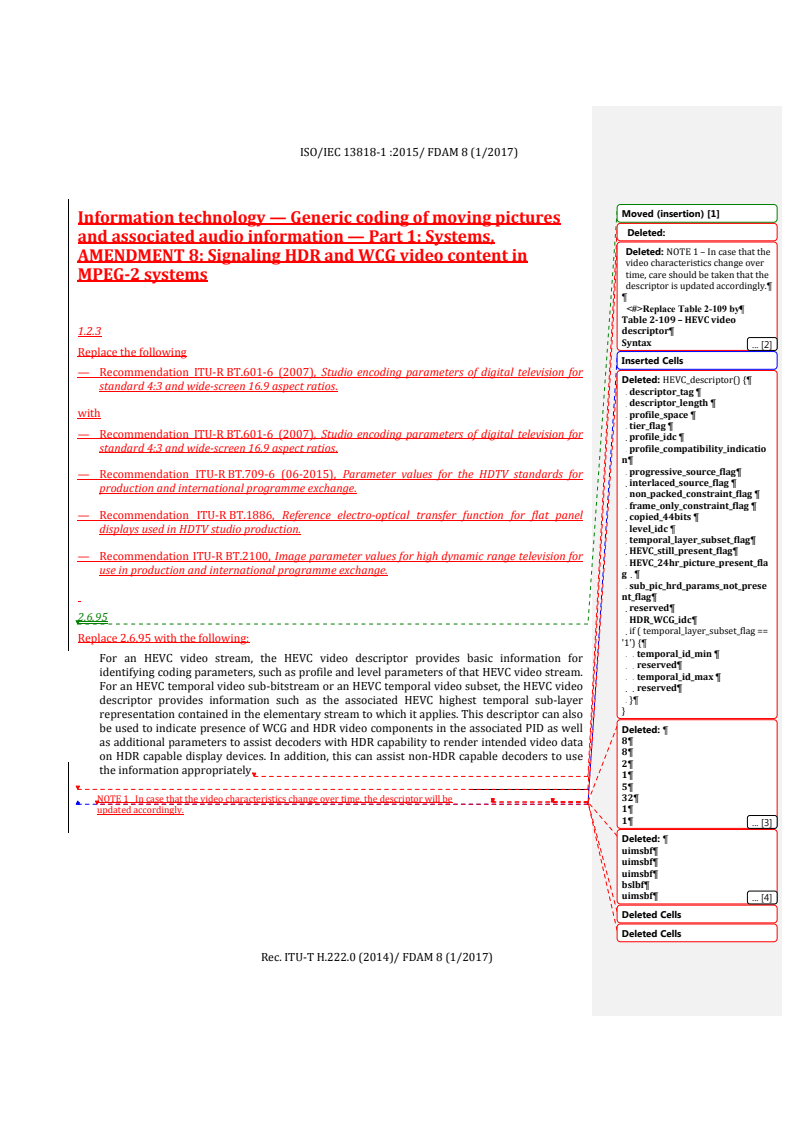
For an HEVC video stream, the HEVC video descriptor provides basic information for identifying
coding parameters, such as profile and level parameters of that HEVC video stream. For an HEVC
temporal video sub-bitstream or an HEVC temporal video subset, the HEVC video descriptor
provides information such as the associated HEVC highest temporal sub-layer representation
contained in the elementary stream to which it applies. This descriptor can also be used to indicate
presence of WCG and HDR video components in the associated PID as well as additional parameters
to assist decoders with HDR capability to render intended video data on HDR capable display
devices. In addition, this can assist non-HDR capable decoders to use the information appropriately.
NOTE 1 In case that the video characteristics change over time, the descriptor will be updated accordingly.
ISO/IEC 13818-1:2015/FDAM 8:2017(E)
Table 2-109
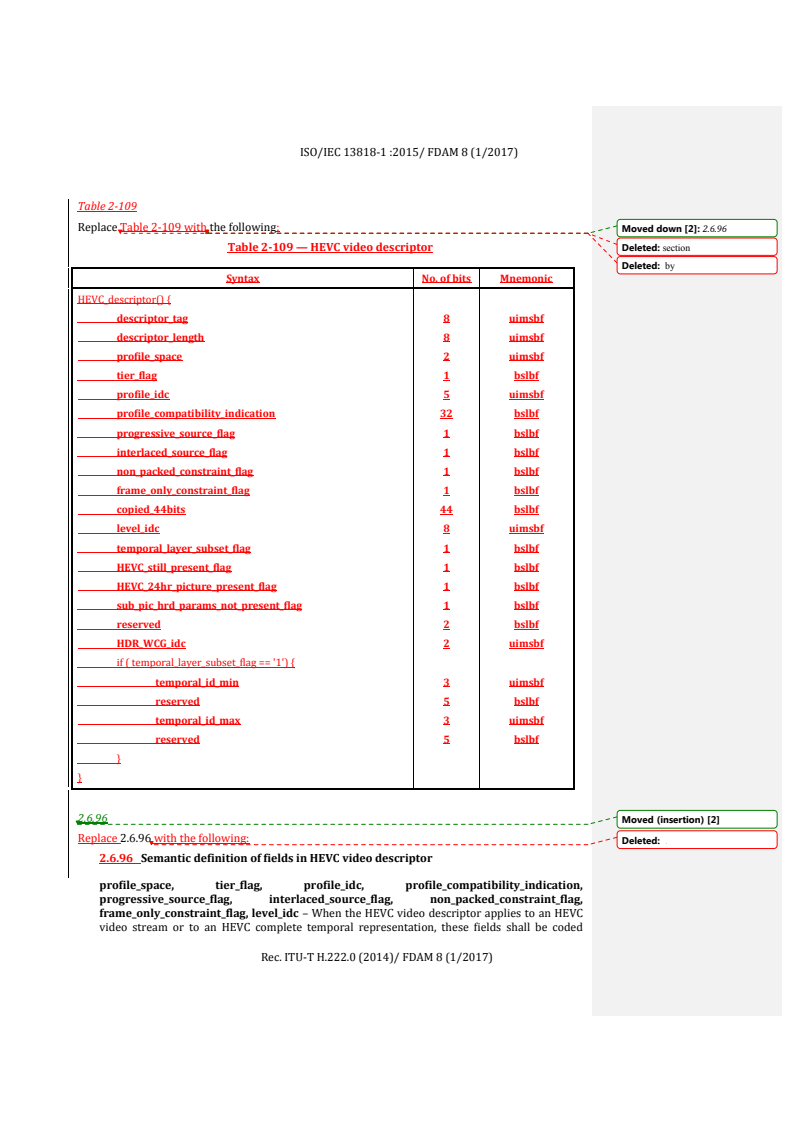
Replace Table 2-109 with the following:
Table 2-109 — HEVC video descriptor
Syntax No. of bits Mnemonic
HEVC_descriptor() {
descriptor_tag 8 uimsbf
descriptor_length 8 uimsbf
profile_space 2 uimsbf
tier_flag 1 bslbf
profile_idc 5 uimsbf
profile_compatibility_indication 32 bslbf
progressive_source_flag 1 bslbf
interlaced_source_flag 1 bslbf
non_packed_constraint_flag 1 bslbf
frame_only_constraint_flag 1 bslbf
copied_44bits 44 bslbf
level_idc 8 uimsbf
temporal_layer_subset_flag 1 bslbf
HEVC_still_present_flag 1 bslbf
HEVC_24hr_picture_present_flag 1 bslbf
sub_pic_hrd_params_not_present_flag 1 bslbf
reserved 2 bslbf
HDR_WCG_idc 2 uimsbf
if ( temporal_layer_subset_flag == ‘1’) {
temporal_id_min 3 uimsbf
reserved 5 bslbf
temporal_id_max 3 uimsbf
reserved 5 bslbf
}
}
2.6.96
Replace 2.6.96 with the following:
2.6.96 Semantic definition of fields in HEVC video descriptor
profile_space, tier_flag, profile_idc, profile_compatibility_indication, progressive_source_
flag, interlaced_source_flag, non_packed_constraint_flag, frame_only_constraint_flag, level_
idc – When the HEVC video descriptor applies to an HEVC video stream or to an HEVC complete
temporal representation, these fields shall be coded according to the semantics defined in Rec.
ITU-T H.265 | ISO/IEC 23008-2 for general_profile_space, general_tier_flag, general_profile_idc,
general_profile_compatibility_flag[i], general_progressive_source_flag, general_interlaced_source_
flag, general_non_packed_constraint_flag, general_frame_only_constraint_flag, general_level_idc,
respectively, for the corresponding HEVC video stream or HEVC complete temporal representation,
and the entire HEVC video stream or HEVC complete temporal representation to which the HEVC
video descriptor is associated shall conform to the information signalled by these fields.
2 © ISO 2017 – All rights reserved
ISO/IEC 13818-1:2015/FDAM 8:2017(E)
When t
...
ISO/IEC 13818‐1 :2015/ FDAM 8 (1/2017)
INTERNATIONAL STANDARD Deleted: INTERNATIONAL
ORGANIZATION FOR
STANDARDIZATION
ITU‐T RECOMMENDATION
ORGANISATION
INTERNATIONALE DE
Information technology — Generic coding of moving pictures and associated audio
NORMALISATION
information — Part 1: Systems, AMENDMENT 8: Signaling HDR and WCG video ISO/IEC JTC1/SC29/WG11
CODING OF MOVING PICTURES
content in MPEG-2 systems
AND AUDIO
ISO/IEC JTC1/SC29/WG11
MPEG2017/ N16593
January 2017, Geneva,
Switzerland

Source
... [1]
Deleted: –
Deleted:
Deleted: 
Amendment
Deleted:
Deleted:
Deleted: Replace section
Rec. ITU‐T H.222.0 (2014)/ FDAM 8 (1/2017)
ISO/IEC 13818‐1 :2015/ FDAM 8 (1/2017)
Foreword
ISO (the International Organization for Standardization) and IEC (the International Electrotechnical
Commission) form the specialized system for worldwide standardization. National bodies that are
members of ISO or IEC participate in the development of International Standards through technical
committees established by the respective organization to deal with particular fields of technical
Moved down [1]: 2.6.95
activity. ISO and IEC technical committees collaborate in fields of mutual interest. Other
international organizations, governmental and non‐governmental, in liaison with ISO and IEC, also
take part in the work. In the field of information technology, ISO and IEC have established a joint
technical committee, ISO/IEC JTC 1.
The procedures used to develop this document and those intended for its further maintenance are
described in the ISO/IEC Directives, Part 1. In particular the different approval criteria needed for
the different types of ISO documents should be noted. This document was drafted in accordance
with the editorial rules of the ISO/IEC Directives, Part 2 (see www.iso.org/directives).
Attention is drawn to the possibility that some of the elements of this document may be the subject
of patent rights. ISO and IEC shall not be held responsible for identifying any or all such patent
rights. Details of any patent rights identified during the development of the document will be in the
Introduction and/or on the ISO list of patent declarations received (see www.iso.org/patents).
Any trade name used in this document is information given for the convenience of users and does
not constitute an endorsement.
For an explanation on the voluntary nature of standards, the meaning of ISO specific terms and
expressions related to conformity assessment, as well as information about ISO's adherence to the
World Trade Organization (WTO) principles in the Technical Barriers to Trade (TBT) see the
following URL: www.iso.org/iso/foreword.html.
Deleted: by the following
This document was prepared by Technical Committee ISO/IEC JTC 1, Information technology, SC 29,
Coding of audio, picture, multimedia and hypermedia information.
A list of all parts in the ISO 13818 series can be found on the ISO website.
Rec. ITU‐T H.222.0 (2014)/ FDAM 8 (1/2017)
ISO/IEC 13818‐1 :2015/ FDAM 8 (1/2017)
Moved (insertion) [1]
Information technology — Generic coding of moving pictures
Deleted:
and associated audio information — Part 1: Systems,
Deleted: NOTE 1 – In case that the
AMENDMENT 8: Signaling HDR and WCG video content in
video characteristics change over
time, care should be taken that the
MPEG-2 systems
descriptor is updated accordingly.

<#>Replace Table 2-109 by
Table 2-109 – HEVC video
descriptor
1.2.3
Syntax
... [2]
Replace the following
Inserted Cells
— Recommendation ITU‐R BT.601‐6 (2007), Studio encoding parameters of digital television for
Deleted: HEVC_descriptor() {
standard 4:3 and wide-screen 16.9 aspect ratios.
descriptor_tag 
descriptor_length 
with profile_space 
tier_flag 
— Recommendation ITU‐R BT.601‐6 (2007), Studio encoding parameters of digital television for
profile_idc 
standard 4:3 and wide-screen 16.9 aspect ratios.
profile_compatibility_indicatio
n
progressive_source_flag
— Recommendation ITU‐R BT.709‐6 (06‐2015), Parameter values for the HDTV standards for
interlaced_source_flag 
production and international programme exchange.
non_packed_constraint_flag 
frame_only_constraint_flag 
— Recommendation ITU‐R BT.1886, Reference electro-optical transfer function for flat panel
copied_44bits 
level_idc 
displays used in HDTV studio production.
temporal_layer_subset_flag
HEVC_still_present_flag
— Recommendation ITU‐R BT.2100, Image parameter values for high dynamic range television for
HEVC_24hr_picture_present_fla
use in production and international programme exchange.
g 
sub_pic_hrd_params_not_prese
nt_flag
reserved
2.6.95
HDR_WCG_idc
if ( temporal_layer_subset_flag ==
Replace 2.6.95 with the following:
'1') {
temporal_id_min 
For an HEVC video stream, the HEVC video descriptor provides basic information for
reserved
identifying coding parameters, such as profile and level parameters of that HEVC video stream.
temporal_id_max 
For an HEVC temporal video sub‐bitstream or an HEVC temporal video subset, the HEVC video
reserved
}
descriptor provides information such as the associated HEVC highest temporal sub‐layer
}
representation contained in the elementary stream to which it applies. This descriptor can also
be used to indicate presence of WCG and HDR video components in the associated PID as well Deleted: 
8
as additional parameters to assist decoders with HDR capability to render intended video data
8
on HDR capable display devices. In addition, this can assist non‐HDR capable decoders to use
2
the information appropriately.
1
5
NOTE 1 In case that the video characteristics change over time, the descriptor will be 32
1
updated accordingly.
1
... [3]
Deleted: 
uimsbf
uimsbf
uimsbf
bslbf
uimsbf
... [4]
Deleted Cells
Deleted Cells
Rec. ITU‐T H.222.0 (2014)/ FDAM 8 (1/2017)
ISO/IEC 13818‐1 :2015/ FDAM 8 (1/2017)
Table 2-109
Replace Table 2‐109 with the following:
Moved down [2]: 2.6.96
Table 2-109 — HEVC video descriptor Deleted: section
Deleted: by
Syntax No. of bits Mnemonic
HEVC_descriptor() {
descriptor_tag 8 uimsbf
descriptor_length 8 uimsbf
profile_space 2 uimsbf
tier_flag 1 bslbf
profile_idc 5 uimsbf
profile_compatibility_indication 32 bslbf
progressive_source_flag 1 bslbf
interlaced_source_flag 1 bslbf
non_packed_constraint_flag 1 bslbf
frame_only_constraint_flag 1 bslbf
copied_44bits 44 bslbf
level_idc 8 uimsbf
temporal_layer_subset_flag 1 bslbf
HEVC_still_present_flag 1 bslbf
HEVC_24hr_picture_present_flag 1 bslbf
sub_pic_hrd_params_not_present_flag 1 bslbf
reserved 2 bslbf
HDR_WCG_idc 2 uimsbf
if ( temporal_layer_subset_flag == '1') {
temporal_id_min 3 uimsbf
reserved 5 bslbf
temporal_id_max 3 uimsbf
reserved 5 bslbf
}
}
2.6.96
Moved (insertion) [2]
Replace 2.6.96 with the following:
Deleted:
2.6.96 Semantic definition of fields in HEVC video descriptor
profile_space, tier_flag, profile_idc, profile_compatibility_indication,
progressive_source_flag, interlaced_source_flag, non_packed_constraint_flag,
frame_only_constraint_flag, level_idc – When the HEVC video descriptor applies to an HEVC
video stream or to an HEVC complete temporal representation, these fields shall be coded
Rec. ITU‐T H.222.0 (2014)/ FDAM 8 (1/2017)
ISO/IEC 13818‐1 :2015/ FDAM 8 (1/2017)
according to the semantics defined in Rec. ITU‐T H.265 | ISO/IEC 23008‐2 for
Deleted:
general_profile_space, general_tier_flag, general_profile_idc, general_profile_compatibility_flag[i],
general_progressive_source_flag, general_interlaced_source_flag,
general_non_packed_constraint_flag, general_frame_only_constraint_flag, general_level_idc,
respectively, for the corresponding HEVC video stream or HEVC complete temporal
representation, and the entire HEVC video stream or HEVC complete temporal representation
to which the HEVC video descriptor is associated shall conform to the information signalled by
these fields.
When the HEVC video descriptor applies to an HEVC temporal video sub‐bitstream or HEVC
temporal video subset of which the corresponding HEVC highest temporal sub‐layer
representation is not an HEVC complete temporal representation, these fields shall be coded
according to the semantics defined in Rec. ITU‐T H.265 | ISO/IEC 23008‐2 for
Deleted:
sub_layer_profile_space, sub_layer_tier_flag, sub_layer_profile_idc,
sub_layer_profile_compatibility_flag[i], sub_layer_progressive_source_flag,
sub_layer_interlaced_source_flag, sub_layer_non_packed_constraint_flag,
sub_layer_frame_only_constraint_flag, sub_layer_level_idc, respectively, for the corresponding
HEVC highest temporal sub‐layer representation, and the entire HEVC highest temporal sub‐
layer representation to which the HEVC video descriptor is associated shall conform to the
information signalled by these fields.
NOTE 1 In one or more sequences in the HEVC video stream, the level may be lower than the level signalled in the
Deleted: NOTE 1 – In one or more
HEVC video descriptor, while also a profile may occur that is a subset of the profile signalled in the HEVC video sequences in the HEVC video
descriptor. However, in the entire HEVC video stream, only subsets of the entire bitstream syntax th
...
Questions, Comments and Discussion
Ask us and Technical Secretary will try to provide an answer. You can facilitate discussion about the standard in here.
Loading comments...