

ISO 17637:2016
(Main)Non-destructive testing of welds — Visual testing of fusion-welded joints
General Information
- Abstract
ISO 17637:2016 specifies the visual testing of fusion welds in metallic materials. It may also be applied to visual testing of the joint prior to welding.
- Status
- Published
- Publication Date
- 20-Nov-2016
- Technical Committee
- ISO/TC 44/SC 5 - Testing and inspection of welds
- Drafting Committee
- ISO/TC 44/SC 5 - Testing and inspection of welds
- Current Stage
- 9093 - International Standard confirmed
- Start Date
- 14-Mar-2022
- Completion Date
- 29-Aug-2026
Buy Documents

ISO 17637:2016 - Non-destructive testing of welds -- Visual testing of fusion-welded joints

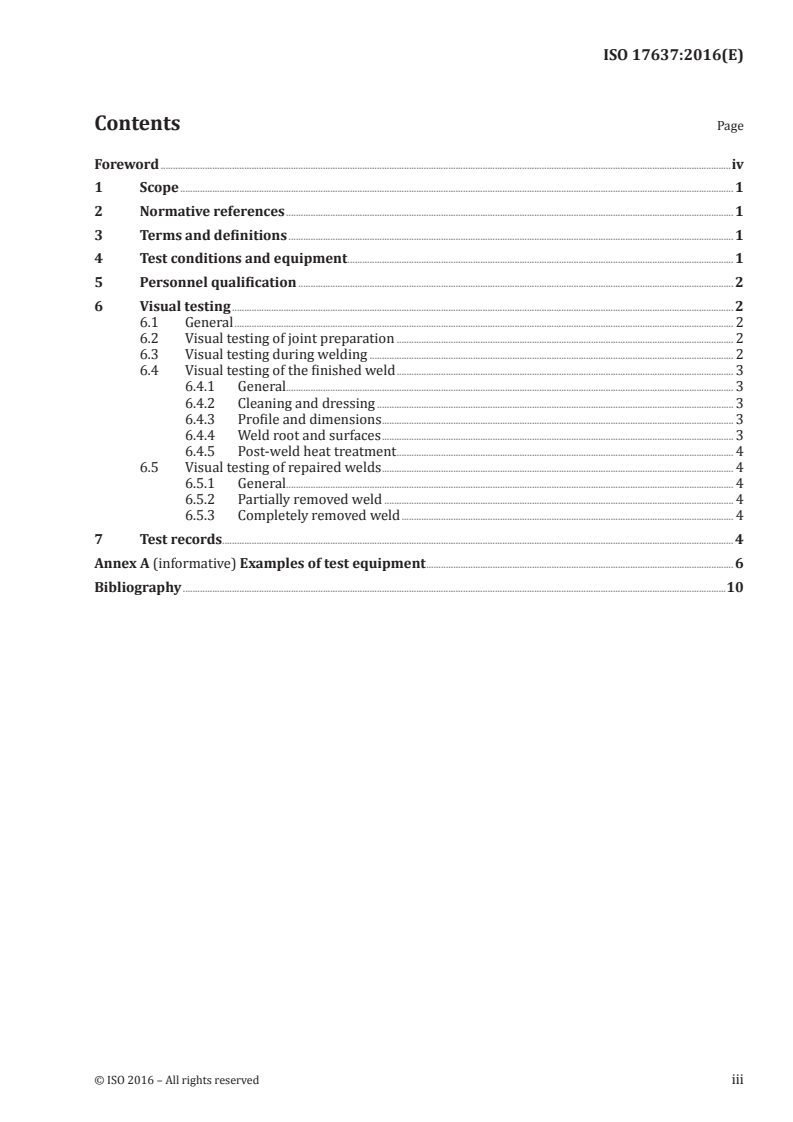
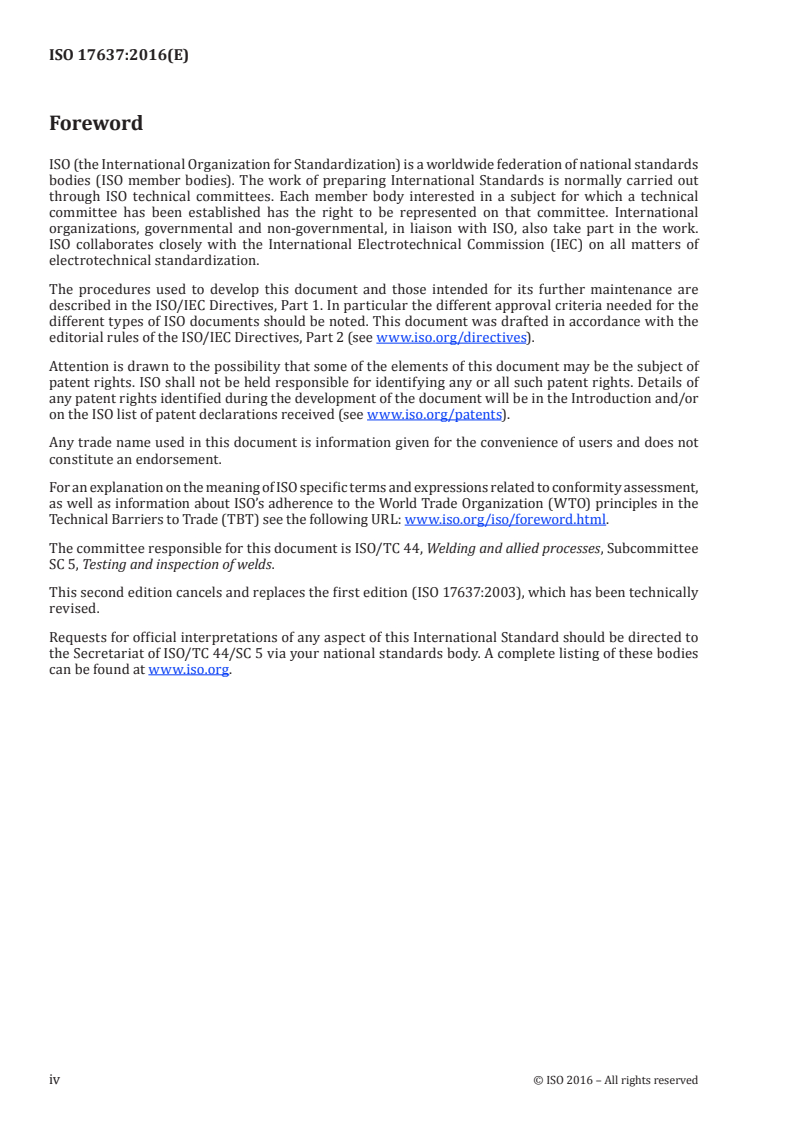
ISO 17637:2016 - Non-destructive testing of welds — Visual testing of fusion-welded joints/21/2016
ISO 17637:2016 - Contrôle non destructif des assemblages soudés -- Contrôle visuel des assemblages soudés par fusion
ISO 17637:2016 - Contrôle non destructif des assemblages soudés — Contrôle visuel des assemblages soudés par fusion/21/2016
Overview
ISO 17637:2016 - "Non-destructive testing of welds - Visual testing of fusion-welded joints" defines requirements and guidance for visual testing (VT) of fusion welds in metallic materials. The standard covers visual inspection before, during and after welding, and applies to finished and repaired welds. It is intended for use alongside application or product standards that specify the extent of inspection and acceptance criteria.
Key topics and technical requirements
- Scope and purpose: Visual testing of fusion-welded joints and, where required, inspection of the joint prior to welding.
- Illumination and viewing conditions: Minimum surface illuminance of 350 lx (wearing tinted goggles increases the minimum); 500 lx recommended. For direct inspection the eye should be within 600 mm of the surface at an angle of at least 30°. Remote inspection (mirrors, boroscopes, fibre optics, cameras) is allowed when direct access is not possible.
- Personnel qualification: Examinations and acceptance decisions must be performed by qualified personnel; indirect VT personnel are recommended to be qualified to ISO 9712 or an equivalent industry scheme.
- Inspection stages:
- Pre-weld: verify weld preparation, cleanliness and correct assembly.
- During welding: check cleanliness between runs, look for visible imperfections, and ensure correct transitions and gouging.
- Post-weld (finished weld): assess cleaning/dressing, profile and dimensions, weld root and surfaces, and compliance with acceptance criteria (e.g., ISO 5817, ISO 10042 where applicable). Final testing after any post‑weld heat treatment.
- Repaired welds: Requirements for visual inspection of partially or completely removed and re-welded joints, ensuring excavations are adequate for removal of imperfections and that final welds meet original criteria.
- Test records: Minimum reporting information includes component and testing body identity, material, joint type and thickness, welding process, acceptance criteria, detected imperfections and locations, extent of inspection, devices used, result, tester name and date. Permanent visual records (photos or sketches) recommended if required.
Applications and who uses it
ISO 17637 is used by:
- Welding engineers and quality managers for weld acceptance and inspection planning.
- NDT technicians and inspectors performing visual weld inspection in fabrication, construction, pressure vessels, pipelines, shipbuilding and structural steel.
- Fabricators and procurement/specification writers to define inspection requirements in welding procedure specifications (WPS) and contracts.
- Training and certification bodies referencing VT scope and competency requirements.
Related standards
- ISO 9712 (personnel qualification for NDT)
- ISO 5817, ISO 10042 (examples of acceptance criteria referenced for finished welds)
- Application/product standards that define specific inspection extent and acceptance criteria
Keywords: ISO 17637, visual testing, non-destructive testing, weld inspection, fusion-welded joints, visual weld inspection, NDT of welds.
Relations
- Effective Date
- 11-Feb-2026
- Effective Date
- 09-Feb-2026
- Effective Date
- 09-Feb-2026
- Effective Date
- 09-Feb-2026
- Effective Date
- 09-Feb-2026
- Effective Date
- 09-Feb-2026
- Effective Date
- 09-Feb-2026
- Effective Date
- 09-Feb-2026
- Effective Date
- 09-Feb-2026
- Effective Date
- 09-Feb-2026
- Effective Date
- 09-Feb-2026
- Effective Date
- 09-Feb-2026
- Effective Date
- 09-Feb-2026
- Effective Date
- 09-Feb-2026
- Referred By
EN ISO 9017:2018 - Destructive tests on welds in metallic materials - Fracture test (ISO 9017:2017) - Effective Date
- 09-Feb-2026
Buy Documents
ISO 17637:2016 - Non-destructive testing of welds -- Visual testing of fusion-welded joints
ISO 17637:2016 - Non-destructive testing of welds — Visual testing of fusion-welded joints/21/2016
ISO 17637:2016 - Contrôle non destructif des assemblages soudés -- Contrôle visuel des assemblages soudés par fusion
ISO 17637:2016 - Contrôle non destructif des assemblages soudés — Contrôle visuel des assemblages soudés par fusion/21/2016
Get Certified
Connect with accredited certification bodies for this standard

DVS-ZERT GmbH
German welding certification society.
CARES (UK Certification Authority for Reinforcing Steels)
UK certification for reinforcing steels and construction.
EWF/IIW (European/International Welding Federation)
International welding personnel certification.
Sponsored listings
Frequently Asked Questions
ISO 17637:2016 is a standard published by the International Organization for Standardization (ISO). Its full title is "Non-destructive testing of welds — Visual testing of fusion-welded joints". This standard covers: ISO 17637:2016 specifies the visual testing of fusion welds in metallic materials. It may also be applied to visual testing of the joint prior to welding.
ISO 17637:2016 specifies the visual testing of fusion welds in metallic materials. It may also be applied to visual testing of the joint prior to welding.
ISO 17637:2016 is classified under the following ICS (International Classification for Standards) categories: 25.160.40 - Welded joints and welds. The ICS classification helps identify the subject area and facilitates finding related standards.
ISO 17637:2016 has the following relationships with other standards: It is inter standard links to EN ISO 18785-5:2021, EN ISO 13703-2:2023, EN ISO 10855-1:2018, EN ISO 15614-11:2025, EN ISO 15614-1:2017, EN ISO 15614-9:2025, EN ISO 10855-3:2024, EN ISO 10675-1:2021, EN ISO 10855-3:2018, EN ISO 10675-1:2016, EN ISO 25239-4:2020, EN ISO 15614-13:2021, EN ISO 15614-2:2025, EN ISO 10675-2:2021, EN ISO 9017:2018. Understanding these relationships helps ensure you are using the most current and applicable version of the standard.
ISO 17637:2016 is available in PDF format for immediate download after purchase. The document can be added to your cart and obtained through the secure checkout process. Digital delivery ensures instant access to the complete standard document.
Standards Content (Sample)
INTERNATIONAL ISO
STANDARD 17637
Second edition
2016-12-01
Non-destructive testing of welds —
Visual testing of fusion-welded joints
Contrôle non destructif des assemblages soudés — Contrôle visuel des
assemblages soudés par fusion
Reference number
©
ISO 2016
© ISO 2016, Published in Switzerland
All rights reserved. Unless otherwise specified, no part of this publication may be reproduced or utilized otherwise in any form
or by any means, electronic or mechanical, including photocopying, or posting on the internet or an intranet, without prior
written permission. Permission can be requested from either ISO at the address below or ISO’s member body in the country of
the requester.
ISO copyright office
Ch. de Blandonnet 8 • CP 401
CH-1214 Vernier, Geneva, Switzerland
Tel. +41 22 749 01 11
Fax +41 22 749 09 47
copyright@iso.org
www.iso.org
ii © ISO 2016 – All rights reserved
Contents Page
Foreword .iv
1 Scope . 1
2 Normative references . 1
3 Terms and definitions . 1
4 Test conditions and equipment . 1
5 Personnel qualification . 2
6 Visual testing . 2
6.1 General . 2
6.2 Visual testing of joint preparation . 2
6.3 Visual testing during welding . 2
6.4 Visual testing of the finished weld . 3
6.4.1 General. 3
6.4.2 Cleaning and dressing . 3
6.4.3 Profile and dimensions . 3
6.4.4 Weld root and surfaces . 3
6.4.5 Post-weld heat treatment . 4
6.5 Visual testing of repaired welds . 4
6.5.1 General. 4
6.5.2 Partially removed weld . 4
6.5.3 Completely removed weld . 4
7 Test records. 4
Annex A (informative) Examples of test equipment . 6
Bibliography .10
Foreword
ISO (the International Organization for Standardization) is a worldwide federation of national standards
bodies (ISO member bodies). The work of preparing International Standards is normally carried out
through ISO technical committees. Each member body interested in a subject for which a technical
committee has been established has the right to be represented on that committee. International
organizations, governmental and non-governmental, in liaison with ISO, also take part in the work.
ISO collaborates closely with the International Electrotechnical Commission (IEC) on all matters of
electrotechnical standardization.
The procedures used to develop this document and those intended for its further maintenance are
described in the ISO/IEC Directives, Part 1. In particular the different approval criteria needed for the
different types of ISO documents should be noted. This document was drafted in accordance with the
editorial rules of the ISO/IEC Directives, Part 2 (see www.iso.org/directives).
Attention is drawn to the possibility that some of the elements of this document may be the subject of
patent rights. ISO shall not be held responsible for identifying any or all such patent rights. Details of
any patent rights identified during the development of the document will be in the Introduction and/or
on the ISO list of patent declarations received (see www.iso.org/patents).
Any trade name used in this document is information given for the convenience of users and does not
constitute an endorsement.
For an explanation on the meaning of ISO specific terms and expressions related to conformity assessment,
as well as information about ISO’s adherence to the World Trade Organization (WTO) principles in the
Technical Barriers to Trade (TBT) see the following URL: www.iso.org/iso/foreword.html.
The committee responsible for this document is ISO/TC 44, Welding and allied processes, Subcommittee
SC 5, Testing and inspection of welds.
This second edition cancels and replaces the first edition (ISO 17637:2003), which has been technically
revised.
Requests for official interpretations of any aspect of this International Standard should be directed to
the Secretariat of ISO/TC 44/SC 5 via your national standards body. A complete listing of these bodies
can be found at www.iso.org.
iv © ISO 2016 – All rights reserved
INTERNATIONAL STANDARD ISO 17637:2016(E)
Non-destructive testing of welds — Visual testing of fusion-
welded joints
1 Scope
This document specifies the visual testing of fusion welds in metallic materials. It may also be applied
to visual testing of the joint prior to welding.
2 Normative references
There are no normative references in this document.
3 Terms and definitions
No terms and definitions are listed in this document.
ISO and IEC maintain terminological databases for use in standardization at the following addresses:
— IEC Electropedia: available at http://www.electropedia.org/
— ISO Online browsing platform: available at http://www.iso.org/obp
4 Test conditions and equipment
The illuminance at the surface with white light shall be a minimum of 350 lx; wearing of tinted goggles
(e.g. protective sunglasses) increases the minimum illuminance. However, 500 lx is recommended.
For direct inspection, the access shall be sufficient to place the eye within 600 mm of the surface to be
examined and at an angle not less than 30° (see Figure 1).
a
Range.
Figure 1 — Access for testing
Remote inspection using mirrors, boroscopes, fibre optic cables or cameras shall be considered when
the access for testing in accordance with Figure 1 is not possible or when specified by an application
standard.
An additional light source can be used to increase the contrast and relief between imperfections and
the background.
Where the result of visual testing is inconclusive, the visual test should be supplemented by other non-
destructive testing methods for surface inspections.
Examples of equipment used for visual testing are given in Annex A.
5 Personnel qualification
Visual testing of welds and the evaluation of results for final acceptance shall be performed by qualified
and capable personnel. It is recommended that the personnel performing indirect visual testing is
qualified according to ISO 9712 or at an appropriate level in the relevant industry sector.
6 Visual testing
6.1 General
This document does not define the extent of visual testing. However, this should be determined in
advance, e.g. by reference to an application or product standard.
The examiner shall have access to the necessary inspection and production documentation required.
Any visual testing prior to, during or after completion of the weld should be carried out while physical
access is still possible. This may include the visual testing of surface treatments.
6.2 Visual testing of joint preparation
When visual testing is required prior to welding, the joint shall be examined to check the following:
a) the shape and dimensions of the weld preparation meet the requirements of the welding procedure
specification;
b) the fusion faces and adjacent surfaces are clean and any required surface treatment has been
carried out in accordance with the application or product standard;
c) the parts to be welded are correctly fixed in relation to each other according to drawings or
instructions.
6.3 Visual testing during welding
When required, the weld shall be tested during the welding process to check the following:
a) each run or layer of weld metal is cleaned before it is covered by a further run, particular attention
being paid to the junctions between the weld metal and the fusion face;
b) there are no visible imperfections, e.g. cracks or cavities; if imperfections are observed, they shall
be reported so
...
INTERNATIONAL ISO
STANDARD 17637
Second edition
2016-12-01
Non-destructive testing of welds —
Visual testing of fusion-welded joints
Contrôle non destructif des assemblages soudés — Contrôle visuel des
assemblages soudés par fusion
Reference number
©
ISO 2016
© ISO 2016, Published in Switzerland
All rights reserved. Unless otherwise specified, no part of this publication may be reproduced or utilized otherwise in any form
or by any means, electronic or mechanical, including photocopying, or posting on the internet or an intranet, without prior
written permission. Permission can be requested from either ISO at the address below or ISO’s member body in the country of
the requester.
ISO copyright office
Ch. de Blandonnet 8 • CP 401
CH-1214 Vernier, Geneva, Switzerland
Tel. +41 22 749 01 11
Fax +41 22 749 09 47
copyright@iso.org
www.iso.org
ii © ISO 2016 – All rights reserved
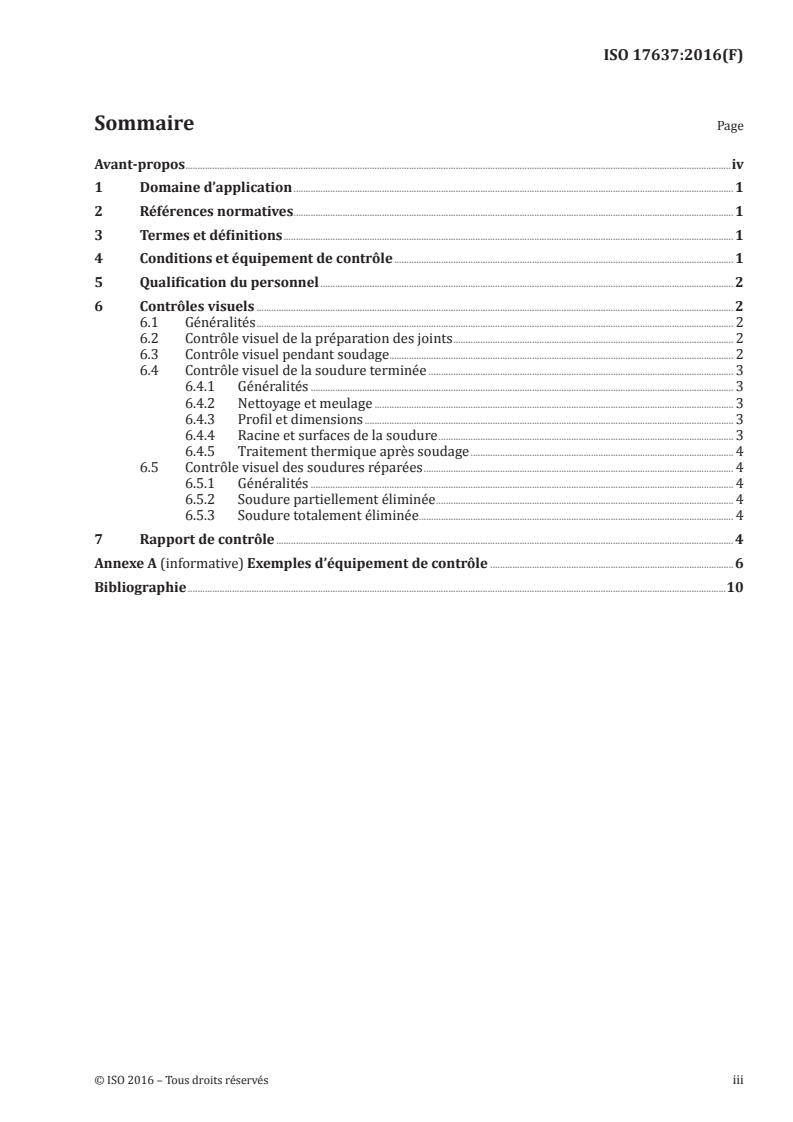
Contents Page
Foreword .iv
1 Scope . 1
2 Normative references . 1
3 Terms and definitions . 1
4 Test conditions and equipment . 1
5 Personnel qualification . 2
6 Visual testing . 2
6.1 General . 2
6.2 Visual testing of joint preparation . 2
6.3 Visual testing during welding . 2
6.4 Visual testing of the finished weld . 3
6.4.1 General. 3
6.4.2 Cleaning and dressing . 3
6.4.3 Profile and dimensions . 3
6.4.4 Weld root and surfaces . 3
6.4.5 Post-weld heat treatment . 4
6.5 Visual testing of repaired welds . 4
6.5.1 General. 4
6.5.2 Partially removed weld . 4
6.5.3 Completely removed weld . 4
7 Test records. 4
Annex A (informative) Examples of test equipment . 6
Bibliography .10
Foreword
ISO (the International Organization for Standardization) is a worldwide federation of national standards
bodies (ISO member bodies). The work of preparing International Standards is normally carried out
through ISO technical committees. Each member body interested in a subject for which a technical
committee has been established has the right to be represented on that committee. International
organizations, governmental and non-governmental, in liaison with ISO, also take part in the work.
ISO collaborates closely with the International Electrotechnical Commission (IEC) on all matters of
electrotechnical standardization.
The procedures used to develop this document and those intended for its further maintenance are
described in the ISO/IEC Directives, Part 1. In particular the different approval criteria needed for the
different types of ISO documents should be noted. This document was drafted in accordance with the
editorial rules of the ISO/IEC Directives, Part 2 (see www.iso.org/directives).
Attention is drawn to the possibility that some of the elements of this document may be the subject of
patent rights. ISO shall not be held responsible for identifying any or all such patent rights. Details of
any patent rights identified during the development of the document will be in the Introduction and/or
on the ISO list of patent declarations received (see www.iso.org/patents).
Any trade name used in this document is information given for the convenience of users and does not
constitute an endorsement.
For an explanation on the meaning of ISO specific terms and expressions related to conformity assessment,
as well as information about ISO’s adherence to the World Trade Organization (WTO) principles in the
Technical Barriers to Trade (TBT) see the following URL: www.iso.org/iso/foreword.html.
The committee responsible for this document is ISO/TC 44, Welding and allied processes, Subcommittee
SC 5, Testing and inspection of welds.
This second edition cancels and replaces the first edition (ISO 17637:2003), which has been technically
revised.
Requests for official interpretations of any aspect of this International Standard should be directed to
the Secretariat of ISO/TC 44/SC 5 via your national standards body. A complete listing of these bodies
can be found at www.iso.org.
iv © ISO 2016 – All rights reserved
INTERNATIONAL STANDARD ISO 17637:2016(E)
Non-destructive testing of welds — Visual testing of fusion-
welded joints
1 Scope
This document specifies the visual testing of fusion welds in metallic materials. It may also be applied
to visual testing of the joint prior to welding.
2 Normative references
There are no normative references in this document.
3 Terms and definitions
No terms and definitions are listed in this document.
ISO and IEC maintain terminological databases for use in standardization at the following addresses:
— IEC Electropedia: available at http://www.electropedia.org/
— ISO Online browsing platform: available at http://www.iso.org/obp
4 Test conditions and equipment
The illuminance at the surface with white light shall be a minimum of 350 lx; wearing of tinted goggles
(e.g. protective sunglasses) increases the minimum illuminance. However, 500 lx is recommended.
For direct inspection, the access shall be sufficient to place the eye within 600 mm of the surface to be
examined and at an angle not less than 30° (see Figure 1).
a
Range.
Figure 1 — Access for testing
Remote inspection using mirrors, boroscopes, fibre optic cables or cameras shall be considered when
the access for testing in accordance with Figure 1 is not possible or when specified by an application
standard.
An additional light source can be used to increase the contrast and relief between imperfections and
the background.
Where the result of visual testing is inconclusive, the visual test should be supplemented by other non-
destructive testing methods for surface inspections.
Examples of equipment used for visual testing are given in Annex A.
5 Personnel qualification
Visual testing of welds and the evaluation of results for final acceptance shall be performed by qualified
and capable personnel. It is recommended that the personnel performing indirect visual testing is
qualified according to ISO 9712 or at an appropriate level in the relevant industry sector.
6 Visual testing
6.1 General
This document does not define the extent of visual testing. However, this should be determined in
advance, e.g. by reference to an application or product standard.
The examiner shall have access to the necessary inspection and production documentation required.
Any visual testing prior to, during or after completion of the weld should be carried out while physical
access is still possible. This may include the visual testing of surface treatments.
6.2 Visual testing of joint preparation
When visual testing is required prior to welding, the joint shall be examined to check the following:
a) the shape and dimensions of the weld preparation meet the requirements of the welding procedure
specification;
b) the fusion faces and adjacent surfaces are clean and any required surface treatment has been
carried out in accordance with the application or product standard;
c) the parts to be welded are correctly fixed in relation to each other according to drawings or
instructions.
6.3 Visual testing during welding
When required, the weld shall be tested during the welding process to check the following:
a) each run or layer of weld metal is cleaned before it is covered by a further run, particular attention
being paid to the junctions between the weld metal and the fusion face;
b) there are no visible imperfections, e.g. cracks or cavities; if imperfections are observed, they shall
be reported so
...
NORME ISO
INTERNATIONALE 17637
Deuxième édition
2016-12-01
Contrôle non destructif des
assemblages soudés — Contrôle visuel
des assemblages soudés par fusion
Non-destructive testing of welds — Visual testing of fusion-welded
joints
Numéro de référence
©
ISO 2016
DOCUMENT PROTÉGÉ PAR COPYRIGHT
© ISO 2016, Publié en Suisse
Droits de reproduction réservés. Sauf indication contraire, aucune partie de cette publication ne peut être reproduite ni utilisée
sous quelque forme que ce soit et par aucun procédé, électronique ou mécanique, y compris la photocopie, l’affichage sur
l’internet ou sur un Intranet, sans autorisation écrite préalable. Les demandes d’autorisation peuvent être adressées à l’ISO à
l’adresse ci-après ou au comité membre de l’ISO dans le pays du demandeur.
ISO copyright office
Ch. de Blandonnet 8 • CP 401
CH-1214 Vernier, Geneva, Switzerland
Tel. +41 22 749 01 11
Fax +41 22 749 09 47
copyright@iso.org
www.iso.org
ii © ISO 2016 – Tous droits réservés
Sommaire Page
Avant-propos .iv
1 Domaine d’application . 1
2 Références normatives . 1
3 Termes et définitions . 1
4 Conditions et équipement de contrôle . 1
5 Qualification du personnel . 2
6 Contrôles visuels . 2
6.1 Généralités . 2
6.2 Contrôle visuel de la préparation des joints . 2
6.3 Contrôle visuel pendant soudage . 2
6.4 Contrôle visuel de la soudure terminée . 3
6.4.1 Généralités . 3
6.4.2 Nettoyage et meulage . 3
6.4.3 Profil et dimensions . 3
6.4.4 Racine et surfaces de la soudure . 3
6.4.5 Traitement thermique après soudage . 4
6.5 Contrôle visuel des soudures réparées . 4
6.5.1 Généralités . 4
6.5.2 Soudure partiellement éliminée . 4
6.5.3 Soudure totalement éliminée. 4
7 Rapport de contrôle . 4
Annexe A (informative) Exemples d’équipement de contrôle . 6
Bibliographie .10
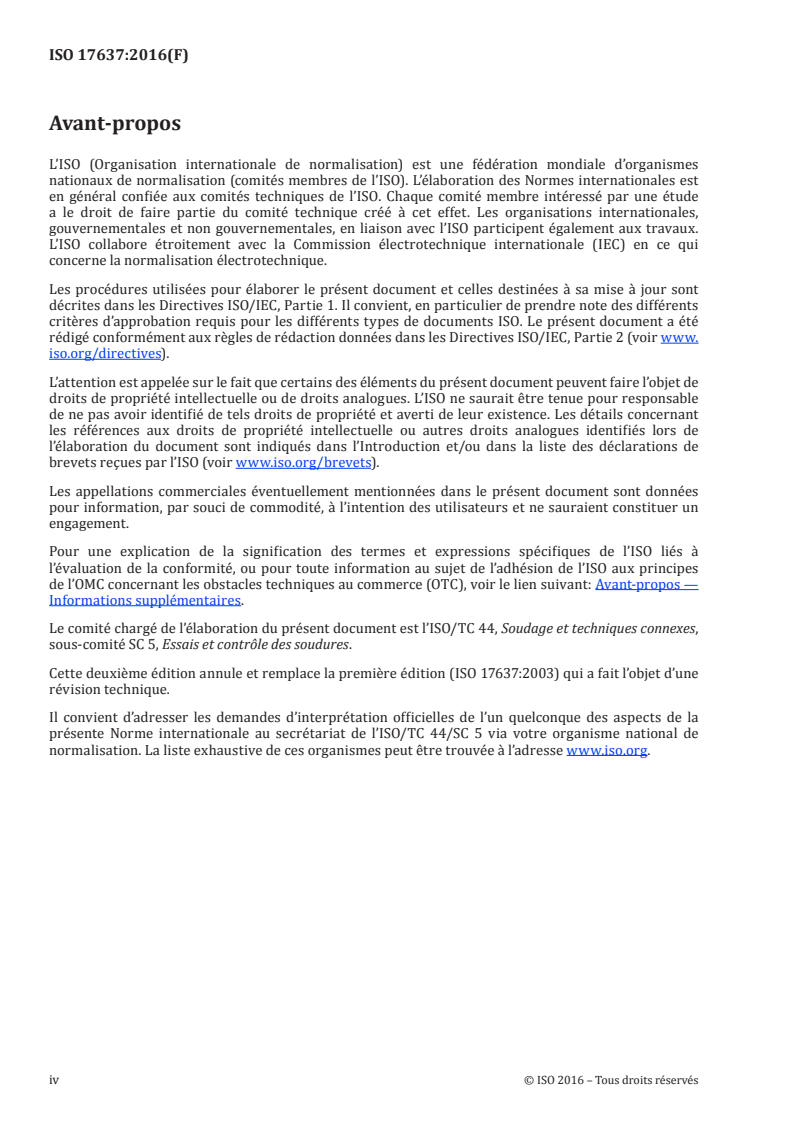
Avant-propos
L’ISO (Organisation internationale de normalisation) est une fédération mondiale d’organismes
nationaux de normalisation (comités membres de l’ISO). L’élaboration des Normes internationales est
en général confiée aux comités techniques de l’ISO. Chaque comité membre intéressé par une étude
a le droit de faire partie du comité technique créé à cet effet. Les organisations internationales,
gouvernementales et non gouvernementales, en liaison avec l’ISO participent également aux travaux.
L’ISO collabore étroitement avec la Commission électrotechnique internationale (IEC) en ce qui
concerne la normalisation électrotechnique.
Les procédures utilisées pour élaborer le présent document et celles destinées à sa mise à jour sont
décrites dans les Directives ISO/IEC, Partie 1. Il convient, en particulier de prendre note des différents
critères d’approbation requis pour les différents types de documents ISO. Le présent document a été
rédigé conformément aux règles de rédaction données dans les Directives ISO/IEC, Partie 2 (voir www.
iso.org/directives).
L’attention est appelée sur le fait que certains des éléments du présent document peuvent faire l’objet de
droits de propriété intellectuelle ou de droits analogues. L’ISO ne saurait être tenue pour responsable
de ne pas avoir identifié de tels droits de propriété et averti de leur existence. Les détails concernant
les références aux droits de propriété intellectuelle ou autres droits analogues identifiés lors de
l’élaboration du document sont indiqués dans l’Introduction et/ou dans la liste des déclarations de
brevets reçues par l’ISO (voir www.iso.org/brevets).
Les appellations commerciales éventuellement mentionnées dans le présent document sont données
pour information, par souci de commodité, à l’intention des utilisateurs et ne sauraient constituer un
engagement.
Pour une explication de la signification des termes et expressions spécifiques de l’ISO liés à
l’évaluation de la conformité, ou pour toute information au sujet de l’adhésion de l’ISO aux principes
de l’OMC concernant les obstacles techniques au commerce (OTC), voir le lien suivant: Avant-propos —
Informations supplémentaires.
Le comité chargé de l’élaboration du présent document est l’ISO/TC 44, Soudage et techniques connexes,
sous-comité SC 5, Essais et contrôle des soudures.
Cette deuxième édition annule et remplace la première édition (ISO 17637:2003) qui a fait l’objet d’une
révision technique.
Il convient d’adresser les demandes d’interprétation officielles de l’un quelconque des aspects de la
présente Norme internationale au secrétariat de l’ISO/TC 44/SC 5 via votre organisme national de
normalisation. La liste exhaustive de ces organismes peut être trouvée à l’adresse www.iso.org.
iv © ISO 2016 – Tous droits réservés
NORME INTERNATIONALE ISO 17637:2016(F)
Contrôle non destructif des assemblages soudés —
Contrôle visuel des assemblages soudés par fusion
1 Domaine d’application
Le présent document traite du contrôle visuel des soudures par fusion des matériaux métalliques. Elle
peut également s’appliquer au contrôle visuel des assemblages avant soudage.
2 Références normatives
Il n’y a pas de référence normative dans le présent document.
3 Termes et définitions
Il n’y a pas de termes ni de définitions dans le présent document.
L’ISO et l’IEC maintiennent des bases de données terminologiques pour utilisation dans le domaine de la
normalisation aux adresses suivantes:
— ISO Online browsing platform: disponible à http://www.iso.org/obp
— IEC Electropedia: disponible à http://www.electropedia.org/
4 Conditions et équipement de contrôle
L’éclairement de la surface par de la lumière blanche doit être au minimum de 350 lx; le port de lunettes
teintées (lunettes de protection solaires par exemple) doit faire augmenter l’éclairement minimal.
Toutefois, une valeur de 500 lx est recommandée.
Dans le cas d’un contrôle direct, l’accessibilité doit être suffisante pour que l’œil puisse se situer à moins
de 600 mm de la surface à observer et à un angle qui ne soit pas inférieur à 30° (voir Figure 1).
a
Plage.
Figure 1 — Accessibilité pour le contrôle
Le contrôle à distance à l’aide de miroirs, d’endoscopes, de fibres optiques ou de caméras doit être
envisagé lorsqu’il n’est pas possible d’obtenir une accessibilité pour le contrôle conforme à la Figure 1
ou bien lorsque cette pratique est exigée par une norme d’application.
Une source lumineuse additionnelle peut être utilisée afin d’améliorer le contraste et la mise en relief
des défauts par rapport à l’arrière-plan.
Lorsque le résultat du contrôle visuel n’est pas concluant, il convient de compléter ce contrôle par
d’autres méthodes de contrôle non destructif pour le contrôle de la surface.
Des exemples d’équipement utilisé pour le contrôle visuel sont donnés dans l’Annexe A.
5 Qualification du personnel
Le contrôle visuel des soudures et l’évaluation des résultats pour l’acceptation finale doivent être
effectués par du personnel qualifié et compétent. Il est recommandé que le personnel qui effectue le
contrôle visuel indirect soit qualifié conformément à l’ISO 9712 ou à une norme équivalente ou à un
niveau approprié dans le secteur industriel correspondant
6 Contrôles visuels
6.1 Généralités
Le présent document ne définit pas l’étendue du contrôle visuel. Toutefois, il convient de la définir à
l’avance, par exemple par rapport à une norme d’application ou à une norme produit.
Le contrôleur doit avoir accès à toute la documentation requise relative au contrôle et à la fabrication.
Il convient que tout contrôle visuel pratiqué avant, pendant ou après achèvement de la soudure soit
pratiqué lorsque l’accès physique est encore possible. Cela peut inclure le contrôle des traitements de
surface.
6.2 Contrôle visuel de la préparation des joints
Lorsque le contrôle visuel avant soudage est exigé, les joints doivent être examinés pour vérifier les
points suivants:
a) la conformité de la forme et des dimensions de la préparation des joints, aux exigences du mode
opératoire de soudage;
b) la propreté des faces de la préparation et des surfaces voisines et la réalisation des traitements de
surface exigés, conformément à la norme d’application ou à la norme produit;
c) la fixation correcte des pièces à souder l’une par rapport à l’autre, conformément aux plans ou aux
instructions.
6.3 Contrôle visuel pendant soudage
Lorsque cela est exigé, la soudure doit être contrôlée au cours de l’opération de soudage pour vérifier
les point suivants:
a) Le nettoyage de chaque passe ou de chaque couche de métal fondu avant leur recouvrement par la
passe suivante, une attention particulière étant portée aux liaisons entre le métal fondu et les faces
à souder;
b) l’absence de défauts visibles, par exemple des fissures ou des cavités; dans le cas où des défauts
sont observés, ils doivent être notés afin que des actions correctives soient entreprises avant de
continuer à déposer du métal fondu;
c) la forme de la transition entre les passes et entre la soudure et le métal de base afin qu’une fusion
satisfaisante puisse être obtenue lors de l’exécution de la passe de soudure suivante;
d) la conformité de la profondeur et la forme du gougeage avec le descriptif d’un mode opératoire
de soudage ou avec la forme d’origine du chanfrein afin d’assurer l’élimination complète du métal
fondu comme il est spécifié;
2 © ISO 2016 – Tous droits réservés
I
...
NORME ISO
INTERNATIONALE 17637
Deuxième édition
2016-12-01
Contrôle non destructif des
assemblages soudés — Contrôle visuel
des assemblages soudés par fusion
Non-destructive testing of welds — Visual testing of fusion-welded
joints
Numéro de référence
©
ISO 2016
DOCUMENT PROTÉGÉ PAR COPYRIGHT
© ISO 2016, Publié en Suisse
Droits de reproduction réservés. Sauf indication contraire, aucune partie de cette publication ne peut être reproduite ni utilisée
sous quelque forme que ce soit et par aucun procédé, électronique ou mécanique, y compris la photocopie, l’affichage sur
l’internet ou sur un Intranet, sans autorisation écrite préalable. Les demandes d’autorisation peuvent être adressées à l’ISO à
l’adresse ci-après ou au comité membre de l’ISO dans le pays du demandeur.
ISO copyright office
Ch. de Blandonnet 8 • CP 401
CH-1214 Vernier, Geneva, Switzerland
Tel. +41 22 749 01 11
Fax +41 22 749 09 47
copyright@iso.org
www.iso.org
ii © ISO 2016 – Tous droits réservés
Sommaire Page
Avant-propos .iv
1 Domaine d’application . 1
2 Références normatives . 1
3 Termes et définitions . 1
4 Conditions et équipement de contrôle . 1
5 Qualification du personnel . 2
6 Contrôles visuels . 2
6.1 Généralités . 2
6.2 Contrôle visuel de la préparation des joints . 2
6.3 Contrôle visuel pendant soudage . 2
6.4 Contrôle visuel de la soudure terminée . 3
6.4.1 Généralités . 3
6.4.2 Nettoyage et meulage . 3
6.4.3 Profil et dimensions . 3
6.4.4 Racine et surfaces de la soudure . 3
6.4.5 Traitement thermique après soudage . 4
6.5 Contrôle visuel des soudures réparées . 4
6.5.1 Généralités . 4
6.5.2 Soudure partiellement éliminée . 4
6.5.3 Soudure totalement éliminée. 4
7 Rapport de contrôle . 4
Annexe A (informative) Exemples d’équipement de contrôle . 6
Bibliographie .10
Avant-propos
L’ISO (Organisation internationale de normalisation) est une fédération mondiale d’organismes
nationaux de normalisation (comités membres de l’ISO). L’élaboration des Normes internationales est
en général confiée aux comités techniques de l’ISO. Chaque comité membre intéressé par une étude
a le droit de faire partie du comité technique créé à cet effet. Les organisations internationales,
gouvernementales et non gouvernementales, en liaison avec l’ISO participent également aux travaux.
L’ISO collabore étroitement avec la Commission électrotechnique internationale (IEC) en ce qui
concerne la normalisation électrotechnique.
Les procédures utilisées pour élaborer le présent document et celles destinées à sa mise à jour sont
décrites dans les Directives ISO/IEC, Partie 1. Il convient, en particulier de prendre note des différents
critères d’approbation requis pour les différents types de documents ISO. Le présent document a été
rédigé conformément aux règles de rédaction données dans les Directives ISO/IEC, Partie 2 (voir www.
iso.org/directives).
L’attention est appelée sur le fait que certains des éléments du présent document peuvent faire l’objet de
droits de propriété intellectuelle ou de droits analogues. L’ISO ne saurait être tenue pour responsable
de ne pas avoir identifié de tels droits de propriété et averti de leur existence. Les détails concernant
les références aux droits de propriété intellectuelle ou autres droits analogues identifiés lors de
l’élaboration du document sont indiqués dans l’Introduction et/ou dans la liste des déclarations de
brevets reçues par l’ISO (voir www.iso.org/brevets).
Les appellations commerciales éventuellement mentionnées dans le présent document sont données
pour information, par souci de commodité, à l’intention des utilisateurs et ne sauraient constituer un
engagement.
Pour une explication de la signification des termes et expressions spécifiques de l’ISO liés à
l’évaluation de la conformité, ou pour toute information au sujet de l’adhésion de l’ISO aux principes
de l’OMC concernant les obstacles techniques au commerce (OTC), voir le lien suivant: Avant-propos —
Informations supplémentaires.
Le comité chargé de l’élaboration du présent document est l’ISO/TC 44, Soudage et techniques connexes,
sous-comité SC 5, Essais et contrôle des soudures.
Cette deuxième édition annule et remplace la première édition (ISO 17637:2003) qui a fait l’objet d’une
révision technique.
Il convient d’adresser les demandes d’interprétation officielles de l’un quelconque des aspects de la
présente Norme internationale au secrétariat de l’ISO/TC 44/SC 5 via votre organisme national de
normalisation. La liste exhaustive de ces organismes peut être trouvée à l’adresse www.iso.org.
iv © ISO 2016 – Tous droits réservés
NORME INTERNATIONALE ISO 17637:2016(F)
Contrôle non destructif des assemblages soudés —
Contrôle visuel des assemblages soudés par fusion
1 Domaine d’application
Le présent document traite du contrôle visuel des soudures par fusion des matériaux métalliques. Elle
peut également s’appliquer au contrôle visuel des assemblages avant soudage.
2 Références normatives
Il n’y a pas de référence normative dans le présent document.
3 Termes et définitions
Il n’y a pas de termes ni de définitions dans le présent document.
L’ISO et l’IEC maintiennent des bases de données terminologiques pour utilisation dans le domaine de la
normalisation aux adresses suivantes:
— ISO Online browsing platform: disponible à http://www.iso.org/obp
— IEC Electropedia: disponible à http://www.electropedia.org/
4 Conditions et équipement de contrôle
L’éclairement de la surface par de la lumière blanche doit être au minimum de 350 lx; le port de lunettes
teintées (lunettes de protection solaires par exemple) doit faire augmenter l’éclairement minimal.
Toutefois, une valeur de 500 lx est recommandée.
Dans le cas d’un contrôle direct, l’accessibilité doit être suffisante pour que l’œil puisse se situer à moins
de 600 mm de la surface à observer et à un angle qui ne soit pas inférieur à 30° (voir Figure 1).
a
Plage.
Figure 1 — Accessibilité pour le contrôle
Le contrôle à distance à l’aide de miroirs, d’endoscopes, de fibres optiques ou de caméras doit être
envisagé lorsqu’il n’est pas possible d’obtenir une accessibilité pour le contrôle conforme à la Figure 1
ou bien lorsque cette pratique est exigée par une norme d’application.
Une source lumineuse additionnelle peut être utilisée afin d’améliorer le contraste et la mise en relief
des défauts par rapport à l’arrière-plan.
Lorsque le résultat du contrôle visuel n’est pas concluant, il convient de compléter ce contrôle par
d’autres méthodes de contrôle non destructif pour le contrôle de la surface.
Des exemples d’équipement utilisé pour le contrôle visuel sont donnés dans l’Annexe A.
5 Qualification du personnel
Le contrôle visuel des soudures et l’évaluation des résultats pour l’acceptation finale doivent être
effectués par du personnel qualifié et compétent. Il est recommandé que le personnel qui effectue le
contrôle visuel indirect soit qualifié conformément à l’ISO 9712 ou à une norme équivalente ou à un
niveau approprié dans le secteur industriel correspondant
6 Contrôles visuels
6.1 Généralités
Le présent document ne définit pas l’étendue du contrôle visuel. Toutefois, il convient de la définir à
l’avance, par exemple par rapport à une norme d’application ou à une norme produit.
Le contrôleur doit avoir accès à toute la documentation requise relative au contrôle et à la fabrication.
Il convient que tout contrôle visuel pratiqué avant, pendant ou après achèvement de la soudure soit
pratiqué lorsque l’accès physique est encore possible. Cela peut inclure le contrôle des traitements de
surface.
6.2 Contrôle visuel de la préparation des joints
Lorsque le contrôle visuel avant soudage est exigé, les joints doivent être examinés pour vérifier les
points suivants:
a) la conformité de la forme et des dimensions de la préparation des joints, aux exigences du mode
opératoire de soudage;
b) la propreté des faces de la préparation et des surfaces voisines et la réalisation des traitements de
surface exigés, conformément à la norme d’application ou à la norme produit;
c) la fixation correcte des pièces à souder l’une par rapport à l’autre, conformément aux plans ou aux
instructions.
6.3 Contrôle visuel pendant soudage
Lorsque cela est exigé, la soudure doit être contrôlée au cours de l’opération de soudage pour vérifier
les point suivants:
a) Le nettoyage de chaque passe ou de chaque couche de métal fondu avant leur recouvrement par la
passe suivante, une attention particulière étant portée aux liaisons entre le métal fondu et les faces
à souder;
b) l’absence de défauts visibles, par exemple des fissures ou des cavités; dans le cas où des défauts
sont observés, ils doivent être notés afin que des actions correctives soient entreprises avant de
continuer à déposer du métal fondu;
c) la forme de la transition entre les passes et entre la soudure et le métal de base afin qu’une fusion
satisfaisante puisse être obtenue lors de l’exécution de la passe de soudure suivante;
d) la conformité de la profondeur et la forme du gougeage avec le descriptif d’un mode opératoire
de soudage ou avec la forme d’origine du chanfrein afin d’assurer l’élimination complète du métal
fondu comme il est spécifié;
2 © ISO 2016 – Tous droits réservés
I
...