

ISO 19579:2006
(Main)Solid mineral fuels — Determination of sulfur by IR spectrometry
General Information
- Abstract
ISO 19579:2006 specifies an alternative method of determining the total sulfur content of hard coal, brown coal, and lignite by high-temperature combustion and infrared absorption using commercially available instruments. This method has been shown to be applicable to coal samples having an ash yield of less than 40 %.
- Status
- Published
- Publication Date
- 02-Oct-2006
- Technical Committee
- ISO/TC 27/SC 5 - Methods of analysis
- Drafting Committee
- ISO/TC 27/SC 5/WG 2 - Carbon, hydrogen, nitrogen, oxygen and sulfur
- Current Stage
- 9092 - International Standard to be revised
- Start Date
- 02-Feb-2026
- Completion Date
- 29-Aug-2026
Buy Documents

ISO 19579:2006 - Solid mineral fuels -- Determination of sulfur by IR spectrometry
ISO 19579:2006 - Solid mineral fuels — Determination of sulfur by IR spectrometry/3/2006
Overview
ISO 19579:2006 specifies an alternative analytical method for determining the total sulfur content of solid mineral fuels (hard coal, brown coal and lignite) using high‑temperature combustion followed by infrared (IR) absorption measurement of combustion gases. The procedure is applicable to coal samples with an ash yield of less than 40% and uses commercially available instruments that integrate a furnace, gas‑purification train and a non‑dispersion IR detector with a microprocessor.
Key topics and technical requirements
- Principle: Sample combusted in oxygen at approx. 1 350 °C; combustion gases pass through glass wool and anhydrous magnesium perchlorate traps; sulfur dioxide (SO2) measured by IR absorption and quantified via instrument calibration.
- Sample preparation: Analysis sample ground to pass a 212 µm sieve; air‑dried to laboratory equilibrium and mixed before weighing.
- Test portion: Typical weighed mass 0.20–0.50 g (accuracy to 0.001 g) placed in ceramic combustion boats.
- Apparatus: Resistance furnace, ceramic combustion tube and boats, gas‑purification train (glass wool, Mg(ClO4)2), IR detector/microprocessor and a balance (1 mg resolution).
- Calibration: Use certified reference materials (CRMs) or reference coals/cokes traceable to an internationally recognized certifying organization. Calibrate across the expected sulfur range; verify calibration by analysing a CRM. Note: coals high in carbonates or certain low‑rank coals may need longer integration times.
- Quality control: Periodic calibration checks recommended (suggested after every five determinations). If calibration check fails, discard preceding results and recalibrate.
- Expression of results: Microprocessor calculates sulfur as mass percent; report mean of duplicate determinations to 0.01%.
- Precision: Repeatability r = 0.02 + 0.03x; reproducibility R = 0.02 + 0.09x (x = mean sulfur concentration).
Applications and users
ISO 19579 is intended for:
- Analytical and fuel testing laboratories performing routine coal quality and fuel specification testing.
- Power utilities, coal suppliers and coke producers requiring total sulfur measurements for combustion control, emissions planning and contractual compliance.
- Environmental and regulatory laboratories assessing sulfur content to support emissions inventories and compliance reporting.
This method complements other coal sulfur techniques where rapid, instrumented analysis by IR spectrometry is required and where sample ash is under 40%.
Related standards
- ISO 334 - Total sulfur - Eschka method
- ISO 351 - Total sulfur - High temperature combustion method
- ISO 11722, ISO 687, ISO 5068‑2 - Moisture determination methods for solid mineral fuels
Keywords: ISO 19579, sulfur determination, IR spectrometry, high‑temperature combustion, coal sulfur, total sulfur in coal, coal analysis methods.
Relations
- Effective Date
- 25-Aug-2026
- Effective Date
- 25-Aug-2026
Buy Documents
ISO 19579:2006 - Solid mineral fuels -- Determination of sulfur by IR spectrometry
ISO 19579:2006 - Solid mineral fuels — Determination of sulfur by IR spectrometry/3/2006
Get Certified
Connect with accredited certification bodies for this standard

Element Materials Technology
Materials testing and product certification.

ABS Group Brazil
ABS Group certification services in Brazil.

ABS Quality Evaluations Inc.
American Bureau of Shipping quality certification.
Sponsored listings
Frequently Asked Questions
ISO 19579:2006 is a standard published by the International Organization for Standardization (ISO). Its full title is "Solid mineral fuels — Determination of sulfur by IR spectrometry". This standard covers: ISO 19579:2006 specifies an alternative method of determining the total sulfur content of hard coal, brown coal, and lignite by high-temperature combustion and infrared absorption using commercially available instruments. This method has been shown to be applicable to coal samples having an ash yield of less than 40 %.
ISO 19579:2006 specifies an alternative method of determining the total sulfur content of hard coal, brown coal, and lignite by high-temperature combustion and infrared absorption using commercially available instruments. This method has been shown to be applicable to coal samples having an ash yield of less than 40 %.
ISO 19579:2006 is classified under the following ICS (International Classification for Standards) categories: 73.040 - Coals; 75.160.10 - Solid fuels. The ICS classification helps identify the subject area and facilitates finding related standards.
ISO 19579:2006 has the following relationships with other standards: It is inter standard links to EN 16510-1:2018, EN 16510-1:2022. Understanding these relationships helps ensure you are using the most current and applicable version of the standard.
ISO 19579:2006 is available in PDF format for immediate download after purchase. The document can be added to your cart and obtained through the secure checkout process. Digital delivery ensures instant access to the complete standard document.
Standards Content (Sample)
INTERNATIONAL ISO
STANDARD 19579
First edition
2006-10-01
Solid mineral fuels — Determination of
sulfur by IR spectrometry
Combustibles minéraux solides — Détermination du soufre par
spectrométrie infrarouge
Reference number
©
ISO 2006
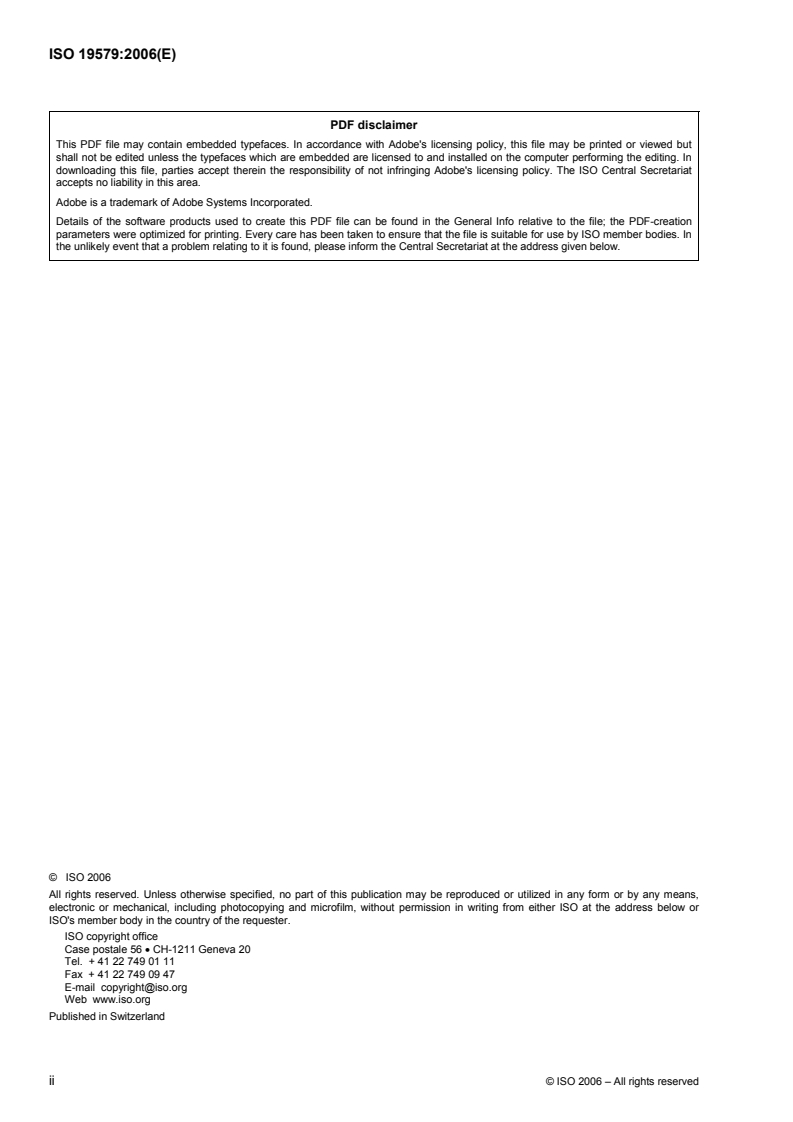
PDF disclaimer
This PDF file may contain embedded typefaces. In accordance with Adobe's licensing policy, this file may be printed or viewed but
shall not be edited unless the typefaces which are embedded are licensed to and installed on the computer performing the editing. In
downloading this file, parties accept therein the responsibility of not infringing Adobe's licensing policy. The ISO Central Secretariat
accepts no liability in this area.
Adobe is a trademark of Adobe Systems Incorporated.
Details of the software products used to create this PDF file can be found in the General Info relative to the file; the PDF-creation
parameters were optimized for printing. Every care has been taken to ensure that the file is suitable for use by ISO member bodies. In
the unlikely event that a problem relating to it is found, please inform the Central Secretariat at the address given below.
© ISO 2006
All rights reserved. Unless otherwise specified, no part of this publication may be reproduced or utilized in any form or by any means,
electronic or mechanical, including photocopying and microfilm, without permission in writing from either ISO at the address below or
ISO's member body in the country of the requester.
ISO copyright office
Case postale 56 • CH-1211 Geneva 20
Tel. + 41 22 749 01 11
Fax + 41 22 749 09 47
E-mail copyright@iso.org
Web www.iso.org
Published in Switzerland
ii © ISO 2006 – All rights reserved
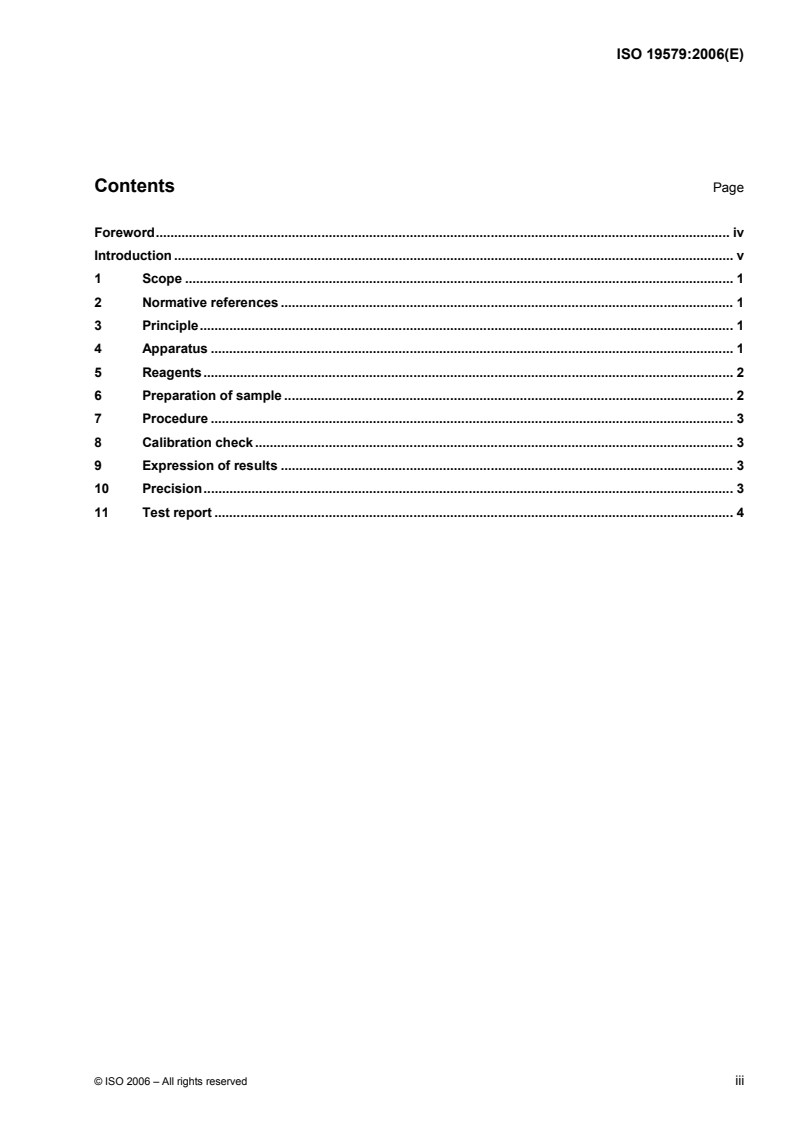
Contents Page
Foreword. iv
Introduction . v
1 Scope . 1
2 Normative references . 1
3 Principle. 1
4 Apparatus . 1
5 Reagents. 2
6 Preparation of sample . 2
7 Procedure . 3
8 Calibration check. 3
9 Expression of results . 3
10 Precision. 3
11 Test report . 4
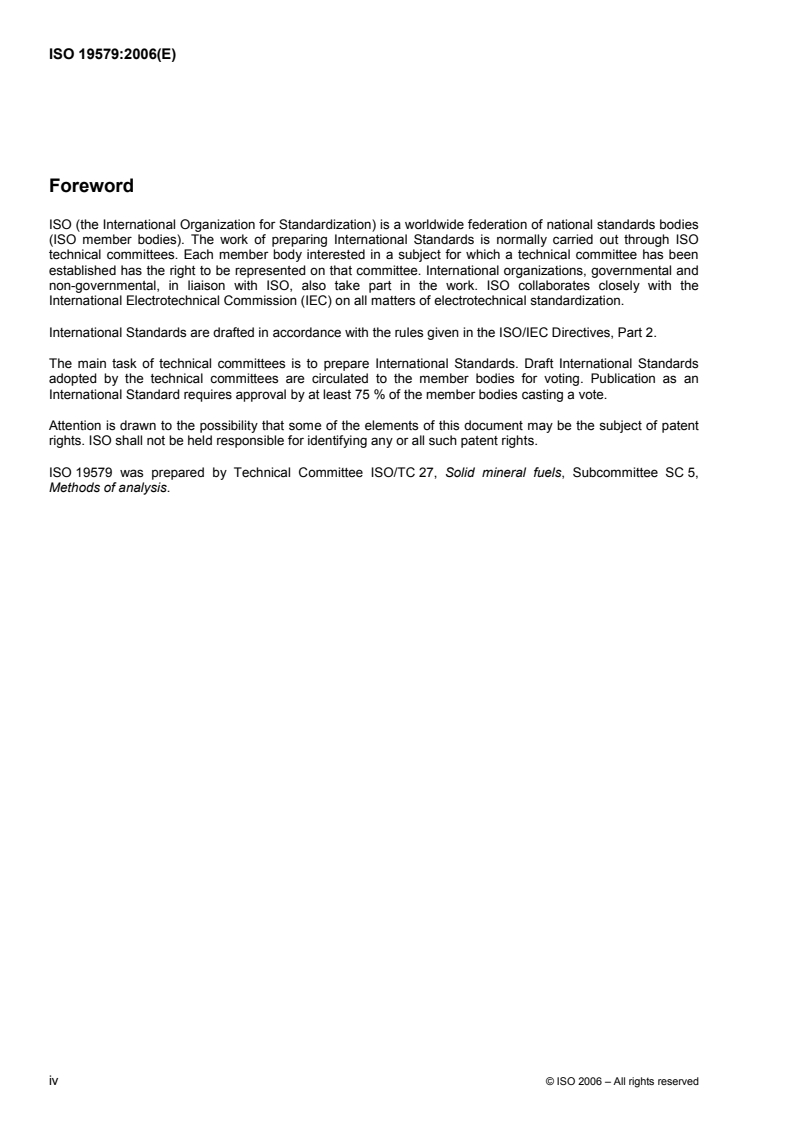
Foreword
ISO (the International Organization for Standardization) is a worldwide federation of national standards bodies
(ISO member bodies). The work of preparing International Standards is normally carried out through ISO
technical committees. Each member body interested in a subject for which a technical committee has been
established has the right to be represented on that committee. International organizations, governmental and
non-governmental, in liaison with ISO, also take part in the work. ISO collaborates closely with the
International Electrotechnical Commission (IEC) on all matters of electrotechnical standardization.
International Standards are drafted in accordance with the rules given in the ISO/IEC Directives, Part 2.
The main task of technical committees is to prepare International Standards. Draft International Standards
adopted by the technical committees are circulated to the member bodies for voting. Publication as an
International Standard requires approval by at least 75 % of the member bodies casting a vote.
Attention is drawn to the possibility that some of the elements of this document may be the subject of patent
rights. ISO shall not be held responsible for identifying any or all such patent rights.
ISO 19579 was prepared by Technical Committee ISO/TC 27, Solid mineral fuels, Subcommittee SC 5,
Methods of analysis.
iv © ISO 2006 – All rights reserved
Introduction
Sulfur is normally present in coal in three forms; inorganic sulfides such as pyrite (FeS ), inorganic sulfates
associated with the mineral matter and organic sulfur in the carbonaceous substance.
This International Standard describes a high-temperature combustion/infrared absorption method of analysis,
which is used to determine the total sulfur content of coal.
INTERNATIONAL STANDARD ISO 19579:2006(E)
Solid mineral fuels — Determination of sulfur by IR
spectrometry
1 Scope
This International Standard specifies an alternative method of determining the total sulfur content of hard coal,
brown coal, and lignite by high-temperature combustion and infrared (IR) absorption using commercially
available instruments.
This method has been shown to be applicable to coal samples having an ash yield of less than 40 %.
2 Normative references
The following referenced documents are indispensable for the application of this document. For dated
references, only the edition cited applies. For undated references, the latest edition of the referenced
document (including any amendments) applies.
ISO 334, Solid mineral fuels — Determination of total sulfur — Eschka method
ISO 351, Solid mineral fuels — Determination of total sulfur — High temperature combustion method
ISO 687, Solid mineral fuels — Coke — Determination of moisture in the general analysis test sample
ISO 5068-2, Brown coals and lignites — Determination of moisture content — Part 2: Indirect gravimetric
method for moisture in the analysis sample
ISO 11722, Solid mineral fuels — Hard coal — Determination of moisture in the general analysis test sample
by drying in nitrogen
3 Principle
The coal sample is combusted at 1
...
INTERNATIONAL ISO
STANDARD 19579
First edition
2006-10-01
Solid mineral fuels — Determination of
sulfur by IR spectrometry
Combustibles minéraux solides — Détermination du soufre par
spectrométrie infrarouge
Reference number
©
ISO 2006
PDF disclaimer
This PDF file may contain embedded typefaces. In accordance with Adobe's licensing policy, this file may be printed or viewed but
shall not be edited unless the typefaces which are embedded are licensed to and installed on the computer performing the editing. In
downloading this file, parties accept therein the responsibility of not infringing Adobe's licensing policy. The ISO Central Secretariat
accepts no liability in this area.
Adobe is a trademark of Adobe Systems Incorporated.
Details of the software products used to create this PDF file can be found in the General Info relative to the file; the PDF-creation
parameters were optimized for printing. Every care has been taken to ensure that the file is suitable for use by ISO member bodies. In
the unlikely event that a problem relating to it is found, please inform the Central Secretariat at the address given below.
© ISO 2006
All rights reserved. Unless otherwise specified, no part of this publication may be reproduced or utilized in any form or by any means,
electronic or mechanical, including photocopying and microfilm, without permission in writing from either ISO at the address below or
ISO's member body in the country of the requester.
ISO copyright office
Case postale 56 • CH-1211 Geneva 20
Tel. + 41 22 749 01 11
Fax + 41 22 749 09 47
E-mail copyright@iso.org
Web www.iso.org
Published in Switzerland
ii © ISO 2006 – All rights reserved
Contents Page
Foreword. iv
Introduction . v
1 Scope . 1
2 Normative references . 1
3 Principle. 1
4 Apparatus . 1
5 Reagents. 2
6 Preparation of sample . 2
7 Procedure . 3
8 Calibration check. 3
9 Expression of results . 3
10 Precision. 3
11 Test report . 4
Foreword
ISO (the International Organization for Standardization) is a worldwide federation of national standards bodies
(ISO member bodies). The work of preparing International Standards is normally carried out through ISO
technical committees. Each member body interested in a subject for which a technical committee has been
established has the right to be represented on that committee. International organizations, governmental and
non-governmental, in liaison with ISO, also take part in the work. ISO collaborates closely with the
International Electrotechnical Commission (IEC) on all matters of electrotechnical standardization.
International Standards are drafted in accordance with the rules given in the ISO/IEC Directives, Part 2.
The main task of technical committees is to prepare International Standards. Draft International Standards
adopted by the technical committees are circulated to the member bodies for voting. Publication as an
International Standard requires approval by at least 75 % of the member bodies casting a vote.
Attention is drawn to the possibility that some of the elements of this document may be the subject of patent
rights. ISO shall not be held responsible for identifying any or all such patent rights.
ISO 19579 was prepared by Technical Committee ISO/TC 27, Solid mineral fuels, Subcommittee SC 5,
Methods of analysis.
iv © ISO 2006 – All rights reserved
Introduction
Sulfur is normally present in coal in three forms; inorganic sulfides such as pyrite (FeS ), inorganic sulfates
associated with the mineral matter and organic sulfur in the carbonaceous substance.
This International Standard describes a high-temperature combustion/infrared absorption method of analysis,
which is used to determine the total sulfur content of coal.
INTERNATIONAL STANDARD ISO 19579:2006(E)
Solid mineral fuels — Determination of sulfur by IR
spectrometry
1 Scope
This International Standard specifies an alternative method of determining the total sulfur content of hard coal,
brown coal, and lignite by high-temperature combustion and infrared (IR) absorption using commercially
available instruments.
This method has been shown to be applicable to coal samples having an ash yield of less than 40 %.
2 Normative references
The following referenced documents are indispensable for the application of this document. For dated
references, only the edition cited applies. For undated references, the latest edition of the referenced
document (including any amendments) applies.
ISO 334, Solid mineral fuels — Determination of total sulfur — Eschka method
ISO 351, Solid mineral fuels — Determination of total sulfur — High temperature combustion method
ISO 687, Solid mineral fuels — Coke — Determination of moisture in the general analysis test sample
ISO 5068-2, Brown coals and lignites — Determination of moisture content — Part 2: Indirect gravimetric
method for moisture in the analysis sample
ISO 11722, Solid mineral fuels — Hard coal — Determination of moisture in the general analysis test sample
by drying in nitrogen
3 Principle
The coal sample is combusted at 1
...