


ISO 10993-18:2005
(Main)Biological evaluation of medical devices — Part 18: Chemical characterization of materials
Biological evaluation of medical devices — Part 18: Chemical characterization of materials
ISO 10993-18:2005 describes a framework for the identification of a material and the identification and quantification of its chemical constituents. The chemical characterization information generated can be used for a range of important applications, for example, as part of an assessment of the overall biological safety of a medical device (ISO 10993-1 and 14971), as a measurement of the level of a leachable substance in a medical device in order to allow the assessment of compliance with the allowable limit derived for that substance from health based risk assessment (ISO 10993-17), for judging equivalence of a proposed material to a clinically established material, for judging equivalence of a final device to a prototype device to check the relevance of data on the latter to be used to support the assessment of the former, or for screening of potential new materials for suitability in a medical device for a proposed clinical application. ISO 10993-18:2005 does not address the identification or quantification of degradation products, which is covered in ISO 10993-9, ISO 10993-13, ISO 10993-14 and ISO 10993-15. The ISO 10993 series of standards is applicable when the material or device comes into contact with the body directly or indirectly (see 4.2.1 of ISO 10993-1). ISO 10993-18:2005 is intended for suppliers of materials and manufacturers of medical devices, when carrying out a biological safety assessment.
Évaluation biologique des dispositifs médicaux — Partie 18: Caractérisation chimique des matériaux
L'ISO 10993-18:2005 décrit un cadre servant à l'identification d'un matériau et à la détermination et la quantification de ses composés chimiques. Les informations relatives à la caractérisation chimique obtenues peuvent servir à une large gamme d'applications importantes notamment, par exemple prendre part à l'évaluation de la sécurité biologique globale d'un dispositif médical (ISO 10993-1 et ISO 14971), mesurer le niveau de substances relargables dans un dispositif médical afin d'évaluer la conformité avec les limites admissibles pour cette substance dérivées d'une évaluation des risques relatifs à la santé (ISO 10993-17), juger de l'équivalence entre un matériau proposé et un matériau cliniquement établi, juger de l'équivalence d'un dispositif final à un prototype pour vérifier la pertinence des données relatives au prototype utilisées pour l'évaluation dudit dispositif; sélectionner les nouveaux matériaux potentiels afin de déterminer le caractère adéquat de ceux-ci au sein d'un dispositif médical pour une application clinique proposée. L'ISO 10993-18:2005 ne traite pas de l'identification ou de la quantification des produits de dégradation qui sont abordés dans l'ISO 10993-9, l'ISO 10993-13, l'ISO 10993-14 et l'ISO 10993-15. Les normes de la série ISO 10993 s'appliquent en cas de contact direct ou indirect entre le matériau ou le dispositif et le corps (voir l'ISO 10993-1, 4.2.1). L'ISO 10993-18:2005 s'adresse aux fournisseurs de matériaux et aux fabricants de dispositifs médicaux pour la conduite d'une évaluation de la sécurité biologique.
General Information
- Status
- Withdrawn
- Publication Date
- 29-Jun-2005
- Withdrawal Date
- 29-Jun-2005
- Technical Committee
- ISO/TC 194 - Biological and clinical evaluation of medical devices
- Drafting Committee
- ISO/TC 194/WG 14 - Material characterization
- Current Stage
- 9599 - Withdrawal of International Standard
- Start Date
- 13-Jan-2020
- Completion Date
- 12-Feb-2026
Relations
- Effective Date
- 10-Feb-2026
- Effective Date
- 12-Feb-2026
- Effective Date
- 06-Jun-2022
- Effective Date
- 10-Aug-2013
Get Certified
Connect with accredited certification bodies for this standard

BSI Group
BSI (British Standards Institution) is the business standards company that helps organizations make excellence a habit.

TÜV Rheinland
TÜV Rheinland is a leading international provider of technical services.

TÜV SÜD
TÜV SÜD is a trusted partner of choice for safety, security and sustainability solutions.
Sponsored listings
Frequently Asked Questions
ISO 10993-18:2005 is a standard published by the International Organization for Standardization (ISO). Its full title is "Biological evaluation of medical devices — Part 18: Chemical characterization of materials". This standard covers: ISO 10993-18:2005 describes a framework for the identification of a material and the identification and quantification of its chemical constituents. The chemical characterization information generated can be used for a range of important applications, for example, as part of an assessment of the overall biological safety of a medical device (ISO 10993-1 and 14971), as a measurement of the level of a leachable substance in a medical device in order to allow the assessment of compliance with the allowable limit derived for that substance from health based risk assessment (ISO 10993-17), for judging equivalence of a proposed material to a clinically established material, for judging equivalence of a final device to a prototype device to check the relevance of data on the latter to be used to support the assessment of the former, or for screening of potential new materials for suitability in a medical device for a proposed clinical application. ISO 10993-18:2005 does not address the identification or quantification of degradation products, which is covered in ISO 10993-9, ISO 10993-13, ISO 10993-14 and ISO 10993-15. The ISO 10993 series of standards is applicable when the material or device comes into contact with the body directly or indirectly (see 4.2.1 of ISO 10993-1). ISO 10993-18:2005 is intended for suppliers of materials and manufacturers of medical devices, when carrying out a biological safety assessment.
ISO 10993-18:2005 describes a framework for the identification of a material and the identification and quantification of its chemical constituents. The chemical characterization information generated can be used for a range of important applications, for example, as part of an assessment of the overall biological safety of a medical device (ISO 10993-1 and 14971), as a measurement of the level of a leachable substance in a medical device in order to allow the assessment of compliance with the allowable limit derived for that substance from health based risk assessment (ISO 10993-17), for judging equivalence of a proposed material to a clinically established material, for judging equivalence of a final device to a prototype device to check the relevance of data on the latter to be used to support the assessment of the former, or for screening of potential new materials for suitability in a medical device for a proposed clinical application. ISO 10993-18:2005 does not address the identification or quantification of degradation products, which is covered in ISO 10993-9, ISO 10993-13, ISO 10993-14 and ISO 10993-15. The ISO 10993 series of standards is applicable when the material or device comes into contact with the body directly or indirectly (see 4.2.1 of ISO 10993-1). ISO 10993-18:2005 is intended for suppliers of materials and manufacturers of medical devices, when carrying out a biological safety assessment.
ISO 10993-18:2005 is classified under the following ICS (International Classification for Standards) categories: 11.100.20 - Biological evaluation of medical devices. The ICS classification helps identify the subject area and facilitates finding related standards.
ISO 10993-18:2005 has the following relationships with other standards: It is inter standard links to EN 60601-1:2006/A1:2013, EN ISO 10993-18:2005, ISO 3894:1977, ISO 10993-18:2020. Understanding these relationships helps ensure you are using the most current and applicable version of the standard.
ISO 10993-18:2005 is available in PDF format for immediate download after purchase. The document can be added to your cart and obtained through the secure checkout process. Digital delivery ensures instant access to the complete standard document.
Standards Content (Sample)
INTERNATIONAL ISO
STANDARD 10993-18
First edition
2005-07-01
Biological evaluation of medical
devices —
Part 18:
Chemical characterization of materials
Évaluation biologique des dispositifs médicaux —
Partie 18: Caractérisation chimique des matériaux
Reference number
©
ISO 2005
PDF disclaimer
This PDF file may contain embedded typefaces. In accordance with Adobe's licensing policy, this file may be printed or viewed but
shall not be edited unless the typefaces which are embedded are licensed to and installed on the computer performing the editing. In
downloading this file, parties accept therein the responsibility of not infringing Adobe's licensing policy. The ISO Central Secretariat
accepts no liability in this area.
Adobe is a trademark of Adobe Systems Incorporated.
Details of the software products used to create this PDF file can be found in the General Info relative to the file; the PDF-creation
parameters were optimized for printing. Every care has been taken to ensure that the file is suitable for use by ISO member bodies. In
the unlikely event that a problem relating to it is found, please inform the Central Secretariat at the address given below.
© ISO 2005
All rights reserved. Unless otherwise specified, no part of this publication may be reproduced or utilized in any form or by any means,
electronic or mechanical, including photocopying and microfilm, without permission in writing from either ISO at the address below or
ISO's member body in the country of the requester.
ISO copyright office
Case postale 56 • CH-1211 Geneva 20
Tel. + 41 22 749 01 11
Fax + 41 22 749 09 47
E-mail copyright@iso.org
Web www.iso.org
Published in Switzerland
ii © ISO 2005 – All rights reserved
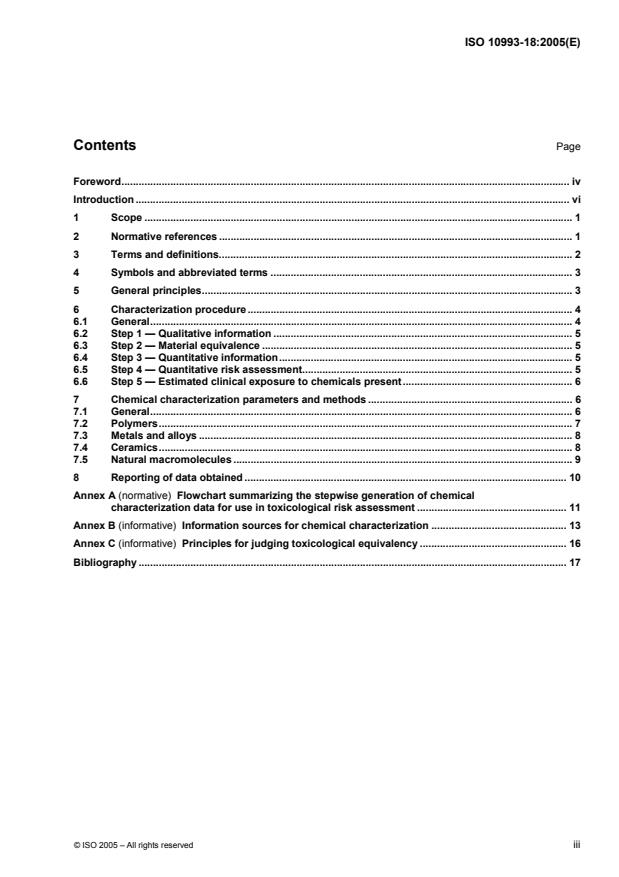
Contents Page
Foreword. iv
Introduction . vi
1 Scope . 1
2 Normative references . 1
3 Terms and definitions. 2
4 Symbols and abbreviated terms . 3
5 General principles. 3
6 Characterization procedure . 4
6.1 General. 4
6.2 Step 1 — Qualitative information . 5
6.3 Step 2 — Material equivalence . 5
6.4 Step 3 — Quantitative information. 5
6.5 Step 4 — Quantitative risk assessment. 5
6.6 Step 5 — Estimated clinical exposure to chemicals present. 6
7 Chemical characterization parameters and methods . 6
7.1 General. 6
7.2 Polymers. 7
7.3 Metals and alloys . 8
7.4 Ceramics. 8
7.5 Natural macromolecules . 9
8 Reporting of data obtained . 10
Annex A (normative) Flowchart summarizing the stepwise generation of chemical
characterization data for use in toxicological risk assessment . 11
Annex B (informative) Information sources for chemical characterization . 13
Annex C (informative) Principles for judging toxicological equivalency . 16
Bibliography . 17
Foreword
ISO (the International Organization for Standardization) is a worldwide federation of national standards bodies
(ISO member bodies). The work of preparing International Standards is normally carried out through ISO
technical committees. Each member body interested in a subject for which a technical committee has been
established has the right to be represented on that committee. International organizations, governmental and
non-governmental, in liaison with ISO, also take part in the work. ISO collaborates closely with the
International Electrotechnical Commission (IEC) on all matters of electrotechnical standardization.
International Standards are drafted in accordance with the rules given in the ISO/IEC Directives, Part 2.
The main task of technical committees is to prepare International Standards. Draft International Standards
adopted by the technical committees are circulated to the member bodies for voting. Publication as an
International Standard requires approval by at least 75 % of the member bodies casting a vote.
Attention is drawn to the possibility that some of the elements of this document may be the subject of patent
rights. ISO shall not be held responsible for identifying any or all such patent rights.
ISO 10993-18 was prepared by Technical Committee ISO/TC 194, Biological evaluation of medical devices.
ISO 10993 consists of the following parts, under the general title Biological evaluation of medical devices:
Part 1: Evaluation and testing
Part 2: Animal welfare requirements
Part 3: Tests for genotoxicity, carcinogenicity and reproductive toxicity
Part 4: Selection of tests for interactions with blood
Part 5: Tests for in vitro cytotoxicity
Part 6: Tests for local effects after implantation
Part 7: Ethylene oxide sterilization residuals
Part 9: Framework for identification and quantification of potential degradation products
Part 10: Tests for irritation and delayed-type hypersensitivity
Part 11: Tests for systemic toxicity
Part 12: Sample preparation and reference materials
Part 13: Identification and quantification of degradation products from polymeric medical devices
Part 14: Identification and quantification of degradation products from ceramics
Part 15: Identification and quantification of degradation products from metals and alloys
Part 16: Toxicokinetic study design for degradation products and leachables
Part 17: Establishment of allowable limits for leachable substances
iv © ISO 2005 – All rights reserved
Part 18: Chemical characterization of materials
The following parts are under preparation:
Part 19: Physico-chemical, mechanical and morphological characterization
Part 20: Principles and methods for immunotoxicology testing of medical devices
Future parts will deal with other relevant aspects of biological testing.
For the purposes of this part of ISO 10993, the CEN annex regarding fulfilment of European Council
Directives has been removed.
Introduction
ISO 10993-1 provides a framework for a structured programme of assessment for the evaluation of biological
safety. Clause 3 of ISO 10993-1:2003 states that in the selection of materials to be used for device
manufacture the first consideration should be fitness for purpose. This should have regard to the
characteristics and properties of the material, which include chemical, toxicological, physical, electrical,
morphological and mechanical properties. This information is necessary prior to any biological evaluation.
Subclause 7.2 of ISO 10993-1:2003 notes that the continuing acceptability of a biological evaluation is an
aspect of a quality management system.
Also ISO 14971 points out that a toxicological risk analysis should take account of the chemical nature of the
materials.
The requirements specified in this document are intended to yield the following information, which will be of
value in predicting the biological response of the materials:
The chemical composition of the materials used in the manufacturing process including processing
additives and residues e.g. trace chemicals, cleaning, disinfection and testing agents, acids and caustic
substances.
The characterization of materials to be used in the production of medical devices, as well as in devices in
their final form.
Identification of the materials of construction of the medical device.
The potential of medical device materials to release substances or breakdown products due to the
manufacturing process.
Changes in the materials of construction, which result from changes in the manufacturing process or
insufficient control of the manufacturing process.
The compositional characteristics of the materials of manufacture are mainly under the control of the suppliers
of these materials. However other characteristics are chiefly influenced by the requirements to be met by the
finished medical device as well as the processes used by the medical device manufacturer.
vi © ISO 2005 – All rights reserved
INTERNATIONAL STANDARD ISO 10993-18:2005(E)
Biological evaluation of medical devices —
Part 18:
Chemical characterization of materials
1 Scope
This part of ISO 10993 describes a framework for the identification of a material and the identification and
quantification of its chemical constituents. The chemical characterization information generated can be used
for a range of important applications, for example:
As part of an assessment of the overall biological safety of a medical device (ISO 10993-1 and 14971).
Measurement of the level of a leachable substance in a medical device in order to allow the assessment
of compliance with the allowable limit derived for that substance from health based risk assessment
(ISO 10993-17).
Judging equivalence of a proposed material to a clinically established material.
Judging equivalence of a final device to a prototype device to check the relevance of data on the latter to
be used to support the assessment of the former.
Screening of potential new materials for suitability in a medical device for a proposed clinical application.
This part of ISO 10993 does not address the identification or quantification of degradation products, which is
covered in ISO 10993-9, ISO 10993-13, ISO 10993-14 and ISO 10993-15.
The ISO 10993 series of standards is applicable when the material or device comes into contact with the body
directly or indirectly (see 4.2.1 of ISO 10993-1:2003).
This part of ISO 10993 is intended for suppliers of materials and manufacturers of medical devices, when
carrying out a biological safety assessment.
2 Normative references
The following referenced documents are indispensable for the application of this document. For dated
references, only the edition cited applies. For undated references, the latest edition of the referenced
document (including any amendments) applies.
ISO 10993-1:2003, Biological evaluation of medical devices — Part 1: Evaluation and testing
ISO 10993-17, Biological evaluation of medical devices — Part 17: Establishment of allowable limits for
leachable substances
ISO 14971:2000, Medical devices — Application of risk management to medical devices
3 Terms and definitions
For the purposes of this document, the terms and definitions given in ISO 10993-1 and the following apply.
3.1
supplier
person or company who manufactures and/or supplies the basic starting materials to be used in the
manufacture of a medical device
3.2
manufacturer
natural or legal person with responsibility for the design, manufacture, packaging and labelling of a device
before it is placed on the market under his own name, regardless of whether these operations are carried out
by that person himself or on his behalf by a third party
3.3
component
item which is manufactured from a basic starting material but is not itself a medical device, since it forms only
one part of a medical device
3.4
convertor
person or company who converts or fabricates a basic raw material into a semi-finished product (e.g. lengths
of rod, tubing or lay-flat film)
3.5
chemical characterization
identification of a material and the identification and quantification of the chemicals present in materials or
finished medical devices
3.6
exhaustive extraction
extraction until the amount of residues in a subsequent extraction is less than 10 % of that detected in the first
extraction
NOTE Extraction is a complex process influenced by time, temperature, surface-area-to-volume-ratio, extraction
medium and the phase equilibrium of the material. The phase equilibrium of a material controls the relative amounts of
amorphous and crystalline phases present. For the amorphous phase, the glass transition temperature, T , dictates the
g
polymer chain mobility and the diffusion rate in the phase. Usually the diffusion rate is considerably higher above the T
g
compared with that below. The diffusion rate is lowest in the crystalline phase.
The extraction conditions should not alter the phase equilibrium of the material. Phase alteration may affect the amount
and type of extractables. The effects of higher temperatures or other conditions on extraction kinetics and the identity of
the extractant(s) should be considered carefully if exhaustive extraction is used. For example, there are a few concerns in
using elevated temperatures:
a) the energy of the increased temperature may cause increased cross-linking of a polymer and therefore decrease the
amount of free monomer that is available to migrate from the polymer;
b) the increased temperature could cause degradant materials to form that are not typically found in the finished device
under use conditions;
c) the increased temperature could cause the disappearance of a leachable material typically found in the finished
device.
3.7
simulated extraction
extraction for evaluating potential risk to the patient or user during routine use of a device, using an extraction
method with an appropriate medium that simulates product use
NOTE See NOTE to 3.6.
2 © ISO 2005 – All rights reserved
4 Symbols and abbreviated terms
The following abbreviated terms are used in Clause 7.
Table 1 — Methodology abbreviations
Abbreviated term Analytical method
DMTA Dynamic mechanical thermal analysis
DSC Differential scanning calorimetry
EDX-SEM Electron dispersal X-ray analysis – scanning electron microscopy
FTIR Fourier transform infra red (spectroscopy)
GC Gas chromatography
a
MS
Mass spectroscopy
GPC Gel permeation chromatography
HPLC High performance liquid chromatography
ICP Inductively coupled plasma
IR Infrared (spectroscopy)
NMR Nuclear magnetic resonance (spectroscopy)
UV Ultraviolet (spectroscopy)
XPS X-ray photoelectron spectroscopy
XRF X-ray fluorescence
2D PAGE Two-dimensional polyacrylamide gel electrophoresis
a
Mass spectroscopy is frequently combined with chromatographic techniques such as GC-MS, LC-MS and MS-MS.
5 General principles
Consideration of the chemical characterization of the materials from which a medical device is made is a
necessary first step in assessing the biological safety of the device. It is also important in judging equivalence
of
a) a proposed material to a clinically established material, and
b) a prototype device to a final device.
An overview of the chemical characterization procedure outlined in this document and its relationship to risk
assessment is given in Annex A.
Qualitative data shall be obtained to describe the chemical composition of a material. When relevant to
biological safety, quantitative data shall also be obtained. For some materials compositional information may
be readily available as part of the material specification. Materials such as polymers may possess more
complex formulations and compositional details should be obtained from the supplier of the material. In the
absence of such details appropriate analytical techniques should be applied to a material to yield
compositional data.
Identification of the constituents of a material intended for use in the manufacture of a medical device enables
the intrinsic toxicity of each constituent to be investigated. The data obtained are intended for use by the
medical device manufacturer as part of the overall biological safety evaluation of the medical device. It is
therefore important that controls should be introduced to prevent a material supplier from changing the
composition of a material supplied under a specific commercial trade name or supply agreement without prior
notification to the medical device manufacturer. The manufacturer should assess the consequences of any
notified changes on the biological safety of the product.
Any of the constituents of a material or additives used in the process of manufacture of a medical device are
potentially bio-available. However it is necessary to obtain information demonstrating the extent to which the
constituents will be available under the actual conditions of use of the finished product to estimate the risk
arising from them. This can be estimated from extraction tests on the material. Appropriate extraction
conditions (simulated extraction) are used to ensure that any constituent which is likely to be released during
finished product use will be released into the extraction media. The extract obtained can be analysed
qualitatively and/or quantitatively to generate data that can then be used in the biological safety evaluation of
the medical device.
The extent of chemical characterization required should reflect the nature and duration of the clinical exposure
and shall be determined by the toxicological risk assessor based on the data necessary to evaluate the
biological safety of the device. It will also reflect the physical form of the materials used, e.g. liquids, gels,
polymers, metals, ceramics, composites or biologically sourced material.
The successful completion of the chemical characterization outlined in this document requires the close
collaboration of material scientists, analytical chemists and toxicological risk assessors. In this partnership, the
material scientist and analytical chemist provide the necessary qualitative and quantitative data that a risk
assessor may use to determine device safety.
6 Characterization procedure
6.1 General
The generation of chemical characterization data is a step-wise process linked to risk assessment and a
flowchart composed of 5 steps is given in Annex A. The chemical characterization requirements and guidance
at each step are specified in 6.2 to 6.6. The analytical methods shall be selected to give the required
information for the toxicological evaluation. If suitable methods cannot be identified, appropriate new methods
shall be developed. Prior to new method development, existing standards, monographs, scientific articles or
other relevant scientific documents should be consulted to check for existing appropriate test methods.
Methods from the literature may need to be adapted and validated before use.
The analytical methods used shall be validated, justified and reported (see Clause 8). The validation of an
analytical method is the process by which it is established that the performance characteristics of the method
meet the requirements for the intended analytical applications. Analytical methods shall be validated as
appropriate with respect to the following justified analytical characteristics:
accuracy;
precision;
specificity;
limit of detection;
limit of quantification;
linearity;
range;
ruggedness;
robustness;
system suitability.
4 © ISO 2005 – All rights reserved
At each step of the characterization procedure, a decision shall be made on the adequacy of the data
obtained as a basis for the risk analysis. This procedure should consider each of the materials used in a
medical device in addition to the requirement for chemical characterization of the finished device.
NOTE 1 Steps 2 and 4, 6.3 and 6.5 respectively, are part of the risk assessment process and are outside the scope of
this part of ISO 10993. They are given for information to indicate the important interaction between chemical
characterization and risk assessment.
NOTE 2 The supplier can be a useful source of appropriate analytical methods. In the absence of any initial
compositional data, a literature study to establish the likely nature of the starting material and any additives is
recommended to assist in the selection of the most appropriate methods of analysis for the material concerned.
If the material or device contacts the body directly or indirectly then this part of ISO 10993 is applicable
(see 4.2.1 of ISO 10993-1:2003).
6.2 Step 1 — Qualitative information
Describe the material/device and its intended purpose. A documented, qualitative description is required of the
composition of the finished device, including additives and processing residues for each material used in the
device (see 3.3 and Clause 4 of ISO 10993-1:2003 and Annex B). The level of qualitative data
provided/required shall reflect the category of medical device in terms of degree of invasiveness and clinical
exposure duration as well as the nature of the materials and shall be justified.
The qualitative description shall, where applicable, include de
...
NORME ISO
INTERNATIONALE 10993-18
Première édition
2005-07-01
Évaluation biologique des dispositifs
médicaux —
Partie 18:
Caractérisation chimique des matériaux
Biological evaluation of medical devices —
Part 18: Chemical characterization of materials
Numéro de référence
©
ISO 2005
PDF – Exonération de responsabilité
Le présent fichier PDF peut contenir des polices de caractères intégrées. Conformément aux conditions de licence d'Adobe, ce fichier
peut être imprimé ou visualisé, mais ne doit pas être modifié à moins que l'ordinateur employé à cet effet ne bénéficie d'une licence
autorisant l'utilisation de ces polices et que celles-ci y soient installées. Lors du téléchargement de ce fichier, les parties concernées
acceptent de fait la responsabilité de ne pas enfreindre les conditions de licence d'Adobe. Le Secrétariat central de l'ISO décline toute
responsabilité en la matière.
Adobe est une marque déposée d'Adobe Systems Incorporated.
Les détails relatifs aux produits logiciels utilisés pour la création du présent fichier PDF sont disponibles dans la rubrique General Info
du fichier; les paramètres de création PDF ont été optimisés pour l'impression. Toutes les mesures ont été prises pour garantir
l'exploitation de ce fichier par les comités membres de l'ISO. Dans le cas peu probable où surviendrait un problème d'utilisation,
veuillez en informer le Secrétariat central à l'adresse donnée ci-dessous.
© ISO 2005
Droits de reproduction réservés. Sauf prescription différente, aucune partie de cette publication ne peut être reproduite ni utilisée sous
quelque forme que ce soit et par aucun procédé, électronique ou mécanique, y compris la photocopie et les microfilms, sans l'accord écrit
de l'ISO à l'adresse ci-après ou du comité membre de l'ISO dans le pays du demandeur.
ISO copyright office
Case postale 56 • CH-1211 Geneva 20
Tel. + 41 22 749 01 11
Fax. + 41 22 749 09 47
E-mail copyright@iso.org
Web www.iso.org
Publié en Suisse
ii © ISO 2005 – Tous droits réservés
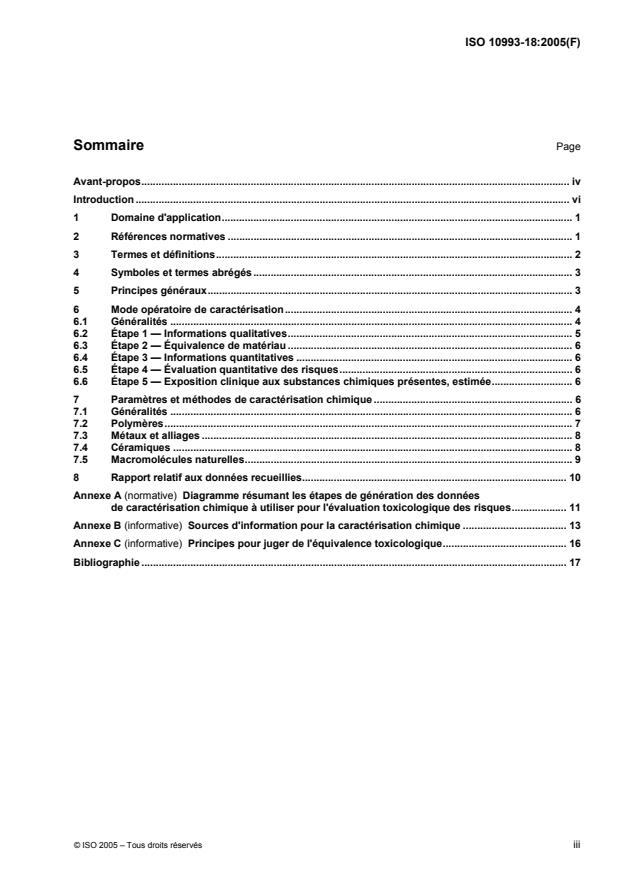
Sommaire Page
Avant-propos. iv
Introduction . vi
1 Domaine d'application. 1
2 Références normatives . 1
3 Termes et définitions. 2
4 Symboles et termes abrégés . 3
5 Principes généraux. 3
6 Mode opératoire de caractérisation. 4
6.1 Généralités . 4
6.2 Étape 1 — Informations qualitatives. 5
6.3 Étape 2 — Équivalence de matériau . 6
6.4 Étape 3 — Informations quantitatives . 6
6.5 Étape 4 — Évaluation quantitative des risques. 6
6.6 Étape 5 — Exposition clinique aux substances chimiques présentes, estimée. 6
7 Paramètres et méthodes de caractérisation chimique . 6
7.1 Généralités . 6
7.2 Polymères. 7
7.3 Métaux et alliages . 8
7.4 Céramiques . 8
7.5 Macromolécules naturelles. 9
8 Rapport relatif aux données recueillies. 10
Annexe A (normative) Diagramme résumant les étapes de génération des données
de caractérisation chimique à utiliser pour l'évaluation toxicologique des risques. 11
Annexe B (informative) Sources d'information pour la caractérisation chimique . 13
Annexe C (informative) Principes pour juger de l'équivalence toxicologique. 16
Bibliographie . 17
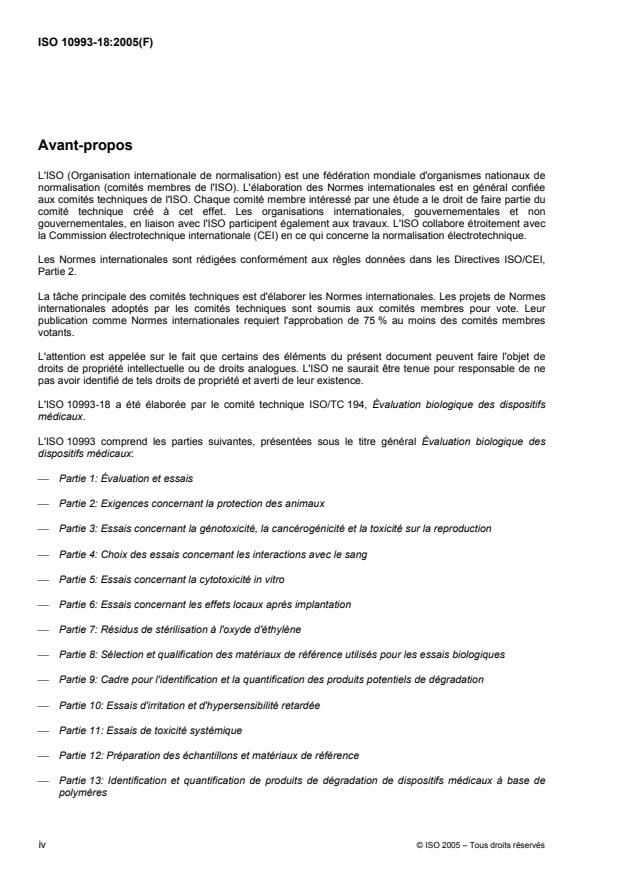
Avant-propos
L'ISO (Organisation internationale de normalisation) est une fédération mondiale d'organismes nationaux de
normalisation (comités membres de l'ISO). L'élaboration des Normes internationales est en général confiée
aux comités techniques de l'ISO. Chaque comité membre intéressé par une étude a le droit de faire partie du
comité technique créé à cet effet. Les organisations internationales, gouvernementales et non
gouvernementales, en liaison avec l'ISO participent également aux travaux. L'ISO collabore étroitement avec
la Commission électrotechnique internationale (CEI) en ce qui concerne la normalisation électrotechnique.
Les Normes internationales sont rédigées conformément aux règles données dans les Directives ISO/CEI,
Partie 2.
La tâche principale des comités techniques est d'élaborer les Normes internationales. Les projets de Normes
internationales adoptés par les comités techniques sont soumis aux comités membres pour vote. Leur
publication comme Normes internationales requiert l'approbation de 75 % au moins des comités membres
votants.
L'attention est appelée sur le fait que certains des éléments du présent document peuvent faire l'objet de
droits de propriété intellectuelle ou de droits analogues. L'ISO ne saurait être tenue pour responsable de ne
pas avoir identifié de tels droits de propriété et averti de leur existence.
L'ISO 10993-18 a été élaborée par le comité technique ISO/TC 194, Évaluation biologique des dispositifs
médicaux.
L'ISO 10993 comprend les parties suivantes, présentées sous le titre général Évaluation biologique des
dispositifs médicaux:
Partie 1: Évaluation et essais
Partie 2: Exigences concernant la protection des animaux
Partie 3: Essais concernant la génotoxicité, la cancérogénicité et la toxicité sur la reproduction
Partie 4: Choix des essais concernant les interactions avec le sang
Partie 5: Essais concernant la cytotoxicité in vitro
Partie 6: Essais concernant les effets locaux après implantation
Partie 7: Résidus de stérilisation à l'oxyde d'éthylène
Partie 8: Sélection et qualification des matériaux de référence utilisés pour les essais biologiques
Partie 9: Cadre pour l'identification et la quantification des produits potentiels de dégradation
Partie 10: Essais d'irritation et d'hypersensibilité retardée
Partie 11: Essais de toxicité systémique
Partie 12: Préparation des échantillons et matériaux de référence
Partie 13: Identification et quantification de produits de dégradation de dispositifs médicaux à base de
polymères
iv © ISO 2005 – Tous droits réservés
Partie 14: Identification et quantification des produits de dégradation des céramiques
Partie 15: Identification et quantification des produits de dégradation issus des métaux et alliages
Partie 16: Conception des études toxicocinétiques des produits de dégradation et des substances
relargables
Partie 17: Établissement des limites admissibles des substances relargables
Partie 18: Caractérisation chimique des matériaux
Les parties suivantes sont en cours d'élaboration:
Partie 19: Caractéristiques physico-chimiques, mécaniques et morphologiques
Partie 20: Principes et méthodes relatifs aux essais d'immunotoxicologie des dispositifs médicaux
Des parties ultérieures concerneront d'autres aspects pertinents des essais biologiques.
Pour les besoins de la présente partie de l'ISO 10993, l'annexe CEN concernant la mise en œuvre des
Directives du Conseil européen a été supprimée.
Introduction
L'ISO 10993-1 définit le cadre d'un programme structuré d'estimation pour l'évaluation de la sécurité
biologique. L'ISO 10993-1:2003, Article 3 indique qu'il convient de privilégier l'adéquation des dispositifs à leur
usage prévu pour choisir les matériaux à utiliser dans la fabrication du dispositif. Il convient que ce choix soit
en rapport avec les caractéristiques et les propriétés du matériau et notamment en matière de propriétés
chimiques, toxicologiques, physiques, électriques, morphologiques et mécaniques. Il faut nécessairement
disposer de ces informations avant toute évaluation biologique. L'ISO 10993-1:2003, 7.2 indique que la
validité permanente de l'acceptabilité de l'évaluation biologique constitue l'un des aspects fondamentaux d'un
système de gestion de la qualité.
De même, l'ISO 14971 stipule qu'il convient de prendre en compte la nature chimique des matériaux dans le
cadre d'une analyse toxicologique des risques.
Les exigences spécifiées dans le présent document visent à regrouper les informations utiles pour prédire la
réponse biologique des matériaux indiqués ci-après:
la composition chimique des matériaux utilisés dans les procédés de fabrication et notamment les additifs
et les résidus de traitement tels que les résidus d'agents chimiques, de nettoyage, de désinfection et
d'essai, les acides et les substances caustiques;
la caractérisation des matériaux utilisés pendant la production de dispositifs médicaux et présents dans
les dispositifs achevés;
l'identification des matériaux constitutifs du dispositif médical;
la capacité des matériaux des dispositifs médicaux à libérer des substances ou des produits de
dégradation liés au processus de fabrication;
les modifications au niveau des matériaux constitutifs induites par des modifications des processus de
fabrication ou un contrôle insuffisant de ces processus.
Le contrôle des caractéristiques de composition des matériaux de fabrication est principalement détenu par
les fournisseurs de ces matériaux. Cependant, d'autres caractéristiques sont grandement influencées par les
exigences auxquelles le dispositif médical fini doit être conforme ainsi que les procédés employés par le
fabricant du dispositif médical.
vi © ISO 2005 – Tous droits réservés
NORME INTERNATIONALE ISO 10993-18:2005(F)
Évaluation biologique des dispositifs médicaux —
Partie 18:
Caractérisation chimique des matériaux
1 Domaine d'application
La présente partie de l'ISO 10993 décrit un cadre servant à l'identification d'un matériau et à la détermination
et la quantification de ses composés chimiques. Les informations relatives à la caractérisation chimique
obtenues peuvent servir à une large gamme d'applications importantes, par exemple:
prendre part à l'évaluation de la sécurité biologique globale d'un dispositif médical (ISO 10993-1 et
ISO 14971);
mesurer le niveau de substances relargables dans un dispositif médical afin d'évaluer la conformité avec
les limites admissibles pour cette substance dérivées d'une évaluation des risques relatifs à la santé
(ISO 10993-17);
juger de l'équivalence entre un matériau proposé et un matériau cliniquement établi;
juger de l'équivalence d'un dispositif final à un prototype pour vérifier la pertinence des données relatives
au prototype utilisées pour l'évaluation dudit dispositif;
sélectionner les nouveaux matériaux potentiels afin de déterminer le caractère adéquat de ceux-ci au
sein d'un dispositif médical pour une application clinique proposée.
La présente partie de l'ISO 10993 ne traite pas de l'identification ou de la quantification des produits de
dégradation qui sont abordés dans l'ISO 10993-9, l'ISO 10993-13, l'ISO 10993-14 et l'ISO 10993-15.
Les normes de la série ISO 10993 s'appliquent en cas de contact direct ou indirect entre le matériau ou le
dispositif et le corps (voir l'ISO 10993-1:2003, 4.2.1).
La présente partie de l'ISO 10993 s'adresse aux fournisseurs de matériaux et aux fabricants de dispositifs
médicaux pour la conduite d'une évaluation de la sécurité biologique.
2 Références normatives
Les documents de référence suivants sont indispensables pour l'application du présent document. Pour les
références datées, seule l'édition citée s'applique. Pour les références non datées, la dernière édition du
document de référence s'applique (y compris les éventuels amendements).
ISO 10993-1:2003, Évaluation biologique des dispositifs médicaux — Partie 1: Évaluation et essais
ISO 10993-17, Évaluation biologique des dispositifs médicaux — Partie 17: Établissement des limites
admissibles des substances relargables
ISO 14971:2000, Dispositifs médicaux — Application de la gestion des risques aux dispositifs médicaux
3 Termes et définitions
Pour les besoins du présent document, les termes et définitions donnés dans ISO 10993-1 ainsi que les
suivants s'appliquent.
3.1
fournisseur
personne ou entreprise qui fabrique et/ou fournit les matériaux constitutifs servant à la fabrication d'un
dispositif médical
3.2
fabricant
personne physique ou morale en charge de la conception, de la fabrication, de l'emballage et de l'étiquetage
d'un dispositif avant sa mise sur le marché sous son nom, que ces opérations soient réalisées par cette
personne ou par une tierce personne pour son compte
3.3
composant
article fabriqué à partir d'un matériau de base n'étant pas un dispositif médical dans la mesure où il ne
constitue qu'une partie du dispositif médical
3.4
convertisseur
personne ou entreprise qui transforme ou fabrique un matériau brut de départ en un produit semi-fini (par
exemple des tiges, des tubes ou une couche laminée)
3.5
caractérisation chimique
identification d'un matériau ainsi que l'identification et la quantification des substances chimiques présentes
dans les matériaux ou les dispositifs médicaux finis
3.6
extraction exhaustive
extraction jusqu'à obtention d'une quantité de résidus au niveau de l'extraction suivante inférieure à 10 % de
la quantité détectée dans la première extraction
NOTE L'extraction est un procédé complexe influencé par la durée, la température, le rapport surface sur volume, le
milieu d'extraction et l'équilibre des phases du matériau. L'équilibre des phases d'un matériau contrôle les quantités
relatives de phases amorphes et cristallines présentes. Dans la phase amorphe, la température de transition vitreuse, T ,
g
régit la mobilité de la chaîne de polymères et le taux de diffusion dans la phase. En règle générale, la vitesse de diffusion
est nettement plus élevée au-dessus de T qu'en dessous. La vitesse de diffusion est plus lente dans la phase cristalline.
g
Il convient que les conditions d'extraction ne modifient pas l'équilibre des phases du matériau. La modification de la phase
a une incidence sur la quantité et le type de substances relargables. En cas d'extraction accentuée, il convient de tenir
scrupuleusement compte de l'effet de températures plus élevées ou d'autres conditions sur la cinétique de l'extraction
ainsi que de l'identité des agents d'extraction. Par exemple, en présence de températures élevées, deux problèmes se
posent:
a) l'énergie de l'augmentation en température peut induire une augmentation de la réticulation des polymères et par
conséquent, réduire la quantité de monomère libre disponible pour la migration en provenance du polymère;
b) l'augmentation en température est susceptible d'induire la formation de matériaux de dégradation qui ne se
rencontrent pas habituellement dans le dispositif fini dans les conditions d'utilisation;
c) l'augmentation en température peut provoquer la disparition du matériau relargable qui se rencontre habituellement
dans le dispositif fini.
2 © ISO 2005 – Tous droits réservés
3.7
extraction simulée
extraction servant à évaluer le risque potentiel pour le patient ou l'utilisateur pendant une utilisation de routine
d'un dispositif, cette extraction est conduite selon une méthode d'extraction utilisant un milieu approprié
servant à simuler les conditions d'utilisation du produit
NOTE Voir la NOTE en 3.6.
4 Symboles et termes abrégés
Les termes abrégés suivants sont utilisés dans l'Article 7.
Tableau 1 — Abréviations des méthodologies
Abréviation Méthode d'analyse
DMTA Analyse thermomécanique dynamique
DSC Calorimétrie différentielle à balayage
EDX-SEM Analyse de EDX – Microscopie électronique à balayage
FTIR Spectroscopie Infrarouge à transformée de Fourier
GC Chromatographie en phase gazeuse
a
MS
Spectroscopie de masse
GPC Chromatographie par perméation de gel
HPLC Chromatographie liquide haute performance
ICP Plasma inductif
IR Spectroscopie Infrarouge
RMN Spectroscopie de résonance magnétique nucléaire
Spectroscopie Ultraviolet
UV
XPS Spectroscopie photoélectronique-X
XRF Fluorescence X
Base de données 2D PAGE Électrophorèse sur gel de polyacrylamide
a
La spectroscopie de masse est souvent associée aux techniques de chromatographie, telles que GC-MS, LC-MS et MS-MS.
5 Principes généraux
Pour évaluer la sécurité biologique du dispositif, tenir compte de la caractérisation chimique des matériaux
utilisés dans un dispositif médical constitue un prérequis incontournable. Ce prérequis a également son
importance pour juger de l'équivalence
a) d'un matériau proposé et un matériau cliniquement établi, et
b) d'un prototype et un dispositif achevé.
Un aperçu du mode opératoire de caractérisation chimique traité dans la présente partie de l'ISO 10993 et sa
relation avec l'évaluation des risques sont présentés à l'Annexe A.
Pour décrire la composition chimique d'un matériau, des données qualitatives doivent être recueillies. Des
données quantitatives doivent également être recueillies lorsque cela est pertinent dans le cadre de la
sécurité biologique. Pour certains matériaux, des informations relatives à la composition peuvent être
obtenues grâce aux spécifications du matériau. Pour les matériaux tels que les polymères susceptibles d'avoir
des formulations plus complexes, il convient de demander les informations relatives à leur composition au
fournisseur du matériau. En l'absence de ce type d'informations, il convient d'analyser le matériau selon des
techniques appropriées permettant de récolter des données relatives à sa composition.
L'identification des éléments constitutifs d'un matériau devant entrer dans la fabrication d'un dispositif médical
permet de rechercher la toxicité intrinsèque de chaque constituant. Les données ainsi obtenues le sont dans
le but d'une utilisation par le fabricant du dispositif médical dans le cadre de l'évaluation globale de la sécurité
biologique dudit dispositif médical. Il est par conséquent primordial d'instaurer des contrôles afin d'empêcher
le fournisseur du matériau de modifier la composition du matériau fourni sous une marque commerciale ou un
agrément de fourniture sans en aviser le fabricant du dispositif médical au préalable. Il convient que le
fabricant évalue les conséquences du moindre changement notifié sur la sécurité biologique du produit.
Tout constituant d'un matériau ou tout additif utilisé dans le procédé de fabrication d'un dispositif médical est
potentiellement biodisponible. Pour évaluer les risques émanant des éléments constitutifs du produit, il est
cependant nécessaire de recueillir les informations permettant de démontrer l'étendue de la disponibilité des
éléments constitutifs dans les conditions d'utilisation réelles du produit fini. L'estimation peut être effectuée
grâce à la conduite d'essais d'extraction sur le matériau. Pour garantir que le tout constituant susceptible
d'être libéré en cours d'utilisation du produit fini est bien libéré dans le milieu d'extraction, mettre en œuvre
des conditions d'extraction appropriées. Il est possible de conduire une analyse qualitative et/ou quantitative
de l'extrait obtenu pour obtenir des données utilisables pour l'évaluation de la sécurité biologique du dispositif
médical.
Il convient que la portée de la caractérisation chimique requise reflète la nature et la durée de l'exposition
clinique et celle-ci doit être déterminée par une évaluation des risques toxicologiques fondée sur les données
nécessaires à l'évaluation de la sécurité biologique du dispositif. La caractérisation chimique reflète
également la forme physique du matériau utilisé, par exemple liquides, gels, polymères, métaux, céramiques,
composites ou matériaux d'origine biologique.
Le succès de la caractérisation chimique abordée dans le présent document requiert une étroite collaboration
entre les spécialistes des matériaux, les chimistes et les spécialistes de l'évaluation des risques
toxicologiques. Dans le cadre de cette collaboration, les spécialistes des matériaux et les chimistes
fournissent les données qualitatives et quantitatives permettant au spécialiste de l'évaluation des risques de
déterminer la sécurité du dispositif.
6 Mode opératoire de caractérisation
6.1 Généralités
Les données relatives à la caractérisation chimique sont obtenues selon un processus par étapes lié à
l'évaluation des risques et un diagramme en cinq parties est représenté dans l'Annexe A. Les exigences
relatives à la caractérisation chimique et les lignes directrices pour chaque étape sont indiquées de 6.2 à 6.6.
Les méthodes analytiques doivent être sélectionnées afin d'obtenir les informations nécessaires à l'évaluation
toxicologique. S'il est impossible de trouver des méthodes appropriées, de nouvelles méthodes adéquates
doivent être mises au point. Avant la mise au point de nouvelles méthodes, il convient de consulter les
normes, les monographies, les articles scientifiques ou les autres documents scientifiques pertinents existants
pour vérifier l'existence de méthodes d'essai appropriées. Il peut s'avérer nécessaire d'adapter et de valider
les méthodes extraites de la littérature avant de les utiliser.
Les méthodes analytiques utilisées doivent être validées, motivées et faire l'objet d'un rapport (voir Article 8).
La validation d'une méthode analytique est le processus qui consiste à vérifier la conformité des
caractéristiques de performance de la méthode avec les exigences des applications d'analyse prévues. Les
méthodes analytiques doivent être validées, le cas échéant, par rapport aux caractéristiques d'analyse
justifiées indiquées ci-dessous:
exactitude;
fidélité;
4 © ISO 2005 – Tous droits réservés
spécificité;
limite de détection;
limite de quantification;
linéarité;
plage;
rugosité;
robustesse;
adéquation du système.
À chaque étape du mode opératoire de caractérisation, il doit être statué sur la pertinence des données
récoltées pour servir de base à l'analyse des risques. En plus des exigences relatives à la caractérisation
chimique du dispositif achevé, il convient que ce mode opératoire prenne en compte tous les matériaux
utilisés dans un dispositif médical.
NOTE 1 Les étapes 2 et 4, 6.3 et 6.5 respectivement, font partie du processus d'évaluation des risques mais ne sont
pas couvertes par la présente partie de l'ISO 10993. Elles sont mentionnées à titre d'information afin de relever
l'importance de l'interaction entre la caractérisation chimique et l'évaluation des risques.
NOTE 2 Le fournisseur peut être à l'origine de méthodes analytiques appropriées. En l'absence de données de départ
relatives à la composition, il est recommandé de procéder à une étude scientifique pour déterminer la nature probable du
matériau de base et des additifs éventuels afin de disposer d'éléments pour la sélection des méthodes analytiques les
plus appropriées au matériau concerné.
Si le matériau ou le dispositif est en contact direct ou indirect avec le corps, la présente partie de l'ISO 10993
est applicable (voir l'ISO 10993-1:2003, 4.2.1).
6.2 Étape 1 — Informations qualitatives
Décrire le matériau ou le dispositif et son utilisation prévue. Une description qualitative documentée de la
composition du dispositif achevé comprenant les additifs et les résidus de traitement de chaque matériau
utilisés dans le dispositif est requise (voir l'ISO 10993-1:2003, 3.3, Article 4 et Annexe B). Le niveau de
données qualitatives fourni/requis doit refléter la catégorie du dispositif médical en termes de degré
d'invasivité et de durée de l'exposition clinique ainsi que la nature des matériaux, ce niveau de données doit
être justifié.
La description qualitative doit, le cas échéant, comprendre des informations détaillées relatives au lot, au
fournisseur et aux spécifications de chaque matériau. Un matériau normalisé, comme l'ISO 5932-1, utilisé
conformément à son utilisation prévue est considéré conforme à la présente exigence.
Il convient que les fabricants de dispositifs médicaux obtiennent, de préférence, les informations qualitatives
et quantitatives relatives à la composition auprès du fournisseur du matériau de base. Il convient également
que les inf
...
МЕЖДУНАРОДНЫЙ ISO
СТАНДАРТ 10993-18
Первое издание
2005-07-01
Оценка биологическая медицинских
изделий.
Часть 18.
Определение химических
характеристик материалов
Biological evaluation of medical devices —
Part 18: Chemical characterization of materials
Ответственность за подготовку русской версии несёт GOST R
(Российская Федерация) в соответствии со статьёй 18.1 Устава ISO
Ссылочный номер
Отказ от ответственности при работе в PDF
Настоящий файл PDF может содержать интегрированные шрифты. В соответствии с условиями лицензирования, принятыми
фирмой Adobe, этот файл можно распечатать или смотреть на экране, но его нельзя изменить, пока не будет получена
лицензия на интегрированные шрифты и они не будут установлены на компьютере, на котором ведется редактирование. В
случае загрузки настоящего файла заинтересованные стороны принимают на себя ответственность за соблюдение
лицензионных условий фирмы Adobe. Центральный секретариат ISO не несет никакой ответственности в этом отношении.
Adobe - торговый знак фирмы Adobe Systems Incorporated.
Подробности, относящиеся к программным продуктам, использованные для создания настоящего файла PDF, можно найти в
рубрике General Info файла; параметры создания PDF были оптимизированы для печати. Были приняты во внимание все
меры предосторожности с тем, чтобы обеспечить пригодность настоящего файла для использования комитетами-членами
ISO. В редких случаях возникновения проблемы, связанной со сказанным выше, просьба проинформировать Центральный
секретариат по адресу, приведенному ниже.
ДОКУМЕНТ ЗАЩИЩЕН АВТОРСКИМ ПРАВОМ
Все права сохраняются. Если не указано иное, никакую часть настоящей публикации нельзя копировать или использовать в
какой-либо форме или каким-либо электронным или механическим способом, включая фотокопии и микрофильмы, без
предварительного письменного согласия ISO, которое должно быть получено после запроса о разрешении, направленного по
адресу, приведенному ниже, или в комитет-член ISO в стране запрашивающей стороны.
ISO copyright office
Case postale 56 • CH-1211 Geneva 20
Tel. + 41 22 749 01 11
Fax + 41 22 749 09 47
E-mail copyright@iso.org
Web www.iso.org
Опубликовано в Швейцарии
ii © ISO 2005 – Все права сохраняются
Содержание Страница
Предисловие .iv
Введение .vi
1 Область применения .1
2 Нормативные ссылки .1
3 Термины и определения .2
4 Обозначения и аббревиатуры .3
5 Общие принципы.3
6 Методика определения характеристик.4
6.1 Общие положения .4
6.2 Этап 1 – Информация о качественных характеристиках.5
6.3 Этап 2 - Эквивалентность материалов.6
6.4 Этап 3 - Информация о количественных характеристиках.6
6.5 Этап 4 - Количественная оценка рисков .6
6.6 Этап 5 - Оценка клинического экспонирования присутствующими химическими
веществами.6
7 Параметры и методы определения характеристик химических веществ .6
7.1 Общие положения .6
7.2 Полимеры .7
7.3 Металлы и сплавы .8
7.4 Керамика.8
7.5 Природные макромолекулы .9
8 Отчет о полученных данных.10
Приложение А (нормативное) Блок-схема, обобщающая поэтапное генерирование данных о
характеристиках химических веществ для применения при оценке
токсикологического риска .11
Приложение В (информативное) Источники информации по характеристикам химических
веществ .13
Приложение С (информативное) Принципы оценки токсикологической эквивалентности .16
Библиография.17
Предисловие
Международная организация по стандартизации (ISO) является всемирной федерацией национальных
организаций по стандартизации (комитетов-членов ISO). Разработка международных стандартов
обычно осуществляется техническими комитетами ISO. Каждый комитет-член, заинтересованный в
деятельности, для которой был создан технический комитет, имеет право быть представленным в этом
комитете. Международные организации, правительственные и неправительственные, имеющие связи
с ISO, также принимают участие в работах. Что касается стандартизации в области электротехники, то
ISO работает в тесном сотрудничестве с Международной электротехнической комиссией (IEC).
Проекты международных стандартов разрабатываются в соответствии с правилами Директив ISO/IEC,
Часть 2.
Основной задачей технических комитетов является разработка международных стандартов. Проекты
международных стандартов, принятые техническими комитетами, рассылаются комитетам-членам на
голосование. Для опубликования их в качестве международного стандарта требуется одобрение не
менее 75 % комитетов-членов, принимающих участие в голосовании.
Необходимо учитывать возможность, что некоторые элементы настоящего документа могут быть
объектом патентных прав. ISO не несет ответственность за определение каких-либо или всех таких
патентных прав.
Стандарт ISO 10993-18 был подготовлен Техническим комитетом ISO/TC 194, Оценка биологическая
медицинских изделий.
Стандарт ISO 10993 состоит из следующих частей, под общим названием Оценка биологическая
медицинских изделий:
— Часть 1. Оценка и испытания
— Часть 2. Требования к охране здоровья животных
— Часть 3. Испытания на генотоксичность, канцерогенность и токсичность, влияющую на
репродуктивность
— Часть 4. Выбор испытаний, относящихся к взаимодействию с кровью
— Часть 5. Испытания на цитотоксичность in vitro
— Часть 6.Испытания для определения локальных эффектов после имплантации
— Часть 7.Остатки при стерилизации этиленоксидом
— Часть 9. Структура идентификации и квантификации потенциальных продуктов разложения
— Часть 10. Пробы на раздражение и аллергическую реакцию замедленного типа
— Часть 11. Испытания на системную токсичность
— Часть 12. Подготовка проб и эталонных материалов
— Часть 13. Идентификация и количественная оценка продуктов разложения в полимерных
медицинских устройствах
iv © ISO 2005 – Все права сохраняются
— Часть 14. Идентификация и количественная оценка продуктов разложения керамики
— Часть 15. Идентификация и количественная оценка продуктов разложения металлов и сплавов
— Часть 16. Концепция токсикокинетических исследований продуктов разложения и
выщелачиваемых веществ
— Часть 17. Установление допустимых пределов выщелачиваемых веществ
— Часть 18. Определение химических характеристик материалов
Следующие части находятся в процессе подготовки:
— Часть 19. Физико-химическая, морфологическая и топографическая характеристика
материалов
— Часть 20. Приниципы и методы иммунологической оценки медицинских изделий
Будущие части данного стандарта будут рассматривать другие необходимые аспекты биологических
испытаний.
Применительно к настоящей части стандарта ISO 10993 приложение CEN, рассматривающее
выполнение Директив европейского Совета, было исключено.
Введение
Стандарт ISO 10993-1 содержит схему структуры программы по оценке биологической безопасности.
Раздел 3 ISO 10993-1:2003 устанавливает, что при выборе материалов для изготовления устройств в
первую очередь необходимо учитывать пригодность этих материалов для целей устройств. Это
означает необходимость учитывать характеристики и свойства материалов, в том числе химические,
токсикологические, физические, электрические, морфологические и механические. Эта информация
необходима в первую очередь для биологической оценки. В Подразделе 7.2 ISO 10993-1:2003 указано,
что непрерывное применение биологической оценки представляет собой один из аспектов системы
менеджмента качества.
В стандарте ISO 14971 также установлено, что при анализе токсикологического риска следует
учитывать химическую природу материалов.
Требования настоящего документа предназначены для обеспечения следующей информации,
представляющей ценность с точки зрения прогнозирования биологического воздействия материалов.
— Химический состав материалов, используемых в процессе изготовления, включая
технологические добавки и отходы, например трассировочные химические вещества, чистящие,
дезинфецирующие и пробные агенты, кислоты и едкие вещества.
— Данные о характеристиках материалов, применяемых при изготовлении медицинских устройств,
а также содержащихся в окончательной форме устройств.
— Обозначение материалов конструкций медицинских устройств.
— Потенциальная возможность материалов медицинских устройств выделять вещества или
продукты разложения в процессе изготовления.
— Изменения материалов конструкции, связанные с изменениями процесса изготовления или
недостаточным контролем этих процессов.
Характеристики состава материалов, используемых для изготовления устройств, должны в основном
контролироваться поставщиками материалов. Однако другие характеристики могут в основном
зависеть от требований, которым должны удовлетворять законченные медицинские устройства, а
также процессы, используемые изготовителями устройств.
vi © ISO 2005 – Все права сохраняются
МЕЖДУНАРОДНЫЙ СТАНДАРТ ISO 10993-18:2005(R)
Оценка биологическая медицинских изделий.
Часть 18.
Определение химических характеристик материалов
1 Область применения
Настоящая часть стандарта ISO 10993 устанавливает схему обозначения материалов и обозначения и
количественного определения его химических компонент. Получаемая при определении химических
свойств информация может быть использована в определенном диапазоне важных приложений,
например следующих:
— В качестве части оценки общей биологической безопасности медицинских устройств (ISO 10993-1
и 14971).
— При измерении уровня выщелачиваемого вещества в медицинском устройстве в целях
выполнения оценки соответствия допустимому уровню, получаемому для этого вещества исходя
из оценок рисков для здоровья.
— При оценке эквивалентности предложенного материала клинически утвержденному материалу.
— При оценке эквивалентности конечного устройства устройству прототипу в целях проверки
пригодности относящихся к последнему устройству данных для обоснования оценки первого из
этих устройств.
— При сортировке потенциально возможных новых материалов по степени пригодности для
использования в данном медицинском устройстве при заданных клинических применениях.
Настоящая часть ISO 10993 не включает идентификацию или количественное определение продуктов
разложения, что рассматривается в стандартах ISO 10993-9, ISO 10993-13, ISO 10993-14 и ISO 10993-15.
Данная серия стандартов ISO 10993 применяется в тех случаях, когда материал или устройство
вступают в контакт с телом человека непосредственно или опосредованно (см. 4.2.1 ISO 10993-1:2003).
Данная часть ISO 10993 предназначена для использования поставщиками материалов и
изготовителями медицинских устройств при выполнении оценки биологической безопасности.
2 Нормативные ссылки
Следующие ниже ссылочные документы обязательны при применении данного документа. При
жестких ссылках используются только цитированные издания. При плавающих ссылках применяется
последнее издание ссылочного документа (включая все изменения).
ISO 10993-1:2003, Оценка биологическая медицинских изделий. Часть 1. Оценка и испытания
ISO 10993-17, Оценка биологическая медицинских изделий. Часть 17. Установление допустимых
пределов выщелачиваемых веществ
ISO 14971:2000, Устройства медицинские. Применение управления рисками к медицинским
устройствам
3 Термины и определения
Для целей настоящего документа приняты термины и определения ISO 10993-1 и приведенные ниже.
3.1
поставщик
supplier
лицо или компания, изготавливающие и/или поставляющие основные исходные материалы,
применяемые при изготовлении медицинских устройств
3.2
изготовитель
manufacturer
физическое или юридическое лицо, несущее ответственность за проектирование, изготовление,
упаковку и маркировку устройства перед его поставкой на рынок под своим собственным именем,
независимо от того, выполняются ли перечисленные операции этим лицом самим или от его имени
третьей стороной
3.3
компонент
component
объект, изготавливаемый из основных исходных материалов, но не являющийся сам медицинским
устройством, поскольку он образует только одну часть медицинского устройства
3.4
переработчик
convertor
лицо или компания, перерабатывающие или обрабатывающие основные сырьевые материалы,
получая полуфабрикаты (например отрезки стержней, или пленки в виде трубок или плоско
уложенные)
3.5
определение химических характеристик
chemical characterization
определение материалов или количественное определение химических веществ, присутствующих в
материалах или законченных медицинских устройствах
3.6
исчерпывающее извлечение
exaustive extraction
экстракция, выполняемая до момента, когда остаток при последовательной экстракции становится
меньше 10 % от первоначально определенного при первой экстракции
ПРИМЕЧАНИЕ Экстракция является комплексным процессом, на который влияет время, отношение площади
поверхности к объему, среда экстрагирования и равновесная фаза материала. Фазовое равновесие материала
контролирует относительные количества присутствующих аморфных и кристаллическх фаз. В случае аморфной
фазы температура стеклования, Tg, определяет подвижность полимерных цепочек и скорость диффузии в фазе.
Обычно скорость диффузии значительно выше при температурах выше Tg по сравнению с этой величиной ниже
Tg. Скорость диффузии наиболее низка в кристаллической фазе.
Условия экстракции не должны приводить к изменению фазового равновесия в материале. Изменение фаз может
оказать влияние на количество и типы экстрагируемых веществ. При использовании исчерпывающей экстракции
необходимо тщательно рассмотреть влияние высоких температур или других условий на кинетику экстракции и
идентичность экстрагирующего агента. Ниже приведены несколько примеров вопросов, возникающих при
использовании повышенных температур:
a) энергия при повышении температуры может привести к росту сшивания полимеров и, следовательно, к
снижению количества свободного мономера, способного мигрировать из полимера;
2 © ISO 2005 – Все права сохраняются
b) повышение температуры может привести к образованию разложившихся материалов, которые обычно
отсутствуют в законченных медицинских устройствах при условиях их применения;
c) повышение температуры может привести к исчезновению выщелачиваемых материалов, обычно
обнаруживаемых в законченных устройствах.
3.7
моделирование экстракции
simulated extraction
экстракция, выполняемая для оценки потенциального риска для пациента или пользователя при
обычном применении устройства, с использованием метода экстракции с подходящей средой,
моделирующей применение изделия
ПРИМЕЧАНИЕ См. ПРИМЕЧАНИЕ к 3.6.
4 Обозначения и аббревиатуры
В Разделе 7 используются следующие аббревиатуры.
Таблица 1 — Методологические аббревиатуры
Аббревиатура Аналитический метод
DMTA Динамический механико-термический анализ
DSC Дифференциальная сканирующая калориметрия
EDX-SEM Электронно-дисперс. рентген. анализ – сканир. электронная микроскопия
FTIR
Инфракрасная (спектроскопия) с преобразованием Фурье
GC Газовая хроматография
а
MS Масс спектроскопия
GPC Гелепроницаемая хроматография
HPLC Жидкостная хроматография высокого разрешения
ICP Индуктивно связанная плазма
IR Инфракрасная (спектроскопия)
NMR Ядерно-магнитный резонанс (спектроскопия)
UV Ультрафиолетовая (спектроскопия)
XPS Рентгеновская фотоэлектронная спектроскопия
XRF Рентгеновская флуоресценция
2D PAGE Двумерный электрофорез полиакриламидного геля
а
Масс спектроскопия часто комбинируется с методами хроматографии, например GC-MS, LC-MS и MS-MS.
5 Общие принципы
Анализ химических характеристик материалов, применяемых при изготовлении медицинского
устройства, является необходимым этапом оценки биологической безопасности устройства. Он также
имеет важное значение для оценки эквивалентности в следующих случаях
a) предлагаемого материала и клинически принятого материала, и
b) устройства прототипа и конечного устройства.
Обзор методики определения химических характеристик приведен в настоящем документе, а ее
взаимосвязь с оценкой риска рассмотрена в Приложении А.
Для описания химического состава материала необходимо получить количественные данные. Что
касается биологической безопасности, количественные данные в этом случае также необходимы. Для
некоторых материалов информация о составе может быть легко доступна в качестве части
технических условий. Такие материалы, как полимеры, могут обладать более сложным составом и
подробные сведения о нем должны быть предоставлены поставщиком. При отсутствии таких
подробных сведений необходимо использовать для их получения соответствующие аналитические
методы.
Идентификация компонент материала, предназначенного для использования при изготовлении
медицинского устройства, позволяет исследовать характеристики токсичности каждого компонента.
Полученные данные предназначены для изготовителя медицинского устройства в качестве части
оценки его полной биологической безопасности. В связи с этим важно проводить контроль, не
допускающий изменение поставщиком состава материала, поставляемого на рынок под определенной
торговой маркой, или договора о поставке, без предварительного извещения об этом изготовителя
медицинского устройства. Изготовитель должен провести оценку влияния любых сообщенных
изменений на биологическую безопасность изделия.
Любые составляющие материала или добавок, используемых в процессе изготовления медицинского
устройства, являются потенциально биологически доступными. Однако для оценки связанного с ними
риска необходимо получить информацию, показывающую степень, в которой каждая из составляющих
будет доступна при фактических условиях применения законченного изделия. Эти данные могут быть
получены в испытаниях материала на экстракцию. Необходимо при этом использовать подходящие
условия экстракции (моделирование экстракции), гарантирующие, что все составляющие, которые
могут быть вероятно выделены при использовании конечного продукта, будут извлечены в среду
экстракции. Полученный экстракт может быть проанализирован качественными и/или
количественными методами, предоставляющими данные, позволяющие выполнить оценку
биологической безопасности медицинского устройства.
Необходимый объем данных по химическим характеристикам должен соответствовать характеру и
продолжительности воздействия в клинических условиях и должен определяться исполнителем оценки
токсикологического риска исходя из информации, требующейся для оценки биологической
безопасности устройства. Он должен также соответствовать физической форме применяемого
материала, например жидкого, гелеобразного, полимера, металлов, керамики, композитного
материала или материала из биологических источников.
Успешное выполнение работ по определению химических характеристик, соответствующее описанию в
настоящем документе, требует тесного сотрудничества специалистов в области материалов, аналитической
химии и оценки токсикологического риска. В этих совместных работах специалисты по материалам и
аналитической химии должны предоставить качественные и количественные данные, которые специалисты в
области оценки рисков могут использовать для оценки безопасности устройства.
6 Методика определения характеристик
6.1 Общие положения
Генерирование данных по химическим характеристикам является поэтапным процессом, связанным с
методами оценки рисков и блок-схемой, состоящей из пяти этапов, приведенных в Приложении А.
Требования к определению химических характеристик и руководство на каждом этапе определения
установлены с 6.2 по 6.6. Для получения информации, требующейся при токсикологической оценке,
следует выбрать подходящие аналитические методы. Если нельзя выбрать подходящий метод из
числа существующих, необходимо разрабатывать новые методы. Перед разработкой нового метода
следует выполнить поиск подходящего метода в имеющихся стандартах, монографиях, научных
работах или других содержащих научную информацию документах. Найденные в литературе методы
могут нуждаться в адаптации и валидации перед использованием.
Применяемые аналитические методы должны пройти валидацию, иметь обоснование и быть
опубликованными (см. Раздел 8). Валидация аналитического метода представляет собой процесс, в
ходе которого устанавливают, что рабочие характеристики метода удовлетворяют требованиям
предусмотренного аналитического применения. Валидация аналитического метода должна
выполняться с точки зрения его пригодности по следующим обоснованным аналитическим
4 © ISO 2005 – Все права сохраняются
характеристикам:
— точность;
— воспроизводимость;
— специфичность;
— предел определения;
— предел определения количественных данных;
— линейность;
— диапазон;
— помехоустойчивость;
— устойчивость;
— системная пригодность.
На каждом этапе выполнения методики определения характеристик необходимо принять решение об
адекватности получаемых данных с точки зрения их использования в качестве базиса анализа рисков.
Эта процедура должна учитывать все материалы, применяемые в медицинском устройстве, помимо
требований к определению химических характеристик всего устройства в целом.
ПРИМЕЧАНИЕ 1 Этапы 2 и 4, 6.3 и 6.5 соответственно, являются частью процесса оценки рисков и не входят в
область применения данной части ISO 10993. Они приведены в целях предоставления информации,
показывающей важное значение взаимодействия между определением характеристик и оценкой рисков.
ПРИМЕЧАНИЕ 2 Поставщик может быть полезным источником подходящих аналитических методов. При
отсутствии каких-либо начальных сведений о составе рекомендуется использовать поиск по литературным
источникам данных о вероятном характере исходных материалов и добавок к ним, в целях облегчения выбора
наиболее подходящих методов анализа рассматриваемых материалов.
Если материал или устройство вступают в контакт с телом человека непосредственно или
опосредованно, то применима настоящая часть ISO 10993 (см. 4.2.1 ISO 10993-1:2003).
6.2 Этап 1 – Информация о качественных характеристиках
Эта информация содержит описание материалов/устройства и их предусматриваемых применений.
Требуется документально оформленное описание качественных характеристик состава законченного
устройства, включая добавки и технологические отходы для каждого материала, используемого в
законченном устройстве (см. 3.3 и Раздел 4 ISO 10993-1:2003 и Приложение В). Уровень
предоставляемых/требуемых качественных данных должен соответствовать категории медицинского
устройства с точки зрения степени инвазивности и длительности клинического воздействия, а также
природы материалов, и должен быть обоснован.
Описание качественных характеристик каждого материала должно, когда это целесообразно, включать
подробные данные о производственной серии или партии, поставщике и технические услови
...
Questions, Comments and Discussion
Ask us and Technical Secretary will try to provide an answer. You can facilitate discussion about the standard in here.
Loading comments...