


ISO/IEC 29500-2:2011
(Main)Information technology — Document description and processing languages — Office Open XML File Formats — Part 2: Open Packaging Conventions
Information technology — Document description and processing languages — Office Open XML File Formats — Part 2: Open Packaging Conventions
ISO/IEC 29500-2:2011 defines a general-purpose file/component packaging facility, which is built on top of the widely used ZIP file structure.
Technologies de l'information — Description des documents et langages de traitement — Formats de fichier "Office Open XML" — Partie 2: Conventions de paquetage ouvert
General Information
- Status
- Withdrawn
- Publication Date
- 11-Aug-2011
- Withdrawal Date
- 11-Aug-2011
- Technical Committee
- ISO/IEC JTC 1/SC 34 - Document description and processing languages
- Drafting Committee
- ISO/IEC JTC 1/SC 34 - Document description and processing languages
- Current Stage
- 9599 - Withdrawal of International Standard
- Start Date
- 22-Aug-2012
- Completion Date
- 12-Feb-2026
Relations
- Effective Date
- 07-Apr-2012
- Effective Date
- 02-Apr-2011

Get Certified
Connect with accredited certification bodies for this standard

BSI Group
BSI (British Standards Institution) is the business standards company that helps organizations make excellence a habit.

NYCE
Mexican standards and certification body.
Sponsored listings
Frequently Asked Questions
ISO/IEC 29500-2:2011 is a standard published by the International Organization for Standardization (ISO). Its full title is "Information technology — Document description and processing languages — Office Open XML File Formats — Part 2: Open Packaging Conventions". This standard covers: ISO/IEC 29500-2:2011 defines a general-purpose file/component packaging facility, which is built on top of the widely used ZIP file structure.
ISO/IEC 29500-2:2011 defines a general-purpose file/component packaging facility, which is built on top of the widely used ZIP file structure.
ISO/IEC 29500-2:2011 is classified under the following ICS (International Classification for Standards) categories: 35.060 - Languages used in information technology; 35.240.30 - IT applications in information, documentation and publishing. The ICS classification helps identify the subject area and facilitates finding related standards.
ISO/IEC 29500-2:2011 has the following relationships with other standards: It is inter standard links to ISO/IEC 29500-2:2012, ISO/IEC 29500-2:2008. Understanding these relationships helps ensure you are using the most current and applicable version of the standard.
ISO/IEC 29500-2:2011 is available in PDF format for immediate download after purchase. The document can be added to your cart and obtained through the secure checkout process. Digital delivery ensures instant access to the complete standard document.
Standards Content (Sample)
INTERNATIONAL ISO/IEC
STANDARD 29500-2
Second edition
2011-08-15
Information technology — Document
description and processing languages —
Office Open XML File Formats —
Part 2:
Open Packaging Conventions
Technologies de l'information — Description des documents et
langages de traitement — Formats de fichier "Office Open XML" —
Partie 2: Conventions de paquetage ouvert
Reference number
©
ISO/IEC 2011
© ISO/IEC 2011
All rights reserved. Unless otherwise specified, no part of this publication may be reproduced or utilized in any form or by any means,
electronic or mechanical, including photocopying and microfilm, without permission in writing from either ISO at the address below or
ISO's member body in the country of the requester.
ISO copyright office
Case postale 56 CH-1211 Geneva 20
Tel. + 41 22 749 01 11
Fax + 41 22 749 09 47
E-mail copyright@iso.org
Web www.iso.org
Published in Switzerland
ii © ISO/IEC 2011 – All rights reserved
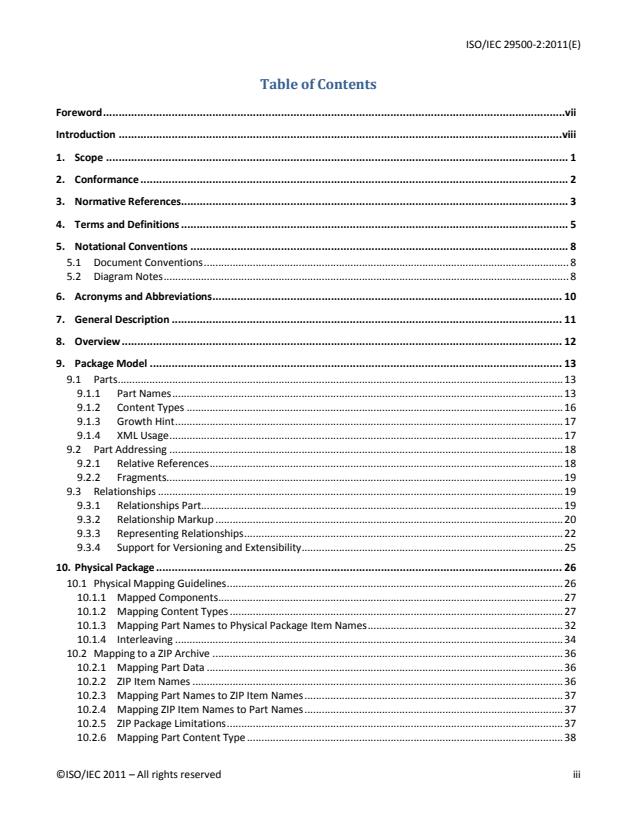
Table of Contents
Foreword .vii
Introduction . viii
1. Scope . 1
2. Conformance . 2
3. Normative References . 3
4. Terms and Definitions . 5
5. Notational Conventions . 8
5.1 Document Conventions . 8
5.2 Diagram Notes . 8
6. Acronyms and Abbreviations . 10
7. General Description . 11
8. Overview . 12
9. Package Model . 13
9.1 Parts . 13
9.1.1 Part Names . 13
9.1.2 Content Types . 16
9.1.3 Growth Hint . 17
9.1.4 XML Usage . 17
9.2 Part Addressing . 18
9.2.1 Relative References . 18
9.2.2 Fragments . 19
9.3 Relationships . 19
9.3.1 Relationships Part. 19
9.3.2 Relationship Markup . 20
9.3.3 Representing Relationships . 22
9.3.4 Support for Versioning and Extensibility . 25
10. Physical Package . 26
10.1 Physical Mapping Guidelines . 26
10.1.1 Mapped Components . 27
10.1.2 Mapping Content Types . 27
10.1.3 Mapping Part Names to Physical Package Item Names . 32
10.1.4 Interleaving . 34
10.2 Mapping to a ZIP Archive . 36
10.2.1 Mapping Part Data . 36
10.2.2 ZIP Item Names . 36
10.2.3 Mapping Part Names to ZIP Item Names . 37
10.2.4 Mapping ZIP Item Names to Part Names . 37
10.2.5 ZIP Package Limitations . 37
10.2.6 Mapping Part Content Type . 38
©ISO/IEC 2011 – All rights reserved iii
10.2.7 Mapping the Growth Hint . 38
10.2.8 Late Detection of ZIP Items Unfit for Streaming Consumption . 39
10.2.9 ZIP Format Clarifications for Packages . 39
11. Core Properties . 40
11.1 Core Properties Part . 41
11.2 Location of Core Properties Part . 43
11.3 Support for Versioning and Extensibility . 43
11.4 Schema Restrictions for Core Properties . 43
12. Thumbnails . 45
12.1 Thumbnail Parts. 45
13. Digital Signatures . 46
13.1 Choosing Content to Sign . 46
13.2 Digital Signature Parts . 46
13.2.1 Digital Signature Origin Part . 47
13.2.2 Digital Signature XML Signature Part . 47
13.2.3 Digital Signature Certificate Part . 48
13.2.4 Digital Signature Markup . 48
13.3 Digital Signature Example . 58
13.4 Generating Signatures . 60
13.5 Validating Signatures . 61
13.5.1 Signature Validation and Streaming Consumption . 62
13.6 Support for Versioning and Extensibility . 62
13.6.1 Using Relationship Types . 62
13.6.2 Markup Compatibility Namespace for Package Digital Signatures . 62
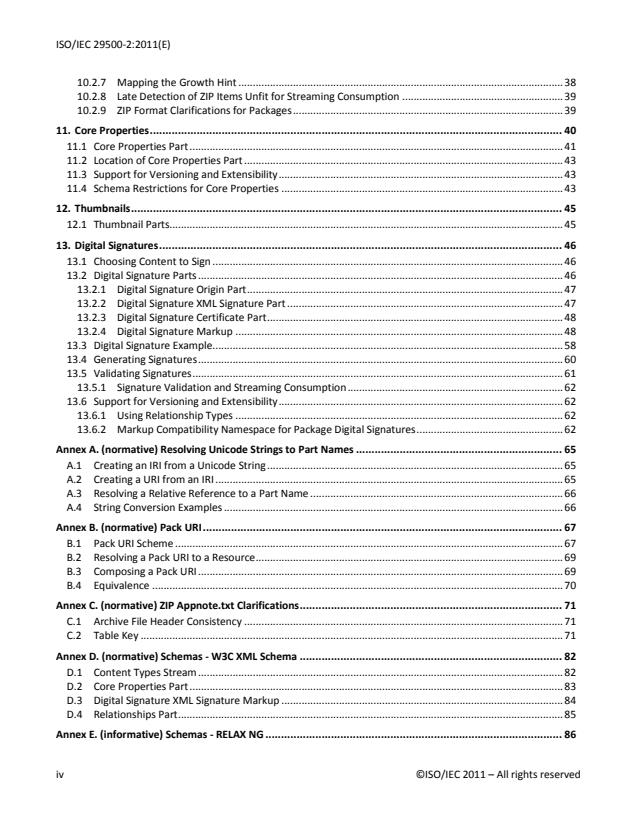
Annex A. (normative) Resolving Unicode Strings to Part Names . 65
A.1 Creating an IRI from a Unicode String . 65
A.2 Creating a URI from an IRI . 65
A.3 Resolving a Relative Reference to a Part Name . 66
A.4 String Conversion Examples . 66
Annex B. (normative) Pack URI . 67
B.1 Pack URI Scheme . 67
B.2 Resolving a Pack URI to a Resource . 69
B.3 Composing a Pack URI . 69
B.4 Equivalence . 70
Annex C. (normative) ZIP Appnote.txt Clarifications . 71
C.1 Archive File Header Consistency . 71
C.2 Table Key . 71
Annex D. (normative) Schemas - W3C XML Schema . 82
D.1 Content Types Stream . 82
D.2 Core Properties Part . 83
D.3 Digital Signature XML Signature Markup . 84
D.4 Relationships Part . 85
Annex E. (informative) Schemas - RELAX NG . 86
iv ©ISO/IEC 2011 – All rights reserved
E.1 Content Types Stream . 86
E.2 Core Properties Part . 87
E.3 Digital Signature XML Signature Markup . 87
E.4 Relationships Part . 88
E.5 Additional Resources . 89
E.5.1 XML . 89
E.5.2 XML Digital Signature Core. 89
Annex F. (normative) Standard Namespaces and Content Types. 90
Annex G. (informative) Physical Model Design Considerations . 92
G.1 Access Styles . 93
G.1.1 Direct Access Consumption . 93
G.1.2 Streaming Consumption . 93
G.1.3 Streaming Creation . 93
G.1.4 Simultaneous Creation and Consumption . 93
G.2 Layout Styles . 93
G.2.1 Simple Ordering. 93
G.2.2 Interleaved Ordering . 94
G.3 Communication Styles . 94
G.3.1 Sequential Delivery . 94
G.3.2 Random Access. 94
Annex H. (informative) Guidelines for Meeting Conformance . 95
H.1 Package Model . 95
H.2 Physical Packages . 103
H.3 ZIP Physical Mapping . 108
H.4 Core Properties . 112
H.5 Thumbnail . 114
H.6 Digital Signatures . 114
H.7 Pack URI . 125
Annex I. (informative) Differences Between ISO/IEC 29500 and ECMA-376:2006 . 127
I.1 XML Elements . 127
I.2 XML Attributes. 127
I.3 XML Enumeration Values . 127
I.4 XML Simple Types . 127
Annex J. (informative) Index . 128
©ISO/IEC 2011 – All rights reserved v
Foreword
ISO (the International Organization for Standardization) and IEC (the International Electrotechnical Commission)
form the specialized system for worldwide standardization. National bodies that are members of ISO or IEC
participate in the development of International Standards through technical committees established by the
respective organization to deal with particular fields of technical activity. ISO and IEC technical committees
collaborate in fields of mutual interest. Other international organizations, governmental and non-governmental,
in liaison with ISO and IEC, also take part in the work. In the field of information technology, ISO and IEC have
established a joint technical committee, ISO/IEC JTC 1.
International Standards are drafted in accordance with the rules given in the ISO/IEC Directives, Part 2.
The main task of the joint technical committee is to prepare International Standards. Draft International
Standards adopted by the joint technical committee are circulated to national bodies for voting. Publication as
an International Standard requires approval by at least 75% of the national bodies casting a vote.
Attention is drawn to the possibility that some of the elements of this document may be the subject of patent
rights. ISO and IEC shall not be held responsible for identifying any or all such patent rights.
ISO/IEC 29500-2 was prepared by ISO/IEC JTC 1, Information technology, Subcommittee SC 34, Document
description and processing languages.
This second edition cancels and replaces the first edition (ISO/IEC 29500-2:2008), which has been technically
revised by incorporation of the Technical Corrigendum ISO/IEC 29500-2:2008/Cor.1:2010.
ISO/IEC 29500 consists of the following parts, under the general title Information technology — Document
description and processing languages — Office Open XML File Formats:
Part 1: Fundamentals and Markup Language Reference
Part 2: Open Packaging Conventions
Part 3: Markup Compatibility and Extensibility
Part 4: Transitional Migration Features
Annexes A, B, C, D, and F form a normative part of this Part of ISO/IEC 29500. Annexes E, G, H, I, and J are for
information only.
This Part of ISO/IEC 29500 includes two annexes (Annex D and Annex E) that refer to data files provided in
electronic form.
©ISO/IEC 2011 – All rights reserved vii
Introduction
ISO/IEC 29500 specifies a family of XML schemas, collectively called Office Open XML, which define the XML
vocabularies for word-processing, spreadsheet, and presentation documents, as well as the packaging of
documents that conform to these schemas.
The goal is to enable the implementation of the Office Open XML formats by the widest set of tools and
platforms, fostering interoperability across office productivity applications and line-of-business systems, as well
as to support and strengthen document archival and preservation, all in a way that is fully compatible with the
existing corpus of Microsoft Office documents.
The following organizations have participated in the creation of ISO/IEC 29500 and their contributions are
gratefully acknowledged:
Apple, Barclays Capital, BP, The British Library, Essilor, Intel, Microsoft, NextPage, Novell, Statoil, Toshiba, and
the United States Library of Congress
viii ©ISO/IEC 2011 – All rights reserved
INTERNATIONAL STANDARD ISO/IEC 29500-2:2011(E)
Information technology — Document description and
processing languages — Office Open XML File Formats
Part 2:
Open Packaging Conventions
1. Scope
This Part of ISO/IEC 29500 specifies a set of conventions that are used by Office Open XML documents to define
the structure and functionality of a package in terms of a package model and a physical model.
The package model is a package abstraction that holds a collection of parts. The parts are composed, processed,
and persisted according to a set of rules. Parts can have relationships to other parts or external resources, and
the package as a whole can have relationships to parts it contains or to external resources. The package model
specifies how the parts of a package are named and related. Parts have content types and are uniquely
identified using the well-defined naming rules provided in this Part of ISO/IEC 29500.
The physical mapping defines the mapping of the components of the package model to the features of a specific
physical format, namely a ZIP archive.
This Part of ISO/IEC 29500 also describes certain features that might be supported in a package, including core
properties for package metadata, a thumbnail for graphical representation of a package, and digital signatures
of package contents.
Because this Part of ISO/IEC 29500 might evolve, packages are designed to accommodate extensions and to
support compatibility goals in a limited way. The versioning and extensibility mechanisms described in Part 3
support compatibility between software systems based on different versions of this Part of ISO/IEC 29500 while
allowing package creators to make use of new or proprietary features.
This Part of ISO/IEC 29500 specifies requirements for documents, producers, and consumers. Conformance
requirements are identified throughout the text of this Part of ISO/IEC 29500. A formal conformance statement
is given in §2. An informative summary of requirements relevant to particular classes of developers is given in
Annex H.
©ISO/IEC 2011 – All rights reserved 1
2. Conformance
Each conformance requirement is given a unique ID comprised of a letter (M – MANDATORY; S – SHOULD; O –
OPTIONAL), an identifier for the topic to which it relates, and a unique ID within that topic. (Producers and
consumers might use these IDs to report error conditions.) Mandatory requirements are those stated with the
normative terms "shall," "shall not," or any of their normative equivalents. Should items are those stated with
the normative terms "should," "should not," or any of their normative equivalents. Optional requirements are
those stated with the normative terms "can," "cannot," "might," "might not," or any of their normative
equivalents.
[Example: Package implementers shall not map logical item name(s) mapped to the Content Types stream in a
ZIP archive to a part name. [M3.11] end example]
Each Part of this multi-part standard has its own conformance clause, as appropriate. The term conformance
class is used to disambiguate conformance within different Parts of this multi-part standard. This Part of ISO/IEC
29500 has only one conformance class, OPC (that is, Open Packaging Conventions).
A document is of conformance class OPC if it obeys all syntactic constraints specified in this Part of ISO/IEC
29500.
OPC conformance is purely syntactic.
2 ©ISO/IEC 2011 – All rights reserved
3. Normative References
The following referenced documents are indispensable for the application of this document. For dated
references, only the edition cited applies. For undated references, the latest edition of the referenced document
(including any amendments) applies.
American National Standards Institute, Coded Character Set — 7-bit American Standard Code for Information
Interchange, ANSI X3.4, 1986.
ISO 8601, Data elements and interchange formats — Information interchange — Representation of dates and
times.
ISO/IEC 9594-8 | ITU-T Rec. X.509, Information technology — Open Systems Interconnection — The Directory:
Public-key and attribute certificate frameworks.
ISO/IEC 10646, Information technology — Universal Coded Character Set (UCS).
ISO/IEC 29500-3, Information technology — Document description and processing languages — Office Open XML
File Formats, Part 3: Markup Compatibility and Extensibility.
Dublin Core Element Set v1.1. http://purl.org/dc/elements/1.1/
Dublin Core Terms Namespace. http://purl.org/dc/terms/
Extensible Markup Language (XML) 1.0 (Third Edition), W3C Recommendation, 04 February 2004.
Namespaces in XML 1.1, W3C Recommendation, 4 February 2004.
RFC 2616 Hypertext Transfer Protocol — HTTP/1.1, The Internet Society, Berners-Lee, T., R. Fielding, H. Frystyk, J.
Gettys, P. Leach, L. Masinter, and J. Mogul, 1999, http://www.ietf.org/rfc/rfc2616.txt.
RFC 3986 Uniform Resource Identifier (URI): Generic Syntax, The Internet Society, Berners-Lee, T., R. Fielding,
and L. Masinter, 2005, http://www.ietf.org/rfc/rfc3986.txt.
RFC 3987 Internationalized Resource Identifiers (IRIs), The Internet Society, Duerst, M. and M. Suignard, 2005,
http://www.ietf.org/rfc/rfc3987.txt.
RFC 4234 Augmented BNF for Syntax Specifications: ABNF, The Internet Society, Crocker, D., (editor), 2005,
http://www.ietf.org/rfc/rfc4234.txt.
The Unicode Consortium. The Unicode Standard, http://www.unicode.org/standard/standard.html.
W3C NOTE 19980827, Date and Time Formats, Wicksteed, Charles, and Misha Wolf, 1997,
http://www.w3.org/TR/1998/NOTE-datetime-19980827.
©ISO/IEC 2011 – All rights reserved 3
XML, Tim Bray, Jean Paoli, Eve Maler, C. M. Sperberg-McQueen, and François Yergeau (editors). Extensible
Markup Language (XML) 1.0, Fourth Edition. World Wide Web Consortium. 2006.
http://www.w3.org/TR/2006/REC-xml-20060816/. [Implementers should be aware that a further correction of
the normative reference to XML to refer to the 5th Edition will be necessary when the related Reference
Specifications to which this International Standard also makes normative reference and which also depend upon
XML, such as XSLT, XML Namespaces and XML Base, are all aligned with the 5th Edition.]
XML Namespaces, Tim Bray, Dave Hollander, Andrew Layman, and Richard Tobin (editors). Namespaces in
XML 1.0 (Third Edition), 8 December 2009. World Wide Web Consortium. http://www.w3.org/TR/2009/REC-xml-
names-20091208/
XML Base, W3C Recommendation, 27 June 2001.
XML Path Language (XPath), Version 1.0, W3C Recommendation, 16 November 1999.
XML Schema Part 1: Structures, W3C Recommendation, 28 October 2004.
XML Schema Part 2: Datatypes, W3C Recommendation, 28 October 2004.
XML-Signature Syntax and Processing, W3C Recommendation, 12 February 2002.
.ZIP File Format Specification from PKWARE, Inc., version 6.2.0 (2004), as specified in
http://www.pkware.com/documents/APPNOTE/APPNOTE_6.2.0.txt. [Note: The supported compression
algorithm is inferred from tables C-3 and C-4 in Annex C. end note]
4 ©ISO/IEC 2011 – All rights reserved
4. Terms and Definitions
For the purposes of this document, the following terms and definitions apply. Other terms are defined where
they appear in italic typeface. Terms explicitly defined in this Part of ISO/IEC 29500 are not to be presumed to
refer implicitly to similar terms defined elsewhere.
The terms base URI and relative reference are used in accordance with RFC 3986.
access style — The style in which local access or networked access is conducted. The access styles are as follows:
streaming creation, streaming consumption, simultaneous creation and consumption, and direct access
consumption.
behavior — External appearance or action.
behavior, implementation-defined — Unspecified behavior where each implementation shall document that
behavior, thereby promoting predictability and reproducibility within any given implementation. (This term is
sometimes called “application-defined behavior”.)
behavior, unspecified —Behavior where this Open Packaging specification imposes no requirements.
communication style — The style in which package contents are delivered by a producer or received by a
consumer. Communication styles include random access and sequential delivery.
consumer — A piece of software or a device that reads packages through a package implementer. A consumer is
often designed to consume packages only for a specific physical package format.
content type — Describes the content stored in a part. Content types define a media type, a subtype, and an
optional set of parameters, as defined in RFC 2616.
Content Types stream — A specially-named stream that defines mappings from part names to content types.
The content types stream is not itself a part, and is not URI addressable.
device — A piece of hardware, such as a personal computer, printer, or scanner, that performs a single function
or set of functions.
format consumer — A consumer that consumes packages conforming to a format designer's specification.
format designer — The author of a particular file format specification built on this Open Packaging Conventions
specification.
format producer — A producer that produces packages conforming to a format designer's specification.
growth hint — A suggested number of bytes to reserve for a part to grow in-place.
©ISO/IEC 2011 – All rights reserved 5
interleaved ordering — The layout style of a physical package where parts are broken into pieces and “mixed-
in” with pieces from other parts. When delivered, interleaved packages can help improve the performance of
the consumer processing the package.
layout style — The style in which the collection of parts in a physical package is laid out: either simple ordering
or interleaved ordering.
local access — The access architecture in which a pipe carries data directly from a producer to a consumer on a
single device.
logical item name — An abstraction that allows package implementers to manipulate physical data items
consistently regardless of whether those data items can be mapped to parts or not or whether the package is
laid out with simple ordering or interleaved ordering.
networked access — The access architecture in which a consumer and the producer communicate over a
protocol, such as across a process boundary, or between a server and a desktop computer.
pack URI — A URI scheme that allows URIs to be used as a uniform mechanism for addressing parts within a
package. Pack URIs are used as Base URIs for resolving relative references among parts in a package.
package — A logical entity that holds a collection of parts.
package implementer — Software that implements the physical input-output operations to a package according
to the requirements and recommendations of this Open Packaging specification. A package implementer is used
by a producer or consumer to interact with a physical package. A package implementer can be either a stand-
alone API or can be an integrated component of a producer, consumer application, or device.
package model — A package abstraction that holds a collection of parts.
package relationship — A relationship whose target is a part and whose source is the package as a whole.
Package relationships are found in the package relationships part named “/_rels/.rels”.
part — A stream of bytes with a MIME content type and associated common properties. Typically corresponds
to a file [Example: on a file system end example], a stream [Example: in a compound file end example], or a
resource [Example: in an HTTP URI end example].
part name — The path component of a pack URI. Part names are used to refer to a part in the context of a
package, typically as part of a URI.
physical model — A description of the capabilities of a particular physical format.
physical package format — A specific file format, or other persistence or transport mechanism, that can
represent all of the capabilities of a package.
piece — A portion of a part. Pieces of different parts can be interleaved together. The individual pieces are
named using a unique mapping from the part name. Piece name grammar is not equivalent to the part name
grammar. Pieces are not addressable in the package model.
6 ©ISO/IEC 2011 – All rights reserved
pipe — A communication mechanism that carries data from the producer to the consumer.
producer — A piece of software or a device that writes packages through a package implementer. A producer is
often designed to produce packages according to a particular physical package format specification.
random access — A style of communication between the producer and the consumer of the package. Random
access allows the consumer to reference and obtain data from anywhere within a package.
relationship —The kind of connection between a source part and a target part in a package. Relationships make
the connections between parts directly discoverable without looking at the content in the parts, and without
altering the parts themselves. (See also Package Relationships.)
relationships part — A part containing an XML representation of relationships.
sequential delivery — A communication style in which all of the physical bits in the package are delivered in the
order they appear in the package.
signature policy — A format-defined policy that specifies what configuration of parts and relationships shall or
might be included in a signature for that format and what additional behaviors that producers and consumers of
that format shall follow when applying or verifying signatures following that format's signature policy.
simple ordering — A defined ordering for laying out the parts in a package in which all the bits comprising each
part are stored contiguously.
simultaneous creation and consumption — A style of access between a producer and a consumer in highly
pipelined environments where streaming creation and streaming consumption occur simultaneously.
stream — A linearly ordered sequence of bytes.
streaming consumption — An access style in which parts of a physical package can be processed by a consumer
before all of the bits of the package have been delivered through the pipe.
streaming creation — A production style in which a producer dynamically adds parts to a package after other
parts have been added without modifying those parts.
thumbnail — A small image that is a graphical representation of a part or the package as a whole.
well-known part — A part with a well-known relationship, which enables the part to be found without knowing
the location of other parts.
XSD — W3C XML Schema
ZIP archive — A ZIP file as defined in the ZIP file format specification. A ZIP archive contains ZIP items.
ZIP item — A ZIP item is an atomic set of data in a ZIP archive that becomes a file when the archive is
uncompressed. When a user unzips a ZIP-based package, the user sees an organized set of files and folders.
©ISO/IEC 2011 – All rights reserved 7
5. Notational Conventions
5.1 Document Conventions
The following typographical conventions are used in ISO/IEC 29500:
1. The first occurrence of a new term is written in italics. [Example: The text in ISO/IEC 29500 is divided
into normative and informative categories. end example]
2. In each definition of a term in §4 (Terms and Definitions), the term is written in bold. [Example: behavior
— External appearance or action. end example]
3. The tag name of an XML element is written using an Element style. [Example: The bookmarkStart and
bookmarkEnd elements specify … end example]
4. The name of an XML attribute is written using an Attribute style. [Example: The dropCap attribute
specifies … end example]
5. The value of an XML attribute is written using a constant-width style. [Example: The attribute value of
auto specifies … end example]
6. The qualified or unqualified name of a simple type, complex type, or base datatype is written using a
Type style. [Example: The possible values for this attribute are defined by the ST_HexColor simple type.
end example]
5.2 Diagram Notes
In some cases, markup semantics are described using diagrams. The diagrams place the parent element on the
left, with attributes and child elements to the right. The symbols are described below.
Symbol Description
Required element: This box represents an element that shall appear
exactly once in markup when the parent element is included. The
“+” and “–” symbols on the right of these boxes have no semantic
meaning.
Optional element: This box represents an element that shall appear
zero or one times in markup when the parent element is included.
Range indicator: These numbers indicate that the designated
element or choice of elements can appear in markup any number of
times within the range specified.
Attribute group: This box indicates that the enclosed boxes are each
attributes of the parent element. Solid-border boxes are required
attributes; dashed-border boxes are optional attributes.
8 ©ISO/IEC 2011 – All rights reserved
Symbol Description
Sequence symbol: The element boxes connected to this symbol
shall appear in markup in the illustrated sequence only, from top to
bottom.
Choice symbol: Only one of the element boxes connected to this
symbol shall appear in markup.
Complex Type indicator: The elements within the dashed box are of
the complex type indicated.
©ISO/IEC 2011 – All rights reserved 9
6. Acronyms and Abbreviations
This clause is informative.
The following acronyms and abbreviations are used throughout this Part of ISO/IEC 29500:
IEC — the International Electrotechnical Commission
ISO — the International Organization for Standardization
W3C — World Wide Web Consortium
End of informative text.
10 ©ISO/IEC 2011 – All rights reserved
7. General Description
This Open Packaging specification is intended for use by implementers, academics, and application
programmers. As such, it contains a considerable amount of explanatory material that, strictly speaking, is not
necessary in a formal specification.
This Open Packaging specification is divided into the following subdivisions:
1. Front matter (clauses 1–7);
2. Overview (clause 8);
3. Main body (clauses 9–13);
4. Annexes
Examples are provided to illustrate possible forms of the constructions described. References are used to refer
to related clauses. Notes are provided to give advice or guidance to implementers or programmers. Annexes
provide additional information and summarize the information contained in this Open Packaging specification.
The following form the normative part of this Open Packaging specification:
Introduction
Clauses 1–5, 7, and 9–13
Annex A–Annex D
Annex F
The following form the informative part of this Open Packaging specification:
Clauses 6 and 8
Annex E
Annex G–Annex J
All notes
All examples
Conformance requirements written as requirements for package implementers (e.g., M1.1) are document
conformance requirements.
Except for whole clauses or annexes that are identified as being informative, informative text that is contained
within normative text is indicated in the following ways:
1. [Example: code fragment, possibly with some narrative … end example]
2. [Note: narrative … end note]
3. [Rationale: narrative … end rationale]
4. [Guidance: narrative … end guidance]
©ISO/IEC 2011 – All rights reserved 11
8. Overview
This clause is informative.
This Open Packaging specification describes an abstract model and physical format conventions for the use of
XML, Unicode, ZIP, and other openly available technologies and specifications to organize the content and
resources of a document within a package. It is intended to support the content types and organization for
various applications and is written for developers who are building systems that process package content.
In addition, this Open Packaging specification defines common services that can be included in a package, such
as Core Properties and Digital Signatures.
A primary goal is to ensure the interoperability of independently created software and hardware systems that
produce or consume package content and use common services. This Open Packaging specification defines the
formal requirements that producers and consumers must satisfy in order to achieve interoperability.
Various XML-based building blocks within a package make use of the conventions described in Part 3 to facilitate
future enhancement and extension of XML markup. That part must be cited explicitly by any markup
specification that bases its versioning and extensibility strategy on Markup Compatibility elements and
attributes.
End of informative text.
12 ©ISO/IEC 2011 – All rights reserved
9. Package Model
A package is a logical entity that holds a collection of parts. The purpose of the package is to aggregate all of the
pieces of a document (or other type of content) into a single object. [Example: A package holding a document
with a picture might contain two parts: an XML markup part representing the document, and another part
representing the
...
Questions, Comments and Discussion
Ask us and Technical Secretary will try to provide an answer. You can facilitate discussion about the standard in here.
Loading comments...