

ISO 9876:2015
(Main)Ships and marine technology — Marine facsimile receivers for meteorological charts
General Information
- Abstract
ISO 9876:2015 specifies the construction, performance, type testing, and inspection for a ship borne marine facsimile receiver that receives meteorological charts transmitted by "Facsimile transmission of meteorological chart over radio circuits" stated in accordance with World Meteorological Organization (WMO) publication No. 386, Part 111-5. ISO 9876:2015 applies to ship borne radio facsimile receivers for the reception of meteorological charts and other graphical representation of meteorological conditions intended as an aid to navigation at sea.
- Status
- Published
- Publication Date
- 17-Mar-2015
- Technical Committee
- ISO/TC 8/SC 6 - Navigation and ship operations
- Drafting Committee
- ISO/TC 8/SC 6 - Navigation and ship operations
- Current Stage
- 9060 - Close of review
- Completion Date
- 04-Jun-2031
Buy Documents
ISO 9876:2015 - Ships and marine technology -- Marine facsimile receivers for meteorological charts
ISO 9876:2015 - Ships and marine technology — Marine facsimile receivers for meteorological charts/18/2015
Overview
ISO 9876:2015 - Ships and marine technology: Marine facsimile receivers for meteorological charts - defines construction, performance, type testing and inspection requirements for ship‑borne radio facsimile receivers that receive meteorological charts transmitted in accordance with the World Meteorological Organization (WMO) Publication No. 386, Part III‑5. The standard ensures reliable reception and readable chart reproduction as an aid to navigation at sea.
Key topics and technical requirements
ISO 9876:2015 covers both the recording unit and the radio receiver and specifies measurable performance and test methods:
Construction and usability
- Receiver plus recording unit configuration
- Recording unit designed for paper and stylus changes under day or subdued artificial light
- Bridge‑mounted, weather‑protected equipment (in line with IEC 60945)
Recording unit performance
- Continuous recording during reception
- Accepts audio‑frequency input (600 Ω) in the range specified (input level approximately −10 dBm to +10 dBm) and frequency shifts about a 1 900 Hz centre
- Automatic or manual Index of Cooperation (IOC) selection: IOC 576 and 288
- Scanning speeds: 60, 90 and 120 scans/min (automatic/manual)
- Automatic responses to IOC, phasing and stop control signals (300 Hz, 675 Hz, 450 Hz signals described)
- Minimum recording width: 180 mm; recording paper marked to show at least 1 m remaining
Radio receiver performance
- Receiving range: equipment shall cover a range within 110 kHz to 27 MHz, with at least 3 MHz to 24 MHz capability and support for F3C emissions
- Up to six pre‑set spot frequencies with clear identification
- Frequency stability: drift not to exceed 50 Hz over +15 °C to +35 °C
- Sensitivity: ≤ 3 μV for ≥ 3 MHz; ≤ 10 μV for 110 kHz–3 MHz
- Selectivity: passband limits ≈ 6.2 kHz (6 dB) and 10 kHz (66 dB); image and intermediate frequency rejection specified
Test methods and inspection
- Type testing using signal generators or actual facsimile transmissions
- Visual and performance checks for synchronization, pitch, completeness and chart fidelity
Applications and users
ISO 9876:2015 is intended for:
- Ship equipment manufacturers designing marine facsimile receivers
- Shipowners, ship operators and shipyards procuring bridge navigation equipment
- Classification societies and certification bodies performing type approval and inspection
- Marine electrical testing laboratories and maintenance teams ensuring reliable meteorological chart reception for voyage planning and safety
Related standards
- WMO Publication No. 386, Part III‑5 (facsimile transmission of meteorological charts)
- IEC 60945 - Maritime navigation and radiocommunication equipment - general requirements
- ITU Radio Regulations (F3C emission designation)
Compliance with ISO 9876:2015 helps ensure consistent, readable meteorological facsimiles on board ships, supporting safe navigation and operational decision‑making.
Relations
- Revises
ISO 9876:1997 - Ships and marine technology — Marine facsimile receivers for meteorological charts - Effective Date
- 12-Feb-2014
Buy Documents
ISO 9876:2015 - Ships and marine technology -- Marine facsimile receivers for meteorological charts
ISO 9876:2015 - Ships and marine technology — Marine facsimile receivers for meteorological charts/18/2015
Get Certified
Connect with accredited certification bodies for this standard

DNV
DNV is an independent assurance and risk management provider.

Lloyd's Register
Lloyd's Register is a global professional services organisation specialising in engineering and technology.

FSC International
Forest Stewardship Council certification.
Sponsored listings
Frequently Asked Questions
ISO 9876:2015 is a standard published by the International Organization for Standardization (ISO). Its full title is "Ships and marine technology — Marine facsimile receivers for meteorological charts". This standard covers: ISO 9876:2015 specifies the construction, performance, type testing, and inspection for a ship borne marine facsimile receiver that receives meteorological charts transmitted by "Facsimile transmission of meteorological chart over radio circuits" stated in accordance with World Meteorological Organization (WMO) publication No. 386, Part 111-5. ISO 9876:2015 applies to ship borne radio facsimile receivers for the reception of meteorological charts and other graphical representation of meteorological conditions intended as an aid to navigation at sea.
ISO 9876:2015 specifies the construction, performance, type testing, and inspection for a ship borne marine facsimile receiver that receives meteorological charts transmitted by "Facsimile transmission of meteorological chart over radio circuits" stated in accordance with World Meteorological Organization (WMO) publication No. 386, Part 111-5. ISO 9876:2015 applies to ship borne radio facsimile receivers for the reception of meteorological charts and other graphical representation of meteorological conditions intended as an aid to navigation at sea.
ISO 9876:2015 is classified under the following ICS (International Classification for Standards) categories: 47.020.70 - Navigation and control equipment. The ICS classification helps identify the subject area and facilitates finding related standards.
ISO 9876:2015 has the following relationships with other standards: It is inter standard links to ISO 9876:1997. Understanding these relationships helps ensure you are using the most current and applicable version of the standard.
ISO 9876:2015 is available in PDF format for immediate download after purchase. The document can be added to your cart and obtained through the secure checkout process. Digital delivery ensures instant access to the complete standard document.
Standards Content (Sample)
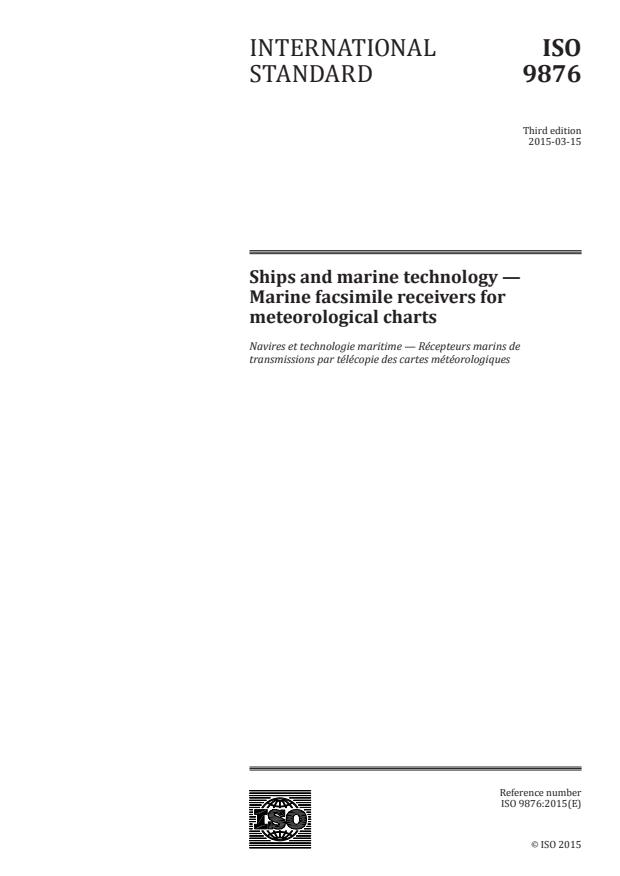
INTERNATIONAL ISO
STANDARD 9876
Third edition
2015-03-15
Ships and marine technology —
Marine facsimile receivers for
meteorological charts
Navires et technologie maritime — Récepteurs marins de
transmissions par télécopie des cartes météorologiques
Reference number
©
ISO 2015
© ISO 2015
All rights reserved. Unless otherwise specified, no part of this publication may be reproduced or utilized otherwise in any form
or by any means, electronic or mechanical, including photocopying, or posting on the internet or an intranet, without prior
written permission. Permission can be requested from either ISO at the address below or ISO’s member body in the country of
the requester.
ISO copyright office
Case postale 56 • CH-1211 Geneva 20
Tel. + 41 22 749 01 11
Fax + 41 22 749 09 47
E-mail copyright@iso.org
Web www.iso.org
Published in Switzerland
ii © ISO 2015 – All rights reserved
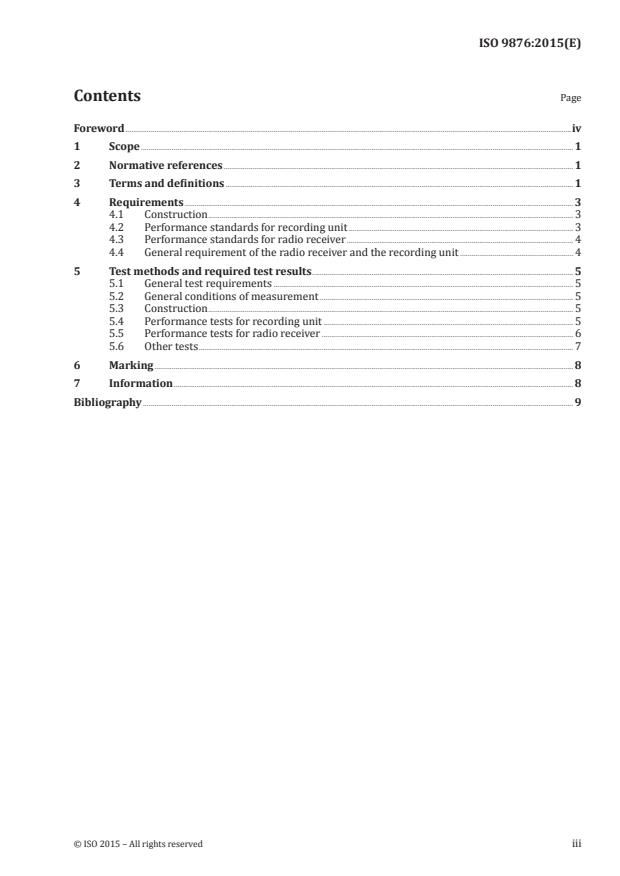
Contents Page
Foreword .iv
1 Scope . 1
2 Normative references . 1
3 Terms and definitions . 1
4 Requirements . 3
4.1 Construction . 3
4.2 Performance standards for recording unit . 3
4.3 Performance standards for radio receiver . 4
4.4 General requirement of the radio receiver and the recording unit . 4
5 Test methods and required test results . 5
5.1 General test requirements . 5
5.2 General conditions of measurement . 5
5.3 Construction . 5
5.4 Performance tests for recording unit . 5
5.5 Performance tests for radio receiver . 6
5.6 Other tests . 7
6 Marking . 8
7 Information . 8
Bibliography . 9
Foreword
ISO (the International Organization for Standardization) is a worldwide federation of national standards
bodies (ISO member bodies). The work of preparing International Standards is normally carried out
through ISO technical committees. Each member body interested in a subject for which a technical
committee has been established has the right to be represented on that committee. International
organizations, governmental and non-governmental, in liaison with ISO, also take part in the work.
ISO collaborates closely with the International Electrotechnical Commission (IEC) on all matters of
electrotechnical standardization.
The procedures used to develop this document and those intended for its further maintenance are
described in the ISO/IEC Directives, Part 1. In particular the different approval criteria needed for the
different types of ISO documents should be noted. This document was drafted in accordance with the
editorial rules of the ISO/IEC Directives, Part 2 (see www.iso.org/directives).
Attention is drawn to the possibility that some of the elements of this document may be the subject of
patent rights. ISO shall not be held responsible for identifying any or all such patent rights. Details of any
patent rights identified during the development of the document will be in the Introduction and/or on
the ISO list of patent declarations received (see www.iso.org/patents).
Any trade name used in this document is information given for the convenience of users and does not
constitute an endorsement.
For an explanation on the meaning of ISO specific terms and expressions related to conformity
assessment, as well as information about ISO’s adherence to the WTO principles in the Technical Barriers
to Trade (TBT), see the following URL: Foreword — Supplementary information.
The committee responsible for this document is ISO/TC 8, Ships and marine technology, Subcommittee
SC 6, Navigation and ship operations.
This third edition cancels and replaces the second edition (ISO 9876:1997), which has been technically
revised.
iv © ISO 2015 – All rights reserved
INTERNATIONAL STANDARD ISO 9876:2015(E)
Ships and marine technology — Marine facsimile receivers
for meteorological charts
1 Scope
This International Standard specifies the construction, performance, type testing, and inspection for
a ship borne marine facsimile receiver that receives meteorological charts transmitted by “Facsimile
transmission of meteorological chart over radio circuits” stated in accordance with World Meteorological
Organization (WMO) publication No. 386, Part III-5.
This International Standard applies to ship borne radio facsimile receivers for the reception of
meteorological charts and other graphical representation of meteorological conditions intended as an
aid to navigation at sea.
2 Normative references
The following documents, in whole or in part, are normatively referenced in this document and are
indispensable for its application. For dated references, only the edition cited applies. For undated
references, the latest edition of the referenced document (including any amendments) applies.
IEC 60945, Maritime navigation and radiocommunication equipment and systems – General requirements
–Methods of testing and required test results
3 Terms and definitions
For the purposes of this document, the following terms and definitions apply.
3.1
dead sector
part of scanning line unavailable for picture signal transmissions the criteria of which are within
4,5 % ± 0,5 % of the length
3.2
facsimile
process, or the result of the process, by which fixed graphic charts are scanned and the information is
converted to electric signals which are used remotely to produce a copy of the chart in record form
3.3
F3C
radio emissions designation from ITU Radio Regulations Appendix 1 for frequency modulation, single
channel having analog information, facsimile
3.4
index of cooperation
IOC
value of the index of cooperation, M, is defined as follows:
ML= F /π
where
L is the length of the scanning line, in centimetres;
F is the density of the scanning line, in reciprocal centimetres.
3.5
IOC selection signal
signal for automatic IOC selection in the facsimile receiver which is accomplished by transmission of
alternating black and white signals lasting for 5 s to 10 s with the following frequencies:
— 300 Hz for IOC 576;
— 675 Hz for IOC 288 (or IOC 576 with alternate line scanning).
Note 1 to entry: The envelopes of the signal are approximately rectangular.
3.6
meteorological chart
chart portraying the state of the weather (such as weather conditions, wind force and direction, high or
low atmospheric pressure, weather front and isobar) at a particular time over a wide area
3.7
phasing
adjusting the phase of the independent synchronous power source so as to be able to receive the weather
chart in its correct position
3.8
phasing signal
signal for automatically phasing the facsimile receiver accomplished by a 30 s transmission of alternating
black and white signals with the following frequencies:
— 1 Hz for 60 lines per minute (60 r/min);
— 1,5 Hz for 90 lines per minute (90 r/min);
— 2 Hz for 120 lines per minutes (120 r/min).
Note 1 to entry: This signal may also be used for automatic starting, automatic selection of scanning frequency,
and automatic adjustment of recording levels.
Note 2 to entry: The wave form of this signal is either symmetrical, i.e. black and white, each lasting half the
scanning line, or symmetrical with the white lasting for 5 % and black for 95 % of the scanning line.
3.9
remote control signal
control signal for operating the apparatus from a distance
Note 1 to entry: The remote control signals for operating the facsimile receiver for meteorological charts include
the phasing signal, the IOC selection signal, and stop signal.
3.10
SND/N
value of signal plus noise plus distortion to noise ratio
2 © ISO 2015 – All rights reserved
3.11
SND/ND
value of signal plus noise plus distortion to noise plus distortion ratio
3.12
spurious responses
ratio of the input level of an unwanted signal at the frequency of the spurious response to the input level
of a wanted signal when the wanted and unwanted
...
INTERNATIONAL ISO
STANDARD 9876
Third edition
2015-03-15
Ships and marine technology —
Marine facsimile receivers for
meteorological charts
Navires et technologie maritime — Récepteurs marins de
transmissions par télécopie des cartes météorologiques
Reference number
©
ISO 2015
© ISO 2015
All rights reserved. Unless otherwise specified, no part of this publication may be reproduced or utilized otherwise in any form
or by any means, electronic or mechanical, including photocopying, or posting on the internet or an intranet, without prior
written permission. Permission can be requested from either ISO at the address below or ISO’s member body in the country of
the requester.
ISO copyright office
Case postale 56 • CH-1211 Geneva 20
Tel. + 41 22 749 01 11
Fax + 41 22 749 09 47
E-mail copyright@iso.org
Web www.iso.org
Published in Switzerland
ii © ISO 2015 – All rights reserved
Contents Page
Foreword .iv
1 Scope . 1
2 Normative references . 1
3 Terms and definitions . 1
4 Requirements . 3
4.1 Construction . 3
4.2 Performance standards for recording unit . 3
4.3 Performance standards for radio receiver . 4
4.4 General requirement of the radio receiver and the recording unit . 4
5 Test methods and required test results . 5
5.1 General test requirements . 5
5.2 General conditions of measurement . 5
5.3 Construction . 5
5.4 Performance tests for recording unit . 5
5.5 Performance tests for radio receiver . 6
5.6 Other tests . 7
6 Marking . 8
7 Information . 8
Bibliography . 9
Foreword
ISO (the International Organization for Standardization) is a worldwide federation of national standards
bodies (ISO member bodies). The work of preparing International Standards is normally carried out
through ISO technical committees. Each member body interested in a subject for which a technical
committee has been established has the right to be represented on that committee. International
organizations, governmental and non-governmental, in liaison with ISO, also take part in the work.
ISO collaborates closely with the International Electrotechnical Commission (IEC) on all matters of
electrotechnical standardization.
The procedures used to develop this document and those intended for its further maintenance are
described in the ISO/IEC Directives, Part 1. In particular the different approval criteria needed for the
different types of ISO documents should be noted. This document was drafted in accordance with the
editorial rules of the ISO/IEC Directives, Part 2 (see www.iso.org/directives).
Attention is drawn to the possibility that some of the elements of this document may be the subject of
patent rights. ISO shall not be held responsible for identifying any or all such patent rights. Details of any
patent rights identified during the development of the document will be in the Introduction and/or on
the ISO list of patent declarations received (see www.iso.org/patents).
Any trade name used in this document is information given for the convenience of users and does not
constitute an endorsement.
For an explanation on the meaning of ISO specific terms and expressions related to conformity
assessment, as well as information about ISO’s adherence to the WTO principles in the Technical Barriers
to Trade (TBT), see the following URL: Foreword — Supplementary information.
The committee responsible for this document is ISO/TC 8, Ships and marine technology, Subcommittee
SC 6, Navigation and ship operations.
This third edition cancels and replaces the second edition (ISO 9876:1997), which has been technically
revised.
iv © ISO 2015 – All rights reserved
INTERNATIONAL STANDARD ISO 9876:2015(E)
Ships and marine technology — Marine facsimile receivers
for meteorological charts
1 Scope
This International Standard specifies the construction, performance, type testing, and inspection for
a ship borne marine facsimile receiver that receives meteorological charts transmitted by “Facsimile
transmission of meteorological chart over radio circuits” stated in accordance with World Meteorological
Organization (WMO) publication No. 386, Part III-5.
This International Standard applies to ship borne radio facsimile receivers for the reception of
meteorological charts and other graphical representation of meteorological conditions intended as an
aid to navigation at sea.
2 Normative references
The following documents, in whole or in part, are normatively referenced in this document and are
indispensable for its application. For dated references, only the edition cited applies. For undated
references, the latest edition of the referenced document (including any amendments) applies.
IEC 60945, Maritime navigation and radiocommunication equipment and systems – General requirements
–Methods of testing and required test results
3 Terms and definitions
For the purposes of this document, the following terms and definitions apply.
3.1
dead sector
part of scanning line unavailable for picture signal transmissions the criteria of which are within
4,5 % ± 0,5 % of the length
3.2
facsimile
process, or the result of the process, by which fixed graphic charts are scanned and the information is
converted to electric signals which are used remotely to produce a copy of the chart in record form
3.3
F3C
radio emissions designation from ITU Radio Regulations Appendix 1 for frequency modulation, single
channel having analog information, facsimile
3.4
index of cooperation
IOC
value of the index of cooperation, M, is defined as follows:
ML= F /π
where
L is the length of the scanning line, in centimetres;
F is the density of the scanning line, in reciprocal centimetres.
3.5
IOC selection signal
signal for automatic IOC selection in the facsimile receiver which is accomplished by transmission of
alternating black and white signals lasting for 5 s to 10 s with the following frequencies:
— 300 Hz for IOC 576;
— 675 Hz for IOC 288 (or IOC 576 with alternate line scanning).
Note 1 to entry: The envelopes of the signal are approximately rectangular.
3.6
meteorological chart
chart portraying the state of the weather (such as weather conditions, wind force and direction, high or
low atmospheric pressure, weather front and isobar) at a particular time over a wide area
3.7
phasing
adjusting the phase of the independent synchronous power source so as to be able to receive the weather
chart in its correct position
3.8
phasing signal
signal for automatically phasing the facsimile receiver accomplished by a 30 s transmission of alternating
black and white signals with the following frequencies:
— 1 Hz for 60 lines per minute (60 r/min);
— 1,5 Hz for 90 lines per minute (90 r/min);
— 2 Hz for 120 lines per minutes (120 r/min).
Note 1 to entry: This signal may also be used for automatic starting, automatic selection of scanning frequency,
and automatic adjustment of recording levels.
Note 2 to entry: The wave form of this signal is either symmetrical, i.e. black and white, each lasting half the
scanning line, or symmetrical with the white lasting for 5 % and black for 95 % of the scanning line.
3.9
remote control signal
control signal for operating the apparatus from a distance
Note 1 to entry: The remote control signals for operating the facsimile receiver for meteorological charts include
the phasing signal, the IOC selection signal, and stop signal.
3.10
SND/N
value of signal plus noise plus distortion to noise ratio
2 © ISO 2015 – All rights reserved
3.11
SND/ND
value of signal plus noise plus distortion to noise plus distortion ratio
3.12
spurious responses
ratio of the input level of an unwanted signal at the frequency of the spurious response to the input level
of a wanted signal when the wanted and unwanted
...