

ISO 11111-5:2005/Amd 2:2016
(Amendment)Textile machinery — Safety requirements — Part 5: Preparatory machinery to weaving and knitting — Amendment 2
General Information
- Abstract
- Status
- Published
- Publication Date
- 18-May-2016
- Technical Committee
- ISO/TC 72/SC 8 - Safety requirements for textile machinery
- Drafting Committee
- ISO/TC 72/SC 8/WG 1 - Safety requirements for textile machinery
- Current Stage
- 9093 - International Standard confirmed
- Start Date
- 04-Feb-2026
- Completion Date
- 29-Aug-2026
Buy Documents


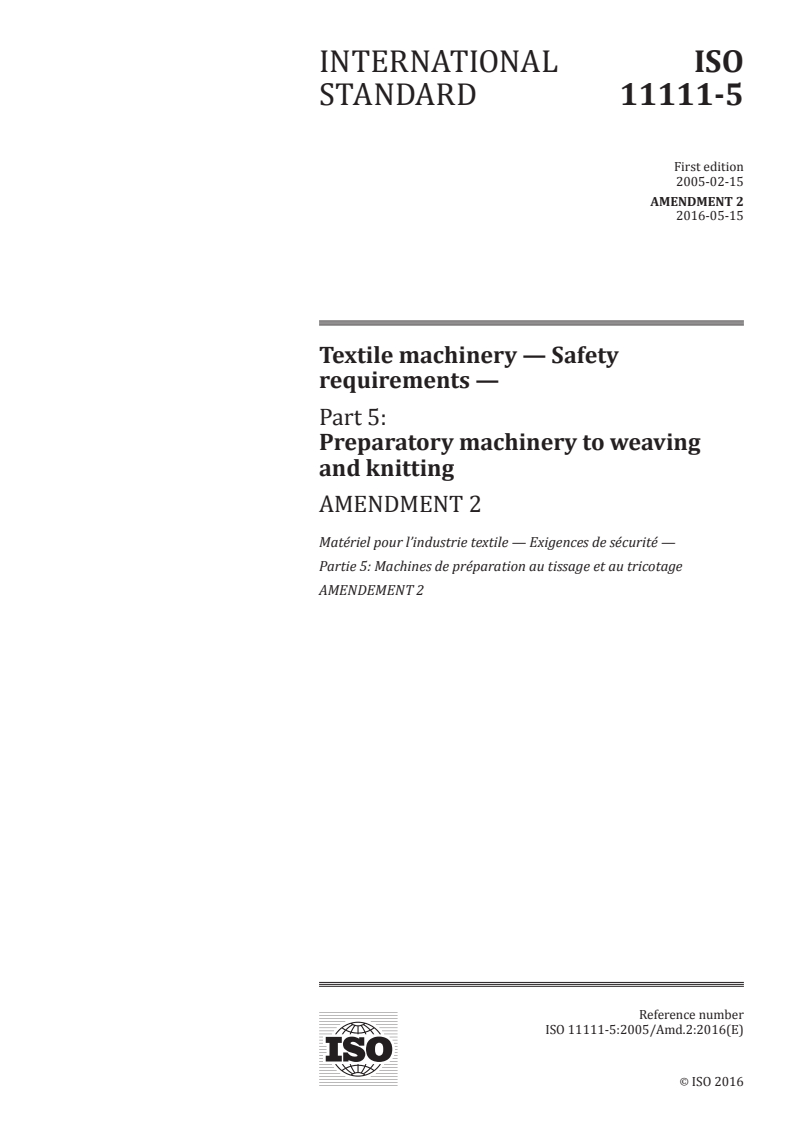

ISO 11111-5:2005/Amd 2:2016 - Textile machinery — Safety requirements — Part 5: Preparatory machinery to weaving and knitting — Amendment 2/19/2016


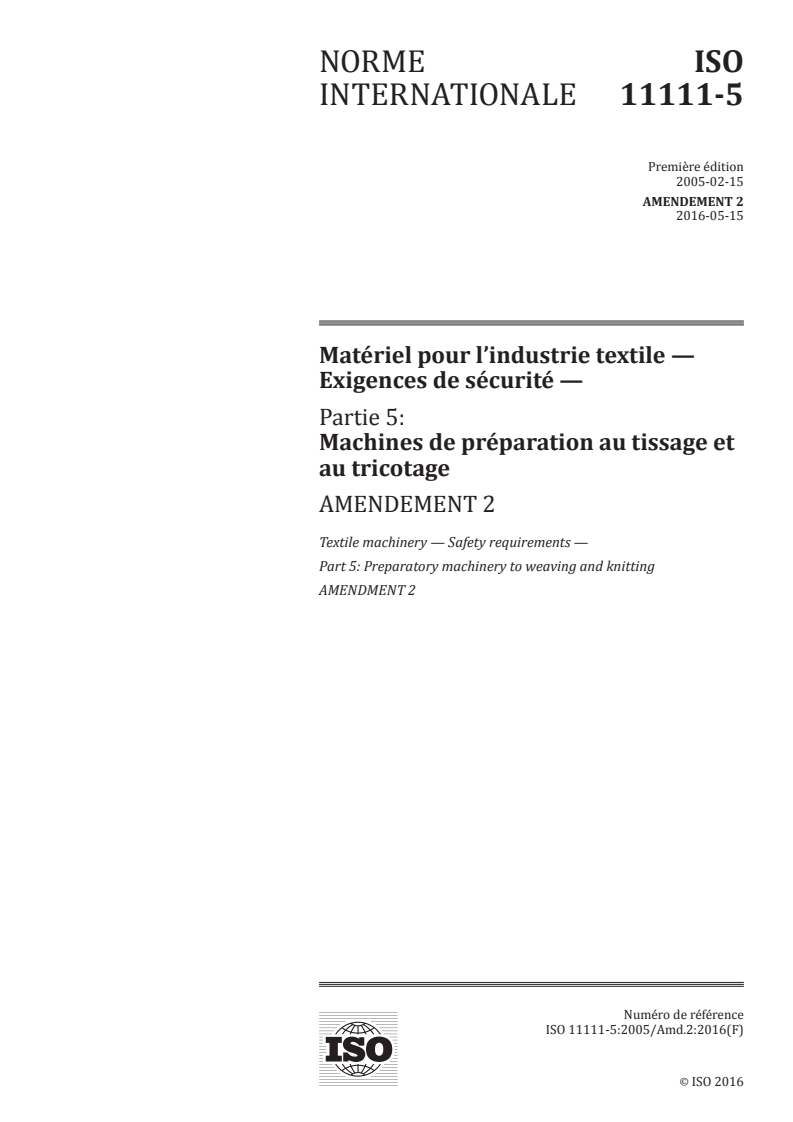

ISO 11111-5:2005/Amd 2:2016 - Matériel pour l'industrie textile — Exigences de sécurité — Partie 5: Machines de préparation au tissage et au tricotage — Amendement 2/19/2016
Overview
ISO 11111-5:2005/Amd 2:2016 is an important amendment to the international standard dedicated to the safety requirements of textile machinery, specifically focusing on preparatory machinery used in weaving and knitting processes. This update, published by ISO, refines and enhances the safety guidelines originally defined in ISO 11111-5:2005 to ensure improved protection for operators and compliance with modern safety benchmarks.
The document belongs to a series under ISO 11111, which addresses safety in various types of textile machinery. Amendment 2 emphasizes updated normative references, noise reduction measures, guarding requirements, and harmonization with related ISO safety standards. The standard is developed by ISO/TC 72, the technical committee specializing in textile machinery and accessories, ensuring industry relevance and technical rigor.
Key Topics
- Safety Enhancements for Preparatory Machinery: The amendment covers specific safety precautions for preparatory machines used before weaving and knitting, including those handling beams, warp threads, rollers, and drawing-in points.
- Updated Normative References: Updates references from earlier versions of ISO 11111 and introduces ISO 23771, which sets out design measures for noise emission reduction in textile machinery.
- Guarding and Safety Devices: Specifies the requirement for physical guards or safety devices around critical pinch points such as beam-to-thread interfaces and roller mechanisms, helping to prevent operator injuries.
- Harmonization with General Safety Standards: Aligns with ISO 12100, the general standard for machinery safety principles, risk assessment, and risk reduction, replacing older cited standards.
- Noise Emission Controls: Emphasizes adherence to type C standards ISO 9902-1, ISO 9902-5, and ISO 23771 concerning noise measurement and reduction, highlighting occupational health considerations.
- Electrical Safety Updates: Revises references to IEC 60204-1 for electrical equipment safety, reflecting the newest editions applicable to machinery in the textiles sector.
Applications
This standard is critical for manufacturers, safety engineers, and maintenance personnel involved in the design, operation, and servicing of preparatory textile machinery. It ensures:
- Operator Safety: By enforcing guarding around moving parts to prevent accidents and injuries.
- Regulatory Compliance: Assists companies in meeting international safety and noise emission regulations.
- Machine Design Improvements: Facilitates integration of modern risk assessment methods and noise reduction technologies.
- Workplace Health: Promotes quieter work environments by mandating adherence to noise emission standards, protecting workers from hearing damage.
- Machinery Upgrades: Supports retrofitting and modification of existing machines to current safety standards.
Applicable in industrial weaving and knitting settings, ISO 11111-5:2005/Amd 2:2016 plays a key role in minimizing risk in preparatory stages, which are often overlooked but critical for overall process safety.
Related Standards
- ISO 11111-1:2016 - Safety requirements for other categories of textile machinery, providing complementary guidelines across the ISO 11111 family.
- ISO 12100 - Safety of machinery - General principles for design and risk assessment fundamental to all machinery safety standards.
- ISO 9902-1 & ISO 9902-5 - Standards addressing noise emission measurement specific to textile machinery.
- ISO 23771 - Design measures for noise reduction in textile machinery, directly referenced to reduce occupational noise hazards.
- IEC 60204-1:2005 + A1:2008 - Electrical safety requirements for machinery, ensuring safe operation of electrical components.
Ensuring compliance with ISO 11111-5:2005/Amd 2:2016 not only improves textile machinery safety but also enhances operational efficiency and supports a healthier working environment. This amendment underscores ISO’s commitment to evolving industry best practices and upholding stringent safety criteria aligned with current technological and regulatory developments.
Relations
- Effective Date
- 09-Feb-2026
- Effective Date
- 12-Feb-2026
- Effective Date
- 06-Jun-2022
- Effective Date
- 14-Oct-2020
Buy Documents
ISO 11111-5:2005/Amd 2:2016 - Textile machinery — Safety requirements — Part 5: Preparatory machinery to weaving and knitting — Amendment 2/19/2016
ISO 11111-5:2005/Amd 2:2016 - Matériel pour l'industrie textile — Exigences de sécurité — Partie 5: Machines de préparation au tissage et au tricotage — Amendement 2/19/2016
Get Certified
Connect with accredited certification bodies for this standard

Control Union Certifications
Global certification for agriculture and sustainability.

Hohenstein Institut
Textile testing and certification.

Bureau Veritas Bangladesh
Bureau Veritas certification services in Bangladesh.
Sponsored listings
Frequently Asked Questions
ISO 11111-5:2005/Amd 2:2016 is a standard published by the International Organization for Standardization (ISO). Its full title is "Textile machinery — Safety requirements — Part 5: Preparatory machinery to weaving and knitting — Amendment 2". This standard covers: Textile machinery — Safety requirements — Part 5: Preparatory machinery to weaving and knitting — Amendment 2
Textile machinery — Safety requirements — Part 5: Preparatory machinery to weaving and knitting — Amendment 2
ISO 11111-5:2005/Amd 2:2016 is classified under the following ICS (International Classification for Standards) categories: 59.120.30 - Looms. Weaving machines; 59.120.40 - Knitting machines. The ICS classification helps identify the subject area and facilitates finding related standards.
ISO 11111-5:2005/Amd 2:2016 has the following relationships with other standards: It is inter standard links to EN ISO 11111-1:2016, EN ISO 11111-5:2005/A2:2016, ISO 22965-2:2007, ISO 11111-5:2005. Understanding these relationships helps ensure you are using the most current and applicable version of the standard.
ISO 11111-5:2005/Amd 2:2016 is available in PDF format for immediate download after purchase. The document can be added to your cart and obtained through the secure checkout process. Digital delivery ensures instant access to the complete standard document.
Standards Content (Sample)
INTERNATIONAL ISO
STANDARD 11111-5
First edition
2005-02-15
AMENDMENT 2
2016-05-15
Textile machinery — Safety
requirements —
Part 5:
Preparatory machinery to weaving
and knitting
AMENDMENT 2
Matériel pour l’industrie textile — Exigences de sécurité —
Partie 5: Machines de préparation au tissage et au tricotage
AMENDEMENT 2
Reference number
ISO 11111-5:2005/Amd.2:2016(E)
©
ISO 2016
ISO 11111-5:2005/Amd.2:2016(E)
© ISO 2016, Published in Switzerland
All rights reserved. Unless otherwise specified, no part of this publication may be reproduced or utilized otherwise in any form
or by any means, electronic or mechanical, including photocopying, or posting on the internet or an intranet, without prior
written permission. Permission can be requested from either ISO at the address below or ISO’s member body in the country of
the requester.
ISO copyright office
Ch. de Blandonnet 8 • CP 401
CH-1214 Vernier, Geneva, Switzerland
Tel. +41 22 749 01 11
Fax +41 22 749 09 47
copyright@iso.org
www.iso.org
ii © ISO 2016 – All rights reserved
ISO 11111-5:2005/Amd.2:2016(E)
Foreword
ISO (the International Organization for Standardization) is a worldwide federation of national standards
bodies (ISO member bodies). The work of preparing International Standards is normally carried out
through ISO technical committees. Each member body interested in a subject for which a technical
committee has been established has the right to be represented on that committee. International
organizations, governmental and non-governmental, in liaison with ISO, also take part in the work.
ISO collaborates closely with the International Electrotechnical Commission (IEC) on all matters of
electrotechnical standardization.
The procedures used to develop this document and those intended for its further maintenance are
described in the ISO/IEC Directives, Part 1. In particular the different approval criteria needed for the
different types of ISO documents should be noted. This document was drafted in accordance with the
editorial rules of the ISO/IEC Directives, Part 2 (see www.iso.org/directives).
Attention is drawn to the possibility that some of the elements of this document may be the subject of
patent rights. ISO shall not be held responsible for identifying any or all such patent rights. Details of
any patent rights identified during th
...
INTERNATIONAL ISO
STANDARD 11111-5
First edition
2005-02-15
AMENDMENT 2
2016-05-15
Textile machinery — Safety
requirements —
Part 5:
Preparatory machinery to weaving
and knitting
AMENDMENT 2
Matériel pour l’industrie textile — Exigences de sécurité —
Partie 5: Machines de préparation au tissage et au tricotage
AMENDEMENT 2
Reference number
ISO 11111-5:2005/Amd.2:2016(E)
©
ISO 2016
ISO 11111-5:2005/Amd.2:2016(E)
© ISO 2016, Published in Switzerland
All rights reserved. Unless otherwise specified, no part of this publication may be reproduced or utilized otherwise in any form
or by any means, electronic or mechanical, including photocopying, or posting on the internet or an intranet, without prior
written permission. Permission can be requested from either ISO at the address below or ISO’s member body in the country of
the requester.
ISO copyright office
Ch. de Blandonnet 8 • CP 401
CH-1214 Vernier, Geneva, Switzerland
Tel. +41 22 749 01 11
Fax +41 22 749 09 47
copyright@iso.org
www.iso.org
ii © ISO 2016 – All rights reserved
ISO 11111-5:2005/Amd.2:2016(E)
Foreword
ISO (the International Organization for Standardization) is a worldwide federation of national standards
bodies (ISO member bodies). The work of preparing International Standards is normally carried out
through ISO technical committees. Each member body interested in a subject for which a technical
committee has been established has the right to be represented on that committee. International
organizations, governmental and non-governmental, in liaison with ISO, also take part in the work.
ISO collaborates closely with the International Electrotechnical Commission (IEC) on all matters of
electrotechnical standardization.
The procedures used to develop this document and those intended for its further maintenance are
described in the ISO/IEC Directives, Part 1. In particular the different approval criteria needed for the
different types of ISO documents should be noted. This document was drafted in accordance with the
editorial rules of the ISO/IEC Directives, Part 2 (see www.iso.org/directives).
Attention is drawn to the possibility that some of the elements of this document may be the subject of
patent rights. ISO shall not be held responsible for identifying any or all such patent rights. Details of
any patent rights identified during th
...
NORME ISO
INTERNATIONALE 11111-5
Première édition
2005-02-15
AMENDEMENT 2
2016-05-15
Matériel pour l’industrie textile —
Exigences de sécurité —
Partie 5:
Machines de préparation au tissage et
au tricotage
AMENDEMENT 2
Textile machinery — Safety requirements —
Part 5: Preparatory machinery to weaving and knitting
AMENDMENT 2
Numéro de référence
ISO 11111-5:2005/Amd.2:2016(F)
©
ISO 2016
ISO 11111-5:2005/Amd.2:2016(F)
DOCUMENT PROTÉGÉ PAR COPYRIGHT
© ISO 2016, Publié en Suisse
Droits de reproduction réservés. Sauf indication contraire, aucune partie de cette publication ne peut être reproduite ni utilisée
sous quelque forme que ce soit et par aucun procédé, électronique ou mécanique, y compris la photocopie, l’affichage sur
l’internet ou sur un Intranet, sans autorisation écrite préalable. Les demandes d’autorisation peuvent être adressées à l’ISO à
l’adresse ci-après ou au comité membre de l’ISO dans le pays du demandeur.
ISO copyright office
Ch. de Blandonnet 8 • CP 401
CH-1214 Vernier, Geneva, Switzerland
Tel. +41 22 749 01 11
Fax +41 22 749 09 47
copyright@iso.org
www.iso.org
ii © ISO 2016 – Tous droits réservés
ISO 11111-5:2005/Amd.2:2016(F)
Avant-propos
L’ISO (Organisation internationale de normalisation) est une fédération mondiale d’organismes
nationaux de normalisation (comités membres de l’ISO). L’élaboration des Normes internationales est
en général confiée aux comités techniques de l’ISO. Chaque comité membre intéressé par une étude
a le droit de faire partie du comité technique créé à cet effet. Les organisations internationales,
gouvernementales et non gouvernementales, en liaison avec l’ISO participent également aux travaux.
L’ISO collabore étroitement avec la Commission électrotechnique internationale (IEC) en ce qui
concerne la normalisation électrotechnique.
Les procédures utilisées pour élaborer le présent document et celles destinées à sa mise à jour sont
décrites dans les Directives ISO/IEC, Partie 1. Il convient, en particulier de prendre note des différents
critères d’approbation requis pour les différents types de documents ISO. Le présent document a été
rédigé conformément aux règles de rédaction données dans les Directives ISO/IEC, Partie 2 (voir www.
iso.org/directives).
L’attention est appelée sur le fait que certains des éléments du présent document peuvent faire l’objet de
droits de propriété intellectuelle ou de droits analogues. L’ISO ne saurait être tenue pour responsable
de ne pas avoir identifié de tels droits de propriété et averti de leur existence. Les détails concernant
les références aux droits de propriété intellectuelle ou autres droits analogues identifiés lors de
l’élaboration du document sont indiqués dans l’Introduction et/ou dans la liste des déclara
...
NORME ISO
INTERNATIONALE 11111-5
Première édition
2005-02-15
AMENDEMENT 2
2016-05-15
Matériel pour l’industrie textile —
Exigences de sécurité —
Partie 5:
Machines de préparation au tissage et
au tricotage
AMENDEMENT 2
Textile machinery — Safety requirements —
Part 5: Preparatory machinery to weaving and knitting
AMENDMENT 2
Numéro de référence
ISO 11111-5:2005/Amd.2:2016(F)
©
ISO 2016
ISO 11111-5:2005/Amd.2:2016(F)
DOCUMENT PROTÉGÉ PAR COPYRIGHT
© ISO 2016, Publié en Suisse
Droits de reproduction réservés. Sauf indication contraire, aucune partie de cette publication ne peut être reproduite ni utilisée
sous quelque forme que ce soit et par aucun procédé, électronique ou mécanique, y compris la photocopie, l’affichage sur
l’internet ou sur un Intranet, sans autorisation écrite préalable. Les demandes d’autorisation peuvent être adressées à l’ISO à
l’adresse ci-après ou au comité membre de l’ISO dans le pays du demandeur.
ISO copyright office
Ch. de Blandonnet 8 • CP 401
CH-1214 Vernier, Geneva, Switzerland
Tel. +41 22 749 01 11
Fax +41 22 749 09 47
copyright@iso.org
www.iso.org
ii © ISO 2016 – Tous droits réservés
ISO 11111-5:2005/Amd.2:2016(F)
Avant-propos
L’ISO (Organisation internationale de normalisation) est une fédération mondiale d’organismes
nationaux de normalisation (comités membres de l’ISO). L’élaboration des Normes internationales est
en général confiée aux comités techniques de l’ISO. Chaque comité membre intéressé par une étude
a le droit de faire partie du comité technique créé à cet effet. Les organisations internationales,
gouvernementales et non gouvernementales, en liaison avec l’ISO participent également aux travaux.
L’ISO collabore étroitement avec la Commission électrotechnique internationale (IEC) en ce qui
concerne la normalisation électrotechnique.
Les procédures utilisées pour élaborer le présent document et celles destinées à sa mise à jour sont
décrites dans les Directives ISO/IEC, Partie 1. Il convient, en particulier de prendre note des différents
critères d’approbation requis pour les différents types de documents ISO. Le présent document a été
rédigé conformément aux règles de rédaction données dans les Directives ISO/IEC, Partie 2 (voir www.
iso.org/directives).
L’attention est appelée sur le fait que certains des éléments du présent document peuvent faire l’objet de
droits de propriété intellectuelle ou de droits analogues. L’ISO ne saurait être tenue pour responsable
de ne pas avoir identifié de tels droits de propriété et averti de leur existence. Les détails concernant
les références aux droits de propriété intellectuelle ou autres droits analogues identifiés lors de
l’élaboration du document sont indiqués dans l’Introduction et/ou dans la liste des déclara
...