

ISO 20032:2013
(Main)Method for evaluation of tensile properties of metallic superplastic materials
General Information
- Abstract
ISO 20032:2013 specifies a method for evaluating the tensile properties of metallic superplastic materials which exhibit what is called "Fine-Grained Superplasticity", without significant work-hardening or dynamic microstructure evolution, by means of a tensile test at constant cross-head velocity, for flat-form test pieces, without an extensometer attached.
- Status
- Published
- Publication Date
- 01-Aug-2013
- Technical Committee
- ISO/TC 164/SC 2 - Ductility testing
- Drafting Committee
- ISO/TC 164/SC 2 - Ductility testing
- Current Stage
- 9093 - International Standard confirmed
- Start Date
- 23-Jun-2024
- Completion Date
- 29-Aug-2026
Buy Documents
ISO 20032:2013 - Method for evaluation of tensile properties of metallic superplastic materials
ISO 20032:2013 - Method for evaluation of tensile properties of metallic superplastic materials/2/2013
Overview
ISO 20032:2013 specifies a standardized tensile test method for evaluating the tensile properties of metallic superplastic materials that display fine-grained superplasticity without significant work‑hardening or dynamic microstructure evolution. The test uses flat-form test pieces (S‑type or R‑type) strained at a constant cross‑head velocity and is performed without an extensometer. Key outputs include superplastic elongation (A), flow stress (σf), and the strain‑rate sensitivity exponent (m‑value) - parameters essential for superplastic forming and materials characterization.
Key Topics and Requirements
- Scope: Intended for fine‑grained superplastic metals tested at elevated temperatures using constant cross‑head velocity; extensometer-free measurements on flat specimens.
- Test pieces: Two specimen geometries are defined:
- S‑type (suitable for lower total strains; gauge and parallel‑side portions specified).
- R‑type (suitable for high‑strain testing since strain concentrates in a central arc‑shaped R portion).
- Dimensional tolerances align with ISO 6892‑1.
- Apparatus:
- Testing machine must conform to ISO 7500‑1 and provide constant cross‑head velocity.
- Clamping devices must resist plastic deformation at test temperature and apply only axial load (minimal pre‑tension to maintain straightness).
- Furnace with controlled, uniform temperature over the gauge length; allowable temperature stability varies with temperature bands (tight tolerances at moderate temperatures, agreed limits at extremes).
- Thermometry via thermocouple per IEC 60584 (or equivalent) to measure specimen temperature accurately.
- Controlled atmosphere considerations and pressure compensation for force readings if applicable.
- Procedure highlights:
- Clamping method to avoid off‑axis loads.
- Temperature measurement directly on the test piece.
- Dimensional measurement after testing for elongation and section area changes.
- Methods to determine m‑value and flow stress, including procedures specific to the R‑type specimen.
Applications and Users
- Who uses ISO 20032: materials engineers, metallurgists, test lab personnel, quality managers, and researchers involved in:
- Superplastic forming process development (aerospace, automotive, precision forming).
- Material selection and qualification for high‑temperature forming.
- R&D on fine‑grained alloys and superplastic behavior.
- Practical benefits: enables reproducible evaluation of superplastic capacity, strain‑rate sensitivity, and flow behavior needed for forming simulations, process optimization, and specification compliance.
Related Standards
- ISO 6892‑1, ISO 6892‑2 (tensile testing at room and elevated temperature)
- ISO 7500‑1 (verification of testing machines)
- ISO 80000‑1 (quantities and units)
- IEC 60584‑1/2 (thermocouple reference tables and tolerances)
Keywords: ISO 20032:2013, tensile properties, metallic superplastic materials, fine‑grained superplasticity, superplastic elongation, m‑value, constant cross‑head velocity, S‑type test piece, R‑type test piece, elevated temperature testing.
Relations
- Revises
ISO 20032:2007 - Method for evaluation of tensile properties of metallic superplastic materials - Effective Date
- 27-Oct-2012
Buy Documents
ISO 20032:2013 - Method for evaluation of tensile properties of metallic superplastic materials
ISO 20032:2013 - Method for evaluation of tensile properties of metallic superplastic materials/2/2013
Get Certified
Connect with accredited certification bodies for this standard

Element Materials Technology
Materials testing and product certification.

Inštitut za kovinske materiale in tehnologije
Institute of Metals and Technology. Materials testing, metallurgical analysis, NDT.
Sponsored listings
Frequently Asked Questions
ISO 20032:2013 is a standard published by the International Organization for Standardization (ISO). Its full title is "Method for evaluation of tensile properties of metallic superplastic materials". This standard covers: ISO 20032:2013 specifies a method for evaluating the tensile properties of metallic superplastic materials which exhibit what is called "Fine-Grained Superplasticity", without significant work-hardening or dynamic microstructure evolution, by means of a tensile test at constant cross-head velocity, for flat-form test pieces, without an extensometer attached.
ISO 20032:2013 specifies a method for evaluating the tensile properties of metallic superplastic materials which exhibit what is called "Fine-Grained Superplasticity", without significant work-hardening or dynamic microstructure evolution, by means of a tensile test at constant cross-head velocity, for flat-form test pieces, without an extensometer attached.
ISO 20032:2013 is classified under the following ICS (International Classification for Standards) categories: 77.040.10 - Mechanical testing of metals. The ICS classification helps identify the subject area and facilitates finding related standards.
ISO 20032:2013 has the following relationships with other standards: It is inter standard links to ISO 20032:2007. Understanding these relationships helps ensure you are using the most current and applicable version of the standard.
ISO 20032:2013 is available in PDF format for immediate download after purchase. The document can be added to your cart and obtained through the secure checkout process. Digital delivery ensures instant access to the complete standard document.
Standards Content (Sample)
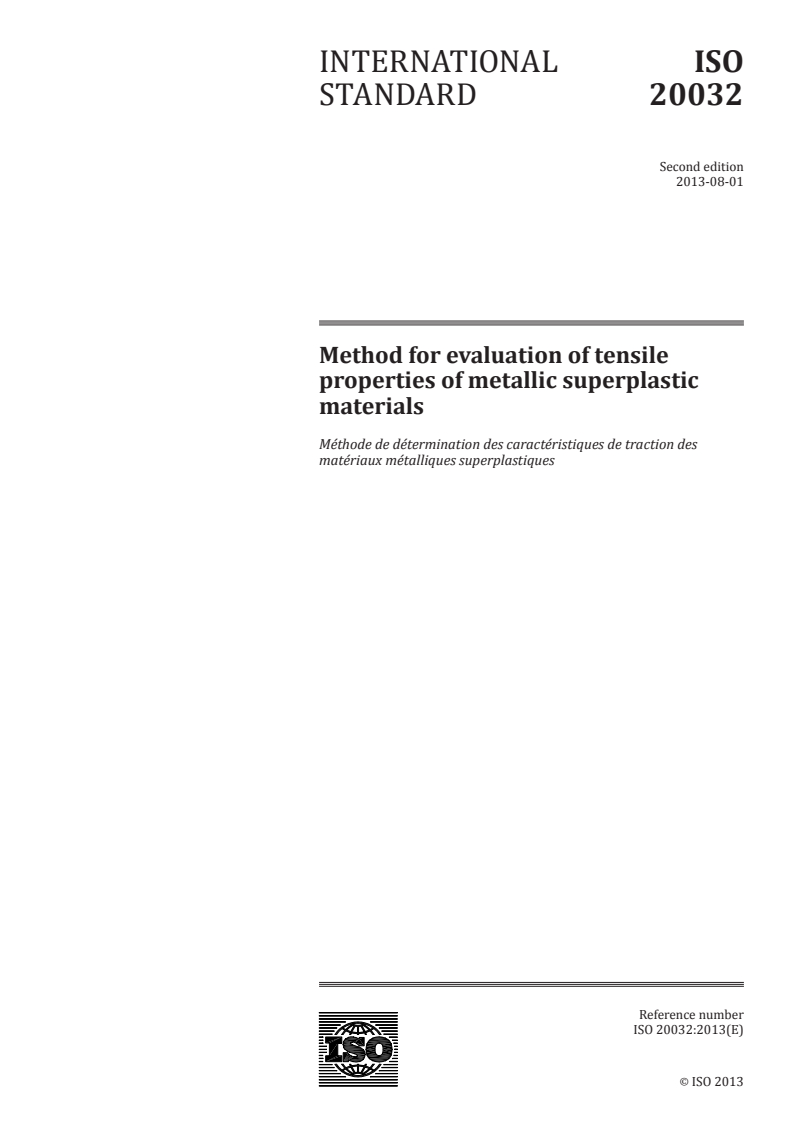
INTERNATIONAL ISO
STANDARD 20032
Second edition
2013-08-01
Method for evaluation of tensile
properties of metallic superplastic
materials
Méthode de détermination des caractéristiques de traction des
matériaux métalliques superplastiques
Reference number
©
ISO 2013
© ISO 2013
All rights reserved. Unless otherwise specified, no part of this publication may be reproduced or utilized otherwise in any form
or by any means, electronic or mechanical, including photocopying, or posting on the internet or an intranet, without prior
written permission. Permission can be requested from either ISO at the address below or ISO’s member body in the country of
the requester.
ISO copyright office
Case postale 56 • CH-1211 Geneva 20
Tel. + 41 22 749 01 11
Fax + 41 22 749 09 47
E-mail copyright@iso.org
Web www.iso.org
Published in Switzerland
ii © ISO 2013 – All rights reserved
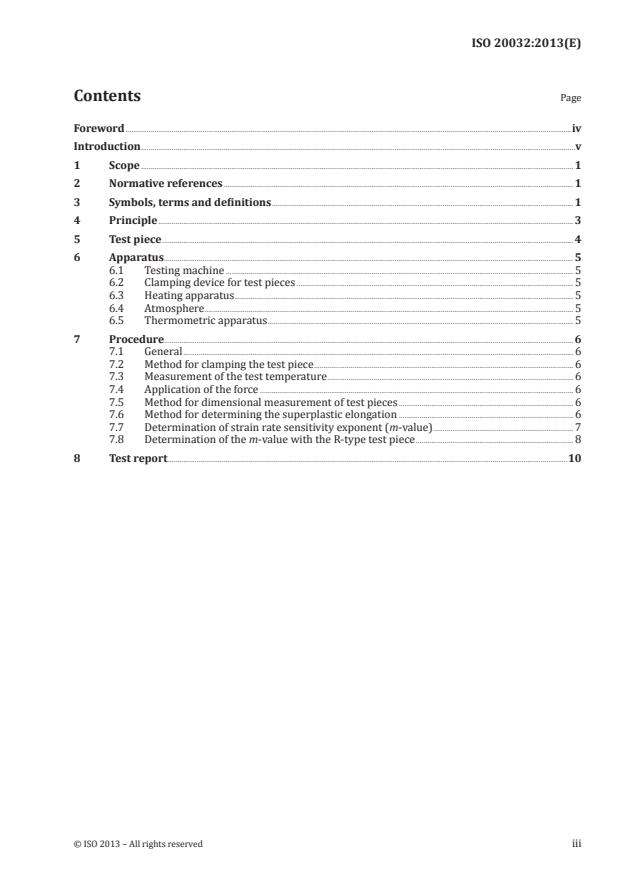
Contents Page
Foreword .iv
Introduction .v
1 Scope . 1
2 Normative references . 1
3 Symbols, terms and definitions . 1
4 Principle . 3
5 Test piece . 4
6 Apparatus . 5
6.1 Testing machine . 5
6.2 Clamping device for test pieces . 5
6.3 Heating apparatus . 5
6.4 Atmosphere . 5
6.5 Thermometric apparatus . 5
7 Procedure. 6
7.1 General . 6
7.2 Method for clamping the test piece . 6
7.3 Measurement of the test temperature . 6
7.4 Application of the force . 6
7.5 Method for dimensional measurement of test pieces . 6
7.6 Method for determining the superplastic elongation . 6
7.7 Determination of strain rate sensitivity exponent (m-value) . 7
7.8 Determination of the m-value with the R-type test piece . 8
8 Test report .10
Foreword
ISO (the International Organization for Standardization) is a worldwide federation of national standards
bodies (ISO member bodies). The work of preparing International Standards is normally carried out
through ISO technical committees. Each member body interested in a subject for which a technical
committee has been established has the right to be represented on that committee. International
organizations, governmental and non-governmental, in liaison with ISO, also take part in the work.
ISO collaborates closely with the International Electrotechnical Commission (IEC) on all matters of
electrotechnical standardization.
The procedures used to develop this document and those intended for its further maintenance are
described in the ISO/IEC Directives, Part 1. In particular the different approval criteria needed for the
different types of ISO documents should be noted. This document was drafted in accordance with the
editorial rules of the ISO/IEC Directives, Part 2. www.iso.org/directives
Attention is drawn to the possibility that some of the elements of this document may be the subject of
patent rights. ISO shall not be held responsible for identifying any or all such patent rights. Details of
any patent rights identified during the development of the document will be in the Introduction and/or
on the ISO list of patent declarations received. www.iso.org/patents
Any trade name used in this document is information given for the convenience of users and does not
constitute an endorsement.
The committee responsible for this document is ISO/TC 164, Mechanical testing of metals, Subcommittee
SC 2, Ductility testing.
This second edition cancels and replaces the first edition (ISO 20032:2007) of which it constitutes a
minor revision.
iv © ISO 2013 – All rights reserved
Introduction
Superplastic forming requires the characterization of metallic superplastic materials. The tensile test
specified in this International Standard permits the evaluation of superplastic properties, such as
superplastic elongation, flow stress, strain rate sensitivity exponent (m-value), stress-strain relation
and flow stress-strain rate relation.
INTERNATIONAL STANDARD ISO 20032:2013(E)
Method for evaluation of tensile properties of metallic
superplastic materials
1 Scope
This International Standard specifies a method for evaluating the tensile properties of metallic
superplastic materials which exhibit what is called “Fine-Grained Superplasticity”, without significant
work-hardening or dynamic microstructure evolution, by means of a tensile test at constant cross-head
velocity, for flat-form test pieces, without an extensometer attached.
2 Normative references
The following documents, in whole or in part, are normatively referenced in this document and are
indispensable for its application. For dated references, only the edition cited applies. For undated
references, the latest edition of the referenced document (including any amendments) applies.
ISO 6892-1, Metallic materials — Tensile testing — Part 1: Method of test at room temperature
ISO 6892-2, Metallic materials — Tensile testing — Part 2: Method of test at elevated temperature
ISO 7500-1, Metallic materials — Verification of static uniaxial testing machines — Part 1: Tension/compression
testing machines — Verification and calibration of the force-measuring system
ISO 80000-1, Quantities and units — Part 1: General
IEC 60584-1, Thermocouples — Part 1: Reference tables
IEC 60584-2, Thermocouples — Part 2: Tolerances
3 Symbols, terms and definitions
For the purposes of this document, the symbols, terms and definitions given in Table 1 apply.
Table 1 — Symbols, terms and definitions
Symbol Term Definition Unit
Superplasticity
— Superplastic state Deformation conditions on onset of superplasticity —
and its continuation
Test piece
— R-type test piece Test piece that has the shape of a conventional ten- —
sile test piece without its parallel portion
— R portion Principal portion of the R-type test piece to be elon- —
gated, which has an arc-like shape between grips
b Width of parallel-sided por- Original width of parallel-sided portion of the mm
tion or minimum width of S-type test piece or original minimum width of the
the R portion R portion of the R-type test piece
b [i] Original width in division, i, Original width in a specific division, i, of the R por- mm
o
of the R portion tion
b[i] Width in division, i, of the Width in a specific division, i, of the R portion after mm
R portion the interrupted test
A Superplastic elongation Elongation after fracture in a superplastic state %
B Grip portion width Width of grip portion of the S- or R-type test piece mm
g
L Original gauge length Original distance between gauge marks measured mm
o
by appropriate apparatus with an accuracy of at
least 1 % of the distance or 0,01 mm, whichever is
greater
L Final gauge length after Final distance between gauge marks measured after mm
u
fracture fracture with fracture surfaces placed together
with care, so that the centre line of either fracture
surface is on a single straight line
L Parallel length Original length of parallel portion of the S-type test mm
c
piece
L Total length of test piece Original total length of test piece mm
t
L Grip portion length Length of grip portion of test piece mm
g
L R portion length Original length of the R portion mm
R
ΔL Elongation of the R portion Increase in the R portion length at any moment dur- mm
R
ing the test
R Radius of fillet or R portion Original radius of fillet of the S-type test pieces or mm
radius original R portion radius of the R-type test piece
S Original cross-sectional Original cross-sectional area of a test piece meas- mm
o
area of test piece in the ured by an appropriate apparatus with an accuracy
reduced section of ±2 % or better
S [i] Original cross-sectional Original cross-sectional area in a specific division, i, mm
o
area in division, i, of the R of the R portion
portion
S[i] Cross-sectional area in divi- Cross-sectional area in a specific division, i, of the mm
sion, i, of the R portion R portion after the interrupted test
t Thickness of test piece Thickness of the S- or R-type test piece mm
t
[i] Original thickness in divi- Original thickness in a specific division, i, of the mm
o
sion, i, of the R portion R portion
2 © ISO 2013 – All rights reserved
Table 1 (continued)
Symbol Term Definition Unit
t[i] Thickness in division, i, Thickness in a specific division, i, of the R portion mm
of the R portion after the interrupted test
Force
F 10 % deformation force Force at 10 % nominal strain N
Stress
K K value A constant-with-stress dimension, which is defined MPa
by Formula (5)
σ 10 % flow stress True stress when 10 % nominal strain is achieved MPa
σ Flow stress True stress during superplastic deformation MPa
f
σ Nominal stress A load during deformation divided by the minimum MPa
N
area of the original cross-section in the R portion,
which is defined for the R-type test piece
σ[i] True stress A load during deformation divided by the cross-sec- MPa
tional area in a specific division, i, of the R portion,
which is defined for the R-type test piece
Strain
ε[i] True strain True strain given by deformation in a specific divi- —
sion, i, of the R portion
Period
τ
Period required for inter- Period required from the time when the axial force s
inter
rupted test starts to increase linearly against strain in the
elastic deformation stage, until elongation of the R
portion, ΔL , reaches
...
INTERNATIONAL ISO
STANDARD 20032
Second edition
2013-08-01
Method for evaluation of tensile
properties of metallic superplastic
materials
Méthode de détermination des caractéristiques de traction des
matériaux métalliques superplastiques
Reference number
©
ISO 2013
© ISO 2013
All rights reserved. Unless otherwise specified, no part of this publication may be reproduced or utilized otherwise in any form
or by any means, electronic or mechanical, including photocopying, or posting on the internet or an intranet, without prior
written permission. Permission can be requested from either ISO at the address below or ISO’s member body in the country of
the requester.
ISO copyright office
Case postale 56 • CH-1211 Geneva 20
Tel. + 41 22 749 01 11
Fax + 41 22 749 09 47
E-mail copyright@iso.org
Web www.iso.org
Published in Switzerland
ii © ISO 2013 – All rights reserved
Contents Page
Foreword .iv
Introduction .v
1 Scope . 1
2 Normative references . 1
3 Symbols, terms and definitions . 1
4 Principle . 3
5 Test piece . 4
6 Apparatus . 5
6.1 Testing machine . 5
6.2 Clamping device for test pieces . 5
6.3 Heating apparatus . 5
6.4 Atmosphere . 5
6.5 Thermometric apparatus . 5
7 Procedure. 6
7.1 General . 6
7.2 Method for clamping the test piece . 6
7.3 Measurement of the test temperature . 6
7.4 Application of the force . 6
7.5 Method for dimensional measurement of test pieces . 6
7.6 Method for determining the superplastic elongation . 6
7.7 Determination of strain rate sensitivity exponent (m-value) . 7
7.8 Determination of the m-value with the R-type test piece . 8
8 Test report .10
Foreword
ISO (the International Organization for Standardization) is a worldwide federation of national standards
bodies (ISO member bodies). The work of preparing International Standards is normally carried out
through ISO technical committees. Each member body interested in a subject for which a technical
committee has been established has the right to be represented on that committee. International
organizations, governmental and non-governmental, in liaison with ISO, also take part in the work.
ISO collaborates closely with the International Electrotechnical Commission (IEC) on all matters of
electrotechnical standardization.
The procedures used to develop this document and those intended for its further maintenance are
described in the ISO/IEC Directives, Part 1. In particular the different approval criteria needed for the
different types of ISO documents should be noted. This document was drafted in accordance with the
editorial rules of the ISO/IEC Directives, Part 2. www.iso.org/directives
Attention is drawn to the possibility that some of the elements of this document may be the subject of
patent rights. ISO shall not be held responsible for identifying any or all such patent rights. Details of
any patent rights identified during the development of the document will be in the Introduction and/or
on the ISO list of patent declarations received. www.iso.org/patents
Any trade name used in this document is information given for the convenience of users and does not
constitute an endorsement.
The committee responsible for this document is ISO/TC 164, Mechanical testing of metals, Subcommittee
SC 2, Ductility testing.
This second edition cancels and replaces the first edition (ISO 20032:2007) of which it constitutes a
minor revision.
iv © ISO 2013 – All rights reserved
Introduction
Superplastic forming requires the characterization of metallic superplastic materials. The tensile test
specified in this International Standard permits the evaluation of superplastic properties, such as
superplastic elongation, flow stress, strain rate sensitivity exponent (m-value), stress-strain relation
and flow stress-strain rate relation.
INTERNATIONAL STANDARD ISO 20032:2013(E)
Method for evaluation of tensile properties of metallic
superplastic materials
1 Scope
This International Standard specifies a method for evaluating the tensile properties of metallic
superplastic materials which exhibit what is called “Fine-Grained Superplasticity”, without significant
work-hardening or dynamic microstructure evolution, by means of a tensile test at constant cross-head
velocity, for flat-form test pieces, without an extensometer attached.
2 Normative references
The following documents, in whole or in part, are normatively referenced in this document and are
indispensable for its application. For dated references, only the edition cited applies. For undated
references, the latest edition of the referenced document (including any amendments) applies.
ISO 6892-1, Metallic materials — Tensile testing — Part 1: Method of test at room temperature
ISO 6892-2, Metallic materials — Tensile testing — Part 2: Method of test at elevated temperature
ISO 7500-1, Metallic materials — Verification of static uniaxial testing machines — Part 1: Tension/compression
testing machines — Verification and calibration of the force-measuring system
ISO 80000-1, Quantities and units — Part 1: General
IEC 60584-1, Thermocouples — Part 1: Reference tables
IEC 60584-2, Thermocouples — Part 2: Tolerances
3 Symbols, terms and definitions
For the purposes of this document, the symbols, terms and definitions given in Table 1 apply.
Table 1 — Symbols, terms and definitions
Symbol Term Definition Unit
Superplasticity
— Superplastic state Deformation conditions on onset of superplasticity —
and its continuation
Test piece
— R-type test piece Test piece that has the shape of a conventional ten- —
sile test piece without its parallel portion
— R portion Principal portion of the R-type test piece to be elon- —
gated, which has an arc-like shape between grips
b Width of parallel-sided por- Original width of parallel-sided portion of the mm
tion or minimum width of S-type test piece or original minimum width of the
the R portion R portion of the R-type test piece
b [i] Original width in division, i, Original width in a specific division, i, of the R por- mm
o
of the R portion tion
b[i] Width in division, i, of the Width in a specific division, i, of the R portion after mm
R portion the interrupted test
A Superplastic elongation Elongation after fracture in a superplastic state %
B Grip portion width Width of grip portion of the S- or R-type test piece mm
g
L Original gauge length Original distance between gauge marks measured mm
o
by appropriate apparatus with an accuracy of at
least 1 % of the distance or 0,01 mm, whichever is
greater
L Final gauge length after Final distance between gauge marks measured after mm
u
fracture fracture with fracture surfaces placed together
with care, so that the centre line of either fracture
surface is on a single straight line
L Parallel length Original length of parallel portion of the S-type test mm
c
piece
L Total length of test piece Original total length of test piece mm
t
L Grip portion length Length of grip portion of test piece mm
g
L R portion length Original length of the R portion mm
R
ΔL Elongation of the R portion Increase in the R portion length at any moment dur- mm
R
ing the test
R Radius of fillet or R portion Original radius of fillet of the S-type test pieces or mm
radius original R portion radius of the R-type test piece
S Original cross-sectional Original cross-sectional area of a test piece meas- mm
o
area of test piece in the ured by an appropriate apparatus with an accuracy
reduced section of ±2 % or better
S [i] Original cross-sectional Original cross-sectional area in a specific division, i, mm
o
area in division, i, of the R of the R portion
portion
S[i] Cross-sectional area in divi- Cross-sectional area in a specific division, i, of the mm
sion, i, of the R portion R portion after the interrupted test
t Thickness of test piece Thickness of the S- or R-type test piece mm
t
[i] Original thickness in divi- Original thickness in a specific division, i, of the mm
o
sion, i, of the R portion R portion
2 © ISO 2013 – All rights reserved
Table 1 (continued)
Symbol Term Definition Unit
t[i] Thickness in division, i, Thickness in a specific division, i, of the R portion mm
of the R portion after the interrupted test
Force
F 10 % deformation force Force at 10 % nominal strain N
Stress
K K value A constant-with-stress dimension, which is defined MPa
by Formula (5)
σ 10 % flow stress True stress when 10 % nominal strain is achieved MPa
σ Flow stress True stress during superplastic deformation MPa
f
σ Nominal stress A load during deformation divided by the minimum MPa
N
area of the original cross-section in the R portion,
which is defined for the R-type test piece
σ[i] True stress A load during deformation divided by the cross-sec- MPa
tional area in a specific division, i, of the R portion,
which is defined for the R-type test piece
Strain
ε[i] True strain True strain given by deformation in a specific divi- —
sion, i, of the R portion
Period
τ
Period required for inter- Period required from the time when the axial force s
inter
rupted test starts to increase linearly against strain in the
elastic deformation stage, until elongation of the R
portion, ΔL , reaches
...