


ISO/IEC 14763-2:2012
(Main)Information technology — Implementation and operation of customer premises cabling — Part 2: Planning and installation
Information technology — Implementation and operation of customer premises cabling — Part 2: Planning and installation
ISO/IEC 14763-2:2012(E) specifies requirements for the planning, installation and operation of cabling and cabling infrastructures (including cabling, pathways, spaces, earthing and bonding) in support of generic cabling standards and associated documents. The following aspects are addressed: - specification of the installation, - quality assurance, - installation planning, - installation practice, - documentation, - administration, - testing, - inspection, - operation, - maintenance and repair. The requirements of Clauses 5 to 14 of this standard are premises-independent and may be amended by the requirements of premises-specific Annexes. This first edition supersedes Clauses 11 and 12 of ISO/IEC 11801, published in 2002, replaces ISO/IEC 14763-1, published in 1999, its Amendment 1 (2004), ISO/IEC TR 14763-2, published in 2000, ISO/IEC 18010, published in 2002, and its Amendment 1 (2005) and constitutes a technical revision. It includes the following significant technical changes with respect to the previous edition: In addition to the supersession of parts of earlier standards and the incorporation of other standards, this standard provides much greater detail in all aspects of planning and installation with respect to ISO/IEC/TR 14763-2 and provides clearly differentiated and directed requirements and recommendations.
Technologies de l'information — Implémentation et fonctionnement du câblage dans les réseaux d'usagers — Partie 2: Planification et installation
General Information
- Status
- Withdrawn
- Publication Date
- 23-Feb-2012
- Withdrawal Date
- 23-Feb-2012
- Technical Committee
- ISO/IEC JTC 1/SC 25 - Interconnection of information technology equipment
- Current Stage
- 9599 - Withdrawal of International Standard
- Start Date
- 20-Dec-2019
- Completion Date
- 12-Feb-2026
Relations
- Effective Date
- 04-Dec-2021
- Effective Date
- 07-Jul-2018
- Effective Date
- 07-Jul-2018
- Revises
ISO/IEC 18010:2002 - Information technology — Pathways and spaces for customer premises cabling - Effective Date
- 07-Jul-2018
- Effective Date
- 07-Jul-2018
- Effective Date
- 25-Feb-2017
- Effective Date
- 22-Aug-2009


Get Certified
Connect with accredited certification bodies for this standard

BSI Group
BSI (British Standards Institution) is the business standards company that helps organizations make excellence a habit.

NYCE
Mexican standards and certification body.
Sponsored listings
Frequently Asked Questions
ISO/IEC 14763-2:2012 is a standard published by the International Organization for Standardization (ISO). Its full title is "Information technology — Implementation and operation of customer premises cabling — Part 2: Planning and installation". This standard covers: ISO/IEC 14763-2:2012(E) specifies requirements for the planning, installation and operation of cabling and cabling infrastructures (including cabling, pathways, spaces, earthing and bonding) in support of generic cabling standards and associated documents. The following aspects are addressed: - specification of the installation, - quality assurance, - installation planning, - installation practice, - documentation, - administration, - testing, - inspection, - operation, - maintenance and repair. The requirements of Clauses 5 to 14 of this standard are premises-independent and may be amended by the requirements of premises-specific Annexes. This first edition supersedes Clauses 11 and 12 of ISO/IEC 11801, published in 2002, replaces ISO/IEC 14763-1, published in 1999, its Amendment 1 (2004), ISO/IEC TR 14763-2, published in 2000, ISO/IEC 18010, published in 2002, and its Amendment 1 (2005) and constitutes a technical revision. It includes the following significant technical changes with respect to the previous edition: In addition to the supersession of parts of earlier standards and the incorporation of other standards, this standard provides much greater detail in all aspects of planning and installation with respect to ISO/IEC/TR 14763-2 and provides clearly differentiated and directed requirements and recommendations.
ISO/IEC 14763-2:2012(E) specifies requirements for the planning, installation and operation of cabling and cabling infrastructures (including cabling, pathways, spaces, earthing and bonding) in support of generic cabling standards and associated documents. The following aspects are addressed: - specification of the installation, - quality assurance, - installation planning, - installation practice, - documentation, - administration, - testing, - inspection, - operation, - maintenance and repair. The requirements of Clauses 5 to 14 of this standard are premises-independent and may be amended by the requirements of premises-specific Annexes. This first edition supersedes Clauses 11 and 12 of ISO/IEC 11801, published in 2002, replaces ISO/IEC 14763-1, published in 1999, its Amendment 1 (2004), ISO/IEC TR 14763-2, published in 2000, ISO/IEC 18010, published in 2002, and its Amendment 1 (2005) and constitutes a technical revision. It includes the following significant technical changes with respect to the previous edition: In addition to the supersession of parts of earlier standards and the incorporation of other standards, this standard provides much greater detail in all aspects of planning and installation with respect to ISO/IEC/TR 14763-2 and provides clearly differentiated and directed requirements and recommendations.
ISO/IEC 14763-2:2012 is classified under the following ICS (International Classification for Standards) categories: 35.200 - Interface and interconnection equipment. The ICS classification helps identify the subject area and facilitates finding related standards.
ISO/IEC 14763-2:2012 has the following relationships with other standards: It is inter standard links to ISO/IEC 14763-2:2012/Amd 1:2015, ISO/IEC 14763-1:1999/Amd 1:2004, ISO/IEC 18010:2002/Amd 1:2005, ISO/IEC 18010:2002, ISO/IEC 14763-1:1999, ISO/IEC 14763-2:2019, ISO/IEC TR 14763-2:2000. Understanding these relationships helps ensure you are using the most current and applicable version of the standard.
ISO/IEC 14763-2:2012 is available in PDF format for immediate download after purchase. The document can be added to your cart and obtained through the secure checkout process. Digital delivery ensures instant access to the complete standard document.
Standards Content (Sample)
ISO/IEC 14763-2
Edition 1.0 2012-02
INTERNATIONAL
STANDARD
colour
inside
Information technology – Implementation and operation of customer premises
cabling –
Part 2: Planning and installation
All rights reserved. Unless otherwise specified, no part of this publication may be reproduced or utilized in any form
or by any means, electronic or mechanical, including photocopying and microfilm, without permission in writing from
either IEC or IEC's member National Committee in the country of the requester.
If you have any questions about ISO/IEC copyright or have an enquiry about obtaining additional rights to this
publication, please contact the address below or your local IEC member National Committee for further information.
IEC Central Office Tel.: +41 22 919 02 11
3, rue de Varembé Fax: +41 22 919 03 00
CH-1211 Geneva 20 info@iec.ch
Switzerland www.iec.ch
About the IEC
The International Electrotechnical Commission (IEC) is the leading global organization that prepares and publishes
International Standards for all electrical, electronic and related technologies.
About IEC publications
The technical content of IEC publications is kept under constant review by the IEC. Please make sure that you have the
latest edition, a corrigenda or an amendment might have been published.
Useful links:
IEC publications search - www.iec.ch/searchpub Electropedia - www.electropedia.org
The advanced search enables you to find IEC publications The world's leading online dictionary of electronic and
by a variety of criteria (reference number, text, technical electrical terms containing more than 30 000 terms and
committee,…). definitions in English and French, with equivalent terms in
It also gives information on projects, replaced and additional languages. Also known as the International
withdrawn publications. Electrotechnical Vocabulary (IEV) on-line.
IEC Just Published - webstore.iec.ch/justpublished Customer Service Centre - webstore.iec.ch/csc
Stay up to date on all new IEC publications. Just Published If you wish to give us your feedback on this publication
details all new publications released. Available on-line and or need further assistance, please contact the
also once a month by email. Customer Service Centre: csc@iec.ch.
ISO/IEC 14763-2
Edition 1.0 2012-02
INTERNATIONAL
STANDARD
colour
inside
Information technology – Implementation and operation of customer premises
cabling –
Part 2: Planning and installation
INTERNATIONAL
ELECTROTECHNICAL
COMMISSION
PRICE CODE
XB
ICS 35.200 ISBN 978-2-88912-897-6
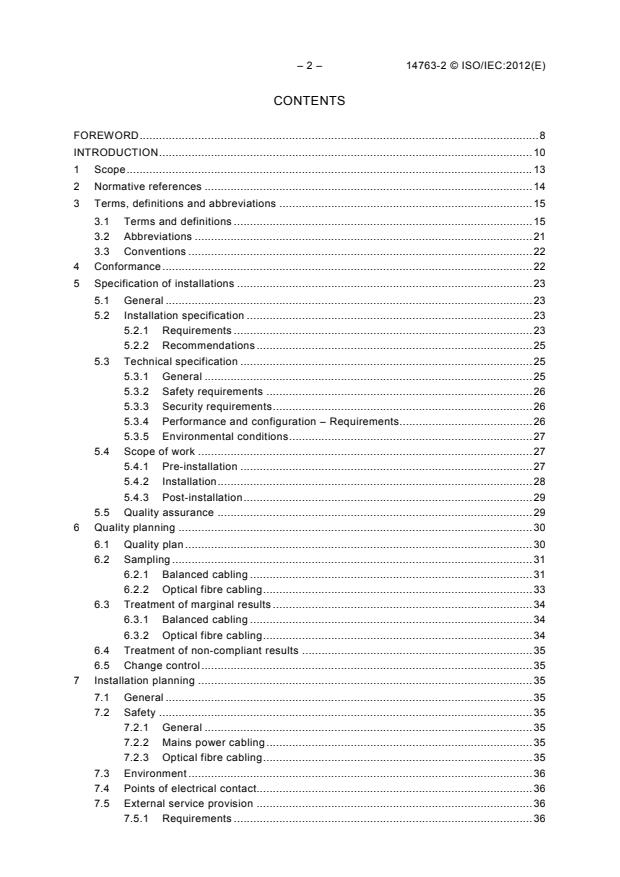
– 2 – 14763-2 © ISO/IEC:2012(E)
CONTENTS
FOREWORD . 8
INTRODUCTION . 10
1 Scope . 13
2 Normative references . 14
3 Terms, definitions and abbreviations . 15
3.1 Terms and definitions . 15
3.2 Abbreviations . 21
3.3 Conventions . 22
4 Conformance . 22
5 Specification of installations . 23
5.1 General . 23
5.2 Installation specification . 23
5.2.1 Requirements . 23
5.2.2 Recommendations . 25
5.3 Technical specification . 25
5.3.1 General . 25
5.3.2 Safety requirements . 26
5.3.3 Security requirements . 26
5.3.4 Performance and configuration – Requirements. 26
5.3.5 Environmental conditions . 27
5.4 Scope of work . 27
5.4.1 Pre-installation . 27
5.4.2 Installation . 28
5.4.3 Post-installation . 29
5.5 Quality assurance . 29
6 Quality planning . 30
6.1 Quality plan . 30
6.2 Sampling . 31
6.2.1 Balanced cabling . 31
6.2.2 Optical fibre cabling . 33
6.3 Treatment of marginal results . 34
6.3.1 Balanced cabling . 34
6.3.2 Optical fibre cabling . 34
6.4 Treatment of non-compliant results . 35
6.5 Change control . 35
7 Installation planning . 35
7.1 General . 35
7.2 Safety . 35
7.2.1 General . 35
7.2.2 Mains power cabling . 35
7.2.3 Optical fibre cabling . 35
7.3 Environment . 36
7.4 Points of electrical contact. 36
7.5 External service provision . 36
7.5.1 Requirements . 36
14763-2 © ISO/IEC:2012(E) – 3 –
7.5.2 Recommendations . 36
7.6 Pathways and pathway systems . 36
7.6.1 General . 36
7.6.2 Inside buildings . 39
7.6.3 Outside buildings . 42
7.7 Spaces . 46
7.7.1 Requirements . 46
7.7.2 Recommendations . 48
7.8 Functional elements . 50
7.8.1 Requirements . 50
7.8.2 Recommendations . 51
7.9 Segregation of information technology cabling and mains power cabling . 52
7.9.1 General . 52
7.9.2 Requirements . 53
7.9.3 Recommendations . 59
7.10 Cabling – Requirements . 59
7.10.1 General . 59
7.10.2 Unscreened cabling . 59
7.10.3 Screened cabling . 60
7.10.4 Optical fibre cabling . 60
8 Installation practices . 60
8.1 General . 60
8.2 Safety . 60
8.2.1 General . 60
8.2.2 Mains power cabling . 60
8.2.3 Functional bonding . 60
8.2.4 Optical fibre cabling . 60
8.2.5 Guards and signs . 61
8.2.6 Enclosed spaces . 61
8.2.7 Maintenance holes . 61
8.2.8 Closures . 61
8.3 Environment . 61
8.3.1 Storage . 61
8.3.2 Installation – Requirements . 61
8.4 Component inspection and testing – Requirements . 61
8.5 Pathways . 62
8.5.1 Requirements . 62
8.5.2 Inside buildings – Requirements . 62
8.5.3 Outside buildings . 62
8.6 Spaces . 63
8.6.1 Requirements . 63
8.6.2 Entrance facilities . 63
8.6.3 Rooms and enclosures intended to contain distributors . 63
8.6.4 Cabinets, frames and racks . 63
8.6.5 Closures . 63
8.6.6 Outlets . 63
8.7 Pathway system installation. 63
8.7.1 General . 63
8.7.2 Inside buildings . 64
– 4 – 14763-2 © ISO/IEC:2012(E)
8.7.3 Outside buildings . 64
8.8 Closure installation . 64
8.9 Cable installation . 65
8.9.1 Cable installation within pathway systems . 65
8.9.2 General . 65
8.9.3 Inside buildings . 66
8.9.4 Cable installation in maintenance holes . 66
8.9.5 Cable installation within closures – Requirements . 67
8.10 Jointing and terminating of cables . 67
8.10.1 Requirements . 67
8.10.2 Balanced cabling . 68
8.10.3 Screened balanced cabling . 68
8.10.4 Optical fibre cabling . 68
8.11 Cords and jumpers . 68
8.12 Surge protective devices . 68
8.13 Acceptance . 68
8.13.1 Inspection . 68
8.13.2 Testing . 69
9 Documentation and administration . 69
9.1 Symbols and preparation of documents . 69
9.2 Administration . 69
9.2.1 General . 69
9.2.2 Administration system . 70
9.2.3 Identifiers – Requirements . 72
9.2.4 Component labelling . 72
9.2.5 Records . 75
9.2.6 Cable administration system . 79
9.2.7 Reports . 82
10 Testing . 82
10.1 General . 82
10.1.1 Links and permanent links . 82
10.1.2 Channels . 83
10.1.3 Cabling interface adaptors . 84
10.1.4 Calibration . 84
10.1.5 Equipment protection . 84
10.1.6 Measurement conditions . 84
10.2 Test procedures for balanced cabling . 85
10.2.1 General . 85
10.2.2 Measurement of length-related parameters . 85
10.2.3 Treatment of marginal test results . 85
10.2.4 Treatment of unacceptable test results . 85
10.2.5 Test result format . 85
10.2.6 Test result documentation . 86
10.3 Test procedures for optical fibre cabling . 86
10.3.1 General . 86
10.3.2 Treatment of unacceptable test results . 86
10.3.3 Test result documentation . 87
11 Inspection . 87
11.1 General . 87
14763-2 © ISO/IEC:2012(E) – 5 –
11.2 Inspection Level 1 . 87
11.3 Inspection Level 2 . 88
11.4 Inspection Level 3 . 88
11.5 Inspection documentation – Requirements . 88
12 Operation . 89
12.1 Standard operating procedure . 89
12.1.1 Requirements . 89
12.1.2 Recommendations . 89
12.2 Cords and jumpers . 89
12.3 Optical fibre adaptors . 89
13 Maintenance . 89
13.1 Approaches to maintenance . 89
13.1.1 General . 89
13.1.2 Requirements . 90
13.2 Maintenance procedures . 90
13.2.1 Requirements . 90
13.2.2 Recommendations . 90
14 Repair . 91
Annex A (normative) Optical fibre polarity maintenance: connecting hardware for
multiple optical fibres . 92
Annex B (normative) Common infrastructures within multi-tenant premises . 101
Annex C (normative) Cabling in accordance with ISO/IEC 11801 . 109
Annex D (normative) Cabling in accordance with ISO/IEC 15018 . 116
Annex E (normative) Cabling in accordance with ISO/IEC 24764 . 122
Annex F (normative) Cabling in accordance with ISO/IEC 24702 . 135
Annex G (normative) Cabling in accordance with ISO/IEC TR 24704 . 138
Bibliography . 139
Figure 1 – Schematic relationship between ISO/IEC 14763-2 and other relevant
standards . 12
Figure 2 – Quality assurance schematic . 23
Figure 3 – Example of conformant and non-conformant bend radius management . 40
Figure 4 – Example of use of curved corners in pathway systems . 42
Figure 5 – Example of cabling installations outside buildings . 43
Figure 6 – Dimensions of rooms intended to contain distributors . 50
Figure 7 – Process of determining cable separation . 54
Figure 8 – Flowchart for cable separation calculation . 57
Figure 9 – Separation of mains power and information technology cables without
dividers . 58
Figure 10 – Separation of mains power and information technology cables with dividers . 58
Figure 11 – Examples of cord and jumper labelling . 74
Figure 12 – Cable administration database and possible linkages . 80
Figure 13 – Basic cabling administration . 80
Figure 14 – Examples of cabling permanent links . 83
Figure 15 – Reference planes for link and channels (point-to-point) . 83
Figure 16 – Example of a cabling channel . 84
– 6 – 14763-2 © ISO/IEC:2012(E)
Figure A.1 – Duplex connecting hardware plug . 93
Figure A.2 – Duplex connecting adapter . 93
Figure A.3 – Duplex patch cord . 93
Figure A.4 – Views of crossover patch cords . 94
Figure A.5 – Optical fibre sequences and adapter orientation in patch panel for the
symmetrical position method . 95
Figure A.6 – Optical fibre sequences and adapter orientation in patch panel for the
reverse-pair position method . 95
Figure A.7 – Array connector cable or patch cord (key-up to key-up) . 97
Figure A.8 – Array adapter with aligned keyways . 97
Figure A.9 – Transition assembly . 98
Figure A.10 – Connectivity method for duplex signals . 99
Figure A.11 – Connectivity method for parallel optics channels . 100
Figure B.1 – Example of common pathways and spaces in a multi-tenant building . 102
Figure B.2 – Example of a campus entrance facility . 104
Figure B.3 – Example 1: Common equipment room . 106
Figure B.4 – Example 1: Common telecommunications room . 107
Figure B.5 – Example 2: Common telecommunications room . 107
Figure C.1 – Connection of functional elements providing redundancy . 110
Figure E.1 – Connection of functional elements providing redundancy . 123
Figure E.2 – Example of layered cable trays with smaller width upper trays . 126
Figure E.3 – Example of uncovered (accessible) row of floor tiles to provide access to
lower tray . 127
Figure E.4 – Dimensions of rooms intended to contain distributors . 129
Figure E.5 – Example of "hot" aisles, "cold" aisles and cable pathway locations . 131
Table 1 – Installed balanced cabling test parameters . 31
Table 2 – Minimum sample sizes for alien (exogenous) crosstalk testing . 33
Table 3 – Installed optical fibre cabling test parameters . 33
Table 4 – Examples of pathway systems . 37
Table 5 – Stacking height for non-continuous and interval support pathway systems . 41
Table 6 – Design and planning of pathways outside buildings . 43
Table 7 – Separation recommendations between metallic information technology
cabling and specific EMI sources . 53
Table 8 – Classification of information technology cables . 55
Table 9 – Minimum separation S . 55
Table 10 – Power cabling factor P . 56
Table 11 – Level of installation complexity . 70
Table 12 – Level of operational complexity . 70
Table 13 – Minimum requirements of administration systems . 71
Table 14 – Minimum requirements of operational administration systems . 72
Table 15 – Labelling requirements . 73
Table 16 – Labelling recommendations (additional). 74
Table 17 – Infrastructure records for spaces, cabinets, racks, frames and closures . 76
14763-2 © ISO/IEC:2012(E) – 7 –
Table 18 – Infrastructure records for cables and termination points . 77
Table 19 – Infrastructure records . 78
Table 20 – Infrastructure records for pathways and premises. 79
Table 21 – Recommendations of installation administration systems . 81
Table 22 – Recommendations of operational administration systems . 81
Table A.1 – Optical fibre colour code scheme of IEC 60794-2 . 92
Table B.1 – Summary of common spaces used to service a multi-tenant building . 102
Table D.1 – Minimum requirements for dimensions of primary distribution spaces . 118
Table D.2 – Requirements for dimensions of secondary distribution spaces . 119
Table D.3 – Minimum dimensions of spaces allocated to junction boxes . 120
Table D.4 – Recommendations for dimensions of primary distribution spaces . 120
Table D.5 – Recommendations for dimensions of secondary distribution spaces . 121
Table E.1 – Environmental requirements for data centres . 124
Table F.1 – Risk elements for consideration in determining an appropriate
maintenance approach . 137
– 8 – 14763-2 © ISO/IEC:2012(E)
INFORMATION TECHNOLOGY –
IMPLEMENTATION AND OPERATION OF
CUSTOMER PREMISES CABLING –
Part 2: Planning and installation
FOREWORD
1) ISO (International Organization for Standardization) and IEC (International Electrotechnical Commission) form the
specialized system for worldwide standardization. National bodies that are members of ISO or IEC participate in
the development of International Standards. Their preparation is entrusted to technical committees; any ISO and
IEC member body interested in the subject dealt with may participate in this preparatory work. International
governmental and non-governmental organizations liaising with ISO and IEC also participate in this preparation.
2) In the field of information technology, ISO and IEC have established a joint technical committee, ISO/IEC JTC 1.
Draft International Standards adopted by the joint technical committee are circulated to national bodies for voting.
Publication as an International Standard requires approval by at least 75 % of the national bodies casting a vote.
3) The formal decisions or agreements of IEC and ISO on technical matters express, as nearly as possible, an
international consensus of opinion on the relevant subjects since each technical committee has representation
from all interested IEC and ISO member bodies.
4) IEC, ISO and ISO/IEC publications have the form of recommendations for international use and are accepted
by IEC and ISO member bodies in that sense. While all reasonable efforts are made to ensure that the
technical content of IEC, ISO and ISO/IEC publications is accurate, IEC or ISO cannot be held responsible for
the way in which they are used or for any misinterpretation by any end user.
5) In order to promote international uniformity, IEC and ISO member bodies undertake to apply IEC, ISO and
ISO/IEC publications transparently to the maximum extent possible in their national and regional publications.
Any divergence between any ISO/IEC publication and the corresponding national or regional publication
should be clearly indicated in the latter.
6) ISO and IEC provide no marking procedure to indicate their approval and cannot be rendered responsible for
any equipment declared to be in conformity with an ISO/IEC publication.
7) All users should ensure that they have the latest edition of this publication.
8) No liability shall attach to IEC or ISO or its directors, employees, servants or agents including individual experts
and members of their technical committees and IEC or ISO member bodies for any personal injury, property
damage or other damage of any nature whatsoever, whether direct or indirect, or for costs (including legal fees)
and expenses arising out of the publication of, use of, or reliance upon, this ISO/IEC publication or any other IEC,
ISO or ISO/IEC publications.
9) Attention is drawn to the normative references cited in this publication. Use of the referenced publications is
indispensable for the correct application of this publication.
10) Attention is drawn to the possibility that some of the elements of this International Standard may be the subject of
patent rights. ISO and IEC shall not be held responsible for identifying any or all such patent rights.
International Standard ISO/IEC 14763-2 was prepared by subcommittee 25: Interconnection
of information technology equipment, of ISO/IEC joint technical committee 1: Information
technology.
This first edition supersedes Clauses 11 and 12 of ISO/IEC 11801, published in 2002,
replaces ISO/IEC 14763-1, published in 1999, its Amendment 1 (2004), ISO/IEC TR 14763-2,
published in 2000, ISO/IEC 18010, published in 2002, and its Amendment 1 (2005) and
constitutes a technical revision.
This edition includes the following significant technical changes with respect to the previous
edition:
In addition to the supersession of parts of earlier standards and the incorporation of other
standards, this standard provides much greater detail in all aspects of planning and
installation with respect to ISO/IEC TR 14763-2 and provides clearly differentiated and
directed requirements and recommendations.
14763-2 © ISO/IEC:2012(E) – 9 –
The list of all currently available parts of the ISO/IEC 14763 series, under the general title
Information technology – Implementation and operation of customer premises cabling, can be
found on the IEC web site.
This International Standard has been approved by vote of the member bodies, and the voting
results may be obtained from the address given on the second title page.
This publication has been drafted in accordance with the ISO/IEC Directives, Part 2.
IMPORTANT – The 'colour inside' logo on the cover page of this publication indicates
that it contains colours which are considered to be useful for the correct
understanding of its contents. Users should therefore print this document using a
colour printer.
– 10 – 14763-2 © ISO/IEC:2012(E)
INTRODUCTION
The importance of services delivered by information technology cabling infrastructure is
similar to that of utilities such as heating, lighting and electricity supplies. As with those
utilities, interruptions to service can have a serious impact. Poor quality of service due to lack
of planning, use of inappropriate components, incorrect installation, poor administration or
inadequate support can threaten an organisation’s effectiveness.
There are four phases in the successful implementation of information technology cabling
a) design,
b) specification – the detailed requirement for the cabling, including the planning of its
accommodation and associated building services addressing safety and specific
environments (e.g. electromagnetic) together with the quality assurance requirements to
be applied,
c) installation – in accordance with the requirements of the specification,
d) operation – the management of connectivity and the maintenance of transmission
performance during the life of the cabling.
This International Standard supports the specification, implementation and operation of
generic information technology cabling designed in accordance with the standards and
associated documents developed by ISO/IEC JTC 1/SC 25 and addresses the following topics
• specification depending on the application, environment, building infrastructure and
facilities, etc.,
• quality assurance,
• installation planning (including pathways and spaces) depending on the application,
environment, building infrastructure and facilities, etc,
• installation practice (including pathways and spaces),
• documentation and administration,
• testing,
• inspection,
• operation,
• maintenance and maintainability (based on any impact from planning and installation),
• repair and repairability (based on any impact from planning and installation).
It does not cover those aspects of installation associated with the transmission of signals in
free space between transmitters, receivers or their associated antenna systems (e.g. wireless,
radio, microwave or satellite).
The following normative Annexes support specific aspects of planning and installation
• Annex A: Optical fibre polarity,
• Annex B: Common infrastructures within multi-tenant premises.
The requirements and recommendations of the main body of this standard are premises-
independent. The following normative Annexes include requirements for generic cabling in
accordance with specific standards
• Annex C: Cabling in accordance with ISO/IEC 11801,
• Annex D: Cabling in accordance with ISO/IEC 15018,
• Annex E: Cabling in accordance with ISO/IEC 24764,
• Annex F: Cabling in accordance with ISO/IEC 24702,
14763-2 © ISO/IEC:2012(E) – 11 –
• Annex G: Cabling in accordance with ISO/IEC TR 24704.
This standard sets out the responsibilities of information technology cabling installers and
premises owners, and is intended to be referenced in relevant contracts. The owners may
delegate selected responsibilities to designers, specifiers, operators and maintainers of
installed information technology cabling.
This standard is also relevant to
• architects, building designers and builders,
• main contractors,
• designers, suppliers, installers, inspectors (auditors), building managers, maintainers and
owners of information technology cabling,
• public network providers and local service providers,
• end users.
This International Standard is one of a number of documents prepared in support of
international standards and technical reports for cabling design produced by
ISO/IEC JTC 1/SC 25. Figure 1 shows the inter-relationship between these standards and
technical reports.
Users of this standard should be familiar with the applicable cabling design standard.
NOTE Telecommunications infrastructure affects raw material consumption. The infrastructure design and
installation methods also influence product life and sustainability of electronic equipment life cycling. These
aspects of telecommunications infrastructure impact our environment. Since building life cycles are typically
planned for decades, technological electronic equipment upgrades are necessary. The telecommunications
infrastructure design and installation process magnifies the need for sustainable infrastructures with respect to
building life, electronic equipment life cycling and considerations of effects on environmental waste.
Telecommunications designers are encouraged to research local building practices for a sustainable environment
and conservation of fossil fuels as part of the design process.
– 12 – 14763-2 © ISO/IEC:2012(E)
ISO/IEC 11801:
Information technology – Generic
cabling for customer premises
ISO/IEC 15018:
Information technology – Generic
cabling for homes
IEC 61935-1:
Specification for the testing of balanced
and coaxial information technology
ISO/IEC 24764:
cabling – Part 1: Installed balanced
Information technology – Generic
cabling as specified in ISO/IEC 11801
cabling for data centres
and related standards
IEC 61935-3:
ISO/IEC 24702: ISO/IEC 14763-2: Testing of balanced and coaxial
information technology cabling – Part 3:
Information technology – Generic Implementation and operation of
Installed cabling as specified ISO/IEC
cabling – Industrial premises customer premises cabling – Part 2:
15018 and related standards
Planning and installation
ISO/IEC 24704:
ISO/IEC 14763-3:
Information technology – Customer
Information technology – Implementation
premises cabling for wireless access
and operation of customer premises
points
cabling – Part 3: Testing of optical
fibre cabling
ISO/IEC 14709-1:
Information technology – Configuration
of customer premises cabling (CPC) for
applications – Part 1: Integrated services
digital network (ISDN) basic access
ISO/IEC 14709-2:
Information technology - Configuration
of customer premises cabling (CPC) for
applications - Part 2: Integrated services
digital network (ISDN) primary rate
Figure 1 – Schematic relationship between ISO/IEC 14763-2
and other relevant standards
14763-2 © ISO/IEC:2012(E) – 13 –
INFORMATION TECHNOLOGY –
IMPLEMENTATION AND OPERATION OF
CUSTOMER PREMISES CABLING –
Part 2: Planning and installation
1 Scope
This part of ISO/IEC 14763 specifies requirements for the planning, installation and operation
of cabling and cabling infrastructures (including cabling, pathways, spaces, earthing and
bonding) in support of generic cabling standards and associated documents.
The following aspects are addressed
• specification of the installation,
• quality assurance,
• installation planning,
• installation practice,
• documentation,
• administration,
• testing,
• inspection,
• operation,
• maintenance,
• repair.
The requirements of Clauses 5 to 14 of this standard are premises-independent and may be
amended by the requirements of premises-specific Annexes.
This part of ISO/IEC 14763 excludes
• specific requirements applicable to other cabling systems (e.g. mains power cabling);
however, it takes account of the effects other cabling systems may have on the installation
of information technology cabling (and vice versa) and gives general advice,
• those aspects of installation associated with the transmission of signals in free space
between tr
...
Questions, Comments and Discussion
Ask us and Technical Secretary will try to provide an answer. You can facilitate discussion about the standard in here.
Loading comments...