


ISO 10303-520:1999
(Main)Industrial automation systems and integration — Product data representation and exchange — Part 520: Application interpreted construct: Associative draughting elements
Industrial automation systems and integration — Product data representation and exchange — Part 520: Application interpreted construct: Associative draughting elements
Systèmes d'automatisation industrielle et intégration — Représentation et échange de données de produits — Partie 520: Constuction interprétée d'application: Éléments de dessin associatif
General Information
- Status
- Withdrawn
- Publication Date
- 08-Dec-1999
- Withdrawal Date
- 08-Dec-1999
- Technical Committee
- ISO/TC 184/SC 4 - Industrial data
- Drafting Committee
- ISO/TC 184/SC 4/WG 12 - STEP product modelling and resources
- Current Stage
- 9599 - Withdrawal of International Standard
- Start Date
- 14-Dec-2011
- Completion Date
- 12-Feb-2026
Relations
- Consolidated By
ISO 9902-6:2001/Amd 1:2009 - Textile machinery — Noise test code — Part 6: Fabric manufacturing machinery — Amendment 1 - Effective Date
- 06-Jun-2022
Get Certified
Connect with accredited certification bodies for this standard

National Aerospace and Defense Contractors Accreditation Program (NADCAP)
Global cooperative program for special process quality in aerospace.
CARES (UK Certification Authority for Reinforcing Steels)
UK certification for reinforcing steels and construction.
DVS-ZERT GmbH
German welding certification society.
Sponsored listings
Frequently Asked Questions
ISO 10303-520:1999 is a standard published by the International Organization for Standardization (ISO). Its full title is "Industrial automation systems and integration — Product data representation and exchange — Part 520: Application interpreted construct: Associative draughting elements". This standard covers: Industrial automation systems and integration — Product data representation and exchange — Part 520: Application interpreted construct: Associative draughting elements
Industrial automation systems and integration — Product data representation and exchange — Part 520: Application interpreted construct: Associative draughting elements
ISO 10303-520:1999 is classified under the following ICS (International Classification for Standards) categories: 25.040.40 - Industrial process measurement and control. The ICS classification helps identify the subject area and facilitates finding related standards.
ISO 10303-520:1999 has the following relationships with other standards: It is inter standard links to ISO 9902-6:2001/Amd 1:2009. Understanding these relationships helps ensure you are using the most current and applicable version of the standard.
ISO 10303-520:1999 is available in PDF format for immediate download after purchase. The document can be added to your cart and obtained through the secure checkout process. Digital delivery ensures instant access to the complete standard document.
Standards Content (Sample)
INTERNATIONAL ISO
STANDARD 10303-520
First edition
1999-12-15
Industrial automation systems and
integration — Product data representation
and exchange —
Part 520:
Application interpreted construct:
Associative draughting elements
Systèmes d'automatisation industrielle et intégration — Représentation
et échange de données de produits —
Partie 520: Construction interprétée d'application: Éléments de dessin
associatif
Reference number
©
ISO 1999
PDF disclaimer
This PDF file may contain embedded typefaces. In accordance with Adobe's licensing policy, this file may be printed or viewed but shall not
be edited unless the typefaces which are embedded are licensed to and installed on the computer performing the editing. In downloading this
file, parties accept therein the responsibility of not infringing Adobe's licensing policy. The ISO Central Secretariat accepts no liability in this
area.
Adobe is a trademark of Adobe Systems Incorporated.
Details of the software products used to create this PDF file can be found in the General Info relative to the file; the PDF-creation parameters
were optimized for printing. Every care has been taken to ensure that the file is suitable for use by ISO member bodies. In the unlikely event
that a problem relating to it is found, please inform the Central Secretariat at the address given below.
© ISO 1999
All rights reserved. Unless otherwise specified, no part of this publication may be reproduced or utilized in any form or by any means, electronic
or mechanical, including photocopying and microfilm, without permission in writing from either ISO at the address below or ISO's member body
in the country of the requester.
ISO copyright office
Case postale 56 � CH-1211 Geneva 20
Tel. + 41 22 749 01 11
Fax + 41 22 734 10 79
E-mail copyright@iso.ch
Web www.iso.ch
Printed in Switzerland
ii © ISO 1999 – All rights reserved
cISO ISO 10303-520:1999(E)
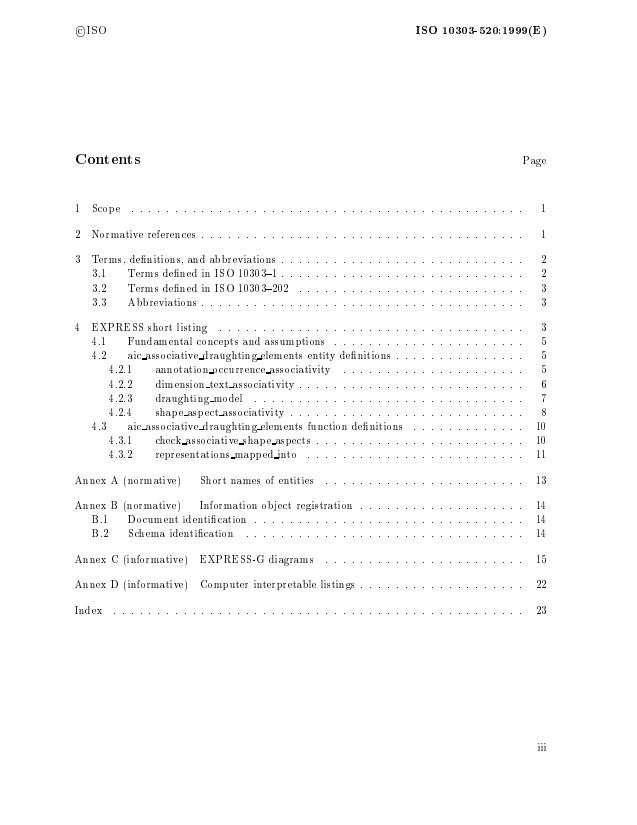
Contents Page
1Scop e.1
2Normative references.1
3Terms, denitions, and abbreviations.2
3.1Terms dened in ISO10303{1.2
3.2Terms dened in ISO10303{202.3
3.3Abbreviations.3
4EXPRESS short listing.3
4.1Fundamental concepts and assumptions.5
4.2aic asso ciative draughting elements entity denitions.5
4.2.1annotation o ccurrence asso ciativity.5
4.2.2dimension text asso ciativity.6
4.2.3draughting mo del.7
4.2.4shap e asp ect asso ciativity.8
4.3aic asso ciative draughting elements function denitions.10
4.3.1check asso ciative shap e asp ects.10
4.3.2representations mapp ed into.11
Annex A (normativ e) Short names of entities.13
Annex B (normativ e) Information ob ject registration.14
B.1 Do cument identication.14
B.2 Schema identication.14
Annex C (informativ e) EXPRESS-G diagrams.15
Annex D (informativ e) Computer interpretable listings.22
Index.23
iii
c
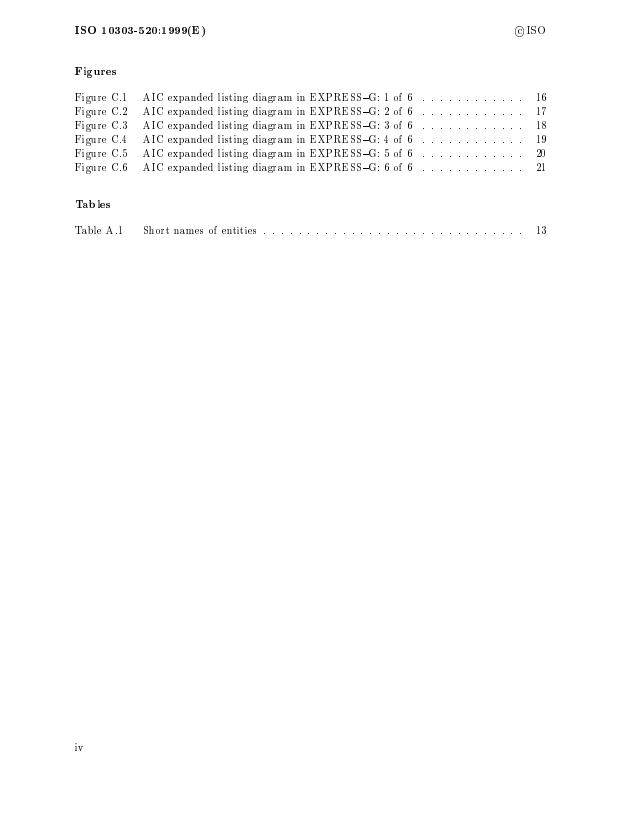
Figures
Figure C.1 AIC expanded listing diagram in EXPRESS{G:1of6.16
Figure C.2 AIC expanded listing diagram in EXPRESS{G:2of6.17
Figure C.3 AIC expanded listing diagram in EXPRESS{G:3of6.18
Figure C.4 AIC expanded listing diagram in EXPRESS{G:4of6.19
Figure C.5 AIC expanded listing diagram in EXPRESS{G:5of6.20
Figure C.6 AIC expanded listing diagram in EXPRESS{G:6of6.21
Tables
Table A.1 Short names of entities.13
iv
cISO ISO 10303-520:1999(E)
Foreword
ISO (the International Organization for Standardization) is a worldwide federation of national
standards b o dies (ISO mem b er b o dies). The work of preparing International Standards is nor-
mally carried out through ISO technical committees. Each member body interested in a sub ject
for which a technical committee has b een established has the right to be represented on that
committee. International organizations, governmental and non-go vernmental, in liaison with
ISO, also tak e part in the work. ISO collab orates closely with the International Electrotechnical
Commission (IEC) on all matters of electrotec hnical standardization.
Draft International Standards adopted by the technical committees are circulated to the member
b o dies for voting. Publication as an International Standard requires approval by at least75%
of the memb er b o dies casting a vote.
International Standard ISO10303{520was prepared by Technical Committee ISO/TC184,
Industrial automation systems and integration, Sub committee SC4, Industrial data.
This International Standard is organized as a series of parts, each published separately.The
parts of ISO10303fall in to one of the following series: description metho ds, in tegrated resources,
application proto cols, abstract test suites, implementation metho ds, and conformance testing.
The series are describ ed in ISO10303{1.
A complete list of parts of ISO10303is a vailable from the internet:
http://www.nist.go v/sc4/editing/step/titles/
Annexes A and B form an integral part of this part of ISO10303.Annexes C and D are for
information only.
v
c
Intro duction
ISO10303is an International Standard for the computer-in terpretable representation and ex-
change of pro duct data. The ob jective is to provide a neutral mechanism capable of describing
pro duct data throughout the life cycle of a pro duct indep endent from any particular system.
The nature of this description makes it suitable not only for neutral le exc hange, but also as a
basis for implementing and sharing pro duct databases and archiving.
This International Standard is organized as a series of parts, each published separately.The
parts of ISO10303fall in to one of the following series: description metho ds, in tegrated resources,
application interpreted constructs, application proto cols, abstract test suites, implementation
metho ds, and conformance testing. The series are describ ed in ISO10303{1.This part of
ISO10303is a memb er of the application interpreted constructs series.
An application interpreted construct (AIC) pro vides a logical grouping of interpreted constructs
that supp orts a sp ecic functionalit y for the usage of pro duct data across multiple application
contexts. An interpreted construct is a common interpretation of the integrated resources that
supp orts shared information requirements among application proto cols.
This do cument sp ecies the application interpreted construct for the description of structures
to asso ciate the annotation used in draughting with the geometric asp ects of the shap e where
the annotation applies.
vi
INTERNATIONAL STANDARDc ISO ISO 10303-520:1999(E)
Industrial automation systems and integration|
Pro duct data representation and exchange|
Part520:
Application interpreted construct:
Asso ciative draughting elements
1Scop e
This part of ISO10303sp ecies the in terpretation of the integrated resources to satisfy require-
ments for the representation of asso ciations between annotation and geometrics asp ects of the
shap e of a pro duct.
The following are within the scop e of this part of ISO10303:
|the structures for representing asso ciations b etween dimensions or draughting callouts and
their resp ective target pro duct shap e geometry or annotation;
|the structures for representing asso ciations between the b oundaries of a ll area and the
pro duct shap e geometry or annotation from which they are derived.
The following are outside the scop e of this part of ISO10303:
|the representation of the pro duct’s shap e;
|the styling of dimensions, annotation, and geometry.
2Normative references
The following normative do cuments contain provisions which, through reference in this text,
constitute provisions of this part of ISO10303.For dated references, subsequent amendments
to, or revisions of, any of these publications do not apply.However, parties to agreements
based on this part of ISO10303are encouraged to investigate the p ossibility of applying the
most recent editions of the normative do cuments indicated b elow. For undated references, the
latest edition of the normative do cument referred to applies. Memb ers of ISO and IEC maintain
registers of currently valid International Standards.
ISO8824{1:1995,Information Technology{Open Systems Interconnection{Abstract Syntax
Notation One (ASN.1){Part1:Specic ation of Basic Notation.
ISO10303{11:1994,Industrial automation systems and integration{Product data representa-
tion and exchange{Part11:Description methods: The EXPRESS language reference manual.
c
ISO10303{41:1994,Industrial automation systems and integration{Product data representa-
tion and exchange{Part41:Integrated generic resources: Fundamentals of product description
and support.
ISO10303{43:1994,Industrial automation systems and integration{Product data representa-
tion and exchange{Part43:Integrated generic resources: Representation structures.
ISO10303{46:1994,Industrial automation systems and integration{Product data representa-
tion and exchange{Part46:Integrated generic resources: Visual presentation.
ISO10303{47:1997,Industrial automation systems and integration{Product data representa-
tion and exchange{Part47:Integrated generic resources: Shape variation tolerances.
ISO10303{101:1994,Industrial automation systems and integration {Pr oduct data representa-
tion and exchange{Part101:Integrated application resources: Draughting.
ISO10303{202:1996,Industrial automation systems and integration {Pr oduct data representa-
tion and exchange{Part202:Application protocol: Associative draughting.
3Terms, denitions, and abbreviations
3.1Terms dened in ISO10303{1
For the purp ose of this part of ISO10303,the following terms dened in ISO10303{1apply:
|abstract test suite (A TS);
|application;
|application context;
|application proto col (AP);
|implementation metho d;
|information;
|integrated resource;
|interpretation;
|mo del;
|pro duct;
|pro duct data.
cISO ISO 10303-520:1999(E)
3.2Terms dened in ISO10303{202
For the purp ose of this part of ISO10303,the following terms dened in ISO10303{202ap-
ply:
3.2.1
application interpreted construct
a logical grouping of interpreted constructs that supp orts a sp ecic function for the usage of
pro duct data across multiple application contexts
[ISO10303{202:1996,denition3.7.1]
3.3Abbreviations
For the purp ose of this part of ISO10303,the following abbreviations apply:
AIC application interpreted construct
AP application proto col
ATS abstract test suite
4EXPRESS short listing
This clause sp ecies the EXPRESS schema that uses elements from the integrated resources
and contains the typ es, entity sp ecializations, and functions that are sp ecic to this part of
ISO10303.
NOTE1-There may b e subtyp es and items of select lists that app ear in the integrated resources
that are not imp orted into the AIC. Constructs are eliminated from the subt yp e tree or select list
through the use of the implicit interface rules of ISO10303-11.References to eliminated constructs
are outside the scop e of the AIC. In some cases, all items of the select list are eliminated. Because
AICs are intended to be implemented in the context of an application proto col, the items of the
select list will b e dened b y the scop e of the application proto col.
EXPRESS sp ecication:
*)
SCHEMA aic_associative_ draughting_el ements;
USE FROM measure_schema--ISO10303-41
(derived_unit,
named_unit);
USE FROM product_property _d efinition_ schema--ISO10303-41
c
(shape_aspect_rel ationship);
USE FROM product_property _r epresentation_s chema--ISO10303-41
(shape_definitio n_ representation);
REFERENCE FROM support_resource_ schema--ISO10303-41
(bag_to_set);
USE FROM representation_s chema--ISO10303-43
(mapped_item,
representation,
representation_it em,
representation_ma p);
REFERENCE FROM representation_sc hema--ISO10303-43
(using_representa tions);
USE FROM qualified_measur e_ schema--ISO10303-45
(measure_represen tation_ item);
USE FROM presentation_app earance_sc hema--ISO10303-46
(curve_style,
styled_item);
USE FROM presentation_def inition_sc hema--ISO10303-46
(annotation_curve _o ccurrence,
annotation_fill_a rea_ occurrence,
annotation_occurr ence,
annotation_occurr ence_re lationship,
annotation_symbol _o ccurrence,
annotation_text_o ccurrence,
text_literal);
USE FROM presentation_org anization_ schema--ISO10303-46
(camera_model);
USE FROM shape_dimension_ schema--ISO10303-47
(dimensional_char acteristic_r epresentation,
shape_dimension_r epresentation);
USE FROM draughting_eleme nt_sc hema--ISO10303-101
(draughting_callo ut,
leader_curve,
projection_curve);
(*
NOTE2-The schemas referenced ab ove can b e found in the following parts of ISO10303:
draughting element schema ISO10303-101
measure schema ISO10303-41
presentation app earance schema ISO10303-46
cISO ISO 10303-520:1999(E)
presentation denition schema ISO10303-46
presentation organization schema ISO10303-46
pro duct prop erty denition schema ISO10303-41
pro duct prop erty representation schema ISO10303-41
representation schema ISO10303-43
shap e dimension schema ISO10303-47
supp ort resource schema ISO10303-41
4.1Fundamental concepts and assumptions
The following entities are intended to b e indep endently instantiated in the application proto col
schemas that use this AIC:
|annotation curve o ccurrence;
|annotation ll area o ccurrence;
|annotation o ccurrence asso ciativity;
|annotation symbol o ccurrence;
|dimension text asso ciativity;
|draughting callout;
|draughting mo del;
|leader curve;
|pro jection curve;
|shap e asp ect asso ciativity;
|shap e denition representation;
|shap e dimension representation.
4.2aic asso ciative draughting elements entity denitions
4.2.1annotation o ccurrence asso ciativity
An annotation o ccurrence asso ciativity is an annotation o ccurrence relationship that
relates an element of annotation to the leader or pro jection curve which visually directs infor-
mation in the drawing to the element or to the ll area whose b oundary is derived from the
element.
c
EXPRESS sp ecication:
*)
ENTITY annotation_occur rence_as sociativity
SUBTYPE OF (annotation_occ urrence_ relationship);
WHERE
WR1: SIZEOF (TYPEOF (SELF.related_ann otation_ occurrence)*
[’AIC_ASSOCIATIVE _DR AUGHTING_ ELEMENTS.A NNOTATION_ FILL_AR EA_OC CURRENCE’,
’AIC_ASSOCIATIVE_ DRAUGHTING_E LEMENTS.PR OJECTION_C URVE’,
’AIC_ASSOCIATIVE_ DRAUGHTING_E LEMENTS.LE ADER_ CURVE’])=1;
END_ENTITY;
(*
Formal prop ositions:
WR1: The related annotation o ccurrence shall b e a leader curve,pro jection curve,or
annotation ll area o ccurrence.
4.2.2dimension text asso ciativity
A dimension text asso ciativity is a text literal that maps a shap e dimension represen-
tation onto the draughting callout which presents the measurement.
NOTE-The measurement of the shap e dimension representation need not be identical to
the character string presented by the text literal.
EXPRESS sp ecication:
*)
ENTITY dimension_text_a ssociativity
SUBTYPE OF (text_literal, mapped_item);
WHERE
WR1: (’AIC_ASSOCIATI VE_ DRAUGHTING_E LEMENTS.SH APE_ DIMENSION_ REPRESENTATION’
IN TYPEOF (SELF\mapped_ite m.
mapping_source.ma pped_ representation));
WR2: (’AIC_ASSOCIATI VE_ DRAUGHTING_E LEMENTS.DR AUGHTING_ CALLOUT’
IN TYPEOF (SELF\mapped_ite m. mapping_ta rget));
WR3: SIZEOF (QUERY (ato<*QUERY (si<*
USEDIN (SELF, ’AIC_ASSOCIATIV E_D RAUGHTING_EL EMENTS. STYLED_ ITEM. ITEM’)|
(’AIC_ASSOCIATI VE_ DRAUGHTING_E LEMENTS.A NNOTATION_ TEXT_ OCCURRENCE’
IN TYPEOF(si)))|
NOT (SIZEOF( QUERY (dc<*
USEDIN (ato, ’AIC_ASSOCIATIVE _D RAUGHTING_ ELEMENTS.’+
’DRAUGHTING_CALLO UT.CO NTENTS’)|
(’AIC_ASSOCIATIVE _D RAUGHTING_ ELEMENTS.D RAUGHTING_CA LLOUT’
IN TYPEOF (dc)))
cISO ISO 10303-520:1999(E)
*[SELF\mapped_ite m. mapping_ta rget])=1)
))=0;
END_ENTITY;
(*
Formal prop ositions:
WR1: The mapp ed representation shall b e a shap e dimension representation.
WR2: The mapping target shall b e a draughting callout.
WR3: The dimension text asso ciativity shall b e used in an annotation text o ccurrence
that is in the contents of the target draughting callout.
4.2.3draughting mo del
A draughting mo del is a representation of the shap e of a pro duct for the purp ose of draugh-
ting. A draughting mo del may contain mapp ed items that are the mappings of shap e-
representations or of other draughting mo dels.A mapp ed item that is the mapping
of a shap e representation sp ecies an explicit representation of the shap e of a pro duct
that is to be presented in the drawing. A mapp ed item that is the mapping of another
draughting mo del sp ecies the use of a sub-mo del. The draughting mo del may contain
styled items.These styled items sp ecify the style for a mapp ed item that is the map-
ping of a shap e representation,and provide the curve style to be used in presenting the
shap e representation in the drawing. The draughting mo del may contain annotation-
o ccurrences.These annotation o ccurrences sp ecify the annotation that is placed in the
same co ordiante system as the shap e representation,and is pro jected into a view when the
draughting mo del is presented in a drawing.
EXPRESS sp ecication:
*)
ENTITY draughting_model
SUBTYPE OF (representation);
UNIQUE
UR1: SELF\representa tion. name;
WHERE
WR1: SIZEOF (QUERY (it<*SELF.items|
NOT (SIZEOF ([’AIC_ASSOCIATI VE_ DRAUGHTING_E LEMENTS.M APPED_IT EM’,
’AIC_ASSOCIATIVE_ DRAUGHTING_E LEMENTS.S TYLED_IT EM’,
’AIC_ASSOCIATIVE_ DRAUGHTING_E LEMENTS.A XIS2_PLACEMENT’,
’AIC_ASSOCIATIVE_ DRAUGHTING_E LEMENTS.C AMERA_MO DEL’]*
TYPEOF (it))=1
)))=0;
WR2: SIZEOF (QUERY (mi<*QUERY (it<*SELF.items|
(’AIC_ASSOCIATIV E_D RAUGHTING_EL EMENTS. MAPPED_ ITEM’ IN TYPEOF(it)))|
NOT(
c
SIZEOF ([’AIC_ASSOCIATIV E_ DRAUGHTING_E LEMENTS. SHAPE_R EPRESENTATION’,
’AIC_ASSOCIATIVE_ DRAUGHTING_E LEMENTS. DRAUGHTING_M ODEL’]*
TYPEOF (mi\mapped_item. mapping_so urce.
mapped_represen tation))=1
)))=0;
WR3: SIZEOF (QUERY (smi<*QUERY (si<*QUERY (it<*SELF.items|
(’AIC_ASSOCIATIV E_D RAUGHTING_EL EMENTS. STYLED_ ITEM’ IN TYPEOF(it)))|
(’AIC_ASSOCIATIV E_D RAUGHTING_EL EMENTS. MAPPED_ ITEM’ IN
TYPEOF(si\styled_ item. item)))|
(NOT ((’AIC_ASSOCIATI VE_DR AUGHTING_ ELEMENTS.S HAPE_ REPRESENTATION’IN
TYPEOF(smi\styled _i tem.i tem\m apped_i tem.
mapping_source.ma pped_ representation))
AND
(SIZEOF (QUERY (sty<*smi\styled_item.s tyles|
(NOT (SIZEOF (QUERY (psa<*sty.styles|
(NOT (’AIC_ASSOCIATIV E_D RAUGHTING_ ELEMENTS. CURVE_S TYLE’
IN TYPEOF(psa)))))=1
))))=1)))
))=0;
END_ENTITY;
(*
Formal prop ositions:
UR1: The name of a draughting mo del shall b e unique.
WR1: Each item of a draughting mo del shall be a mapp ed item,styled item,axis2-
placement,or camera mo del.
WR2: If there is a mapp ed item in the draughting mo del,the source of the mapp ed item
shall b e a shap e representation or another draughting mo del.
WR3: If a mapp ed item is styled, the source of the mapp ed item shall be a shap e-
representation and the style applied to the mapp ed item shall b e a curve style.
4.2.4shap e asp ect asso ciativity
A shap e asp ect asso ciativity is a shap e asp ect relationship that relates an element of
the shap e representation to the leader or pro jection curve which visually directs information
in the drawing to the element or to the ll area b oundary that is deriv ed from the element.
EXPRESS sp ecication:
*)
ENTITY shape_aspect_ass ociativity
SUBTYPE OF (shape_aspect_r elationship);
WHERE
WR1: SELF.relating_s hape_ aspect.p roduct_ definitional;
cISO ISO 10303-520:1999(E)
WR2: NOT (SELF.related_sh ape_a spect.p roduct_d efinitional);
WR3: SIZEOF (QUERY (pd<*USEDIN (SELF, ’AIC_ASSOCIATIVE_ DRAUGHTING_E LEMENTS.’+
’PROPERTY_DEFINI TION. DEFINITION’)|
NOT (SIZEOF (QUERY (sdr<*QUERY (pdr<*USEDIN (pd,
’AIC_ASSOCIATIVE_ DRAUGHTING_E LEMENTS.’+
’PROPERTY_DEFINIT ION_R EPRESENTATION. DEFINITION’)|
(’AIC_ASSOCIATIV E_ DRAUGHTING_E LEMENTS.SH APE_D EFINITION_RE PRESENTATION’
IN TYPEOF (pdr)))|
NOT (SIZEOF (QUERY (it<*sdr.used_represen tation. items|
NOT (’AIC_ASSOCIATI VE_ DRAUGHTING_E LEMENTS.C URVE’ IN TYPEOF(it))
AND
(SIZEOF (QUERY (aco<*USEDIN (it,
’AIC_ASSOCIATIVE_ DRAUGHTING_E LEMENTS.ST YLED_IT EM.IT EM’)|
SIZEOF (TYPEOF (aco)*
[’AIC_ASSOCIATIVE _D RAUGHTING_ ELEMENTS.L EADER_C URVE’,
’AIC_ASSOCIATIVE _D RAUGHTING_ ELEMENTS.P ROJECTION_CU RVE’])=1))+
SIZEOF (USEDIN (it, ’AIC_ASSOCIATIV E_ DRAUGHTING_EL EMENTS.’+
’ANNOTATION_FILL _A REA.B OUNDARIES’))>=1)
))=1)
))=0)
))=0;
WR4: SIZEOF (QUERY (pd<*USEDIN (SELF, ’AIC_ASSOCIATIVE_ DRAUGHTING_E LEMENTS.’+
’PROPERTY_DEFINI TION. DEFINITION’)|
NOT (SIZEOF (QUERY (sdr<*QUERY (pdr<*USEDIN (pd,
’AIC_ASSOCIATIVE_ DRAUGHTING_E LEMENTS.’+
’PROPERTY_DEFINIT ION_R EPRESENTATION. DEFINITION’)|
(’AIC_ASSOCIATIV E_ DRAUGHTING_E LEMENTS.SH APE_D EFINITION_RE PRESENTATION’
IN TYPEOF (pdr)))|
NOT (check_associativ e_s hape_as pects(s dr))
))=0)
))=0;
END_ENTITY;
(*
Formal prop ositions:
WR1: The relating shap e asp ect shall dene the pro duct.
WR2: The related shap e asp ect shall not dene the pro duct.
WR3: One of the items in the shap e representation for the shap e asp ect asso ciativity
shall b e the basis curve for a leader curve,a pro jection curve,or a ll area b oundary.
WR4: The shap e representation for the shap e asp ect asso ciativity shall contain two
items. One item shall b e an item in a shap e representation that is mapp ed into a draught-
ing mo del.This draughting mo del shall either contain the related leader, pro jection curv e,
or ll area as an element or be pro jected into the presentation view in which the related
leader, pro jection curv e, or ll area is an elemen t.
c
...
Questions, Comments and Discussion
Ask us and Technical Secretary will try to provide an answer. You can facilitate discussion about the standard in here.
Loading comments...