

ISO/TR 21959-1:2020
(Main)Road vehicles — Human performance and state in the context of automated driving — Part 1: Common underlying concepts
General Information
- Abstract
This document introduces basic common underlying concepts related to driver performance and state in the context of automated driving. The concepts in this document are applicable to all levels of automated driving functions that require a human/driver to be engaged or fallback-ready (SAE level 1, 2 and 3). It can also be used with levels that enable a driver to resume manual control of the vehicle (a compatible feature for SAE levels 1 to 5). Common underlying concepts can be applicable for human factors assessment/evaluations using driving simulators, tests on restricted roadways (e.g. test tracks) or tests on public roads. The information applies to all vehicle categories. This document contains a mixture of information where technical consensus supports such guidance, as well as discussion of those areas where further research is required to support technical consensus. These common underlying concepts can be also useful for product descriptions and owner manuals. The contents in this document are informative, rather than normative, in nature.
- Status
- Published
- Publication Date
- 08-Jan-2020
- Technical Committee
- ISO/TC 22/SC 39 - Ergonomics
- Drafting Committee
- ISO/TC 22/SC 39/WG 8 - TICS on-board-MMI
- Current Stage
- 6060 - International Standard published
- Start Date
- 09-Jan-2020
- Due Date
- 11-Mar-2021
- Completion Date
- 09-Jan-2020
Buy Documents

ISO/TR 21959-1:2020 - Road vehicles — Human performance and state in the context of automated driving — Part 1: Common underlying concepts Released:1/9/2020

ISO/TR 21959-1:2020 - Road vehicles — Human performance and state in the context of automated driving — Part 1: Common underlying concepts/9/2020
Overview
ISO/TR 21959-1:2020 - "Road vehicles - Human performance and state in the context of automated driving - Part 1: Common underlying concepts" provides a harmonized set of informative concepts describing driver performance and driver state for automated driving. It applies primarily to systems that require a human to remain engaged or fallback-ready (notably SAE levels 1, 2 and 3) and can also inform features that allow the driver to resume manual control across SAE levels 1–5. The report is intended for researchers, OEMs, human factors practitioners and test engineers and is applicable across vehicle categories and test contexts (driving simulators, test tracks, public roads).
Key topics and technical concepts
- Transition process models - conceptual models for transitions from manual → automated driving and automated → manual driving, including system- and driver-initiated transitions.
- Definitions of driver states and activities - clear terminology for concepts such as Manual Control, Automation Available, Activation/Request to Engage Automation, and Automated Driving.
- Driver state transition - physical and cognitive aspects of releasing control to automation and of regaining control from automation (hands/feet release, cognitive confirmation).
- Measures for human performance - topics and candidate measures for assessing transition performance (behavioural markers, timing, success/failure indicators) - presented as guidance rather than prescriptive requirements.
- Mental and non-driving related states - taxonomy of mental states, Non-Driving Related Activities (NDRA) and Non-Driving Related Tasks (NDRT), posture and driving position considerations.
- Driver readiness / availability - concepts that predict intervention performance and are relevant to driver monitoring and system HMI.
- User experience factors - prior system image, education and training, user understanding of driving automation, and behavioral attitudes while using the system.
Note: ISO/TR 21959-1:2020 is informative (technical report) - it provides consensus guidance where available and highlights research gaps rather than setting normative requirements.
Practical applications - who uses it
- Automotive OEMs and Tier-1 suppliers for concept alignment and product descriptions
- HMI designers and UX teams to evaluate driver understanding and handover cues
- Human factors researchers designing simulator and on-road evaluations
- Test engineers planning restricted-road or public-road trials
- Regulators and safety assessors seeking common terminology for driver-related evaluations
- Technical writers preparing owner manuals and product documentation
Related standards
- SAE J3016 (levels of driving automation) - referenced for automation level definitions
- SAE J3114 - complementary guidance on automated driving concepts
- ISO/SAE 22736 (planned) - expected to cover additional aspects referenced in this report
- Other parts of the ISO 21959 series for more detailed or normative guidance
Keywords: ISO/TR 21959-1:2020, automated driving, human performance, driver state, SAE levels, driver readiness, HMI, driver monitoring, NDRA, NDRT, human factors.
Relations
- Effective Date
- 23-Apr-2020
Buy Documents
ISO/TR 21959-1:2020 - Road vehicles — Human performance and state in the context of automated driving — Part 1: Common underlying concepts Released:1/9/2020
ISO/TR 21959-1:2020 - Road vehicles — Human performance and state in the context of automated driving — Part 1: Common underlying concepts/9/2020
Get Certified
Connect with accredited certification bodies for this standard

TÜV Rheinland
TÜV Rheinland is a leading international provider of technical services.

TÜV SÜD
TÜV SÜD is a trusted partner of choice for safety, security and sustainability solutions.

BSI Group
BSI (British Standards Institution) is the business standards company that helps organizations make excellence a habit.
Sponsored listings
Frequently Asked Questions
ISO/TR 21959-1:2020 is a technical report published by the International Organization for Standardization (ISO). Its full title is "Road vehicles — Human performance and state in the context of automated driving — Part 1: Common underlying concepts". This standard covers: This document introduces basic common underlying concepts related to driver performance and state in the context of automated driving. The concepts in this document are applicable to all levels of automated driving functions that require a human/driver to be engaged or fallback-ready (SAE level 1, 2 and 3). It can also be used with levels that enable a driver to resume manual control of the vehicle (a compatible feature for SAE levels 1 to 5). Common underlying concepts can be applicable for human factors assessment/evaluations using driving simulators, tests on restricted roadways (e.g. test tracks) or tests on public roads. The information applies to all vehicle categories. This document contains a mixture of information where technical consensus supports such guidance, as well as discussion of those areas where further research is required to support technical consensus. These common underlying concepts can be also useful for product descriptions and owner manuals. The contents in this document are informative, rather than normative, in nature.
This document introduces basic common underlying concepts related to driver performance and state in the context of automated driving. The concepts in this document are applicable to all levels of automated driving functions that require a human/driver to be engaged or fallback-ready (SAE level 1, 2 and 3). It can also be used with levels that enable a driver to resume manual control of the vehicle (a compatible feature for SAE levels 1 to 5). Common underlying concepts can be applicable for human factors assessment/evaluations using driving simulators, tests on restricted roadways (e.g. test tracks) or tests on public roads. The information applies to all vehicle categories. This document contains a mixture of information where technical consensus supports such guidance, as well as discussion of those areas where further research is required to support technical consensus. These common underlying concepts can be also useful for product descriptions and owner manuals. The contents in this document are informative, rather than normative, in nature.
ISO/TR 21959-1:2020 is classified under the following ICS (International Classification for Standards) categories: 43.020 - Road vehicles in general. The ICS classification helps identify the subject area and facilitates finding related standards.
ISO/TR 21959-1:2020 has the following relationships with other standards: It is inter standard links to ISO/TR 21959-1:2018. Understanding these relationships helps ensure you are using the most current and applicable version of the standard.
ISO/TR 21959-1:2020 is available in PDF format for immediate download after purchase. The document can be added to your cart and obtained through the secure checkout process. Digital delivery ensures instant access to the complete standard document.
Standards Content (Sample)
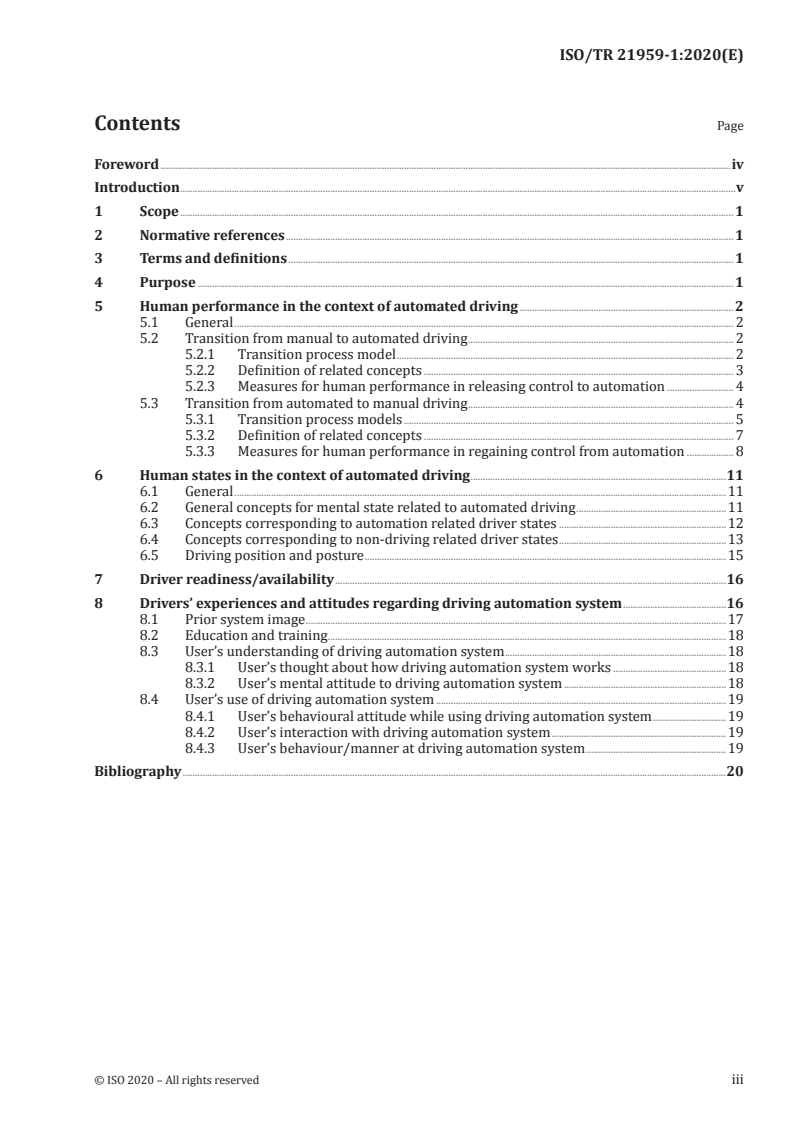
TECHNICAL ISO/TR
REPORT 21959-1
Second edition
2020-01
Road vehicles — Human performance
and state in the context of automated
driving —
Part 1:
Common underlying concepts
Véhicules routiers — Etat et performance humaine dans le contexte
de la conduite automatisée —
Partie 1: Concepts fondamentaux
Reference number
©
ISO 2020
© ISO 2020
All rights reserved. Unless otherwise specified, or required in the context of its implementation, no part of this publication may
be reproduced or utilized otherwise in any form or by any means, electronic or mechanical, including photocopying, or posting
on the internet or an intranet, without prior written permission. Permission can be requested from either ISO at the address
below or ISO’s member body in the country of the requester.
ISO copyright office
CP 401 • Ch. de Blandonnet 8
CH-1214 Vernier, Geneva
Phone: +41 22 749 01 11
Fax: +41 22 749 09 47
Email: copyright@iso.org
Website: www.iso.org
Published in Switzerland
ii © ISO 2020 – All rights reserved
Contents Page
Foreword .iv
Introduction .v
1 Scope . 1
2 Normative references . 1
3 Terms and definitions . 1
4 Purpose . 1
5 Human performance in the context of automated driving . 2
5.1 General . 2
5.2 Transition from manual to automated driving . 2
5.2.1 Transition process model . 2
5.2.2 Definition of related concepts . 3
5.2.3 Measures for human performance in releasing control to automation . 4
5.3 Transition from automated to manual driving . 4
5.3.1 Transition process models . 5
5.3.2 Definition of related concepts . 7
5.3.3 Measures for human performance in regaining control from automation . 8
6 Human states in the context of automated driving .11
6.1 General .11
6.2 General concepts for mental state related to automated driving .11
6.3 Concepts corresponding to automation related driver states .12
6.4 Concepts corresponding to non-driving related driver states .13
6.5 Driving position and posture .15
7 Driver readiness/availability .16
8 Drivers’ experiences and attitudes regarding driving automation system .16
8.1 Prior system image .17
8.2 Education and training .18
8.3 User’s understanding of driving automation system .18
8.3.1 User’s thought about how driving automation system works .18
8.3.2 User’s mental attitude to driving automation system .18
8.4 User’s use of driving automation system .19
8.4.1 User’s behavioural attitude while using driving automation system .19
8.4.2 User’s interaction with driving automation system .19
8.4.3 User’s behaviour/manner at driving automation system .19
Bibliography .20
Foreword
ISO (the International Organization for Standardization) is a worldwide federation of national standards
bodies (ISO member bodies). The work of preparing International Standards is normally carried out
through ISO technical committees. Each member body interested in a subject for which a technical
committee has been established has the right to be represented on that committee. International
organizations, governmental and non-governmental, in liaison with ISO, also take part in the work.
ISO collaborates closely with the International Electrotechnical Commission (IEC) on all matters of
electrotechnical standardization.
The procedures used to develop this document and those intended for its further maintenance are
described in the ISO/IEC Directives, Part 1. In particular, the different approval criteria needed for the
different types of ISO documents should be noted. This document was drafted in accordance with the
editorial rules of the ISO/IEC Directives, Part 2 (see www .iso .org/ directives).
Attention is drawn to the possibility that some of the elements of this document may be the subject of
patent rights. ISO shall not be held responsible for identifying any or all such patent rights. Details of
any patent rights identified during the development of the document will be in the Introduction and/or
on the ISO list of patent declarations received (see www .iso .org/ patents).
Any trade name used in this document is information given for the convenience of users and does not
constitute an endorsement.
For an explanation of the voluntary nature of standards, the meaning of ISO specific terms and
expressions related to conformity assessment, as well as information about ISO's adherence to the
World Trade Organization (WTO) principles in the Technical Barriers to Trade (TBT) see www .iso .org/
iso/ foreword .html.
This document was prepared by Technical Committee ISO/TC 22, Road vehicles, Subcommittee SC 39,
Ergonomics.
This second edition cancels and replaces the first edition (ISO/TR 21959-1:2018), which has been
technically revised. The main changes compared to the previous edition are as follows:
— editorial modifications to the format of the figures;
— corrections of the references to clause numbers (Clause 7 is now Clause 8);
— corrections to redundant descriptions.
A list of all parts in the ISO 21959 series can be found on the ISO website.
Any feedback or questions on this document should be directed to the user’s national standards body. A
complete listing of these bodies can be found at www .iso .org/ members .html.
iv © ISO 2020 – All rights reserved
Introduction
Although automation technology is advancing at a very fast pace, the majority of automated driving
levels (as defined by SAE) still require a human to fulfil specific remaining (driving related) tasks while
being in automated driving mode. The basic requirements with respect to the driver strongly depend on
the level of automation and are subject to human factors research all over the world. The SAE standards
[70] [71] [72]
SAE J3016 and SAE J3114 have already introduced working definitions of key concepts in this
field. This document puts an emphasis on common underlying concepts of driver performance and state
in the context of automated driving.
Driver performance includes driver’s activities in transitions both from manual driving to automated
driving and from automated to manual driving, as well as interaction behaviour while using the system.
Driver state here means driver’s internal conditions that may affect performance including knowledge
of and attitudes toward driving automation systems.
Concepts on driver performances in transition from manual to automated driving and from automated
to manual driving are described in Clause 5. Concepts on driver state related to the transition are
described in Clause 6 and a specific concept “readiness/availability” that refers to driver state that
predicts the intervention performance is described in Clause 7. Concepts for driver’s experiences
and attitudes that may affect driver performance and state in the context of automated driving are
described in Clause 8.
TECHNICAL REPORT ISO/TR 21959-1:2020(E)
Road vehicles — Human performance and state in the
context of automated driving —
Part 1:
Common underlying concepts
1 Scope
This document introduces basic common underlying concepts related to driver performance and
state in the context of automated driving. The concepts in this document are applicable to all levels of
automated driving functions that require a human/driver to be engaged or fallback-ready (SAE level 1,
2 and 3). It can also be used with levels that enable a driver to resume manual control of the vehicle (a
compatible feature for SAE levels 1 to 5).
Common underlying concepts can be applicable for human factors assessment/evaluations using driving
simulators, tests on restricted roadways (e.g. test tracks) or tests on public roads. The information
applies to all vehicle categories.
This document contains a mixture of information where technical consensus supports such guidance,
as well as discussion of those areas where further research is required to support technical consensus.
These common underlying concepts can be also useful for product descriptions and owner manuals.
The contents in this document are informative, rather than normative, in nature.
2 Normative references
There are no normative references in this document.
3 Terms and definitions
No terms and definitions are listed in this document.
ISO and IEC maintain terminological databases for use in standardization at the following addresses:
— ISO Online browsing platform: available at https:// www .iso .org/ obp
— IEC Electropedia: available at http:// www .electropedia .org/
4 Purpose
The purpose of this document is to provide common underlying concepts for human performance and
state for the researchers and developers of driving automation systems (more specifically SAE levels
1–5) in order to facilitate the sharing of information and knowledge as these systems are developed
and deployed.
This document does not provide design principles on how a human-machine interface (HMI) for
automated driving should be designed or developed. However, common concepts and measures could
be used during the development phase when different HMI designs are evaluated in terms of usability,
user experience and safety.
It is not intended that anything in this document restricts or provides direction regarding the
technology used to create these systems, or the underlying design of these system.
5 Human performance in the context of automated driving
5.1 General
Human performance has two aspects—behaviour being the means and its consequence being the
[16]
end . The focus on consequences, and hence on performance, is especially relevant for situations
such as the transition processes from automated to manual control (level 0) and vice versa (see
Figures 1 to 4). The following subclauses give an overview of possible measures for driver- and system-
initiated transitions. For transitions between different automation levels (e.g. 4→2 or 3→1) within one
vehicle appropriate measures can be selected or adapted according to the specific circumstances.
5.2 Transition from manual to automated driving
5.2.1 Transition process model
Figure 1 shows a process model for a prototypical transition from manual to automated control, either
initiated by the driver or by the system.
EXAMPLE After entering the highway the driver is informed about the availability of a “highway pilot
1)
function” . He/she decides to activate automation by a dedicated steering wheel button.
1) See: https:// www .daimler .com/ innovation/ case/ autonomous/ highway -pilot -2 .html, Hunger 2017. Highway
pilot system is an example of a suitable product available commercially. This information is given for the convenience
of users of this document and does not constitute an endorsement by ISO of this product.
2 © ISO 2020 – All rights reserved
Figure 1 — Driver/system-initiated transition from manual to automated driving
(concepts are further specified in 5.2.2 and 5.2.3)
5.2.2 Definition of related concepts
a) Manual control: Driving phase where a human driver is performing the dynamic driving task
(DDT)—all of the real-time operational and tactical functions required to operate a vehicle in on-
road traffic (see Reference [70] for the definition of level 0 automation). In cases where lower level
automation features are already active, this phase can be regarded as including the remaining
(manual) elements of the DDT required by the driving automation system. For example, driving
with adaptive cruise control requires the driver to perform the lateral control (sub) task as well as
the object and event detection and response (OEDR) subtask.
b) Automation available: If all operational conditions for a driving automation system are fulfilled
the system is ready to be activated by either the user or the system. This system availability may
be signalled to the user via the driver vehicle interface (e.g. screen, tones). However, even if an
automation feature is available, the driver may have to judge whether activation is appropriate
[taking into account the mechanical condition of the vehicle (not detected by the vehicle, e.g. broken
suspension component)] This will be covered in a future planned document (ISO/SAE 22736).
c) Request to engage automation: Event usually initiated by the user through the driver-vehicle
interface of the vehicle to activate the driving automation system. Apart from user-initiated
transitions, system-initiated transitions from manual to automated control may also be possible,
especially after the driver has temporarily overridden the automated mode by manual intervention.
At the end of driver intervention, the system may automatically activate/resume from suspended
to active mode. For example, in some automated steering control systems, after the driver has
transitioned from automated to manual control by manual use of the steering wheel, when the
driver is no longer moving the steering wheel, the system may automatically activate/resume from
manual to automated steering control.
d) Activation of automation: Onset of the driving automation system activation. There may be a
delay between requesting the activation and the activation itself either due to technical reasons or
by intentionally introducing an activation process as an HMI design feature.
e) Driver state transition (manual to automated): Process where the driver is releasing control to
the driving automation system. The transition includes physical aspects (releasing hands and feet
from primary vehicle controls) as well as cognitive aspects (ensuring that automation has taken
over successfully). The physical transition phase ends when the driver fully releases manual
vehicle control (hands and feet do not have any action on longitudinal or lateral vehicle control).
Behavioural markers for the end of the cognitive transition are less obvious.
f) Automated driving: Driving phase where a level 1 – level 5 (L1 – L5) system is performing specific
aspects of the DDT.
g) Acceptable driver state by automation level: Driver state that is required or activity that is
allowed by the driving automation system. The driver state may or may not be monitored by the
driving automation system. Requirements on acceptable driver states are strongly dependent on
the automation level. Sleep is commonly seen as not acceptable by L2/L3 features or physically
leaving the driver’s seat is not acceptable for L2/L3 features.
h) Non-Driving Related Activity (NDRA): Any activity not related to the monitoring of the driving
automation system and/or the current driving situation is called non-driving related activity. This
can include activities that take up any of visual, auditory, visual-manual, auditory-manual, manual,
or cognitive capabilities.
i) Non-Driving Related Task (NDRT): Any activity related to a dedicated task that is different from
the monitoring of the driving automation system and/or the current driving situation is called non-
driving related task. An activity becomes a task when it has a specific goal, and the task can be
made up of a series of activities leading up to this goal. A NDRT can also be called secondary task,
but only as long as there is a primary task, in this case operating the vehicle. When driving is no
longer the driver’s primary task—such as during automated driving at SAE levels 3 and higher—
the NDRT stops being a secondary task. Under such circumstances the NDRT itself can be regarded
as the primary task.
5.2.3 Measures for human performance in releasing control to automation
a) Time to activate system: It is the time interval between events “automation available” and
“request to engage automation”.
b) Time to release controls: It is the time interval between events “activation of automation” and
“full release of vehicle control”.
c) Time to start/resume NDRA: It is the time interval between events “activation of automation”
and “start of NDRA”.
d) Method used to engage driving automation system: It is the specification of required driver
action to fully release control to driving automation system (e.g. double-pull of stalk at steering
column or simultaneous activation of dedicated steering wheel controls).
5.3 Transition from automated to manual driving
Transitions from automated to manual driving, may have two different “sources”. They may be system
initiated or they may be driver initiated as is presented in the subclauses below.
4 © ISO 2020 – All rights reserved
5.3.1 Transition process models
Figure 2 shows the process model for a system-initiated transition from automated to manual vehicle
control with definitions of relevant time periods. This transition model assumes the result of a fully
stabilised vehicle.
2)
EXAMPLE 1 While using a highway pilot system the function issues a request to intervene (RtI) due to an
internal system error. After preparing for taking over manual vehicle control the driver deactivates the highway
pilot function and switches to manual driving mode.
Figure 2 — System-initiated transition from automated to manual driving
(concepts are further specified in 5.3.2 and 5.3.3)
In addition to system-initiated transitions, user-initiated transitions without a RtI are covered, as
level 1 to level 3, and some level 4 or level 5 systems may be designed to be deactivated by the user
at any point in time during full operation. There are two types of reasons for a user to deactivate the
automation feature which are described below.
Figure 3 describes the process of regaining manual vehicle control due to the detection of system
performance limitations (mandatory transition). In this case the L1/L2 driving automation system
does not issue a RtI to the driver.
EXAMPLE 2 While using a L2 automation system in a construction zone the driver observes that the system
is following invalid lane markings. He/she decides to immediately take-over control by manually overriding the
lateral steering control (leading to manual driving mode).
2) See: https:// www .daimler .com/ innovation/ case/ autonomous/ highway -pilot -2 .html, Hunger 2017. Highway
pilot system is an example of a suitable product available commercially. This information is given for the convenience
of users of this document and does not constitute an endorsement by ISO of this product.
Figure 3 — Mandatory human-initiated transition of automated to manual driving due to
detection of system performance limits (concepts are further specified in 5.3.2 and 5.3.3)
On the other hand, the driver may want to deactivate the driving automation system without detecting
system performance limitations (optional limitations). For this case the transition process described
above can be slightly adapted (see Figure 4).
EXAMPLE 3 While using a traffic jam pilot feature in heavy traffic on a city freeway, the driver deactivates all
driving automation features using a designated control for that purpose and switches to manual driving in order
to exit the freeway and find a faster route.
Figure 4 — Optional human-initiated transition of automated to manual driving
(without system performance limit; concepts are further specified in 5.3.2 and 5.3.3)
6 © ISO 2020 – All rights reserved
5.3.2 Definition of related concepts
a) Request to intervene (RtI): Notification by a driving automation system to a driver/fallback-
ready user indicating that he/she should take over vehicle control (perform all or parts of the DDT).
According to the requirements of SAE level 3+ systems, all system related limits are recognized
and appropriate driver requests to take-over control are triggered. The RtI time stamp is essential
to analyse the subsequent transition process as it is regarded as the beginning of the driver state
transition process. If a request to intervene is not issued by the driving automation system because
of an automation-external vehicle failure (for example, flat tyre, broken steering system and so on),
the (perceivable) failure signal can alternatively be used as a corresponding event. Drivers of level 2
automation may encounter (silent) system failures or performance limits which are not recognized
and communicated by the driving automation system. In this case the driver may notice suspicious
vehicle control due to a potential system limit which triggers the decision to regain manual control.
b) Silent system failure and/or silent system limit: System performance limitation of a driving
automation system that is not recognized and communicated to the user. The performance limitation
may be due to internal failure states or incorrect interpretation of the driving environment.
c) Critical event due to system limit: Situation that can be specified in time and space that the
driving automation system cannot handle safely and that will occur in case the driver does not
intervene. System limits are associated with different time budgets:
— Long-term system limits (e.g. the planned transition of a highway pilot when reaching the exit)
can be communicated well in advance to allow for a sufficient preparation. Driver performances
with respect to early communication of long-term system limits are not within primary interest
of this document.
— Mid-term system limits (e.g. approaching a construction site that cannot be handled by the
system) require the driver/fallback-ready user to take-over within a certain time budget. This
type of system limit is central to the definition of SAE level 3 systems.
— Short-term limits (e.g. due to sensor range) ask the driver for immediate take-over of the DDT.
This type of system limit is central to the definition of SAE level 2 systems.
Although the majority of system limits will be detected and communicated via a RtI for higher
automation levels, there may be system limits for level 2 systems without a RtI (see Figure 4).
d) Take-over mode: The concept refers to the system behaviour after a RtI has been issued. The
remaining performance depends on the automation level and on the design of a particular system.
Level 3-5 systems can be able to continue operation after issuing a RtI for a specified period of
time. Depending on the type of system limit, system operation might be of degraded nature. Level
2 systems may be deactivated immediately after a RtI has been issued. The take-over mode may
already contain measures to reach a minimal risk condition (such as a stopping manoeuvre).
However, details on human performance aspects with respect to a minimal risk manoeuvre will be
[51]
covered in a future, planned document (ISO/TR 21959-2 ).
e) Driver state transition (automated to manual): Process of transforming the actual driver state
(possibly determined by NDRA) to a target driver state suitable to effectively take-over manual
control. This process can be analysed on a sensory, motoric and cognitive level. Relevant time
markers within this phase are: interrupting/finishing a non-driving related task, start of visual
reorientation, gaze on road centre, hands on wheel/feet on pedals, etc.
f) Significant driver intervention: Action initiated by the user of a driving automation system to
request manual control over all or some parts of the DDT. The way manual control can be resumed
by the user depends on the driving automation system design, but usually comprises significant
driver intervention on primary vehicle controls and regular deactivation mechanisms (e.g. based
on buttons or switches). The system reaction towards the driver intervention also depends on
the particular design of the automation function. For higher-level automated driving systems
(ADS) which remain active after a RtI, “significant driver intervention” corresponds to requesting
system deactivation. The subsequent change of the system status may be immediate or delayed
(e.g. in order to establish safe conditions for manual driving). SAE level 2 functions may deactivate
vehicle control of some or all aspects of the DDT at the time of issuing the RtI. In this case driver
intervention takes place in manual mode and typically corresponds to significant and relevant
actions on primary vehicle controls.
g) Post transition (manual) control: A defined, extended time window to analyse the quality
of manual control driving after a RtI has been issued. The post transition driving phase can be
decomposed in the driver intervention itself and a control stabilisation phase.
h) Completion of driving manoeuvre: The kind of take-over action that is expected by the driver to
successfully handle the system limit. The intervention depends on the demands of the take-over
situation. Examples range from easy tasks such as bringing hands back on the steering wheel to
follow the lane to more complex manoeuvres such as manual lane changes or brake manoeuvres,
etc. Depending on the take-over situation it can be difficult to determine the exact end of the driver
intervention as there is a gradual transition to the control stabilisation phase.
i) Vehicle control fully stabilised: After the immediate driver intervention phase, manual vehicle
control performance can be below the average performance of an individual driver. The time period
until vehicle control performance is fully re-established is referred to as “control stabilisation phase”.
5.3.3 Measures for human performance in regaining control from automation
5.3.3.1 Type of driver intervention
The method for how a particular driving automation system can be overridden or deactivated can
be fully specified. This includes describing thresholds for significant driver intervention on primary
vehicle controls and/or how the system can be deactivated by dedicated controls.
Following is an overview of methods used to resume manual vehicle control (perform part or all of the
DDT). Typical categories are:
— automation feature override or deactivation by brake intervention;
— automation feature override or deactivation by accelerating;
— automation feature override or deactivation by steering intervention;
— automation feature override or deactivation by dedicated controls (e.g. on/off switch); and
— other automation feature override or deactivation.
Overview of different sequences of driver intervention, for example 1st action (leading to manual
mode), 2nd action, 3rd action (focus on start of action since actions may also be performed in parallel).
5.3.3.2 Time-related performance measures
The time-based performance measures apply to the transition process depicted in Figures 2, 3 and 4.
The described time periods can be further split up into sub-processes (similarly as is shown for driver
take-over time) but also combined to define new time periods (e.g. driver take-over time + driver
intervention time). For the sake of simplicity, no dedicated concepts are introduced for these derived
measures. Intervention time combined with the previously mentioned term take-over time is also a
relevant time-based metric.
a) Take-over time: Time interval between onset of RtI and user-initiated intervention or deactivation
of an engaged automation function. This measure is central to human factors research on automated
driving and has been used by many authors (e.g. References [17]; [6]; [66]). The transition process
can be decomposed into further sub-processes (all starting with the RtI):
— time to first driver reaction (e.g. interruption of non-driving related task);
— time to start of visual re-orientation;
8 © ISO 2020 – All rights reserved
— time to visually fixate RtI message (if visual HMI is involved);
— time to visually fixate road centre (or other relevant aspects of the scenery);
— time to start to move (at least one) hand to wheel/feet to pedals;
— time to grasp wheel/touch pedals;
— time to start to operate relevant vehicle controls (e.g. blinker) or steering/pedal operation; and
— time to onset to override or deactivate an engaged automation feature by specified methods.
b) System deactivation time: Higher level automation functions may be deliberately designed
to delay the transition to manual control under certain circumstances (e.g. in order to establish
safe conditions for manual driving). This period of time (not mentioned in Figures 2 to 4) can be
considered separately and is not part of the human-focused “take-over time”.
c) Decision time: Time interval between detection of a silent system failure and the decision to
disengage the automation feature (see Figure 3).
d) Intervention time: Time interval required by the driver to handle the imminent take-over situation
by performing an appropriate driving manoeuvre. The requirements of the driver intervention
vary from performing complex driving manoeuvres to simple tasks such as maintaining the
current vehicle dynamics. In the latter case the driver intervention time could be very short or even
be neglected. In any case clear behavioural or environmental markers is defined for the end of the
required driver intervention. An example is shown in Reference [61]. Intervention time combined
with the previously mentioned term take-over time is also a relevant time-based metric.
e) Total time budget: The time interval between the RtI and the system limit is defined as total time
budget. It represents the maximum time window after a RtI for a successful resumption of manual
control by the driver.
f) Driving recovery time: Time required by the driver to recover driving with the appropriate
reaction (according to the driving context) from the RtI warning. It is defined as take-over time in
addition to the intervention time. Comparison between total time budget and driving recovery time
is used to provide guidelines that take account of all the driver’s reactions to ensure a successful
manoeuvre.
g) Remaining action time: Time interval between a successfully finished driver intervention and
the system limit. Computationally, it can be calculated as the difference between the total time
[17]
budget and the sum of driver take-over time and driver intervention time. Gold, et al. (2013)
used a slightly modified variant of this measure, namely the remaining time to last intervention
possibility at the time of intervention.
h) Control stabilisation time: Time duration it takes for an individual user to reach a similar or
comparable quality level of manual driving performance as in ordinary level 0 driving by an average
driver (reference condition). For downward transitions to levels >0, corresponding performance
for this particular level can be used as reference behaviour. Longitudinal and lateral dimensions of
vehicle control can be considered. An example is shown in Reference [30].
5.3.3.3 Quality-related measures
Apart from describing the type and timeliness of user response it is essential to assess the quality of
the driver intervention after the RtI. The interpretation of take-over quality measures will always
depend on the (design of) take-over situation under investigation. For example, a driver reaction
that is beneficial in one situation (e.g. swerving to avoid an accident) may be detrimental in another
(e.g. swerving when there is neighbouring traffic). Accordingly, different investigations of take-
over quality are always compared carefully and with extensive attention to detail. Furthermore, the
described quality measures vary in external validity and sensitivity (usually following the relationship
of increased validity—decreased sensitivity and vice versa). They can further be classified in terms
of objective (e.g. behavioural and electrophysiological measures that do not depend on a person who
measure) and subjective (e.g. self-reported base on the person’s experience) measures.
a) Safety-oriented, objective take-over quality measures: A variety of measures are available and
have been used to assess driving behaviour in take-over situations with respect to its safety effects
on the individual itself and on other traffic participants. Examples of performance measures for
assessing the safety-effects of a driver response to a RtI (e.g. used by References [17]; [38]; [6];
[66]; [45]; [58]) are:
— share of test subjects being able to avoid collision with other traffic participants/prevent run
off-road events;
— description of collision severity;
— omission of visual checks/mirror use;
— operating errors (especially related to system deactivation);
— maximum longitudinal/lateral acceleration values/frequency of strong or emergency braking
2 2
(e.g. −4 m/s /−6 m/s );
— minimum time to collision/minimum time on/to headway/frequency of “near misses” (TTC
min
<1 s/1,5 s); and
— minimum time to lane crossing (TLC ).
min
b) Sensitivity-oriented, objective take-over quality measures: As opposed to the safety-oriented
measures that are relevant to the critical situation, other measures can be used to show potential
mid- and long-term detrimental effects of having to regain manual control after an extended period
of automated driving. The potential measures related to lateral and longitudinal control are:
— Standard deviation (SD) of lateral position (e.g. References [45]; [42]);
— SD of steering wheel angle (e.g. Reference [8]);
— yaw rate error and SD of yaw rate error (e.g. Reference [10]);
— metrics of distance to other vehicles or objects; and
— metrics for longitudinal control quality, e.g. time headways, speed behaviour (e.g. considering
speed limits).
The measures are recommended to be used on an individual level to compare baseline manual driving
performance with post-transition performance.
c) Expert-based assessment of take-over quality: In order to assess the overall safety effects of
a transition in a particular traffic situation, a combination of appropriate measures is taken into
account as single measures may not be sufficient to differentiate safe and unsafe events (for
a definition of safety-critical events see Reference [33]). Expert-based assessments of traffic
situations have the potential to weigh and integrate different timing and quality parameters into
a global controllability measure. This approach has also been recommended in the Response Code
[54]
of Practice in order to assess the controllability of driver assistance systems. In the context of
automated driving, controllability can be defined as the driver’s likelihood to safely cope with all
possible driving situations occurring during normal use, at system limits or after system failures.
[47]
Naujoks et al. (2017) proposed a standardized rating scheme for controllability of transitions
by trained raters that aggregates different aspects of the take-over situation to one global measure
of driving performance based on video footage (see also References [27] and [26] for expert-based
assessments of manual driving performance) which differentiates the following performance levels:
— Rating “1”: perfect performance (i.e., absence of imprecisions and errors);
— Rating “2–3”: imprecisions of vehicle control (e.g., imprecise lane keeping);
10 © ISO 2020 – All rights reserved
— Rating “4–6”: occurrence of driving errors (e.g., late or insufficient braking);
— Rating “7–9”: endangerments of oneself or other road users (e.g., near misses); and
— Rating “10”: collisions or loss of control.
d) Subjective take-over quality measures: Objective measures are ideally combined with subjective
judgements of the intervention quality, either by the driver him/herself or by an external observer.
Examples of judged aspects can be trust in coping with the situation, experience of being precise,
and to what level the driver feels in control. A potential scale that can easily be adapted for this
[48]
purpose is the “Scale for criticality assessment of driving and traffic scenarios” .
6 Human states in the context of automated driving
6.1 General
The scope of this clause is to introduce a basic structure for how to think about driver states in the
context of automated driving. Rather than covering measures for all possible user states, the overview
is intentionally limited to human states that are related to human performance in transition situations.
6.2 General concepts for mental state related to automated driving
The cognitive aspect of a human state in the context of automated driving primarily refers to the
interpretation of the current driving situation with respect to perception, decision and response
selection. It includes higher-level states such as situation and automation mode awareness (see Clause 8)
during automated driving as well as in transition situations.
The process of perception, decision and response selection is influenced by the way in which attentional
resources are allocated to the current tasks (e.g. Reference [64]) as well as by long-term, memory-based
factors such as the mental model a human driver has developed for the system.
Knowledge (or assumptions) about the likelihood of system limits and the kind of possible transitions
influence the speed with which a transition situation can be correctly interpreted. Similarly, system
trust is considered as an influencing element on the cognitive driver state as it influences the way we
think about and use automation (see Clause 8).
The cognitive state is also influenced by arousal level because total amount of attentional resource is
considered to be influenced by arousal level. The following list describes exemplary impacts on the
human’s cognitive state.
a) Attention: The element of cognitive functioning in which the mental resources are focused on
a specific issue, object, or activity. Attention has been described as a function that accomplishes
[65] [62][4][63]
selection and its main purpose is to facilitate perceptual processes . Attention is also
[5][1][7][4]
said to be a function that selects stimuli for further higher-level cognitive processing .
b) Attentional resource: Amount of attention applied to the target of attention. Physiological
measures such as EFRP (Eye Fixation Related Potential) can be used to assess the amount of
attentional resources applied to the road environment or to the non-driving related visual (also
[60]
visual-manual) task . Attentional resource is also called mental resource. Subsidiary task
[69]
methods, such as the DTR (Detection Response Task ), are used to obtain behavioural measures
to assess spare attentional resource. The Operation Span Test can also be used to assess spare
[59]
attentional resource .
c) (Task) demand: Level of mental activities necessary to achieve the goal of a task. The human’s
cognitive state during automated driving may be affected by the level of task demand requested by
the current (potentially non-driving related) activity and the effort invested by the human. A wide
range of measures have been proposed. Examples of subjective measures are the Rating Scale of
[67] [22] [28][50]
Mental Effort , the NASA-TLX scale , and the Driving Activity Load Index (DALI) scale . In
automobile driving context, road structure (e.g. curve radius) and surrounding traffic (e.g. distance
to an adjacent vehicle) are factors of the demand. It also depends on the driver behaviour task that a
driver can select (e.g. target speed and target time to arrive the destination). The amount of mental
...
TECHNICAL ISO/TR
REPORT 21959-1
Second edition
2020-01
Road vehicles — Human performance
and state in the context of automated
driving —
Part 1:
Common underlying concepts
Véhicules routiers — Etat et performance humaine dans le contexte
de la conduite automatisée —
Partie 1: Concepts fondamentaux
Reference number
©
ISO 2020
© ISO 2020
All rights reserved. Unless otherwise specified, or required in the context of its implementation, no part of this publication may
be reproduced or utilized otherwise in any form or by any means, electronic or mechanical, including photocopying, or posting
on the internet or an intranet, without prior written permission. Permission can be requested from either ISO at the address
below or ISO’s member body in the country of the requester.
ISO copyright office
CP 401 • Ch. de Blandonnet 8
CH-1214 Vernier, Geneva
Phone: +41 22 749 01 11
Fax: +41 22 749 09 47
Email: copyright@iso.org
Website: www.iso.org
Published in Switzerland
ii © ISO 2020 – All rights reserved
Contents Page
Foreword .iv
Introduction .v
1 Scope . 1
2 Normative references . 1
3 Terms and definitions . 1
4 Purpose . 1
5 Human performance in the context of automated driving . 2
5.1 General . 2
5.2 Transition from manual to automated driving . 2
5.2.1 Transition process model . 2
5.2.2 Definition of related concepts . 3
5.2.3 Measures for human performance in releasing control to automation . 4
5.3 Transition from automated to manual driving . 4
5.3.1 Transition process models . 5
5.3.2 Definition of related concepts . 7
5.3.3 Measures for human performance in regaining control from automation . 8
6 Human states in the context of automated driving .11
6.1 General .11
6.2 General concepts for mental state related to automated driving .11
6.3 Concepts corresponding to automation related driver states .12
6.4 Concepts corresponding to non-driving related driver states .13
6.5 Driving position and posture .15
7 Driver readiness/availability .16
8 Drivers’ experiences and attitudes regarding driving automation system .16
8.1 Prior system image .17
8.2 Education and training .18
8.3 User’s understanding of driving automation system .18
8.3.1 User’s thought about how driving automation system works .18
8.3.2 User’s mental attitude to driving automation system .18
8.4 User’s use of driving automation system .19
8.4.1 User’s behavioural attitude while using driving automation system .19
8.4.2 User’s interaction with driving automation system .19
8.4.3 User’s behaviour/manner at driving automation system .19
Bibliography .20
Foreword
ISO (the International Organization for Standardization) is a worldwide federation of national standards
bodies (ISO member bodies). The work of preparing International Standards is normally carried out
through ISO technical committees. Each member body interested in a subject for which a technical
committee has been established has the right to be represented on that committee. International
organizations, governmental and non-governmental, in liaison with ISO, also take part in the work.
ISO collaborates closely with the International Electrotechnical Commission (IEC) on all matters of
electrotechnical standardization.
The procedures used to develop this document and those intended for its further maintenance are
described in the ISO/IEC Directives, Part 1. In particular, the different approval criteria needed for the
different types of ISO documents should be noted. This document was drafted in accordance with the
editorial rules of the ISO/IEC Directives, Part 2 (see www .iso .org/ directives).
Attention is drawn to the possibility that some of the elements of this document may be the subject of
patent rights. ISO shall not be held responsible for identifying any or all such patent rights. Details of
any patent rights identified during the development of the document will be in the Introduction and/or
on the ISO list of patent declarations received (see www .iso .org/ patents).
Any trade name used in this document is information given for the convenience of users and does not
constitute an endorsement.
For an explanation of the voluntary nature of standards, the meaning of ISO specific terms and
expressions related to conformity assessment, as well as information about ISO's adherence to the
World Trade Organization (WTO) principles in the Technical Barriers to Trade (TBT) see www .iso .org/
iso/ foreword .html.
This document was prepared by Technical Committee ISO/TC 22, Road vehicles, Subcommittee SC 39,
Ergonomics.
This second edition cancels and replaces the first edition (ISO/TR 21959-1:2018), which has been
technically revised. The main changes compared to the previous edition are as follows:
— editorial modifications to the format of the figures;
— corrections of the references to clause numbers (Clause 7 is now Clause 8);
— corrections to redundant descriptions.
A list of all parts in the ISO 21959 series can be found on the ISO website.
Any feedback or questions on this document should be directed to the user’s national standards body. A
complete listing of these bodies can be found at www .iso .org/ members .html.
iv © ISO 2020 – All rights reserved
Introduction
Although automation technology is advancing at a very fast pace, the majority of automated driving
levels (as defined by SAE) still require a human to fulfil specific remaining (driving related) tasks while
being in automated driving mode. The basic requirements with respect to the driver strongly depend on
the level of automation and are subject to human factors research all over the world. The SAE standards
[70] [71] [72]
SAE J3016 and SAE J3114 have already introduced working definitions of key concepts in this
field. This document puts an emphasis on common underlying concepts of driver performance and state
in the context of automated driving.
Driver performance includes driver’s activities in transitions both from manual driving to automated
driving and from automated to manual driving, as well as interaction behaviour while using the system.
Driver state here means driver’s internal conditions that may affect performance including knowledge
of and attitudes toward driving automation systems.
Concepts on driver performances in transition from manual to automated driving and from automated
to manual driving are described in Clause 5. Concepts on driver state related to the transition are
described in Clause 6 and a specific concept “readiness/availability” that refers to driver state that
predicts the intervention performance is described in Clause 7. Concepts for driver’s experiences
and attitudes that may affect driver performance and state in the context of automated driving are
described in Clause 8.
TECHNICAL REPORT ISO/TR 21959-1:2020(E)
Road vehicles — Human performance and state in the
context of automated driving —
Part 1:
Common underlying concepts
1 Scope
This document introduces basic common underlying concepts related to driver performance and
state in the context of automated driving. The concepts in this document are applicable to all levels of
automated driving functions that require a human/driver to be engaged or fallback-ready (SAE level 1,
2 and 3). It can also be used with levels that enable a driver to resume manual control of the vehicle (a
compatible feature for SAE levels 1 to 5).
Common underlying concepts can be applicable for human factors assessment/evaluations using driving
simulators, tests on restricted roadways (e.g. test tracks) or tests on public roads. The information
applies to all vehicle categories.
This document contains a mixture of information where technical consensus supports such guidance,
as well as discussion of those areas where further research is required to support technical consensus.
These common underlying concepts can be also useful for product descriptions and owner manuals.
The contents in this document are informative, rather than normative, in nature.
2 Normative references
There are no normative references in this document.
3 Terms and definitions
No terms and definitions are listed in this document.
ISO and IEC maintain terminological databases for use in standardization at the following addresses:
— ISO Online browsing platform: available at https:// www .iso .org/ obp
— IEC Electropedia: available at http:// www .electropedia .org/
4 Purpose
The purpose of this document is to provide common underlying concepts for human performance and
state for the researchers and developers of driving automation systems (more specifically SAE levels
1–5) in order to facilitate the sharing of information and knowledge as these systems are developed
and deployed.
This document does not provide design principles on how a human-machine interface (HMI) for
automated driving should be designed or developed. However, common concepts and measures could
be used during the development phase when different HMI designs are evaluated in terms of usability,
user experience and safety.
It is not intended that anything in this document restricts or provides direction regarding the
technology used to create these systems, or the underlying design of these system.
5 Human performance in the context of automated driving
5.1 General
Human performance has two aspects—behaviour being the means and its consequence being the
[16]
end . The focus on consequences, and hence on performance, is especially relevant for situations
such as the transition processes from automated to manual control (level 0) and vice versa (see
Figures 1 to 4). The following subclauses give an overview of possible measures for driver- and system-
initiated transitions. For transitions between different automation levels (e.g. 4→2 or 3→1) within one
vehicle appropriate measures can be selected or adapted according to the specific circumstances.
5.2 Transition from manual to automated driving
5.2.1 Transition process model
Figure 1 shows a process model for a prototypical transition from manual to automated control, either
initiated by the driver or by the system.
EXAMPLE After entering the highway the driver is informed about the availability of a “highway pilot
1)
function” . He/she decides to activate automation by a dedicated steering wheel button.
1) See: https:// www .daimler .com/ innovation/ case/ autonomous/ highway -pilot -2 .html, Hunger 2017. Highway
pilot system is an example of a suitable product available commercially. This information is given for the convenience
of users of this document and does not constitute an endorsement by ISO of this product.
2 © ISO 2020 – All rights reserved
Figure 1 — Driver/system-initiated transition from manual to automated driving
(concepts are further specified in 5.2.2 and 5.2.3)
5.2.2 Definition of related concepts
a) Manual control: Driving phase where a human driver is performing the dynamic driving task
(DDT)—all of the real-time operational and tactical functions required to operate a vehicle in on-
road traffic (see Reference [70] for the definition of level 0 automation). In cases where lower level
automation features are already active, this phase can be regarded as including the remaining
(manual) elements of the DDT required by the driving automation system. For example, driving
with adaptive cruise control requires the driver to perform the lateral control (sub) task as well as
the object and event detection and response (OEDR) subtask.
b) Automation available: If all operational conditions for a driving automation system are fulfilled
the system is ready to be activated by either the user or the system. This system availability may
be signalled to the user via the driver vehicle interface (e.g. screen, tones). However, even if an
automation feature is available, the driver may have to judge whether activation is appropriate
[taking into account the mechanical condition of the vehicle (not detected by the vehicle, e.g. broken
suspension component)] This will be covered in a future planned document (ISO/SAE 22736).
c) Request to engage automation: Event usually initiated by the user through the driver-vehicle
interface of the vehicle to activate the driving automation system. Apart from user-initiated
transitions, system-initiated transitions from manual to automated control may also be possible,
especially after the driver has temporarily overridden the automated mode by manual intervention.
At the end of driver intervention, the system may automatically activate/resume from suspended
to active mode. For example, in some automated steering control systems, after the driver has
transitioned from automated to manual control by manual use of the steering wheel, when the
driver is no longer moving the steering wheel, the system may automatically activate/resume from
manual to automated steering control.
d) Activation of automation: Onset of the driving automation system activation. There may be a
delay between requesting the activation and the activation itself either due to technical reasons or
by intentionally introducing an activation process as an HMI design feature.
e) Driver state transition (manual to automated): Process where the driver is releasing control to
the driving automation system. The transition includes physical aspects (releasing hands and feet
from primary vehicle controls) as well as cognitive aspects (ensuring that automation has taken
over successfully). The physical transition phase ends when the driver fully releases manual
vehicle control (hands and feet do not have any action on longitudinal or lateral vehicle control).
Behavioural markers for the end of the cognitive transition are less obvious.
f) Automated driving: Driving phase where a level 1 – level 5 (L1 – L5) system is performing specific
aspects of the DDT.
g) Acceptable driver state by automation level: Driver state that is required or activity that is
allowed by the driving automation system. The driver state may or may not be monitored by the
driving automation system. Requirements on acceptable driver states are strongly dependent on
the automation level. Sleep is commonly seen as not acceptable by L2/L3 features or physically
leaving the driver’s seat is not acceptable for L2/L3 features.
h) Non-Driving Related Activity (NDRA): Any activity not related to the monitoring of the driving
automation system and/or the current driving situation is called non-driving related activity. This
can include activities that take up any of visual, auditory, visual-manual, auditory-manual, manual,
or cognitive capabilities.
i) Non-Driving Related Task (NDRT): Any activity related to a dedicated task that is different from
the monitoring of the driving automation system and/or the current driving situation is called non-
driving related task. An activity becomes a task when it has a specific goal, and the task can be
made up of a series of activities leading up to this goal. A NDRT can also be called secondary task,
but only as long as there is a primary task, in this case operating the vehicle. When driving is no
longer the driver’s primary task—such as during automated driving at SAE levels 3 and higher—
the NDRT stops being a secondary task. Under such circumstances the NDRT itself can be regarded
as the primary task.
5.2.3 Measures for human performance in releasing control to automation
a) Time to activate system: It is the time interval between events “automation available” and
“request to engage automation”.
b) Time to release controls: It is the time interval between events “activation of automation” and
“full release of vehicle control”.
c) Time to start/resume NDRA: It is the time interval between events “activation of automation”
and “start of NDRA”.
d) Method used to engage driving automation system: It is the specification of required driver
action to fully release control to driving automation system (e.g. double-pull of stalk at steering
column or simultaneous activation of dedicated steering wheel controls).
5.3 Transition from automated to manual driving
Transitions from automated to manual driving, may have two different “sources”. They may be system
initiated or they may be driver initiated as is presented in the subclauses below.
4 © ISO 2020 – All rights reserved
5.3.1 Transition process models
Figure 2 shows the process model for a system-initiated transition from automated to manual vehicle
control with definitions of relevant time periods. This transition model assumes the result of a fully
stabilised vehicle.
2)
EXAMPLE 1 While using a highway pilot system the function issues a request to intervene (RtI) due to an
internal system error. After preparing for taking over manual vehicle control the driver deactivates the highway
pilot function and switches to manual driving mode.
Figure 2 — System-initiated transition from automated to manual driving
(concepts are further specified in 5.3.2 and 5.3.3)
In addition to system-initiated transitions, user-initiated transitions without a RtI are covered, as
level 1 to level 3, and some level 4 or level 5 systems may be designed to be deactivated by the user
at any point in time during full operation. There are two types of reasons for a user to deactivate the
automation feature which are described below.
Figure 3 describes the process of regaining manual vehicle control due to the detection of system
performance limitations (mandatory transition). In this case the L1/L2 driving automation system
does not issue a RtI to the driver.
EXAMPLE 2 While using a L2 automation system in a construction zone the driver observes that the system
is following invalid lane markings. He/she decides to immediately take-over control by manually overriding the
lateral steering control (leading to manual driving mode).
2) See: https:// www .daimler .com/ innovation/ case/ autonomous/ highway -pilot -2 .html, Hunger 2017. Highway
pilot system is an example of a suitable product available commercially. This information is given for the convenience
of users of this document and does not constitute an endorsement by ISO of this product.
Figure 3 — Mandatory human-initiated transition of automated to manual driving due to
detection of system performance limits (concepts are further specified in 5.3.2 and 5.3.3)
On the other hand, the driver may want to deactivate the driving automation system without detecting
system performance limitations (optional limitations). For this case the transition process described
above can be slightly adapted (see Figure 4).
EXAMPLE 3 While using a traffic jam pilot feature in heavy traffic on a city freeway, the driver deactivates all
driving automation features using a designated control for that purpose and switches to manual driving in order
to exit the freeway and find a faster route.
Figure 4 — Optional human-initiated transition of automated to manual driving
(without system performance limit; concepts are further specified in 5.3.2 and 5.3.3)
6 © ISO 2020 – All rights reserved
5.3.2 Definition of related concepts
a) Request to intervene (RtI): Notification by a driving automation system to a driver/fallback-
ready user indicating that he/she should take over vehicle control (perform all or parts of the DDT).
According to the requirements of SAE level 3+ systems, all system related limits are recognized
and appropriate driver requests to take-over control are triggered. The RtI time stamp is essential
to analyse the subsequent transition process as it is regarded as the beginning of the driver state
transition process. If a request to intervene is not issued by the driving automation system because
of an automation-external vehicle failure (for example, flat tyre, broken steering system and so on),
the (perceivable) failure signal can alternatively be used as a corresponding event. Drivers of level 2
automation may encounter (silent) system failures or performance limits which are not recognized
and communicated by the driving automation system. In this case the driver may notice suspicious
vehicle control due to a potential system limit which triggers the decision to regain manual control.
b) Silent system failure and/or silent system limit: System performance limitation of a driving
automation system that is not recognized and communicated to the user. The performance limitation
may be due to internal failure states or incorrect interpretation of the driving environment.
c) Critical event due to system limit: Situation that can be specified in time and space that the
driving automation system cannot handle safely and that will occur in case the driver does not
intervene. System limits are associated with different time budgets:
— Long-term system limits (e.g. the planned transition of a highway pilot when reaching the exit)
can be communicated well in advance to allow for a sufficient preparation. Driver performances
with respect to early communication of long-term system limits are not within primary interest
of this document.
— Mid-term system limits (e.g. approaching a construction site that cannot be handled by the
system) require the driver/fallback-ready user to take-over within a certain time budget. This
type of system limit is central to the definition of SAE level 3 systems.
— Short-term limits (e.g. due to sensor range) ask the driver for immediate take-over of the DDT.
This type of system limit is central to the definition of SAE level 2 systems.
Although the majority of system limits will be detected and communicated via a RtI for higher
automation levels, there may be system limits for level 2 systems without a RtI (see Figure 4).
d) Take-over mode: The concept refers to the system behaviour after a RtI has been issued. The
remaining performance depends on the automation level and on the design of a particular system.
Level 3-5 systems can be able to continue operation after issuing a RtI for a specified period of
time. Depending on the type of system limit, system operation might be of degraded nature. Level
2 systems may be deactivated immediately after a RtI has been issued. The take-over mode may
already contain measures to reach a minimal risk condition (such as a stopping manoeuvre).
However, details on human performance aspects with respect to a minimal risk manoeuvre will be
[51]
covered in a future, planned document (ISO/TR 21959-2 ).
e) Driver state transition (automated to manual): Process of transforming the actual driver state
(possibly determined by NDRA) to a target driver state suitable to effectively take-over manual
control. This process can be analysed on a sensory, motoric and cognitive level. Relevant time
markers within this phase are: interrupting/finishing a non-driving related task, start of visual
reorientation, gaze on road centre, hands on wheel/feet on pedals, etc.
f) Significant driver intervention: Action initiated by the user of a driving automation system to
request manual control over all or some parts of the DDT. The way manual control can be resumed
by the user depends on the driving automation system design, but usually comprises significant
driver intervention on primary vehicle controls and regular deactivation mechanisms (e.g. based
on buttons or switches). The system reaction towards the driver intervention also depends on
the particular design of the automation function. For higher-level automated driving systems
(ADS) which remain active after a RtI, “significant driver intervention” corresponds to requesting
system deactivation. The subsequent change of the system status may be immediate or delayed
(e.g. in order to establish safe conditions for manual driving). SAE level 2 functions may deactivate
vehicle control of some or all aspects of the DDT at the time of issuing the RtI. In this case driver
intervention takes place in manual mode and typically corresponds to significant and relevant
actions on primary vehicle controls.
g) Post transition (manual) control: A defined, extended time window to analyse the quality
of manual control driving after a RtI has been issued. The post transition driving phase can be
decomposed in the driver intervention itself and a control stabilisation phase.
h) Completion of driving manoeuvre: The kind of take-over action that is expected by the driver to
successfully handle the system limit. The intervention depends on the demands of the take-over
situation. Examples range from easy tasks such as bringing hands back on the steering wheel to
follow the lane to more complex manoeuvres such as manual lane changes or brake manoeuvres,
etc. Depending on the take-over situation it can be difficult to determine the exact end of the driver
intervention as there is a gradual transition to the control stabilisation phase.
i) Vehicle control fully stabilised: After the immediate driver intervention phase, manual vehicle
control performance can be below the average performance of an individual driver. The time period
until vehicle control performance is fully re-established is referred to as “control stabilisation phase”.
5.3.3 Measures for human performance in regaining control from automation
5.3.3.1 Type of driver intervention
The method for how a particular driving automation system can be overridden or deactivated can
be fully specified. This includes describing thresholds for significant driver intervention on primary
vehicle controls and/or how the system can be deactivated by dedicated controls.
Following is an overview of methods used to resume manual vehicle control (perform part or all of the
DDT). Typical categories are:
— automation feature override or deactivation by brake intervention;
— automation feature override or deactivation by accelerating;
— automation feature override or deactivation by steering intervention;
— automation feature override or deactivation by dedicated controls (e.g. on/off switch); and
— other automation feature override or deactivation.
Overview of different sequences of driver intervention, for example 1st action (leading to manual
mode), 2nd action, 3rd action (focus on start of action since actions may also be performed in parallel).
5.3.3.2 Time-related performance measures
The time-based performance measures apply to the transition process depicted in Figures 2, 3 and 4.
The described time periods can be further split up into sub-processes (similarly as is shown for driver
take-over time) but also combined to define new time periods (e.g. driver take-over time + driver
intervention time). For the sake of simplicity, no dedicated concepts are introduced for these derived
measures. Intervention time combined with the previously mentioned term take-over time is also a
relevant time-based metric.
a) Take-over time: Time interval between onset of RtI and user-initiated intervention or deactivation
of an engaged automation function. This measure is central to human factors research on automated
driving and has been used by many authors (e.g. References [17]; [6]; [66]). The transition process
can be decomposed into further sub-processes (all starting with the RtI):
— time to first driver reaction (e.g. interruption of non-driving related task);
— time to start of visual re-orientation;
8 © ISO 2020 – All rights reserved
— time to visually fixate RtI message (if visual HMI is involved);
— time to visually fixate road centre (or other relevant aspects of the scenery);
— time to start to move (at least one) hand to wheel/feet to pedals;
— time to grasp wheel/touch pedals;
— time to start to operate relevant vehicle controls (e.g. blinker) or steering/pedal operation; and
— time to onset to override or deactivate an engaged automation feature by specified methods.
b) System deactivation time: Higher level automation functions may be deliberately designed
to delay the transition to manual control under certain circumstances (e.g. in order to establish
safe conditions for manual driving). This period of time (not mentioned in Figures 2 to 4) can be
considered separately and is not part of the human-focused “take-over time”.
c) Decision time: Time interval between detection of a silent system failure and the decision to
disengage the automation feature (see Figure 3).
d) Intervention time: Time interval required by the driver to handle the imminent take-over situation
by performing an appropriate driving manoeuvre. The requirements of the driver intervention
vary from performing complex driving manoeuvres to simple tasks such as maintaining the
current vehicle dynamics. In the latter case the driver intervention time could be very short or even
be neglected. In any case clear behavioural or environmental markers is defined for the end of the
required driver intervention. An example is shown in Reference [61]. Intervention time combined
with the previously mentioned term take-over time is also a relevant time-based metric.
e) Total time budget: The time interval between the RtI and the system limit is defined as total time
budget. It represents the maximum time window after a RtI for a successful resumption of manual
control by the driver.
f) Driving recovery time: Time required by the driver to recover driving with the appropriate
reaction (according to the driving context) from the RtI warning. It is defined as take-over time in
addition to the intervention time. Comparison between total time budget and driving recovery time
is used to provide guidelines that take account of all the driver’s reactions to ensure a successful
manoeuvre.
g) Remaining action time: Time interval between a successfully finished driver intervention and
the system limit. Computationally, it can be calculated as the difference between the total time
[17]
budget and the sum of driver take-over time and driver intervention time. Gold, et al. (2013)
used a slightly modified variant of this measure, namely the remaining time to last intervention
possibility at the time of intervention.
h) Control stabilisation time: Time duration it takes for an individual user to reach a similar or
comparable quality level of manual driving performance as in ordinary level 0 driving by an average
driver (reference condition). For downward transitions to levels >0, corresponding performance
for this particular level can be used as reference behaviour. Longitudinal and lateral dimensions of
vehicle control can be considered. An example is shown in Reference [30].
5.3.3.3 Quality-related measures
Apart from describing the type and timeliness of user response it is essential to assess the quality of
the driver intervention after the RtI. The interpretation of take-over quality measures will always
depend on the (design of) take-over situation under investigation. For example, a driver reaction
that is beneficial in one situation (e.g. swerving to avoid an accident) may be detrimental in another
(e.g. swerving when there is neighbouring traffic). Accordingly, different investigations of take-
over quality are always compared carefully and with extensive attention to detail. Furthermore, the
described quality measures vary in external validity and sensitivity (usually following the relationship
of increased validity—decreased sensitivity and vice versa). They can further be classified in terms
of objective (e.g. behavioural and electrophysiological measures that do not depend on a person who
measure) and subjective (e.g. self-reported base on the person’s experience) measures.
a) Safety-oriented, objective take-over quality measures: A variety of measures are available and
have been used to assess driving behaviour in take-over situations with respect to its safety effects
on the individual itself and on other traffic participants. Examples of performance measures for
assessing the safety-effects of a driver response to a RtI (e.g. used by References [17]; [38]; [6];
[66]; [45]; [58]) are:
— share of test subjects being able to avoid collision with other traffic participants/prevent run
off-road events;
— description of collision severity;
— omission of visual checks/mirror use;
— operating errors (especially related to system deactivation);
— maximum longitudinal/lateral acceleration values/frequency of strong or emergency braking
2 2
(e.g. −4 m/s /−6 m/s );
— minimum time to collision/minimum time on/to headway/frequency of “near misses” (TTC
min
<1 s/1,5 s); and
— minimum time to lane crossing (TLC ).
min
b) Sensitivity-oriented, objective take-over quality measures: As opposed to the safety-oriented
measures that are relevant to the critical situation, other measures can be used to show potential
mid- and long-term detrimental effects of having to regain manual control after an extended period
of automated driving. The potential measures related to lateral and longitudinal control are:
— Standard deviation (SD) of lateral position (e.g. References [45]; [42]);
— SD of steering wheel angle (e.g. Reference [8]);
— yaw rate error and SD of yaw rate error (e.g. Reference [10]);
— metrics of distance to other vehicles or objects; and
— metrics for longitudinal control quality, e.g. time headways, speed behaviour (e.g. considering
speed limits).
The measures are recommended to be used on an individual level to compare baseline manual driving
performance with post-transition performance.
c) Expert-based assessment of take-over quality: In order to assess the overall safety effects of
a transition in a particular traffic situation, a combination of appropriate measures is taken into
account as single measures may not be sufficient to differentiate safe and unsafe events (for
a definition of safety-critical events see Reference [33]). Expert-based assessments of traffic
situations have the potential to weigh and integrate different timing and quality parameters into
a global controllability measure. This approach has also been recommended in the Response Code
[54]
of Practice in order to assess the controllability of driver assistance systems. In the context of
automated driving, controllability can be defined as the driver’s likelihood to safely cope with all
possible driving situations occurring during normal use, at system limits or after system failures.
[47]
Naujoks et al. (2017) proposed a standardized rating scheme for controllability of transitions
by trained raters that aggregates different aspects of the take-over situation to one global measure
of driving performance based on video footage (see also References [27] and [26] for expert-based
assessments of manual driving performance) which differentiates the following performance levels:
— Rating “1”: perfect performance (i.e., absence of imprecisions and errors);
— Rating “2–3”: imprecisions of vehicle control (e.g., imprecise lane keeping);
10 © ISO 2020 – All rights reserved
— Rating “4–6”: occurrence of driving errors (e.g., late or insufficient braking);
— Rating “7–9”: endangerments of oneself or other road users (e.g., near misses); and
— Rating “10”: collisions or loss of control.
d) Subjective take-over quality measures: Objective measures are ideally combined with subjective
judgements of the intervention quality, either by the driver him/herself or by an external observer.
Examples of judged aspects can be trust in coping with the situation, experience of being precise,
and to what level the driver feels in control. A potential scale that can easily be adapted for this
[48]
purpose is the “Scale for criticality assessment of driving and traffic scenarios” .
6 Human states in the context of automated driving
6.1 General
The scope of this clause is to introduce a basic structure for how to think about driver states in the
context of automated driving. Rather than covering measures for all possible user states, the overview
is intentionally limited to human states that are related to human performance in transition situations.
6.2 General concepts for mental state related to automated driving
The cognitive aspect of a human state in the context of automated driving primarily refers to the
interpretation of the current driving situation with respect to perception, decision and response
selection. It includes higher-level states such as situation and automation mode awareness (see Clause 8)
during automated driving as well as in transition situations.
The process of perception, decision and response selection is influenced by the way in which attentional
resources are allocated to the current tasks (e.g. Reference [64]) as well as by long-term, memory-based
factors such as the mental model a human driver has developed for the system.
Knowledge (or assumptions) about the likelihood of system limits and the kind of possible transitions
influence the speed with which a transition situation can be correctly interpreted. Similarly, system
trust is considered as an influencing element on the cognitive driver state as it influences the way we
think about and use automation (see Clause 8).
The cognitive state is also influenced by arousal level because total amount of attentional resource is
considered to be influenced by arousal level. The following list describes exemplary impacts on the
human’s cognitive state.
a) Attention: The element of cognitive functioning in which the mental resources are focused on
a specific issue, object, or activity. Attention has been described as a function that accomplishes
[65] [62][4][63]
selection and its main purpose is to facilitate perceptual processes . Attention is also
[5][1][7][4]
said to be a function that selects stimuli for further higher-level cognitive processing .
b) Attentional resource: Amount of attention applied to the target of attention. Physiological
measures such as EFRP (Eye Fixation Related Potential) can be used to assess the amount of
attentional resources applied to the road environment or to the non-driving related visual (also
[60]
visual-manual) task . Attentional resource is also called mental resource. Subsidiary task
[69]
methods, such as the DTR (Detection Response Task ), are used to obtain behavioural measures
to assess spare attentional resource. The Operation Span Test can also be used to assess spare
[59]
attentional resource .
c) (Task) demand: Level of mental activities necessary to achieve the goal of a task. The human’s
cognitive state during automated driving may be affected by the level of task demand requested by
the current (potentially non-driving related) activity and the effort invested by the human. A wide
range of measures have been proposed. Examples of subjective measures are the Rating Scale of
[67] [22] [28][50]
Mental Effort , the NASA-TLX scale , and the Driving Activity Load Index (DALI) scale . In
automobile driving context, road structure (e.g. curve radius) and surrounding traffic (e.g. distance
to an adjacent vehicle) are factors of the demand. It also depends on the driver behaviour task that a
driver can select (e.g. target speed and target time to arrive the destination). The amount of mental
...