

ISO/TS 19206-7:2025
(Main)Road vehicles — Test devices for target vehicles, vulnerable road users and other objects, for assessment of active safety functions — Part 7: Test method for target carrier system behaviour
General Information
- Abstract
This document provides test methods to determine the properties and performance of target carriers, in combination with specified targets. This document specifies how to validate the target carrier with target regarding the dynamic performance versus the requirements and tolerances specified in test protocols. The main characteristics validated in this document are the speed, yaw rate and lateral deviation. This document does not address the test synchronization between the vehicle under test (VUT) and the target carrier with target. This document does not address the detection characteristics of the target carrier with target. NOTE Performance requirements of targets and properties related to detection by sensor systems are covered by other parts of the ISO 19206 series.
- Status
- Published
- Publication Date
- 07-Oct-2025
- Technical Committee
- ISO/TC 22 - Road vehicles
- Drafting Committee
- ISO/TC 22 - Road vehicles
- Current Stage
- 6060 - International Standard published
- Start Date
- 08-Oct-2025
- Due Date
- 12-Jul-2025
- Completion Date
- 08-Oct-2025
Buy Documents
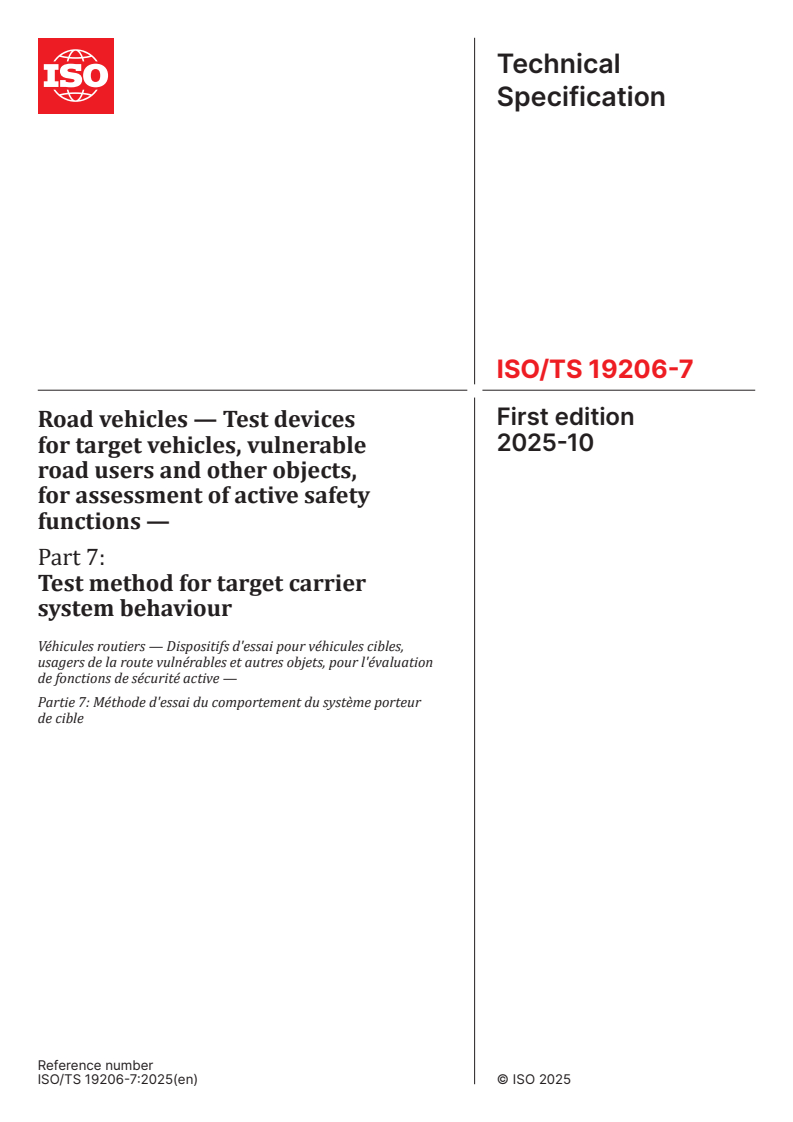
ISO/TS 19206-7:2025 - Road vehicles — Test devices for target vehicles, vulnerable road users and other objects, for assessment of active safety functions — Part 7: Test method for target carrier system behaviour Released:10/8/2025
Overview
ISO/TS 19206-7:2025 - "Road vehicles - Test devices … Part 7: Test method for target carrier system behaviour" defines standardized validation methods for target carrier systems used in active safety and ADAS testing. The technical specification describes how to verify the dynamic behaviour of a target carrier with its associated target (vehicle, pedestrian, bicyclist, scooter, powered two‑wheeler) against the performance requirements and tolerances specified in test protocols. It focuses on validating motion accuracy rather than sensor detection or VUT synchronization.
Key topics and technical requirements
- Primary performance parameters validated
- Speed control and accuracy
- Yaw rate (rotational motion) control
- Lateral deviation (path tracking) accuracy
- Test procedures covered
- Straight‑line motion and straight‑line braking
- Turning maneuvers
- Lane change trajectories
- Specialized procedures for different target types (GVT/EVT vehicle targets, pedestrian (PT), bicyclist (BT), standing scooter (SST), PTWT)
- Environmental and site conditions
- Asphalt must be dry and uniform; road surface no rougher than road class A per ISO 8608
- Side incline ≤ 1 %
- Ambient temperature range: 0 °C to 30 °C
- Wind influence: real‑time wind measurement recommended; wind speed should be < 5 m/s
- Scope limits
- Does not address detection characteristics of targets (covered in other ISO 19206 parts)
- Does not define test synchronization between the vehicle under test (VUT) and the target carrier
Practical applications and users
ISO/TS 19206-7 is intended for anyone involved in the validation and use of moving surrogate targets in active safety testing:
- OEM test engineers and ADAS validation teams - to qualify target carrier systems during development and pre‑test verification
- Independent test labs and NCAP/consumer‑test organizations - to ensure repeatable, comparable target motion in type‑approval and consumer safety protocols
- Target carrier and test‑equipment manufacturers - to design and certify carriers (belt systems, towing systems, top‑mounted rigs, self‑propelled carriers)
- Regulation bodies and test protocol authors - to reference standardized motion validation criteria in test specifications
Related standards
- ISO 19206 series (other parts cover target properties and detection characteristics)
- ISO 8608 (road surface profiles) - referenced for road surface quality
Keywords: ISO/TS 19206-7:2025, target carrier, ADAS testing, active safety functions, vulnerable road users, validation tests, speed control, yaw rate, lateral deviation, NCAP, test method.
Buy Documents
ISO/TS 19206-7:2025 - Road vehicles — Test devices for target vehicles, vulnerable road users and other objects, for assessment of active safety functions — Part 7: Test method for target carrier system behaviour Released:10/8/2025
Get Certified
Connect with accredited certification bodies for this standard

TÜV Rheinland
TÜV Rheinland is a leading international provider of technical services.

TÜV SÜD
TÜV SÜD is a trusted partner of choice for safety, security and sustainability solutions.

BSI Group
BSI (British Standards Institution) is the business standards company that helps organizations make excellence a habit.
Sponsored listings
Frequently Asked Questions
ISO/TS 19206-7:2025 is a technical specification published by the International Organization for Standardization (ISO). Its full title is "Road vehicles — Test devices for target vehicles, vulnerable road users and other objects, for assessment of active safety functions — Part 7: Test method for target carrier system behaviour". This standard covers: This document provides test methods to determine the properties and performance of target carriers, in combination with specified targets. This document specifies how to validate the target carrier with target regarding the dynamic performance versus the requirements and tolerances specified in test protocols. The main characteristics validated in this document are the speed, yaw rate and lateral deviation. This document does not address the test synchronization between the vehicle under test (VUT) and the target carrier with target. This document does not address the detection characteristics of the target carrier with target. NOTE Performance requirements of targets and properties related to detection by sensor systems are covered by other parts of the ISO 19206 series.
This document provides test methods to determine the properties and performance of target carriers, in combination with specified targets. This document specifies how to validate the target carrier with target regarding the dynamic performance versus the requirements and tolerances specified in test protocols. The main characteristics validated in this document are the speed, yaw rate and lateral deviation. This document does not address the test synchronization between the vehicle under test (VUT) and the target carrier with target. This document does not address the detection characteristics of the target carrier with target. NOTE Performance requirements of targets and properties related to detection by sensor systems are covered by other parts of the ISO 19206 series.
ISO/TS 19206-7:2025 is classified under the following ICS (International Classification for Standards) categories: 43.020 - Road vehicles in general. The ICS classification helps identify the subject area and facilitates finding related standards.
ISO/TS 19206-7:2025 is available in PDF format for immediate download after purchase. The document can be added to your cart and obtained through the secure checkout process. Digital delivery ensures instant access to the complete standard document.
Standards Content (Sample)
Technical
Specification
ISO/TS 19206-7
First edition
Road vehicles — Test devices
2025-10
for target vehicles, vulnerable
road users and other objects,
for assessment of active safety
functions —
Part 7:
Test method for target carrier
system behaviour
Véhicules routiers — Dispositifs d'essai pour véhicules cibles,
usagers de la route vulnérables et autres objets, pour l'évaluation
de fonctions de sécurité active —
Partie 7: Méthode d'essai du comportement du système porteur
de cible
Reference number
© ISO 2025
All rights reserved. Unless otherwise specified, or required in the context of its implementation, no part of this publication may
be reproduced or utilized otherwise in any form or by any means, electronic or mechanical, including photocopying, or posting on
the internet or an intranet, without prior written permission. Permission can be requested from either ISO at the address below
or ISO’s member body in the country of the requester.
ISO copyright office
CP 401 • Ch. de Blandonnet 8
CH-1214 Vernier, Geneva
Phone: +41 22 749 01 11
Email: copyright@iso.org
Website: www.iso.org
Published in Switzerland
ii
Contents Page
Foreword .iv
Introduction .v
1 Scope . 1
2 Normative references . 1
3 Terms and definitions . 1
4 Abbreviated terms . 2
5 Description of the target carrier with target associations . 2
6 Description of validation tests for target carrier with target . 4
6.1 Test conditions .4
6.1.1 General .4
6.1.2 Generic conditions .4
6.1.3 Quality of the ground .4
6.1.4 Wind influence .4
6.2 Validation tests with GVT (3D) or EVT (2D) car targets .4
6.3 Validation tests with pedestrian targets .5
6.4 Validation tests with bicyclist target or standing scooter target .6
6.5 Validation tests with PTWT motorcycle or PTWT scooter .7
7 Test procedure . 8
7.1 GVT or EVT targets . .8
7.1.1 Straight line .8
7.1.2 Straight-line braking .10
7.1.3 Turning . 13
7.1.4 Lane change . 15
7.2 VRU targets .17
7.2.1 Straight line .17
7.2.2 Straight line braking . 20
7.2.3 Lane change . 20
7.2.4 Evaluation with a top based target system . 20
7.3 Presentation of results . 20
7.3.1 Results . 20
7.3.2 Plot representation.21
Annex A (informative) Turning path and lane change path definitions .25
Annex B (informative) Report templates .27
Annex C (informative) Result example .34
Bibliography .36
iii
Foreword
ISO (the International Organization for Standardization) is a worldwide federation of national standards
bodies (ISO member bodies). The work of preparing International Standards is normally carried out through
ISO technical committees. Each member body interested in a subject for which a technical committee
has been established has the right to be represented on that committee. International organizations,
governmental and non-governmental, in liaison with ISO, also take part in the work. ISO collaborates closely
with the International Electrotechnical Commission (IEC) on all matters of electrotechnical standardization.
The procedures used to develop this document and those intended for its further maintenance are described
in the ISO/IEC Directives, Part 1. In particular, the different approval criteria needed for the different types
of ISO documents should be noted. This document was drafted in accordance with the editorial rules of the
ISO/IEC Directives, Part 2 (see www.iso.org/directives).
ISO draws attention to the possibility that the implementation of this document may involve the use of (a)
patent(s). ISO takes no position concerning the evidence, validity or applicability of any claimed patent
rights in respect thereof. As of the date of publication of this document, ISO had not received notice of
patents which may be required to implement this document. However, implementers are cautioned that
this may not represent the latest information, which may be obtained from the patent database available at
www.iso.org/patents. ISO shall not be held responsible for identifying any or all such patent rights.
Any trade name used in this document is information given for the convenience of users and does not
constitute an endorsement.
For an explanation of the voluntary nature of standards, the meaning of ISO specific terms and expressions
related to conformity assessment, as well as information about ISO's adherence to the World Trade
Organization (WTO) principles in the Technical Barriers to Trade (TBT), see www.iso.org/iso/foreword.html.
This document was prepared by Technical Committee ISO/TC 22, Road vehicles, Subcommittee SC 33, Vehicle
dynamics, chassis components and driving automation systems testing.
A list of all parts in the ISO 19206 series can be found on the ISO website.
Any feedback or questions on this document should be directed to the user’s national standards body. A
complete listing of these bodies can be found at www.iso.org/members.html.
iv
Introduction
ADAS (advanced driver assistance systems) and active-safety systems are designed to support decision-
making for the driver, extend the driver’s awareness of the traffic situation with advanced warnings,
improve the behaviour of the vehicle and even take over vehicle control in an emergency situation. The goal
is to completely avoid an accident or at least reduce the severity of an accident.
The surrogate target is an essential component in the evaluation of ADAS, active-safety functions and
different levels of automated driving systems, in all situations where a collision with the target can occur.
To make test protocols more realistic, the multiple targets which are used for testing are put on a target
carrier system which can move following pre-defined trajectories, speeds, etc.
The motion of this target carrier with the target are designed to accurately fulfil the specifications defined
in the test protocols, which can be type approval tests, consumer tests (for example, Euro NCAP or other
NCAP) or development tests. The dynamic performance of the target carrier system can be determined
using the methods in this document.
The target carrier can be of a large or a smaller type according to the size of the target and other demands of
the pre-defined tests.
The description of the tests is based on the current NCAP test protocols and can be adapted for future test
protocols.
v
Technical Specification ISO/TS 19206-7:2025(en)
Road vehicles — Test devices for target vehicles, vulnerable
road users and other objects, for assessment of active safety
functions —
Part 7:
Test method for target carrier system behaviour
IMPORTANT — The electronic file of this document contains colours which are considered to be
useful for the correct understanding of the document. Users should therefore consider printing this
document using a colour printer.
1 Scope
This document provides test methods to determine the properties and performance of target carriers, in
combination with specified targets.
This document specifies how to validate the target carrier with target regarding the dynamic performance
versus the requirements and tolerances specified in test protocols. The main characteristics validated in
this document are the speed, yaw rate and lateral deviation.
This document does not address the test synchronization between the vehicle under test (VUT) and the
target carrier with target.
This document does not address the detection characteristics of the target carrier with target.
NOTE Performance requirements of targets and properties related to detection by sensor systems are covered by
other parts of the ISO 19206 series.
2 Normative references
The following documents are referred to in the text in such a way that some or all of their content constitutes
requirements of this document. For dated references, only the edition cited applies. For undated references,
the latest edition of the referenced document (including any amendments) applies.
ISO 8608, Mechanical vibration — Road surface profiles — Reporting of measured data
3 Terms and definitions
For the purposes of this document, the following terms and definitions apply.
ISO and IEC maintain terminology databases for use in standardization at the following addresses:
— ISO Online browsing platform: available at https:// www .iso .org/ obp
— IEC Electropedia: available at https:// www .electropedia .org/
3.1
target carrier
mechanical or electro-mechanical system used to move and/or support the target structure according to a
test protocol
Note 1 to entry: The target carrier can be self-contained within, or supporting the target structure or external devices
connected with cables, beams, or similar structures. It can also be a self-propelled carrier.
Note 2 to entry: The target structure and target carrier can be integrated.
Note 3 to entry: The target structure fixation can be included in the target carrier.
[SOURCE: ISO 19206-3:2021, 3.2.2]
4 Abbreviated terms
BT bicyclist target (target reference ISO 19206-4)
EVT Euro NCAP vehicle target (2D vehicle target, reference ISO 19206-1)
GVT global vehicle target (3D vehicle target, reference ISO 19206-3)
MFDD mean fully developed deceleration
NCAP new car assessment program
PT pedestrian target (target reference ISO 19206-2)
PTWT powered two-wheeler target (target reference ISO 19206-5)
SST standing scooter target
VRU vulnerable road user
VUT vehicle under test (ego vehicle, subject vehicle)
5 Description of the target carrier with target associations
The target carrier with target is used to perform tests defined by NCAP or by a regulation organization.
Table 1 shows combinations of target carriers and targets considered in this document. The cells in grey are
the most relevant and common combinations.
Table 1 — Combinations of target carrier with target
Target carrier EVT (2D) GVT (3D) Pedestrian Bicyclist Standing PTWT
adult/child scooter
MC/scooter
target
ISO target reference VT (2D) VT (3D) PT BT SST PTWT
Leading vehicle with
towing system
Vehicle target carrier
VRU target carrier
Dual belt
Single belt
Multi dimensions top
based
NOTE 1 Dual belt is mainly used for short displacement tests (i.e. crossing tests) and single belt for longer displacement tests
(i.e. longitudinal tests).
NOTE 2 Target carriers can have extensions to accommodate VRU targets including offset pedestrian targets (PTs).
NOTE 3 PTWT can be tested also on belt systems in low speeds.
6 Description of validation tests for target carrier with target
6.1 Test conditions
6.1.1 General
The tests of the target carrier with target are sensitive to the following testing conditions which can impact
the validity of the tests:
— generic conditions (see 6.1.2);
— quality of the ground (see 6.1.3);
— wind influence (see 6.1.4).
6.1.2 Generic conditions
The asphalt should be dry.
The angle of the side incline should not exceed 1 %.
The ambient air temperature should be in the range of 0 °C and 30 °C.
6.1.3 Quality of the ground
The tests shall be performed on a uniform, solid-paved surface. The surface shall be paved and shall
not contain irregularities (e.g. large dips or cracks, manhole covers or reflective studs) that can create
disturbances on the target carrier displacement.
The road surface shall be smooth and not rougher than road class A as defined in ISO 8608.
6.1.4 Wind influence
The wind can significantly disturb the behaviour of the target carrier with target, especially in case of a
strong lateral wind.
The measurement of the wind can be done before and after testing. The preferred solution is to measure the
wind speed and wind orientation in real time during the test.
Wind speed should be less than 5 m/s.
6.2 Validation tests with GVT (3D) or EVT (2D) car targets
The validation reference tests are specified in Table 2. Each test is run in two directions, run 1 and run 2.
Table 2 — Validation tests with GVT or EVT
Target car- Target
Target
rier with Test description decelera- Tolerance
speed
target tion
[km/h] [m/s ] Speed Lateral devia- Yaw rate error
[km/h] tion [°/s]
[m]
a
Straight line ±0,1 ±1
(if (if
speed ≤ 40 km/h) speed ≤ 40 km/h)
Vehicle tar-
60 0 ±0,5
±0,2 ±3
get carrier
(if (if
with GVT
speed ≥ 80 km/h) speed ≥ 80 km/h)
or towing 100
e e
system with
b
EVT
Straight line braking 2
g
50 ±0,5 ±0,125 ±1,5
c
Turning
20 0 ±0,5 ±0,1 ±4
Vehicle tar-
get carrier
d
Lane change
with GVT
f
70 0 ±0,5 ±0,175 ±12,5
a
Straight-line test procedure is described in 7.1.1.
b
Straight-line braking test procedure is described in 7.1.2.
c
Turning test procedure is described in 7.1.3. Turning path is described in Annex A.
d
Lane change test procedure is described in 7.1.4. Lane change path is described in Annex A.
e
Linear interpolation is applied between 40 km/h and 80 km/h.
f
See 7.1.4 for the definition of ω .
max
g
Leading vehicle pulling towing system plus EVT should be equipped with a driving robot.
6.3 Validation tests with pedestrian targets
The validation reference tests are specified in Table 3. Each test is run in two directions, run 1 and run 2.
Table 3 — Validation tests with pedestrian targets
Target car-
Target Target decel-
rier with Target trajectory Tolerance
speed eration
target
[km/h] [m/s ] Speed Lateral deviation Yaw rate
[km/h] [m] error
[°/s]
a
VRU target Straight line
carrier with
5 0 ±0,2 ±0,05 ±1
pedestrian
adult
a
VRU target Straight line
carrier with
5 0 ±0,2 ±0,05 ±1
pedestrian
child
a b
Straight line 3
Dual belt
with pedes- 5 0 ±0,2 ±0,05 ±1
trian adult
Single belt
with pedes- 0 ±0,2 ±0,15 ±1
trian adult
a b
Straight line
Dual belt
with pedes- 5 0 ±0,2 ±0,05 ±1
trian child
a b
Straight line
Single belt
with pedes- 5 0 ±0,2 ±0,15 ±1
trian child
a c d
Straight line 3
Top based
with pedes- 5 0 ±0,2 ±0,05 ±1
trian adult
a c d
Straight line
Top based
with pedes- 5 0 ±0,2 ±0,05 ±1
trian child
a
Straight-line test procedure is described in 7.2.1.
b
Evaluation with belt system is described in 7.2.1.2.
c
Evaluation with top based system is described in 7.2.4.
d
For multi dimensions top based systems, duration of 10 s is possible except for:
Speed = 5 km/h: (duration = 5 s).
Speed = 8 km/h: (duration = 4 s).
6.4 Validation tests with bicyclist target or standing scooter target
The validation reference tests are specified in Table 4. Each test is run in two directions, run 1 and run 2.
Table 4 — Validation tests with bicyclist target or standing scooter target
Target
Target Target decel-
carrier with Target trajectory Tolerance
speed eration
target
[km/h] [m/s ] Speed Lateral deviation Yaw rate
[km/h] [m] error
[°/s]
a
VRU target Straight line
carrier with
bicyclist or
20 0 ±0,5 ±0,05 ±1
standing
scooter
target
a b
Dual belt Straight line
with bicyclist
or stand- 20 0 ±0,5 ±0,05 ±1
ing scooter
target
a b
Single belt Straight line
with bicyclist
or stand- 20 0 ±0,5 ±0,15 ±1
ing scooter
target
a
Straight-line test procedure is described in 7.2.1.
b
Evaluation with belt system is described in 7.2.1.2.
6.5 Validation tests with PTWT motorcycle or PTWT scooter
The validation reference tests are specified in Table 5. Each test is run in two directions, run 1 and run 2.
Table 5 — Validation tests with PTWT motorcycle or PTWT scooter
Target Target
Target
carrier with Target trajectory deceler- Tolerance
speed
target ation
[km/h] [m/s ] Speed Lateral deviation Yaw rate error
[km/h] [m] [°/s]
a
Straight line ±0,1 ±1
(if (if
speed ≤ 40 km/h) speed ≤ 40 km/h)
60 0 ±0,5
±0,2 ±3
(if (if
f
e e
speed ≥ 80 km/h) speed ≥ 80 km/h)
VRU target
b
Straight line braking
carrier
50 4 ±0,5 ±0,125 ±1,5
with PTWT
scooter or
motorcycle
c
Lane change
±0,1 (if ±10 if
g
50 speed ≤ 40 km/h) speed = 50 km/h
0 ±0,5
70 ±0,2 (if ±12,5
speed ≥ 80 km/h) if speed = 70 km/h
a d
Dual belt Straight line
with PTWT 20 0 ±0,5 ±0,1 ±1
scooter
a d
Straight line
Single belt
with PTWT 20 0 ±0,5 ±0,15 ±1
scooter
a
Straight-line test procedure is described in 7.2.1.
b
Straight-line braking test procedure is described in 7.2.2.
c
Lane change test procedure is described in 7.2.3. Lane change path is described in Annex A.
d
Evaluation with belt system is described in 7.2.1.2.
e
Linear interpolation is applied between 40 km/h and 80 km/h.
f
Tests with PTWT scooter are limited to low speed only 20 km/h and 40 km/h (PTWT scooter is class 1 up to 45 km/h)
g
See 7.1.4 for the definition of ω .
max
7 Test procedure
7.1 GVT or EVT targets
7.1.1 Straight line
Straight-line tests are conducted with GVT or EVT according to Figure 1. Only run 1 is shown in Figure 1.
Key
X time [s]
Y speed [km/h]
1 run 1
A stabilization phase [s]
B evaluation phase [s]
a
Stabilization phase (A) is starting when v is reached and its duration should be equal or greater than 1 s.
test
b
Evaluation phase (B) duration is 10 s. In case t cannot be reached (for example, in case of test track too
end
short), it should be mentioned as a test deviation in the Table B.1 or B.2.
t time when the specified speed is reached [s]
t start time of evaluation [s]
start
t end time of evaluation [s]
end
v specified test speed [km/h]
test
Figure 1 — Sequence of the GVT or EVT straight line test
7.1.1.1 Test procedure
Carry out the test procedure as follows:
— accelerate the target carrier with target at the specified test speed v ;
test
— stabilize the target carrier with target and start the recording of the three variables (speed, lateral
deviation and yaw rate) during the stabilization phase;
— record the three variables during the evaluation phase;
— stop the data recording after t ;
end
— stop the target carrier with target and drive it in the opposite direction (run 2), repeating the manoeuvre
as described above.
7.1.1.2 Post processing
Speed and lateral deviation should not be filtered.
Yaw rate should be filtered with a 12-pole phaseless Butterworth filter with a cut-off frequency of 2 Hz.
The results are represented by:
— numerical value: refer to 7.3.1 using the Table B.1 (GVT) or Table B.2 (EVT);
— plot: refer to 7.3.2.
NOTE The numerical values of the speed reported in the Table B.1 or B.2 are relative to the speed deviation v (t)
dev
in Formula (1).
v (t) = v(t) – v (1)
dev test
where
v(t) is the speed function of time;
v is the specified test speed [km/h].
test
7.1.2 Straight-line braking
Straight-line braking tests can be conducted with GVT or EVT using the evaluation phase C shown in
Figure 2. Only run 1 is shown in Figure 2.
The evaluation phase is defined according to the MFDD (mean fully developed deceleration) starting and
ending speeds:
— v is 80 % of the specified test speed (40 km/h);
start
— v is 10 % of the specified test speed (5 km/h);
end
— t is the time when the actual speed of the target carrier with target is reaching v ;
start start
— t is the time when the actual speed of the target carrier with target is reaching v .
end end
Key
X time [s]
Y speed [km/h]
1 run 1
A stabilization phase [s]
B initial braking phase [s]
C evaluation phase [s]
a
The stabilization phase (A) is starting when v is reached and its duration should be equal or greater than 1 s.
test
b
The duration between phase (A) and (B) is not specified.
t time when the specified speed is reached [s]
t end time of the stabilization phase [s]
t reference time for deceleration [s]
brk
t start time of evaluation [s]
start
t end time of evaluation [s]
end
v specified test speed [km/h]
test
v speed at time of start of deceleration [km/h]
brk
v speed at time of start of the evaluation [km/h]
start
v speed at time of end of the evaluation [km/h]
end
Figure 2 — Sequence of the GVT or EVT braking test
The initial braking phase (B) is named t and is given by Formula (2):
stab
t = t – t (2)
stab start brk
where
t is the time when the actual speed of the target carrier with target is reaching v ;
start start
t is the time when the speed of the target carrier with target is getting below the lower tolerance
brk
defined in Table 2 (GVT or EVT) or Table 5 (PTWT scooter or PTWT motorcycle).
For each deceleration, the initial braking phase (B) has a maximum value t (see Table 6).
stab_max
Table 6 — t for each deceleration
stab_max
v v Deceleration t t v
test brk stab stab_max end
[km/h] [km/h] [m/s ] theoretical [s] [km/h]
[s]
50 49,5 2 1,32 1,50 5
4 0,66 0,85
6 0,44 0,75
8 0,33 0,75
v (t) is the speed deviation between t and t , see Formula (3).
dev start end
v (t) = v(t) – v (t) (3)
dev ref
where
v(t) is t
...