

ISO/TS 19206-9:2025
(Main)Road vehicles — Test devices for target vehicles, vulnerable road users and other objects, for assessment of active safety functions — Part 9: Requirements for small child targets
General Information
- Abstract
This document specifies performance requirements for surrogate small child targets (SCT) used to assess the system detection and activation performance of active safety systems and automated driving systems (ADS). This document specifies the properties of targets that represent two small children in terms of size, shape, reflection properties, etc. for testing purposes. The two targets represent a 9- to 12-month-old infant and a two-year-old toddler. This document addresses the detection requirements for the targets in terms of sensing technologies commonly in use at the time of publication, and where possible, anticipated future sensing technologies. It also addresses methodologies to verify the target response properties to these sensors. This document does not address the test procedures in terms of speed, position, or timing of events. Performance criteria for the active safety system being evaluated are also not addressed. NOTE Related test procedures using small child targets according to this document can be found in ISO 4273 and ISO 23374-1.
- Status
- Published
- Publication Date
- 25-Aug-2025
- Technical Committee
- ISO/TC 22/SC 33 - Vehicle dynamics and chassis components
- Drafting Committee
- ISO/TC 22/SC 33 - Vehicle dynamics and chassis components
- Current Stage
- 6060 - International Standard published
- Start Date
- 26-Aug-2025
- Due Date
- 15-Sep-2025
- Completion Date
- 26-Aug-2025
Buy Documents

ISO/TS 19206-9:2025 - Road vehicles — Test devices for target vehicles, vulnerable road users and other objects, for assessment of active safety functions — Part 9: Requirements for small child targets Released:26. 08. 2025
Overview
ISO/TS 19206-9:2025 specifies performance requirements for surrogate small child targets (SCT) used to evaluate detection and activation performance of active safety systems, ADAS and automated driving systems (ADS). The Technical Specification defines the physical and sensing-response properties of two stationary SCTs that represent a 9–12‑month infant and a two‑year‑old toddler (dimensions and postures in Annex A). It focuses on realistic detection characteristics for cameras, near‑infrared (NIR), PMD, LIDAR, radar and ultrasonic (US) sensors, and on methods to verify target response properties - but it does not specify test procedures (speeds, positions or timings) or the performance criteria of the safety system being tested.
Key topics and requirements
- Target types and sizes: Two SCTs - an infant target (IT) and a toddler target (TT) - with dimensions and static postures (standing, sitting, crawling/walking) defined in normative annexes.
- Postures & articulation: Moveable joints (hips, knees, shoulders, elbows) to realize different static postures; dynamic articulation optional.
- Sensor response properties:
- Optical (visible and NIR): requirements for realistic camera, PMD and LIDAR detection characteristics.
- Radar: radar cross section (RCS) considerations, with reference measurements and RCS properties in annexes.
- Ultrasonic (US): ultrasonic cross section (UCS) boundaries, measurement and verification methods.
- Verification & calibration: Methods to verify SCT response to sensing technologies and reference measurement procedures (see Annexes B and C).
- Operational & environmental:
- Designed for standardized tests up to 30 km/h, especially low‑speed/parking scenarios.
- SCT operating temperature range −5 °C to +40 °C; storage −20 °C to +80 °C.
- Repairability after impacts up to 30 km/h; field repairable with hand tools.
- Target carrier: SCT may be mounted on a movable carrier; optional carrier speed range 0–5 km/h.
Applications
- Development, calibration and validation of pedestrian/child detection, automatic emergency braking (AEB) for vulnerable road users, and low‑speed manoeuvre aids.
- Laboratory and track testing by vehicle OEMs, Tier‑1 suppliers, sensor manufacturers and independent test labs to produce reproducible detection datasets.
- Integration into test programs for ADAS/ADS functional verification, especially for safe handling of child-sized objects in parking and urban low‑speed scenarios.
Who should use this standard
- ADAS/ADS system engineers and integrators
- Automotive test laboratories and validation centers
- OEM safety teams and compliance engineers
- Sensor and test‑target manufacturers
- Regulatory bodies and certification authorities evaluating detection capability for vulnerable road users
Related standards
- ISO 19206 series (other target classes, e.g., ISO/TS 19206‑2 for adult and 7‑year‑old child targets)
- ISO 4273 and ISO 23374‑1 (related test procedures referencing SCTs)
Keywords: ISO/TS 19206-9:2025, small child target, SCT, infant target, toddler target, ADAS testing, ADS validation, pedestrian detection, ultrasonic cross section, radar cross section, LIDAR, camera sensors.
Buy Documents
ISO/TS 19206-9:2025 - Road vehicles — Test devices for target vehicles, vulnerable road users and other objects, for assessment of active safety functions — Part 9: Requirements for small child targets Released:26. 08. 2025
Get Certified
Connect with accredited certification bodies for this standard

TÜV Rheinland
TÜV Rheinland is a leading international provider of technical services.

TÜV SÜD
TÜV SÜD is a trusted partner of choice for safety, security and sustainability solutions.

BSI Group
BSI (British Standards Institution) is the business standards company that helps organizations make excellence a habit.
Sponsored listings
Frequently Asked Questions
ISO/TS 19206-9:2025 is a technical specification published by the International Organization for Standardization (ISO). Its full title is "Road vehicles — Test devices for target vehicles, vulnerable road users and other objects, for assessment of active safety functions — Part 9: Requirements for small child targets". This standard covers: This document specifies performance requirements for surrogate small child targets (SCT) used to assess the system detection and activation performance of active safety systems and automated driving systems (ADS). This document specifies the properties of targets that represent two small children in terms of size, shape, reflection properties, etc. for testing purposes. The two targets represent a 9- to 12-month-old infant and a two-year-old toddler. This document addresses the detection requirements for the targets in terms of sensing technologies commonly in use at the time of publication, and where possible, anticipated future sensing technologies. It also addresses methodologies to verify the target response properties to these sensors. This document does not address the test procedures in terms of speed, position, or timing of events. Performance criteria for the active safety system being evaluated are also not addressed. NOTE Related test procedures using small child targets according to this document can be found in ISO 4273 and ISO 23374-1.
This document specifies performance requirements for surrogate small child targets (SCT) used to assess the system detection and activation performance of active safety systems and automated driving systems (ADS). This document specifies the properties of targets that represent two small children in terms of size, shape, reflection properties, etc. for testing purposes. The two targets represent a 9- to 12-month-old infant and a two-year-old toddler. This document addresses the detection requirements for the targets in terms of sensing technologies commonly in use at the time of publication, and where possible, anticipated future sensing technologies. It also addresses methodologies to verify the target response properties to these sensors. This document does not address the test procedures in terms of speed, position, or timing of events. Performance criteria for the active safety system being evaluated are also not addressed. NOTE Related test procedures using small child targets according to this document can be found in ISO 4273 and ISO 23374-1.
ISO/TS 19206-9:2025 is classified under the following ICS (International Classification for Standards) categories: 43.020 - Road vehicles in general. The ICS classification helps identify the subject area and facilitates finding related standards.
ISO/TS 19206-9:2025 is available in PDF format for immediate download after purchase. The document can be added to your cart and obtained through the secure checkout process. Digital delivery ensures instant access to the complete standard document.
Standards Content (Sample)
Technical
Specification
ISO/TS 19206-9
First edition
Road vehicles — Test devices
2025-08
for target vehicles, vulnerable
road users and other objects,
for assessment of active safety
functions —
Part 9:
Requirements for small child targets
Véhicules routiers — Dispositifs d'essai pour véhicules cibles,
usagers de la route vulnérables et autres objets, pour l'évaluation
de fonctions de sécurité active —
Partie 9: Exigences pour cibles de petits enfants
Reference number
© ISO 2025
All rights reserved. Unless otherwise specified, or required in the context of its implementation, no part of this publication may
be reproduced or utilized otherwise in any form or by any means, electronic or mechanical, including photocopying, or posting on
the internet or an intranet, without prior written permission. Permission can be requested from either ISO at the address below
or ISO’s member body in the country of the requester.
ISO copyright office
CP 401 • Ch. de Blandonnet 8
CH-1214 Vernier, Geneva
Phone: +41 22 749 01 11
Email: copyright@iso.org
Website: www.iso.org
Published in Switzerland
ii
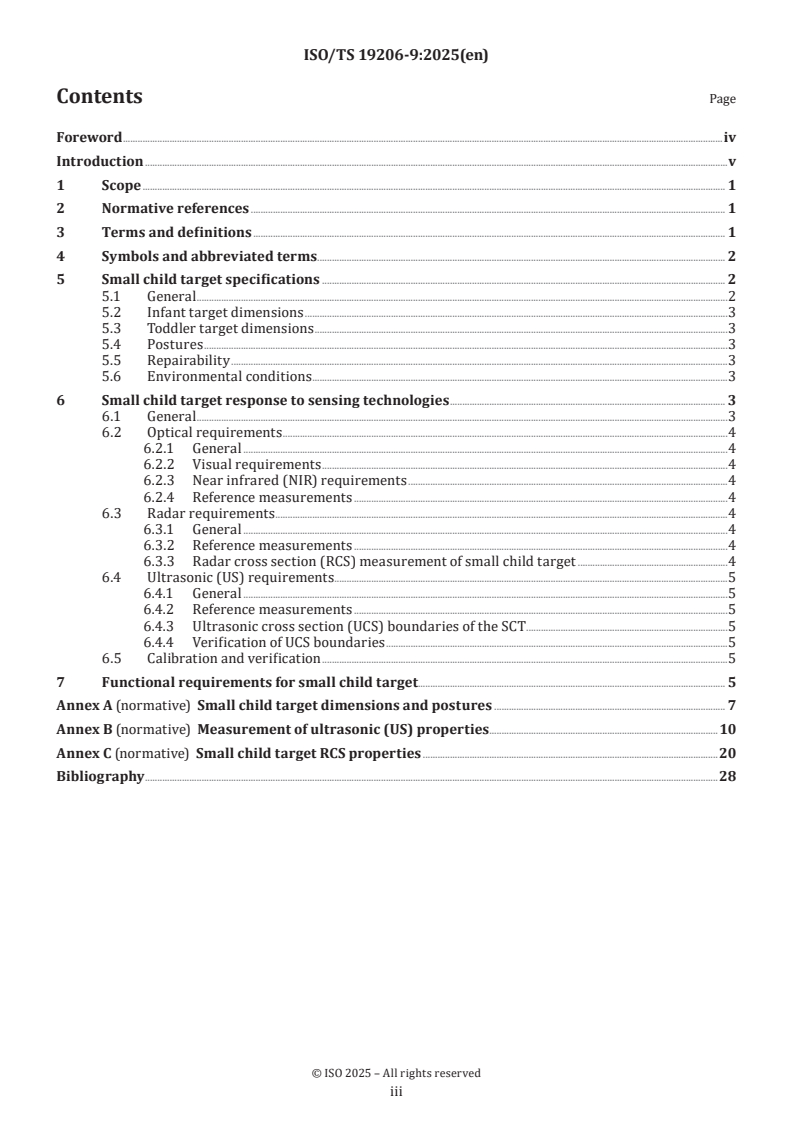
Contents Page
Foreword .iv
Introduction .v
1 Scope . 1
2 Normative references . 1
3 Terms and definitions . 1
4 Symbols and abbreviated terms. 2
5 Small child target specifications . 2
5.1 General .2
5.2 Infant target dimensions .3
5.3 Toddler target dimensions .3
5.4 Postures .3
5.5 Repairability .3
5.6 Environmental conditions .3
6 Small child target response to sensing technologies . 3
6.1 General .3
6.2 Optical requirements .4
6.2.1 General .4
6.2.2 Visual requirements .4
6.2.3 Near infrared (NIR) requirements .4
6.2.4 Reference measurements .4
6.3 Radar requirements .4
6.3.1 General .4
6.3.2 Reference measurements .4
6.3.3 Radar cross section (RCS) measurement of small child target .4
6.4 Ultrasonic (US) requirements .5
6.4.1 General .5
6.4.2 Reference measurements .5
6.4.3 Ultrasonic cross section (UCS) boundaries of the SCT .5
6.4.4 Verification of UCS boundaries .5
6.5 Calibration and verification .5
7 Functional requirements for small child target . 5
Annex A (normative) Small child target dimensions and postures . 7
Annex B (normative) Measurement of ultrasonic (US) properties .10
Annex C (normative) Small child target RCS properties .20
Bibliography .28
iii
Foreword
ISO (the International Organization for Standardization) is a worldwide federation of national standards
bodies (ISO member bodies). The work of preparing International Standards is normally carried out through
ISO technical committees. Each member body interested in a subject for which a technical committee
has been established has the right to be represented on that committee. International organizations,
governmental and non-governmental, in liaison with ISO, also take part in the work. ISO collaborates closely
with the International Electrotechnical Commission (IEC) on all matters of electrotechnical standardization.
The procedures used to develop this document and those intended for its further maintenance are described
in the ISO/IEC Directives, Part 1. In particular, the different approval criteria needed for the different types
of ISO documents should be noted. This document was drafted in accordance with the editorial rules of the
ISO/IEC Directives, Part 2 (see www.iso.org/directives).
ISO draws attention to the possibility that the implementation of this document may involve the use of (a)
patent(s). ISO takes no position concerning the evidence, validity or applicability of any claimed patent
rights in respect thereof. As of the date of publication of this document, ISO had not received notice of (a)
patent(s) which may be required to implement this document. However, implementers are cautioned that
this may not represent the latest information, which may be obtained from the patent database available at
www.iso.org/patents. ISO shall not be held responsible for identifying any or all such patent rights.
Any trade name used in this document is information given for the convenience of users and does not
constitute an endorsement.
For an explanation of the voluntary nature of standards, the meaning of ISO specific terms and expressions
related to conformity assessment, as well as information about ISO's adherence to the World Trade
Organization (WTO) principles in the Technical Barriers to Trade (TBT), see www.iso.org/iso/foreword.html.
This document was prepared by Technical Committee ISO/TC 22, Road vehicles, Subcommittee SC 33, Vehicle
dynamics, chassis components and driving automation systems testing.
A list of all parts in the ISO 19206 series can be found on the ISO website.
Any feedback or questions on this document should be directed to the user’s national standards body. A
complete listing of these bodies can be found at www.iso.org/members.html.
iv
Introduction
Advanced driver assistance systems (ADAS) and active safety systems are designed to support decision-
making for the driver, extend the driver’s awareness of the traffic situation with advanced warnings,
improve the behaviour of the vehicle, and even take over vehicle control in an emergency situation. The goal
is to completely avoid an accident or at least reduce the severity of an accident.
The ISO 19206 series addresses the specification of test target objects for traffic scenarios representing
vehicles, vulnerable road users and other objects in the path of the subject vehicle. This document addresses
the specification of test targets for small children as a supplement to ISO 19206-2, where targets for an adult
and a seven-year-old child are specified.
Small child test targets (SCT) represent two different sizes for testing of different functions to evaluate their
performance. Current test procedures only address stationary SCT, and consequently this document only
addresses the stationary SCT without movement by a target carrier.
The SCT described in this document series can be used for system development or applied in conjunction
with existing standards, or standards under development, for assessment of active safety systems and
automated driving systems (ADS).
v
Technical Specification ISO/TS 19206-9:2025(en)
Road vehicles — Test devices for target vehicles, vulnerable
road users and other objects, for assessment of active safety
functions —
Part 9:
Requirements for small child targets
1 Scope
This document specifies performance requirements for surrogate small child targets (SCT) used to assess
the system detection and activation performance of active safety systems and automated driving systems
(ADS). This document specifies the properties of targets that represent two small children in terms of size,
shape, reflection properties, etc. for testing purposes. The two targets represent a 9- to 12-month-old infant
and a two-year-old toddler.
This document addresses the detection requirements for the targets in terms of sensing technologies
commonly in use at the time of publication, and where possible, anticipated future sensing technologies. It
also addresses methodologies to verify the target response properties to these sensors.
This document does not address the test procedures in terms of speed, position, or timing of events.
Performance criteria for the active safety system being evaluated are also not addressed.
NOTE Related test procedures using small child targets according to this document can be found in ISO 4273 and
ISO 23374-1.
2 Normative references
The following documents are referred to in the text in such a way that some or all of their content constitutes
requirements of this document. For dated references, only the edition cited applies. For undated references,
the latest edition of the referenced document (including any amendments) applies.
ISO 8855, Road vehicles — Vehicle dynamics and road-holding ability — Vocabulary
ISO 17386, Intelligent transport systems — Manoeuvring aids for low-speed operation (MALSO) — Performance
requirements and test procedures
ISO 19206-2, Road vehicles — Test devices for target vehicles, vulnerable road users and other objects, for
assessment of active safety functions — Part 2: Requirements for pedestrian targets
3 Terms and definitions
For the purposes of this document, the terms and definitions given in ISO 8855 and the following apply.
ISO and IEC maintain terminological databases for use in standardization at the following addresses:
— IEC Electropedia: available at https:// www .electropedia .org/
— ISO Online browsing platform: available at https:// www .iso .org/ obp
3.1
subject vehicle
SV
vehicle with active safety system to be tested
3.2
small child target
SCT
test device representing an infant or a toddler used to test active safety systems
Note 1 to entry: "SCT" is an umbrella term and includes the infant target and the toddler target.
3.2.1
infant target
IT
test device representing an infant used to test active safety systems
Note 1 to entry: The infant target is corresponding to the dimensions of a 9- to 12-month-old child.
3.2.2
toddler target
TT
test device representing a toddler used to test active safety systems
3.3
target body
physical structure that resembles an infant or toddler body used to activate sensor systems
3.4
ultrasonic cross section
UCS
ratio between the echo amplitudes of the device under test and a reference pole
Note 1 to entry: The reference pole used in this document is specified in ISO 17386.
4 Symbols and abbreviated terms
LIDAR light detection and ranging
NIR near infrared
PMD photonic mixer device
RCS radar cross section
SCT small child target
UCS ultrasonic cross section
US ultrasonic
5 Small child target specifications
5.1 General
The SCTs should represent small children that have a certain probability of being located in the path of a
vehicle or in the area surrounding a vehicle. Relevant ages for vulnerable targets are an infant (see 5.2) and
a two-year-old child (see 5.3).
The sizes and dimensions of small children depend slightly on the region. For the purposes of this document,
[9]
data from the National Institute of Standards and Technology (NIST, USA) were used as they provide
a broad statistical basis for different age classes. To check the plausibility of the NIST data, child growth
[10] [11],[12]
data from the World Health Organization and the Child Anthropometry database CANDAT were
compared. The NIST dimensions were found to represent typical children with only slight deviations from
the dimensions found in the other sources.
5.2 Infant target dimensions
The infant target (IT) shall represent a 9- to 12-month-old child that is able to crawl and stand upright. The
IT dimensions given in Annex A shall be followed.
5.3 Toddler target dimensions
The toddler target (TT) shall represent a two-year-old child that is able to run and quickly change position.
The TT dimensions given in Annex A shall be followed.
5.4 Postures
The joints at the hips, knees, shoulders and elbows shall be moveable to realize different static postures.
The IT static postures shall include standing, sitting and crawling, with the arms in different positions.
The TT static postures shall include standing, walking and sitting, with the arms in different positions.
Dynamic postures with articulation of the extremities, both for IT and TT, are optional.
The IT and TT may be attached to a movable target carrier. Speed range can be limited to 0 km/h to 5 km/h.
5.5 Repairability
The IT and TT should be easily reassembled or repaired after contact with a test vehicle up to a speed of
30 km/h. Field repairs should be possible with hand tools. After repair, the target body shall be verified
according to 6.5.
5.6 Environmental conditions
The SCT shall meet all requirements in a temperature range of −5 °C to +40 °C. The SCT shall not deteriorate
under storage temperatures in the range of −20 °C to +80 °C when properly stored.
NOTE The specified temperature range recognises that there can be substantial technical challenges to achieving
a cost-effective target that meets the requirements at temperatures below −5 °C.
6 Small child target response to sensing technologies
6.1 General
The SCT is intended to be used in standardized ADAS tests for traffic situations with vehicle speeds up
to 30 km/h and especially for parking manoeuvres to get comparable test results. According to favoured
sensing technologies for low speed manoeuvring, the SCT shall especially provide realistic detection
characteristics for cameras and ultrasonic (US) sensors. Light detection and ranging (LIDAR) and radar
reflectivity characteristics may be limited to distances up to 10 m.
Requirements related to sensing technologies commonly in use at the time of publication of this document
are given in 6.2, 6.3 and 6.4.
An SCT intended for use with a specific set of sensing technologies needs only to meet the requirements of
those technologies.
6.2 Optical requirements
6.2.1 General
Sensors operating on optical principles include mono and stereo camera sensors, photonic mixer devices
(PMD) and LIDAR. These systems cover visible and near infrared (NIR) light frequency spectra. PMD and
LIDAR are more reliant on the infrared reflectivity of the target surface.
6.2.2 Visual requirements
The same requirements as for adult and child targets according to ISO 19206-2 shall apply.
For development testing, alternative colours of clothing of IT and TT can be chosen provided that the
requirements of 6.2.3 are fulfilled.
6.2.3 Near infrared (NIR) requirements
The same requirements as for adult and child target according to ISO 19206-2 shall apply.
IR reflectivity shall be measured in accordance with ISO 19206-2.
6.2.4 Reference measurements
When technology-specific reference measurements are required, information on the type of sensor used,
the environmental conditions during measurement and the date of measurement shall be provided with
the description of the SCT. The version of the SCT shall be traceable to manufacturing drawings or supplier
specifications. For more information, see Annex C.
6.3 Radar requirements
6.3.1 General
At the time of publication of this document, automotive applications of radar use 24 GHz and 76 GHz to 81 GHz.
6.3.2 Reference measurements
The reference measurement setups for human subjects specified in Annex C shall be used for verification.
When technology-specific reference measurements are required, information on the type of sensor used,
the environmental conditions during measurement and the date of measurement shall be provided with the
description of the reference subject(s). The version of the SCT shall be traceable to manufacturing drawings
or supplier specifications.
6.3.3 Radar cross section (RCS) measurement of small child target
The radar reflective characteristics of the SCT should be comparable to real children of the same size.
Recommendations on radar properties are given in Annex C. It is recommended to conduct the measurements
with older children and not with infants or toddlers. Use extrapolated data from these measurements to
achieve a size-scaled radar cross section (RCS) for the IT and the TT, assuming that the RCS of the IT and the
TT is the same, since the size difference is very small. An example of a scaling procedure is shown in C.3.2.
For every radar frequency relevant for the TT, a set of RCS measurements shall be made. The main steps are
as follows:
1) Measure the toddler reference subjects or RCS standard targets.
2) Establish the boundaries.
3) Verify that the RCS measurements of the TT are within the boundaries.
6.4 Ultrasonic (US) requirements
6.4.1 General
At the time of publication of this document, automotive applications of US sensors mainly use frequencies
between 47 kHz and 52 kHz. The descriptions in this document are valid for this core frequency range but
can also be effective for extended ranges.
6.4.2 Reference measurements
The reference measurements shall be performed in accordance with Annex B.
6.4.3 Ultrasonic cross section (UCS) boundaries of the SCT
According to the measurement results in Clause B.5, the ultrasonic cross section (UCS) of the SCT shall be
between 50 % and 150 % of the reflectivity of a standard pole in the complete distance range D from 1 m
obj
to 3 m. As the UCS is widely independent of the target orientation and distance, it is sufficient to verify the
UCS value at a distance D = 2 m ± 0,5 m and with frontal orientation. The specified limits are valid for both
obj
the IT and the TT.
As outlined in Clause B.5, it is recommended to use an undressed SCT as the standard target since the UCS of
clothing is not well-defined and can cause abnormal UCS deviation when using highly reflective or absorbent
clothing. An undressed target provides the most predictable and reproducible surface. This recommendation
counts especially for any standardized and official approval tests.
If collision tests are conducted with perception systems using different fused sensor technologies like radar
or LIDAR, it is recommended to dress the targets in a t-shirt and trousers, as defined in ISO 19206-2 and
ISO 19206-4, where it is recommended to dress the targets in a T-shirt and trousers if clothing is used.
The UCS of the SCT shall represent the US reflectivity of a real child without any items in the vicinity. In
particular, stands or carriers used to achieve the target pose or movement shall not significantly influence the
UCS. Therefore, the derived UCS limits shall be met with or without stands, carriers or other auxiliary means.
It is recommended to cover those means with absorbing material to minimize their influence on the UCS.
6.4.4 Verification of UCS boundaries
To verify that the UCS is within the specified boundaries of 50 % to 150 %, ten consecutive UCS measurements
at a distance of 2 m shall be conducted without considering outliers (for a detailed evaluation procedure, see
Clause B.6). This verification procedure is applicable for both the final tests after manufacturing as well as
for confirmation tests in the field.
6.5 Calibration and verification
The SCT manufacturer shall provide a certificate detailing which test information has been used to verify
product performance and which sensor technologies the SCT conforms to.
Calibration shall be based on representative characteristics of the applied detection technology as described
in 6.2, 6.3 and 6.4 and the related annexes.
7 Functional requirements for small child target
The SCTs are intended to be used mainly as stand-alone static targets.
If the TT is used with a moveable target carrier, the target carrier system shall be in accordance with
ISO 19206-2.
The target carrier shall not significantly influence the detection properties of the sensors. The specified SCT
properties include the influence of the target carrier or other auxiliary means (e.g. stands, fixtures) used to
realize the pose or movement of the SCT. This means:
— The RCS shall be within the boundaries specified in 6.3.3.
— The UCS shall be within 50 % and 150 %.
— The NIR properties shall be within the specification in 6.2.3.
— The surface of the target carrier shall be non-reflecting to avoid glare from cameras. The surface colour
shall be roughly adapted to the colour of the road surface.
— For any SCT posture, the lowest part of the SCT shall not be more than 25 mm above the road surface.
Annex A
(normative)
Small child target dimensions and postures
Figure A.1 illustrates the dimension of the IT and the TT. The dimensions of these two SCTs are given in
Tables A.1 and A.2.
Figure A.1 — IT and TT dimensions (front and side views)
NOTE The dimensions are based on Reference [9] and represent the mean value of mixed sexes of infants and
toddlers for the respective ages.
Table A.1 — Dimensions of infant target (IT)
Dimension Key reference,
Segment Aspect Tolerance
(mm) Figure A.1
Body height Standing posture 729 ±20 1
Sitting mid-shoulder
260 ±10 2
height
Buttock to knee (rump
192 ±10 3
to knee) length
Knee height 197 ±10 4
Upper arm length Shoulder to elbow 145 ±10 5
Lower arm length Including hands 193 ±10 6
Head length Back to front 161 ±10 7
Torso depth 107 ±10 8
TTabablele A A.11 ((ccoonnttiinnueuedd))
Dimension Key reference,
Segment Aspect Tolerance
(mm) Figure A.1
Shoulder width 205 ±10 9
Head width Temple to temple 124 ±10 10
Waist circumference 392 ±10 11
Forearm circumference 140 ±10 12
Calf circumference 177 ±10 13
Ankle circumference 128 ±10 14
Table A.2 — Dimensions of toddler target (TT)
Dimension Key reference,
Segment Aspect Tolerance
(mm) Figure A.1
Body height Standing posture 847 ±20 1
Sitting mid-shoulder
310 ±10 2
height
Buttock to knee (rump to
238 ±10 3
knee) length
Knee height 236 ±10 4
Upper arm length Shoulder to elbow 170 ±10 5
Lower arm length Including hands 225 ±10 6
Head length Back to front 172 ±10 7
Torso depth 115 ±10 8
Shoulder width 227 ±10 9
Head width Temple to temple 131 ±10 10
Waist circumference 443 ±10 11
Forearm circumference 150 ±10 12
Calf circumference 193 ±10 13
Ankle circumference 138 ±10 14
Illustrations of typical required and optional postures are shown in Figure A.2 and Table A.3.
NOTE Bounding box dimensions are given in Table A.3.
Figure A.2 — Illustration of postures of IT and TT and bounding boxes
The following postures apply, where M indicates Mandatory and O indicates Optional:
— IT: Standing (M), sitting (M), static posture crawling (M), dynamic crawling (O);
— TT: Standing (M), sitting (M), static posture walking (M), dynamic walking (O).
No gait phases or similar are required for the postures.
Table A.3 shows the bounding box dimensions related to Figure A.2.
Table A.3 — Bounding box dimensions
a b
Height Length
Dummy Posture Tolerance
(mm) (mm)
Standing 729 144 ±20
Sitting 466 368 ±20
Infant
target
Static posture crawling 342 587 ±20
Dynamic crawling 337 643 ±20
Standing 847 167 ±20
Sitting 542 427 ±20
Toddler
target
Static posture walking 847 407 ±20
Dynamic walking 847 407 ±20
a
Height (a) of bounding box shown in Figure A.2.
b
Length (b) of bounding box shown in Figure A.2.
Annex B
(normative)
Measurement of ultrasonic (US) properties
B.1 Scientific background of US propagation
As long as the properties of the medium are not changed, airborne sound maintains the direction of the
wave front of its propagation. For example, a spherical wave continues its propagation on spherical surfaces
without any disturbances.
A change in the direction of propagation only occurs at the interfaces in the propagation volume where its
properties change. The physical quantity that is essential for these changes is the characteristic impedance,
which in acoustics is referred to as the sound characteristic impedance. The sound characteristic impedance
is calculated according to Formula (B.1).
Zc=⋅ρ (B.1)
where
Z is the sound characteristic impedance;
ρ
is the
...