


ISO/IEC 14443-3:2018/Amd 2:2020
(Amendment)Cards and security devices for personal identification — Contactless proximity objects — Part 3: Initialization and anticollision — Amendment 2: Enhancements for harmonization
Cards and security devices for personal identification — Contactless proximity objects — Part 3: Initialization and anticollision — Amendment 2: Enhancements for harmonization
Cartes et dispositifs de sécurité pour l'identification personnelle — Objets sans contact de proximité — Partie 3: Initialisation et anticollision — Amendement 2: Améliorations pour harmonisation
General Information
- Status
- Published
- Publication Date
- 04-Aug-2020
- Technical Committee
- ISO/IEC JTC 1/SC 17 - Cards and security devices for personal identification
- Drafting Committee
- ISO/IEC JTC 1/SC 17/WG 8 - Integrated circuit cards without contacts
- Current Stage
- 6060 - International Standard published
- Start Date
- 05-Aug-2020
- Due Date
- 10-Oct-2021
- Completion Date
- 05-Aug-2020
Relations
- Effective Date
- 13-Oct-2020
Overview
ISO/IEC 14443-3:2018/Amd 2:2020 is an international standard amendment that specifies enhancements for harmonization in the initialization and anticollision processes of contactless proximity cards and security devices used for personal identification. As part of the ISO/IEC 14443 series, this amendment focuses on ensuring consistent operation and interoperability of contactless smart cards within proximity-based systems, particularly those that operate at 13.56 MHz frequencies for applications such as access control, transport ticketing, and secure identification.
Developed by the Joint Technical Committee ISO/IEC JTC 1, Subcommittee SC 17, this amendment introduces refined procedures that optimize the communication between Proximity Coupling Devices (PCDs) and contactless cards, addressing collision detection and reset mechanisms necessary for reliable contactless identification.
Key Topics
Initialization Procedures
The amendment provides defined steps for initializing contactless proximity cards in a secure and efficient manner, including updated signaling sequences like REQA/WUPA for enhanced device wake-up and response consistency.Anticollision Enhancements
To manage simultaneous responses from multiple cards, this standard refines the anticollision algorithm. This includes instructions for PCDs to either restart the anticollision loop or reset the operating field when detecting collisions in the communication frames.PCD Operating Field Reset
A novel operational reset mechanism is introduced where the PCD switches off the RF operating field for a minimum of 5.1 ms followed by the application of an unmodulated RF field for the same duration. This reset capability helps maintain communication integrity and device synchronization.Harmonization Focus
The amendment standardizes operational behaviors across different manufacturers and devices to ensure interoperability and reduce ambiguities in contactless communication protocols.
Applications
Secure Personal Identification
Used in identity cards, passports, and security tokens to enable contactless verification without compromising user convenience or security.Access Control Systems
Enhances reliability and performance in electronic door entry systems by reducing communication errors caused by multiple cards in proximity.Public Transportation Tickets
Ensures smooth transaction processing in ticketing solutions that rely on contactless cards for fare payment and validation.Payment Systems
Applicable in contactless credit/debit cards and digital wallets, supporting quick and secure initialization and data exchange.IoT and Smart Devices
Provides foundational protocols for secure data exchange in emerging proximity-based smart applications.
Related Standards
ISO/IEC 14443 Part 1 & 2 – Covering physical characteristics and radio frequency power and signal interface for contactless proximity cards.
ISO/IEC 14443-4 – Specifies the transmission protocol for data exchange after anticollision and initialization.
ISO/IEC 7816 – Standard for contact-based smart cards, often referenced for combined contact and contactless identification solutions.
ISO/IEC 18092 (NFC) – Defines Near Field Communication interface and protocol, frequently interoperating with ISO/IEC 14443-based devices.
Practical Value
Implementing ISO/IEC 14443-3:2018/Amd 2:2020 ensures that contactless proximity cards and readers are capable of handling initialization and anticollision reliably, reducing errors in environments where multiple cards coexist. The harmonized procedures promote device compatibility and streamline development efforts for manufacturers and integrators in secure identification technologies. This amendment is critical for maintaining global standards compliance and enhancing user experience in fast-growing contactless applications.
Keywords: ISO/IEC 14443-3, contactless proximity cards, anticollision, initialization, PCD operating field reset, personal identification, security devices, contactless smart cards, RFID standards, harmonization, contactless communication, secure identification.


Get Certified
Connect with accredited certification bodies for this standard

BSI Group
BSI (British Standards Institution) is the business standards company that helps organizations make excellence a habit.

NYCE
Mexican standards and certification body.
Sponsored listings
Frequently Asked Questions
ISO/IEC 14443-3:2018/Amd 2:2020 is a standard published by the International Organization for Standardization (ISO). Its full title is "Cards and security devices for personal identification — Contactless proximity objects — Part 3: Initialization and anticollision — Amendment 2: Enhancements for harmonization". This standard covers: Cards and security devices for personal identification — Contactless proximity objects — Part 3: Initialization and anticollision — Amendment 2: Enhancements for harmonization
Cards and security devices for personal identification — Contactless proximity objects — Part 3: Initialization and anticollision — Amendment 2: Enhancements for harmonization
ISO/IEC 14443-3:2018/Amd 2:2020 is classified under the following ICS (International Classification for Standards) categories: 35.240.15 - Identification cards. Chip cards. Biometrics. The ICS classification helps identify the subject area and facilitates finding related standards.
ISO/IEC 14443-3:2018/Amd 2:2020 has the following relationships with other standards: It is inter standard links to ISO/IEC 14443-3:2018. Understanding these relationships helps ensure you are using the most current and applicable version of the standard.
ISO/IEC 14443-3:2018/Amd 2:2020 is available in PDF format for immediate download after purchase. The document can be added to your cart and obtained through the secure checkout process. Digital delivery ensures instant access to the complete standard document.
Standards Content (Sample)
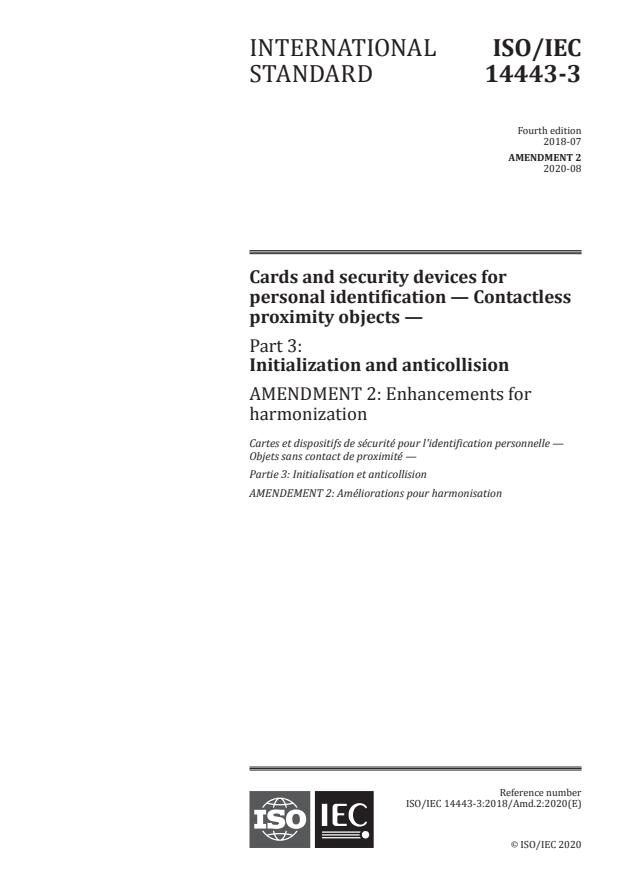
INTERNATIONAL ISO/IEC
STANDARD 14443-3
Fourth edition
2018-07
AMENDMENT 2
2020-08
Cards and security devices for
personal identification — Contactless
proximity objects —
Part 3:
Initialization and anticollision
AMENDMENT 2: Enhancements for
harmonization
Cartes et dispositifs de sécurité pour l'identification personnelle —
Objets sans contact de proximité —
Partie 3: Initialisation et anticollision
AMENDEMENT 2: Améliorations pour harmonisation
Reference number
ISO/IEC 14443-3:2018/Amd.2:2020(E)
©
ISO/IEC 2020
ISO/IEC 14443-3:2018/Amd.2:2020(E)
© ISO/IEC 2020
All rights reserved. Unless otherwise specified, or required in the context of its implementation, no part of this publication may
be reproduced or utilized otherwise in any form or by any means, electronic or mechanical, including photocopying, or posting
on the internet or an intranet, without prior written permission. Permission can be requested from either ISO at the address
below or ISO’s member body in the country of the requester.
ISO copyright office
CP 401 • Ch. de Blandonnet 8
CH-1214 Vernier, Geneva
Phone: +41 22 749 01 11
Email: copyright@iso.org
Website: www.iso.org
Published in Switzerland
ii © ISO/IEC 2020 – All rights reserved
ISO/IEC 14443-3:2018/Amd.2:2020(E)
Foreword
ISO (the International Organization for Standardization) and IEC (the International Electrotechnical
Commission) form the specialized system for worldwide standardization. National bodies that
are members of ISO or IEC participate in the development of International Standards through
technical committees established by the respective organization to deal with particular fields of
technical activity. ISO and IEC technical committees collaborate in fields of mutual interest. Other
international organizations, governmental and non-governmental, in liaison with ISO and IEC, also
take part in the work.
The procedures used to develop this document and those intended for its further maintenance are
described in the ISO/IEC Directives, Part 1. In particular, the different approval criteria needed for
the different types of document should be noted. This document was drafted in accordance with the
editorial rules of the ISO/IEC Directives, Part 2 (see www .iso .org/ directives).
Attention is drawn to the possibility that some of the elements of this document may be the subject
of patent rights. ISO and IEC shall not be held responsible for identifying any or all such patent
rights. Details of any patent rights identified during the
...
Questions, Comments and Discussion
Ask us and Technical Secretary will try to provide an answer. You can facilitate discussion about the standard in here.
Loading comments...