

ISO 6106:2013
(Main)Abrasive products — Checking the grain size of superabrasives
General Information
- Abstract
ISO 6106:2013 specifies a method for determining or checking the grain size of superabrasives (diamond or cubic boron nitride) as used for the manufacture of industrial products, such as grinding wheels and saws. It is applicable to the grain size designations defined. It describes the grain size designations, the size limits, the sieves for use in determining them and the procedure to be adopted for checking the grain size exclusive of any coating.
- Status
- Published
- Publication Date
- 04-Apr-2013
- Technical Committee
- ISO/TC 29/SC 5 - Grinding wheels and abrasives
- Drafting Committee
- ISO/TC 29/SC 5 - Grinding wheels and abrasives
- Current Stage
- 9093 - International Standard confirmed
- Start Date
- 05-Jun-2024
- Completion Date
- 29-Aug-2026
Buy Documents
ISO 6106:2013 - Abrasive products — Checking the grain size of superabrasives Released:4/5/2013
ISO 6106:2013 - Produits abrasifs — Vérification de la dimension des grains de superabrasifs Released:4/5/2013
Overview
ISO 6106:2013 - Abrasive products - Checking the grain size of superabrasives - specifies a laboratory method for determining or checking the grain size of superabrasives (diamond or cubic boron nitride, CBN) used in industrial products such as grinding wheels and saws. The standard defines grain size designations, allowable particle-size limits, the required sieves, and a repeatable sieving procedure to assess particle-size distribution exclusive of any coating.
Key topics and technical requirements
- Scope and purpose: Method for checking grain size of diamond (D) and cubic boron nitride (B) grains and assigning ISO grain designations (see Tables 2 and 3).
- Apparatus:
- Test-sieving machines that provide reproducible results (e.g., in accordance with ISO 9284).
- Electroformed precision sieves (200 mm or 75 mm diameter) with square apertures and a supporting grid (≈2.2 lines/cm) to prevent particle sliding.
- Adaptors for 75 mm sieves (specified in Annex A).
- Sampling and sample mass: Use representative sampling techniques (blending, sample splitters) to obtain the test mass specified in the standard.
- Test conditions: Conditioning per ISO 554 - nominally 23 °C ±2 °C and 50 % ±5 % relative humidity.
- Sieving procedure:
- Assemble nested sieves from coarsest to finest with pan and cover.
- Sieving time: 15 minutes on an approved sieve shaker.
- Remove and weigh oversize, on‑size and undersize fractions; electroformed sieves cleaned ultrasonically where needed.
- Measurement precision:
- Balance precision: at least 0.01 g for 200 mm sieves and 0.001 g for 75 mm sieves.
- Timer accuracy: ±1 % over 15 minutes.
- Evaluation and designation:
- Calculate percent retained per fraction relative to cumulative mass; repeat if total <99 %.
- Designation format: “Superabrasive ISO 6106 - D 151” (type D or B plus ISO grain number).
Applications and who uses it
- Manufacturers of superabrasive grain and coated/bonded abrasive products (grinding wheels, cutting saws) for quality control and product specification.
- Test laboratories and QA/QC departments that verify particle-size distribution and compliance with ISO designations.
- Procurement and standards teams specifying grain size acceptance criteria in supply contracts.
- R&D teams developing abrasive formulations that require controlled grain-size distributions.
Related standards
- ISO 9284 - test-sieving machines (reproducibility guidance)
- ISO 554 - standard atmospheres for conditioning/testing
Keywords: ISO 6106, superabrasives, grain size, diamond, cubic boron nitride, sieving, electroformed sieves, particle size distribution, grinding wheels, quality control.
Relations
- Effective Date
- 09-Feb-2026
- Effective Date
- 09-Feb-2026
- Effective Date
- 18-Feb-2010
Buy Documents
ISO 6106:2013 - Abrasive products — Checking the grain size of superabrasives Released:4/5/2013
ISO 6106:2013 - Produits abrasifs — Vérification de la dimension des grains de superabrasifs Released:4/5/2013
Get Certified
Connect with accredited certification bodies for this standard

DVS-ZERT GmbH
German welding certification society.
CARES (UK Certification Authority for Reinforcing Steels)
UK certification for reinforcing steels and construction.
EWF/IIW (European/International Welding Federation)
International welding personnel certification.
Sponsored listings
Frequently Asked Questions
ISO 6106:2013 is a standard published by the International Organization for Standardization (ISO). Its full title is "Abrasive products — Checking the grain size of superabrasives". This standard covers: ISO 6106:2013 specifies a method for determining or checking the grain size of superabrasives (diamond or cubic boron nitride) as used for the manufacture of industrial products, such as grinding wheels and saws. It is applicable to the grain size designations defined. It describes the grain size designations, the size limits, the sieves for use in determining them and the procedure to be adopted for checking the grain size exclusive of any coating.
ISO 6106:2013 specifies a method for determining or checking the grain size of superabrasives (diamond or cubic boron nitride) as used for the manufacture of industrial products, such as grinding wheels and saws. It is applicable to the grain size designations defined. It describes the grain size designations, the size limits, the sieves for use in determining them and the procedure to be adopted for checking the grain size exclusive of any coating.
ISO 6106:2013 is classified under the following ICS (International Classification for Standards) categories: 25.100.70 - Abrasives. The ICS classification helps identify the subject area and facilitates finding related standards.
ISO 6106:2013 has the following relationships with other standards: It is inter standard links to EN 1083-1:2024, EN ISO 7711-1:2021, ISO 6106:2005. Understanding these relationships helps ensure you are using the most current and applicable version of the standard.
ISO 6106:2013 is available in PDF format for immediate download after purchase. The document can be added to your cart and obtained through the secure checkout process. Digital delivery ensures instant access to the complete standard document.
Standards Content (Sample)
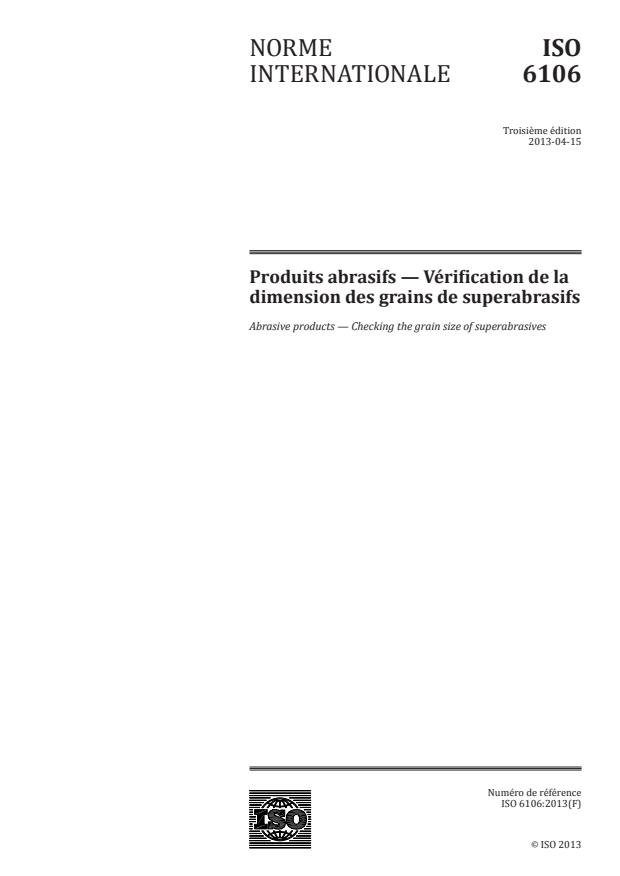
INTERNATIONAL ISO
STANDARD 6106
Third edition
2013-04-15
Abrasive products — Checking the
grain size of superabrasives
Produits abrasifs — Vérification de la dimension des grains de
superabrasifs
Reference number
©
ISO 2013
© ISO 2013
All rights reserved. Unless otherwise specified, no part of this publication may be reproduced or utilized otherwise in any form
or by any means, electronic or mechanical, including photocopying, or posting on the internet or an intranet, without prior
written permission. Permission can be requested from either ISO at the address below or ISO’s member body in the country of
the requester.
ISO copyright office
Case postale 56 • CH-1211 Geneva 20
Tel. + 41 22 749 01 11
Fax + 41 22 749 09 47
E-mail copyright@iso.org
Web www.iso.org
Published in Switzerland
ii © ISO 2013 – All rights reserved
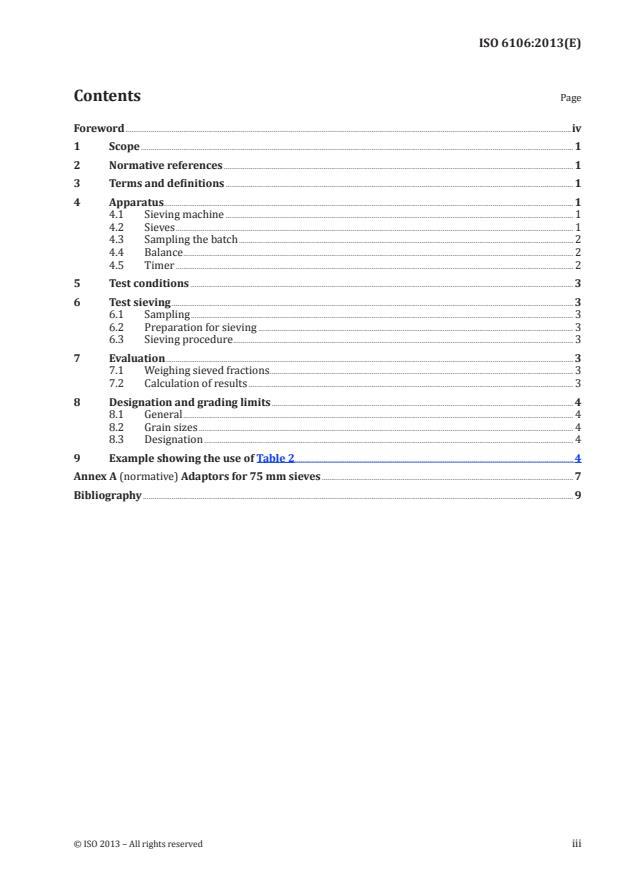
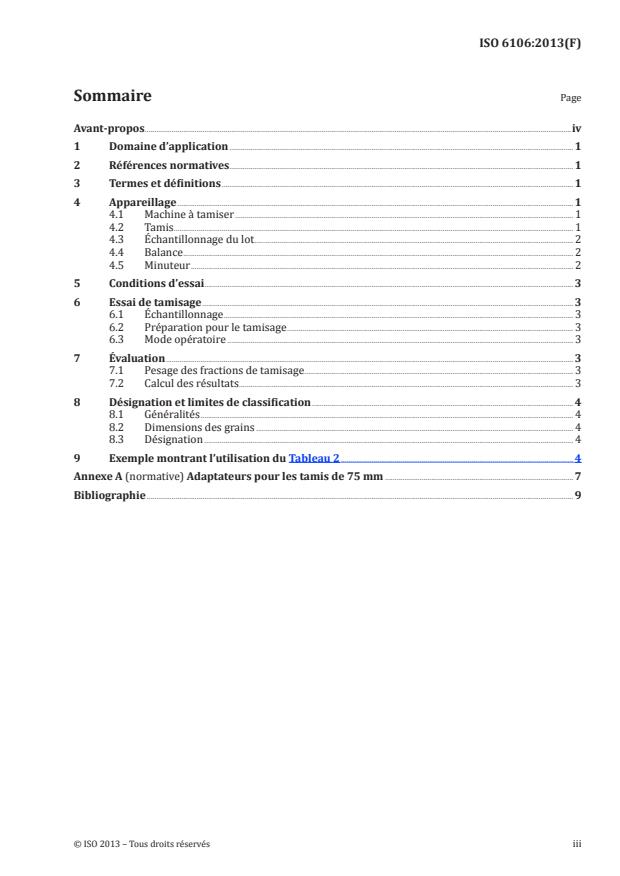
Contents Page
Foreword .iv
1 Scope . 1
2 Normative references . 1
3 Terms and definitions . 1
4 Apparatus . 1
4.1 Sieving machine . 1
4.2 Sieves . 1
4.3 Sampling the batch . 2
4.4 Balance . 2
4.5 Timer . 2
5 Test conditions . 3
6 Test sieving . 3
6.1 Sampling . 3
6.2 Preparation for sieving . 3
6.3 Sieving procedure . 3
7 Evaluation . 3
7.1 Weighing sieved fractions . 3
7.2 Calculation of results . 3
8 Designation and grading limits . 4
8.1 General . 4
8.2 Grain sizes . 4
8.3 Designation . 4
9 Example showing the use of Table 2. 4
Annex A (normative) Adaptors for 75 mm sieves . 7
Bibliography . 9
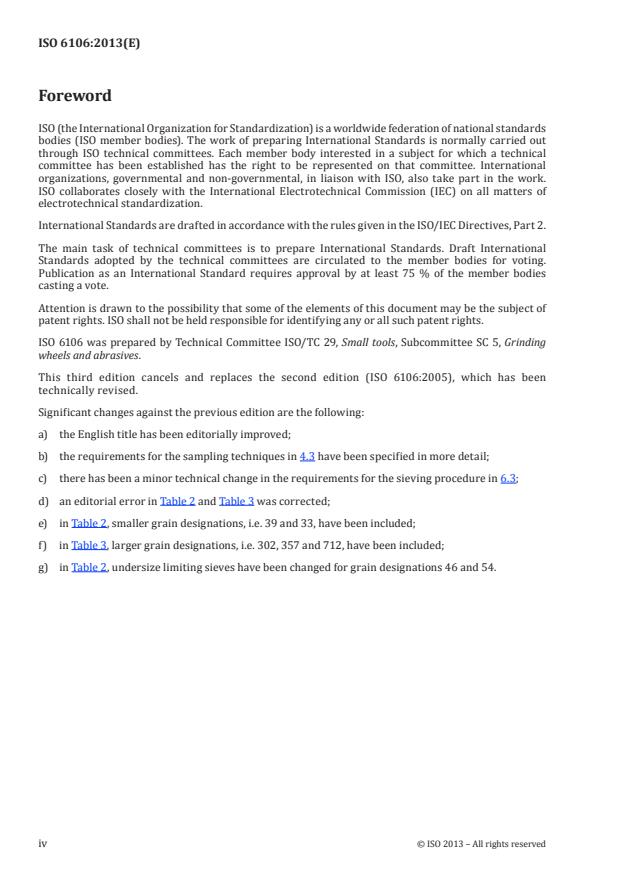
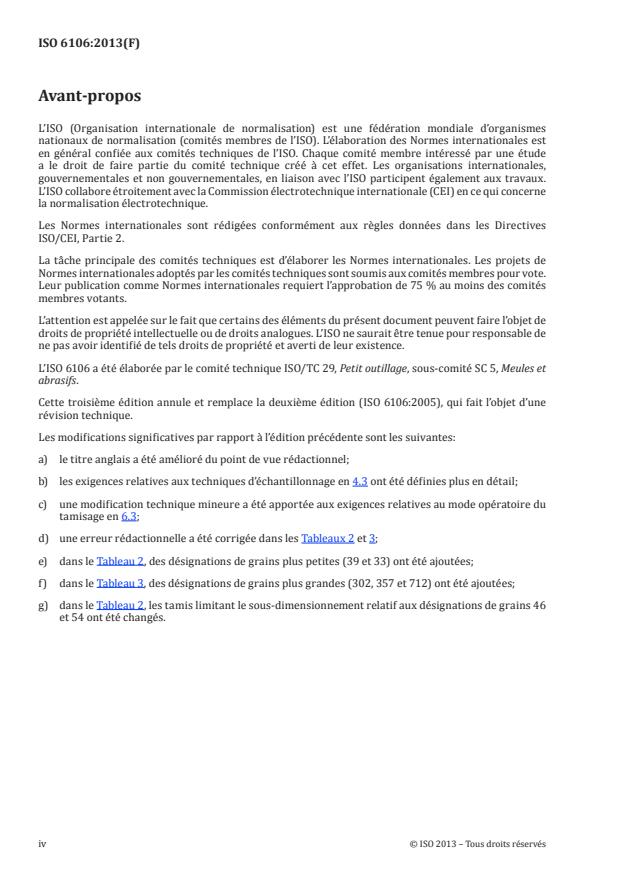
Foreword
ISO (the International Organization for Standardization) is a worldwide federation of national standards
bodies (ISO member bodies). The work of preparing International Standards is normally carried out
through ISO technical committees. Each member body interested in a subject for which a technical
committee has been established has the right to be represented on that committee. International
organizations, governmental and non-governmental, in liaison with ISO, also take part in the work.
ISO collaborates closely with the International Electrotechnical Commission (IEC) on all matters of
electrotechnical standardization.
International Standards are drafted in accordance with the rules given in the ISO/IEC Directives, Part 2.
The main task of technical committees is to prepare International Standards. Draft International
Standards adopted by the technical committees are circulated to the member bodies for voting.
Publication as an International Standard requires approval by at least 75 % of the member bodies
casting a vote.
Attention is drawn to the possibility that some of the elements of this document may be the subject of
patent rights. ISO shall not be held responsible for identifying any or all such patent rights.
ISO 6106 was prepared by Technical Committee ISO/TC 29, Small tools, Subcommittee SC 5, Grinding
wheels and abrasives.
This third edition cancels and replaces the second edition (ISO 6106:2005), which has been
technically revised.
Significant changes against the previous edition are the following:
a) the English title has been editorially improved;
b) the requirements for the sampling techniques in 4.3 have been specified in more detail;
c) there has been a minor technical change in the requirements for the sieving procedure in 6.3;
d) an editorial error in Table 2 and Table 3 was corrected;
e) in Table 2, smaller grain designations, i.e. 39 and 33, have been included;
f) in Table 3, larger grain designations, i.e. 302, 357 and 712, have been included;
g) in Table 2, undersize limiting sieves have been changed for grain designations 46 and 54.
iv © ISO 2013 – All rights reserved
INTERNATIONAL STANDARD ISO 6106:2013(E)
Abrasive products — Checking the grain size of
superabrasives
1 Scope
This International Standard specifies a method for determining or checking the grain size of
superabrasives (diamond or cubic boron nitride) as used for the manufacture of industrial products,
such as grinding wheels and saws. It is applicable to grain size designations as defined in Tables 2 and 3.
This International Standard describes the grain size designations, the size limits, the sieves for use in
determining them and the procedure to be adopted for checking the grain size exclusive of any coating.
2 Normative references
The following documents, in whole or in part, are normatively referenced in this document and are
indispensable for its application. For dated references, only the edition cited applies. For undated
references, the latest edition of the referenced document (including any amendments) applies.
ISO 554, Standard atmospheres for conditioning and/or testing — Specifications
3 Terms and definitions
For the purposes of this document, the following terms and definitions apply.
3.1
grain
product whose size is defined by sieving
3.2
grain size
designated on-size fraction located between the upper and a lower control sieve as specified
Note 1 to entry: The grain may include oversize and undersize factors as specified.
4 Apparatus
4.1 Sieving machine
The test shall only be carried out with test-sieving machines giving reproducible and comparable results,
e.g. test-sieving machines in accordance with ISO 9284.
4.2 Sieves
Electroformed sieves with standard 200 mm or 75 mm diameter stainless frame nested sieves, half-
height (nominal 25 mm) shall be used. A cover and pan are required. The precision electroformed sieves
with square apertures, which shall be used in the size checking procedure described in this International
Standard, shall
...
NORME ISO
INTERNATIONALE 6106
Troisième édition
2013-04-15
Produits abrasifs — Vérification de la
dimension des grains de superabrasifs
Abrasive products — Checking the grain size of superabrasives
Numéro de référence
©
ISO 2013
DOCUMENT PROTÉGÉ PAR COPYRIGHT
© ISO 2013
Droits de reproduction réservés. Sauf indication contraire, aucune partie de cette publication ne peut être reproduite ni utilisée
sous quelque forme que ce soit et par aucun procédé, électronique ou mécanique, y compris la photocopie, l’affichage sur
l’internet ou sur un Intranet, sans autorisation écrite préalable. Les demandes d’autorisation peuvent être adressées à l’ISO à
l’adresse ci-après ou au comité membre de l’ISO dans le pays du demandeur.
ISO copyright office
Case postale 56 • CH-1211 Geneva 20
Tel. + 41 22 749 01 11
Fax + 41 22 749 09 47
E-mail copyright@iso.org
Web www.iso.org
Publié en Suisse
ii © ISO 2013 – Tous droits réservés
Sommaire Page
Avant-propos .iv
1 Domaine d’application . 1
2 Références normatives . 1
3 Termes et définitions . 1
4 Appareillage . 1
4.1 Machine à tamiser . 1
4.2 Tamis. 1
4.3 Échantillonnage du lot . 2
4.4 Balance . 2
4.5 Minuteur . 2
5 Conditions d’essai . 3
6 Essai de tamisage . 3
6.1 Échantillonnage . 3
6.2 Préparation pour le tamisage . 3
6.3 Mode opératoire . 3
7 Évaluation . 3
7.1 Pesage des fractions de tamisage . 3
7.2 Calcul des résultats . 3
8 Désignation et limites de classification . 4
8.1 Généralités . 4
8.2 Dimensions des grains . 4
8.3 Désignation . 4
9 Exemple montrant l’utilisation du Tableau 2 . 4
Annexe A (normative) Adaptateurs pour les tamis de 75 mm . 7
Bibliographie . 9
Avant-propos
L’ISO (Organisation internationale de normalisation) est une fédération mondiale d’organismes
nationaux de normalisation (comités membres de l’ISO). L’élaboration des Normes internationales est
en général confiée aux comités techniques de l’ISO. Chaque comité membre intéressé par une étude
a le droit de faire partie du comité technique créé à cet effet. Les organisations internationales,
gouvernementales et non gouvernementales, en liaison avec l’ISO participent également aux travaux.
L’ISO collabore étroitement avec la Commission électrotechnique internationale (CEI) en ce qui concerne
la normalisation électrotechnique.
Les Normes internationales sont rédigées conformément aux règles données dans les Directives
ISO/CEI, Partie 2.
La tâche principale des comités techniques est d’élaborer les Normes internationales. Les projets de
Normes internationales adoptés par les comités techniques sont soumis aux comités membres pour vote.
Leur publication comme Normes internationales requiert l’approbation de 75 % au moins des comités
membres votants.
L’attention est appelée sur le fait que certains des éléments du présent document peuvent faire l’objet de
droits de propriété intellectuelle ou de droits analogues. L’ISO ne saurait être tenue pour responsable de
ne pas avoir identifié de tels droits de propriété et averti de leur existence.
L’ISO 6106 a été élaborée par le comité technique ISO/TC 29, Petit outillage, sous-comité SC 5, Meules et
abrasifs.
Cette troisième édition annule et remplace la deuxième édition (ISO 6106:2005), qui fait l’objet d’une
révision technique.
Les modifications significatives par rapport à l’édition précédente sont les suivantes:
a) le titre anglais a été amélioré du point de vue rédactionnel;
b) les exigences relatives aux techniques d’échantillonnage en 4.3 ont été définies plus en détail;
c) une modification technique mineure a été apportée aux exigences relatives au mode opératoire du
tamisage en 6.3;
d) une erreur rédactionnelle a été corrigée dans les Tableaux 2 et 3;
e) dans le Tableau 2, des désignations de grains plus petites (39 et 33) ont été ajoutées;
f) dans le Tableau 3, des désignations de grains plus grandes (302, 357 et 712) ont été ajoutées;
g) dans le Tableau 2, les tamis limitant le sous-dimensionnement relatif aux désignations de grains 46
et 54 ont été changés.
iv © ISO 2013 – Tous droits réservés
NORME INTERNATIONALE ISO 6106:2013(F)
Produits abrasifs — Vérification de la dimension des grains
de superabrasifs
1 Domaine d’application
La présente Norme internationale spécifie une méthode permettant de déterminer ou de vérifier la
dimension des grains de superabrasifs (diamant ou nitrure de bore cubique) utilisés pour la fabrication
de produits industriels tels que les meules et les scies. Elle est applicable aux dimensions de grains dont
la désignation est définie dans les Tableaux 2 et 3.
La présente Norme internationale donne la désignation de la dimension du grain, les limites
dimensionnelles, les tamis à utiliser pour les déterminer et le procédé à utiliser pour vérifier la dimension
du grain dépourvu de tout revêtement métallique.
2 Références normatives
Les documents de référence suivants, en tout ou partie, sont référencés normativement dans le présent
document et sont indispensables à son application. Pour les références datées, seule l’édition citée
s’applique. Pour les références non datées, la dernière édition du document de référence s’applique (y
compris les éventuels amendements).
ISO 554, Atmosphères normales de conditionnement et/ou d’essai — Spécifications
3 Termes et définitions
Pour les besoins du présent document, les termes et définitions suivants s’appliquent.
3.1
grain
produit dont la dimension est définie par tamisage
3.2
dimension de grain
fraction dimensionnelle située entre le tamis de contrôle bas et haut comme spécifié
Note 1 à l’article: Le grain peut comprendre des facteurs de surdimensionnement ou de sous-dimensionnement
si spécifié.
4 Appareillage
4.1 Machine à tamiser
L’essai ne doit être réalisé qu’avec des machines à tamiser d’essai donnant des résultats comparables et
reproductibles, par exemple des machines à tamiser d’essai conformes à l’ISO 9284.
4.2 Tamis
Des tamis électroformés standards emboîtés dans des châssis en acier inoxydable de diamètre 200 mm
ou 75 mm, mi-haut (25 mm nominal) doivent être utilisés. Un couvercle et un réceptacle sont requis.
Les tamis électroformés de précision avec des ouvertures carrées qui doivent être utilisés dans le
procédé de vérification des dimensions décrit dans la présente Norme internationale doivent avoir
un support renforcé à raison de 2,2 fils/cm, attaché à la surface supérieure du tamis. Si cela n’est
pas fait, le superabrasif glisse sur la surface supérieure lisse du tamis et l’efficacité du tamisage est
consid
...