


ISO/IEC CD 29187-1
(Main)Information technology — Identification of privacy protection requirements pertaining to learning, education and training (LET) — Part 1: Framework and reference model
Information technology — Identification of privacy protection requirements pertaining to learning, education and training (LET) — Part 1: Framework and reference model
Technologies de l'information — Identification des exigences de protection privée concernant l'apprentissage, l'éducation et la formation (AÉF) — Partie 1: Cadre général et modèle de référence
General Information
- Status
- Withdrawn
- Current Stage
- 3098 - Project deleted
- Start Date
- 03-Jul-2018
- Completion Date
- 12-Feb-2026
Relations
- Effective Date
- 16-Jan-2016

Get Certified
Connect with accredited certification bodies for this standard

BSI Group
BSI (British Standards Institution) is the business standards company that helps organizations make excellence a habit.

Bureau Veritas
Bureau Veritas is a world leader in laboratory testing, inspection and certification services.

DNV
DNV is an independent assurance and risk management provider.
Sponsored listings
Frequently Asked Questions
ISO/IEC CD 29187-1 is a standard published by the International Organization for Standardization (ISO). Its full title is "Information technology — Identification of privacy protection requirements pertaining to learning, education and training (LET) — Part 1: Framework and reference model". This standard covers: Information technology — Identification of privacy protection requirements pertaining to learning, education and training (LET) — Part 1: Framework and reference model
Information technology — Identification of privacy protection requirements pertaining to learning, education and training (LET) — Part 1: Framework and reference model
ISO/IEC CD 29187-1 is classified under the following ICS (International Classification for Standards) categories: 03.100.30 - Management of human resources; 35.240.90 - IT applications in education; 35.240.99 - IT applications in other fields. The ICS classification helps identify the subject area and facilitates finding related standards.
ISO/IEC CD 29187-1 has the following relationships with other standards: It is inter standard links to ISO/IEC 29187-1:2013. Understanding these relationships helps ensure you are using the most current and applicable version of the standard.
ISO/IEC CD 29187-1 is available in PDF format for immediate download after purchase. The document can be added to your cart and obtained through the secure checkout process. Digital delivery ensures instant access to the complete standard document.
Standards Content (Sample)
FINAL
INTERNATIONAL ISO/IEC
DRAFT
STANDARD FDIS
29187-1
ISO/IEC JTC 1/SC 36
Information technology —
Secretariat: KATS
Identification of privacy protection
Voting begins on:
2016-04-22 requirements pertaining to learning,
education and training (LET) —
Voting terminates on:
2016-06-22
Part 1:
Framework and reference model
Technologies de l’information — Identification des exigences de
protection privée concernant l’apprentissage, l’éducation et la
formation (AÉF) —
Partie 1: Cadre général et modèle de référence
RECIPIENTS OF THIS DRAFT ARE INVITED TO
SUBMIT, WITH THEIR COMMENTS, NOTIFICATION
OF ANY RELEVANT PATENT RIGHTS OF WHICH
THEY ARE AWARE AND TO PROVIDE SUPPOR TING
DOCUMENTATION.
IN ADDITION TO THEIR EVALUATION AS
Reference number
BEING ACCEPTABLE FOR INDUSTRIAL, TECHNO-
ISO/IEC FDIS 29187-1:2016(E)
LOGICAL, COMMERCIAL AND USER PURPOSES,
DRAFT INTERNATIONAL STANDARDS MAY ON
OCCASION HAVE TO BE CONSIDERED IN THE
LIGHT OF THEIR POTENTIAL TO BECOME STAN-
DARDS TO WHICH REFERENCE MAY BE MADE IN
©
NATIONAL REGULATIONS. ISO/IEC 2016
ISO/IEC FDIS 29187-1:2016(E)
© ISO/IEC 2016, Published in Switzerland
All rights reserved. Unless otherwise specified, no part of this publication may be reproduced or utilized otherwise in any form
or by any means, electronic or mechanical, including photocopying, or posting on the internet or an intranet, without prior
written permission. Permission can be requested from either ISO at the address below or ISO’s member body in the country of
the requester.
ISO copyright office
Ch. de Blandonnet 8 • CP 401
CH-1214 Vernier, Geneva, Switzerland
Tel. +41 22 749 01 11
Fax +41 22 749 09 47
copyright@iso.org
www.iso.org
ii © ISO/IEC 2016 – All rights reserved
ISO/IEC FDIS 29187-1:2016(E)
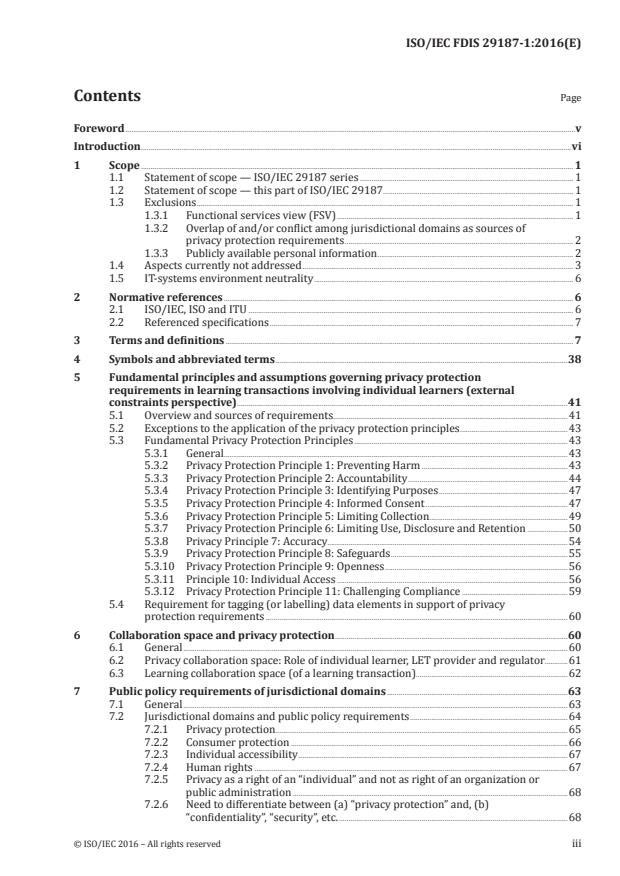
Contents Page
Foreword .v
Introduction .vi
1 Scope . 1
1.1 Statement of scope — ISO/IEC 29187 series . 1
1.2 Statement of scope — this part of ISO/IEC 29187 . 1
1.3 Exclusions . 1
1.3.1 Functional services view (FSV) . 1
1.3.2 Overlap of and/or conflict among jurisdictional domains as sources of
privacy protection requirements . 2
1.3.3 Publicly available personal information . 2
1.4 Aspects currently not addressed . 3
1.5 IT-systems environment neutrality . 6
2 Normative references . 6
2.1 ISO/IEC, ISO and ITU . 6
2.2 Referenced specifications . 7
3 Terms and definitions . 7
4 Symbols and abbreviated terms .38
5 Fundamental principles and assumptions governing privacy protection
requirements in learning transactions involving individual learners (external
constraints perspective) .41
5.1 Overview and sources of requirements .41
5.2 Exceptions to the application of the privacy protection principles .43
5.3 Fundamental Privacy Protection Principles .43
5.3.1 General.43
5.3.2 Privacy Protection Principle 1: Preventing Harm .43
5.3.3 Privacy Protection Principle 2: Accountability .44
5.3.4 Privacy Protection Principle 3: Identifying Purposes .47
5.3.5 Privacy Protection Principle 4: Informed Consent .47
5.3.6 Privacy Protection Principle 5: Limiting Collection . .49
5.3.7 Privacy Protection Principle 6: Limiting Use, Disclosure and Retention .50
5.3.8 Privacy Principle 7: Accuracy.54
5.3.9 Privacy Protection Principle 8: Safeguards .55
5.3.10 Privacy Protection Principle 9: Openness .56
5.3.11 Principle 10: Individual Access .56
5.3.12 Privacy Protection Principle 11: Challenging Compliance .59
5.4 Requirement for tagging (or labelling) data elements in support of privacy
protection requirements .60
6 Collaboration space and privacy protection .60
6.1 General .60
6.2 Privacy collaboration space: Role of individual learner, LET provider and regulator.61
6.3 Learning collaboration space (of a learning transaction).62
7 Public policy requirements of jurisdictional domains .63
7.1 General .63
7.2 Jurisdictional domains and public policy requirements .64
7.2.1 Privacy protection . . .65
7.2.2 Consumer protection .66
7.2.3 Individual accessibility .67
7.2.4 Human rights .67
7.2.5 Privacy as a right of an “individual” and not as right of an organization or
public administration .68
7.2.6 Need to differentiate between (a) “privacy protection” and, (b)
“confidentiality”, “security”, etc. .68
© ISO/IEC 2016 – All rights reserved iii
ISO/IEC FDIS 29187-1:2016(E)
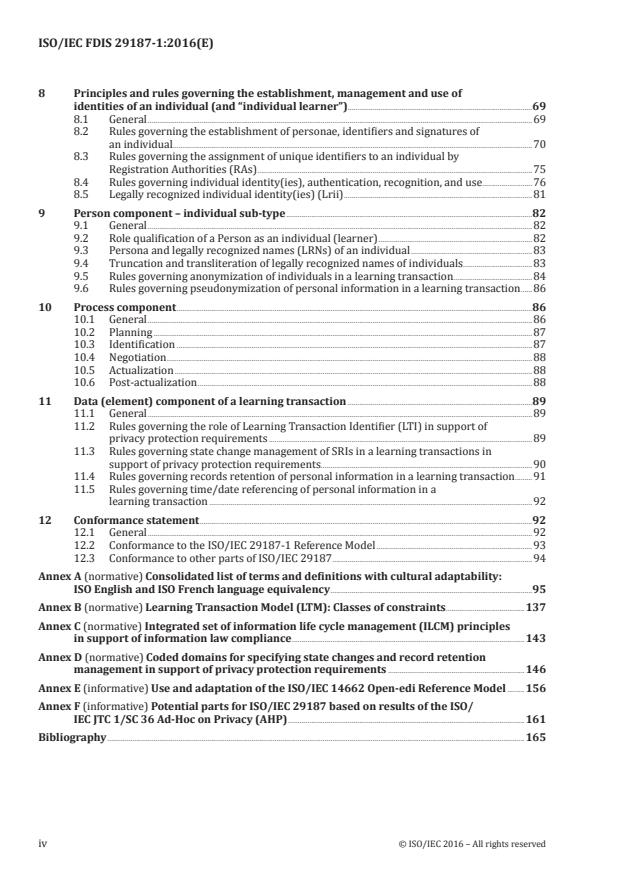
8 Principles and rules governing the establishment, management and use of
identities of an individual (and “individual learner”) .69
8.1 General .69
8.2 Rules governing the establishment of personae, identifiers and signatures of
an individual.70
8.3 Rules governing the assignment of unique identifiers to an individual by
Registration Authorities (RAs) .75
8.4 Rules governing individual identity(ies), authentication, recognition, and use .76
8.5 Legally recognized individual identity(ies) (Lrii) .81
9 Person component – individual sub-type .82
9.1 General .82
9.2 Role qualification of a Person as an individual (learner) .82
9.3 Persona and legally recognized names (LRNs) of an individual .83
9.4 Truncation and transliteration of legally recognized names of individuals .83
9.5 Rules governing anonymization of individuals in a learning transaction .84
9.6 Rules governing pseudonymization of personal information in a learning transaction .86
10 Process component .86
10.1 General .86
10.2 Planning .87
10.3 Identification .87
10.4 Negotiation .88
10.5 Actualization .88
10.6 Post-actualization .88
11 Data (element) component of a learning transaction .89
11.1 General .89
11.2 Rules governing the role of Learning Transaction Identifier (LTI) in support of
privacy protection requirements .89
11.3 Rules governing state change management of SRIs in a learning transactions in
support of privacy protection requirements . .90
11.4 Rules governing records retention of personal information in a learning transaction .91
11.5 Rules governing time/date referencing of personal information in a
learning transaction .92
12 Conformance statement .92
12.1 General .92
12.2 Conformance to the ISO/IEC 29187-1 Reference Model .93
12.3 Conformance to other parts of ISO/IEC 29187 .94
Annex A (normative) Consolidated list of terms and definitions with cultural adaptability:
ISO English and ISO French language equivalency .95
Annex B (normative) Learning Transaction Model (LTM): Classes of constraints.137
Annex C (normative) Integrated set of information life cycle management (ILCM) principles
in support of information law compliance .143
Annex D (normative) Coded domains for specifying state changes and record retention
management in support of privacy protection requirements .146
Annex E (informative) Use and adaptation of the ISO/IEC 14662 Open-edi Reference Model .156
Annex F (informative) Potential parts for ISO/IEC 29187 based on results of the ISO/
IEC JTC 1/SC 36 Ad-Hoc on Privacy (AHP) .161
Bibliography .165
iv © ISO/IEC 2016 – All rights reserved
ISO/IEC FDIS 29187-1:2016(E)
Foreword
ISO (the International Organization for Standardization) and IEC (the International Electrotechnical
Commission) form the specialized system for worldwide standardization. National bodies that are
members of ISO or IEC participate in the development of International Standards through technical
committees established by the respective organization to deal with particular fields of technical
activity. ISO and IEC technical committees collaborate in fields of mutual interest. Other international
organizations, governmental and non-governmental, in liaison with ISO and IEC, also take part in the
work. In the field of information technology, ISO and IEC have established a joint technical committee,
ISO/IEC JTC 1.
The procedures used to develop this document and those intended for its further maintenance are
described in the ISO/IEC Directives, Part 1. In particular the different approval criteria needed for
the different types of document should be noted. This document was drafted in accordance with the
editorial rules of the ISO/IEC Directives, Part 2 (see www.iso.org/directives).
Attention is drawn to the possibility that some of the elements of this document may be the subject
of patent rights. ISO and IEC shall not be held responsible for identifying any or all such patent
rights. Details of any patent rights identified during the development of the document will be in the
Introduction and/or on the ISO list of patent declarations received (see www.iso.org/patents).
Any trade name used in this document is information given for the convenience of users and does not
constitute an endorsement.
For an explanation on the meaning of ISO specific terms and expressions related to conformity assessment,
as well as information about ISO’s adherence to the World Trade Organization (WTO) principles in the
Technical Barriers to Trade (TBT) see the following URL: www.iso.org/iso/foreword.html.
The committee responsible for this document is ISO/IEC JTC 1, Information technology, Subcommittee
SC 36, Information technology for learning, education, and training.
This second edition cancels and replaces the first edition (ISO/IEC 29187-1:2013), of which it constitutes
a minor revision.
ISO/IEC 29187 consists of the following parts, under the general title Information technology —
Identification of privacy protection requirements pertaining to learning, education and training (LET):
— Part 1: Framework and reference model
Further parts may be added in the future.
© ISO/IEC 2016 – All rights reserved v
ISO/IEC FDIS 29187-1:2016(E)
Introduction
Purpose and overview
For the purposes of this part of ISO/IEC 29187, the use of LET covers learning, education and training. In
order to determine the need and focus of LET standards in support of privacy protection requirements
applicable to personal information of an individual learner, ISO/IEC JTC 1/SC 36 established an “Ad-
Hoc on Privacy (AHP)” (the majority of the ISO/IEC JTC 1/SC 36 P-members represent jurisdictional
domains which are governed by privacy/data protection requirements of a legislative/regulatory
nature which apply to “individual learners). The results of this detailed preparatory work and survey
by this JTC 1/SC 36 AHP identified user requirements and served as the basis for the need for this
International Standard. See Annex F.
NOTE 1 The mandate and objectives of this JTC 1/SC 36 AHP, as well as the Survey instrument, are stated in
document 36N1436.
ISO/IEC JTC 1/SC 36 considers it important that International Standards which facilitate the use
of information and communication technologies (ICT) be structured to be able to support legal
requirements of the jurisdictional domains in which they are to be implemented and used. This is
particularly so in cases where such standards are used to capture and manage recorded information
for decision-making about individuals. Common legal and regulatory requirements of this nature,
which impact the development of ICT-based standards, include those of a public policy nature such as
those pertaining to consumer protection, privacy protection, individual accessibility, human rights, etc.
The role of ISO/IEC JTC 1/SC 36 is to develop ICT-based standards in the fields of learning, education
and training (LET). Since the application and use of a majority of JTC 1/SC 36 standards involve the role
of an individual as “learner”, i.e. as an “individual learner”, this means that any recorded information
on or about an identifiable individual as a “learner” is subject to applicable privacy/data protection a
requirement.
This part of ISO/IEC 29187 serves as a “Framework and Reference Model”. Based on a set of (primary)
principles, the “Framework and Reference Model” is composed of a number of conceptual and structural
models. These are represented via “illustrative” figures and associated lexical models in the form of rules.
NOTE 2 One such lexical model is the key concepts and their definitions of the Framework and Reference
Model as presented in Clause 3.
More specific and detailed “typical models” are to be developed in future parts of this International
Standard. These future parts will focus on more detailed specifications of particular components of the
Framework and Reference Model.
Benefits of using a multipart ISO/IEC 29187 standard approach
There are several benefits from taking an integrated approach.
— A multipart standard approach provides for a systematic, cost-efficient and effective approach to
the creation of robust, (re-)useable components in support of LET privacy protection requirements,
including those needed to facilitate the use of generic global requirements perspective, as well as
added requirements of particular jurisdictional domains of human interface equivalents (HIEs) at
any level of granularity.
— This multipart standard will provide cost savings to those organizations and public administrations,
individual learners and suppliers of LET-based products and services, i.e. “LET providers”. It will do
so from a multilingual requirements perspective and in support of cultural adaptability, individual
accessibility and diversity.
NOTE 3 Multilingual communications (whatever the supporting IT platform used including the Internet)
is already supported by existing technologies. Many ISO/IEC and ISO standards already exist (or are under
development) whose contents can and will be used as building blocks for the integration of this new LET
standard.
vi © ISO/IEC 2016 – All rights reserved
ISO/IEC FDIS 29187-1:2016(E)
— having a common IT-facilitated approach will (a) benefit individual users world-wide (doing so in
respect and support of cultural diversity), (b) ensure that requirements of jurisdictional domains (at
whatever level) can be supported in a very cost-effective and efficient manner, and (c) also benefit
suppliers of LET focused products and services.
The concept of (semantic) collaboration space (SCS), introduced in Clause 7 is directed at supporting
the implementation of the UN Convention on the Rights of Persons with Disabilities in an ITLET context
including those of a privacy protection nature.
Informed consent and learning transaction
NOTE 4 Annex E provides informative information on the key modelling constructs introduced in this part of
ISO/IEC 29187.
A key privacy protection requirement is that it requires informed consent of the individual, including
in the role of an individual learner. It also requires the identification of the purpose(s), goal for which
the personal information is to be created/collected, used, managed, shared, deleted, etc. In addition to
identifying purpose(s) and informed consent (presented below) as Privacy Protection principles in 5.3.3
and 5.3.4, there are also the Privacy Protection Principles of “accountability” of “limiting collection”,
“limiting use, disclosure and retention”, “accuracy”, “openness”, “individual access”, and “challenging
compliance” (presented below Privacy Protection principles in 5.3.2, 5.3.5, 5.3.6, 5.3.7, 5.3.9, 5.3.10, and
5.3.11, respectively).
Requirements of this nature focus on what might be considered the LET operational view (LOV). In
addition, there are ICT technical support requirements for privacy protection principles #8 “safeguards”
(see 5.3.8). These include security services, communication services, etc.
Requirements of this nature are not unique to an LET (or ITLET) context. They have already been
identified and addressed in a generic manner in the ISO/IEC 14662 Open-edi Reference Model as being
a “transaction” nature in support of an agreed upon commitment exchange between an individual
learner and an LET provider.
Consequently, the “LET Privacy Protection Framework and Reference Model” (presented in Figure 1)
is based on the “Open-edi Reference Model”. A key construct of the Open-edi Reference Model is that it
recognizes that a commitment exchange, modelled as a transaction needs to be treated and supported
as a whole. At the same time, and from an ICT (including ITLET) perspective, it is recognized that ICT-
based support services, i.e. functional support services view change as ICT changes on the whole, but
those of the user and operational requirements view remain fairly constant. The interaction and inter-
working between (a) the user operational view and (b) the ICT support services view in modelling
a transaction and then developing standards in support of the same as presented in the Open-edi
Reference Model as the need to differentiate between the business operation view (BOV) and functional
services view (FSV) (see Annex E). LET privacy protection Framework and Reference Model uses these
two views of the Open-edi Reference Model to describe the relevant aspects of a learning transaction:
a) the “Learning Operational View (LOV) aspects of a learning transaction;
b) the “LET- FSV view of a learning transaction.
The Learning Operational View (LOV) addresses the aspects of the context and semantic aspects of
personal information in a learning transaction including data management and interchange aspects.
The LOV also can be referred to as the operational and user requirements view.
The LET-FSV addresses the ICT infrastructure and support services meeting the mechanical needs of the
Learning Operational View. Its purpose is to support the demands on the supporting ICT infrastructure
of the Learning Operational View. It focuses on ICT aspects of
a) functional capabilities,
b) service interfaces, and
c) protocols and APIs.
© ISO/IEC 2016 – All rights reserved vii
ISO/IEC FDIS 29187-1:2016(E)
Figure 1 — Learning Transaction — Privacy Protection — Framework and Reference Model
Use of “jurisdictional domain”, jurisdiction, country
NOTE 5 For more detailed information on this and related matters pertaining to “jurisdictional domain”,
see ISO/IEC 15944-5. This is a freely available ISO/IEC standard (see http://standards.iso.org/ittf/
PubliclyAvailableStandards/).
Multiple different definitions are currently in use for “jurisdiction”. Some have legal status and others
do not. Further, it is a common practice to equate “jurisdiction” with “country”. Yet, at the time, it is also
a common practice to refer to “provinces”, “states”, “länder”, “cantons”, “territories”, “municipalities”,
etc., as jurisdictions. In addition, several UN member states can combine to form a “jurisdiction” (e.g.
the European Union, NAFTA, etc.).
In this standard,
a) the use of “jurisdictional domain” represents its use as a defined term, and
b) the use of “jurisdiction(s)” and/or country(ies) represents their use in generic contexts.
Most often in this International Standard, “jurisdictional domain” is used as it represents the primary
source of external constraints pertaining to “privacy protection” rights of individuals. It also reflects
the fact that in UN member states which are “federated” in nature, that it is the “province”, “state”,
“länder”, “territory”, in that UN member state which is often responsible for LET-related activities and
thus is the responsible jurisdictional domain.
This International Standard incorporates the common aspects of such laws and regulations as
pertaining to privacy protection, applicable at the time of publication only. The concept of “privacy
protection” also integrates these various set of legal and regulatory requirements and does so from a
public policy requirements perspective. See Clause 7
It has to be born in mind that the delivery of “privacy protection” requires action both at the LET
operational level (LOV) and technology level of functional service (FSV). Where human beings interact
with recorded information once it has passed through an Open-edi transaction, they may have the
potential to compromise technical controls (FSV) that may have been applied. It is essential that LET
models take account of the need to establish overarching operational processes that address issues that
have not been, and/or cannot be resolved by the technical FSV controls applied so as to provide the
overall privacy demands of regulation that should be applied to personal data, their use, proscribed
dissemination and so on. In this regard, the interplay of the LOVLOV and FSV views of all organizations
should be taken into account.
viii © ISO/IEC 2016 – All rights reserved
ISO/IEC FDIS 29187-1:2016(E)
Use of “Person”, “individual”, “organization”, “public administration” and “person” in the context
of a learning transaction
It is important to differentiate an “individual” from the other two sub-types of Person, namely that of
an “organization” and a “public administration”. There are several reasons why this is necessary. These
include the following.
a) The fact that in UN conventions, Charters, treaties, etc., as well as in the laws and regulations of
jurisdictional domains, the word “person” is often used without explicitly specifying whether
“person” applies only to a human being, a natural person, i.e. as an “individual,” but also other types
of persons recognized in law, i.e. legal persons such as organizations and public administrations.
NOTE 6 The “UN Convention on the Rights of Persons with Disabilities” does not explicitly state or define
what a “Person” is. From its purpose and context, one deduces that these are “natural persons” and not “legal
persons” (e.g. not organizations or public administrations). In an ICT environment (or the virtual world), one
needs to be very explicit.
For example, the human right of “freedom of expression” which is stated in the UN Charter as
written and was intended to be a right of human beings (natural persons) only. However, in some
well as the Constitution (and/or Charter of Human Rights) and of most jurisdictional domains
was jurisdictional domains, corporations have been allowed to claim the right of “freedom of
expression” since they are also “Persons”, i.e. “legal persons”, with the result that “freedom of
expression” rights are applied to “advertising”.
b) The need to ensure that public policy requirements of jurisdictional domains (see Clause 6 below)
which are created and intended for human beings continue to pertain to human beings only, i.e.
“individual”.
c) For the first 20 years to 30 years, the use of ICT was restricted to organizations and public
administrations. The advent of the Internet and the World-Wide Web (WWW) has resulted in
“individuals” becoming full participants in the use of ICT.
Consequently, many, if not most of the ISO/IEC JTC 1 standards, as well as other ICT-based standards
of ISO, IEC and ITU (and others) do not distinguish whether or not the real end user is another IT
system or a Person, i.e. an entity able to make a commitment, and then whether that entity making a
commitment is doing so on behalf of itself, i.e. as an “individual”, or on behalf of an organization, i.e. as
an organization Person.
To address these and other related requirements, the additional concept and term of “Person” was
introduced and defined (see ISO/IEC 15944-1:2011, 6.2) in such a way that it is capable of having the
potential legal and regulatory constraints applied to it, i.e. as “external constraints”. In the context of
this International Standard, these include the following:
a) external constraints of a public policy nature in general and of a “privacy protection” nature in
particular as legal rights of an individual;
b) external constraints of a public policy nature in general and of a privacy protection nature in
particular, which apply to organizations or public administrations as legal obligations to be
complied with when providing goods and services to any individual.
In summary, there are three broad categories of a Person as a player in any process involving the
making of a decision, and/or the making of a “commitment” namely the following:
a) the Person as “individual”;
b) the Person as “organization”;
c) the Person as “public administration”.
There are also three basic (or primitive) roles of Persons in learning transactions, i.e. the making of a
commitment of whatever nature, namely “buyer”, “seller”, and “regulator”.
© ISO/IEC 2016 – All rights reserved ix
ISO/IEC FDIS 29187-1:2016(E)
The reader of this International Standard should understand that
a) the use of Person with a capital “P” represents Person as a defined term, i.e. as the entity that
carries the legal responsibility for making commitment(s),
b) “individual”, “organization” and “public administration” are defined terms representing the three
common sub-types of “Person”, and
c) the words “person(s)” and/or “party(ies)” are used in their generic contexts independent of roles
of “Person” (as defined in ISO/IEC 14662 and ISO/IEC 15944-1). A “party” to any decision making
process, a commitment making process (including any kind of learning transaction) has the
properties and behaviours of a “Person”.
Importance of definitions and terms
NOTE 7 See further, the document titled “Importance of Definitions for Concepts”, (2008-05-20) ISO/IEC JTC 1
N0129/SC 36.
The ISO/IEC Directives Part 2 provide for “Terms and definitions” as a “Technical normative element”,
necessary for the understanding of certain terms used in the document. A primary reason for having
“Terms and definitions” in an International Standard is because one cannot assume that there exists
a common understanding, worldwide, for a specific concept. And even if one assumes that such
an understanding exists, then having such a common definition in Clause 3 serves to formally and
explicitly affirm (re-affirm) such a common understanding, i.e. ensure that all parties concerned share
this common understanding as stated through the text of the definitions in Clause3.
A primary objective of the ISO/IEC 29187-1 standard on LET privacy protection is the need
a) to have clear, unambiguous and explicitly stated definitions for the concepts introduced or used,
b) to appreciate and understand that one needs to be careful in the choice of the “label”, i.e. term, to be
associated with a concept, and
c) to understand that a) and b) are essential to privacy protection and the creation and provision
of human interface equivalents (HIEs) of the semantics of the content of what is intended to be
communicated. This is required to support the “informed consent” privacy protection requirement.
If one looks at any UN convention, treaty, covenant, any law or regulation of a jurisdictional domain,
an International Standard, etc., one will find that their first two chapters, clauses, articles or sections
are “purpose” or “scope” and “definitions”. From an academic and scientific LET perspective, the
introduction of a new concept, its definition, what it “is” (or meant to be understood as), how and where
it fits or is to be used, etc., is the focus of many papers, presentations, etc.
Definitions of concepts form the foundation of research and even more so in a multidisciplinary network
context. As such, it is important that definitions be explicit, unambiguous, and precise with respect to
the semantics conveyed.
This is important because the “definition” and associated label, i.e. “term”, of a concept not only serves
as the basis for a “common understanding” of all parties involved but also serves as the basis for any
other (non-involved) individual to be able to understand the meaning and use of a concept as per its
definition and a common bridge between ICT-based and ICT-neutral approaches.
At times, in order to ensure that the concept being defined is not confused with other related concepts,
i.e. via word, label, or term, used to denote the concept, it is necessary to introduce, i.e. invent or “coin”,
a new term as the label for that concept. The key purpose is not to have multiple different meanings
associated with a single label or term.
Standard based on rules and guidelines
This standard is intended to be used within and outside of the ISO, IEC, and ITU communities by diverse
sets of users having different perspectives and needs.
x © ISO/IEC 2016 – All rights reserved
ISO/IEC FDIS 29187-1:2016(E)
ISO states (ISO/IEC JTC 1 Directives, Part 1: 1998, 2.5 and ISO/IEC Guide 2:2004, 1.7) that a new
standard is a
“documented agreement containing technical specifications or other precise criteria to be used consistently
as rules, guidelines, or definitions of characteristics to ensure that materials, products, processes and
services are fit for their purpose”.
This International Standard focuses on “other precise criteria to be used consistently as rules,
guidelines or definitions of characteristics, to ensure that products, processes and services are fit for
their purpose”, i.e. from an operational and user perspective by individuals and in compliance with
applicable external constraints.
This means that this International Standard is based on rules which are predefined and mutually
agreed to. See Clause 5 and succeeding clauses.
Size of document and role of this part of ISO/IEC 29187
While in an ITLET context, this part of ISO/IEC 29187 may seem to be voluminous, it is noted that there
are many ISO/IEC JTC 1 (and ISO or IEC) standards which are over 1,000 pages in size. The purpose of
this part of ISO/IEC 29187 is exactly that, to provide an overall “Framework and Reference Model” in
an ITLET context to identify the requirements and context for implementation of these requirements in
subsequent Parts of ISO/IEC 29187.
In order for subsequent parts of this multipart standard to be as “short” as possible, it is necessary for
them to be able to use and reference normative and informative Clauses and Annexes of this part of
ISO/IEC 29187.
Use of “identifier” (in a learning transaction)
Unambiguous identification of the two primary parties to a learning transaction, i.e. the individual
learner and the LET provider (as well as associated agents or third parties) is a primary LET privacy
protection requirement. Clause 8 and Clause 11 addresses the issues pertaining to the establishment
and management of use of identities of parties to a learning transaction, that of the parties to a learning
transaction (including the use of various personae (or names) identities, etc.
However, “unambiguous” is a key issue in learning transactions because states of unambiguity and
uncertainty are not permitted in the context of LET privacy requirements and even more so with
respect to LET transactions which involve EDI. A key assumption of Open-edi Reference Model which
applies to any commitment made among autonomous parties is that the resulting transaction shall have
a unique identifier.
Use of “privacy protection” in the context of a commitment exchange and learning transaction
To be able to address privacy protection requirements, one needs to do this in the context of a
commitment exchange between an individual learner and an LET provider involving identified purpose
and informed consent. Such a set of activities is modelled as a learning transaction, i.e. a set of activities
or processes which is initiated either by an individual learner or an LET provider to accomplish and
explicitly shared goal and terminated upon recognition of one of the agreed conclusions by all the
involved Persons, although some of the recognition may be implicit (e.g. a student drops out of a class or
a study programme).
Organization and description of document
This part of ISO/IEC 29187 identifies basic common LET privacy protection requirements, as external
constraints of jurisdictional domains, on the modelling of learning transactions.
Introduction provides key concepts and common content for this multipart standard. These are based
on ISO/IEC 14662, as well as the ISO/IEC 15944 series.
Clause 1, which follows, not only provides the overall scope of this part of ISO/IEC 29187 but this states
its exclusions, as well as relevant aspects not yet addressed in this edition of this part of ISO/IEC 29187.
© ISO/IEC 2016 – All rights reserved xi
ISO/IEC FDIS 29187-1:2016(E)
Clause 2 provides the Normative References used in this part of ISO/IEC 29187. It is noted that a key
principle in the development of this par of ISO/IEC 29187 (as well as subsequent Parts) is to maximize
use of existing international ISO, ISO/IEC, JTC 1, IEC, and ITU-T standards, as well as applicable
referenced specifications.
The principle of maximizes re-use of applicable international standards also applies to subsequent
Clause 3 and Clause 4.
Clause 5 provides the key elements applicable to not only this part of ISO/IEC 29187 but all other
subsequent Parts of ISO/IEC 29187. Clause 5 identifies the fundamental principles governing privacy
protection requirements on learning transactions involving individual learners.
The purpose of Clause 6 is to place the Clause 5 privacy protection requirements identified as
“Fundamental Principles” in Clause 5 in the context of the use of the “collaboration space” modelling
construct” in support of privacy protection requirements. The focus of Clause 6 is to place LET privacy
protection requirements in a “collaboration space” context. The purpose is recognition and support of
the fact that the “identifying purpose” and “informed consent” LET privacy protection requirements
(see 5.3.3 and 5.3.4). Clause 6 introduces the concept of “learning collaboration space” and does so in
the context of a “learning transaction”.
The purpose of Clause 7 is to situate LET privacy protection requirements in the context of other similar
public policy requirements such as consumer protection and individual accessibility.
Clause 8 focuses on presenting the principles and rules governing the management of use of identities of
an individual learner. Based on generic Open-edi standards, it brings to the fore the fact of an individual
having multiple personae, identities, associated unique identifiers, legally recognized individual
id
...
Questions, Comments and Discussion
Ask us and Technical Secretary will try to provide an answer. You can facilitate discussion about the standard in here.
Loading comments...