

ISO 18611-2:2014
(Main)Ships and marine technology — Marine NOx reduction agent AUS 40 — Part 2: Test methods
General Information
- Abstract
ISO 18611-2:2014 specifies test methods required for the determination of the quality characteristics of the NOx reduction agent AUS 40 (aqueous urea solution) specified in ISO 18611-1. In the remaining parts of ISO 18611, the term "NOx reduction agent AUS 40" will be abbreviated to "AUS 40". This International Standard is covering quality requirements and guidelines for AUS 40 for marine applications, irrespective of manufacturing method or technique.
- Status
- Published
- Publication Date
- 22-Sep-2014
- Technical Committee
- ISO/TC 8/SC 2 - Marine environment protection
- Drafting Committee
- ISO/TC 8/SC 2 - Marine environment protection
- Current Stage
- 9060 - Close of review
- Completion Date
- 02-Dec-2030
Buy Documents


ISO 18611-2:2014 - Ships and marine technology -- Marine NOx reduction agent AUS 40
ISO 18611-2:2014 - Ships and marine technology — Marine NOx reduction agent AUS 40 — Part 2: Test methods/23/2014
Overview
ISO 18611-2:2014 specifies the test methods required to determine the quality characteristics of the marine NOx reduction agent AUS 40 (aqueous urea solution). Part 2 of the ISO 18611 series defines sampling, analytical procedures and precision requirements used to confirm compliance with the quality limits set out in ISO 18611-1. The standard is targeted at marine applications for selective catalytic reduction (SCR) systems and is applicable regardless of AUS 40 manufacturing method.
Key topics and technical requirements
- Scope and linkage: Test methods to verify the AUS 40 quality parameters defined in ISO 18611-1; complements ISO 18611-1 (quality requirements) and ISO 18611-3 (handling, transport, storage).
- Sampling (Annex A): Procedures for representative sampling across the supply chain, bottle materials (HDPE, HDPP, PFA, PTFE alternatives), labeling and chain-of-custody requirements, and storage guidance (preferably 1 °C to 20 °C; long-term 1 °C to 15 °C). Analysis is recommended within three weeks to account for ammonia changes.
- Analytical methods (Annexes B–J):
- Urea content by total nitrogen (combustion analysis) and by refractive index
- Density determination (ISO 3675 or ISO 12185 referenced)
- Alkalinity, biuret, aldehyde and insoluble matter test methods
- Phosphate by photometric method
- Trace elements (Ca, Fe, K, Mg, Na) by ICP‑OES
- Identity check by FTIR (informative)
- Precision and dispute resolution: Precision statements follow ISO 4259; precision data mainly adopted from ISO 22241-2 and summarized in Annex K.
Applications and who uses it
ISO 18611-2 is used by:
- AUS 40 producers and distributors for quality control and certification
- SCR system and catalyst manufacturers to ensure compatibility and reliable converter operation
- Marine engine builders and OEMs to validate fuel‑system inputs and emission control performance
- Ship operators, fleet managers and port laboratories for incoming inspection, acceptance testing and dispute resolution
- Analytical laboratories performing compliance testing using standardized methods (ICP‑OES, FTIR, photometry, combustion analysers).
Related standards
- ISO 18611-1 (Quality requirements for AUS 40)
- ISO 18611-3 (Handling, transportation and storage)
- ISO 22241-2 (source methods adapted for urea testing)
- ISO 4259 (precision and dispute procedures)
- ISO 3675, ISO 12185 (density); ISO 5661 (refractive index); ISO 3696 (laboratory water); ISO 5667-3 (sampling handling)
This standard ensures consistent, traceable laboratory methods for AUS 40 quality control, supporting reliable SCR NOx reduction performance and regulatory compliance in maritime emissions control.
Buy Documents
ISO 18611-2:2014 - Ships and marine technology -- Marine NOx reduction agent AUS 40
ISO 18611-2:2014 - Ships and marine technology — Marine NOx reduction agent AUS 40 — Part 2: Test methods/23/2014
Get Certified
Connect with accredited certification bodies for this standard

DNV
DNV is an independent assurance and risk management provider.

BSI Group
BSI (British Standards Institution) is the business standards company that helps organizations make excellence a habit.

Bureau Veritas
Bureau Veritas is a world leader in laboratory testing, inspection and certification services.
Sponsored listings
Frequently Asked Questions
ISO 18611-2:2014 is a standard published by the International Organization for Standardization (ISO). Its full title is "Ships and marine technology — Marine NOx reduction agent AUS 40 — Part 2: Test methods". This standard covers: ISO 18611-2:2014 specifies test methods required for the determination of the quality characteristics of the NOx reduction agent AUS 40 (aqueous urea solution) specified in ISO 18611-1. In the remaining parts of ISO 18611, the term "NOx reduction agent AUS 40" will be abbreviated to "AUS 40". This International Standard is covering quality requirements and guidelines for AUS 40 for marine applications, irrespective of manufacturing method or technique.
ISO 18611-2:2014 specifies test methods required for the determination of the quality characteristics of the NOx reduction agent AUS 40 (aqueous urea solution) specified in ISO 18611-1. In the remaining parts of ISO 18611, the term "NOx reduction agent AUS 40" will be abbreviated to "AUS 40". This International Standard is covering quality requirements and guidelines for AUS 40 for marine applications, irrespective of manufacturing method or technique.
ISO 18611-2:2014 is classified under the following ICS (International Classification for Standards) categories: 13.020.99 - Other standards related to environmental protection; 47.020.99 - Other standards related to shipbuilding and marine structures. The ICS classification helps identify the subject area and facilitates finding related standards.
ISO 18611-2:2014 is available in PDF format for immediate download after purchase. The document can be added to your cart and obtained through the secure checkout process. Digital delivery ensures instant access to the complete standard document.
Standards Content (Sample)
INTERNATIONAL ISO
STANDARD 18611-2
First edition
2014-10-01
Ships and marine technology —
Marine NOx reduction agent AUS 40 —
Part 2:
Test methods
Navires et technologie marine — Agents réducteurs NOx marins AUS
40 —
Partie 2: Méthodes d’essai
Reference number
©
ISO 2014
© ISO 2014
All rights reserved. Unless otherwise specified, no part of this publication may be reproduced or utilized otherwise in any form
or by any means, electronic or mechanical, including photocopying, or posting on the internet or an intranet, without prior
written permission. Permission can be requested from either ISO at the address below or ISO’s member body in the country of
the requester.
ISO copyright office
Case postale 56 • CH-1211 Geneva 20
Tel. + 41 22 749 01 11
Fax + 41 22 749 09 47
E-mail copyright@iso.org
Web www.iso.org
Published in Switzerland
ii © ISO 2014 – All rights reserved
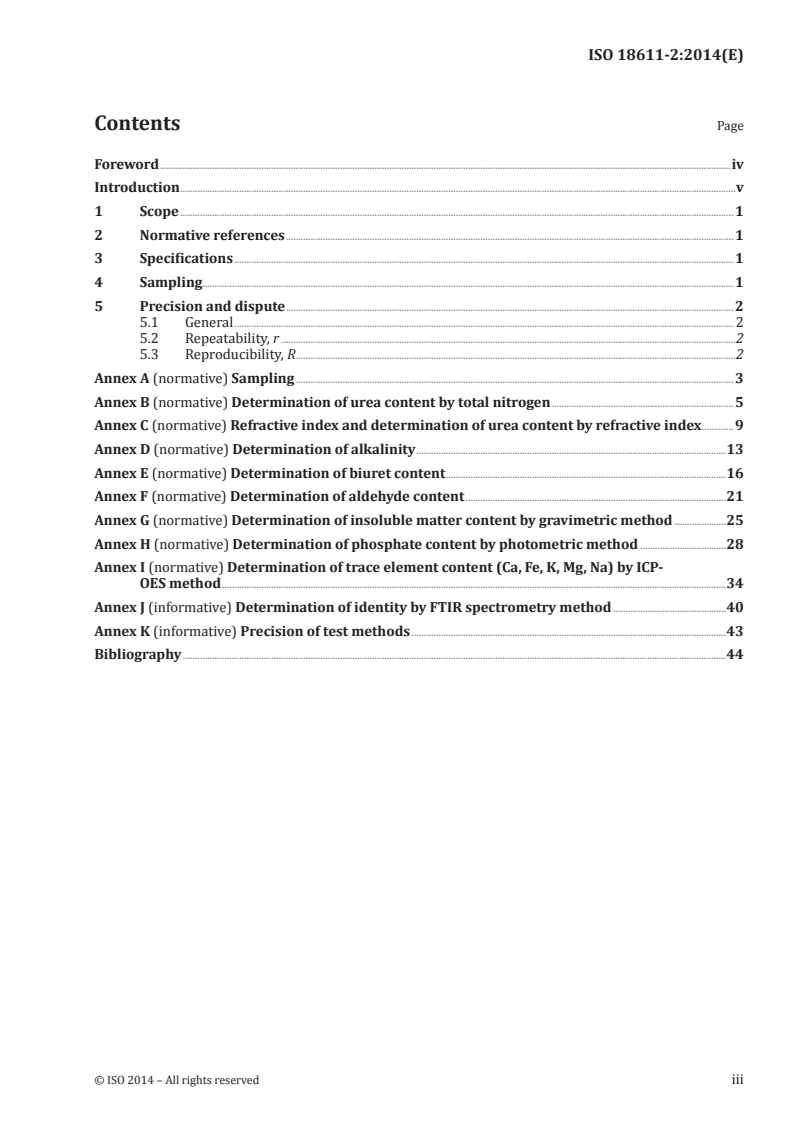
Contents Page
Foreword .iv
Introduction .v
1 Scope . 1
2 Normative references . 1
3 Specifications . 1
4 Sampling . 1
5 Precision and dispute . 2
5.1 General . 2
5.2 Repeatability, r .2
5.3 Reproducibility, R .2
Annex A (normative) Sampling . 3
Annex B (normative) Determination of urea content by total nitrogen . 5
Annex C (normative) Refractive index and determination of urea content by refractive index .9
Annex D (normative) Determination of alkalinity .13
Annex E (normative) Determination of biuret content .16
Annex F (normative) Determination of aldehyde content .21
Annex G (normative) Determination of insoluble matter content by gravimetric method
.....................25
Annex H (normative) Determination of phosphate content by photometric method .28
Annex I (normative) Determination of trace element content (Ca, Fe, K, Mg, Na) by ICP-
OES method .34
Annex J (informative) Determination of identity by FTIR spectrometry method .40
Annex K (informative) Precision of test methods .43
Bibliography .44
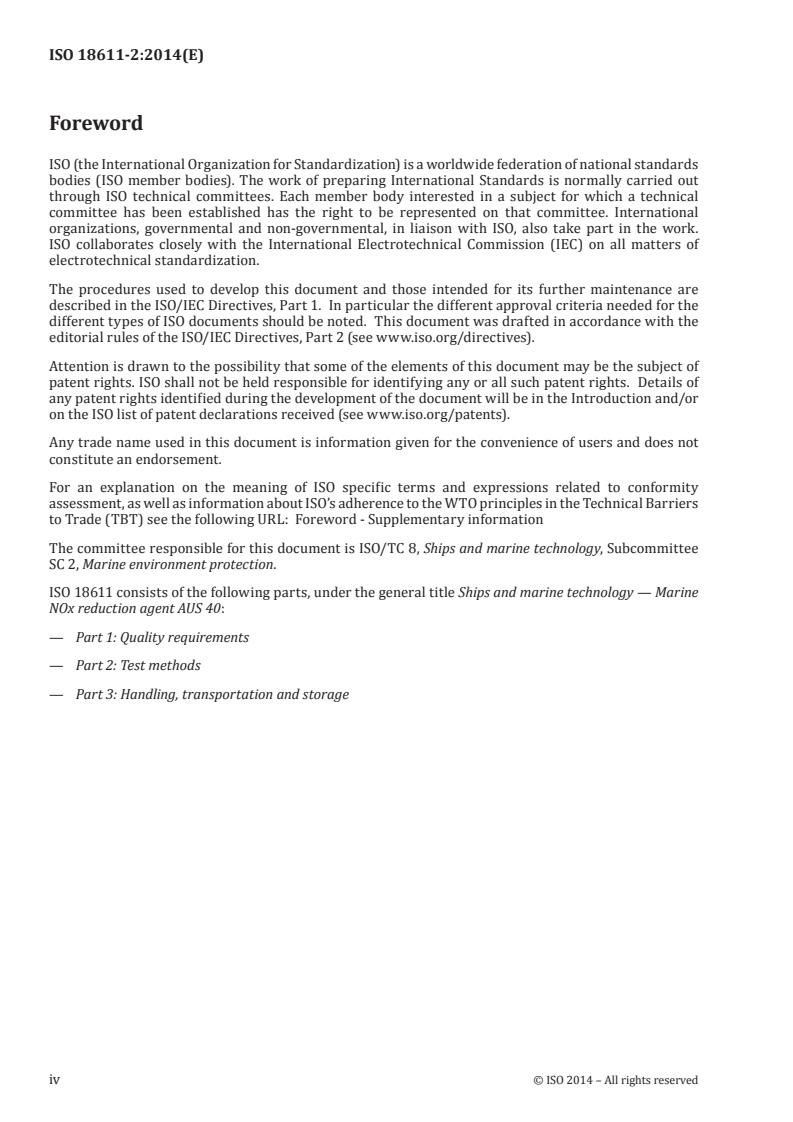
Foreword
ISO (the International Organization for Standardization) is a worldwide federation of national standards
bodies (ISO member bodies). The work of preparing International Standards is normally carried out
through ISO technical committees. Each member body interested in a subject for which a technical
committee has been established has the right to be represented on that committee. International
organizations, governmental and non-governmental, in liaison with ISO, also take part in the work.
ISO collaborates closely with the International Electrotechnical Commission (IEC) on all matters of
electrotechnical standardization.
The procedures used to develop this document and those intended for its further maintenance are
described in the ISO/IEC Directives, Part 1. In particular the different approval criteria needed for the
different types of ISO documents should be noted. This document was drafted in accordance with the
editorial rules of the ISO/IEC Directives, Part 2 (see www.iso.org/directives).
Attention is drawn to the possibility that some of the elements of this document may be the subject of
patent rights. ISO shall not be held responsible for identifying any or all such patent rights. Details of
any patent rights identified during the development of the document will be in the Introduction and/or
on the ISO list of patent declarations received (see www.iso.org/patents).
Any trade name used in this document is information given for the convenience of users and does not
constitute an endorsement.
For an explanation on the meaning of ISO specific terms and expressions related to conformity
assessment, as well as information about ISO’s adherence to the WTO principles in the Technical Barriers
to Trade (TBT) see the following URL: Foreword - Supplementary information
The committee responsible for this document is ISO/TC 8, Ships and marine technology, Subcommittee
SC 2, Marine environment protection.
ISO 18611 consists of the following parts, under the general title Ships and marine technology — Marine
NOx reduction agent AUS 40:
— Part 1: Quality requirements
— Part 2: Test methods
— Part 3: Handling, transportation and storage
iv © ISO 2014 – All rights reserved
Introduction
In order to protect the environment and to enhance air quality, exhaust emissions regulations around
the world are continuously strengthened. For ships with large combustion engines, particulate matter
(PM), nitrogen oxide (NOx) emissions, and sulfur dioxide emissions are the main concern, and efforts
have been focused on the development of technology that can reduce them effectively with minimum fuel
economy penalty. Selective catalytic reduction (SCR) converters using a urea solution as the reducing
agent is considered to be a key technology for reducing NOx emissions. The quality of the urea solution
used for that technology needs to be specified to ensure reliable and stable operation of the SCR converter
systems. The ISO 18611 series provides the specifications for quality characteristics, for handling,
transportation, and storage, as well as the test methods needed by manufacturers of SCR converters, by
engine producers, by producers, distributors of the urea solution, and by fleet operators/ship owners.
Efficient expanding of the use of urea SCR technology requires a consolidated framework that can be
followed by producers, end users, OEMs, and catalyst suppliers.
INTERNATIONAL STANDARD ISO 18611-2:2014(E)
Ships and marine technology — Marine NOx reduction
agent AUS 40 —
Part 2:
Test methods
1 Scope
This part of ISO 18611 specifies test methods required for the determination of the quality characteristics
of the NOx reduction agent AUS 40 (aqueous urea solution) specified in ISO 18611-1. In the remaining
parts of ISO 18611, the term “NOx reduction agent AUS 40” will be abbreviated to “AUS 40”.
This International Standard is covering quality requirements and guidelines for AUS 40 for marine
applications, irrespective of manufacturing method or technique.
2 Normative references
The following documents, in whole or in part, are normatively referenced in this document and are
indispensable for its application. For dated references, only the edition cited applies. For undated
references, the latest edition of the referenced document (including any amendments) applies.
ISO 3675, Crude petroleum and liquid petroleum products — Laboratory determination of density —
Hydrometer method
ISO 3696, Water for analytical laboratory use — Specification and test methods
ISO 4259, Petroleum products — Determination and application of precision data in relation to methods of
test
ISO 5661, Petroleum products — Hydrocarbon liquids — Determination of refractive index
ISO 5667-3, Water quality — Sampling — Part 3: Preservation and handling of water samples
ISO 12185, Crude petroleum and petroleum products — Determination of density — Oscillating U-tube
method
3 Specifications
Compliance with the limits specified in ISO 18611-1, Table 1 shall be determined by the test methods
specified in Annexes B through J of this part of ISO 18611. Determination of the density shall be conducted
in accordance with ISO 3675 or ISO 12185.
NOTE For the purposes of this International Standard, the terms “%(m/m)” and “%(V/V)” are used to
represent the mass fraction and the volume fraction of a material respectively.
4 Sampling
Samples shall be taken in accordance with Annex A.
5 Precision and dispute
5.1 General
All test methods referred to in this part of ISO 18611 include a precision statement according to ISO 4259.
In cases of dispute, the procedures described in ISO 4259 shall be used for resolving the dispute, and
interpretation of the results based on the test method precision shall be used. The test methods described
in this International Standard has been adopted from ISO 22241-2. Some minor changes have been made
to the ISO 22241 test methods in order to adapt it to the specifications as described in ISO 18611-1, Table
1.
The precision of the test methods has been adopted from ISO 22241-2. In ISO 22241-2, the precision was
determined by statistical examination in accordance with ISO 4259 with the exception of the methdods
for determination of density that was taken from ISO 3675 and ISO 12185. The precision of the test
methods is specified in each annex. Additionally, this information is summarized in Annex K for all test
methods for the convenience of the user of this part of ISO 18611.
The statistical significance of the precision quoted in this part of ISO 18611 is generically defined in 5.2
and 5.3, in which the “xx (unit)” stands for the repeatability and reproducibility in question.
5.2 Repeatability, r
The difference between two test results obtained by the same operator with the same apparatus under
constant operating conditions on identical test material should, in the long run, in the normal and correct
operation of the test method, exceed xx (unit) in only one case in 20.
5.3 Reproducibility, R
The difference between two single and independent test results obtained by different operators working
in different laboratories on identical test material would, in the long run, in the normal and correct
operation of the test method, exceed xx (unit) in only one case in 20.
2 © ISO 2014 – All rights reserved
Annex A
(normative)
Sampling
A.1 General
The sampling method specified in this annex is valid for each sampling of AUS 40 throughout the supply
chain after the shipment from the manufacturer’s site to the AUS 40 containers on board the vessels.
A.2 Principle
The limits for the quality characteristics of AUS 40, which are specified in ISO 18611-1, are the
representative analytical results that can only be obtained when the sample is protected from any
contamination before the analysis.
Therefore, suitable bottles shall be used for sampling, which do not contaminate the sample, especially
regarding the trace elements, and which minimize the risk of algae or bacteria growth.
NOTE The sampling method specified in this annex is based on ISO 5667-2 and ISO 5667-3.
A.3 Possible contaminants
During the sampling process, foreign matter may lead to contamination of the sample. Under realistic
conditions, the following sources of contamination will pose a major hazard:
— residues of process aids used for the production of the sampling bottles;
— contaminants which have been deposited in the empty bottles during the time they are stored
empty;
— contaminants from the air, i.e. dust or any foreign matter from the surrounding, during the sampling;
— residues of cleaning agents, which have been used for cleaning the sampling equipment and the
bottles as well;
— fuel.
A.4 Apparatus
A.4.1 Sampling bottles
1000-ml wide neck bottles shall be used. Suitable materials for these bottles are HD-polyethylene, HD-
polypropylene, polyfluorethylene, polyvinylidenedifluoride, and tetrafluoroethylene-perfluoroalky
vinyl ether copolymer (PFA). In case of dispute, PFA bottles should be used.
Prior to the first use with AUS 40, the bottles shall be cleaned and finally rinsed with de-ionized water
followed by AUS 40.
A.4.2 Labels
Each bottle shall be labelled using labels of approximately 10 cm × 5 cm. The labels and the writing on
these labels shall be resistant to water and to AUS 40.
A.5 Sampling
The locked wide-neck bottle shall be opened; the cap shall be put down on a clean surface with the
opening turned downward. After flushing the sampling pipe, the bottle shall be filled completely with
AUS 40 from the container. The first filling shall be discarded, and the bottle shall immediately be re-
filled with AUS 40 and closed tightly. The label shall be attached to the bottle (see A.4.2). During the
filling of the sample, due care shall be taken that neither dust nor liquid pollutants get into the bottle.
The filled bottle should reach the laboratory as soon as possible. During transportation and storage,
the sample should be kept at the lowest possible temperature, preferably between 1 °C and room
temperature (20 °C), and kept away from daylight to prevent growth of algae. Samples to be stored for
a long period of time should be stored at between 1 °C and 15 °C and should be kept away from daylight.
It is recommended to conduct the analysis within three weeks in order to take into account possible
changes in the ammonia content.
A.6 Sample quantity
The minimum quantity of sample material depends on the type of analysis conducted. Whenever
possible, make sure that a sufficient volume of sample material is available (recommendation: 1 litre),
and at least double that which is required for complete verification of AUS 40 specifications. In case of
dispute, a sufficient number of samples shall be taken according to ISO 4259.
A.7 Labelling and Chain of Custody information
Samples will be labelled and a Chain of Custody form shall be utilized in order to track the movement of
the samples as they are transferred to a laboratory for analysis.
A.7.1 Labelling
The label should contain the following information:
— sample identification number;
— product name;
1)
— address/vessel name where the sample was taken from ;
1)
— container/location from which the sample was taken ;
1)
— date and time of sampling .
A.7.2 Chain of Custody information
The Chain of Custody form shall contain the following information:
— sample identification number;
— product name;
1)
— address/vessel name where the sample was taken from ;
1)
— container/location from which the sample was taken ;
1)
— date and time of sampling ;
— name and signature of person who sampled
— date when the sample left the site.
1) Mandatory only in cases of dispute.
4 © ISO 2014 – All rights reserved
Annex B
(normative)
Determination of urea content by total nitrogen
B.1 General
This annex specifies the procedure for determining the urea content of AUS 40.
The method is applicable for the determination of the urea content in the range from 38 % to 42 %
(m/m).
B.2 Principle
The sample is combusted at high temperatures in a stream of oxygen. Following the reduction of formed
nitrogen oxides to elemental nitrogen and removal of any interfering products of combustion, nitrogen
is measured with a thermal-conductivity detector. The urea content is calculated from the determined
total nitrogen minus the nitrogen content of biuret.
B.3 Apparatus
B.3.1 Automatic nitrogen analyser
The unit to be used is based on combustion methods.
B.3.2 Analytical balance
The accuracy of the balance is a function of the analyser used and the required weighed portions.
Resolution should be 0,1 % or better of the weighed portion.
B.3.3 Auxiliary devices for sample preparation
Examples of these devices include
— tweezers with a blunt tip,
— micro-spatula with a flattened tip, and
— pipette.
The pipette is recommended for weighing in and thus does not need to be calibrated. It is important,
however, to obtain a good droplet size (small droplets). Fixed-volume pipettes or pipettes with an
adjustable volume in the range of 10 µl to 1 000 µl or single-trip Pasteur pipettes with a fine tip can also
be used.
NOTE This is customarily chemically resistant glass.
B.4 Chemicals
B.4.1 De-ionized water, conductivity less than 0,1 mS/m, according to ISO 3696, grade 2.
B.4.2 Auxiliary combustion agent and other equipments, appropriate for use with the selected
nitrogen analyser.
The following materials are merely examples. Other or similar materials can be used as required,
depending on the system that is available:
— tin capsule or similar sample containers;
— auxiliary combustion agent, non-nitrogenous, such as saccharose, cellulose;
— absorbing agent for liquids, non-nitrogenous, such as magnesium oxide.
B.4.3 Standard substances for nitrogen determination, preferably with certified nitrogen content.
EXAMPLE Suitable standard substances include ethylenediamine tetraacetic acid (EDTA), nicotinic acid
amide.
Low-biuret urea of adequate purity (for example, crystalline ultra pure or analytical) or other such
standard substances recommended by and available from the equipment manufacturer can also be
used. Certified standard substances should be preferred.
NOTE Liquid standard substances (e.g. urea solutions) are not suited for calibration purposes.
B.4.4 Oxygen, min. 99,995 % O .
B.4.5 Other ultrapure gases, if required to operate the nitrogen analyser, such as helium, min. 99,996 %
He.
B.4.6 Other reagents or auxiliary agents, as required by the equipment.
B.5 Procedure
B.5.1 General
The sample should be fully dissolved and free from urea crystals. It can be heated to max. 40 °C as
required prior to further processing.
NOTE Different types of apparatus are available on the market. The resulting various resources and modes of
operation are not an object of this part of ISO 18611. Rather, activity should be based on the respective operation
manuals.
B.5.2 Reference curve
Perform calibration as required for the specific type of analyser and according to the respective operation
manuals (for example, after replacement of the combustion tube, reagent or similar) by performing
measurements as described in B.5.4. Weigh in an appropriate amount of standard substances repeatedly
as appropriate for the respective types of apparatus to obtain a reference curve.
B.5.3 Inspecting the apparatus for good working order, and the reference curve
Use an appropriate standard substance to review the good working order of the apparatus and the
reference curve. Preferably, a certified urea standard solution should be used.
Frequency of inspection is a function of the analyser used.
6 © ISO 2014 – All rights reserved
B.5.4 Measurement
Weigh a portion of the sample in a suitable holder (such as a tin capsule) as specified for the type of
nitrogen analyser used. The amount should be such that the absolute amount of nitrogen is in the middle
range of the reference curve.
Use approximately the threefold amount of combustion agent (for example, non-nitrogenous cellulose)
and additional binders (for example, magnesium oxide) as required.
When using liquid feeder systems, the volume used should be no less than 100 µl. The sample mass is
calculated using the density that was calculated according to ISO 12185.
Enter the required data (weighed portion, sample identification) into the analyser (or a control computer),
depending on the type of apparatus. Feed the weighed-in sample to the analyser, and start combustion.
Perform at least three (3) single determinations.
B.6 Results
B.6.1 Calculation
Prior to calculating the reference curve, drift of the baseline, or samples, determine the blank reading
value by means of blank samples, and use this value to correct the respective analytical sequences.
Use the apparatus-specific programme to calculate the reference curve or the drift correction for the
samples.
Calculate the mean value for the samples. If there is a strong dispersion of single values (relative standard
deviation RSD > 1,0 %), repeat the affected sample. After that, determine the mean value for this sample
from all single values.
Determine the urea content from the mean value from at least three nitrogen determinations:
ww=−2,1438××Fw −Fw× (B.1)
()
UN 12Bi NH3
where
w is the urea content [% (m/m)];
U
w is the mean value of the nitrogen content [% (m/m)] (to the nearest 0,01 %);
N
w is the mean value of the biuret content (%), determined according to Annex E;
Bi
w is the mean value of the ammonia content (%), determined according to Annex D;
NH3
F is the factor for converting the biuret content to nitrogen (0,407 6);
F is the factor for converting the ammonia content to nitrogen (0,822 5).
B.6.2 Expression of results
The result is the arithmetic mean value from at least three (3) single determinations (nitrogen
determinations).
Round off the result of the urea content calculation to the nearest 0,1 %.
B.7 Precision
See 5.2, 5.3, and Table B.1.
Table B.1 — Precision
Urea content Repeatability Reproducibility
w r R
U
% (m/m) % (m/m) % (m/m)
38 to 42 0,4 1,0
B.8 Test report
The report shall include the following data as a minimum requirement:
a) type and description of tested product;
b) reference to this part of ISO 18611 (i.e. 18611-2);
c) sampling method used;
d) test result (see B.6);
e) deviations from the specified mode of operation, if any;
f) test date.
8 © ISO 2014 – All rights reserved
Annex C
(normative)
Refractive index and determination of urea content by refractive
index
C.1 General
This annex specifies the procedure for the determination of the refractive index of AUS 40. The test
method is applicable to liquids having refractive indices in the range of 1,33 to 1,41 and at temperatures
of 20 °C to 30 °C.
Based on the measurement of refractive index, the method shall be used for determining the content of
urea in the range of 38 % to 42 % (m/m).
C.2 Principle
Measurement is based on the dependence of the refractive index on the concentration of urea in an
aqueous solution at a definite temperature.
The content is determined by means of a reference curve.
NOTE The method specified in this annex is based on ISO 5661.
C.3 Apparatus
C.3.1 Refractometer, measuring range 1,330 00 to 1,410 00, resolution 0,000 01.
C.3.2 Analytical balance, resolution 0,1 mg or better.
C.3.3 Thermostat, temperature-control precision 0,02 °C.
C.3.4 Drying oven.
C.3.5 150 ml beaker, tall form.
C.3.6 Typical laboratory glass.
C.4 Chemicals
C.4.1 De-ionized water, conductivity less than 0,5 mS/m, according to ISO 3696, grade 3.
C.4.2 Urea, crystalline, with biuret content less than 0,1 % (m/m).
Prior to weighing the urea to draw the reference curve, it shall be dried for 2 h at 105 °C.
C.4.3 Urea test solution, 40 % (m/m).
The test solution shall be made by exactly weighing urea and water. The desired value and the permissible
dispersion shall be established through 10 measurements.
The solution shall be kept air-tight in the refrigerator and should be used within 12 weeks maximum.
C.5 Procedure
C.5.1 General
The sample should be fully dissolved and free from urea crystals. It can be heated to ≤40 °C as required
prior to further processing.
Different types of apparatus are available on the market. The resulting various resources and modes of
operation are not an object of this part of ISO 18611. Rather, operation should be based on the respective
operation manuals.
C.5.2 Drawing the reference curve and determining the evaluation factor
The following urea solutions shall be prepared by weighing urea in glass beakers and then adding the
corresponding quantity of de-ionized water: 38,0 % (m/m) / 39 % (m/m) / 40 % (m/m) / 41 % (m/m) /
43,0 % (m/m).
The refractive index of these solutions shall be determined at 20 °C ± 0,02 °C.
The diagram shall show a stringent linear relationship between the refractive index and concentration.
An evaluation factor shall be calculated from the urea concentrations and the refractive indices:
w
∑ U,i
i=1
F = (C.1)
nn−
()
UW,i
∑
i=1
where
F is the evaluation factor (%);
w is the urea content of the i-th reference solution [%(m/m)];
U,i
n is the refractive index of the i-th reference solution;
U,i
n is the refractive index of water and is 1,332 96 when measured with a refractometer of five-
W
decimal resolution.
C.5.3 Checking the instrument function and the reference curve
The instrument function shall be checked weekly using water or a reference standard. If a deviation
greater than 0,000 02 from the desired value occurs, adjust the instrument according to the instructions
provided by the manufacturer. If afterwards the desired value is not attained, then the instrument shall
be disabled for further measurements and the manufacturer’s service should be called for.
Adjust the thermostat to the desired temperature, reading this temperature on the refractometer
thermometer on the discharge side. Maintain the flow of water so that the desired temperature shall be
reached and maintained within ±0,02 °C.
Furthermore, the reference curve shall be verified weekly with urea solution [32,5 % (m/m)]. In the
process, the refractive index shall be determined and the concentration shall be calculated with the help
10 © ISO 2014 – All rights reserved
of the factor according to C.6. If the concentration determined deviates from the desired value by more
than 0,1 % (m/m), a new test solution shall be used. If the deviation persists, the reference curve shall
be created anew.
C.5.4 Sample preparation and measuring
The original sample shall be measured at 20 °C ± 0,02 °C without further preparation.
Measure the urea content two times with different test portions. Should the difference between the
separate values be more than 0,000 05, the measurements shall be repeated.
C.6 Results
C.6.1 Calculation
Urea content shall be calculated according to Formula (C.2):
wn=−nF×−wW− (C.2)
()
UP WBi NH3
where
w is the urea content [% (m/m)];
U
n is the refractive index of the sample (with five decimals);
P
n is the refractive index of water (with five decimals);
W
F is the evaluation factor (%);
w is the biuret content of the solution [% (m/m)]
Bi
(determined according to Annex E; biuret has the same refractive index as urea);
w is the ammonia content of the sample determined according to Annex D [ammonia dissolved
NH3
in water can be assumed to have the same refractive index as water if concentration is less
than 0,5 % (m/m)].
C.6.2 Expression of results
The result is defined as the arithmetic mean of two single measurements. Round off the result of the
refractive index to four decimals. Round off the result of the urea content calculation to the nearest
0,1 % (m/m).
C.7 Precision
See 5.2, 5.3, and Table C.1.
Table C.1 — Precision
Characteristics Repeatability Reproducibility
r R
Refractive index
n 0,000 1 0,001 0
P
1,33 to 1,41
Urea content w
U
38 % to 42 % 0,1 % (m/m) 1,0 % (m/m)
(m/m)
C.8 Test report
The report shall include the following data as a minimum requirement:
a) type and description of tested product;
b) reference to this part of ISO 18611 (i.e. 18611-2);
c) sampling method used;
d) test result (see C.6);
e) deviations from the specified mode of operation, if any;
f) test date.
12 © ISO 2014 – All rights reserved
Annex D
(normative)
Determination of alkalinity
D.1 General
This annex specifies the procedure for the determination of the alkalinity of AUS 40, calculated as
ammonia, in the range 0,1 % to 0,5 % (m/m).
D.2 Principle
The measurement is based on potentiometric titration of free ammonia of a test portion with a standard
volumetric hydrochloric acid solution to the end point at pH = 4.5
D.3 Apparatus
D.3.1 Analytical balance, resolution 0,1 mg or better.
D.3.2 Automatic burette.
D.3.3 Potentiometer, capable of measuring with a precision of 0,01 pH units, equipped with glass
combined pH-electrode.
D.3.4 Magnetic stirrer.
D.3.5 Beaker, 150 ml, tall shaped.
D.3.6 Measuring cylinder, 100 ml.
D.4 Chemicals
D.4.1 General
During the analysis, use only reagents of recognized analytical grade and only distilled or de-ionized
water of an electric conductivity lower than 0,5 mS/m, according to ISO 3696, grade 3.
D.4.2 Hydrochloric acid
This is 0,01 mol/l standard solution.
D.4.3 Buffer solutions
The following standard buffer solutions shall be used for the determination of alkalinity:
— standard buffer solution, pH = 4,008;
— standard buffer solution, pH = 9,184;
— standard buffer solution, pH = 8,00.
NOTE Such solutions are commercially available.
D.5 Procedure
D.5.1 Interferences
The samples of AUS 40 taken shall be stored and shipped at a temperature not higher than 25 °C in order
to avoid ammonia formation.
The containers shall be closed tightly and the analysis time shall not be protracted in order to avoid
evaporation of ammonia.
D.5.2 Check of potentiometric system
The correct function of the potentiometric system shall be checked by use of the standard buffer
solutions at pH = 4,008 and pH = 9,180.
The standard buffer solution at pH = 8,00 shall be used for daily check of the potentiometric system.
D.5.3 Preliminary test
Weigh about 1 g of the homogenous sample ±0,05 g (sample mass m ) and put it into a 150 ml beaker
S
filled with about 100 ml distilled or de-ionized water.
Titrate with the hydrochloric acid solution (0,01 mol/l) under stirring to the end point at pH = 4,5.
Calculate the content of ammonia.
Depending on the content of alkalinity found, weigh the following sample portions for the determination:
— alkalinity content found by the preliminary test [% (m/m)]: 0,02 0,05 0,1 0,2 to 0,5
— mass of test portion for the determination (g): 10 5 2 1
— see D.6.1 for example.
D.5.4 Determination
Weigh the mass of the homogenous sample ±0,05 g found by the preliminary test (sample mass m ) and
S
put it into a 150 ml beaker filled with about 100 ml distilled or de-ionized water.
Titrate with the hydrochloric acid solution (0,1 mol/l) under stirring at first to pH = 7,5 with normal
speed, then titrate to the end point at pH = 4,5 with reduced speed.
Perform two measurements.
14 © ISO 2014 – All rights reserved
D.6 Results
D.6.1 Calculation
The alkalinity, expressed as a percentage by mass of ammonia (NH ), is given by Formula (D.1):
wV= ×0,017 m (D.1)
()
NH3S
where
w is the alkalinity, calculated as ammonia [% (m/m)];
NH3
V is the volume of the hydrochloric acid solution used for the titration (ml);
m is the mass of the test portion (g).
S
D.6.2 Expression of results
Calculate the mean value of the two measurements. Express the result to the nearest 0,01 % (m/m).
D.7 Precision
See 5.2, 5.3, and Table D.1.
Table D.1 — Precision
Alkalinity con- Repeatability Reproducibility
tent r R
w(NH ) % (m/m) % (m/m)
% (m/m)
0,1 to 0,5 0,01 0,2 × x
NOTE x is mean value.
D.8 Test report
The report shall include the following data as a minimum requirement:
a) type and description of tested product;
b) reference to this part of ISO 18611 (i.e. 18611-2);
c) sampling test method;
d) test result (see D.6);
e) deviations from the specified mode of operation, if any;
f) test date.
Annex E
(normative)
Determination of biuret content
E.1 General
This annex specifies the procedure for the determination of the biuret content of AUS 40 with contents
of biuret from 0,1 % to 0,8 % (m/m) by photometric method. The method is also applicable to contents
up to 1,5 % (m/m); however, precision data have not been determined.
E.2 Principle
Biuret forms in alkaline solution in the presence of sodium-potassium-tartrate with bivalent copper
a violet-coloured complex with an absorption maximum at 550 nm. The colour complex is read
spectrophotometrically at 550 nm and the biuret concentration is determined by reference to a
calibration curve prepared from standard biuret solutions.
E.3 Apparatus
E.3.1 Laboratory balance, resolution in reading 0,001 g.
E.3.2 Vacuum filtration unit, applicable for filter with 0,45 µm pore size.
E.3.3 Spectrophotometer, for use at 550 nm with 50-mm-cell.
E.3.4 Volumetric flasks, 1 000 ml, 250 ml, 100 ml, 50 ml.
E.3.5 Pipettes.
E.3.6 Rotary evaporator.
E.3.7 Constant-temperature bath, capable of maintaining a temperature of 30 °C ± 1 °C.
E.4 Chemicals
E.4.1 Chemicals of analytical grade
These shall be used in all tests. The water shall be de-ionized and boiled out to remove carbon dioxide
before use.
E.4.2 Saturated potassium carbonate solution
E.4.3 Copper sulfate solution
Dissolve 15 g copper sulfate (CuSO ⋅5H O) in CO -free water and dilute to 1 000 ml.
4 2 2
16 © ISO 2014 – All rights reserved
E.4.4 Alkaline potassium sodium tartrate solution
Dissolve 40 g sodium hydroxide in 500 ml water in a 1 000 mI volumetric flask. After cooling, add 50 g
potassium sodium tartrate (KNaC H O ⋅4H O) and fill up the flask with water to the mark. Let the
4 4 6 2
flasks stand 1 day before use.
E.4.5 Biuret standard solution, of 0,8 mg biuret/ml
Dissolve 800 mg pure biuret in CO -free water and dilute to 1 000 ml. Dry the biuret for 3 h at 105 °C
before use.
Biuret can be purified as follows:
— add 50 g biuret to 500 ml ammonia solution of 25 % (m/m) concentration and stir for 15 min;
— filter, rinse with ammonia-free water, and dry the biuret;
— dissolve in ethanol (10g/1 litre), filter, and concentrate by gentle heating to one-fourth the volume;
— cool to 5 °C and filter;
— dry the biuret in vacuum oven at 80 °C;
— check the purity by photometrical measurements according to E.5.5.
The step of re-crystallizing from ethanol shall be repeated until there is no more noticeable improvement
of purity.
E.5 Procedure
E.5.1 Interferences
Spectrophotometric measuring is only allowed with clear solutions. Pass the sample through a 0,45 µm
filter to get a clear solution.
Ammonia forms with bivalent copper a coloured complex, which absorbs light energy at 550 nm. The
method is applicable only if the ammonia-content of the sample is less than 500 mg/kg.
To remove ammonia-contents greater than 500 mg/kg, put 50,0 g of the sample in a 1 l flask of a rotary
evaporator, add 15 ml potassium carbonate solution and evaporate it for 1 h at 40 °C with a rotating
speed of 60 r/min and under a vacuum of 2 kPa to 3 kPa to an end volume of approximately 20 ml.
Transfer this volume into a 250 ml volumetric flask.
E.5.2 Preparation of the calibration curve
Into a series of six 50 ml volumetric flasks, transfer 2 ml, 5 ml, 10 ml, 15 ml, 20 ml, and 25 ml of the biuret
standard solution and add water (to each of the six flasks) to a total of mixture volume of approximately
25 ml. Add, while stirring after each addition, 10 ml of the alkaline potassium sodium tartrate solution
and 10 ml of the copper sulfate solution. Immerse the flasks in the constant-temperature bath, regulated
at 30 °C ± 1 °C and leave them there for about 15 min.
Carry out a blank test in parallel with the determination; following the same procedure and using the
same quantities of all the reagents used for the measurement (see E.5.5).
After cooling to room temperature, fill up the flasks with water to the mark and mix well. Carry out
the photometric measurements with the spectrophotometer at a wavelength of about 550 nm using a
50 mm cell against water as the reference.
Subtract the extinction of the blank test from the extinction of the measured values and set up the
calibration curve. In the concentration range, the curve shall be strictly linear.
E.5.3 Calculation of the calibration factor
Calculate the calibration factor according to Formula (E.1):
m
Bi,i
∑
61,6
i=1
F = = (E.1)
6 6
EE− EE−
() ()
∑∑12,,i 12i
i==1 i 1
where
F is the calibration factor (mg);
m is the mass of biuret of the i-th sample (mg);
Bi,i
E is the extinction of the i-th sample;
1,i
E is the extinction of the blank test.
The determination of the calibration curve and the calibration factor shall be repeated on a yearly basis
and shall be documented.
E.5.4 Day-factor
The day-factor shall be determined on a weekly basis.
Perform a measurement of 10 ml of the biuret standard solution (8 mg biuret) as described in E.5.5.
Calculated in Formula (E.2):
F = (E.2)
D
EE−
()
where
F is the day-factor (mg);
D
E is the extinction of the standard solution (average from two measures);
E is the extinction of the blank test.
The deviation of the day-factor shall be within ±5 % to the calibration factor. For measuring of samples,
the day-factor shall be used.
E.5.5 Measurement
Weigh, to the nearest 0,01 g, 100 g of the test sample in a 250 mI volumetric flask. Fill the flask to the
mark with water and mix well.
Transfer an aliquot of 10 ml from the test solution into a 50 ml volumetric flask and add water to
approximately 25 ml. Add, with stirring after each addition, 10 ml of the alkaline potassium sodium
tartrate solution and 10 ml of the copper sulfate solution. Immerse the flask in the constant-temperature
bath, regulated at 30 °C ± 1 °C and leave it there for about 15 min.
Carry out a blank test in parallel with the determination, following the same procedure and using the
same quantities of all the reagents used for the determination.
18 © ISO 2014 – All rights reserved
After cooling to room temperature, fill up the flask with water to the mark and mix well. Carry out
the photometric measurements with the spectrophotometer at a wavelength of about 550 nm using a
50 mm cell against water as the reference.
To determine non-specific absorptions, put another 10 ml of the test solution into a 50 ml volumetric
flask, fill the flask up to the mark with water, and measure the absorption in the same order.
Duplicate determinations shall be carried out.
E.6 Results
E.6.1 Calculation
The biuret content is given, as a percentage by mass, by Formula (E.3):
EE− ××F 250
()
SB D
w = (E.3)
A
m ××10 1000
S
where
w is the content of biuret [% (m/m)];
A
E is the extinction of the sample;
S
E is the extinction of the blank test (reagent blank + sample blank);
B
m is the mass of sample used to prepare test solution (g);
S
F is the calibration factor (µg).
D
E.6.2 Expression of results
Express the result to the nearest 0,01 % (m/m).
E.7 Precision
See 5.2, 5.3, and Table E.1.
Table E.1 — Precision
Biuret content Repeatability Reproducibility
w r R
Bi
% (m/m) % (m/m) % (m/m)
0,1 to 0,8 0,01 0,04
E.8 Test report
The report shall include the following data as a minimum requirement:
a) type and description of tested product;
b) reference to this part of ISO 18611 (i.e. 18611-2);
c) sampling method used;
d) test result (see E.6);
e) deviations from the specified mode of operation, if any;
f) test date.
20 © ISO 2014 – All rights reserved
Annex F
(normative)
Determination of aldehyde content
F.1 General
This annex specifies the procedure for the determination of the content of free and bound aldehyde,
calculated as formaldehyde, of AUS 40 with contents of aldehyde from 5 mg/kg to 100 mg/kg.
F.2 Principle
Formaldehyde forms in strong sulphuric acid solution with chromotropic acid a purple colour with
absorption maximum at 565 nm. The colour complex is read spectrophotometrically at 565 nm and
the aldehyde concentration is determined by reference to a calibration curve prepared from standard
formaldehyde solutions.
NOTE The method specified in this Annex is based on ISO 22241-2.
F.3 Apparatus
F.3.1 Laboratory balance, resolution in reading 0,000 1 g.
F.3.2 Spectrophotometer, for use at 565 nm with 10 mm cell.
F.3.3 Volumetric flasks.
F.3.4 Pipettes.
F.4 Chemicals
F.4.1 Chemicals of analytical grade, shall be used in all tests.
F.4.2 Sulphuric acid, 96 % (m/m).
F.4.3 Chromotropic acid (4,5-dihydroxynaphthalene-2,7-disulphonic acid sodium salt or
4,5-dihydroxy-naphthalene-2,7-disulphonic acid disodium salt dihydrate), 3 % (m/m) in sulphuric acid
of 15 % (m/m).
In order to make this solution, add 41 ml sulphuric acid to 410 ml of water while cooling the mixture and
then add 15 g of chromotropic acid and mix them well.
NOTE If stored in a brown glass bottle, this solution is usable for at least 3 months.
F.4.4 Formaldehyde standard solution, prepared as follows:
— put 6,5 g to 7 g of formalde
...
INTERNATIONAL ISO
STANDARD 18611-2
First edition
2014-10-01
Ships and marine technology —
Marine NOx reduction agent AUS 40 —
Part 2:
Test methods
Navires et technologie marine — Agents réducteurs NOx marins AUS
40 —
Partie 2: Méthodes d’essai
Reference number
©
ISO 2014
© ISO 2014
All rights reserved. Unless otherwise specified, no part of this publication may be reproduced or utilized otherwise in any form
or by any means, electronic or mechanical, including photocopying, or posting on the internet or an intranet, without prior
written permission. Permission can be requested from either ISO at the address below or ISO’s member body in the country of
the requester.
ISO copyright office
Case postale 56 • CH-1211 Geneva 20
Tel. + 41 22 749 01 11
Fax + 41 22 749 09 47
E-mail copyright@iso.org
Web www.iso.org
Published in Switzerland
ii © ISO 2014 – All rights reserved
Contents Page
Foreword .iv
Introduction .v
1 Scope . 1
2 Normative references . 1
3 Specifications . 1
4 Sampling . 1
5 Precision and dispute . 2
5.1 General . 2
5.2 Repeatability, r .2
5.3 Reproducibility, R .2
Annex A (normative) Sampling . 3
Annex B (normative) Determination of urea content by total nitrogen . 5
Annex C (normative) Refractive index and determination of urea content by refractive index .9
Annex D (normative) Determination of alkalinity .13
Annex E (normative) Determination of biuret content .16
Annex F (normative) Determination of aldehyde content .21
Annex G (normative) Determination of insoluble matter content by gravimetric method
.....................25
Annex H (normative) Determination of phosphate content by photometric method .28
Annex I (normative) Determination of trace element content (Ca, Fe, K, Mg, Na) by ICP-
OES method .34
Annex J (informative) Determination of identity by FTIR spectrometry method .40
Annex K (informative) Precision of test methods .43
Bibliography .44
Foreword
ISO (the International Organization for Standardization) is a worldwide federation of national standards
bodies (ISO member bodies). The work of preparing International Standards is normally carried out
through ISO technical committees. Each member body interested in a subject for which a technical
committee has been established has the right to be represented on that committee. International
organizations, governmental and non-governmental, in liaison with ISO, also take part in the work.
ISO collaborates closely with the International Electrotechnical Commission (IEC) on all matters of
electrotechnical standardization.
The procedures used to develop this document and those intended for its further maintenance are
described in the ISO/IEC Directives, Part 1. In particular the different approval criteria needed for the
different types of ISO documents should be noted. This document was drafted in accordance with the
editorial rules of the ISO/IEC Directives, Part 2 (see www.iso.org/directives).
Attention is drawn to the possibility that some of the elements of this document may be the subject of
patent rights. ISO shall not be held responsible for identifying any or all such patent rights. Details of
any patent rights identified during the development of the document will be in the Introduction and/or
on the ISO list of patent declarations received (see www.iso.org/patents).
Any trade name used in this document is information given for the convenience of users and does not
constitute an endorsement.
For an explanation on the meaning of ISO specific terms and expressions related to conformity
assessment, as well as information about ISO’s adherence to the WTO principles in the Technical Barriers
to Trade (TBT) see the following URL: Foreword - Supplementary information
The committee responsible for this document is ISO/TC 8, Ships and marine technology, Subcommittee
SC 2, Marine environment protection.
ISO 18611 consists of the following parts, under the general title Ships and marine technology — Marine
NOx reduction agent AUS 40:
— Part 1: Quality requirements
— Part 2: Test methods
— Part 3: Handling, transportation and storage
iv © ISO 2014 – All rights reserved
Introduction
In order to protect the environment and to enhance air quality, exhaust emissions regulations around
the world are continuously strengthened. For ships with large combustion engines, particulate matter
(PM), nitrogen oxide (NOx) emissions, and sulfur dioxide emissions are the main concern, and efforts
have been focused on the development of technology that can reduce them effectively with minimum fuel
economy penalty. Selective catalytic reduction (SCR) converters using a urea solution as the reducing
agent is considered to be a key technology for reducing NOx emissions. The quality of the urea solution
used for that technology needs to be specified to ensure reliable and stable operation of the SCR converter
systems. The ISO 18611 series provides the specifications for quality characteristics, for handling,
transportation, and storage, as well as the test methods needed by manufacturers of SCR converters, by
engine producers, by producers, distributors of the urea solution, and by fleet operators/ship owners.
Efficient expanding of the use of urea SCR technology requires a consolidated framework that can be
followed by producers, end users, OEMs, and catalyst suppliers.
INTERNATIONAL STANDARD ISO 18611-2:2014(E)
Ships and marine technology — Marine NOx reduction
agent AUS 40 —
Part 2:
Test methods
1 Scope
This part of ISO 18611 specifies test methods required for the determination of the quality characteristics
of the NOx reduction agent AUS 40 (aqueous urea solution) specified in ISO 18611-1. In the remaining
parts of ISO 18611, the term “NOx reduction agent AUS 40” will be abbreviated to “AUS 40”.
This International Standard is covering quality requirements and guidelines for AUS 40 for marine
applications, irrespective of manufacturing method or technique.
2 Normative references
The following documents, in whole or in part, are normatively referenced in this document and are
indispensable for its application. For dated references, only the edition cited applies. For undated
references, the latest edition of the referenced document (including any amendments) applies.
ISO 3675, Crude petroleum and liquid petroleum products — Laboratory determination of density —
Hydrometer method
ISO 3696, Water for analytical laboratory use — Specification and test methods
ISO 4259, Petroleum products — Determination and application of precision data in relation to methods of
test
ISO 5661, Petroleum products — Hydrocarbon liquids — Determination of refractive index
ISO 5667-3, Water quality — Sampling — Part 3: Preservation and handling of water samples
ISO 12185, Crude petroleum and petroleum products — Determination of density — Oscillating U-tube
method
3 Specifications
Compliance with the limits specified in ISO 18611-1, Table 1 shall be determined by the test methods
specified in Annexes B through J of this part of ISO 18611. Determination of the density shall be conducted
in accordance with ISO 3675 or ISO 12185.
NOTE For the purposes of this International Standard, the terms “%(m/m)” and “%(V/V)” are used to
represent the mass fraction and the volume fraction of a material respectively.
4 Sampling
Samples shall be taken in accordance with Annex A.
5 Precision and dispute
5.1 General
All test methods referred to in this part of ISO 18611 include a precision statement according to ISO 4259.
In cases of dispute, the procedures described in ISO 4259 shall be used for resolving the dispute, and
interpretation of the results based on the test method precision shall be used. The test methods described
in this International Standard has been adopted from ISO 22241-2. Some minor changes have been made
to the ISO 22241 test methods in order to adapt it to the specifications as described in ISO 18611-1, Table
1.
The precision of the test methods has been adopted from ISO 22241-2. In ISO 22241-2, the precision was
determined by statistical examination in accordance with ISO 4259 with the exception of the methdods
for determination of density that was taken from ISO 3675 and ISO 12185. The precision of the test
methods is specified in each annex. Additionally, this information is summarized in Annex K for all test
methods for the convenience of the user of this part of ISO 18611.
The statistical significance of the precision quoted in this part of ISO 18611 is generically defined in 5.2
and 5.3, in which the “xx (unit)” stands for the repeatability and reproducibility in question.
5.2 Repeatability, r
The difference between two test results obtained by the same operator with the same apparatus under
constant operating conditions on identical test material should, in the long run, in the normal and correct
operation of the test method, exceed xx (unit) in only one case in 20.
5.3 Reproducibility, R
The difference between two single and independent test results obtained by different operators working
in different laboratories on identical test material would, in the long run, in the normal and correct
operation of the test method, exceed xx (unit) in only one case in 20.
2 © ISO 2014 – All rights reserved
Annex A
(normative)
Sampling
A.1 General
The sampling method specified in this annex is valid for each sampling of AUS 40 throughout the supply
chain after the shipment from the manufacturer’s site to the AUS 40 containers on board the vessels.
A.2 Principle
The limits for the quality characteristics of AUS 40, which are specified in ISO 18611-1, are the
representative analytical results that can only be obtained when the sample is protected from any
contamination before the analysis.
Therefore, suitable bottles shall be used for sampling, which do not contaminate the sample, especially
regarding the trace elements, and which minimize the risk of algae or bacteria growth.
NOTE The sampling method specified in this annex is based on ISO 5667-2 and ISO 5667-3.
A.3 Possible contaminants
During the sampling process, foreign matter may lead to contamination of the sample. Under realistic
conditions, the following sources of contamination will pose a major hazard:
— residues of process aids used for the production of the sampling bottles;
— contaminants which have been deposited in the empty bottles during the time they are stored
empty;
— contaminants from the air, i.e. dust or any foreign matter from the surrounding, during the sampling;
— residues of cleaning agents, which have been used for cleaning the sampling equipment and the
bottles as well;
— fuel.
A.4 Apparatus
A.4.1 Sampling bottles
1000-ml wide neck bottles shall be used. Suitable materials for these bottles are HD-polyethylene, HD-
polypropylene, polyfluorethylene, polyvinylidenedifluoride, and tetrafluoroethylene-perfluoroalky
vinyl ether copolymer (PFA). In case of dispute, PFA bottles should be used.
Prior to the first use with AUS 40, the bottles shall be cleaned and finally rinsed with de-ionized water
followed by AUS 40.
A.4.2 Labels
Each bottle shall be labelled using labels of approximately 10 cm × 5 cm. The labels and the writing on
these labels shall be resistant to water and to AUS 40.
A.5 Sampling
The locked wide-neck bottle shall be opened; the cap shall be put down on a clean surface with the
opening turned downward. After flushing the sampling pipe, the bottle shall be filled completely with
AUS 40 from the container. The first filling shall be discarded, and the bottle shall immediately be re-
filled with AUS 40 and closed tightly. The label shall be attached to the bottle (see A.4.2). During the
filling of the sample, due care shall be taken that neither dust nor liquid pollutants get into the bottle.
The filled bottle should reach the laboratory as soon as possible. During transportation and storage,
the sample should be kept at the lowest possible temperature, preferably between 1 °C and room
temperature (20 °C), and kept away from daylight to prevent growth of algae. Samples to be stored for
a long period of time should be stored at between 1 °C and 15 °C and should be kept away from daylight.
It is recommended to conduct the analysis within three weeks in order to take into account possible
changes in the ammonia content.
A.6 Sample quantity
The minimum quantity of sample material depends on the type of analysis conducted. Whenever
possible, make sure that a sufficient volume of sample material is available (recommendation: 1 litre),
and at least double that which is required for complete verification of AUS 40 specifications. In case of
dispute, a sufficient number of samples shall be taken according to ISO 4259.
A.7 Labelling and Chain of Custody information
Samples will be labelled and a Chain of Custody form shall be utilized in order to track the movement of
the samples as they are transferred to a laboratory for analysis.
A.7.1 Labelling
The label should contain the following information:
— sample identification number;
— product name;
1)
— address/vessel name where the sample was taken from ;
1)
— container/location from which the sample was taken ;
1)
— date and time of sampling .
A.7.2 Chain of Custody information
The Chain of Custody form shall contain the following information:
— sample identification number;
— product name;
1)
— address/vessel name where the sample was taken from ;
1)
— container/location from which the sample was taken ;
1)
— date and time of sampling ;
— name and signature of person who sampled
— date when the sample left the site.
1) Mandatory only in cases of dispute.
4 © ISO 2014 – All rights reserved
Annex B
(normative)
Determination of urea content by total nitrogen
B.1 General
This annex specifies the procedure for determining the urea content of AUS 40.
The method is applicable for the determination of the urea content in the range from 38 % to 42 %
(m/m).
B.2 Principle
The sample is combusted at high temperatures in a stream of oxygen. Following the reduction of formed
nitrogen oxides to elemental nitrogen and removal of any interfering products of combustion, nitrogen
is measured with a thermal-conductivity detector. The urea content is calculated from the determined
total nitrogen minus the nitrogen content of biuret.
B.3 Apparatus
B.3.1 Automatic nitrogen analyser
The unit to be used is based on combustion methods.
B.3.2 Analytical balance
The accuracy of the balance is a function of the analyser used and the required weighed portions.
Resolution should be 0,1 % or better of the weighed portion.
B.3.3 Auxiliary devices for sample preparation
Examples of these devices include
— tweezers with a blunt tip,
— micro-spatula with a flattened tip, and
— pipette.
The pipette is recommended for weighing in and thus does not need to be calibrated. It is important,
however, to obtain a good droplet size (small droplets). Fixed-volume pipettes or pipettes with an
adjustable volume in the range of 10 µl to 1 000 µl or single-trip Pasteur pipettes with a fine tip can also
be used.
NOTE This is customarily chemically resistant glass.
B.4 Chemicals
B.4.1 De-ionized water, conductivity less than 0,1 mS/m, according to ISO 3696, grade 2.
B.4.2 Auxiliary combustion agent and other equipments, appropriate for use with the selected
nitrogen analyser.
The following materials are merely examples. Other or similar materials can be used as required,
depending on the system that is available:
— tin capsule or similar sample containers;
— auxiliary combustion agent, non-nitrogenous, such as saccharose, cellulose;
— absorbing agent for liquids, non-nitrogenous, such as magnesium oxide.
B.4.3 Standard substances for nitrogen determination, preferably with certified nitrogen content.
EXAMPLE Suitable standard substances include ethylenediamine tetraacetic acid (EDTA), nicotinic acid
amide.
Low-biuret urea of adequate purity (for example, crystalline ultra pure or analytical) or other such
standard substances recommended by and available from the equipment manufacturer can also be
used. Certified standard substances should be preferred.
NOTE Liquid standard substances (e.g. urea solutions) are not suited for calibration purposes.
B.4.4 Oxygen, min. 99,995 % O .
B.4.5 Other ultrapure gases, if required to operate the nitrogen analyser, such as helium, min. 99,996 %
He.
B.4.6 Other reagents or auxiliary agents, as required by the equipment.
B.5 Procedure
B.5.1 General
The sample should be fully dissolved and free from urea crystals. It can be heated to max. 40 °C as
required prior to further processing.
NOTE Different types of apparatus are available on the market. The resulting various resources and modes of
operation are not an object of this part of ISO 18611. Rather, activity should be based on the respective operation
manuals.
B.5.2 Reference curve
Perform calibration as required for the specific type of analyser and according to the respective operation
manuals (for example, after replacement of the combustion tube, reagent or similar) by performing
measurements as described in B.5.4. Weigh in an appropriate amount of standard substances repeatedly
as appropriate for the respective types of apparatus to obtain a reference curve.
B.5.3 Inspecting the apparatus for good working order, and the reference curve
Use an appropriate standard substance to review the good working order of the apparatus and the
reference curve. Preferably, a certified urea standard solution should be used.
Frequency of inspection is a function of the analyser used.
6 © ISO 2014 – All rights reserved
B.5.4 Measurement
Weigh a portion of the sample in a suitable holder (such as a tin capsule) as specified for the type of
nitrogen analyser used. The amount should be such that the absolute amount of nitrogen is in the middle
range of the reference curve.
Use approximately the threefold amount of combustion agent (for example, non-nitrogenous cellulose)
and additional binders (for example, magnesium oxide) as required.
When using liquid feeder systems, the volume used should be no less than 100 µl. The sample mass is
calculated using the density that was calculated according to ISO 12185.
Enter the required data (weighed portion, sample identification) into the analyser (or a control computer),
depending on the type of apparatus. Feed the weighed-in sample to the analyser, and start combustion.
Perform at least three (3) single determinations.
B.6 Results
B.6.1 Calculation
Prior to calculating the reference curve, drift of the baseline, or samples, determine the blank reading
value by means of blank samples, and use this value to correct the respective analytical sequences.
Use the apparatus-specific programme to calculate the reference curve or the drift correction for the
samples.
Calculate the mean value for the samples. If there is a strong dispersion of single values (relative standard
deviation RSD > 1,0 %), repeat the affected sample. After that, determine the mean value for this sample
from all single values.
Determine the urea content from the mean value from at least three nitrogen determinations:
ww=−2,1438××Fw −Fw× (B.1)
()
UN 12Bi NH3
where
w is the urea content [% (m/m)];
U
w is the mean value of the nitrogen content [% (m/m)] (to the nearest 0,01 %);
N
w is the mean value of the biuret content (%), determined according to Annex E;
Bi
w is the mean value of the ammonia content (%), determined according to Annex D;
NH3
F is the factor for converting the biuret content to nitrogen (0,407 6);
F is the factor for converting the ammonia content to nitrogen (0,822 5).
B.6.2 Expression of results
The result is the arithmetic mean value from at least three (3) single determinations (nitrogen
determinations).
Round off the result of the urea content calculation to the nearest 0,1 %.
B.7 Precision
See 5.2, 5.3, and Table B.1.
Table B.1 — Precision
Urea content Repeatability Reproducibility
w r R
U
% (m/m) % (m/m) % (m/m)
38 to 42 0,4 1,0
B.8 Test report
The report shall include the following data as a minimum requirement:
a) type and description of tested product;
b) reference to this part of ISO 18611 (i.e. 18611-2);
c) sampling method used;
d) test result (see B.6);
e) deviations from the specified mode of operation, if any;
f) test date.
8 © ISO 2014 – All rights reserved
Annex C
(normative)
Refractive index and determination of urea content by refractive
index
C.1 General
This annex specifies the procedure for the determination of the refractive index of AUS 40. The test
method is applicable to liquids having refractive indices in the range of 1,33 to 1,41 and at temperatures
of 20 °C to 30 °C.
Based on the measurement of refractive index, the method shall be used for determining the content of
urea in the range of 38 % to 42 % (m/m).
C.2 Principle
Measurement is based on the dependence of the refractive index on the concentration of urea in an
aqueous solution at a definite temperature.
The content is determined by means of a reference curve.
NOTE The method specified in this annex is based on ISO 5661.
C.3 Apparatus
C.3.1 Refractometer, measuring range 1,330 00 to 1,410 00, resolution 0,000 01.
C.3.2 Analytical balance, resolution 0,1 mg or better.
C.3.3 Thermostat, temperature-control precision 0,02 °C.
C.3.4 Drying oven.
C.3.5 150 ml beaker, tall form.
C.3.6 Typical laboratory glass.
C.4 Chemicals
C.4.1 De-ionized water, conductivity less than 0,5 mS/m, according to ISO 3696, grade 3.
C.4.2 Urea, crystalline, with biuret content less than 0,1 % (m/m).
Prior to weighing the urea to draw the reference curve, it shall be dried for 2 h at 105 °C.
C.4.3 Urea test solution, 40 % (m/m).
The test solution shall be made by exactly weighing urea and water. The desired value and the permissible
dispersion shall be established through 10 measurements.
The solution shall be kept air-tight in the refrigerator and should be used within 12 weeks maximum.
C.5 Procedure
C.5.1 General
The sample should be fully dissolved and free from urea crystals. It can be heated to ≤40 °C as required
prior to further processing.
Different types of apparatus are available on the market. The resulting various resources and modes of
operation are not an object of this part of ISO 18611. Rather, operation should be based on the respective
operation manuals.
C.5.2 Drawing the reference curve and determining the evaluation factor
The following urea solutions shall be prepared by weighing urea in glass beakers and then adding the
corresponding quantity of de-ionized water: 38,0 % (m/m) / 39 % (m/m) / 40 % (m/m) / 41 % (m/m) /
43,0 % (m/m).
The refractive index of these solutions shall be determined at 20 °C ± 0,02 °C.
The diagram shall show a stringent linear relationship between the refractive index and concentration.
An evaluation factor shall be calculated from the urea concentrations and the refractive indices:
w
∑ U,i
i=1
F = (C.1)
nn−
()
UW,i
∑
i=1
where
F is the evaluation factor (%);
w is the urea content of the i-th reference solution [%(m/m)];
U,i
n is the refractive index of the i-th reference solution;
U,i
n is the refractive index of water and is 1,332 96 when measured with a refractometer of five-
W
decimal resolution.
C.5.3 Checking the instrument function and the reference curve
The instrument function shall be checked weekly using water or a reference standard. If a deviation
greater than 0,000 02 from the desired value occurs, adjust the instrument according to the instructions
provided by the manufacturer. If afterwards the desired value is not attained, then the instrument shall
be disabled for further measurements and the manufacturer’s service should be called for.
Adjust the thermostat to the desired temperature, reading this temperature on the refractometer
thermometer on the discharge side. Maintain the flow of water so that the desired temperature shall be
reached and maintained within ±0,02 °C.
Furthermore, the reference curve shall be verified weekly with urea solution [32,5 % (m/m)]. In the
process, the refractive index shall be determined and the concentration shall be calculated with the help
10 © ISO 2014 – All rights reserved
of the factor according to C.6. If the concentration determined deviates from the desired value by more
than 0,1 % (m/m), a new test solution shall be used. If the deviation persists, the reference curve shall
be created anew.
C.5.4 Sample preparation and measuring
The original sample shall be measured at 20 °C ± 0,02 °C without further preparation.
Measure the urea content two times with different test portions. Should the difference between the
separate values be more than 0,000 05, the measurements shall be repeated.
C.6 Results
C.6.1 Calculation
Urea content shall be calculated according to Formula (C.2):
wn=−nF×−wW− (C.2)
()
UP WBi NH3
where
w is the urea content [% (m/m)];
U
n is the refractive index of the sample (with five decimals);
P
n is the refractive index of water (with five decimals);
W
F is the evaluation factor (%);
w is the biuret content of the solution [% (m/m)]
Bi
(determined according to Annex E; biuret has the same refractive index as urea);
w is the ammonia content of the sample determined according to Annex D [ammonia dissolved
NH3
in water can be assumed to have the same refractive index as water if concentration is less
than 0,5 % (m/m)].
C.6.2 Expression of results
The result is defined as the arithmetic mean of two single measurements. Round off the result of the
refractive index to four decimals. Round off the result of the urea content calculation to the nearest
0,1 % (m/m).
C.7 Precision
See 5.2, 5.3, and Table C.1.
Table C.1 — Precision
Characteristics Repeatability Reproducibility
r R
Refractive index
n 0,000 1 0,001 0
P
1,33 to 1,41
Urea content w
U
38 % to 42 % 0,1 % (m/m) 1,0 % (m/m)
(m/m)
C.8 Test report
The report shall include the following data as a minimum requirement:
a) type and description of tested product;
b) reference to this part of ISO 18611 (i.e. 18611-2);
c) sampling method used;
d) test result (see C.6);
e) deviations from the specified mode of operation, if any;
f) test date.
12 © ISO 2014 – All rights reserved
Annex D
(normative)
Determination of alkalinity
D.1 General
This annex specifies the procedure for the determination of the alkalinity of AUS 40, calculated as
ammonia, in the range 0,1 % to 0,5 % (m/m).
D.2 Principle
The measurement is based on potentiometric titration of free ammonia of a test portion with a standard
volumetric hydrochloric acid solution to the end point at pH = 4.5
D.3 Apparatus
D.3.1 Analytical balance, resolution 0,1 mg or better.
D.3.2 Automatic burette.
D.3.3 Potentiometer, capable of measuring with a precision of 0,01 pH units, equipped with glass
combined pH-electrode.
D.3.4 Magnetic stirrer.
D.3.5 Beaker, 150 ml, tall shaped.
D.3.6 Measuring cylinder, 100 ml.
D.4 Chemicals
D.4.1 General
During the analysis, use only reagents of recognized analytical grade and only distilled or de-ionized
water of an electric conductivity lower than 0,5 mS/m, according to ISO 3696, grade 3.
D.4.2 Hydrochloric acid
This is 0,01 mol/l standard solution.
D.4.3 Buffer solutions
The following standard buffer solutions shall be used for the determination of alkalinity:
— standard buffer solution, pH = 4,008;
— standard buffer solution, pH = 9,184;
— standard buffer solution, pH = 8,00.
NOTE Such solutions are commercially available.
D.5 Procedure
D.5.1 Interferences
The samples of AUS 40 taken shall be stored and shipped at a temperature not higher than 25 °C in order
to avoid ammonia formation.
The containers shall be closed tightly and the analysis time shall not be protracted in order to avoid
evaporation of ammonia.
D.5.2 Check of potentiometric system
The correct function of the potentiometric system shall be checked by use of the standard buffer
solutions at pH = 4,008 and pH = 9,180.
The standard buffer solution at pH = 8,00 shall be used for daily check of the potentiometric system.
D.5.3 Preliminary test
Weigh about 1 g of the homogenous sample ±0,05 g (sample mass m ) and put it into a 150 ml beaker
S
filled with about 100 ml distilled or de-ionized water.
Titrate with the hydrochloric acid solution (0,01 mol/l) under stirring to the end point at pH = 4,5.
Calculate the content of ammonia.
Depending on the content of alkalinity found, weigh the following sample portions for the determination:
— alkalinity content found by the preliminary test [% (m/m)]: 0,02 0,05 0,1 0,2 to 0,5
— mass of test portion for the determination (g): 10 5 2 1
— see D.6.1 for example.
D.5.4 Determination
Weigh the mass of the homogenous sample ±0,05 g found by the preliminary test (sample mass m ) and
S
put it into a 150 ml beaker filled with about 100 ml distilled or de-ionized water.
Titrate with the hydrochloric acid solution (0,1 mol/l) under stirring at first to pH = 7,5 with normal
speed, then titrate to the end point at pH = 4,5 with reduced speed.
Perform two measurements.
14 © ISO 2014 – All rights reserved
D.6 Results
D.6.1 Calculation
The alkalinity, expressed as a percentage by mass of ammonia (NH ), is given by Formula (D.1):
wV= ×0,017 m (D.1)
()
NH3S
where
w is the alkalinity, calculated as ammonia [% (m/m)];
NH3
V is the volume of the hydrochloric acid solution used for the titration (ml);
m is the mass of the test portion (g).
S
D.6.2 Expression of results
Calculate the mean value of the two measurements. Express the result to the nearest 0,01 % (m/m).
D.7 Precision
See 5.2, 5.3, and Table D.1.
Table D.1 — Precision
Alkalinity con- Repeatability Reproducibility
tent r R
w(NH ) % (m/m) % (m/m)
% (m/m)
0,1 to 0,5 0,01 0,2 × x
NOTE x is mean value.
D.8 Test report
The report shall include the following data as a minimum requirement:
a) type and description of tested product;
b) reference to this part of ISO 18611 (i.e. 18611-2);
c) sampling test method;
d) test result (see D.6);
e) deviations from the specified mode of operation, if any;
f) test date.
Annex E
(normative)
Determination of biuret content
E.1 General
This annex specifies the procedure for the determination of the biuret content of AUS 40 with contents
of biuret from 0,1 % to 0,8 % (m/m) by photometric method. The method is also applicable to contents
up to 1,5 % (m/m); however, precision data have not been determined.
E.2 Principle
Biuret forms in alkaline solution in the presence of sodium-potassium-tartrate with bivalent copper
a violet-coloured complex with an absorption maximum at 550 nm. The colour complex is read
spectrophotometrically at 550 nm and the biuret concentration is determined by reference to a
calibration curve prepared from standard biuret solutions.
E.3 Apparatus
E.3.1 Laboratory balance, resolution in reading 0,001 g.
E.3.2 Vacuum filtration unit, applicable for filter with 0,45 µm pore size.
E.3.3 Spectrophotometer, for use at 550 nm with 50-mm-cell.
E.3.4 Volumetric flasks, 1 000 ml, 250 ml, 100 ml, 50 ml.
E.3.5 Pipettes.
E.3.6 Rotary evaporator.
E.3.7 Constant-temperature bath, capable of maintaining a temperature of 30 °C ± 1 °C.
E.4 Chemicals
E.4.1 Chemicals of analytical grade
These shall be used in all tests. The water shall be de-ionized and boiled out to remove carbon dioxide
before use.
E.4.2 Saturated potassium carbonate solution
E.4.3 Copper sulfate solution
Dissolve 15 g copper sulfate (CuSO ⋅5H O) in CO -free water and dilute to 1 000 ml.
4 2 2
16 © ISO 2014 – All rights reserved
E.4.4 Alkaline potassium sodium tartrate solution
Dissolve 40 g sodium hydroxide in 500 ml water in a 1 000 mI volumetric flask. After cooling, add 50 g
potassium sodium tartrate (KNaC H O ⋅4H O) and fill up the flask with water to the mark. Let the
4 4 6 2
flasks stand 1 day before use.
E.4.5 Biuret standard solution, of 0,8 mg biuret/ml
Dissolve 800 mg pure biuret in CO -free water and dilute to 1 000 ml. Dry the biuret for 3 h at 105 °C
before use.
Biuret can be purified as follows:
— add 50 g biuret to 500 ml ammonia solution of 25 % (m/m) concentration and stir for 15 min;
— filter, rinse with ammonia-free water, and dry the biuret;
— dissolve in ethanol (10g/1 litre), filter, and concentrate by gentle heating to one-fourth the volume;
— cool to 5 °C and filter;
— dry the biuret in vacuum oven at 80 °C;
— check the purity by photometrical measurements according to E.5.5.
The step of re-crystallizing from ethanol shall be repeated until there is no more noticeable improvement
of purity.
E.5 Procedure
E.5.1 Interferences
Spectrophotometric measuring is only allowed with clear solutions. Pass the sample through a 0,45 µm
filter to get a clear solution.
Ammonia forms with bivalent copper a coloured complex, which absorbs light energy at 550 nm. The
method is applicable only if the ammonia-content of the sample is less than 500 mg/kg.
To remove ammonia-contents greater than 500 mg/kg, put 50,0 g of the sample in a 1 l flask of a rotary
evaporator, add 15 ml potassium carbonate solution and evaporate it for 1 h at 40 °C with a rotating
speed of 60 r/min and under a vacuum of 2 kPa to 3 kPa to an end volume of approximately 20 ml.
Transfer this volume into a 250 ml volumetric flask.
E.5.2 Preparation of the calibration curve
Into a series of six 50 ml volumetric flasks, transfer 2 ml, 5 ml, 10 ml, 15 ml, 20 ml, and 25 ml of the biuret
standard solution and add water (to each of the six flasks) to a total of mixture volume of approximately
25 ml. Add, while stirring after each addition, 10 ml of the alkaline potassium sodium tartrate solution
and 10 ml of the copper sulfate solution. Immerse the flasks in the constant-temperature bath, regulated
at 30 °C ± 1 °C and leave them there for about 15 min.
Carry out a blank test in parallel with the determination; following the same procedure and using the
same quantities of all the reagents used for the measurement (see E.5.5).
After cooling to room temperature, fill up the flasks with water to the mark and mix well. Carry out
the photometric measurements with the spectrophotometer at a wavelength of about 550 nm using a
50 mm cell against water as the reference.
Subtract the extinction of the blank test from the extinction of the measured values and set up the
calibration curve. In the concentration range, the curve shall be strictly linear.
E.5.3 Calculation of the calibration factor
Calculate the calibration factor according to Formula (E.1):
m
Bi,i
∑
61,6
i=1
F = = (E.1)
6 6
EE− EE−
() ()
∑∑12,,i 12i
i==1 i 1
where
F is the calibration factor (mg);
m is the mass of biuret of the i-th sample (mg);
Bi,i
E is the extinction of the i-th sample;
1,i
E is the extinction of the blank test.
The determination of the calibration curve and the calibration factor shall be repeated on a yearly basis
and shall be documented.
E.5.4 Day-factor
The day-factor shall be determined on a weekly basis.
Perform a measurement of 10 ml of the biuret standard solution (8 mg biuret) as described in E.5.5.
Calculated in Formula (E.2):
F = (E.2)
D
EE−
()
where
F is the day-factor (mg);
D
E is the extinction of the standard solution (average from two measures);
E is the extinction of the blank test.
The deviation of the day-factor shall be within ±5 % to the calibration factor. For measuring of samples,
the day-factor shall be used.
E.5.5 Measurement
Weigh, to the nearest 0,01 g, 100 g of the test sample in a 250 mI volumetric flask. Fill the flask to the
mark with water and mix well.
Transfer an aliquot of 10 ml from the test solution into a 50 ml volumetric flask and add water to
approximately 25 ml. Add, with stirring after each addition, 10 ml of the alkaline potassium sodium
tartrate solution and 10 ml of the copper sulfate solution. Immerse the flask in the constant-temperature
bath, regulated at 30 °C ± 1 °C and leave it there for about 15 min.
Carry out a blank test in parallel with the determination, following the same procedure and using the
same quantities of all the reagents used for the determination.
18 © ISO 2014 – All rights reserved
After cooling to room temperature, fill up the flask with water to the mark and mix well. Carry out
the photometric measurements with the spectrophotometer at a wavelength of about 550 nm using a
50 mm cell against water as the reference.
To determine non-specific absorptions, put another 10 ml of the test solution into a 50 ml volumetric
flask, fill the flask up to the mark with water, and measure the absorption in the same order.
Duplicate determinations shall be carried out.
E.6 Results
E.6.1 Calculation
The biuret content is given, as a percentage by mass, by Formula (E.3):
EE− ××F 250
()
SB D
w = (E.3)
A
m ××10 1000
S
where
w is the content of biuret [% (m/m)];
A
E is the extinction of the sample;
S
E is the extinction of the blank test (reagent blank + sample blank);
B
m is the mass of sample used to prepare test solution (g);
S
F is the calibration factor (µg).
D
E.6.2 Expression of results
Express the result to the nearest 0,01 % (m/m).
E.7 Precision
See 5.2, 5.3, and Table E.1.
Table E.1 — Precision
Biuret content Repeatability Reproducibility
w r R
Bi
% (m/m) % (m/m) % (m/m)
0,1 to 0,8 0,01 0,04
E.8 Test report
The report shall include the following data as a minimum requirement:
a) type and description of tested product;
b) reference to this part of ISO 18611 (i.e. 18611-2);
c) sampling method used;
d) test result (see E.6);
e) deviations from the specified mode of operation, if any;
f) test date.
20 © ISO 2014 – All rights reserved
Annex F
(normative)
Determination of aldehyde content
F.1 General
This annex specifies the procedure for the determination of the content of free and bound aldehyde,
calculated as formaldehyde, of AUS 40 with contents of aldehyde from 5 mg/kg to 100 mg/kg.
F.2 Principle
Formaldehyde forms in strong sulphuric acid solution with chromotropic acid a purple colour with
absorption maximum at 565 nm. The colour complex is read spectrophotometrically at 565 nm and
the aldehyde concentration is determined by reference to a calibration curve prepared from standard
formaldehyde solutions.
NOTE The method specified in this Annex is based on ISO 22241-2.
F.3 Apparatus
F.3.1 Laboratory balance, resolution in reading 0,000 1 g.
F.3.2 Spectrophotometer, for use at 565 nm with 10 mm cell.
F.3.3 Volumetric flasks.
F.3.4 Pipettes.
F.4 Chemicals
F.4.1 Chemicals of analytical grade, shall be used in all tests.
F.4.2 Sulphuric acid, 96 % (m/m).
F.4.3 Chromotropic acid (4,5-dihydroxynaphthalene-2,7-disulphonic acid sodium salt or
4,5-dihydroxy-naphthalene-2,7-disulphonic acid disodium salt dihydrate), 3 % (m/m) in sulphuric acid
of 15 % (m/m).
In order to make this solution, add 41 ml sulphuric acid to 410 ml of water while cooling the mixture and
then add 15 g of chromotropic acid and mix them well.
NOTE If stored in a brown glass bottle, this solution is usable for at least 3 months.
F.4.4 Formaldehyde standard solution, prepared as follows:
— put 6,5 g to 7 g of formalde
...