

ISO 6324:2024
(Main)Thermal insulation products — Flexible microporous insulation for industrial applications — Specification
General Information
- Abstract
This document specifies the requirements for factory-made flexible microporous insulation (FMI), which is used for the thermal insulation of industrial applications. It specifies requirements for insulation that exhibits thermal insulating performance through nano-sized pore composite material comprising a blend of inorganic powder, fibres and opacifiers. The products are delivered as a flexible microporous type. This document describes product characteristics and includes procedures for testing, evaluation of conformity, marking and labelling. It does not specify the required level of a given property to be achieved by a product to demonstrate fitness for purpose in a particular application. The levels required for a given application can be found in regulations or non-conflicting standards.
- Status
- Published
- Publication Date
- 11-Jan-2024
- Technical Committee
- ISO/TC 163/SC 3 - Thermal insulation products, components and systems
- Drafting Committee
- ISO/TC 163/SC 3 - Thermal insulation products, components and systems
- Current Stage
- 6060 - International Standard published
- Start Date
- 12-Jan-2024
- Due Date
- 17-Feb-2024
- Completion Date
- 12-Jan-2024
Overview
ISO 6324:2024 - "Thermal insulation products - Flexible microporous insulation for industrial applications - Specification" (First edition, 2024) defines requirements for factory-made flexible microporous insulation (FMI) used in industrial thermal insulation. The standard covers product description, key characteristics, sampling and test procedures, evaluation of conformity, and marking and labelling. It applies to FMI made from a nano‑sized pore composite (inorganic powder, fibres and opacifiers) delivered as a flexible microporous type, and explicitly does not prescribe application-specific performance levels (these come from regulations or other standards).
Key Topics and Requirements
- Material and construction: FMI described as a fibre‑reinforced inorganic powder composite encased in incombustible fabric (e.g., glass or silica fibre) and stitched for flexibility.
- Dimensional control: Measurement of length, width and thickness (thickness measured under 250 Pa) with specified tolerances and minimum specimen counts.
- Density and thermal performance: Density measured per ISO 29470; thermal conductivity testing in accordance with ISO 8301 or ISO 8302; declared thermal conductivity determined per ISO 23993 and expressed to three significant digits.
- Service temperature and dimensional stability: Permanent linear change tested per ISO 18097 with declared maximum service temperature (ST) levels (steps of 100 °C).
- Durability and resistance: Requirements and tests for water absorption (ISO 29767 or ISO 16535), water vapour transmission (ISO 1663), compressive strength, corrosiveness to steel, resistance to fungi (ISO 846), and flexibility.
- Reaction to fire: Assessment of reaction to fire as applicable; users must consider applicable local legislation.
- Quality control and conformity: Sampling, conditioning, testing procedures, a designation code, and requirements for factory production control (FPC - Annex A) and evaluation of conformity.
Applications and Who Uses This Standard
ISO 6324:2024 is intended for:
- Manufacturers of factory‑made FMI to specify production, testing and labelling requirements.
- Thermal insulation specifiers and engineers selecting materials for industrial piping, vessels, furnaces and high‑temperature equipment where low thermal conductivity and flexibility are needed.
- Procurement and quality assurance teams requiring standardised test methods and conformity evidence.
- Testing laboratories and conformity assessors performing measurements and FPC verification. Note: designers and end users must identify required property levels from applicable regulations or non-conflicting standards for specific applications.
Related Standards (selected)
Normative references include ISO 8301, ISO 8302, ISO 23993, ISO 13787, ISO 29465, ISO 29466, ISO 29470, ISO 29767, ISO 16535, ISO 1663, ISO 18097 and ISO 12576‑1 - all relevant for testing, declared properties and conformity systems for thermal insulation products.
Get Certified
Connect with accredited certification bodies for this standard

DNV
DNV is an independent assurance and risk management provider.

Lloyd's Register
Lloyd's Register is a global professional services organisation specialising in engineering and technology.
DNV Energy Systems
Energy and renewable energy certification.
Sponsored listings
Frequently Asked Questions
ISO 6324:2024 is a standard published by the International Organization for Standardization (ISO). Its full title is "Thermal insulation products — Flexible microporous insulation for industrial applications — Specification". This standard covers: This document specifies the requirements for factory-made flexible microporous insulation (FMI), which is used for the thermal insulation of industrial applications. It specifies requirements for insulation that exhibits thermal insulating performance through nano-sized pore composite material comprising a blend of inorganic powder, fibres and opacifiers. The products are delivered as a flexible microporous type. This document describes product characteristics and includes procedures for testing, evaluation of conformity, marking and labelling. It does not specify the required level of a given property to be achieved by a product to demonstrate fitness for purpose in a particular application. The levels required for a given application can be found in regulations or non-conflicting standards.
This document specifies the requirements for factory-made flexible microporous insulation (FMI), which is used for the thermal insulation of industrial applications. It specifies requirements for insulation that exhibits thermal insulating performance through nano-sized pore composite material comprising a blend of inorganic powder, fibres and opacifiers. The products are delivered as a flexible microporous type. This document describes product characteristics and includes procedures for testing, evaluation of conformity, marking and labelling. It does not specify the required level of a given property to be achieved by a product to demonstrate fitness for purpose in a particular application. The levels required for a given application can be found in regulations or non-conflicting standards.
ISO 6324:2024 is classified under the following ICS (International Classification for Standards) categories: 27.220 - Heat recovery. Thermal insulation. The ICS classification helps identify the subject area and facilitates finding related standards.
ISO 6324:2024 is available in PDF format for immediate download after purchase. The document can be added to your cart and obtained through the secure checkout process. Digital delivery ensures instant access to the complete standard document.
Standards Content (Sample)
International
Standard
ISO 6324
First edition
Thermal insulation products —
2024-01
Flexible microporous insulation
for industrial applications —
Specification
Reference number
© ISO 2024
All rights reserved. Unless otherwise specified, or required in the context of its implementation, no part of this publication may
be reproduced or utilized otherwise in any form or by any means, electronic or mechanical, including photocopying, or posting on
the internet or an intranet, without prior written permission. Permission can be requested from either ISO at the address below
or ISO’s member body in the country of the requester.
ISO copyright office
CP 401 • Ch. de Blandonnet 8
CH-1214 Vernier, Geneva
Phone: +41 22 749 01 11
Email: copyright@iso.org
Website: www.iso.org
Published in Switzerland
ii
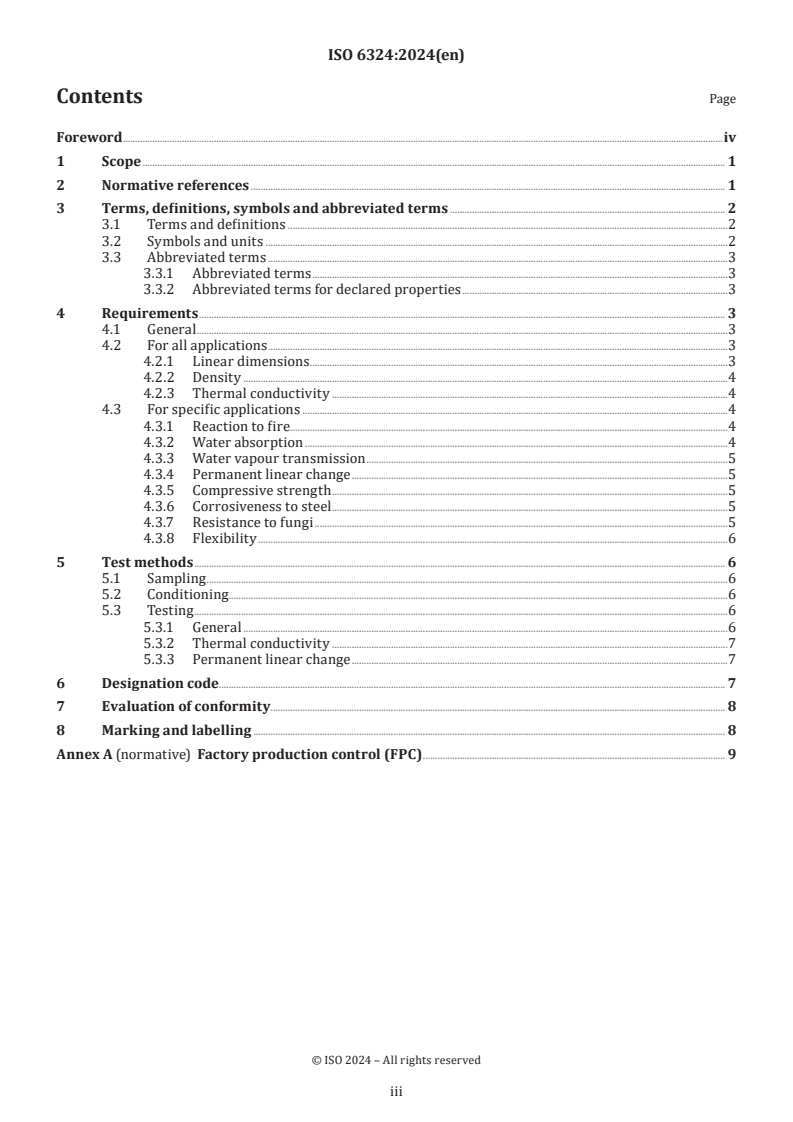
Contents Page
Foreword .iv
1 Scope . 1
2 Normative references . 1
3 Terms, definitions, symbols and abbreviated terms . 2
3.1 Terms and definitions .2
3.2 Symbols and units .2
3.3 Abbreviated terms .3
3.3.1 Abbreviated terms .3
3.3.2 Abbreviated terms for declared properties .3
4 Requirements . 3
4.1 General .3
4.2 For all applications .3
4.2.1 Linear dimensions . . .3
4.2.2 Density .4
4.2.3 Thermal conductivity .4
4.3 For specific applications .4
4.3.1 Reaction to fire.4
4.3.2 Water absorption .4
4.3.3 Water vapour transmission .5
4.3.4 Permanent linear change .5
4.3.5 Compressive strength .5
4.3.6 Corrosiveness to steel .5
4.3.7 Resistance to fungi .5
4.3.8 Flexibility .6
5 Test methods . 6
5.1 Sampling .6
5.2 Conditioning.6
5.3 Testing .6
5.3.1 General .6
5.3.2 Thermal conductivity .7
5.3.3 Permanent linear change .7
6 Designation code . . 7
7 Evaluation of conformity . . 8
8 Marking and labelling . 8
Annex A (normative) Factory production control (FPC) . 9
iii
Foreword
ISO (the International Organization for Standardization) is a worldwide federation of national standards
bodies (ISO member bodies). The work of preparing International Standards is normally carried out through
ISO technical committees. Each member body interested in a subject for which a technical committee
has been established has the right to be represented on that committee. International organizations,
governmental and non-governmental, in liaison with ISO, also take part in the work. ISO collaborates closely
with the International Electrotechnical Commission (IEC) on all matters of electrotechnical standardization.
The procedures used to develop this document and those intended for its further maintenance are described
in the ISO/IEC Directives, Part 1. In particular, the different approval criteria needed for the different types
of ISO document should be noted. This document was drafted in accordance with the editorial rules of the
ISO/IEC Directives, Part 2 (see www.iso.org/directives).
ISO draws attention to the possibility that the implementation of this document may involve the use of (a)
patent(s). ISO takes no position concerning the evidence, validity or applicability of any claimed patent
rights in respect thereof. As of the date of publication of this document, ISO had not received notice of (a)
patent(s) which may be required to implement this document. However, implementers are cautioned that
this may not represent the latest information, which may be obtained from the patent database available at
www.iso.org/patents. ISO shall not be held responsible for identifying any or all such patent rights.
Any trade name used in this document is information given for the convenience of users and does not
constitute an endorsement.
For an explanation of the voluntary nature of standards, the meaning of ISO specific terms and expressions
related to conformity assessment, as well as information about ISO's adherence to the World Trade
Organization (WTO) principles in the Technical Barriers to Trade (TBT), see www.iso.org/iso/foreword.html.
This document was prepared by Technical Committee ISO/TC 163, Thermal performance and energy use in
the built environment, Subcommittee SC 3, Thermal insulation products, components and systems.
Any feedback or questions on this document should be directed to the user’s national standards body. A
complete listing of these bodies can be found at www.iso.org/members.html.
iv
International Standard ISO 6324:2024(en)
Thermal insulation products — Flexible microporous
insulation for industrial applications — Specification
1 Scope
This document specifies the requirements for factory-made flexible microporous insulation (FMI), which
is used for the thermal insulation of industrial applications. It specifies requirements for insulation that
exhibits thermal insulating performance through nano-sized pore composite material comprising a blend of
inorganic powder, fibres and opacifiers. The products are delivered as a flexible microporous type.
This document describes product characteristics and includes procedures for testing, evaluation of
conformity, marking and labelling.
It does not specify the required level of a given property to be achieved by a product to demonstrate fitness
for purpose in a particular application. The levels required for a given application can be found in regulations
or non-conflicting standards.
2 Normative references
The following documents are referred to in the text in such a way that some or all of their content constitutes
requirements of this document. For dated references, only the edition cited applies. For undated references,
the latest edition of the referenced document (including any amendments) applies.
ISO 846:2019, Plastics — Evaluation of the action of microorganisms
ISO 1663, Rigid cellular plastics — Determination of water vapour transmission properties
ISO 8301, Thermal insulation — Determination of steady-state thermal resistance and related properties —
Heat flow meter apparatus
ISO 8302, Thermal insulation — Determination of steady-state thermal resistance and related properties —
Guarded hot plate apparatus
ISO 23993, Thermal insulation products for building equipment and industrial installations — Determination of
design thermal conductivity
ISO 12576-1, Thermal insulation — Insulating materials and products for buildings — Conformity control
systems — Part 1: Factory-made products
ISO 12624, Thermal insulating products for building equipment and industrial installations — Determination of
trace quantities of water-soluble chloride, fluoride, silicate, sodium ions and pH
ISO 13787, Thermal insulation products for building equipment and industrial installations — Determination of
declared thermal conductivity
ISO 16535, Thermal insulating products for building applications — Determination of long-term water
absorption by immersion
ISO 18097, Thermal insulating products for building equipment and industrial installations — Determination of
maximum service temperature
ISO 29465, Thermal insulating products for building applications — Determination of length and width
ISO 29466, Thermal insulating products for building applications — Determination of thickness
ISO 29469:2022, Thermal insulating products for building applications — Determination of compression
behaviour
ISO 29470, Thermal insulating products for building applications — Determination of the apparent density
ISO 29767, Thermal insulating products for building applications — Determination of short-term water
absorption by partial immersion
3 Terms, definitions, symbols and abbreviated terms
For the purposes of this document, the following terms and definitions apply.
ISO and IEC maintain terminology databases for use in standardization at the following addresses:
— ISO Online browsing platform: available at https:// www .iso .org/ obp
— IEC Electropedia: available at http:// www .electropedia .org/
3.1 Terms and definitions
3.1.1
inorganic powder
base ingredient of microporous thermal insulation (e.g. fumed silica) composed of SiO and fumed alumina
oxide
3.1.2
microporous
composite material that comes in the form of fibre reinforced inorganic powder (e.g. small particles of
dispersed silica), creating micro-pores
3.1.3
flexible microporous thermal insulation
type of microporous thermal insulation that is encased in incombustible fabric (e.g. glass fibre fa
...