

ISO 20498-2:2017
(Main)Traditional Chinese medicine — Computerized tongue image analysis system — Part 2: Light environment
General Information
- Abstract
ISO 20498-2:2017 specifies the light environment necessary for the functioning of a computerized tongue image analysis system (CTIS). ISO 20498-2:2017 does not include the electrical safety and biocompatibility of the lighting component.
- Status
- Published
- Publication Date
- 16-May-2017
- Technical Committee
- ISO/TC 249 - Traditional Chinese medicine
- Current Stage
- 9093 - International Standard confirmed
- Start Date
- 18-Nov-2022
- Completion Date
- 29-Aug-2026
Buy Documents

ISO 20498-2:2017 - Traditional Chinese medicine -- Computerized tongue image analysis system
ISO 20498-2:2017 - Traditional Chinese medicine — Computerized tongue image analysis system — Part 2: Light environment/17/2017
Overview
ISO 20498-2:2017 specifies the light environment required for a Computerized Tongue Image Analysis System (CTIS). The standard defines optical conditions on the effective surface area where a patient’s tongue is imaged - covering illuminance, colour temperature, colour rendering, illumination uniformity, irradiance and ultraviolet (UV) irradiance. It does not cover electrical safety or biocompatibility of lighting components.
Keywords: ISO 20498-2:2017, CTIS, computerized tongue image analysis system, light environment, illuminance, colour temperature, colour rendering index, irradiance, ultraviolet irradiance.
Key topics and technical requirements
- Illuminance: 500 lx to 13 000 lx across the effective surface area.
- Colour temperature (CCT): 3 000 K to 7 000 K to control visual appearance and sensor response.
- Colour rendering index (CRI): > 90 to ensure accurate colour reproduction for diagnostic analysis.
- Illumination distribution (uniformity): ratio of minimum to maximum illuminance on the effective area must be > 0.9 (high uniformity).
- Irradiance (300–2 500 nm): total irradiance shall not exceed 350 W·m–2 (thermal/retinal/skin risk control).
- Effective UV irradiance (200–400 nm): shall not exceed 0.008 W·m–2 using the spectral weighting function in Annex A (actinic hazard assessment).
- Test methods: specifies a measuring grid (partial surfaces with centres ≤3 cm apart) and measurement procedures: illuminance meter for lux, spectroradiometer/sensor for spectral irradiance and UV, CRI measurement per CIE 013.3-1995. Sensor for irradiance measurements should have diameter ≤ 3 cm; measure at the point of maximum illuminance.
Applications and practical value
- Ensures consistent, repeatable imaging conditions for automated tongue diagnosis in Traditional Chinese Medicine (TCM) and related clinical workflows.
- Guides selection and validation of lighting systems for CTIS devices - important for manufacturers, system integrators and test labs.
- Protects patient safety by limiting thermal and photobiological exposure (irradiance and UV limits).
- Improves diagnostic reliability by enforcing high CRI and strict uniformity, reducing colour and shading artifacts that can skew image analysis algorithms.
- Useful for clinical deployment, device certification, quality assurance, and imaging protocol development.
Who should use this standard
- CTIS and medical imaging device manufacturers
- Clinical engineers, quality managers and regulatory/compliance teams
- Test laboratories and certification bodies
- Researchers developing tongue image analysis algorithms and imaging protocols
- TCM clinics adopting digital diagnostic tools
Related standards
- CIE 013.3-1995 (colour rendering measurement methods)
- IEC 62471:2006 (photobiological safety - referenced for UV weighting)
- Other parts of the ISO 20498 series (see ISO website for the full list)
Buy Documents
ISO 20498-2:2017 - Traditional Chinese medicine -- Computerized tongue image analysis system
ISO 20498-2:2017 - Traditional Chinese medicine — Computerized tongue image analysis system — Part 2: Light environment/17/2017
Get Certified
Connect with accredited certification bodies for this standard

BSI Group
BSI (British Standards Institution) is the business standards company that helps organizations make excellence a habit.

TÜV Rheinland
TÜV Rheinland is a leading international provider of technical services.

TÜV SÜD
TÜV SÜD is a trusted partner of choice for safety, security and sustainability solutions.
Sponsored listings
Frequently Asked Questions
ISO 20498-2:2017 is a standard published by the International Organization for Standardization (ISO). Its full title is "Traditional Chinese medicine — Computerized tongue image analysis system — Part 2: Light environment". This standard covers: ISO 20498-2:2017 specifies the light environment necessary for the functioning of a computerized tongue image analysis system (CTIS). ISO 20498-2:2017 does not include the electrical safety and biocompatibility of the lighting component.
ISO 20498-2:2017 specifies the light environment necessary for the functioning of a computerized tongue image analysis system (CTIS). ISO 20498-2:2017 does not include the electrical safety and biocompatibility of the lighting component.
ISO 20498-2:2017 is classified under the following ICS (International Classification for Standards) categories: 11.040.99 - Other medical equipment. The ICS classification helps identify the subject area and facilitates finding related standards.
ISO 20498-2:2017 is available in PDF format for immediate download after purchase. The document can be added to your cart and obtained through the secure checkout process. Digital delivery ensures instant access to the complete standard document.
Standards Content (Sample)
INTERNATIONAL ISO
STANDARD 20498-2
First edition
2017-05
Traditional Chinese medicine —
Computerized tongue image analysis
system —
Part 2:
Light environment
Médecine traditionnelle chinoise — Système d’analyse d’images
numérisées de la langue —
Partie 2: Environnement lumineux
Reference number
©
ISO 2017
© ISO 2017, Published in Switzerland
All rights reserved. Unless otherwise specified, no part of this publication may be reproduced or utilized otherwise in any form
or by any means, electronic or mechanical, including photocopying, or posting on the internet or an intranet, without prior
written permission. Permission can be requested from either ISO at the address below or ISO’s member body in the country of
the requester.
ISO copyright office
Ch. de Blandonnet 8 • CP 401
CH-1214 Vernier, Geneva, Switzerland
Tel. +41 22 749 01 11
Fax +41 22 749 09 47
copyright@iso.org
www.iso.org
ii © ISO 2017 – All rights reserved
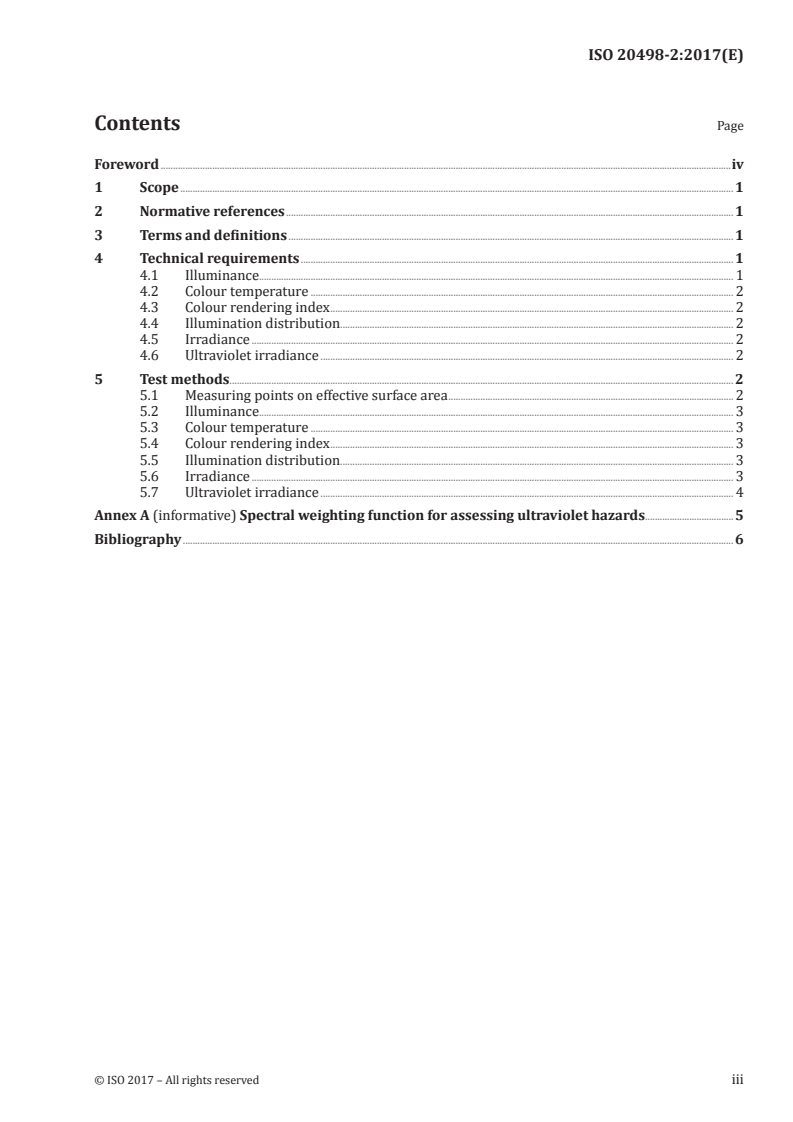
Contents Page
Foreword .iv
1 Scope . 1
2 Normative references . 1
3 Terms and definitions . 1
4 Technical requirements . 1
4.1 Illuminance. 1
4.2 Colour temperature . 2
4.3 Colour rendering index . 2
4.4 Illumination distribution. 2
4.5 Irradiance . 2
4.6 Ultraviolet irradiance . 2
5 Test methods . 2
5.1 Measuring points on effective surface area . 2
5.2 Illuminance. 3
5.3 Colour temperature . 3
5.4 Colour rendering index . 3
5.5 Illumination distribution. 3
5.6 Irradiance . 3
5.7 Ultraviolet irradiance . 4
Annex A (informative) Spectral weighting function for assessing ultraviolet hazards .5
Bibliography . 6
Foreword
ISO (the International Organization for Standardization) is a worldwide federation of national standards
bodies (ISO member bodies). The work of preparing International Standards is normally carried out
through ISO technical committees. Each member body interested in a subject for which a technical
committee has been established has the right to be represented on that committee. International
organizations, governmental and non-governmental, in liaison with ISO, also take part in the work.
ISO collaborates closely with the International Electrotechnical Commission (IEC) on all matters of
electrotechnical standardization.
The procedures used to develop this document and those intended for its further maintenance are
described in the ISO/IEC Directives, Part 1. In particular the different approval criteria needed for the
different types of ISO documents should be noted. This document was drafted in accordance with the
editorial rules of the ISO/IEC Directives, Part 2 (see www .iso .org/ directives).
Attention is drawn to the possibility that some of the elements of this document may be the subject of
patent rights. ISO shall not be held responsible for identifying any or all such patent rights. Details of
any patent rights identified during the development of the document will be in the Introduction and/or
on the ISO list of patent declarations received (see www .iso .org/ patents).
...
INTERNATIONAL ISO
STANDARD 20498-2
First edition
2017-05
Traditional Chinese medicine —
Computerized tongue image analysis
system —
Part 2:
Light environment
Médecine traditionnelle chinoise — Système d’analyse d’images
numérisées de la langue —
Partie 2: Environnement lumineux
Reference number
©
ISO 2017
© ISO 2017, Published in Switzerland
All rights reserved. Unless otherwise specified, no part of this publication may be reproduced or utilized otherwise in any form
or by any means, electronic or mechanical, including photocopying, or posting on the internet or an intranet, without prior
written permission. Permission can be requested from either ISO at the address below or ISO’s member body in the country of
the requester.
ISO copyright office
Ch. de Blandonnet 8 • CP 401
CH-1214 Vernier, Geneva, Switzerland
Tel. +41 22 749 01 11
Fax +41 22 749 09 47
copyright@iso.org
www.iso.org
ii © ISO 2017 – All rights reserved
Contents Page
Foreword .iv
1 Scope . 1
2 Normative references . 1
3 Terms and definitions . 1
4 Technical requirements . 1
4.1 Illuminance. 1
4.2 Colour temperature . 2
4.3 Colour rendering index . 2
4.4 Illumination distribution. 2
4.5 Irradiance . 2
4.6 Ultraviolet irradiance . 2
5 Test methods . 2
5.1 Measuring points on effective surface area . 2
5.2 Illuminance. 3
5.3 Colour temperature . 3
5.4 Colour rendering index . 3
5.5 Illumination distribution. 3
5.6 Irradiance . 3
5.7 Ultraviolet irradiance . 4
Annex A (informative) Spectral weighting function for assessing ultraviolet hazards .5
Bibliography . 6
Foreword
ISO (the International Organization for Standardization) is a worldwide federation of national standards
bodies (ISO member bodies). The work of preparing International Standards is normally carried out
through ISO technical committees. Each member body interested in a subject for which a technical
committee has been established has the right to be represented on that committee. International
organizations, governmental and non-governmental, in liaison with ISO, also take part in the work.
ISO collaborates closely with the International Electrotechnical Commission (IEC) on all matters of
electrotechnical standardization.
The procedures used to develop this document and those intended for its further maintenance are
described in the ISO/IEC Directives, Part 1. In particular the different approval criteria needed for the
different types of ISO documents should be noted. This document was drafted in accordance with the
editorial rules of the ISO/IEC Directives, Part 2 (see www .iso .org/ directives).
Attention is drawn to the possibility that some of the elements of this document may be the subject of
patent rights. ISO shall not be held responsible for identifying any or all such patent rights. Details of
any patent rights identified during the development of the document will be in the Introduction and/or
on the ISO list of patent declarations received (see www .iso .org/ patents).
...