

ISO 15638-5:2013
(Main)Intelligent transport systems — Framework for collaborative Telematics Applications for Regulated commercial freight Vehicles (TARV) — Part 5: Generic vehicle information
General Information
- Abstract
ISO 15638-5:2013 defines generic basic vehicle and core application data provision to application service providers to be supported by in-vehicle systems (IVS) for cooperative telematics applications for regulated commercial freight vehicles (TARV), and to provide basic vehicle data for cooperative intelligent transport systems. ISO 15638-5:2013 provides the specifications for generic basic vehicle data that it is required for all TARV IVSs to support and make available to application service providers via a wireless communications link supported by the IVS, in order to support the provision of regulated and commercial application services. Some further data concepts, while not required in all cases for every TARV in every jurisdiction, may be required generically for all equipment within a particular jurisdiction, or class of TARV within a jurisdiction, in order for the jurisdiction to achieve its regulation of TARVs. Equipped vehicles operating internationally will need to carry all of the additional data concepts required by all of the jurisdictions within which they operate, in order to determine their core application data. ISO 15638-5:2013 provides standard definitions for these commonly expected additional data concepts. A second set of (largely complementary) 'basic vehicle' data is required to support interoperable cooperative intelligent transport systems and this is also determined and provided within ISO 15638-5:2013. The framework architecture and many of the protocols are common between both (TARV and C-ITS) sets of requirements, and also with those being adopted by the wider cooperative ITS sector.
- Status
- Published
- Publication Date
- 02-Jun-2013
- Technical Committee
- ISO/TC 204 - Intelligent transport systems
- Drafting Committee
- ISO/TC 204/WG 7 - General fleet management and commercial/freight
- Current Stage
- 9060 - Close of review
- Completion Date
- 04-Mar-2029
Overview
ISO 15638-5:2013 - "Intelligent transport systems - Framework for collaborative Telematics Applications for Regulated commercial freight Vehicles (TARV) - Part 5: Generic vehicle information" defines the generic vehicle and core application data that in-vehicle systems (IVS) must provide to application service providers for regulated commercial freight vehicles. The standard specifies how basic vehicle data are organized, named and made available over a wireless communications link to support regulated services and cooperative intelligent transport systems (C-ITS). It also standardizes commonly expected additional data concepts so vehicles operating across jurisdictions can meet differing regulatory data requirements.
Key topics and technical requirements
- Generic vehicle data model: standardized items such as vehicle unique identifier, VIN, vehicle class, propulsion/storage type, timestamps (UTC), location, direction of travel, speed, ignition status, driver and trailer identification, and load data.
- Core application data and Local Data Trees (LDTs): definitions for TARV LDT and C-ITS LDT, naming of apps, recent data archives, and session control.
- Communications and protocols: requirements for IVS to serve data via wireless links; test scripts reference cellular (2G/3G), 5.9 GHz (802.11p/WAVE) and mesh Wi‑Fi for LDT and core data exchanges.
- Security and system requirements: TARV–ROAM security, host management centre (HMC) requirements and facilities-layer expectations to ensure trusted data exchange.
- Commands and services: GET/CREATE commands for TARV/C-ITS LDTs, retrieving core application data and archive access.
- Testing and conformance: defined test scripts and procedures for independent protocol verification, plus marking/registration provisions (see Annex A referencing ISO 14816).
Practical applications
- Fleet operators: standardized telemetry for compliance reporting, cross-border operations and regulatory adherence.
- Telematics/IVS vendors: implementation guidance for exposing vehicle data to third‑party application service providers.
- Regulators and enforcement agencies: specifying required data elements and interoperability rules for regulated freight vehicles.
- C-ITS integrators and ITS service providers: support for cooperative services that rely on consistent vehicle information across platforms.
Who should use this standard
- Automotive OEMs and IVS manufacturers
- Telematics platform and application developers
- Fleet managers and logistics providers
- Transportation authorities and policy makers
- ITS system integrators and testing houses
Related standards
- Other parts of the ISO 15638 TARV framework (the wider family covers architecture and interfaces)
- ISO 14816 (referenced in Annex A for registration provisions)
- Standards from ISO/TC 204 and C‑ITS specifications (for harmonized cooperative ITS protocols)
ISO 15638-5:2013 is essential for organizations implementing interoperable telematics for regulated commercial freight vehicles, ensuring consistent, secure, and testable vehicle data provision for regulatory and cooperative transport applications.
Get Certified
Connect with accredited certification bodies for this standard

BSI Group
BSI (British Standards Institution) is the business standards company that helps organizations make excellence a habit.

Great Wall Tianjin Quality Assurance Center
Established 1993, first batch to receive national accreditation with IAF recognition.
Hong Kong Quality Assurance Agency (HKQAA)
Hong Kong's leading certification body.
Sponsored listings
Frequently Asked Questions
ISO 15638-5:2013 is a standard published by the International Organization for Standardization (ISO). Its full title is "Intelligent transport systems — Framework for collaborative Telematics Applications for Regulated commercial freight Vehicles (TARV) — Part 5: Generic vehicle information". This standard covers: ISO 15638-5:2013 defines generic basic vehicle and core application data provision to application service providers to be supported by in-vehicle systems (IVS) for cooperative telematics applications for regulated commercial freight vehicles (TARV), and to provide basic vehicle data for cooperative intelligent transport systems. ISO 15638-5:2013 provides the specifications for generic basic vehicle data that it is required for all TARV IVSs to support and make available to application service providers via a wireless communications link supported by the IVS, in order to support the provision of regulated and commercial application services. Some further data concepts, while not required in all cases for every TARV in every jurisdiction, may be required generically for all equipment within a particular jurisdiction, or class of TARV within a jurisdiction, in order for the jurisdiction to achieve its regulation of TARVs. Equipped vehicles operating internationally will need to carry all of the additional data concepts required by all of the jurisdictions within which they operate, in order to determine their core application data. ISO 15638-5:2013 provides standard definitions for these commonly expected additional data concepts. A second set of (largely complementary) 'basic vehicle' data is required to support interoperable cooperative intelligent transport systems and this is also determined and provided within ISO 15638-5:2013. The framework architecture and many of the protocols are common between both (TARV and C-ITS) sets of requirements, and also with those being adopted by the wider cooperative ITS sector.
ISO 15638-5:2013 defines generic basic vehicle and core application data provision to application service providers to be supported by in-vehicle systems (IVS) for cooperative telematics applications for regulated commercial freight vehicles (TARV), and to provide basic vehicle data for cooperative intelligent transport systems. ISO 15638-5:2013 provides the specifications for generic basic vehicle data that it is required for all TARV IVSs to support and make available to application service providers via a wireless communications link supported by the IVS, in order to support the provision of regulated and commercial application services. Some further data concepts, while not required in all cases for every TARV in every jurisdiction, may be required generically for all equipment within a particular jurisdiction, or class of TARV within a jurisdiction, in order for the jurisdiction to achieve its regulation of TARVs. Equipped vehicles operating internationally will need to carry all of the additional data concepts required by all of the jurisdictions within which they operate, in order to determine their core application data. ISO 15638-5:2013 provides standard definitions for these commonly expected additional data concepts. A second set of (largely complementary) 'basic vehicle' data is required to support interoperable cooperative intelligent transport systems and this is also determined and provided within ISO 15638-5:2013. The framework architecture and many of the protocols are common between both (TARV and C-ITS) sets of requirements, and also with those being adopted by the wider cooperative ITS sector.
ISO 15638-5:2013 is classified under the following ICS (International Classification for Standards) categories: 03.220.20 - Road transport; 35.240.60 - IT applications in transport. The ICS classification helps identify the subject area and facilitates finding related standards.
ISO 15638-5:2013 is available in PDF format for immediate download after purchase. The document can be added to your cart and obtained through the secure checkout process. Digital delivery ensures instant access to the complete standard document.
Standards Content (Sample)
INTERNATIONAL ISO
STANDARD 15638-5
First edition
2013-06-15
Intelligent transport systems —
Framework for collaborative Telematics
Applications for Regulated commercial
freight Vehicles (TARV) —
Part 5:
Generic vehicle information
Systèmes intelligents de transport — Cadre pour applications
télématiques collaboratives pour véhicules de fret commercial
réglementé (TARV) —
Partie 5: Informations génériques sur le véhicule
Reference number
©
ISO 2013
© ISO 2013
All rights reserved. Unless otherwise specified, no part of this publication may be reproduced or utilized otherwise in any form or by any
means, electronic or mechanical, including photocopying, or posting on the internet or an intranet, without prior written permission.
Permission can be requested from either ISO at the address below or ISO’s member body in the country of the requester.
ISO copyright office
Case postale 56 CH-1211 Geneva 20
Tel. + 41 22 749 01 11
Fax + 41 22 749 09 47
E-mail copyright@iso.org
Web www.iso.org
Published in Switzerland
ii © ISO 2013 – All rights reserved
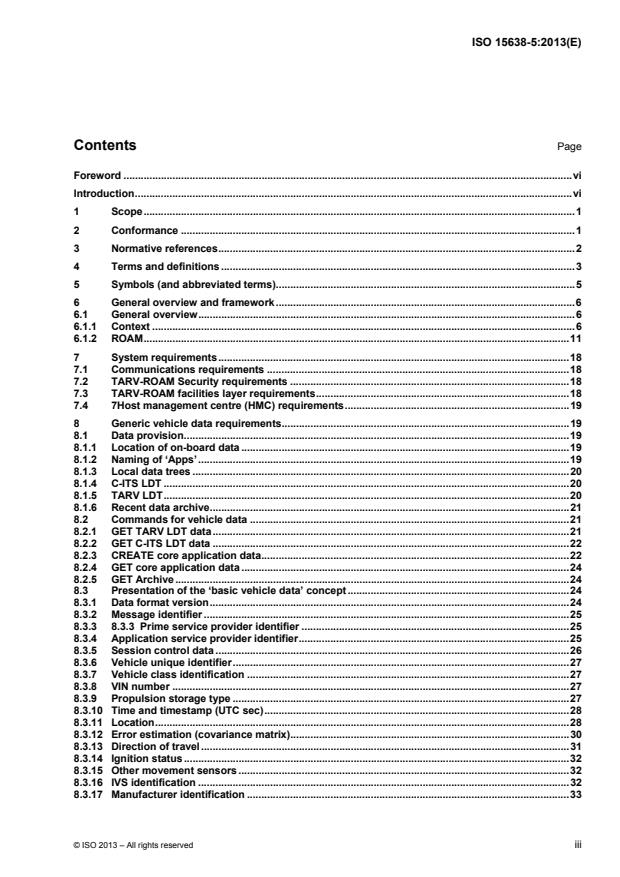
Contents Page
Foreword . vi
Introduction . vi
1 Scope . 1
2 Conformance . 1
3 Normative references . 2
4 Terms and definitions . 3
5 Symbols (and abbreviated terms) . 5
6 General overview and framework . 6
6.1 General overview . 6
6.1.1 Context . 6
6.1.2 ROAM . 11
7 System requirements . 18
7.1 Communications requirements . 18
7.2 TARV-ROAM Security requirements . 18
7.3 TARV-ROAM facilities layer requirements . 18
7.4 7Host management centre (HMC) requirements . 19
8 Generic vehicle data requirements . 19
8.1 Data provision . 19
8.1.1 Location of on-board data . 19
8.1.2 Naming of ‘Apps’ . 19
8.1.3 Local data trees . 20
8.1.4 C-ITS LDT . 20
8.1.5 TARV LDT . 20
8.1.6 Recent data archive . 21
8.2 Commands for vehicle data . 21
8.2.1 GET TARV LDT data . 21
8.2.2 GET C-ITS LDT data . 22
8.2.3 CREATE core application data . 22
8.2.4 GET core application data . 24
8.2.5 GET Archive . 24
8.3 Presentation of the ‘basic vehicle data’ concept . 24
8.3.1 Data format version . 24
8.3.2 Message identifier . 25
8.3.3 8.3.3 Prime service provider identifier . 25
8.3.4 Application service provider identifier . 25
8.3.5 Session control data . 26
8.3.6 Vehicle unique identifier . 27
8.3.7 Vehicle class identification . 27
8.3.8 VIN number . 27
8.3.9 Propulsion storage type . 27
8.3.10 Time and timestamp (UTC sec) . 28
8.3.11 Location . 28
8.3.12 Error estimation (covariance matrix) . 30
8.3.13 Direction of travel . 31
8.3.14 Ignition status . 32
8.3.15 Other movement sensors . 32
8.3.16 IVS identification . 32
8.3.17 Manufacturer identification . 33
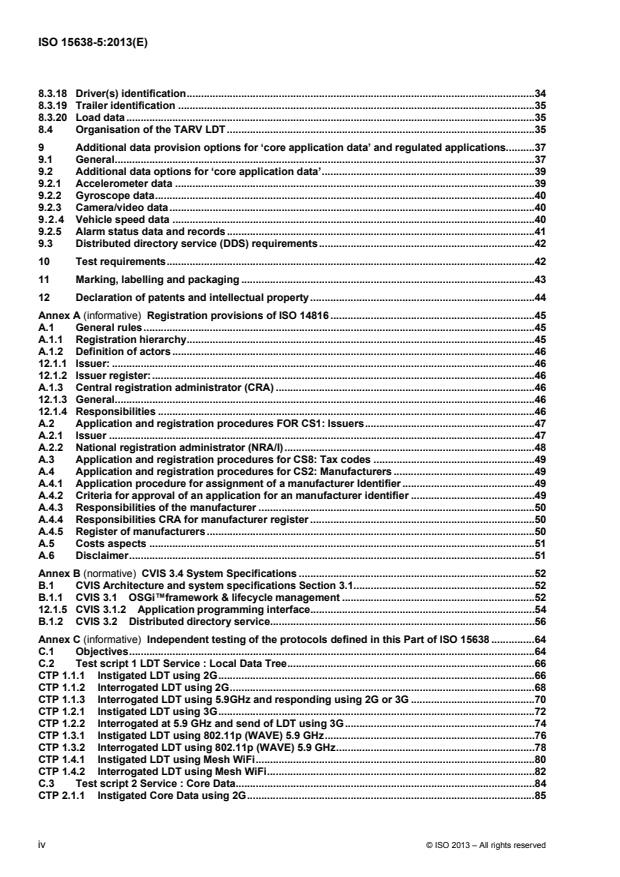
8.3.18 Driver(s) identification .34
8.3.19 Trailer identification .35
8.3.20 Load data .35
8.4 Organisation of the TARV LDT .35
9 Additional data provision options for ‘core application data’ and regulated applications .37
9.1 General .37
9.2 Additional data options for ‘core application data’ .39
9.2.1 Accelerometer data .39
9.2.2 Gyroscope data .40
9.2.3 Camera/video data .40
9.2.4 Vehicle speed data .40
9.2.5 Alarm status data and records .41
9.3 Distributed directory service (DDS) requirements .42
10 Test requirements .42
11 Marking, labelling and packaging .43
12 Declaration of patents and intellectual property .44
Annex A (informative) Registration provisions of ISO 14816 .45
A.1 General rules .45
A.1.1 Registration hierarchy .45
A.1.2 Definition of actors .46
12.1.1 Issuer: .46
12.1.2 Issuer register: .46
A.1.3 Central registration administrator (CRA) .46
12.1.3 General .46
12.1.4 Responsibilities .46
A.2 Application and registration procedures FOR CS1: Issuers .47
A.2.1 Issuer .47
A.2.2 National registration administrator (NRA/I) .48
A.3 Application and registration procedures for CS8: Tax codes .49
A.4 Application and registration procedures for CS2: Manufacturers .49
A.4.1 Application procedure for assignment of a manufacturer Identifier .49
A.4.2 Criteria for approval of an application for an manufacturer identifier .49
A.4.3 Responsibilities of the manufacturer .50
A.4.4 Responsibilities CRA for manufacturer register .50
A.4.5 Register of manufacturers .50
A.5 Costs aspects .51
A.6 Disclaimer .51
Annex B (normative) CVIS 3.4 System Specifications .52
B.1 CVIS Architecture and system specifications Section 3.1 .52
B.1.1 CVIS 3.1 OSGi™framework & lifecycle management .52
12.1.5 CVIS 3.1.2 Application programming interface.54
B.1.2 CVIS 3.2 Distributed directory service .56
Annex C (informative) Independent testing of the protocols defined in this Part of ISO 15638 .64
C.1 Objectives .64
C.2 Test script 1 LDT Service : Local Data Tree .66
CTP 1.1.1 Instigated LDT using 2G .66
CTP 1.1.2 Interrogated LDT using 2G .68
CTP 1.1.3 Interrogated LDT using 5.9GHz and responding using 2G or 3G .70
CTP 1.2.1 Instigated LDT using 3G .72
CTP 1.2.2 Interrogated at 5.9 GHz and send of LDT using 3G .74
CTP 1.3.1 Instigated LDT using 802.11p (WAVE) 5.9 GHz .76
CTP 1.3.2 Interrogated LDT using 802.11p (WAVE) 5.9 GHz .78
CTP 1.4.1 Instigated LDT using Mesh WiFi .80
CTP 1.4.2 Interrogated LDT using Mesh WiFi .82
C.3 Test script 2 Service : Core Data .84
CTP 2.1.1 Instigated Core Data using 2G .85
iv © ISO 2013 – All rights reserved
CTP 2.1.2 Interrogated Core Data using 2G . 87
CTP 2.1.3 Interrogated Core Data using 5.9GHz and responding using 2G or 3G . 89
CTP 2.2.1 Instigated Core Data using 3G . 91
CTP 2.2.2 Interrogated at 5.9 GHz and send of Core Data using 3G . 93
CTP 2.3.1 Instigated Core Data using 802.11p (WAVE) 5.9 GHz . 95
CTP 2.3.2 Interrogated Core Data using 802.11p (WAVE) 5.9 GHz . 97
CTP 2.4.1 Instigated Core Data using Mesh WiFi . 99
CTP 2.4.2 Interrogated Core Data using Mesh WiFi . 101
Bibliography . 103
Foreword
ISO (the International Organization for Standardization) is a worldwide federation of national standards bodies
(ISO member bodies). The work of preparing International Standards is normally carried out through ISO
technical committees. Each member body interested in a subject for which a technical committee has been
established has the right to be represented on that committee. International organizations, governmental and
non-governmental, in liaison with ISO, also take part in the work. ISO collaborates closely with the
International Electrotechnical Commission (IEC) on all matters of electrotechnical standardization.
The procedures used to develop this document and those intended for its further maintenance are described
in the ISO/IEC Directives, Part 1. In particular the different approval criteria needed for the different types of
ISO documents should be noted. This document was drafted in accordance with the editorial rules of the
ISO/IEC Directives, Part 2. www.iso.org/directives
Attention is drawn to the possibility that some of the elements of this document may be the subject of patent
rights. ISO shall not be held responsible for identifying any or all such patent rights. Details of any patent
rights identified during the development of the document will be in the Introduction and/or on the ISO list of
patent declarations received. www.iso.org/patents
Any trade name used in this document is information given for the convenience of users and does not
constitute an endorsement.
The committee responsible for this document is ISO/TC 204, Intelligent transport systems
ISO 15638 consists of the following parts, under the general title Intelligent transport systems — Framework
for collaborative Telematics Applications for Regulated commercial freight Vehicles (TARV):
— Part 1 Framework and architecture
— Part 2: Common platform parameters using CALM
— Part 3: Operating requirements, 'Approval Authority' procedures, and enforcement provisions for the
providers of regulated services
— Part 5:Generic vehicle information
— Part 6: Regulated applications [Technical Specification]
— Part 7: Other applications
— Part 8: Vehicle access monitoring (VAM) [Technical Specification]
— Part 9: Remote electronic tachograph monitoring (RTM) [Technical Specification]
— Part 10: Emergency messaging system/eCall (EMS) [Technical Specification]
— Part 11: Driver work records (work and rest hours compliance) (DWR) [Technical Specification]
— Part 12: Vehicle mass monitoring (VMM) [Technical Specification]
— Part 14: Vehicle access control (VAC) [Technical Specification]
— Part 15: Vehicle location monitoring (VLM) [Technical Specification]
— Part 16: Vehicle speed monitoring (VSM) [Technical Specification]
vi © ISO 2013 – All rights reserved
— Part 17: Consignment and location monitoring (CLM) [Technical Specification]
— Part 18: ADR (Dangerous Goods) transport monitoring (ADR) [Technical Specification]
— Part 19: Vehicle parking facilities (VPF) [Technical Specification]
The following parts are under preparation:
— Part 4: System security requirements [Technical Specification]
— Part 13: Mass Penalties and Levies (VMC)
Introduction
Many ITS technologies have been embraced by commercial transport operators and freight owners, in the
areas of fleet management, safety and security. Telematics applications have also been developed for
governmental use. While the regulatory services in use or being considered varies from country to country,
these include services such as charging, digital tachograph, hazardous goods tracking and e-call. Additional
applications with a regulatory impact being developed include access monitoring, on-board mass monitoring,
fatigue management, speed monitoring and heavy vehicle charging based on mass, location, distance and
time.
In such an emerging environment of regulatory and commercial applications, it is timely to consider an overall
architecture (business and functional) that could support these functions from a single platform within a
commercial vehicle that operate within such regulations. Such International Standards will allow for a speedy
development and specification of new applications that build upon the functionality of a generic specification
platform. This suite of standards deliverables describes and defines the framework and requirements so that
the in-vehicle system [4.7] can be commercially designed in an open market to meet common requirements.
This suite of standards deliverables will provide the basis for future development of cooperative telematics
applications for regulated commercial freight vehicles [4.14]. Many elements to accomplish this are already
available. Existing relevant standards will be referenced, and the specifications will use existing standards
(such as CALM) wherever practicable.
This suite of standards deliverables will also allow for a powerful platform for highly cost-effective delivery of a
range of telematics applications for regulated commercial freight vehicles [4.14].
Finally, a business architecture based on a (multiple) service provider [4.15] oriented approach will also require
consideration of legal and regulatory aspects for the approval authority [4.3] approval and auditing of service
providers [4.7].
This suite of standards deliverables is timely as many governments (Europe, North America, Asia and
Australia/New Zealand) are considering the use of telematics for a range of regulatory purposes. Ensuring that
a single in-vehicle platform can deliver a range of services to both government and industry through open
standards and competitive markets is a strategic objective.
This suite of standards deliverables addresses and defines the framework for a range of cooperative
telematics applications for regulated commercial freight vehicles [4.14] (such as access monitoring, driver
fatigue management, speed monitoring, on-board mass monitoring and charging). The overall scope includes
the concept of operation, legal and regulatory issues, and the generic cooperative ITS service platform. The
framework will be based on a (multiple) service provider [4.15] oriented approach provisions for the approval
authority [4.3] approval and auditing of service providers.
This part of the ISO 15638 family of standards deliverables provides specifications for generic basic vehicle
data [4.4] that it is required for all IVSs to support and make available to application service providers [4.15]
using the IVS wireless communications link(s), in order to support the provision of regulated and commercial
application services for TARVs; and provides basic vehicle data for cooperative intelligent transport systems.
NOTE The definition of what comprises a ‘regulated’ vehicle is regarded as an issue for national decision, and may
vary from country to country. This suite of standards deliverables does not impose any requirements on nations in respect
of how they define a regulated vehicle.
NOTE The definition of what comprises a ‘regulated’ service is regarded as an issue for national decision, and may
vary from country to country. This suite of standards deliverables does not impose any requirements on nations in respect
of which services for regulated vehicles countries will require, or support as an option, but will provide standardised sets of
requirements descriptions for identified services to enable consistent and cost efficient implementations where
implemented.
viii © ISO 2013 – All rights reserved
NOTE Cooperative ITS applications, in this context, are defined as the use of an in-vehicle ITS platform to meet both
commercial and regulatory needs from a (functionally) single on-board platform.
INTERNATIONAL STANDARD ISO 15638-5:2013(E)
Intelligent transport systems — Framework for collaborative
Telematics Applications for Regulated commercial freight
Vehicles (TARV) —
Part 5:
Generic vehicle information
1 Scope
This part of ISO 15638 defines generic basic vehicle and core application data [4.5] provision to application
service providers [4.15] to be supported by in-vehicle system [4.7] (IVS) for cooperative telematics applications
for regulated commercial freight vehicles [4.14] (TARV), and to provide basic vehicle data [4.4] for cooperative
intelligent transport systems.
This part of ISO 15638 provides the specifications for generic basic vehicle data [4.4] that it is required for all
TARV IVSs to support and make available to application service providers [4.15] via a wireless communications
link supported by the IVS, in order to support the provision of regulated and commercial application services.
Some further data concepts, while not required in all cases for every TARV in every jurisdiction [4.9], may be
required generically for all equipment within a particular jurisdiction [4.9], or class of TARV within a jurisdiction
[4.9], in order for the jurisdiction to achieve its regulation of TARVs.
Equipped vehicles operating internationally will need to carry all of the additional data concepts required by all
of the jurisdictions [4.9] within which they operate, in order to determine their core application data [4.5]. This
part of ISO 15638 provides standard definitions for these commonly expected additional data concepts.
A second set of (largely complementary) ‘basic vehicle’ data is required to support interoperable cooperative
intelligent transport systems and this is also determined and provided within this part of ISO 15638. The
framework architecture and many of the protocols are common between both (TARV and C-ITS) sets of
requirements, and also with those being adopted by the wider cooperative ITS sector.
2 Conformance
This part of ISO 15638 defines specifications for generic basic vehicle data [4.4] that it is required for all IVSs
to support and make available to application service providers [4.15] using the IVS wireless communications
link(s), in order to support the provision of regulated and commercial application services for TARVs; and
provides basic vehicle data for cooperative intelligent transport systems., and has no specific conformance
tests defined herein, however Clause 10 specifies which tests may be required. Some aspects defined within
may have conformance tests defined in other parts of ISO 15638.
Conformance to any other International Standard or specification referenced in this part of ISO 15638 shall be
ascertained according to the requirements of the referenced deliverable.
Conformance to this part of ISO 15638 is therefore a matter of self-declaration of compliance, or by
submission to a test house to ascertain that the provisions of the clauses of this part of ISO 15638 have been
adhered to.
The protocols defined in this part of ISO 15638 have been independently tested. Annex C (Informative)
provides results of these tests. In any conformance assurance process undertaken by candidate systems,
where appropriate the results may be used as part of its process of conformance compliance.
3 Normative references
The following referenced documents, in whole or in part, are normatively referenced in this document and are
indispensable for its application. For dated references, only the edition cited applies. For undated references,
the latest edition of the referenced document (including any amendments) applies.
ISO 3166-1 Codes for the representation of names of countries and their subdivisions — Part 1:
Country codes
ISO 3166-2 Codes for the representation of names of countries and their subdivisions — Part 2:
Country subdivision codes
ISO 3779 Road vehicles — Vehicle identification number (VIN) -- Content and structure
ISO/IEC 8824-1 Information processing systems — Open Systems Interconnection —Specification of
abstract syntax notation one (ASN.1) — Part 1: Specification of the Basic Notation
ISO/IEC 8824-2 Information processing systems — Open Systems Interconnection — Specification of
abstract syntax notation one (ASN.1) — Part 2: Information Object Specification
ISO/IEC 8824-3 Information processing systems — Open Systems Interconnection — Specification of
abstract syntax notation one (ASN.1) — Part 3:Constraint Specification
ISO/IEC 8824-4 Information processing systems — Open Systems Interconnection — Specification of
abstract syntax notation one (ASN.1) — Part 4:Parameterisation of the ASN.1
Specifications
ISO/IEC 8825-2 Information technology — ASN.1 encoding rules: Specification of Packed Encoding
Rules (PER)
ISO 10918-1 Information technology — Digital compression and coding of continuous-tone still
images: Requirements and guidelines).
ISO 13183 Intelligent transport systems — Communications access for land mobiles (CALM) —
Broadcast communications
ISO 14816 Road transport and traffic telematics — Automatic vehicle and equipment identification
— Numbering and data structure
ISO 15638-1 Intelligent transport systems — Framework for cooperative telematics applications for
regulated commercial freight vehicles (TARV) — Part 1: Framework and architecture
ISO 15638 -2 Intelligent transport systems — Framework for cooperative telematics applications for
regulated commercial freight vehicles (TARV) — Common platform parameters using
CALM
ISO 15638 -3 Framework for cooperative telematics applications for regulated commercial freight
vehicles TARV — Operating requirements, ‘Approval authority’ procedures, and
enforcement provisions for the providers of regulated services
ISO 15638 -4 Intelligent transport systems — Framework for cooperative telematics applications for
regulated commercial freight vehicles (TARV) — System security requirements
ISO 17262 Intelligent transport systems — Automatic vehicle and equipment identification —
Numbering and data structures
ISO 21210 Intelligent transport systems — Communications access for land mobiles — IPv6
Networking
2 © ISO 2013 – All rights reserved
ISO 21212 Intelligent transport systems — Communications access for land mobiles (CALM) — 2G
Cellular systems
ISO 21213 (CALM) — 3G Cellular systems
ISO 21214 Intelligent transport systems — Communications access for land mobiles (CALM) —
Infra-red systems
ISO 21215 Intelligent transport systems — Communications access for land mobiles (CALM) -- M5
ISO 21216 Intelligent transport systems — Wireless communications — CALM using millimetre
communications — Air interface
ISO 21217 Intelligent transport systems — Communications access for land mobiles (CALM) —
Architecture
ISO 21218 Intelligent transport systems — Communications access for land mobiles (CALM) —
Medium service access points
ISO 25111 Intelligent transport systems — Communications access for land mobiles (CALM) —
General requirements for using public networks
ISO 25112 Intelligent transport systems — Communications access for land mobiles (CALM) —
Mobile wireless broadband using IEEE 802.16
ISO 25113 (CALM) — Mobile wireless broadband using HC-SDMA
ISO TS 26683-2 Intelligent transport systems — Freight land conveyance content identification and
communication — Part 2: Application interface profiles
ISO 29281 Intelligent transport systems — Communications access for land mobiles (CALM) —
Non-IP networking
ISO 29282 Intelligent transport systems — Communications access for land mobiles (CALM) —
Applications using satellite networks
ISO 29283 ITS CALM Mobile Wireless Broadband applications using Communications in
accordance with IEEE 802.20
ETSI TS 102 894 Intelligent Transport System (ITS);Users & Applications requirements;Facility layer
structure, functional requirements and specifications;Facility layer structure, functional
requirements and specifications
ETSI TS 102 890-1 Intelligent Transport Systems (ITS);Facilities layer function;Communication
Management specification Facilities Communication Management
ETSI TS 102 890-2 Intelligent Transport Systems (ITS);Facilities layer function;Services announcement
specification-Facilities Service Announcement
EN 302 895 Intelligent Transport Systems (ITS);Vehicular Communications;Basic Set of
Applications; Local Dynamic Map (LDM) Specification
4 Terms and definitions
For the purposes of this document, the terms and definitions given in ISO 15638-1 and the following apply.
4.1
A/D voltage
analogue to digital converter voltage
4.2
application service
service provided by a service provider [4.15] accessing data from the IVS of a regulated commercial freight
vehicle [4.14] via a wireless communications network
4.3
approval authority
organization (usually independent) which conducts ‘Approval Authority’ approval and ongoing audit for service
providers [4.15]
4.4
basic vehicle data
data maintained/provided by all IVS
4.5
core application data
basic vehicle data [4.4] plus any additional data required to provide an implemented regulated application
services [4.13]
4.6
G’s
gravitational force
object's acceleration relative to free-fall
4.7
in-vehicle system (IVS)
equipment on-board a vehicle that can provide the specified telematics functionality
NOTE This equipment may comprise a single physical on-board unit [4.11], or a telematics functionality within one or
multiple equipments on-board a vehicle
4.8
Java™
object oriented open source operating language developed by ‘SUN Microsystems’™
4.9
jurisdiction
government, road or traffic authority which owns the ‘regulatory applications [4.12]
EXAMPLE Country, state, city council, road authority, government department (customs, treasury, transport), etc.
4.10
local data tree
LDT
frequently updated data concept stored in the on on-board data pantry containing a collection of data values
deemed essential for either a) TARV regulated applications [4.12], or b) cooperative intelligent transport
systems
4.11
on-board unit
OBU
integrated telematics unit installed on-board which provides the specified telematics functionality required for
the IVS
4.12
regulated/regulatory application
approval arrangement utilized by jurisdictions [4.9] for granting certain categories of commercial vehicles rights
to operate in regulated circumstances subject to certain conditions
4 © ISO 2013 – All rights reserved
NOTE Each jurisdiction may use their own terminology including, but not limited to, permit, application, scheme,
concession, exemption, gazettal and notice
4.13
regulated application service
TARV application service [4.2] that is mandated by a regulation imposed by a jurisdiction [4.9], or is an option
supported by a jurisdiction
4.14
regulated commercial freight vehicle
vehicle designed to haul commercial freight that is subject to regulations determined by the jurisdiction [4.9] as
to the use of the road system of the jurisdiction and the compliance with specific regulations for that class of
regulated commercial freight vehicle, often through the provision of information via TARV
4.15
service provider
party which is approved by a approval authority [4.3] as suitable to provide regulated or commercial ITS
services
4.16
unique vehicle identification
unambiguous identification of the vehicle
5 Symbols (and abbreviated terms)
ACK
acknowledgement
API
application program interface
app
application programme
AS
application service
CALM
communications access for land mobiles
C-ITS
cooperative intelligent transport systems
CVIS
'Cooperative Vehicle-Infrastructure Systems' (EC Project)
DDS
distributed directory service
FOAM
framework for open applications (standards deliverable within CVIS)
G
gravitational force
GNSS
global navigation satellite system
HMC
host management centre
ITS
intelligent transport systems
IVS
in-vehicle system [4.7]
LDM
local dynamic map
LDT
local data tree [4.10]
JAVA
TM
JAVA [4.8]
OBU
on-board unit [4.11]
OEM
original equipment manufacturer
OMA
open mobile alliance
OSGi™
open services gateway initiative
PSP
prime service provider
RAM
random access memory
SI
Système international d’unité
ROAM
regime for open application management
TARV
telematics applications for regulated commercial freight vehicles [4.14]
URI
uniform resource identifier
UTC
universal time coordinated
6 General overview and framework
6.1 General overview
6.1.1 Context
6.1.1.1 Framework and architecture
ISO 15638-1 provides a framework and architecture for TARV. It provided a general description of the roles of
the actors in TARV and their relationships.
6 © ISO 2013 – All rights reserved
Exception
Reports
Fees
Service
Provision
Figure 1 shows the role model conceptual architecture showing the key actors and their relationships.
Application
Application
Application
Services
Application
Services
Services
Services
Certification &
Auditing
Service
Providers
Approval
Authority
Enrolment
Jurisdictions
Users
Regulated Service Offerings/
Requirements
Figure 1 — Role model conceptual architecture
(Source: ISO 15638-1)
To understand more clearly the TARV framework in detail the reader is referred to ISO 15638-1.
ISO 15638 provides a suite of standards deliverables addresses and defines the framework for a range of
cooperative telematics applications for regulated commercial freight vehicles (such as access monitoring,
driver fatigue management, speed monitoring, on-board mass monitoring and charging). The overall scope
includes the concept of operation, legal and regulatory issues, and the generic cooperative ITS service
platform. The framework is based on a (multiple) service provider [4.15] oriented approach provisions for the
approval authority [4.3] approval and auditing of service providers.
ISO 15638 is comprised of seven framework parts and twelve application specific parts. The framework parts
are:
Part 1: Framework and architecture
Part 2: Common platform parameters using CALM
Part 3: Operating requirements, 'Approval Authority' procedures, and enforcement provisions for the
providers of regulated services
Appoints
Exception
Reports
Part 4: System security requirements
Part 5:Generic vehicle information
Part 6: Regulated applications [Technical Specification]
Part 7: Other applications
While specific application services [4.2], both regulated and commercial, will have their own application specific
requirements for data provided by the IVS or harvested by the IVS from connected equipment and
instruments, some generic data is required by many, if not most, and in some cases all, application services
for regulated commercial vehicles.
It is therefore required that, while not designing the functionality or physical form of any IVS (which is
considered a function of the marketplace or jurisdictions [4.9] who are regulating in order to implement), that
the generic information known within the ISO 15638 suite of standards deliverables as basic vehicle data [4.4],
shall be supported by all IVSs.
(for example, shall have a unique identifier, collect time and location data, etc.)
Some further data concepts, while not required in all cases for every TARV in every jurisdiction [4.9], may be
required generically for all equipment within a particular jurisdiction, or class of TARV within a jurisdiction, in
order for the jurisdiction to achieve its regulation of TARVs. A number of these data concepts, which are
expected to frequently be required are, for reasons of interoperability, defined within this part of ISO 15638.
The combination of basic vehicle data [4.4] and those additional data concepts required within a particular
jurisdiction [4.9] (or class of TARVs) are known as core application data [4.5] for that jurisdiction. Basic vehicle
data [4.4] will therefore be found in all equipped TARVs, while core application data [4.5] will be found in all
equipped TARVs (or class of TARVs) within a particular jurisdiction.
Equipped vehicles operating internationally will need to carry all of the additional data concepts required by all
of the jurisdictions [4.9] within which they operate, in order to determine their core application data [4.5]. By
providing standard definitions for these commonly expected additional data concepts, this will be easy to
achieve and provide international interoperability.
This part (15638-5) provides definition for generic vehicle information, and simple means for authorised actors
to download that information. This information comprises:
basic vehicle data [4.4] provided by the TARV LDT [4.10]* for TARV applications (local data tree [4.10]);
basic vehicle data [4.4] provided by the C-ITS LDT [4.10]* for cooperative intelligent transport systems
(particularly cooperative safety related systems);
core application data [4.5] which comprises basic vehicle data [4.4] (from the TARV LDT [4.10]) together
with additional data requirements in a particular jurisdiction [4.9];
Archive data, which enables the prime service provider [4.15] to maintain a complete record of data
calculated and recorded on-board.
NOTE *LDT (local data tree [4.10]) is a data concept stored in the on on-board data pantry containing a collection of
data values deemed essential for either a) TARV regulated applications [4.12], or b) cooperative intelligent transport
systems.
ISO 15638-1 (TARV Framework and architecture) recognises that different jurisdictions [4.9] will have different
requirements and that they may require in addition to th
...