

ISO 13847:2013
(Main)Petroleum and natural gas industries — Pipeline transportation systems — Welding of pipelines
General Information
- Abstract
ISO 13847:2013 specifies requirements, for the petroleum, petrochemical and natural gas industries, for producing and inspecting girth, branch and fillet welds in the pipeline part of pipeline transportation systems which meet the requirements of ISO 13623:2009 or equivalent. ISO 13847:2013 is applicable to the requirements for welding of carbon and low-alloy steel pipes, and includes guidance for the welding of corrosion-resistant alloy (CRA) and CRA-clad pipelines in Annex A. Application is restricted to pipes with a diameter of 20 mm or more and a wall thickness of 3 mm or more, a specified minimum yield strength of 555 MPa or less, and which are designed not to exceed permissible equivalent stresses as defined in ISO 13623:2009 or equivalent. It is also applicable to welding into pipelines of items such as spools, risers, launchers/receivers, fittings, flanges and pup pieces to pipeline valves. Guidance for special welding applications is provided in: Annex B for hyperbaric welding; Annex C for brazing and aluminothermic welding of anode leads; Annex D for branch and fillet welding on in-service pipelines. The welding processes covered are shielded metal arc welding (SMAW), gas tungsten arc welding (GTAW), gas metal arc welding (GMAW), gas-shielded flux-cored arc welding (GSFCAW), self-shielded flux-cored arc welding (SSFCAW) and submerged arc welding (SAW). ISO 13847:2013 is not applicable to flash girth welding, resistance welding, solid-phase welding or other one-shot welding processes, nor to longitudinal welds in pipe or fittings or to the welding of process piping outside the scope of ISO 13623:2009.
- Status
- Published
- Publication Date
- 11-Dec-2013
- Technical Committee
- ISO/TC 67/SC 2 - Pipeline transportation systems
- Drafting Committee
- ISO/TC 67/SC 2 - Pipeline transportation systems
- Current Stage
- 9092 - International Standard to be revised
- Start Date
- 06-Jan-2026
- Completion Date
- 29-Aug-2026
Buy Documents

ISO 13847:2013 - Petroleum and natural gas industries -- Pipeline transportation systems -- Welding of pipelines

ISO 13847:2013 - Petroleum and natural gas industries — Pipeline transportation systems — Welding of pipelines/12/2013
Overview
ISO 13847:2013 - Petroleum and natural gas industries - Pipeline transportation systems - Welding of pipelines specifies requirements for producing and inspecting girth, branch and fillet welds in pipeline transportation systems that meet ISO 13623:2009 (or equivalent). The standard applies primarily to welding of carbon and low-alloy steel pipes (with guidance for corrosion‑resistant alloy (CRA) and CRA‑clad pipelines in Annex A) used in petroleum, petrochemical and natural gas systems.
Key scope limits:
- Pipe diameter ≥ 20 mm and wall thickness ≥ 3 mm
- Specified minimum yield strength ≤ 555 MPa
- Designed to meet permissible equivalent stresses per ISO 13623:2009
- Covers welding into pipeline items such as spools, risers, fittings and valves
ISO 13847:2013 identifies covered welding processes (SMAW, GTAW, GMAW, GSFCAW, SSFCAW, SAW) and explicitly excludes flash girth welding, resistance welding, solid‑phase and other one‑shot welding processes, plus longitudinal welds outside the scope.
Key Topics and Requirements
- Welding procedure specification (WPS) and qualification: requirements for preparing, testing and approving WPS and test pieces.
- Welder and welding operator approval: procedures for qualification, testing, re‑testing and records.
- Production welding controls: guidance on equipment, pipe preparation, tack welding, preheat, back‑up, deposition and post‑weld heat treatment.
- Non‑Destructive Testing (NDT): visual, radiographic, ultrasonic, magnetic particle and liquid penetrant testing procedures and personnel requirements (including approval of NDT procedures).
- Acceptance criteria and fitness‑for‑service: acceptance rules for detected discontinuities and right of rejection, with provisions for engineering critical assessment (ECA).
- Repair and defect management: authorization, defect removal and rework controls.
- Special applications: annex guidance for CRA welding, hyperbaric welding (Annex B), brazing/aluminothermic for anode leads (Annex C) and branch/fillet welding on in‑service pipelines (Annex D).
- Documentation and traceability: pipe and weld records, NDT reports and certification requirements.
Applications and Who Uses It
ISO 13847:2013 is used by:
- Pipeline operators and owners in the petroleum and natural gas industries
- Welding engineers and QA/QC specialists developing WPS and inspection plans
- Fabrication yards, pipeline contractors and inspectors performing girth/branch/fillet welding
- NDT personnel and laboratories for establishing test procedures and acceptance criteria
- Designers and integrity engineers referencing welding requirements for transmission and onshore distribution pipelines
Practical benefits include consistent welding quality, improved safety and integrity of pipeline transportation systems, and regulatory/commercial alignment with international pipeline welding practices.
Related Standards
- ISO 13623:2009 - Design, materials and operating criteria for pipeline transportation systems (referenced for stress/fitness limits)
- Applicable NDT and welder qualification standards (as referenced in ISO 13847:2013)
Keywords: ISO 13847:2013, welding of pipelines, pipeline welding standard, girth welds, NDT, welder qualification, petroleum and natural gas.
Relations
- Effective Date
- 11-Mar-2026
- Effective Date
- 09-Feb-2026
- Effective Date
- 09-Feb-2026
- Effective Date
- 09-Feb-2026
- Effective Date
- 15-Apr-2008
Buy Documents
ISO 13847:2013 - Petroleum and natural gas industries -- Pipeline transportation systems -- Welding of pipelines
ISO 13847:2013 - Petroleum and natural gas industries — Pipeline transportation systems — Welding of pipelines/12/2013
Get Certified
Connect with accredited certification bodies for this standard

Element Materials Technology
Materials testing and product certification.

ABS Group Brazil
ABS Group certification services in Brazil.

ABS Quality Evaluations Inc.
American Bureau of Shipping quality certification.
Sponsored listings
Frequently Asked Questions
ISO 13847:2013 is a standard published by the International Organization for Standardization (ISO). Its full title is "Petroleum and natural gas industries — Pipeline transportation systems — Welding of pipelines". This standard covers: ISO 13847:2013 specifies requirements, for the petroleum, petrochemical and natural gas industries, for producing and inspecting girth, branch and fillet welds in the pipeline part of pipeline transportation systems which meet the requirements of ISO 13623:2009 or equivalent. ISO 13847:2013 is applicable to the requirements for welding of carbon and low-alloy steel pipes, and includes guidance for the welding of corrosion-resistant alloy (CRA) and CRA-clad pipelines in Annex A. Application is restricted to pipes with a diameter of 20 mm or more and a wall thickness of 3 mm or more, a specified minimum yield strength of 555 MPa or less, and which are designed not to exceed permissible equivalent stresses as defined in ISO 13623:2009 or equivalent. It is also applicable to welding into pipelines of items such as spools, risers, launchers/receivers, fittings, flanges and pup pieces to pipeline valves. Guidance for special welding applications is provided in: Annex B for hyperbaric welding; Annex C for brazing and aluminothermic welding of anode leads; Annex D for branch and fillet welding on in-service pipelines. The welding processes covered are shielded metal arc welding (SMAW), gas tungsten arc welding (GTAW), gas metal arc welding (GMAW), gas-shielded flux-cored arc welding (GSFCAW), self-shielded flux-cored arc welding (SSFCAW) and submerged arc welding (SAW). ISO 13847:2013 is not applicable to flash girth welding, resistance welding, solid-phase welding or other one-shot welding processes, nor to longitudinal welds in pipe or fittings or to the welding of process piping outside the scope of ISO 13623:2009.
ISO 13847:2013 specifies requirements, for the petroleum, petrochemical and natural gas industries, for producing and inspecting girth, branch and fillet welds in the pipeline part of pipeline transportation systems which meet the requirements of ISO 13623:2009 or equivalent. ISO 13847:2013 is applicable to the requirements for welding of carbon and low-alloy steel pipes, and includes guidance for the welding of corrosion-resistant alloy (CRA) and CRA-clad pipelines in Annex A. Application is restricted to pipes with a diameter of 20 mm or more and a wall thickness of 3 mm or more, a specified minimum yield strength of 555 MPa or less, and which are designed not to exceed permissible equivalent stresses as defined in ISO 13623:2009 or equivalent. It is also applicable to welding into pipelines of items such as spools, risers, launchers/receivers, fittings, flanges and pup pieces to pipeline valves. Guidance for special welding applications is provided in: Annex B for hyperbaric welding; Annex C for brazing and aluminothermic welding of anode leads; Annex D for branch and fillet welding on in-service pipelines. The welding processes covered are shielded metal arc welding (SMAW), gas tungsten arc welding (GTAW), gas metal arc welding (GMAW), gas-shielded flux-cored arc welding (GSFCAW), self-shielded flux-cored arc welding (SSFCAW) and submerged arc welding (SAW). ISO 13847:2013 is not applicable to flash girth welding, resistance welding, solid-phase welding or other one-shot welding processes, nor to longitudinal welds in pipe or fittings or to the welding of process piping outside the scope of ISO 13623:2009.
ISO 13847:2013 is classified under the following ICS (International Classification for Standards) categories: 75.200 - Petroleum products and natural gas handling equipment. The ICS classification helps identify the subject area and facilitates finding related standards.
ISO 13847:2013 has the following relationships with other standards: It is inter standard links to EN ISO 16923:2026, EN ISO 16923:2018, EN ISO 15589-1:2017, EN 14161:2011+A1:2015, ISO 13847:2000. Understanding these relationships helps ensure you are using the most current and applicable version of the standard.
ISO 13847:2013 is available in PDF format for immediate download after purchase. The document can be added to your cart and obtained through the secure checkout process. Digital delivery ensures instant access to the complete standard document.
Standards Content (Sample)
INTERNATIONAL ISO
STANDARD 13847
Second edition
2013-12-15
Petroleum and natural gas
industries — Pipeline transportation
systems — Welding of pipelines
Industries du pétrole et du gaz naturel — Conduites pour systèmes de
transport — Soudage des conduites
Reference number
©
ISO 2013
© ISO 2013
All rights reserved. Unless otherwise specified, no part of this publication may be reproduced or utilized otherwise in any form
or by any means, electronic or mechanical, including photocopying, or posting on the internet or an intranet, without prior
written permission. Permission can be requested from either ISO at the address below or ISO’s member body in the country of
the requester.
ISO copyright office
Case postale 56 • CH-1211 Geneva 20
Tel. + 41 22 749 01 11
Fax + 41 22 749 09 47
E-mail copyright@iso.org
Web www.iso.org
Published in Switzerland
ii © ISO 2013 – All rights reserved
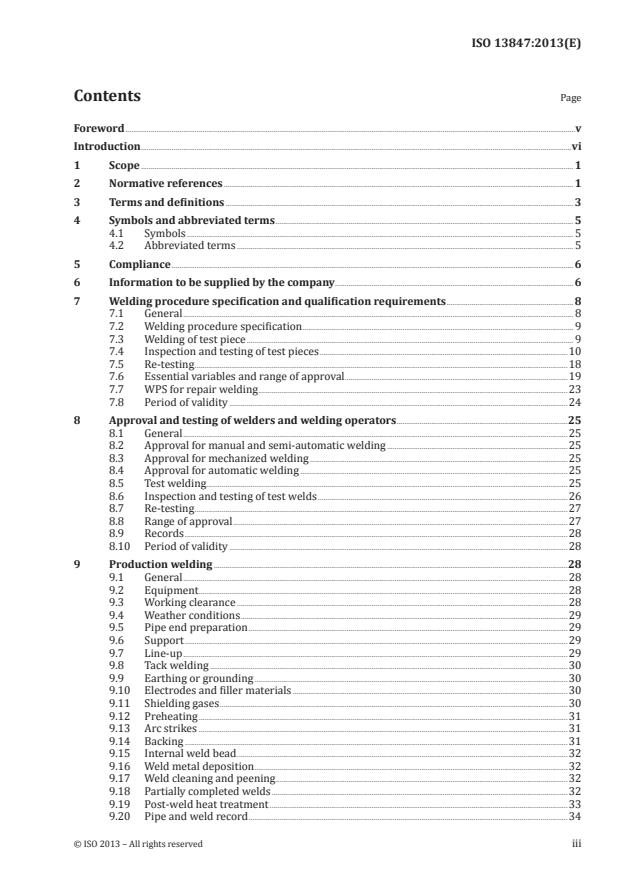
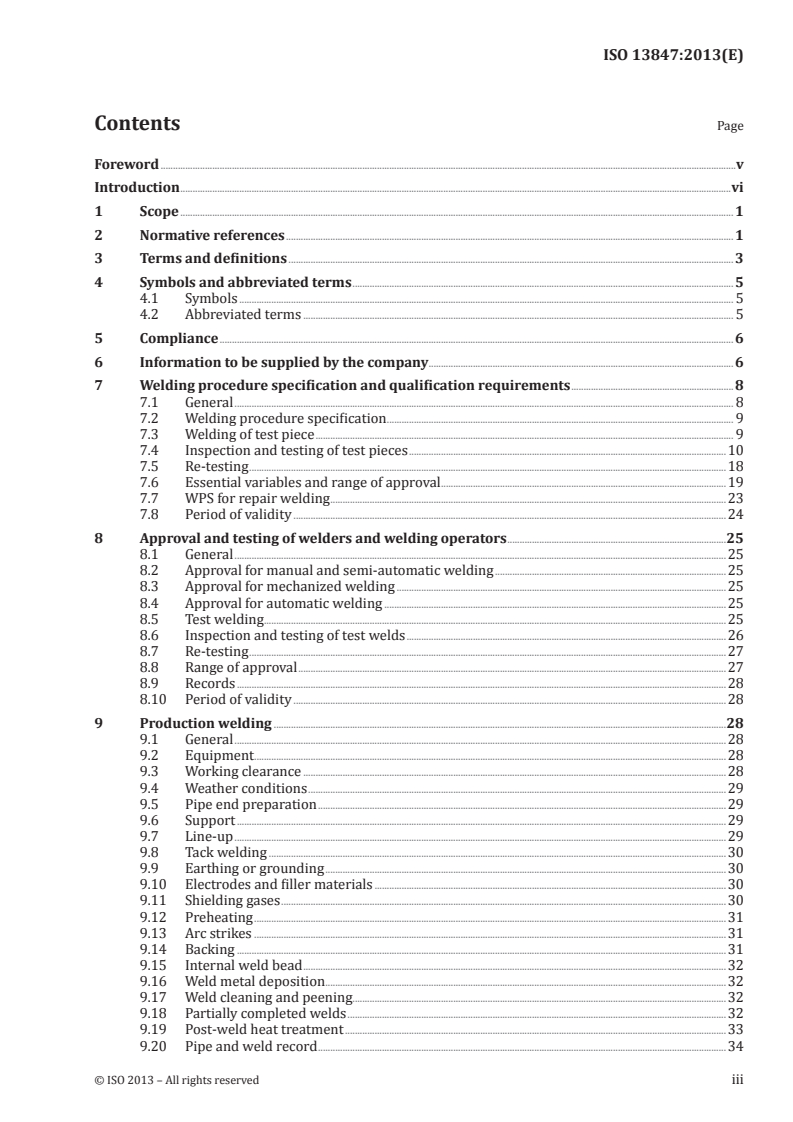
Contents Page
Foreword .v
Introduction .vi
1 Scope . 1
2 Normative references . 1
3 Terms and definitions . 3
4 Symbols and abbreviated terms . 5
4.1 Symbols . 5
4.2 Abbreviated terms . 5
5 Compliance . 6
6 Information to be supplied by the company . 6
7 Welding procedure specification and qualification requirements . 8
7.1 General . 8
7.2 Welding procedure specification . 9
7.3 Welding of test piece . 9
7.4 Inspection and testing of test pieces .10
7.5 Re-testing .18
7.6 Essential variables and range of approval .19
7.7 WPS for repair welding .23
7.8 Period of validity .24
8 Approval and testing of welders and welding operators .25
8.1 General .25
8.2 Approval for manual and semi-automatic welding .25
8.3 Approval for mechanized welding .25
8.4 Approval for automatic welding .25
8.5 Test welding.25
8.6 Inspection and testing of test welds .26
8.7 Re-testing .27
8.8 Range of approval .27
8.9 Records .28
8.10 Period of validity .28
9 Production welding .28
9.1 General .28
9.2 Equipment .28
9.3 Working clearance .28
9.4 Weather conditions .29
9.5 Pipe end preparation .29
9.6 Support .29
9.7 Line-up .29
9.8 Tack welding .30
9.9 Earthing or grounding .30
9.10 Electrodes and filler materials .30
9.11 Shielding gases .30
9.12 Preheating .31
9.13 Arc strikes .31
9.14 Backing .31
9.15 Internal weld bead .32
9.16 Weld metal deposition .32
9.17 Weld cleaning and peening.32
9.18 Partially completed welds .32
9.19 Post-weld heat treatment .33
9.20 Pipe and weld record .34
10 Non-destructive testing .34
10.1 General .34
10.2 NDT personnel .34
10.3 NDT procedure approval .34
10.4 Visual examination .34
10.5 Radiographic testing .35
10.6 Ultrasonic testing .37
10.7 Magnetic particle testing .38
10.8 Liquid penetrant testing .39
10.9 NDT report .39
11 Acceptance criteria for non-destructive testing .39
11.1 General .39
11.2 Right of rejection .39
11.3 Visual testing .39
11.4 Radiographic testing .40
11.5 Ultrasonic testing .42
11.6 Surface testing .43
11.7 Discontinuities in pipe or fittings .43
11.8 Acceptance criteria — ECA .43
12 Repair and removal of defects .43
12.1 General .43
12.2 Authorization for repair .44
12.3 Multiple repairs .44
12.4 Defect removal and preparation for repair .44
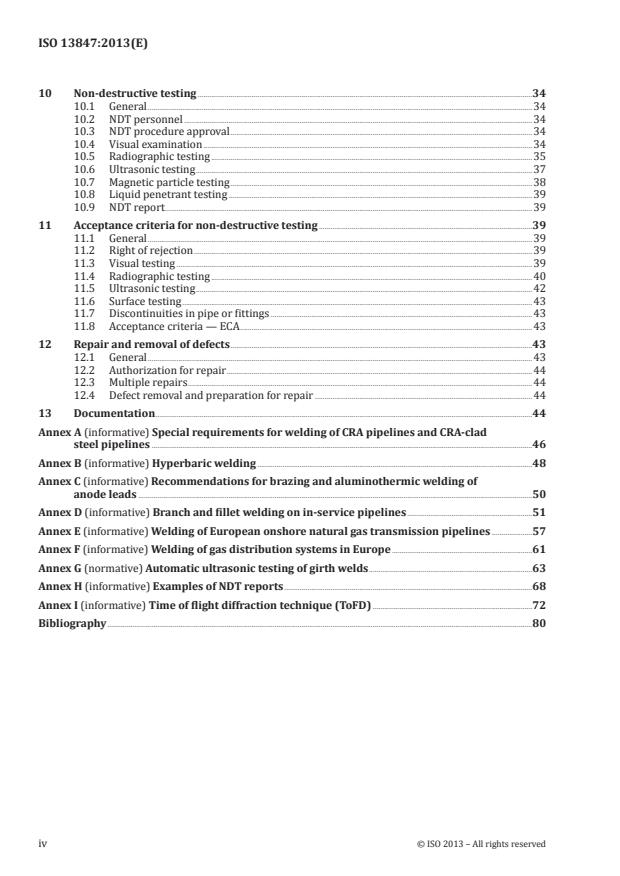
13 Documentation .44
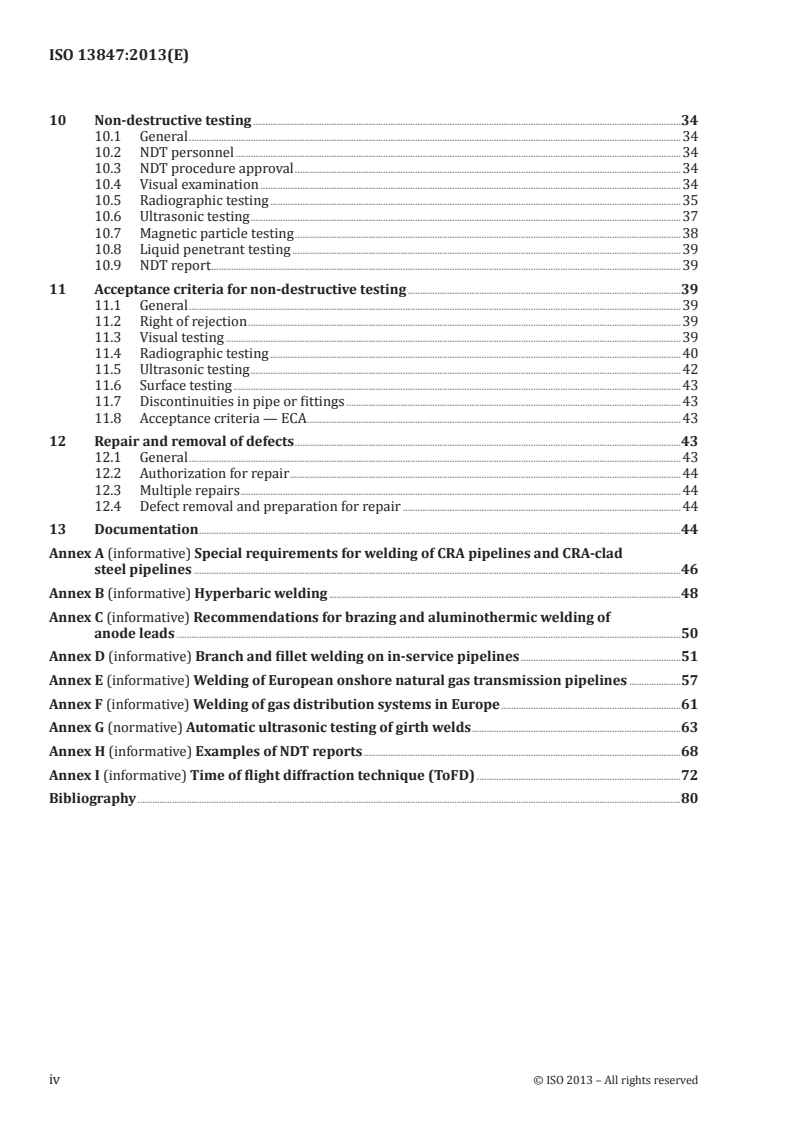
Annex A (informative) Special requirements for welding of CRA pipelines and CRA-clad
steel pipelines .46
Annex B (informative) Hyperbaric welding .48
Annex C (informative) Recommendations for brazing and aluminothermic welding of
anode leads .50
Annex D (informative) Branch and fillet welding on in-service pipelines .51
Annex E (informative) Welding of European onshore natural gas transmission pipelines .57
Annex F (informative) Welding of gas distribution systems in Europe .61
Annex G (normative) Automatic ultrasonic testing of girth welds .63
Annex H (informative) Examples of NDT reports .68
Annex I (informative) Time of flight diffraction technique (ToFD) .72
Bibliography .80
iv © ISO 2013 – All rights reserved
Foreword
ISO (the International Organization for Standardization) is a worldwide federation of national standards
bodies (ISO member bodies). The work of preparing International Standards is normally carried out
through ISO technical committees. Each member body interested in a subject for which a technical
committee has been established has the right to be represented on that committee. International
organizations, governmental and non-governmental, in liaison with ISO, also take part in the work.
ISO collaborates closely with the International Electrotechnical Commission (IEC) on all matters of
electrotechnical standardization.
The procedures used to develop this document and those intended for its further maintenance are
described in the ISO/IEC Directives, Part 1. In particular the different approval criteria needed for the
different types of ISO documents should be noted. This document was drafted in accordance with the
editorial rules of the ISO/IEC Directives, Part 2 (see www.iso.org/directives).
Attention is drawn to the possibility that some of the elements of this document may be the subject of
patent rights. ISO shall not be held responsible for identifying any or all such patent rights. Details of
any patent rights identified during the development of the document will be in the Introduction and/or
on the ISO list of patent declarations received (see www.iso.org/patents).
Any trade name used in this document is information given for the convenience of users and does not
constitute an endorsement.
For an explanation on the meaning of ISO specific terms and expressions related to conformity
assessment, as well as information about ISO’s adherence to the WTO principles in the Technical Barriers
to Trade (TBT), see the following URL: Foreword - Supplementary information.
The committee responsible for this document is Technical Committee ISO/TC 67, Materials, equipment
and offshore structures for petroleum, petrochemical and natural gas industries, Subcommittee SC 2,
Pipeline transportation systems for the petroleum and natural gas industries.
This second edition cancels and replaces the first edition (ISO 13847:2000), which has been technically
revised.
The following annexes have been added compared with the first edition:
— branch and filet welding on in-service pipelines (Annex D);
— welding of European onshore natural gas transmission pipelines (Annex E);
— welding of gas distribution systems in Europe (Annex F);
— automatic ultrasonic testing of girth welds (Annex G);
— time of flight diffraction techniques (Annex I).
Introduction
Users of this International Standard are advised that further or differing requirements might be needed
for individual applications, using alternative engineering solutions, particularly where there is innovative
or developing technology. Where an alternative is offered, it is advisable that the manufacturer identifies
any variations from this International Standard and provides details.
vi © ISO 2013 – All rights reserved
INTERNATIONAL STANDARD ISO 13847:2013(E)
Petroleum and natural gas industries — Pipeline
transportation systems — Welding of pipelines
1 Scope
This International Standard specifies requirements for the petroleum, petrochemical and natural gas
industries, for producing and inspecting girth, branch and fillet welds in the pipeline part of pipeline
transportation systems which meet the requirements of ISO 13623:2009 or equivalent.
This International Standard is applicable to the requirements for welding of carbon and low-alloy steel
pipes, and includes guidance for the welding of corrosion-resistant alloy (CRA) and CRA-clad pipelines
in Annex A. Application is restricted to pipes with a diameter of 20 mm or more and a wall thickness of
3 mm or more, a specified minimum yield strength of 555 MPa or less, and which are designed not to
exceed permissible equivalent stresses as defined in ISO 13623:2009 or equivalent. It is also applicable
to welding into pipelines of items such as spools, risers, launchers/receivers, fittings, flanges and pup
pieces to pipeline valves.
Guidance for special welding applications is provided in:
— Annex B for hyperbaric welding;
— Annex C for brazing and aluminothermic welding of anode leads;
— Annex D for branch and fillet welding on in-service pipelines.
The welding processes covered are shielded metal arc welding (SMAW), gas tungsten arc welding
(GTAW), gas metal arc welding (GMAW), gas-shielded flux-cored arc welding (GSFCAW), self-shielded
flux-cored arc welding (SSFCAW) and submerged arc welding (SAW).
This International Standard is not applicable to flash girth welding, resistance welding, solid-phase
welding or other one-shot welding processes, nor to longitudinal welds in pipe or fittings or to the
welding of process piping outside the scope of ISO 13623:2009.
NOTE 1 Additional requirements might be necessary for the welding of pipeline for particular pipeline
operating conditions, for pipelines with a specified yield strength exceeding 555 MPa and for pipelines designed
to permissible strain criteria. These can include limitations on maximum hardness or strength, minimum
impact toughness values, crack tip-opening displacement, all weld metal tensile testing or bend testing, thermal
stress relief, or others. Where appropriate, it is advisable that these additional requirements be added to the
requirements of this International Standard in a project-specific supplement.
NOTE 2 Annex E specifies additional requirements for the welding of onshore gas supply systems applicable
only when located in European member states. Annex F specifies additional requirements for the welding of
gas distribution systems applicable only when located in European member states. It is the responsibility of the
company to specify the normative applicability of these annexes.
2 Normative references
The following documents, in whole or in part, are normatively referenced in this document and are
indispensable for its application. For dated references, only the edition cited applies. For undated
references, the latest edition of the referenced document (including any amendments) applies.
ISO 148-1, Metallic materials — Charpy pendulum impact test — Part 1: Test method
ISO 857-1, Welding and allied processes — Vocabulary — Part 1: Metal welding processes
ISO 3183, Petroleum and natural gas industries — Steel pipe for pipeline transportation systems
ISO 3834 (all parts), Quality requirements for fusion welding of metallic materials
ISO 4136, Destructive tests on welds in metallic materials — Transverse tensile test
ISO 5173, Destructive tests on welds in metallic materials — Bend tests
ISO 5178, Destructive tests on welds in metallic materials — Longitudinal tensile test on weld metal in
fusion welded joints
ISO 6507-1, Metallic materials — Vickers hardness test — Part 1: Test method
ISO 6520-1, Welding and allied processes — Classification of geometric imperfections in metallic materials —
Part 1: Fusion welding
ISO 6947, Welding and allied processes — Welding positions
ISO 9015-1, Destructive tests on welds in metallic materials — Hardness testing — Part 1: Hardness test on
arc welded joints
ISO 9712, Non-destructive testing — Qualification and certification of NDT personnel
ISO 10474, Steel and steel products — Inspection documents
ISO 10863:2011, Non-destructive testing of welds — Ultrasonic testing — Use of time-of-flight diffraction
technique (TOFD)
ISO 13588, Non-destructive testing of welds — Ultrasonic testing — Use of automated phased array
technology
ISO 13623:2009, Petroleum and natural gas industries — Pipeline transportation systems
ISO 13916, Welding — Guidance on the measurement of preheating temperature, interpass temperature
and preheat maintenance temperature
ISO 14175, Welding consumables — Gases and gas mixtures for fusion welding and allied processes
ISO 14732, Welding personnel — Qualification testing of welding operators and weld setters for mechanized
and automatic welding of metallic materials
ISO 15609-1, Specification and qualification of welding procedures for metallic materials — Welding
procedure specification — Part 1: Arc welding
ISO 15614-1:2004, Specification and qualification of welding procedures for metallic materials — Welding
procedure test — Part 1: Arc and gas welding of steels and arc welding of nickel and nickel alloys
ISO 17636-1:2013, Non-destructive testing of welds — Radiographic testing — Part 1: X- and gamma-ray
techniques with film
EN 1321, Destructive tests on welds in metallic materials — Macroscopic and microscopic examination of
welds
ASME, Boiler and Pressure Vessel Code Section V, Non-destructive examination
ASTM E1961:2011, Standard Practice for Mechanized Ultrasonic Testing of Girth Welds Using Zonal
Discrimination with Focused Search Units
AWS A5.01, Filler metal procurement guidelines
AWS C5.3, Recommended practices for air carbon arc gouging and cutting
2 © ISO 2013 – All rights reserved
3 Terms and definitions
For the purposes of this document, the terms and definitions given in ISO 857-1, ISO 6520-1 and the
following apply.
3.1
approved welder
welder who has fulfilled the requirements of this International Standard
3.2
approved welding operator
welding operator who has fulfilled the requirements of this International Standard
3.3
approved WPS
welding procedure specification which has fulfilled the requirements of this International Standard
3.4
arc energy
product of welding voltage and current divided by travel speed of welding
Note 1 to entry: The often-used term “heat input” corresponds more precisely to the arc energy modified by an
arc efficiency factor.
3.5
automatic welding
welding where the welding parameters and torch guidance are fully controlled mechanically or
electronically
3.6
by agreement
agreed between the company and the contractor
3.7
company
owner company, operator or the engineering agency in charge of construction
Note 1 to entry: The company can act through an inspector or other authorized representative. The company can
also be the contractor in some instances.
3.8
contractor
entity that performs the work covered by this International Standard
3.9
defect
imperfection or discontinuity exceeding the specified acceptance criteria
3.10
girth weld
circumferential butt weld in pipe
3.11
imperfection
discontinuity
relevant indication related to welding quality
3.12
internal repair
repair of the root pass from inside the pipe
3.13
manual welding
welding where the welding parameters and torch guidance are controlled by the welder
3.14
mechanized welding
welding where the welding parameters and torch guidance are controlled mechanically or electronically,
but where minor adjustments can be manually varied during welding to maintain the required welding
conditions
3.15
one-shot welding process
process characterized by fusion or metallic bonding being induced around the entire circumference of
the pipe simultaneously
EXAMPLE Flash welding, friction welding or pressure welding.
3.16
relevant indication
indication from welding anomalies and related to weld quality
3.17
semi-automatic welding
welding where the welding parameters and torch guidance are controlled by the welder, but where the
equipment incorporate wire feeding
3.18
penumbra
shadow produced on a radiographic image when the incident radiation is partially, but not wholly, cut
off by an intervening body
Note 1 to entry: The penumbra is the region of geometric unsharpness around the image of an indication.
3.19
roll welding
welding process in which two pipes are abutted in a horizontal position and rotated while one or more
welding passes are deposited between previously prepared bevels on the abutting ends
3.20
test piece
welded assembly prepared for the purpose of approving a welding procedure specification, welder or
welding operator
3.21
welder
person who holds and manipulates the electrode holder, welding torch or blowpipe by hand
[SOURCE: ISO 9606-1:2012, 3.1]
3.22
weld repair
process of correcting a defect that is discovered after the weld has been completed and submitted for
inspection
Note 1 to entry: The repair can involve complete removal of a cylinder of pipe, or removal of a localized area by
grinding or other means, followed by additional welding.
3.23
welding operator
person who performs mechanized and/or automatic welding
[SOURCE: ISO 14732:1998, 3.10, modified]
4 © ISO 2013 – All rights reserved
3.24
welding procedure
specific course of action to be followed in making a weld, including reference to materials, preparation,
preheating (if necessary), method and control of welding and post-weld heat treatment (if necessary)
and equipment to be used
3.27
welding procedure specification
WPS
document providing the required variables for a specific welding procedure
4 Symbols and abbreviated terms
4.1 Symbols
d outside diameter of pipe
r nominal internal radius
t wall thickness
4.2 Abbreviated terms
AC alternating current
AUT automatic ultrasonic testing
AWT all-weld-metal tensile test
CE carbon equivalent
CE carbon equivalent, based upon the chemical portion of the Ito-Bessyo carbon equivalent equation
pcm
CRA corrosion-resistant alloy
CTOD crack tip opening displacement
DAC distance amplitude correction
DC direct current
ECA engineering critical assessment
FCAW flux-cored arc welding
GMAW gas metal arc welding (ISO 4063:2009, process 13)
GSFCAW gas-shielded flux-cored arc welding (ISO 4063:2009, processes 136)
GTAW gas tungsten arc welding (ISO 4063:2009, process 141)
HAZ heat-affected zone
HDM hydrogen dissolved in metal
HV Vickers hardness
IQI image-quality indicator
LPT liquid penetrant testing
MT magnetic-particle testing
NDT non-destructive testing
PWHT post-weld heat treatment
RT radiographic testing
SAW submerged arc welding (ISO 4063:2009, process 12)
SMAW shielded metal arc welding (ISO 4063:2009, process 111)
SMYS specified minimum yield strength
SSFCAW self-shielded flux-cored arc welding
ToFD time-of-flight diffraction
UT ultrasonic testing
VT visual testing
WPS welding procedure specification
5 Compliance
A quality system addressing the quality requirements of ISO 3834 (or equivalent, if agreed) can be
applied to assist compliance with the requirements of this International Standard.
NOTE ISO/TS 29001 gives sector-specific guidance on quality management systems.
The contractor is responsible for complying with all of the applicable requirements of this International
Standard. It is permissible for the company to make any investigation necessary in order to be ensured
of compliance by the contractor and to reject any material that does not comply.
6 Information to be supplied by the company
The user of this International Standard requires the company to specify additional requirements, and
company and contractor to agree optional items.
a) Items to be specified by the company:
1) documentation of information on the NDT method for test welds (see 7.2);
2) requirements for all-weld-metal tensile tests (see Table 1, footnote d);
3) use of full pipe lengths for welding of test pieces (see 7.3.5.1);
4) energy values and test temperatures for Charpy impact testing for wall thicknesses greater
than 25 mm (see 7.4.3.5);
5) permission to transfer WPS between contractors (see 7.6.2);
6) additional destructive testing of test welds (see 8.6.2);
7) testing of filler material with lot classification and extent of testing (see 9.10);
8) frequency, extent and method(s) of NDT if different from ISO 13623:2009 (see 10.1);
9) use of mechanized UT equipment (see 10.6.5);
10) use of ECA (see 11.8);
6 © ISO 2013 – All rights reserved
11) weld repair from inside of the pipe (see 12.2);
12) permission for repair-on-repair welding (see 12.2);
13) tests to demonstrate adequate corrosion resistance of the weld in service (see Clause A.2);
14) additional safety measures for in-service welding based on service fluid (see Clause D.1);
15) deletion of transverse notches for detection of transverse defects (see G.4.1);
16) additional qualification when applying workmanship criteria (see G.4.2);
17) other NDT method for comparison of AUT indications (see G.4.2);
1)
18) applicability of Annex E (see Clause E.1) ;
1)
19) supplementary applicable national standards or codes (see Clause E.1) ;
1)
20) proportion of different NDE techniques (see Table E.1, footnote a) ;
1)
21) number of welds to be additionally examined when one weld is rejected (see E.3.1) ;
2)
22) applicability of Annex F (see Clause F.1) ;
b) Items to be agreed:
1) use of ISO 3834 or an alternative standard for quality requirements, if applicable (see Clause 5);
2) use of an alternative standard for WPS approval (see 7.1);
3) approval of inspector (internal or external) and/or third party for WPS qualification welding
and testing (see 7.1);
4) use of materials for welding of test pieces in accordance with ISO 15614-1:2004 (see 7.1);
5) extent of inspection and testing of test pieces for approval of WPS for fillet and branch welds
(see 7.4.1);
6) waiving requirements for impact testing for pipe with t ≤ 6 mm or SMYS < 360 MPa (see Table 1,
footnote b);
7) if applicable, locations of test specimens made by a combination of uphill and downhill welding
(see 7.4.3.1);
8) degassing of test specimens made using cellulosic-coated electrodes (see 7.4.3.2);
9) permission for hardness retesting (see 7.4.3.7);
for sour service (see 7.6.3.2);
10) permissible increase in values for CE or CE
pcm
11) use of other type of line up clamp as used during qualification (see 7.6.4.12);
12) requirements for approval of a WPS for repair welding (see 7.7);
13) period of WPS validity (see 7.8);
14) use of another recognized standard for welders and welding operators approval (see 8.1);
15) use and properties of flat plate material for joint simulation (see 8.5.1.3);
16) use of alternative NDT method (see 8.6.1);
1) Applicable only to gas infrastructure systems in European member states.
2) Applicable only to gas distribution systems in European member states.
17) re-test of welder or welding operator after second failure (see 8.7);
18) movement of the weld after completion of the root (see 9.6);
19) selection of electrodes and filler materials (see 9.10);
20) repair of arc strikes (see 9.13);
21) the minimum number of passes to be completed before interrupting welding (see 9.18);
22) numbering system for production welds (see 9.20);
23) use of gamma-ray (see 10.5.1);
24) use of DC prods (see 10.7);
25) use of permanent magnets or DC-yokes (see 10.7);
26) retention period and location of records (see Clause 13);
27) additional CEN requirements and/or equivalent ISO standards for ISO standards in Annex E
1)
(see Clause E.1) ;
1)
28) the method(s) for NDT (see E.3.2) ;
1)
29) applicable image quality class (see E.3.2) ;
2)
30) standard for welder and welding operator approval (see Clause F.3) ;
2)
31) use of socket joints (see Clause F.4) ;
2)
32) use of alignment aids and similar temporary attachments (see Clause F.4) .
7 Welding procedure specification and qualification requirements
7.1 General
The WPS shall be specified in accordance with 7.2.
To qualify a WPS in accordance with this International Standard, test pieces shall be welded, inspected
and tested in accordance with ISO 15614:2004, and with 7.3 and 7.4 of this International Standard.
By agreement, a WPS may be approved in accordance with ISO 15607, ISO 15609 and ISO 15614-1:2004,
or ISO 15612 or ISO 15613 without any of the requirements of 7.2 to 7.7.
A WPS shall be approved only if all the requirements of International Standard and the supplementary
requirements specified by the company have been met.
The welding and testing for WPS qualification shall be witnessed by an inspector (internal or external)
or third party approved by the company.
Prior to the start of production welding, the contractor shall submit to the company for agreement
either the preliminary WPS(s) to be approved, or the WPS(s) already approved in accordance with this
International Standard. This process may be omitted when the company has supplied the contractor
with an appropriately approved WPS or preliminary WPS(s).
Test pieces should be welded using project-specific materials. By agreement, materials for welding of
test pieces may be selected in accordance with ISO 15614-1:2004, 8.3.1 to 8.3.3.
8 © ISO 2013 – All rights reserved
7.2 Welding procedure specification
The WPS shall incorporate the technical contents specified in ISO 15609-1, in 7.6 of this International
Standard and, if applicable, the following:
— steel grade and delivery condition in accordance with ISO 3183;
— number of welders for the specific weld passes;
— maximum time lapse between start of root pass and start of second (hot) pass;
— type of line-up clamp or tack welding;
— preheating procedure;
— minimum interpass temperature if different from the preheat temperature;
— extent of welding required before removal of line-up clamp or other line-up device;
— part of weld to be completed before joint is permitted to cool to ambient temperature;
— method for control of cooling;
— part of weld to be completed before lowering off, i.e. from side boom to pipe support, or barge move-
up;
— action required for partially completed welds.
The company may require information on the method used for NDT of test welds to be documented.
Where the intended installation and/or service application of the welded pipeline involves significant
plastic strain, such as during pipe-reeling or J-tube installation, the use of documented strain-ageing
data and/or supplementary testing should be considered to demonstrate adequate evidence of strain-
ageing resistance.
Weldability tests may be required to provide the necessary information for the selection of welding
variables for a WPS.
All relevant welding parameters and variables shall be specified individually in accordance with
ISO 15609-1 if a previously approved WPS is offered to the company for agreement.
For steel grades with increased susceptibility to delayed hydrogen cracking due to welding, the WPS
shall be designed to prevent such cracking from occurring. Such welding may also require the use of low
hydrogen processes, PWHT, and a delay period prior to inspection.
7.3 Welding of test piece
7.3.1 Preliminary WPS
The preparation for, and welding of, test pieces shall be carried out in accordance with a documented
preliminary WPS.
7.3.2 Test welding conditions
Test pieces should be welded under conditions that simulate those of the site production location (see
9.3 and 9.4).
7.3.3 Welding position
Welding positions and limitations for the angle of slope and rotation of the test piece shall be in
accordance with ISO 6947.
7.3.4 Tack welds
Test pieces shall be tack-welded only if tack welding is necessary during production welding.
7.3.5 Shape and dimensions of test pieces
7.3.5.1 Girth welds
Test pieces for the approval of a WPS for girth welding shall be made by joining pipes with a minimum
length of one diameter or 300 mm, whichever is greater. Certain situations may require the use of full
pipe lengths.
NOTE Longer test pieces can be required to allow the use of internal clamps selected for production welding
or simulate installation conditions.
7.3.5.2 Branch connections and fillet welds
Test pieces for the approval of a WPS for welding branch connections or fillet welds shall be of the shape
and dimensions specified in ISO 15614-1:2004.
7.3.5.3 Welds between different materials
Test pieces may be welded for the approval of a WPS from two different materials, provided the test
pieces can provide sufficient material for all the testing required for each material.
EXAMPLE A weld between thermal mechanically controlled pipe and a quenched and tempered forged flange
is subjected to appropriate mechanical testing on both sides of the weld.
7.4 Inspection and testing of test pieces
7.4.1 Scope of inspection and testing
The extent of inspection and testing of test pieces for the approval of a WPS for girth welding shall be in
accordance with Table 1.
The extent of inspection and testing of test pieces for the approval of a WPS for fillet and branch welds
shall be established by agreement.
Table 1 — Inspection and testing of the test pieces for girth welding
Type of inspection/test Extent of inspection/testing
VT 100 %
a
RT or AUT 100 %
Transverse tensile test 2 specimens
b
Impact test 2 sets for t ≤ 20 mm
4 sets for t > 20 mm
Macro-examination and hardness test 2 specimens
c
Bend test 4 bends
d
All-weld-metal tensile test by agreement
a
AUT shall be a qualified production system.
b
Test may not be required for pipe with t ≤ 6 mm or with SMYS < 360 MPa.
c
For t < 12,5 mm, the total number of bends shall be split evenly between root and face bends. For t ≥ 20 mm, side
bends only are acceptable. For 12,5 mm ≤ t < 20 mm, evenly split root and face bends or side bends shall be tested.
d
Optional requirement to confirm overmatching of the yield strength of the weld metal.
10 © ISO 2013 – All rights reserved
7.4.2 Non-destructive testing
All test pieces shall be examined visually and non-destructively in accordance with Clause 10 following
any required PWHT and prior to cutting of the test specimens.
Test welds for the approval of a WPS shall be subjected to NDT no sooner than 24 h after completion of
welding.
The NDT shall be reported in accordance with Clause 10 and the result
...
INTERNATIONAL ISO
STANDARD 13847
Second edition
2013-12-15
Petroleum and natural gas
industries — Pipeline transportation
systems — Welding of pipelines
Industries du pétrole et du gaz naturel — Conduites pour systèmes de
transport — Soudage des conduites
Reference number
©
ISO 2013
© ISO 2013
All rights reserved. Unless otherwise specified, no part of this publication may be reproduced or utilized otherwise in any form
or by any means, electronic or mechanical, including photocopying, or posting on the internet or an intranet, without prior
written permission. Permission can be requested from either ISO at the address below or ISO’s member body in the country of
the requester.
ISO copyright office
Case postale 56 • CH-1211 Geneva 20
Tel. + 41 22 749 01 11
Fax + 41 22 749 09 47
E-mail copyright@iso.org
Web www.iso.org
Published in Switzerland
ii © ISO 2013 – All rights reserved
Contents Page
Foreword .v
Introduction .vi
1 Scope . 1
2 Normative references . 1
3 Terms and definitions . 3
4 Symbols and abbreviated terms . 5
4.1 Symbols . 5
4.2 Abbreviated terms . 5
5 Compliance . 6
6 Information to be supplied by the company . 6
7 Welding procedure specification and qualification requirements . 8
7.1 General . 8
7.2 Welding procedure specification . 9
7.3 Welding of test piece . 9
7.4 Inspection and testing of test pieces .10
7.5 Re-testing .18
7.6 Essential variables and range of approval .19
7.7 WPS for repair welding .23
7.8 Period of validity .24
8 Approval and testing of welders and welding operators .25
8.1 General .25
8.2 Approval for manual and semi-automatic welding .25
8.3 Approval for mechanized welding .25
8.4 Approval for automatic welding .25
8.5 Test welding.25
8.6 Inspection and testing of test welds .26
8.7 Re-testing .27
8.8 Range of approval .27
8.9 Records .28
8.10 Period of validity .28
9 Production welding .28
9.1 General .28
9.2 Equipment .28
9.3 Working clearance .28
9.4 Weather conditions .29
9.5 Pipe end preparation .29
9.6 Support .29
9.7 Line-up .29
9.8 Tack welding .30
9.9 Earthing or grounding .30
9.10 Electrodes and filler materials .30
9.11 Shielding gases .30
9.12 Preheating .31
9.13 Arc strikes .31
9.14 Backing .31
9.15 Internal weld bead .32
9.16 Weld metal deposition .32
9.17 Weld cleaning and peening.32
9.18 Partially completed welds .32
9.19 Post-weld heat treatment .33
9.20 Pipe and weld record .34
10 Non-destructive testing .34
10.1 General .34
10.2 NDT personnel .34
10.3 NDT procedure approval .34
10.4 Visual examination .34
10.5 Radiographic testing .35
10.6 Ultrasonic testing .37
10.7 Magnetic particle testing .38
10.8 Liquid penetrant testing .39
10.9 NDT report .39
11 Acceptance criteria for non-destructive testing .39
11.1 General .39
11.2 Right of rejection .39
11.3 Visual testing .39
11.4 Radiographic testing .40
11.5 Ultrasonic testing .42
11.6 Surface testing .43
11.7 Discontinuities in pipe or fittings .43
11.8 Acceptance criteria — ECA .43
12 Repair and removal of defects .43
12.1 General .43
12.2 Authorization for repair .44
12.3 Multiple repairs .44
12.4 Defect removal and preparation for repair .44
13 Documentation .44
Annex A (informative) Special requirements for welding of CRA pipelines and CRA-clad
steel pipelines .46
Annex B (informative) Hyperbaric welding .48
Annex C (informative) Recommendations for brazing and aluminothermic welding of
anode leads .50
Annex D (informative) Branch and fillet welding on in-service pipelines .51
Annex E (informative) Welding of European onshore natural gas transmission pipelines .57
Annex F (informative) Welding of gas distribution systems in Europe .61
Annex G (normative) Automatic ultrasonic testing of girth welds .63
Annex H (informative) Examples of NDT reports .68
Annex I (informative) Time of flight diffraction technique (ToFD) .72
Bibliography .80
iv © ISO 2013 – All rights reserved
Foreword
ISO (the International Organization for Standardization) is a worldwide federation of national standards
bodies (ISO member bodies). The work of preparing International Standards is normally carried out
through ISO technical committees. Each member body interested in a subject for which a technical
committee has been established has the right to be represented on that committee. International
organizations, governmental and non-governmental, in liaison with ISO, also take part in the work.
ISO collaborates closely with the International Electrotechnical Commission (IEC) on all matters of
electrotechnical standardization.
The procedures used to develop this document and those intended for its further maintenance are
described in the ISO/IEC Directives, Part 1. In particular the different approval criteria needed for the
different types of ISO documents should be noted. This document was drafted in accordance with the
editorial rules of the ISO/IEC Directives, Part 2 (see www.iso.org/directives).
Attention is drawn to the possibility that some of the elements of this document may be the subject of
patent rights. ISO shall not be held responsible for identifying any or all such patent rights. Details of
any patent rights identified during the development of the document will be in the Introduction and/or
on the ISO list of patent declarations received (see www.iso.org/patents).
Any trade name used in this document is information given for the convenience of users and does not
constitute an endorsement.
For an explanation on the meaning of ISO specific terms and expressions related to conformity
assessment, as well as information about ISO’s adherence to the WTO principles in the Technical Barriers
to Trade (TBT), see the following URL: Foreword - Supplementary information.
The committee responsible for this document is Technical Committee ISO/TC 67, Materials, equipment
and offshore structures for petroleum, petrochemical and natural gas industries, Subcommittee SC 2,
Pipeline transportation systems for the petroleum and natural gas industries.
This second edition cancels and replaces the first edition (ISO 13847:2000), which has been technically
revised.
The following annexes have been added compared with the first edition:
— branch and filet welding on in-service pipelines (Annex D);
— welding of European onshore natural gas transmission pipelines (Annex E);
— welding of gas distribution systems in Europe (Annex F);
— automatic ultrasonic testing of girth welds (Annex G);
— time of flight diffraction techniques (Annex I).
Introduction
Users of this International Standard are advised that further or differing requirements might be needed
for individual applications, using alternative engineering solutions, particularly where there is innovative
or developing technology. Where an alternative is offered, it is advisable that the manufacturer identifies
any variations from this International Standard and provides details.
vi © ISO 2013 – All rights reserved
INTERNATIONAL STANDARD ISO 13847:2013(E)
Petroleum and natural gas industries — Pipeline
transportation systems — Welding of pipelines
1 Scope
This International Standard specifies requirements for the petroleum, petrochemical and natural gas
industries, for producing and inspecting girth, branch and fillet welds in the pipeline part of pipeline
transportation systems which meet the requirements of ISO 13623:2009 or equivalent.
This International Standard is applicable to the requirements for welding of carbon and low-alloy steel
pipes, and includes guidance for the welding of corrosion-resistant alloy (CRA) and CRA-clad pipelines
in Annex A. Application is restricted to pipes with a diameter of 20 mm or more and a wall thickness of
3 mm or more, a specified minimum yield strength of 555 MPa or less, and which are designed not to
exceed permissible equivalent stresses as defined in ISO 13623:2009 or equivalent. It is also applicable
to welding into pipelines of items such as spools, risers, launchers/receivers, fittings, flanges and pup
pieces to pipeline valves.
Guidance for special welding applications is provided in:
— Annex B for hyperbaric welding;
— Annex C for brazing and aluminothermic welding of anode leads;
— Annex D for branch and fillet welding on in-service pipelines.
The welding processes covered are shielded metal arc welding (SMAW), gas tungsten arc welding
(GTAW), gas metal arc welding (GMAW), gas-shielded flux-cored arc welding (GSFCAW), self-shielded
flux-cored arc welding (SSFCAW) and submerged arc welding (SAW).
This International Standard is not applicable to flash girth welding, resistance welding, solid-phase
welding or other one-shot welding processes, nor to longitudinal welds in pipe or fittings or to the
welding of process piping outside the scope of ISO 13623:2009.
NOTE 1 Additional requirements might be necessary for the welding of pipeline for particular pipeline
operating conditions, for pipelines with a specified yield strength exceeding 555 MPa and for pipelines designed
to permissible strain criteria. These can include limitations on maximum hardness or strength, minimum
impact toughness values, crack tip-opening displacement, all weld metal tensile testing or bend testing, thermal
stress relief, or others. Where appropriate, it is advisable that these additional requirements be added to the
requirements of this International Standard in a project-specific supplement.
NOTE 2 Annex E specifies additional requirements for the welding of onshore gas supply systems applicable
only when located in European member states. Annex F specifies additional requirements for the welding of
gas distribution systems applicable only when located in European member states. It is the responsibility of the
company to specify the normative applicability of these annexes.
2 Normative references
The following documents, in whole or in part, are normatively referenced in this document and are
indispensable for its application. For dated references, only the edition cited applies. For undated
references, the latest edition of the referenced document (including any amendments) applies.
ISO 148-1, Metallic materials — Charpy pendulum impact test — Part 1: Test method
ISO 857-1, Welding and allied processes — Vocabulary — Part 1: Metal welding processes
ISO 3183, Petroleum and natural gas industries — Steel pipe for pipeline transportation systems
ISO 3834 (all parts), Quality requirements for fusion welding of metallic materials
ISO 4136, Destructive tests on welds in metallic materials — Transverse tensile test
ISO 5173, Destructive tests on welds in metallic materials — Bend tests
ISO 5178, Destructive tests on welds in metallic materials — Longitudinal tensile test on weld metal in
fusion welded joints
ISO 6507-1, Metallic materials — Vickers hardness test — Part 1: Test method
ISO 6520-1, Welding and allied processes — Classification of geometric imperfections in metallic materials —
Part 1: Fusion welding
ISO 6947, Welding and allied processes — Welding positions
ISO 9015-1, Destructive tests on welds in metallic materials — Hardness testing — Part 1: Hardness test on
arc welded joints
ISO 9712, Non-destructive testing — Qualification and certification of NDT personnel
ISO 10474, Steel and steel products — Inspection documents
ISO 10863:2011, Non-destructive testing of welds — Ultrasonic testing — Use of time-of-flight diffraction
technique (TOFD)
ISO 13588, Non-destructive testing of welds — Ultrasonic testing — Use of automated phased array
technology
ISO 13623:2009, Petroleum and natural gas industries — Pipeline transportation systems
ISO 13916, Welding — Guidance on the measurement of preheating temperature, interpass temperature
and preheat maintenance temperature
ISO 14175, Welding consumables — Gases and gas mixtures for fusion welding and allied processes
ISO 14732, Welding personnel — Qualification testing of welding operators and weld setters for mechanized
and automatic welding of metallic materials
ISO 15609-1, Specification and qualification of welding procedures for metallic materials — Welding
procedure specification — Part 1: Arc welding
ISO 15614-1:2004, Specification and qualification of welding procedures for metallic materials — Welding
procedure test — Part 1: Arc and gas welding of steels and arc welding of nickel and nickel alloys
ISO 17636-1:2013, Non-destructive testing of welds — Radiographic testing — Part 1: X- and gamma-ray
techniques with film
EN 1321, Destructive tests on welds in metallic materials — Macroscopic and microscopic examination of
welds
ASME, Boiler and Pressure Vessel Code Section V, Non-destructive examination
ASTM E1961:2011, Standard Practice for Mechanized Ultrasonic Testing of Girth Welds Using Zonal
Discrimination with Focused Search Units
AWS A5.01, Filler metal procurement guidelines
AWS C5.3, Recommended practices for air carbon arc gouging and cutting
2 © ISO 2013 – All rights reserved
3 Terms and definitions
For the purposes of this document, the terms and definitions given in ISO 857-1, ISO 6520-1 and the
following apply.
3.1
approved welder
welder who has fulfilled the requirements of this International Standard
3.2
approved welding operator
welding operator who has fulfilled the requirements of this International Standard
3.3
approved WPS
welding procedure specification which has fulfilled the requirements of this International Standard
3.4
arc energy
product of welding voltage and current divided by travel speed of welding
Note 1 to entry: The often-used term “heat input” corresponds more precisely to the arc energy modified by an
arc efficiency factor.
3.5
automatic welding
welding where the welding parameters and torch guidance are fully controlled mechanically or
electronically
3.6
by agreement
agreed between the company and the contractor
3.7
company
owner company, operator or the engineering agency in charge of construction
Note 1 to entry: The company can act through an inspector or other authorized representative. The company can
also be the contractor in some instances.
3.8
contractor
entity that performs the work covered by this International Standard
3.9
defect
imperfection or discontinuity exceeding the specified acceptance criteria
3.10
girth weld
circumferential butt weld in pipe
3.11
imperfection
discontinuity
relevant indication related to welding quality
3.12
internal repair
repair of the root pass from inside the pipe
3.13
manual welding
welding where the welding parameters and torch guidance are controlled by the welder
3.14
mechanized welding
welding where the welding parameters and torch guidance are controlled mechanically or electronically,
but where minor adjustments can be manually varied during welding to maintain the required welding
conditions
3.15
one-shot welding process
process characterized by fusion or metallic bonding being induced around the entire circumference of
the pipe simultaneously
EXAMPLE Flash welding, friction welding or pressure welding.
3.16
relevant indication
indication from welding anomalies and related to weld quality
3.17
semi-automatic welding
welding where the welding parameters and torch guidance are controlled by the welder, but where the
equipment incorporate wire feeding
3.18
penumbra
shadow produced on a radiographic image when the incident radiation is partially, but not wholly, cut
off by an intervening body
Note 1 to entry: The penumbra is the region of geometric unsharpness around the image of an indication.
3.19
roll welding
welding process in which two pipes are abutted in a horizontal position and rotated while one or more
welding passes are deposited between previously prepared bevels on the abutting ends
3.20
test piece
welded assembly prepared for the purpose of approving a welding procedure specification, welder or
welding operator
3.21
welder
person who holds and manipulates the electrode holder, welding torch or blowpipe by hand
[SOURCE: ISO 9606-1:2012, 3.1]
3.22
weld repair
process of correcting a defect that is discovered after the weld has been completed and submitted for
inspection
Note 1 to entry: The repair can involve complete removal of a cylinder of pipe, or removal of a localized area by
grinding or other means, followed by additional welding.
3.23
welding operator
person who performs mechanized and/or automatic welding
[SOURCE: ISO 14732:1998, 3.10, modified]
4 © ISO 2013 – All rights reserved
3.24
welding procedure
specific course of action to be followed in making a weld, including reference to materials, preparation,
preheating (if necessary), method and control of welding and post-weld heat treatment (if necessary)
and equipment to be used
3.27
welding procedure specification
WPS
document providing the required variables for a specific welding procedure
4 Symbols and abbreviated terms
4.1 Symbols
d outside diameter of pipe
r nominal internal radius
t wall thickness
4.2 Abbreviated terms
AC alternating current
AUT automatic ultrasonic testing
AWT all-weld-metal tensile test
CE carbon equivalent
CE carbon equivalent, based upon the chemical portion of the Ito-Bessyo carbon equivalent equation
pcm
CRA corrosion-resistant alloy
CTOD crack tip opening displacement
DAC distance amplitude correction
DC direct current
ECA engineering critical assessment
FCAW flux-cored arc welding
GMAW gas metal arc welding (ISO 4063:2009, process 13)
GSFCAW gas-shielded flux-cored arc welding (ISO 4063:2009, processes 136)
GTAW gas tungsten arc welding (ISO 4063:2009, process 141)
HAZ heat-affected zone
HDM hydrogen dissolved in metal
HV Vickers hardness
IQI image-quality indicator
LPT liquid penetrant testing
MT magnetic-particle testing
NDT non-destructive testing
PWHT post-weld heat treatment
RT radiographic testing
SAW submerged arc welding (ISO 4063:2009, process 12)
SMAW shielded metal arc welding (ISO 4063:2009, process 111)
SMYS specified minimum yield strength
SSFCAW self-shielded flux-cored arc welding
ToFD time-of-flight diffraction
UT ultrasonic testing
VT visual testing
WPS welding procedure specification
5 Compliance
A quality system addressing the quality requirements of ISO 3834 (or equivalent, if agreed) can be
applied to assist compliance with the requirements of this International Standard.
NOTE ISO/TS 29001 gives sector-specific guidance on quality management systems.
The contractor is responsible for complying with all of the applicable requirements of this International
Standard. It is permissible for the company to make any investigation necessary in order to be ensured
of compliance by the contractor and to reject any material that does not comply.
6 Information to be supplied by the company
The user of this International Standard requires the company to specify additional requirements, and
company and contractor to agree optional items.
a) Items to be specified by the company:
1) documentation of information on the NDT method for test welds (see 7.2);
2) requirements for all-weld-metal tensile tests (see Table 1, footnote d);
3) use of full pipe lengths for welding of test pieces (see 7.3.5.1);
4) energy values and test temperatures for Charpy impact testing for wall thicknesses greater
than 25 mm (see 7.4.3.5);
5) permission to transfer WPS between contractors (see 7.6.2);
6) additional destructive testing of test welds (see 8.6.2);
7) testing of filler material with lot classification and extent of testing (see 9.10);
8) frequency, extent and method(s) of NDT if different from ISO 13623:2009 (see 10.1);
9) use of mechanized UT equipment (see 10.6.5);
10) use of ECA (see 11.8);
6 © ISO 2013 – All rights reserved
11) weld repair from inside of the pipe (see 12.2);
12) permission for repair-on-repair welding (see 12.2);
13) tests to demonstrate adequate corrosion resistance of the weld in service (see Clause A.2);
14) additional safety measures for in-service welding based on service fluid (see Clause D.1);
15) deletion of transverse notches for detection of transverse defects (see G.4.1);
16) additional qualification when applying workmanship criteria (see G.4.2);
17) other NDT method for comparison of AUT indications (see G.4.2);
1)
18) applicability of Annex E (see Clause E.1) ;
1)
19) supplementary applicable national standards or codes (see Clause E.1) ;
1)
20) proportion of different NDE techniques (see Table E.1, footnote a) ;
1)
21) number of welds to be additionally examined when one weld is rejected (see E.3.1) ;
2)
22) applicability of Annex F (see Clause F.1) ;
b) Items to be agreed:
1) use of ISO 3834 or an alternative standard for quality requirements, if applicable (see Clause 5);
2) use of an alternative standard for WPS approval (see 7.1);
3) approval of inspector (internal or external) and/or third party for WPS qualification welding
and testing (see 7.1);
4) use of materials for welding of test pieces in accordance with ISO 15614-1:2004 (see 7.1);
5) extent of inspection and testing of test pieces for approval of WPS for fillet and branch welds
(see 7.4.1);
6) waiving requirements for impact testing for pipe with t ≤ 6 mm or SMYS < 360 MPa (see Table 1,
footnote b);
7) if applicable, locations of test specimens made by a combination of uphill and downhill welding
(see 7.4.3.1);
8) degassing of test specimens made using cellulosic-coated electrodes (see 7.4.3.2);
9) permission for hardness retesting (see 7.4.3.7);
for sour service (see 7.6.3.2);
10) permissible increase in values for CE or CE
pcm
11) use of other type of line up clamp as used during qualification (see 7.6.4.12);
12) requirements for approval of a WPS for repair welding (see 7.7);
13) period of WPS validity (see 7.8);
14) use of another recognized standard for welders and welding operators approval (see 8.1);
15) use and properties of flat plate material for joint simulation (see 8.5.1.3);
16) use of alternative NDT method (see 8.6.1);
1) Applicable only to gas infrastructure systems in European member states.
2) Applicable only to gas distribution systems in European member states.
17) re-test of welder or welding operator after second failure (see 8.7);
18) movement of the weld after completion of the root (see 9.6);
19) selection of electrodes and filler materials (see 9.10);
20) repair of arc strikes (see 9.13);
21) the minimum number of passes to be completed before interrupting welding (see 9.18);
22) numbering system for production welds (see 9.20);
23) use of gamma-ray (see 10.5.1);
24) use of DC prods (see 10.7);
25) use of permanent magnets or DC-yokes (see 10.7);
26) retention period and location of records (see Clause 13);
27) additional CEN requirements and/or equivalent ISO standards for ISO standards in Annex E
1)
(see Clause E.1) ;
1)
28) the method(s) for NDT (see E.3.2) ;
1)
29) applicable image quality class (see E.3.2) ;
2)
30) standard for welder and welding operator approval (see Clause F.3) ;
2)
31) use of socket joints (see Clause F.4) ;
2)
32) use of alignment aids and similar temporary attachments (see Clause F.4) .
7 Welding procedure specification and qualification requirements
7.1 General
The WPS shall be specified in accordance with 7.2.
To qualify a WPS in accordance with this International Standard, test pieces shall be welded, inspected
and tested in accordance with ISO 15614:2004, and with 7.3 and 7.4 of this International Standard.
By agreement, a WPS may be approved in accordance with ISO 15607, ISO 15609 and ISO 15614-1:2004,
or ISO 15612 or ISO 15613 without any of the requirements of 7.2 to 7.7.
A WPS shall be approved only if all the requirements of International Standard and the supplementary
requirements specified by the company have been met.
The welding and testing for WPS qualification shall be witnessed by an inspector (internal or external)
or third party approved by the company.
Prior to the start of production welding, the contractor shall submit to the company for agreement
either the preliminary WPS(s) to be approved, or the WPS(s) already approved in accordance with this
International Standard. This process may be omitted when the company has supplied the contractor
with an appropriately approved WPS or preliminary WPS(s).
Test pieces should be welded using project-specific materials. By agreement, materials for welding of
test pieces may be selected in accordance with ISO 15614-1:2004, 8.3.1 to 8.3.3.
8 © ISO 2013 – All rights reserved
7.2 Welding procedure specification
The WPS shall incorporate the technical contents specified in ISO 15609-1, in 7.6 of this International
Standard and, if applicable, the following:
— steel grade and delivery condition in accordance with ISO 3183;
— number of welders for the specific weld passes;
— maximum time lapse between start of root pass and start of second (hot) pass;
— type of line-up clamp or tack welding;
— preheating procedure;
— minimum interpass temperature if different from the preheat temperature;
— extent of welding required before removal of line-up clamp or other line-up device;
— part of weld to be completed before joint is permitted to cool to ambient temperature;
— method for control of cooling;
— part of weld to be completed before lowering off, i.e. from side boom to pipe support, or barge move-
up;
— action required for partially completed welds.
The company may require information on the method used for NDT of test welds to be documented.
Where the intended installation and/or service application of the welded pipeline involves significant
plastic strain, such as during pipe-reeling or J-tube installation, the use of documented strain-ageing
data and/or supplementary testing should be considered to demonstrate adequate evidence of strain-
ageing resistance.
Weldability tests may be required to provide the necessary information for the selection of welding
variables for a WPS.
All relevant welding parameters and variables shall be specified individually in accordance with
ISO 15609-1 if a previously approved WPS is offered to the company for agreement.
For steel grades with increased susceptibility to delayed hydrogen cracking due to welding, the WPS
shall be designed to prevent such cracking from occurring. Such welding may also require the use of low
hydrogen processes, PWHT, and a delay period prior to inspection.
7.3 Welding of test piece
7.3.1 Preliminary WPS
The preparation for, and welding of, test pieces shall be carried out in accordance with a documented
preliminary WPS.
7.3.2 Test welding conditions
Test pieces should be welded under conditions that simulate those of the site production location (see
9.3 and 9.4).
7.3.3 Welding position
Welding positions and limitations for the angle of slope and rotation of the test piece shall be in
accordance with ISO 6947.
7.3.4 Tack welds
Test pieces shall be tack-welded only if tack welding is necessary during production welding.
7.3.5 Shape and dimensions of test pieces
7.3.5.1 Girth welds
Test pieces for the approval of a WPS for girth welding shall be made by joining pipes with a minimum
length of one diameter or 300 mm, whichever is greater. Certain situations may require the use of full
pipe lengths.
NOTE Longer test pieces can be required to allow the use of internal clamps selected for production welding
or simulate installation conditions.
7.3.5.2 Branch connections and fillet welds
Test pieces for the approval of a WPS for welding branch connections or fillet welds shall be of the shape
and dimensions specified in ISO 15614-1:2004.
7.3.5.3 Welds between different materials
Test pieces may be welded for the approval of a WPS from two different materials, provided the test
pieces can provide sufficient material for all the testing required for each material.
EXAMPLE A weld between thermal mechanically controlled pipe and a quenched and tempered forged flange
is subjected to appropriate mechanical testing on both sides of the weld.
7.4 Inspection and testing of test pieces
7.4.1 Scope of inspection and testing
The extent of inspection and testing of test pieces for the approval of a WPS for girth welding shall be in
accordance with Table 1.
The extent of inspection and testing of test pieces for the approval of a WPS for fillet and branch welds
shall be established by agreement.
Table 1 — Inspection and testing of the test pieces for girth welding
Type of inspection/test Extent of inspection/testing
VT 100 %
a
RT or AUT 100 %
Transverse tensile test 2 specimens
b
Impact test 2 sets for t ≤ 20 mm
4 sets for t > 20 mm
Macro-examination and hardness test 2 specimens
c
Bend test 4 bends
d
All-weld-metal tensile test by agreement
a
AUT shall be a qualified production system.
b
Test may not be required for pipe with t ≤ 6 mm or with SMYS < 360 MPa.
c
For t < 12,5 mm, the total number of bends shall be split evenly between root and face bends. For t ≥ 20 mm, side
bends only are acceptable. For 12,5 mm ≤ t < 20 mm, evenly split root and face bends or side bends shall be tested.
d
Optional requirement to confirm overmatching of the yield strength of the weld metal.
10 © ISO 2013 – All rights reserved
7.4.2 Non-destructive testing
All test pieces shall be examined visually and non-destructively in accordance with Clause 10 following
any required PWHT and prior to cutting of the test specimens.
Test welds for the approval of a WPS shall be subjected to NDT no sooner than 24 h after completion of
welding.
The NDT shall be reported in accordance with Clause 10 and the result
...