

ISO 19697:2016
(Main)Ships and marine technology — Navigation and ship operations — Electronic inclinometers
General Information
- Abstract
ISO 19697:2016 specifies the performance requirements, methods of testing and test results of electronic inclinometers required by the performance standard, IMO resolution MSC.363 (92), in addition to the general requirements contained in resolution A.694 (17) and is associated with IEC 60945. The electronic inclinometers provide information about actual heel angle, roll amplitude, roll period to support decision-making process on board in order to avoid dangerous situations, in stability (see Annex A for information), as well as to assist in maritime casualty investigation. The electronic inclinometers are mainly composed of a set of sensors, a signal processor, a display, an input device and an interface to other systems. It does not apply to the electronic inclinometers installed for purposes which are outside the scope of this document, e.g. monitoring of cargo status. Where a requirement in this document is different from IEC 60945, the requirement in this document takes precedence.
- Status
- Withdrawn
- Publication Date
- 07-Nov-2016
- Technical Committee
- ISO/TC 8/SC 6 - Navigation and ship operations
- Drafting Committee
- ISO/TC 8/SC 6/WG 9 - Indicators
- Current Stage
- 9599 - Withdrawal of International Standard
- Start Date
- 01-Jul-2026
- Completion Date
- 29-Aug-2026
Buy Documents

ISO 19697:2016 - Ships and marine technology -- Navigation and ship operations -- Electronic inclinometers

ISO 19697:2016 - Ships and marine technology — Navigation and ship operations — Electronic inclinometers/8/2016
Overview
ISO 19697:2016 - Ships and marine technology - Navigation and ship operations - Electronic inclinometers - specifies performance requirements, test methods and required results for shipborne electronic inclinometers. It implements IMO performance standards (MSC.363 (92)) alongside general IMO requirements (A.694 (17)) and is associated with IEC 60945. The standard covers devices that measure and present the ship’s actual heel angle, roll amplitude and roll period to support onboard decision‑making, stability assessment and maritime casualty investigation.
Key topics and technical requirements
- Measured parameters: actual heel angle, roll amplitude and roll period (minimum measurable period range: 4 s to 40 s; amplitude and heel angle range: ±90°).
- System components: sensors, signal processor, display (analogue and/or digital), input device and interfaces to other systems (notably VDR).
- Functionality: accurate determination and continuous presentation of roll behaviour; provision of a standardized instantaneous heel angle interface to the Voyage Data Recorder (VDR).
- Displays & alerts: requirements for clear presentation (analogue/digital), operational and functional alerts, roll peak hold values and reset function, with tests for display performance and alerting.
- Accuracy and testing: static, dynamic and long‑term heel angle tests; roll period and roll peak hold tests; connection/interface tests; power‑supply and environmental performance in line with associated IEC requirements.
- Installation and information: guidance on installation position, human factors and ergonomic considerations; Annex A links roll period to transverse metacentric stability for stability context.
Practical applications and users
Who uses ISO 19697:2016
- Shipowners and operators seeking reliable bridge instrumentation for safety and operational decision‑making.
- Equipment manufacturers and system integrators designing and certifying electronic inclinometers and bridge displays.
- Classification societies, maritime inspectors and test laboratories performing type‑approval and compliance testing.
- Naval architects and stability technicians using roll period data for stability assessment and design validation.
- Investigators and insurers relying on accurate inclinometers for post‑incident analysis.
Practical benefits
- Improves situational awareness on the bridge by providing validated heel and roll information.
- Supports avoidance of dangerous rolling and informs stability decisions in adverse conditions.
- Ensures standardized interfaces to VDR and other navigation systems for consistent data capture.
Related standards
- IEC 60945 (maritime equipment general requirements) - precedence: where this ISO differs, ISO 19697 takes precedence.
- IEC 61162‑1 / 61162‑2 (digital interfaces)
- IEC 61924‑2 (integrated navigation systems)
- IEC 62288 (presentation of navigation information)
- IMO resolutions MSC.363 (92) and A.694 (17)
Keywords: ISO 19697:2016, electronic inclinometers, ship roll, roll period, roll amplitude, actual heel angle, IMO MSC.363, IEC 60945, VDR, maritime stability.
Relations
- Effective Date
- 08-Oct-2022
- Effective Date
- 05-Nov-2015
Buy Documents
ISO 19697:2016 - Ships and marine technology -- Navigation and ship operations -- Electronic inclinometers
ISO 19697:2016 - Ships and marine technology — Navigation and ship operations — Electronic inclinometers/8/2016
Get Certified
Connect with accredited certification bodies for this standard

DNV
DNV is an independent assurance and risk management provider.

Lloyd's Register
Lloyd's Register is a global professional services organisation specialising in engineering and technology.

FSC International
Forest Stewardship Council certification.
Sponsored listings
Frequently Asked Questions
ISO 19697:2016 is a standard published by the International Organization for Standardization (ISO). Its full title is "Ships and marine technology — Navigation and ship operations — Electronic inclinometers". This standard covers: ISO 19697:2016 specifies the performance requirements, methods of testing and test results of electronic inclinometers required by the performance standard, IMO resolution MSC.363 (92), in addition to the general requirements contained in resolution A.694 (17) and is associated with IEC 60945. The electronic inclinometers provide information about actual heel angle, roll amplitude, roll period to support decision-making process on board in order to avoid dangerous situations, in stability (see Annex A for information), as well as to assist in maritime casualty investigation. The electronic inclinometers are mainly composed of a set of sensors, a signal processor, a display, an input device and an interface to other systems. It does not apply to the electronic inclinometers installed for purposes which are outside the scope of this document, e.g. monitoring of cargo status. Where a requirement in this document is different from IEC 60945, the requirement in this document takes precedence.
ISO 19697:2016 specifies the performance requirements, methods of testing and test results of electronic inclinometers required by the performance standard, IMO resolution MSC.363 (92), in addition to the general requirements contained in resolution A.694 (17) and is associated with IEC 60945. The electronic inclinometers provide information about actual heel angle, roll amplitude, roll period to support decision-making process on board in order to avoid dangerous situations, in stability (see Annex A for information), as well as to assist in maritime casualty investigation. The electronic inclinometers are mainly composed of a set of sensors, a signal processor, a display, an input device and an interface to other systems. It does not apply to the electronic inclinometers installed for purposes which are outside the scope of this document, e.g. monitoring of cargo status. Where a requirement in this document is different from IEC 60945, the requirement in this document takes precedence.
ISO 19697:2016 is classified under the following ICS (International Classification for Standards) categories: 47.020.70 - Navigation and control equipment. The ICS classification helps identify the subject area and facilitates finding related standards.
ISO 19697:2016 has the following relationships with other standards: It is inter standard links to ISO 19697:2026, ISO/PAS 19697:2014. Understanding these relationships helps ensure you are using the most current and applicable version of the standard.
ISO 19697:2016 is available in PDF format for immediate download after purchase. The document can be added to your cart and obtained through the secure checkout process. Digital delivery ensures instant access to the complete standard document.
Standards Content (Sample)
INTERNATIONAL ISO
STANDARD 19697
First edition
2016-11-15
Ships and marine technology —
Navigation and ship operations —
Electronic inclinometers
Navires et technologie maritime — Navigation et opérations
maritimes — Inclinomètres électroniques
Reference number
©
ISO 2016
© ISO 2016, Published in Switzerland
All rights reserved. Unless otherwise specified, no part of this publication may be reproduced or utilized otherwise in any form
or by any means, electronic or mechanical, including photocopying, or posting on the internet or an intranet, without prior
written permission. Permission can be requested from either ISO at the address below or ISO’s member body in the country of
the requester.
ISO copyright office
Ch. de Blandonnet 8 • CP 401
CH-1214 Vernier, Geneva, Switzerland
Tel. +41 22 749 01 11
Fax +41 22 749 09 47
copyright@iso.org
www.iso.org
ii © ISO 2016 – All rights reserved
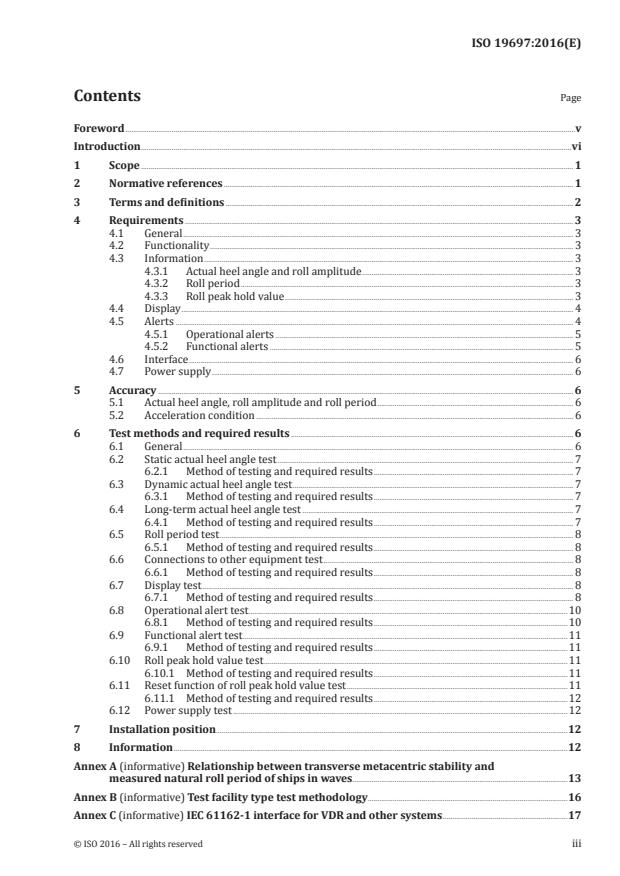
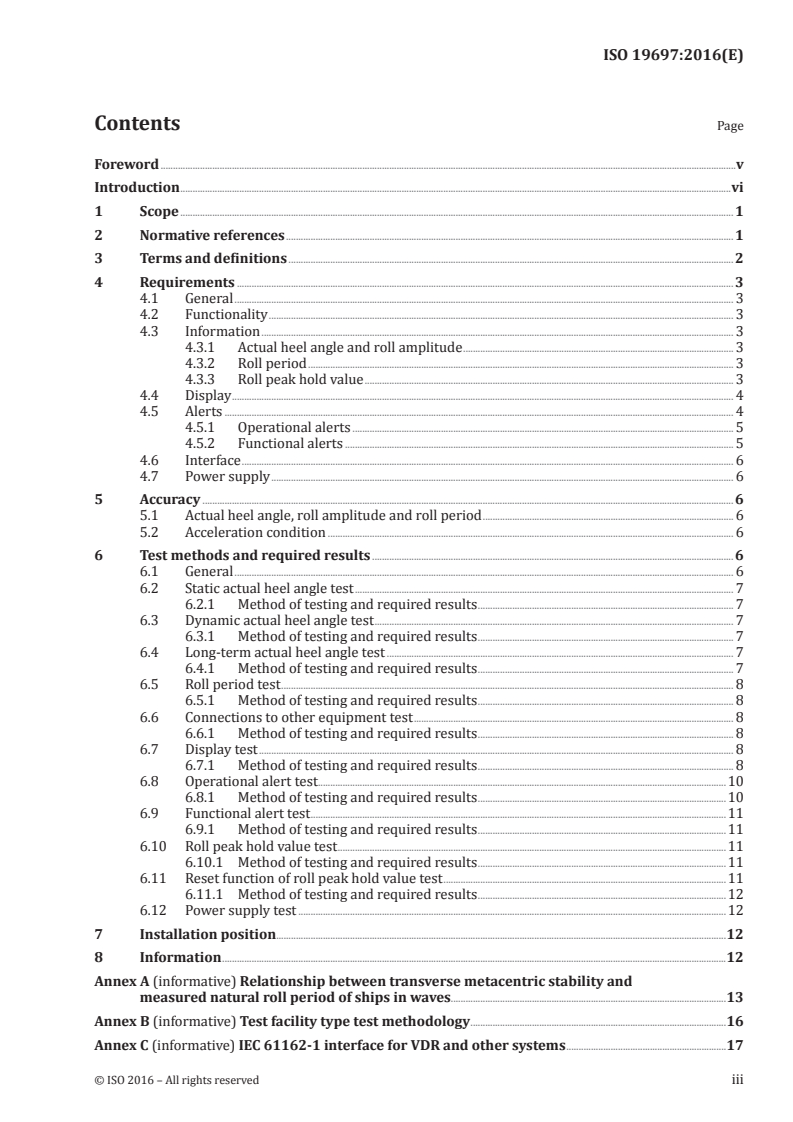
Contents Page
Foreword .v
Introduction .vi
1 Scope . 1
2 Normative references . 1
3 Terms and definitions . 2
4 Requirements . 3
4.1 General . 3
4.2 Functionality . 3
4.3 Information . 3
4.3.1 Actual heel angle and roll amplitude . 3
4.3.2 Roll period . 3
4.3.3 Roll peak hold value . 3
4.4 Display . 4
4.5 Alerts . 4
4.5.1 Operational alerts . 5
4.5.2 Functional alerts . 5
4.6 Interface . 6
4.7 Power supply . 6
5 Accuracy . 6
5.1 Actual heel angle, roll amplitude and roll period . 6
5.2 Acceleration condition . 6
6 Test methods and required results . 6
6.1 General . 6
6.2 Static actual heel angle test . 7
6.2.1 Method of testing and required results . 7
6.3 Dynamic actual heel angle test . 7
6.3.1 Method of testing and required results . 7
6.4 Long-term actual heel angle test . 7
6.4.1 Method of testing and required results . 7
6.5 Roll period test . 8
6.5.1 Method of testing and required results . 8
6.6 Connections to other equipment test . 8
6.6.1 Method of testing and required results . 8
6.7 Display test . 8
6.7.1 Method of testing and required results . 8
6.8 Operational alert test .10
6.8.1 Method of testing and required results .10
6.9 Functional alert test .11
6.9.1 Method of testing and required results .11
6.10 Roll peak hold value test .11
6.10.1 Method of testing and required results .11
6.11 Reset function of roll peak hold value test .11
6.11.1 Method of testing and required results .12
6.12 Power supply test .12
7 Installation position.12
8 Information .12
Annex A (informative) Relationship between transverse metacentric stability and
measured natural roll period of ships in waves .13
Annex B (informative) Test facility type test methodology .16
Annex C (informative) IEC 61162‑1 interface for VDR and other systems .17
Bibliography .19
iv © ISO 2016 – All rights reserved
Foreword
ISO (the International Organization for Standardization) is a worldwide federation of national standards
bodies (ISO member bodies). The work of preparing International Standards is normally carried out
through ISO technical committees. Each member body interested in a subject for which a technical
committee has been established has the right to be represented on that committee. International
organizations, governmental and non-governmental, in liaison with ISO, also take part in the work.
ISO collaborates closely with the International Electrotechnical Commission (IEC) on all matters of
electrotechnical standardization.
The procedures used to develop this document and those intended for its further maintenance are
described in the ISO/IEC Directives, Part 1. In particular the different approval criteria needed for the
different types of ISO documents should be noted. This document was drafted in accordance with the
editorial rules of the ISO/IEC Directives, Part 2 (see www.iso.org/directives).
Attention is drawn to the possibility that some of the elements of this document may be the subject of
patent rights. ISO shall not be held responsible for identifying any or all such patent rights. Details of
any patent rights identified during the development of the document will be in the Introduction and/or
on the ISO list of patent declarations received (see www.iso.org/patents).
Any trade name used in this document is information given for the convenience of users and does not
constitute an endorsement.
For an explanation on the meaning of ISO specific terms and expressions related to conformity assessment,
as well as information about ISO’s adherence to the World Trade Organization (WTO) principles in the
Technical Barriers to Trade (TBT) see the following URL: www.iso.org/iso/foreword.html.
The committee responsible for this document is ISO/TC 8, Ships and marine technology, Subcommittee
SC 6, Navigation and ship operations.
This first edition cancels and replaces ISO/PAS 19697:2014.
Introduction
An electronic inclinometer is an electronic device that provides information about roll period, roll
amplitude and the heel angle of the ship. Electronic inclinometers are intended to support the decision-
making process on board in order to avoid dangerous situations, as well as assist in and facilitate maritime
casualty investigation. The requirements in this document take into account human factors, ergonomic
principles and advances in technology.
vi © ISO 2016 – All rights reserved
INTERNATIONAL STANDARD ISO 19697:2016(E)
Ships and marine technology — Navigation and ship
operations — Electronic inclinometers
1 Scope
This document specifies the performance requirements, methods of testing and test results of electronic
inclinometers required by the performance standard, IMO resolution MSC.363 (92), in addition to the
general requirements contained in resolution A.694 (17) and is associated with IEC 60945.
The electronic inclinometers provide information about actual heel angle, roll amplitude, roll period
to support decision-making process on board in order to avoid dangerous situations, in stability
(see Annex A for information), as well as to assist in maritime casualty investigation. The electronic
inclinometers are mainly composed of a set of sensors, a signal processor, a display, an input device and
an interface to other systems.
It does not apply to the electronic inclinometers installed for purposes which are outside the scope of
this document, e.g. monitoring of cargo status.
Where a requirement in this document is different from IEC 60945, the requirement in this document
takes precedence.
NOTE All requirements that are extracted from the recommendations of IMO Resolution MSC.363 (92),
performance standards for electronic inclinometers, are printed in italics and the resolution and paragraph
numbers are indicated in brackets.
2 Normative references
The following documents are referred to in the text in such a way that some or all of their content
constitutes requirements of this document. For dated references, only the edition cited applies. For
undated references, the latest edition of the referenced document (including any amendments) applies.
IEC 60945, Maritime navigation and radiocommunication equipment and systems — General
requirements — Methods of testing and required test results
IEC 61162-1, Maritime navigation and radiocommunication equipment and systems — Digital interfaces —
Part 1: Single talker and multiple listeners
IEC 61162-2, Maritime navigation and radiocommunication equipment and systems — Digital interfaces —
Part 2: Single talker and multiple listeners, high-speed transmission
IEC 61924-2, Maritime navigation and radiocommunication equipment and systems — Integrated
navigation systems — Part 2: Modular structure for INS — Operational and performance requirements,
methods of testing and required test results
IEC 62288, Maritime navigation and radiocommunication equipment and systems — Presentation of
navigation-related information on shipborne navigational displays — General requirements, methods of
testing and required test results
IMO resolution MSC.191 (79), Performance standard for the presentation of navigation-related information
on shipborne navigational displays
IMO resolution MSC.252 (83), Performance standards for Integrated Navigation Systems (INS)
3 Terms and definitions
For the purposes of this document, the following terms and definitions apply.
ISO and IEC maintain terminological databases for use in standardization at the following addresses:
— IEC Electropedia: available at http://www.electropedia.org/
— ISO Online browsing platform: available at https://www.iso.org/obp/
3.1
actual heel angle
momentary angle of roll referenced to a levelled ship to port or starboard side
[SOURCE: IMO MSC.363 (92), Par. 3.1]
3.2
analogue type display
display (3.3) that shows actual heel angle (3.1), roll amplitudes (3.7) and roll peak hold values (3.9) in a
continuous way, such as by means of an arrow pointer and graduated scale
3.3
digital type display
display (3.3) that shows actual heel angle (3.1), roll amplitudes (3.7) and roll peak hold values (3.9) in the
form of numbers
3.4
display
means by which the roll behaviour of the ship and the state of the electronic inclinometer system are
presented to an observer
3.5
inspection equipment
equipment for testing the performance of the electronic inclinometer
3.6
reset function for roll peak hold value
function for resetting roll peak hold values (3.9) to zero and for recording reset date (month, day and
year) and time
3.7
roll amplitude
maximum values of heel angle to port or starboard side
[SOURCE: IMO MSC.363 (92), Par. 3.1]
3.8
roll period
time between two successive maximum values of heel angle on the same side of the ship
[SOURCE: IMO MSC.363 (92), Par. 3.1]
3.9
roll peak hold value
maximum values of roll amplitude (3.7) to port or starboard side from the last reset
3.10
rolling
motion around the longitudinal axis of the ship
Note 1 to entry: Positive roll is starboard down.
2 © ISO 2016 – All rights reserved
[SOURCE: IMO MSC.363 (92), Par. 3.1]
3.11
zero crossing method
way for measuring wave period by using a zero crossing which is a point where the sign of a measured
value (roll angle) changes
EXAMPLE From positive to negative.
4 Requirements
4.1 General
Users of this document shall note that while attempting to implement the requirements, they shall
ensure compliance with such statutory requirements, rules and regulations so as to be applicable to the
individual ship concerned.
4.2 Functionality
[IMO MSC.363 (92) Par. 1.2] The electronic inclinometers shall in a reliable form
a) determine the actual heel angle with the required accuracy,
b) determine the roll amplitude with the required accuracy,
c) determine the roll period with the required accuracy,
d) present the information on a bridge display, and
e) provide a standardized interface to instantaneous heel angle to the voyage data recorder (VDR).
4.3 Information
4.3.1 Actual heel angle and roll amplitude
[IMO MSC.363 (92) Par. 4] Electronic inclinometers shall be capable of measuring the actual heel angle
and determining the amplitude of the rolling oscillation of the ship over a range of ±90°.
4.3.2 Roll period
[IMO MSC.363 (92) Par. 5] Electronic inclinometers shall be capable of measuring the time between the
maximum values of the rolling oscillation and determining the roll period over a minimum range of 4 s to 40 s.
If enough precision is not attained, the period may be measured by the “zero crossing method”.
4.3.3 Roll peak hold value
Electronic inclinometers may optionally record the roll peak hold values on both sides and present
them on any kind of display.
If optional recording of the roll peak hold values is provided, electronic inclinometers shall have a mean
of manually resetting the roll peak hold values by a single operator action.
If necessary, the following sentences may be provided for the reset of roll peak hold value:
$–TXT,01,01,01,EI_RPHVReset_yyyy_mm_dd_oo_nn_ss*hh < CR > < LF > (see IEC 61162-1)
where:
— “yyyy” is the reset year;
— “mm” is the reset month;
— “dd” is the reset day;
— “oo” is the reset hour;
— “nn” is the reset minute;
— “ss” is the reset second;
— “hh” is the check sum;
— TXT (see IEC 61162–1).
4.4 Display
[IMO MSC.363 (92) Par. 7.2] The actual heel angle to port or starboard shall be indicated in an analogue
form between the limits of ±45°. When the actual heel angle exceeds 45° to either side, the analogue
display is permitted to remain at 45°.
[IMO MSC.363 (92) Par. 7.1.2] Electronic inclinometers shall display the roll amplitude to both port and
starboard side with a minimum resolution of 1°.
Electronic inclinometers may optionally display the roll peak hold value for both sides, port and
starboard, with a minimum resolution of 1°. They may also optionally display its reset date/time or
relative time from the reset, if the roll peak hold value function is installed.
[IMO MSC.363 (92) Par. 7.1.1] Electronic inclinometers shall display the latest roll period with a minimum
resolution of 1 s.
[IMO MSC.363 (92) Par. 7.3] The display may be implemented as a dedicated display or integrated into
other bridge systems.
4.5 Alerts
Electronic inclinometer may provide operational alerts as described in 4.5.1 and shall provide
functional alerts as described in 4.5.2.
The alerts shall conform to protocol requirements of [IMO MSC.252 (83)] as specified in IEC 61924-2.
The presentation of alerts shall conform to the presentation requirements of [IMO MSC.191 (79)] as
specified in IEC 62288.
[IMO MSC.363 (92) Par. 10.2] Electronic inclinometers shall have a bidirectional interface to facilitate
communication, to transfer alerts from inclinometers to external systems, and to acknowledge and silence
alerts from external systems.
All alerts provided in the electronic inclinometer shall be output via alert communications interface.
The following sentences shall be provided for the alert communications interface.
Sentences transmitted by the electronic inclinometers:
— ALC and ALF (see IEC 61924-2).
Sentences received by the electronic inclinometers:
— ACN (see IEC 61924-2).
4 © ISO 2016 – All rights reserved
When an Integrated Navigation System (INS) is fitted, a suitable interface shall be provided for CAM-
HMI with the Integrated Navigation System [IMO Res. MSC.252 (83) and IEC 61924-2].
4.5.1 Operational alerts
[IMO MSC.363 (92) Par. 8.2] Electronic inclinometers may optionally provide a warning for indicating that
a set heel angle had been exceeded.
The alert on heel angle excess shall be classified as CAT B Warning. The electronic inclinometer shall
have a method of manually setting the threshold value of heel angle excess. The warning is initiated
and its warning state becomes “active – unacknowledged”, when the measured heel angle exceeds the
threshold value of heel angle excess. The electronic inclinometer shall have the means to acknowledge
the alert on heel angle excess. If the alert is not acknowledged, it shall be repeated as warning within
5 min. Once the warning state becomes “active – acknowledged”, the warning state shall not be returned
to “normal” automatically regardless of the measured value. The electronic inclinometer shall have a
method of changing the alert state from “active – acknowledged” to “normal”.
ALF sentence is used to initiate a warning on other bridge systems when the actual heel angle exceeds
the pre-set threshold.
The following sentence may be provided for the input of a threshold value of heel angle excess:
$–TXT,01,01,01,EI_SetRollThresholdAngle_xx_deg *hh < CR > < LF >
and the sentence for transmitting the pre-set value of the threshold:
$–TXT,01,01,01,EI_RollThresholdAngle_xx_deg *hh < CR > < LF >
where:
— “xx” is the threshold value of heel angle;
— “hh” is the check sum;
— TXT (see IEC 61162–1).
Also, the following sentence may be provided for changing the alert state from “active acknowledged”
to “normal”:
$–TXT,01,01,01,EI_ChangeToNnormalState*hh < CR > < LF >
where:
— “hh” is check sum;
— TXT (see IEC 61162–1).
NOTE The usual alert handling may not be appropriate in this document. According to the usual alert
handling, a state of the warning “active acknowledged” becomes “normal” automatically when the measured
heel angle becomes lower than the threshold. However, the measured heel angle changing cyclically in starboard
side or port side causes frequent initiation of alerts because a state of warning “active acknowledged” becomes
“normal” just after acknowledged and the alert initiated again when the ship rolls to the other side and the
measured roll angle exceeds the threshold.
4.5.2 Functional alerts
[IMO MSC.363 (92) Par. 9.1] Electronic inclinometers shall internally check and indicate to the user if all
components are operative and if the information provided is valid or not.
All functional alerts should be classified as CAT.B Warning.
An alert shall be provided on the following conditions:
— malfunction of the electronic inclinometer sensor(s);
— failure of the power supply;
— heel angle data is invalid.
4.6 Interface
[IMO MSC.363 (92) Par. 10.1] Electronic inclinometers shall comprise a digital interface providing actual
heel angle information to other systems like, e.g. the voyage data recorder (VDR), with an update rate
of at least 5 Hz. Electronic inclinometers shall also comprise a digital interface providing the displayed
information of roll period and roll amplitude (see 4.3).
[I
...
INTERNATIONAL ISO
STANDARD 19697
First edition
2016-11-15
Ships and marine technology —
Navigation and ship operations —
Electronic inclinometers
Navires et technologie maritime — Navigation et opérations
maritimes — Inclinomètres électroniques
Reference number
©
ISO 2016
© ISO 2016, Published in Switzerland
All rights reserved. Unless otherwise specified, no part of this publication may be reproduced or utilized otherwise in any form
or by any means, electronic or mechanical, including photocopying, or posting on the internet or an intranet, without prior
written permission. Permission can be requested from either ISO at the address below or ISO’s member body in the country of
the requester.
ISO copyright office
Ch. de Blandonnet 8 • CP 401
CH-1214 Vernier, Geneva, Switzerland
Tel. +41 22 749 01 11
Fax +41 22 749 09 47
copyright@iso.org
www.iso.org
ii © ISO 2016 – All rights reserved
Contents Page
Foreword .v
Introduction .vi
1 Scope . 1
2 Normative references . 1
3 Terms and definitions . 2
4 Requirements . 3
4.1 General . 3
4.2 Functionality . 3
4.3 Information . 3
4.3.1 Actual heel angle and roll amplitude . 3
4.3.2 Roll period . 3
4.3.3 Roll peak hold value . 3
4.4 Display . 4
4.5 Alerts . 4
4.5.1 Operational alerts . 5
4.5.2 Functional alerts . 5
4.6 Interface . 6
4.7 Power supply . 6
5 Accuracy . 6
5.1 Actual heel angle, roll amplitude and roll period . 6
5.2 Acceleration condition . 6
6 Test methods and required results . 6
6.1 General . 6
6.2 Static actual heel angle test . 7
6.2.1 Method of testing and required results . 7
6.3 Dynamic actual heel angle test . 7
6.3.1 Method of testing and required results . 7
6.4 Long-term actual heel angle test . 7
6.4.1 Method of testing and required results . 7
6.5 Roll period test . 8
6.5.1 Method of testing and required results . 8
6.6 Connections to other equipment test . 8
6.6.1 Method of testing and required results . 8
6.7 Display test . 8
6.7.1 Method of testing and required results . 8
6.8 Operational alert test .10
6.8.1 Method of testing and required results .10
6.9 Functional alert test .11
6.9.1 Method of testing and required results .11
6.10 Roll peak hold value test .11
6.10.1 Method of testing and required results .11
6.11 Reset function of roll peak hold value test .11
6.11.1 Method of testing and required results .12
6.12 Power supply test .12
7 Installation position.12
8 Information .12
Annex A (informative) Relationship between transverse metacentric stability and
measured natural roll period of ships in waves .13
Annex B (informative) Test facility type test methodology .16
Annex C (informative) IEC 61162‑1 interface for VDR and other systems .17
Bibliography .19
iv © ISO 2016 – All rights reserved
Foreword
ISO (the International Organization for Standardization) is a worldwide federation of national standards
bodies (ISO member bodies). The work of preparing International Standards is normally carried out
through ISO technical committees. Each member body interested in a subject for which a technical
committee has been established has the right to be represented on that committee. International
organizations, governmental and non-governmental, in liaison with ISO, also take part in the work.
ISO collaborates closely with the International Electrotechnical Commission (IEC) on all matters of
electrotechnical standardization.
The procedures used to develop this document and those intended for its further maintenance are
described in the ISO/IEC Directives, Part 1. In particular the different approval criteria needed for the
different types of ISO documents should be noted. This document was drafted in accordance with the
editorial rules of the ISO/IEC Directives, Part 2 (see www.iso.org/directives).
Attention is drawn to the possibility that some of the elements of this document may be the subject of
patent rights. ISO shall not be held responsible for identifying any or all such patent rights. Details of
any patent rights identified during the development of the document will be in the Introduction and/or
on the ISO list of patent declarations received (see www.iso.org/patents).
Any trade name used in this document is information given for the convenience of users and does not
constitute an endorsement.
For an explanation on the meaning of ISO specific terms and expressions related to conformity assessment,
as well as information about ISO’s adherence to the World Trade Organization (WTO) principles in the
Technical Barriers to Trade (TBT) see the following URL: www.iso.org/iso/foreword.html.
The committee responsible for this document is ISO/TC 8, Ships and marine technology, Subcommittee
SC 6, Navigation and ship operations.
This first edition cancels and replaces ISO/PAS 19697:2014.
Introduction
An electronic inclinometer is an electronic device that provides information about roll period, roll
amplitude and the heel angle of the ship. Electronic inclinometers are intended to support the decision-
making process on board in order to avoid dangerous situations, as well as assist in and facilitate maritime
casualty investigation. The requirements in this document take into account human factors, ergonomic
principles and advances in technology.
vi © ISO 2016 – All rights reserved
INTERNATIONAL STANDARD ISO 19697:2016(E)
Ships and marine technology — Navigation and ship
operations — Electronic inclinometers
1 Scope
This document specifies the performance requirements, methods of testing and test results of electronic
inclinometers required by the performance standard, IMO resolution MSC.363 (92), in addition to the
general requirements contained in resolution A.694 (17) and is associated with IEC 60945.
The electronic inclinometers provide information about actual heel angle, roll amplitude, roll period
to support decision-making process on board in order to avoid dangerous situations, in stability
(see Annex A for information), as well as to assist in maritime casualty investigation. The electronic
inclinometers are mainly composed of a set of sensors, a signal processor, a display, an input device and
an interface to other systems.
It does not apply to the electronic inclinometers installed for purposes which are outside the scope of
this document, e.g. monitoring of cargo status.
Where a requirement in this document is different from IEC 60945, the requirement in this document
takes precedence.
NOTE All requirements that are extracted from the recommendations of IMO Resolution MSC.363 (92),
performance standards for electronic inclinometers, are printed in italics and the resolution and paragraph
numbers are indicated in brackets.
2 Normative references
The following documents are referred to in the text in such a way that some or all of their content
constitutes requirements of this document. For dated references, only the edition cited applies. For
undated references, the latest edition of the referenced document (including any amendments) applies.
IEC 60945, Maritime navigation and radiocommunication equipment and systems — General
requirements — Methods of testing and required test results
IEC 61162-1, Maritime navigation and radiocommunication equipment and systems — Digital interfaces —
Part 1: Single talker and multiple listeners
IEC 61162-2, Maritime navigation and radiocommunication equipment and systems — Digital interfaces —
Part 2: Single talker and multiple listeners, high-speed transmission
IEC 61924-2, Maritime navigation and radiocommunication equipment and systems — Integrated
navigation systems — Part 2: Modular structure for INS — Operational and performance requirements,
methods of testing and required test results
IEC 62288, Maritime navigation and radiocommunication equipment and systems — Presentation of
navigation-related information on shipborne navigational displays — General requirements, methods of
testing and required test results
IMO resolution MSC.191 (79), Performance standard for the presentation of navigation-related information
on shipborne navigational displays
IMO resolution MSC.252 (83), Performance standards for Integrated Navigation Systems (INS)
3 Terms and definitions
For the purposes of this document, the following terms and definitions apply.
ISO and IEC maintain terminological databases for use in standardization at the following addresses:
— IEC Electropedia: available at http://www.electropedia.org/
— ISO Online browsing platform: available at https://www.iso.org/obp/
3.1
actual heel angle
momentary angle of roll referenced to a levelled ship to port or starboard side
[SOURCE: IMO MSC.363 (92), Par. 3.1]
3.2
analogue type display
display (3.3) that shows actual heel angle (3.1), roll amplitudes (3.7) and roll peak hold values (3.9) in a
continuous way, such as by means of an arrow pointer and graduated scale
3.3
digital type display
display (3.3) that shows actual heel angle (3.1), roll amplitudes (3.7) and roll peak hold values (3.9) in the
form of numbers
3.4
display
means by which the roll behaviour of the ship and the state of the electronic inclinometer system are
presented to an observer
3.5
inspection equipment
equipment for testing the performance of the electronic inclinometer
3.6
reset function for roll peak hold value
function for resetting roll peak hold values (3.9) to zero and for recording reset date (month, day and
year) and time
3.7
roll amplitude
maximum values of heel angle to port or starboard side
[SOURCE: IMO MSC.363 (92), Par. 3.1]
3.8
roll period
time between two successive maximum values of heel angle on the same side of the ship
[SOURCE: IMO MSC.363 (92), Par. 3.1]
3.9
roll peak hold value
maximum values of roll amplitude (3.7) to port or starboard side from the last reset
3.10
rolling
motion around the longitudinal axis of the ship
Note 1 to entry: Positive roll is starboard down.
2 © ISO 2016 – All rights reserved
[SOURCE: IMO MSC.363 (92), Par. 3.1]
3.11
zero crossing method
way for measuring wave period by using a zero crossing which is a point where the sign of a measured
value (roll angle) changes
EXAMPLE From positive to negative.
4 Requirements
4.1 General
Users of this document shall note that while attempting to implement the requirements, they shall
ensure compliance with such statutory requirements, rules and regulations so as to be applicable to the
individual ship concerned.
4.2 Functionality
[IMO MSC.363 (92) Par. 1.2] The electronic inclinometers shall in a reliable form
a) determine the actual heel angle with the required accuracy,
b) determine the roll amplitude with the required accuracy,
c) determine the roll period with the required accuracy,
d) present the information on a bridge display, and
e) provide a standardized interface to instantaneous heel angle to the voyage data recorder (VDR).
4.3 Information
4.3.1 Actual heel angle and roll amplitude
[IMO MSC.363 (92) Par. 4] Electronic inclinometers shall be capable of measuring the actual heel angle
and determining the amplitude of the rolling oscillation of the ship over a range of ±90°.
4.3.2 Roll period
[IMO MSC.363 (92) Par. 5] Electronic inclinometers shall be capable of measuring the time between the
maximum values of the rolling oscillation and determining the roll period over a minimum range of 4 s to 40 s.
If enough precision is not attained, the period may be measured by the “zero crossing method”.
4.3.3 Roll peak hold value
Electronic inclinometers may optionally record the roll peak hold values on both sides and present
them on any kind of display.
If optional recording of the roll peak hold values is provided, electronic inclinometers shall have a mean
of manually resetting the roll peak hold values by a single operator action.
If necessary, the following sentences may be provided for the reset of roll peak hold value:
$–TXT,01,01,01,EI_RPHVReset_yyyy_mm_dd_oo_nn_ss*hh < CR > < LF > (see IEC 61162-1)
where:
— “yyyy” is the reset year;
— “mm” is the reset month;
— “dd” is the reset day;
— “oo” is the reset hour;
— “nn” is the reset minute;
— “ss” is the reset second;
— “hh” is the check sum;
— TXT (see IEC 61162–1).
4.4 Display
[IMO MSC.363 (92) Par. 7.2] The actual heel angle to port or starboard shall be indicated in an analogue
form between the limits of ±45°. When the actual heel angle exceeds 45° to either side, the analogue
display is permitted to remain at 45°.
[IMO MSC.363 (92) Par. 7.1.2] Electronic inclinometers shall display the roll amplitude to both port and
starboard side with a minimum resolution of 1°.
Electronic inclinometers may optionally display the roll peak hold value for both sides, port and
starboard, with a minimum resolution of 1°. They may also optionally display its reset date/time or
relative time from the reset, if the roll peak hold value function is installed.
[IMO MSC.363 (92) Par. 7.1.1] Electronic inclinometers shall display the latest roll period with a minimum
resolution of 1 s.
[IMO MSC.363 (92) Par. 7.3] The display may be implemented as a dedicated display or integrated into
other bridge systems.
4.5 Alerts
Electronic inclinometer may provide operational alerts as described in 4.5.1 and shall provide
functional alerts as described in 4.5.2.
The alerts shall conform to protocol requirements of [IMO MSC.252 (83)] as specified in IEC 61924-2.
The presentation of alerts shall conform to the presentation requirements of [IMO MSC.191 (79)] as
specified in IEC 62288.
[IMO MSC.363 (92) Par. 10.2] Electronic inclinometers shall have a bidirectional interface to facilitate
communication, to transfer alerts from inclinometers to external systems, and to acknowledge and silence
alerts from external systems.
All alerts provided in the electronic inclinometer shall be output via alert communications interface.
The following sentences shall be provided for the alert communications interface.
Sentences transmitted by the electronic inclinometers:
— ALC and ALF (see IEC 61924-2).
Sentences received by the electronic inclinometers:
— ACN (see IEC 61924-2).
4 © ISO 2016 – All rights reserved
When an Integrated Navigation System (INS) is fitted, a suitable interface shall be provided for CAM-
HMI with the Integrated Navigation System [IMO Res. MSC.252 (83) and IEC 61924-2].
4.5.1 Operational alerts
[IMO MSC.363 (92) Par. 8.2] Electronic inclinometers may optionally provide a warning for indicating that
a set heel angle had been exceeded.
The alert on heel angle excess shall be classified as CAT B Warning. The electronic inclinometer shall
have a method of manually setting the threshold value of heel angle excess. The warning is initiated
and its warning state becomes “active – unacknowledged”, when the measured heel angle exceeds the
threshold value of heel angle excess. The electronic inclinometer shall have the means to acknowledge
the alert on heel angle excess. If the alert is not acknowledged, it shall be repeated as warning within
5 min. Once the warning state becomes “active – acknowledged”, the warning state shall not be returned
to “normal” automatically regardless of the measured value. The electronic inclinometer shall have a
method of changing the alert state from “active – acknowledged” to “normal”.
ALF sentence is used to initiate a warning on other bridge systems when the actual heel angle exceeds
the pre-set threshold.
The following sentence may be provided for the input of a threshold value of heel angle excess:
$–TXT,01,01,01,EI_SetRollThresholdAngle_xx_deg *hh < CR > < LF >
and the sentence for transmitting the pre-set value of the threshold:
$–TXT,01,01,01,EI_RollThresholdAngle_xx_deg *hh < CR > < LF >
where:
— “xx” is the threshold value of heel angle;
— “hh” is the check sum;
— TXT (see IEC 61162–1).
Also, the following sentence may be provided for changing the alert state from “active acknowledged”
to “normal”:
$–TXT,01,01,01,EI_ChangeToNnormalState*hh < CR > < LF >
where:
— “hh” is check sum;
— TXT (see IEC 61162–1).
NOTE The usual alert handling may not be appropriate in this document. According to the usual alert
handling, a state of the warning “active acknowledged” becomes “normal” automatically when the measured
heel angle becomes lower than the threshold. However, the measured heel angle changing cyclically in starboard
side or port side causes frequent initiation of alerts because a state of warning “active acknowledged” becomes
“normal” just after acknowledged and the alert initiated again when the ship rolls to the other side and the
measured roll angle exceeds the threshold.
4.5.2 Functional alerts
[IMO MSC.363 (92) Par. 9.1] Electronic inclinometers shall internally check and indicate to the user if all
components are operative and if the information provided is valid or not.
All functional alerts should be classified as CAT.B Warning.
An alert shall be provided on the following conditions:
— malfunction of the electronic inclinometer sensor(s);
— failure of the power supply;
— heel angle data is invalid.
4.6 Interface
[IMO MSC.363 (92) Par. 10.1] Electronic inclinometers shall comprise a digital interface providing actual
heel angle information to other systems like, e.g. the voyage data recorder (VDR), with an update rate
of at least 5 Hz. Electronic inclinometers shall also comprise a digital interface providing the displayed
information of roll period and roll amplitude (see 4.3).
[I
...