


ISO/IEC 9594-1:2005
(Main)Information technology — Open Systems Interconnection — The Directory: Overview of concepts, models and services — Part 1:
Information technology — Open Systems Interconnection — The Directory: Overview of concepts, models and services — Part 1:
ISO/IEC 9594-1:2005 includes specifications for how information about objects, e.g. persons, is organized, created, maintained and retrieved. It provides provisions for protecting stored information through authentication and access control specifications. ISO/IEC 9594-1:2005 introduces the concepts of the Directory and the DIB (Directory Information Base), and overviews the services and capabilities which they provide. It is intended to give an introduction to the other parts of ISO/IEC 9594. It is not an implementation specification.
Technologies de l'information — Interconnexion de systèmes ouverts (OSI) — L'annuaire: Aperçu général des concepts, modèles et services — Partie 1:
L'ISO/CEI 9594-1:2005 fournit des spécifications sur la manière dont les informations relatives aux objets, par exemple des personnes, sont organisées, crées, mises à jour et extraites. Elle donne aussi des dispositions pour protéger les informations en mémoire à travers l'authentification et les spécifications de contrôle d'accès. L'ISO/CEI 9594-1:2005 introduit les concepts de l'annuaire et de la base d'informations d'annuaire (DIB), et survole les services et capacités qu'ils fournissent. Elle est destinée à donner une introduction aux autres parties de l'ISO/CEI 9594. Elle n'est pas une spécification de mise en application.
General Information
- Status
- Withdrawn
- Publication Date
- 14-Dec-2005
- Withdrawal Date
- 14-Dec-2005
- Current Stage
- 9599 - Withdrawal of International Standard
- Start Date
- 13-Sep-2012
- Completion Date
- 12-Feb-2026
Relations
- Effective Date
- 10-Oct-2009
- Effective Date
- 18-Dec-2008
- Effective Date
- 15-Apr-2008
ISO/IEC 9594-1:2005 - Information technology -- Open Systems Interconnection -- The Directory: Overview of concepts, models and services
ISO/IEC 9594-1:2005 - Technologies de l'information -- Interconnexion de systemes ouverts (OSI) -- L'annuaire: Aperçu général des concepts, modeles et services
Get Certified
Connect with accredited certification bodies for this standard

BSI Group
BSI (British Standards Institution) is the business standards company that helps organizations make excellence a habit.

NYCE
Mexican standards and certification body.
Sponsored listings
Frequently Asked Questions
ISO/IEC 9594-1:2005 is a standard published by the International Organization for Standardization (ISO). Its full title is "Information technology — Open Systems Interconnection — The Directory: Overview of concepts, models and services — Part 1:". This standard covers: ISO/IEC 9594-1:2005 includes specifications for how information about objects, e.g. persons, is organized, created, maintained and retrieved. It provides provisions for protecting stored information through authentication and access control specifications. ISO/IEC 9594-1:2005 introduces the concepts of the Directory and the DIB (Directory Information Base), and overviews the services and capabilities which they provide. It is intended to give an introduction to the other parts of ISO/IEC 9594. It is not an implementation specification.
ISO/IEC 9594-1:2005 includes specifications for how information about objects, e.g. persons, is organized, created, maintained and retrieved. It provides provisions for protecting stored information through authentication and access control specifications. ISO/IEC 9594-1:2005 introduces the concepts of the Directory and the DIB (Directory Information Base), and overviews the services and capabilities which they provide. It is intended to give an introduction to the other parts of ISO/IEC 9594. It is not an implementation specification.
ISO/IEC 9594-1:2005 is classified under the following ICS (International Classification for Standards) categories: 35.100.70 - Application layer. The ICS classification helps identify the subject area and facilitates finding related standards.
ISO/IEC 9594-1:2005 has the following relationships with other standards: It is inter standard links to ISO/IEC 9594-2:2008, ISO/IEC 9594-1:2008, ISO/IEC 9594-1:2001. Understanding these relationships helps ensure you are using the most current and applicable version of the standard.
ISO/IEC 9594-1:2005 is available in PDF format for immediate download after purchase. The document can be added to your cart and obtained through the secure checkout process. Digital delivery ensures instant access to the complete standard document.
Standards Content (Sample)
INTERNATIONAL ISO/IEC
STANDARD 9594-1
Fifth edition
2005-12-15
Information technology — Open Systems
Interconnection — The Directory:
Overview of concepts, models and
services
Technologies de l'information — Interconnexion de systèmes ouverts
(OSI) — L'annuaire: Aperçu général des concepts, modèles et services
Reference number
©
ISO/IEC 2005
PDF disclaimer
This PDF file may contain embedded typefaces. In accordance with Adobe's licensing policy, this file may be printed or viewed but
shall not be edited unless the typefaces which are embedded are licensed to and installed on the computer performing the editing. In
downloading this file, parties accept therein the responsibility of not infringing Adobe's licensing policy. The ISO Central Secretariat
accepts no liability in this area.
Adobe is a trademark of Adobe Systems Incorporated.
Details of the software products used to create this PDF file can be found in the General Info relative to the file; the PDF-creation
parameters were optimized for printing. Every care has been taken to ensure that the file is suitable for use by ISO member bodies. In
the unlikely event that a problem relating to it is found, please inform the Central Secretariat at the address given below.
© ISO/IEC 2005
All rights reserved. Unless otherwise specified, no part of this publication may be reproduced or utilized in any form or by any means,
electronic or mechanical, including photocopying and microfilm, without permission in writing from either ISO at the address below or
ISO's member body in the country of the requester.
ISO copyright office
Case postale 56 • CH-1211 Geneva 20
Tel. + 41 22 749 01 11
Fax + 41 22 749 09 47
E-mail copyright@iso.org
Web www.iso.org
Published by ISO in 2006
Published in Switzerland
ii © ISO/IEC 2005 – All rights reserved
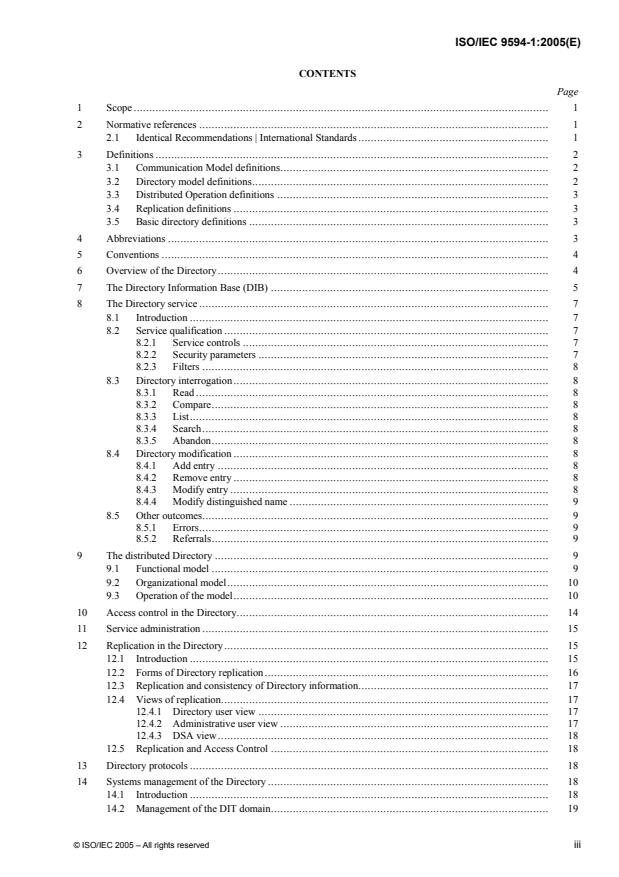
CONTENTS
Page
1 Scope. 1
2 Normative references . 1
2.1 Identical Recommendations | International Standards. 1
3 Definitions . 2
3.1 Communication Model definitions. 2
3.2 Directory model definitions. 2
3.3 Distributed Operation definitions . 3
3.4 Replication definitions . 3
3.5 Basic directory definitions . 3
4 Abbreviations . 3
5 Conventions . 4
6 Overview of the Directory. 4
7 The Directory Information Base (DIB) . 5
8 The Directory service . 7
8.1 Introduction . 7
8.2 Service qualification . 7
8.2.1 Service controls . 7
8.2.2 Security parameters . 7
8.2.3 Filters . 8
8.3 Directory interrogation. 8
8.3.1 Read . 8
8.3.2 Compare. 8
8.3.3 List. 8
8.3.4 Search. 8
8.3.5 Abandon. 8
8.4 Directory modification . 8
8.4.1 Add entry . 8
8.4.2 Remove entry . 8
8.4.3 Modify entry . 8
8.4.4 Modify distinguished name . 9
8.5 Other outcomes. 9
8.5.1 Errors. 9
8.5.2 Referrals. 9
9 The distributed Directory . 9
9.1 Functional model . 9
9.2 Organizational model. 10
9.3 Operation of the model. 10
10 Access control in the Directory. 14
11 Service administration . 15
12 Replication in the Directory. 15
12.1 Introduction . 15
12.2 Forms of Directory replication. 16
12.3 Replication and consistency of Directory information. 17
12.4 Views of replication. 17
12.4.1 Directory user view . 17
12.4.2 Administrative user view . 17
12.4.3 DSA view. 18
12.5 Replication and Access Control . 18
13 Directory protocols . 18
14 Systems management of the Directory . 18
14.1 Introduction . 18
14.2 Management of the DIT domain. 19
© ISO/IEC 2005 – All rights reserved iii
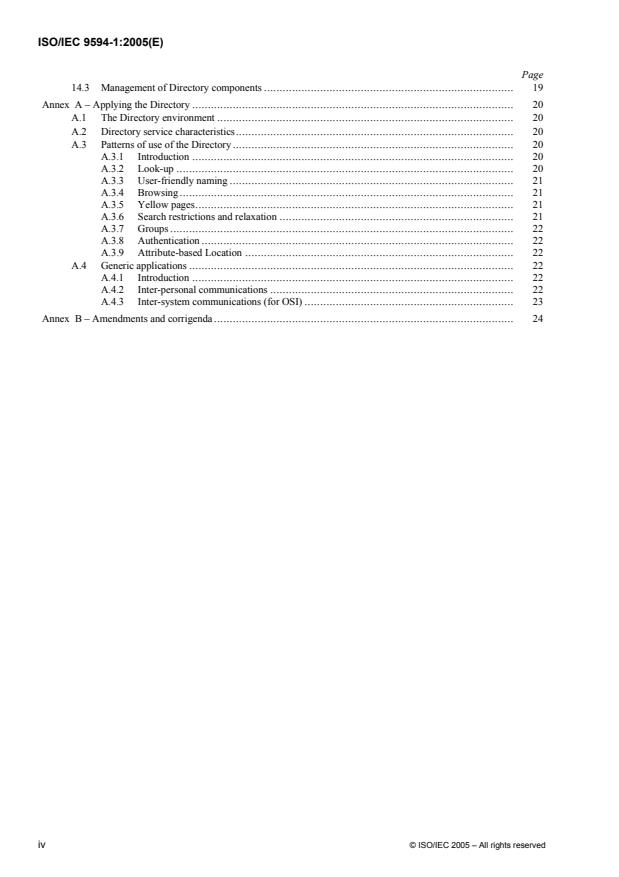
Page
14.3 Management of Directory components . 19
Annex A – Applying the Directory . 20
A.1 The Directory environment . 20
A.2 Directory service characteristics. 20
A.3 Patterns of use of the Directory. 20
A.3.1 Introduction . 20
A.3.2 Look-up . 20
A.3.3 User-friendly naming . 21
A.3.4 Browsing. 21
A.3.5 Yellow pages. 21
A.3.6 Search restrictions and relaxation . 21
A.3.7 Groups . 22
A.3.8 Authentication . 22
A.3.9 Attribute-based Location . 22
A.4 Generic applications . 22
A.4.1 Introduction . 22
A.4.2 Inter-personal communications . 22
A.4.3 Inter-system communications (for OSI) . 23
Annex B – Amendments and corrigenda. 24
iv © ISO/IEC 2005 – All rights reserved
Foreword
ISO (the International Organization for Standardization) and IEC (the International Electrotechnical
Commission) form the specialized system for worldwide standardization. National bodies that are members of
ISO or IEC participate in the development of International Standards through technical committees
established by the respective organization to deal with particular fields of technical activity. ISO and IEC
technical committees collaborate in fields of mutual interest. Other international organizations, governmental
and non-governmental, in liaison with ISO and IEC, also take part in the work. In the field of information
technology, ISO and IEC have established a joint technical committee, ISO/IEC JTC 1.
International Standards are drafted in accordance with the rules given in the ISO/IEC Directives, Part 2.
The main task of the joint technical committee is to prepare International Standards. Draft International
Standards adopted by the joint technical committee are circulated to national bodies for voting. Publication as
an International Standard requires approval by at least 75 % of the national bodies casting a vote.
Attention is drawn to the possibility that some of the elements of this document may be the subject of patent
rights. ISO and IEC shall not be held responsible for identifying any or all such patent rights.
ISO/IEC 9594-1 was prepared by Joint Technical Committee ISO/IEC JTC 1, Information technology,
Subcommittee SC 6, Telecommunications and information exchange between systems, in collaboration with
ITU-T. The identical text is published as ITU-T Rec. X.500.
This fifth edition of ISO/IEC 9594-1 constitutes a technical revision of the fourth edition
(ISO/IEC 9594-1:2001), which is provisionally retained in order to support implementations based on the
fourth edition.
ISO/IEC 9594 consists of the following parts, under the general title Information technology — Open Systems
Interconnection — The Directory:
⎯ Part 1: Overview of concepts, models and services
⎯ Part 2: Models
⎯ Part 3: Abstract service definition
⎯ Part 4: Procedures for distributed operation
⎯ Part 5: Protocol specifications
⎯ Part 6: Selected attribute types
⎯ Part 7: Selected object classes
⎯ Part 8: Public-key and attribute certificate frameworks
⎯ Part 9: Replication
⎯ Part 10: Use of systems management for administration of the Directory
© ISO/IEC 2005 – All rights reserved v
Introduction
This Recommendation | International Standard together with other Recommendations | International Standards, has
been produced to facilitate the interconnection of information processing systems to provide directory services. A set of
such systems, together with the directory information that they hold, can be viewed as an integrated whole, called the
Directory. The information held by the Directory, collectively known as the Directory Information Base (DIB), is
typically used to facilitate communication between, with or about objects such as application entities, people, terminals
and distribution lists.
The Directory plays a significant role in Open Systems Interconnection, whose aim is to allow, with a minimum of
technical agreement outside of the interconnection standards themselves, the interconnection of information processing
systems:
– from different manufacturers;
– under different managements;
– of different levels of complexity; and
– of different ages.
This Recommendation | International Standard introduces and models the concepts of the Directory and of the DIB and
overviews the services and capabilities which they provide. Other Recommendations | International Standards make use
of these models in defining the abstract service provided by the Directory, and in specifying the protocols through
which this service can be obtained or propagated.
This Recommendation | International Standard provides the foundation frameworks upon which industry profiles can be
defined by other standards groups and industry forums. Many of the features defined as optional in these frameworks,
may be mandated for use in certain environments through profiles. This fifth edition technically revises and enhances,
but does not replace, the fourth edition of this Recommendation | International Standard. Implementations may still
claim conformance to the fourth edition. However, at some point, the fourth edition will not be supported (i.e., reported
defects will no longer be resolved). It is recommended that implementations conform to this fifth edition as soon as
possible.
This fifth edition specifies versions 1 and 2 of the Directory protocols.
The first and second editions specified only version 1. Most of the services and protocols specified in this edition are
designed to function under version 1. However some enhanced services and protocols, e.g., signed errors, will not
function unless all Directory entities involved in the operation have negotiated version 2. Whichever version has been
negotiated, differences between the services and between the protocols defined in the five editions, except for those
specifically assigned to version 2, are accommodated using the rules of extensibility defined in ITU-T Rec. X.519 |
ISO/IEC 9594-5.
Annex A, which is an integral part of this Recommendation | International Standard, describes the types of use to which
the Directory can be applied.
Annex B, which is not an integral part of this Recommendation | International Standard, lists the amendments and
defect reports that have been incorporated to form this edition of this Recommendation | International Standard.
vi © ISO/IEC 2005 – All rights reserved
ISO/IEC 9594-1:2005 (E)
INTERNATIONAL STANDARD
ITU-T RECOMMENDATION
Information technology – Open Systems Interconnection –
The Directory: Overview of concepts, models and services
1 Scope
The Directory provides the directory capabilities required by OSI applications, OSI management processes, other OSI
layer entities, and telecommunications services. Among the capabilities which it provides are those of "user-friendly
naming", whereby objects can be referred to by names which are suitable for citing by human users (though not all
objects need have user-friendly names); and "name-to-address mapping" which allows the binding between objects and
their locations to be dynamic. The latter capability allows OSI networks, for example, to be "self-configuring" in the
sense that addition, removal and the changes of object location do not affect OSI network operation.
The Directory is not intended to be a general-purpose database system, although it may be built on such systems. It is
assumed, for instance, that, as is typical with communications directories, there is a considerably higher frequency of
"queries" than of updates. The rate of updates is expected to be governed by the dynamics of people and organizations,
rather than, for example, the dynamics of networks. There is also no need for instantaneous global commitment of
updates; transient conditions, where both old and new versions of the same information are available, are quite
acceptable.
It is a characteristic of the Directory that, except as a consequence of differing access rights or unpropagated updates,
the results of directory queries will not be dependent on the identity or location of the inquirer. This characteristic
renders the Directory unsuitable for some telecommunications applications, for example some types of routing. For
cases where the results are dependent on the identity of the inquirer, access to directory information and updates of the
Directory may be denied.
2 Normative references
The following Recommendations and International Standards contain provisions which, through reference in this text,
constitute provisions of this Recommendation | International Standard. At the time of publication, the editions indicated
were valid. All Recommendations and Standards are subject to revision, and parties to agreements based on this
Recommendation | International Standard are encouraged to investigate the possibility of applying the most recent
edition of the Recommendations and Standards listed below. Members of IEC and ISO maintain registers of currently
valid International Standards. The Telecommunication Standardization Bureau of the ITU maintains a list of currently
valid ITU-T Recommendations.
2.1 Identical Recommendations | International Standards
– ITU-T Recommendation X.200 (1994) | ISO/IEC 7498-1:1994, Information technology – Open Systems
Interconnection – Basic Reference Model: The basic model.
– ITU-T Recommendation X.501 (2005) | ISO/IEC 9594-2:2005, Information technology – Open Systems
Interconnection – The Directory: Models.
– ITU-T Recommendation X.509 (2005) | ISO/IEC 9594-8:2005, Information technology – Open Systems
Interconnection – The Directory: Public-key and attribute certificate frameworks.
– ITU-T Recommendation X.511 (2005) | ISO/IEC 9594-3:2005, Information technology – Open Systems
Interconnection – The Directory: Abstract service definition.
– ITU-T Recommendation X.518 (2005) | ISO/IEC 9594-4:2005, Information technology – Open Systems
Interconnection – The Directory: Procedures for distributed operation.
– ITU-T Recommendation X.519 (2005) | ISO/IEC 9594-5:2005, Information technology – Open Systems
Interconnection – The Directory: Protocol specifications.
– ITU-T Recommendation X.520 (2005) | ISO/IEC 9594-6:2005, Information technology – Open Systems
Interconnection – The Directory: Selected attribute types.
ITU-T Rec. X.500 (08/2005) 1
ISO/IEC 9594-1:2005 (E)
– ITU-T Recommendation X.521 (2005) | ISO/IEC 9594-7:2005, Information technology – Open Systems
Interconnection – The Directory: Selected object classes.
– ITU-T Recommendation X.525 (2005) | ISO/IEC 9594-9:2005, Information technology – Open Systems
Interconnection – The Directory: Replication.
– ITU-T Recommendation X.530 (2005) | ISO/IEC 9594-10:2005, Information technology – Open Systems
Interconnection – The Directory: Use of systems management for administration of the Directory.
3 Definitions
For the purposes of this Recommendation | International Standard, the following definitions apply.
3.1 Communication Model definitions
The following terms are defined in ITU-T Rec. X.519 | ISO/IEC 9594-5:
a) application-entity;
b) Application Layer;
c) application process.
3.2 Directory model definitions
The following terms are defined in ITU-T Rec. X.501 | ISO/IEC 9594-2:
a) access control;
b) Administration Directory Management Domain;
c) alias;
d) ancestor;
e) attribute;
f) attribute type;
g) attribute value;
h) authentication;
i) compound entry;
j) context;
k) Directory Information Tree (DIT);
l) Directory Management Domain (DMD);
m) Directory System Agent (DSA);
n) Directory User Agent (DUA);
o) distinguished name;
p) entry;
q) family (of entries);
r) hierarchical group;
s) LDAP client;
t) LDAP requester;
u) LDAP responder;
v) LDAP server;
w) name;
x) object (of interest);
y) Private Directory Management Domain;
z) related entries;
aa) relative distinguished name;
bb) root;
2 ITU-T Rec. X.500 (08/2005)
ISO/IEC 9594-1:2005 (E)
cc) schema;
dd) security policy;
ee) subordinate object;
ff) superior entry;
gg) superior object;
hh) tree.
3.3 Distributed Operation definitions
The following terms are defined in ITU-T Rec. X.518 | ISO/IEC 9594-4:
a) uni-chaining;
b) multi-chaining;
c) referral.
3.4 Replication definitions
The following terms are defined in ITU-T Rec. X.525 | ISO/IEC 9594-9:
a) caching;
b) cache copy;
c) entry copy;
d) master DSA;
e) replication;
f) shadow consumer;
g) shadow supplier;
h) shadowed information;
i) shadowing agreement.
3.5 Basic directory definitions
The following terms are defined in this Recommendation | International Standard:
3.5.1 the Directory: A collection of open systems cooperating to provide directory services.
3.5.2 directory information base (DIB): The set of information managed by the Directory.
3.5.3 (directory) user: The end user of the Directory, i.e., the entity or person which accesses the Directory.
4 Abbreviations
For the purposes of this Recommendation | International Standard, the following abbreviations apply:
ACI Access Control Information
ADDMD Administration Directory Management Domain
DAP Directory Access Protocol
DIB Directory Information Base
DISP Directory Information Shadowing Protocol
DIT Directory Information Tree
DMD Directory Management Domain
DOP Directory Operational Binding Management Protocol
DSA Directory System Agent
DSP Directory System Protocol
DUA Directory User Agent
LDAP Lightweight Directory Access Protocol
ITU-T Rec. X.500 (08/2005) 3
ISO/IEC 9594-1:2005 (E)
OSI Open Systems Interconnection
PRDMD Private Directory Management Domain
RDN Relative Distinguished Name
5 Conventions
With minor exceptions this Directory Specification has been prepared according to the Rules for presentation of ITU-T |
ISO/IEC common text, November 2001.
The term "Directory Specification" (as in "this Directory Specification") shall be taken to mean ITU-T Rec. X.500 |
ISO/IEC 9594-1. The term "Directory Specifications" shall be taken to mean the X.500-series Recommendations and all
parts of ISO/IEC 9594.
This Directory Specification uses the term first edition systems to refer to systems conforming to the first edition of the
Directory Specifications, i.e., the 1988 edition of the series of CCITT X.500 Recommendations and the
ISO/IEC 9594:1990 edition. This Directory Specification uses the term second edition systems to refer to systems
conforming to the second edition of the Directory Specifications, i.e., the 1993 edition of the series of ITU-T X.500
Recommendations and the ISO/IEC 9594:1995 edition. This Directory Specification uses the term third edition systems
to refer to systems conforming to the third edition of the Directory Specifications, i.e., the 1997 edition of the series of
ITU-T X.500 Recommendations and the ISO/IEC 9594:1998 edition. This Directory Specification uses the term fourth
edition systems to refer to systems conforming to the fourth edition of the Directory Specifications, i.e., the 2001
editions of ITU-T Recs X.500, X.501, X.511, X.518, X.519, X.520, X.521, X.525, and X.530, the 2000 edition of
ITU-T Rec. X.509, and parts 1-10 of the ISO/IEC 9594:2001 edition.
This Directory Specification uses the term fifth edition systems to refer to systems conforming to the fifth edition of the
Directory Specifications, i.e., the 2005 editions of ITU-T Recs X.500, X.501, X.509, X.511, X.518, X.519, X.520,
X.521, X.525, and X.530 and parts 1-10 of the ISO/IEC 9594:2005 edition.
This Directory Specification presents ASN.1 notation in the bold Helvetica typeface. When ASN.1 types and values are
referenced in normal text, they are differentiated from normal text by presenting them in the bold Helvetica typeface.
The names of procedures, typically referenced when specifying the semantics of processing, are differentiated from
normal text by displaying them in bold Times. Access control permissions are presented in italicized Times.
6 Overview of the Directory
The Directory is a collection of open systems which cooperate to hold a logical database of information about a set of
objects in the real world. The users of the Directory, including people and computer programs, can read or modify the
information, or parts of it, subject to having permission to do so. Each user is represented in accessing the Directory by
a Directory User Agent (DUA) or an LDAP client, each of which is considered to be an application-process. These
concepts are illustrated in Figure 1.
NOTE – The Directory Specifications refer to the Directory in the singular, and reflects the intention to create, through a single,
unified, name space, one logical directory composed of many systems and serving many applications. Whether or not these
systems choose to interwork will depend on the needs of the applications they support. Applications dealing with non-
intersecting worlds of objects may have no such need. The single name space facilitates later interworking should the needs
change. For a variety of reasons, such as security, connectivity, or business decisions, it is likely that some portions of the
Directory may be unreachable from other portions of the Directory using third edition operations. This results in differing views
of the Directory. Such differing views may contain related entries about a given real world object. Such related entries may or
may not have the same distinguished name. Using fourth or subsequent edition systems, it is possible to perform operations
across multiple, differing views to provide an integrated response to the user. Specifically:
– DMD administrators (see 9.2) may have a need to publish their own view (or views) of some specific real-world object; a
real-world object may thus be modelled by multiple independent entries in the directory. This may happen whether or not
they need to interwork. Interworking using DSP may also be unsupported.
– Notwithstanding the last sentence of the Note, it is also possible that particular DMDs may choose to publish information
about real-world objects within their own distinct directory name-spaces (i.e., in one of multiple DITs); in this case, it
would be possible to have a specific real-world object modelled by entries in the same or different DIT namespaces, with
the same or different distinguished names in each. Note that certain Directory facilities (e.g., the acquisition of certificates,
and related functions based on digital signatures) cannot be implemented when distinct objects are permitted to share
distinguished names.
– The objective of related entries is to provide a means whereby users can access such entries, bringing the resulting
information together, if possible. This would apply to the situation described by both of the preceding bullet points.
4 ITU-T Rec. X.500 (08/2005)
ISO/IEC 9594-1:2005 (E)
Figure 1 – Access to the Directory
The information held in the Directory is collectively known as the Directory Information Base (DIB). Clause 7 gives an
overview of its structure.
The Directory provides a well-defined set of access capabilities, known as the abstract service of the Directory, to its
users. This service, which is briefly described in clause 8, provides a simple modification and retrieval capability. This
can be built on with local DUA functions to provide the capabilities required by the end-users.
The Directory is distributed, both along functional and organizational lines. Clause 9 gives an overview of the
corresponding models of the Directory. These have been developed in order to provide a framework for the cooperation
of the various components to provide an integrated whole.
The Directory exists in an environment where various administrative authorities control access to their portion of the
information. Clause 10 gives an overview of access control.
When the Directory is distributed, it may be desirable to replicate information to improve performance and availability.
Clause 11 gives an overview of the Directory replication mechanism.
The provision and consumption of the Directory services requires that the users (actually the DUAs and/or LDAP
clients) and the various functional components of the Directory should cooperate with one another. In many cases this
will require cooperation between application processes in different open systems, which in turn requires standardized
application protocols, briefly described in clause 11, to govern this cooperation.
The Directory has been designed so as to support multiple applications, drawn from a wide range of possibilities. The
nature of the applications supported governs which objects are listed in the Directory, which users access the
information, and which kinds of access they carry out. Applications may be very specific, such as the provision of
distribution lists for electronic mail, or generic, such as the 'inter-personal communications directory' application. The
Directory provides the opportunity to exploit commonness among the applications:
– A single object may be relevant to more than one application: Perhaps even the same piece of
information about the same object may be so relevant.
– To support this, a number of object classes and attribute types are defined, which are useful across a
range of applications. These definitions are contained in ITU-T Rec. X.520 | ISO/IEC 9594-6 and
ITU-T Rec. X.521 | ISO/IEC 9594-7.
– Certain patterns of use of the Directory are common across a range of applications: Annex A gives an
overview of this area.
7 The Directory Information Base (DIB)
NOTE 1 – The DIB, and its structure, are defined in ITU-T Rec. X.501 | ISO/IEC 9594-2.
The DIB is made up of information about objects. It is composed of (Directory) entries, each of which consists of a
collection of information on one object. An entry may be an aggregate of member entries each holding information
about a particular aspect of an object. Such an aggregate entry is called a compound entry. Each entry is made up of
attributes, each with a type and one or more values. The types of attribute which are present in a particular entry are
dependent on the class of object which the entry describes. Each value of an attribute may be tagged with one or more
contexts that specify information about a value that can be used to determine the applicability of the value.
The entries of the DIB are arranged in the form of a tree, the Directory Information Tree (DIT) where the vertices
represent the entries. Entries higher in the tree (nearer the root) will often represent objects such as countries or
organizations, while entries lower in the tree will represent people or application processes.
ITU-T Rec. X.500 (08/2005) 5
ISO/IEC 9594-1:2005 (E)
NOTE 2 – The services defined in the Directory Specifications operate only on a tree-structured DIT. The Directory
Specifications do not preclude the existence in the future of other structures (as the need arises).
Every entry has a distinguished name, which uniquely and unambiguously identifies the entry. These properties of the
distinguished name are derived from the tree structure of the information. The distinguished name of an entry is made
up of the distinguished name of its superior entry, together with specially nominated attribute values (the distinguished
values) from the entry.
Some of the entries at the leaves of the tree are alias entries, while other entries are object entries and compound entries.
Alias entries point to object entries, and provide the basis for alternative names for the corresponding objects.
A compound entry is an entry representing a single object and it is an aggregate of member entries each representing a
part of the information about the object.
The Directory enforces a set of rules to ensure that the DIB remains well-formed in the face of modifications over time.
These rules, known as the Directory schema, prevent entries having the wrong types of attributes for its object class,
attribute values being of the wrong form for the attribute type, and even entries having subordinate entries of the wrong
class.
Figure 2 illustrates the above concepts of the DIT and its components.
Figure 2 – Structure of the DIT and of Entries
Figure 3 gives a hypothetical example of a DIT. The tree provides examples of some of the types of attributes used to
identify different objects. For example the name:
{C=GB, L=Winslow, O=Graphic Services, CN=Laser Printer}
identifies the application entity, "Laser Printer", which has in its distinguished name the geographical attribute of
Locality.
The residential person, John Jones, whose name is {C=GB, L=Winslow, CN=John Jones}, has the same geographical
attribute in his distinguished name.
The growth and form of the DIT, the definition of the Directory schema, and the selection of distinguished names for
entries as they are added, is the responsibility of various authorities, whose hierarchical relationship is reflected in the
shape of the tree. The authorities shall ensure, for example, that all of the entries in their jurisdiction have unambiguous
distinguished names, by carefully managing the attribute types and values which appear in those names. Responsibility
is passed down the tree from superior to subordinate authorities, with control being exercised by means of the schema.
6 ITU-T Rec. X.500 (08/2005)
ISO/IEC 9594-1:2005 (E)
Figure 3 – A Hypothetical Directory Information Tree
The hierarchical group function allows an alternative hierarchical relationship to be established among entries
independent of the hierarchical relationship reflected by the DIT structure. The Directory Search operation (see 8.3.4)
can return not only information from matched entries, but also other members of the hierarchical group to which the
matched entry might belong. The hierarchical group function also has the advantage that it allows hierarchical
relationships to be changed without changing the DIT structure and thereby the distinguished names of the entries.
8 The Directory service
NOTE – The definition of the abstract service of the Directory can be found in ITU-T Rec. X.511 | ISO/IEC 9594-3.
8.1 Introduction
This clause provides an overview of the service provided to users, as represented by their DUAs and/or LDAP clients,
by the Directory. All services are provided by the Directory in response to requests from DUAs and/or LDAP clients.
There are requests which allow interrogation of the Directory, as described in 8.3, and those for modification, as
described in 8.4. In addition, requests for service can be qualified, as described in 8.2. The Directory always reports the
outcome of each request that is made of it. The form of the normal outcome is specific to the request, and is evident
from the description of the request. Most abnormal outcomes are common to several requests. The possibilities are
described in 8.5.
The Directory ensures that changes to the DIB, whether the result of a Directory service request, or by some other
(local) means, result in a DIB which continues to obey the rules of the Directory schema.
A user and the Directory are bound together for a period of time at an access point to the Directory. At the time of
binding, the user and the Directory optionally verify each other's identity.
8.2 Service qualification
8.2.1 Service controls
A number of controls can be applied to the various service requests, primarily to allow the user to impose limits on the
use of resources that the Directory shall not surpass, but also to control the progress of the Directory operation. Controls
are provided on, among other things: the amount of time, the size of results, the scope of search, the interaction modes,
and the priority of the request.
8.2.2 Security parameters
Each request may be accompanied by information in support of security mechanisms for protecting the Directory
information. Such information may include the user's request for various kinds of protection; a digital signature of the
request, together with information to assist the correct party to verify the signature.
ITU-T Rec. X.500 (08/2005) 7
ISO/IEC 9594-1:2005 (E)
8.2.3 Filters
A number of requests, whose outcome involves information from or concerning a number of entries, may carry with
them one or more filters. A filter expresses one or more conditions that an entry or a compound entry shall satisfy in
order to be returned as part of the outcome. This allows the set of entries returned to be reduced to only those relevant.
8.3 Directory interrogation
8.3.1 Read
A read request is aimed at a particular entry, or a compound entry and causes the values of some or all of the attributes
of that entry to be returned. In the case of compound entries, family member information is contained in a package (of
syntax similar to that of an attribute) comprising the selected family information. Where only some attributes are to be
returned, the DUA supplies the list of attribute types of interest as part of the request. A DUA may also supply one or
more contexts for one or more attribute types of interest, in order to select only those values that apply in the specified
contexts.
NOTE – LDAP clients do not support the Read operation.
8.3.2 Compare
A compare request is aimed at a particular attribute of a particular entry or a compound entry, and causes the Directory
to check whether a supplied value matches a value of that attribute. A DUA may also supply one or more contexts for
the attribute value of interest to constrain the comparison operation.
NOTE – For example, this can be used to carry out password checking, where the password, held in the Directory, might be
inaccessible for read, but accessible for compare.
8.3.3 List
A list request causes the Directory to return the list of immediate subordinates of a particular named entry in the DIT. A
DUA may also supply one or more contexts to select which contexts are used in the returned RDNs.
NOTE – LDAP clients do not support the List operation.
8.3.4 Search
A search request causes the Directory to return information from all of the entries or compound entries within one or
more portions of the DIT that satisfy some filters. The information returned from each entry consists of some or all of
the attributes of that entry as with read. Information returned from related entries may be combined according to some
join criteria.
It is possible to put restrictions on the types of searches that can be performed by use of search-rules. It is also possible,
as a facility of search-rules, to progressively relax or tighten up searches within a single Directory operation, if too few
or too many items of entry information would otherwise be returned.
8.3.5 Abandon
An abandon request, as applied to an outstanding interrogation request, informs the Directory that the originator of the
request is no longer interested in the request being carried out. The Directory may, for example, cease processing the
request, and may discard any results so far achieved.
8.4 Directory modification
8.4.1 Add entry
An add entry request causes a new leaf entry to be added to the DIT. Contexts may be included with the attribute values
for the new entry.
8.4.2 Remove entry
A remove entry request causes a leaf entry or, if required, the entries comprising a compound entry to be removed from
the DIT.
8.4.3 Modify entry
A modify entry request causes the Directory to execute a sequence of changes to a particular entry or family member.
Either all of the changes are made, or none of them, and the DIB is always left in a state consistent with the schema.
The changes allowed include the addition, removal, or replacement of attributes or attribute values. Contexts may be
8 ITU-T Rec. X.500 (08/2005)
ISO/IEC 9594-1:2005 (E)
included with attribute values that are added to the entry. This operation can only be used on a single family member,
but cannot manipulate a compound entry as a whole.
A Modify Entry operation can, if required, in the result supply the information contained in the entry or compound entry
after a successful modification has taken place.
8.4.4 Modify distinguished name
A modify distinguished name (DN) request is used to change the relative distinguished name of an entry (either an
object entry, an alias, or a family member) or to move an entry, if not a family member, to a new superior in the DIT. If
an entry has subordinates, then all subordinates are renamed or moved accordingly. Contexts may be included in the
new RDN of the entry. In the case of family members, these can be moved to have new superiors, provided that they
remain within the same compound entry.
8.5 Other outcomes
8.5.1 Errors
Any service may fail, for example because of problems with the user supplied parameters, in which case an error is
reported. Information is returned with the error, where possible, to assist in correcting the problem. However, in general
only the first error encountered by the Directory is reported. Besides the above-mentioned example of problems with
the parameters supplied by the user (particularly invalid names for entries or invalid attribute types) errors may arise
from violations of security policy, schema rules, and service controls.
8.5.2 Referrals
A service may fail because the particular a
...
NORME ISO/CEI
INTERNATIONALE 9594-1
Cinquième édition
2005-12-15
Technologies de l'information —
Interconnexion de systèmes ouverts
(OSI) — L'annuaire: Aperçu général des
concepts, modèles et services
Information technology — Open Systems Interconnection — The
Directory: Overview of concepts, models and services
Numéro de référence
ISO/CEI 9594-1:2005(F)
©
ISO/CEI 2005
ISO/CEI 9594-1:2005(F)
PDF – Exonération de responsabilité
Le présent fichier PDF peut contenir des polices de caractères intégrées. Conformément aux conditions de licence d'Adobe, ce fichier
peut être imprimé ou visualisé, mais ne doit pas être modifié à moins que l'ordinateur employé à cet effet ne bénéficie d'une licence
autorisant l'utilisation de ces polices et que celles-ci y soient installées. Lors du téléchargement de ce fichier, les parties concernées
acceptent de fait la responsabilité de ne pas enfreindre les conditions de licence d'Adobe. Le Secrétariat central de l'ISO décline toute
responsabilité en la matière.
Adobe est une marque déposée d'Adobe Systems Incorporated.
Les détails relatifs aux produits logiciels utilisés pour la création du présent fichier PDF sont disponibles dans la rubrique General Info
du fichier; les paramètres de création PDF ont été optimisés pour l'impression. Toutes les mesures ont été prises pour garantir
l'exploitation de ce fichier par les comités membres de l'ISO. Dans le cas peu probable où surviendrait un problème d'utilisation,
veuillez en informer le Secrétariat central à l'adresse donnée ci-dessous.
DOCUMENT PROTÉGÉ PAR COPYRIGHT
© ISO/CEI 2005
Droits de reproduction réservés. Sauf prescription différente, aucune partie de cette publication ne peut être reproduite ni utilisée sous
quelque forme que ce soit et par aucun procédé, électronique ou mécanique, y compris la photocopie et les microfilms, sans l'accord écrit
de l'ISO à l'adresse ci-après ou du comité membre de l'ISO dans le pays du demandeur.
ISO copyright office
Case postale 56 • CH-1211 Geneva 20
Tel. + 41 22 749 01 11
Fax. + 41 22 749 09 47
E-mail copyright@iso.org
Web www.iso.org
Version française parue en 2008
Publié en Suisse
ii © ISO/CEI 2005 – Tous droits réservés
ISO/CEI 9594-1:2005(F)
TABLE DES MATIÈRES
Page
1 Domaine d'application . 1
2 Références normatives. 1
2.1 Recommandations | Normes internationales identiques. 1
3 Définitions . 2
3.1 Définitions du modèle de communication . 2
3.2 Définitions du modèle d'annuaire . 2
3.3 Définitions concernant l'exploitation répartie. 3
3.4 Définitions concernant la duplication . 3
3.5 Définitions concernant l'annuaire de base. 3
4 Abréviations. 3
5 Conventions . 4
6 Aperçu général de l'annuaire. 4
7 Base d'informations d'annuaire (DIB) . 6
8 Service d'annuaire. 7
8.1 Introduction . 7
8.2 Qualification de service. 8
8.3 Interrogation de l'annuaire . 8
8.4 Modification de l'annuaire . 9
8.5 Autres résultats. 9
9 Annuaire réparti . 9
9.1 Modèle fonctionnel. 10
9.2 Modèle organisationnel . 10
9.3 Fonctionnement du modèle . 10
10 Contrôle d'accès aux informations contenues dans l'annuaire. 14
11 Administration du service. 15
12 Duplication d'annuaire. 15
12.1 Introduction . 15
12.2 Formes de duplication d'annuaire . 16
12.3 Duplication et cohérence des informations d'annuaire. 17
12.4 Points de vue sur la duplication. 17
12.5 Duplication et contrôle d'accès. 18
13 Protocoles d'annuaire. 18
14 Gestion-systèmes de l'annuaire. 19
14.1 Introduction . 19
14.2 Gestion du domaine de l'arbre DIT . 19
14.3 Gestion des composantes de l'annuaire . 19
Annexe A Application de l'annuaire. 20
A.1 L'environnement de l'annuaire . 20
A.2 Caractéristiques du service d'annuaire . 20
A.3 Schémas d'utilisation de l'annuaire. 20
A.4 Applications génériques . 23
Annexe B Amendements et corrigenda. 24
© ISO/CEI 2005 – Tous droits réservés iii
ISO/CEI 9594-1:2005(F)
Avant-propos
L'ISO (Organisation internationale de normalisation) et la CEI (Commission électrotechnique internationale)
forment le système spécialisé de la normalisation mondiale. Les organismes nationaux membres de l'ISO ou
de la CEI participent au développement de Normes internationales par l'intermédiaire des comités techniques
créés par l'organisation concernée afin de s'occuper des domaines particuliers de l'activité technique. Les
comités techniques de l'ISO et de la CEI collaborent dans des domaines d'intérêt commun. D'autres
organisations internationales, gouvernementales et non gouvernementales, en liaison avec l'ISO et la CEI
participent également aux travaux. Dans le domaine des technologies de l'information, l'ISO et la CEI ont créé
un comité technique mixte, l'ISO/CEI JTC 1.
Les Normes internationales sont rédigées conformément aux règles données dans les Directives ISO/CEI,
Partie 2.
La tâche principale du comité technique mixte est d'élaborer les Normes internationales. Les projets de
Normes internationales adoptés par le comité technique mixte sont soumis aux organismes nationaux pour
vote. Leur publication comme Normes internationales requiert l'approbation de 75 % au moins des
organismes nationaux votants.
L'attention est appelée sur le fait que certains des éléments du présent document peuvent faire l'objet de
droits de propriété intellectuelle ou de droits analogues. L'ISO et la CEI ne sauraient être tenues pour
responsables de ne pas avoir identifié de tels droits de propriété et averti de leur existence.
L'ISO/CEI 9594-1 a été élaborée par le comité technique mixte ISO/CEI JTC 1, Technologies de l'information,
sous-comité SC 6, Téléinformatique, en collaboration avec l’UIT-T. Le texte identique est publié en tant que
Rec. UIT-T X.500.
Cette cinquième édition constitue une révision technique de la quatrième édition (ISO/CEI 9594-1:2001), qui a
été provisoirement retenue pour soutenir les mises en application basées sur la quatrième édition.
L'ISO/CEI 9594 comprend les parties suivantes, présentées sous le titre général Technologies de
l'information — Interconnexion de systèmes ouverts (OSI) — L'annuaire:
⎯ Partie 1: Aperçu général des concepts, modèles et services
⎯ Partie 2: Les modèles
⎯ Partie 3: Définition du service abstrait
⎯ Partie 4: Procédures pour le fonctionnement réparti
⎯ Partie 5: Spécifications du protocole
⎯ Partie 6: Types d'attributs sélectionnés
⎯ Partie 7: Classes d'objets sélectionnées
⎯ Partie 8: Cadre général des certificats de clé publique et d'attribut
⎯ Partie 9: Duplication
⎯ Partie 10: Utilisation de la gestion-systèmes pour l'administration de l'annuaire
iv © ISO/CEI 2005 – Tous droits réservés
ISO/CEI 9594-1:2005(F)
Introduction
La présente Recommandation | Norme internationale a été élaborée, ainsi que d'autres Recommandations | Normes
internationales, pour faciliter l'interconnexion des systèmes de traitement de l'information et permettre ainsi d'assurer
des services d'annuaire. L'ensemble de tous ces systèmes, avec les informations d'annuaire qu'ils contiennent, peut être
considéré comme un tout intégré, appelé annuaire. Les informations de l'annuaire, appelées collectivement base
d'informations d'annuaire (DIB), sont généralement utilisées pour faciliter la communication entre, avec ou à propos
d'objets tels que des entités d'application, des personnes, des terminaux et des listes de distribution.
L'annuaire joue un rôle important dans l'interconnexion des systèmes ouverts, dont le but est de permettre, moyennant
un minimum d'accords techniques en dehors des normes d'interconnexion proprement dites, l'interconnexion des
systèmes de traitement de l'information:
– provenant de divers fabricants;
– gérés différemment;
– de niveaux de complexité différents;
– de générations différentes.
La présente Recommandation | Norme internationale présente et modélise les concepts de l'annuaire et de la base DIB.
Elle donne un aperçu général des services et des possibilités qu'ils offrent. D'autres Recommandations | Normes
internationales utilisent ces modèles pour définir le service abstrait fourni par l'annuaire et pour spécifier les protocoles
permettant d'obtenir ou de diffuser ce service.
La présente Recommandation | Norme internationale fournit les cadres généraux de base permettant à d'autres
organismes de normalisation et à des forums industriels de définir des profils d'industrie. L'utilisation d'un grand
nombre des fonctionnalités définies comme facultatives dans ces cadres peut être rendue obligatoire dans certains
environnements au moyen de profils. La présente cinquième édition révise et améliore d'un point de vue technique, mais
ne remplace pas, la quatrième édition de la présente Recommandation | Norme internationale. Les implémentations
peuvent encore revendiquer la conformité à la quatrième édition mais celle-ci finira par ne plus être prise en charge
(c'est-à-dire que les erreurs signalées ne seront plus corrigées). Il est recommandé que les implémentations se
conforment, dès que possible, à la présente cinquième édition.
Cette cinquième édition spécifie les versions 1 et 2 des protocoles d'annuaire.
Les première et deuxième éditions ne spécifiaient que la version 1. La plupart des services et protocoles spécifiés dans
la présente édition sont conçus pour fonctionner selon la version 1. Certains services et protocoles améliorés, comme les
erreurs signées, ne fonctionneront cependant pas avant que toutes les entités d'annuaire mises en jeu dans l'exploitation
aient négocié la version 2. Quelle que soit la version négociée, on a traité les différences entre les services et entre les
protocoles définis dans les cinq éditions, à l'exception de ceux qui sont spécifiquement définis dans la version 2 en
utilisant les règles d'extensibilité définies dans l'édition actuelle de la Rec. UIT-T X.519 | ISO/CEI 9594-5.
L'Annexe A, qui fait partie intégrante de la présente Recommandation | Norme internationale, contient une description
des types d'utilisation de l'annuaire.
L'Annexe B, qui ne fait pas partie intégrante de la présente Recommandation | Norme internationale, donne la liste des
amendements et des erreurs qui ont été signalées et dont on a tenu compte dans cette édition de la présente
Recommandation | Norme internationale.
© ISO/CEI 2005 – Tous droits réservés v
ISO/CEI 9594-1:2005 (F)
NORME INTERNATIONALE
RECOMMANDATION UIT
Technologies de l'information – Interconnexion des systèmes ouverts –
L'annuaire: aperçu général des concepts, modèles et services
1 Domaine d'application
L'annuaire offre les possibilités d'annuaire requises par les applications OSI, les méthodes de gestion OSI, d'autres
entités de couche OSI et les services de télécommunication. Parmi les possibilités qu'il offre, citons des "dénominations
faciles à utiliser", c'est-à-dire des noms d'objets que les utilisateurs peuvent citer facilement (bien que tous les objets
n'aient pas besoin d'avoir des noms faciles à utiliser); et le "mappage nom-adresse", grâce auquel il existe un lien
dynamique entre les objets et leurs emplacements. Cette dernière capacité permet aux réseaux OSI, par exemple, d'être
autonomes dans le sens où une adjonction, une suppression ou une modification des emplacements d'objet n'affecte pas
le fonctionnement du réseau OSI.
L'annuaire n'est pas censé être un système de base de données général, bien qu'il puisse être fondé sur ce type de
système. On suppose par exemple, comme cela est caractéristique des annuaires de communication, qu'il y a beaucoup
plus "d'interrogations" que de mises à jour. La fréquence des mises à jour dépend normalement de la dynamique des
personnes et des organisations et non, par exemple, de la dynamique des réseaux. L'application globale instantanée des
mises à jour n'est pas non plus nécessaire: des conditions transitoires, dans lesquelles l'ancienne version et la nouvelle
version de la même information coexistent, sont tout à fait acceptables.
Une caractéristique de l'annuaire est que les résultats des interrogations de l'annuaire ne dépendront ni de l'identité ni de
l'emplacement du demandeur, sauf si cela découle de droits d'accès différents ou de mises à jour non diffusées. En
raison de cette caractéristique, l'annuaire n'est pas approprié pour certaines applications de télécommunication, par
exemple certains types d'acheminement. Dans les cas où les résultats dépendront de l'identité du demandeur, l'accès aux
informations de l'annuaire et les mises à jour de l'annuaire pourront être refusés.
2 Références normatives
Les Recommandations et Normes internationales suivantes contiennent des dispositions qui, par suite de la référence
qui y est faite, constituent des dispositions valables pour la présente Recommandation | Norme internationale. Au
moment de la publication, les éditions indiquées étaient en vigueur. Toutes Recommandations et Normes sont sujettes à
révision et les parties prenantes aux accords fondés sur la présente Recommandation | Norme internationale sont
invitées à rechercher la possibilité d'appliquer les éditions les plus récentes des Recommandations et Normes indiquées
ci-après. Les membres de la CEI et de l'ISO possèdent le registre des Normes internationales en vigueur. Le Bureau de
normalisation des télécommunications de l'UIT tient à jour une liste des Recommandations UIT-T en vigueur.
2.1 Recommandations | Normes internationales identiques
– Recommandation UIT-T X.200 (1994) | ISO/CEI 7498-1:1994, Technologies de l'information –
Interconnexion des systèmes ouverts – Modèle de référence de base: le modèle de référence de base.
– Recommandation UIT-T X.501 (2005) | ISO/CEI 9594-2:2005, Technologies de l'information –
Interconnexion des systèmes ouverts – L'annuaire: les modèles.
– Recommandation UIT-T X.509 (2005) | ISO/CEI 9594-8:2005, Technologies de l'information –
Interconnexion des systèmes ouverts – L'annuaire: cadre général des certificats de clé publique et
d'attribut.
– Recommandation UIT-T X.511 (2005) | ISO/CEI 9594-3:2005, Technologies de l'information –
Interconnexion des systèmes ouverts – L'annuaire: définition du service abstrait.
– Recommandation UIT-T X.518 (2005) | ISO/CEI 9594-4:2005, Technologies de l'information –
Interconnexion des systèmes ouverts – L'annuaire: procédures pour le fonctionnement réparti.
– Recommandation UIT-T X.519 (2005) | ISO/CEI 9594-5:2005, Technologies de l'information –
Interconnexion des systèmes ouverts – L'annuaire: spécification des protocoles.
Rec. UIT-T X.500 (08/2005) 1
ISO/CEI 9594-1:2005 (F)
– Recommandation UIT-T X.520 (2005) | ISO/CEI 9594-6:2005, Technologies de l'information –
Interconnexion des systèmes ouverts – L'annuaire: types d'attributs sélectionnés.
– Recommandation UIT-T X.521 (2005) | ISO/CEI 9594-7:2005, Technologies de l'information –
Interconnexion des systèmes ouverts – L'annuaire: classes d'objets sélectionnées.
– Recommandation UIT-T X.525 (2005) | ISO/CEI 9594-9:2005, Technologies de l'information –
Interconnexion des systèmes ouverts – L'annuaire: duplication.
– Recommandation UIT-T X.530 (2005) | ISO/CEI 9594-10:2005, Technologies de l'information –
Interconnexion des systèmes ouverts – L'annuaire: utilisation de la gestion-systèmes pour
l'administration de l'annuaire.
3 Définitions
Dans la présente Recommandation | Norme internationale, les définitions suivantes s'appliquent.
3.1 Définitions du modèle de communication
Les termes suivants sont définis dans la Rec. UIT-T X.519 | ISO/CEI 9594-5:
a) entité d'application;
b) couche Application;
c) processus d'application.
3.2 Définitions du modèle d'annuaire
Les termes suivants sont définis dans la Rec. UIT-T X.501 | ISO/CEI 9594-2:
a) contrôle d'accès;
b) domaine de gestion d'annuaire d'administration;
c) alias;
d) ascendant;
e) attribut;
f) type d'attribut;
g) valeur d'attribut;
h) authentification;
i) entrée composite;
j) contexte;
k) arbre d'information d'annuaire (DIT);
l) domaine de gestion d'annuaire (DMD);
m) agent de système d'annuaire (DSA);
n) agent utilisateur d'annuaire (DUA);
o) nom distinctif;
p) entrée;
q) famille (d'entrées);
r) groupe hiérarchique;
s) client LDAP;
t) demandeur LDAP;
u) répondeur LDAP;
v) serveur LDAP;
w) nom;
x) objet (d'intérêt);
y) domaine de gestion privé d'annuaire;
z) entrées liées;
2 Rec. UIT-T X.500 (08/2005)
ISO/CEI 9594-1:2005 (F)
aa) nom distinctif relatif;
bb) racine;
cc) schéma;
dd) politique de sécurité;
ee) objet subordonné;
ff) entrée supérieure;
gg) objet supérieur;
hh) arborescence.
3.3 Définitions concernant l'exploitation répartie
Les termes suivants sont définis dans la Rec. UIT-T X.518 | ISO/CEI 9594-4:
a) chaînage simple;
b) chaînage multiple;
c) renvoi.
3.4 Définitions concernant la duplication
Les termes suivants sont définis dans la Rec. UIT-T X.525 | ISO/CEI 9594-9:
a) copie cache (processus);
b) copie cache;
c) copie d'entrée;
d) DSA maître;
e) duplication;
f) consommateur d'informations miroirs;
g) fournisseur d'informations miroirs;
h) information miroir;
i) accord de duplication miroir.
3.5 Définitions concernant l'annuaire de base
Les termes suivants sont définis dans la présente Recommandation | Norme internationale:
3.5.1 annuaire: ensemble de systèmes ouverts coopérant à la fourniture de services d'annuaire.
3.5.2 base d'informations d'annuaire (DIB, directory information base): ensemble d'informations géré par
l'annuaire.
3.5.3 utilisateur (d'annuaire): utilisateur final de l'annuaire, c'est-à-dire, l'entité ou la personne physique qui
accède à l'annuaire.
4 Abréviations
Dans la présente Recommandation | Norme internationale, les abréviations suivantes sont utilisées:
ACI Information de contrôle d'accès (access control information)
ADDMD Domaine de gestion d'annuaire d'administration (administration directory management
domain)
DAP Protocole d'accès à l'annuaire (directory access protocol)
DIB Base d'informations d'annuaire (directory information base)
DISP Protocole de duplication miroir d'informations de l'annuaire (directory information shadowing
protocol)
DIT Arbre d'information d'annuaire (directory information tree)
Rec. UIT-T X.500 (08/2005) 3
ISO/CEI 9594-1:2005 (F)
DMD Domaine de gestion d'annuaire (directory management domain)
DOP Protocole de gestion des liens opérationnels d'annuaire (directory operational binding
management protocol)
DSA Agent de système d'annuaire (directory system agent)
DSP Protocole du système d'annuaire (directory system protocol)
DUA Agent d'utilisateur d'annuaire (directory user agent)
LDAP Protocole rapide d'accès à l'annuaire (lightweight directory access protocol)
OSI Interconnexion des systèmes ouverts (open systems interconnection)
PRDMD Domaine de gestion privé d'annuaire (private directory management domain)
RDN Nom distinctif relatif (relative distinguished name)
5 Conventions
A quelques exceptions mineures près, la présente Spécification d'annuaire a été élaborée conformément aux "Règles de
présentation des textes communs UIT-T | ISO/CEI" datant de novembre 2001.
L'expression "Spécification d'annuaire" (comme dans "la présente Spécification d'annuaire") désigne la
Rec. UIT-T X.500 | ISO/CEI 9594-1. L'expression "Spécifications d'annuaire" désigne les Recommandations de la série
X.500 et toutes les parties de l'ISO/CEI 9594.
La présente Spécification d'annuaire utilise l'expression "systèmes de la première édition" pour désigner les systèmes
conformes à la première édition des Spécifications d'annuaire, c'est-à-dire à l'édition 1988 des Recommandations
CCITT de la série X.500 et à l'ISO/CEI 9594:1990. La présente Spécification d'annuaire utilise l'expression "systèmes
de la deuxième édition" pour désigner les systèmes conformes à la deuxième édition des Spécifications d'annuaire, c'est-
à-dire à l'édition 1993 des Recommandations UIT-T de la série X.500 et à l'ISO/CEI 9594:1995. La présente
Spécification d'annuaire utilise l'expression "systèmes de la troisième édition" pour désigner les systèmes conformes à la
troisième édition des Spécifications d'annuaire, c'est-à-dire à l'édition 1997 des Recommandations UIT-T de la série
X.500 et à l'ISO/CEI 9594:1998. La présente Spécification d'annuaire utilise l'expression "systèmes de la quatrième
édition" pour désigner les systèmes conformes à la quatrième édition des Spécifications d'annuaire, c'est-à-dire à
l'édition 2001 des Recommandations UIT-T X.500, X.501, X.511, X.518, X.519, X.520, X.521, X.525 et X.530, à
l'édition 2000 de la Rec. UIT-T X.509 et aux parties 1 à 10 de l'ISO/CEI 9594:2001.
La présente Spécification d'annuaire utilise l'expression "systèmes de la cinquième édition" pour désigner les systèmes
conformes à la cinquième édition des Spécifications d'annuaire, c'est-à-dire à l'édition 2005 des Recommandations
UIT-T X.500, X.501, X.509, X.511, X.518, X.519, X.520, X.521, X.525 et X.530 ainsi qu'aux parties 1 à 10 de
l'ISO/CEI 9594:2005.
La présente Spécification d'annuaire présente la notation ASN.1 en caractères gras Helvetica. Lorsque des types et des
valeurs ASN.1 sont cités dans le texte normal, ils en sont différenciés par leur présentation en caractères gras Helvetica.
Les noms des procédures, généralement cités lorsque l'on spécifie la sémantique du traitement, sont différenciés du
texte normal par une présentation en caractères gras Times. Les autorisations de contrôle d'accès sont présentées en
caractères italiques Times.
6 Aperçu général de l'annuaire
L'annuaire est un ensemble de systèmes ouverts qui coopèrent pour établir une base de données logique contenant des
informations sur un ensemble d'objets dans le monde réel. Les utilisateurs de l'annuaire, qu'il s'agisse de personnes ou
de programmes d'ordinateurs, peuvent lire ou modifier les informations ou une partie de celles-ci, à condition qu'ils
soient autorisés à le faire. Pour accéder à l'annuaire, chaque utilisateur est représenté par un agent d'utilisateur
d'annuaire (DUA, directory user agent) ou par un client LDAP, tous deux considérés comme des processus
d'application. Ces concepts sont illustrés sur la Figure 1.
NOTE – Les Spécifications d'annuaire s'appliquent à l'annuaire au singulier et traduisent l'intention de créer, par l'intermédiaire
d'un espace de nom simple, unifié, un annuaire logique comprenant de nombreux systèmes et destiné à de nombreuses
applications. La question de savoir si ces systèmes choisissent l'interfonctionnement dépendra des besoins des applications qu'ils
assurent. Les applications traitant de mondes d'objets qui ne se croisent pas n'auront peut-être pas ce besoin. L'espace de nom
unique facilite l'interfonctionnement ultérieur au cas où les besoins changeraient. Pour de multiples raisons, notamment de
sécurité ou de connectivité, ou à cause de décisions commerciales, il est probable que certaines parties de l'annuaire ne seront pas
atteignables à partir d'autres parties ayant des fonctionnements correspondant à la troisième édition. Il en résulte des
représentations divergentes de l'annuaire, qui peuvent contenir des entrées liées au sujet d'un objet donné du monde réel. De telles
entrées liées peuvent ou non avoir le même nom distinctif. Dans les systèmes de la quatrième édition ou d'une édition ultérieure,
il est possible d'effectuer des opérations sur plusieurs représentations divergentes pour fournir à l'utilisateur une réponse intégrée.
4 Rec. UIT-T X.500 (08/2005)
ISO/CEI 9594-1:2005 (F)
− Les administrateurs de domaines DMD (voir le § 9.2) doivent parfois publier leur ou leurs propres représentations d'un
objet concret donné. Un tel objet peut donc être modélisé par plusieurs entrées autonomes dans l'annuaire, et cela peut se
produire indépendamment du fait qu'ils doivent ou ne doivent pas interfonctionner. L'interfonctionnement avec emploi du
protocole DSP peut aussi ne pas être pris en charge.
− En dépit de la dernière phrase de la Note, il est aussi possible que des domaines DMD donnés préfèrent publier des
informations sur les objets concrets dans leurs propres espaces de noms d'annuaire distincts (c'est-à-dire dans un ou
plusieurs arbres DIT); dans ce cas, il se peut qu'un objet concret spécifique soit modélisé par des entrées dans le même
espace de nom d'arbre DIT ou dans des espaces différents avec le même nom distinctif ou avec des noms différents dans
chacun d'eux. On notera que certaines ressources d'annuaire (telles que l'acquisition de certificats et des fonctions associées
basées sur les signatures numériques) ne peuvent pas être implémentées lorsque des objets distincts peuvent utiliser des
noms distinctifs en partage.
− L'objectif des entrées associées est d'offrir un moyen par lequel les utilisateurs ont accès à de telles entrées, réunissant, si
possible, l'information résultante. Cela pourrait s'appliquer à la situation décrite dans les deux alinéas précédents.
Point d'accès
Utilisateur
DUA/
L'annuaire
d'annuaire
client
LDAP
X.500_F01
Figure 1 – Accès à l'annuaire
L'information contenue dans l'annuaire est appelée collectivement base d'informations d'annuaire (DIB, directory
information base). Le paragraphe 7 donne un aperçu général de sa structure.
L'annuaire offre à ses utilisateurs un ensemble bien défini de capacités d'accès, appelé service abstrait de l'annuaire. Ce
service, qui est décrit brièvement au § 8, offre une capacité simple de modification et d'extraction. Elle peut être établie
avec des fonctions DUA locales pour offrir les capacités requises par les utilisateurs finals.
L'annuaire est réparti aux niveaux fonctionnel et organisationnel. Le paragraphe 9 donne un aperçu général des modèles
correspondants de l'annuaire. Ils ont été élaborés afin de fournir un cadre pour que la coopération des divers éléments
forme un tout intégré.
L'annuaire existe dès lors que les diverses autorités administratives contrôlent l'accès aux éléments d'information placés
sous leur responsabilité. Le paragraphe 10 donne un aperçu général du contrôle d'accès.
En cas de répartition de l'annuaire, il peut être souhaitable de dupliquer des informations pour améliorer la performance
et la disponibilité. Le paragraphe 11 donne un aperçu général du mécanisme de duplication de l'annuaire.
La mise à disposition et l'utilisation des services d'annuaire exigent que les utilisateurs (en réalité les agents DUA et/ou
les clients LDAP) et les divers éléments fonctionnels de l'annuaire coopèrent les uns avec les autres. Très souvent, il
sera nécessaire d'établir une coopération entre les processus d'application dans les différents systèmes ouverts, puis
d'utiliser les protocoles d'application normalisés brièvement décrits au § 11, pour régir cette coopération.
L'annuaire a été conçu de façon à assurer des applications multiples, choisies parmi une vaste gamme de possibilités. La
nature des applications assurées décide des objets qui sont énumérés dans l'annuaire, des utilisateurs qui accèdent à
l'information et des types d'accès qui sont offerts. Les applications peuvent être très spécifiques (établissement de listes
de distribution pour le courrier électronique) ou génériques (application d'annuaire de communications
interpersonnelles). L'annuaire offre la possibilité d'exploiter des éléments communs aux différentes applications:
– un simple objet peut convenir pour plusieurs applications: il se peut encore qu'un même élément
d'information, concernant un même objet puisse être approprié;
– pour cela, un certain nombre de classes d'objets et de types d'attribut sont définis; ils sont utiles pour
toute une gamme d'applications. Ces définitions figurent dans la Rec. UIT-T X.520 | ISO/CEI 9594-6 et
dans la Rec. UIT-T X.521 | ISO/CEI 9594-7;
– certains schémas d'utilisation de l'annuaire sont communs à une gamme d'applications: l'Annexe A en
donne un aperçu général.
Rec. UIT-T X.500 (08/2005) 5
ISO/CEI 9594-1:2005 (F)
7 Base d'informations d'annuaire (DIB)
NOTE 1 – La base DIB et sa structure sont définies dans la Rec. UIT-T X.501 | ISO/CEI 9594-2.
La base DIB est un ensemble d'informations sur des objets. Elle est composée d'entrées (d'annuaire), chacune
comprenant un ensemble d'informations sur un objet. Une entrée peut être un agrégat d'entrées de membre qui
possèdent chacune des informations sur un aspect particulier d'un objet. Cette entrée est appelée entrée composite.
Chaque entrée est composée d'attributs, chacun ayant un type et une ou plusieurs valeurs. Les types d'attribut qui sont
présents dans une entrée donnée dépendent de la classe d'objets que l'entrée décrit. Chaque valeur d'un attribut peut être
étiquetée avec un ou plusieurs contextes qui spécifient des informations sur la valeur, ces informations pouvant servir à
déterminer l'applicabilité de la valeur.
Les entrées de la base DIB sont présentées sous forme arborescente: l'arbre d'information d'annuaire (DIT, directory
information tree) dont les sommets représentent les entrées. Les entrées se trouvant près de la racine de l'arbre
représenteront souvent des objets tels que des pays ou des organisations, alors que les entrées plus éloignées de la racine
représenteront des personnes ou des processus d'application.
NOTE 2 – Les services définis dans les Spécifications d'annuaire ne fonctionnent que d'après une structure d'arbre (DIT). Les
Spécifications d'annuaire n'excluent pas l'existence, à l'avenir, d'autres structures (selon les besoins).
Chaque entrée a un nom distinctif, qui l'identifie de façon unique et non ambiguë. Les caractéristiques du nom distinctif
découlent de la structure d'arbre d'information. Le nom distinctif d'une entrée est composé du nom distinctif de son
entrée supérieure, ainsi que des valeurs d'attribut spécialement désignées (les valeurs distinctives) de l'entrée.
Certaines entrées se trouvant au niveau des feuilles de l'arbre sont des entrées alias alors que toutes les autres entrées
sont des entrées d'objets et des entrées composites. Les entrées alias désignent les entrées d'objet et constituent la base
d'autres noms pour les objets correspondants.
Une entrée composite est une entrée représentant un objet unique; elle est une combinaison d'entrées de membres
représentant chacune une partie des informations relatives à l'objet.
L'annuaire applique un ensemble de règles pour s'assurer que la base DIB reste bien formée face aux modifications qui
interviennent dans le temps. Ces règles, appelées le schéma de annuaire, empêchent que les entrées aient des types
d'attribut qui ne conviennent pas pour la classe d'objets, (les valeurs d'attribut ayant une forme incorrecte pour le type
d'attribut) et même que les entrées aient des entrées subordonnées de la mauvaise classe.
La Figure 2 illustre les concepts ci-dessus d'arbre DIT et de ses éléments.
Entrée d'objet
DIT
Entrée
pseudonyme
Entrée
Valeur(s)
Attribut
X.500_F02
Figure 2 – Structure de l'arbre DIT et des entrées
La Figure 3 donne un exemple hypothétique d'arbre DIT. L'arbre donne des exemples de certaines des catégories types
d'attributs utilisés pour identifier différents objets. Par exemple le nom:
{C=Royaume-Uni; L=Winslow, O=Services graphiques, CN=Imprimante laser}
identifie l'entité d'application "imprimante laser" qui a, dans son nom distinctif, l'attribut géographique de la localité.
6 Rec. UIT-T X.500 (08/2005)
ISO/CEI 9594-1:2005 (F)
Le résidant John Jones, dont le nom est {C=Royaume-Uni; L=Winslow, CN=John Jones} a le même attribut
géographique dans son nom distinctif.
La croissance et la forme de l'arbre DIT, la définition du schéma d'annuaire et la sélection des noms distinctifs pour des
entrées, à mesure qu'elles sont ajoutées, relèvent de la compétence des diverses autorités, dont la relation hiérarchique
est reflétée par la forme de l'arbre. Les autorités doivent s'assurer, par exemple, que toutes les entrées dépendant de leur
juridiction ont des noms distinctifs non ambigus, en gérant minutieusement les types d'attributs et les valeurs qui
apparaissent dans ces noms. La responsabilité est transmise, comme le montre l'arbre, des autorités supérieures aux
autorités subordonnées, le contrôle étant exercé au moyen du schéma.
Figure 3 – Arbre hypothétique d'information de l'annuaire
La fonction de groupe hiérarchique permet de créer une autre relation hiérarchique entre les entrées, indépendamment
de la relation hiérarchique reflétée par la structure de l'arbre DIT. L'opération de recherche dans l'annuaire (voir
§ 8.3.4.) peut restituer non seulement des informations provenant d'entrées mises en correspondance, mais aussi d'autres
membres du groupe hiérarchique auquel peut appartenir l'entrée mise en correspondance. La fonction de groupe
hiérarchique présente aussi l'avantage de pouvoir changer les relations hiérarchiques sans changer la structure de l'arbre
DIT et donc les noms distinctifs des entrées.
8 Service d'annuaire
NOTE – La définition du service abstrait d'annuaire figure dans la Rec. UIT-T X.511 | ISO/CEI 9594-3.
8.1 Introduction
Le présent paragraphe donne un aperçu général du service qu'offre l'annuaire aux utilisateurs, représentés par leurs
agents DUA et/ou leurs clients LDAP. Tous les services sont fournis par l'annuaire en réponse aux demandes provenant
des agents DUA et/ou des clients LDAP. Il y a des demandes qui permettent l'interrogation de l'annuaire, comme décrit
au § 8.3, et des demandes de modification comme décrit au § 8.4. De plus, les demandes de service peuvent être
qualifiées, comme indiqué au § 8.2. L'annuaire indique toujours les résultats de chaque demande faite. La forme des
résultats normaux est propre à chaque demande et est évidente d'après la description de la demande. La plupart des
résultats anormaux sont communs à plusieurs réponses. Les possibilités sont décrites au § 8.5.
L'annuaire est conçu de façon que les modifications apportées à la base DIB, qu'elles soient le résultat d'une demande de
service d'annuaire ou d'autres moyens (locaux), permettent à celle-ci de continuer à respecter les règles du schéma
d'annuaire.
Un utilisateur et l'annuaire sont liés pendant un certain temps à un point d'accès à l'annuaire. Au moment où ils se lient,
l'utilisateur et l'annuaire peuvent, en option, vérifier leur identité respective.
Rec. UIT-T X.500 (08/2005) 7
ISO/CEI 9594-1:2005 (F)
8.2 Qualification de service
8.2.1 Commandes de service
Diverses commandes peuvent être appliquées aux différentes demandes de service, avant tout pour permettre à
l'utilisateur d'imposer à l'annuaire des limites à ne pas dépasser quant à l'utilisation des ressources, mais aussi pour
contrôler la progression des opérations de l'annuaire. Des commandes sont notamment prévues concernant: la durée,
l'ampleur des résultats, la portée de la recherche, les modes d'interaction et la priorité de la demande.
8.2.2 Paramètres de sécurité
Chaque demande peut être accompagnée d'informations fournies à l'appui des mécanismes de sécurité pour protéger
l'information d'annuaire. Ces informations peuvent inclure: la demande de divers types de protection faite par
l'utilisateur, une signature numérique de la demande ainsi que des informations pour aider l'entité concernée à vérifier la
signature.
8.2.3 Filtres
Certaines demandes dont le résultat dépend d'informations provenant d'un certain nombre d'entrées ou les concernant,
peuvent être accompagnées d'un ou de plusieurs filtres. Un filtre exprime une ou plusieurs conditions auxquelles une
entrée ou une entrée composite doit satisfaire afin d'être retournée comme une partie du résultat. Cela permet de ne
retourner que les entrées appropriées.
8.3 Interrogation de l'annuaire
8.3.1 Lecture
Une demande de lecture vise une entrée particulière ou une entrée composite et implique la restitution des valeurs de
certains (ou de l'ensemble) des attributs de cette entrée. Dans le cas d'entrées composites, l'information des membres
familiaux fait partie d'un ensemble (dont la syntaxe est analogue à celle d'un attribut) comprenant l'information de la
famille sélectionnée. Lorsque seuls certains attributs doivent être retournés, l'agent DUA fournit la liste des types
d'attributs en question dans le cadre de la demande. Un agent DUA peut aussi fournir un ou plusieurs contextes pour
l'un au moins des types d'attributs en question, afin de sélectionner uniquement les valeurs qui s'appliquent dans les
contextes spécifiés.
NOTE – Les clients LDAP ne prennent pas en charge l'opération de lecture.
8.3.2 Comparaison
Une demande de comparaison vise un attribut particulier d'une entrée donnée ou d'une entrée composite et oblige
l'annuaire à vérifier si une valeur donnée correspond à une valeur de cet attribut. Un agent DUA peut aussi fournir un ou
plusieurs contextes pour la valeur d'attribut en question afin d'imposer des contraintes à l'opération de comparaison.
NOTE – Par exemple, on peut l'utiliser pour vérifier un mot de passe dans le cas où ce dernier, qui figure dans l'annuaire, risque
d'être inaccessible pour la lecture mais accessible pour la comparaison.
8.3.3 Listage
Une demande de listage oblige l'annuaire à restituer la liste des subordonnés immédiats d'une entrée désignée dans
l'arbre DIT. Un agent DUA peut aussi fournir un ou plusieurs contextes en vue d'une sélection des contextes utilisés
dans les noms RDN retournés.
NOTE – Les clients LDAP ne prennent pas en charge l'opération de listage.
8.3.4 Recherche
Une demande de recherche oblige l'annuaire à restituer les informations provenant de toutes les entrées ou de toutes les
entrées composites dans une ou plusieurs parties de l'arbre DIT satisfaisant à certains filtres. Les informations provenant
de chaque entrée comprennent une partie ou l'ensemble des attributs de cette entrée, comme pour la lecture. Les
informations provenant d'entrées liées peuvent être combinées en fonction de certains critères d'association.
Il est possible d'imposer des restrictions aux types de recherches qui peuvent être effectuées en appliquant des règles de
recherche. Il est aussi possible, comme le permettent ces règles, d'élargir ou de resserrer progressivement les recherches
dans une seule opération de l'annuaire pour empêcher la restitution d'un nombre trop restreint ou au contraire trop
important d'éléments d'information d'entrée.
8 Rec. UIT-T X.500 (08/2005)
ISO/CEI 9594-1:2005 (F)
8.3.5 Abandon
Une demande d'abandon, appliquée à une demande d'interrogation en instance informe l'annuaire que l'expéditeur de la
demande ne désire plus qu'il soit donné suite à sa demande. L'annuaire peut, par exemple, arrêter le traitement de la
demande et annuler les résultats déjà obtenus.
8.4 Modification de l'annuaire
8.4.1 Adjonction d'entrée
Une demande d'adjonction d'entrée entraîne l'adjonction à l'arbre DIT d'une nouvelle entrée feuille. Il est possible
d'inclure des contextes avec les valeurs d'attribut associées à la nouvelle entrée.
8.4.2 Suppression d'entrée
Une demande de suppression d'entrée oblige à retirer l'entrée feuille de l'arbre DIT.
8.4.3 Modification d'entrée
Une demande de modification d'entrée oblige l'annuaire à apporter une série de modifications à une entrée ou à un
membre familial donné. Il apporte soit toutes les modifications ou aucune modification et la base DIB reste toujours
dans un état compatible avec le schéma. Les modifications autorisées comprennent l'adjonction, la suppression ou le
remplacement d'attributs ou de valeurs d'attribut. Il est possible d'inclure des contextes avec les valeurs d'attribut qui
sont ajoutées à l'entrée. Cette opération ne peut être utilisée que sur un seul membre familial, mais ne peut agir sur une
entrée composite dans son ensemble.
Une opération de modification d'entrée peut, si nécessaire, fournir dans le résultat les informations contenues dans
l'entrée simple ou composite après qu'une modification a été effectuée avec succès.
8.4.4 Modification du nom distinctif relatif
Une demande de modification du nom distinctif (DN, disting
...
Questions, Comments and Discussion
Ask us and Technical Secretary will try to provide an answer. You can facilitate discussion about the standard in here.
Loading comments...