


ISO/IEC 9594-2:2008
(Main)Information technology — Open Systems Interconnection — The Directory: Models — Part 2:
Information technology — Open Systems Interconnection — The Directory: Models — Part 2:
The models defined in ISO/IEC 9594-2:2008 provide a conceptual and terminological framework for the other parts of ISO/IEC 9594, which define various aspects of the Directory. The functional and administrative authority models define ways in which the Directory can be distributed, both functionally and administratively. Generic DSA and DSA information models and an Operational Framework are also provided to support Directory distribution. The generic Directory Information Models describe the logical structure of the DIB from the perspective of Directory and Administrative Users. In these models, the fact that the Directory is distributed, rather than centralized, is not visible. ISO/IEC 9594-2:2008 provides a specialization of the generic Directory Information Models to support Directory Schema administration. Other parts of ISO/IEC 9594 make use of the concepts defined in ISO/IEC 9594-2:2008 to define specializations of the generic information and DSA models to provide specific information, DSA and operational models supporting particular directory capabilities (e.g. Replication): the service provided by the Directory is described (ISO/IEC 9594-3) in terms of the concepts of the information framework: this allows the service provided to be somewhat independent of the physical distribution of the DIB; the distributed operation of the Directory is specified (ISO/IEC 9594-4) so as to provide that service, and therefore maintain that logical information structure, given that the DIB is in fact highly distributed; replication capabilities offered by the component parts of the Directory to improve overall Directory performance are specified (ISO/IEC 9594-9). The security model establishes a framework for the specification of access control mechanisms. It provides a mechanism for identifying the access control scheme in effect in a particular portion of the DIT, and it defines three flexible, specific access control schemes which are suitable for a wide variety of applications and styles of use. The security model also provides a framework for protecting the confidentiality and integrity of directory operations using mechanisms such as encryption and digital signatures. This makes use of the framework for authentication defined in ISO/IEC 9594-8 as well as generic upper layers security tools defined in ISO/IEC 11586-1. DSA models establish a framework for the specification of the operation of the components of the Directory. Specifically: the Directory functional model describes how the Directory is manifested as a set of one or more components, each being a DSA; the Directory distribution model describes the principals according to which the DIB entries and entry-copies may be distributed among DSAs; the DSA information model describes the structure of the Directory user and operational information held in a DSA; the DSA operational framework describes the means by which the definition of specific forms of cooperation between DSAs to achieve particular objectives (e.g. shadowing) is structured.
Technologies de l'information — Interconnexion de systèmes ouverts (OSI) — L'annuaire: Les modèles — Partie 2:
General Information
- Status
- Withdrawn
- Publication Date
- 14-Dec-2008
- Withdrawal Date
- 14-Dec-2008
- Current Stage
- 9599 - Withdrawal of International Standard
- Start Date
- 25-Feb-2014
- Completion Date
- 12-Feb-2026
Relations
- Effective Date
- 31-Aug-2013
- Effective Date
- 10-Oct-2009
- Effective Date
- 18-Dec-2008
Get Certified
Connect with accredited certification bodies for this standard

BSI Group
BSI (British Standards Institution) is the business standards company that helps organizations make excellence a habit.

NYCE
Mexican standards and certification body.
Sponsored listings
Frequently Asked Questions
ISO/IEC 9594-2:2008 is a standard published by the International Organization for Standardization (ISO). Its full title is "Information technology — Open Systems Interconnection — The Directory: Models — Part 2:". This standard covers: The models defined in ISO/IEC 9594-2:2008 provide a conceptual and terminological framework for the other parts of ISO/IEC 9594, which define various aspects of the Directory. The functional and administrative authority models define ways in which the Directory can be distributed, both functionally and administratively. Generic DSA and DSA information models and an Operational Framework are also provided to support Directory distribution. The generic Directory Information Models describe the logical structure of the DIB from the perspective of Directory and Administrative Users. In these models, the fact that the Directory is distributed, rather than centralized, is not visible. ISO/IEC 9594-2:2008 provides a specialization of the generic Directory Information Models to support Directory Schema administration. Other parts of ISO/IEC 9594 make use of the concepts defined in ISO/IEC 9594-2:2008 to define specializations of the generic information and DSA models to provide specific information, DSA and operational models supporting particular directory capabilities (e.g. Replication): the service provided by the Directory is described (ISO/IEC 9594-3) in terms of the concepts of the information framework: this allows the service provided to be somewhat independent of the physical distribution of the DIB; the distributed operation of the Directory is specified (ISO/IEC 9594-4) so as to provide that service, and therefore maintain that logical information structure, given that the DIB is in fact highly distributed; replication capabilities offered by the component parts of the Directory to improve overall Directory performance are specified (ISO/IEC 9594-9). The security model establishes a framework for the specification of access control mechanisms. It provides a mechanism for identifying the access control scheme in effect in a particular portion of the DIT, and it defines three flexible, specific access control schemes which are suitable for a wide variety of applications and styles of use. The security model also provides a framework for protecting the confidentiality and integrity of directory operations using mechanisms such as encryption and digital signatures. This makes use of the framework for authentication defined in ISO/IEC 9594-8 as well as generic upper layers security tools defined in ISO/IEC 11586-1. DSA models establish a framework for the specification of the operation of the components of the Directory. Specifically: the Directory functional model describes how the Directory is manifested as a set of one or more components, each being a DSA; the Directory distribution model describes the principals according to which the DIB entries and entry-copies may be distributed among DSAs; the DSA information model describes the structure of the Directory user and operational information held in a DSA; the DSA operational framework describes the means by which the definition of specific forms of cooperation between DSAs to achieve particular objectives (e.g. shadowing) is structured.
The models defined in ISO/IEC 9594-2:2008 provide a conceptual and terminological framework for the other parts of ISO/IEC 9594, which define various aspects of the Directory. The functional and administrative authority models define ways in which the Directory can be distributed, both functionally and administratively. Generic DSA and DSA information models and an Operational Framework are also provided to support Directory distribution. The generic Directory Information Models describe the logical structure of the DIB from the perspective of Directory and Administrative Users. In these models, the fact that the Directory is distributed, rather than centralized, is not visible. ISO/IEC 9594-2:2008 provides a specialization of the generic Directory Information Models to support Directory Schema administration. Other parts of ISO/IEC 9594 make use of the concepts defined in ISO/IEC 9594-2:2008 to define specializations of the generic information and DSA models to provide specific information, DSA and operational models supporting particular directory capabilities (e.g. Replication): the service provided by the Directory is described (ISO/IEC 9594-3) in terms of the concepts of the information framework: this allows the service provided to be somewhat independent of the physical distribution of the DIB; the distributed operation of the Directory is specified (ISO/IEC 9594-4) so as to provide that service, and therefore maintain that logical information structure, given that the DIB is in fact highly distributed; replication capabilities offered by the component parts of the Directory to improve overall Directory performance are specified (ISO/IEC 9594-9). The security model establishes a framework for the specification of access control mechanisms. It provides a mechanism for identifying the access control scheme in effect in a particular portion of the DIT, and it defines three flexible, specific access control schemes which are suitable for a wide variety of applications and styles of use. The security model also provides a framework for protecting the confidentiality and integrity of directory operations using mechanisms such as encryption and digital signatures. This makes use of the framework for authentication defined in ISO/IEC 9594-8 as well as generic upper layers security tools defined in ISO/IEC 11586-1. DSA models establish a framework for the specification of the operation of the components of the Directory. Specifically: the Directory functional model describes how the Directory is manifested as a set of one or more components, each being a DSA; the Directory distribution model describes the principals according to which the DIB entries and entry-copies may be distributed among DSAs; the DSA information model describes the structure of the Directory user and operational information held in a DSA; the DSA operational framework describes the means by which the definition of specific forms of cooperation between DSAs to achieve particular objectives (e.g. shadowing) is structured.
ISO/IEC 9594-2:2008 is classified under the following ICS (International Classification for Standards) categories: 35.100.70 - Application layer. The ICS classification helps identify the subject area and facilitates finding related standards.
ISO/IEC 9594-2:2008 has the following relationships with other standards: It is inter standard links to ISO/IEC 9594-2:2014, ISO/IEC 9594-1:2005, ISO/IEC 9594-2:2005. Understanding these relationships helps ensure you are using the most current and applicable version of the standard.
ISO/IEC 9594-2:2008 is available in PDF format for immediate download after purchase. The document can be added to your cart and obtained through the secure checkout process. Digital delivery ensures instant access to the complete standard document.
Standards Content (Sample)
INTERNATIONAL ISO/IEC
STANDARD 9594-2
Sixth edition
2008-12-15
Information technology — Open Systems
Interconnection — The Directory: Models
Technologies de l'information — Interconnexion de systèmes ouverts
(OSI) — L'annuaire: Les modèles
Reference number
©
ISO/IEC 2008
PDF disclaimer
This PDF file may contain embedded typefaces. In accordance with Adobe's licensing policy, this file may be printed or viewed but
shall not be edited unless the typefaces which are embedded are licensed to and installed on the computer performing the editing. In
downloading this file, parties accept therein the responsibility of not infringing Adobe's licensing policy. The ISO Central Secretariat
accepts no liability in this area.
Adobe is a trademark of Adobe Systems Incorporated.
Details of the software products used to create this PDF file can be found in the General Info relative to the file; the PDF-creation
parameters were optimized for printing. Every care has been taken to ensure that the file is suitable for use by ISO member bodies. In
the unlikely event that a problem relating to it is found, please inform the Central Secretariat at the address given below.
© ISO/IEC 2008
All rights reserved. Unless otherwise specified, no part of this publication may be reproduced or utilized in any form or by any means,
electronic or mechanical, including photocopying and microfilm, without permission in writing from either ISO at the address below or
ISO's member body in the country of the requester.
ISO copyright office
Case postale 56 • CH-1211 Geneva 20
Tel. + 41 22 749 01 11
Fax + 41 22 749 09 47
E-mail copyright@iso.org
Web www.iso.org
Published by ISO in 2009
Published in Switzerland
ii © ISO/IEC 2008 – All rights reserved
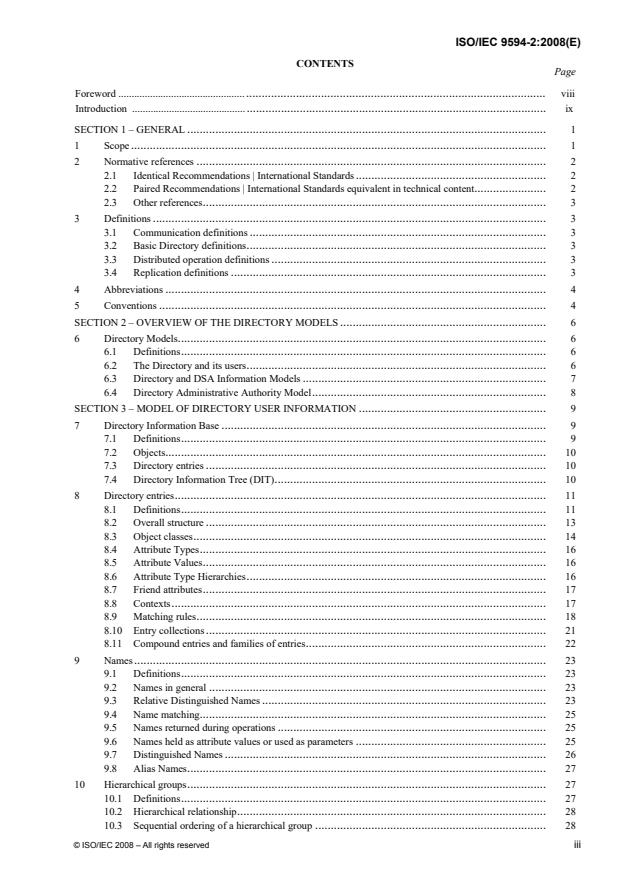
CONTENTS
Page
Foreword . viii
Introduction . ix
SECTION 1 – GENERAL . 1
1 Scope. 1
2 Normative references . 2
2.1 Identical Recommendations | International Standards. 2
2.2 Paired Recommendations | International Standards equivalent in technical content. 2
2.3 Other references. 3
3 Definitions . 3
3.1 Communication definitions . 3
3.2 Basic Directory definitions. 3
3.3 Distributed operation definitions . 3
3.4 Replication definitions . 3
4 Abbreviations . 4
5 Conventions . 4
SECTION 2 – OVERVIEW OF THE DIRECTORY MODELS . 6
6 Directory Models. 6
6.1 Definitions. 6
6.2 The Directory and its users. 6
6.3 Directory and DSA Information Models . 7
6.4 Directory Administrative Authority Model. 8
SECTION 3 – MODEL OF DIRECTORY USER INFORMATION . 9
7 Directory Information Base . 9
7.1 Definitions. 9
7.2 Objects. 10
7.3 Directory entries . 10
7.4 Directory Information Tree (DIT). 10
8 Directory entries. 11
8.1 Definitions. 11
8.2 Overall structure . 13
8.3 Object classes. 14
8.4 Attribute Types. 16
8.5 Attribute Values. 16
8.6 Attribute Type Hierarchies. 16
8.7 Friend attributes. 17
8.8 Contexts. 17
8.9 Matching rules. 18
8.10 Entry collections . 21
8.11 Compound entries and families of entries. 22
9 Names. 23
9.1 Definitions. 23
9.2 Names in general . 23
9.3 Relative Distinguished Names . 23
9.4 Name matching. 25
9.5 Names returned during operations . 25
9.6 Names held as attribute values or used as parameters . 25
9.7 Distinguished Names . 26
9.8 Alias Names. 27
10 Hierarchical groups. 27
10.1 Definitions. 27
10.2 Hierarchical relationship. 28
10.3 Sequential ordering of a hierarchical group . 28
© ISO/IEC 2008 – All rights reserved iii
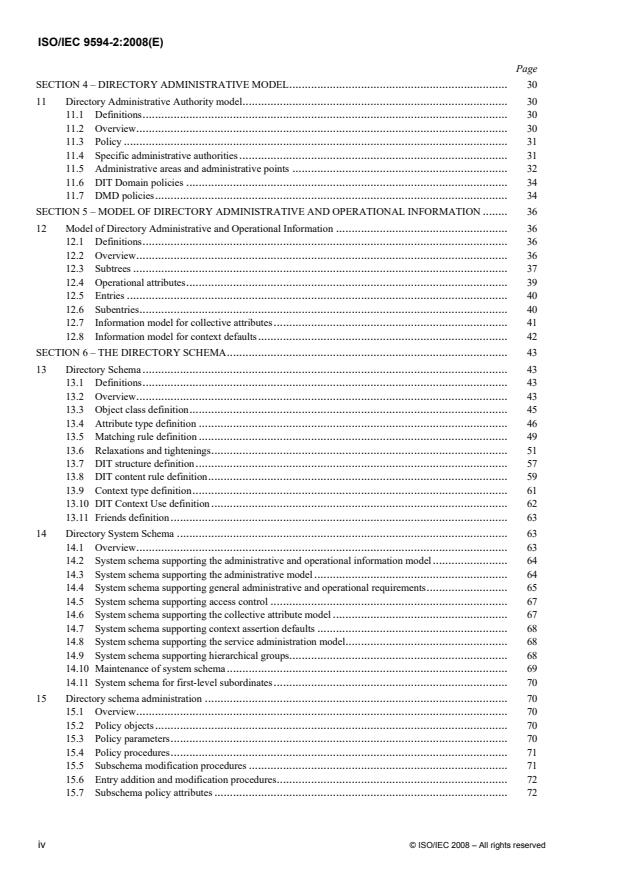
Page
SECTION 4 – DIRECTORY ADMINISTRATIVE MODEL. 30
11 Directory Administrative Authority model. 30
11.1 Definitions. 30
11.2 Overview. 30
11.3 Policy . 31
11.4 Specific administrative authorities. 31
11.5 Administrative areas and administrative points . 32
11.6 DIT Domain policies . 34
11.7 DMD policies. 34
SECTION 5 – MODEL OF DIRECTORY ADMINISTRATIVE AND OPERATIONAL INFORMATION . 36
12 Model of Directory Administrative and Operational Information . 36
12.1 Definitions. 36
12.2 Overview. 36
12.3 Subtrees . 37
12.4 Operational attributes. 39
12.5 Entries . 40
12.6 Subentries. 40
12.7 Information model for collective attributes. 41
12.8 Information model for context defaults. 42
SECTION 6 – THE DIRECTORY SCHEMA. 43
13 Directory Schema . 43
13.1 Definitions. 43
13.2 Overview. 43
13.3 Object class definition. 45
13.4 Attribute type definition . 46
13.5 Matching rule definition . 49
13.6 Relaxations and tightenings. 51
13.7 DIT structure definition. 57
13.8 DIT content rule definition. 59
13.9 Context type definition. 61
13.10 DIT Context Use definition. 62
13.11 Friends definition. 63
14 Directory System Schema . 63
14.1 Overview. 63
14.2 System schema supporting the administrative and operational information model. 64
14.3 System schema supporting the administrative model. 64
14.4 System schema supporting general administrative and operational requirements. 65
14.5 System schema supporting access control . 67
14.6 System schema supporting the collective attribute model . 67
14.7 System schema supporting context assertion defaults . 68
14.8 System schema supporting the service administration model. 68
14.9 System schema supporting hierarchical groups. 68
14.10 Maintenance of system schema. 69
14.11 System schema for first-level subordinates. 70
15 Directory schema administration . 70
15.1 Overview. 70
15.2 Policy objects. 70
15.3 Policy parameters. 70
15.4 Policy procedures. 71
15.5 Subschema modification procedures . 71
15.6 Entry addition and modification procedures. 72
15.7 Subschema policy attributes . 72
iv © ISO/IEC 2008 – All rights reserved
Page
SECTION 7 – DIRECTORY SERVICE ADMINISTRATION . 78
16 Service Administration Model. 78
16.1 Definitions. 78
16.2 Service-type/user-class model. 78
16.3 Service-specific administrative areas. 79
16.4 Introduction to search-rules. 80
16.5 Subfilters. 80
16.6 Filter requirements . 81
16.7 Attribute information selection based on search-rules. 81
16.8 Access control aspects of search-rules. 81
16.9 Contexts aspects of search-rules. 82
16.10 Search-rule specification . 82
16.11 Matching restriction definition. 90
16.12 Search-validation function . 90
SECTION 8 – SECURITY . 91
17 Security model. 91
17.1 Definitions. 91
17.2 Security policies . 91
17.3 Protection of Directory operations . 92
18 Basic Access Control . 93
18.1 Scope and application . 93
18.2 Basic Access Control model. 93
18.3 Access control administrative areas . 95
18.4 Representation of Access Control Information . 98
18.5 ACI operational attributes. 103
18.6 Protecting the ACI. 104
18.7 Access control and Directory operations. 104
18.8 Access Control Decision Function. 104
18.9 Simplified Access Control . 106
19 Rule-based Access Control. 106
19.1 Scope and application . 106
19.2 Rule-based Access Control model . 107
19.3 Access control administrative areas . 107
19.4 Security Label . 107
19.5 Clearance . 109
19.6 Access Control and Directory operations . 109
19.7 Access Control Decision Function. 110
19.8 Use of Rule-based and Basic Access Control. 110
20 Data Integrity in Storage . 110
20.1 Introduction . 110
20.2 Protection of an Entry or Selected Attribute Types. 110
20.3 Context for Protection of a Single Attribute Value. 112
SECTION 9 – DSA MODELS. 113
21 DSA Models. 113
21.1 Definitions. 113
21.2 Directory Functional Model . 113
21.3 Directory Distribution Model . 114
© ISO/IEC 2008 – All rights reserved v
Page
SECTION 10 – DSA INFORMATION MODEL. 116
22 Knowledge. 116
22.1 Definitions. 116
22.2 Introduction . 116
22.3 Knowledge References. 117
22.4 Minimum Knowledge . 119
22.5 First Level DSAs . 120
23 Basic Elements of the DSA Information Model . 120
23.1 Definitions. 120
23.2 Introduction . 120
23.3 DSA Specific Entries and their Names . 121
23.4 Basic Elements . 122
24 Representation of DSA Information . 124
24.1 Representation of Directory User and Operational Information . 124
24.2 Representation of Knowledge References . 125
24.3 Representation of Names and Naming Contexts . 131
SECTION 11 – DSA OPERATIONAL FRAMEWORK. 133
25 Overview. 133
25.1 Definitions. 133
25.2 Introduction . 133
26 Operational bindings . 133
26.1 General . 133
26.2 Application of the operational framework . 134
26.3 States of cooperation. 135
27 Operational binding specification and management. 136
27.1 Operational binding type specification. 136
27.2 Operational binding management . 137
27.3 Operational binding specification templates . 137
28 Operations for operational binding management . 139
28.1 Application-context definition . 139
28.2 Establish Operational Binding operation. 140
28.3 Modify Operational Binding operation . 142
28.4 Terminate Operational Binding operation . 143
28.5 Operational Binding Error. 144
28.6 Operational Binding Management Bind and Unbind . 145
Annex A – Object identifier usage. 146
Annex B – Information Framework in ASN.1. 149
Annex C – SubSchema Administration Schema in ASN.1. 159
Annex D – Service Administration in ASN.1. 163
Annex E – Basic Access Control in ASN.1 . 167
Annex F – DSA Operational Attribute Types in ASN.1 . 171
Annex G – Operational Binding Management in ASN.1 . 174
Annex H – Enhanced security. 178
Annex I – The Mathematics of Trees . 181
Annex J – Name Design Criteria. 182
vi © ISO/IEC 2008 – All rights reserved
Page
Annex K – Examples of various aspects of schema. 184
K.1 Example of an attribute hierarchy. 184
K.2 Example of a subtree specification. 184
K.3 Schema specification . 185
K.4 DIT content rules . 186
K.5 DIT context use . 187
Annex L – Overview of basic access control permissions. 188
L.1 Introduction . 188
L.2 Permissions required for operations . 188
L.3 Permissions affecting error. 189
L.4 Entry level permissions . 189
L.5 Entry level permissions . 190
Annex M – Examples of access control . 192
M.1 Introduction . 192
M.2 Design principles for Basic Access Control. 192
M.3 Introduction to example. 192
M.4 Policy affecting the definition of specific and inner areas. 193
M.5 Policy affecting the definition of DACDs. 195
M.6 Policy expressed in prescriptiveACI attributes . 197
M.7 Policy expressed in subentryACI attributes. 202
M.8 Policy expressed in entryACI attributes . 203
M.9 ACDF examples . 204
M.10 Rule-based Access Control . 206
Annex N – DSE type combinations . 207
Annex O – Modelling of knowledge . 209
Annex P – Names held as attribute values or used as parameters . 214
Annex Q – Subfilters . 215
Annex R – Compound entry name patterns and their use. 216
Annex S – Naming concepts and considerations. 218
S.1 History tells us … . 218
S.2 A new look at name resolution. 218
Annex T – Alphabetical index of definitions. 224
Annex U – Amendments and corrigenda. 226
© ISO/IEC 2008 – All rights reserved vii
Foreword
ISO (the International Organization for Standardization) and IEC (the International Electrotechnical
Commission) form the specialized system for worldwide standardization. National bodies that are members of
ISO or IEC participate in the development of International Standards through technical committees
established by the respective organization to deal with particular fields of technical activity. ISO and IEC
technical committees collaborate in fields of mutual interest. Other international organizations, governmental
and non-governmental, in liaison with ISO and IEC, also take part in the work. In the field of information
technology, ISO and IEC have established a joint technical committee, ISO/IEC JTC 1.
International Standards are drafted in accordance with the rules given in the ISO/IEC Directives, Part 2.
The main task of the joint technical committee is to prepare International Standards. Draft International
Standards adopted by the joint technical committee are circulated to national bodies for voting. Publication as
an International Standard requires approval by at least 75 % of the national bodies casting a vote.
Attention is drawn to the possibility that some of the elements of this document may be the subject of patent
rights. ISO and IEC shall not be held responsible for identifying any or all such patent rights.
Subcommittee SC 6, Telecommunications and information exchange between systems, in collaboration with
ITU-T. The identical text is published as ITU-T Rec. X.501 (11/2008).
This sixth edition of ISO/IEC 9594-2 constitutes a technical revision of ISO/IEC 9594-2:2005, which has been
provisionally retained to maintain alignment with ITU-T Rec. X.501 (08/2005).
ISO/IEC 9594 consists of the following parts, under the general title Information technology — Open Systems
Interconnection — The Directory:
⎯ Part 1: Overview of concepts, models and services
⎯ Part 2: Models
⎯ Part 3: Abstract service definition
⎯ Part 4: Procedures for distributed operation
⎯ Part 5: Protocol specifications
⎯ Part 6: Selected attribute types
⎯ Part 7: Selected object classes
⎯ Part 8: Public-key and attribute certificate frameworks
⎯ Part 9: Replication
⎯ Part 10: Use of systems management for administration of the Directory
viii © ISO/IEC 2008 – All rights reserved
Introduction
This Recommendation | International Standard, together with the other Recommendations | International Standards, has
been produced to facilitate the interconnection of information processing systems to provide directory services. A set of
such systems, together with the directory information that they hold, can be viewed as an integrated whole, called the
Directory. The information held by the Directory, collectively known as the Directory Information Base (DIB), is
typically used to facilitate communication between, with or about objects such as application entities, people, terminals
and distribution lists.
The Directory plays a significant role in Open Systems Interconnection, whose aim is to allow, with a minimum of
technical agreement outside of the interconnection standards themselves, the interconnection of information processing
systems:
– from different manufacturers;
– under different managements;
– of different levels of complexity; and
– of different ages.
This Recommendation | International Standard provides a number of different models for the Directory as a framework
for the other Recommendations in the ITU-T X.500 series | parts of ISO/IEC 9594. The models are the overall
(functional) model; the administrative authority model, generic Directory Information Models providing Directory User
and Administrative User views on Directory information, generic DSA and DSA information models, an Operational
Framework and a security model.
The generic Directory Information Models describe, for example, how information about objects is grouped to form
Directory entries for those objects and how that information provides names for objects.
The generic DSA and DSA information models and the Operational Framework provide support for Directory
distribution.
This Recommendation | International Standard provides a specialization of the generic Directory Information Models to
support Directory Schema administration.
This Recommendation | International Standard provides the foundation frameworks upon which industry profiles can be
defined by other standards groups and industry forums. Many of the features defined as optional in these frameworks
may be mandated for use in certain environments through profiles. This sixth edition technically revises and enhances,
but does not replace, the fifth edition of this Recommendation | International Standard. Implementations may still claim
conformance to the fifth edition. However, at some point, the fifth edition will not be supported (i.e., reported defects
will no longer be resolved). It is recommended that implementations conform to this sixth edition as soon as possible.
This sixth edition specifies versions 1 and 2 of the Directory protocols.
The first and second editions specified only version 1. Most of the services and protocols specified in this edition are
designed to function under version 1. However, some enhanced services and protocols, e.g., signed errors, will not
function unless all Directory entities involved in the operation have negotiated version 2. Whichever version has been
negotiated, differences between the services and between the protocols defined in the six editions, except for those
specifically assigned to version 2, are accommodated using the rules of extensibility defined in ITU-T Rec. X.519 |
ISO/IEC 9594-5.
Annex A, which is an integral part of this Recommendation | International Standard, summarizes the usage of ASN.1
object identifiers in the ITU-T X.500-series Recommendations | parts of ISO/IEC 9594.
Annex B, which is an integral part of this Recommendation | International Standard, provides the ASN.1 module which
contains all of the definitions associated with the information framework.
Annex C, which is an integral part of this Recommendation | International Standard, provides the subschema
administration schema in ASN.1.
Annex D, which is an integral part of this Recommendation | International Standard, provides the ASN.1 module for
Service Administration.
Annex E, which is an integral part of this Recommendation | International Standard, provides the ASN.1 module for
Basic Access Control.
Annex F, which is an integral part of this Recommendation | International Standard, provides the ASN.1 module which
contains all the definitions associated with DSA operational attribute types.
Annex G, which is an integral part of this Recommendation | International Standard, provides the ASN.1 module which
contains all the definitions associated with operational binding management operations.
© ISO/IEC 2008 – All rights reserved ix
Annex H, which is an integral part of this Recommendation | International Standard, provides the ASN.1 module which
contains all the definitions associated with enhanced security.
Annex I, which is not an integral part of this Recommendation | International Standard, summarizes the mathematical
terminology associated with tree structures.
Annex J, which is not an integral part of this Recommendation | International Standard, describes some criteria that can
be considered in designing names.
Annex K, which is not an integral part of this Recommendation | International Standard, provides some examples of
various aspects of Schema.
Annex L, which is not an integral part of this Recommendation | International Standard, provides an overview of the
semantics associated with Basic Access Control permissions.
Annex M, which is not an integral part of this Recommendation | International Standard, provides an extended example
of the use of Basic Access Control.
Annex N, which is not an integral part of this Recommendation | International Standard, describes some DSA specific
entry combinations.
Annex O, which is not an integral part of this Recommendation | International Standard, provides a framework for the
modelling of knowledge.
Annex P, which is not an integral part of this Recommendation | International Standard, describes criteria on whether a
name can be an alternative distinguished name or the primary distinguished name, whether it can contain alternative
values, and whether it can include context information.
Annex Q, which is not an integral part of this Recommendation | International Standard, describes the concept of
subfilters.
Annex R, which is not an integral part of this Recommendation | International Standard, describes recommendations
and examples on how family members can be named.
Annex S, which is not an integral part of this Recommendation | International Standard, gives an introduction to
Naming Concepts and Considerations.
Annex T, which is not an integral part of this Recommendation | International Standard, lists alphabetically the terms
defined in this Recommendation | International Standard.
Annex U, which is not an integral part of this Recommendation | International Standard, lists the amendments and
defect reports that have been incorporated to form this edition of this Recommendation | International Standard.
x © ISO/IEC 2008 – All rights reserved
INTERNATIONAL STANDARD
ITU-T RECOMMENDATION
Information technology – Open Systems Interconnection –
The Directory: Models
SECTION 1 – GENERAL
1 Scope
The models defined in this Recommendation | International Standard provide a conceptual and terminological
framework for the other ITU-T X.500-series Recommendations | parts of ISO/IEC 9594 which define various aspects of
the Directory.
The functional and administrative authority models define ways in which the Directory can be distributed, both
functionally and administratively. Generic DSA and DSA information models and an Operational Framework are also
provided to support Directory distribution.
The generic Directory Information Models describe the logical structure of the DIB from the perspective of Directory
and Administrative Users. In these models, the fact that the Directory is distributed, rather than centralized, is not
visible.
This Recommendation | International Standard provides a specialization of the generic Directory Information Models to
support Directory Schema administration.
The other ITU-T Recommendations in the X.500 series | parts of ISO/IEC 9594 make use of the concepts defined in this
Recommendation | International Standard to define specializations of the generic information and DSA models to
provide specific information, DSA and operational models supporting particular directory capabilities (e.g.,
Replication):
a) the service provided by the Directory is described (in ITU-T Rec. X.511 | ISO/IEC 9594-3) in terms of
the concepts of the information framework: this allows the service provided to be somewhat independent
of the physical distribution of the DIB;
b) the distributed operation of the Directory is specified (in ITU-T Rec. X.518 | ISO/IEC 9594-4) so as to
provide that service, and therefore maintain that logical information structure, given that the DIB is in
fact highly distributed;
c) replication capabilities offered by the component parts of the Directory to improve overall Directory
performance are sp
...
Questions, Comments and Discussion
Ask us and Technical Secretary will try to provide an answer. You can facilitate discussion about the standard in here.
Loading comments...