

ISO 15590-3:2022
(Main)Petroleum and natural gas industries — Factory bends, fittings and flanges for pipeline transportation systems — Part 3: Flanges
General Information
- Abstract
This document specifies the technical requirements for carbon steel and low-alloy steel forged flanges for use in pipeline transportation systems for the petroleum and natural gas industries as defined in ISO 13623. This document applies to weldneck and blind flanges (full face, raised face, and RTJ groove) as well as anchor, swivel-ring flanges and orifice flanges. This document designates those categories of flanges that meet the industry's need to match ISO 3183 pipe. These flanges are for normal and low-temperature service and include supplementary requirements where required for sour service. Materials for, or the attachment of, factory-welded extensions, bolting materials, gaskets, slip-on flanges or flanged fittings are not covered by this document. This document is not applicable to integrally cast or forged flanges for valves, pumps or other equipment. This document does not cover the selection of the flange category or pressure class. Sizes and pressure classes listed in ISO 7005-1 and applicable to this document are as follows: — DN 10 (NPS 1/2) to DN 1500 (NPS 60); — PN 20 (class 150), PN 50 (class 300), PN 100 (class 600), PN 150 (class 900), PN 250 (class 1500), PN 420 (class 2500).
- Status
- Published
- Publication Date
- 20-Mar-2022
- Technical Committee
- ISO/TC 67/SC 2 - Pipeline transportation systems
- Drafting Committee
- ISO/TC 67/SC 2/WG 10 - Pipeline flanges, fittings and shopbends
- Current Stage
- 6060 - International Standard published
- Start Date
- 21-Mar-2022
- Due Date
- 11-Mar-2022
- Completion Date
- 21-Mar-2022


Overview - What ISO 15590-3:2022 covers
ISO 15590-3:2022 specifies technical requirements for carbon steel and low-alloy steel forged flanges used in pipeline transportation systems for the petroleum and natural gas industries (as defined in ISO 13623). The standard applies to weldneck and blind flanges (full face, raised face and RTJ groove), plus anchor, swivel‑ring and orifice flanges intended to match ISO 3183 pipe for normal and low‑temperature service. It includes supplementary requirements for sour service and sets size and pressure‑class ranges in line with ISO 7005‑1 (DN 10/NPS 1/2 to DN 1500/NPS 60; PN 20 to PN 420 / Class 150 to Class 2500).
Note: ISO 15590-3:2022 does not cover bolting, gaskets, slip‑on flanges, factory‑welded extensions, integrally cast/forged flanges for valves or selection of flange category/pressure class.
Key topics and technical requirements
- Scope of materials: carbon and low‑alloy forged steels suitable for pipeline service, including low‑temperature and sour environments.
- Flange types covered: weldneck, blind (full face, raised face, RTJ), anchor, swivel‑ring, and orifice flanges.
- Designation, dimensions & tolerances: flange dimensions and tolerances harmonized with ASME B16.5, B16.36, B16.47 and ANSI/MSS SP‑44 where applicable.
- Manufacturing controls: requirements for starting material, hub manufacture, heat treatment and manufacturing procedure specifications.
- Testing & inspection: chemical analysis, tensile and Charpy V‑notch impact testing, hardness, metallography, HIC/SSC evaluation where required, nondestructive testing (visual, MT/PT, ultrasonic) and hydrostatic testing.
- NDE & personnel: acceptance of international, EN and ASTM NDE standards and ISO 9712 qualification for NDT personnel.
- Documentation & marking: inspection documents, manufacturing record book and marking requirements (aligned with ASME B16.5 practices).
Practical applications - who uses this standard
- Flange manufacturers producing forged pipeline flanges to meet oil & gas transport requirements.
- Pipeline designers and engineers specifying flange materials and inspection criteria for new or replacement sections.
- Procurement and QA/QC teams ensuring supplied flanges comply with ISO 15590‑3 requirements.
- Inspection and NDT personnel executing acceptance testing (MT/PT/UT, hardness, Charpy).
- Operators and integrity teams managing sour service, low‑temperature or high‑pressure pipeline assets.
Related standards
- ISO 13623 (pipeline systems), ISO 3183 (steel pipe), ISO 7005‑1 (steel flanges), ASME B16.5/B16.36/B16.47, ISO 15590 parts 1–2/4, ISO 9712 (NDT personnel), NACE TM standards (HIC/SSC).
Using ISO 15590‑3:2022 helps ensure forged flanges meet industry expectations for safety, interchangeability and traceable testing in petroleum and natural gas pipeline systems.
Relations
- Effective Date
- 23-Apr-2020
Get Certified
Connect with accredited certification bodies for this standard

Element Materials Technology
Materials testing and product certification.

ABS Group Brazil
ABS Group certification services in Brazil.

ABS Quality Evaluations Inc.
American Bureau of Shipping quality certification.
Sponsored listings
Frequently Asked Questions
ISO 15590-3:2022 is a standard published by the International Organization for Standardization (ISO). Its full title is "Petroleum and natural gas industries — Factory bends, fittings and flanges for pipeline transportation systems — Part 3: Flanges". This standard covers: This document specifies the technical requirements for carbon steel and low-alloy steel forged flanges for use in pipeline transportation systems for the petroleum and natural gas industries as defined in ISO 13623. This document applies to weldneck and blind flanges (full face, raised face, and RTJ groove) as well as anchor, swivel-ring flanges and orifice flanges. This document designates those categories of flanges that meet the industry's need to match ISO 3183 pipe. These flanges are for normal and low-temperature service and include supplementary requirements where required for sour service. Materials for, or the attachment of, factory-welded extensions, bolting materials, gaskets, slip-on flanges or flanged fittings are not covered by this document. This document is not applicable to integrally cast or forged flanges for valves, pumps or other equipment. This document does not cover the selection of the flange category or pressure class. Sizes and pressure classes listed in ISO 7005-1 and applicable to this document are as follows: — DN 10 (NPS 1/2) to DN 1500 (NPS 60); — PN 20 (class 150), PN 50 (class 300), PN 100 (class 600), PN 150 (class 900), PN 250 (class 1500), PN 420 (class 2500).
This document specifies the technical requirements for carbon steel and low-alloy steel forged flanges for use in pipeline transportation systems for the petroleum and natural gas industries as defined in ISO 13623. This document applies to weldneck and blind flanges (full face, raised face, and RTJ groove) as well as anchor, swivel-ring flanges and orifice flanges. This document designates those categories of flanges that meet the industry's need to match ISO 3183 pipe. These flanges are for normal and low-temperature service and include supplementary requirements where required for sour service. Materials for, or the attachment of, factory-welded extensions, bolting materials, gaskets, slip-on flanges or flanged fittings are not covered by this document. This document is not applicable to integrally cast or forged flanges for valves, pumps or other equipment. This document does not cover the selection of the flange category or pressure class. Sizes and pressure classes listed in ISO 7005-1 and applicable to this document are as follows: — DN 10 (NPS 1/2) to DN 1500 (NPS 60); — PN 20 (class 150), PN 50 (class 300), PN 100 (class 600), PN 150 (class 900), PN 250 (class 1500), PN 420 (class 2500).
ISO 15590-3:2022 is classified under the following ICS (International Classification for Standards) categories: 75.200 - Petroleum products and natural gas handling equipment. The ICS classification helps identify the subject area and facilitates finding related standards.
ISO 15590-3:2022 has the following relationships with other standards: It is inter standard links to ISO 15590-3:2004. Understanding these relationships helps ensure you are using the most current and applicable version of the standard.
ISO 15590-3:2022 is available in PDF format for immediate download after purchase. The document can be added to your cart and obtained through the secure checkout process. Digital delivery ensures instant access to the complete standard document.
Standards Content (Sample)
INTERNATIONAL ISO
STANDARD 15590-3
Second edition
2022-03
Petroleum and natural gas
industries — Factory bends,
fittings and flanges for pipeline
transportation systems —
Part 3:
Flanges
Industries du pétrole et du gaz naturel — Coudes d'usine, raccords et
brides pour systèmes de transport par conduites —
Partie 3: Brides
Reference number
© ISO 2022
All rights reserved. Unless otherwise specified, or required in the context of its implementation, no part of this publication may
be reproduced or utilized otherwise in any form or by any means, electronic or mechanical, including photocopying, or posting on
the internet or an intranet, without prior written permission. Permission can be requested from either ISO at the address below
or ISO’s member body in the country of the requester.
ISO copyright office
CP 401 • Ch. de Blandonnet 8
CH-1214 Vernier, Geneva
Phone: +41 22 749 01 11
Email: copyright@iso.org
Website: www.iso.org
Published in Switzerland
ii
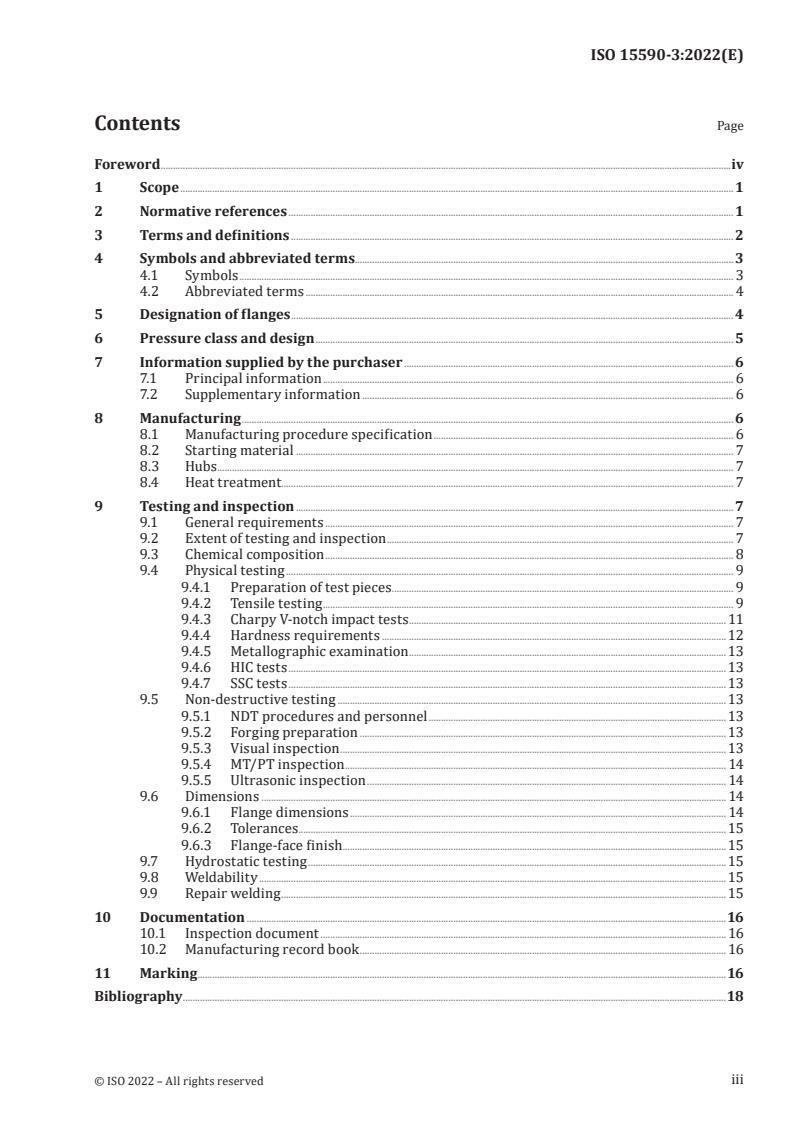
Contents Page
Foreword .iv
1 Scope . 1
2 Normative references . 1
3 Terms and definitions . 2
4 Symbols and abbreviated terms.3
4.1 Symbols . 3
4.2 Abbreviated terms . 4
5 Designation of flanges . 4
6 Pressure class and design . 5
7 Information supplied by the purchaser . 6
7.1 Principal information . 6
7.2 Supplementary information . 6
8 Manufacturing . 6
8.1 Manufacturing procedure specification . 6
8.2 Starting material . 7
8.3 Hubs . . 7
8.4 Heat treatment. 7
9 Testing and inspection .7
9.1 General requirements . 7
9.2 Extent of testing and inspection . 7
9.3 Chemical composition . 8
9.4 Physical testing . 9
9.4.1 Preparation of test pieces . 9
9.4.2 Tensile testing . 9
9.4.3 Charpy V-notch impact tests . 11
9.4.4 Hardness requirements .12
9.4.5 Metallographic examination . 13
9.4.6 HIC tests . 13
9.4.7 SSC tests . 13
9.5 Non-destructive testing . 13
9.5.1 NDT procedures and personnel . 13
9.5.2 Forging preparation . 13
9.5.3 Visual inspection . 13
9.5.4 MT/PT inspection . 14
9.5.5 Ultrasonic inspection . 14
9.6 Dimensions . 14
9.6.1 Flange dimensions . 14
9.6.2 Tolerances . 15
9.6.3 Flange-face finish .15
9.7 Hydrostatic testing .15
9.8 Weldability . 15
9.9 Repair welding . 15
10 Documentation .16
10.1 Inspection document . 16
10.2 Manufacturing record book . 16
11 Marking . .16
Bibliography .18
iii
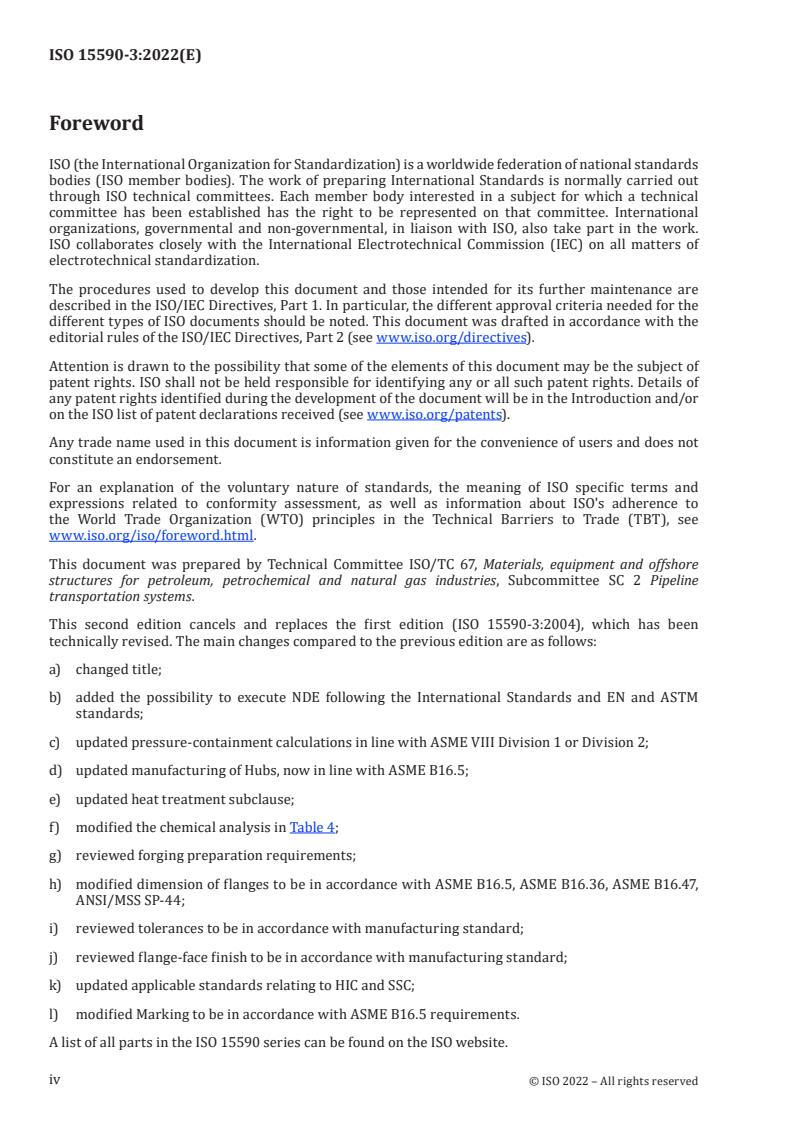
Foreword
ISO (the International Organization for Standardization) is a worldwide federation of national standards
bodies (ISO member bodies). The work of preparing International Standards is normally carried out
through ISO technical committees. Each member body interested in a subject for which a technical
committee has been established has the right to be represented on that committee. International
organizations, governmental and non-governmental, in liaison with ISO, also take part in the work.
ISO collaborates closely with the International Electrotechnical Commission (IEC) on all matters of
electrotechnical standardization.
The procedures used to develop this document and those intended for its further maintenance are
described in the ISO/IEC Directives, Part 1. In particular, the different approval criteria needed for the
different types of ISO documents should be noted. This document was drafted in accordance with the
editorial rules of the ISO/IEC Directives, Part 2 (see www.iso.org/directives).
Attention is drawn to the possibility that some of the elements of this document may be the subject of
patent rights. ISO shall not be held responsible for identifying any or all such patent rights. Details of
any patent rights identified during the development of the document will be in the Introduction and/or
on the ISO list of patent declarations received (see www.iso.org/patents).
Any trade name used in this document is information given for the convenience of users and does not
constitute an endorsement.
For an explanation of the voluntary nature of standards, the meaning of ISO specific terms and
expressions related to conformity assessment, as well as information about ISO's adherence to
the World Trade Organization (WTO) principles in the Technical Barriers to Trade (TBT), see
www.iso.org/iso/foreword.html.
This document was prepared by Technical Committee ISO/TC 67, Materials, equipment and offshore
structures for petroleum, petrochemical and natural gas industries, Subcommittee SC 2 Pipeline
transportation systems.
This second edition cancels and replaces the first edition (ISO 15590-3:2004), which has been
technically revised. The main changes compared to the previous edition are as follows:
a) changed title;
b) added the possibility to execute NDE following the International Standards and EN and ASTM
standards;
c) updated pressure-containment calculations in line with ASME VIII Division 1 or Division 2;
d) updated manufacturing of Hubs, now in line with ASME B16.5;
e) updated heat treatment subclause;
f) modified the chemical analysis in Table 4;
g) reviewed forging preparation requirements;
h) modified dimension of flanges to be in accordance with ASME B16.5, ASME B16.36, ASME B16.47,
ANSI/MSS SP-44;
i) reviewed tolerances to be in accordance with manufacturing standard;
j) reviewed flange-face finish to be in accordance with manufacturing standard;
k) updated applicable standards relating to HIC and SSC;
l) modified Marking to be in accordance with ASME B16.5 requirements.
A list of all parts in the ISO 15590 series can be found on the ISO website.
iv
Any feedback or questions on this document should be directed to the user’s national standards body. A
complete listing of these bodies can be found at www.iso.org/members.html.
v
INTERNATIONAL STANDARD ISO 15590-3:2022(E)
Petroleum and natural gas industries — Factory bends,
fittings and flanges for pipeline transportation systems —
Part 3:
Flanges
1 Scope
This document specifies the technical requirements for carbon steel and low-alloy steel forged flanges
for use in pipeline transportation systems for the petroleum and natural gas industries as defined in
ISO 13623.
This document applies to weldneck and blind flanges (full face, raised face, and RTJ groove) as well as
anchor, swivel-ring flanges and orifice flanges.
This document designates those categories of flanges that meet the industry's need to match
ISO 3183 pipe. These flanges are for normal and low-temperature service and include supplementary
requirements where required for sour service.
Materials for, or the attachment of, factory-welded extensions, bolting materials, gaskets, slip-on
flanges or flanged fittings are not covered by this document.
This document is not applicable to integrally cast or forged flanges for valves, pumps or other equipment.
This document does not cover the selection of the flange category or pressure class. Sizes and pressure
classes listed in ISO 7005-1 and applicable to this document are as follows:
— DN 10 (NPS 1/2) to DN 1500 (NPS 60);
— PN 20 (class 150), PN 50 (class 300), PN 100 (class 600), PN 150 (class 900), PN 250 (class 1500),
PN 420 (class 2500).
2 Normative references
The following documents are referred to in the text in such a way that some or all of their content
constitutes requirements of this document. For dated references, only the edition cited applies. For
undated references, the latest edition of the referenced document (including any amendments) applies.
ISO 148-1, Metallic materials — Charpy pendulum impact test — Part 1: Test method
ISO 377, Steel and steel products — Location and preparation of samples and test pieces for mechanical
testing
ISO 2566-1, Steel — Conversion of elongation values — Part 1: Carbon and low alloy steels
ISO 3183, Petroleum and natural gas industries — Steel pipe for pipeline transportation systems
ISO 4885, Ferrous materials — Heat treatments — Vocabulary
ISO 6892-1, Metallic materials — Tensile testing — Part 1: Method of test at room temperature
ISO 6892-2, Metallic materials — Tensile testing — Part 2: Method of test at elevated temperature
ISO 6507-1:2018, Metallic materials — Vickers hardness test — Part 1: Test method
ISO 7005-1, Pipe flanges — Part 1: Steel flanges for industrial and general service piping systems
ISO/TS 7705:2017, Guidelines for specifying Charpy V-notch impact prescriptions in steel specifications
ISO 9327-1, Steel forgings and rolled or forged bars for pressure purposes — Technical delivery conditions
— Part 1: General requirements
ISO 9712, Non-destructive testing — Qualification and certification of NDT personnel
ISO 10474, Steel and steel products — Inspection documents
ISO 10893-4, Non-destructive testing of steel tubes — Part 4: Liquid penetrant inspection of seamless and
welded steel tubes for the detection of surface imperfections
ISO 10893-5, Non-destructive testing of steel tubes — Part 5: Magnetic particle inspection of seamless and
welded ferromagnetic steel tubes for the detection of surface imperfections
ISO 13623, Petroleum and natural gas industries — Pipeline transportation systems
ISO 15590-1, Petroleum and natural gas industries — Induction bends, fittings and flanges for pipeline
transportation systems — Part 1: Induction bends
ISO 15590-2, Petroleum and natural gas industries — Factory bends, fittings and flanges for pipeline
transportation systems — Part 2: Fittings
ISO 15590-4, Petroleum and natural gas industries — Factory bends, fittings and flanges for pipeline
transportation systems — Part 4: Factory cold bends
EN 10204, Metallic components: Types of inspection documents
EN 10228-1, Non-destructive testing of steel forgings — Part 1: Magnetic particle inspection
EN 10228-2, Non-destructive testing of steel forgings — Part 2: Penetrant testing
ASME BPVC Section VIII-Rules for construction of pressure vessels division 1
ASME BPVC Section VIII-Rules for construction of pressure vessels division 2
ASME B16.5-20, Pipe flanges and flanged fittings — NPS 1/2 through NPS 24
ASME B16.36, Orifice flanges
ASME B16.47, Large diameter steel flange — NPS 26 through NPS 60
ASTM E112, Standard test methods for determining average grain size
ASTM E165, Standard practice for liquid penetrant testing for general industry
ASTM E709, Standard guide for magnetic particle testing
ANSI/MSS SP-44, Steel pipeline flanges
NACE TM 0177-2016-SG, Standard test method — Laboratory testing of metals for resistance to sulfide
stress cracking and stress corrosion cracking in H S environments
NACE TM 0284-2016-SG, Standard test method — Evaluation of pipeline and pressure vessel steels for
resistance to hydrogen-induced cracking
3 Terms and definitions
For the purposes of this document, the following terms and definitions apply.
ISO and IEC maintain terminology databases for use in standardization at the following addresses:
— ISO Online browsing platform: available at https:// www .iso .org/ obp
— IEC Electropedia: available at https:// www .electropedia .org/
3.1
ANSI rating class
numerical pressure design class defined in ASME B16.5 and used for reference purposes
Note 1 to entry: The ANSI rating class is designated by the word “Class” followed by a number.
3.2
by agreement
agreed between manufacturer and purchaser
3.3
heat
batch of steel prepared in one steel-making process
[SOURCE: ISO 15590-1:2018, 3.9, modified]
3.4
imperfection
discontinuity or irregularity in the product wall or on the product surface that is detectable through by
inspection methods
3.5
manufacturing procedure specification
MPS
document that specifies the process control parameters and the acceptance criteria applied for all
manufacturing, inspection and testing activities performed during flange manufacture
[SOURCE: ISO 15590-2:2021, 3.5, modified]
3.6
matching pipe
specified pipe grade and thickness to which the flange will be attached
3.7
pressure class
numerical pressure design class expressed in accordance with either the nominal pressure class or the
ANSI rating class
Note 1 to entry: In this document, the pressure class is stated by the nominal pressure class followed by the ANSI
rating class between brackets.
3.8
test unit
flange or test piece of the same type, starting material, wall thickness, heat, manufacturing procedure
specification, and heat treatment condition
4 Symbols and abbreviated terms
4.1 Symbols
A original cross-sectional area of the parallel length of a test specimen
o
E carbon equivalent
c
P crack measurement parameter (see Table 4)
cm
S sour service
t specified wall thickness at the welding ends for flanges
T minimum design temperature
d,min
T maximum Charpy V-notch test temperature
max
4.2 Abbreviated terms
CE carbon equivalent
DN nominal diameter
HIC hydrogen-induced cracking
HV Vickers hardness
MPS manufacturing procedure specification
MT magnetic particle testing
NDT non-destructive testing
NPS nominal pipe size
PN nominal pressure
RTJ ring type joint
SMYS specified minimum yield strength
SMTS specified minimum tensile strength
SSC sulfide stress cracking
UT ultrasonic testing
5 Designation of flanges
Designation of flanges according to this document, i.e. ISO 15590-3, shall take the form:
ISO 15590-3 YY,
where YY is a textual description of the type of flange designation as specified in Table 1.
Table 1 — Flange designations
Non-sour service Sour service
Temperature, T Flange designa- Temperature, T Flange designa-
d,min d,min
°C tion °C tion
⩾0 (N) ⩾0 (NS)
<0 (L) <0 (LS)
N: normal service
NS: normal sour service
L: low-temperature service
LS: low-temperature sour service
Flanges with a minimum design temperature lower than 0 °C shall demonstrate proven notch toughness
in accordance with Clause 9.
Flanges intended for sour service shall be so specified by the purchaser and meet the applicable
requirements of Clause 9.
6 Pressure class and design
The flange shall be capable of withstanding an internal pressure equal to the working pressure at the
temperature range required. Maximum pressures for the various pressure classes against temperature
are shown in Table 2.
Table 2 — Maximum pressures as a function of temperature
Temperature PN
20 50 100 150 250 420
°C
Class
150 300 600 900 1 500 2 500
MPa (bar) MPa (bar) MPa (bar) M
...