

ISO/IEC 14496-2:2004/Amd 5:2009
(Amendment)Information technology — Coding of audio-visual objects — Part 2: Visual — Amendment 5: Simple studio profile levels 5 and 6
General Information
- Abstract
- Status
- Published
- Publication Date
- 27-May-2009
- Current Stage
- 6060 - International Standard published
- Start Date
- 28-May-2009
- Due Date
- 28-Apr-2011
- Completion Date
- 28-Apr-2011


Overview
ISO/IEC 14496-2:2004/Amd 5:2009 is an important amendment to the international standard ISO/IEC 14496-2, part of the MPEG-4 series focused on the coding of audio-visual objects - specifically Part 2: Visual. Published by ISO and IEC Joint Technical Committee ISO/IEC JTC 1, this amendment introduces enhancements to the Simple Studio Profile by defining new Levels 5 and 6. These levels extend the standard to support higher visual session resolutions and increased bit rate capabilities, targeting professional video production and high-resolution studio environments.
The amendment, released in June 2009, specifies increased capabilities for video motion vector (VMV) size, video coding buffer (VCV) size and decoder rate, video buffering verifier (VBV) buffer size, and bit rate. These enhancements enable support for ultra-high-definition video formats at frame rates that are typical in modern studio productions.
Key Topics
- Simple Studio Profile Enhancement: Defines two new profile levels, Level 5 and Level 6, to accommodate more demanding studio video coding needs.
- Support for 4K Resolutions:
- Level 5 supports 4K x 2K resolution at 24p and 30p frame rates.
- Level 6 supports 4K x 2K resolution at 60p frame rate.
- Higher Bit Rate and Buffer Capacities: Increases maximum allowable video bit rates, buffer sizes, and decoder performance parameters compared to earlier profile levels, enabling efficient handling of large, high-fidelity video data.
- Coding Syntax Corrections: Updates to code syntax and variable length code definitions are included for accurate and consistent implementation.
- Macroblock Number Length Extension: Macroblock identification code length is extended from 14 to 16 bits for improved addressing in very large frame sizes.
- New Start Codes for Levels: Introduces new coded identifiers in the standard to represent Levels 5 and 6 within the Simple Studio Profile.
Applications
This amendment significantly benefits industries and sectors where ultra-high-definition video quality and frame rates are critical, including:
- Professional Video Production: Enables studios producing 4K content at cinematic frame rates to encode and distribute high-quality compressed video streams within the MPEG-4 framework.
- Broadcasting and Post-Production: Supports workflows requiring high-resolution visual coding with smooth frame rates for editing, special effects, and archiving.
- Digital Cinema: Aligns with requirements for digital film distribution, preservation, and playback at standard cinema resolutions and frame rates.
- Media Streaming Services: Assists streaming platforms aiming to deliver high-quality 4K content efficiently while adhering to international standards.
- Video Surveillance and Scientific Imaging: Applicable to systems needing large frame sizes combined with high frame rates and robust compression methods.
The amendment also encourages interoperability among hardware and software devices by providing standardized definitions for encoding, decoding, and buffer management of advanced studio-quality video.
Related Standards
- ISO/IEC 14496-2:2004 (Base Standard): The original edition of MPEG-4 Part 2, defining the core visual coding tools and profiles.
- ISO/IEC 14496 (MPEG-4): The full suite of standards specifying multimedia coding of audio-visual objects across multiple parts.
- ISO/IEC JTC 1/SC 29: The specific subcommittee responsible for developing standards in multimedia coding, including associated amendments and technical reports.
- MPEG Video Standards: Other video coding standards related to MPEG-2, MPEG-4 Part 10 (H.264/AVC), and HEVC relevant to comparison and complementing visual coding technologies.
- ITU-T Recommendations: Such as H.262 and H.263, which focus on video coding and compression techniques alongside MPEG standards.
By adopting ISO/IEC 14496-2:2004/Amd 5:2009, organizations and developers ensure compliance with the latest studio-level enhancements in visual object coding, facilitating future-proof video production and distribution workflows in line with global best practices.
Keywords: ISO/IEC 14496-2 Amendment 5, MPEG-4 Part 2, Simple Studio Profile Levels, 4K video coding, visual object coding standard, studio profile visual coding, video bit rate, video buffering, macroblock coding, ultra-high-definition video standard.
Relations
- Amends
ISO/IEC 14496-2:2004 - Information technology — Coding of audio-visual objects — Part 2: Visual - Effective Date
- 06-Jun-2022
- Child
ISO/IEC 14496-2:2004 - Information technology — Coding of audio-visual objects — Part 2: Visual - Effective Date
- 20-Jun-2008
Get Certified
Connect with accredited certification bodies for this standard

BSI Group
BSI (British Standards Institution) is the business standards company that helps organizations make excellence a habit.

NYCE
Mexican standards and certification body.
Sponsored listings
Frequently Asked Questions
ISO/IEC 14496-2:2004/Amd 5:2009 is a standard published by the International Organization for Standardization (ISO). Its full title is "Information technology — Coding of audio-visual objects — Part 2: Visual — Amendment 5: Simple studio profile levels 5 and 6". This standard covers: Information technology — Coding of audio-visual objects — Part 2: Visual — Amendment 5: Simple studio profile levels 5 and 6
Information technology — Coding of audio-visual objects — Part 2: Visual — Amendment 5: Simple studio profile levels 5 and 6
ISO/IEC 14496-2:2004/Amd 5:2009 is classified under the following ICS (International Classification for Standards) categories: 35.040 - Information coding; 35.040.40 - Coding of audio, video, multimedia and hypermedia information. The ICS classification helps identify the subject area and facilitates finding related standards.
ISO/IEC 14496-2:2004/Amd 5:2009 has the following relationships with other standards: It is inter standard links to ISO/IEC 14496-2:2004; is excused to ISO/IEC 14496-2:2004. Understanding these relationships helps ensure you are using the most current and applicable version of the standard.
ISO/IEC 14496-2:2004/Amd 5:2009 is available in PDF format for immediate download after purchase. The document can be added to your cart and obtained through the secure checkout process. Digital delivery ensures instant access to the complete standard document.
Standards Content (Sample)
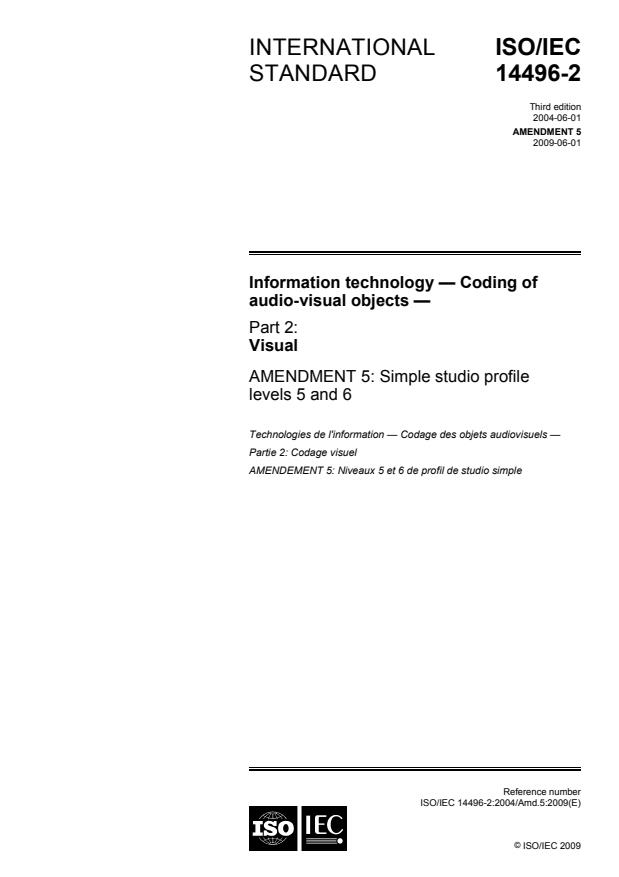
INTERNATIONAL ISO/IEC
STANDARD 14496-2
Third edition
2004-06-01
AMENDMENT 5
2009-06-01
Information technology — Coding of
audio-visual objects —
Part 2:
Visual
AMENDMENT 5: Simple studio profile
levels 5 and 6
Technologies de l'information — Codage des objets audiovisuels —
Partie 2: Codage visuel
AMENDEMENT 5: Niveaux 5 et 6 de profil de studio simple
Reference number
ISO/IEC 14496-2:2004/Amd.5:2009(E)
©
ISO/IEC 2009
ISO/IEC 14496-2:2004/Amd.5:2009(E)
PDF disclaimer
This PDF file may contain embedded typefaces. In accordance with Adobe's licensing policy, this file may be printed or viewed but
shall not be edited unless the typefaces which are embedded are licensed to and installed on the computer performing the editing. In
downloading this file, parties accept therein the responsibility of not infringing Adobe's licensing policy. The ISO Central Secretariat
accepts no liability in this area.
Adobe is a trademark of Adobe Systems Incorporated.
Details of the software products used to create this PDF file can be found in the General Info relative to the file; the PDF-creation
parameters were optimized for printing. Every care has been taken to ensure that the file is suitable for use by ISO member bodies. In
the unlikely event that a problem relating to it is found, please inform the Central Secretariat at the address given below.
© ISO/IEC 2009
All rights reserved. Unless otherwise specified, no part of this publication may be reproduced or utilized in any form or by any means,
electronic or mechanical, including photocopying and microfilm, without permission in writing from either ISO at the address below or
ISO's member body in the country of the requester.
ISO copyright office
Case postale 56 • CH-1211 Geneva 20
Tel. + 41 22 749 01 11
Fax + 41 22 749 09 47
E-mail copyright@iso.org
Web www.iso.org
Published in Switzerland
ii © ISO/IEC 2009 – All rights reserved
ISO/IEC 14496-2:2004/Amd.5:2009(E)
Foreword
ISO (the International Organization for Standardization) and IEC (the International Electrotechnical
Commission) form the specialized system for worldwide standardization. National bodies that are members of
ISO or IEC participate in the development of International Standards through technical committees
established by the respective organization to deal with particular fields of technical activity. ISO and IEC
technical committees collaborate in fields of mutual interest. Other international organizations, governmental
and non-governmental, in liaison with ISO and IEC, also take part in the work. In the field of information
technology, ISO and IEC have established a joint technical committee, ISO/IEC JTC 1.
International Standards are drafted in accordance with the rules given in the ISO/IEC Directives, Part 2.
The main task of the joint technical committee is to prepare International Standards. Draft International
Standards adopted by the joint technical committee are circulated to national bodies for voting. Publication as
an International Standard requires approval by at least 75 % of the national bodies casting a vote.
Attention is drawn to the possibility that some of the elements of this document may be the subject of patent
rights. ISO and IEC shall not be held responsible for identifying any or all such patent rights.
Amendment 5 to ISO/IEC 14496-2:2004 was prepared by Joint Technical Committee ISO/IEC JTC 1,
Information technology, Subcommittee SC 29, Coding of audio, picture, multimedia and hypermedia
information.
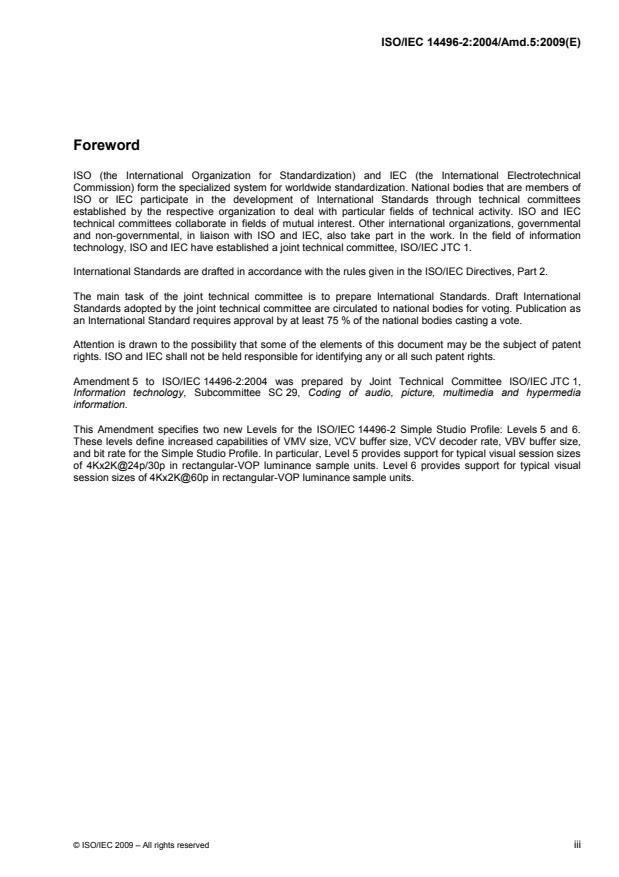
This Amendment specifies two new Levels for the ISO/IEC 14496-2 Simple Studio Profile: Levels 5 and 6.
These levels define increased capabilities of VMV size, VCV buffer size, VCV decoder rate, VBV buffer size,
and bit rate for the Simple Studio Profile. In particular, Level 5 provides support for typical visual session sizes
of 4Kx2K@24p/30p in rectangular-VOP luminance sample units. Level 6 provides support for typical visual
session sizes of 4Kx2K@60p in rectangular-VOP luminance sample units.
© ISO/IEC 2009 – All rights reserved iii
ISO/IEC 14496-2:2004/Amd.5:2009(E)
Information technology — Coding of audio-visual objects —
Part 2:
Visual
AMENDMENT 5: Simple studio profile levels 5 and 6
In 5.2.9, replace:
while
...