

ISO 4301-5:1991
(Main)Cranes — Classification — Part 5: Overhead travelling and portal bridge cranes
General Information
- Abstract
Establishes the classification of cranes based on the number of operating cycles to be carried out during the expected life of the appliance and its mechanisms, and a load spectrum factor which represents the nominal state of loading.
- Status
- Withdrawn
- Publication Date
- 11-Sep-1991
- Technical Committee
- ISO/TC 96/SC 9 - Bridge and gantry cranes
- Drafting Committee
- ISO/TC 96/SC 9 - Bridge and gantry cranes
- Current Stage
- 9599 - Withdrawal of International Standard
- Start Date
- 21-Jan-2025
- Completion Date
- 29-Aug-2026
Buy Documents


ISO 4301-5:1991 - Cranes — Classification — Part 5: Overhead travelling and portal bridge cranes Released:9/12/1991


ISO 4301-5:1991 - Appareils de levage a charge suspendue — Classification — Partie 5: Ponts roulants et ponts portiques
Overview
ISO 4301-5:1991 - "Cranes - Classification - Part 5: Overhead travelling and portal bridge cranes" defines how to classify overhead travelling and portal (bridge) cranes by their expected lifetime usage. The standard establishes classification criteria based on the number of operating cycles a crane (and its mechanisms) will perform over its life and a load spectrum factor that represents the nominal state of loading. ISO 4301-5 is part of the ISO 4301 series and refers to ISO 4301-1 for general classification principles.
Key topics and requirements
- Classification principle: Cranes are classified by expected operating cycles (duty) and by a load spectrum factor indicating typical loading conditions.
- Appliance vs mechanisms: The standard distinguishes classification of the crane as a whole (appliance) and of individual mechanisms (hoist, travelling, traversing).
- Class codes: Guidance uses grouped class codes (for example, A1–A8 for appliances and M1–M8 for mechanisms) to indicate increasing duty and loading severity.
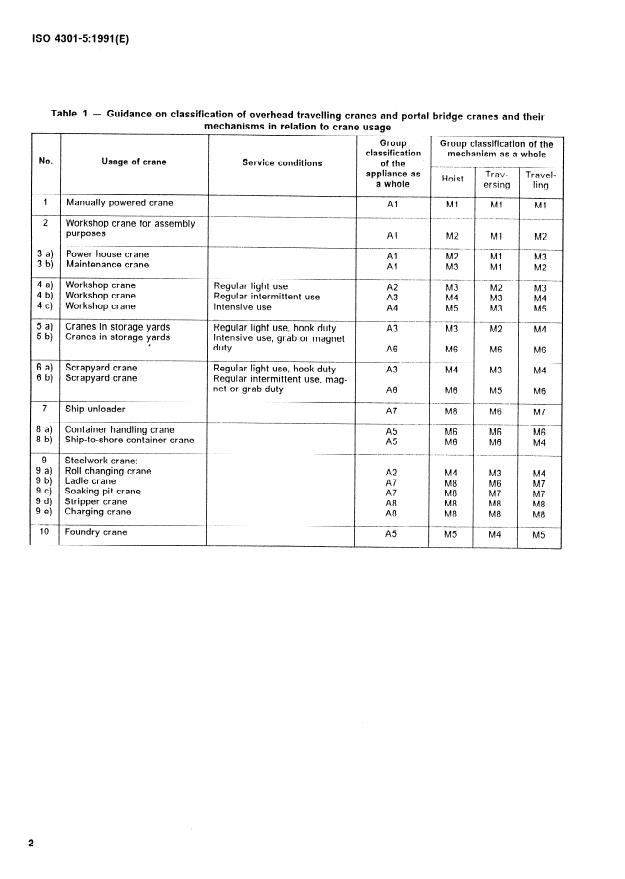
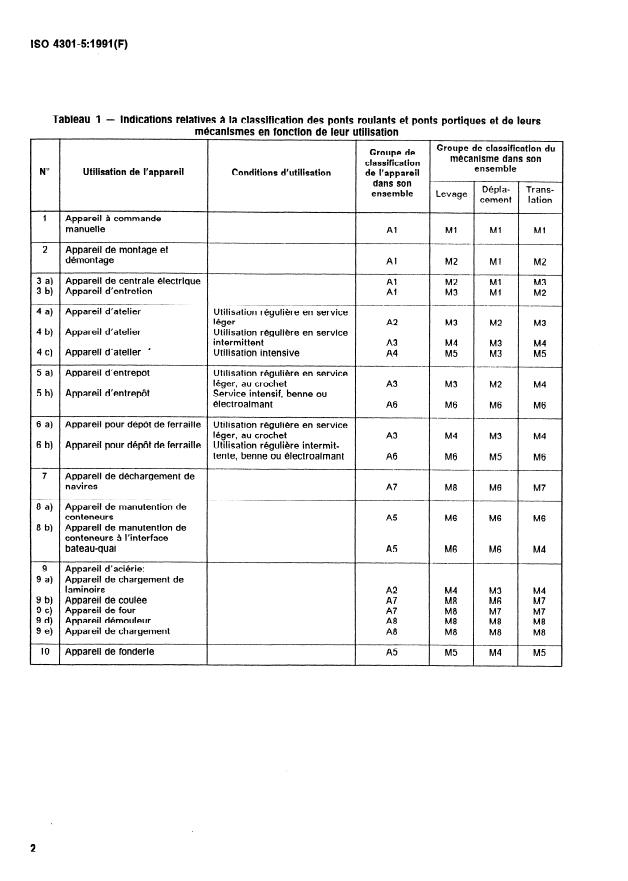
- Usage-based guidance: The standard supplies a table mapping typical crane usages (workshop, powerhouse, scrapyard, container handling, ship-to-shore, steelworks, foundry, etc.) to recommended classification codes.
- Normative reference: ISO 4301-1 is normative for general rules on classification; users should apply the most recent editions where appropriate.
- Minimum approach: When actual duty or loading state is unknown, the classification in ISO 4301-5 should be treated as a minimum requirement.
Applications and who uses it
ISO 4301-5 is practical for anyone involved in crane selection, design, procurement, safety and maintenance:
- Crane manufacturers and designers use it to size components and select materials consistent with expected duty classes.
- Plant engineers and maintenance managers apply classifications to plan inspection and maintenance regimes and to set lifecycle expectations.
- Procurement and specification writers reference the standard to specify duty class requirements in tender documents and contracts.
- Safety professionals and regulators use classification to assess operational risk and ensure compliance with design-intent service conditions.
- Classification societies and consultants apply it when certifying equipment for specific industrial uses (e.g., ports, steelworks, foundries).
Related standards
- ISO 4301-1 - Classification: General rules and definitions (normative reference for Part 5).
- Other parts of ISO 4301 address mobile cranes, tower cranes and jib cranes (Parts 2–4) and provide consistent duty-classification across crane types.
Keywords: ISO 4301-5, crane classification, overhead travelling crane, portal bridge crane, load spectrum factor, operating cycles, crane duty classification, crane standards.
Relations
- Effective Date
- 29-Oct-2022
Buy Documents
ISO 4301-5:1991 - Cranes — Classification — Part 5: Overhead travelling and portal bridge cranes Released:9/12/1991
ISO 4301-5:1991 - Appareils de levage a charge suspendue — Classification — Partie 5: Ponts roulants et ponts portiques
Frequently Asked Questions
ISO 4301-5:1991 is a standard published by the International Organization for Standardization (ISO). Its full title is "Cranes — Classification — Part 5: Overhead travelling and portal bridge cranes". This standard covers: Establishes the classification of cranes based on the number of operating cycles to be carried out during the expected life of the appliance and its mechanisms, and a load spectrum factor which represents the nominal state of loading.
Establishes the classification of cranes based on the number of operating cycles to be carried out during the expected life of the appliance and its mechanisms, and a load spectrum factor which represents the nominal state of loading.
ISO 4301-5:1991 is classified under the following ICS (International Classification for Standards) categories: 53.020.20 - Cranes. The ICS classification helps identify the subject area and facilitates finding related standards.
ISO 4301-5:1991 has the following relationships with other standards: It is inter standard links to ISO 4301-5:2025. Understanding these relationships helps ensure you are using the most current and applicable version of the standard.
ISO 4301-5:1991 is available in PDF format for immediate download after purchase. The document can be added to your cart and obtained through the secure checkout process. Digital delivery ensures instant access to the complete standard document.
Standards Content (Sample)
INTERNATIONAL
STANDARD
First edi tion
1991-09-15
Cranes
- Classification -
Part 5:
Overhead travelling and Portal bridge cranes
Appareils de levage a charqe suspendrle - Classification -
s.
Partie 5: Ponts roulants et ponts portiques
ZE-_ ~-~----~
__~ _~--__-- ----_ . ---_- - .--.------- - _. --__
-__----~
---- --
Reference nurnber
ISO 4301~5:1991(E)
ISO 4301=5:1991(E)
Foreword
ISO (the International Organization for Standardization) is a worldwide
federation of national Standards bodies (ISO member bodies). The work
of preparing International Standards is normally carried out through ISO
technical committees. Esch member body interested in a subject for
which a technical committee has been established has the right to be
represented on that comrnittee. International organizations, govern-
mental and non-governmental, in liaison with ISO, also take part in the
work. ISO collaborates closely with the International Electrotechnical
Commission (IEC) on all ‘matters of electrotechnical standardization.
Draft International Standards adopted by the technical committees are
circulated to the member bodies for voting. Publication as an Inter-
national Standard requires approval by at least 75 % of the member
bodies casting a vote.
International Standard ISO 4301-5 was prepared by Technical Committee
ISO/TC 96, Cranes, Sub-Committee SC 9. Bridge and gantry cranes.
ISO 4301 consists of the followinq park, under the general title
.-
- Classifka tion:
Cranes
-- Part I: Genera1
- Part 2: Mobile cranes
- Part 3: Tower cranes
- Part 4: Jib cranes
- Part 5: Overhead travelling and portal bridge cranes
0 ISO 1991
All rights reserved. No part of this publication may be reproduced or utilized in any form
or by any means, electronie or mechanical, inciuding photocopying and microfilm, without
Permission in writing from the publisher.
International Orga nization for Standardiz ation
Case Postale 56 l Switzer Iand
CH-l 21 1 Geneve 20 l
Printed in Switzerland
ii
ISO 4301~5:1991(E)
INTERNATIONAL STANDARD
- Classification -
Cranes
Part 5:
Overhead travelling and portal bridge cranes
tion of the Standard indicated below. Members of
1 Scope
IEC and ISO maintain registers of currently valid
International Standards.
This part of ISO 4301 establishes the classification
of overhead travelling cranes and Portal bridge
ISO 4301-1:1986, Cr-alles and lifting appliances -
cranes based on the number of operating cycles to
Classification - Part 1: General.
be carried out during the expected life of the ap-
pliance and its mechanisms, and a load spectrum
factor which represents the nominal state of loading.
3 Classification
The crane as a whole and its mechanisms shall be
2 Normative reference
classified in accordance with ISO 4301-1.
The following Standard contains provisions which,
Guidance as to typical classifications for overhead
through reference in this text, constitu
...
NORME
4301-5
INTERNATIONALE
Première édition
1991-09-M
--- -II--_-
-- -----_.-- -----.----_. ---.-- -.-- -.-. -.---_- _._. rzzL_---.
Appareils de levage à charge suspendue -
Classification -
Partie 5:
Ponts roulants et ponts portiques
Cranes - Classification -
Part 5: Overhead travelling and porta1 bridge cranes
w- --
Numéro de référence
--
-.- - -------_- ISO 4301-5:1991(F)
- .--. - _ . ._. -
ISO 4301=5:1991(F)
Avant-propos
L’ISO (Organisation internationale de normalisation) est une fédération
mondiale d’organismes nationaux de normalisation (comités membres
de I’ISO). L’élaboration des Normes internationales est en général
confiée aux comités techniques de I’ISO. Chaque comité membre inté-
ressé par une étude a le droit de faire partie du comité technique créé
à cet effet. Les organisations internationales, gouvernementales et non
gouvernementales, en liaison avec I’ISO participent également aux tra-
vaux. LIS0 collabore étroitement avec la Commission électrotechnique
internationale (CEI) en ce qui concerne la normalisation électrotech-
nique.
Les projets de Normes internationales adoptés par les comités techni-
ques sont soumis aux comités membres pour vote. Leur publication
comme Normes internationales requiert l’approbation de 75 % au moins
des comités membres votants.
La Norme internationale ISO 4301-S a été élaborée par le comité tech-
nique ISO/TC 96, Appareils de levage à charge suspendue, sous-comité
SC 9, Ponts et portiques roulants.
L’ISO 4301 comprend les parties suivantes, présentées sous le titre gé-
néral Appareils de levage à charge suspendue -- Classification:
- Partie 1: Généralités
- Partie 2: Grues mobiles
- Partie 3: Grues à tour
- Partie 4: Grues à flèche
- Partie 5: Ponts roulants et ponts portiques
0 ISO 1993
Droits de reproduction réservés. Aucune partie de cette publication ne peut être repro-
duite ni utilisée sous quelque forme que ce soit et par aucun procédé, électronique ou
mécanique, y compris la photocopie et les microfilms, sans l’accord écrit de l’éditeur.
Organisation internationale de normalisation
Case Postale 56 l CH-121 1 Genève 20 + Suisse
Imprimé en Suisse
ii
ISO 430-l-5:1 991 (F)
NORME INTERNATIONALE
Appareils de levage à charge suspendue - Classification -
Partie 5:
Ponts roulants et ponts portiques
bres de la CEI et de I’ISO possèdent le registre des
1 Domaine d’application
Normes internationales en vigueur à un moment
donné.
La présente partie de I’ISO 4301 établit la classi-
fication des ponts roulants et ponts portiques, basée
ISO 430%1:1986, Grues et appareils de levage -
sur le nombre de cycles de manoeuvre à effectuer
Classification - Partie 1: Généralités.
pendant la durée de vie prévue de l’appareil et de
ses mécanismes, ainsi que le coefficient du spectre
des charges représentant l’état de charge nominal.
3 Classification
L’appareil dans son ensemble ainsi que ses méca-
2 Référence normative
nismes doivent être classés conformément à
I’ISO 4301-I.
La norme suivante contient des dispositions qui,
...