


ISO/IEC 24759:2017
(Main)Information technology — Security techniques — Test requirements for cryptographic modules
Information technology — Security techniques — Test requirements for cryptographic modules
ISO/IEC 24759:2017 specifies the methods to be used by testing laboratories to test whether the cryptographic module conforms to the requirements specified in ISO/IEC 19790:2012. The methods are developed to provide a high degree of objectivity during the testing process and to ensure consistency across the testing laboratories. This document also specifies the requirements for information that vendors provide to testing laboratories as supporting evidence to demonstrate their cryptographic modules' conformity to the requirements specified in ISO/IEC 19790:2012. Vendors can use this document as guidance in trying to verify whether their cryptographic modules satisfy the requirements specified in ISO/IEC 19790:2012 before they apply to the testing laboratory for testing.
Technologies de l'information — Techniques de sécurité — Exigences d'essai pour modules cryptographiques
General Information
- Status
- Withdrawn
- Publication Date
- 03-Apr-2017
- Current Stage
- 9599 - Withdrawal of International Standard
- Start Date
- 26-Feb-2025
- Completion Date
- 12-Feb-2026
Relations
- Effective Date
- 09-Feb-2026
- Effective Date
- 06-Jun-2022
- Effective Date
- 10-Dec-2016
Overview
ISO/IEC 24759:2017 - Information technology - Security techniques - Test requirements for cryptographic modules - defines the standardized test methods and evidence requirements used by testing laboratories to determine whether a cryptographic module conforms to the security requirements in ISO/IEC 19790:2012. The standard is intended to provide objective, repeatable test procedures and to ensure consistent results across laboratories. It also specifies what vendors must supply as supporting evidence and can be used by vendors as pre-test guidance.
Key topics and technical requirements
ISO/IEC 24759:2017 organizes testing around the security areas defined in ISO/IEC 19790 and maps those requirements into explicit testable assertions and vendor/tester actions. Major topics covered include:
- Assertions and test structure
- Security requirements are broken into assertions (AS...). Each assertion lists applicable security levels and is followed by vendor evidence (VE...) and tester (TE...) requirements.
- Cryptographic module specification
- Includes tests for module type, cryptographic boundary, and operational modes.
- Interfaces, roles, services and authentication
- Test methods for module interfaces, trusted channels, role-based services and authentication mechanisms.
- Software/firmware and operational environment
- Examination and testing of firmware integrity and operational environment constraints (modifiable vs non‑modifiable).
- Physical and non-invasive security
- Tests for physical embodiments, tamper resistance and non-invasive attack mitigation.
- Sensitive security parameter (SSP) management
- Requirements and tests for random bit generators, key generation, storage, entry/output, and zeroisation.
- Self-tests and life‑cycle assurance
- Pre-operational and conditional self-tests, development and configuration management, vendor testing, delivery, operation and end-of-life considerations.
- Documentation and supporting evidence
- Specific vendor documentation required to demonstrate conformity (design, test vectors, procedures).
- Mapping to security levels
- Assertions specify which security levels (1–4) they apply to, guiding scope and rigor of testing.
Practical applications and users
ISO/IEC 24759:2017 is used by:
- Testing laboratories and certification bodies to execute objective cryptographic module testing and produce consistent conformity assessments.
- Vendors and product developers as a pre-test checklist and to prepare the required vendor evidence and documentation prior to formal evaluation.
- Procurement officers and security architects to understand what certified cryptographic modules have been tested against and which security levels apply.
- Regulators and auditors seeking standardized test evidence for cryptographic module compliance.
Related standards
- ISO/IEC 19790:2012 - Security requirements for cryptographic modules (normative reference and the primary requirements tested by ISO/IEC 24759).
- Prepared by ISO/IEC JTC 1/SC 27 (Information security techniques).
Keywords: ISO/IEC 24759:2017, cryptographic modules, cryptographic module testing, security requirements, ISO/IEC 19790, testing laboratories, vendor evidence, conformity assessment.
Get Certified
Connect with accredited certification bodies for this standard

BSI Group
BSI (British Standards Institution) is the business standards company that helps organizations make excellence a habit.

Bureau Veritas
Bureau Veritas is a world leader in laboratory testing, inspection and certification services.

DNV
DNV is an independent assurance and risk management provider.
Sponsored listings
Frequently Asked Questions
ISO/IEC 24759:2017 is a standard published by the International Organization for Standardization (ISO). Its full title is "Information technology — Security techniques — Test requirements for cryptographic modules". This standard covers: ISO/IEC 24759:2017 specifies the methods to be used by testing laboratories to test whether the cryptographic module conforms to the requirements specified in ISO/IEC 19790:2012. The methods are developed to provide a high degree of objectivity during the testing process and to ensure consistency across the testing laboratories. This document also specifies the requirements for information that vendors provide to testing laboratories as supporting evidence to demonstrate their cryptographic modules' conformity to the requirements specified in ISO/IEC 19790:2012. Vendors can use this document as guidance in trying to verify whether their cryptographic modules satisfy the requirements specified in ISO/IEC 19790:2012 before they apply to the testing laboratory for testing.
ISO/IEC 24759:2017 specifies the methods to be used by testing laboratories to test whether the cryptographic module conforms to the requirements specified in ISO/IEC 19790:2012. The methods are developed to provide a high degree of objectivity during the testing process and to ensure consistency across the testing laboratories. This document also specifies the requirements for information that vendors provide to testing laboratories as supporting evidence to demonstrate their cryptographic modules' conformity to the requirements specified in ISO/IEC 19790:2012. Vendors can use this document as guidance in trying to verify whether their cryptographic modules satisfy the requirements specified in ISO/IEC 19790:2012 before they apply to the testing laboratory for testing.
ISO/IEC 24759:2017 is classified under the following ICS (International Classification for Standards) categories: 35.030 - IT Security. The ICS classification helps identify the subject area and facilitates finding related standards.
ISO/IEC 24759:2017 has the following relationships with other standards: It is inter standard links to EN ISO/IEC 19896-2:2023, ISO/IEC 24759:2025, ISO/IEC 24759:2014. Understanding these relationships helps ensure you are using the most current and applicable version of the standard.
ISO/IEC 24759:2017 is available in PDF format for immediate download after purchase. The document can be added to your cart and obtained through the secure checkout process. Digital delivery ensures instant access to the complete standard document.
Standards Content (Sample)
INTERNATIONAL ISO/IEC
STANDARD 24759
Third edition
2017-03
Information technology — Security
techniques — Test requirements for
cryptographic modules
Technologies de l’information — Techniques de sécurité — Exigences
d’essai pour modules cryptographiques
Reference number
©
ISO/IEC 2017
© ISO/IEC 2017, Published in Switzerland
All rights reserved. Unless otherwise specified, no part of this publication may be reproduced or utilized otherwise in any form
or by any means, electronic or mechanical, including photocopying, or posting on the internet or an intranet, without prior
written permission. Permission can be requested from either ISO at the address below or ISO’s member body in the country of
the requester.
ISO copyright office
Ch. de Blandonnet 8 • CP 401
CH-1214 Vernier, Geneva, Switzerland
Tel. +41 22 749 01 11
Fax +41 22 749 09 47
copyright@iso.org
www.iso.org
ii © ISO/IEC 2017 – All rights reserved
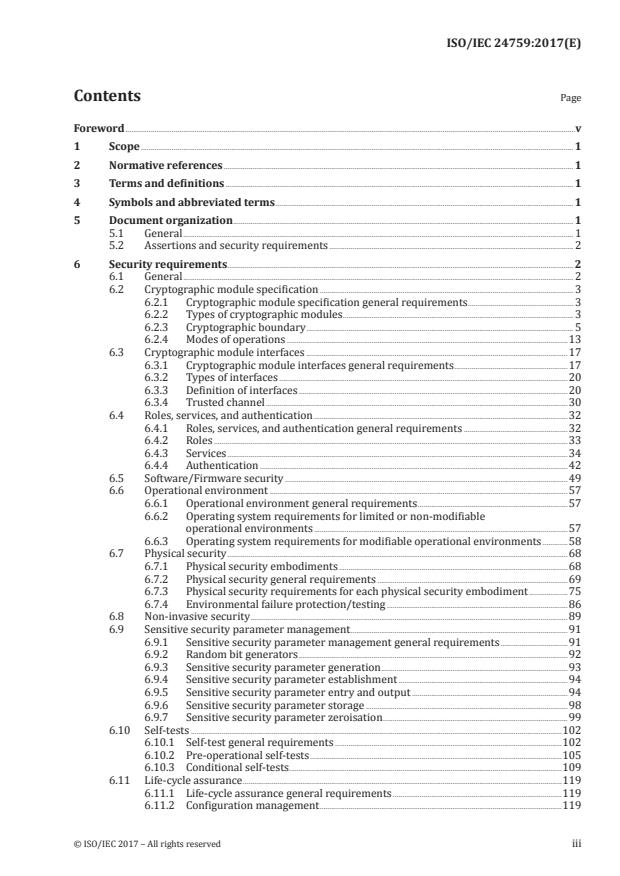
Contents Page
Foreword .v
1 Scope . 1
2 Normative references . 1
3 Terms and definitions . 1
4 Symbols and abbreviated terms . 1
5 Document organization . 1
5.1 General . 1
5.2 Assertions and security requirements . 2
6 Security requirements . 2
6.1 General . 2
6.2 Cryptographic module specification . 3
6.2.1 Cryptographic module specification general requirements . 3
6.2.2 Types of cryptographic modules . 3
6.2.3 Cryptographic boundary . 5
6.2.4 Modes of operations .13
6.3 Cryptographic module interfaces .17
6.3.1 Cryptographic module interfaces general requirements .17
6.3.2 Types of interfaces .20
6.3.3 Definition of interfaces .20
6.3.4 Trusted channel .30
6.4 Roles, services, and authentication .32
6.4.1 Roles, services, and authentication general requirements .32
6.4.2 Roles .33
6.4.3 Services .34
6.4.4 Authentication .42
6.5 Software/Firmware security .49
6.6 Operational environment .57
6.6.1 Operational environment general requirements .57
6.6.2 Operating system requirements for limited or non-modifiable
operational environments .57
6.6.3 Operating system requirements for modifiable operational environments .58
6.7 Physical security .68
6.7.1 Physical security embodiments .68
6.7.2 Physical security general requirements .69
6.7.3 Physical security requirements for each physical security embodiment .75
6.7.4 Environmental failure protection/testing .86
6.8 Non-invasive security .89
6.9 Sensitive security parameter management .91
6.9.1 Sensitive security parameter management general requirements .91
6.9.2 Random bit generators .92
6.9.3 Sensitive security parameter generation .93
6.9.4 Sensitive security parameter establishment .94
6.9.5 Sensitive security parameter entry and output .94
6.9.6 Sensitive security parameter storage .98
6.9.7 Sensitive security parameter zeroisation .99
6.10 Self-tests .102
6.10.1 Self-test general requirements .102
6.10.2 Pre-operational self-tests .105
6.10.3 Conditional self-tests.109
6.11 Life-cycle assurance .119
6.11.1 Life-cycle assurance general requirements .119
6.11.2 Configuration management .119
© ISO/IEC 2017 – All rights reserved iii
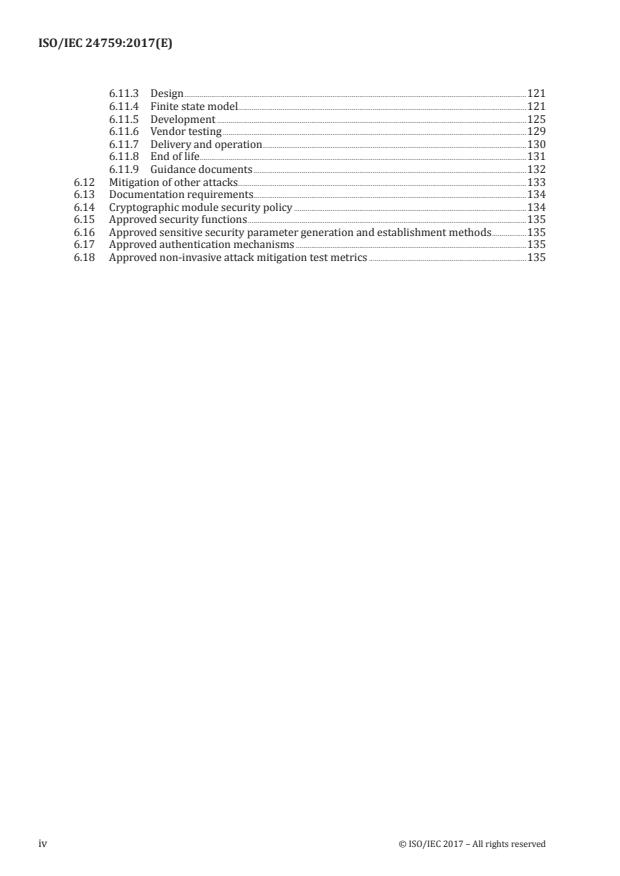
6.11.3 Design .121
6.11.4 Finite state model.121
6.11.5 Development .125
6.11.6 Vendor testing .129
6.11.7 Delivery and operation .130
6.11.8 End of life .131
6.11.9 Guidance documents .132
6.12 Mitigation of other attacks .133
6.13 Documentation requirements.134
6.14 Cryptographic module security policy .134
6.15 Approved security functions .135
6.16 Approved sensitive security parameter generation and establishment methods .135
6.17 Approved authentication mechanisms .135
6.18 Approved non-invasive attack mitigation test metrics .135
iv © ISO/IEC 2017 – All rights reserved
Foreword
ISO (the International Organization for Standardization) and IEC (the International Electrotechnical
Commission) form the specialized system for worldwide standardization. National bodies that are
members of ISO or IEC participate in the development of International Standards through technical
committees established by the respective organization to deal with particular fields of technical
activity. ISO and IEC technical committees collaborate in fields of mutual interest. Other international
organizations, governmental and non-governmental, in liaison with ISO and IEC, also take part in the
work. In the field of information technology, ISO and IEC have established a joint technical committee,
ISO/IEC JTC 1.
The procedures used to develop this document and those intended for its further maintenance are
described in the ISO/IEC Directives, Part 1. In particular the different approval criteria needed for the
different types of ISO documents should be noted. This document was drafted in accordance with the
editorial rules of the ISO/IEC Directives, Part 2 (see www .iso .org/ directives).
Attention is drawn to the possibility that some of the elements of this document may be the subject of
patent rights. ISO shall not be held responsible for identifying any or all such patent rights. Details of
any patent rights identified during the development of the document will be in the Introduction and/or
on the ISO list of patent declarations received (see www .iso .org/ patents).
Any trade name used in this document is information given for the convenience of users and does not
constitute an endorsement.
For an explanation on the voluntary nature of standards, the meaning of ISO specific terms and
expressions related to conformity assessment, as well as information about ISO’s adherence to the
World Trade Organization (WTO) principles in the Technical Barriers to Trade (TBT) see the following
URL: w w w . i s o .org/ iso/ foreword .html.
This document was prepared by ISO/IEC JTC 1, Information technology, Subcommittee SC 27, IT Security
techniques.
This third edition cancels and replaces the second edition (ISO/IEC 24759:2014), of which it constitutes
a minor revision. It also incorporates the Technical Corrigendum ISO/IEC 24759:2014/Cor.1:2015.
The main changes compared to the previous edition (plus other minor editorial modifications) are as
follows:
— References to ISO/IEC 19790:2012 have been corrected throughout:
— 6.2.3.2: AS02.15, AS02.16, AS02.17 and AS02.18 modified;
— 6.3.3: AS03.04, AS03.07, AS03.10 and AS03.15 modified;
— 6.3.4: AS03.19 modified;
— 6.4.1: AS04.02 modified;
— 6.4.2; AS04.05, AS04.06 and AS04.07 modified;
— 6.4.3.1: AS04.11, AS04.13 and AS04.14;
— 6.4.3.2 and AS04.20;
— 6.4.4: AS04.39, AS04.40 and AS04.42 modified;
— 6.5: AS05.05, AS05.06, AS05.07, AS05.08, AS05.13, AS05.17 and AS05.18 modified;
— 6.8: AS08.04 modified;
— 6.10.1: AS10.17 modified.
© ISO/IEC 2017 – All rights reserved v
vi © ISO/IEC 2017 – All rights reserved
INTERNATIONAL STANDARD ISO/IEC 24759:2017(E)
Information technology — Security techniques — Test
requirements for cryptographic modules
1 Scope
This document specifies the methods to be used by testing laboratories to test whether the
cryptographic module conforms to the requirements specified in ISO/IEC 19790:2012. The methods are
developed to provide a high degree of objectivity during the testing process and to ensure consistency
across the testing laboratories.
This document also specifies the requirements for information that vendors provide to testing
laboratories as supporting evidence to demonstrate their cryptographic modules’ conformity to the
requirements specified in ISO/IEC 19790:2012.
Vendors can use this document as guidance in trying to verify whether their cryptographic modules
satisfy the requirements specified in ISO/IEC 19790:2012 before they apply to the testing laboratory
for testing.
2 Normative references
The following documents are referred to in the text in such a way that some or all of their content
constitutes requirements of this document. For dated references, only the edition cited applies. For
undated references, the latest edition of the referenced document (including any amendments) applies.
ISO/IEC 19790:2012, Information technology — Security techniques — Security requirements for
cryptographic modules
3 Terms and definitions
For the purposes of this document, the terms and definitions given in ISO/IEC 19790:2012 apply.
ISO and IEC maintain terminological databases for use in standardization at the following addresses:
— IEC Electropedia: available at http:// www .electropedia .org/
— ISO Online browsing platform: available at http:// www .iso .org/ obp
4 Symbols and abbreviated terms
For the purposes of this document, the symbols and abbreviated terms given in ISO/IEC 19790:2012 apply.
5 Document organization
5.1 General
Clause 6 specifies the methods that shall be used by testing laboratories and the requirements for
information that vendors shall provide to testing laboratories. Clause 6, besides a general subclause,
6.1, includes eleven subclauses corresponding to the eleven areas of security requirements and six
subclauses corresponding to the six annexes, Annex A to Annex F, of ISO/IEC 19790:2012.
© ISO/IEC 2017 – All rights reserved 1
5.2 Assertions and security requirements
Within each subclause, the corresponding security requirements from ISO/IEC 19790:2012 are divided
into a set of assertions (i.e. statements that have to be true for the module to satisfy the requirement of
a given area at a given level). All of the assertions are direct quotations from ISO/IEC 19790:2012.
The assertions are denoted by the form
AS.
where “requirement_number” is the number of the corresponding area specified in ISO/IEC 19790:2012
(i.e. one to twelve and A to F), and “sequence_number” is a sequential identifier for assertions within a
subclause. After the statement of each assertion, the security levels to which the assertion applies (i.e.
levels 1 to 4) are listed in parentheses.
Following each assertion is a set of requirements levied on the vendor. These requirements describe the
types of documentation or explicit information that the vendor shall provide in order for the tester to
verify conformity to the given assertion. These requirements are denoted by the form
VE..
where “requirement_number” and “assertion_sequence_number” are identical to the corresponding
assertion requirement number and sequence number, and “sequence_number” is a sequential identifier
for vendor requirements within the assertion requirement.
Also following each assertion and the requirements levied on the vendor is a set of requirements
levied on the tester of the cryptographic module. These requirements instruct the tester as to what
he or she shall do in order to test the cryptographic module with respect to the given assertion. These
requirements are denoted by the form
TE..
where “requirement_number” and “assertion_sequence_number” are identical to the corresponding
assertion requirement number and sequence number, and “sequence_number” is a sequential identifier
for tester requirements within the assertion requirement.
A validation authority may modify, add, or delete VEs and/or TEs in this document.
5.3 Assertions with cross references
For clarity in some assertions, cross references to ISO/IEC 19790:2012 or other assertions numbers
have been put between curly brackets “{“ and ”}”. Those cross references are written in italics.
6 Security requirements
6.1 General
NOTE 6.1 states general requirements to meet the assertions of the other subclauses in Clause 6, and
ISO/IEC 19790:2012, Annex A to Annex F. 6.1 sets no assertion of itself and is not separately tested.
AS01.01: (General — Levels 1, 2, 3, and 4)
This clause specifies the security requirements that shall be satisfied by the cryptographic
module’s compliance to {ISO/IEC 19790:2012}.
AS01.02: (General — Levels 1, 2, 3, and 4)
A cryptographic module shall be tested against the requirements of each area addressed in
this clause.
NOTE The tests can be performed in one or more of the following manners.
2 © ISO/IEC 2017 – All rights reserved
a) Tester performs tests at the tester’s facility.
b) Tester performs tests at the vendor’s facility.
c) Tester supervises vendor performing tests at the vendor’s facility.
— Rationale is included that explains why tester could not perform the tests.
— Tester develops the required test plan and required tests.
— Tester directly observes the tests being performed.
An assertion fails if any of its subsequent tests fails.
AS01.03: (General — Levels 1, 2, 3, and 4)
The cryptographic module shall be independently rated in each area.
AS01.04: (General — Levels 1, 2, 3, and 4)
All documentation, including copies of the user and installation manuals, design specifications,
life-cycle documentation shall be provided for a cryptographic module that is to undergo an
independent verification or evaluation scheme.
6.2 Cryptographic module specification
6.2.1 Cryptographic module specification general requirements
AS02.01: (Specification — Levels 1, 2, 3, and 4)
A cryptographic module shall be a set of hardware, software, firmware, or some combination
thereof, that at a minimum, implements a defined cryptographic service employing an
approved cryptographic algorithm, security function or process and contained within a defined
cryptographic boundary.
NOTE This assertion is not separately tested.
AS02.02: (Specification — Levels 1, 2, 3, and 4)
The documentation requirements specified in {ISO/IEC 19790:2012} A.2.2 shall be provided.
NOTE This assertion is tested as part of ASA.01.
6.2.2 Types of cryptographic modules
AS02.03: (Specification — Levels 1, 2, 3, and 4)
A cryptographic module shall be defined as one of the following module types:
— Hardware module is a module whose cryptographic boundary is specified at a hardware
perimeter. Firmware and/or software, which may also include an operating system, may be
included within this hardware cryptographic boundary.
— Software module is a module whose cryptographic boundary delimits the software exclusive
component(s) (may be one or multiple software components) that execute(s) in a modifiable
operational environment. The computing platform and operating system of the operational
environment which the software executes in are external to the defined software module
boundary.
— Firmware module is a module whose cryptographic boundary delimits the firmware exclusive
component(s) that execute(s) in a limited or non-modifiable operational environment.
The computing platform and operating system of the operational environment which the
© ISO/IEC 2017 – All rights reserved 3
firmware executes in are external to the defined firmware module boundary but explicitly
bound to the firmware module.
— Hybrid Software module is a module whose cryptographic boundary delimits the composite of
a software component and a disjoint hardware component (i.e. the software component is not
contained within the hardware module boundary). The computing platform and operating
system of the operational environment which the software executes in are external to the
defined hybrid software module boundary.
— Hybrid Firmware module is a module whose cryptographic boundary delimits the composite
of a firmware component and a disjoint hardware component (i.e. the firmware component
is not contained within the hardware module boundary). The computing platform and
operating system of the operational environment which the firmware executes in are
external to the defined hybrid firmware module boundary but explicitly bound to the hybrid
firmware module.
Required Vendor Information
VE02.03.01: The vendor shall provide a description of the cryptographic module describing the type of
cryptographic module. It will explain the rationale of the module type selection.
VE02.03.02: The vendor shall provide a specification of the cryptographic module identifying all
hardware, software, and/or firmware components of the cryptographic module.
Required Test Procedures
TE02.03.01: The tester shall verify that the vendor provided documentation identifies one of the module
types listed in AS02.03.
TE02.03.02: The tester shall verify from the vendor provided specification documentation, by
identifying all hardware, software, and/or firmware components (AS02.15 to AS02.18), that the
cryptographic module is consistent with the type of the cryptographic module.
AS02.04: (Specification — Levels 1, 2, 3, and 4)
For hardware and firmware modules, the applicable physical security and non-invasive security
requirements found in {ISO/IEC 19790:2012} 7.7 and 7.8 shall apply.
NOTE This assertion is not tested separately.
AS02.05: (Specification — Levels 1, 2, 3, and 4)
For software modules executing in a modifiable environment, the physical security
requirements found in {ISO/IEC 19790:2012} 7.7 are optional and the applicable non-invasive
security requirements in {ISO/IEC 19790:2012} 7.8 shall apply.
NOTE This assertion is not tested separately.
4 © ISO/IEC 2017 – All rights reserved
AS02.06: (Specification — Levels 1, 2, 3, and 4)
For hybrid modules, all applicable requirements of {ISO/IEC 19790:2012} 7.5, 7.6, 7.7 and 7.8
shall apply.
NOTE This assertion is not tested separately.
6.2.3 Cryptographic boundary
6.2.3.1 Cryptographic boundary general requirements
AS02.07: (Specification — Levels 1, 2, 3, and 4)
The cryptographic boundary shall consist of an explicitly defined perimeter (i.e. set of hardware,
software or firmware components) that establishes the boundary of all components of the
cryptographic module.
Required Vendor Information
VE02.07.01: The vendor documentation shall specify all components within the cryptographic
boundary.
Required Test Procedures
TE02.07.01: The tester shall verify by inspection and from the vendor documentation that all the
components specified in AS02.15 to AS02.18 are within the cryptographic boundary.
TE02.07.02: The tester shall verify by inspection and from the vendor documentation that there are
no unidentified components which are not specified in AS02.15 to AS02.18 within the cryptographic
boundary.
AS02.08: (Specification — Levels 1, 2, 3, and 4)
The requirements of {ISO/IEC 19790:2012} shall apply to all algorithms, security functions,
processes, and components within the module’s cryptographic boundary.
NOTE This assertion is not tested separately.
AS02.09: (Specification — Levels 1, 2, 3, and 4)
The cryptographic boundary shall, at a minimum, encompass all security relevant algorithms,
security functions, processes, and components of a cryptographic module (i.e. security relevant
within the scope of this document).
Required Vendor Information
VE02.09.01: The vendor shall provide a list of all the security relevant algorithms, security functions,
processes, and components within the cryptographic boundary.
Required Test Procedures
TE02.09.01: The tester shall verify that the vendor provided documentation clearly identifies and lists
all the security relevant algorithms, security functions, processes, and components of the module
within the cryptographic boundary.
AS02.10: (Specification — Levels 1, 2, 3, and 4)
Non-security relevant algorithms, security functions, processes or components which are
used in an approved mode of operation shall be implemented in a manner to not interfere or
compromise the approved operation of the cryptographic module.
© ISO/IEC 2017 – All rights reserved 5
Required Vendor Information
VE02.10.01: The vendor provided documentation shall list the non-security relevant functions used in
an approved mode of operation and justify that they are not interfering with the approved mode of
operation of the module.
Required Test Procedures
TE02.10.01: The tester shall verify through documentation review and inspection of the module that the
non-security relevant functions are not interfering or compromising the approved mode of operation of
the module.
TE02.10.02: The tester shall verify the correctness of any rationale for not interfering nor compromising
provided by the vendor. The burden of proof is on the vendor; if there is any uncertainty or ambiguity,
the tester shall require the vendor to produce additional information as needed.
AS02.11: (Specification — Levels 1, 2, 3, and 4)
The defined name of a cryptographic module shall be representative of the composition of the
components within the cryptographic boundary and not representative of a larger composition
or product.
Required Vendor Information
VE02.11.01: The vendor shall provide the defined name of the module.
Required Test Procedures
TE02.11.01: The tester shall verify that the vendor provided module name is consistent with the
composition of the components within the cryptographic boundary.
TE02.11.02: The tester shall verify that the module name does not represent a composition of
components or functions that are not consistent with the composition of the components within the
cryptographic boundary.
AS02.12: (Specification — Levels 1, 2, 3, and 4)
The cryptographic module shall have, at minimum, specific versioning information representing
the distinct individual hardware, software, and/or firmware components.
Required Vendor Information
VE02.12.01: The vendor shall provide the versioning information of the modules distinct individual
hardware, software, and/or firmware components.
Required Test Procedures
TE02.12.01: The tester shall verify the versioning information represents the modules distinct
individual hardware, software, and/or firmware components.
AS02.13: (Specification — Levels 1, 2, 3, and 4)
The excluded hardware, software or firmware components shall be implemented in a manner to
not interfere or compromise the approved secure operation of the cryptographic module.
Required Vendor Information
VE02.13.01: The vendor shall describe the excluded components of the module and justify that these
components will not interfere with the approved secure operation of the module.
VE02.13.02: The vendor documentation shall provide the rationale for excluding each of the
components. The rationale shall describe how each excluded component, when working properly or
6 © ISO/IEC 2017 – All rights reserved
when it malfunctions, cannot interfere with the approved secure operation of the module. Rationale
that may be acceptable, if adequately supported by documentation, includes the following.
a) The component is not connected with security relevant components of the module that would allow
inappropriate transfer of SSPs, plaintext data, or other information that could interfere with the
approved secure operation of the module.
b) All information processed by the component is strictly for internal use of the module, and does not
in any way impact the correctness of control, status or data outputs.
Required Test Procedures
TE02.13.01: The tester shall verify from the vendor provided documentation that the excluded
components of the cryptographic boundary will not interfere with the approved secure operation of
the module.
TE02.13.02: The tester shall verify the correctness of any rationale for exclusion provided by the vendor.
The burden of proof is on the vendor; if there is any uncertainty or ambiguity, the tester shall require
the vendor to produce additional information as needed.
TE02.13.03: The tester shall manipulate (e.g. to cause the component to operate not as designed) the
excluded components in a manner to cause incorrect operation of the excluded component. The tester
shall verify that the incorrect operation of the excluded component shall not interfere with the approved
secure operation of the module.
AS02.14: (Specification — Levels 1, 2, 3, and 4)
The excluded hardware, software or firmware shall be specified {ISO/IEC 19790:2012} (Annex A).
Required Vendor Information
VE02.14.01: All components that are to be excluded from the security requirements shall be explicitly
listed in the vendor documentation.
Required Test Procedures
TE02.14.01: The tester shall verify whether the vendor indicates that any components of the module are
to be excluded from the requirements of ISO/IEC 19790:2012.
6.2.3.2 Definitions of cryptographic boundary
AS02.15: (Specification — Levels 1, 2, 3, and 4)
The cryptographic boundary of a hardware cryptographic module shall delimit and identify:
— the set of hardware components which may include:
— physical structures, including circuit boards, substrates or other mounting surfaces that
provide the interconnecting physical wiring between components;
— active electrical components such as semi-integrated, custom-integrated or common-
integrated circuits, processors, memory, power supplies, converters, etc.;
— physical structures, such as enclosures, potting or encapsulation materials, connectors,
and interfaces;
— firmware, which may include an operating system;
— other components types not listed above.
© ISO/IEC 2017 – All rights reserved 7
Required Vendor Information
VE02.15.01: All hardware components of the cryptographic module shall be identified in the vendor
documentation. Components to be listed shall include all of the following:
a) physical structures, including circuit boards, substrates or other mounting surfaces that provide
the interconnecting physical wiring between components:
1) circuit boards, substrates and mounting surfaces;
b) active electrical components such as semi-integrated, custom-integrated or common-integrated
circuits, processors, memory, power supplies, converters, etc.:
1) processors, including microprocessors, digital signal processors, custom processors,
microcontrollers, or any other types of processors (identify manufacturer and type);
2) read-only memory (ROM) integrated circuits for program executable code and data (this may
include mask-programmed ROM, programmable ROM (PROM) such as ultraviolet, erasable
PROM (EPROM), electrically erasable PROM (EEPROM), or Flash-memory);
3) random-access memory (RAM) or other integrated circuits for temporary data storage;
4) semi-custom, application-specific integrated circuits, such as gate arrays, programmable logic
arrays, field programmable gate arrays, or other programmable logic devices;
5) fully custom, application-specific integrated circuits, including any custom cryptographic
integrated circuits;
6) power supply components, including power supply, power converters (e.g. AC-to-DC or DC-to-
DC modules, transformers), input power connectors, and output power connectors;
7) other active electronic circuit elements (passive circuit elements such as pull up/pull down
resistors or bypass capacitors do not need to be included if they do not provide security
relevant function as part of the cryptographic module);
c) physical structures, such as enclosures, potting or encapsulation materials, connectors, and
interfaces:
1) physical structures and enclosures, including any removable access doors or covers;
2) potting or encapsulation materials;
3) boundary connectors;
4) connectors between major independent sub assemblies within the module;
d) firmware, which may include an operating system:
1) executable code:
i) non-modifiable
ii) modifiable
e) other components types not listed above:
1) cooling or heating arrangements, such as conduction plates, cooling airflow, heat exchanger,
cooling fins, fans, heaters, or other arrangements for removing or adding heat.
VE02.15.02: The vendor documentation shall indicate the internal layout and assembly methods (e.g.
fasteners and fittings) of the module, including drawings that are at least approximately to scale.
8 © ISO/IEC 2017 – All rights reserved
VE02.15.03: The vendor documentation shall describe the primary physical parameters of the module,
including descriptions of the enclosure, access points, circuit boards, location of power supply,
interconnection wiring runs, cooling arrangements, and any other significant parameters.
VE02.15.04: The vendor documentation shall include a block diagram which represents the module’s
boundary and relationship of the hardware components.
Required Test Procedures
TE02.15.01: The tester shall identify all hardware components of the cryptographic module.
Components to be listed shall include all of the following:
a) physical structures, including circuit boards, substrates or other mounting surfaces that provide
the interconnecting physical wiring between components:
1) circuit boards, substrates and mounting surfaces;
b) active electrical components such as semi-integrated, custom-integrated or common-integrated
circuits, processors, memory, power supplies, converters, etc.:
1) processors, including microprocessors, digital signal processors, custom processors,
microcontrollers, or any other types of processors (identify manufacturer and type);
2) read-only memory (ROM) integrated circuits for program executable code and data (this may
include mask-programmed ROM, programmable ROM (PROM) such as ultraviolet, erasable
PROM (EPROM), electrically erasable PROM (EEPROM), or Flash-memory;
3) random-access memory (RAM) or other integrated circuits for temporary data storage;
4) semi-custom, application-specific integrated circuits, such as gate arrays, programmable logic
arrays, field programmable gate arrays, or other programmable logic devices;
5) fully custom, application-specific, integrated circuits, including any custom cryptographic
integrated circuits;
6) power supply components, including power supply, power converters (e.g. AC-to-DC or DC-to-
DC modules, transformers), input power connectors, and output power connectors;
7) other active electronic circuit elements (passive circuit elements such as pull up/pull down
resistors or bypass capacitors do not need to be included if they do not provide security
relevant function as part of the cryptographic module);
c) physical structures, such as enclosures, potting or encapsulation materials, connectors, and
interfaces:
1) physical structures and enclosures, including any removable access doors or covers;
2) potting or encapsulation materials;
3) boundary connectors;
4) connectors between major independent sub assemblies within the module;
d) firmware, which may include an operating system:
1) executable code:
i) non-modifiable
© ISO/IEC 2017 – All rights reserved 9
ii) modifiable
e) other components types not listed above:
1) cooling or heating arrangements, such as conduction plates, cooling airflow, heat exchanger,
cooling fins, fans, heaters, or other arrangements for removing or adding heat.
TE02.15.02: The tester shall verify that the components list is consistent with information provided for
other assertions of 6.2.3, as defined below.
a) The specification of the cryptographic boundary under assertion AS02.07. Verify that all
components inside the cryptographic boundary are included in the components list and vice versa.
Also verify that any components outside the cryptographic boundary are not listed as components
of the cryptographic module.
b) The specification of the block diagram under assertion ASA.01. Verify that any individual
components identified in the block diagram (e.g. processors, application specific integrated
circuits) are also listed in the components list.
c) Any components that are to be excluded from the requirements of ISO/IEC 19790:2012 under the
provisions of assertions AS02.13 and AS02.14. Verify that components to be so excluded are still
listed in the components list.
TE02.15.03: The tester shall verify that the cryptographic boundary is physically contiguous, such that
there are no gaps that could allow uncontrolled input, output, or other access into the cryptographic
module. (Physical protection and tamper protection are covered separately in requirements under
ISO/IEC 19790:2012, 7.7.) The module design has to also ensure that there are no uncontrolled interfaces
into or out of the cryptographic module.
TE02.15.04: The tester shall verify that the cryptographic boundary encompasses all components that
are identified in the block diagram under assertion ASA.01 as inputting, outputting, or processing SSPs,
plaintext data, or other information.
TE02.15.05: As a partial exception to the above requirements, the vendor is allowed to exclude certain
components from the requirements of ISO/IEC 19790:2012 after satisfying the requirements under
assertions AS02.13 and AS02.14 in 6.2.3.1. The tester shall verify that any interfaces or physical
connections between such excluded components and the rest of the module do not allow the following:
a) uncontrolled release of CSPs, plaintext data, or other information that if misused could lead to a
compromise;
b) uncontrolled modifications of SSPs or other information that could lead to a compromise.
TE02.15.06: The tester shall verify that the vendor’s documentation shows the internal layout of the
module, including the placement and approximate dimensions of major identifiable components of the
module. This has to include drawings that are at least approximately to scale.
TE02.15.07: The tester shall verify that the vendor’s documentation indicates the major physical
assemblies of the module and how they are assembled or inserted into the module.
TE02.15.08: The tester shall verify that the vendor’s documentation describes the primary physical
parameters of the module. This description has to include at least the following:
a) enclosure shape and approximate dimensions, including any access doors or covers;
b) circuit board(s) approximate dimensions, layout, and interconnections;
c) location of power supply, power converters, and power inputs and outputs;
d) interconnection wiring runs: routing and terminals;
e) cooling or heating arrangements, such as conduction plates, cooling airflow, heat exchanger, cooling
fins, fans, heaters, or other arrangements for removing heat from or adding heat to the module;
10 © ISO/IEC 2017 – All rights reserved
f) other component types not listed above.
TE02.15.09: The tester shall verify that the vendor provided block diagram represents the module’s
boundary and relationship of the hardware components.
AS02.16: (Specification — Levels 1, 2, 3, and 4)
The cryptographic boundary of a software cryptographic module shall delimit and identify
— the set of executable file or files that constitute the cryptographic module, and
— the instantiation of the cryptographic module saved in memory and executed by one or more
processors.
Required Vendor Information
VE02.16.01: All software components of the cryptographic module shall be identified in the vendor
documentation. Components to be listed shall include all of the following:
a) the set of executable file or files that constitute the cryptographic module;
b) other security relevant component types not listed above.
VE02.16.02: The vendor documentation shall indicate the internal software architecture, including how
the software components interact.
VE02.16.03: The vendor documentation shall indicate the software environment
...
Questions, Comments and Discussion
Ask us and Technical Secretary will try to provide an answer. You can facilitate discussion about the standard in here.
Loading comments...