

ISO 10313:1993/Amd 1:2024
(Amendment)Ambient air — Determination of the mass concentration of ozone — Chemiluminescence method — Amendment 1: Consensus value for the ozone absorption cross-section at room temperature at the mercury-line wavelength (253,65 nm air)
General Information
- Abstract
- Status
- Published
- Publication Date
- 25-Jul-2024
- Technical Committee
- ISO/TC 146/SC 3 - Ambient atmospheres
- Drafting Committee
- ISO/TC 146/SC 3 - Ambient atmospheres
- Current Stage
- 6060 - International Standard published
- Start Date
- 26-Jul-2024
- Due Date
- 14-Jun-2025
- Completion Date
- 26-Jul-2024
Buy Documents
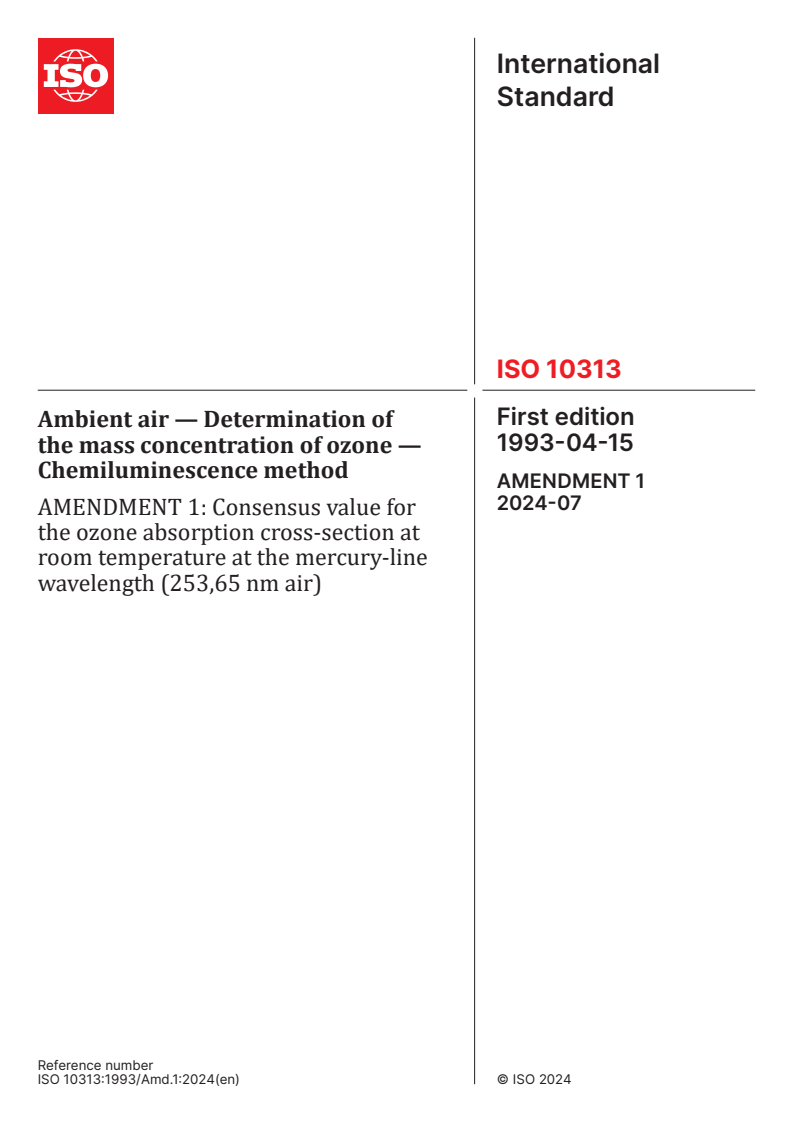

ISO 10313:1993/Amd 1:2024 - Ambient air — Determination of the mass concentration of ozone — Chemiluminescence method — Amendment 1: Consensus value for the ozone absorption cross-section at room temperature at the mercury-line wavelength (253,65 nm air) Released:7/26/2024

Overview
ISO 10313:1993/Amd 1:2024 amends the ISO 10313 chemiluminescence method for determining the mass concentration of ozone in ambient air. The amendment provides a consensus value for the ozone absorption cross-section at room temperature specifically at the mercury-line wavelength 253.65 nm (air) and updates key numerical constants used in concentration calculations. This update ensures improved consistency and traceability for ozone measurements and instrument calibration.
Key topics and requirements
- Scope & method: Amendment to the established chemiluminescence method for ambient ozone mass concentration (ISO 10313).
- Consensus absorption value: Adds a literature-backed consensus value for the ozone absorption cross-section at 253.65 nm, and references supporting publications (added References [7] and [8]).
- Updated numerical constants:
- Reference pressure changed from 101.3 to 101.325 (kPa).
- Reference temperature set to 298.15 K (room temperature).
- Mercury-line wavelength specified as 253.65 nm (previously 253.7 nm).
- Absorption coefficient (numeric constant) revised from 1.44 to 1.4214 (unit as defined in the standard).
- Documentation & traceability: Amendment cites a 2019 Metrologia review and a 2022 BIPM report for consensus and guidance on units/significant digits, improving reproducibility and standard conformity.
Applications
- Calibration and verification of ozone analysers using chemiluminescence detectors.
- Routine air quality monitoring by environmental agencies and networks measuring ambient ozone mass concentration.
- Laboratory quality assurance (QA/QC) and method validation where accurate conversion between optical absorption and mass concentration is required.
- Instrument manufacturers and metrology labs adopting harmonized constants for product specifications, data comparability, and regulatory compliance.
Who uses this standard
- National and regional environmental protection agencies
- Air quality laboratories and field monitoring teams
- Instrument manufacturers and calibration service providers
- Atmospheric scientists and metrologists involved in ozone measurement and standardization
- Standards bodies and conformity assessment organizations (ISO/TC 146, SC 3)
Related standards
- Other ISO standards and guidance developed by ISO Technical Committee 146 (Air quality) covering ambient atmosphere measurements and instrument performance. The amendment aligns ozone measurement practice with metrological recommendations cited in the new references.
Keywords: ISO 10313, ambient air, ozone, chemiluminescence method, ozone absorption cross-section, 253.65 nm, mercury-line wavelength, mass concentration, air quality monitoring, instrument calibration.
Relations
- Effective Date
- 17-Jun-2023
Buy Documents
ISO 10313:1993/Amd 1:2024 - Ambient air — Determination of the mass concentration of ozone — Chemiluminescence method — Amendment 1: Consensus value for the ozone absorption cross-section at room temperature at the mercury-line wavelength (253,65 nm air) Released:7/26/2024
Get Certified
Connect with accredited certification bodies for this standard

CIS Institut d.o.o.
Personal Protective Equipment (PPE) certification body. Notified Body NB-2890 for EU Regulation 2016/425 PPE.

Kiwa BDA Testing
Building and construction product certification.
Kmetijski inštitut Slovenije
Agricultural Institute of Slovenia. Soil testing, plant health, agricultural product analysis.
Sponsored listings
Frequently Asked Questions
ISO 10313:1993/Amd 1:2024 is a standard published by the International Organization for Standardization (ISO). Its full title is "Ambient air — Determination of the mass concentration of ozone — Chemiluminescence method — Amendment 1: Consensus value for the ozone absorption cross-section at room temperature at the mercury-line wavelength (253,65 nm air)". This standard covers: Ambient air — Determination of the mass concentration of ozone — Chemiluminescence method — Amendment 1: Consensus value for the ozone absorption cross-section at room temperature at the mercury-line wavelength (253,65 nm air)
Ambient air — Determination of the mass concentration of ozone — Chemiluminescence method — Amendment 1: Consensus value for the ozone absorption cross-section at room temperature at the mercury-line wavelength (253,65 nm air)
ISO 10313:1993/Amd 1:2024 is classified under the following ICS (International Classification for Standards) categories: 13.040.20 - Ambient atmospheres. The ICS classification helps identify the subject area and facilitates finding related standards.
ISO 10313:1993/Amd 1:2024 has the following relationships with other standards: It is inter standard links to ISO 10313:1993. Understanding these relationships helps ensure you are using the most current and applicable version of the standard.
ISO 10313:1993/Amd 1:2024 is available in PDF format for immediate download after purchase. The document can be added to your cart and obtained through the secure checkout process. Digital delivery ensures instant access to the complete standard document.
Standards Content (Sample)
International
Standard
ISO 10313
First edition
Ambient air — Determination of
1993-04-15
the mass concentration of ozone —
Chemiluminescence method
AMENDMENT 1
2024-07
AMENDMENT 1: Consensus value for
the ozone absorption cross-section at
room temperature at the mercury-line
wavelength (253,65 nm air)
Reference number
ISO 10313:1993/Amd.1:2024(en) © ISO 2024
ISO 10313:1993/Amd.1:2024(en)
© ISO 2024
All rights reserved. Unless otherwise specified, or required in the context of its implementation, no part of this publication may
be reproduced or utilized otherwise in any form or by any means, electronic or mechanical, including photocopying, or posting on
the internet or an intranet, without prior written permission. Permission can be requested from either ISO at the address below
or ISO’s member body in the country of the requester.
ISO copyright office
CP 401 • Ch. de Blandonnet 8
CH-1214 Vernier, Geneva
Phone: +41 22 749 01 11
Email: copyright@iso.org
Website: www.iso.org
Published in Switzerland
ii
ISO 10313:1993/Amd.1:2024(en)
Foreword
ISO (the International Organization for Standardization) is a worldwide federation of national standards
bodies (ISO member bodies). The work of preparing International Standards is normally carried out through
ISO technical committees. Each member body interested in a subject for which a technical committee
has been established has the right to be represented on that committee. International organizations,
governmental and non-governmental, in liaison with ISO, also take part in the work. ISO collaborates closely
with the International Electrotechnical Commission (IEC) on all matters of electrotechnical standardization.
The procedures used to develop this document and those intended for its further maintenance are described
in the ISO/IEC Directives, Part 1. In particular, the different approval criteria needed for the different types
of ISO document should be noted. This document was drafted in accordance with the editorial rules of the
ISO/IEC Directives, Part 2 (see www.iso.org/directives).
ISO draws attention to the possibility that the implementation of this document may involve the use of (a)
patent(s). ISO takes no position concerning the evidence, validity or applicability of any claimed patent
rights in respect thereof. As of the date of publication of this document, ISO had not received notice of (a)
patent(s) which may be required to implement this document. However, implementers are cautioned th
...
SLOVENSKI STANDARD
01-junij-2025
Zunanji zrak - Določanje masne koncentracije ozona - Kemiluminiscenčna metoda
- Dopolnilo A1: Dogovorjena vrednost za absorpcijski presek ozona pri sobni
temperaturi pri valovni dolžini živega srebra (253,65 nm v zraku)
Ambient air - Determination of the mass concentration of ozone - Chemiluminescence
method - Amendment 1: Consensus value for the ozone absorption cross-section at
room temperature at the mercury-line wavelength (253,65 nm air)
Air ambiant - Détermination de la concentration en masse d'ozone - Méthode par
chimiluminescence - Amendement 1
Ta slovenski standard je istoveten z: ISO 10313:1993/Amd 1:2024
ICS:
13.040.20 Kakovost okoljskega zraka Ambient atmospheres
2003-01.Slovenski inštitut za standardizacijo. Razmnoževanje celote ali delov tega standarda ni dovoljeno.
International
Standard
ISO 10313
First edition
Ambient air — Determination of
1993-04-15
the mass concentration of ozone —
Chemiluminescence method
AMENDMENT 1
2024-07
AMENDMENT 1: Consensus value for
the ozone absorption cross-section at
room temperature at the mercury-line
wavelength (253,65 nm air)
Reference number
ISO 10313:1993/Amd.1:2024(en) © ISO 2024
ISO 10313:1993/Amd.1:2024(en)
© ISO 2024
All rights reserved. Unless otherwise specified, or required in the context of its implementation, no part of this publication may
be reproduced or utilized otherwise in any form or by any means, electronic or mechanical, including photocopying, or posting on
the internet or an intranet, without prior written permission. Permission can be requested from either ISO at the address below
or ISO’s member body in the country of the requester.
ISO copyright office
CP 401 • Ch. de Blandonnet 8
CH-1214 Vernier, Geneva
Phone: +41 22 749 01 11
Email: copyright@iso.org
Website: www.iso.org
Published in Switzerland
ii
ISO 10313:1993/Amd.1:2024(en)
Foreword
ISO (the International Organization for Standardization) is a worldwide federation of national standards
bodies (ISO member bodies). The work of preparing International Standards is normally carried out through
ISO technical committees. Each member body interested in a subject for which a technical committee
has been established has the right to be represented on that committee. International organizations,
governmental and non-governmental, in liaison with ISO, also take part in the work. ISO collaborates closely
with the International Electrotechnical Commission (IEC) on all matters of electrotechnical standardization.
The procedures used to develop this document and those intended for its further maintenance are described
in the ISO/IEC Directives, Part 1. In particular, the different approval criteria needed for the different types
of ISO document
...