


ISO 8721:2018
(Main)Road vehicles — Measurement techniques in impact tests — Optical instrumentation
Road vehicles — Measurement techniques in impact tests — Optical instrumentation
This document defines performance criteria for an optical data channel used in impact tests on road vehicles, when numerical time and space data are taken from images to analyse impact test results. The objective of this document is to facilitate comparison between results obtained by different laboratories by specifying minimum quality criteria. Annexes A, B, C and D present a method of measuring several indices like quality parameters of sub processes of the optical data channel, using a calibration target, reference distances and analysis systems.
Véhicules routiers — Techniques de mesure lors des essais de chocs — Instrumentation optique
General Information
Relations
Standards Content (Sample)
INTERNATIONAL ISO
STANDARD 8721
Third edition
2018-08
Road vehicles — Measurement
techniques in impact tests — Optical
instrumentation
Véhicules routiers — Techniques de mesure lors des essais de chocs —
Instrumentation optique
Reference number
©
ISO 2018
© ISO 2018
All rights reserved. Unless otherwise specified, or required in the context of its implementation, no part of this publication may
be reproduced or utilized otherwise in any form or by any means, electronic or mechanical, including photocopying, or posting
on the internet or an intranet, without prior written permission. Permission can be requested from either ISO at the address
below or ISO’s member body in the country of the requester.
ISO copyright office
CP 401 • Ch. de Blandonnet 8
CH-1214 Vernier, Geneva
Phone: +41 22 749 01 11
Fax: +41 22 749 09 47
Email: copyright@iso.org
Website: www.iso.org
Published in Switzerland
ii © ISO 2018 – All rights reserved
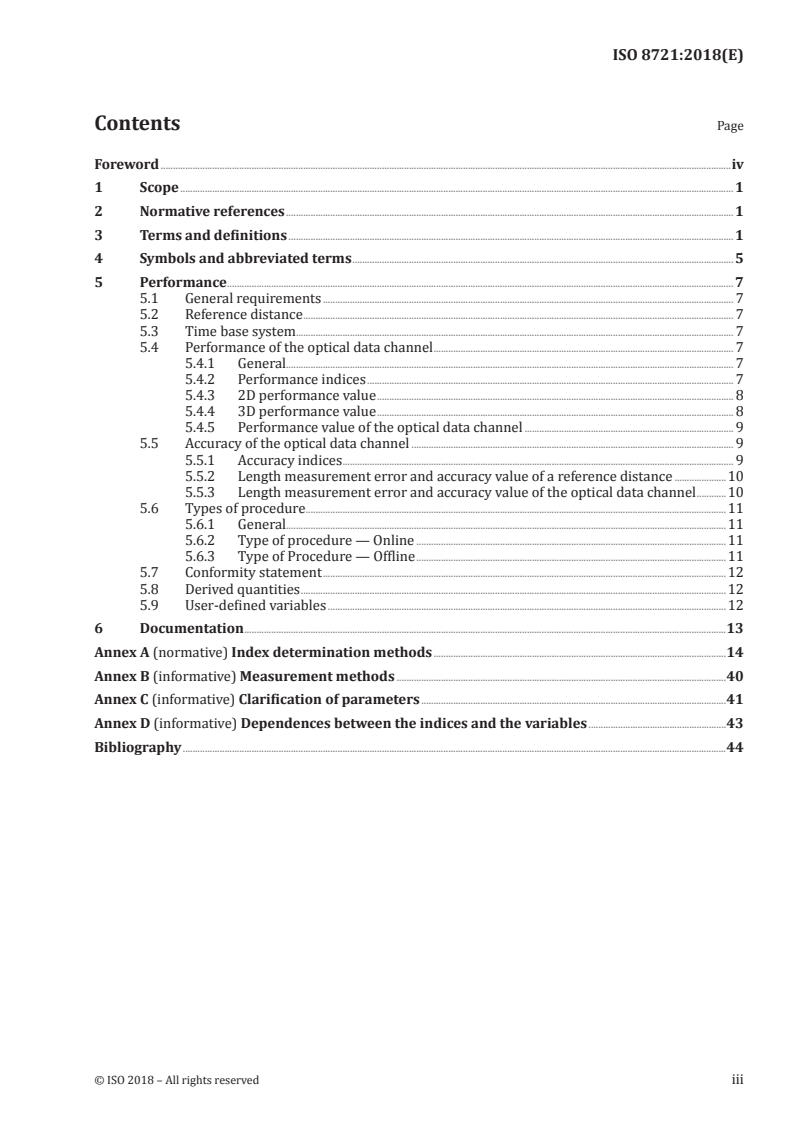
Contents Page
Foreword .iv
1 Scope . 1
2 Normative references . 1
3 Terms and definitions . 1
4 Symbols and abbreviated terms . 5
5 Performance . 7
5.1 General requirements . 7
5.2 Reference distance . 7
5.3 Time base system. 7
5.4 Performance of the optical data channel . 7
5.4.1 General. 7
5.4.2 Performance indices . 7
5.4.3 2D performance value . 8
5.4.4 3D performance value . 8
5.4.5 Performance value of the optical data channel . 9
5.5 Accuracy of the optical data channel . 9
5.5.1 Accuracy indices . 9
5.5.2 Length measurement error and accuracy value of a reference distance .10
5.5.3 Length measurement error and accuracy value of the optical data channel .10
5.6 Types of procedure .11
5.6.1 General.11
5.6.2 Type of procedure — Online .11
5.6.3 Type of Procedure — Offline .11
5.7 Conformity statement .12
5.8 Derived quantities .12
5.9 User-defined variables .12
6 Documentation .13
Annex A (normative) Index determination methods .14
Annex B (informative) Measurement methods .40
Annex C (informative) Clarification of parameters .41
Annex D (informative) Dependences between the indices and the variables .43
Bibliography .44
Foreword
ISO (the International Organization for Standardization) is a worldwide federation of national standards
bodies (ISO member bodies). The work of preparing International Standards is normally carried out
through ISO technical committees. Each member body interested in a subject for which a technical
committee has been established has the right to be represented on that committee. International
organizations, governmental and non-governmental, in liaison with ISO, also take part in the work.
ISO collaborates closely with the International Electrotechnical Commission (IEC) on all matters of
electrotechnical standardization.
The procedures used to develop this document and those intended for its further maintenance are
described in the ISO/IEC Directives, Part 1. In particular the different approval criteria needed for the
different types of ISO documents should be noted. This document was drafted in accordance with the
editorial rules of the ISO/IEC Directives, Part 2 (see www .iso .org/directives).
Attention is drawn to the possibility that some of the elements of this document may be the subject of
patent rights. ISO shall not be held responsible for identifying any or all such patent rights. Details of
any patent rights identified during the development of the document will be in the Introduction and/or
on the ISO list of patent declarations received (see www .iso .org/patents).
Any trade name used in this document is information given for the convenience of users and does not
constitute an endorsement.
For an explanation on the voluntary nature of standards, the meaning of ISO specific terms and
expressions related to conformity assessment, as well as information about ISO's adherence to the
World Trade Organization (WTO) principles in the Technical Barriers to Trade (TBT) see the following
URL: www .iso .org/iso/foreword .html
This document was prepared by Technical Committee ISO/TC 22, Road vehicles, Subcommittee SC 36,
Safety and impact testing.
This third edition cancels and replaces the second edition (ISO 8721:2010), of which it constitutes a
minor revision with editorial changes.
iv © ISO 2018 – All rights reserved
INTERNATIONAL STANDARD ISO 8721:2018(E)
Road vehicles — Measurement techniques in impact tests
— Optical instrumentation
1 Scope
This document defines performance criteria for an optical data channel used in impact tests on road
vehicles, when numerical time and space data are taken from images to analyse impact test results.
The objective of this document is to facilitate comparison between results obtained by different
laboratories by specifying minimum quality criteria.
Annexes A, B, C and D present a method of measuring several indices like quality parameters of sub
processes of the optical data channel, using a calibration target, reference distances and analysis
systems.
2 Normative references
The following documents are referred to in the text in such a way that some or all of their content
constitutes requirements of this document. For dated references, only the edition cited applies. For
undated references, the latest edition of the referenced document (including any amendments) applies.
ISO 6487, Road vehicles — Measurement techniques in impact tests — Instrumentation
3 Terms and definitions
For the purposes of this document, the following terms and definitions apply.
ISO and IEC maintain terminological databases for use in standardization at the following addresses:
— IEC Electropedia: available at http: //www .electropedia .org/
— ISO Online browsing platform: available at https: //www .iso .org/obp
3.1
analysis system
system to measure and collect the coordinates of target points in image space as a function of time
Note 1 to entry: The calculation results of the analysis system are 3D coordinates in object space, whereas in the
case of 2D analysis, the depth of the target points is known and considered.
3.2
cell size
distance of neighbouring pixels on the sensor of an image recording device
Note 1 to entry: If there are different distance values in the two main directions of the image, the cell size is the
maximum of these values.
3.3
control point
point that was determined with a higher accuracy and is further accepted as an error-free point
3.4
frame rate
f
r
frequency of renewal of information for a given point, expressed in renewals per second, or in images
per second if all points of the image are renewed simultaneously
3.5
image recording device
system composed of a camera/lens unit together with a recording system
3.6
location accuracy
a
loc
desired accuracy of the object or target being measured
3.7
optical data channel
system composed of one or more image recording devices and a system for analysing the images,
including any analysis procedure and data correction that validate and modify the content of the data
3.8
reference distance
known distance between a validation target pair
3.9
synchronism device
device to identify the synchronism effect in two or more corresponding image recording devices
3.10
time base system
device allowing determination of the time interval elapses between any two recorded events for each
image recording device
3.11
time origin identification device
device to identify the instant chosen as the time origin, usually the contact between the test objects
3.12
validation target pair
pair of targets placed in the field of view so that the distance separating them remains constant
Note 1 to entry: Both of them are visible during the impact test.
3.13
accuracy value
a
value that represents the relative overall accuracy of any point measurement within the optical data
channel when the performance value is satisfied
3.14
accuracy value limit
r
avl
user-defined limit for the accuracy value that represents the relative overall accuracy of any point
measurement within the optical data channel when the performance value is satisfied
3.15
camera position calculation index
i
cpc
index that gives the possibility to evaluate whether the accuracy of the optical data channel determined
from one time step is representative for the entire sequence
2 © ISO 2018 – All rights reserved
3.16
camera set-up index
i
cs
index that makes it possible to evaluate whether the set-up of the camera with respect to the movement
plane permits a reliable analysis
Note 1 to entry: Only for 2D film analysis.
3.17
control point distribution index
i
cpd
index that makes it possible to evaluate whether the distribution of the control points in the image
permits a reliable orientation of the used images
3.18
distortion index
i
d
index that makes it possible to evaluate whether the interior orientation parameters of the used camera
are still valid
3.19
focal length index
i
fl
index that makes it possible to evaluate whether the focal length of the used image recording device is
still valid
3.20
index value
value that is determined by its index calculation equation (one value for each index)
Note 1 to entry: For the different index calculation equations see Annex A.
Note 2 to entry: The index value is the result of the index determination and is a floating point number.
3.21
index condition
condition of the check of the index
Note 1 to entry: The index condition can be true (value 1) or false (value 0). A true or false measure indicating if
an index is within its required limits.”
3.22
intersection index
i
i
index that makes it possible to evaluate the intersection geometry of the rays from the image recording
devices to the object points
Note 1 to entry: Only for 3D film analysis.
3.23
length measurement error
value that represents the absolute overall accuracy of any point measurement within the optical data
channel when the performance value is satisfied
3.24
motion blur index
i
mb
index that allows one to evaluate whether the exposure time used in the test is small enough with
respect to the appropriate object movement, in order to ensure a reliable point identification and point
measurement in the images
3.25
performance value
numerical value indicating suitable general conditions for the estimation of the accuracy of the optical
data channel
Note 1 to entry: It is derived from all indices which describe the performance of the optical data channel.
3.26
plane scale index
i
ps
index used to rate the appropriateness of evaluating the scale constellation in the movement planes
(scale in each movement plane)
Note 1 to entry: Only for 2D film analysis.
3.27
point motion index
i
pm
index used to rate the appropriateness of the frame rate in regards to test requirements
3.28
scale index
i
s
index used to rate the appropriateness of the scale constellation to control the system scale (presence
of independent reference distances)
3.29
synchronism index
i
sy
index used to rate the appropriateness of the synchronization method for the data analysis in regards
to the test requirements
Note 1 to entry: Only for 3D film analysis.
3.30
target detection index
i
td
index used to rate the appropriateness of the measuring accuracy of the image coordinates in regards
to test requirements
3.31
target size index
i
ts
index used to rate the appropriateness of the target size for a reliable point identification and point
measurement in the images
3.32
time base index
i
tb
index used to rate the appropriateness of the used time base system in regards to the test requirements
3.33
time origin identification index
i
toi
index used to rate the appropriateness of the used time origin identification device in regards to the
test requirements
4 © ISO 2018 – All rights reserved
4 Symbols and abbreviated terms
Symbol Definition
A control point formed area
cf
A image area
i
a accuracy value of the optical data channel
a allowed location accuracy in depth
alaid
a current location accuracy (distortion)
clad
a current location accuracy (focal length)
claf
a current location accuracy (intersection)
clai
a current location accuracy in depth
claid
a current location accuracy (target)
clat
a current location accuracy (time base)
clatb
a current location accuracy (time origin identification)
clatoi
a distortion accuracy
d
a focal length accuracy
fl
a frame rate accuracy
fr
a location accuracy
loc
a accuracy value of the reference distance, r
refdist,r
a target detection accuracy
td
d object distance
e exposure time
f focal length
f frame rate
r
i camera position calculation index
cpc
i control point distribution index
cpd
i camera set-up index
cs
i distortion index
d
i focal length index
fl
i intersection index
i
i motion blur index
mb
i point motion index
pm
i plane scale index
ps
i scale index
s
i synchronism index
sy
i time base index
tb
i target detection index
td
i time origin identification index
toi
i target size index
ts
ΔL length measurement error of the optical data channel
Δl length measurement error of reference distance, r
r
l asynchronism effect in viewing direction
aed
l asynchronism effect perpendicular to the viewing direction
aep
l allowed point motion between two sequenced images in object space
apm
l calibrated length of reference distance, r
c,r
l camera base
cb
Symbol Definition
l current motion blur value
cmbv
l current point motion between two sequenced images in object space
cpm
l cell size
cs
l current target diameter
ctd
l distance camera base to object
dco
l fix point distance
fpd
l image height
ih
l image width
iw
l (t) measured length of reference distance, r, as a function of time
m,r
l maximum displacement in image space
mdi
l maximum displacement in object space
mdo
l required target diameter
rtd
l theoretical target diameter
ttd
p 3D performance value of the optical data channel
p control point area
cpa
p control point distribution
cpd
p distance to plane of motion i
dtp,i
p number of planes of motion
np
p reference distance
rd,r
p reference distance in direction i
rd,i
p reference distance in plane of motion i
rdp,i
p scale information in all planes of motion
siap
p scale information in plane of motion i
sip,i
p synchronism index in viewing direction
syd
p synchronism index perpendicular to the viewing direction
syp
p target in image section i
t,i
p type of camera set-up
tpc
p type of position determination
tpd
Q performance value of the optical data channel
q 2D performance value of the image recording device i
i
r allowed accuracy relation
aar
r accuracy value limit
avl
r current accuracy relation
car
t beginning of the analysed time interval
b
t user-defined time within the analysed time interval
c
t current asynchronism
ca
t difference between t -image and -signal
dtz 0
t end of the analysed time interval
e
t time interval
int
t time drift
td
t total time drift
ttd
v velocity
6 © ISO 2018 – All rights reserved
5 Performance
5.1 General requirements
The performance of the optical data channel shall be evaluated initially to establish performance levels.
This evaluation shall be repeated whenever the system is modified to an extent which could cause a
change in accuracy. This shall be done with an offline procedure.
It is also possible to measure the performance of the optical data channel during an impact test. This is
called the online procedure.
The performance of the optical data channel shall be estimated using 2D performance values, or 3D
performance values, or both. These values consist of different performance indices depending on the
test constellation. To verify the estimated performance values, an accuracy value shall be determined
using two or more reference distances.
If a film analysis is carried out using the image sequences of on-board cameras, the used equipment
(camera and lens) shall correspond to the expected shock.
Further details are described in the annexes.
The determination methods for several indices are described in Annex A and shall be used for the index
calculation.
Details for the two measurement methods (online and offline procedure) are listed in Annex B.
A complete list of all used parameters with short text, long text and the type is in Annex C.
The matrix structure in Annex D presents the dependencies between the indices and the parameters.
5.2 Reference distance
The reference distances shall be determined 10 times more precisely than the desired location accuracy.
The determination of the reference distances shall be done before the test.
The reference distances shall be located on approximately perpendicular (90 ± 10)° lines (see A.3.2).
For 3D analysis, all three directions in space shall be covered. See Annex A for additional information.
5.3 Time base system
The time base shall be determined 10 times more precisely than the desired time accuracy.
5.4 Performance of the optical data channel
5.4.1 General
The performance of the optical data channel consists of different indices (see Table 1). The determination
depends on the application (2D or 3D).
5.4.2 Performance indices
Each index value shall be at least 0,5. If this minimum requirement is not fulfilled for every index, then
the impact test does not conform to this document. The index condition of a certain index is 0 if the
requirements for this index (see Annex A) are not fulfilled; otherwise the index condition is 1.
Table 1 — Performance indices
Number per optical
Index 2D 3D Comment
data channel
a a
Focal length index one per image recording device in a suitable image
a a
Distortion index one per image recording device in a suitable image
a a
Target detection index one per image recording device worst target used in the analysis
a a
Target size index one per image recording device worst target used in the analysis
a a
Motion blur index one per image recording device at maximum object speed
a a
Point motion index one per image recording device at maximum object speed
Control point distribution
a a
one per image recording device in a suitable image
index
a a
Time base index one per image recording device —
Time origin identification
a a
one per image recording device —
index
a b
Camera set-up index one per image recording device —
a b
Plane scale index one per image recording device —
best pair of image recording
b a
Intersection index one
devices
worst pair of image recording
b a
Synchronism index one
devices
a
Index value is used for the performance value.
b
Index value is not used for the performance value.
5.4.3 2D performance value
The performance value for every image recording device is estimated by all 2D related index conditions
(see Table 1). The 2D performance value, q , is the ratio of the achieved sum to the possible sum of index
i
conditions with respect to the test requirements, and is calculated as shown in Formula (1):
n
x
∑ ji
j=1
q = (1)
i
n
where
i is the image recording device number;
j is the 2D performance index number;
x is the index condition of the 2D performance index, j, of the image recording device, i;
ji
n is the number of 2D performance indices (2D film analysis: n = 11; 3D film analysis: n = 9).
5.4.4 3D performance value
The 3D performance value of the optical data channel, p, is calculated as shown in Formula (2):
m
py= (2)
k
∑
k=1
where
8 © ISO 2018 – All rights reserved
k is the 3D performance index number;
y is the index condition of the 3D performance index, k, of the optical data channel;
k
m is the number of 3D performance indices (m = 2).
5.4.5 Performance value of the optical data channel
For 2D analysis, the performance value of the optical data channel, Q, is identical to the 2D performance
value, q , as shown in Formula (3):
Qq= (3)
For 3D analysis with only one image recording device, the intersection index and the synchronism
index are not defined. In this case, the performance value of the optical data channel, Q, is equal to the
2D performance value, q .
For 3D analysis, the performance value of the optical data channel, Q, is the ratio of the achieved sum to
the possible sum of all index conditions, calculated according to Formula (4):
u u
n
nq× +×()pu × qp+
∑∑i i
u
i==11i
Q= = (4)
nu× +×mu n++m
() ()
where
i is the image recording device number;
q is the 2D performance value of the image recording device, i;
i
u is the number of image recording devices;
n is the number of 2D performance indices (2D film analysis: n = 11; 3D film analysis: n = 9);
m is the number of 3D performance indices (m = 2);
p is the 3D performance value of the optical data channel.
5.5 Accuracy of the optical data channel
5.5.1 Accuracy indices
The accuracy indices are shown in Table 2.
Table 2 — Accuracy indices
Number per optical data
Index Comment
channel
Camera position calculation
one per image recording device —
index
Scale index one indispensable index
5.5.2 Length measurement error and accuracy value of a reference distance
The length measurement error and accuracy value of a reference distance are defined as follows:
— the length measurement error, Δl , of the reference distance, r, is the maximum difference between
r
the measured length, l (t), and the calibrated length, l , within the analysed time interval;
m,r c,r
— the accuracy value, a , of the reference distance, r, is the maximum relative difference between
refdist,r
the measured length, l (t), and the calibrated length, l , within the analysed time interval.
m,r c,r
All used image recording devices shall be used for the calculation of the reference distances.
If the index condition of the camera position calculation index, i , of all used image recording devices
cpc
is fulfilled, the length measurement error, Δl , can be determined at a single time step within the
r
analysed time interval. If the index condition of only one image recording device is not fulfilled, the
length measurement error, Δl , shall be calculated for every time step within the analysed time interval.
r
The accuracy value, a , of the reference distance, r, is the ratio between the length measurement
refdist,r
error, Δl , and the calibrated length, l .
r c,r
If every i ≥ 1, then the length measurement error, Δl , is calculated according to Formula (5):
cpc,i r
Δll=−()tl (5)
rrm,,cc r
where
i is the index value of the camera position calculation index of the image recording device, i;
cpc,i
i is the image recording device number;
r is the reference distance number;
l (t) is the measured length of reference distance, r, as a function of time;
m,r
l is the calibrated length of reference distance, r.
c,r
If any i < 1, then the length measurement error, Δl , is calculated according to Formula (6):
cpc,i r
t
e
Δll=−max(tl) (6)
rrmc,,r
t
b
where
t is the beginning of the analysed time interval;
b
t is the end of the analysed time interval;
e
t is a user-defined time within the analysed time interval.
c
The accuracy value, a , is calculated according to Formula (7):
refdist,r
Δl
r
a = (7)
refdist,r
l
c,r
5.5.3 Length measurement error and accuracy value of the optical data channel
— The length measurement error of the optical data channel, ΔL, is the maximum of the length
measurement errors, Δl , of all reference distances, r.
r
— The accuracy value of the optical data channel, a, is the maximum of the accuracy values, a , of
refdist,r
all reference distances, r
.
10 © ISO 2018 – All rights reserved
ΔΔLl=max (8)
()
r
aa=max (9)
()
refdist,r
5.6 Types of procedure
5.6.1 General
Conformity with this document can be verified by different types of procedure, depending on the
desired complexity. The different types of procedure are shown in Table 3.
Table 3 — Types of procedure
Before the real impact test During the real impact test
Type of
procedure
Performance value Accuracy value Performance value Accuracy value
ΔL ≤ a
loc
Online — — Q ≥ 0,7
a ≤ r
avl
Synchronism index
ΔL ≤ a ΔL ≤ a
loc loc
Offline Q ≥ 0,8 i ≥ 1
sy
a ≤ r a ≤ r
avl avl
(only 3D analysis)
Key
Q performance value of the optical data channel
ΔL length measurement error of the optical data channel
a accuracy value of the optical data channel
r user-defined accuracy value limit of the optical data channel
avl
a user-defined location accuracy of the optical data channel
loc
5.6.2 Type of procedure — Online
5.6.2.1 The online procedure is of the highest complexity. All work shall be done for every impact test.
The performance and the accuracy of the optical data channel can be checked during the test.
This procedure can be used, if the equipment of the optical data channel will often be changed essentially
between the impact tests, or if no prior information about the optical data channel is available.
The user has the possibility to evaluate every component of the optical data channel for every impact test.
5.6.2.2 Tasks during the impact test are specified below.
— All described performance and accuracy indices shall be calculated during the real impact test.
— All described performance index values shall be at least 0,5.
— The performance value of the optical data channel, Q, shall be greater than 0,7.
— The length measurement error of the optical data channel, ΔL, shall be lower than the location
accuracy, a .
loc
— The accuracy value of the optical data channel, a, shall be lower than the accuracy value limit, r .
avl
5.6.3 Type of Procedure — Offline
5.6.3.1 The offline procedure is of middle complexity. The main part of the calculation shall be done
once in the preliminary test. The performance of the optical data channel can only be checked in this test.
During the impact test, only the accuracy can be calculated. For a 3D analysis, the synchronism shall be
checked.
This procedure can be used if the equipment of the optical data channel will not be changed, or if only
minor changes will be done.
The user has the possibility to evaluate every component of the optical data channel once in the
preliminary test. For every impact test, the user only has the possibility to evaluate the overall result of
the optical data channel.
5.6.3.2 Tasks in the preliminary test are specified below.
The lighting and the frame rates of the image recording devices in the preliminary test shall be similar
to an impact test. The using of a VDI/VDE 2634 Part 1 artefact is recommended (see Reference [2]). The
size of the artefact should correspond to the size of the measuring area of the impact test.
— All described performance index values shall be at least 0,5.
— The performance value of the optical data channel, Q, shall be greater than 0,8.
— The length measurement error of the optical data channel, ΔL, shall be lower than the location
accuracy, a .
loc
— The accuracy value of the optical data channel, a, shall be lower than the accuracy value limit, r .
avl
5.6.3.3 Tasks during the impact test are specified below.
— For 3D analysis, the synchronism index shall be fulfilled, i ≥1.
sy
— The length measurement error of the optical data channel, ΔL, shall be lower than the location
accuracy, a .
loc
— The accuracy value of the optical data channel, a, shall be lower than the accuracy value limit, r .
avl
5.7 Conformity statement
The accuracy value represents the overall accuracy of any point measurement within the optical
data channel when suitable general conditions are valid. The accuracy value is only valid when the
performance value is greater than the minimum value required by the procedure.
An optical data channel conforms to this document if the index value of the scale index is 1 and the
accuracy value and the performance value fit the requirements of the used procedure.
5.8 Derived quantities
For derived computed quantities, the requests for the digital signal processing of a data channel shall
be considered in accordance with ISO 6487.
5.9 User-defined variables
The user is able to influence the results of the testing procedure by the specification of user-defined
variables. The conformity or non-conformity of this document depends on these user-defined variables.
They shall be listed in the inspection record. With these variables, the user specifies his desired
measurement accuracy.
User-defined variables are given in Table 4.
12 © ISO 2018 – All rights reserved
Table 4 — User-defined variables
Variable Symbol Definition Unit
desired accuracy of the object or target being measured
location accuracy a (target detection index, focal length index, distortion index, length unit
loc
motion blur index, length measurement error)
allowed point motion between two sequenced images in object
allowed point motion l length unit
apm
space (point motion index)
allowed accuracy relation between the accuracy perpendic-
allowed accuracy
r ular to the camera base in the direction to the object and the —
aar
relation
accuracy in the other two directions (intersection index)
desired accuracy relation of the reference distances being
accuracy value limit r —
avl
measured (accuracy value)
6 Documentation
For the interpretation of the accuracy and performance values, it is necessary to specify the type of
procedure that was used (online/offline), the type of analysis (2D/3D), the number of image recording
devices and the time interval used for the evaluation. All user-specific input values and all index values,
including the accuracy value, shall be recorded.
If the frame rate is not constant over the time interval, the time vector shall be recorded.
For the documentation of the performance of an optical data channel, an inspection record is
recommended (see A.4).
Annex A
(normative)
Index determination methods
A.1 2D performance indices
A.1.1 Focal length index, i
fl
The focal length index determines the influence of an incorrect focal length on the location accuracy.
The accuracy of the determined focal length is calculated by algorithms determining the camera
internal parameters.
For a 2D film analysis using a perpendicular set-up of the camera with respect to the movement plane
(see A.1.8), and if reference distances are available in each motion plane (see A.1.9), the index value of
the focal length index is 1. Otherwise, the index value shall be calculated by Formulae (A.1) and (A.2),
using the parameters in Table A.1.
Table A.1 — Parameters to determine focal length index
Parameter Symbol Definition Unit
length
focal length f focal length of the used image recording device
unit
Input distance between object and image recording length
object distance d
parameters device unit
focal length accu- length
a accuracy of the determined focal length
fl
racy unit
User-defined desired accuracy of the object or target being length
location accuracy a
loc
variables measured unit
current location current accuracy of the object or target being length
Derived values a
claf
accuracy measured unit
The functional connection is as shown in Formula (A.1):
d
a =×a (A.1)
claf fl
f
The requirement for the parameter focal length index, i , is as shown in Formula (A.2):
fl
a
loc
i =≥1 (A.2)
fl
a
claf
EXAMPLE If f = 16 mm, d = 5 000 mm, a = 10 mm and a = 0,02 mm, then
loc fl
a = (5 000 mm/16 mm) × 0,02 mm = 6,25 mm
claf
i = 10 mm/6,25 mm = 1,6
fl
i ≥ 1
fl
A.1.2 Distortion index, i
d
The distortion index determines the influence of incorrect distortion parameters of the interior
orientation on the location accuracy. The distortion accuracy is the remaining maximum residual of the
14 © ISO 2018 – All rights reserved
process of determining the internal camera parameters. The distortion index value shall be calculated
by Formulae (A.3) and (A.4), using the parameters in Table A.2.
Table A.2 — Parameters to determine distortion index
Parameter Symbol Definition Unit
length
focal length f focal length of the used image recording device
unit
distance between object and image recording length
object distance d
device unit
Input
parameters
accuracy of the determined distortion parameters
distortion accuracy a pixel
d
(maximum residuals)
length
cell size l cell size of the digital image
cs
unit/pixel
User-defined desired accuracy of the object or target being length
location accuracy a
loc
variables measured unit
current location ac- current accuracy of the object or target being length
Derived values a
clad
curacy (distortion) measured unit
The functional connection is as shown in Formula (A.3):
d
a =×al× (A.3)
clad dcs
f
The requirement for the parameter distortion index, i , is as shown in Formula (A.4):
d
a
loc
i =≥1 (A.4)
d
a
clad
EXAMPLE If f = 16 mm, d = 5 000 mm, a = 10 mm, a = 1 pixel and l = 0,016 mm/pixel, then
loc d cs
a = (5 000 mm/16 mm) × 1 pixel × 0,016 mm/pixel = 5 mm
clad
i = 10 mm/5 mm = 2,0
d
i ≥ 1 e
d
A.1.3 Target detection index, i
td
The target detection index determines the influence of the target detection accuracy on the location
accuracy. The worst target used in the analysis shall be used for the determination of the target
detection index. The target detection index value shall be calculated by Formulae (A.5) and (A.6), using
the parameters in Table A.3.
Table A.3 — Parameters to determine target detection index
Parameter Symbol Definition Unit
length
focal length f focal length of the used image recording device
unit
length
object distance d distance between object and image recording device
unit
Input
target detection accuracy (e.g. determined by meas-
parameters
target detec-
a urement on similar target type and target size of pixel
td
tion accuracy
known location)
length
cell size l cell size of the digital image
cs
unit/pixel
User-defined location accu- length
a desired accuracy of the object or target being measured
loc
variables racy unit
current loca-
length
Derived values tion accuracy a current accuracy of the object or target being measured
clat
unit
(target)
The functional connection is as shown in Formula (A.5):
d
a =×al× (A.5)
clat td cs
f
The requirement for the parameter target detection index, i , is as shown in Formula (A.6):
td
a
loc
i =≥1 (A.6)
td
a
clat
EXAMPLE If f = 16 mm, d = 8 000 mm, a = 10 mm, a = 0,1 pixel and l = 0,016 mm/pixel, then
loc td cs
a = (8 000 mm/16 mm) × 0,1 pixel × 0,016 mm/pixel = 0,8 mm
clad
i = 10 mm/0,8 mm = 12,5
td
i ≥ 1
td
A.1.4 Target size index, i
ts
The target size index compares the current and the required diameter of the targets in object space. The
worst target used in the analysis shall be used for the determination of the target size index. The target
size index value shall be calculated by Formulae (A.7) and (A.8), using the parameters in Table A.4.
Table A.4 — Parameters to determine target size index
Parameter Symbol Definition Unit
length
focal length f focal length of the used image recording device
unit
length
object distance d distance between object and image recording device
unit
required target required target diameter in image space (required
Input parameters l pixel
rtd
diameter by the analysis system developer)
length
cell size l cell size of the digital image
cs
unit/pixel
current target length
l real target diameter in object space
ctd
diameter unit
theoretical target length
Derived values l theoretical target diameter in object space
ttd
diameter unit
16 © ISO 2018 – All rights reserved
The functional connection is as shown in Formula (A.7):
d
l =×ll× (A.7)
ttd rtdcs
f
The requirement for the parameter target size index, i , is as shown in Formula (A.8):
ts
l
ctd
i =≥1 (A.8)
ts
l
ttd
EXAMPLE If f = 25 mm, d = 5 000 mm, l = 10 pixel and l = 0,016 mm/pixel and l = 35 mm, then
rtd cs ctd
l = (5 000 mm/25 mm) × 10 pixel × 0,016 mm/pixel = 32 mm
ttd
i = 35 mm/32 mm = 1,09
ts
i ≥ 1
ts
A.1.5 Motion blur index, i
mb
The motion blur index determines the influence of the motion blur on the location accuracy. The motion
blur index value shall be calculated by Formulae (A.9) and (A.10), using the parameters in Table A.5.
Table A.5 — Parameters to determine motion blur index
Parameter Symbol Definition Unit
length
maximum speed of the object perpendicular to the
object speed v unit/time
Input parame-
optical axis
unit
ters
exposure time e exposure time of the used image recording device time unit
User-defined desired accuracy of the object or target being length
location accuracy a
loc
variables measured unit
current motion length
Derived values l current motion blur value at the object
cmbv
blur value unit
The functional connection is as shown in Formula (A.9):
lv=×05, ×e (A.9)
cmbv
The requirement for the parameter motion blur index, i , is as shown in Formula (A.10):
mb
a
loc
i =≥1 (A.10)
mb
l
cmbv
EXAMPLE If v = 18 m/s, e = 0,4 ms and a = 5 mm, then
loc
l = 0,5 × 18 mm/ms × 0,4 ms = 3,6 mm
cmbv
i = 5,0 mm/3,6 mm = 1,39
mb
i ≥ 1
mb
A.1.6 Point motion index, i
pm
The point motion index determines the current point motion between two images of a sequence
with respect to the test requirements. The point motion index value shall be calculated by
Formulae (A.11) and (A.12), using the parameters in Table A.6.
Table A.6 — Parameters to determine point motion index
Parameter Symbol Definition Unit
length
maximum speed of the object perpendicular to the
object speed v unit/time
optical axis
Input
unit
parameters
frame rate of the image recording device during 1/time
frame rate f
r
the test unit
User-defined allowed point allowed point motion between two sequenced im- length
l
apm
variables motion ages in object space unit
current point current point motion between two sequenced im- length
Derived values l
cpm
motion ages in object space unit
The functional connection is as shown in Formula (A.11):
lv=× (A.11)
cpm
f
r
The requirement for the parameter point motion index, i , is as shown in Formula (A.12):
pm
l
apm
i =≥1 (A.12)
pm
l
cpm
EXAMPLE If v = 14 m/s, f = 1 000 Hz and l = 15 mm, then
r apm
l = 14 mm/ms × 1 ms = 14 mm
cpm
i = 15 mm/14 mm = 1,07
pm
i ≥ 1
pm
A.1.7 Control point distribution index, i
cpd
The control point distribution index determines the number of control points in the different image
sections (see Figure A.1) and the percentage coverage of the control point area over the image.
Figure A.1 — Sections of the image (specifications in accordance with A.12 and Figure A.2)
For a 2D film analysis using a perpendicular set-up of the camera with respect to the movement plane
...
Questions, Comments and Discussion
Ask us and Technical Secretary will try to provide an answer. You can facilitate discussion about the standard in here.
Loading comments...