

ISO 17234-2:2011
(Main)Leather — Chemical tests for the determination of certain azo colorants in dyed leathers — Part 2: Determination of 4-aminoazobenzene
General Information
- Abstract
ISO 17234-2:2011 is supplementary to ISO 17234-1 and describes a special procedure to detect the use of certain azo colorants in commodities, which can release 4-aminoazobenzene. The procedure also detects 4-aminoazobenzene (Solvent Yellow 1) which is already available as free amine in commodities without reducing pretreatment. Azo colorants that are able to form 4-aminoazobenzene generate, under the conditions of ISO 17234‑1, the amines aniline and 1,4-phenylenediamine. The presence of these 4-aminoazobenzene colorants cannot be reliably ascertained without additional information (e.g. the chemical structure of the colorant used) or without a special procedure.
- Status
- Published
- Publication Date
- 09-Mar-2011
- Technical Committee
- IULTCS - International Union of Leather Technologists and Chemists Societies
- Current Stage
- 9092 - International Standard to be revised
- Start Date
- 08-Apr-2026
- Completion Date
- 29-Aug-2026
Buy Documents
ISO 17234-2:2011 - Leather — Chemical tests for the determination of certain azo colorants in dyed leathers — Part 2: Determination of 4-aminoazobenzene Released:3/10/2011
ISO 17234-2:2011 - Cuir — Essais chimiques pour le dosage de certains colorants azoiques dans les cuirs teints — Partie 2: Dosage du 4-aminoazobenzene Released:3/10/2011
Overview
ISO 17234-2:2011 - Leather: Chemical tests for the determination of certain azo colorants in dyed leathers - Part 2: Determination of 4‑aminoazobenzene describes a specialised analytical procedure to detect and quantify 4‑aminoazobenzene (Solvent Yellow 1) in leather. Supplementary to ISO 17234‑1, this standard targets azo colorants that can release 4‑aminoazobenzene by reductive cleavage of azo groups and sets out sample preparation, extraction and chromatographic analysis steps for reliable detection and quantification.
Key topics and requirements
- Scope and purpose: Detects free 4‑aminoazobenzene and azo dyes that can generate it under reductive conditions; important for regulatory compliance (REACH Annex XVII).
- Sample preparation: Degreasing (n‑hexane ultrasonic treatment), grinding/sampling per ISO 2418 and ISO 4044, removal of adhesives and separation of colour zones for patchwork leather.
- Reductive cleavage: Treatment with aqueous sodium dithionite in alkaline medium at (40 ± 2) °C for 30 minutes in a gas‑tight vessel to release amines.
- Extraction and concentration: Liquid–liquid extraction into tert‑butyl methyl ether with salting‑out (NaCl); optional concentration by rotary evaporator with precautions to avoid analyte loss.
- Analytical techniques: Detection by HPLC/DAD, HPLC/MS, GC/MS, CE/DAD or TLC/HPTLC; quantification typically by HPLC/DAD or GC/MS (use internal standards for GC/MS).
- Calibration and performance checks: Calibration solutions and recovery checks (phase partition recovery ~95–100%; procedural check recovery ≥60%).
- Safety: 4‑aminoazobenzene is a suspected human carcinogen - follow national safety regulations, MSDS guidance and use PPE (gloves, eyewear, respirator for powders).
Practical applications and users
- Regulatory compliance testing: Laboratories verifying leather products against REACH Annex XVII limits and national chemical restrictions.
- Quality control in tanneries and manufacturers: Screening dyed leathers, footwear, garments and accessories for banned or hazardous azo colorants.
- Third‑party test labs and OEMs: Contract testing, supplier audits and material certification for import/export and retail safety.
- Research and method development: Analytical chemists developing confirmatory workflows using HPLC/DAD, GC/MS or CE/DAD.
Related standards and references
- ISO 17234‑1 - Determination of certain aromatic amines from azo colorants (parent method)
- ISO 2418 - Sampling location for leather tests
- ISO 4044 - Preparation of chemical test samples
- REACH (EC) No. 1907/2006 - Annex XVII restrictions on 4‑aminoazobenzene
Keywords: ISO 17234-2:2011, 4‑aminoazobenzene, leather testing, azo colorants, HPLC/DAD, GC/MS, REACH compliance, chemical tests for dyed leathers.
Relations
- Effective Date
- 09-Feb-2026
- Effective Date
- 09-Feb-2026
- Effective Date
- 09-Feb-2026
- Effective Date
- 09-Feb-2026
- Effective Date
- 09-Feb-2026
- Effective Date
- 09-Feb-2026
- Effective Date
- 12-Feb-2026
Buy Documents
ISO 17234-2:2011 - Leather — Chemical tests for the determination of certain azo colorants in dyed leathers — Part 2: Determination of 4-aminoazobenzene Released:3/10/2011
ISO 17234-2:2011 - Cuir — Essais chimiques pour le dosage de certains colorants azoiques dans les cuirs teints — Partie 2: Dosage du 4-aminoazobenzene Released:3/10/2011
Get Certified
Connect with accredited certification bodies for this standard

Control Union Certifications
Global certification for agriculture and sustainability.

Hohenstein Institut
Textile testing and certification.

Bureau Veritas Bangladesh
Bureau Veritas certification services in Bangladesh.
Sponsored listings
Frequently Asked Questions
ISO 17234-2:2011 is a standard published by the International Organization for Standardization (ISO). Its full title is "Leather — Chemical tests for the determination of certain azo colorants in dyed leathers — Part 2: Determination of 4-aminoazobenzene". This standard covers: ISO 17234-2:2011 is supplementary to ISO 17234-1 and describes a special procedure to detect the use of certain azo colorants in commodities, which can release 4-aminoazobenzene. The procedure also detects 4-aminoazobenzene (Solvent Yellow 1) which is already available as free amine in commodities without reducing pretreatment. Azo colorants that are able to form 4-aminoazobenzene generate, under the conditions of ISO 17234‑1, the amines aniline and 1,4-phenylenediamine. The presence of these 4-aminoazobenzene colorants cannot be reliably ascertained without additional information (e.g. the chemical structure of the colorant used) or without a special procedure.
ISO 17234-2:2011 is supplementary to ISO 17234-1 and describes a special procedure to detect the use of certain azo colorants in commodities, which can release 4-aminoazobenzene. The procedure also detects 4-aminoazobenzene (Solvent Yellow 1) which is already available as free amine in commodities without reducing pretreatment. Azo colorants that are able to form 4-aminoazobenzene generate, under the conditions of ISO 17234‑1, the amines aniline and 1,4-phenylenediamine. The presence of these 4-aminoazobenzene colorants cannot be reliably ascertained without additional information (e.g. the chemical structure of the colorant used) or without a special procedure.
ISO 17234-2:2011 is classified under the following ICS (International Classification for Standards) categories: 59.140.30 - Leather and furs. The ICS classification helps identify the subject area and facilitates finding related standards.
ISO 17234-2:2011 has the following relationships with other standards: It is inter standard links to EN ISO 14931:2015, EN ISO 17234-1:2020, EN ISO 20137:2017, EN ISO 17234-1:2015, EN ISO 17234-1:2024, EN ISO 14931:2021, EN ISO 17234-2:2011. Understanding these relationships helps ensure you are using the most current and applicable version of the standard.
ISO 17234-2:2011 is available in PDF format for immediate download after purchase. The document can be added to your cart and obtained through the secure checkout process. Digital delivery ensures instant access to the complete standard document.
Standards Content (Sample)
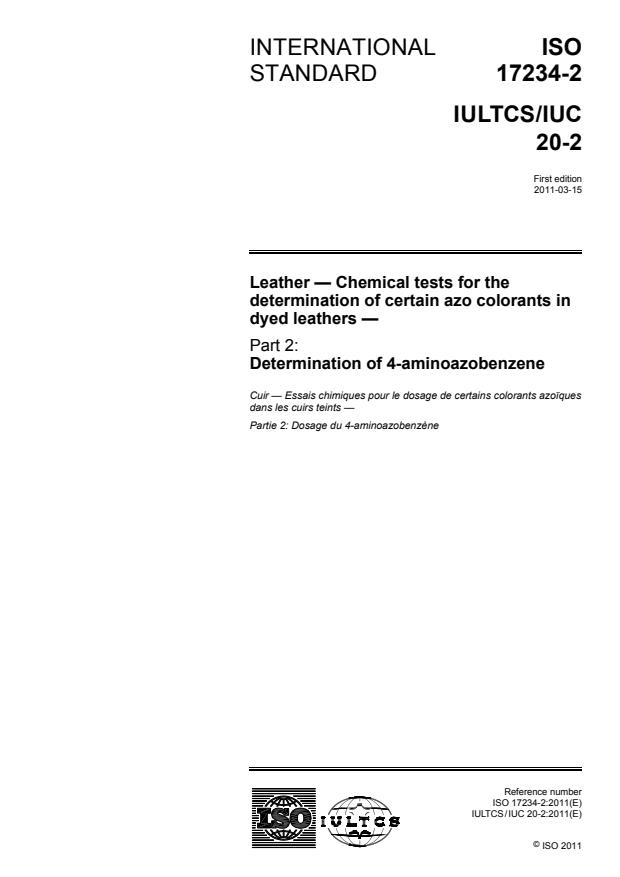
INTERNATIONAL ISO
STANDARD 17234-2
IULTCS/IUC
20-2
First edition
2011-03-15
Leather — Chemical tests for the
determination of certain azo colorants in
dyed leathers —
Part 2:
Determination of 4-aminoazobenzene
Cuir — Essais chimiques pour le dosage de certains colorants azoïques
dans les cuirs teints —
Partie 2: Dosage du 4-aminoazobenzène
Reference number
IULTCS/IUC 20-2:2011(E)
©
ISO 2011
IULTCS/IUC 20-2:2011(E)
PDF disclaimer
This PDF file may contain embedded typefaces. In accordance with Adobe's licensing policy, this file may be printed or viewed but
shall not be edited unless the typefaces which are embedded are licensed to and installed on the computer performing the editing. In
downloading this file, parties accept therein the responsibility of not infringing Adobe's licensing policy. The ISO Central Secretariat
accepts no liability in this area.
Adobe is a trademark of Adobe Systems Incorporated.
Details of the software products used to create this PDF file can be found in the General Info relative to the file; the PDF-creation
parameters were optimized for printing. Every care has been taken to ensure that the file is suitable for use by ISO member bodies. In
the unlikely event that a problem relating to it is found, please inform the Central Secretariat at the address given below.
© ISO 2011
All rights reserved. Unless otherwise specified, no part of this publication may be reproduced or utilized in any form or by any means,
electronic or mechanical, including photocopying and microfilm, without permission in writing from either ISO at the address below or
ISO's member body in the country of the requester.
ISO copyright office
Case postale 56 • CH-1211 Geneva 20
Tel. + 41 22 749 01 11
Fax + 41 22 749 09 47
E-mail copyright@iso.org
Web www.iso.org
Published in Switzerland
ii © ISO 2011 – All rights reserved
IULTCS/IUC 20-2:2011(E)
Contents Page
Foreword .iv
1 Scope.1
2 Normative references.1
3 General .1
4 Principle .2
5 Safety precautions .2
6 Apparatus.2
7 Reagents .3
8 Sampling .3
9 Procedure.4
9.1 Degreasing .4
9.2 Reductive cleavage .4
9.3 Separation and concentration of 4-aminoazobenzene.4
9.4 Calibration solution.4
9.5 Check of the analytical system .5
9.6 Chromatographic analyses .5
10 Evaluation .5
10.1 Calculation with internal standard.5
10.2 Calculation without internal standard.5
10.3 Reliability of the method.6
11 Test report.6
Annex A (informative) Chromatographic analyses .7
Annex B (informative) Reliability of the method.14
Annex C (informative) Assessment guide — Interpretation of analytical results .15
Bibliography.16
IULTCS/IUC 20-2:2011(E)
Foreword
ISO (the International Organization for Standardization) is a worldwide federation of national standards bodies
(ISO member bodies). The work of preparing International Standards is normally carried out through ISO
technical committees. Each member body interested in a subject for which a technical committee has been
established has the right to be represented on that committee. International organizations, governmental and
non-governmental, in liaison with ISO, also take part in the work. ISO collaborates closely with the
International Electrotechnical Commission (IEC) on all matters of electrotechnical standardization.
International Standards are drafted in accordance with the rules given in the ISO/IEC Directives, Part 2.
The main task of technical committees is to prepare International Standards. Draft International Standards
adopted by the technical committees are circulated to the member bodies for voting. Publication as an
International Standard requires approval by at least 75 % of the member bodies casting a vote.
Attention is drawn to the possibility that some of the elements of this document may be the subject of patent
rights. ISO shall not be held responsible for identifying any or all such patent rights.
ISO 17234-2 was prepared by the European Committee for Standardization (CEN) Technical Committee
CEN/TC 289, Leather, in collaboration with the Chemical Test Commission of the International Union of
Leather Technologists and Chemists Societies (IUC Commission, IULTCS), in accordance with the
Agreement on technical cooperation between ISO and CEN (Vienna Agreement). This method is technically
similar to the method in IUC 20-2.
IULTCS, originally formed in 1897, is a world-wide organization of professional leather societies to further the
advancement of leather science and technology. IULTCS has three Commissions, which are responsible for
establishing international methods for the sampling and testing of leather. ISO recognizes IULTCS as an
international standardizing body for the preparation of test methods for leather.
ISO 17234 consists of the following parts, under the general title Leather — Chemical tests for the
determination of certain azo colorants in dyed leathers:
⎯ Part 1: Determination of certain aromatic amines derived from azo colorants
⎯ Part 2: Determination of 4-aminoazobenzene
iv © ISO 2011 – All rights reserved
INTERNATIONAL STANDARD
IULTCS/IUC 20-2:2011(E)
Leather — Chemical tests for the determination of certain azo
colorants in dyed leathers —
Part 2:
Determination of 4-aminoazobenzene
1 Scope
This part of ISO 17234 is supplementary to ISO 17234-1 and describes a special procedure to detect the use
of certain azo colorants in commodities, which can release 4-aminoazobenzene. The procedure also detects
4-aminoazobenzene (Solvent Yellow 1) which is already available as free amine in commodities without
reducing pretreatment.
Azo colorants that are able to form 4-aminoazobenzene generate, under the conditions of ISO 17234-1, the
amines aniline and 1,4-phenylenediamine. The presence of these 4-aminoazobenzene colorants cannot be
reliably ascertained without additional information (e.g. the chemical structure of the colorant used) or without
a special procedure.
The use of certain azo colorants, which may release, by reductive cleavage of their azo group(s), one or more
of the other aromatic amines listed in Annex XVII of Regulation (EC) No. 1907/2006 of the European
Parliament and of the Council on the Registration, Evaluation, Authorisation and Restriction of Chemicals
(REACH), except 4-aminoazobenzene, cannot be determined quantitatively with this method.
2 Normative references
The following referenced documents are indispensable for the application of this document. For dated
references, only the edition cited applies. For undated references, the latest edition of the referenced
document (including any amendments) applies.
ISO 2418, Leather — Chemical, physical and mechanical and fastness tests — Sampling location
ISO 4044, Leather — Chemical tests — Preparation of chemical test samples
3 General
Certain azo colorants may release by reductive cleavage of their azo group(s), 4-aminoazobenzene, which is
proscribed under Annex XVII of Regulation (EC) No. 1907/2006 of the European Parliament and of the
Council on the Registration, Evaluation, Authorisation and Restriction of Chemicals (REACH).
Table 1 — 4-aminoazobenzene proscribed under Regulation REACH 1907/2006/Annex XVII
No. CAS number Index number EC number Substance
22 60-09-3 611-008-00-4 200-453-6 4-aminoazobenzene
IULTCS/IUC 20-2:2011(E)
4 Principle
After degreasing, the leather sample is treated with sodium dithionite in an alkaline solution at 40 °C in a
closed vessel. 4-Aminoazobenzene, which is released in the process, is transferred to a tert-butyl methyl ether
phase by means of liquid/liquid extraction. An aliquot of the tert-butyl methyl ether phase is used for analysis.
The detection and determination of 4-aminoazobenzene is performed using high-performance liquid
chromatography (HPLC) with a diode array detector (DAD) or mass selective detector (HPLC/MS), capillary
gas chromatography with a mass-selective detector (GC/MS) or capillary electrophoresis with a diode array
detector (CE/DAD), or qualitatively with thin-layer chromatography (TLC, HPTLC).
If 4-aminoazobenzene is detected by one chromatographic method, confirmation shall be made using one or
more alternative methods. Amine quantification is performed by HPLC/DAD.
5 Safety precautions
5.1 The compound 4-aminoazobenzene is classified as a substance suspected to be a human carcinogen.
Any handling and disposal of this substance shall be in strict accordance with the appropriate national health
and safety regulations.
5.2 It is the user's responsibility to use safe and proper techniques when handling materials in this test
method. Consult manufacturers for specific details, such as material safety data sheets and other
recommendations.
5.3 Good laboratory practice should be followed. Wear safety glasses in all laboratory areas, and a dust
respirator and single-use gloves while handling powder colorants and 4-aminoazobenzene.
5.4 Users should comply with any national and local safety regulations.
6 Apparatus
Usual laboratory equipment and, in particular, the following.
6.1 Suitable reaction vessel, of temperature-resistant glass with a gastight closure.
6.2 Heating source, that generates a temperature of (40 ± 2) °C.
6.3 Separator, with a revolution speed of more than 3 000 r/min.
6.4 Vacuum rotary evaporator.
6.5 Pipettes, in required or variable sizes.
6.6 Ultrasonic bath, at least 160 W, with controllable heating.
−1
6.7 Horizontal shaker, with a sufficient frequency of 5 s , path length 2 cm to 5 cm.
6.8 Polypropylene or polyethylene syringe, 2 ml.
6.9 Instrumental equipment
6.9.1 Gas chromatography (GC), with mass-selective detector (MS).
6.9.2 High-performance liquid chromatography (HPLC), with gradient elution and diode array
detector (DAD) or mass-selective detector (MS).
2 © ISO 2011 – All rights reserved
IULTCS/IUC 20-2:2011(E)
6.9.3 Thin-layer chromatography (TLC), or high-performance thin-layer chromatography (HPTLC)
equipment, including relevant detection.
6.9.4 Capillary electrophoresis (CE) with DAD.
NOTE A description of the equipment is given in Annex A.
7 Reagents
Unless otherwise specified, analytical grade chemicals shall be used.
7.1 Sodium hydroxide.
1)
7.2 Aqueous sodium dithionite solution, ρ = 200 mg/ml , freshly prepared, to be used immediately after
resting for 1 h in a closed vessel.
2)
7.3 Sodium hydroxide solution, w = 2 % .
7.4 n-Hexane.
7.5 tert-Butyl methyl ether.
7.6 Sodium chloride.
7.7 4-Aminoazobenzene, highest purity.
7.8 Internal standards for gas chromatography (IS), e.g.:
⎯ IS1: naphthalene-d8 (CAS No.: 1146-65-2);
⎯ IS2: 2,4,5-trichloroaniline (CAS No.: 636-30-6);
⎯ IS3: benzidine-d8 (CAS No.: 92890-63-6);
⎯ IS4: anthracene-d10 (CAS No.: 1719-06-8).
7.9 Standard solutions
7.9.1 Internal standard solution (IS), in tert-butyl methyl ether, ρ = 10,0 μg/ml.
7.9.2 4-Aminoazobenzene calibration solution, for checking the experimental procedure and preparation
of calibration solutions, 4-aminoazobenzene in methanol, ρ = 500 μg/ml.
8 Sampling
Sample in accordance with ISO 2418 and grind the leather in accordance with ISO 4044. If sampling in
accordance with ISO 2418 is not possible (e.g. in the case of leathers from finished products like shoes,
garments, etc.), details about sampling shall be given in the test report. Any traces of adhesives shall be
removed mechanically.
1) ρ = mass concentration
2) w = mass fraction (percentage by mass)
IULTCS/IUC 20-2:2011(E)
In the case of leather patchwork fabrics with varicoloured patterns, the various colours have to be taken into
account separately as far as possible. For commodities consisting of various leather qualities, specimens of
the various qualities shall be analysed separately.
9 Procedure
9.1 Degreasing
Treat more than 1,0 g of leather cut into pieces (25 mm ) or a ground leather sample in a closed 50 ml
vessel (6.1) with 20 ml of n-hexane (7.4) in an ultrasonic bath (6.6) at (40 ± 2) °C for 20 min.
Decant the n-hexane layer from the leather sample. Any loss of leather particles during decanting shall be
avoided. Directly after decanting, treat the sample in the same way as before with 20 ml of n-hexane.
Evaporate the residual n-hexane at least overnigh
...
NORME ISO
INTERNATIONALE 17234-2
IULTCS/IUC
20-2
Première édition
2011-03-15
Cuir — Essais chimiques pour le dosage
de certains colorants azoïques dans les
cuirs teints —
Partie 2:
Dosage du 4-aminoazobenzène
Leather — Chemical tests for the determination of certain azo colorants
in dyed leathers —
Part 2: Determination of 4-aminoazobenzene
Numéro de référence
IULTCS/IUC 20-2:2011(F)
©
ISO 2011
IULTCS/IUC 20-2:2011(F)
PDF – Exonération de responsabilité
Le présent fichier PDF peut contenir des polices de caractères intégrées. Conformément aux conditions de licence d'Adobe, ce fichier
peut être imprimé ou visualisé, mais ne doit pas être modifié à moins que l'ordinateur employé à cet effet ne bénéficie d'une licence
autorisant l'utilisation de ces polices et que celles-ci y soient installées. Lors du téléchargement de ce fichier, les parties concernées
acceptent de fait la responsabilité de ne pas enfreindre les conditions de licence d'Adobe. Le Secrétariat central de l'ISO décline toute
responsabilité en la matière.
Adobe est une marque déposée d'Adobe Systems Incorporated.
Les détails relatifs aux produits logiciels utilisés pour la création du présent fichier PDF sont disponibles dans la rubrique General Info
du fichier; les paramètres de création PDF ont été optimisés pour l'impression. Toutes les mesures ont été prises pour garantir
l'exploitation de ce fichier par les comités membres de l'ISO. Dans le cas peu probable où surviendrait un problème d'utilisation,
veuillez en informer le Secrétariat central à l'adresse donnée ci-dessous.
DOCUMENT PROTÉGÉ PAR COPYRIGHT
© ISO 2011
Droits de reproduction réservés. Sauf prescription différente, aucune partie de cette publication ne peut être reproduite ni utilisée sous
quelque forme que ce soit et par aucun procédé, électronique ou mécanique, y compris la photocopie et les microfilms, sans l'accord écrit
de l'ISO à l'adresse ci-après ou du comité membre de l'ISO dans le pays du demandeur.
ISO copyright office
Case postale 56 • CH-1211 Geneva 20
Tel. + 41 22 749 01 11
Fax + 41 22 749 09 47
E-mail copyright@iso.org
Web www.iso.org
Publié en Suisse
ii © ISO 2011 – Tous droits réservés
IULTCS/IUC 20-2:2011(F)
Sommaire Page
Avant-propos .iv
1 Domaine d'application .1
2 Références normatives.1
3 Généralités .1
4 Principe .2
5 Précautions concernant la sécurité.2
6 Appareillage .2
7 Réactifs.3
8 Échantillonnage.4
9 Mode opératoire.4
9.1 Dégraissage .4
9.2 Coupure par réduction.4
9.3 Séparation et concentration du 4-aminoazobenzène .4
9.4 Solution d'étalonnage .5
9.5 Vérification du système d'analyse.5
9.6 Analyses chromatographiques.5
10 Évaluation .5
10.1 Calcul à l'aide d'un étalon interne.5
10.2 Calcul sans l'aide d'un étalon interne .6
10.3 Fiabilité de la méthode.6
11 Rapport d'essai.6
Annexe A (informative) Analyses chromatographiques .7
Annexe B (informative) Fiabilité de la méthode.14
Annexe C (informative) Guide d'évaluation — Interprétation des résultats d'analyse.15
Bibliographie.16
IULTCS/IUC 20-2:2011(F)
Avant-propos
L'ISO (Organisation internationale de normalisation) est une fédération mondiale d'organismes nationaux de
normalisation (comités membres de l'ISO). L'élaboration des Normes internationales est en général confiée
aux comités techniques de l'ISO. Chaque comité membre intéressé par une étude a le droit de faire partie du
comité technique créé à cet effet. Les organisations internationales, gouvernementales et non
gouvernementales, en liaison avec l'ISO participent également aux travaux. L'ISO collabore étroitement avec
la Commission électrotechnique internationale (CEI) en ce qui concerne la normalisation électrotechnique.
Les Normes internationales sont rédigées conformément aux règles données dans les Directives ISO/CEI,
Partie 2.
La tâche principale des comités techniques est d'élaborer les Normes internationales. Les projets de Normes
internationales adoptés par les comités techniques sont soumis aux comités membres pour vote. Leur
publication comme Normes internationales requiert l'approbation de 75 % au moins des comités membres
votants.
L'attention est appelée sur le fait que certains des éléments du présent document peuvent faire l'objet de
droits de propriété intellectuelle ou de droits analogues. L'ISO ne saurait être tenue pour responsable de ne
pas avoir identifié de tels droits de propriété et averti de leur existence.
L'ISO 17234-2 a été élaborée par le comité technique CEN/TC 289, Cuir, du Comité européen de
normalisation (CEN), en collaboration avec la Commission des essais chimiques de l'Union internationale des
sociétés de techniciens et chimistes du cuir (commission IUC, IULTCS), conformément à l'Accord de
coopération technique entre l'ISO et le CEN (Accord de Vienne). Cette méthode est techniquement identique
à la méthode décrite dans l'IUC 20-2.
L'IULTCS est une organisation mondiale de sociétés professionnelles des industries du cuir fondée en 1897
ayant pour mission de favoriser l'avancement des sciences et technologies du cuir. L'IULTCS a trois
commissions, qui sont responsables de l'établissement des méthodes internationales d'échantillonnage et
d'essai des cuirs. L'ISO reconnaît l'IULTCS en tant qu'organisme international à activités normatives pour
l'élaboration de méthodes d'essai relatives au cuir.
L'ISO 17234 comprend les parties suivantes, présentées sous le titre général Cuir — Essais chimiques pour
le dosage de certains colorants azoïques dans les cuirs teints:
⎯ Partie 1: Dosage de certaines amines aromatiques dérivées des colorants azoïques
⎯ Partie 2: Dosage du 4-aminoazobenzène
iv © ISO 2011 – Tous droits réservés
NORME INTERNATIONALE
IULTCS/IUC 20-2:2011(F)
Cuir — Essais chimiques pour le dosage de certains colorants
azoïques dans les cuirs teints —
Partie 2:
Dosage du 4-aminoazobenzène
1 Domaine d'application
La présente partie de l'ISO 17234 est complémentaire à l'ISO 17234-1 et décrit un mode opératoire spécial
permettant de détecter l'utilisation dans des produits de certains colorants azoïques, qui peuvent libérer du
4-aminoazobenzène. Le mode opératoire détecte également le 4-aminoazobenzène (Solvent Yellow 1) qui est
déjà disponible comme amine libre dans les produits sans prétraitement de réduction.
Les colorants azoïques qui sont capables de former du 4-aminoazobenzène génèrent, dans les conditions de
l'ISO 17234-1, les amines aniline et 1,4-phénylènediamine. La présence de ces colorants
4-aminoazobenzène ne peut pas être établie de façon fiable sans information complémentaire (par exemple la
structure chimique du colorant utilisé) ou sans un mode opératoire spécial.
L'emploi de certains colorants azoïques qui peuvent libérer, par coupure par réduction d'un ou de plusieurs de
leurs groupes azoïques, une ou plusieurs des autres amines aromatiques répertoriées dans l'Annexe XVII du
Règlement (CE) n° 1907/2006 du Parlement européen et du Conseil concernant l'enregistrement, l'évaluation
et l'autorisation des substances chimiques, ainsi que les restrictions applicables à ces substances (REACH),
à l'exception du 4-aminoazobenzène, ne peut être déterminé quantitativement avec cette méthode.
2 Références normatives
Les documents de référence suivants sont indispensables pour l'application du présent document. Pour les
références datées, seule l'édition citée s'applique. Pour les références non datées, la dernière édition du
document de référence s'applique (y compris les éventuels amendements).
ISO 2418, Cuir — Essais chimiques, physiques, mécaniques et de solidité — Emplacement de
l'échantillonnage
ISO 4044, Cuir — Essais chimiques — Préparation des échantillons pour essais chimiques
3 Généralités
Certains colorants azoïques peuvent libérer, par coupure par réduction d'un ou de plusieurs groupes azoïques,
du 4-aminoazobenzène, qui est interdit par l'Annexe XVII du Règlement (CE) n° 1907/2006 du Parlement
européen et du Conseil concernant l'enregistrement, l'évaluation et l'autorisation des substances chimiques,
ainsi que les restrictions applicables à ces substances (REACH).
Tableau 1 — 4-Aminoazobenzène interdit par l'Annexe XVII du Règlement REACH 1907/2006
N° N° CAS N° d'indice N° CE Substance
22 60-09-3 611-008-00-4 200-453-6 4-aminoazobenzène
IULTCS/IUC 20-2:2011(F)
4 Principe
Une fois dégraissé, l'échantillon de cuir est traité par une solution alcaline de dithionite de sodium à 40 °C
dans un vase clos. Le 4-aminoazobenzène libéré pendant le processus est transféré en phase éther
t-butylméthylique par extraction liquide/liquide. Une aliquote de la phase éther t-butylméthylique est utilisée
pour analyse.
La détection et le dosage du 4-aminoazobenzène sont réalisés par chromatographie en phase liquide haute
performance avec un détecteur à barrette de diodes (CLHP/UV) ou avec un détecteur sélectif de masse
(CLHP/SM), par chromatographie en phase gazeuse sur colonne capillaire avec détecteur sélectif de masse
(CG/SM) ou par électrophorèse capillaire avec détecteur à barrette de diodes (EC/UV), ou qualitativement par
chromatographie sur couche mince (CCM, CCMHP).
En cas de détection du 4-aminoazobenzène par une méthode de chromatographie, une confirmation doit être
effectuée en utilisant une ou plusieurs autres méthodes. La quantification des amines est effectuée par
CLHP/UV.
5 Précautions concernant la sécurité
5.1 Le 4-aminoazobenzène est classé en tant que substance susceptible d'être carcinogène pour l'homme.
Toute manipulation et toute élimination de cette substance doivent se faire en stricte conformité avec les
réglementations nationales appropriées en matière de santé et de sécurité.
5.2 Il incombe à l'utilisateur d'appliquer des techniques sûres et appropriées lors de la manipulation des
produits indiqués dans la présente méthode d'essai. S'adresser aux fabricants afin d'obtenir des informations
spécifiques, telles que les fiches de données de sécurité et autres recommandations.
5.3 Il convient de respecter les bonnes pratiques de laboratoire. Porter des lunettes de sécurité dans toutes
les zones du laboratoire ainsi qu'un masque anti-poussière jetable et des gants jetables lors de la
manipulation des colorants en poudre et du 4-aminoazobenzène.
5.4 Il convient que les utilisateurs se conforment à toutes les réglementations locales et nationales en
matière de sécurité.
6 Appareillage
Matériel courant de laboratoire et, en particulier, ce qui suit.
6.1 Flacon de réaction approprié, en verre résistant à la chaleur avec bouchon étanche.
6.2 Source de chaleur, produisant une température de (40 ± 2) °C.
6.3 Séparateur, ayant une vitesse de rotation supérieure à 3 000 r/min.
6.4 Évaporateur rotatif sous vide.
6.5 Pipettes, de tailles requises ou variables.
6.6 Bain à ultrasons, au moins 160 W, avec chaleur contrôlable.
−1
6.7 Agitateur horizontal, avec une fréquence suffisante de 5 s , trajet de 2 cm à 5 cm.
6.8 Seringue en polypropylène ou en polyéthylène, 2 ml.
6.9 Équipement d'analyse
2 © ISO 2011 – Tous droits réservés
IULTCS/IUC 20-2:2011(F)
6.9.1 Appareil de chromatographie en phase gazeuse (CG), avec détecteur sélectif de masse (SM).
6.9.2 Système de chromatographie en phase liquide haute performance (CLHP), avec pompe à
gradient et détecteur à barrette de diodes (UV) ou avec détecteur sélectif de masse (SM).
6.9.3 Système pour chromatographie sur couche mince (CCM) ou pour chromatographie sur couche
mince haute performance (CCMHP) comprenant un mode de détection approprié.
6.9.4 Appareil d'électrophorèse capillaire (EC), avec détecteur à barrette de diodes (UV).
NOTE Une description de l'équipement est fournie dans l'Annexe A.
7 Réactifs
Sauf spécification contraire, utiliser des produits chimiques de qualité analytique reconnue.
7.1 Hydroxyde de sodium.
1)
7.2 Solution aqueuse de dithionite de sodium, ρ = 200 mg/ml , fraîchement préparée pour une
utilisation immédiate après un repos de 1 h dans un vase clos.
2)
7.3 Solution d'hydroxyde de sodium, w = 2 % .
7.4 n-Hexane.
7.5 Éther t-butylméthylique.
7.6 Chlorure de sodium.
7.7 4-Aminoazobenzène, de la plus grande pureté.
7.8 Étalons internes pour la chromatographie en phase gazeuse (IS), par exemple:
⎯ IS1: naphtalène-d8 (n° CAS: 1146-65-2);
⎯ IS2: 2,4,5-trichloroaniline (n° CAS: 636-30-6);
⎯ IS3: benzidine-d8 (n° CAS: 92890-63-6);
⎯ IS4: anthracène-d10 (n° CAS: 1719-06-8).
7.9 Solutions étalons
7.9.1 Solution étalon interne (IS), dans de l'éther t-butylméthylique, ρ = 10,0 µg/ml.
7.9.2 Solution d'étalonnage de 4-aminoazobenzène, pour la vérification du mode opératoire
expérimental et la préparation de solutions d'étalonnage de 4-aminoazobenzène dans du méthanol,
ρ = 500 µg/ml.
1) ρ = concentration massique
2) w = fraction massique (pourcentage en masse)
IULTCS/IUC 20-2:2011(F)
8 Échantillonnage
Prélever un échantillon conformément à l'ISO 2418 et broyer le cuir conformément à l'ISO 4044. Si
l'échantillonnage n'est pas possible conformément à l'ISO 2418 (par exemple dans le cas de cuirs de produits
finis comme les chaussures, les vêtements, etc.), des précisions relatives au prélèvement des échantillons
doivent figurer dans le rapport d'essai. Toute trace de colle doit être éliminée par voie mécanique.
Dans le cas de tissus constitués de pièces de cuirs avec des motifs multicolores, les différentes couleurs
doivent être prises en compte séparément, dans la mesure du possible. Pour les produits constitués de
diverses qualités de cuir, des éprouvettes des diverses qualités doivent être analysées séparément.
9 Mode opératoire
9.1 Dégraissage
Traiter dans un bain à ultrasons (6.6) à (40 ± 2) °C pendant 20 min plus de 1,0 g d'échantillon de cuir découpé
en morceaux (25 mm ) ou broyé dans un vase clos de 50 ml (6.1) contenant 20 ml de n-hexane (7.4).
Laisser décanter la couche de n-hexane imprégnant l'échantillon de cuir. Durant la décantation, il faut éviter
toute perte de particule de cuir. Immédiatement après décantation, retraiter l'échantillon de la même manière
que précédemment avec 20 ml de n-hexane. Laisser évaporer le n-hexane résiduel au moins une nuit dans le
vase ouvert.
9.2 Coupure par réduction
Ajouter 9 ml
...