

ISO/TS 10303-325:2004
(Main)Industrial automation systems and integration — Product data representation and exchange — Part 325: Abstract test suite: Building elements using explicit shape representation
General Information
- Abstract
ISO/TS 10303-325:2004 specifies the abstract test suite to be used in the conformance testing of implementations of ISO 10303-225. The following are within the scope of ISO/TS 10303-325:2004: the specification of the test purposes associated with ISO 10303-225; the verdict criteria to be applied during conformance testing of an implementation of ISO 10303-225 using ISO 10303-21 or ISO 10303-22; NOTE The verdict criteria are used to ascertain whether a test purpose has been satisfactorily met by an implementation under test (IUT) within the context of a given test case. the abstract test cases to be used as the basis for the executable test cases for conformance testing. The following are outside the scope of ISO/TS 10303-325:2004: the creation of executable test cases; test specifications for tests other than conformance testing such as interoperability or acceptance testing; other implementation methods.
- Status
- Published
- Publication Date
- 06-Jan-2004
- Technical Committee
- ISO/TC 184/SC 4 - Industrial data
- Drafting Committee
- ISO/TC 184/SC 4/WG 12 - STEP product modelling and resources
- Current Stage
- 9093 - International Standard confirmed
- Start Date
- 10-Nov-2023
- Completion Date
- 29-Aug-2026
Buy Documents
ISO/TS 10303-325:2004 - Industrial automation systems and integration — Product data representation and exchange — Part 325: Abstract test suite: Building elements using explicit shape representation Released:1/7/2004
ISO/TS 10303-325:2004 - Industrial automation systems and integration — Product data representation and exchange — Part 325: Abstract test suite: Building elements using explicit shape representation Released:1/7/2004
Overview
ISO/TS 10303-325:2004 is an ISO Technical Specification that defines an abstract test suite for conformance testing of implementations of ISO 10303-225. Titled "Abstract test suite: Building elements using explicit shape representation," this document provides the test purposes, abstract test cases and verdict criteria to assess whether an implementation correctly supports the ISO 10303-225 data model for building elements when exchanged using ISO 10303-21 or ISO 10303-22 file formats.
Key facts:
- Published: First edition, 2004-01-15
- Scope: Conformance testing (abstract level) for building elements with explicit shape representation
- Not included: Creation of executable test cases, interoperability or acceptance testing, or implementation methods
Key topics and requirements
- Test purposes: Clear statements of what each abstract test case is intended to validate against ISO 10303-225.
- Abstract test cases: Structured, non-executable test cases that serve as the basis for developing executable tests used in lab or automated conformance testing.
- Verdict criteria: Formal pass/fail rules and criteria to determine whether an Implementation Under Test (IUT) satisfies a test purpose within the context of a given test case.
- Supported exchange formats: Guidance for conformance testing when exchanging data using ISO 10303-21 or ISO 10303-22.
- Scope boundaries: Explicit exclusion of executable test generation, non‑conformance testing types (e.g., interoperability), and alternate implementation techniques.
Applications
ISO/TS 10303-325 is used to:
- Define the test objectives and acceptance criteria for software vendors implementing ISO 10303-225 support for building elements with explicit shapes.
- Serve as the authoritative basis for test laboratories and QA teams to develop executable conformance tests for CAD/BIM and product data exchange tools.
- Support procurement and certification processes that require formal conformance evidence to ISO 10303-225.
Practical value:
- Ensures consistent interpretation of ISO 10303-225 requirements across implementations.
- Reduces ambiguity in conformance testing by providing standardized verdict criteria.
- Enables vendors and test houses to move from abstract test definitions to repeatable executable tests.
Who should use this standard
- Software vendors implementing ISO 10303-225 functionality for building elements
- Test laboratories and certification bodies developing executable conformance test suites
- QA, interoperability and compliance teams in architecture, engineering, construction (AEC) and CAD/BIM toolchains
Related standards
- ISO 10303-225 (the implementation under test)
- ISO 10303-21 and ISO 10303-22 (exchange file formats referenced for conformance testing)
Keywords: ISO/TS 10303-325, ISO 10303-225, conformance testing, abstract test suite, building elements, explicit shape representation, ISO 10303-21, ISO 10303-22, product data representation and exchange.
Buy Documents
ISO/TS 10303-325:2004 - Industrial automation systems and integration — Product data representation and exchange — Part 325: Abstract test suite: Building elements using explicit shape representation Released:1/7/2004
ISO/TS 10303-325:2004 - Industrial automation systems and integration — Product data representation and exchange — Part 325: Abstract test suite: Building elements using explicit shape representation Released:1/7/2004
Get Certified
Connect with accredited certification bodies for this standard

DVS-ZERT GmbH
German welding certification society.
CARES (UK Certification Authority for Reinforcing Steels)
UK certification for reinforcing steels and construction.
EWF/IIW (European/International Welding Federation)
International welding personnel certification.
Sponsored listings
Frequently Asked Questions
ISO/TS 10303-325:2004 is a technical specification published by the International Organization for Standardization (ISO). Its full title is "Industrial automation systems and integration — Product data representation and exchange — Part 325: Abstract test suite: Building elements using explicit shape representation". This standard covers: ISO/TS 10303-325:2004 specifies the abstract test suite to be used in the conformance testing of implementations of ISO 10303-225. The following are within the scope of ISO/TS 10303-325:2004: the specification of the test purposes associated with ISO 10303-225; the verdict criteria to be applied during conformance testing of an implementation of ISO 10303-225 using ISO 10303-21 or ISO 10303-22; NOTE The verdict criteria are used to ascertain whether a test purpose has been satisfactorily met by an implementation under test (IUT) within the context of a given test case. the abstract test cases to be used as the basis for the executable test cases for conformance testing. The following are outside the scope of ISO/TS 10303-325:2004: the creation of executable test cases; test specifications for tests other than conformance testing such as interoperability or acceptance testing; other implementation methods.
ISO/TS 10303-325:2004 specifies the abstract test suite to be used in the conformance testing of implementations of ISO 10303-225. The following are within the scope of ISO/TS 10303-325:2004: the specification of the test purposes associated with ISO 10303-225; the verdict criteria to be applied during conformance testing of an implementation of ISO 10303-225 using ISO 10303-21 or ISO 10303-22; NOTE The verdict criteria are used to ascertain whether a test purpose has been satisfactorily met by an implementation under test (IUT) within the context of a given test case. the abstract test cases to be used as the basis for the executable test cases for conformance testing. The following are outside the scope of ISO/TS 10303-325:2004: the creation of executable test cases; test specifications for tests other than conformance testing such as interoperability or acceptance testing; other implementation methods.
ISO/TS 10303-325:2004 is classified under the following ICS (International Classification for Standards) categories: 25.040.40 - Industrial process measurement and control. The ICS classification helps identify the subject area and facilitates finding related standards.
ISO/TS 10303-325:2004 is available in PDF format for immediate download after purchase. The document can be added to your cart and obtained through the secure checkout process. Digital delivery ensures instant access to the complete standard document.
Standards Content (Sample)
TECHNICAL ISO/TS
SPECIFICATION 10303-325
First edition
2004-01-15
Industrial automation systems and
integration — Product data
representation and exchange —
Part 325:
Abstract test suite: Building elements
using explicit shape representation
Systèmes d'automatisation industrielle et intégration — Représentation
et échange de données de produits
Partie 325: Suite d'essais abstraite: Éléments de construction utilisant
une représentation de forme explicite
Reference number
©
ISO 2004
PDF disclaimer
This PDF file may contain embedded typefaces. In accordance with Adobe's licensing policy, this file may be printed or viewed but
shall not be edited unless the typefaces which are embedded are licensed to and installed on the computer performing the editing. In
downloading this file, parties accept therein the responsibility of not infringing Adobe's licensing policy. The ISO Central Secretariat
accepts no liability in this area.
Adobe is a trademark of Adobe Systems Incorporated.
Details of the software products used to create this PDF file can be found in the General Info relative to the file; the PDF-creation
parameters were optimized for printing. Every care has been taken to ensure that the file is suitable for use by ISO member bodies. In
the unlikely event that a problem relating to it is found, please inform the Central Secretariat at the address given below.
This CD-ROM contains the publication ISO/TS 10303-325 in portable document format (PDF), which can be
viewed using Adobe® Acrobat® Reader.
Adobe and Ac
...
TECHNICAL ISO/TS
SPECIFICATION 10303-325
First edition
2004-01-15
Industrial automation systems and
integration — Product data
representation and exchange —
Part 325:
Abstract test suite: Building elements
using explicit shape representation
Systèmes d'automatisation industrielle et intégration — Représentation
et échange de données de produits
Partie 325: Suite d'essais abstraite: Éléments de construction utilisant
une représentation de forme explicite
Reference number
©
ISO 2004
PDF disclaimer
This PDF file may contain embedded typefaces. In accordance with Adobe's licensing policy, this file may be printed or viewed but
shall not be edited unless the typefaces which are embedded are licensed to and installed on the computer performing the editing. In
downloading this file, parties accept therein the responsibility of not infringing Adobe's licensing policy. The ISO Central Secretariat
accepts no liability in this area.
Adobe is a trademark of Adobe Systems Incorporated.
Details of the software products used to create this PDF file can be found in the General Info relative to the file; the PDF-creation
parameters were optimized for printing. Every care has been taken to ensure that the file is suitable for use by ISO member bodies. In
the unlikely event that a problem relating to it is found, please inform the Central Secretariat at the address given below.
© ISO 2004
All rights reserved. Unless otherwise specified, no part of this publication may be reproduced or utilized in any form or by any means,
electronic or mechanical, including photocopying and microfilm, without permission in writing from either ISO at the address below or
ISO's member body in the country of the requester.
ISO copyright office
Case postale 56 • CH-1211 Geneva 20
Tel. + 41 22 749 01 11
Fax + 41 22 749 09 47
E-mail copyright@iso.org
Web www.iso.org
Published in Switzerland
ii © ISO 2004 — All rights reserved
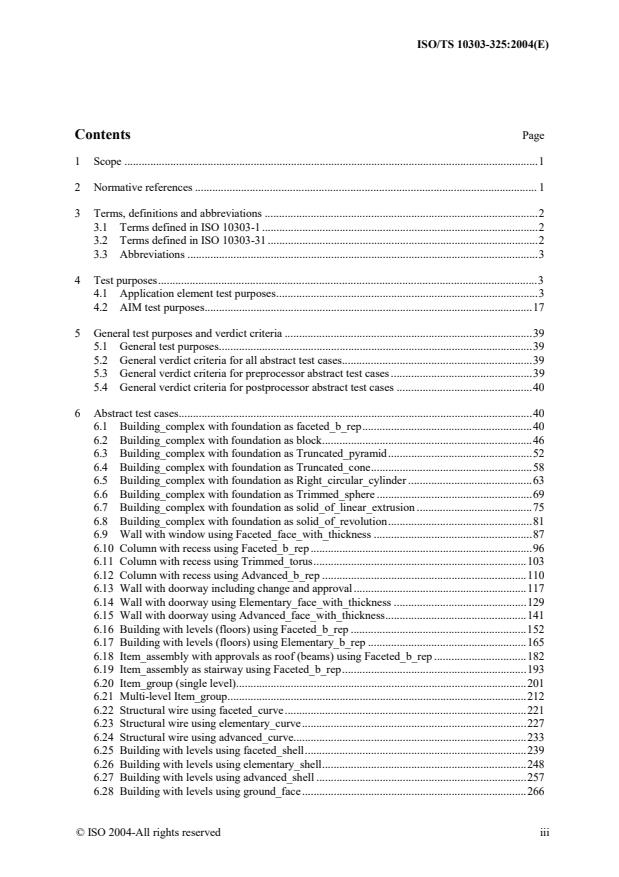
Contents Page
1 Scope .1
2 Normative references . 1
3 Terms, definitions and abbreviations .2
3.1 Terms defined in ISO 10303-1 .2
3.2 Terms defined in ISO 10303-31 .2
3.3 Abbreviations.3
4 Test purposes.3
4.1 Application element test purposes.3
4.2 AIM test purposes.17
5 General test purposes and verdict criteria .39
5.1 General test purposes.39
5.2 General verdict criteria for all abstract test cases.39
5.3 General verdict criteria for preprocessor abstract test cases .39
5.4 General verdict criteria for postprocessor abstract test cases .40
6 Abstract test cases.40
6.1 Building_complex with foundation as faceted_b_rep.40
6.2 Building_complex with foundation as block.46
6.3 Building_complex with foundation as Truncated_pyramid.52
6.4 Building_complex with foundation as Truncated_cone.58
6.5 Building_complex with foundation as Right_circular_cylinder .63
6.6 Building_complex with foundation as Trimmed_sphere .69
6.7 Building_complex with foundation as solid_of_linear_extrusion .75
6.8 Building_complex with foundation as solid_of_revolution.81
6.9 Wall with window using Faceted_face_with_thickness .87
6.10 Column with recess using Faceted_b_rep .96
6.11 Column with recess using Trimmed_torus.103
6.12 Column with recess using Advanced_b_rep .110
6.13 Wall with doorway including change and approval.117
6.14 Wall with doorway using Elementary_face_with_thickness .129
6.15 Wall with doorway using Advanced_face_with_thickness.141
6.16 Building with levels (floors) using Faceted_b_rep .152
6.17 Building with levels (floors) using Elementary_b_rep .165
6.18 Item_assembly with approvals as roof (beams) using Faceted_b_rep .182
6.19 Item_assembly as stairway using Faceted_b_rep.193
6.20 Item_group (single level).201
6.21 Multi-level Item_group.212
6.22 Structural wire using faceted_curve.221
6.23 Structural wire using elementary_curve.227
6.24 Structural wire using advanced_curve.233
6.25 Building with levels using faceted_shell.239
6.26 Building with levels using elementary_shell.248
6.27 Building with levels using advanced_shell .257
6.28 Building with levels using ground_face.266
6.29 Building_complex with surrounding_grounds_shape as faceted_surface .276
6.30 Building_complex with surrounding_grounds_shape as point_and_line_representation.278
Annex A (normative) Conformance classes .281
Annex B (normative) Information object registration .288
Annex C (normative) Postprocessor input specification file names.289
Annex D (informative) Excluded test purposes.291
Index.292
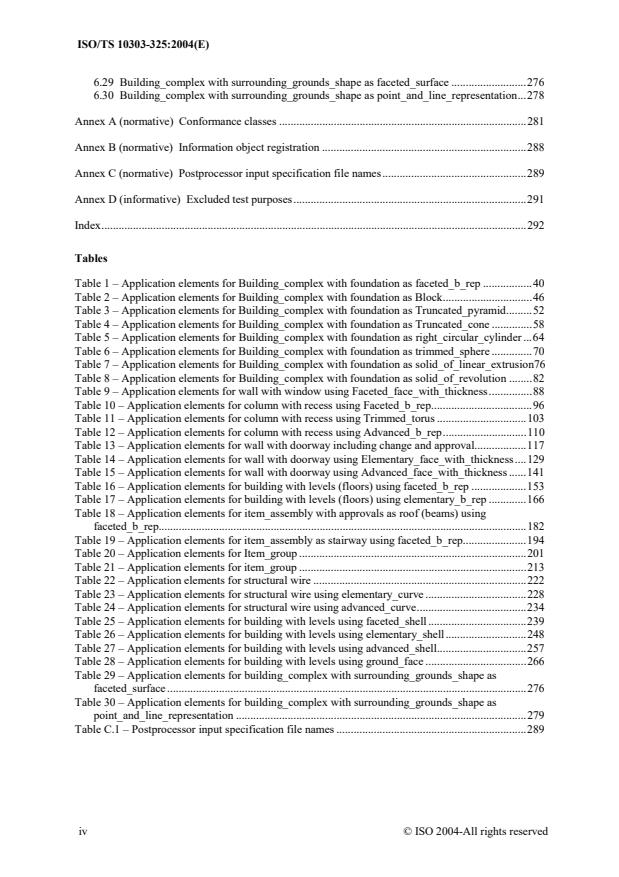
Tables
Table 1 – Application elements for Building_complex with foundation as faceted_b_rep .40
Table 2 – Application elements for Building_complex with foundation as Block.46
Table 3 – Application elements for Building_complex with foundation as Truncated_pyramid.52
Table 4 – Application elements for Building_complex with foundation as Truncated_cone .58
Table 5 – Application elements for Building_complex with foundation as right_circular_cylinder .64
Table 6 – Application elements for Building_complex with foundation as trimmed_sphere .70
Table 7 – Application elements for Building_complex with foundation as solid_of_linear_extrusion76
Table 8 – Application elements for Building_complex with foundation as solid_of_revolution .82
Table 9 – Application elements for wall with window using Faceted_face_with_thickness.88
Table 10 – Application elements for column with recess using Faceted_b_rep.96
Table 11 – Application elements for column with recess using Trimmed_torus .103
Table 12 – Application elements for column with recess using Advanced_b_rep.110
Table 13 – Application elements for wall with doorway including change and approval.117
Table 14 – Application elements for wall with doorway using Elementary_face_with_thickness.129
Table 15 – Application elements for wall with doorway using Advanced_face_with_thickness .141
Table 16 – Application elements for building with levels (floors) using faceted_b_rep .153
Table 17 – Application elements for building with levels (floors) using elementary_b_rep .166
Table 18 – Application elements for item_assembly with approvals as roof (beams) using
faceted_b_rep.182
Table 19 – Application elements for item_assembly as stairway using faceted_b_rep.194
Table 20 – Application elements for Item_group .201
Table 21 – Application elements for item_group .213
Table 22 – Application elements for structural wire .222
Table 23 – Application elements for structural wire using elementary_curve .228
Table 24 – Application elements for structural wire using advanced_curve.234
Table 25 – Application elements for building with levels using faceted_shell .239
Table 26 – Application elements for building with levels using elementary_shell.248
Table 27 – Application elements for building with levels using advanced_shell.257
Table 28 – Application elements for building with levels using ground_face .266
Table 29 – Application elements for building_complex with surrounding_grounds_shape as
faceted_surface .276
Table 30 – Application elements for building_complex with surrounding_grounds_shape as
point_and_line_representation .279
Table C.1 – Postprocessor input specification file names .289
iv © ISO 2004-All rights reserved
Foreword
ISO (the International Organization for Standardization) is a worldwide federation of national stan-
dards bodies (ISO member bodies). The work of preparing International Standards is normally carried
out through ISO technical committees. Each member body interested in a subject for which a techni-
cal committee has been established has the right to be represented on that committee. International
organizations, governmental and non-governmental, in liaison with ISO, also take part in the work.
ISO collaborates closely with the International Electrotechnical Commission (IEC) on all matters of
electrotechnical standardization.
International Standards are drafted in accordance with the rules given in the ISO/IEC Directives,
Part 2.
The main task of technical committees is to prepare International Standards. Draft International Stan-
dards adopted by the technical committees are circulated to the member bodies for voting. Publica-
tion as an International Standard requires approval by at least 75 % of the member bodies casting a
vote.
In other circumstances, particularly when there is an urgent market requirement for such documents,
a technical committee may decide to publish other types of normative document:
— an ISO Publicly Available Specification (ISO/PAS) represents an agreement between technical
experts in an ISO working group and is accepted for publication if it is approved by more than
50 % of the members of the parent committee casting a vote;
— an ISO Technical Specification (ISO/TS) represents an agreement between the members of a
technical committee and is accepted for publication if it is approved by 2/3 of the members of the
committee casting a vote.
An ISO/PAS or ISO/TS is reviewed after three years in order to decide whether it will be confirmed
for a further three years, revised to become an International Standard, or withdrawn. If the ISO/PAS
or ISO/TS is confirmed, it is reviewed again after a further three years, at which time it must either be
transformed into an International Standard or be withdrawn.
Attention is drawn to the possibility that some of the elements of this document may be the subject of
patent rights. ISO shall not be held responsible for identifying any or all such patent rights.
ISO/TS 10303-325 was prepared by Technical Committee ISO/TC 184, Industrial automation sys-
tems and integration, Subcommittee SC 4, Industrial data.
ISO 10303 is organized as a series of parts, each published separately. The structure of ISO 10303 is
described in ISO 10303-1.
A complete list of parts of ISO 10303 is available from the Internet: http://www.tc184-sc4.org/titles
Introduction
ISO 10303 is an International Standard for the computer-interpretable representation and exchange of
product data. The objective is to provide a neutral mechanism capable of describing product data
throughout the life cycle of a product independent from any particular system. The nature of this de-
scription makes it suitable not only for neutral file exchange, but also as a basis for implementing and
sharing product databases and archiving.
This International Standard is organized as a series of parts, each published separately. The parts of
ISO 10303 fall into one of the following series: description methods, integrated resources, application
interpreted constructs, application protocols, abstract test suites, implementation methods, and con-
formance testing. The series are described in ISO 10303-1. This part of ISO 10303 is a member of the
abstract test suite series.
The purpose of an abstract test suite is to provide a basis for evaluating whether a particular imple-
mentation of an application protocol actually conforms to the requirements of that application proto-
col. A standard abstract test suite helps ensure that evaluations of conformance are conducted in a
consistent manner by different test laboratories.
This part of ISO 10303 specifies the abstract test suite for ISO 10303-225, Application protocol:
Building elements using explicit shape representation. The abstract test cases presented here are the
basis for conformance testing of implementations of ISO 10303-225.
This abstract test suite is made up of two major parts:
— the test purposes, the specific items to be covered by conformance testing;
— the set of abstract test cases that meet those test purposes.
The test purposes are statements of the application protocol requirements that are to be addressed by
the abstract test cases. Test purposes are derived primarily from the application protocol's application
elements and application interpreted model, as well as from other sources such as standards refer-
enced by the application protocol and requirements stated in the application protocol conformance
requirements clause.
The abstract test cases address the test purposes by:
— specifying the requirements for input data to be used when testing an implementation of the ap-
plication protocol;
— specifying the verdict criteria to be used when evaluating whether the implementation success-
fully converted the input data to a different form.
The abstract test cases set the requirements for the executable test cases that are required to actually
conduct a conformance test. Executable test cases contain the scripts, detailed values, and other ex-
plicit information required to conduct a conformance test on a specific implementation of the applica-
tion protocol.
At the time of publication of this document, conformance testing requirements had been established
for implementations of application protocols in combination with ISO 10303-21 and ISO 10303-22.
vi © ISO 2004-All rights reserved
Accordingly, this part of ISO 10303 only specifies test purposes and abstract test cases appropriate to
such implementations.
For ISO 10303-21, two kinds of implementations, preprocessors and postprocessors, must be tested.
Both these are addressed in this abstract test suite.
For ISO 10303-22, a class of applications will possess the capability to upload and download applica-
tion protocol-compliant standard data access interface-models and/or schema instances to and from
applications that implement the standard data access interface. This abstract test suite addresses such
applications.
TECHNICAL SPECIFICATION ISO/TS 10303-325:2004(E)
Industrial automation systems and integration — Product data
representation and exchange —
Part 325:
Abstract test suite: Building elements using explicit shape
representation
1 Scope
This part of ISO 10303 specifies the abstract test suite to be used in the conformance testing of im-
plementations of ISO 10303-225. The following are within the scope of this part of ISO 10303:
— the specification of the test purposes associated with ISO 10303-225;
— the verdict criteria to be applied during conformance testing of an implementation of ISO 10303-
225 using ISO10303-21 or ISO 10303-22;
NOTE The verdict criteria are used to ascertain whether a test purpose has been satisfactorily met by
an implementation under test (IUT) within the context of a given test case.
— the abstract test cases to be used as the basis for the executable test cases for conformance test-
ing.
The following are outside the scope of this part of ISO 10303:
— the creation of executable test cases;
— test specifications for tests other than conformance testing such as interoperability or acceptance
testing;
— other implementation methods.
2 Normative references
The following referenced documents are indispensable for the application of this document. For dated
references, only the edition cited applies. For undated references, the latest edition of the referenced
document (including any amendments) applies.
ISO/IEC 8824-1:1998, Information Technology — Abstract Syntax Notation One (ASN.1): Specification
of basic notation
ISO 10303-1:1994, Industrial automation systems and integration — Product data representation
and exchange — Part 1: Overview and fundamental principles
ISO 10303-11:1994, Industrial automation systems and integration — Product data representation
and exchange — Part 11: Description methods: The EXPRESS language reference manual
ISO/TR 10303-12:1997, Industrial automation systems and integration — Product data representa-
tion and exchange — Part 12: Description methods: The EXPRESS-I language reference manual
ISO 10303-21:2002, Industrial automation systems and integration — Product data representation
and exchange — Part 21: Implementation methods: Clear text encoding of the exchange structure
ISO 10303-22:1998, Industrial automation systems and integration — Product data representation
and exchange — Part 22: Implementation methods: Standard data access interface
ISO 10303-31:1994, Industrial automation systems and integration — Product data representation
and exchange — Part 31: Conformance testing methodology and framework: General concepts
ISO 10303-32:1998, Industrial automation systems and integration — Product data representation
and exchange — Part 32: Conformance testing methodology and framework: Requirements on test-
ing laboratories and clients
ISO 10303-225:1999, Industrial automation systems and integration — Product data representation
and exchange — Part 225: Application protocol: Building elements using explicit shape representa-
tion
3 Terms, definitions and abbreviations
3.1 Terms defined in ISO 10303-1
For the purposes of this document, the following terms defined in ISO 10303-1 apply.
— abstract test suite;
— application protocol (AP);
— implementation method;
3.2 Terms defined in ISO 10303-31
For the purposes of this document, the following terms defined in ISO 10303-31 apply.
— abstract test case;
— conformance testing
— executable test case;
— test purpose;
— verdict criterion.
2 © ISO 2004-All rights reserved
ISO/TS10303-325:2004(E)
3.3 Abbreviations
For the purposes of this document, the following abbreviations apply.
AE Application element
IUT Implementation Under Test
4 Test purposes
4.1 Application element test purposes
Application element test purposes are derived from the application objects (4.2 of ISO 10303-225)
and the application assertions (4.3 of ISO 10303-225). The test purposes are collected as test purpose
groups; the test purpose groups are structured by the application objects.
4.1.1 Advanced_b_rep
ae012 Advanced_b_rep with b_spline_surface (see 6.12)
ae013 Advanced_b_rep is element of one Component_shape_representation (see 6.12)
4.1.2 Advanced_curve
ae022 Advanced_curve with b_spline_curve type (see 6.24)
ae023 Advanced_curve is element of one Component_shape_representation (see 6.24)
4.1.3 Advanced_face_with_thickness
ae032 Advanced_face_with_thickness with underlying surface as b_spline_surface and
boundaries as b_spline_curve (see 6.15)
ae033 Advanced_face_with_thickness is element of one Component_ shape_representation object
(see 6.15)
4.1.4 Advanced_shell
ae042 Advanced_shell defines the space shape of one Space (see 6.27)
4.1.5 Approval
ae052 Approval with approver (see 6.13, 6.14, 6.15, 6.16, 6.17, 6.18, 6.19, 6.20, 6.25, 6.26, 6.27,
6.28)
ae053 Approval with date (see 6.13, 6.14, 6.15, 6.16, 6.17, 6.18, 6.19, 6.20, 6.25, 6.26, 6.27, 6.28)
ae054 Approval with purpose (see 6.13, 6.14, 6.15, 6.16, 6.17, 6.18, 6.19, 6.20, 6.25, 6.26, 6.27,
6.28)
ae055 Approval with status (see 6.13, 6.14, 6.15, 6.16, 6.17, 6.18, 6.19, 6.20, 6.25, 6.26, 6.27,
6.28)
ae057 Approval providing approval for one Building_element_component (see 6.13, 6.14, 6.15,
6.16, 6.17)
ae058 Approval providing approval for many Building_element_component (see 6.18)
ae0510 Approval providing approval for one Building_item (see 6.18, 6.19, 6.25, 6.26, 6.27)
ae0511 Approval providing approval for many Building_item (see 6.20, 6.28)
ae0513 Approval providing authorization for one Change_request (see 6.13, 6.14, 6.15, 6.17, 6.25,
6.26, 6.27)
ae0514 Approval providing authorization for many Change_request (see 6.20, 6.28)
ae0516 Approval provides approval for one Item_assembly (see 6.18, 6.25, 6.26, 6.27)
ae0517 Approval provides approval for many Item_assembly (see 6.19)
4.1.6 Block
ae062 Block is element of one Component_shape_representation (see 6.2)
4.1.7 Building
ae072 Building with address present (see 6.1, 6.2, 6.3, 6.4, 6.5, 6.6, 6.7, 6.8, 6.20)
ae073 Building with address not present (see 6.9, 6.10, 6,11, 6.12, 6.13, 6.14, 6.15, 6.16, 6.17,
6.18, 6.19, 6.21, 6.22, 6.23, 6.24, 6.25, 6.26, 6.27, 6.28)
ae074 Building with description (see 6.1, 6.2, 6.3, 6.4, 6.5, 6.6, 6.7, 6.8, 6.9, 6.10, 6.11, 6.12,
6.13, 6.14, 6.15, 6.16, 6.17, 6.18, 6.19, 6.20, 6.21, 6.22, 6.23. 6.24. 6.25,6.26, 6.27 6.28)
ae075 Building with name (see 6.1, 6.2, 6.3, 6.4, 6.5, 6.6, 6.7, 6.8, 6.9, 6.10, 6.11, 6.12, 6.13, 6.14,
6.15, 6.16, 6.17, 6.18, 6.19, 6.20, 6.21, 6.22, 6.23. 6.24. 6.25,6.26, 6.27 6.28)
ae076 Building with owner (see 6.1, 6.2, 6.3, 6.4, 6.5, 6.6, 6.7, 6.8, 6.9, 6.10, 6.11, 6.12, 6.13,
6.14, 6.15, 6.16, 6.17, 6.18, 6.19, 6.20, 6.21, 6.22, 6.23. 6.24. 6.25,6.26, 6.27 6.28)
ae077 Building with status (see 6.1, 6.2, 6.3, 6.4, 6.5, 6.6, 6.7, 6.8, 6.9, 6.10, 6.11, 6.12, 6.13,
6.14, 6.15, 6.16, 6.17, 6.18, 6.19, 6.20, 6.21, 6.22, 6.23. 6.24. 6.25,6.26, 6.27 6.28)
ae078 Building is the positioned building in one Building_position_in_complex (see 6.1, 6.2, 6.3,
6.4, 6.5, 6.6, 6.7, 6.8, 6.9, 6.10, 6.11, 6.12, 6.13, 6.14, 6.15, 6.16, 6.17, 6.18, 6.19, 6.20,
6.21, 6.22, 6.23. 6.24. 6.25,6.26, 6.27 6.28)
ae0710 Building contains one Section_position_in_building (see 6.1, 6.2, 6.3, 6.4, 6.5, 6.6, 6.7, 6.8,
6.9, 6.10, 6.11, 6.12, 6.13, 6.14, 6.15, 6.16, 6.17, 6.18, 6.19, 6.21, 6.22, 6.23. 6.24.
6.25,6.26, 6.27)
ae0711 Building contains many Section_position_in_building (see 6.20, 6.28)
4.1.8 Building_complex
ae082 Building_complex with description (see 6.1, 6.2, 6.3, 6.4, 6.5, 6.6, 6.7, 6.8, 6.9, 6.10, 6.11,
6.12, 6.13, 6.14, 6.15, 6.16, 6.17, 6.18, 6.19, 6.20, 6.21, 6.22, 6.23. 6.24. 6.25,6.26, 6.27
6.28, 6.29, 6.30)
ae083 Building_complex with global_position (see 6.1, 6.2, 6.3, 6.4, 6.5, 6.6, 6.7, 6.8, 6.9, 6.10,
6.11, 6.12, 6.13, 6.14, 6.15, 6.16, 6.25, 6.26, 6.27)
ae084 Building_complex with name (see 6.1, 6.2, 6.3, 6.4, 6.5, 6.6, 6.7, 6.8, 6.9, 6.10, 6.11, 6.12,
6.13, 6.14, 6.15, 6.16, 6.17, 6.18, 6.19, 6.20, 6.21, 6.22, 6.23. 6.24. 6.25,6.26, 6.27 6.28,
6.29, 6.30)
ae085 Building_complex with owner (see 6.1, 6.2, 6.3, 6.4, 6.5, 6.6, 6.7, 6.8, 6.9, 6.10, 6.11, 6.12,
6.13, 6.14, 6.15, 6.16, 6.17, 6.18, 6.19, 6.20, 6.21, 6.22, 6.23. 6.24. 6.25,6.26, 6.27 6.28,
6.29, 6.30)
ae088 Building_complex with surrounding grounds shape defined by zero Site_shape_-
representation (see 6.1, 6.2, 6.3, 6.4, 6.5, 6.6, 6.7, 6.8, 6.9, 6.10, 6.11, 6.12, 6.13, 6.14, 6.15,
6.16, 6.17, 6.18, 6.19, 6.20, 6.21, 6.22, 6.23. 6.24. 6.25,6.26, 6.27 6.28)
ae089 Building_complex with surrounding_grounds_shape defined by one Site_shape_-
representation (see 6.29, 6.30)
ae0810 Building_complex with global position specified by zero Gis_position (see 6.9, 6.10, 6.11,
6.12, 6.13, 6.14, 6.15, 6.16, 6.17, 6.18, 6.19, 6.20, 6.22, 6.23, 6.24, 6.28, 6.29, 6.30)
ae0811 Building_complex with global position specified by one Gis_position (see 6.1, 6.2, 6.3, 6.4,
6.5, 6.6, 6.7, 6.8, 6.25, 6.26, 6.27)
4 © ISO 2004-All rights reserved
ISO/TS10303-325:2004(E)
ae0812 Building_complex contains zero Building_position_in_complex (see 6.29, 6.30)
ae0813 Building_complex contains one Building_position_in_complex (see 6.1, 6.2, 6.3, 6.4, 6.5,
6.6, 6.7, 6.8, 6.9, 6.10, 6.11, 6.12, 6.13, 6.14, 6.15, 6.16, 6.17, 6.18, 6.19, 6.20, 6.21, 6.22,
6.23. 6.24. 6.25,6.26, 6.27)
ae0814 Building_complex contains many Building_position_in_complex (see 6.28)
4.1.9 Building_document_reference
ae092 Building_document_reference with document_type (see 6.13,6.14, 6.15, 6.16, 6.17, 6.18,
6.19, 6.20, 6.21, 6.22, 6.23, 6.24, 6.25, 6.26, 6.27)
ae093 Building_document_reference with identifier (see 6.13,6.14, 6.15, 6.16, 6.17, 6.18, 6.19,
6.20, 6.21, 6.22, 6.23, 6.24, 6.25, 6.26, 6.27)
ae094 Building_document_reference with item_in_document (see 6.13,6.14, 6.15, 6.16, 6.17,
6.18, 6.19, 6.20, 6.21, 6.22, 6.23, 6.24, 6.25, 6.26, 6.27)
ae096 Building_document_reference provides information for one Building_item (see 6.13,6.14,
6.15, 6.16, 6.18, 6.19, 6.20, 6.21, 6.22, 6.23, 6.24, 6.25, 6.26, 6.27)
ae098 Building_document_reference provides information for one Building_element_component
(see 6.17)
4.1.10 Building_element
ae102 Building_element with additions_and_subtractions (see 6.9, 6.10, 6.11, 6.12, 6.13, 6.14,
6.15, 6.16, 6.17, 6.18)
ae103 Building_element with additions_and_subtractions not present (see 6.1, 6.2, 6.3, 6.4, 6.5,
6.6, 6.7, 6.8, 6.15, 6.16, 6.17, 6.18, 6.19, 6.20, 6.21, 6.22, 6.23, 6.24)
ae105 Building_element as Structure_enclosure_element (see 6.1, 6.2, 6.3, 6.4, 6.5, 6.6, 6.7, 6.8,
6.9, 6.10, 6.11, 6.12, 6.13, 6.14, 6.16, 6.17, 6.18, 6.19, 6.20, 6.21, 6.22, 6.23, 6.24)
ae106 Building_element as Service_element (see 6.21)
ae107 Building_element as Fixture_equipment_element (see 6.9, 6.13, 6.14, 6.15, 6.19)
ae109 Building_element contains many Building_element_component (see 6.9, 6.10, 6.11, 6.12,
6.13, 6.14, 6.15, 6.16, 6.17)
ae1010 Building_element has a main_component shape defined by one Positive_component (see
6.1, 6.2, 6.3, 6.4, 6.5, 6.6, 6.7, 6.8, 6.9. 6.10, 6.11, 6.12, 6.13, 6.14, 6.15, 6.16, 6.17, 6.18,
6.19, 6.20, 6.21, 6.22, 6.23, 6.24)
4.1.11 Building_element_component
ae112 Building_element_component with approval_information present (see 6.16, 6.17, 6.18)
ae113 Building_element_component with approval_information not present (see 6.1, 6.2, 6.3, 6.4,
6.5, 6.6, 6.7, 6.8, 6.9, 6.10, 6.11, 6.12, 6.13, 6.14, 6.15, 6.16, 6.17, 6.186.19. 6.20, 6.21,
6.22, 6.23, 6.24)
ae1118 Building_element_component with many approval_information present
ae114 Building_element_component with component_characterization present (see 6.9, 6.10,
6.11, 6.12)
ae115 Building_element_component with component_characterization not present (see 6.1, 6.2,
6.3, 6.4, 6.5, 6.6, 6.7, 6.8, 6.9, 6.10, 6.11, 6.12, 6.13, 6.14, 6.15, 6.16, 6.17, 6.18, 6.19, 6.20,
6.22, 6.23, 6.24)
ae1119 Building_element_component with many component_characterization present (see 6.21 )
ae116 Building_element_component with component_class present (see 6.10, 6.11, 6.12, 6.18)
ae117 Building_element_component with component_class not present (see 6.1, 6.2, 6.3, 6.4, 6.5,
6.6, 6.7, 6.8, 6.9, 6.10, 6.11, 6.12, 6.13, 6.14, 6.15, 6.16, 6.17, 6.18, 6.19, 6.20, 6.21, 6.22,
6.23, 6.24)
ae1120 Building_element_component with many component_class present
ae118 Building_element_component with description (see 6.1, 6.2, 6.3, 6.4, 6.5, 6.6, 6.7, 6.8, 6.9,
6.10, 6.11, 6.12, 6.13, 6.14, 6.15, 6.16, 6.17, 6.18, 6.19, 6.20, 6.21, 6.22, 6.23, 6.24)
ae119 Building_element_component with document_reference (see 6.10, 6.11, 6.12, 6.16, 6.17,
6.21)
ae1110 Building_element_component with document_reference not present (see 6.1, 6.2, 6.3, 6.4,
6.5, 6.6, 6.7, 6.8, 6.9, 6.10, 6.11, 6.12, 6.13, 6.14, 6.15, 6.16, 6.17, 6.18, 6.19, 6.20, 6.21,
6.22, 6.23, 6.24)
ae1111 Building_element_component with identifier (see 6.1, 6.2, 6.3, 6.4, 6.5, 6.6, 6.7, 6.8, 6.9,
6.10, 6.11, 6.12, 6.13, 6.14, 6.15, 6.16, 6.17, 6.18, 6.19, 6.20, 6.21, 6.22, 6.23, 6.24)
ae1112 Building_element_component with position (see 6.1, 6.2, 6.3, 6.4, 6.5, 6.6, 6.7, 6.8, 6.9,
6.10, 6.11, 6.12, 6.13, 6.14, 6.15, 6.16, 6.17, 6.18, 6.19, 6.20, 6.21, 6.22, 6.23, 6.24)
ae1113 Building_element_component with shape (see 6.1, 6.2, 6.3, 6.4, 6.5, 6.6, 6.7, 6.8, 6.9, 6.10,
6.11, 6.12, 6.13, 6.14, 6.15, 6.16, 6.17, 6.18, 6.19, 6.20, 6.21, 6.22, 6.23, 6.24)
ae1114 Building_element_component as Positive_component (see 6.1, 6.2, 6.3, 6.4, 6.5, 6.6, 6.7,
6.8, 6.9, 6.10, 6.11, 6.12, 6.13, 6.14, 6.15, 6.16, 6.17, 6.18, 6.19, 6.20, 6.21, 6.22, 6.23,
6.24)
ae1115 Building_element_component as Negative_component (see 6.9, 6.10, 6.11, 6.12, 6.13,
6.14, 6.15, 6.18)
ae1116 Building_element_component defining an addition to the shape of one Building_element
object (see 6.16, 6.17)
ae1117 Building_element_component defining a subtraction from the shape of one Building_-
element object (see 6.9, 6.10, 6.11, 6.12, 6.13, 6.14, 6.15)
4.1.12 Building_item
ae122 Building_item as Building_element (see 6.1, 6.2, 6.3, 6.4, 6.5, 6.6, 6.7, 6.8, 6.13, 6.14,
6.15, 6.17, 6.18, 6.19, 6.20, 6.21, 6.22, 6.23, 6.24)
ae123 Building_item as Space (see 6.25, 6.26, 6.27, 6.28)
ae124 Building_item with approval_information (see 6.13, 6.14, 6.15, 6.18, 6.19, 6.20, 6.25,
6.26, 6.27, 6.28)
ae125 Building_item with approval_information not present (see 6.1, 6.2, 6.3, 6.4, 6.5, 6.6, 6.7,
6.8, 6.13, 6.14, 6.15, 6.17, 6.18, 6.21, 6.22, 6.23, 6.24, 6.28)
ae1217 Building_item with many approval_information present (see 6.25)
ae126 Building_item with description (see 6.1, 6.2, 6.3, 6.4, 6.5, 6.6, 6.7, 6.8, 6.13, 6,14, 6.15,
6.17, 6.18, 6.19, 6.20, 6.21, 6.22, 6.23, 6.24, 6.25, 6.26, 6.27, 6.28)
ae127 Building_item with document_reference (see 6.13, 6.14, 6.15, 6.18, 6.19, 6.20, 6.21, 6.22,
6.23, 6.24, 6.25, 6.26, 6.27)
ae128 Building_item with document_reference not present (see 6.1, 6.2, 6.3, 6.4, 6.5, 6.6, 6.7, 6.8,
6.14, 6.15, 6,17, 6.18, 6.21, 6.26, 6.28)
ae129 Building_item with identifier (see 6.1, 6.2, 6.3, 6.4, 6.5, 6.6, 6.7, 6.8, 6.13, 6.14, 6.15, 6.17,
6.18, 6.19, 6.20, 6.21, 6.22, 6.23, 6.24, 6.25, 6.27, 6.28)
ae1210 Building_item with item_characterization (see 6.18, 6.19, 6.21, 6.22, 6.23, 6.24, 6.25, 6.26,
6.27)
ae1211 Building_item with item_characterization not present (see 6.1, 6.2, 6.3, 6.4, 6.5, 6.6, 6.7,
6.8, 6.13, 6.14, 6.15, 6.17, 6.18, 6.20, 6.28)
ae1212 Building_item with item_class (see 6.19, 6.20, 6.25, 6.27, 6.28)
ae1213 Building_item with item_class not present (see 6.1, 6.2, 6.3, 6.4, 6.5, 6.6, 6.7, 6.8, 6.13,
6.14, 6.15, 6.17, 6.18, 6.21, 6.22, 6.23, 6.24, 6.26)
ae1214 Building_item with level_assignment (see 6.17, 6.20, 6.25, 6.26, 6.27, 6.28)
ae1215 Building_item with level_assignment not present (see 6.1, 6.2, 6.3, 6.4, 6.5, 6.6, 6.7, 6.8,
6.13, 6.14, 6.15, 6.18, 6.19, 6.21, 6.22, 6.23, 6.24, 6.28)
ae1216 Building_item with status (see 6.1, 6.2, 6.3, 6.4, 6.5, 6.6, 6.7, 6.8, 6.13, 6.14, 6.15, 6.17,
6.18, 6.19, 6.20, 6.21, 6.22, 6.23, 6.24,6.25, 6.26, 6.27, 6.28)
6 © ISO 2004-All rights reserved
ISO/TS10303-325:2004(E)
4.1.13 Building_item_identification
ae132 Building_item_identification with item_identifier (see 6.1, 6.2, 6.3, 6.4, 6.5, 6.6, 6.7, 6.8,
6.9, 6.10, 6.11, 6.12, 6.13, 6.14, 6.15, 6.16, 6.17, 6.18, 6.19, 6.20, 6.21, 6.22, 6.23, 6.24,
6.25, 6.26, 6.27, 6.28)
ae133 Building_item_identification with administrator (see 6.1, 6.2, 6.3, 6.4, 6.5, 6.6, 6.7, 6.8,
6.9, 6.10, 6.11, 6.12, 6.13, 6.14, 6.15, 6.16, 6.17, 6.18, 6.19, 6.20, 6.21, 6.22, 6.23, 6.24,
6.25, 6.26, 6.27, 6.28)
ae134 Building_item_identification with project (see 6.1, 6.2, 6.3, 6.4, 6.5, 6.6, 6.7, 6.8, 6.9, 6.10,
6.11, 6.12, 6.13, 6.14, 6.15, 6.16, 6.17, 6.18, 6.19, 6.20, 6.21, 6.22, 6.23, 6.24, 6.25, 6.26,
6.27, 6.28)
ae136 Building_item_identification identifies one Building_element_component ((see 6.1, 6.2,
6.3, 6.4, 6.5, 6.6, 6.7, 6.8, 6.9, 6.10, 6.11, 6.12, 6.13, 6.14, 6.15, 6.16, 6.17, 6.18, 6.19, 6.20,
6.21, 6.22, 6.23)
ae138 Building_item_identification identifies one Building_item (see 6.1, 6.2, 6.3, 6.4, 6.5, 6.6,
6.7, 6.8, 6.9, 6.10, 6.11, 6.12, 6.13, 6.14, 6.15, 6.16, 6.17, 6.18, 6.19, 6.20, 6.21, 6.22, 6.23,
6.24, 6.25, 6.26, 6.27, 6.28)
ae1310 Building_item_identification identifies one Building_level (see 6.16, 6.20, 6.25, 6.26, 6.27,
6.28)
ae1312 Building_item_identification identifies one Building_section (see 6.1, 6.2, 6.3, 6.4, 6.5, 6.6,
6.7, 6.8, 6.9, 6.10, 6.11, 6.12, 6.13, 6.14, 6.15, 6.16, 6.17, 6.18, 6.19, 6.20, 6.21, 6.22, 6.23,
6.24, 6.25, 6.26, 6.27, 6.28)
ae1314 Building_item_identification identifies Building_item as unsatisfactory by one Change_-
request objects (see 6.13, 6.14, 6.15, 6.25, 6.26, 6.27)
ae1315 Building_item_identification identifies Building_item as unsatisfactory by many Change_-
request objects (see 6.20, 6.28)
4.1.14 Building_level
ae142 Building_level with identifier (see 6.16, 6.17, 6.20, 6.25, 6.26, 6.27, 6.28)
ae143 Building_level with level_characterization (see 6.17, 6.20, 6.25, 6.26, 6.27)
ae144 Building_level with level_characterization not present (see 6.16, 6.17, 6.20, 6.25, 6.26,
6.27, 6.28)
ae145 Building_level with level_class (see 6.17, 6.20, 6.25, 6.27)
ae146 Building_level with level_class not present (see 6.16, 6.17, 6.25, 6.26, 6.27, 6.28)
ae147 Building_level with name (see 6.16, 6.17, 6.20, 6.25, 6.26, 6.27, 6.28)
ae148 Building_level with space_shapes as Ground_face (see 6.28)
ae149 Building_level with space_shapes as Faceted_shell (see 6.25)
ae1410 Building_level with space_shapes as Elementary_shell (see 6.26)
ae1411 Building_level with space_shapes as Advanced_shell (see 6.27)
ae1412 Building_level with space shapes not present (see 6.16, 6.17, 6.20)
ae1413 Building_level as Sublevel (see 6.16, 6.17, 6.25, 6.26, 6.27, 6.28)
ae1414 Building_level with Sublevels (see 6.16, 6.17, 6.25, 6.26, 6.27, 6.28)
ae1415 Building_level assigned zero Building_item object (see 6.20, 6.28)
ae1416 Building_level assigned one Building_item object (see 6.16, 6.17, 6.20, 6.25, 6.26, 6.27,
6.28)
ae1428 Building_level is the positioned level in one Level_position_in_section object (see 6.16,
6.17, 6.20, 6.25, 6.26, 6.27, 6.28)
4.1.15 Building_position_in_complex
ae152 Building_position_in_complex with location (see 6.1, 6.2, 6.3, 6.4, 6.5, 6.6, 6.7, 6.8, 6.9,
6.10, 6.11, 6.12, 6.13, 6.14, 6.15, 6.16, 6.17, 6.18, 6.19, 6.20, 6.21, 6.22, 6.23, 6.24, 6.25,
6.26, 6.27, 6.28)
ae153 Building_position_in_complex with positioned_building (see 6.1, 6.2, 6.3, 6.4, 6.5, 6.6,
6.7, 6.8, 6.9, 6.10, 6.11, 6.12, 6.13, 6.14, 6.15, 6.16, 6.17, 6.18, 6.19, 6.20, 6.21, 6.22, 6.23,
6.24, 6.25, 6.26, 6.27, 6.28)
ae154 Building_position_in_complex with positioned_within (see 6.1, 6.2, 6.3, 6.4, 6.5, 6.6, 6.7,
6.8, 6.9, 6.10, 6.11, 6.12, 6.13, 6.14, 6.15, 6.16, 6.17, 6.18, 6.19, 6.20, 6.21, 6.22, 6.23,
6.24, 6.25, 6.26, 6.27, 6.28)
4.1.16 Building_section
ae162 Building_section with description (see 6.1, 6.2, 6.3, 6.4, 6.5, 6.6, 6.7, 6.8, 6.9, 6.10, 6.11,
6.12, 6.13, 6.14, 6.15, 6.16, 6.17, 6.18, 6.19, 6.20, 6.21, 6.22, 6.23, 6.24, 6.25, 6.26, 6.27,
6.28)
ae163 Building_section with identifier (see 6.1, 6.2, 6.3, 6.4, 6.5, 6.6, 6.7, 6.8, 6.9, 6.10, 6.11,
6.12, 6.13, 6.14, 6.15, 6.16, 6.17, 6.18, 6.19, 6.20, 6.21, 6.22, 6.23, 6.24, 6.25, 6.26, 6.27,
6.28)
ae164 Building_section with name (see 6.1, 6.2, 6.3, 6.4, 6.5, 6.6, 6.7, 6.8, 6.9, 6.10, 6.11, 6.12,
6.13, 6.14, 6.15, 6.16, 6.17, 6.18, 6.19, 6.20, 6.21, 6.22, 6.23, 6.24, 6.25, 6.26, 6.27, 6.28)
ae165 Building_section with status (see 6.1, 6.2, 6.3, 6.4, 6.5, 6.6, 6.7, 6.8, 6.9, 6.10, 6.11, 6.12,
6.13, 6.14, 6.15, 6.18, 6.25, 6.28)
ae168 Building_section has positioned_in it one Item_position_in_section (see 6.1, 6.2, 6.3, 6.4,
6.5, 6.6, 6.7, 6.8, 6.9, 6.10, 6.11, 6.12, 6.13, 6.14, 6.15, 6.16, 6.19, 6.21)
ae169 Building_section has positioned_in it many Item_position_in_section (see 6.18, 6.20)
ae1611 Building_section has positioned_in it one Level_position_in_section (see 6.20, 6.28)
ae1612 Building_section has positioned_in it many Level_position_in_section (see 6.17, 6.25,
6.26, 6.27, 6.28)
ae1613 Building_section is the positioned_section in one Section_position_in_building (see 6.1,
6.2, 6.3, 6.4, 6.5, 6.6, 6.7, 6.8, 6.9, 6.10, 6.11, 6.12, 6.13, 6.14, 6.15, 6.16, 6.17, 6.18, 6.19,
6.20, 6.21, 6.22, 6.23, 6.24, 6.25, 6.26, 6.27, 6.28)
4.1.17 Change_request
ae172 Change_request with approval_information (see 6.13, 6.14, 6.15, 6.17, 6.20, 6.26, 6.27,
6.28)
ae1714 Change_request with many approval_information (see 6.14, 6.25, 6.28)
ae173 Change_request with change_from (see 6.13, 6.14, 6.15, 6.17, 6.20, 6.25, 6.26, 6.27, 6.28)
ae174 Change_request with change_to (see 6.13, 6.16, 6.20, 6.28)
ae175 Change_request with change_to not present (see 6.14, 6.15, 6.17, 6.25, 6.26, 6.27, 6.28)
ae176 Change_request with description (see 6.13, 6.14, 6.15, 6.17, 6.20, 6.25, 6.26, 6.27, 6.28)
ae177 Change_request with reason (see 6.13, 6.14, 6.15, 6.17, 6.20, 6.25, 6.26, 6.27, 6.28)
ae178 Change_request with request_date (see 6.13, 6.14, 6.15, 6.17, 6.20, 6.25, 6.26, 6.27, 6.28)
ae179 Change_request with requestor (see 6.13, 6.14, 6.15, 6.17, 6.20, 6.25, 6.26, 6.27, 6.28)
ae1710 Change_request with responsibility (see 6.13, 6.14, 6.15, 6.17, 6.20, 6.25, 6.26, 6.27, 6.28)
ae1711 Change_request with solution (see 6.13, 6.16, 6.20, 6.28)
ae1712 Change_request with solution not present (see 6.14, 6.15, 6.17, 6.25, 6.26, 6.27, 6.28)
ae1713 Change_request with status (see 6.13, 6.14, 6.15, 6.17, 6.20, 6.25, 6.26, 6.27, 6.28)
ae1715 Change_request specifies one Building_item as proposed replacement (see 6.13, 6.14, 6.15,
6.16, 6.20, 6.28)
ae1717 Change_request specifies one Building_element_component as proposed replacement
8 © ISO 2004-All rights reserved
ISO/TS10303-325:2004(E)
4.1.18 Component_location_in_element
ae183 Component_location_in_element specifying position of one Building_element_component
(see 6.1, 6.2, 6.3, 6.4, 6.5, 6.6, 6.7, 6.8, 6.9, 6.10, 6.11, 6.12, 6.13, 6.14, 6.15, 6.16, 6.19,
6.20, 6.21, 6.22, 6.23, 6.24)
4.1.19 Component_shape
ae193 Component_shape is shape of Building_element_component (see 6.1, 6.2, 6.3, 6.4, 6.5, 6.6,
6.7, 6.8, 6.9, 6.10, 6.11, 6.12, 6.13, 6.14, 6.15, 6.16, 6.17, 6.18, 6.20, 6.21, 6.22, 6.23, 6.24)
ae194 Component_shape is shape of Fixture_equipment_element (see 6.19)
ae195 Component_shape is shape of Service_element (see 6.21)
ae196 Component_shape represented by one Component_shape_representation (see 6.1, 6.2, 6.3,
6.4, 6.5, 6.6, 6.7, 6.8, 6.9, 6.10, 6.11, 6.12, 6.13, 6.14, 6.15, 6.16, 6.17, 6.18, 6.19, 6.20,
6.21, 6.22, 6.23, 6.24)
ae197 Component_shape represented by many Component_shape_representation object (see
6.13, 6.19)
4.1.20 Component_shape_representation
ae202 Component_shape_representation with representation_element (see 6.1, 6.2, 6.3, 6.4, 6.5,
6.6, 6.7, 6.8, 6.9, 6.10, 6.11, 6.12, 6.13, 6.14, 6.15, 6.16, 6.17, 6.18, 6.19, 6.20, 6.21, 6.22,
6.23, 6.24)
ae204 Component_shape_representation with representation_type as detail (see 6.16)
ae205 Component_shape_representation with representation_type as envelope (see 6.20)
ae206 Component_shape_representation with representation_type as outline (see 6.1, 6.2, 6.3,
6.4, 6.5, 6.6, 6.7, 6.8, 6.9, 6.10, 6.11, 6.12, 6.13, 6.14, 6.15, 6.16, 6.17, 6.18, 6.19, 6.22,
6.24)
ae207 Component_shape_representation with representation_type as user_supplied (see 6.21)
ae208 Component_shape_representation representing one Component_shape (see 6.1, 6.2, 6.3,
6.4, 6.5, 6.6, 6.7, 6.8, 6.9, 6.10, 6.11, 6.12, 6.13, 6.14, 6.15, 6.16, 6.17, 6.18, 6.19, 6.20,
6.21, 6.22, 6.23, 6.24)
ae2010 Component_shape_representation containing one Advanced_b_rep (see 6.12)
ae2012 Component_shape_representation containing one Advanced_curve (see 6.24)
ae2014 Component_shape_representation containing one Advan
...