


ISO/ASTM 51608:2015
(Main)Practice for dosimetry in an X-ray (bremsstrahlung) facility for radiation processing at energies between 50 keV and 7.5 MeV
Practice for dosimetry in an X-ray (bremsstrahlung) facility for radiation processing at energies between 50 keV and 7.5 MeV
ISO/ASTM 51608:2015 outlines the dosimetric procedures to be followed during installation qualification, operational qualification, performance qualification and routine processing at an X-ray (bremsstrahlung) irradiator. Other procedures related to operational qualification, performance qualification and routine processing that may influence absorbed dose in the product are also discussed. ISO/ASTM 51608:2015 is one of a set of standards that provides recommendations for properly implementing and utilizing dosimetry in radiation processing. It is intended to be read in conjunction with ISO/ASTM Practice 52628, "Practice for Dosimetry in Radiation Processing". In contrast to monoenergetic gamma radiation, the X-ray energy spectrum extends from low values (about 35 keV) up to the maximum energy of the electrons incident on the X-ray target.
Practique de la dosimétrie dans une installation de traitement par des rayons X (bremsstrahlung) entre 50 KeV et 7,5 MeV
General Information
- Status
- Published
- Publication Date
- 16-Mar-2015
- Current Stage
- 9599 - Withdrawal of International Standard
- Start Date
- 04-Apr-2025
- Completion Date
- 30-Oct-2025
Relations
- Effective Date
- 07-Jun-2014
Overview
ISO/ASTM 51608:2015 - Practice for dosimetry in an X‑ray (bremsstrahlung) facility for radiation processing at energies between 50 keV and 7.5 MeV - provides recommended procedures for implementing and using dosimetry during installation qualification, operational qualification, performance qualification and routine processing of X‑ray irradiators. The standard addresses dosimetric measurement, process control and documentation needed to ensure accurate absorbed dose determination in products treated with bremsstrahlung X‑rays, whose continuous energy spectra differ fundamentally from monoenergetic gamma sources.
Key Topics and Requirements
- Scope and purpose: Dosimetric practice specific to X‑ray (bremsstrahlung) irradiators in the 50 keV–7.5 MeV range; guidance for IQ, OQ, PQ and routine processing.
- Radiation source characteristics: Consideration of the broad X‑ray energy spectrum and influence of target material and geometry on emitted photons.
- Types of facilities: Guidance for different X‑ray processing configurations and conveyor/scan arrangements.
- Selection and calibration of dosimetry systems: Requirements for choosing appropriate dosimeters and establishing calibration traces to measure absorbed dose accurately.
- Process parameters and dose mapping: Procedures for measuring beam length/width, dose uniformity ratio, depth‑dose behavior and dose distribution across load configurations.
- Qualification stages: Defined activities and documentation for Installation Qualification (IQ), Operational Qualification (OQ) and Performance Qualification (PQ).
- Routine processing and certification: Ongoing dosimetric checks, record keeping and certification to support process control.
- Measurement uncertainty and process variability: Guidance to quantify uncertainty and account for variability in dose delivery.
- Annexes and figures supporting beam profiles, spectra and attenuation behavior.
Practical Applications and Users
ISO/ASTM 51608:2015 is intended for:
- Dosimetrists and metrology laboratories performing calibration and absorbed‑dose measurements for X‑ray processing.
- Radiation processing facility operators and QA managers who must validate and control sterilization, polymer modification or material treatment processes.
- Regulatory and certification bodies assessing process validation documentation.
- Accelerator manufacturers and service engineers involved in installation and commissioning of X‑ray irradiators.
Typical applications include medical device sterilization, polymer crosslinking and other industrial radiation treatments where accurate dose delivery and traceable dosimetry are required (note: where food or medical sterilization specifics exist, ISO 14470 or ISO 11137‑1 take precedence).
Related Standards (if applicable)
- ISO/ASTM Practice 52628 - Practice for Dosimetry in Radiation Processing
- ISO 11137‑1 - Sterilization of health care products: radiation (process validation)
- ISO 14470 - Food irradiation (process validation)
- ISO/ASTM 51649, 51702, 51707, 51261, 51539 - complementary dosimetry and calibration guides
Keywords: ISO/ASTM 51608:2015, dosimetry, X‑ray bremsstrahlung, radiation processing, absorbed dose, installation qualification, operational qualification, performance qualification, dose uncertainty.
Frequently Asked Questions
ISO/ASTM 51608:2015 is a standard published by the International Organization for Standardization (ISO). Its full title is "Practice for dosimetry in an X-ray (bremsstrahlung) facility for radiation processing at energies between 50 keV and 7.5 MeV". This standard covers: ISO/ASTM 51608:2015 outlines the dosimetric procedures to be followed during installation qualification, operational qualification, performance qualification and routine processing at an X-ray (bremsstrahlung) irradiator. Other procedures related to operational qualification, performance qualification and routine processing that may influence absorbed dose in the product are also discussed. ISO/ASTM 51608:2015 is one of a set of standards that provides recommendations for properly implementing and utilizing dosimetry in radiation processing. It is intended to be read in conjunction with ISO/ASTM Practice 52628, "Practice for Dosimetry in Radiation Processing". In contrast to monoenergetic gamma radiation, the X-ray energy spectrum extends from low values (about 35 keV) up to the maximum energy of the electrons incident on the X-ray target.
ISO/ASTM 51608:2015 outlines the dosimetric procedures to be followed during installation qualification, operational qualification, performance qualification and routine processing at an X-ray (bremsstrahlung) irradiator. Other procedures related to operational qualification, performance qualification and routine processing that may influence absorbed dose in the product are also discussed. ISO/ASTM 51608:2015 is one of a set of standards that provides recommendations for properly implementing and utilizing dosimetry in radiation processing. It is intended to be read in conjunction with ISO/ASTM Practice 52628, "Practice for Dosimetry in Radiation Processing". In contrast to monoenergetic gamma radiation, the X-ray energy spectrum extends from low values (about 35 keV) up to the maximum energy of the electrons incident on the X-ray target.
ISO/ASTM 51608:2015 is classified under the following ICS (International Classification for Standards) categories: 17.240 - Radiation measurements. The ICS classification helps identify the subject area and facilitates finding related standards.
ISO/ASTM 51608:2015 has the following relationships with other standards: It is inter standard links to ISO/ASTM 51608:2005. Understanding these relationships helps ensure you are using the most current and applicable version of the standard.
You can purchase ISO/ASTM 51608:2015 directly from iTeh Standards. The document is available in PDF format and is delivered instantly after payment. Add the standard to your cart and complete the secure checkout process. iTeh Standards is an authorized distributor of ISO standards.
Standards Content (Sample)
INTERNATIONAL ISO/ASTM
STANDARD 51608
Third edition
2015-03-15
Practice for dosimetry in an X-ray
(bremsstrahlung) facility for radiation
processing at energies between 50 KeV
and 7.5 MeV
Pratique de la dosimétrie dans une installation de traitement par
des rayons X (bremsstrahlung) entre 50 KeV et 7,5 MeV
Reference number
© ISO/ASTM International 2015
PDF disclaimer
This PDF file may contain embedded typefaces. In accordance with Adobe’s licensing policy, this file may be printed or viewed but
shall not be edited unless the typefaces which are embedded are licensed to and installed on the computer performing the editing.
In downloading this file, parties accept therein the responsibility of not infringing Adobe’s licensing policy. Neither the ISO Central
Secretariat nor ASTM International accepts any liability in this area.
Adobe is a trademark of Adobe Systems Incorporated.
Details of the software products used to create this PDF file can be found in the General Info relative to the file; the PDF-creation
parameters were optimized for printing. Every care has been taken to ensure that the file is suitable for use by ISO member bodies
and ASTM members. In the unlikely event that a problem relating to it is found, please inform the ISO Central Secretariat or ASTM
International at the addresses given below.
© ISO/ASTM International 2015
All rights reserved. Unless otherwise specified, no part of this publication may be reproduced or utilized in any form or by any means, electronic or
mechanical, including photocopying and microfilm, without permission in writing from either ISO at the address below or ISO’s member body in the
country of the requester. In the United States, such requests should be sent to ASTM International.
ISO copyright office ASTM International,100 Barr Harbor Drive, PO Box C700,
Case postale 56 • CH-1211 Geneva 20 West Conshohocken, PA 19428-2959, USA
Tel. +41 22 749 01 11 Tel. +610 832 9634
Fax +41 22 749 09 47 Fax +610 832 9635
E-mail copyright@iso.org E-mail khooper@astm.org
Web www.iso.org Web www.astm.org
Published in Switzerland
ii © ISO/ASTM International 2015 – All rights reserved
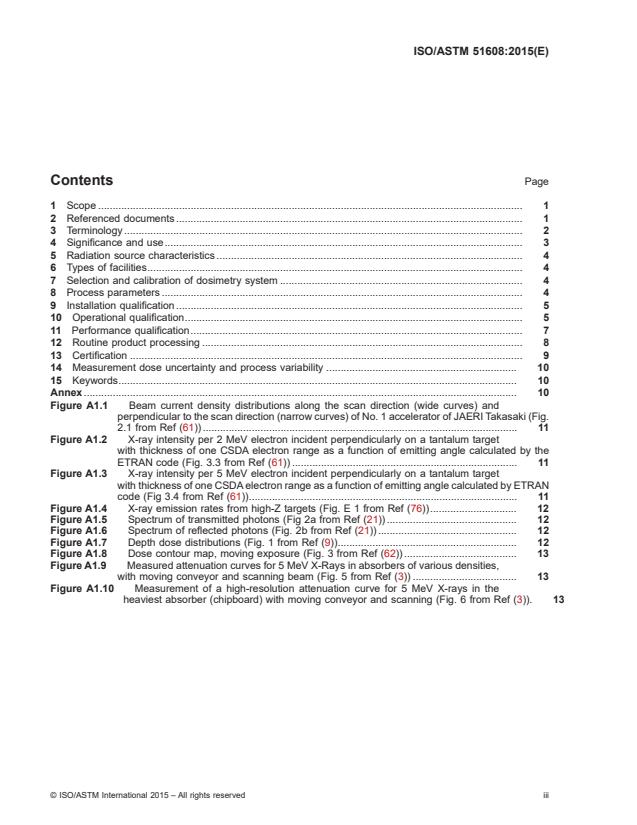
Contents Page
1 Scope. 1
2 Referenced documents. 1
3 Terminology. 2
4 Significance and use. 3
5 Radiation source characteristics. 4
6 Types of facilities. 4
7 Selection and calibration of dosimetry system. 4
8 Process parameters. 4
9 Installation qualification. 5
10 Operational qualification. 5
11 Performance qualification. 7
12 Routine product processing. 8
13 Certification . 9
14 Measurement dose uncertainty and process variability . 10
15 Keywords. 10
Annex. 10
Figure A1.1 Beam current density distributions along the scan direction (wide curves) and
perpendiculartothescandirection(narrowcurves)ofNo.1acceleratorofJAERITakasaki(Fig.
2.1 from Ref (61)). 11
Figure A1.2 X-ray intensity per 2 MeV electron incident perpendicularly on a tantalum target
with thickness of one CSDA electron range as a function of emitting angle calculated by the
ETRAN code (Fig. 3.3 from Ref (61)). 11
Figure A1.3 X-ray intensity per 5 MeV electron incident perpendicularly on a tantalum target
withthicknessofoneCSDAelectronrangeasafunctionofemittinganglecalculatedbyETRAN
code (Fig 3.4 from Ref (61)). 11
Figure A1.4 X-ray emission rates from high-Z targets (Fig. E 1 from Ref (76)). 12
Figure A1.5 Spectrum of transmitted photons (Fig 2a from Ref (21)). 12
Figure A1.6 Spectrum of reflected photons (Fig. 2b from Ref (21)). 12
Figure A1.7 Depth dose distributions (Fig. 1 from Ref (9)). 12
Figure A1.8 Dose contour map, moving exposure (Fig. 3 from Ref (62)). 13
FigureA1.9 Measured attenuation curves for 5 MeV X-Rays in absorbers of various densities,
with moving conveyor and scanning beam (Fig. 5 from Ref (3)). 13
Figure A1.10 Measurement of a high-resolution attenuation curve for 5 MeV X-rays in the
heaviest absorber (chipboard) with moving conveyor and scanning (Fig. 6 from Ref (3)). 13
© ISO/ASTM International 2015 – All rights reserved iii
Foreword
ISO(theInternationalOrganizationforStandardization)isaworldwidefederationofnationalstandardsbodies
(ISO member bodies). The work of preparing International Standards is normally carried out through ISO
technical committees. Each member body interested in a subject for which a technical committee has been
established has the right to be represented on that committee. International organizations, governmental and
non-governmental, in liaison with ISO, also take part in the work. ISO collaborates closely with the
International Electrotechnical Commission (IEC) on all matters of electrotechnical standardization.
Draft International Standards adopted by the technical committees are circulated to the member bodies for
voting. Publication as an International Standard requires approval by at least 75% of the member bodies
casting a vote.
ASTM International is one of the world’s largest voluntary standards development organizations with global
participation from affected stakeholders. ASTM technical committees follow rigorous due process balloting
procedures.
A project between ISO and ASTM International has been formed to develop and maintain a group of
ISO/ASTM radiation processing dosimetry standards. Under this project, ASTM Committee E61, Radiation
Processing, is responsible for the development and maintenance of these dosimetry standards with
unrestricted participation and input from appropriate ISO member bodies.
Attention is drawn to the possibility that some of the elements of this document may be the subject of patent
rights. Neither ISO nor ASTM International shall be held responsible for identifying any or all such patent
rights.
International Standard ISO/ASTM 51608 was developed by ASTM Committee E61, Radiation Processing,
through Subcommittee E61.03, Dosimetry Application, and by Technical Committee ISO/TC 85, Nuclear
energy, nuclear technologies and radiological protection.
This third edition cancels and replaces the second edition (ISO/ASTM 51608:2005), which has been
technically revised.
iv © ISO/ASTM International 2015 – All rights reserved
An American National Standard
Standard Practice for
Dosimetry in an X-Ray (Bremsstrahlung) Facility for
Radiation Processing at Energies between 50 keV and 7.5
MeV
This standard is issued under the fixed designation ISO/ASTM 51608; the number immediately following the designation indicates the
year of original adoption or, in the case of revision, the year of last revision.
1. Scope keV) up to the maximum energy of the electrons incident on
the X-ray target (see Section 5 and Annex A1).
1.1 This practice outlines the dosimetric procedures to be
followed during installation qualification, operational
1.6 Informationabouteffectiveorregulatorydoselimitsand
qualification, performance qualification and routine processing
energy limits for X-ray applications is not within the scope of
at an X-ray (bremsstrahlung) irradiator. Other procedures
this practice.
related to operational qualification, performance qualification
1.7 This standard does not purport to address all of the
androutineprocessingthatmayinfluenceabsorbeddoseinthe
safety concerns, if any, associated with its use. It is the
product are also discussed.
responsibility of the user of this standard to establish appro-
NOTE 1—Dosimetry is only one component of a total quality assurance
priate safety and health practices and determine the applica-
program for adherence to good manufacturing practices used in radiation
processing applications. bility of regulatory limitations prior to use.
NOTE 2—ISO/ASTM Practices 51649, 51818 and 51702 describe
dosimetric procedures for electron beam and gamma facilities for radia-
2. Referenced documents
tion processing.
2.1 ASTM Standards:
1.2 For radiation sterilization of health care products, see
E170Terminology Relating to Radiation Measurements and
ISO 11137-1, Sterilization of health care products – Radiation
Dosimetry
– Part 1: Requirements for development, validation and
E2232Guide for Selection and Use of Mathematical Meth-
routine control of a sterilization process for medical devices.In
ods for CalculatingAbsorbed Dose in Radiation Process-
those areas covered by ISO 11137-1, that standard takes
ing Applications
precedence.
E2303Guide for Absorbed-Dose Mapping in Radiation
1.3 Forirradiationoffood,seeISO14470, Food irradiation
Processing Facilities
– Requirements for development, validation and routine con-
2.2 ISO/ASTM Standards:
trol of the process of irradiation using ionizing radiation for
51261Practice for Calibration of Routine Dosimetry Sys-
the treatment of food. In those areas covered by ISO 14470,
tems for Radiation Processing
that standard takes precedence.
51539Guide for Use of Radiation-Sensitive Indicators
1.4 This document is one of a set of standards that provides
51649Practice for Dosimetry in an Electron Beam Facility
recommendations for properly implementing and utilizing
for Radiation Processing at Energies Between 300 keV
dosimetry in radiation processing. It is intended to be read in
and 25 MeV
conjunction with ISO/ASTM Practice 52628, “Practice for
51702Practice for Dosimetry in a Gamma Facility for
Dosimetry in Radiation Processing”.
Radiation Processing
51707Guide for Estimating Uncertainties in Dosimetry for
1.5 In contrast to monoenergetic gamma radiation, the
Radiation Processing
X-ray energy spectrum extends from low values (about 35
51818Practice for Dosimetry in an Electron Beam Facility
for Radiation Processing at Energies Between 80and 300
keV
This practice is under the jurisdiction of ASTM Committee E61 on Radiation
52628Practice for Dosimetry in Radiation Processing
Processing and is the direct responsibility of Subcommittee E61.03 on Dosimetry
Application, and is also under the jurisdiction of ISO/TC 85/WG 3.
Current edition approved Sept. 8, 2014. Published February 2015. Originally
published asASTM E 1608–94. Last previousASTM edition E 1608–00.ASTM E
1608–94 was adopted by ISO in 1998 with the intermediate designation ISO For referenced ASTM or ISO/ASTM standards, visit the ASTM website,
15567:1998(E). The present International Standard ISO/ASTM 51608:2015(E) is a www.astm.org, or contact ASTM Customer Service at service@astm.org. For
major revision of the last previous edition ISO/ASTM 51608:2005(E), which Annual Book of ASTM Standards volume information, refer to the standard’s
replaced ISO/ASTM 51608:2002(E). Document Summary page on the ASTM website.
© ISO/ASTM International 2015 – All rights reserved
52701Guide for Performance Characterization of Dosim- 3.1.3 beam width—dimension of the irradiation zone per-
etersandDosimetrySystemsforuseinRadiationProcess- pendiculartothedirectionofproductmovement,ataspecified
ing distance from the accelerator window.
3.1.3.1 Discussion—For graphic illustration, see ISO/
2.3 ISO Standards:
ASTM Practice 51649. This term usually applies to electron
ISO 11137-1Sterilization of health care products – Radia-
irradiation.
tion – Part 1: Requirements for development, validation
and routine control of a sterilization process for medical
3.1.4 bremsstrahlung—broad-spectrum electromagnetic ra-
devices
diation emitted when an energetic charged particle is influ-
ISO 14470 Food irradiation – Requirements for the
enced by a strong electric or magnetic field, such as that in the
development,validationandroutinecontroloftheprocess
vicinity of an atomic nucleus.
of irradiation using ionizing radiation for the treatment of
3.1.4.1 Discussion—In radiation processing, bremsstrahl-
food
ung photons with sufficient energy to cause ionization are
2.4 International Commission on Radiation Units and Mea- generated by the deceleration or deflection of energetic elec-
surements (ICRU) Reports: trons in a target material. When an electron passes close to an
ICRU Report 14Radiation Dosimetry: X Rays and Gamma atomicnucleus,thestrongcoulombfieldcausestheelectronto
RayswithMaximumPhotonEnergiesBetween0.6and50 deviate from its original motion. This interaction results in a
MeV loss of kinetic energy by the emission of electromagnetic
ICRU Report 34Dosimetry of Pulsed Radiation radiation.Suchencountersareuncontrolledandtheyproducea
ICRU Report 35Radiation Dosimetry: Electron Beams with
continuous photon energy distribution that extends up to the
Energies Between 1 and 50 MeV maximum kinetic energy of the incident electron. The
ICRU Report 37Stopping Powers for Electrons and Posi-
bremsstrahlung energy spectrum depends on the electron
trons energy, the composition and thickness of the X-ray target, and
ICRU Report 80Dosimetry Systems for Use in Radiation
theemissiondirectionofphotonangleofemissionwithrespect
Processing to the incident electron.
ICRU Report 85aFundamental Quantities and Units for
3.1.5 charged-particle equilibrium (referred to as electron
Ionizing Radiation
equilibrium in the case of electrons set in motion by photon-
2.5 Joint Committee for Guides in Metrology (JCGM)
beam irradiation of a material)—condition in which the kinetic
Report:
energy of charged particles (or electrons), excluding rest mass,
JCGM 100:2008, GUM 1995, with minor corrections,
entering an infinitesimal volume of the irradiated material
Evaluation of measurement data–Guide to the expression
equals the kinetic energy of charge particles (or electrons)
of uncertainty in measurement
emerging from it.
3.1.6 dose uniformity ratio—ratio of the maximum to the
3. Terminology
minimum absorbed dose within the irradiated product.
3.1 Definitions:
3.1.6.1 Discussion—The concept is also referred to as the
3.1.1 absorbed dose (D)—quantity of ionizing radiation
max/min dose ratio.
energy imparted per unit mass of a specified material. The SI
3.1.7 dosimeter—device that, when irradiated, exhibits a
unit of absorbed dose is the gray (Gy), where 1 gray is
quantifiable change that can be related to absorbed dose in a
equivalent to the absorption of 1 joule per kilogram of the
given material using appropriate measurement instrument(s)
specified material (1 Gy = 1 J/kg). The mathematical relation-
and procedures.
ship is the quotient of dε by dm, where dε is the mean
3.1.8 dosimeter response—reproducible, quantifiable effect
incremental energy imparted by ionizing radiation to matter of
produced in the dosimeter by ionizing radiation.
incremental mass dm (see ICRU Report 85a).
3.1.9 dosimetry system—system used for measuring ab-
D 5dε/dm (1)
sorbed dose, consisting of dosimeters, measurement instru-
3.1.2 beam length—dimension of the irradiation zone along
ments and their associated reference standards, and procedures
thedirectionofproductmovement,ataspecifieddistancefrom
for the system’s use.
the accelerator window.
3.1.10 electron energy—kinetic energy of an electron.
3.1.2.1 Discussion—Beam length is perpendicular to beam
3.1.10.1 Discussion—Unit is usually electron volt (eV),
width and to the electron beam axis. In case of product that is
stationary during irradiation, ‘beam length’ and ‘beam width’ kiloelectron volt (keV), or megaelectron volt (MeV). 1 eV is
the kinetic energy acquired by a single electron accelerated
may be interchangeable.
throughapotentialdifferenceof1V.1eVisequaltoenergyof
-19
1.602 × 10 joules.
Available from the International Organization for Standardization, 1 Rue de
3.1.11 electron energy spectrum—particle fluence distribu-
Varembé, Case Postale 56, CH–1211, Geneva 20, Switzerland.
tion of electrons as a function of energy.
Available from the International Commission on Radiation Units and
Measurements, 7910 Woodmont Ave., Suite 800, Bethesda, MD 20814, U.S.A.
3.1.12 installation qualification (IQ)—process of obtaining
DocumentproducedbyWorkingGroup1oftheJointCommitteeforGuidesin
and documenting evidence that equipment has been provided
Metrology (JCGM/WG 1). Available free of charge at the BIPM website (http://
www.bipm.org). and installed in accordance with its specifications.
© ISO/ASTM International 2015 – All rights reserved
3.1.13 irradiation container—holder in which product is metal with a high atomic number (such as tantalum), high
placed during the irradiation process.
melting temperature, and high thermal conductivity.
3.1.13.1 Discussion—“Irradiation container” is often re-
3.3 Definitions of other terms used in this standard that
ferred to simply as “container” and can be a carrier, cart, tray,
pertain to radiation measurement and dosimetry may be found
product carton, pallet, product package or other holder.
inASTM Terminology E170. Definitions in E170 are compat-
3.1.14 measurement management system—set of interre-
ible with ICRU Report 85a, which may be used as an
latedorinteractingelementsnecessarytoachievemetrological
alternative reference.
confirmation and continual control of measurement processes.
3.1.15 operational qualification (OQ)—processofobtaining 4. Significance and use
and documenting evidence that installed equipment operates
4.1 A variety of products and materials are irradiated with
within predetermined limits when used in accordance with its
X-radiation to modify their characteristics and improve the
operational procedures.
economic value or to reduce their microbial population for
3.1.16 performance qualification (PQ)—process of obtain-
health-related purposes. Dosimetry requirements might vary
ing and documenting evidence that the equipment, as installed
depending on the type and end use of the product. Some
and operated in accordance with operational procedures, con-
examples of irradiation applications where dosimetry may be
sistently performs in accordance with predetermined criteria
used are:
and thereby yields product meeting its specification.
4.1.1 Sterilization of health care products;
3.1.17 process load—volume of material with a specified
4.1.2 Treatment of food for the purpose of parasite and
loading configuration irradiated as a single entity.
pathogencontrol,insectdisinfestation,andshelflifeextension;
3.1.18 processing category—group of different product that
4.1.3 Disinfection of consumer products;
can be processed together.
4.1.4 Cross-linking or degradation of polymers and elasto-
3.1.18.1 Discussion—Processing categories can be based
mers;
on, for instance, composition, density or dose requirements.
4.1.5 Curing composite material;
3.1.19 reference material—homogeneousmaterialofknown
4.1.6 Polymerization of monomers and oligomer and graft-
radiation absorption and scattering properties used to establish
ing of monomers onto polymers;
characteristics of the irradiation process, such as scan
4.1.7 Enhancement of color in gemstones and other mate-
uniformity,depth-dosedistribution,throughputrate,andrepro-
rials;
ducibility of dose delivery.
4.1.8 Modification of characteristics of semiconductor de-
3.1.20 simulated product—material with radiation attenua-
vices; and
tion and scattering properties similar to those of the product,
4.1.9 Research on materials effects of irradiation.
material or substance to be irradiated.
3.1.20.1 Discussion—Simulatedproductisusedduringirra-
NOTE 3—Dosimetry with measurement traceability and with known
diator characterization as a substitute for the actual product,
measurement uncertainty is required for regulated irradiation processes,
material or substance to be irradiated. When used in routine such as the sterilization of health care products and treatment of food.
Dosimetry may be less important for other industrial processes, such as
production runs in order to compensate for the absence of
polymer modification, which can be evaluated by changes in the physical
product, simulated product is sometimes referred to as com-
propertiesoftheirradiatedmaterials.Nevertheless,routinedosimetrymay
pensating dummy. When used for absorbed-dose mapping,
be used to monitor the reproducibility of the radiation process.
simulated product is sometimes referred to as phantom mate-
4.2 Radiation processing specifications usually include a
rial.
pair of absorbed-dose limits: a minimum value to ensure the
3.2 Definitions of Terms Specific to This Standard:
intended beneficial effect and a maximum value that the
3.2.1 X-radiation—ionizing electromagnetic radiation,
product can tolerate while still meeting its functional or
which includes both bremsstrahlung and the characteristic
regulatory specifications. For a given application, one or both
radiation emitted when atomic electrons make transitions to
of these values may be prescribed by process specifications or
more tightly bound states. See bremsstrahlung.
regulations. Knowledge of the dose distribution within irradi-
3.2.1.1 Discussion—In radiation processing applications,
ated material is essential to help meet these requirements.
the principal X-radiation is bremsstrahlung.
Dosimetry is essential to the radiation process since it is used
3.2.2 X-ray—of or relating to X-radiation.
to determine both of these limits and to confirm that the
3.2.2.1 Discussion—X-ray is used as an adjective while
product is routinely irradiated within these limits.
X-radiation is used as a noun.
4.3 Several critical parameters must be controlled to obtain
3.2.3 X-ray converter—device for generating X-radiation
reproducible dose distributions in the process load. The
(bremsstrahlung)fromanelectronbeam,consistingofatarget,
absorbed-dose distribution within the product depends on the
means for cooling the target, and a supporting structure.
overallproductdimensionsandmassandirradiationgeometry.
3.2.4 X-ray target—component of the X-ray converter that
The processing rate and dose distribution depend on the X-ray
isstruckbytheelectronbeamandwhichproducesX-radiation. intensity, photon energy spectrum, and spatial distribution of
3.2.4.1 Discussion—The X-ray target is usually made of the radiation field and conveyor speed.
© ISO/ASTM International 2015 – All rights reserved
4.4 Before an irradiator can be used, it must be qualified 6.4 Product Handling System—The process load size for
(IQ, OQ) to determine its effectiveness in reproducibly deliv- optimum photon power utilization and dose uniformity de-
ering known, controllable absorbed doses. This involves test- pendsonthemaximumphotonenergyandproductdensity.The
ing the process equipment, calibrating the equipment and narrow width of X-Ray field favors the use of continuously
dosimetry system, and characterizing the magnitude, distribu- moving product rather than shuffle-dwell systems to improve
tion and reproducibility of the absorbed dose delivered by the dose uniformity.
irradiator for a range of product densities.
7. Selection and calibration of dosimetry system
4.5 Toensureconsistentdosedeliveryinaqualifiedirradia-
tion process, routine process control requires procedures for
7.1 Selection of Dosimetry Systems—Dosimetry systems
routine product dosimetry and for product handling before and
suitable for the expected radiation processing applications at
after the treatment, consistent product loading configuration,
the irradiator shall be selected in accordance with the selection
control and monitoring of critical process parameters, and
criteria listed in ISO/ASTM 52628. During the selection
documentation of the required activities and functions.
process, for each dosimetry system, the performance behavior
with respect to relevant influence quantities and the dose
5. Radiation source characteristics
measurement uncertainty associated with it shall be taken into
5.1 X-radiation (bremsstrahlung) is a form of electromag-
account.
netic radiation, which is analogous to gamma radiation. Al- NOTE4—Mostdosimetrysystemssuitableforgammaradiation(suchas
those from Co) may also be suitable for X-radiation (3, 12, 13).
though its effects on irradiated materials are generally similar,
it differs in energy spectrum, angular distribution, and dose
7.2 The dosimetry system shall be calibrated in accordance
rate.
with ISO/ASTM 51261, and the user’s procedures, which
should specify details of the calibration process and quality
5.2 ThephysicalcharacteristicsoftheX-rayfielddependon
assurance requirements.
the design of the X-ray converter and the parameters of the
electron beam striking the target, that is, the electron energy
7.3 The dosimetry system calibration is part of a measure-
spectrum, average electron beam current, and beam current
ment management system.
distribution on the target.
5.3 These aspects of X-radiation and its suitability for 8. Process parameters
radiation processing are reviewed in more detail in AnnexA1.
8.1 Absorbeddoseinaproductisdeterminedandcontrolled
by several characteristics of the irradiator as well as of the
6. Types of facilities
product. Thus, all parameters characterizing the irradiator
6.1 The design of an irradiator affects the delivery of
components, process load and the irradiation conditions that
absorbed dose to a product. Therefore, the irradiator design
affect absorbed dose are referred to as “process parameters.”
should be considered when performing the absorbed-dose
They should, therefore, be considered when performing the
measurements described in Sections9–11.
absorbed-dose measurements required in Sections10–12.
6.2 The electron beam energy range used to produce
8.2 For X-ray facilities, process parameters include:
X-radiation covered in this practice is between 50 keVand 7.5
8.2.1 Beam characteristics (for example, electron beam
MeV. The upper limit is determined to avoid the induction of
energy, beam current, pulse frequency),
activity in a tantalum target and or product (1, 2).
8.2.2 Beam dispersion (for example, scan width, scan
6.3 Irradiator Components—An X-ray irradiator typically
frequency, collimator aperture, parallel magnet),
includes an electron accelerator with X-ray converter, product
8.2.3 Product handling characteristics (for example, con-
conveyor system, radiation shield with personnel safety
veyor speed),
system, products loading and storage areas, auxiliary equip-
8.2.4 Product loading characteristics (for example, size of
ment for power, cooling, ventilation, etc., equipment room,
the process load, bulk density, orientation of product), and
laboratory for dosimetry and product testing, and personnel
8.2.5 Irradiation geometry (for example, multiple passes,
offices. The irradiator design shall conform to applicable
rotation, source or product overlap.
regulations and guidelines. For information on some industrial
8.3 Theparametersin8.2.1,8.2.2and8.2.3characterizethe
facilities, see Refs (3-7).
irradiatorwithoutreferencetotheproductortheprocess.These
6.3.1 Discussion—TheconfigurationoftheX-rayconverter,
subsetsofparametersarereferredtoas“operatingparameters.”
theelectronbeamdistributionontheX-raytarget,thepenetrat-
ing characteristic of the radiation, and the size, shape, and
8.4 Procedures during operational qualification (OQ) deal
densityoftheprocessloadaffectthedoseuniformityratio(see
with operating parameters.
Refs 3, 4, 8-10). In some cases, the dose uniformity ratio may
8.5 The objective of performance qualification (PQ) is to
be improved by the use of collimators between the X-ray
establish the values of all process parameters for the radiation
converterandtheproduct(11),orbytheuseofamagnetbefore
process under consideration.
the X-ray converter to control the divergence of the beam.
8.6 During routine product processing, operating param-
6 eters are continuously controlled and monitored for process
TheboldfacenumbersinparenthesesrefertotheBibliographyattheendofthis
standard. control.
© ISO/ASTM International 2015 – All rights reserved
9. Installation qualification 9.4.1 All equipment associated with operating the irradiator
shall be tested to verify that the irradiator is operating in
9.1 Objective—The purpose of an installation qualification
accordance with design and performance specifications. All
program is to obtain and document evidence that the irradiator
test results shall be recorded.
with its associated processing equipment and measurement
9.4.2 Theperformanceofmeasurementinstrumentsshallbe
instruments has been delivered and installed in accordance
verifiedorcalibrated(ifrequired)toensurethattheinstruments
with their specifications. Installation qualification includes
are operating in accordance with design and performance
documentation of the irradiator and the associated processing
specifications. All test results shall be recorded.
equipment and measurement instruments, establishment of the
9.4.3 If any modification or change is made to the process-
testing, operation and calibration procedures for their use, and
ing equipment or measurement instruments during installation
verification that they operate according to specifications.
qualification, they shall be re-tested.
9.2 Equipment Documentation—Document descriptions of
9.4.4 The characteristics of the electron beam (such as
the irradiator and the associated processing equipment and
average beam current, energy) and X-ray field (such as
measurement instruments installed at the irradiator.This docu-
dimension and uniformity) shall be determined and recorded.
mentation shall be retained for the life of the irradiator. At a
They typically include the following:
minimum, it shall include:
9.4.4.1 Electron beam energy estimation with direct mea-
9.2.1 Description of the location of the irradiator (accelera-
surement (also see ISO/ASTM 51649)—When the electron
tor) within the operator’s premises in relation to the areas
beam is accessible, the depth-dose distribution is measured by
assigned and the means established for ensuring the segrega-
irradiating dosimeters in a stack of plates of homogeneous
tion of un-irradiated products from irradiated products,
material or by placing dosimeters or a dosimeter strip at an
9.2.2 Accelerator specifications and characteristics,
angle through a homogeneous absorber. Electron beam energy
9.2.3 Operating procedure of the irradiator,
can be determined from depth-dose distribution parameters
9.2.4 Description of the construction and operation of the
based on established relationships.
product handling equipment,
9.4.4.2 Electron beam energy estimation with indirect
9.2.5 Description of the materials and construction of any
measurement—When the electron beam is not readily
containers used to hold products during irradiation,
accessible,forexamplewhentheX-rayconverterisattachedto
9.2.6 Description of the process control system,
the end of the scanner and the electron beam is not transmitted
9.2.7 Description of any modifications made during and
intotheairbeforestrikingtheX-raytarget,thentheattenuation
after the irradiator installation, and ofX-radiationinasuitablereferencematerialmightbeusedto
9.2.8 Description of X-ray converter characteristics
indirectly estimate the electron beam energy.
(dimension, materials and nature of construction).
NOTE 5—A procedure suitable for typical industrial irradiation
processes, which is based on common practice in the field of therapeutic
9.3 Testing, Operation and Calibration Procedures—
X-ray treatment, has been published (14).Additionally, measurements of
Standard operating procedures for the testing, operation and
induced radioactivity in certain elements with threshold values below 8
calibration (if necessary) of the installed irradiator and its
MeV might be used for energy determination (15, 16).
associatedprocessingequipmentandmeasurementinstruments
9.4.4.3 X-ray field characterization (width, length and
shall be established.
depth)—The target cooling system and target geometry have a
9.3.1 Testing Procedures—These procedures describe the
significant effect on X-ray field, and therefore the X-ray field
testing methods used to ensure that the installed irradiator and
shall be characterized before OQ is started (See Figs. A1.1-
its associated processing equipment and measurement instru-
A1.3). The electron beam width and length are measured by
ments operate according to specification.
placing dosimeter strips or discrete dosimeters at selected
9.3.2 Operation Procedures—These procedures describe
intervalsoverthefullbeamwidthandlengthrangewithoutthe
how to operate the irradiator and its associated processing
converter in place, or if not possible, directly on the converter.
equipmentandmeasurementinstrumentsduringroutineopera-
Wheneverpossible,dosimetersshallalsobeplacedbeyondthe
tion.
expectedbeamdimensiontoidentifythelimitsofthefullbeam
9.3.3 Calibration Procedures—These procedures describe
dimensions. X-ray field may be characterized by placing
periodic calibration and verification methods that ensure that
dosimeterstripsordiscretedosimeteratselectedintervalsover
the installed processing equipment and measurement instru-
thefullX-raybeamwidthandlengthrangeatvaryingintervals
ments continue to operate within specifications.The frequency
and distances from the X-ray target.
of calibration for some equipment and instruments might be
specified by a regulatory authority. Calibration of some equip- 10. Operational qualification
ment and instruments is required to be traceable to a national
10.1 Objective—The objective of the operational qualifica-
or international standard.
tion (OQ) of an X-ray irradiator is to obtain and document
9.4 Testing of Processing Equipment and Measurement evidence that installed equipment and instrumentation operate
Instruments—It must be verified that the installed processing within predetermined limits when used in accordance with
equipment and measurement instruments operate within their operational procedures. The purpose of dosimetry during
designspecificationsbyfollowingthetestingproceduresnoted operational qualification is to establish baseline operational
in 9.3.1. The equipment and instruments shall be calibrated limitsandperformanceexpectationsforroutineprocessingand
according to the calibration procedures. in turn evaluate the following characteristics:
© ISO/ASTM International 2015 – All rights reserved
10.1.1 Ability to predict the delivered dose for the range of dosimeters mixed randomly with and carried by product
conditions of operation for the key operating parameters that throughtheirradiationzone.Astatisticalmodelshouldbeused
affect absorbed dose in the product. to estimate the number of dosimeters required. Calculations of
minimumandmaximumabsorbeddosesmaybeanappropriate
10.1.2 Ability of the irradiator to deliver reproducible dose
alternative.
for the range of conditions of operation for the key operating
parameters that affect absorbed dose in the product (17).
NOTE 8—Theoretical calculations may be performed using the Monte
10.1.3 Absorbed-dose distribution in process loads.
Carlo methods (18), and applied to industrial radiation processing (19).
The use of the point-kernel method can be considered for X-ray facilities
NOTE 6—The absorbed dose received by any portion of product in a
(20). Both of these methods require that accurate radiation interaction
process load depends on the conveyor design, the converter design, the
cross-sections for all materials between and surrounding the source point
X-ray field geometry and characteristics, the process load characteristic
and dose point are known. General-purpose software packages are
and configuration, the treatment geometry.
available for these types of calculations (see ASTM Guide E2232).
Modelsbuiltusingthesecodesshouldbevalidatedagainstdosimetrydata
10.1.4 Dosimetry tests carried out during IQ (see 9.4.4)
for their predictions to be meaningful. Empirically derived models built
should be repeated as part of irradiator OQ.
directlyfromdosimetrydatamaybesatisfactorybutshouldbeconfinedto
the boundaries of experiments at a specific irradiator.
10.2 Absorbed-dose Mapping—Absorbed-dose mapping is
NOTE 9—For an X-ray irradiator, the depth-dose distribution in a
performedtocharacterizetheirradiatorwithrespecttothedose
homogeneous material of low atomic number is approximately
distribution and reproducibility of absorbed-dose delivery.
exponential,andpenetrationfor5MeVX-radiationisslightlygreaterthan
Mapping the absorbed-dose distribution is carried out by
that for cobalt-60 gamma radiation (see Fig. A1.7).
placing sets of dosimeters in a three-dimensional array within
10.3 Absorbed Dose and Operating Parameters:
a process load containing reference material. For guidance on
10.3.1 Objective—The absorbed dose in the product de-
performing absorbed-dose mapping see ASTM Guide E2303.
pends on several operating parameters. Over the expected
10.2.1 The amount of reference material in each irradiation
range of these parameters, establish the absorbed-dose charac-
container should be the amount expected during typical pro-
teristics in a reference material using an appropriate calibrated
duction runs or should be the maximum design volume for the
dosimetry system.
irradiation container.
10.3.1.1 The dose distribution within a process load de-
10.2.2 Dosimeter placement patterns should be selected to
pends on photon energy spectrum, photon field geometry, the
identify the locations of the absorbed-dose maxima and
distance to the X-ray target and the reference material charac-
minima. It may be necessary to place more dosimeter sets in
teristics.
these locations and fewer dosimeter sets in locations likely to
NOTE 10—For X-ray irradiators, photon energy spectrum and angular
receive intermediate absorbed doses to adequately identify the
distribution depend on the design and composition of the X-ray converter
absorbed-dose maxima and minima. Dosimetry data from
and on the electron beam energy spectrum. Higher energy electrons will
previously qualified irradiators of the same design or calcula-
increase forward concentration of the photon distribution and therefore
tions using mathematical models (see ASTM Guide E2232)
improve penetration in the product (9, 21, 22).
may provide useful information for determining the number
10.3.2 The relationships between the minimum and maxi-
and location of dosimeters for this qualification process.
mum doses for an irradiation container filled with a reference
material of known density, and product speed (or irradiation
NOTE 7—Dosimeter strips or sheets may be used to increase spatial
resolutionoftheabsorbed-dosemap,iftheuseofindividualdosimetersis
time), beam characteristics and parameters controlling the
inadequate.
photon field over the expected range of these parameters
should be established. These relationships should be estab-
10.2.3 Asufficientnumberofprocessloads(minimum3)of
lishedforeachdensity(10.2.5)andirradiatorpathway(10.2.6).
homogenous density should be dose mapped to estimate the
10.3.2.1 Establish the range of absorbed dose that can be
variability of the magnitude and distribution of the absorbed
delivered, the range of densities that can be processed and the
dose within the process load. Dosimetry data from previously
number of irradiator pathways that can be used during routine
qualified irradiators of the same design may provide useful
processing. This will set the operational limits for the irradia-
information for determining the number of process loads for
tor.
this qualification.
10.2.4 The number of process loads preceding and follow-
NOTE 11—The conveyor speed and the beam current may be linked
ing the dose-mapped process load shall be sufficient to effec-
during routine product processing so that a variation in one causes a
tively simulate an irradiator filled with the product. corresponding change in the other to maintain a constant delivery of the
dose.
10.2.5 Absorbed-dose mapping shall be carried out at and
between the density range for products expected to be irradi- 10.4 Dose Variability:
ated routinely. 10.4.1 The magnitude of the dose variations in a reference
material should be estimated by, for example, passing dosim-
10.2.6 Absorbed-dosemappingshallbecarriedoutforeach
different irradiator pathway to be used for routine product eters in the reference geometry through the irradiation zone on
the product conveyor at time intervals appropriate to the
processing.
frequency of the parameter fluctuations.
10.2.7 The procedures for absorbed-dose mapping outlined
in this section may not be feasible for some types of bulk-flow
NOTE 12—It is often difficult to separate the effect of operating
irradiators. In such cases, minimum and maximum absorbed
parameter variability and dosimetry system uncertainty; thus, the mea-
doses should be estimated by using an appropriate number of sured variability will often be a combination of the two.
© ISO/ASTM International 2015 – All rights reserved
10.4.2 Routine Monitoring Positions—If the locations of 10.9.2 Changes to the irradiation container,
absorbed dose extremes identified during the dose mapping
10.9.3 Repair or replacement of scanning magnet,
procedure are not readily accessible during production runs,
10.9.4 Repair or replacement of beam bending magnet,
alternative locations (external or internal to the process load)
10.9.5 Changes in the element of the irradiator creating
may be used for routine product processing dosimetry. These
scattering effects, and
positionscouldbelocatedontheirradiationcontaineroronthe
10.9.6 Changes to the X-ray Target (including cooling
process load. Dose variability in routine monitoring position
system).
shall be evaluated.
10.5 Effect of adjacent process loads with different product
11. Performance qualification
densities—For a production run with process loads of different
11.1 Objective—The objective of performance qualification
densities close to each other, dose distribution within adjacent
is to obtain and document evidence that the equipment and
process loads may be different. These effects may be due to
instrumentation, as installed and operated in accordance with
scattering of X-radiation from the process load which is front
operational procedures, can consistently process product
of the target, and they can be determined
...
Questions, Comments and Discussion
Ask us and Technical Secretary will try to provide an answer. You can facilitate discussion about the standard in here.
Loading comments...