


ISO/PAS 18167:2014
(Main)Textile floor coverings — Installation practices — General
Textile floor coverings — Installation practices — General
ISO/PAS 18167:2014 sets out the requirements for installing textile floor coverings (carpets). It gives details of the work necessary in preparing subfloor surfaces together with the procedures that are to be adopted where textile floor coverings are laid over various types of subfloors and underlays and where subfloor heating units are installed. NOTE This International Standard addresses needle insertion tufted, woven, fusion bonded, fibre bonded, knitted, non-woven, felted, and flocked textile floor coverings. The objective of this International Standard is to provide the contractors, manufacturers, suppliers, and purchasers of textile floor coverings and others, for example, technical educators, with procedures to enable the provision of correctly installed textile floor coverings.
Revêtements de sol textiles — Pratiques d'installation — Généralités
General Information
- Status
- Withdrawn
- Publication Date
- 26-Nov-2014
- Withdrawal Date
- 26-Nov-2014
- Technical Committee
- ISO/TC 219 - Floor coverings
- Drafting Committee
- ISO/TC 219/WG 1 - Textile floor coverings
- Current Stage
- 9599 - Withdrawal of International Standard
- Start Date
- 15-Jun-2020
- Completion Date
- 12-Feb-2026
Relations
- Effective Date
- 06-Jun-2022
- Effective Date
- 31-Mar-2018


Get Certified
Connect with accredited certification bodies for this standard

Control Union Certifications
Global certification for agriculture and sustainability.

Bureau Veritas Bangladesh
Bureau Veritas certification services in Bangladesh.

ECOCERT France
Leader in organic and sustainability certification worldwide.
Sponsored listings
Frequently Asked Questions
ISO/PAS 18167:2014 is a technical specification published by the International Organization for Standardization (ISO). Its full title is "Textile floor coverings — Installation practices — General". This standard covers: ISO/PAS 18167:2014 sets out the requirements for installing textile floor coverings (carpets). It gives details of the work necessary in preparing subfloor surfaces together with the procedures that are to be adopted where textile floor coverings are laid over various types of subfloors and underlays and where subfloor heating units are installed. NOTE This International Standard addresses needle insertion tufted, woven, fusion bonded, fibre bonded, knitted, non-woven, felted, and flocked textile floor coverings. The objective of this International Standard is to provide the contractors, manufacturers, suppliers, and purchasers of textile floor coverings and others, for example, technical educators, with procedures to enable the provision of correctly installed textile floor coverings.
ISO/PAS 18167:2014 sets out the requirements for installing textile floor coverings (carpets). It gives details of the work necessary in preparing subfloor surfaces together with the procedures that are to be adopted where textile floor coverings are laid over various types of subfloors and underlays and where subfloor heating units are installed. NOTE This International Standard addresses needle insertion tufted, woven, fusion bonded, fibre bonded, knitted, non-woven, felted, and flocked textile floor coverings. The objective of this International Standard is to provide the contractors, manufacturers, suppliers, and purchasers of textile floor coverings and others, for example, technical educators, with procedures to enable the provision of correctly installed textile floor coverings.
ISO/PAS 18167:2014 is classified under the following ICS (International Classification for Standards) categories: 59.080.60 - Textile floor coverings; 97.150 - Floor coverings. The ICS classification helps identify the subject area and facilitates finding related standards.
ISO/PAS 18167:2014 has the following relationships with other standards: It is inter standard links to ISO 4126-3:2020, ISO 18167:2020. Understanding these relationships helps ensure you are using the most current and applicable version of the standard.
ISO/PAS 18167:2014 is available in PDF format for immediate download after purchase. The document can be added to your cart and obtained through the secure checkout process. Digital delivery ensures instant access to the complete standard document.
Standards Content (Sample)
PUBLICLY ISO/PAS
AVAILABLE 18167
SPECIFICATION
First edition
2014-12-15
Textile floor coverings — Installation
practices — General
Revêtements de sol textiles — Pratiques d’installation — Généralités
Reference number
©
ISO 2014
© ISO 2014
All rights reserved. Unless otherwise specified, no part of this publication may be reproduced or utilized otherwise in any form
or by any means, electronic or mechanical, including photocopying, or posting on the internet or an intranet, without prior
written permission. Permission can be requested from either ISO at the address below or ISO’s member body in the country of
the requester.
ISO copyright office
Case postale 56 • CH-1211 Geneva 20
Tel. + 41 22 749 01 11
Fax + 41 22 749 09 47
E-mail copyright@iso.org
Web www.iso.org
Published in Switzerland
ii © ISO 2014 – All rights reserved
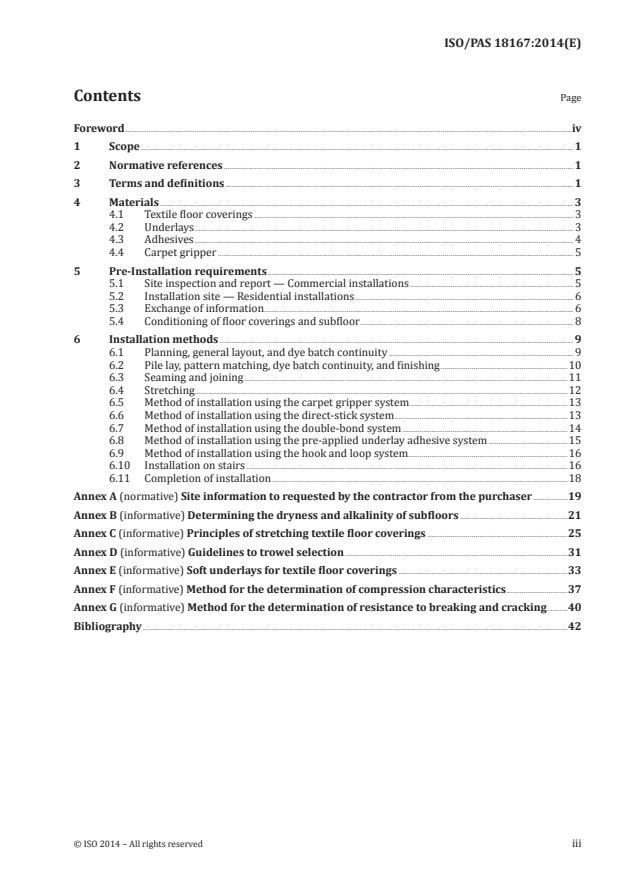
Contents Page
Foreword .iv
1 Scope . 1
2 Normative references . 1
3 Terms and definitions . 1
4 Materials . 3
4.1 Textile floor coverings . 3
4.2 Underlays . 3
4.3 Adhesives . 4
4.4 Carpet gripper . 5
5 Pre-Installation requirements . 5
5.1 Site inspection and report — Commercial installations . 5
5.2 Installation site — Residential installations. 6
5.3 Exchange of information. 6
5.4 Conditioning of floor coverings and subfloor . 8
6 Installation methods . 9
6.1 Planning, general layout, and dye batch continuity . 9
6.2 Pile lay, pattern matching, dye batch continuity, and finishing .10
6.3 Seaming and joining .11
6.4 Stretching .12
6.5 Method of installation using the carpet gripper system .13
6.6 Method of installation using the direct-stick system .13
6.7 Method of installation using the double-bond system .14
6.8 Method of installation using the pre-applied underlay adhesive system .15
6.9 Method of installation using the hook and loop system.16
6.10 Installation on stairs .16
6.11 Completion of installation .18
Annex A (normative) Site information to requested by the contractor from the purchaser .19
Annex B (informative) Determining the dryness and alkalinity of subfloors .21
Annex C (informative) Principles of stretching textile floor coverings .25
Annex D (informative) Guidelines to trowel selection .31
Annex E (informative) Soft underlays for textile floor coverings .33
Annex F (informative) Method for the determination of compression characteristics .37
Annex G (informative) Method for the determination of resistance to breaking and cracking .40
Bibliography .42
Foreword
ISO (the International Organization for Standardization) is a worldwide federation of national standards
bodies (ISO member bodies). The work of preparing International Standards is normally carried out
through ISO technical committees. Each member body interested in a subject for which a technical
committee has been established has the right to be represented on that committee. International
organizations, governmental and non-governmental, in liaison with ISO, also take part in the work.
ISO collaborates closely with the International Electrotechnical Commission (IEC) on all matters of
electrotechnical standardization.
The procedures used to develop this document and those intended for its further maintenance are
described in the ISO/IEC Directives, Part 1. In particular the different approval criteria needed for the
different types of ISO documents should be noted. This document was drafted in accordance with the
editorial rules of the ISO/IEC Directives, Part 2 (see www.iso.org/directives).
Attention is drawn to the possibility that some of the elements of this document may be the subject of
patent rights. ISO shall not be held responsible for identifying any or all such patent rights. Details of any
patent rights identified during the development of the document will be in the Introduction and/or on
the ISO list of patent declarations received (see www.iso.org/patents).
Any trade name used in this document is information given for the convenience of users and does not
constitute an endorsement.
For an explanation on the meaning of ISO specific terms and expressions related to conformity
assessment, as well as information about ISO’s adherence to the WTO principles in the Technical Barriers
to Trade (TBT) see the following URL: Foreword - Supplementary Information
The committee responsible for this document is ISO/TC 219, Floor coverings.
iv © ISO 2014 – All rights reserved
PUBLICLY AVAILABLE SPECIFICATION ISO/PAS 18167:2014(E)
Textile floor coverings — Installation practices — General
1 Scope
This International Standard sets out the requirements for installing textile floor coverings (carpets). It
gives details of the work necessary in preparing subfloor surfaces together with the procedures that are
to be adopted where textile floor coverings are laid over various types of subfloors and underlays and
where subfloor heating units are installed.
NOTE This International Standard addresses needle insertion tufted, woven, fusion bonded, fibre bonded,
knitted, non-woven, felted, and flocked textile floor coverings.
The objective of this International Standard is to provide the contractors, manufacturers, suppliers, and
purchasers of textile floor coverings and others, for example, technical educators, with procedures to
enable the provision of correctly installed textile floor coverings.
2 Normative references
The following documents, in whole or in part, are normatively referenced in this document and are
indispensable for its application. For dated references, only the edition cited applies. For undated
references, the latest edition of the referenced document (including any amendments) applies.
ISO 1957, Machine-made textile floor coverings — Selection and cutting of specimens for physical tests
ISO 2424, Textile floor coverings — Vocabulary
3 Terms and definitions
For the purposes of this document, the terms and definitions given in ISO 2424 and the following apply.
3.1
adhesive
substance that dries to a film capable of holding materials together by surface attachment. Applying
adhesive to the floor is normally accomplished with a trowel, airless spray, or roller
3.2
adhesive transfer
degree of coverage and/or penetration of the applied adhesive (3.1) into the back of the carpet (when
installing the carpet) while maintaining full coverage of the floor
Note 1 to entry: The degree of coverage can be influenced by adhesive type, method of installation, open assembly
time, and other factors.
3.3
alkali
soluble substance with base properties and having a pH (3.11) greater than 7
3.4
bow
distortion visible as wavy or crooked lines when viewed across the carpet’s width or length
3.5
contractor
firm or person authorized by the purchaser to carry out the laying of the textile floor covering
3.6
crotch
junction of the lower edge of the riser with the rearmost edge of the stair tread
3.7
fill-out
installed length of textile floor covering of a width dimension less than its usable manufactured width
3.8
laitance
layer of material formed from the constituents of concrete which can collect on the surface soon after
pouring
3.9
pattern bow
distortion visible as wavy or crooked pattern lines when viewed across the carpet width
3.10
pattern skew
distortion visible when the pattern on one side is slightly ahead of the pattern on the other side
Note 1 to entry: Skew or bias describes pattern squareness.
3.11
pH
value representing the concentration of hydrogen ions in gram-equivalents per litre used to indicate
the acidity or alkalinity (base) of a substance on a scale from 0 to 14 with 7 representing neutrality,
numbers less than 7 increasing acidity, and numbers greater than 7 increasing alkalinity
Note 1 to entry: For laboratory and field testing of pH, distilled water should be used.
3.12
plane (surface)
condition such that when a straightedge 3,0 m long is placed on the surface at any position, no part is
more than 5 mm above or below the straightedge
3.13
power stretcher (i.e. mechanical stretching device)
carpet installation tool used to stretch carpet for installation on the tack strip and consists of a pinned
plate that grips the carpet, tubular extensions, a padded end used to brace against an opposing wall or
other structure, and a lever system that multiplies the installer‘s applied stretching force
3.14
purchaser
principal to the contract or person authorized by the principal to superintend the work on his behalf
3.15
seam
joints or interface of two pieces of carpet by the use of various securing techniques in a carpet installation
3.16
seam adhesive
specifically formulated adhesive (3.1) for securing and protecting cut edges of carpet to be seamed
3.17
seam peaking
slight elevation of taped seams which usually renders the seam (3.15) more visible resulting from
stretching of the carpet sometimes referred to as seam stress realignment
Note 1 to entry: Peaking is a natural and sometimes unavoidable condition and not the result of a manufacturing
or installation defect.
2 © ISO 2014 – All rights reserved
Note 2 to entry: For additional information, refer to CRI Technical Bulletin ― Peaking Seams in Stretch-In Carpet
Installations.
3.18
seam sealing (edge sealing)
application of seam adhesive (3.16) to secure and protect cut edges of carpet to be seamed from edge
ravelling and delamination
3.19
seaming tape
tape used for joining two sections of the carpet
Note 1 to entry: Hot-melt tape is pre-coated with a thermoplastic adhesive and adhesives (3.1) can be applied
separately to other types of seaming tapes.
3.20
secondary backing
woven or non-woven fabric reinforcement laminated to the back of tufted carpet, usually with an
adhesive (3.1), to enhance dimensional stability, strength, stretch resistance, and ease of handling
3.21
smooth (surface)
condition such that, when a straightedge 150 mm long is placed on the surface at any position, no part of
it is more than 1 mm below the straightedge
3.22
stair nose
leading edge of a stair thread
Note 1 to entry: For carpet installation, it is required that this edge be rounded.
3.23
subfloor
surface on which the textile floor covering or the underlay is to be laid (see Figure 1)
3.24
subfloor heating (underfloor heating)
any panel heating appliance or system whereby the subfloor structure is warmed intentionally for space
heating purposes
3.25
trowel
hand implement used for metering and spreading adhesive (3.1) to the floor or other substrate
4 Materials
4.1 Textile floor coverings
Textile floor coverings shall comply with the requirements of the relevant International Standards.
Where applicable, the textile floor covering referred to in this International Standard shall be suitable
for use above subfloor heating where the temperature of the upper surface of the subfloor does not
exceed 29 °C.
4.2 Underlays
4.2.1 Underlays
Unless the subfloor is substantially free from grooves, ridges, gaps, holes, and similar imperfections, the
use of a hard underlay is recommended.
Where a hard underlay is used, the following requirements apply:
a) the underlay shall have an estimated service life not shorter than that of the textile floor covering;
b) the underlay shall be compatible with the textile floor covering and the adhesive(s) to be used;
c) the underlay shall be non-staining, non-exuding, and sufficiently dense to withstand normal traffic
load on the floor without becoming indented or deformed;
d) the underlay shall be capable of being bonded to the subfloor in such a manner that the bonding is
not affected by normal traffic loading;
e) the underlay shall be non-shrinking to the extent that when the textile floor covering is laid, no
evidence of gaps shall be visible;
f) the maximum variation in length between the diagonals of underlay sheet shall not exceed 1,0 mm;
g) for timber subfloors, the underlay shall be either reduced density hardboard flooring underlay or
medium density fibreboard or medium density fibre cement sheet known to manufacturers as hard
underlay.
NOTE Other products can be used if agreed between the contractor and the purchaser.
4.2.2 Soft underlays
The soft underlay shall have a service life no shorter than that of the textile floor covering in accordance
with the recommendations of the underlay manufacturer and the carpet manufacturer. The requirements
for soft underlays are detailed in Annex E of this International Standard.
In commercial applications, soft underlays shall have a total thickness not greater than 10 mm. For
installation of soft underlays, see 6.7 and 6.8.
Carpet should never be laid over existing carpet and/or existing underlay as this can cause permanent
damage to the new floor covering installation.
4.3 Adhesives
The choice of adhesives shall be made by consultation between the contractor and the
manufacturer/supplier of the selected underlay, manufacturer/supplier of the textile floor covering, and
the manufacturer/supplier of the adhesive and the purchaser shall be advised if requested.
Adhesives used shall be such that they ensure minimal hazardous risk to both personnel and property
involved with the installation and site. Adhesives used shall be labelled in accordance with the
regulations concerning occupational health and safety, poisons, dangerous goods, and transportation
of dangerous goods.
Material Safety Data Sheets which should be easily obtainable from manufacturers of all chemical
products should be provided on-site whenever adhesives are being used.
Where the relative humidity of the atmosphere in the building is 75 % or more, only adhesives suitable
for such conditions shall be used. Any such adhesive shall be used in accordance with the instructions of
the manufacturers of the textile floor covering and of the adhesive.
NOTE 1 In high humidity, condensation can form on the surface of the substrate and/or adhesive and prevent
adhesion of the flooring.
Where subfloor heating units are installed, the adhesive shall be such that it is not affected adversely by
the temperature at which the heating units are to be operated.
4 © ISO 2014 – All rights reserved
Where additives such as curing agents, parting agents, and surface treatments which can have a
deleterious effect on an adhesive are present on the subfloor, the adhesive shall be isolated from the
deleterious material/s with the use of appropriate trowelled-on compounds.
NOTE 2 Some curing agents might need to be removed by grinding or sanding. Some parting agents can be
removed by washing with sugar soap, water blasting, and/or grinding.
4.4 Carpet gripper
The carpet gripper shall be constructed of five even thickness plywood layers.
The carpet gripper shall be constructed of sufficient pins and nails so as to withstand a minimum
stretching force of 6 580 N over a 1 220 mm length.
5 Pre-Installation requirements
5.1 Site inspection and report — Commercial installations
5.1.1 Inspection by contractor
For textile floor coverings to be installed, a state of cleanliness for concrete/timber floors is required.
Cleanliness of floors can require, as a minimum, sanding, grinding, power washing, wet/dry vacuuming,
or similar.
If dry clean processes are used, remove all residual waste materials by vacuuming. If wet clean processes
are used, ensure that the floors are dry enough to vacuum waste surface materials before installing the
textile floor coverings.
The contractor shall obtain the site information on the subfloor outlined in Annex A and inspect the
following:
a) each of the relevant particulars required in Annex A;
b) whether any repairs to the subfloor are required and whether the surface of timber subfloors needs
to be sanded;
c) whether the surface of the subfloor requires cleaning to remove existing floor covering, any
deleterious materials such as grease, oil, paint curing or parting agents, or any surface treatment
which could adversely affect adhesion.
5.1.2 Report by contractor
If the contractor considers the subfloor under inspection to be unsuitable, the contractor shall submit a
report in writing to the purchaser, and where appropriate, the builder.
The report shall state the following:
a) whether the subfloor over which the floor covering is to be laid is in suitable condition;
b) any and all conditions that, in the contractor’s opinion, will affect the satisfactory execution of
the installation work or impair the durability and serviceability of the textile floor covering or
installation systems.
Where the contractor indicates that the subfloor is not in a suitable condition for laying of the floor
coverings, the contractor shall specify reasons for the unsuitability of the subfloor.
Where the contractor indicates that removal or rectification work on the subfloor, doors, quads, or
scotia moulding is needed, the contractor shall advise the purchaser that this work is the responsibility
of others or as otherwise agreed.
5.2 Installation site — Residential installations
The contractor shall advise the purchaser, prior to installation, of the factors which can make the
subfloor unsuitable to receive the new floor covering(s). Where the condition of the subfloor can be
practically determined, the contractor shall advise the purchaser of necessary remedial work.
5.3 Exchange of information
5.3.1 General
The information to be exchanged between the contractor and the purchaser shall include advice as to
whether the installation should be in accordance with the commercial or residential laying requirements
of this International Standard.
Where, because of economics or aesthetics, compliance with parts of this International Standardare not
practical, the contractor shall discuss the effects of non-compliance with the purchaser and reach an
understanding on the effects of non-compliance.
5.3.2 Commercial installations
In addition to the information required to be provided by the contractor, elsewhere specified in this
International Standard, there shall be consultation, preferably early in the design stage and generally
throughout the whole course of the contract between all parties concerned with the work. Information
to be exchanged shall include the following as applicable:
a) site factors such as location, access, other contractors on site, unloading, hoisting and storage facilities,
air conditioning, heating, lighting and power supply, floor loading, and security arrangements;
b) building factors such as the nature of the building, assessment of type and density of traffic,
particulars of corrosive conditions, or other potentially damaging conditions;
c) specifications for or details of
1) the floor structure,
2) the damp-proof membrane and its location within the floor construction,
3) screed curing and drying times,
4) floor warming installations,
5) underlays,
6) adhesives and accessories including floor preservation treatments,
7) textile floor coverings, including type, batch or rotation number, classification, supplier,
dimensions, and repeat pattern size if applicable,
8) subsequent maintenance of the textile floor covering, and
9) finished floor level and permissible deviations;
d) associated work including services embedded in or passing through the floor, skirtings and
abutments, ducts, and junctions with other adjacent floorings;
e) planning and procedures for the installation, i.e.
1) adequate details of total area including landings and stairs,
2) number of stair treads and landings where direction of seams or lay of the pile is outside normal
practice, and
6 © ISO 2014 – All rights reserved
3) method of installation and seaming;
f) details on the intended means of protection including the method of, and responsibility for, the
protection of the stored textile floor covering and the completed work and fabric of the building;
g) storage instructions: the textile floor covering shall be stored on a flat, clean, dry surface preferably
suspended from the sub-floor, protected from soil, dust, and moisture. Heavy objects shall not be
stacked on top of the carpet rolls and carpet rolls shall not be stacked more than three rolls high;
h) contract information shall include particulars of the form and type of contract, whether the work is
to be completed in any specific order or in sections, safeguarding against damage and theft, safety
and health provisions, welfare facilities, air conditioning, heating, lighting and power supply, and
insurance;
i) a time schedule for the progress of the work in relation to other trades and services (see Annex A);
j) time lapse before use: where pressure sensitive adhesive, direct-stick or double-bond systems have
been used, advice shall be given that concentrated foot and wheeled traffic should be avoided for
24 h after installation so that arrangements can be made for protection if avoidance is not possible;
k) details of problems which might be expected to arise and where special consultation might be
necessary, e.g. pattern matching;
l) prior to the installation of the textile floor covering, the purchaser shall be informed of the floor
covering plan setting out the details required by this clause. The floor covering plan shall include
the following:
1) a scaled drawing or proportional sketch of the areas in which the installation shall take place;
2) all dimensions necessary to the installation in accordance with this International Standard;
3) all dimensions recorded in centimetres;
4) all dimensions recorded in a manner that enables them to be read from the bottom-right hand
corner;
5) where possible, all dimensions recorded inside the scaled drawing or proportional sketch;
6) the approximate position of all seams and cross joins;
7) the manufacturer’s description of the textile floor covering for the installation;
8) the manufacturer’s description of the underlay for the installation;
9) the manufacturer’s description of the accessories for the installation;
10) so far as possible, a description of the condition of the subfloor;
11) so far as possible, details of the subfloor preparation required to obtain a subfloor that complies
with 5.4.2.3;
12) the method of seaming to be used for the installation;
13) the direction of pile lay, clearly identified.
5.3.3 Residential installations
The contractor shall provide the following:
a) the manufacturer’s description of the textile floor covering material to be installed;
b) the manufacturer’s description of the type of underlay to be used for the installation;
c) where appropriate, a description of accessories and fittings;
d) where the condition of the subfloor can be practicably determined by the contractor or where the
contractor has previously advised the purchaser of necessary subfloor preparation, the nature of
any work required to the subfloor.
The contractor shall provide the purchaser with the total quantity meterage and an assurance that the
textile floor covering will be installed in accordance with this installation document.
5.4 Conditioning of floor coverings and subfloor
5.4.1 General
The following shall apply:
a) before conditioning, textile floor covering and underlay materials shall be kept in a clean, dry, well-
ventilated place and stored as specified in 5.3.2, g);
b) before installation, the textile floor covering shall be allowed to come to the same temperature and
relative humidity as the area where it is to be laid;
c) the preferred ambient installation temperature in the area where the textile floor covering is
to be laid shall be between 10 °C and 35 °C, but reference shall be made to the manufacturer’s
recommendation;
d) the textile floor covering shall be installed only where relative humidity of the area does not exceed
75 % or fall below 30 %.
NOTE The optimum installation temperature is between 15 °C and 25 °C. Floor coverings installed outside
this temperature range can experience variations in carpet tension.
Adequate ventilation and airflow should be maintained at all times before and after conditioning
materials and adhesives and sub-floor preparation. For double-bond and pre-applied installations, see
6.7, c) for conditioning of soft underlay.
5.4.2 Commercial installations
5.4.2.1 Air-conditioned areas
Wherever possible, no underlay or textile floor covering shall be laid on the subfloor until the air-
conditioning units have been in operation at normal operating temperature for at least seven days.
During this period, the temperature should not be allowed to fall outside the textile floor coverings
manufacturer’s recommended limits. These conditions should be maintained during laying and for the
next 72 h.
Where air-conditioning is to be installed, but is not yet operational, it is recommended that the room be
maintained within the temperature range of 10 °C to 35 °C for seven days prior to and during installation
and for the next 72 h.
Without such temperature control at this stage, subsequent movement of the subfloor, underlay, and
textile floor coverings can occur.
5.4.2.2 Heating units
Where underfloor heating units are installed on or in the subfloor, the following shall apply:
a) the heating units shall be turned on prior to laying the floor covering for a period sufficient to
ensure that the moisture condition of the heated subfloor is such as will permit successful laying of
the covering;
8 © ISO 2014 – All rights reserved
b) the heating unit shall then be turned off to allow the subfloor to return to the temperature range
recommended by the textile floor coverings manufacturer and soft underlay manufacturer before
the laying is commenced;
c) the heating units shall remain turned off during the laying and shall not be turned on until 48 h after
the laying is completed in order to allow the adhesive to cure;
d) heating units shall not be used to dry the concrete subfloor before the concrete is fully cured, e.g.
one month after placing. The concrete shall be allowed to dry out slowly to minimize cracking.
Cyclic heating should be avoided during this period. Following curing, it is recommended that the lowest
temperature setting be used and heating be maintained over a period of at least seven days to assist in
lowering the moisture content.
5.4.2.3 Subfloor preparation
Before a floor coverings installation is commenced over a concrete subfloor or screed topping all
subfloor, surfaces shall be dry, smooth, plane, sound, and clean (see Annex A). Dryness shall be considered
satisfactory when relative humidity by the hygrometer test does not exceed 70 %.
NOTE For the determination of subfloor dryness, methods detailed in Annex B are recognized procedures.
When double-bond or direct-stick systems are used, porous subfloors shall be primed as recommended
by the adhesive manufacturer.
5.4.3 Residential installations
Before the installation of the floor coverings is commenced, all subfloor surfaces shall be dry, smooth,
plane, sound, and clean (see Annex A).
When double-bond or direct-stick systems are used, porous subfloors shall be primed as recommended
by the adhesive manufacturer.
6 Installation methods
6.1 Planning, general layout, and dye batch continuity
The contractor shall give consideration to the general layout so that, where possible:
a) seams run the length of the area;
b) traffic runs along rather than across the seams;
c) light from windows does not strike across seams;
d) all pile faces away from the main source of incident light;
e) all pile faces towards the main entry to the area of installation;
f) on stairs, the pile lay runs towards the leading stair edge;
g) selvedge seams are accurately aligned throughout the entire installation;
h) textile floor coverings start within a full width on the door side;
i) part width fill-outs are placed on the opposite side of the room from the door;
j) textile floor coverings are accurately and closely fitted to all skirtings, architraves, and other
perimeters;
k) where a textile floor covering joins occur in a doorway, it is recommended that the joins fall within
the thickness of the closed door;
l) where a textile floor covering abuts a different floor covering in a doorway, it is recommended that
the join falls within the thickness of the closed door;
m) where a textile floor covering edge finishes at a bare subfloor in a doorway, it is recommended that
the edge of the textile floor covering falls within the thickness of the closed door;
n) full widths of textile floor coverings should be used wherever practical;
o) textile floor coverings shall all run in the same direction in any one area,
p) where textile floor coverings run contiguously in adjoining areas on the same level, the textile floor
coverings shall all run in the same direction and be from the same dye batch;
q) fill-outs are not used in doorways where the same textile floor coverings are on both sides;
r) in circumstances where two fill-outs are used in one room, they do not abut;
s) fill-outs are not positioned between full widths except in unusual circumstances where laying has
to commence on opposite walls and proceed to the middle of floor area. The final width installed
can be reduced to no less than 50 % of a full width (see Figure 1.).
Key
A out direction
B wall
C reduced width
D direction of lay
1 to 8 strips of textile floor covering
Figure 1 — Possible reduced width where laying has commenced at opposite walls
6.2 Pile lay, pattern matching, dye batch continuity, and finishing
The following shall apply:
a) where two or more pieces of the textile floor coverings abut, the pile direction shall be the same;
b) where possible or where the manufacturer’s tolerance allows, the pattern repeat shall be aligned;
10 © ISO 2014 – All rights reserved
c) where textile floor covering runs continuously in adjoining areas on the same level, it shall all be
from the same dye batch;
d) where two or more pieces of textile floor coverings are adjacent (i.e. lie in the same field of vision),
the pile direction shall be the same, unless otherwise specified.
Edging and dividing strips available in wood, metal, or other suitable materials can be used between
dissimilar types of floor coverings at door openings or to act as a finish to a floor. Textile floor coverings
can then be used as skirtings, but in such cases, adequate provision should be made for the protection of
the exposed raw edge of the materials.
6.3 Seaming and joining
6.3.1 General
Except for fibre-bonded textile floor coverings, the following requirements and recommendations apply:
a) the seams and cross-joins shall be strong enough to permit the textile floor coverings to be stretched
without gaping and to not break down under traffic using machine or hand-stitched installation
processes or a seaming tape recommended by the manufacturer for the intended purpose;
NOTE Refer to direct stick system and the double-bond system for method of seaming and joining.
b) the pile lay shall be in the same direction on either side of a seam or cross join;
c) the pile shall not be caught down into a seam or cross-join, nor shall there be gaps in the pile;
d) the seams and cross-joins shall be straight and aligned;
e) the seams and cross-joins shall be as flat as possible;
f) the diagonals and designs shall be, where possible, correctly aligned;
g) the backing edges shall butt and they shall not overlap or gape;
h) care shall be taken to minimize cross-joins in an installation;
i) cross-joins shall be unobtrusive;
j) wherever possible, cross-joins shall not be placed in main traffic ways;
k) cross-joins in a fill-out shall be not less than 100 cm apart;
l) wherever possible, the number of cross-joins in a fill out shall be not greater than
1) in a half-width, one cross-join,
2) in a third-width fill, two cross-joins, or
3) in a quarter-width fill, three cross-joins;
m) where the pattern of a textile floor covering requires cross-joins less than 100 cm apart, they shall
be the closest multiple of the pattern to 100 cm;
n) any variance from these requirements for cross-joins shall be determined through negotiations
with the purchaser (see 5.3.1).
6.3.2 Methods of seaming and cross joining
6.3.2.1 Machine or hand sewing
Make the stitching of even tension. Protect cut edges of woven carpets to prevent loss of pile along the
seam. Use approximately 20 stitches per 10 cm depending on the type of carpet being sewn.
When seaming woven carpets in commercial installations, it is recommended that the contractor consult
the textile floor coverings manufacturer on preferred seaming techniques. Particular seaming methods
can be preferable for particular woven carpet constructions or where there are site specific factors such
as end-use environment or traffic conditions which favour the use of the particular seaming method.
6.3.2.2 Hot-melt adhesive tapes (heat bond iron or electrically activated)
When a heat bond iron is used, protect the textile floor coverings with a heat shield with the iron set and
moved along the seam at a rate in accordance with the instructions given by the hot-melt adhesive tape
manufacturer. Use electrically heated tapes in accordance with the instructions given by the electrically
activated tape and control unit manufacturer. Butt all edges. When seaming carpets with hot-melt
adhesive tape in contact with a polyethylene surfaced underlay, joining tape with silicon release backing
shall be used if required to prevent the carpet bonding to the underlay.
NOTE A slip-sheet or powder equivalent can also be used in this application.
6.3.2.3 Seam sealing
Apply appropriate seam sealer to each cut edge to ensure that the tufts are adequately anchored within
the textile floor covering.
Before using methods described in 6.3.2.2 and 6.3.2.3, all edges which are to be seamed or joined
should be cut straight and square (cuts should follow the tuft line wherever possible). To avoid warranty
exclusion, where recommended by the machine made textile floor coverings manufacturer, cut edges
should be treated with an edge sealing adhesive.
6.4 Stretching
The following shall apply:
a) the textile floor coverings shall, when laid over soft underlay, be installed flat, taut, and evenly
tensioned.
b) care shall be taken to ensure that the textile floor covering is stretched in accordance with the
manufacturer’s recommendations (where available);
c) a two-way stretch shall be used;
NOTE The principles of stretching textile floor coverings are given in Annex C.
d) textile floor coverings shall be laid using a suitable power stretcher aided by a knee-kicker or a
tubeless power stretcher (restretcher), but should not be stretched using a knee-kicker as the
principal tool for stretching;
e) foam-backed or fibre-bonded textile floor coverings shall be tensioned, but not stretched;
f) care shall be taken when using a knee-kicker or a power stretcher to ensure by correct adjustment
of the pins that its force is applied on the total textile carpet backing substrate and not just on the
pile or wear surface and does not cause movement of or damage to the soft underlay.
NOTE Poor penetration of the knee-kicker or power stretcher will cause pile to be partly or totally
removed.
12 © ISO 2014 – All rights reserved
6.5 Method of installation using the carpet gripper system
6.5.1 General
The carpet gripper system can be used with most types of textile floor coverings with the exception of
foam back types, fibre bonded types without pile, and carpet tiles.
6.5.2 Carpet gripper
Inspect any existing gripper strips and determine whether they are damaged, loose, or in any way
unsuitable for correct tensioning of carpet. Leave in place any gripper strips that are sound, secure, and
in good condition. Replace any others with new gripper strips.
For all textile floor coverings where any dimension in the area to be covered is more than 7 m in any
direction, one row of a commercial grade carpet gripper or two rows of a domestic grade carpet gripper
shall be used.
6.5.3 Procedure
Textile floor coverings shall be installed using the carpet gripper system as follows:
a) make sure the floor and walls form a right angle to each other to allow correct fitting of carpet
gripper;
b) fit and fix carpet gripper strips around the entire perimeter of the area(s) to be fitted (with the
exception of doorway openings) leaving a gully between the carpet gripper and the wall of not more
than 60 % of the thickness of the textile floor covering being installed, unless otherwise specified
by the textile floor coverings manufacturer;
c) on timber subfloors, fix the carpet gripper strips with annular ringed nails or on monolithic
subfloors, fix the carpet gripper strips with hardened steel core nails,
1) by drilling and plugging,
2) by an appropriate adhesive, or
3) with a combination of these methods;
d) fix carpet gripper strips at maximum intervals of 15 cm and at a maximum of 3,5 cm from each end.
Fix carpet gripper strips less than 7 cm in length in a minimum of two places;
e) carpet gripper strips shall not be fitted across door openings except where textile floor coverings
abut a floor covering of a different type and a suitable door bar is fitted;
f) spot-fix fibrous (impregnated fibrous and needle felt) underlay by stapling or by adhesive;
g) staple or adhere seams to provide a flat butt joint;
h) lay non-fibrous [cellular plastics (polymeric), cellular rubber/rubber crumb combinations] underlay
loose with tight butt joints secured by applying pressure-sensitive tape with a minimum width of
50 mm. Run the tape continuously down the butted underlay seams and joints and on timber floors,
use stapling or some other method of fixing to prevent movement.
6.6 Method of installation using the direct-stick system
6.6.1 General
The direct stick method is not recommended for all types of textile floor coverings and shall be carried
out in accordance with advice from the textile floor coverings manufacturer or adhesive manufacturer.
6.6.2 Ambient temperature
The following shall apply:
a) the minimum ambient room temperature before commencing surface preparation and adhesive
application shall be 10 °C;
b) where there are underfloor heating units, switch the heating off for 48 h prior to installation and
do not switch it on again until the adhesive is set. Avoid peak temperatures until seven days after
completion of the laying operations [see 5.4.2.2)];
c) an ambient room temperature of 10 °C to 35 °C and the relative humidity between 30 % and 75 %
shall be maintained in the laying area well before and after laying. During the laying period, a
temperature of 10 °C to 35 °C shall be maintained in the laying area.
It is recommended that these conditions are maintained at least 48 h before and after laying.
6.6.3 Laying procedure
The textile floor covering shall be installed as follows:
a) prepare the subfloor in accordance with 5.4.2.3;
b) spread the pri
...
Questions, Comments and Discussion
Ask us and Technical Secretary will try to provide an answer. You can facilitate discussion about the standard in here.
Loading comments...