


ISO 11238:2018
(Main)Health informatics — Identification of medicinal products — Data elements and structures for the unique identification and exchange of regulated information on substances
Health informatics — Identification of medicinal products — Data elements and structures for the unique identification and exchange of regulated information on substances
This document provides an information model to define and identify substances within medicinal products or substances used for medicinal purposes, including dietary supplements, foods and cosmetics. The information model can be used in the human and veterinary domain since the principles are transferrable. Other standards and external terminological resources are referenced that are applicable to this document.
Informatique de santé — Identification des produits médicaux — Éléments de données et structures pour l'identification unique et l'échange d'informations réglementées sur les substances
Le présent document donne un modèle d'informations visant à définir et identifier des substances utilisées dans des médicaments ou à des fins médicinales, y compris les compléments alimentaires, les produits alimentaires et les produits cosmétiques. Le modèle d'informations, qui repose sur des principes transférables, peut être utilisé aussi bien dans le domaine humain que vétérinaire. Il est fait référence à d'autres normes et ressources terminologiques externes applicables au présent document.
General Information
Relations
Standards Content (Sample)
INTERNATIONAL ISO
STANDARD 11238
Second edition
2018-07
Health informatics — Identification
of medicinal products — Data
elements and structures for the
unique identification and exchange of
regulated information on substances
Informatique de santé — Identification des produits médicaux —
Eléments de données et structures pour l'identification unique et
l'échange d'informations réglementées sur les substances
Reference number
©
ISO 2018
© ISO 2018
All rights reserved. Unless otherwise specified, or required in the context of its implementation, no part of this publication may
be reproduced or utilized otherwise in any form or by any means, electronic or mechanical, including photocopying, or posting
on the internet or an intranet, without prior written permission. Permission can be requested from either ISO at the address
below or ISO’s member body in the country of the requester.
ISO copyright office
CP 401 • Ch. de Blandonnet 8
CH-1214 Vernier, Geneva
Phone: +41 22 749 01 11
Fax: +41 22 749 09 47
Email: copyright@iso.org
Website: www.iso.org
Published in Switzerland
ii © ISO 2018 – All rights reserved
Contents Page
Foreword .v
Introduction .vi
1 Scope . 1
2 Normative references . 1
3 Terms and definitions . 1
4 Symbols and abbreviated terms .14
5 Description of the information modelling principles and practices .17
5.1 General considerations .17
5.2 Conceptual overview diagrams .17
5.3 Section high-level diagrams .18
5.4 Detailed diagrams.18
5.5 Relationships between classes .19
5.6 Notes .21
5.7 Attributes .21
5.8 Message exchange format .21
5.9 Conformance terminology and context as it relates to ISO 11238 and ISO/TS 19844 .22
6 Requirements .22
6.1 General .22
6.2 Concepts required for the unique identification and description of substances .22
6.3 Concepts required for the description of specified substances .24
6.3.1 Relationship between Substances and Specified Substance Groups .26
6.4 Naming of substances .27
6.5 Requirements for unique identifiers .28
6.6 Existing identifiers and molecular structure representation .28
7 Types of substances .29
7.1 General .29
7.2 Element sets common to multiple types of substances .29
7.2.1 Structure .29
7.2.2 Isotope .29
7.2.3 Modification .30
7.2.4 Reference information .31
7.2.5 Source material .32
7.2.6 Taxonomy .33
7.2.7 Authentication of Herbal Drugs .33
7.2.8 Substance codes .34
7.3 Chemical substances .34
7.4 Protein substances .35
7.5 Nucleic acid substances .37
7.6 Polymer substances .38
7.7 Structurally diverse substances .39
7.8 Mixture .42
8 Defining specified substances .43
8.1 General .43
8.2 Specified Substance Group 1 .44
8.3 Specified Substance Group 2 .47
8.4 Specified Substance Group 3 .49
8.5 Specified Substance Group 4 .50
8.5.1 General.50
8.5.2 Specified Substance Group 4 Name .50
8.5.3 Grade .51
8.5.4 Use of analytical data .51
8.5.5 Manufacturing .52
8.5.6 Version and specification.52
Annex A (informative) Existing identifiers and molecular structure representations .56
Bibliography .60
iv © ISO 2018 – All rights reserved
Foreword
ISO (the International Organization for Standardization) is a worldwide federation of national standards
bodies (ISO member bodies). The work of preparing International Standards is normally carried out
through ISO technical committees. Each member body interested in a subject for which a technical
committee has been established has the right to be represented on that committee. International
organizations, governmental and non-governmental, in liaison with ISO, also take part in the work.
ISO collaborates closely with the International Electrotechnical Commission (IEC) on all matters of
electrotechnical standardization.
The procedures used to develop this document and those intended for its further maintenance are
described in the ISO/IEC Directives, Part 1. In particular, the different approval criteria needed for the
different types of ISO documents should be noted. This document was drafted in accordance with the
editorial rules of the ISO/IEC Directives, Part 2. www .iso .org/directives
Attention is drawn to the possibility that some of the elements of this document may be the subject of
patent rights. ISO shall not be held responsible for identifying any or all such patent rights. Details of
any patent rights identified during the development of the document will be in the Introduction and/or
on the ISO list of patent declarations received. www .iso .org/patents
Any trade name used in this document is information given for the convenience of users and does not
constitute an endorsement.
For an explanation on the voluntary nature of standards, the meaning of ISO specific terms and
expressions related to conformity assessment, as well as information about ISO's adherence to the WTO
principles in the Technical Barriers to Trade (TBT) see the following URL: Foreword - Supplementary
information.
This document was prepared by ISO/TC 215, Health informatics.
[2]
This second edition cancels and replaces the first edition ISO 11238:2012 , which has been technically
revised.
Introduction
This document was developed in response to a worldwide demand for internationally harmonized
specifications for medicinal products. It is one of a group of five standards and four technical
specifications which together provide the basis for the unique identification of medicinal products. The
group of standards and technical specifications comprises:
[3]
ISO 11615 , Health informatics — Identification of medicinal products — Data elements and structures
for the unique identification and exchange of regulated medicinal product information
[4]
ISO 11616 , Health informatics — Identification of medicinal products — Data elements and structures
for the unique identification and exchange of regulated pharmaceutical product information
ISO 11238, Health informatics — Identification of medicinal products — Data elements and structures for
the unique identification and exchange of regulated information on substances
[5]
ISO 11239 , Health informatics — Identification of medicinal products — Data elements and structures
for the unique identification and exchange of regulated information on pharmaceutical dose forms, units of
presentation, routes of administration and packaging
[6]
ISO 11240 , Health informatics — Identification of medicinal products — Data elements and structures
for the unique identification and exchange of units of measurement
ISO/TS 19844, Health informatics — Identification of medicinal products — Implementation guidelines
for data elements and structures for the unique identification and exchange of regulated information on
substances
[7]
ISO/TS 20440 , Health informatics — Identification of Medicinal Products — Implementation guide for
ISO 11239 data elements and structures for the unique identification and exchange of regulated information
on pharmaceutical dose forms, units of presentation, routes of administration and packaging
[8]
ISO/TS 20443 , Health informatics — Identification of Medicinal Products — Implementation guide for
ISO 11615 data elements and structures for the unique identification and exchange of regulated Medicinal
Product information
[9]
ISO/TS 20451 , Health informatics — Identification of Medicinal Products — Implementation guide
for ISO 11616 data elements and structures for the unique identification and exchange of regulated
pharmaceutical product information
These standards for the identification of medicinal products (IDMP) support the activities of medicines
regulatory agencies worldwide by jurisdiction. These include a variety of regulatory activities
related to development, registration and life cycle management of medicinal products, as well as
pharmacovigilance and risk management.
To meet the primary objectives of the regulation of medicines and pharmacovigilance, it is necessary to
reliably exchange medicinal product information in a robust and reliable manner. The IDMP standards
therefore support the following interactions:
— between one medicine regulatory agency and another, e.g. European Medicines Agency to the US
Food and Drug Administration (FDA), or vice versa; and between the European Medicines Agency
and the National Competent Authorities in the EU, vice versa;
— between pharmaceutical companies and medicine regulatory agencies, e.g. "Pharma Company A" to
Health Canada;
— between the sponsor of a clinical trial to a medicine regulatory agency, e.g. "University X" to the
Austrian Agency for Health and Food Safety (AGES);
— between a medicine regulatory agency and other stakeholders, e.g. UK Medicines and Health Care
Products Regulatory Agency (MHRA) to the National Health Service (NHS);
vi © ISO 2018 – All rights reserved
— between medicine regulatory agencies and worldwide-maintained data sources, e.g. the
Pharmaceutical and Medical Device Agency (PMDA) and the organization responsible for assigning
substance identifiers.
Unique identifiers produced in conformance with the IDMP standards will support applications for
which it is necessary to reliably identify and trace the use of medicinal products and the ingredients
within medicinal products.
This document provides a structure that enables the assignment and maintenance of unique identifiers
for all substances in medicinal products. This document sets out the general rules for defining and
distinguishing substances, and provides a high-level model for substances and specified substances to
support the organization and capturing of data.
It is anticipated that implementation will use the ISO/TS 19844 and HL7 messaging (see 5.8) to deliver
a strong, non-semantic unique identifier for every substance present in a medicinal product. It is
anticipated that a single maintenance organization will be responsible for the generation of global
identifiers for every substance and that such an organization would retain the defining elements upon
which the substance identifier was based. At the specified substance level, a more regional approach
may be necessary because of the proprietary nature of much of the information.
The use of the identifier is essential for the description of substances in medicinal products on a global
scale. This document does not involve developing nomenclature for substances or specified substances,
but common and official substance names in current use can be mapped to each identifier.
Ingredients used in medicinal products range from simple chemicals to gene-modified cells to animal
tissues. To unambiguously define these substances is particularly challenging. This document defines
substances based on their scientific identity (i.e. what they are) rather than on their use or method of
production. Molecular structure or other immutable properties, such as taxonomic, anatomical and/or
fractionation information, are used to define substances. This document contains five single substance
types and a mixture substance class that are sufficient to define all substances. Although it is certainly
possible to define or classify substances in other ways, this document uses a minimalistic structured
scientific concept approach focusing on the critical elements necessary to distinguish two substances
from one another. There are frequently interactions between substances when they are mixed together,
but this document has intentionally not included these supramolecular interactions at the substance
level because of the variable nature and strength of such interactions. This document also allows for
the capture of multiple terms which refer to a given substance and a variety of reference information
that could be used to classify substances or relate one substance to another.
In addition to the substance level, this document also provides elements for the capture of further
information on substances that make up the defining characteristics of specified substances, such as
grade, manufacturer, manufacturing information and specifications, and also to capture information
on substances that are frequently combined together in commerce but are not strictly a medicinal
product. At the specified substance level, four groups of elements provide information essential to the
tracking and description of substances in medicinal products.
The basic concepts in the regulatory and pharmaceutical standards development domain use a wide
variety of terms in various contexts. The information models presented in this document depict
elements and the relationship between elements that are necessary to define substances. The terms and
definitions described in this document are to be applied for the concepts that are required to uniquely
identify, characterize and exchange information on substances in regulated medicinal products.
The terms and definitions adopted in this document are intended to facilitate the interpretation and
application of legal and regulatory requirements, but they are without prejudice to any legally binding
document. In case of doubt or potential conflict, the terms and definitions contained in legally binding
documents prevail.
In this document, “% (V/V)” is used in place of “% volume fraction”.
INTERNATIONAL STANDARD ISO 11238:2018(E)
Health informatics — Identification of medicinal
products — Data elements and structures for the unique
identification and exchange of regulated information on
substances
CAUTION — This document uses colour. This should be taken into consideration when printing.
1 Scope
This document provides an information model to define and identify substances within medicinal
products or substances used for medicinal purposes, including dietary supplements, foods and
cosmetics. The information model can be used in the human and veterinary domain since the principles
are transferrable. Other standards and external terminological resources are referenced that are
applicable to this document.
2 Normative references
The following documents are referred to in the text in such a way that some or all of their content
constitutes requirements of this document. For dated references, only the edition cited applies. For
undated references, the latest edition of the referenced document (including any amendments) applies.
ISO/TS 19844:2018, Health informatics — Identification of medicinal products (IDMP) — Implementation
guidelines for ISO 11238 for data elements and structures for the unique identification and exchange of
regulated information on substances
3 Terms and definitions
For the purposes of this document, the following terms and definitions apply.
ISO and IEC maintain terminological databases for use in standardization at the following addresses:
— ISO Online browsing platform: available at http: //www .iso .org/obp
— IEC Electropedia: available at http: //www .electropedia .org/
3.1
adjuvant
component that potentiates the immune response to an antigen and/or modulates it towards the
desired immune response
3.2
active marker
constituent or groups of constituents of a (herbal) Substance (fresh), Herbal Drug, Herbal preparation
or herbal medicinal product which are of interest for control purposes and are generally accepted to
contribute to therapeutic activity
Note 1 to entry: Active markers are not equivalent to analytical or signature markers that serve solely for
identification or control purposes.
3.3
allergen
material of concern used as ingredient or in a device capable of stimulating a type-I hypersensitivity or
allergic reaction in atopic individuals
Note 1 to entry: In this document the definition is specified to a molecule (substance) capable of inducing an
immunoglobulin E (IgE) response and/or a Type I allergenic reaction.
3.4
allergoids
allergen extracts chemically modified (e.g. by formaldehyde or glutaraldehyde) in order to reduce
allergenicity while maintaining immunogenicity
Note 1 to entry: Formaldehyde and glutaraldehyde react with primary amino groups in the polypeptide chain of
the allergen leading to intramolecular and intermolecular cross-linked high-molecular-weight allergen polymers;
in this way conformational IgE epitopes should be destroyed while the linear T-cell epitopes remain unaffected.
3.5
analytical data
set of elements to describe and capture methods and reference material used to determine purity,
potency or identity in a specified substance
3.6
analytical marker
constituent or groups of constituents that serve for analytical purposes
Note 1 to entry: Active markers are not equivalent to analytical or signature markers that serve solely for
identification or control purposes.
3.7
ATC Code
Anatomical Therapeutic Chemical Classification code
substance classification code
code used for the classification of drugs
1)
Note 1 to entry: It is controlled by the WHO Collaborating Centre for Drug Statistics Methodology (WHOCC) .
Note 2 to entry: This pharmaceutical coding system divides drugs into different groups according to the organ or
system on which they act and/or their therapeutic, pharmacological and chemical properties. Each bottom-level
ATC code stands for a pharmaceutically used substance or a combination of substances in a single indication (or
use). This means that one drug can have more than one code: Acetylsalicylic acid, for example, has A01AD05 as
a drug for local oral treatment, B01AC06 as a platelet inhibitor, and N02BA01 as an analgesic and antipyretic.
On the other hand, several different brands share the same code if they have the same active substance and
indications.
3.8
CAS Index name
Chemical Abstracts Service Index name
CAS Registry name
identifier that usually identifies a single substance
Note 1 to entry: For further explanations see subclause A.1.2.
3.9
CAS Registry Number
2)
CAS number
unique numerical identifier of a substance in the CAS Registry system
Note 1 to entry: For further explanations see subclause A.1.2.
1) https: //www .whocc .no/atc/structure _and _principles/
2) https: //www .cas .org/content/chemical -substances/faqs
2 © ISO 2018 – All rights reserved
3.10
chemical bond
condition that occurs when forces acting between two atoms or groups of atoms lead to the formation
of a stable discrete molecular entity
3.11
chemical substance
type of substance that can be described as a stoichiometric or non-stoichiometric single molecular
entity and is not a protein, nucleic acid or polymer substance
Note 1 to entry: Chemical substances are generally considered “small” molecules which have associated salts,
solvates or ions and may be described using a single definitive or representative structure.
3.12
chiral substance
substance whose molecular structure is not superimposable on its mirror image
3.13
co-crystals
homogenous (single phase) crystalline structures made up of two or more components in a definite
stoichiometric ratio where the arrangement in the crystal lattice is not based on ionic bonds
3.14
component
substance which is part of a mixture and that defines a multi-substance material at the Specified
Substance Group 1 level
EXAMPLE Dimethicone and silicon dioxide are components of simethicone. Human insulin and protamine
are the components in human insulin isophane.
Note 1 to entry: Components are used to describe a multi-substance material.
3.15
composition stoichiometry
quantitative relationships between the chemical elements or moieties that make up a substance
EXAMPLE Disodium hydrogen phosphate heptahydrate and disodium hydrogen phosphate dihydrate are
defined as different substances because they differ in composition stoichiometry.
3.16
configuration
method for indicating the three-dimensional arrangement of atoms at a stereogenic carbon,
phosphorous, sulfur centre or stereocenter
3.17
constituent
substance present within a Specified Substance or a parent substance
Note 1 to entry: Constituents can be impurities, degradants, extraction solvents, vehicles, active markers or
signature substances, parent substances or single substances mixed together to form a multi-substance material.
Note 2 to entry: Constituents shall have an associated role and amount at the Specified Substance Group
1 information model. Constituent specifications shall be used to describe components as well as limits on
impurities or related substances for a given material.
EXAMPLE The substance, triamcinolone acetonide is the parent (constituent) substance of the Specified
Substance Group 1 substance, triamcinolone acetonide, micronized.
Note 3 to entry: Constituent component is part of a mixture belonging to a homologous group of individual
components, described as parent substances for the manufacture of an allergenic extract.
3.18
controlled vocabulary
finite set of values that represent the only allowed values for a data item
Note 1 to entry: The allowed values can be codes, text or numeric.
[16]
[SOURCE: CDISC Clinical Research Glossary V10.0, 2016, modified]
3.19
copolymer
polymer with more than one type of structural repeat unit linked through covalent bonds
Note 1 to entry: Copolymers are obtained by copolymerization or sequential polymerization of two or more
different monomers. Copolymers can be random, statistical, alternating, periodic, block, cross, graft or mixed.
3.20
critical process parameter
process parameter whose variability has an impact on a critical quality attribute and therefore should
be monitored or controlled to ensure the process produces the desired quality
Note 1 to entry: A manufacturing parameter is considered “critical” and necessary for production of Substance or
Specified Substance e.g. inclusion of chromatographic step for removal or reduction of impurities, viruses.
Note 2 to entry: The critical process is tied to the Production Method type.
3.21
cytokine
small protein released by cells that has a specific effect on the interactions between cells, on
communications between cells or on the behaviour of cells
3.22
degree of polymerization
average number of monomers or repeat units in a polymeric block or chain
Note 1 to entry: Applies to both homopolymers and block copolymers where it refers to the degree of
polymerization within a block.
3.23
diverse origin
substances that are not isolated together or the result of the same process
3.24
drug extract ratio
ratio of the quantity of the (herbal) substance (fresh), or herbal drug to the quantity of the resulting
herbal preparation
3.25
enhancer
cis-acting sequence of DNA that increases the utilization of some eukaryotic promoters and which can
function in either orientation and in any location (upstream or downstream) relative to the promoter
3.26
extract ratio for allergens
extraction ratio indicating the relative proportions (m/V) of allergenic source materials and solvents
Note 1 to entry: This ratio is a minimal requirement for allergens for which there are not enough patients to
determine the total allergenic activity in vivo or in vitro.
3.27
extraction solvents
solvents which are used for the extraction process
4 © ISO 2018 – All rights reserved
3.28
fraction
distinct portion of material derived from a complex matrix, the composition of which differs from
antecedent material
Note 1 to entry: This concept is used to describe source material and is recursive in that a subsequent fraction
can be derived from an antecedent fraction.
EXAMPLE Serum immunoglobulins to polyclonal IgG is an example of recursive fractionation.
3.29
gene
basic unit of hereditary information composed of chains of nucleotide base pairs in specific sequences
that encodes a protein or protein subunit
3.30
gene element
individual element within a gene such as a promoter, enhancer, silencer or coding sequence
3.31
glycosylation
enzymatic process that links saccharides or oligosaccharides to substances
3.32
glycosylation type
significant differences in glycosylation between different types of organisms
Note 1 to entry: This distinguishes the pattern of glycosylation across organism types, e.g. human, mammalian
and avian. The glycosylation type is a defining element when a glycosylated protein exists as a substance.
3.33
grade
set of specifications indicating the quality of a substance or specified substance
3.34
harvesting
process of collecting a (herbal) substance (fresh) or parts of botanical material from the field or process
of collecting viral or bacterial material from its production/manufacturing site
3.35
homeopathic stocks
substances, products of preparations used as starting materials for the production of homeopathic
preparations.
Note 1 to entry: A stock is usually one of the following: a mother tincture or a glycerol macerate, for raw materials
of botanical, zoological or human origin, or the substance itself, for raw materials of chemical or mineral origin.
3.36
homopolymer
polymer containing a single structural repeat unit
3.37
isotope
variants of a chemical element that differ by atomic mass, having the same number of protons and
differing in the number of neutrons in the nucleus
Note 1 to entry: Radionuclides or nuclides with a non-natural isotopic ratio are shown in the structural
representation with the nuclide number displayed. Natural abundance isotopes are represented by an elemental
symbol without a nuclide number.
EXAMPLE C refers to a carbon atom that has an atomic mass of 13.
3.38
manufactured item
qualitative and quantitative composition of a product as contained in the packaging of the Medicinal
Product
Note 1 to entry: A Medicinal Product may contain one or more manufactured items. In many instances the
manufactured item is equal to the pharmaceutical product. However, there are instances where the manufactured
item(s) undergo a transformation before being administered to the patient (as the pharmaceutical product) and
the two are not equal.
3.39
manufacturer
organization that holds the authorization for the manufacturing process
Note 1 to entry: In this document the definition refers to a company responsible for the manufacturing of the
substance
3.40
manufacturing
process of production for a substance or medicinal product from the acquisition of all materials through
all processing stages
Note 1 to entry: The critical process, critical process steps, starting and processing materials and critical
production parameters are included.
3.41
material
entity that has mass, occupies space and consists of one or more substances
3.42
medicinal product
pharmaceutical product or combination of pharmaceutical products that can be administered to human
beings (or animals) for treating or preventing disease, with the aim/purpose of making a medical
diagnosis or to restore, correct or modify physiological functions
Note 1 to entry: A Medicinal Product may contain in the packaging one or more manufactured items and one or
more pharmaceutical products. In certain regions, a Medicinal Product may also be defined as any substance or
combination of substances which may be used to make a medical diagnosis.
3.43
microheterogeneity
substances isolated together that contain minor differences in structure between essentially identical
substances that are isolated/source material (e.g. sequence heterogeneity) and/or post-translational
modification such as glycosylation
Note 1 to entry: Microheterogeneity is not a defining characteristic of substances but can be a defining one at the
specified substance group 1 information level, e.g. differences in glycans.
Note 2 to entry: Microheterogeneity consists of variability in the type of glycosylation (biantennary, triantennary),
extent of glycosylation at a given site (site occupancy), sequence heterogeneity due to polymorphism in source
material, translation errors or variable proteolytic processing or other.
3.44
mixture
type of polydisperse substance that is a combination of single substances isolated together or produced
in the same synthetic process
Note 1 to entry: Single substances of diverse origin that are brought together and do not undergo a chemical
transformation as a result of that combination are defined as multi-substance materials (Specified Substance
Group 1) and not as mixture.
6 © ISO 2018 – All rights reserved
EXAMPLE 1 Gentamicin is defined as a mixture substance of Gentamicin C1, Gentamicin C1A, Gentamicin
C2, Gentamicin C2A and Gentamicin C2B. Glyceryl monoesters are defined as mixture substances of two single
substances which differ in the position of esterification. Simethicone, which consists of dimethicone and silicon
dioxide, is not defined as a mixture substance since these are diverse materials brought together to form a multi-
substance material.
EXAMPLE 2 Glyceryl monoesters could be defined as a mixture of two single substances which differ in the
position of esterification.
Note 2 to entry: Mixture could be used for a homologous group of structurally diverse single substances used
as starting materials in order to prepare an allergen extract. The extract is further described by using the class
'Source Material', element group 'Fraction Description' (allergen preparation) obtained from the structurally
diverse single substances (starting materials) as parent substances. This substance (allergen extract) is the
result of the same (synthetic) process and hence the extract is considered as a mixture substance.
3.45
moiety
entity within a substance that has a complete and continuous molecular structure
EXAMPLE The strength of a medicinal product is often based on what is referred to as the active moiety
of the molecule, responsible for the physiological or pharmacological action of the drug substance. To avoid
ambiguity, the free acid and/or free base should be used as the moiety upon which strength is based.
Note 1 to entry: The active moiety of a stoichiometric or non-stoichiometrical substance molecule is considered
that part of the molecule that is the base, free acid or ion molecular part of a salt, solvate, chelate, clathrate,
molecular complex or ester.
3.46
molecular formula
chemical formula that shows the total number and kind of atoms in a molecule indicating atomic
proportional ratios (the numerical proportions of atoms of one type to those of other types) which is
a way of expressing information about the proportions of atoms that constitute a particular chemical
compound, using a single line of chemical element symbols, numbers, and sometimes other symbols
Note 1 to entry: The molecular formula could contain other symbols, such as parentheses, dashes, brackets,
and plus (+) and minus (−) signs. These are limited to a single typographic line of symbols, which may include
subscripts and superscripts. A chemical formula contains no words (e.g. Glucose is represented as C H O ).
6 12 6
Note 2 to entry: Molecular formulas are written in accordance with the Hill system/ Hill notation such that
the number of carbon atoms in a molecule is indicated first, the number of hydrogen atoms next, and then the
number of all other chemical elements subsequently, in alphabetic order. When the formula contains no carbon,
all the elements, including hydrogen, are listed alphabetically.
Note 3 to entry: Inorganic acids and metal salts are shown without charges or bonds: HClO and KMnO
4 4
respectively. If metal salts of inorganic acids include several metals, the symbols for the metals are shown in
alphabetic order, e.g. K NaPO .
2 4
3.47
molecular formula by moiety
way of describing of the molecular formula of a stoichiometric or non-stoichiometric substance existing
of two or more moieties, the molecular formula of each moiety shall be described separated by a dot
Note 1 to entry: The molecular formula of the chemical salt Amlodipine besilate is described as C H ClN O .
20 25 2 5
C H O S.
6 6 3
Note 2 to entry: In non-cyclic linear structures like sodium nitroprusside: Na [Fe(CN) (NO)].2H O, a non-cyclic
2 5 2
structure is constructed in the following order:
a) symbol of the central atom placed on the left;
b) ionic ligands with cations first then anions;
c) neutral ligands.
3.48
molecular fragment
portion of a molecule that has one or more sites of attachment to other fragments or moieties
Note 1 to entry: Molecular fragments are used in the description of polymers to represent substituents and in
structural modifications to a substance.
3.49
molecular structure
unambiguous representation of the arrangement of atoms
Note 1 to entry: For the purposes of defining substances, the three-dimensional conformations are not captured.
Individual conformations or conformers of substances would only be captured in either a general sense for
proteins (i.e. denatured) or when a given rotation about a single bond is restricted in such a way that the two
different conformers are isolatable from each other and do not interconvert at room temperature (e.g. substituted
biphenyls).
Note 2 to entry: This representation should be generally translatable into a graphical representation.
3.50
molecular weight
mass of one molecule of a homogenous substance or the average mass of molecules that comprise a
heterogeneous substance, which is derived from the molecular structure or the molecular formula
Note 1 to entry: It is calculated as the sum of the mass of each constituent atom multiplied by the number of
atoms of that element in the molecular formula. The unified atomic mass unit is the unit of molecular weight and
includes the type of molecular weight (g/mol).
Note 2 to entry: For stoichiometric chemicals, the molecular weight is calculated from the molecular formula
using standard masses for each of the elements. The molecular mass refers to the complete structure or a moiety
or a fragment.
Note 3 to entry: The unified atomic mass unit or Dalton is the unit of molecular weight. The type of molecular
weight should always be captured.
Note 4 to entry: For polymers, there are several different types of molecular weight (weight average, number
average, etc.).
Note 5 to entry: For a substance not described in a Pharmacopoeia a mass spectrum may be provided to
substantiate the calculated molecular weight.
3.51
monodisperse substance
single substance that is homogeneous in molecular weight, that is, it does not have a distribution of
different molecular weight chains within the total mass
3.52
multi-substance material
single substances or specified substances of diverse origin that are brought together and do not undergo
a chemical transformation
EXAMPLE Materials such as human insulin isophane, simethicone, aluminium lakes, nicotine polacrilex, and
phosphate buffered saline are all multi-substance ingredients.
Note 1 to entry: Each substance part of the multi-substance material is a parent substance of the multi-substance
material and should be registered first. The multi-substance material is captured at the Specified Substance
Group 1 information level.
3.53
multi-substance starting material
mixture of multi-substances of which another substance will be prepared
EXAMPLE Aqueous extract of a mixture of homologous group of allergenic source material.
8 © ISO 2018 – All rights reserved
3.54
nucleic acid substance
type of substance that can be defined by a linear sequence of nucleosides typically linked thro
...
ISO TC 215/WG 6
Secretariat: ANSI
Health informatics – Identification of medicinal products – Data elements and structures for the
unique identification and exchange of regulated information on substances
All rights reserved. Unless otherwise specified, no part of this publication may be reproduced or
utilized otherwise in any form or by any means, electronic or mechanical, including photocopying,
or posting on the internet or an intranet, without prior written permission. Permission can be
requested from either ISO at the address below or ISO's member body in the country of the
requester.
ISO copyright office
Case postale 56 • CH-1211 Geneva 20
Tel. + 41 22 749 01 11
Fax + 41 22 749 09 47
E-mail copyright@iso.org
Web www.iso.orgwww.iso.org
Published in Switzerland.
Contents
Foreword . 7
Introduction. 7
1 Scope . 10
2 Normative references . 10
3 Terms and definitions . 10
4 Symbols and abbreviated terms . 25
5 Description of the information modelling principles and practices . 28
5.1 General considerations . 28
5.2 Conceptual overview diagrams . 28
5.3 Section high-level diagrams . 29
5.4 Detailed diagrams . 29
5.5 Relationships between classes . 30
5.6 Notes . 32
5.7 Attributes . 32
5.8 Message exchange format . 33
5.9 Conformance terminology and context as it relates to the ISO 11238 and ISO/TS 19844 . 33
6 Requirement . 34
6.1 General . 34
6.2 Concepts required for the unique identification and description of substances . 34
6.3 Concepts required for the description of specified substances . 35
2 © ISO 2018 – All rights reserved
6.3.1 Relationship between Substances and Specified Substance Groups. 37
6.4 Naming of substances . 38
6.5 Requirements for unique identifiers . 39
6.6 Existing identifiers and molecular structure representation . 40
7 Type of Substances . 40
7.1 General . 40
7.2 Element sets common to multiple types of substances . 40
7.2.1 Structure . 40
7.2.2 Isotope. 40
7.2.3 Modification . 41
7.2.4 Reference information. 42
7.2.5 Source material . 43
7.2.6 Taxonomy . 44
7.2.7 Authentication of Herbal Drugs . 44
7.2.8 Substance codes . 45
7.3 Chemical substances . 45
7.4 Protein substances. 46
7.5 Nucleic acid substances . 49
7.6 Polymer substances . 50
7.7 Structurally diverse substances . 51
7.8 Mixture . 54
8 Defining specified substances . 56
8.1 General . 56
8.2 Specified Substance Group 1 . 56
8.3 Specified Substance Group 2 . 59
8.4 Specified Substance Group 3 . 61
8.5 Specified Substance Group 4 . 62
8.5.1 General . 62
8.5.2 Specified Substance Group 4 Name. 63
8.5.3 Grade . 63
8.5.4 Use of Analytical data . 64
8.5.5 Manufacturing . 64
8.5.6 Version and Specification . 65
Annex A (informative) Existing identifiers and molecular structure representations . 69
A.1 Identifiers . 69
A.1.1 General . 69
A.1.2 CAS Registry numbers . 69
A.1.3 InChI and InChIKey . 69
A.1.4 EC Number . 69
A.1.5 UNII . 70
A.1.6 ASK Number . 70
A.1.7 EV Code. 70
A.2 Molecular structure representations . 71
A.2.1 General . 71
A.2.2 Molfile . 71
A.2.3 SMILES . 72
A.2.4 InChI . 72
A.2.5 CDX and CDXML file format . 72
Bibliography . 73
Foreword . 8
Introduction. 9
1 Scope . 11
2 Normative references . 11
3 Terms and definitions . 11
4 Symbols and abbreviated terms . 24
5 Description of the information modelling principles and practices . 28
5.1 General considerations . 28
Figure 1 — Legend for colour coding of model classes . 28
5.2 Conceptual overview diagrams . 28
Figure 2 — Example conceptual overview diagram . 29
5.3 Section high-level diagrams . 29
Figure 3 — Example high-level diagram . 29
5.4 Detailed diagrams . 29
Figure 4 — Example detailed description diagram . 30
5.5 Relationships between classes . 30
Figure 5 — Association . 30
Figure 6 — Multiplicity . 30
4 © ISO 2018 – All rights reserved
Figure 7 — Inheritance/generalization . 31
Figure 8 — Display of Inherited Attributes . 31
5.6 Notes . 32
Figure 9 — Note used as a comment on a diagram . 32
5.7 Attributes . 32
5.8 Message exchange format . 32
5.9 Conformance terminology and context as it relates to ISO 11238 and ISO/TS 19844 . 33
6 Requirements . 33
6.1 General . 33
6.2 Concepts required for the unique identification and description of substances . 33
Figure 10 — High-level information model of substances . 35
6.3 Concepts required for the description of specified substances . 35
Figure 11 — High-level Substance - Specified substance information model . 37
6.3.1 Relationship between Substances and Specified Substance Groups. 37
Figure 12 — Parent Substance and Specified Substances Groups relationships of Triamcinolone
acetonide . 38
6.4 Naming of substances . 38
Figure 13 — Information model for substance names . 39
6.5 Requirements for unique identifiers . 39
6.6 Existing identifiers and molecular structure representation . 39
7 Types of substances . 40
7.1 General . 40
7.2 Element sets common to multiple types of substances . 40
7.2.1 Structure . 40
7.2.2 Isotope. 40
Figure 14 — Information model for structure and isotope . 41
7.2.3 Modification . 41
Figure 15 — Information model for modification . 42
7.2.4 Reference information. 42
Figure 16 — Information model for reference information . 43
7.2.5 Source material . 43
Figure 17 — Information model for source material information . 44
7.2.6 Taxonomy . 44
7.2.7 Authentication of Herbal Drugs . 44
7.2.8 Substance codes . 44
Figure 18 — Information model for substance code . 45
7.3 Chemical substances . 45
Figure 19 — Information model for the chemical substance . 46
7.4 Protein substances. 46
Figure 20 — Information model for the protein substance . 48
7.5 Nucleic acid substances . 48
Figure 21 — Information model for the nucleic acid substance, high level view . 49
7.6 Polymer substances . 49
Figure 22 — Information model for the polymer substance . 50
7.7 Structurally diverse substances . 50
Figure 23 — Information model for the structurally diverse substance . 52
7.8 Mixture . 52
Figure 24 — Information model for the mixture . 54
8 Defining specified substances . 54
8.1 General . 54
8.2 Specified Substance Group 1 . 55
Figure 25 — High level information model for the Specified Substance Group 1 . 56
8.3 Specified Substance Group 2 . 57
Figure 26 — High level information model for the Specified Substance Group 2 . 58
Figure 27 — Extended manufacturing information model for the Specified Substance Group 2 . 59
8.4 Specified Substance Group 3 . 59
Figure 28 — Information model for the Specified Substance Group 3 . 60
8.5 Specified Substance Group 4 . 60
8.5.1 General . 60
Figure 29 — High level information model for the Specified Substance Group 4 . 61
8.5.2 Specified Substance Group 4 Name. 61
8.5.3 Grade . 61
8.5.4 Use of analytical data . 62
8.5.5 Manufacturing . 62
Figure 30 — Information model for manufacturing . 63
8.5.6 Version and specification . 63
Figure 31 — Specified Substance Group 4 information model/view of specification . 64
Figure 32 — Detailed Information model for the Specified Substance Group 4 . 66
6 © ISO 2018 – All rights reserved
Annex A (informative) Existing identifiers and molecular structure representations. 67
A.1 Identifiers . 67
A.1.1 General . 67
A.1.2 CAS Registry numbers . 67
A.1.3 InChI and InChIKey . 67
A.1.4 EC Number . 67
A.1.5 UNII . 67
A.1.6 ASK Number . 68
A.1.7 EV Code. 68
A.2 Molecular structure representations . 68
A.2.1 General . 68
A.2.2 Molfile . 68
A.2.3 SMILES . 69
A.2.4 InChI . 69
A.2.5 CDX and CDXML file format . 70
Bibliography . 71
Foreword
ISO (the International Organization for Standardization) is a worldwide federation of national standards
bodies (ISO member bodies). The work of preparing International Standards is normally carried out
through ISO technical committees. Each member body interested in a subject for which a technical
committee has been established has the right to be represented on that committee. International
organizations, governmental and non-governmental, in liaison with ISO, also take part in the work. ISO
collaborates closely with the International Electrotechnical Commission (IEC) on all matters of
electrotechnical standardization.
The procedures used to develop this document and those intended for its further maintenance are
described in the ISO/IEC Directives, Part 1. In particular, the different approval criteria needed for the
different types of ISO documents should be noted. This document was drafted in accordance with the
editorial rules of the ISO/IEC Directives, Part 2. www.iso.org/directiveswww.iso.org/directives
Attention is drawn to the possibility that some of the elements of this document may be the subject of
patent rights. ISO shall not be held responsible for identifying any or all such patent rights. Details of any
patent rights identified during the development of the document will be in the Introduction and/or on
the ISO list of patent declarations received. www.iso.org/patentswww.iso.org/patents
Any trade name used in this document is information given for the convenience of users and does not
constitute an endorsement.
For an explanation on the voluntary nature of standards, the meaning of ISO specific terms and
expressions related to conformity assessment, as well as information about ISO's adherence to the WTO
principles in the Technical Barriers to Trade (TBT) see the following URL: Foreword - Supplementary
informationForeword - Supplementary information.
This document was prepared by ISO/TC 215, Health informatics.
[2]
This second edition cancels and replaces the first edition ISO 11238:2012 , which has been technically
revised.
8 © ISO 2018 – All rights reserved
Introduction
This document was developed in response to a worldwide demand for internationally harmonized
specifications for medicinal products. It is one of a group of five standards and four technical
specifications which together provide the basis for the unique identification of medicinal products. The
group of standards and technical specifications comprises:
[3]
ISO 11615 , Health informatics — Identification of medicinal products — Data elements and structures for
the unique identification and exchange of regulated medicinal product information
[4]
ISO 11616 , Health informatics — Identification of medicinal products — Data elements and structures for
the unique identification and exchange of regulated pharmaceutical product information
ISO 11238, Health informatics — Identification of medicinal products — Data elements and structures for
the unique identification and exchange of regulated information on substances
[5]
ISO 11239 , Health informatics — Identification of medicinal products — Data elements and structures for
the unique identification and exchange of regulated information on pharmaceutical dose forms, units of
presentation, routes of administration and packaging
[6]
ISO 11240 , Health informatics — Identification of medicinal products — Data elements and structures for
the unique identification and exchange of units of measurement
ISO/TS 19844, Health informatics — Identification of medicinal products — Implementation guidelines for
data elements and structures for the unique identification and exchange of regulated information on
substances
[7]
ISO/TS 20440 , Health informatics — Identification of Medicinal Products — Implementation guide for
ISO 11239 data elements and structures for the unique identification and exchange of regulated information
on pharmaceutical dose forms, units of presentation, routes of administration and packaging
[8]
ISO/TS 20443 , Health informatics — Identification of Medicinal Products — Implementation guide for
ISO 11615 data elements and structures for the unique identification and exchange of regulated Medicinal
Product information
[9]
ISO/TS 20451 , Health informatics — Identification of Medicinal Products — Implementation guide for
ISO 11616 data elements and structures for the unique identification and exchange of regulated
pharmaceutical product information
These standards for the identification of medicinal products (IDMP) support the activities of medicines
regulatory agencies worldwide by jurisdiction. These include a variety of regulatory activities related to
development, registration and life cycle management of medicinal products, as well as pharmacovigilance
and risk management.
To meet the primary objectives of the regulation of medicines and pharmacovigilance, it is necessary to
reliably exchange medicinal product information in a robust and reliable manner. The IDMP standards
therefore support the following interactions:
— between one medicine regulatory agency and another, e.g. European Medicines Agency to the US
Food and Drug Administration (FDA), or vice versa; and between the European Medicines Agency
and the National Competent Authorities in the EU, vice versa;
— between pharmaceutical companies and medicine regulatory agencies, e.g. "Pharma Company A" to
Health Canada;
— between the sponsor of a clinical trial to a medicine regulatory agency, e.g. "University X" to the
Austrian Agency for Health and Food Safety (AGES);
— between a medicine regulatory agency and other stakeholders, e.g. UK Medicines and Health Care
Products Regulatory Agency (MHRA) to the National Health Service (NHS);
— between medicine regulatory agencies and worldwide-maintained data sources, e.g. the
Pharmaceutical and Medical Device Agency (PMDA) and the organization responsible for assigning
substance identifiers.
Unique identifiers produced in conformance with the IDMP standards will support applications for which
it is necessary to reliably identify and trace the use of medicinal products and the ingredients within
medicinal products.
This document provides a structure that enables the assignment and maintenance of unique identifiers
for all substances in medicinal products. This document sets out the general rules for defining and
distinguishing substances, and provides a high-level model for substances and specified substances to
support the organization and capturing of data.
It is anticipated that implementation will use the ISO/TS 19844 and HL7 messaging (see 5.8) to deliver a
strong, non-semantic unique identifier for every substance present in a medicinal product. It is
anticipated that a single maintenance organization will be responsible for the generation of global
identifiers for every substance and that such an organization would retain the defining elements upon
which the substance identifier was based. At the specified substance level, a more regional approach may
be necessary because of the proprietary nature of much of the information.
The use of the identifier is essential for the description of substances in medicinal products on a global
scale. This document does not involve developing nomenclature for substances or specified substances,
but common and official substance names in current use can be mapped to each identifier.
Ingredients used in medicinal products range from simple chemicals to gene-modified cells to animal
tissues. To unambiguously define these substances is particularly challenging. This document defines
substances based on their scientific identity (i.e. what they are) rather than on their use or method of
production. Molecular structure or other immutable properties, such as taxonomic, anatomical and/or
fractionation information, are used to define substances. This document contains five single substance
types and a mixture substance class that are sufficient to define all substances. Although it is certainly
possible to define or classify substances in other ways, this document uses a minimalistic structured
scientific concept approach focusing on the critical elements necessary to distinguish two substances
from one another. There are frequently interactions between substances when they are mixed together,
but this document has intentionally not included these supramolecular interactions at the substance level
because of the variable nature and strength of such interactions. This document also allows for the
capture of multiple terms which refer to a given substance and a variety of reference information that
could be used to classify substances or relate one substance to another.
In addition to the substance level, this document also provides elements for the capture of further
information on substances that make up the defining characteristics of specified substances, such as
grade, manufacturer, manufacturing information and specifications, and also to capture information on
substances that are frequently combined together in commerce but are not strictly a medicinal product.
At the specified substance level, four groups of elements provide information essential to the tracking
and description of substances in medicinal products.
The basic concepts in the regulatory and pharmaceutical standards development domain use a wide
variety of terms in various contexts. The information models presented in this document depict elements
and the relationship between elements that are necessary to define substances. The terms and definitions
described in this document are to be applied for the concepts that are required to uniquely identify,
characterize and exchange information on substances in regulated medicinal products.
The terms and definitions adopted in this document are intended to facilitate the interpretation and
application of legal and regulatory requirements, but they are without prejudice to any legally binding
document. In case of doubt or potential conflict, the terms and definitions contained in legally binding
documents prevail.
In this document, “% (V/V)” is used in place of “% volume fraction”.
10 © ISO 2018 – All rights reserved
Health informatics – Identification of medicinal products — Data elements and structures for the
unique identification and exchange of regulated information on substances
CAUTION — This document uses colour. This should be taken into consideration when printing.
1 Scope
This document provides an information model to define and identify substances within medicinal
products or substances used for medicinal purposes, including dietary supplements, foods and cosmetics.
The information model can be used in the human and veterinary domain since the principles are
transferrable. Other standards and external terminological resources are referenced that are applicable
to this document.
2 Normative references
The following documents are referred to in the text in such a way that some or all of their content
constitutes requirements of this document. For dated references, only the edition cited applies. For
undated references, the latest edition of the referenced document (including any amendments) applies.
ISO/TS 19844:— :2018, Health informatics — Identification of medicinal products (IDMP) —
Implementation guidelines for ISO 11238 for data elements and structures for the unique identification and
exchange of regulated information on substances
3 Terms and definitions
For the purposes of this document, the following terms and definitions apply.
ISO and IEC maintain terminological databases for use in standardization at the following addresses:
— ISO Online browsing platform: available at http://www.iso.org/obphttp://www.iso.org/obp
— IEC Electropedia: available at http://www.electropedia.org/http://www.electropedia.org/
3.1
adjuvant
component that potentiates the immune response to an antigen and/or modulates it towards the desired
immune response
3.2
active marker
constituent or groups of constituents of a (herbal) Substance (fresh), Herbal Drug, Herbal preparation or
herbal medicinal product which are of interest for control purposes and are generally accepted to
contribute to therapeutic activity
Note 1 to entry: Active markers are not equivalent to analytical or signature markers that serve solely for
identification or control purposes.
3.3
allergen
material of concern used as ingredient or in a device capable of stimulating a type-I hypersensitivity or
allergic reaction in atopic individuals
Note 1 to entry: In this document the definition is specified to a molecule (substance) capable of inducing an
immunoglobulin E (IgE) response and/or a Type I allergenic reaction.
To be published. Stage at time of publication ISO/PRF TS 19844:2018
3.4
allergoids
allergen extracts chemically modified (e.g. by formaldehyde or glutaraldehyde) in order to reduce
allergenicity while maintaining immunogenicity
Note 1 to entry: Formaldehyde and glutaraldehyde react with primary amino groups in the polypeptide chain of the
allergen leading to intramolecular and intermolecular cross-linked high-molecular-weight allergen polymers; in
this way conformational IgE epitopes should be destroyed while the linear T-cell epitopes remain unaffected.
3.5
analytical data
set of elements to describe and capture methods and reference material used to determine purity,
potency or identity in a specified substance
3.6
analytical marker
constituent or groups of constituents that serve for analytical purposes
Note 1 to entry: Active markers are not equivalent to analytical or signature markers that serve solely for
identification or control purposes.
3.7
ATC Code
Anatomical Therapeutic Chemical Classification code
substance classification code
code used for the classification of drugs
Note 1 to entry: It is controlled by the WHO Collaborating Centre for Drug Statistics Methodology (WHOCC) .
Note 2 to entry: This pharmaceutical coding system divides drugs into different groups according to the organ or
system on which they act and/or their therapeutic, pharmacological and chemical properties. Each bottom-level
ATC code stands for a pharmaceutically used substance or a combination of substances in a single indication (or
use). This means that one drug can have more than one code: Acetylsalicylic acid, for example, has A01AD05 as a
drug for local oral treatment, B01AC06 as a platelet inhibitor, and N02BA01 as an analgesic and antipyretic. On the
other hand, several different brands share the same code if they have the same active substance and indications.
3.8
CAS Index name
Chemical Abstracts Service Index name
CAS Registry name
identifier that usually identifies a single substance
Note 1 to entry: For further explanations see subclause A.1.2.
3.9
CAS Registry Number
CAS number
unique numerical identifier of a substance in the CAS Registry system
Note 1 to entry: For further explanations see subclause A.1.2.
3.10
chemical bond
https://www.whocc.no/atc/structure_and_principles/
https://www.cas.org/content/chemical-substances/faqs
12 © ISO 2018 – All rights reserved
condition that occurs when forces acting between two atoms or groups of atoms lead to the formation of
a stable discrete molecular entity
3.11
chemical substance
type of substance that can be described as a stoichiometric or non-stoichiometric single molecular entity
and is not a protein, nucleic acid or
...
NORME ISO
INTERNATIONALE 11238
Deuxième édition
2018-07
Informatique de santé —
Identification des produits
médicaux — Éléments de données
et structures pour l'identification
unique et l'échange d'informations
réglementées sur les substances
Health informatics — Identification of medicinal products — Data
elements and structures for the unique identification and exchange of
regulated information on substances
Numéro de référence
©
ISO 2018
DOCUMENT PROTÉGÉ PAR COPYRIGHT
© ISO 2018
Tous droits réservés. Sauf prescription différente ou nécessité dans le contexte de sa mise en œuvre, aucune partie de cette
publication ne peut être reproduite ni utilisée sous quelque forme que ce soit et par aucun procédé, électronique ou mécanique,
y compris la photocopie, ou la diffusion sur l’internet ou sur un intranet, sans autorisation écrite préalable. Une autorisation peut
être demandée à l’ISO à l’adresse ci-après ou au comité membre de l’ISO dans le pays du demandeur.
ISO copyright office
Case postale 401 • Ch. de Blandonnet 8
CH-1214 Vernier, Genève
Tél.: +41 22 749 01 11
Fax: +41 22 749 09 47
E-mail: copyright@iso.org
Web: www.iso.org
Publié en Suisse
ii © ISO 2018 – Tous droits réservés
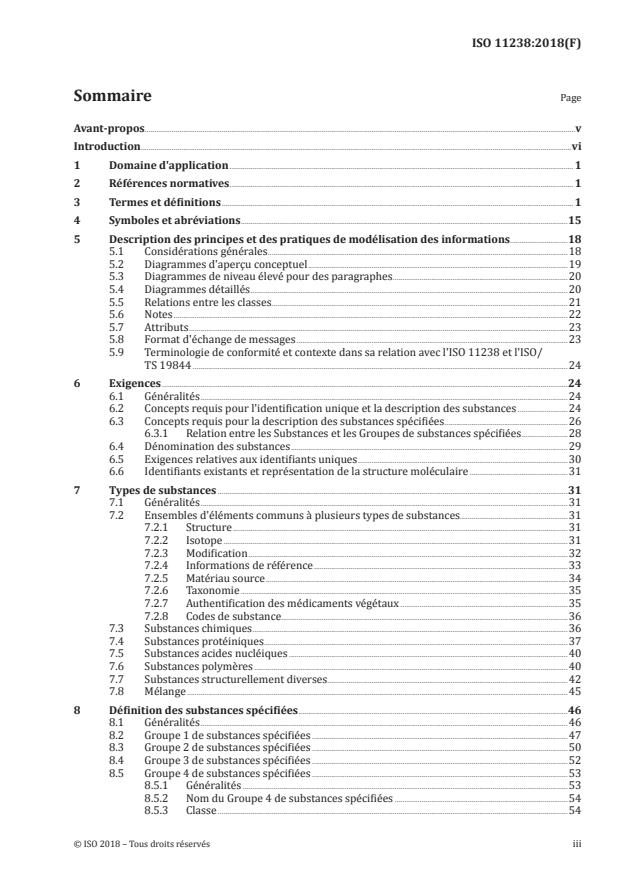
Sommaire Page
Avant-propos .v
Introduction .vi
1 Domaine d'application . 1
2 Références normatives . 1
3 Termes et définitions . 1
4 Symboles et abréviations .15
5 Description des principes et des pratiques de modélisation des informations.18
5.1 Considérations générales .18
5.2 Diagrammes d'aperçu conceptuel .19
5.3 Diagrammes de niveau élevé pour des paragraphes .20
5.4 Diagrammes détaillés .20
5.5 Relations entre les classes .21
5.6 Notes .22
5.7 Attributs .23
5.8 Format d'échange de messages .23
5.9 Terminologie de conformité et contexte dans sa relation avec l'ISO 11238 et l'ISO/
TS 19844 .24
6 Exigences .24
6.1 Généralités .24
6.2 Concepts requis pour l'identification unique et la description des substances .24
6.3 Concepts requis pour la description des substances spécifiées .26
6.3.1 Relation entre les Substances et les Groupes de substances spécifiées .28
6.4 Dénomination des substances .29
6.5 Exigences relatives aux identifiants uniques .30
6.6 Identifiants existants et représentation de la structure moléculaire .31
7 Types de substances .31
7.1 Généralités .31
7.2 Ensembles d'éléments communs à plusieurs types de substances . .31
7.2.1 Structure .31
7.2.2 Isotope .31
7.2.3 Modification .32
7.2.4 Informations de référence .33
7.2.5 Matériau source .34
7.2.6 Taxonomie .35
7.2.7 Authentification des médicaments végétaux .35
7.2.8 Codes de substance . .36
7.3 Substances chimiques .36
7.4 Substances protéiniques .37
7.5 Substances acides nucléiques .40
7.6 Substances polymères .40
7.7 Substances structurellement diverses .42
7.8 Mélange .45
8 Définition des substances spécifiées .46
8.1 Généralités .46
8.2 Groupe 1 de substances spécifiées .47
8.3 Groupe 2 de substances spécifiées .50
8.4 Groupe 3 de substances spécifiées .52
8.5 Groupe 4 de substances spécifiées .53
8.5.1 Généralités .53
8.5.2 Nom du Groupe 4 de substances spécifiées .54
8.5.3 Classe .54
8.5.4 Utilisation des données d'analyse .55
8.5.5 Fabrication .55
8.5.6 Version et spécification .56
Annexe A (informative) Identifiants existants et représentations de la structure moléculaire .60
Bibliographie .64
iv © ISO 2018 – Tous droits réservés
Avant-propos
L'ISO (Organisation internationale de normalisation) est une fédération mondiale d'organismes
nationaux de normalisation (comités membres de l'ISO). L'élaboration des Normes internationales est
en général confiée aux comités techniques de l'ISO. Chaque comité membre intéressé par une étude
a le droit de faire partie du comité technique créé à cet effet. Les organisations internationales,
gouvernementales et non gouvernementales, en liaison avec l'ISO participent également aux travaux.
L'ISO collabore étroitement avec la Commission électrotechnique internationale (IEC) en ce qui
concerne la normalisation électrotechnique.
Les procédures utilisées pour élaborer le présent document et celles destinées à sa mise à jour sont
décrites dans les Directives ISO/IEC, Partie 1. Il convient, en particulier de prendre note des différents
critères d'approbation requis pour les différents types de documents ISO. Le présent document a été
rédigé conformément aux règles de rédaction données dans les Directives ISO/IEC, Partie 2. www .iso
.org/directives
L'attention est attirée sur le fait que certains des éléments du présent document peuvent faire l'objet de
droits de propriété intellectuelle ou de droits analogues. L'ISO ne saurait être tenue pour responsable
de ne pas avoir identifié de tels droits de propriété et averti de leur existence. Les détails concernant
les références aux droits de propriété intellectuelle ou autres droits analogues identifiés lors de
l'élaboration du document sont indiqués dans l'Introduction et/ou dans la liste des déclarations de
brevets reçues par l'ISO. www .iso .org/brevets
Les appellations commerciales éventuellement mentionnées dans le présent document sont données
pour information, par souci de commodité, à l'intention des utilisateurs et ne sauraient constituer un
engagement.
Pour une explication de la nature volontaire des normes, la signification des termes et expressions
spécifiques de l'ISO liés à l'évaluation de la conformité, ou pour toute information au sujet de l'adhésion
de l'ISO aux principes de l'Organisation mondiale du commerce (OMC) concernant les obstacles
techniques au commerce (OTC), voir le lien suivant: Avant-propos — Informations supplémentaires.
Le présent document a été élaboré par le comité technique ISO/TC 215, Informatique de santé.
[2]
Cette deuxième édition annule et remplace la première édition (ISO 11238:2012 ), qui a fait l'objet
d'une révision technique.
Introduction
Le présent document a été élaboré en réponse à une demande mondiale de spécifications sur les
médicaments qui soient harmonisées au niveau international. Il fait partie d'un groupe de cinq normes
et de quatre spécifications techniques qui constituent, ensemble, la base de l'identification unique des
médicaments. Ce groupe de normes et de spécifications techniques comprend:
[3]
ISO 11615 , Informatique de santé — Identification des médicaments — Éléments de données et structures
pour l'identification unique et l'échange d'informations réglementées sur les médicaments
[4]
ISO 11616 , Informatique de santé — Identification des médicaments — Éléments de données et structures
pour l'identification unique et l'échange d'informations réglementées sur les produits pharmaceutiques
ISO 11238, Informatique de santé — Identification des médicaments — Éléments de données et structures
pour l'identification unique et l'échange d'informations réglementées sur les substances
[5]
ISO 11239 , Informatique de santé — Identification des médicaments — Éléments de données et
structures pour l'identification unique et l'échange d'informations réglementées sur les formes des doses
pharmaceutiques, les unités de présentation, les voies d'administration et les emballages
[6]
ISO 11240 , Informatique de santé — Identification des médicaments — Éléments de données et structures
pour l'identification unique et l'échange d'informations sur les unités de mesure
ISO/TS 19844, Informatique de santé — Identification des médicaments — Lignes directrices pour la mise
en œuvre des éléments de données et structures pour l'identification unique et l'échange d'informations
réglementées sur les substances
[7]
ISO/TS 20440 , Informatique de santé — Identification des produits médicaux — Guide de mise en œuvre
des éléments de données et structures pour l'identification unique et l'échange d'informations réglementées
sur les formes des doses pharmaceutiques, les unités de présentation, les voies d'administration et les
emballages de l'ISO 11239
[8]
ISO/TS 20443 , Informatique de santé — Identification des médicaments — Lignes directrices pour
l'implémentation des éléments de données et structures ISO 11615 pour l'identification unique et l'échange
d'informations réglementées sur les médicaments
[9]
ISO/TS 20451 , Informatique de santé — Identification des médicaments — Lignes directrices pour
l'implémentation des éléments de données et structures ISO 11616 pour l'identification unique et l'échange
d'informations réglementées sur les produits pharmaceutiques
Ces normes d'identification de médicaments (IDMP) soutiennent les activités des autorités de
réglementation des médicaments dans le monde par juridiction. Celles-ci comprennent de nombreuses
activités réglementaires relatives au développement, à l'enregistrement et à la gestion du cycle de vie
de médicaments, ainsi qu'à la pharmacovigilance et à la gestion du risque.
Pour atteindre les objectifs principaux de la réglementation des médicaments et de la pharmacovigilance,
il est nécessaire d'échanger des informations sur les médicaments d'une manière rigoureuse et fiable.
Les normes IDMP soutiennent donc les interactions suivantes:
— entre une autorité de réglementation médicale et une autorité de réglementation médicale, par
exemple entre l'Agence européenne des médicaments et la Food and Drug Administration américaine
(FDA) ou inversement; et entre l'Agence européenne des médicaments et les autorités nationales
compétentes dans l'UE ou inversement;
— entre des laboratoires pharmaceutiques et des autorités de réglementation médicale, par exemple
entre une «société pharmaceutique A» et Santé Canada;
— entre le commanditaire d'un essai clinique et une autorité de réglementation médicale, par exemple
entre «l'Université X» et l'Austrian Agency for Health and Food Safety (AGES);
vi © ISO 2018 – Tous droits réservés
— entre une autorité de réglementation médicale et d'autres parties prenantes, par exemple entre
l'UK Medicines and Health Care Products Regulatory Agency (MHRA) et la NHS (National Health
System);
— entre des autorités de réglementation et des sources de données mondiales, par exemple entre la
Pharmaceutical and Medical Device Agency (PMDA) et l'organisme responsable de l'affectation de
nouveaux identifiants de substances.
Les identifiants uniques générés conformément aux normes IDMP prennent en charge les applications
lorsqu'il s'avère nécessaire d'identifier et suivre de façon fiable l'utilisation des médicaments et des
ingrédients qui les composent.
Le présent document fournit une structure qui permet qui permet l'affectation et la maintenance
d'identifiants uniques pour toutes les substances contenues dans les médicaments. Il établit les règles
générales de définition et de distinction des substances, ainsi qu'un modèle général permettant de
définir l'organisation et la collecte des données relatives aux substances et aux substances spécifiées.
Il est prévu que la mise en application fasse appel à l'ISO/TS 19844 et à la messagerie HL7 (voir 5.8)
afin de produire un identifiant fort, unique et non sémantique pour chaque substance présente dans
un médicament. Il est prévu d'attribuer la responsabilité de la création des identifiants globaux à une
seule organisation de maintenance, laquelle conserverait les éléments de définition sur lesquels repose
l'identifiant. Au niveau de la substance spécifiée, une démarche plus régionale peut s'avérer nécessaire,
compte tenu de la nature propriétaire de la plupart des informations.
L'utilisation de l'identifiant est essentielle à la description des substances des médicaments au niveau
mondial. Le présent document n'implique pas de développer une nomenclature pour les substances ou
substances spécifiées, mais les noms de substance communs et officiels actuellement utilisés peuvent
être associés à chaque identifiant.
Les ingrédients utilisés dans les médicaments vont des produits chimiques élémentaires aux tissus
animaux en passant par des cellules génétiquement modifiées. Une définition sans ambiguïté de ces
substances constitue un véritable défi. Le présent document définit les substances en se fondant sur
leur identité scientifique (c'est-à-dire ce qu'elles sont) plutôt que sur leur usage ou leur méthode de
production. La structure moléculaire ou d'autres propriétés immuables telles que les informations
taxonomiques, anatomiques et/ou de fractionnement sont utilisées pour définir les substances. Le
présent document contient cinq types de substances simples et une classe de substances de mélange
qui suffisent à définir toutes les substances. Bien qu'il existe vraisemblablement d'autres manières de
définir ou de classifier les substances, le présent document emploie une approche de concept scientifique
à structure minimaliste mettant l'accent sur les éléments critiques nécessaires pour différencier
deux substances l'une de l'autre. Il existe souvent des interactions entre les substances lorsqu'elles
sont mélangées entre elles, mais le présent document n'a volontairement pas inclus ces interactions
supramoléculaires au niveau de la substance en raison de la nature variable et de l'intensité de telles
interactions. De même, le présent document autorise la capture de plusieurs termes se référant à une
substance donnée et à une pluralité d'informations de référence qui pourraient être utilisées pour
classifier les substances ou pour établir une relation entre deux substances.
En plus du niveau de la substance, le présent document fournit également des éléments pour la
capture d'autres informations sur les substances qui composent les caractéristiques de définition des
substances spécifiées, comme la classe, le fabricant, les informations et spécifications de fabrication,
et aussi pour la capture d'informations sur des substances qui sont fréquemment combinées entre
elles dans le commerce, mais qui ne sont pas un médicament en tant que tel. Au niveau de la substance
spécifiée, quatre groupes d'éléments fournissent les informations essentielles au suivi et à la description
des substances dans les médicaments.
Les concepts de base dans le domaine du développement de normes réglementaires et pharmaceutiques
utilisent différents termes dans divers contextes. Les modèles d'information présentés dans le présent
document décrivent des éléments et les relations entre éléments qui sont nécessaires à la définition
des substances. Les termes et définitions décrits dans le présent document doivent être appliqués aux
concepts nécessaires pour identifier et caractériser de façon unique les substances utilisées dans les
médicaments réglementés et échanger des informations les concernant.
Les termes et définitions adoptés dans le présent document visent à faciliter l'interprétation et
l'application des exigences juridiques et réglementaires, mais ne doivent en aucun cas aller à l'encontre
d'un document juridiquement contraignant. En cas de doute ou de conflit potentiel, les termes et
définitions des documents juridiquement contraignants doivent prévaloir.
Dans le présent document, l'abréviation «% (V/V)» est utilisée en lieu et place de «% de fraction
volumique».
viii © ISO 2018 – Tous droits réservés
NORME INTERNATIONALE ISO 11238:2018(F)
Informatique de santé — Identification des produits
médicaux — Éléments de données et structures pour
l'identification unique et l'échange d'informations
réglementées sur les substances
IMPORTANT — Le fichier électronique du présent document contient des couleurs qui sont
jugées utiles pour la bonne compréhension du document. Il convient donc aux utilisateurs de
considérer l'emploi d'une imprimante couleur pour l'impression du présent document.
1 Domaine d'application
Le présent document donne un modèle d'informations visant à définir et identifier des substances
utilisées dans des médicaments ou à des fins médicinales, y compris les compléments alimentaires,
les produits alimentaires et les produits cosmétiques. Le modèle d'informations, qui repose sur des
principes transférables, peut être utilisé aussi bien dans le domaine humain que vétérinaire. Il est fait
référence à d'autres normes et ressources terminologiques externes applicables au présent document.
2 Références normatives
Les documents suivants cités dans le texte constituent, pour tout ou partie de leur contenu, des
exigences du présent document. Pour les références datées, seule l'édition citée s'applique. Pour les
références non datées, la dernière édition du document de référence s'applique (y compris les éventuels
amendements).
ISO/TS 19844:2018, Informatique de santé — Identification des médicaments — Lignes directrices pour la
mise en œuvre de l’ISO 11238 relative aux éléments de données et structures pour l’identification unique et
l’échange d’informations réglementées sur les substances
3 Termes et définitions
Pour les besoins du présent document, les termes et définitions suivants s’appliquent.
L’ISO et l’IEC tiennent à jour des bases de données terminologiques destinées à être utilisées en
normalisation, consultables aux adresses suivantes:
— ISO Online browsing platform: disponible à l’adresse https: //www .iso .org/obp
— IEC Electropedia: disponible à l’adresse http: //www .electropedia .org/
3.1
adjuvant
composant qui renforce la réponse immunitaire à un antigène et/ou la module vers la réponse
immunitaire souhaitée
3.2
marqueur actif
constituant ou groupes de constituants d'une substance (végétale) (fraîche), d'un médicament végétal,
d'une préparation végétale ou d'un médicament végétal, présentant un intérêt pour le contrôle et dont
la contribution à l'activité thérapeutique est généralement reconnue
Note 1 à l'article: Les marqueurs actifs ne sont pas équivalents aux marqueurs analytiques ou de signature, qui
sont uniquement utilisés pour l'identification ou le contrôle.
3.3
allergène
substance préoccupante utilisée comme ingrédient ou dans un dispositif, susceptible de stimuler une
hypersensibilité de type I ou une réaction allergique chez des individus atopiques
Note 1 à l'article: Dans le présent document, la définition s'applique à une molécule (substance) capable d'induire
une réponse de l'immunoglobuline E (IgE) et/ou une réaction allergique de Type I.
3.4
allergoïdes
extraits allergéniques chimiquement modifiés (par exemple par formaldéhyde ou glutaraldéhyde) afin
de réduire l'allergénicité tout en préservant l'immunogénicité
Note 1 à l'article: Le formaldéhyde et le glutaraldéhyde réagissent avec les groupes amines primaires de la chaîne
polypeptidique, ce qui conduit à la formation de polymères allergéniques de haut poids moléculaire à réticulation
intramoléculaire et intermoléculaire; de cette manière, il convient que les épitopes IgE conformationnels soient
détruits sans que les épitopes linéaires de la cellule T ne soient affectés.
3.5
données analytiques
ensemble d'éléments permettant de décrire et de capturer les méthodes et matériaux de référence
utilisés pour déterminer la pureté, l'activité thérapeutique ou l'identité d'une substance spécifiée
3.6
marqueur analytique
constituant ou groupes de constituants utilisés à des fins d'analyse
Note 1 à l'article: Les marqueurs actifs ne sont pas équivalents aux marqueurs analytiques ou de signature, qui
sont uniquement utilisés pour l'identification ou le contrôle.
3.7
code ATC
code de classification anatomique, thérapeutique et chimique
code de classification des substances
code utilisé pour la classification des médicaments
Note 1 à l'article: Il est contrôlé par le Centre collaborateur de l'OMS pour la méthodologie sur les statistiques
1)
pharmaceutiques (CCOMS) .
Note 2 à l'article: Ce système de code pharmaceutique divise les médicaments en différents groupes, selon
l'organe ou le système sur lequel ils agissent et/ou selon leurs caractéristiques thérapeutiques, pharmacologiques
et chimiques. Chaque code ATC de niveau inférieur désigne une substance à usage pharmaceutique ou une
combinaison de substances donnée pour une seule indication (ou utilisation). Un même médicament peut donc
posséder plusieurs codes: l'acide acétylsalicylique, par exemple, est associé au code A01AD05 lorsqu'il est indiqué
pour un traitement oral local, au code B01AC06 lorsqu'il est utilisé comme antiagrégant plaquettaire, et au
code N02BA01 lorsqu'il est employé comme analgésique et antipyrétique. En revanche, le même code est attribué
à plusieurs marques différentes de médicaments si elles possèdent les mêmes substances actives et indications.
3.8
nom d'index CAS
nom d'index du Chemical Abstracts Service
nom de registre CAS
identifiant servant habituellement à identifier une substance simple
Note 1 à l'article: Pour des explications plus détaillées, voir A.1.2.
1) https: //www .whocc .no/atc/structure _and _principles/
2 © ISO 2018 – Tous droits réservés
3.9
numéro de registre CAS
2)
numéro CAS
identifiant numérique unique d'une substance attribué dans le système de registre CAS
Note 1 à l'article: Pour des explications plus détaillées, voir A.1.2.
3.10
liaison chimique
forces agissant entre deux atomes ou groupes d'atomes menant à la formation d'une entité moléculaire
indépendante stable
3.11
substance chimique
type de substance pouvant être défini par une structure moléculaire unique qui n'est ni une protéine, ni
un acide nucléique, ni une substance polymère
Note 1 à l'article: En règle générale, les substances chimiques sont considérées comme de «petites» molécules
qui ont des sels, des solvates ou des ions associés, et peuvent être décrites avec une seule structure définitive ou
représentative.
3.12
substance chirale
substance dont la structure moléculaire ne peut pas être superposée à son image symétrique
3.13
co-cristaux
structures cristallines homogènes (monophasées) constituées d'au moins deux composants dans un
rapport stœchiométrique défini où la disposition dans le réseau cristallin ne repose pas sur des liaisons
ioniques
3.14
composant
substance qui fait partie d'un mélange et qui définit un matériau à substances multiples au niveau
Groupe 1 de substances spécifiées
EXEMPLE Le diméthicone et le dioxyde de silicium sont des composants du siméthicone. L'insuline humaine
et la protamine sont les composants de l'isophane insuline humaine.
Note 1 à l'article: Les composants sont utilisés pour décrire un matériau à substances multiples.
3.15
stœchiométrie de composition
relations quantitatives entre les éléments chimiques ou les groupes caractéristiques composant une
substance
EXEMPLE Le phosphate dibasique de sodium heptahydrate et le phosphate dibasique de sodium dihydrate
sont définis comme étant des substances différentes car ils possèdent une stœchiométrie de composition
différente.
3.16
configuration
méthode d'indication de l'organisation des atomes en trois dimensions dans un centre stéréogène de
carbone, de phosphore et de soufre
2) https: //www .cas .org/content/chemical -substances/faqs
3.17
constituant
substance présente dans une substance spécifiée ou dans une substance parente
Note 1 à l'article: Les constituants peuvent être des impuretés, des éléments dégradants, des solvants
d'extraction, des véhicules, des marqueurs actifs ou des substances de signature, des substances parentes ou
encore des substances simples mélangées ensemble pour former un matériau à substances multiples.
Note 2 à l'article: Les constituants doivent être associés à un rôle et à une quantité dans le modèle d'informations
du Groupe 1 de substances spécifiées. Les spécifications des constituants doivent être utilisées pour décrire les
composants ainsi que les limites applicables aux impuretés ou aux substances associées pour un matériau donné.
EXEMPLE La substance acétonide de triamcinolone est la substance parente (le constituant) de la substance
attachée au Groupe 1 de substances spécifiées, acétonide de triamcinolone, micronisé.
Note 3 à l'article: Un composant constituant fait partie d'un mélange appartenant à un groupe homogène de
composants individuels, décrits comme substances parentes pour la fabrication d'un extrait allergénique.
3.18
vocabulaire contrôlé
ensemble fini de valeurs qui correspondent aux seules valeurs admises pour un élément de données
Note 1 à l'article: Les valeurs autorisées peuvent être des codes, du texte ou des valeurs numériques.
[16]
[SOURCE: CDISC Clinical Research Glossary V10.0, 2016, modifié]
3.19
copolymère
polymère composé de plusieurs types de motifs de répétition structuraux liés par des liaisons
covalentes
Note 1 à l'article: Les copolymères sont obtenus par copolymérisation ou polymérisation séquentielle de deux
monomères différents ou plus. Les copolymères peuvent être aléatoires, statistiques, alternés, périodiques,
séquencés, réticulés, greffés ou mélangés.
3.20
paramètre de procédé critique
paramètre de procédé dont la variabilité affecte un attribut critique de la qualité et qu'il convient, par
conséquent, de surveiller ou contrôler afin de s'assurer que le procédé produit la qualité recherchée
Note 1 à l'article: Un paramètre de fabrication est considéré comme «critique» et nécessaire à la production d'une
substance ou d'une substance spécifiée, par exemple inclusion d'une étape chromatographique pour l'élimination
ou la réduction des impuretés et virus.
Note 2 à l'article: Le procédé critique est lié au type de méthode de production.
3.21
cytokine
petite protéine produite par des cellules et qui a un effet particulier sur les interactions intercellulaires,
sur la communication intercellulaire ou sur le comportement des cellules
3.22
degré de polymérisation
nombre moyen de monomères ou de motifs de répétition structuraux d'un bloc ou d'une chaîne de
polymères
Note 1 à l'article: Il concerne les homopolymères et copolymères séquencés, où il fait référence au degré de
polymérisation à l'intérieur d'un bloc.
3.23
origine diverse
substances qui ne sont pas isolées ensemble ou qui sont le résultat du même processus
4 © ISO 2018 – Tous droits réservés
3.24
rapport médicament/extrait
rapport entre la quantité de substance (végétale) (fraîche) ou de médicament végétal et la quantité de
préparation végétale obtenue
3.25
amplificateur
séquence d'ADN agissant en CIS permettant d'améliorer l'utilisation de (certains) promoteurs
eucaryotes et pouvant fonctionner selon l'orientation et dans n'importe quel emplacement (en amont ou
en aval) par rapport au promoteur
3.26
ratio d'extraction pour les allergènes
rapport d'extraction indiquant les proportions relatives (en m/V) de matériaux sources allergéniques
et de solvants
Note 1 à l'article: Ce ratio constitue une exigence minimale pour les allergènes pour lesquels le nombre de patients
touché est insuffisant pour déterminer l'activité allergénique totale dans des études in vivo ou in vitro.
3.27
solvants d'extraction
solvants utilisés pour le processus d'extraction
3.28
fraction
partie distincte d'un matériau dérivée d'une matrice complexe, dont la composition est différente de
celle de l'antécédent
Note 1 à l'article: Ce concept est utilisé pour décrire le matériau source. Le concept est récursif en ce sens qu'une
fraction subséquente peut être dérivée à partir d'une fraction antérieure.
EXEMPLE La fraction polyclonale IgG dérivée de l'immunoglobuline, elle-même dérivée du sérum sanguin,
est un exemple de fractionnement récursif.
3.29
gène
unité élémentaire des informations héréditaires, composée de chaînes de paires de base de nucléotides
dans des séquences spécifiques, qui code et contrôle une protéine ou une sous-unité protéique
3.30
élément génétique
élément individuel à l'intérieur d'un gène, tel que promoteur, amplificateur, silenceur ou séquences
de codage
3.31
glycosylation
processus enzymatique liant les saccharides ou oligosaccharides aux substances
3.32
type de glycosylation
différences significatives de glycosylation entre les classes d'organismes
Note 1 à l'article: Cela distingue le modèle de glycosylation à l'intérieur d'une classe d'organismes, par exemple
humaine, mammifère et aviaire. Le type de glycosylation doit être un élément de définition lorsqu'il existe une
protéine glycosylée sous forme de substance.
3.33
classe
ensemble de spécifications indiquant la qualité d'une substance ou d'une substance spécifiée
3.34
récolte
processus de collecte d'une substance (végétale) (fraîche) ou de parties d'un matériau botanique
dans le champ ou processus de collecte d'un matériau viral ou bactérien dans son site de production/
fabrication
3.35
souches homéopathiques
substances, produits de préparations utilisés comme matières premières pour la production de
préparations homéopathiques
Note 1 à l'article: Une souche se présente généralement sous l'une des formes suivantes: une teinture-mère ou
un macérat glycériné pour les matières premières d'origine botanique, zoologique ou humaine, ou la substance
elle-même pour les matières premières d'origine chimique ou minérale.
3.36
homopolymère
polymère ne contenant qu'un seul motif de répétition structural
3.37
isotope
variantes d'un élément chimique qui diffèrent par leur masse atomique, qui possèdent le même nombre
de protons et dont le noyau contient un nombre différent de neutrons
Note 1 à l'article: Les radionucléides ou nucléides avec un rapport isotopique non naturel sont représentés
dans la représentation structurelle avec le numéro nucléique affiché. Les isotopes d'abondance naturelle sont
représentés par un symbole élémentaire plein.
EXEMPLE C désigne un atome de carbone ayant une masse atomique de 13.
3.38
article manufacturé
composition qualitative et quantitative d'un produit tel que contenu dans l'emballage du médicament
Note 1 à l'article: Un médicament peut contenir un ou plusieurs articles manufacturés. Dans la plupart des
cas, l'article manufacturé équivaut au produit pharmaceutique. Dans certains cas, cependant, le ou les articles
manufacturés sont transformés avant d'être administrés au patient (comme le produit pharmaceutique) et les
deux sont différents.
3.39
fabricant
organisation qui détient l'autorisation du procédé de fabrication
Note 1 à l'article: Dans le présent document, la définition renvoie à une entreprise responsable de la fabrication
de la substance.
3.40
fabrication
processus de production d'une substance ou d'un médicament depuis l'acquisition de tous les matériaux
en passant par toutes les phases d'élaboration
Note 1 à l'article: Le procédé critique, les étapes de procédé critique, les matières premières et les matériaux de
traitement ainsi que les paramètres de production critiques sont capturés.
3.41
matériau
entité possédant une masse, occupant un espace et constituée d'une ou plusieurs substances
6 © ISO 2018 – Tous droits réservés
3.42
médicament
produit pharmaceutique ou combinaison de produits pharmaceutiques possédant des propriétés
curatives ou préventives à l'égard des maladies humaines (ou animales) et pouvant être administré(e)
en vue d'établir un diagnostic médical ou de restaurer, corriger ou modifier des fonctions physiologiques
Note 1 à l'article: Un médicament peut contenir dans son emballage un ou plusieurs articles manufacturés et
un ou plusieurs produits pharmaceutiques. Dans certaines régions, un médicament peut être également défini
comme toute substance ou composition de substances pouvant être utilisée pour établir un diagnostic médical.
3.43
microhétérogénéité
substances isolées ensemble contenant des différences mineures au niveau de la structure entre des
substances isolées essentiellement identiques/le matériau source (par exemple, hétérogénéité de
séquence) et/ou de la modification post-traductionnelle, comme la glycosylation
Note 1 à l'article: La microhétérogénéité n'est pas une caractéristique de définition des substances, mais elle peut
l'être au niveau d'information Groupe 1 de substances spécifiées, par exemple différences de glycanes.
Note 2 à l'article: La microhétérogénéité est composée d'un éventail de types de glycosylation (biantennaire,
triantennaire), d'une étendue de glycosylation au niveau d'un site donné (occupation du site), d'une hétérogénéité
de séquence due au polymorphisme du matériau source, aux erreurs de traduction ou au traitement protéolytique
variable ou autre.
3.44
mélange
type de substances polydispersives qui est une combinaison de substances simples isolées ou produites
selon le même processus synthétique
Note 1 à l'article: Les substances simples d'origines diverses qui sont assemblées et ne subissent pas de
transformation chimique en conséquence de cette combinaison sont définies comme des matériaux à substances
multiples (Groupe 1 de substances spécifiées) et non comme un mélange.
EXEMPLE 1 La gentamicine est définie comme une substance de mélange de la gentamicine C1, de la
gentamicine C1A, de la gentamicine C2, de la gentamicine C2A et de la gentamicine C2B. Les monoesters de
glycérol peuvent être définis comme une substance de mélange de deux substances simples qui diffèrent quant
à la position de l'estérification. Le siméthicone, qui est composé de diméthicone et de dioxyde de silicium, n'est
pas défini comme une substance de mélange, étant donné que divers matériaux sont assemblés pour former un
matériau à substances multiples.
EXEMPLE 2 Les monoesters de glycérol peuvent être définis comme un mélange de deux substances simples
qui diffèrent quant à la position de l'estérification.
Note 2 à l'article: Un mélange peut être utilisé pour un groupe homologue de substances simples structurellement
diverses employées comme matières premières dans la préparation d'un extrait allergénique. L'extrait est
ensuite décrit à l'aide du «matériau source» de la classe et de la «description de la fraction» du groupe d'éléments
(préparation allergénique) obtenue à partir des substances simples structurellement diverses (matières
premières) employées comme substances parentes. Cette substance (extrait allergénique) étant le résultat du
même procédé (de synthèse), l'extrait est considéré comme une substance de mélange.
3.45
groupe caractéristique
entité composant une substance, présentant une structure moléculaire complète et continue
EXEMPLE Le dosage d'un médicament repose souvent sur ce qui est appelé le groupe caractéristique actif
de la molécule, responsable de l'action physiologique ou pharmacologique de la substance médicamenteuse. Pour
éviter toute ambigüité, il convient d'utiliser l'acide libre et/ou la base libre comme groupe caractéristique sur
lequel va reposer le dosage.
Note 1 à l'article: Le groupe caractéristique actif d'une molécule présente dans une substance dans des
proportions stœchiométriques ou non stœchiométriques est considéré comme la partie de la molécule qui
correspond à la base, à l'acide libre ou à la partie moléculaire ionique d'un sel, solvate, chélate, clathrate, complexe
moléculaire ou ester.
3.46
formule moléculaire
formule chimique qui décrit le nombre total et le type d'atomes contenus dans une molécule pour
indiquer les rapports proportionnels atomiques (proportions numériques d'atomes d'un type donné par
rapport aux atomes d'autres types), afin d'exprimer des informations sur les proportions d'atomes qui
constituent un composé chimique donné, à l'aide d'une simple ligne de symboles d'élément chimique, de
nombres et, parfois, d'autres symboles
Note 1 à l'article: La formule moléculaire peut contenir d'autres symboles, comme des parenthèses, tirets,
crochets et signes plus (+) et moins (-). Ceux-ci sont limités à une seule ligne typographique de symboles qui
peuvent inclure des indices et des exposants. Une formule chimique ne contient aucun mot du
...
Questions, Comments and Discussion
Ask us and Technical Secretary will try to provide an answer. You can facilitate discussion about the standard in here.
Loading comments...