

ISO/IEC 20547-4:2020
(Main)Information technology — Big data reference architecture — Part 4: Security and privacy
General Information
- Abstract
This document specifies the security and privacy aspects applicable to the big data reference architecture (BDRA) including the big data roles, activities and functional components and also provides guidance on security and privacy operations for big data.
- Status
- Published
- Publication Date
- 22-Sep-2020
- Drafting Committee
- ISO/IEC JTC 1/SC 27/WG 4 - Security controls and services
- Current Stage
- 9060 - Close of review
- Completion Date
- 04-Mar-2031
Buy Documents




ISO/IEC 20547-4:2020 - Information technology -- Big data reference architecture


ISO/IEC 20547-4:2020 - Information technology — Big data reference architecture — Part 4: Security and privacy/23/2020
Overview - ISO/IEC 20547-4:2020 (Big data - Security and privacy)
ISO/IEC 20547-4:2020 defines the security and privacy aspects of the Big Data Reference Architecture (BDRA). It specifies how big data security and privacy (BD‑S&P) apply to BDRA roles, activities and functional components, and it provides operational guidance for securing big data systems. The standard addresses both technical and governance perspectives to ensure confidentiality, integrity, availability and privacy across the big data lifecycle.
Key topics and technical requirements
- Big data security & privacy concerns - Explains risks driven by big data characteristics (volume, velocity, variety, variability, volatility, veracity, value) and how these amplify threats such as data leakage, inference attacks and advanced persistent threats (APT) or DDoS.
- Security and privacy objectives - Establishes high‑level goals to protect data, support privacy-by-design and maintain trust across ecosystems.
- Governance, management and operations - Defines activities for BD‑S&P governance (planning, directing, monitoring), management (planning, assessing, updating) and operational tasks (solution design, evaluation and enablement).
- Roles and responsibilities - Maps security & privacy responsibilities to BDRA roles to support accountability and interoperability.
- Guidance on operations - Practical guidance at organization and ecosystem levels covering requirements definition, risk management, controls and lifecycle operations for data processing chains.
- Functional components - Describes security and privacy functional components and multi‑layer functions to be integrated into BDRA implementations.
- Threats and controls classification - Informative annexes provide examples of threat classifications (e.g., STRIDE, LINDDUN) and control classifications to support risk assessments and control selection.
Practical applications - who uses this standard
ISO/IEC 20547-4:2020 is intended for:
- Big data architects and solution designers - to embed BD‑S&P components and privacy-by-design principles.
- Security and privacy officers / compliance teams - for governance frameworks, controls selection and risk management aligned to BDRA.
- Data engineers and platform operators - to apply operational guidance for secure ingestion, storage, processing and access.
- Systems integrators and vendors - to ensure interoperable, secure big data solutions across ecosystems.
- Regulators and auditors - to evaluate big data systems against widely accepted BD‑S&P practices.
Practical uses include designing secure big data platforms, creating cross‑organization security operations, performing privacy risk assessments, and mapping controls to BDRA roles and lifecycle stages.
Related standards
- ISO/IEC 20546 - Big data - Overview and vocabulary
- ISO/IEC 20547-3 - Big data reference architecture - Part 3: Reference architecture
- ISO/IEC/IEEE 15288 - Systems and software engineering - System life cycle processes
Keywords: ISO/IEC 20547-4:2020, BDRA, big data security, privacy, BD‑S&P, big data reference architecture, privacy-by-design, STRIDE, LINDDUN, PII.
Buy Documents
ISO/IEC 20547-4:2020 - Information technology -- Big data reference architecture
ISO/IEC 20547-4:2020 - Information technology — Big data reference architecture — Part 4: Security and privacy/23/2020
Get Certified
Connect with accredited certification bodies for this standard

BSI Group
BSI (British Standards Institution) is the business standards company that helps organizations make excellence a habit.

NYCE
Mexican standards and certification body.
Sponsored listings
Frequently Asked Questions
ISO/IEC 20547-4:2020 is a standard published by the International Organization for Standardization (ISO). Its full title is "Information technology — Big data reference architecture — Part 4: Security and privacy". This standard covers: This document specifies the security and privacy aspects applicable to the big data reference architecture (BDRA) including the big data roles, activities and functional components and also provides guidance on security and privacy operations for big data.
This document specifies the security and privacy aspects applicable to the big data reference architecture (BDRA) including the big data roles, activities and functional components and also provides guidance on security and privacy operations for big data.
ISO/IEC 20547-4:2020 is classified under the following ICS (International Classification for Standards) categories: 35.020 - Information technology (IT) in general. The ICS classification helps identify the subject area and facilitates finding related standards.
ISO/IEC 20547-4:2020 is available in PDF format for immediate download after purchase. The document can be added to your cart and obtained through the secure checkout process. Digital delivery ensures instant access to the complete standard document.
Standards Content (Sample)
INTERNATIONAL ISO/IEC
STANDARD 20547-4
First edition
2020-09
Information technology — Big data
reference architecture —
Part 4:
Security and privacy
Technologies de l'information — Architecture de référence des
mégadonnées —
Partie 4: Sécurité et confidentialité
Reference number
©
ISO/IEC 2020
© ISO/IEC 2020
All rights reserved. Unless otherwise specified, or required in the context of its implementation, no part of this publication may
be reproduced or utilized otherwise in any form or by any means, electronic or mechanical, including photocopying, or posting
on the internet or an intranet, without prior written permission. Permission can be requested from either ISO at the address
below or ISO’s member body in the country of the requester.
ISO copyright office
CP 401 • Ch. de Blandonnet 8
CH-1214 Vernier, Geneva
Phone: +41 22 749 01 11
Email: copyright@iso.org
Website: www.iso.org
Published in Switzerland
ii © ISO/IEC 2020 – All rights reserved
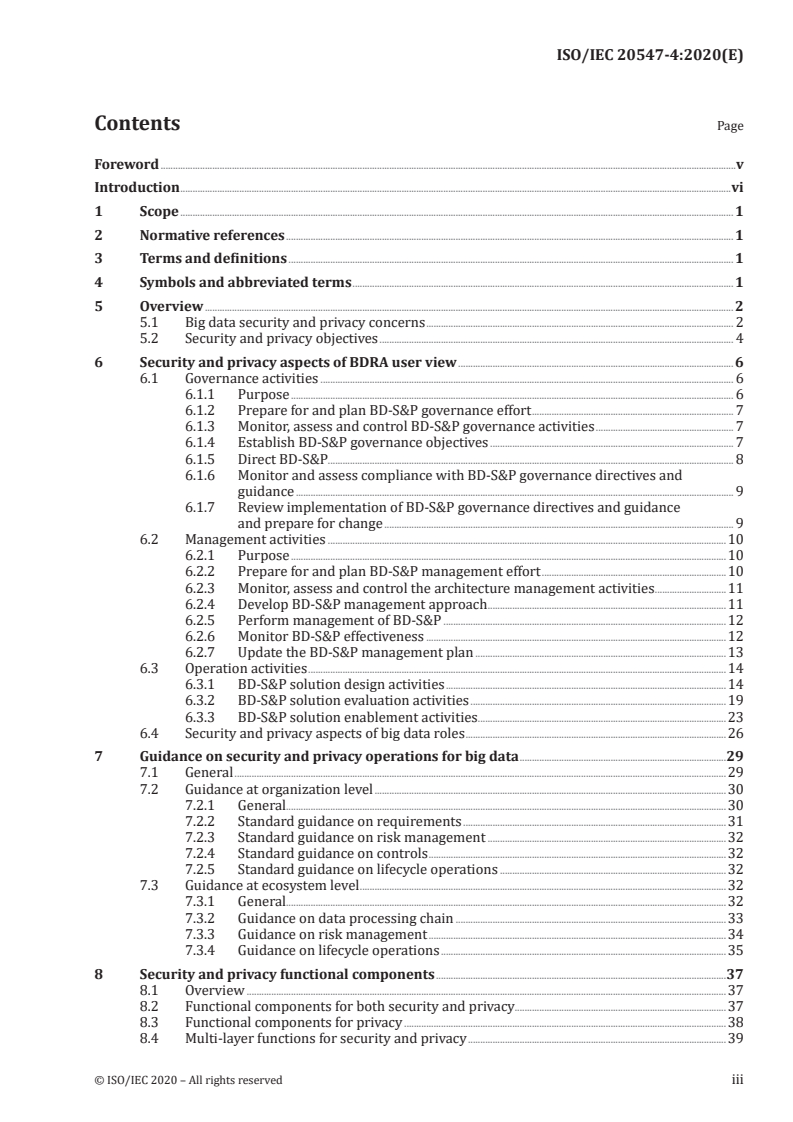
Contents Page
Foreword .v
Introduction .vi
1 Scope . 1
2 Normative references . 1
3 Terms and definitions . 1
4 Symbols and abbreviated terms . 1
5 Overview . 2
5.1 Big data security and privacy concerns . 2
5.2 Security and privacy objectives . 4
6 Security and privacy aspects of BDRA user view . 6
6.1 Governance activities . 6
6.1.1 Purpose . 6
6.1.2 Prepare for and plan BD-S&P governance effort . 7
6.1.3 Monitor, assess and control BD-S&P governance activities . 7
6.1.4 Establish BD-S&P governance objectives . 7
6.1.5 Direct BD-S&P. 8
6.1.6 Monitor and assess compliance with BD-S&P governance directives and
guidance . 9
6.1.7 Review implementation of BD-S&P governance directives and guidance
and prepare for change . 9
6.2 Management activities .10
6.2.1 Purpose .10
6.2.2 Prepare for and plan BD-S&P management effort .10
6.2.3 Monitor, assess and control the architecture management activities .11
6.2.4 Develop BD-S&P management approach .11
6.2.5 Perform management of BD-S&P .12
6.2.6 Monitor BD-S&P effectiveness .12
6.2.7 Update the BD-S&P management plan .13
6.3 Operation activities .14
6.3.1 BD-S&P solution design activities .14
6.3.2 BD-S&P solution evaluation activities .19
6.3.3 BD-S&P solution enablement activities .23
6.4 Security and privacy aspects of big data roles .26
7 Guidance on security and privacy operations for big data .29
7.1 General .29
7.2 Guidance at organization level .30
7.2.1 General.30
7.2.2 Standard guidance on requirements .31
7.2.3 Standard guidance on risk management .32
7.2.4 Standard guidance on controls .32
7.2.5 Standard guidance on lifecycle operations .32
7.3 Guidance at ecosystem level .32
7.3.1 General.32
7.3.2 Guidance on data processing chain .33
7.3.3 Guidance on risk management .34
7.3.4 Guidance on lifecycle operations .35
8 Security and privacy functional components .37
8.1 Overview .37
8.2 Functional components for both security and privacy.37
8.3 Functional components for privacy .38
8.4 Multi-layer functions for security and privacy .39
© ISO/IEC 2020 – All rights reserved iii
Annex A (informative) Examples of security and privacy threat classification .41
Annex B (informative) Examples of security and privacy control classification .42
Annex C (informative) Examples of ecosystem and resulting coordination of security and
privacy operations .45
Annex D (informative) Examples of security and privacy controls per BDRA roles .52
Bibliography .58
iv © ISO/IEC 2020 – All rights reserved
Foreword
ISO (the International Organization for Standardization) is a worldwide federation of national standards
bodies (ISO member bodies). The work of preparing International Standards is normally carried out
through ISO technical committees. Each member body interested in a subject for which a technical
committee has been established has the right to be represented on that committee. International
organizations, governmental and non-governmental, in liaison with ISO, also take part in the work.
ISO collaborates closely with the International Electrotechnical Commission (IEC) on all matters of
electrotechnical standardization.
The procedures used to develop this document and those intended for its further maintenance are
described in the ISO/IEC Directives, Part 1. In particular, the different approval criteria needed for the
different types of ISO documents should be noted. This document was drafted in accordance with the
editorial rules of the ISO/IEC Directives, Part 2 (see www .iso .org/ directives).
Attention is drawn to the possibility that some of the elements of this document may be the subject of
patent rights. ISO shall not be held responsible for identifying any or all such patent rights. Details of
any patent rights identified during the development of the document will be in the Introduction and/or
on the ISO list of patent declarations received (see www .iso .org/ patents).
Any trade name used in this document is information given for the convenience of users and does not
constitute an endorsement.
For an explanation of the voluntary nature of standards, the meaning of ISO specific terms and
expressions related to conformity assessment, as well as information about ISO's adherence to
the World Trade Organization (WTO) principles in the Technical Barriers to Trade (TBT), see
www .iso .org/ iso/ foreword .html.
This document was prepared by Joint Technical Committee ISO/IEC JTC 1, Information technology,
Subcommittee SC 27, Information security, cybersecurity and privacy protection.
Any feedback or questions on this document should be directed to the user’s national standards body. A
complete listing of these bodies can be found at www .iso .org/ members .html.
A list of all parts in the ISO/IEC 20547 series can be found on the ISO website.
© ISO/IEC 2020 – All rights reserved v
Introduction
Big data refers to the massive amount of digital information collected in various forms from different
sources of digital and physical environments. This data is not only generated by traditional means
of information exchange, but also from sensors embedded in physical environments, such as city
surroundings, transportation vehicles, critical infrastructures, etc. The collection and processing of big
data provides additional challenges not inherent in the traditional digital information exchange setting.
This document was developed in response to the worldwide demand for a common baseline of security
and privacy aspects for big data architectures to facilitate interoperability in big data systems without
compromising privacy, confidentiality, or integrity.
The big data paradigm blurs the security boundaries between data collection, storage and access —
areas traditionally addressed independently — that now needs to be confronted holistically with a
comprehensive security and privacy foundation, tightly coupled to all architecture components.
Effective standardization of security and privacy is paramount to the development of mutual trust and
cooperation amongst big data stakeholders.
vi © ISO/IEC 2020 – All rights reserved
INTERNATIONAL STANDARD ISO/IEC 20547-4:2020(E)
Information technology — Big data reference
architecture —
Part 4:
Security and privacy
1 Scope
This document specifies the security and privacy aspects applicable to the big data reference
architecture (BDRA) including the big data roles, activities and functional components and also
provides guidance on security and privacy operations for big data.
2 Normative references
The following documents are referred to in the text in such a way that some or all of their content
constitutes the requirements of this document. For dated references, only the edition cited applies. For
undated references, the latest edition of the referenced document (including any amendments) applies.
ISO/IEC 20546, Information technology — Big data — Overview and vocabulary
ISO/IEC 20547-3, Information technology — Big data reference architecture — Part 3: Reference
architecture
ISO/IEC/IEEE 15288, Systems and software engineering — System life cycle processes
3 Terms and definitions
For the purposes of this document, the terms and definitions given in ISO/IEC 20546 apply.
ISO and IEC maintain terminological databases for use in standardization at the following addresses:
— ISO Online browsing platform: available at https:// www .iso .org/ obp
— IEC Electropedia: available at http:// www .electropedia .org/
4 Symbols and abbreviated terms
APT advanced persistent threat
BDRA big data reference architecture
BD-S&P big data security and privacy
DDoS distributed denial of service
LINDDUN linkability, identifiability, non-repudiation, detectability, disclosure of information, una-
wareness, non-compliance
PII personally identifiable information
STRIDE spoofing of user identity, tampering, repudiation, information disclosure, denial of ser-
vice, elevation of privilege
© ISO/IEC 2020 – All rights reserved 1
5 Overview
5.1 Big data security and privacy concerns
This subclause addresses three types of concerns:
— risks caused by big data characteristics;
— security and privacy challenges from big data;
— ecosystem coordination capabilities needed in the context of big data.
Big data has the key data characteristics of volume, velocity, variety and variability and also the key data
processing characteristics of volatility, veracity and value. These characteristics introduce additional
risks and thus challenges on the security and privacy aspect of big data.
— Volume of data is at risk associated with massive amounts of data in various layers. For example,
multi-tiered, distributed storages and transmission on various networks with different protocols.
— Velocity of data has risks associated with faster flow at which the data is created, stored, analysed
or visualized. Security controls can be a burden on velocity and easily omitted.
— Variety of data brings more complexity from a diversity of sources under the control of various
actors. Complexity inevitably leads to vulnerability. An emergent phenomenon introduced by big
data variety is its ability to infer identity from anonymized datasets by correlating with apparently
innocuous public databases.
— Variability of data has risks associated with faster changes in data rate, format/structure, semantics
and/or quality. It can become more difficult to apply security controls on data security and privacy.
— Volatility of data can affect to keep audit trails and make security management difficult.
— Veracity of data brings higher requirements to integrity, consistency and accuracy. Associated risks
can be aggregated and magnified.
— Value of data brings more attacks for a variety of purposes and interests.
Big data application boom brings more serious security and privacy issues on data, such as frequent
incidents of data loss and personal data leakage, illegal data transactions underground, which cause
data abuse and Internet fraud and endanger social stability and national security.
From technology platform perspective, due to the continuous emergence of a variety of big data
technology, new technical architecture and support platforms and big data software, the following
security and privacy capabilities are needed in the big data context.
— Traditional security controls in big data context are needed.
Massive, multi-sourced, heterogeneous, dynamic and other big data characteristics lead to the
difference of data application security from a closed environment. Big data applications generally
use open distributed computing and storage architecture with complex underlying support to
provide massive data distributed storage and high-performance computing services. These new
technologies and architectures make the network boundaries of big data applications become
blurred so that the boundary-based traditional security protection measures are no longer valid.
Meanwhile, under this new situation, the advanced persistent threat (APT), distributed denial
of service (DDoS), machine learning-based data mining and privacy discovery and other attacks
make the traditional defence, detection and other security controls expose serious deficiencies. For
instance, providing secure data management and threat intelligence, providing secure data storage
for big data as well as secure log data generation, transmission, storage, analysis and disposal
becomes very difficult. Additionally, novel technical approaches for privacy-preserving, machine
learning, cryptographic mechanisms for data-centric security and access control are necessary.
2 © ISO/IEC 2020 – All rights reserved
For more information on the requirements of big data security and privacy, refer to the security
and privacy technical considerations in different use cases provided by ISO/IEC TR 20547-2.
— Security and privacy need to be provided for the distributed computation and data store
infrastructure of big data.
This requires privacy-preserving and secure distributed computation and information
dissemination. Big data requires scalable and distributed solutions for secure data storage as
well as for audits and investigations for data provenance. Data integrity for streaming influx of
data from various sensors and other endpoints has to be provided. Real-time analytics for threat
intelligence requires the processing of large amounts of security-related information such as traffic
streams and log information.
— Platform security mechanisms need to be improved in the context of big data security and privacy.
In general, existing big data applications use big data management platforms and technology,
such as Hadoop-based HBase/Hive, Cassandra/Spark, MongoDB. At the beginning of design, these
platforms and technology are mostly considered to be used in the trusted internal network, with
little consideration of authentication, authorization, key services and security audit. Although some
software is improved, such as adding the Kerberos authentication mechanism, the overall security
capability is still relatively weak. Meanwhile, third-party open-source components are often used
in big data applications. Due to the lack of rigorous test management and security certification of
these components, the ability to prevent software vulnerabilities and malicious backdoors in big
data applications is insufficient.
— Application access control capabilities in big data context are needed.
Because of the variety of data types and the wide range of applications of big data, it is often
used to provide multiple services to users with different identities and purposes from different
organizations or departments. In general, access control is an effective means to achieve controlled
access to data. However, due to a large number of unknown data users and data to be accessed,
it is very difficult to pre-set roles and permissions of data access. Although the user’s rights to
access data can be classified in advance, because of the numerous roles, it is difficult to define
the control of each role's actual permissions in a fine-grained way. So, it is difficult to accurately
specify the range of data for each user to access without deploying a newer access control model
such as attribute-base access control (ABAC). This also causes the issue with the data minimization
principle in ISO/IEC 29100.
— Scalable security and privacy mechanisms are needed.
When designing and applying security and privacy mechanisms such key management, identity
and access management, de-identification, etc., in the big data environment, not only the security
and privacy functionalities need to be considered, but also the scalability of these mechanisms
needs to be taken into account in order to support processing of high volume and high velocity of
the data.
From the data application perspective, due to the big Vs (volume, variety, velocity and variability)
characteristics of big data and huge value in big data, the following security and privacy capabilities are
needed in big data context:
— Data protection capabilities in big data context are needed.
In the open network society, the huge volume of big data with immeasurable potential value
makes it more favoured and easier to become a significant target of network attacks. In recent
years, information security incidents frequently occur, for example, leakage of email accounts,
social security information and bank card numbers. The distributed system deployment, the open
network environment, the complex data application and the large number of user accesses, all
cause the big data to face the bigger challenges in confidentiality, integrity, availability and so on.
© ISO/IEC 2020 – All rights reserved 3
— Personal data protection capabilities in big data context are needed.
Due to the large amount of personal data in big data systems, when the security incidents such as
data abuse, internal theft and network attacks occur, the consequences of personal data leakage are
more serious than ordinary information systems. On the other hand, the advantage of generating
value from the analysis and usage of large amounts of data can be compromised by the more risk of
personal data leakage during the comprehensive analysis of multi-source data where analysts are
easier to explore more personal data through correlation analysis.
— Data authenticity capabilities in big data context are needed.
Data in big data systems have a wide range of sources that can be a variety of sensors, active uploads
and public websites. In addition to reliable data sources, there are a large number of untrusted data
sources. Some attackers even deliberately falsify data in an attempt to induce data analysis results.
Therefore, it is very important to verify the authenticity of data and their sources. However, there
are many difficulties in verifying all the data authenticity because of the performance limitation
of data acquisition terminals, the lack of technology, the limited amount of information and the
variety and complexity of sources.
— Data owner’s right protection capabilities in big data context are needed.
During the application of big data, the data can be accessed by a variety of users, flow from one
controller to another and even be mined to produce new data. Therefore, in the process of data
exchange and sharing, there is the circumstance where the data ownership of a data owner and the
data use right of a data manager are separated, which implies that data can be out of data owner's
control and brings the risks such as data abuse, vague ownership of data, unclear responsibilities of
data security supervision so that the rights and interests of data owners can be seriously damaged.
Big data involves ecosystems, or networks of organizations that collaborate to collect, analyse and
share data. The following collaborations are needed in a big data context:
— collaboration between stakeholders to ensure that overall ecosystem security and privacy
requirements and individual organization’s security and privacy requirements are consistent;
— collaboration between stakeholders to ensure that the overall ecosystem risk management and the
individual organization’s risk management are consistent; and
— collaboration between stakeholders to ensure that individual organizations ensure consistent
treatment of the assets to protect.
5.2 Security and privacy objectives
Big data applications have security and privacy objectives. Table 1 describes examples of security
objectives. Table 2 describes examples of privacy objectives. Note that Table 2 describes alternative
ways to look at objectives.
4 © ISO/IEC 2020 – All rights reserved
Table 1 — Security objectives
Objective Description Examples
Protected transmission of collected
Ensures that information is not
data, protected access with suitable
made available or disclosed to
Confidentiality authentication schemes, protected
unauthorized individuals,
processing of data and protected
entities, or processes.
storage.
Security
Protection of integrity during
protection goals
Ensures the accuracy and
transmission, processing of data, as
Integrity completeness of data over its
[From
well as at storage level using schemes
entire life cycle.
ISO/IEC 27000]
such as digital signatures
Preventing service disruptions due
Ensures accessibility and
to power outages, hardware failures,
Availability usability upon demand by
or denial of service attacks using
an authorized entity
schemes such as redundant systems.
Table 2 — Privacy objectives
Objective Description
Providing PII principals with clear, prominent, easily
understandable, accessible and affordable mechanisms to
Consent and choice
exercise choice and to give consent in relation to the
processing of their PII at the time of collection
Purpose legitimacy Presupposing that the purpose(s) is in compliance with applica-
and specification ble law and relies on a permissible legal basis
Limiting the collection of PII to that which is within the bounds
Collection limitation
of applicable law and strictly necessary for the specified purpose
Data minimization Strictly minimizes the processing of PII
Limiting the use, retention and disclosure (including transfer) of
Use retention and
PII to that which is necessary in order to fulfil specific, explicit
disclosure limitation
and legitimate purposes
Ensuring that the PII processed is accurate, complete, up to date
Accuracy and quality (unless there is a legitimate basis for keeping outdated data),
adequate and relevant for use
Privacy principles
Openness, Providing PII principals with clear and easily accessible
transparency information about the PII controller’s policies, procedures and
[From
and notice practices concerning the processing of PII
ISO/IEC TR 27550]
Giving PII principals the ability to access and review their PII,
Individual
provided their identity is first authenticated with an
participation
appropriate level of assurance and such access is not prohibited
and access
by applicable law
The processing of PII entails a duty of care and the adoption of
Accountability
concrete and practical measures for its protection
Protecting PII under its authority with appropriate controls
at the operational, functional and strategic level to ensure the
integrity, confidentiality and availability of the PII and protect it
Information security
against risks such as unauthorized access, destruction, use,
modification, disclosure or loss throughout the whole of its life
cycle;
Verifying and demonstrating that the processing meets data
protection and privacy safeguarding requirements by
Privacy compliance
periodically conducting audits using internal auditors or
trusted third-party auditors
© ISO/IEC 2020 – All rights reserved 5
Table 2 (continued)
Objective Description
Ensures that a PII principal may make multiple uses of resources
or services without others being able to link these uses together
Unlinkability
EXAMPLE A customer uses two different accounts for a service
that involves big data analysis.
Ensures that an adequate level of clarity of the processes in
privacy relevant data processing is reached so that the collection,
Privacy processing and use of the information can be understood and
Transparency
protection goals reconstructed at any time
[From EXAMPLE Understandable documentation covering technology,
ISO/IEC TR 27550] organization and responsibilities accessible to the PII principal.
Ensures that PII principals, PII controller, PII processors and
supervisory authorities can intervene in all privacy-relevant data
processing
Intervenability
EXAMPLE Processes for influencing or stopping the data
processing fully or partially, manually overturning an automated
decision, data portability precautions.
Providing a reliable understanding of what is occurring with PII
processing within a system
Predictability
EXAMPLE Developing a PII processing capability that is
repeatable. Related to the transparency protection goal.
Privacy Administration of PII with sufficient granularity so that the right
engineering level of control can be applied
objectives
Manageability
EXAMPLE Development of a privacy preference management
[From that allows PII principal the right level of control. Related to the
ISO/IEC TR 27550] intervenability protection goal.
Actively protect or “blind” an individual’s identity or associated
activities from unnecessary exposure during transactions
Disassociability
EXAMPLE Development of a health data processing capability
that is anonymous. Related to the unlinkability protection goal.
Clauses 6 to 8 are under the context of big data systems that have the above security and privacy (S&P)
concerns and objectives.
Big data security and privacy (BD-S&P) shall be based on the big data reference architecture (BDRA)
defined in ISO/IEC 20547-3.
6 Security and privacy aspects of BDRA user view
6.1 Governance activities
6.1.1 Purpose
The data governance defined in ISO/IEC 20547-3 is the governance of an organization that focuses
on the data aspect of the organization. The purpose of BD-S&P governance activities is to establish
and maintain BD-S&P's coherence and alignment with objectives and constraints with respect to the
current and future security and privacy needs of an organization and its stakeholders or interested
parties.
NOTE Governance of BD S&P can apply to an organization internally, or to an ecosystem. For instance, an
organization in charge of a big data market place can provide governance policies to its participants.
6 © ISO/IEC 2020 – All rights reserved
6.1.2 Prepare for and plan BD-S&P governance effort
a) Establish BD-S&P strategy derived from organizational objectives, strategy and vision.
b) Establish role, responsibilities, accountabilities, authorities and organizational structures to
support BD-S&P governance effort and reporting requirements.
c) Establish BD-S&P governance organizational structure that is consistent with defined roles,
authorities, responsibilities and accountabilities.
d) Establish guiding principles and work instructions for performing BD-S&P governance.
NOTE These work instructions delineate the steps to be performed by those who execute the governance
activities. This is to ensure the decision processes are transparent and consistently followed. Sometimes, a
secretariat is used to administer these work instructions and to ensure they are properly followed.
e) Establish decision forums to carry out BD-S&P governance work instructions.
f) Define procedures for identifying, managing, auditing and disseminating information related to
BD-S&P governance decisions.
1) Link these procedures to BD-S&P strategy.
2) Map these procedures to resources and constraints to support strategy, planning and
decision making.
g) Plan BD-S&P governance effort.
1) Establish the scope of BD-S&P governance effort.
2) Establish metrics for BD-S&P governance effort.
3) Identify the data and information needed for BD-S&P governance effort.
4) Identify and define BD-S&P governance work elements and associated resources.
5) Develop BD-S&P governance schedule and define associated milestones.
h) Obtain necessary approvals and funding for the plan.
i) Collect the data and information needed for BD-S&P governance effort.
6.1.3 Monitor, assess and control BD-S&P governance activities
a) Monitor and assess metrics for BD-S&P governance effort.
b) Identify and assess risks and opportunities associated with BD-S&P governance effort.
c) Ensure that other processes (e.g. enterprise life cycle processes, system life cycle processes) are
properly using BD-S&P governance directives and guidance.
d) Report BD-S&P governance activity plans and status in accordance with reporting requirements.
e) Assess and control BD-S&P governance effort.
f) Manage risks associated with BD-S&P governance.
6.1.4 Establish BD-S&P governance objectives
a) Examine current and future big-data-related business needs when known.
1) Examine current and future big-data-related enterprise objectives that need to be achieved,
such as maintaining a competitive advantage.
© ISO/IEC 2020 – All rights reserved 7
2) Examine and make a judgment on the current and future big-data-related enterprise vision,
including strategies, proposals and supply arrangements (whether internal, external, or both)
in support of the big-data-related enterprise objectives.
NOTE 1 The examination can consider the external or internal pressures acting on the enterprise,
such as business change, technological change, economic and social trends and political influences.
3) Examine BD-S&P objectives of the strategies and proposals that are being evaluated.
b) Examine current and future big-data-related mission needs for those missions supported by the
enterprise.
1) Examine current and future big-data-related mission objectives that need to be achieved.
2) Examine and evaluate possible future use of big data, including strategies, proposals and
supply arrangements (whether internal, external or both) in support of the mission objectives.
NOTE 2 The examination can consider the external or internal pressures acting on the enterprise,
such as technological change, economic and social trends and political influences.
3) Examine BD-S&P objectives of the strategies and proposals that are being evaluated.
c) Establish BD-S&P strategy by making the relevant decisions about the governance in BD-S&P.
1) Discover, develop, define and evaluate the overall goals of BD-S&P as a whole.
a) Identify work to be performed to achieve these goals.
b) Create a configuration of resources that are necessary ingredients in meeting these goals.
c) Establish a means of measuring governance effectiveness.
2) Define BD-S&P governance policies related to BD-S&P.
3) Define a set of governance principles that apply to BD-S&P.
4) Determine adherence of objectives based on governance compliance criteria and strategies.
5) Establish management criteria for control of BD-S&P governance practices, dispensations and
compliance.
d) Identify BD-S&P objectives to be pursued and desired levels of achievement for each.
6.1.5 Direct BD-S&P
a) Establish and issue governance direction in the form of directives and guidance for BD-S&P.
1) Develop and issue governance directive(s) that drive the appropriate evolution of BD-S&P.
2) Implement a governance framework that supports this governance directive to define
conceptual and organizational structures and provide a structured decision-making approach.
3) Establish a decision-making mechanism that minimizes or avoids potential conflicts of
interests with an escalation in the enterprise if the problems cannot be properly addressed by
BD-S&P governance.
b) Assign responsibility for, direct preparation and implementation of directives, standards and
policies that set the direction for BD-S&P efforts.
c) Make strategic decisions within the scope of BD-S&P governance responsibilities and authorities.
d) Review and communicate the decisions.
8 © ISO/IEC 2020 – All rights reserved
6.1.6 Monitor and assess compliance with BD-S&P governance directives and guidance
a) Monitor the governance of BD-S&P by the enterprise by utilizing appropriate means.
NOTE 1 BD-S&P is not monitored. In order to see how well BD-S&P are helping to achieve the enterprise
goals and objectives, BD-S&P governance can monitor metrics from the development and use of actual
entities based on BD-S&P.
b) Establish a means for monitoring compliance with BD-S&P governance directives and guidance.
NOTE 2 A dashboard is a common way of doing this.
c) Presuppose that BD-S&P is in compliance with external obligations (regulatory, legislative, common
law, contractual) and internal work practices.
d) When appropriate, BD-S&P governance authority may access directly an entity constructed
according to a BD-S&P design under auspices of the governance authority.
NOTE 3 This access by governance is to enable verification that a system, an enterprise, a software item, a
service, or other kinds of BD-S&P entity conform to obligations established by governance directives. Merely
checking BD-S&P for conformance can be insufficient since BD-S&P features can lack a proper translation
into the design or operation of the entity.
e) Establish a responsibility matrix to ensure responsibilities are appropriately assigned.
f) Monitor management plans and status and assess compliance with governance directives and
guidance for BD-S&P.
g) Examine the effectiveness of the governance policies and initiate steps to revise the policies as
necessary.
h) Collect lessons learned regarding BD-S&P governance as reported from previous engagements and
make these lessons available to future projects.
6.1.7 Review implementation of BD-S&P governance directives and guidance and prepare
for change
NOTE This activity includes the tasks necessary for the BD-S&P governance authority to close out BD-S&P
governance effort.
a) Review all information to assert that BD-S&P governance work is complete and that BD-S&P
objectives have been met.
b) Presuppose compliance with current regulations and standards that affect BD-S&P governance.
c) Establish procedures to investigate and capture the various reasons for non-implementation of
governance directives and guidance.
d) Record lessons learned and communicate with all relevant stakeholders.
1) Contribute to best practices for BD-S&P governance.
2) Scrutinize the effectiveness of governance directives and guidance.
e) Identify and select the changes to be made to BD-S&P governance directives and guidance.
f) Incorporate the changes into BD-S&P governance directives and guidance.
© ISO/IEC 2020 – All rights reserved 9
6.2 Management activities
6.2.1 Purpose
The purpose of BD-S&P management activities is to ensure the proper implementation of BD-S&P
governance directives and the timely and efficient achievement of BD-S&P objectives.
6.2.2 Prepare for and plan BD-S&P management effort
a) Identify BD-S&P management approaches, constraints, methods, tools and techniques according to
BD-S&P governance policies, directives and guidance.
NOTE Management by objectives, management by measurement and management by policies are
examples of management approaches.
b) Develop a charter for the management of BD-S&P.
1) Identify organizational assets (people, resources, processes) that influence the management
of BD-S&P.
2) Identify knowledge assets (historical information, issues and defect resolutions, successful
outcomes) that can aid in the management of BD-S&P.
3) Identify internal and external factors and criteria that influence the management of BD-S&P.
4) Identify in-scope and out-of-scope items that influence the management of BD-S&P.
5) Develop a statement of work in alignment with the charter for management of BD-S&P.
6) Define measurable BD-S&P management objectives and related success criteria for BD-S&P.
c) Develop BD-S&P management organizational structure.
1) Identify the necessary managerial roles, responsibilities and authorities that are concerned
with or involved in BD-S&P management.
2) Define a BD-S&P management control hierarchy corresponding to the identified roles and
responsibilities.
3) Ensure proper delegation of management responsibilities in the BD-S&P management control
hierarchy.
4) Ensure proper allocation of roles to identified role players in the BD-S&P management
hierarchy.
d) Plan the effort for managing BD-S&P.
1) Establish the scope of the BD-S&P management effort.
2) Identify metrics for the BD-S&P management effort.
3) Collect the data and information needed for the BD-S&P effort.
4) Obtain access to enablers needed for the BD-S&P management effort.
5) Identify and define BD-S&P management work elements and associated resources.
6) Develop BD-S&P management schedule and define associated milestones.
7) Obtain necessary approvals for the BD-S&P management plan.
8) Ensure that BD-S&P is established and maintained in accordance with the relevant plans.
10 © ISO/IEC 2020 – All rights reserved
6.2.3 Monitor, assess and control the architecture management activities
a) Report BD-S&P management activity plans and status.
b) Monitor and assess whether BD-S&P governance directives and guidance are being followed.
c) Monitor and assess metrics for the BD-S&P
...
INTERNATIONAL ISO/IEC
STANDARD 20547-4
First edition
2020-09
Information technology — Big data
reference architecture —
Part 4:
Security and privacy
Technologies de l'information — Architecture de référence des
mégadonnées —
Partie 4: Sécurité et confidentialité
Reference number
©
ISO/IEC 2020
© ISO/IEC 2020
All rights reserved. Unless otherwise specified, or required in the context of its implementation, no part of this publication may
be reproduced or utilized otherwise in any form or by any means, electronic or mechanical, including photocopying, or posting
on the internet or an intranet, without prior written permission. Permission can be requested from either ISO at the address
below or ISO’s member body in the country of the requester.
ISO copyright office
CP 401 • Ch. de Blandonnet 8
CH-1214 Vernier, Geneva
Phone: +41 22 749 01 11
Email: copyright@iso.org
Website: www.iso.org
Published in Switzerland
ii © ISO/IEC 2020 – All rights reserved
Contents Page
Foreword .v
Introduction .vi
1 Scope . 1
2 Normative references . 1
3 Terms and definitions . 1
4 Symbols and abbreviated terms . 1
5 Overview . 2
5.1 Big data security and privacy concerns . 2
5.2 Security and privacy objectives . 4
6 Security and privacy aspects of BDRA user view . 6
6.1 Governance activities . 6
6.1.1 Purpose . 6
6.1.2 Prepare for and plan BD-S&P governance effort . 7
6.1.3 Monitor, assess and control BD-S&P governance activities . 7
6.1.4 Establish BD-S&P governance objectives . 7
6.1.5 Direct BD-S&P. 8
6.1.6 Monitor and assess compliance with BD-S&P governance directives and
guidance . 9
6.1.7 Review implementation of BD-S&P governance directives and guidance
and prepare for change . 9
6.2 Management activities .10
6.2.1 Purpose .10
6.2.2 Prepare for and plan BD-S&P management effort .10
6.2.3 Monitor, assess and control the architecture management activities .11
6.2.4 Develop BD-S&P management approach .11
6.2.5 Perform management of BD-S&P .12
6.2.6 Monitor BD-S&P effectiveness .12
6.2.7 Update the BD-S&P management plan .13
6.3 Operation activities .14
6.3.1 BD-S&P solution design activities .14
6.3.2 BD-S&P solution evaluation activities .19
6.3.3 BD-S&P solution enablement activities .23
6.4 Security and privacy aspects of big data roles .26
7 Guidance on security and privacy operations for big data .29
7.1 General .29
7.2 Guidance at organization level .30
7.2.1 General.30
7.2.2 Standard guidance on requirements .31
7.2.3 Standard guidance on risk management .32
7.2.4 Standard guidance on controls .32
7.2.5 Standard guidance on lifecycle operations .32
7.3 Guidance at ecosystem level .32
7.3.1 General.32
7.3.2 Guidance on data processing chain .33
7.3.3 Guidance on risk management .34
7.3.4 Guidance on lifecycle operations .35
8 Security and privacy functional components .37
8.1 Overview .37
8.2 Functional components for both security and privacy.37
8.3 Functional components for privacy .38
8.4 Multi-layer functions for security and privacy .39
© ISO/IEC 2020 – All rights reserved iii
Annex A (informative) Examples of security and privacy threat classification .41
Annex B (informative) Examples of security and privacy control classification .42
Annex C (informative) Examples of ecosystem and resulting coordination of security and
privacy operations .45
Annex D (informative) Examples of security and privacy controls per BDRA roles .52
Bibliography .58
iv © ISO/IEC 2020 – All rights reserved
Foreword
ISO (the International Organization for Standardization) is a worldwide federation of national standards
bodies (ISO member bodies). The work of preparing International Standards is normally carried out
through ISO technical committees. Each member body interested in a subject for which a technical
committee has been established has the right to be represented on that committee. International
organizations, governmental and non-governmental, in liaison with ISO, also take part in the work.
ISO collaborates closely with the International Electrotechnical Commission (IEC) on all matters of
electrotechnical standardization.
The procedures used to develop this document and those intended for its further maintenance are
described in the ISO/IEC Directives, Part 1. In particular, the different approval criteria needed for the
different types of ISO documents should be noted. This document was drafted in accordance with the
editorial rules of the ISO/IEC Directives, Part 2 (see www .iso .org/ directives).
Attention is drawn to the possibility that some of the elements of this document may be the subject of
patent rights. ISO shall not be held responsible for identifying any or all such patent rights. Details of
any patent rights identified during the development of the document will be in the Introduction and/or
on the ISO list of patent declarations received (see www .iso .org/ patents).
Any trade name used in this document is information given for the convenience of users and does not
constitute an endorsement.
For an explanation of the voluntary nature of standards, the meaning of ISO specific terms and
expressions related to conformity assessment, as well as information about ISO's adherence to
the World Trade Organization (WTO) principles in the Technical Barriers to Trade (TBT), see
www .iso .org/ iso/ foreword .html.
This document was prepared by Joint Technical Committee ISO/IEC JTC 1, Information technology,
Subcommittee SC 27, Information security, cybersecurity and privacy protection.
Any feedback or questions on this document should be directed to the user’s national standards body. A
complete listing of these bodies can be found at www .iso .org/ members .html.
A list of all parts in the ISO/IEC 20547 series can be found on the ISO website.
© ISO/IEC 2020 – All rights reserved v
Introduction
Big data refers to the massive amount of digital information collected in various forms from different
sources of digital and physical environments. This data is not only generated by traditional means
of information exchange, but also from sensors embedded in physical environments, such as city
surroundings, transportation vehicles, critical infrastructures, etc. The collection and processing of big
data provides additional challenges not inherent in the traditional digital information exchange setting.
This document was developed in response to the worldwide demand for a common baseline of security
and privacy aspects for big data architectures to facilitate interoperability in big data systems without
compromising privacy, confidentiality, or integrity.
The big data paradigm blurs the security boundaries between data collection, storage and access —
areas traditionally addressed independently — that now needs to be confronted holistically with a
comprehensive security and privacy foundation, tightly coupled to all architecture components.
Effective standardization of security and privacy is paramount to the development of mutual trust and
cooperation amongst big data stakeholders.
vi © ISO/IEC 2020 – All rights reserved
INTERNATIONAL STANDARD ISO/IEC 20547-4:2020(E)
Information technology — Big data reference
architecture —
Part 4:
Security and privacy
1 Scope
This document specifies the security and privacy aspects applicable to the big data reference
architecture (BDRA) including the big data roles, activities and functional components and also
provides guidance on security and privacy operations for big data.
2 Normative references
The following documents are referred to in the text in such a way that some or all of their content
constitutes the requirements of this document. For dated references, only the edition cited applies. For
undated references, the latest edition of the referenced document (including any amendments) applies.
ISO/IEC 20546, Information technology — Big data — Overview and vocabulary
ISO/IEC 20547-3, Information technology — Big data reference architecture — Part 3: Reference
architecture
ISO/IEC/IEEE 15288, Systems and software engineering — System life cycle processes
3 Terms and definitions
For the purposes of this document, the terms and definitions given in ISO/IEC 20546 apply.
ISO and IEC maintain terminological databases for use in standardization at the following addresses:
— ISO Online browsing platform: available at https:// www .iso .org/ obp
— IEC Electropedia: available at http:// www .electropedia .org/
4 Symbols and abbreviated terms
APT advanced persistent threat
BDRA big data reference architecture
BD-S&P big data security and privacy
DDoS distributed denial of service
LINDDUN linkability, identifiability, non-repudiation, detectability, disclosure of information, una-
wareness, non-compliance
PII personally identifiable information
STRIDE spoofing of user identity, tampering, repudiation, information disclosure, denial of ser-
vice, elevation of privilege
© ISO/IEC 2020 – All rights reserved 1
5 Overview
5.1 Big data security and privacy concerns
This subclause addresses three types of concerns:
— risks caused by big data characteristics;
— security and privacy challenges from big data;
— ecosystem coordination capabilities needed in the context of big data.
Big data has the key data characteristics of volume, velocity, variety and variability and also the key data
processing characteristics of volatility, veracity and value. These characteristics introduce additional
risks and thus challenges on the security and privacy aspect of big data.
— Volume of data is at risk associated with massive amounts of data in various layers. For example,
multi-tiered, distributed storages and transmission on various networks with different protocols.
— Velocity of data has risks associated with faster flow at which the data is created, stored, analysed
or visualized. Security controls can be a burden on velocity and easily omitted.
— Variety of data brings more complexity from a diversity of sources under the control of various
actors. Complexity inevitably leads to vulnerability. An emergent phenomenon introduced by big
data variety is its ability to infer identity from anonymized datasets by correlating with apparently
innocuous public databases.
— Variability of data has risks associated with faster changes in data rate, format/structure, semantics
and/or quality. It can become more difficult to apply security controls on data security and privacy.
— Volatility of data can affect to keep audit trails and make security management difficult.
— Veracity of data brings higher requirements to integrity, consistency and accuracy. Associated risks
can be aggregated and magnified.
— Value of data brings more attacks for a variety of purposes and interests.
Big data application boom brings more serious security and privacy issues on data, such as frequent
incidents of data loss and personal data leakage, illegal data transactions underground, which cause
data abuse and Internet fraud and endanger social stability and national security.
From technology platform perspective, due to the continuous emergence of a variety of big data
technology, new technical architecture and support platforms and big data software, the following
security and privacy capabilities are needed in the big data context.
— Traditional security controls in big data context are needed.
Massive, multi-sourced, heterogeneous, dynamic and other big data characteristics lead to the
difference of data application security from a closed environment. Big data applications generally
use open distributed computing and storage architecture with complex underlying support to
provide massive data distributed storage and high-performance computing services. These new
technologies and architectures make the network boundaries of big data applications become
blurred so that the boundary-based traditional security protection measures are no longer valid.
Meanwhile, under this new situation, the advanced persistent threat (APT), distributed denial
of service (DDoS), machine learning-based data mining and privacy discovery and other attacks
make the traditional defence, detection and other security controls expose serious deficiencies. For
instance, providing secure data management and threat intelligence, providing secure data storage
for big data as well as secure log data generation, transmission, storage, analysis and disposal
becomes very difficult. Additionally, novel technical approaches for privacy-preserving, machine
learning, cryptographic mechanisms for data-centric security and access control are necessary.
2 © ISO/IEC 2020 – All rights reserved
For more information on the requirements of big data security and privacy, refer to the security
and privacy technical considerations in different use cases provided by ISO/IEC TR 20547-2.
— Security and privacy need to be provided for the distributed computation and data store
infrastructure of big data.
This requires privacy-preserving and secure distributed computation and information
dissemination. Big data requires scalable and distributed solutions for secure data storage as
well as for audits and investigations for data provenance. Data integrity for streaming influx of
data from various sensors and other endpoints has to be provided. Real-time analytics for threat
intelligence requires the processing of large amounts of security-related information such as traffic
streams and log information.
— Platform security mechanisms need to be improved in the context of big data security and privacy.
In general, existing big data applications use big data management platforms and technology,
such as Hadoop-based HBase/Hive, Cassandra/Spark, MongoDB. At the beginning of design, these
platforms and technology are mostly considered to be used in the trusted internal network, with
little consideration of authentication, authorization, key services and security audit. Although some
software is improved, such as adding the Kerberos authentication mechanism, the overall security
capability is still relatively weak. Meanwhile, third-party open-source components are often used
in big data applications. Due to the lack of rigorous test management and security certification of
these components, the ability to prevent software vulnerabilities and malicious backdoors in big
data applications is insufficient.
— Application access control capabilities in big data context are needed.
Because of the variety of data types and the wide range of applications of big data, it is often
used to provide multiple services to users with different identities and purposes from different
organizations or departments. In general, access control is an effective means to achieve controlled
access to data. However, due to a large number of unknown data users and data to be accessed,
it is very difficult to pre-set roles and permissions of data access. Although the user’s rights to
access data can be classified in advance, because of the numerous roles, it is difficult to define
the control of each role's actual permissions in a fine-grained way. So, it is difficult to accurately
specify the range of data for each user to access without deploying a newer access control model
such as attribute-base access control (ABAC). This also causes the issue with the data minimization
principle in ISO/IEC 29100.
— Scalable security and privacy mechanisms are needed.
When designing and applying security and privacy mechanisms such key management, identity
and access management, de-identification, etc., in the big data environment, not only the security
and privacy functionalities need to be considered, but also the scalability of these mechanisms
needs to be taken into account in order to support processing of high volume and high velocity of
the data.
From the data application perspective, due to the big Vs (volume, variety, velocity and variability)
characteristics of big data and huge value in big data, the following security and privacy capabilities are
needed in big data context:
— Data protection capabilities in big data context are needed.
In the open network society, the huge volume of big data with immeasurable potential value
makes it more favoured and easier to become a significant target of network attacks. In recent
years, information security incidents frequently occur, for example, leakage of email accounts,
social security information and bank card numbers. The distributed system deployment, the open
network environment, the complex data application and the large number of user accesses, all
cause the big data to face the bigger challenges in confidentiality, integrity, availability and so on.
© ISO/IEC 2020 – All rights reserved 3
— Personal data protection capabilities in big data context are needed.
Due to the large amount of personal data in big data systems, when the security incidents such as
data abuse, internal theft and network attacks occur, the consequences of personal data leakage are
more serious than ordinary information systems. On the other hand, the advantage of generating
value from the analysis and usage of large amounts of data can be compromised by the more risk of
personal data leakage during the comprehensive analysis of multi-source data where analysts are
easier to explore more personal data through correlation analysis.
— Data authenticity capabilities in big data context are needed.
Data in big data systems have a wide range of sources that can be a variety of sensors, active uploads
and public websites. In addition to reliable data sources, there are a large number of untrusted data
sources. Some attackers even deliberately falsify data in an attempt to induce data analysis results.
Therefore, it is very important to verify the authenticity of data and their sources. However, there
are many difficulties in verifying all the data authenticity because of the performance limitation
of data acquisition terminals, the lack of technology, the limited amount of information and the
variety and complexity of sources.
— Data owner’s right protection capabilities in big data context are needed.
During the application of big data, the data can be accessed by a variety of users, flow from one
controller to another and even be mined to produce new data. Therefore, in the process of data
exchange and sharing, there is the circumstance where the data ownership of a data owner and the
data use right of a data manager are separated, which implies that data can be out of data owner's
control and brings the risks such as data abuse, vague ownership of data, unclear responsibilities of
data security supervision so that the rights and interests of data owners can be seriously damaged.
Big data involves ecosystems, or networks of organizations that collaborate to collect, analyse and
share data. The following collaborations are needed in a big data context:
— collaboration between stakeholders to ensure that overall ecosystem security and privacy
requirements and individual organization’s security and privacy requirements are consistent;
— collaboration between stakeholders to ensure that the overall ecosystem risk management and the
individual organization’s risk management are consistent; and
— collaboration between stakeholders to ensure that individual organizations ensure consistent
treatment of the assets to protect.
5.2 Security and privacy objectives
Big data applications have security and privacy objectives. Table 1 describes examples of security
objectives. Table 2 describes examples of privacy objectives. Note that Table 2 describes alternative
ways to look at objectives.
4 © ISO/IEC 2020 – All rights reserved
Table 1 — Security objectives
Objective Description Examples
Protected transmission of collected
Ensures that information is not
data, protected access with suitable
made available or disclosed to
Confidentiality authentication schemes, protected
unauthorized individuals,
processing of data and protected
entities, or processes.
storage.
Security
Protection of integrity during
protection goals
Ensures the accuracy and
transmission, processing of data, as
Integrity completeness of data over its
[From
well as at storage level using schemes
entire life cycle.
ISO/IEC 27000]
such as digital signatures
Preventing service disruptions due
Ensures accessibility and
to power outages, hardware failures,
Availability usability upon demand by
or denial of service attacks using
an authorized entity
schemes such as redundant systems.
Table 2 — Privacy objectives
Objective Description
Providing PII principals with clear, prominent, easily
understandable, accessible and affordable mechanisms to
Consent and choice
exercise choice and to give consent in relation to the
processing of their PII at the time of collection
Purpose legitimacy Presupposing that the purpose(s) is in compliance with applica-
and specification ble law and relies on a permissible legal basis
Limiting the collection of PII to that which is within the bounds
Collection limitation
of applicable law and strictly necessary for the specified purpose
Data minimization Strictly minimizes the processing of PII
Limiting the use, retention and disclosure (including transfer) of
Use retention and
PII to that which is necessary in order to fulfil specific, explicit
disclosure limitation
and legitimate purposes
Ensuring that the PII processed is accurate, complete, up to date
Accuracy and quality (unless there is a legitimate basis for keeping outdated data),
adequate and relevant for use
Privacy principles
Openness, Providing PII principals with clear and easily accessible
transparency information about the PII controller’s policies, procedures and
[From
and notice practices concerning the processing of PII
ISO/IEC TR 27550]
Giving PII principals the ability to access and review their PII,
Individual
provided their identity is first authenticated with an
participation
appropriate level of assurance and such access is not prohibited
and access
by applicable law
The processing of PII entails a duty of care and the adoption of
Accountability
concrete and practical measures for its protection
Protecting PII under its authority with appropriate controls
at the operational, functional and strategic level to ensure the
integrity, confidentiality and availability of the PII and protect it
Information security
against risks such as unauthorized access, destruction, use,
modification, disclosure or loss throughout the whole of its life
cycle;
Verifying and demonstrating that the processing meets data
protection and privacy safeguarding requirements by
Privacy compliance
periodically conducting audits using internal auditors or
trusted third-party auditors
© ISO/IEC 2020 – All rights reserved 5
Table 2 (continued)
Objective Description
Ensures that a PII principal may make multiple uses of resources
or services without others being able to link these uses together
Unlinkability
EXAMPLE A customer uses two different accounts for a service
that involves big data analysis.
Ensures that an adequate level of clarity of the processes in
privacy relevant data processing is reached so that the collection,
Privacy processing and use of the information can be understood and
Transparency
protection goals reconstructed at any time
[From EXAMPLE Understandable documentation covering technology,
ISO/IEC TR 27550] organization and responsibilities accessible to the PII principal.
Ensures that PII principals, PII controller, PII processors and
supervisory authorities can intervene in all privacy-relevant data
processing
Intervenability
EXAMPLE Processes for influencing or stopping the data
processing fully or partially, manually overturning an automated
decision, data portability precautions.
Providing a reliable understanding of what is occurring with PII
processing within a system
Predictability
EXAMPLE Developing a PII processing capability that is
repeatable. Related to the transparency protection goal.
Privacy Administration of PII with sufficient granularity so that the right
engineering level of control can be applied
objectives
Manageability
EXAMPLE Development of a privacy preference management
[From that allows PII principal the right level of control. Related to the
ISO/IEC TR 27550] intervenability protection goal.
Actively protect or “blind” an individual’s identity or associated
activities from unnecessary exposure during transactions
Disassociability
EXAMPLE Development of a health data processing capability
that is anonymous. Related to the unlinkability protection goal.
Clauses 6 to 8 are under the context of big data systems that have the above security and privacy (S&P)
concerns and objectives.
Big data security and privacy (BD-S&P) shall be based on the big data reference architecture (BDRA)
defined in ISO/IEC 20547-3.
6 Security and privacy aspects of BDRA user view
6.1 Governance activities
6.1.1 Purpose
The data governance defined in ISO/IEC 20547-3 is the governance of an organization that focuses
on the data aspect of the organization. The purpose of BD-S&P governance activities is to establish
and maintain BD-S&P's coherence and alignment with objectives and constraints with respect to the
current and future security and privacy needs of an organization and its stakeholders or interested
parties.
NOTE Governance of BD S&P can apply to an organization internally, or to an ecosystem. For instance, an
organization in charge of a big data market place can provide governance policies to its participants.
6 © ISO/IEC 2020 – All rights reserved
6.1.2 Prepare for and plan BD-S&P governance effort
a) Establish BD-S&P strategy derived from organizational objectives, strategy and vision.
b) Establish role, responsibilities, accountabilities, authorities and organizational structures to
support BD-S&P governance effort and reporting requirements.
c) Establish BD-S&P governance organizational structure that is consistent with defined roles,
authorities, responsibilities and accountabilities.
d) Establish guiding principles and work instructions for performing BD-S&P governance.
NOTE These work instructions delineate the steps to be performed by those who execute the governance
activities. This is to ensure the decision processes are transparent and consistently followed. Sometimes, a
secretariat is used to administer these work instructions and to ensure they are properly followed.
e) Establish decision forums to carry out BD-S&P governance work instructions.
f) Define procedures for identifying, managing, auditing and disseminating information related to
BD-S&P governance decisions.
1) Link these procedures to BD-S&P strategy.
2) Map these procedures to resources and constraints to support strategy, planning and
decision making.
g) Plan BD-S&P governance effort.
1) Establish the scope of BD-S&P governance effort.
2) Establish metrics for BD-S&P governance effort.
3) Identify the data and information needed for BD-S&P governance effort.
4) Identify and define BD-S&P governance work elements and associated resources.
5) Develop BD-S&P governance schedule and define associated milestones.
h) Obtain necessary approvals and funding for the plan.
i) Collect the data and information needed for BD-S&P governance effort.
6.1.3 Monitor, assess and control BD-S&P governance activities
a) Monitor and assess metrics for BD-S&P governance effort.
b) Identify and assess risks and opportunities associated with BD-S&P governance effort.
c) Ensure that other processes (e.g. enterprise life cycle processes, system life cycle processes) are
properly using BD-S&P governance directives and guidance.
d) Report BD-S&P governance activity plans and status in accordance with reporting requirements.
e) Assess and control BD-S&P governance effort.
f) Manage risks associated with BD-S&P governance.
6.1.4 Establish BD-S&P governance objectives
a) Examine current and future big-data-related business needs when known.
1) Examine current and future big-data-related enterprise objectives that need to be achieved,
such as maintaining a competitive advantage.
© ISO/IEC 2020 – All rights reserved 7
2) Examine and make a judgment on the current and future big-data-related enterprise vision,
including strategies, proposals and supply arrangements (whether internal, external, or both)
in support of the big-data-related enterprise objectives.
NOTE 1 The examination can consider the external or internal pressures acting on the enterprise,
such as business change, technological change, economic and social trends and political influences.
3) Examine BD-S&P objectives of the strategies and proposals that are being evaluated.
b) Examine current and future big-data-related mission needs for those missions supported by the
enterprise.
1) Examine current and future big-data-related mission objectives that need to be achieved.
2) Examine and evaluate possible future use of big data, including strategies, proposals and
supply arrangements (whether internal, external or both) in support of the mission objectives.
NOTE 2 The examination can consider the external or internal pressures acting on the enterprise,
such as technological change, economic and social trends and political influences.
3) Examine BD-S&P objectives of the strategies and proposals that are being evaluated.
c) Establish BD-S&P strategy by making the relevant decisions about the governance in BD-S&P.
1) Discover, develop, define and evaluate the overall goals of BD-S&P as a whole.
a) Identify work to be performed to achieve these goals.
b) Create a configuration of resources that are necessary ingredients in meeting these goals.
c) Establish a means of measuring governance effectiveness.
2) Define BD-S&P governance policies related to BD-S&P.
3) Define a set of governance principles that apply to BD-S&P.
4) Determine adherence of objectives based on governance compliance criteria and strategies.
5) Establish management criteria for control of BD-S&P governance practices, dispensations and
compliance.
d) Identify BD-S&P objectives to be pursued and desired levels of achievement for each.
6.1.5 Direct BD-S&P
a) Establish and issue governance direction in the form of directives and guidance for BD-S&P.
1) Develop and issue governance directive(s) that drive the appropriate evolution of BD-S&P.
2) Implement a governance framework that supports this governance directive to define
conceptual and organizational structures and provide a structured decision-making approach.
3) Establish a decision-making mechanism that minimizes or avoids potential conflicts of
interests with an escalation in the enterprise if the problems cannot be properly addressed by
BD-S&P governance.
b) Assign responsibility for, direct preparation and implementation of directives, standards and
policies that set the direction for BD-S&P efforts.
c) Make strategic decisions within the scope of BD-S&P governance responsibilities and authorities.
d) Review and communicate the decisions.
8 © ISO/IEC 2020 – All rights reserved
6.1.6 Monitor and assess compliance with BD-S&P governance directives and guidance
a) Monitor the governance of BD-S&P by the enterprise by utilizing appropriate means.
NOTE 1 BD-S&P is not monitored. In order to see how well BD-S&P are helping to achieve the enterprise
goals and objectives, BD-S&P governance can monitor metrics from the development and use of actual
entities based on BD-S&P.
b) Establish a means for monitoring compliance with BD-S&P governance directives and guidance.
NOTE 2 A dashboard is a common way of doing this.
c) Presuppose that BD-S&P is in compliance with external obligations (regulatory, legislative, common
law, contractual) and internal work practices.
d) When appropriate, BD-S&P governance authority may access directly an entity constructed
according to a BD-S&P design under auspices of the governance authority.
NOTE 3 This access by governance is to enable verification that a system, an enterprise, a software item, a
service, or other kinds of BD-S&P entity conform to obligations established by governance directives. Merely
checking BD-S&P for conformance can be insufficient since BD-S&P features can lack a proper translation
into the design or operation of the entity.
e) Establish a responsibility matrix to ensure responsibilities are appropriately assigned.
f) Monitor management plans and status and assess compliance with governance directives and
guidance for BD-S&P.
g) Examine the effectiveness of the governance policies and initiate steps to revise the policies as
necessary.
h) Collect lessons learned regarding BD-S&P governance as reported from previous engagements and
make these lessons available to future projects.
6.1.7 Review implementation of BD-S&P governance directives and guidance and prepare
for change
NOTE This activity includes the tasks necessary for the BD-S&P governance authority to close out BD-S&P
governance effort.
a) Review all information to assert that BD-S&P governance work is complete and that BD-S&P
objectives have been met.
b) Presuppose compliance with current regulations and standards that affect BD-S&P governance.
c) Establish procedures to investigate and capture the various reasons for non-implementation of
governance directives and guidance.
d) Record lessons learned and communicate with all relevant stakeholders.
1) Contribute to best practices for BD-S&P governance.
2) Scrutinize the effectiveness of governance directives and guidance.
e) Identify and select the changes to be made to BD-S&P governance directives and guidance.
f) Incorporate the changes into BD-S&P governance directives and guidance.
© ISO/IEC 2020 – All rights reserved 9
6.2 Management activities
6.2.1 Purpose
The purpose of BD-S&P management activities is to ensure the proper implementation of BD-S&P
governance directives and the timely and efficient achievement of BD-S&P objectives.
6.2.2 Prepare for and plan BD-S&P management effort
a) Identify BD-S&P management approaches, constraints, methods, tools and techniques according to
BD-S&P governance policies, directives and guidance.
NOTE Management by objectives, management by measurement and management by policies are
examples of management approaches.
b) Develop a charter for the management of BD-S&P.
1) Identify organizational assets (people, resources, processes) that influence the management
of BD-S&P.
2) Identify knowledge assets (historical information, issues and defect resolutions, successful
outcomes) that can aid in the management of BD-S&P.
3) Identify internal and external factors and criteria that influence the management of BD-S&P.
4) Identify in-scope and out-of-scope items that influence the management of BD-S&P.
5) Develop a statement of work in alignment with the charter for management of BD-S&P.
6) Define measurable BD-S&P management objectives and related success criteria for BD-S&P.
c) Develop BD-S&P management organizational structure.
1) Identify the necessary managerial roles, responsibilities and authorities that are concerned
with or involved in BD-S&P management.
2) Define a BD-S&P management control hierarchy corresponding to the identified roles and
responsibilities.
3) Ensure proper delegation of management responsibilities in the BD-S&P management control
hierarchy.
4) Ensure proper allocation of roles to identified role players in the BD-S&P management
hierarchy.
d) Plan the effort for managing BD-S&P.
1) Establish the scope of the BD-S&P management effort.
2) Identify metrics for the BD-S&P management effort.
3) Collect the data and information needed for the BD-S&P effort.
4) Obtain access to enablers needed for the BD-S&P management effort.
5) Identify and define BD-S&P management work elements and associated resources.
6) Develop BD-S&P management schedule and define associated milestones.
7) Obtain necessary approvals for the BD-S&P management plan.
8) Ensure that BD-S&P is established and maintained in accordance with the relevant plans.
10 © ISO/IEC 2020 – All rights reserved
6.2.3 Monitor, assess and control the architecture management activities
a) Report BD-S&P management activity plans and status.
b) Monitor and assess whether BD-S&P governance directives and guidance are being followed.
c) Monitor and assess metrics for the BD-S&P
...